The Dow and S&P near three-year lows, Nasdaq falls as well, and treasuries are no haven

It was another brutal day on Wall Street as investors continue to come to grips with the new economic realities imposed by the COVID-19 outbreak in the U.S. Both the Dow Jones Industrial Average (DJIA) and the S&P 500 are scraping near their lowest point in the last three years, brushing their lowest numbers since the inauguration of President Donald J. Trump. The Nasdaq, while not down quite as sharply, is also following the the pack downward.

It seems there’s no herd immunity from a dark fiscal prognosis.

And another Presidential news conference invoking powers not called upon since the days of the Korean War did nothing to calm nervous investors. So the song remains the same, lots of volatility and no safe haven.

Here’re the numbers from the major American indices, as they wrapped the day:

  • DJIA: plummeted, 1,334.86, or 6.29%, to 19,902.52
  • S&P 500: slumped 130.88, or 5.17%, to 2,398.31
  • Nasdaq Composite: sunk 344.94, or 4.70%, to 6,989.84

Adding in other assets, SaaS and cloud stocks were off 4.4% on the day, making them better than other tradable equities on the day, though they have, at times, taken worse hits than the broader market itself. Cryptocurrencies and other digital tokens are largely flat, having broken their fever and plateauing, at least temporarily.

A good question at this point is what good news would look like that’s sufficient to begin to rectify the situation; strong employment numbers would help, but with recent reporting concerning mass layoffs around the country that seems unlikely. Government stimulus is helping, but, again, not enough to keep the markets up.

In short just as it was hard to parse out what the bad thing would be that would trigger an inevitable selloff, it’s hard to pinpoint what might set things right.

Original Content podcast: Hulu’s ‘Hillary’ retraces a controversial career and a heartbreaking election

While Hillary Clinton’s comments about Bernie Sanders (“Nobody likes him”) have prompted more headlines than anything else in Hulu’s “Hillary,” there’s a lot more to learn from the documentary.

Over the course of four-plus hours, “Hillary” traces Clinton’s life and career, with a particular focus on the 2016 election — both the combative primary with Sanders and then the shocking loss to Donald Trump. It is, fundamentally, a sympathetic portrait, drawing on extensive interviews with Hillary and Bill Clinton, as well as friends, colleagues, family members and journalists.

The documentary acknowledges that Clinton has been criticized throughout her time in public life, but it usually (and convincingly) suggests that many of her detractors are motivated by good old-fashioned misogyny. And while it can be hard to watch at times, it ends on hopeful note.

We review “Hillary” at the end of a packed mid-week episode of the Original Content podcast, which also includes a big reality TV catch-up, followed by a discussion of how the coronavirus pandemic is affecting TV production and movie distribution.

You can listen in the player below, subscribe using Apple Podcasts or find us in your podcast player of choice. If you like the show, please let us know by leaving a review on Apple. You also can send us feedback directly. (Or suggest shows and movies for us to review!)

And if you’d like to skip ahead, here’s how the episode breaks down:

0:00 Intro
1:26 “Big Brother” coronavirus reveal
9:03 “The Bachelor” discussion (spoilers)
26:52 “Love Is Blind” follow-up (spoilers)
38:23 Coronavirus and TV production
41:58 Movie theater closures/streaming releases
48:02 “Hillary” review

Can Apple keep the AR industry alive?

Augmented reality still has Apple’s enthusiasm behind it, but can that keep the whole industry afloat?

On Wednesday, Apple debuted a new iPad Pro, the hallmark feature of which was a lidar time-of-flight sensor baked into the camera, which is designed to make augmented reality experiences more realistic and immersive. For most potential users, the inclusion is something of an oddity. Consumer AR apps are few and far between, and Apple has also been slow to bring AR functionality into its own stock apps.

For the AR industry, the hardware inclusion amounts to an industry gift, signaling once again that Apple is still committed to making an augmented reality future happen.

The company’s ARKit development platform has brought out some interesting use cases, but app developers have scored few resounding victories. The reasons why increasingly seem to have little to do with individual technical features of the development platform or camera hardware. Apple can keep improving both, but without some concerted integrations of AR functionality into the core of iOS or iPadOS, it’s unclear whether these little developer-focused feature bumps will make a dent. Consumers just don’t see anything they want yet.

AR startups have already been struggling and hardware efforts have largely cratered. The software platforms have had some success building what Apple hasn’t or won’t for niche enterprise customers, but as the economic realities shift, all bets are off.

Meditation apps offer free mindfulness, as social distancing takes a toll

I’m not sure how many days we are into this “15 days” thing. Frankly, I’m not really sure what day of the week it is. As we collectively lose our grip on reality and socialization and increasingly turn to technology to cope, a number of meditation apps are offering up content free to help folks recenter as we push to shelter in place.

Headspace was among the first to offer a plan. The popular app announced that it would be making its premium tier free for “all US healthcare professionals who work in public health settings,” a nice nod to the first-responders who are among the hardest working and most emotionally wiped amid the pandemic.

Interested parties who qualify can redeem free access to Headspace Plus through the end of 2020 by entering their National Provider Identifier (NPI) and email address on the service’s site.

Simple Habit this morning announced free premium memberships for “all people who are impacted by the pandemic and can no longer afford to pay.” Those who qualify need only email help [at] simplehabit.com and note that they’re in a precarious financial position due to the pandemic. Access includes free meditation collections through the end of April.

Calm CEO Michael Acton Smith told TechCrunch that the company is currently exploring ways it might help a strained community. In the meantime, the service is making a number of meditations available for free to users.

A number of yoga studios and exercise applications are offering similar services for those who are housebound.

VC firms offer group therapy for founders due to the COVID-19 outbreak

Founders face many trials and tribulations when building their companies, from fundraising woes to visa challenges to product failures to company failures. 

And according to Kari Sulenes, “almost everybody who has built a company has a burnout story.” Her startup, Atlas, connects venture firms and startup founders to specialized therapy sessions. Plus, it views the silver linings of burnout stories: “There’s also a large number of people who have a burnout story who have an impact story that comes out of it.” 

More recently, as a response to the coronavirus outbreak, the company was hired by a number of venture capital firms to provide mental health services to portfolio companies. The uptick in business — that is, clients looking to provide founder-specialized therapy during uncertain times — makes Atlas projected to double its estimated revenue this year.   

We’ve interviewed VCs that, in the wake of the novel coronavirus disease, have told their startups to hold off putting excessive capital to work. Others said to keep your head down and work on the product. And some that say it is business as usual until the dry powder dries up

Beyond business economics, mental health remains largely unaddressed from the slew of issues that founders struggle with, oftentimes alone and in private. Atlas’ utilization sheds light on how the tech industry’s financial arm is prioritizing health. 

It’s just one data point, but it’s an important one, nonetheless.

Starting this week, Atlas is launching a small group founder program with the following firms: Primary VC, Corigin Ventures, SoGal Ventures, Spero Ventures, Lerer Hippeau and Crosscut Ventures. 

Atlas is also working with the venture capital firm it spun out from in the first place: AlphaBridge VC. Sulenes, the founder and executive director, noted that while these firms were in prior communication with Atlas, the outbreak helped increase their business with the company (in other words, the world ending inspired the firms to bring its mental health resources out to its portfolio founders).

Atlas in action 

Here’s how small group sessions for founders will shape up: Atlas will hold a virtual group program that connects six to eight founders, mixed between all the portfolios of client venture firms with a minimum commitment of six months. Each small group will meet twice a month for one and a half hours, and it will be facilitated by a trained life coach. From there, Sulenes says, there is not much structure. 

“Founders can’t bring [anxiety] to their company, they have to hold steady and strong,” she said. “We are the place they can have their freak out that they can’t have every other place.”

The small groups will be created by a three-interview process led by Atlas. Sulenes noted that she matches groups based on stage of company, plus goals and personality structure “so the people who want to go deep and talk about existential problems” can. Others, she said, might want to keep it to business impact. 

Atlas “anti-matches” on sectors so there aren’t competitors in the same group. The company also has an offering in which it embeds a coach in a company to work with employees, executives and managers for mindfulness and development. 

Before the outbreak, Atlas relied simply on word of mouth. 

“We are different from coaching firms who are charging a lot of money and looking to be seen as experts — we are who we serve,” Sulenes said. There are no clinical psychologists within Atlas, but there are individuals who are trained to be life coaches.

Sulenes says that the team was thankfully “at scale” for massive interest with a group of trained coaches on deck. Right now, due to the pandemic, the startup is offering any founder a preliminary conversation, free of charge. 

Of course, the startup has had to respond to the novel coronavirus outbreak in-house as well. While the meetup is usually done in person, Sulenes said that the small groups will be done virtually. Next week, they’re having a free event for group coaching — it is titled Homeostasis Happy Hour. 

GM, Ford and FCA shutter all North American factories over coronavirus fears

Detroit’s big three automakers are to shut down all factories due to fears over the coronavirus. Details are still in the works and will be announced shortly.

Over the last few days, United Auto Workers has been pushing the automakers to shut down their factories over concerns of worker safety. UAW President Rory Gamble sent a letter calling on the automakers to shut down for two weeks. It’s unclear if this pressure had any effects on the automakers’ thought process.

Ford and FCA said they intended to only suspend operations at several Michigan-based plants. Early today, Honda announced it was pausing all operations at its 12 North American factories, including transmission and engine plants in Ohio, Indiana, Alabama, Canada and Mexico. Ford and GM followed several hours later. Now, in the afternoon, FCA also decided to close its factories.

At this time it seems the automakers are focusing on manufacturing and assembly plants. Most automakers had already instituted a work-at-home plan for office workers.

Along with these factories owned by major automakers, third-party suppliers will be affected, as their parts will no longer be needed. It’s unclear how many workers will ultimately be affected by these closures.

Tesla is reportedly working through shelter-in-place mandates. Early today, TechCrunch published an internal Tesla memo detailing employee instructions for its Fremont-based factory.

It read, in part, “There are no changes in your normal assignment and you should continue to report to work if you are in an essential function: production, service, deliveries, testing and supporting groups as discussed with your manager.” Tesla’s manufacturing employees, unlike the big three Detroit automakers, are not represented by the United Auto Workers.

Bill Gates addresses coronavirus fears and hopes in AMA

Bill Gates, newly free from his role on the Microsoft board, has taken to Reddit to answer the community’s questions about the pandemic, the government response, and what the world can do to be better prepared. Always candid but never cynical, Gates gives some heartening but realistic advice.

Worth noting at the outset is that Gates and the Foundation have been warning about and preparing for an epidemic of this type for years. His 2015 TED talk in particular is extremely prescient, and he wrote a detailed article (PDF) around then for the New England Journal of Medicine detailing the lessons we should learn from the Ebola outbreak. The Foundation also participated in the creation of the Center for Epidemic Preparedness Innovations in 2017. (A recent simulation with Johns Hopkins that has been getting attention for its eerie parallels to the present situation is not in fact a prediction or good comparison.)

You can read all his responses (and the thousands of questions and comments) at the AMA, of course, but the most interesting ones have been lightly edited and condensed below.

Q: What do you think about the current state of testing nationwide?

“The testing in the US is not organized yet…Things are a bit confused on this right now.”

Gates: The testing in the US is not organized yet. In the next few weeks I hope the government fixes this by having a website you can go to to find out about home testing and kiosks. Things are a bit confused on this right now. In Seattle the U of W is providing thousands of tests per day but no one is connected to a national tracking system.

Whenever there is a positive test it should be seen to understand where the disease is and whether we need to strengthen the social distancing. South Korea did a great job on this including digital contact tracing.

We need to democratize and scale the testing system by having a CDC website that people go to and enter their situation. Priority situations should get tested within 24 hours. This is very possible since many countries have done it. Health care workers for example should have priority. Elderly people should have priority. We will be able to catch up on the testing demand within a few weeks of getting the system in place. Without the system we don’t know what is missing – swabs, reagents etc.

Q: What about this Imperial College study suggesting 1-4 million Americans will die with current approaches, but total shutdown would limit deaths to a few thousand?

Fortunately it appears the parameters used in that model were too negative. The experience in China is the most critical data we have. They did their “shut down” and were able to reduce the number of cases. They are testing widely so they see rebounds immediately and so far there have not been a lot. They avoided widespread infection. The Imperial model does not match this experience. Models are only as good as the assumptions put into them. People are working on models that match what we are seeing more closely and they will become a key tool. A group called Institute for Disease Modeling that I fund is one of the groups working with others on this.

One tool that is helping us is looking at the genetics of the virus to understand the tree of infection.

Q: Can the 18 month estimate for a vaccine be shortened?

“My retiring from public boards was not related to the epidemic.”

Gates: This is a great question. There are over 6 different efforts going on to make a vaccine. Some use a new approach called RNA which is unproven. We will have to build lots of manufacturing for the different approaches knowing that some of them will not work. We will need literally billions of vaccines to protect the world. Vaccines require testing to make sure they are safe and effective. Some vaccines like the flu don’t for the elderly.

The first vaccines we get will go to health care workers and critical workers. This could happen before 18 months if everything goes well but we and Fauci and others are being careful not to promise this when we are not sure. The work is going at full speed.

Q: (Deleted, but regarding Gates stepping down from the Microsoft board)

Gates: My retiring from public boards was not related to the epidemic but it does reinforce my decision to focus on the work of the Foundation including it’s work to help with the epidemic.

Q: (In response to a deleted comment)

Gates: We should not call this the Chinese virus.

“We should not call this the Chinese virus.”

Q: What about a timeline for effective treatment?

Gates: A therapeutic could be available well before a vaccine. Ideally this would reduce the number of people who need intensive care including respirators. The Foundation has organized a Therapeutics Accelerator to look at all the most promising ideas and bring all the capabilities of industry into play. So I am hopeful something will come out of this. It could be an anti-viral or antibodies or something else.

One idea that is being explored is using the blood (plasma) from people who are recovered. This may have antibodies to protect people. If it works it would be the fastest way to protect health care workers and patients who have severe disease.

Q: “Thoughts on chloroquine/hydroxychloroquine?”

Gates: There are a lot of therapeutic drugs being examined. This is one of many but it is not proven. If it works we will need to make sure the finite supplies are held for the patients who need it most. We have a study going on to figure this out. We also have a screening effort to look at all the ideas for Therapeutics because the number being proposed is very large and only the most promising should be tried in patients. China was testing some things but now they have so few cases that that testing needs to move to other locations.

Q: Can you help with ventilator production?

Gates: There are a lot of efforts to do this. If we do social distancing (“shut down”) properly then the surge of cases won’t be as overwhelming. Our Foundation’s expertise is in diagnostics, therapeutics and vaccines so we are not involved in the ventilator efforts but it could make a contribution to have more especially as the disease gets into developing countries including Africa.

Q: What do you think of efforts to slow the spread?

“I worry about all the economic damage, but even worse will be how this will affect the developing countries who cannot do the social distancing the same way as rich countries, and whose hospital capacity is much lower.”

Gates: The only model that is known to work is a serious social distancing effort (“shut down”). If you don’t do this then the disease will spread to a high percentage of the population and your hospitals will be overloaded with cases. So this should be avoided despite the problems caused by the “shut down”. If a country doesn’t control its cases then other countries will prevent anyone going into or coming out of that country.

We are going into lockdown but as usual in retrospect we should have done it sooner. The sooner it is done the easier it is to get the cases down to small numbers.

The current phase has a lot of the cases in rich countries. With the right actions including the testing and social distancing within 2-3 months the rich countries should have avoided high levels of infection. I worry about all the economic damage, but even worse will be how this will affect the developing countries who cannot do the social distancing the same way as rich countries, and whose hospital capacity is much lower.

Some people like health care workers will be doing heroic work and we need to support them. We do need to stay calm even though this is an unprecedented situation.

“People like health care workers will be doing heroic work and we need to support them.”

Q: What about a national “shelter in place” policy?

Gates: Most people can shelter in their home but for people who that doesn’t work for there should be a place for them to go. We are working on seeing if we can send test kits to people at home so they don’t have to go out and so the tests get to the people who are the priority. The US still is not organized on testing.

I think people in the US will be able to largely isolate for 2-3 months. If they can access testing including a home test kit then they will understand who is infected. I keep saying how important the testing piece is.

Q: What can educators and parents do for students, especially kids from low income families?

Gates: It is a huge problem that schools will likely be shut down for the next few months. There are a lot of online resources from people like Khan Academy and Scholastic. Comcast and other internet connectivity providers are doing special programs to help with access. Microsoft and others are working on getting machines out but the supply chain is quite constrained. Unfortunately low-income students will be hurt more by the situation than others so we need to help any way we can.

Q: How should we determine which businesses should stay open?

Gates: The question of which businesses should keep going is tricky. Certainly food supply and the health system. We still need water, electricity and the internet. Supply chains for critical things need to be maintained. Countries are still figuring out what to keep running.

Eventually we will have some digital certificates to show who has recovered or been tested recently, or when we have a vaccine, who has received it.

Q: Will there be multiple waves or “rebounds” after the first?

Eventually we will have some digital certificates to show who has recovered or been tested recently, or when we have a vaccine, who has received it.

Gates: It depends on how you deal with people coming in from other countries and how strong the testing effort was. So far in China the amount of rebound being seen is very low. They are controlling people coming into the country very tightly. Hong Kong, Taiwan and Singapore have all done a good job on this. If we do it right the rebounds should be fairly small in numbers.

There are many models to look at what will happen. That article is based on a set of assumptions derived from Influenza and it doesn’t match what has happened in China or even South Korea. So we need to be humble about what we know but it does appear that social distancing with testing can get the cases down to low levels.

In China less than .01% of the population was infected because of the measures they took. Most rich countries should be able to achieve a low level of infections. Some developing countries will not be able to do that.

Q: How is the Foundation helping, and how can we help?

Our foundation is working with all the groups who make diagnostics, therapeutics and vaccines to make sure the right efforts are prioritized. We want to make sure all countries get access to these tools. We donated $100M in February for a variety of things and we will be doing more. One priority is to make sure that there is enough manufacturing capacity for therapeutics and vaccines. We have other efforts like our education group working to make sure the online resources for students are as helpful as they can be.

We don’t yet have all the tools we need to fight COVID-19. This is an important step toward having treatments, while we also explore vaccines and diagnostics. Thanks to @wellcometrust and @mastercard for launching this effort with us. https://t.co/M8AJ3083zK

— Bill Gates (@BillGates) March 10, 2020

There will be lots of opportunity to give to social service organizations including food banks and I am sure people will be generous about this. Once we know who tests positive we can figure out how to support them so they can stay isolated and still get the food and medicine they need.

Q: How can we be better prepared for the next pandemic?

We need to have the ability to scale up diagnostics, drugs and vaccines very rapidly. The technologies exist to do this well if the right investments are made.

Gates: The TED talk I did in 2015 talked about this. We need to have the ability to scale up diagnostics, drugs and vaccines very rapidly. The technologies exist to do this well if the right investments are made. Countries can work together on this. We did create CEPI = Coalition for Epidemic Preparedness Innovation which did some work on vaccines but that needs to be funded at higher level to have the standby manufacturing capacity for the world.

I think that after this is under control that Governments and others will invest heavily in being ready for the next one. This will take global cooperation particularly to help the developing countries who will be hurt the most. A good example is the need to test therapeutics wherever the disease is to help the whole world. The Virus doesn’t respect national boundaries.

Q(?): I can’t believe Bill Gates just answered my question! (And general thanks.)

Gates: Its nice to hear something positive in this time of great uncertainty. I hope the Reddit community can spread the word about social distancing. Digital tools like this can help us stay in touch even though we are physically isolated.

Across furtive videocons, junior VCs wait for the layoffs to begin

Amid post-YC Demo Day discussions and online “coffee” catchups, there is a lingering sense of dread among VCs — particularly junior VCs — about their own job security.

Over the past few days, I have heard rumors — and they are just rumors, for now — about three recognizable venture firms and how they are beginning to rethink staffing in the year ahead amidst the novel coronavirus pandemic. Two of those firms are in active discussion about potential exits with specific individuals, while another is nearing a decision to eliminate seven investors at the associate, principal and venture partner levels due to massive declines in their own predicted returns.

We are actively reporting this; feel free to reach out to me or other staffers at TechCrunch if you have tips here.

Nonetheless, it seems almost inevitable that an industry that has massively expanded its partnerships and junior staffs in the bull market of the past few years would suddenly need to rethink the exorbitant costs of all that salary overhead.

There are a couple of considerations here based on what I have been told by VCs. The first is that the pace of investing will slow down, allowing investors more time to do due diligence, plan and use their staffs more effectively, thus requiring fewer folks to do sourcing, analysis and customer calls.

Let me give three examples of the kind of speed we saw before and how that is changing today.

Take the news that Sequoia let go of its investment in Finix a little while back. We had heard that one of the causes for why the firm seemed to accidentally invest in a direct competitor to one of its most valuable portfolio companies, Stripe, is that the deal got done so quickly (I heard 48-72 hours from someone in a position to know, but let’s say a week or two) that there was limited time for diligence or even I guess competitive mapping in the process.

Or take the news that Kleiner Perkins raised a new fund two weeks ago, just a year after raising its last early-stage fund, having spent the entire investible capital in all of 12 months. Investing an entire fund like this in one year requires a huge and energetic staff to pull off.

Or finally, take a seed-stage company I was talking to a few weeks ago that closed its seed round and then met a top investor just a few days later — and that investor actually wrote another, richer-valued seed check almost immediately after the meeting. Why? So that the second seed investor didn’t have to compete for the inevitable Series A bake-off.

That speed required VCs to have the staff to be able to process deals and diligence in real time since another firm could lock in a round in a matter of hours. But with what looks like an almost certain slowdown in investing in the coming months, how many staffers will VC firms need, particularly if they have weeks to make investment decisions instead of mere hours?

Another consideration on staffing from what I have gathered — and one that almost no VC is willing to talk about on or even off the record — is that GPs have to immediately start husbanding their management fees for what might be a tricky few years of cash flow.

That might sound surprising, given that VC firms would seem to be among the most stable employers; after all, management fees built into fund docs are guaranteed by a formula for typically 10 years. However, there are a couple of nuances that make these funds more complicated than they might appear.

First, it’s generally reported that management fees are 2% of assets per year. That means that a $100 million fund has access to $2 million to pay overhead expenses every year. That general rule is both true and not true. Those fees are generally front-weighted to the early side of a fund’s life cycle. A fund may pay out 2% fees in years one-five, but then decline to less than 1% by year 10.

That’s why maintaining a firm’s level of management fees generally requires them to consistently raise VC dollars in order to maintain their cash flow. That could be challenging with a looming economic depression and a tougher LP fundraising environment. If the time between funds lengthens from one year to two or even three years, plus if fund sizes get smaller to boot, the amount of management fees will decline accordingly.

Third, and this is rarer, some funds have made loans or real estate investments using their management fee income as a way to boost the salary returns of the general partners. Those financial arrangements drastically limit the flexibility around management fees in an economic downturn, and that can cause more acute pain than might otherwise be publicly visible.

The thinking goes then that carefully managing expenses today can protect those fee streams further in the coming years, providing more stability for the firm at the cost of some early unhappy news today.

There are a couple of other reasons beyond those two, and from what I can tell from my talks with VC sources, most VCs seem to be in a wait-and-see mode. But the discussions are starting to happen at least, even if no decisions have seemingly been made, at least to my knowledge. Which means that it is important to have open lines of conversation and start to understand a firm’s financial context and what the next few months might look like as everyone processes the new economic reality.

Listen to the TechCrunch staff’s YC Demo Day wrap-up call here

It’s been a bonkers week in the world, with markets gyrating, companies fretting, investors tweeting and founders re-cutting their 2020 forecasts. But for one collection of startups, the past few days weren’t about work crises or the latest Slack share price. Instead, for Y Combinator’s Winter batch, it was Demo Day week.

TechCrunch has covered Y Combinator companies since time immemorial. And we’ve been present throughout a number of format changes over the years. We’ve been around for things like the old single-day events in the South Bay computer history museum, and we’ve been around for the SF era. Hell, we were there for the two-stage concept.

But this year’s Demo Day brought with it something altogether new: No in-person pitches and demos. Yep, in response to COVID-19, Y Combinator made its demo day virtual, even scooting up its presentations by a full week. Obviously we tuned in en masse, writing a host of posts about the presenting companies (read them here, here, here and here). We also caught up with CEO of Y Combinator, Michael Seibel, to here his take on what’s ahead for the accelerator.

Given the scale of change, however, we weren’t content with just those entries. So, we gathered the TechCrunch crew, hopped on a Zoom, invited in our friends until our Zoom account maxed out (we didn’t know that that was a thing; more capacity coming) to chat over observations and the most interesting startups. We didn’t even miss the usual slew of Y Combinator live tweets — for the most part.

Hit the jump and we’ve got the recording for you. And see which companies the TechCrunch staff liked the most.

The Chat

Focused on health in the home, Novi lands $1.5M to help CPG companies source clean, safe ingredients

Kimberly Shenk has been focused for a while now on “clean” products that are made without harmful chemicals. In 2017, Shenk and friend Jaleh Bisharat launched NakedPoppy, a site that curates and sells cosmetics that have been vetted by chemists (including some of its own products).

Interestingly, as the young startup was announcing $4 million in seed funding last summer from Cowboy Ventures, among others, Shenk — who remains on the board of Naked Poppy — was splitting off to launch a second company. Called Novi, it hopes to address the same need that Shenk and Bisharat discovered, but it plans to go much broader.

Specifically, Novi is developing a platform that it hopes will eventually become a go-to service for beauty brands, as well as a lot of other businesses that sell to the growing number of consumers concerned about what, exactly, is in their homes. Think carpet sellers, medical device makers, developers of house cleaning products like detergents. If it needs to be formulated, Novi wants to assess it and give it its stamp of approval.

It’s not an easy thing to pull together, concedes Shenk, a graduate of the United States Air Force Academy and MIT who spent several years as the head of Eventbrite’s data science operation. Just one of the many steps involved is building connections to far-flung and disparate raw suppliers, like makers of the surfactants used for cleansing, foaming, thickening and other special effects in cosmetics. The reason: Novi will need to learn about and certify as safe their manufacturing processes.

It’s a major piece of the overall puzzle, and it’s harder than it might sound to nail down, as many manufacturers are hesitant to share information that they view as proprietary.

Still, Novi thinks it can persuade them to be more forthcoming by touting an AI-driven platform that it says can ingest and manage manufacturers’ proprietary data at scale — and make it easier, in turn, for consumer companies that are focused on using vetted ingredients and chemicals to find them. Indeed, where Novi will really shine, suggests Shenk, is in data management.

Investors who know her seem to think she has what it takes. Brian Rothenberg, a partner at Defy Partners who helped scale Eventbrite across six years before he joined the world of venture capital, just led a $1.5 million seed round for Novi. (“We see a groundswell of consumer consciousness in this area,” Rothenberg said in an emailed statement to us.)

The startup further has the backing of Eventbrite co-founders Kevin and Julia Hartz.

Also working in its favor: Novi says it’s already working with a large beauty retailer that likes the results it has seen as a customer of Novi’s software-as-a-service. (Shenk declines to name the outfit, but she says another reason she had to split off from NakedPoppy was the high likelihood that Novi would be working with competitors to the company.)

It’s certainly progress, considering that Novi is still fairly nascent, with a team of just four people as it ramps up.

In addition to Shenk, it’s run by Bisharat, who remains CEO of NakedPoppy but is also a co-founder of Novi and a board member; an engineer; and a chemist who previously worked for another “clean” beauty company, called Beautycounter.

Sling TV rolls out free streaming to US consumers stuck at home

Dish-owned TV streaming service Sling TV announced today it’s making a selection of its content available to stream for free, no credit card or account required. The free offering includes breaking news and live events from ABC News Live, movies and kids’ content for families and other lifestyle and entertainment programming. The new service arrives at a time when a significant number of Americans are stuck at home due to the COVID-19 outbreak. But Sling TV isn’t just hoping for a little good press — it’s also marketing its paid service to the free users by promoting content that’s labeled as being only available to subscribers.

“Stay in & SLING,” as the free service is called, now includes thousands of shows and movies without the need to sign up.

This includes a selection of older shows like “Hell’s Kitchen,” “Forensic Files,” “Kitchen Nightmares,” “Black Sails,” “Third Rock from the Sun,” “Roseanne,” “Grounded for Life,” “Hunter,” “Grace Under Fire,” “Shameless,” “21 Jump Street” and others, plus a small selection of free live TV channels led by ABC News Live.

The movie section is organized by category, including Horror, Action, Drama and Popular. In the latter, you’ll find mostly older films and unknown titles.

The free kids’ content section is a little more promising, with free episodes and seasons from shows like “Teen Titans Go!,” “Adventure Time,” “DC Super Hero Girls,” “Total Dramarama,” “Justice League Action,” “LEGO Ninjago,” “Bob the Builder” and others.

There are also rows featuring free comedy standup specials, free true crime shows, free popular shows (e.g. “Rick and Morty,” “Impractical Jokers,” “Samurai Jack” and more), plus a section with “get a free taste” shows. This latter row is a selection of single free episodes from better-known shows like “Power,” “Vida,” “American Gods,” “The White Queen,” “Party Down” and more hailing from Starz.

All this free content offered is sandwiched in between much more enticing paid fare — like rows featuring sports, news and entertainment programs, each with big, yellow “Subscribe” buttons overtop the image thumbnail. So if you want to watch shows like “Friends,” “SportsCenter,” “Anderson Cooper 360” or movies you’re more likely to have heard of, you’d have to pay. There’s also a giant ad for Sling TV at the top of the screen.

This setup is because Sling TV’s free tier isn’t something it just came up with to capitalize on the health crisis. Sling TV has offered a free selection in the past, in order to draw in potential subscribers. However, its free tier last year had included access to more than 100 hours of free shows and movies. The newly rebranded and relaunched free tier is larger, with thousands of movies and shows included.

Sling TV, however, is positioning the free service primarily as a way to help U.S. consumers keep up with the news during the coronavirus outbreak.

“To stay informed in these uncertain times, Americans need access to news from reputable sources,” said Warren Schlichting, Sling TV’s group president, in a statement. “With many Americans finding themselves staying at home, we have an opportunity to use our platform to help them deal with this rapidly evolving situation,” he said.

Sling TV had been in a rough situation before the COVID-19 crisis, with regard to subscribers, it’s worth noting.

The company reported its first-ever decline in Sling TV subscribers in the fourth quarter of 2019, with a drop of 94,000 customers to end the year with 2.59 million total subscribers. The decline is likely due to a number of factors, including price hikes, increased competition from rivals like Hulu with Live TV and YouTube TV, and new subscription services like Disney+ and Apple TV+ that are eating into consumers’ limited entertainment budgets.

Still, Sling TV is far from the only streamer looking to win viewership by marketing to home-bound Americans during the COVID-19 outbreak.

Disney just released “Frozen 2” on its service, Disney+, a full three months ahead of schedule. Hulu released the first three episodes of “Little Fires Everywhere” early, as well. And NBCU is finally breaking the theatrical window to release “The Invisible Man” and other movies on-demand.

The Sling TV free experience is available through the Sling app for Roku, Amazon or Android devices or via the web using a Chrome, Safari or Microsoft Edge browser.

Why is Blue Apron’s stock skyrocketing?

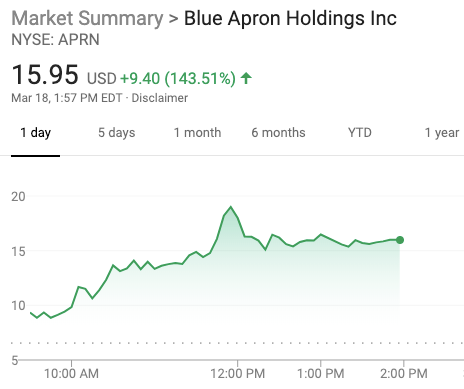
Back in 2017, a formerly hot, formerly profitable company called Blue Apron went public. It didn’t go well. Today as the global stock market continues to fall, shares in the former venture darling are soaring, up more than 140% in midday trading.

Before its IPO, the company had to reduce its price range from $15 to $17 per share to $10 to $11 per share. That pricing change limited the company’s worth, and reduced the capital it raised in its debut. The meal kit delivery company finally priced at $10 per share. It opened up a hair, but closed the day a mere penny above its IPO price.

Then things got worse. In fact, Blue Apron’s share price decline got so bad that in mid-2019 Blue Apron had to execute a 1-for-15 reverse split. In most stock splits, a company’s share price gets too high for comfort. So, the firm decides to give its investors the same value of the company, but in new, smaller chunks. So a concern trading for $1,000 per share that wanted to split would normally give, say, its investors 10 new shares worth $100 apiece in exchange for their single $1,000 share.

A reverse split is the other way. You get fewer shares at a higher per-share value. It’s what you do if you need to avoid slipping under $1 per share, or other, similar fates.

Time passed, and everyone forgot about Blue Apron in the same manner as they did Grubhub, companies that came, made an impact, went public and then slowly dissolved.

The latest

Until now. Suddenly Blue Apron is the hottest stock in the world, skyrocketing as other companies shed value. Today in regular trading, American indices fell so far that they triggered protective circuit breakers. At the same time, Blue Apron was doing this (via Google Finance):

Bear in mind that we are looking at the company after its reverse split. So, no, the company is not worth 60% more than its IPO price of $10 per share. It’s worth far less. Indeed, Blue Apron is worth just $211 million today including its day’s gains, according to Google Finance.

Blue Apron was worth about $1.9 billion when it went public, for reference.

Anyway, why is the company skyrocketing? TechCrunch thinks it figured it out. Walk with us:

  1. Everyone is looking for something to buy that will go up as everything else goes down
  2. Blue Apron makes meal kits that folks can make at home
  3. Over the weekend, many U.S. cities began shutting down
  4. That meant less dine-in service
  5. So people are now, putatively, cooking more
  6. That means Blue Apron might benefit!
  7. Enter a hilarious momentum trade in a low-cap stock
  8. Kaboom goes its share price

Don’t pop the champagne. Blue Apron is still worth about what it raised as a private company; its market cap is only about 40% of the money it raised while private in addition to its IPO haul. This company is still priced like it’s on life support.

And that makes some sense. Here are some facts from its Q4 and full-year 2019 report:

  • 1.62 million Q4 orders, down from both Q3 2019 (1.73 million) and Q4 2018 (2.42 million)
  • $94.3 million in Q4 revenue, down 33% compared to the year-ago period
  • A net loss of $21.9 million

Not great! Perhaps Blue Apron will explode, beating guidance and earning its newly resurrected share price. Maybe. But before you pile into the company, pause, and then probably don’t.