Now might be the perfect time to rethink your fundraising approach

Russ Heddleston
Contributor

Russ is the co-founder and CEO of DocSend. He was previously a product manager at Facebook, where he arrived via the acquisition of his startup Pursuit.com, and has held roles at Dropbox, Greystripe, and Trulia. Follow him here: @rheddleston and @docsend

Many founders will have kicked off the new year with a new fundraising round. According to the data we shared last year, March, October and November were the months when VCs were reviewing the most decks.

But the COVID-19 pandemic has ground to a halt many industries, and there are even warnings that this will affect the next two quarters in regards to fundraising.

We’ve reviewed the data in our 2020 DocSend Startup Index and we’ve begun tracking the Pitch Deck Interest Metric. With San Francisco under a shelter-in-place order and many VCs scrambling to adjust their processes to an all-remote world, we saw pitch deck interest drop 11.6% when compared to the same week in 2019. While there has been a drop in interest so far, there is still a lot of activity, and VCs seem to still be reading pitch decks.

We will be monitoring the Pitch Deck Interest Metric in the coming weeks, but if you’re an early-stage startup and are in the middle of your fundraise, or are about to fundraise, there are some things you can do to help insure your startup is ready for funding before you meet with any (more) investors.
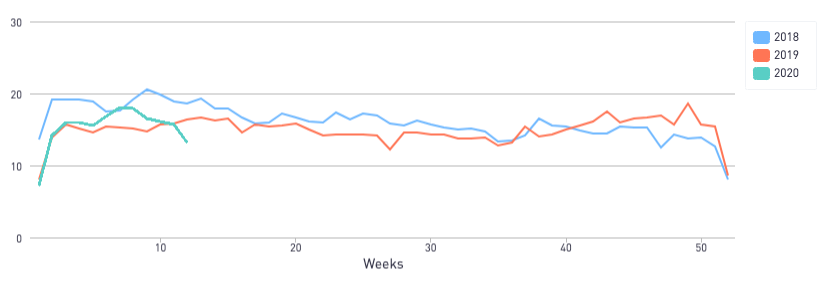
time spent reading pitch decks

The Pitch Deck Interest Metric declined 11.6% compared to the same week in 2019

Expectations have shifted and will continue to do so

If you were about to kick off a fundraising round, you should have been prepared to contact 50 or more investors, have 20-30 meetings and spend somewhere around 20 weeks before you signed your term sheet. That’s a lot of time and energy to invest, especially when the economy is poised for a downturn and you’re most likely needed in other parts of your business.

If you’ve already started your round and are wondering if you should push through, I’ve written a piece on knowing when to quit and recalibrate versus when to push through (Extra Crunch membership required).

Many factors play into navigating a successful fundraising round, and the expectations of investors are constantly changing — specifically when it comes to the pre-seed round.

Investors are now looking for market-ready products and want to see pitch decks that feature the content they’re expecting. We expect to see this focus intensify over the coming months as VCs have more time to spend not just to review pitch decks, but on due diligence for companies in which they plan to invest. Our new report outlines advice for pre-seed startups that are looking to adjust their fundraising strategy.

Focus on an MVP, not just a great PowerPoint

Our analysis reveals a shift in the level of readiness required by institutional investment to receive pre-seed funding. In the past, pre-seed startups could get by with just an MVPP (Minimum Viable PowerPoint). But now, investors are placing their bets on pre-seed startups that have already entered the market and developed an alpha, beta or shipping product.

In fact, 92% of companies with successful pitch decks had either an alpha, beta or shipping product, where only 68% of companies with unsuccessful pitch decks presented the same type of product readiness.
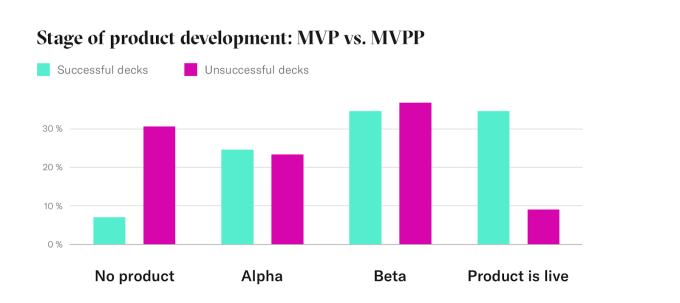
stage of product development mvp vs mvpp

As the economy moves closer to a downturn we can expect VCs to be more cautious with their investments. The current data already shows a preference for companies that have live products; it’s worth the time and effort to be product-ready coming into a pre-seed round or if you’re a startup ready to tackle the round again with a fresh perspective.

Rethink your deck

That said, even if you do have an MVP, rethinking your pitch deck may be something else to consider. Here’s a good test. Using your pitch deck, spend three to four minutes (that’s all the time you’ll get from a VC) to pitch your business to a friend or family member who knows nothing about your business. Afterward, ask them for a one-sentence description of your company. If they’re not clearly describing what your company does and the problem it’s trying to solve, you probably need to rethink your pitch deck.

According to our recent report, a “less is more” attitude toward creating a compelling pitch deck for meetings could mean more success in pre-seed fundraising.

Your pitch deck will be your main calling card right now. As community events are being replaced with online gatherings during the COVID-19 pandemic, we can expect to see less one-to-one engagement at these events. So pitching a VC in person is not likely to happen anytime soon. Whether you’re sending them a cold email, or getting a warm intro from a portfolio company, you’re going to need to lead with your pitch deck.

Despite the product taking a more prominent role in the fundraising round, the pitch deck is still a focal point and should be tailored to tell your story in the most effective way, as investors are spending less time evaluating them. On average, investors are spending just 3 minutes and 21 seconds on the pitch deck and the average deck is just 20 slides.

If you are in the process of reevaluating your pitch deck, it could be helpful to make sure your slides feature the right content in the right order. Investors spend nearly 50% more time on the product slides in successful pitch decks and over 18% longer on the business model in unsuccessful pitch decks. Additionally, investors spent more time on solution slides in successful decks than unsuccessful decks.
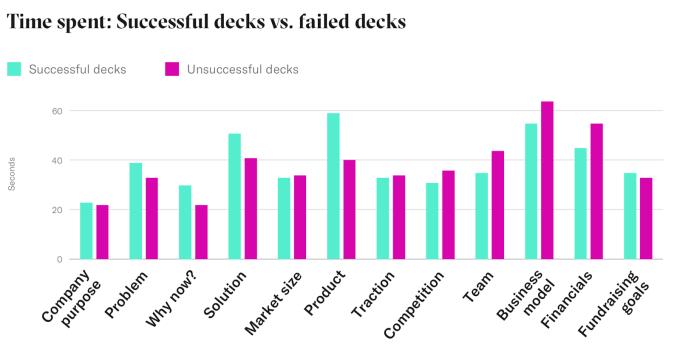
time spent on successful decks

It’s a numbers game… to a certain extent

Another area that could benefit from reevaluation is the number of investors contacted, meetings held and the number of weeks spent in a funding round. Generally speaking, the average amount of investors contacted for successful fundraising rounds is 56, resulting in 26 meetings. On average, successful pre-seed startups will spend 20.5 weeks on fundraising.

When it comes to fundraising, there are diminishing returns for investor outreach. You shouldn’t need to send your deck to more than 60-70 investors and have more than 20-30 meetings. If you’re doing more than that, the ROI on your time just isn’t worth it. Because the current crisis is affecting VCs’ willingness to invest, you’re better off finding a small list of investors who are active and targeting your pitch to them. If you’ve reached out to more than 70 investors, but you’re still faced with a wall of “nos” you’re better off pausing your fundraising and addressing the feedback you’ve received so far. For more on when you should quit and reevaluate versus push through you can read my article here (Extra Crunch membership required).
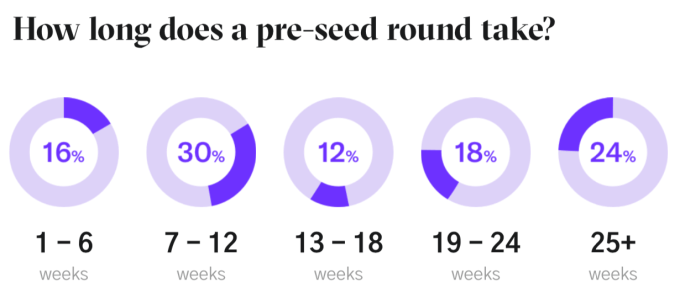
how long does a pre seed round take

Another area pre-seed startups should evaluate is the number of founders of a company. Our data shows investors still prefer teams of two-three founders, though our data shows that being a solo founder is preferable to having too many founders. For teams of five founders, they averaged earning $195,085 while founding teams of three garnered $511,522.

This may be the right time to find a co-founder. With many people working from home or out of work, this could be the opportunity to take your idea and bring on the technical founder you need. There are online groups and events popping up everywhere in response to social distancing. If you’re worried being a solo founder is going to hold you back, you may want to invest time in those new communities.
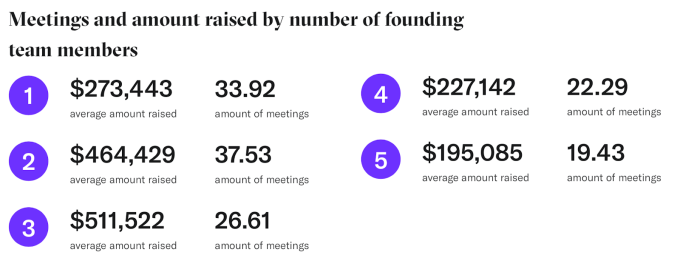
meetings and amount raised

Get some perspective

For many startups, especially if you are not in Silicon Valley where a substantial amount of funding happens, the process of fundraising can be very opaque. DocSend’s purpose in analyzing this data is to bring some transparency to the process. This in turn provides perspective.

But what founders should do, if they haven’t done so already, is to get some additional perspective. Talk to experts outside your immediate circle of influence. Don’t have a mentor or advisors? Find them. Get a different take on your product idea or the market conditions. Especially now that community events are going virtual, location doesn’t have to hold you back from joining the startup community and finding people to offer feedback on your product or company.

Fundraising is both an art and science. Combining the insights from our data with the benefit of your own community can help you get back on your feet and pitching your company with hopefully a better outcome.


SpaceX to deliver cargo to NASA’s lunar Gateway station using a new ‘Dragon XL’ spacecraft

NASA has tapped SpaceX as the first provider of space-based logistics to deliver experiment materials, cargo and supplies to its lunar Gateway, the agency announced on Friday. This means SpaceX will be among the companies that NASA can turn to when it needs things shuttled via spaceship between Earth and this forthcoming platform, which will orbit the Moon and provide a staging ground for future crewed Moon missions.

The contract means that SpaceX will play a key role in not only NASA’s forthcoming Artemis Moon missions, which will eventually seek to establish a permanent scientific human lunar presence, but that it also will be involved as NASA begins to work toward extending its reach to Mars, as well. NASA plans to launch multiple cargo supply missions to the Gateway, which has yet to be constructed, with spacecraft designed to go to the station and remain there for between six and 12 months at a time.

The total value of these contracts will top out at a maximum of $7 billion for the entire contract, with a guaranteed minimum of two missions per provider. Other providers will likely be selected, but SpaceX is the first company to be signed by NASA under the agreement. SpaceX is already contracted by NASA to deliver regular supply runs to the International Space Station in Earth orbit using its Dragon cargo spacecraft.

SpaceX is going to be launching a new variant of its Dragon spacecraft called the “Dragon XL” in order to support these missions, and they will be able to carry more than five metric tons to the Moon-orbiting station. They’ll use SpaceX’s existing Falcon Heavy craft to launch from Earth for the trip.

In terms of timing, we’ll likely have to wait a while for the first of these missions to actually take off: While the current plan is to launch the first module for the station as early as 2022, it’ll likely only be a few years after that that the station is in any shape to receive regular cargo runs.

Daily Crunch: Clearstep’s chatbot offers in-depth COVID-19 screening

We look at an in-depth screener app for COVID-19, U.S. stocks take another tumble and Apple extends its free trial for Final Cut Pro and Logic Pro. Here’s your Daily Crunch for March 27, 2020.

Stay safe and socially distanced this weekend!

1. Clearstep’s COVID-19 chat-based screener goes in-depth to preserve healthcare resources

There are a growing number of symptom checker and screening tools that you can use at home if you suspect you might have contracted the new coronavirus that is causing the global COVID-19 pandemic. Most of these are relatively simple, including three or four questions that cover the top reported symptoms experienced by anyone who has confirmed to have had the disease.

In contrast, chatbot-based symptom checking software startup Clearstep has created its own COVID-19 screener, which goes more in-depth to combine symptom checking with screening for potential exposure to the virus.

2. Stocks fall sharply Friday morning as the mid-week recovery falls short

The major American stock market indices are down sharply this morning at the open, with stocks falling after a multi-day rally helped shave some losses off their calendar-year results.

3. Apple extends free trials for its pro creative apps

Apple announced today that they are temporarily extending the free trials on Final Cut Pro X and Logic Pro X from 30 days to 90 days, giving potential customers stuck at home a longer window of time to try out the software. With this announcement, Apple joins a number of other software companies extending the free trials of their products in the midst of the COVID-19 crisis.

4. Yelp pauses GoFundMe Covid-19 fundraising after opt-out outcry

A fundraising program that Yelp and GoFundMe put in place this week to help local businesses impacted by the COVID-19 pandemic has been paused after public outcry over how it was rolled out — specifically, controversy over how the two provided no easy and quick way to opt out of the fundraising.

5. Smart telescope startups vie to fix astronomy’s satellite challenge

The stakes involved are high, with projects like Starlink (the satellite branch of SpaceX) potentially being central to the future of global internet coverage, especially as new infrastructure implements 5G and edge computing. At the same time, satellite clusters — whether from Starlink or national militaries — could threaten the foundations of astronomical research. (Extra Crunch membership required.)

6. Notarize to add 1,000 online notaries to address demand for remote transactions

The startup is partnering with the National Notary Association to verify notaries have been screened and have the necessary insurance or bonding. The service is available to Americans in all 50 states or abroad, but notaries must be physically located in Florida, Nevada, Texas or Virginia to join the platform.

7. Social Bluebook was hacked, exposing 217,000 influencers’ accounts

Social Bluebook, a Los Angeles-based company, allows advertisers to pay social media “influencers” for posts that promote their products and services. The company claims it has some 300,000 influencers on its books, but in October 2019, its entire backend database was stolen in a data breach.

The Daily Crunch is TechCrunch’s roundup of our biggest and most important stories. If you’d like to get this delivered to your inbox every day at around 9am Pacific, you can subscribe here.

Bird lays off about 30% of workforce amid COVID-19 pandemic

Bird is the latest startup hit by the COVID-19 pandemic. Today, Bird laid off about 30% of its employees amid the uncertainty caused by the coronavirus, TechCrunch has learned.

“The unprecedented COVID-19 crisis has forced our leadership team and the board of directors to make many extremely difficult and painful decisions relating to some of your teammates,” Bird CEO Travis VanderZanden wrote to staffers in a memo, obtained by TechCrunch, today. “As you know, we’ve had to pause many markets around the world and drastically cut spending. Due to the financial and operational impact of the ongoing COVID-19 crisis, we are saying goodbye to about 30% of our team.”

Bird has confirmed the layoffs and says it is providing four weeks of pay, three months of health coverage* and an extended time frame of 12 months to exercise their stock options. According to a source, Bird’s balance sheet is strong but it needed to reduce burn in order to extend its runway into 2021.

Bird’s layoffs come shortly after news broke that Lime is looking for a funding round that would cut its valuation from $2.4 billion to $400 million.

Last week Bird and Lime suspended their respective services in response to the pandemic.

Bird is not the only startup forced to have layoffs amid the crisis. As The Information reported earlier this week, layoffs are accelerating across Silicon Valley. Meanwhile, Lime is reportedly considering laying off up to 70 people in the San Francisco Bay Area.

Here’s the full memo VanderZanden sent this morning:

We’ve watched the COVID-19 pandemic radically and quickly transform our lives, the world, and our business in less than a month. This once in a decade black swan event presents one of the greatest challenges in history because of the viral impact it has not just on our health, but also on our lives—our families, friends, communities, finances, work, emotions—the list goes on.

The unprecedented COVID-19 crisis has forced our leadership team and the board of directors to make many extremely difficult and painful decisions relating to some of your teammates. As you know, we’ve had to pause many markets around the world and drastically cut spending. Due to the financial and operational impact of the ongoing COVID-19 crisis, we are saying goodbye to about 30% of our team.

In business, I feel like every challenge is surmountable with the right team. And I believe Bird has been building the right team these past few years. Until today, there wasn’t a problem we couldn’t solve together. That’s what makes this such a painful situation. To say goodbye to some of the most incredible, intelligent, scrappy, funny, loving, dedicated members of our Bird Family for reasons totally outside our control, hurts deeply.

I recognize and sympathize that this situation adds to an already difficult time. As you know, we strive to be community-focused at Bird—we always try to care deeply about the people we serve. The impacted individuals are an important part of this community and I hope that our commitment to caring and supporting them during this transition by providing severance pay, extended health insurance, and an extended window to exercise options makes a positive impact during this crisis.

We looked at many different options and scenarios and took as many preventive measures as possible to reduce the impact of the virus. Given the unknown timeline and current economic situation, we were forced to cut back in this way to elongate the trajectory of Bird and our mission.  As you know, we just raised hundreds of millions from investors, but given all the uncertainty, we needed to ensure a cash runway to last through the end of 2021.

Moving forward, together

As we all know: yes, the world has changed and continues to change. This will be a difficult season, but we continue to work around the clock to move us forward as a team. As mentioned last week, we’re aggressively shoring up resources and protecting our existing assets. We’ve curbed all spending company-wide that is not directly related to helping us weather this storm together. We appreciate all your help identifying unnecessary spend during this down time.

History also tells us something important: micromobility, especially scooters, will very likely have an important role to play as communities begin to get moving again in the wake of the COVID-19 pandemic.

This is not the first time that a public health crisis has had a direct impact on the micromobility industry. When the SARS outbreak was sweeping through China, e-bike sales surged as riders looked for more personalized alternatives to public transit.

History suggests that people will demand a large scale mobility option that still allows for personal distancing. And Bird will be there, working hand in hand with cities to help communities heal, and help riders regain mobility, in the wake of the most serious global pandemic in recent memory.

I just want to give a heartfelt thank you to everyone who has rallied to keep up with such a rapidly changing situation. We’ll try to keep everyone informed as it relates to changing priorities and business impact. We’ve had successes that allow businesses to persevere in times of uncertainty and, with your trust, patience and determination, we will overcome the challenges we face today as well.

Lean on each other. Over communicate. Support each other. Reach out to your teammates and managers to understand what you can do to keep us moving forward.

*An earlier version of this story said three weeks of health insurance instead of three months. We apologize for the error.

Google sets aside $800M in ads and loans to help in COVID-19 fight

Google CEO Sundar Pichai announced Friday that his company would be donating more than $800 million in ad credits and loans to help government orgs and small businesses respond to the COVID-19 crisis.

The announcement gives a full breakdown of the deployment, the bulk of which is in credits for Google services:

  • Google will be giving $250 million worth of ad grants to more than 100 government orgs across the globe, including the World Health Organization.
  • They will also be seeding $340 million in ad credits to small businesses with accounts that have been active in the past year. The credits are good through the end of the year.
  • They’ll be giving away $20 million worth of Google Cloud credits to academic institutions and researchers that are tackling COVID-19.
  • $200 million will go to an investment fund for nonprofits and financial institutions to provide small businesses with loans.
  • Google further reiterated they will continue to invest in helping suppliers scale up production of face masks and other personal protective equipment.

COVID-19 is a global crisis and big tech companies like Google have strong global networks that are important to leverage. The global economy is undoubtedly being stressed by the pandemic, with small businesses especially being affected, and Google signal-boosting the World Health Organization and other government orgs with information to disseminate is a good move that more companies should follow.

As with any donation from a big tech company, it’s healthy to look at what recipients are getting and what the institution itself is earning.

Google’s ad business has taken a major pandemic hit as businesses that have temporarily closed up shop or reduced operations have also stopped advertising their services. Giving away hundreds of millions of dollars’ worth of ads gets some of these businesses back to their advertising dashboards, lets Google boost the throughput of the competitive ad ecosystem and lands the company some solid goodwill in the process. Giving ads away to government orgs boosts goodwill that could be useful for future lobbying efforts, and bringing academics into the fold with Google Cloud credits could entice those institutions away from AWS or Azure.

NYU makes face shield design for healthcare workers that can be built in under a minute available to all

New York University is among the many academic, private and public institutions doing what it can to address the need for personal protective equipment (PPE) among healthcare workers across the world. The school worked quickly to develop an open-source face-shield design, and is now offering that design freely to any and all in order to help scale manufacturing to meet needs.

Face shields are a key piece of equipment for front-line healthcare workers operating in close contact with COVID-19 patients. They’re essentially plastic, transparent masks that extend fully to cover a wearer’s face. These are to be used in tandem with N95 and surgical masks, and can protect a healthcare professional from exposure to droplets containing the virus expelled by patients when they cough or sneeze.

The NYU project is one of many attempts to scale production of face masks, but many others rely on 3D printing. This has the advantage of allowing even very small commercial 3D-print operations and individuals to contribute, but 3D printing takes a lot of time — roughly 30 minutes to an hour per print. NYU’s design requires only basic materials, including two pieces of clear, flexible plastic and an elastic band, and it can be manufactured in less than a minute by essentially any production facility that includes equipment for producing flat products (whole punches, laser cutters, etc.).

This was designed in collaboration with clinicians, and over 100 of them have already been distributed to emergency rooms. NYU’s team plans to ramp production of up to 300,000 of these once they have materials in hand at the factories of production partners they’re working with, which include Daedalus Design and Production, PRG Scenic Technologies and Showman Fabricators.

Now, the team is putting the design out there for pubic use, including a downloadable tool kit so that other organizations can hopefully replicate what they’ve done and get more into circulation. They’re also welcoming inbound contact from manufacturers who can help scale additional production capacity.

Other initiatives are working on different aspects of the PPE shortage, including efforts to build ventilators and extend their use to as many patients as possible. It’s a great example of what’s possible when smart people and organizations collaborate and make their efforts available to the community, and there are bound to be plenty more examples like this as the COVID-19 crisis deepens.

Instacart shoppers are planning a nationwide strike to demand better safety protections and pay amid COVID-19

Instacart shoppers, led by the folks over at Gig Workers Collective, are planning a nationwide strike in protest of the company’s practices amid the COVID-19 pandemic, Vice first reported. Shoppers, who are responsible for grocery shopping and deliveries, say they have urged Instacart to take proper safety precautions, such as providing hand sanitizer and disinfectant products, but “have been ignored,” Gig Workers Collective wrote in a post today.

On March 30, shoppers will strike and not return to work until their demands are met. Shoppers are demanding Instacart provide personal protective equipment at no cost to workers and hazard pay of $5 extra per order, change the default tip to 10%, extend the sick pay policy to those who have a doctor’s note for a pre-existing condition that may make them more susceptible to contracting the virus and extend the deadline to qualify for those benefits beyond April 8th.

“The health and safety of our entire community — shoppers, customers, and employees — is our first priority,” an Instacart spokesperson said in a statement to TechCrunch. “Our goal is to offer a safe and flexible earnings opportunity to shoppers, while also proactively taking the appropriate precautionary measures to operate safely. We want to underscore that we absolutely respect the rights of shoppers to provide us feedback and voice their concerns. It’s a valuable way for us to continuously make improvements to the shopper experience and we’re committed to supporting this important community during this critical time.”

Shortly after their demands went public, Instacart outlined its plans to extend its financial assistance through May 8, 2020. The company says it is also extending contactless deliveries to alcohol so that shoppers will no longer need to collect signatures from customers unless it’s explicitly required by the state or retailer. While Instacart has addressed some of the demands, the company has not met all of them.

This all comes after Instacart announced it would bring on another 300,000 independent contractors to keep up with the demand that has resulted from many Americans staying at home during the pandemic.

“Instacart has a well established history of exploiting its Shoppers, one that extends years back before our current crisis,” the shoppers wrote. “Now, its mistreatment of Shoppers has stooped to an all-time low. They are profiting astronomically off of us literally risking our lives, all while refusing to provide us with effective protection, meaningful pay, and meaningful benefits.”

Amid the coronavirus outbreak, Instacart has offered sick pay for in-store shoppers and extended pay for independent contractors. The company has also implemented contactless deliveries, but shoppers say these efforts fall short. In fact, shoppers say Instacart has failed to honor its promise of paying shoppers up to 14 days of pay if diagnosed or placed in quarantine.

It’s now widely understood that gig workers are providing essential services during these times, as many cities have enacted shelter-in-place ordinances and as vulnerable people are remaining at home in order to reduce their risk of exposure to the virus. In San Francisco, legislators are pushing for more gig worker protections while the House of Representatives is currently reviewing the $2 trillion stimulus package that would provide gig workers with unemployment insurance.

House passes historic $2 trillion coronavirus economic rescue bill

A massive bipartisan effort to provide relief to a U.S. economy on ice just leapt over its last major hurdle. On Friday, the House of Representatives passed a historic stimulus package known as the Coronavirus Aid, Relief, and Economic Security or “CARES” act, which contains an unprecedented $2.2 trillion in total financial relief for businesses, public institutions and individuals hit hard by the COVID-19 pandemic.

The bill passed the House today after Rep. Thomas Massie (R-KY) took the unpopular step of blocking a voice vote that House members could conduct remotely. House lawmakers quickly returned to Washington to appear in person Friday, where they spread out in the galleries above the House floor for safety. The bill passed with a quorum of more than 216 members of the House present.

“The aid must be robust, rapid and resilient, just like its recipients,” House Minority Leader Kevin McCarthy (R-CA) said during proceedings Friday. “We are going to help Americans through this. We are going to do it together.”

“Whatever concerns we may have and whatever we want to do next, right now we’re going to pass this legislation,” House Speaker Nancy Pelosi (D-CA) said in her speech on the floor.

To get to a place of fast bipartisan consensus, the bill, shepherded by Treasury Secretary Steven Mnuchin, came together through addition rather than subtraction. The result is a sprawling 880-page piece of legislation stuffed with concessions for members of both parties — but one that can provide for Americans quickly. Here are some of the key relief measures targeted toward small businesses, big industry players and a gutted American workforce reeling from job losses.

Expanded unemployment benefits

After Democrats negotiated their own priorities into the bill, it now includes greatly boosted unemployment benefits that will reach workers usually left out in the cold. Under the new legislation, gig workers, contract workers and freelancers will be now eligible for unemployment benefits — a huge boon for anyone not employed full-time.

The bill also includes a substantial additional $600 per week on top of existing state benefits to help the jobless navigate the crisis. Nearly one in five Americans had lost work as of mid-March — a number that’s likely going up.

Those benefits will last four months, in spite of objections from Republican Senator Lindsey Graham who claimed the enhanced unemployment provisions could actually give some workers more money than they were making previously, a fact he said “incentivized people not to go back to work.” Democratic presidential candidate Bernie Sanders slammed those objections in a passionate speech on the Senate floor Wednesday night.

“Somebody who’s making 12 bucks an hour now like the rest of us faces an unprecedented economic crisis with 600 bucks on top of their regular unemployment check might be making a few bucks more for four months,” Sanders said. “Oh my word, will the universe survive? How absurd and wrong is that?”

Business loans

Small businesses can expect some relief. The bill sets aside $350 billion for small business loans up to $10 million, with priority given to women-owned businesses, new businesses and those run by anyone “socially and economically disadvantaged.” A separate $10 billion in emergency small business grants of up to $10,000 is also set aside — an unprecedented measure from the Small Business Administration.

A separate $500 billion pool of money is set aside for bailing out larger businesses hurt by the crisis with emergency loans — a provision of the bill key to its Republican support. In recent days, Democrats were able to work in some oversight measures for how that money gets allocated, provisioning for an inspector general to oversee the process.

The hard-hit airline industry will receive $58 billion from that pool of money, half in loans and half in grants for worker pay. The loans come with some strings attached — to accept them, airlines will have to agree not to lay off workers through the end of September. The package forbids stock buybacks and issuing dividends to shareholders for a year after paying off one of the loans.

The bill also sets aside $100 billion for hospitals and health providers as they struggle to meet the challenge of COVID-19 amid widespread shortages of personal protective equipment and depleted staffs.

In an effort to get companies to spend the money on workers rather than self-enrichment, the bill includes a ban on companies buying back their own stock while receiving help from the federal government and for one year afterward.

Cash payments

One of the most surprising parts of the package is the bipartisan decision to include direct cash payments to Americans, a generally strongly Democratic idea with its roots in universal basic income proposals. The stimulus will include direct cash payments of $1,200 for adults and $500 for children in a move likely to include up to 94% of all tax filers. Above an adjusted gross income of $75,000 for single filers and $150,000 for couples filing jointly the payment phases out by $5 for every $100 in extra income. Single filers without children making $99,000 and couples without children making $198,000 would receive no benefit.

In spite of some Democrats pushing for recurring payments, the benefit is a one-time payout, though some in Congress expect additional payments to be discussed in the near-future bills. House Speaker Nancy Pelosi said she didn’t think Congress has “seen the end of direct payments.”

The payment will go directly to anyone who received a tax refund through direct deposit in recent years. For everyone else, the government will be sending a check — a process that’s expected to take longer. Some critics of the final bill wanted the direct payments to circumvent the notoriously difficult-to-navigate U.S. tax system, but this is how they ended up.


We’ll be sorting through the finer print in the coming days and looking for ways the stimulus will affect workers, startups and tech giants. To comb through yourself, the full text of the bill is embedded below.

Fox Sports to broadcast the full season of NASCAR’s virtual race series

Esports racing, helped by record-setting viewership, is hitting the big time.

Fox Sports said Tuesday it will broadcast the rest of the eNASCAR Pro Invitational iRacing Series, following Sunday’s virtual race that was watched by 903,000 viewers, according to Nielsen Media Research.

While those numbers are far below the millions of viewers who watch NASCAR’s official races — the last one at Phoenix Raceway reached 4.6 million — it still hit a number of firsts that Fox Sports found notable enough to commit to broadcasting the virtual racing series for the remainder of the season, beginning March 29.

The races will be simulcast on the FOX broadcast network, Fox Sports iRacing and the FOX Sports app. Races will be available in Canada through FOX Sports Racing.

Virtual racing, which lets competitors race using a system that includes a computer, steering wheel and pedals, has been around for years. But it’s garnered more attention as the spread of COVID-19, the disease caused by coronavirus, has prompted sports organizers to cancel or postpone live events, including the NCAA March Madness basketball tournament, NBA, NHL and MLB seasons as well as Formula 1 and NASCAR racing series.

Classic. @JimmieJohnson checks in live with @JeffGordonWeb during the #ProInvitationalSeries and says he needs to "learn different cars" for his 2021 schedule. ?

(And Jeff helps him notice a bit of damage ?) pic.twitter.com/5gFgl1f0e3

— FOX: NASCAR (@NASCARONFOX) March 22, 2020

NASCAR ran its first virtual race in the series on Sunday in lieu of its planned race at the Homestead-Miami Speedway, which was canceled due to COVID-19. Not only was it the most watched esports event in U.S. television history, it was Sunday’s most-watched sports telecast on cable television that day.

50 seconds of #ProInvitationalSeries virtual engines. CRANK IT UP! pic.twitter.com/wyG1JhFkPQ

— FOX: NASCAR (@NASCARONFOX) March 22, 2020

“This rapid-fire collaboration between FOX Sports, NASCAR and iRacing obviously has resonated with race fans, gamers and television viewers across the country in a very positive way,” Brad Zager, FOX Sports executive producer said in a statement. “We have learned so much in a relatively short period of time, and we are excited to expand coverage of this brand-new NASCAR esports series to an even wider audience.”

Granted, there aren’t any live sports to watch in this COVID-19 era. Still, it bodes well for the future of esports, perhaps even after the COVID-19 pandemic ends.

“The response on social media to last Sunday’s race has been incredible,” said four-time NASCAR Cup Series champion Jeff Gordon, who is announcer for Fox NASCAR. “We were able to broadcast a virtual race that was exciting and entertaining. It brought a little bit of ‘normalcy’ back to the weekend, and I can’t wait to call the action Sunday at Texas.”

You can see what the virtual racing looks like here in this clip from Fox Sports.

NASCAR isn’t the only racing series to turn to esports. Formula 1 announced last week that it would host an esports series, the F1 Esports Virtual Grand Prix series, with a number of current F1 drivers alongside a number of other stars.

The virtual Formula 1 races will use Codemaster’s official Formula 1 2019 PC game and fans can follow along on YouTube, Twitch and Facebook, as well as on F1.com. The races will be about half as long as regular races, with 28 laps. The first race took place March 22. The first-ever virtual round of the Nürburgring Endurance Series kicked off on March 21.

Rocket Lab postpones next mission due to coronavirus pandemic

Rocket Lab is the latest new space company to feel the impact of the global coronavirus pandemic: The small satellite launcher announced on Tuesday that it would be suspending its next launch, a mission called ‘Don’t Stop Me Now’ that was set to take-off from Rocket Lab’s Launch Complex 1 on New Zealand’s Mahia peninsula on March 30.

The launch is a rideshare mission that includes satellites from a range of customers, including NASA, as well as the US. National Reconnaissance Office (NRO), and a communications and tech demonstration satellite built by the University of New South Wales, Canberra Space and the Australian government. Rocket Lab says that it has “the full support of [its] customers in pausing operations,” and that it will be working with the New Zealand government and health officials, as well as its customers, in figuring out a new timeframe for the mission, with the launch vehicle and systems on the ground set to “remain in a state of readiness for launch” for the time being.

Rocket Lab said in its statement about the delay that it made this decision in light of the New Zealand government’s March 23 announcement that it would be escalating its COVID-19 response to Level 4 as of Wednesday March 25, which means everyone is expected to effectively stay at home, while all non-essential businesses are closed and events are cancelled.

The company, which was founded in New Zealand but now maintains a headquarters in Los Angeles, also said that it “commend[s]” the decision to take this level of action in an effort to stop the spread, and that its team is now working from home for the most part, with a few personnel deemed to be essential remaining on site to ensure site and mission safety.

Rocket Lab also notes that despite pausing its production of new launch vehicles, it has taken an approach of readying rockets and launch pads ahead of time in order to meet rapid-response requirements from its customers, so it has a stock of vehicles ready even with a production stoppage.

So far, the COVID-19 crisis has impacted some launches but not others – SpaceX flew a Starlink mission last week, for instance, but will postpone a planned launch at end of March, while ULA appears to be on track to launch a sixth high-frequency defense communications satellite on behalf of the U.S. Space Force on Thursday.

Second Life-maker calls it quits on their VR follow-up

The game developer behind Second Life has abandoned its grand efforts for a virtual reality follow-up to its early 2000s hit.

SF-based Linden Lab announced today that they’ve sold off assets related to Sansar to a small, little-known company called Wookey Search Technologies, which will take over development of the title. Linden Lab will continue developing and maintaining Second Life and it sounds like some of its employees will be joining Wookey. The deal was reported by Protocol.

The game studio had already announced layoffs last month.

Second Life has remained in the limelight of popular culture, and the studio claimed to still be hauling in substantial revenues from the game in recent years. That said, the failure of Sansar is a disaster for Linden Lab, which has focused considerable resources on the effort since it first teased the platform back in 2014.

When the title was announced, VR was at the peak of its hype following Facebook’s Oculus VR acquisition. Though Sansar launched in beta with support for both VR and desktop usage, the slow adoption of VR certainly didn’t help the title’s popularity. The studio’s leadership has detailed in interviews that the majority of Sansar’s users are desktop-based.

Given the evident turmoil at the studio, Sansar’s user base will likely be relieved to hear that the studio did their best to give the title a soft landing, though it’s unclear what resources its new acquirer has access to.

Wefunder launches campaign to help coronavirus-impacted small businesses crowdfund loans

With the COVID-19 crisis, startups across Silicon Valley are looking for opportunities where they can both increase the visibility of their services and be helpful to people and businesses deeply affected by the pandemic.

Wefunder, an investment crowdfunding platform, announced an initiative Tuesday to help small businesses impacted by the coronavirus secure loans through its platform on friendlier terms.

The goal of the Coronavirus Crisis Loan program is to “provide critical cash flow during this economic crisis at a reduced interest rate,” a release from the company detailed. Loans can be structured in amounts ranging from $20,000 to $1 million with payments deferred until 2021 (and flexible, depending on revenue). The startup has a pretty simple calculator on its site to help businesses estimate what their payment structure would look like.

For Wefunder’s part, it’s not charity — they’re still taking a slice of the total volume raised, though they are halving their usual percentage from 7.5% to 3.75%. Wefunder also charges individuals a 2% cut from their contribution.

Wefunder was founded in 2011 and has raised just over $9 million in funding from investors, including Visary Capital and Y Combinator. In recent years, legislation passed that has made it possible for companies to raise smaller amounts of money — about $1 million or less in total — from non-accredited investors. The company says that businesses have raised $130 million to date through the platform.

Back in 2016 when the legislation was first introduced, equity crowdfunding was a pretty hot topic of discussion, but for the most part, equity crowdfunding hasn’t become commonplace. Part of this is the result of prevalent seed capital, something that has likely increased the riskiness of the startups that seek funding through platforms like these. This is obviously less of an issue when a good deal of the motivation to invest in a small business is because of the social good component, as might be the case with investors backing businesses taking advantage of this new program.

Alongside its loan program, Wefunder has also announced a three-month startup accelerator program focused on startups that can help tackle problems that will result from the crisis. They’ve notably cast a pretty wide net for the startups they are looking for, everything from remote collaboration to telemedicine to homeschooling, but they will invest $50,000 in each company and then help them raise more money through their platform on demo day.

Looking back at Zoom’s ascent a year after it filed to go public

Zoom, a video chat service then popular with corporations, filed to go public on March 22, 2019.

Best known in venture and corporate circles, Zoom was far from a household name at the time. However, the groundwork for its 2020-era consumer breakthrough during the novel coronavirus epidemic was detailed during its IPO march in the years leading up to its public debut.

The company didn’t begin trading until mid-April last year, but it was through its March 2019 IPO filing that its name took on new prominence; here was a quickly growing software as a service (SaaS) business that was posting profits at the same time. As the rate at which unprofitable companies went public set records, Zoom’s growth and positive net income helped it gain brand recognition even before its shares began to trade.

Investors certainly recognized this was a rarity among SaaS companies, sending its IPO share price up 72% in its first day. The company’s equity has risen more than 100% since that first close, more than doubling in less than a year. Not bad in a market that has turned ice-cold in recent weeks.

To understand how Zoom became so valuable as a business — and later as a consumer product — let’s go back in time to consider its product and business strategies. As we’ll see, to become the video chat tool that everyone is using today, Zoom had to beat a host of entrenched competition. And it did so while making money, helping set the financial stage for its prominence today.

Product history