Instacart’s hiring spree continues as it faces unprecedented demand

Instacart is adding more support roles to help its shoppers, customers and retail partners as the company faces unprecedented demand for its grocery delivery services due to COVID-19 shelter in place orders.

Today Instacart announced that it has doubled its Care team, from 1,200 agents to 3,000 agents. Care team employees will work on answering questions about how Instacart works, delivery issues, address mishaps and other general woes.

The hiring news comes after Instacart shoppers organized a strike last month, demanding personal protective equipment, hazard pay, default tips and extended sick pay.

Instacart has been on a hiring spree as customer demand increased more than 300% year over year last week alone. Last month, the Instacart shopper community grew to 350,000 active shoppers, up from 200,000 two weeks ago.

Today, along with doubling its Care team, Instacart says it has also hired and signed an additional 15,000 representatives that will join the team by May. With that, Instacart says it will have a Care team of about 18,000 members.

Some of Instacart’s new hires have are experienced support agents recently laid off in the flurry of cuts across the hospitality and travel industry.

With more demand, and thus more stresses on shoppers than ever before, the new members seem like yet another move by Instacart to try to pacify its growing shopper network. Last month, Instacart outlined an extended pay policy and contactless pay option. The company also introduced new product features aimed at making delivery windows for shoppers more flexible and fast.

Earlier this week, tip-baiting emerged as a grotesque tactic used by customers. Customers have been baiting Instacart shoppers to pick up their groceries by putting large tips on the bill through the app. Then, once the shopper drops off the groceries, customers are changing that tip to a lesser amount or even to $0.

The ability to change the tip price up to three days after grocery drop-off is an option provided through the Instacart application.

According to Instacart, tip-baiting is rare. Customers either adjusted their tip upward or did not adjust tip at all on 99.5% of orders. The company also removed the “none” option in the customer tip section with hopes that customers will tip at minimum.

While these feature updates will likely have a positive impact, Instacart has still not banned customers from changing the tip after getting their groceries. The new roles will not be able to help shoppers with tip-baiting changes either, as the tip is entirely up to the customer.

The company has also not changed the default tip minimum, as worker protests asked for tip defaults to be put at 10% during this time.

The surge of hires for Instacart’s Care team was not related to the tip-baiting issue, says the company, but instead related to the surge of demand for the service.

The intersection of small business, tech and our financial system is more important than ever

Ann Marie Mehlum
Contributor

Ann Marie Mehlum serves on several boards, including Summit Bank, and is a senior advisor at FS Vector, Fenway Summer’s advisory affiliate. Previously, she was associate administrator of Capital Access at SBA.

Javier Saade
Contributor

Javier Saade serves on several boards, is venture partner at Fenway Summer and is a senior advisor at FS Vector, Fenway Summer’s advisory affiliate. Previously, he was associate administrator and chief of investment and innovation at SBA.

The two of us oversaw the U.S. Small Business Administration’s capital, investment, loan and innovation programs serving America’s small businesses. The nation is rooting for our 30 million small businesses. They employ more than half of the country and create most net new jobs, and 80% of them have less than 60 days cash on hand.

The world has never experienced dislocation of labor and business activity at this scale and speed. We applaud Congress and the White House for stepping up with a $2 trillion relief package, of which, $350 billion is being injected into America’s small businesses. Another $250 billion is being contemplated and negotiated as we write this.

Washington has been talking regularly with the financial sector, and for small business relief to be effective, banks of all sizes, fintechs, other tech companies, community banks and other capital conduits need to be involved in the solution. There is an urgent need to deploy the funds, and technology will be critical to that end.

Two encouraging developments  occurred on Wednesday: 1) SBA launched a new AWS-powered gateway for a streamlined lender entry point and 2) an application for non-bank, non-insured (read: fintech) lenders was made available. Good steps for sure, but retrofits always come with limitations at their root.

Looking back to move forward, the crisis of 2008 was in many ways a “dress rehearsal” of what we are experiencing now. While there are some similarities, the pandemic’s massive toll on virtually every sector of the economy is happening simultaneously, as evidenced by the fact that 17 million people have filed for jobless claims.

The financial crisis was driven by excess risk in the financial system whose shock rippled through our economy with some level of predictability. The number of exogenous factors of the pandemic’s effect on our economy are more interconnected, more widely spread and faster to hit than those in 2008.

This 21st century problem requires 21st century solutions, and that requires fresh thinking, from policy-to-execution. The large part of our economy that lives at the intersection of small business and the financial system is expecting this thinking and execution.

It must be pointed out that some constraints and limitations of implementing the CARES Act are not regulatory in nature — they are born out of legacy technologies that slow banks down. The antiquated systems of our government agencies, such as SBA’s much talked about and clunky E-Tran system, do not help either.

Government agencies, let alone their systems, were not built to deal with anything of this magnitude and urgency. But the inherent scalability, penetration, infrastructure, algorithmic capability and plumbing of financial technology should be brought to bear, and now! More on this below.

The financial system has significant tech adoption lags, organizational inertia and regulatory constraints — all contributing to the chaotic nature of the programs’ implementation. The design of a potential fourth phase of relief should take this into account. While pumping more money into small businesses is a good decision, the process and its underpinning needs to be improved.

We want regulators and agencies to help minimize the impact to American small businesses and implement the CARES Act in the spirit of what Congress intended. We don’t believe much cash has reached taxpaying citizens or small businesses as of this writing. According to the latest figures, SBA has guaranteed 25% of the relief. While this is an encouraging marker, it is still a small fraction of the $350 billion.

Probably more important for people to understand is that when banks secure loan guarantees, that does not immediately translate to funded loans injecting cash into small businesses.

For cash to move, a few things would help smooth the glide path from CARES Act to small businesses: 1) finalizing definitive guidance on bank notes; 2) enhancing secondary market liquidity; 3) developing a 21st century digital interface for more streamlined touch points for all stakeholders; and 4) opening the pathway to new players, including fintech companies as service providers, rails or lenders themselves.

This is important because SBA has been tasked to increase its capacity by a factor of at least 50. All of its credit programs combined put out $25 billion a year. The task at hand: $350 billion in 8-12 weeks. We know SBA has been working 24×7 — along with Treasury, FRB and other agencies — on systems, technology and execution, but there are real friction points working against solving the problem at hand.

The Federal Reserve’s liquidity backstop for SBA loans is welcome news, but it will take time to develop. Equally welcome news is FDIC’s easing on community bank leverage ratios. Regulators are considering relaxing additional prudent and temporary requirements and limits. This all assists the endeavor, yet there are still unanswered questions keeping lenders of all stripes on the sidelines.

The use of digital constructs and 21st century technology is highly needed due to the amount of dollars, number of loans and the short window we have to deploy them. We urge the SBA, other agencies and regulators to deploy energy and resources to leverage digital finance and financial technology.

Financial technology can help streamline applications, comply with know-your-customer and anti-money laundering rules and application automation. Technology also improves origination, underwriting, loan disbursement and loan servicing, and should be leveraged. Millions of small businesses, the most vulnerable ones in fact, don’t use bank credit. Yet many use Square to accept payments, for example. Fintech now has an open door to participate — good! We encourage regulators to fully leverage the collective capabilities of technology.

Not everyone has a printer, let alone the ability to walk into a bank — but most small businesses and their owners have mobile phones and a digital footprint. A number of fintech companies provide technology to banks themselves, and in those cases, banks should use this time with alacrity to leverage those capabilities. To be clear, fintech is no longer an innovation experiment, given the $200 billion that has been invested in financial technology since the financial crisis.

There is immeasurable pressure to get capital out on the one hand, but on the other, tight regulations create an equally forceful pull. COVID-19 has put a spotlight on the need to usher in a financial system that works for all, and technology is central to that. If there is a time to try new constructs, that time is now!

The problem with losing a job is that it is very hard to re-create. Preserving them, which is the guiding principle of all the recent government action — is energy better spent. Let’s focus on preserving jobs and providing relief to our economy’s beating heart — small businesses.

Listen to our midweek chat with USV’s Albert Wenger

Earlier this week TechCrunch caught up with Union Square Ventures‘ (USV) Albert Wenger. Wenger, a managing partner at the venture firm, is well-known in the New York startup scene. USV has invested in former startups like Twitter, Twilio, Etsy and Cloudflare.

TechCrunch is touching base with a number of investors during the COVID-19-driven economic slowdown. Everyone is already at home, in front of a computer, so why not get them on the phone? (Follow @TechCrunch for updates, we’re keeping the series alive over the next few weeks with more neat guests.)

We wanted to know what Wenger thought about the level of fear in his local market, and how much cash startups should hold during the COVID-19 era. On the latter point, Wenger noted that each company’s present situation is suitably diverse as to avoid any single rule, but implied that companies with healthy backers don’t have to hold as much cash, as they have access to more; the weaker a startup’s investing syndicate is, the more cash it should hold, as that might be all the money it has access to.

We also took time to talk about PPP loans, and what types of startups should apply for them, a subject that Wenger has written about. There’s a moral point in the discussion that’s worth understanding.

We also took a number of questions from folks tuned in on Zoom during the call and generally had a good time. We’ve preserved the audio, so take a listen. If you wanted to see the video of TechCrunch’s Jordan Crook and Alex Wilhelm talking to Wenger, every one of the three in a different state, you missed out. Come to our next public Zoom!

The recording

Pangea.app raises $400K pre-seed round to help connect student workers with businesses

Pangea.app, a Providence, Rhode Island-based startup has raised a $400,000 pre-seed round, it told TechCrunch this week. The company’s new capital, raised as a post-money SAFE, comes from PJC, a Boston-based venture capital firm and Underdog Labs. Previously, Pangea.app raised money from angel investors.

The company links “remote college freelancers,” per its website, to businesses around the country. College students want paid work and resume-building experience, while businesses need help with piece-work that students can help with, like graphic design. Today, with colleges and universities closing due to COVID-19, students stuck at home, and many businesses leery about adding new, full-time staff, Pangea.app could find itself in a market sweet spot.

Some students that had work lined up for the summer are now unexpectedly free, possibly adding to the startup’s labor rolls. “I can’t tell you how many students I’ve spoken with who have had summer internships and on-campus jobs canceled,” Adam Alpert, Pangea.app’s CEO and co-founder told TechCrunch, “we are filling an important gap helping them find short-term, remote opportunities that enable them to contribute while learning.”

Pangea.app CEO Adam Alpert and CTO John Tambunting

If its marketing position resonates as its CEO hopes, the firm could see quick growth. According to Alpert the company has seen five figures of contracts flow through its platform to date, and expects to reach a gross merchandise volume run rate that’s a multiple of its current size by the end of summer.

Some 250 schools have students on the platform; 60 schools have joined in the last three weeks.

Pangea.app makes money in two ways, taking a 15% cut of transaction volume and charging some companies a SaaS fee for access to its best-vetted student workers. The company had targeted a $500,000 raise, a sum that Alpert says he’s confident that his company can meet.

While the national economy stutters and the venture capital world slows, Pangea.app may have picked up capital at a propitious time; raising capital is only going to get harder as the year continues and it now has enough to operate for a year without generating revenue; it will generate top line, however, extending its cash cushion.

Pangea.app aspires to more than just growth. Alpert told TechCrunch that it has a number of development-focused hires on the docket for 2020, including a UI/UX designer and engineering talent. The company also intends to use its own platform to staff up over the summer to help speed up its own development.

Being based in Providence, not precisely the center of the world’s startup gravity, may have some advantages for Pangea.app. The company said that it is working to reach break-even profitability before it works on the next part of its business. It’s easier to do that in Providence where the cost of living and doing business is far lower than it is in larger startup hubs.

Update: The round was a pre-seed investment, not a seed deal as originally reported. The post has been corrected. 

Pedaling-in-place with the Cubii Pro

So it has come to this. I haven’t set foot outside my apartment for a week and a half. YouTube yoga has been a kind of lifesaver, and I happened to have a largely untouched 30-pound kettlebell lying around. My Apple Watch has been mostly untouched, however. The stark realities of woefully underperforming exercise minutes and step counts are just too much on top of everything else.

Honestly, I scoffed a bit when a friend initially recommended an under-desk elliptical. But those were better days, when I was still able to take the bicycle out for a socially distant spin. Due to doctor’s orders, however, I now find myself unable to travel beyond the mailbox in my building lobby — and even that feels like tempting fate some days.

Now here I am, peddling away, writing a review of the Cubii Pro. It’s not a new product, exactly. But it’s certainly having its moment. In normal times, the device seems a silly bit of office “fitness” paraphernalia, designed to counteract the dangers of prolonged sitting we’ve frequently been warned against.

But if sitting was the new smoking in 2019, it’s simply the new reality in this era of self-quarantine. We’ll take our exercise wherever we can sneak it in — even if that means little more than walking between the desk and the kitchen most days. The Cubii line of products are by no means a replacement for more full-bodied exercise, but they’re a valiant attempt to help falling victim to complete atrophy.

As the name implies, the Pro is a step up from the standard Cubii that was launched via a Kickstarter campaign back in 2016. At $349, it’s an investment, with the biggest upgrades coming in the form of Bluetooth connectivity. There’s an app for iOS and Android that connects to third-party tracking software like Apple Health. That’s a pretty solid add-on, frankly, for those who’ve put a lot of stock in closing their Apple Watch rings.

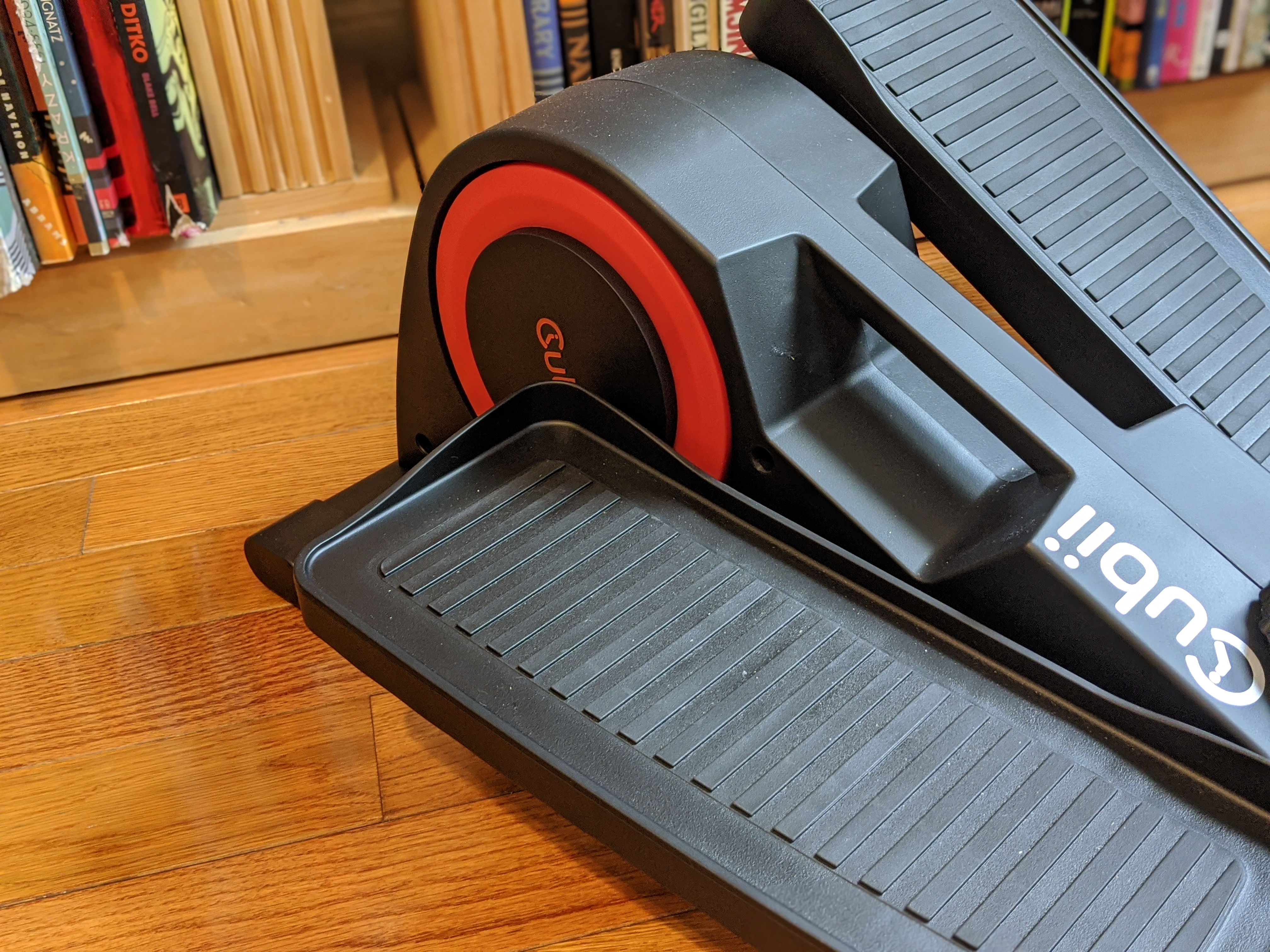
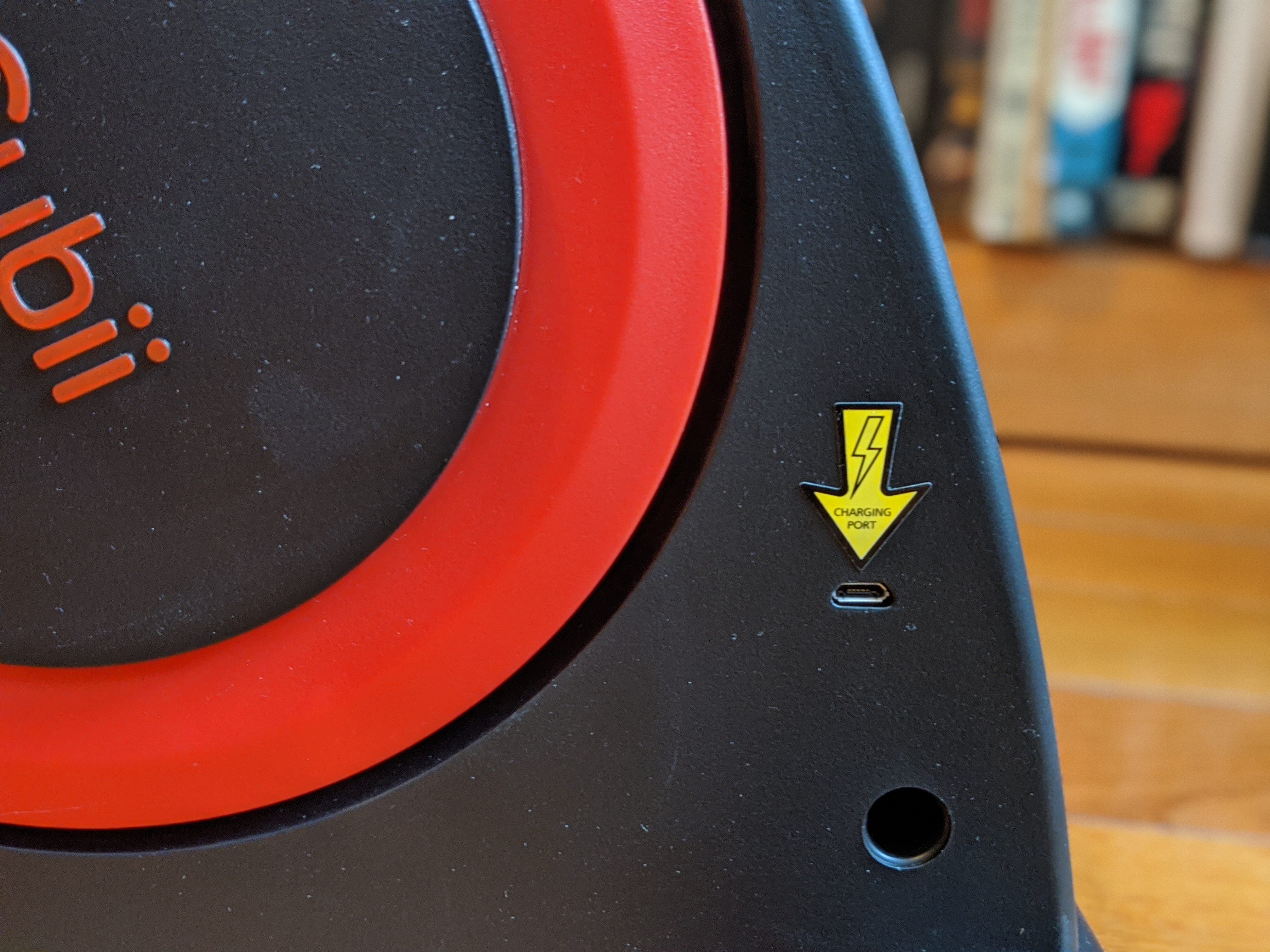
The device ships mostly assembled. You’ll need to take it the last mile by attaching the pedals. And hey, free screwdriver. That’s simple enough. Honestly, the biggest headache about set up is charging the thing. The Pro is significantly larger and heavier than I’d initially anticipated, and it charges via microUSB. That means unless you’ve got a long cable, you’re going to have to find a spot to stick it near an outlet for an extended period. I don’t have floor outlets in my small apartment, so I had to get creative.

Charging takes a while, too. It’s best done overnight, if you can manage. The good news on that front, however, is it will stay charged for a while. I don’t anticipate having to charge it more often than every few weeks.

The size is also a constraint from the standpoint of use. The device’s length meant I had to pull my desk out from the wall a bit to use it. I also find myself having to sit back a bit, so as to avoid banging my knees on the bottom of the desk. Honestly, it’s probably best used while seated on a couch, watching TV (a laptop is too much to ask without a desk). If your office chair rolls as mine does, you’ll once again find yourself getting creative. The aforementioned kettlebell is getting even more use these days, as it currently sits between chair legs, hampering me from rolling backward with every peddle.

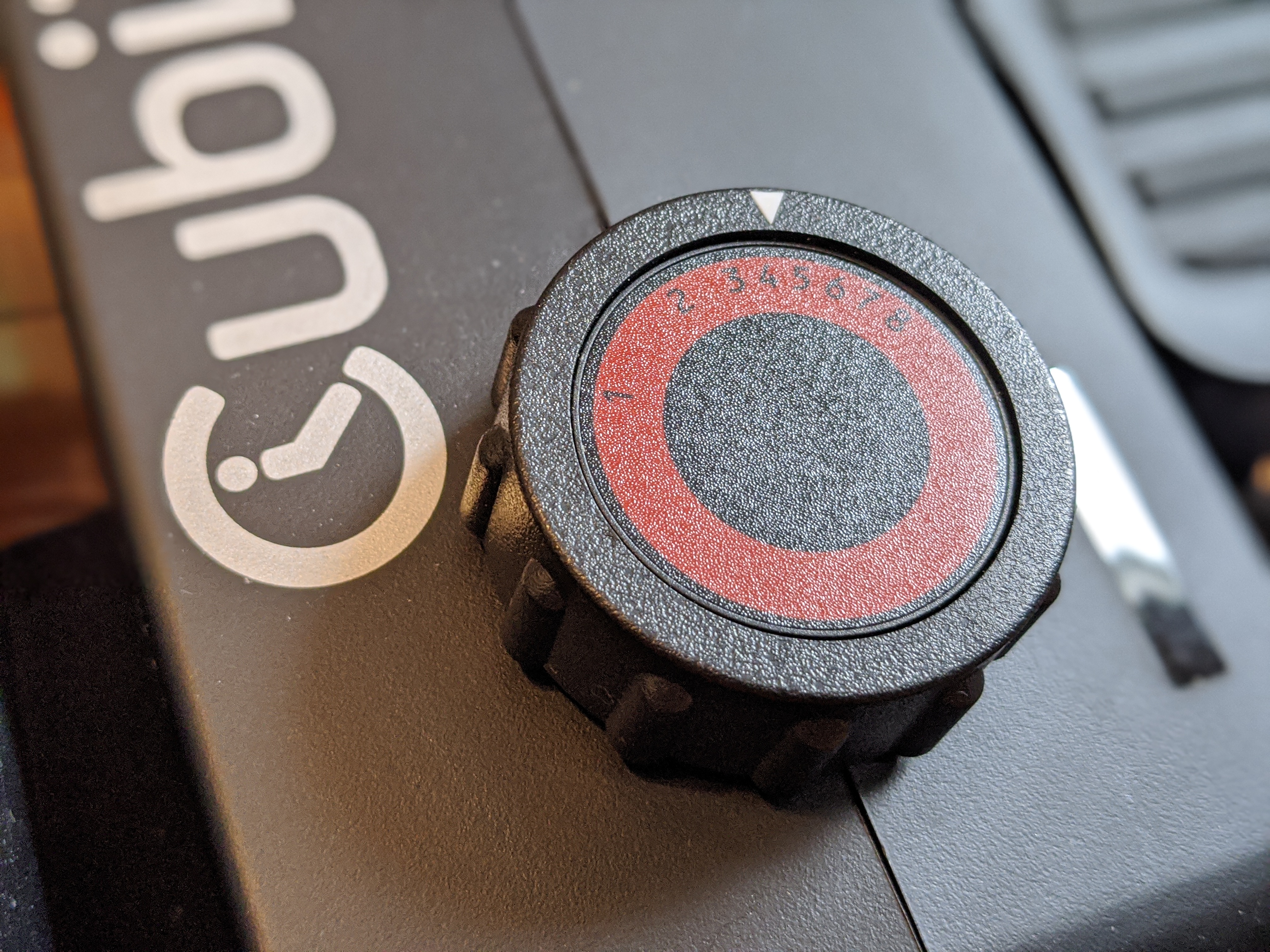
Those quibbles aside, I’ve mostly been enjoying my time with the product. The movement is smooth, the Bluetooth connection works well (though you may have to open the app to get it started) and there are eight resistance settings to keep things fresh. In other circumstances, I couldn’t imagine spending that much on this sort of product, but these are unique times. For those who still have trouble leaving the home even after things go mostly back to normal, it’s a nice, portable alternative to far pricier home exercise devices, with a solid little app to boot.

Incoming IBM CEO Arvind Krishna faces monumental challenges on multiple fronts

Arvind Krishna is not the only CEO to step into a new job this week, but he is the only one charged with helping turn around one of the world’s most iconic companies. Adding to the degree of difficulty, he took the role in the midst of a global pandemic and economic crisis. No pressure or anything.

IBM has struggled in recent years to find its identity as technology has evolved rapidly. While Krishna’s predecessor Ginni Rometty left a complex legacy as she worked to bring IBM into the modern age, she presided over a dreadful string of 22 straight quarters of declining revenue, a record Krishna surely hopes to avoid.

Strong headwinds

To her credit, under Rometty the company tried hard to pivot to more modern customer requirements, like cloud, artificial intelligence, blockchain and security. While the results weren’t always there, Krishna acknowledged in an email employees received on his first day that she left something to build on.

“IBM has already built enduring platforms in mainframe, services and middleware. All three continue to serve our clients. I believe now is the time to build a fourth platform in hybrid cloud. An essential, ubiquitous hybrid cloud platform our clients will rely on to do their most critical work in this century. A platform that can last even longer than the others,” he wrote.

But Ray Wang, founder and principal analyst at Constellation Research, says the market headwinds the company faces are real, and it’s going to take some strong leadership to get customers to choose IBM over its primary cloud infrastructure competitors.

“His top challenge is to restore the trust of clients that IBM has the latest technology and solutions and is reinvesting enough in innovation that clients want to see. He has to show that IBM has the same level of innovation and engineering talent as the hyper scalers Google, Microsoft and Amazon,” Wang explained.

Cultural transformation

Altman and others want to crowdfund 1 billion masks in the next 180 days

Sam Altman, former president of Y Combinator and CEO of OpenAI, tweeted out his goal to secure 1 billion masks in 180 days. People just need to crowdfund those masks, first.

Altman, along with his brother Max Altman, an employee at Rippling; Radu Spineanu, the co-founder of Two Tap; Tinnei Pang, a designer at Mercari US; and others, are all working with suppliers in China to get 1 billion single-use masks to help the broader U.S. population, from service workers to those in hospitals but not directly working with COVID-19 patients.

1 billion masks: https://t.co/Ux7Mane93M

Masks help stop the spread of COVID-19, but they're hard for local governments and essential workers to get.

This is a way to combine forces to get high-quality masks at a good price via crowdfunding.

— Sam Altman (@sama) April 10, 2020

The tech leaders will not be financing these masks themselves, but instead have asked institutions to fund the orders. Originally, 1billionmasks.com site used the phrase “crowdfunding” to ask for cash, but it has since changed that wording so the general public does not think they need to order masks.

“We are only taking orders for 10,000,000 or larger. So 10M is the minimum order,” according to Max Altman. “The idea is for institutions, States, cities, organizations, universities, etcetera to pool large orders to get the price per mask down and to increase the number of masks available.”

“This is a somewhat unusual market—the most effective way to guarantee supply is to pay up front so that factories can buy the equipment and supplies they need, and buying in bulk leads to significant cost savings,” the site reads.

According to the initiative’s website, none of the organizers will make money from the mask production.

Users can visit the 1billionmasks.com website and submit a form of “indication of interest.” If there’s enough demand, according to the team, an order form will appear on the site, and approved buyers will sign a contract and submit a payment to then “crowdfund” the masks.

If the demand hits a certain point, the team will be able to sell masks at 32 cents per mask, not inclusive of taxes and duties. If there is less demand, that price will be higher.

The masks are not meant to replace the dramatic shortage of N95 masks we’re seeing across the country, but rather to stop those not on the front lines from buying scarce N95 masks.

N95 masks are necessary because they filter out small particles, which is key for healthcare workers on the front lines caring for COVID-19 patients. This doesn’t mean that others don’t need to wear masks — and in fact, the WHO and CDC both recommend the use of masks broadly. Because of the recommendation, many DIY mask tutorials have been created, urging folks to use materials ranging from scarves to socks.

There has been a flurry of efforts from the private tech sector to help with medical shortages across the country. Apple, for example, sourced over 20 million protective masks and is now building “face shields.” Smaller companies are stepping up too: a heating filter company, a robotics startup and an architecture startup have all independently shifted operations to start making masks and ventilators.

The option that Altman and his team are providing has been rated for bacterial infiltration for people not on the front lines. The mask option is closer to a surgical mask than an N95 mask. Surgical masks do not provide as much respiratory protection as an N95 respirator, but do protect against droplets and large respiratory particles. According to the CDC, “most surgical masks do not effectively filter small particles from the air and do not prevent leakage around the edge of the mask when the user inhales.”

According to the website, the masks could be distributed by state and local governments, institutions, organizations and companies to essential workers, like grocery shoppers or delivery people.

Deliveries would start to arrive in Long Beach three to four weeks from the first order and then continue weekly for six months. Long Beach is the drop-off point because it is the location that the team can get supplies to the quickest, according to Max Altman.

Update: The team got back to TechCrunch with more details after publication. This story has been updated with more information.

Apple and Google are launching a joint COVID-19 tracing tool for iOS and Android

Apple and Google’s engineering teams have banded together to create a decentralized contact tracing tool that will help individuals determine whether they have been exposed to someone with COVID-19.

Contact tracing is a useful tool that helps public health authorities track the spread of the disease and inform the potentially exposed so that they can get tested. It does this by identifying and “following up with” people who have come into contact with a COVID-19-affected person.

The first phase of the project is an API that public health agencies can integrate into their own apps. The next phase is a system-level contact tracing system that will work across iOS and Android devices on an opt-in basis.

The system uses on-board radios on your device to transmit an anonymous ID over short ranges — using Bluetooth beaconing. Servers relay your last 14 days of rotating IDs to other devices, which search for a match. A match is determined based on a threshold of time spent and distance maintained between two devices.

If a match is found with another user that has told the system that they have tested positive, you are notified and can take steps to be tested and to self-quarantine.

Contact tracing is a well-known and debated tool, but one that has been adopted by health authorities and universities that are working on multiple projects like this. One such example is MIT’s efforts to use Bluetooth to create a privacy-conscious contact tracing tool that was inspired by Apple’s Find My system. The companies say that those organizations identified technical hurdles that they were unable to overcome and asked for help.

Our own Jon Evans laid out the need for a broader tracing apparatus a week ago, along with the notion that you’d need buy-in from Apple and Google to make it happen.

The project was started two weeks ago by engineers from both companies. One of the reasons the companies got involved is that there is poor interoperability between systems on various manufacturer’s devices. With contact tracing, every time you fragment a system like this between multiple apps, you limit its effectiveness greatly. You need a massive amount of adoption in one system for contact tracing to work well.

At the same time, you run into technical problems like Bluetooth power suck, privacy concerns about centralized data collection and the sheer effort it takes to get enough people to install the apps to be effective.

Two-phase plan

To fix these issues, Google and Apple teamed up to create an interoperable API that should allow the largest number of users to adopt it, if they choose.

The first phase, a private proximity contact detection API, will be released in mid-May by both Apple and Google for use in apps on iOS and Android. In a briefing today, Apple and Google said that the API is a simple one and should be relatively easy for existing or planned apps to integrate. The API would allow apps to ask users to opt-in to contact tracing (the entire system is opt-in only), allowing their device to broadcast the anonymous, rotating identifier to devices that the person “meets.” This would allow tracing to be done to alert those who may come in contact with COVID-19 to take further steps.

The value of contact tracing should extend beyond the initial period of pandemic and into the time when self-isolation and quarantine restrictions are eased.

The second phase of the project is to bring even more efficiency and adoption to the tracing tool by bringing it to the operating system level. There would be no need to download an app, users would just opt-in to the tracing right on their device. The public health apps would continue to be supported, but this would address a much larger spread of users.

This phase, which is slated for the coming months, would give the contract tracing tool the ability to work at a deeper level, improving battery life, effectiveness and privacy. If its handled by the system, then every improvement in those areas — including cryptographic advances — would benefit the tool directly.

How it works

A quick example of how a system like this might work:

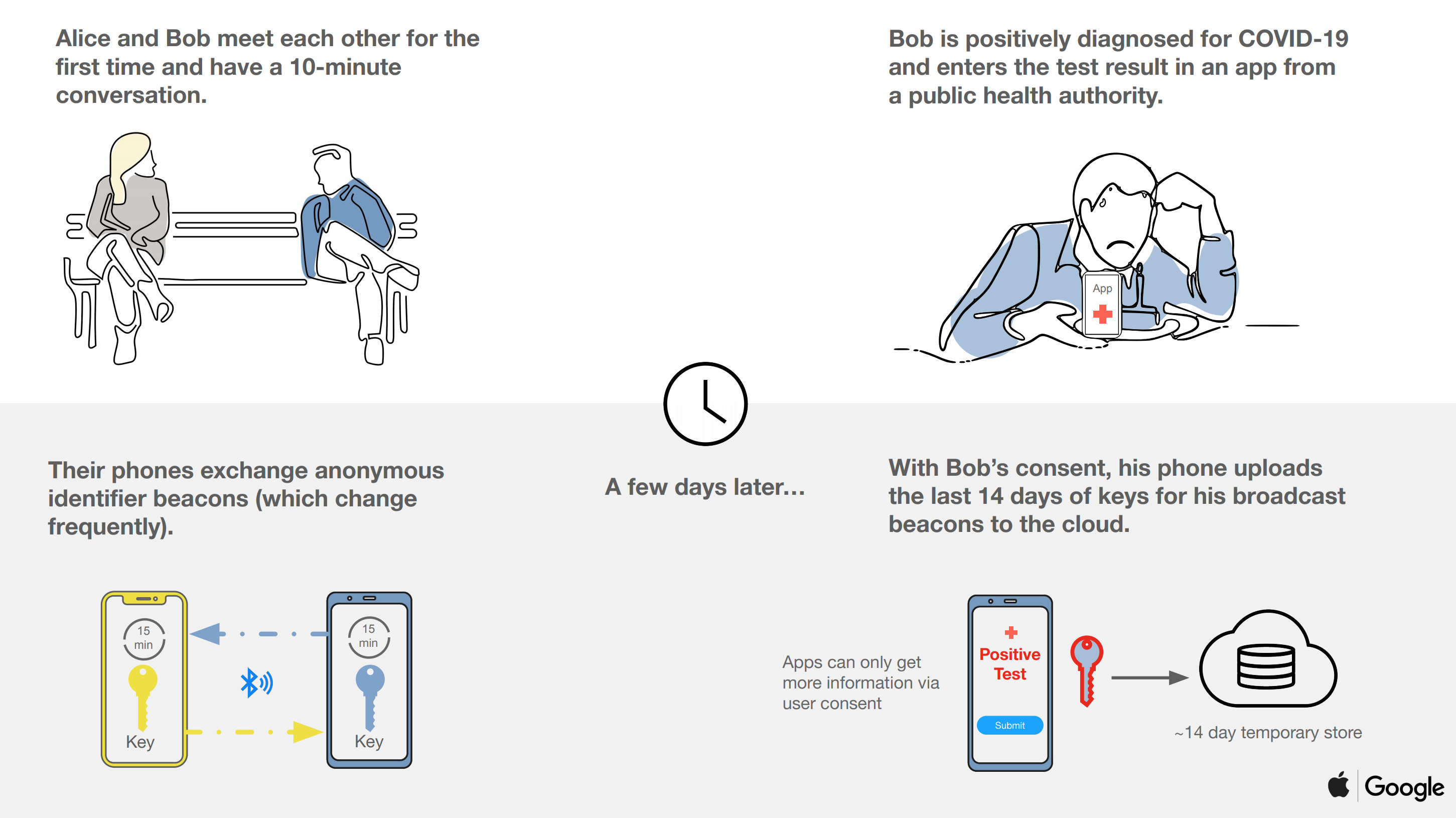
  1. Two people happen to be near each other for a period of time, let’s say 10 minutes. Their phones exchange the anonymous identifiers (which change every 15 minutes).
  2. Later on, one of those people is diagnosed with COVID-19 and enters it into the system via a Public Health Authority app that has integrated the API.
  3. With an additional consent, the diagnosed user allows his anonymous identifiers for the last 14 days to be transmitted to the system.
  4. The person they came into contact with has a Public Health app on their phone that downloads the broadcast keys of positive tests and alerts them to a match.
  5. The app gives them more information on how to proceed from there.

Privacy and transparency

Both Apple and Google say that privacy and transparency are paramount in a public health effort like this one and say they are committed to shipping a system that does not compromise personal privacy in any way. This is a factor that has been raised by the ACLU, which has cautioned that any use of cell phone tracking to track the spread of COVID-19 would need aggressive privacy controls.

There is zero use of location data, which includes users who report positive. This tool is not about where affected people are but instead whether they have been around other people.

The system works by assigning a random, rotating identifier to a person’s phone and transmitting it via Bluetooth to nearby devices. That identifier, which rotates every 15 minutes and contains no personally identifiable information, will pass through a simple relay server that can be run by health organizations worldwide.

Even then, the list of identifiers you’ve been in contact with doesn’t leave your phone unless you choose to share it. Users that test positive will not be identified to other users, Apple or Google. Google and Apple can disable the broadcast system entirely when it is no longer needed.

All identification of matches is done on your device, allowing you to see — within a 14-day window — whether your device has been near the device of a person who has self-identified as having tested positive for COVID-19.

The entire system is opt-in. Users will know upfront that they are participating, whether in app or at a system level. Public health authorities are involved in notifying users that they have been in contact with an affected person.

The American Civil Liberties Union appears to be cautiously optimistic.

“No contact tracing app can be fully effective until there is widespread, free, and quick testing and equitable access to healthcare. These systems also can’t be effective if people don’t trust them,” said ACLU’s surveillance and cybersecurity counsel Jennifer Granick. “To their credit, Apple and Google have announced an approach that appears to mitigate the worst privacy and centralization risks, but there is still room for improvement. We will remain vigilant moving forward to make sure any contract tracing app remains voluntary and decentralized, and used only for public health purposes and only for the duration of this pandemic.”

Apple and Google say that they will openly publish information about the work that they have done for others to analyze in order to bring the most transparency possible to the privacy and security aspects of the project.

“All of us at Apple and Google believe there has never been a more important moment to work together to solve one of the world’s most pressing problems,” the companies said in a statement. “Through close cooperation and collaboration with developers, governments and public health providers, we hope to harness the power of technology to help countries around the world slow the spread of COVID-19 and accelerate the return of everyday life.”

You can find more information about the contact tracing API on Google’s post here and on Apple’s page here including specifications.

Updated with comment from the ACLU.

Tesla resurrects long-range RWD Model 3 for the Chinese market

Tesla is now producing and selling the long-range rear-wheel-drive version of its Model 3 electric vehicle at its Shanghai factory, a month after receiving approval from the Chinese government.

The move might not be a milestone, but it’s notable because Tesla discontinued production of the long-range RWD Model 3 in the U.S. and now only offers that variant as a dual-motor all-wheel drive. It also marks a shift from Tesla’s initial plan to sell a more basic version of the Model 3 in China.

The company updated its China website showing the standard-range-plus model — the first vehicle produced at the Shanghai factory — as well as the long-range RWD and performance versions of the Model 3. Bloomberg was the first to report the change. The long-range RWD version starts at 366,550 yuan, or about $52,000 after incentives. Deliveries of the long-range RWD version are expected to begin in June.

The standard-range-plus model starts at 323,800 yuan, or about $46,000, before local subsidies.

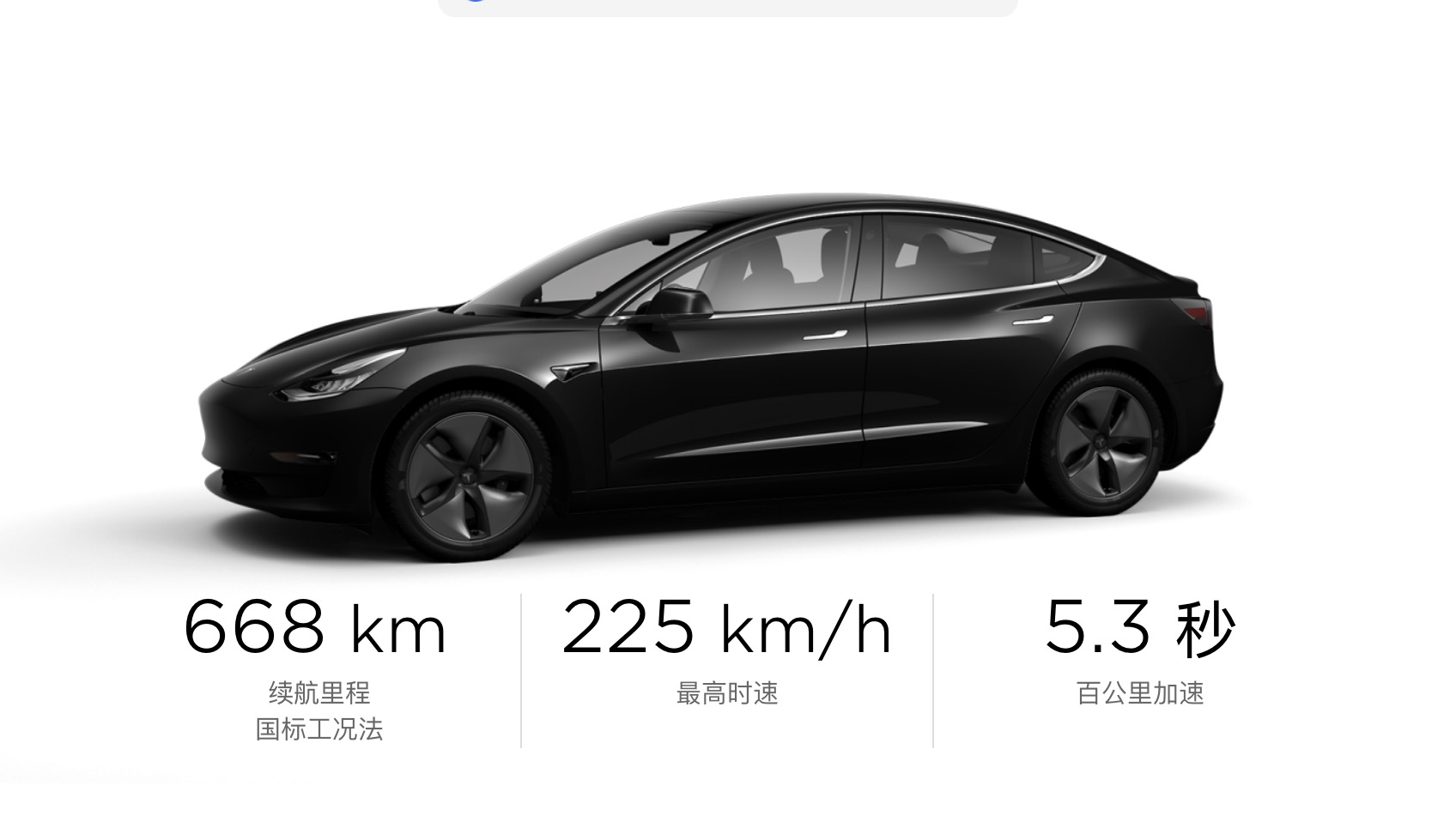
The standard-range-plus Model 3 can travel 276 miles on a single charge, according to Tesla’s China website. The same website says the long-range RWD Model 3 has a range of 668 km, or 415 miles. Those range estimates are based on the New European Driving Cycle, a forgiving standard that Europe replaced several years ago with the WLTP. The real-word range is likely much lower.

Tesla model 3 long range RWD china

Image Credits: Tesla/screenshot

Tesla started producing a standard-range-plus rear-wheel-drive version of the Model 3 at its Shanghai factory late last year. The first deliveries began in early January. The March approval from the Ministry of Industry and Information Technology gave Tesla permission to add another variant to its Chinese portfolio.

Eventually, Tesla plans to manufacture the Model Y electric vehicle at the China factory.

It’s ‘bullshit’ that VCs are open for business right now (but that could change in a month)

Earlier today, to get a sense of what’s happening in the land of venture capital, the law firm Fenwick & West hosted a virtual roundtable discussion with New York investors Hadley Harris, a founding general partner with Eniac Ventures; Brad Svrluga, a co-founder and general partner of Primary Ventures; and Ellie Wheeler, a partner with Greylock.

Each investor is experiencing the coronavirus-driven lockdown in unique ways, unsurprisingly. Their professional experiences are very much in sync, however, and founders should know the bottom line is that they aren’t making brand-new bets at this very moment.

On the personal front, Wheeler is expecting her first child. Harris is enjoying lunch with his wife every day. Svrluga said that he hasn’t had so many consecutive meals with his kids in more than a decade. (He described this as a treat.)

Professionally, things have been more of a struggle. First, all have been swamped in recent weeks, trying to assess which of their startups are the most at risk, which are worth salvaging and which may be encountering unexpected opportunity — and how to address each of these scenarios.

They are so busy, in fact, that none is writing checks right now to founders who might be trying to reach them for the first time. Indeed, Harris takes issue with investors who’ve said throughout this crisis that they are still very open to pitches. “I’ve seen a lot of VCs talking about being open for business, and I’ve been pretty outspoken on Twitter that I think that’s largely bullshit and sends the wrong message to entrepreneurs.

“We’re completely swamped right now in terms of bandwidth” because of the work required by existing portfolio companies. Bandwidth, he added, “is our biggest constraint, not money.”

What happens when bandwidth is no longer such an issue? It’s worth noting that none thinks that meeting founders exclusively remotely is natural or normal or conducive to deal-making — not at their firms, in any case.

Wheeler noted that while “some accelerators and seed funds that are prolific have been doing this in some way, shape or form for a bit,” for “a lot of firms,” it’s just awkward to contemplate funding someone they have never met in person.

“The first part of the diligence process is the same, that’s not hard,” said Wheeler. “It’s meeting the team, visiting [the startup’s workspace], meeting our team. How do you do that [online]?” she asked. “How do you mimic what you pick up from spending time together [both] casually and formally? I don’t think people have figured that out,” she said, adding, “The longer this goes on, we’ll have to.”

As for what to pitch them anyway, each is far less interested in sectors that aren’t highly relevant to this new world. Harris said, for example, that now is not the time to float your new idea for a brick-and-mortar business. Wheeler separately observed that many people have discovered in recent weeks that “distributed teams and remote work are actually more viable and sustainable than people thought they were,” suggesting that related software is of continued interest to Greylock.

Svrluga said Primary Ventures is paying attention to software that enables more seamless remote work, too.  Telecommuting “has been a culture-positive event for the 18 people at my firm,” he said.

Naturally, the three were asked — by Fenwick attorney Evan Bienstock, who moderated the discussion — about downsizing, which each had noted was a nearly inescapable part of lengthening a startup’s runway right now. (“It sucks,” said Svrluga. “People are losing their jobs. But to continue to run teams with the same organizational structure as 60 days ago, [which was] the most favorable environment for building industries, you can’t do it.”)

Their uniform advice for management teams that have to cut is to cut deeply to prevent from having to do it a second time.

Though no one wants to part ways with the people who they’ve brought aboard, “no CEO has ever told me, ‘Dammit, we cut too far,’ ” said Svrluga, who has been through two downturns in his career. In contrast, “at least 30%” of the CEOs he has known admitted to not going far enough to insulate their business while also keeping its culture intact.

The “second cut hurts way more,” added Wheeler. “It’s the second [layoff] that really throws people.”

If you’re wondering what’s next, the VCs all said that they’ll be receptive to new ideas after working through layoffs and burn rates and projected runways, along with the new stimulus package that they’re trying to find a way to make work for their startups.

As for how soon that might be, Wheeler and Svrluga suggested the world might look less upside down in a month. They proposed that four or so more weeks should also give founders more needed time to adjust some of their expectations.

Harris seemed to agree. “It will probably be a gradual thing . . . I’m not sure what next week holds, but feel free to ping me in a month and I’ll let [founders] know if I think it’s opening up.”

After an extended quarantine, the next ISS crew arrives in orbit

Working from home is easy for some and difficult for others, but one place it’s downright impossible is the International Space Station . So pandemic or no pandemic, the latest crew had to get themselves up there. They’ve just had a successful launch and arrival, but only after a protracted quarantine period.

To be clear, ISS crews are always quarantined prior to launch to make sure they don’t bring the flu up from a chance encounter, but given the coronavirus situation, this was a special occasion. Quarantine started in April and not even the crew’s families were allowed to be confined with them. Only essential personnel were allowed at launch.

I’ve asked NASA for more details and any extra measures they’ve taken regarding the coronavirus for this or future missions.

Expedition 63 will relieve the current crew after about a week of overlap, during which no doubt the ISS begins to feel fairly crowded.

This crew is special in that among its duties will be to welcome the astronauts aboard the first Commercial Crew mission to the ISS, who will arrive on a SpaceX Crew Dragon capsule launched aboard a Falcon 9 rocket. That mission, too, is currently on schedule for May despite the pandemic.

Every crew mission for years has been done using Russia’s venerable Soyuz spacecraft. These have been updated continually for decades, but still feature more than a little of what might best be described as “repeatedly flight proven” technology.

The effort to engineer a state of the art spacecraft for crewed missions has lasted several years, coming down to SpaceX and rival Boeing in the home stretch. But while both have suffered repeated delays, Boeing has had numerous other failures that have pushed its launch out toward the end of the year and perhaps beyond. SpaceX, on the other hand, is ready to go.

The first Commercial Crew mission, whether it’s next month or a little later, will be the culmination of years of competition, and the first time a crew has gone to orbit in an American-made spacecraft since the Shuttle was retired. (Virgin Galactic has piloted its spacecraft to the edge of space, but its human-rated craft is not an orbital vehicle.)

If all goes well, NASA’s Chris Cassidy and Roscosmos’s Anatoly Ivanishin and Ivan Vagner will welcome the historic mission to the ISS soon.