ServiceNow pledges no layoffs in 2020

You don’t need your PhD in economics to know the economy is in rough shape right now due to the impact of COVID-19, but ServiceNow today pledged that it would not lay off a single employee in 2020 — and in fact, it’s hiring.

While Salesforce’s Marc Benioff pledged no significant layoffs for 90 days last month, and asked other company leaders to do the same, ServiceNow did them one better by promising to keep every employee for at least the rest of the year.

Bill McDermott, who came on as CEO at the end of last year after nine years as CEO at SAP, said that he wanted to keep his employees concentrating on the job at hand without being concerned about a potential layoff should things get a little tighter for the company.

“We want our employees focused on supporting our customers, not worried about their own jobs,” he said in a statement.

In addition, the company plans to fill 1,000 jobs worldwide, as well as hire 360 college students as interns this summer, as they continue to expand their workforce, when many industries and fellow tech companies are laying off or furloughing employees.

The company also announced that it is taking part in a program called People+Work Connect, with Accenture, Lincoln Financial Group and Verizon (the owner of this publication). This program acts as an online employer to employer clearing house for these companies to hire employees laid off or furloughed by other companies. The company plans to post 800 jobs through this channel.

Pileus helps businesses cut their cloud spend

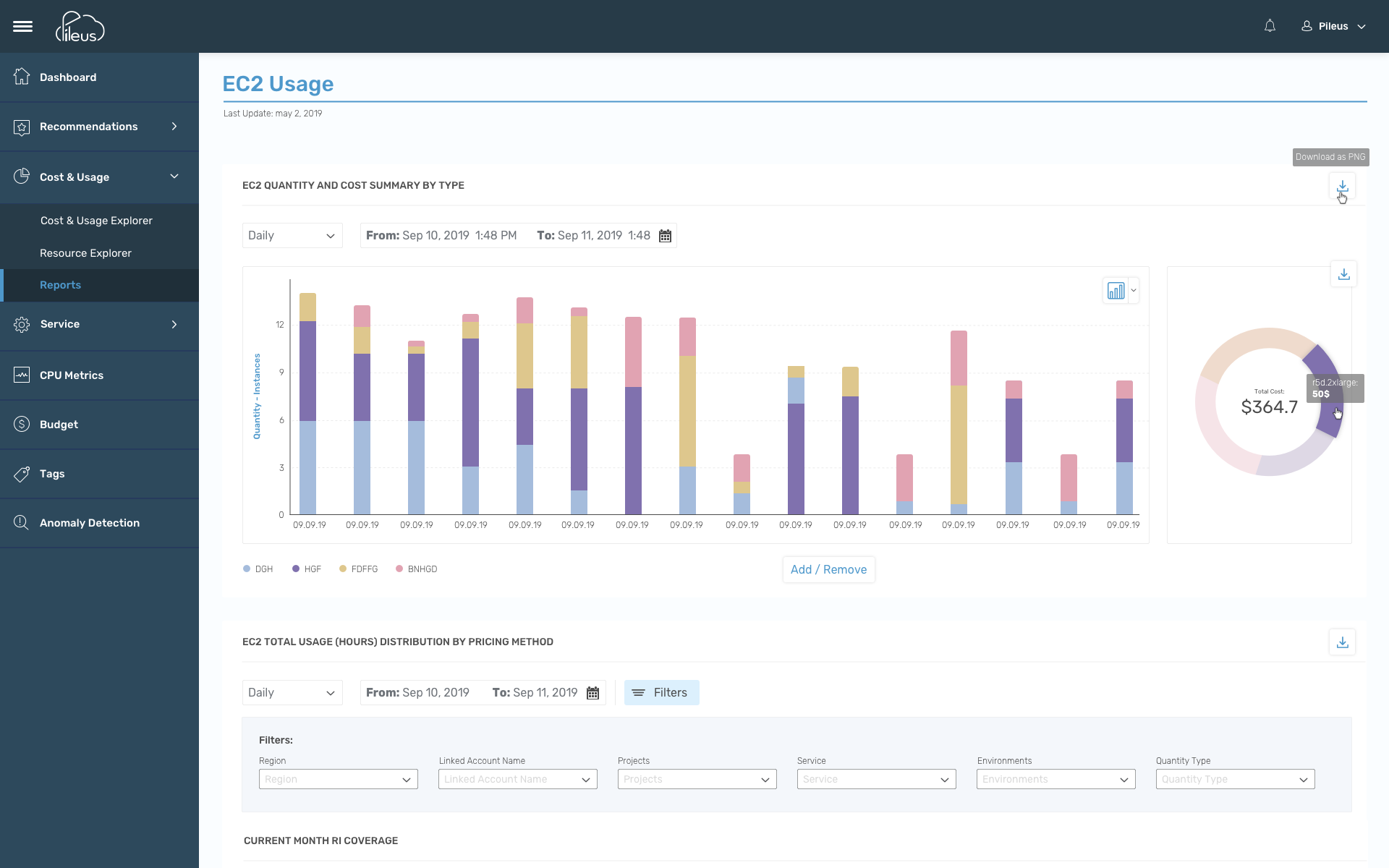
Israel-based Pileus, which is officially launching today, aims to help businesses keep their cloud spend under control. The company also today announced that it has raised a $1 million seed round from a private angel investor.

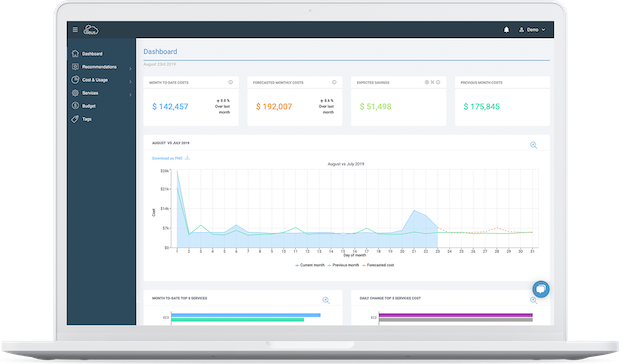
Using machine learning, the company’s platform continuously learns about how a user typically uses a given cloud and then provides forecasts and daily personalized recommendations to help them stay within a budget.

Pileus currently supports AWS, with support for Google Cloud and Microsoft Azure coming soon.

With all of the information it gathers about your cloud usage, the service can also monitor usage for any anomalies. Because, at its core, Pileus keeps a detailed log of all your cloud spend, it also can provide detailed reports and dashboards of what a user is spending on each project and resource.

If you’ve ever worked on a project like this, you know that these reports are only as good as the tags you use to identify each project and resource, so Pileus makes that a priority on its platform, with a tagging tool that helps enforce tagging policies.

“My team and I spent many sleepless nights working on this solution,” says Pileus CEO Roni Karp. “We’re thrilled to finally be able to unleash Pileus to the masses and help everyone gain more efficiency of their cloud experience while helping them understand their usage and costs better than ever before.”

Pileus currently offers a free 30-day trial. After that, the service shows you a $180/month or $800 per year price, but once you connect your accounts, it’ll charge 1% of your savings, not the default pricing you’ll see at first.

The company isn’t just focused on individual businesses, though. It’s also targeting managed service providers that can use the platform to create reports and manage their own customer billing. Karp believes this will become a significant source of revenue for Pileus because “there are not many good tools in the field today, especially for Azure.”

It’s no secret that Pileus is launching into a crowded market, where well-known incumbents like Cloudability already share mindshare with a growing number of startups. Karp, however, believes that Pileus can stand out, largely because of its machine learning platform and its ability to provide users with immediate value, whereas, he argues, it often takes several weeks for other platforms to deliver results.


Google Play adds a ‘Teacher Approved’ section to its app store

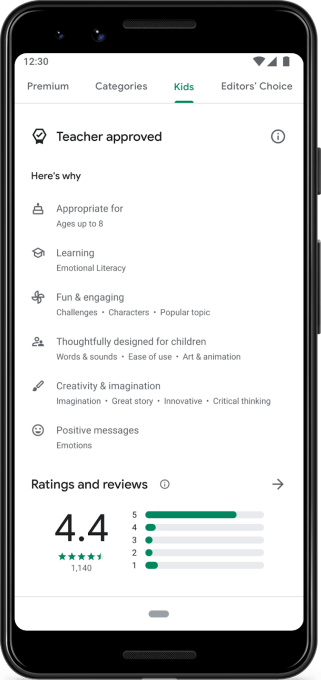
Google today is making it easier for families to find quality educational apps with the addition of a new “Teacher Approved” section to Google Play. All apps found in this section are vetted by a panel of reviewers, including more than 200 teachers across the U.S., and meet Google’s existing requirements for its “Designed for Families” program.

That program requires apps to meet government regulations around data collection and ad targeting, and also limits the types of ads that can be displayed to children, if apps are ad-supported.

The apps chosen for the “Teacher Approved” section, however, don’t just meet the program’s minimum requirements — they’re also reviewed and rated highly by teachers. These may be apps teachers suggest for supplemental learning while others may just be used for fun.

The launch arrives at a time when most U.S. children are now out of school due to the COVID-19 pandemic and the subsequent school closures. To date, at least 55.1 million students are no longer attending their public or private school in-person, according to data from the National Center for Education Statistics. This change has left parents scrambling to fill their child’s time with educational activities. And even if distance learning is available in their school district, it isn’t typically enough to keep the child engaged throughout the day.

Google says it heard from parents that it was difficult to find kid-friendly apps they felt good about letting their children use, which is why it chose to launch the new “Teacher Approved” section on Google Play.

The company worked with academic experts, including lead advisors Joe Blatt (Harvard Graduate School of Education) and Dr. Sandra Calvert (Georgetown University) to create the framework for rating apps for kids. But the apps themselves are chosen by a panel with teacher involvement. The panel rates apps on various aspects like age-appropriateness, quality of experience, enrichment and whether kids enjoy using the app.

To access the new section, you can either visit the “Kids” tab on Google Play or you can look for the “Teacher Approved” badge on any given app to see if it met with teachers’ approval. In addition, Google Play Pass will offer subscribers a selection of “Teacher Approved” content under the “Apps and games for kids” section.

The apps will be grouped by age: 5 & under, ages 6-8 and ages 9-12. Google will also include information in the app’s listing about why it was rated highly.

At launch, Google tells us there will be around 1,000 Teacher Approved apps live in the Play Store and around 60 also included in Google Play Pass. The company says it’s working with its Play Pass partners to increase this number over time.


“I think it’s terrific that Google is taking this unprecedented stand – creating a unique space for apps that teachers have rated high in quality and value for kids and their families,” said Joe Blatt, senior lecturer and faculty director of the Technology, Innovation, and Education Program, in a statement about the launch. “Over the past three years, together with faculty colleagues and students, I have worked to pinpoint criteria for developmental appropriateness, learning impact, and appeal. Then we helped Google build a rating system that enables teachers to apply these criteria reliably. I’m really impressed with the dedication and professionalism that the Google team has invested in this project,” he added.

The new Kids tab with “Teacher approved” apps will roll out in the U.S. on Google Play over the next few days. Google says it will expand the experience internationally in the months to come.

New Earth-sized planet found in habitable sweet-spot orbit around a distant star

Researchers have discovered a new Earth-sized planet orbiting a star outside our solar system. The planet, called Kepler-1649c, is only around 1.06 times larger than Earth, making it very similar to our own planet in terms of physical dimensions. It’s also quite close to its star, orbiting at a distance that means it gets around 75% of the light we do from the Sun.

The planet’s star is a red dwarf, which is more prone to the kind of flares that might make it difficult for life to have evolved on its rocky satellite’s surface, unlike here in our own neighborhood. It orbits so closely to its star, too, that one year is just 19.5 of our days — but the star puts out significantly less heat than the Sun, so that’s actually right in the proper region to allow for the presence of liquid water.

Kepler-1649c was found by scientists digging into existing observations gathered by the Kepler space telescope before its retirement from operational status in 2018. An algorithm that was developed to go through the troves of data collected by the telescope and identify potential planets for further study failed to properly ID this one, but researchers noticed it when reviewing the information.

There’s still a lot that remains to be discovered about the exoplanet, like what its atmosphere is like. There could be any number of other problems with Kepler-1649c relative to its ability to support life, as well, including errors in the data used to determine that it is Earth-like and in the correct habitable zone around its star. But this represents one of the best-ever potential extra-solar planets found in terms of its potential of supporting life, thanks to the combo of its size and the temperate orbital band it occupies.

Identified exoplanets with Earth-like characteristics provide scientists with good candidates for future study, including targeting via Earth-based and in-space observation instruments. It’ll probably be a long time before we can definitively say anything about whether or not they might support actual life, but even finding exoplanets with the potential is an exciting development.

What do we do with the positives?

Here come the blood tests, and it’s about time. Serosurveys, to determine what percentage of populations have already contracted COVID-19. And, individually, tests to indicate whether you, too, already caught it, but suffered only mild symptoms, or none at all.

In America alone, millions will soon be recovered from COVID-19 infection. Half the people I know, including myself, seem to have had Schrödinger’s Respiratory Infection in the last couple of months, and are beyond eager to know if they test positive for COVID-19 antibodies.

Even if they do, though — to be clear, most won’t — what then? Suppose antibodies indicate immunity, for a while at least. That seems somewhat likely, he said cautiously. Suppose the tests are accurate enough to rely on. What do we as a society then do with that information?

The immune — the positives — could return to relative normality with no immediate fear of further infection, while everyone else — the negatives — could not. Do we want to create a two-tier society like that? Do we want to make a point of replacing negatives with positives in high-risk contexts like nursing homes? Do we want people’s test status to be publicly known, or available upon demand by the government? How about their employer? How about their healthcare provider?

Most of these are hard questions with no easy answers, and while I, like you, have opinions, some strong, about which are the least bad options, I also think this is mostly a subject about which reasonable people can disagree. Still, no matter what our collective answers are, we can all agree we want them to be implemented in the most privacy-preserving way. That’s where technology comes in.

Lots of techies and trust-safety-privacy professionals are looking for some way to contribute to COVID response other than some silly hackathons.

I have an idea: let's start thinking about a robust, counterfeit-resistant, privacy-preserving mechanism to prove immunity to nCoV.

— Alex Stamos (@alexstamos) March 30, 2020

It’s worth noting that proving immunity is far from a new problem. I’ve traveled to many countries which require proof of yellow-fever vaccination before they allow visitors to enter. Some even enforce it. The solution is venerable, simple, and decentralized; a slip of paper stamped, dated, and signed by a doctor.

This solution is relatively privacy-preserving — authorities can’t demand to see anyone’s yellow-fever papers at any given moment, because they’re only needed at border posts. It is very hard to verify, and relatively easy to forge … but it’s good enough to have worked. Its purpose is not to eliminate the risk of transmission with absolute 100% efficacy, but to reduce it to a manageable amount.

The same applies to COVID-19. As Harvard epidemiologists Bill Hanage and Marc Lipsitch wrote back in February, it’s important to “distinguish between whether something ever happens and whether it is happening at a frequency that matters.” We don’t have to worry about freakish edge cases. A 99% effective solution should be just fine.

So what would that solution be? Something simple, decentralized, reasonably effective, and privacy-preserving. Suppose that you go to your doctor’s office to get a test, and while you’re there, your picture is taken, and you choose a passcode. Then, along with your test result, you may receive some kind of wristband with a QR code. When your status needs to be verified, the QR code is scanned, you enter your passcode (or choose not to, or conveniently forget it), and then your headshot pops up, confirming your identity and status.

I’m not pretending this is any kind of perfect solution; real cryptographers will likely come up with something different and better. (In particular, to pseudonymize your individual test sample to the extent possible, and ensure that whoever hosts the central database, if any, cannot decipher the data therein.) This is to illustrate the key points that 1) only those you approve of can see your status, and 2) that status can be verified to ensure it’s actually yours, via some personal identifier like a headshot.

What do we then do with such a system? Well, after the curve flattens and recedes, perhaps we will consider reopening restaurants so long as every other table remains empty, and stores as long as only 1 (masked) customer is within for every 100 square feet of floor space. Alternatively, perhaps, restaurants and stores will also have the option of opening only to the positives — meaning with no internal restrictions, but COVID-19 positive status must be verified before allowing entry, in the same way that bars check your age before letting you enter.

Would those requirements be desirable? Again, that is eminently debatable. Would some people hack such a system in the same way that kids use fake IDs? Sure. Will this happen “at a frequency that matters?” That seems quite unlikely. In cases where it seems more likely, presumably more stringent rules can be applied.

The important thing to which technology can contribute is to make this all simple, straightforward, effective, and privacy-preserving, while consonant with our collective goals as a society. Regardless on what we agree on as those goals, if it turns out previous infection confers immunity, the positives will have a key part to play as we try to resume our lives — to the extent possible — in the ever-present shadow of the pandemic.

Tech for good during COVID-19: Pivots and partnerships to help people deal

Some of us have learned how to be uniquely scrappy during this pandemic. I’m talking socks as masks and chickpea water as a vegetarian egg-white replacement type of scrappy.

And you will learn in this week’s installment of Tech For Good startups are no exception. Companies around the world are pivoting and partnering their way into helping us navigate the  COVID-19 pandemic. Below is a list of some recent partnerships that caught our eyes, as well as other goodness from private companies.


From greeting cards to virtual therapy

Ali O’Grady founded greeting-card startup Thoughtful Human in 2017. The greeting cards tackle difficult topics, such as cancer, grief and, more recently, quarantine and the pandemic. Thoughtful Human has partnered with BetterHelp Therapy to offer a month of free virtual therapy through phone or text.

Zira wants to help you bounce back if you were laid off

Zira is an automated workforce solution to help with shift schedules and team communication. Now, it launched a free tool called Bounce Back to help those laid off due to COVID-19. The application chiefly teaches users how to navigate unemployment, curated by location. It also creates a community for users to stay in touch with former employers, and has a job marketplace.

Yext goes up State

Yext, a site search tool, has partnered with the US Department of State to create a COVID-19 informational hub to disseminate information about travel alerts. In the last month, Yext has developed sites for the State of New Jersey and the State of Alabama.

An alternative to a good ol’ restaurant menu

My Menu, which traditionally offered a digital tablet menu platform to restaurants, is now giving away its underlying technology to help restaurants become online-friendly overnight. Using My Menu technology, restaurants can create a menu that pops up when customers scan a QR code on their phones. It will help restaurants make their menus more accessible.

Creativity using the cloud

DigitalOcean, a cloud provider, created a hub for developers to share projects aimed at helping people deal with the pandemic. Projects that have sprouted up as a result include an app that lets people anonymously report their health conditions to pulsecheck the spread across the world, and a remote learning group of Kenyan primary school teachers.

Founder therapy for free

Betaworks is launching a free, 6-week, peer-to-peer mentorship program to connect founders and company leaders in mentor-led support groups. The application deadline is April 13, and participants will be chosen on a first-come, first-served basis.

#MaskUp

Janelle M. Jimenez, the founder and CEO of sustainable clothing startup Stellari, is using her startup capital to work with Los Angeles manufacturers to create masks. She has invested $15,000 of seed money into partnerships with factories, and needs $10,000 to produce cloth masks at scale. She plans to donate the masks at cost and support the local garment industry at the same time. The effort has raised nearly $24,000 on Indiegogo.

Coders unite to make websites COVID-19 friendly

Coding Dojo has launched an initiative to connect its alumni group of coders to small businesses that need website development. Coders will take on projects, for no charge, like creating a website for that corner bodega or adding a delivery feature to existing websites.

As the marathon gets canceled, Boston’s new stride

Tom O’Keefe is the founder of StrideForStride, which buys race bibs for low-income runners from around the world, ranging from Guatemala, Nicaragua, El Salvador, Brazil, Chile, Cuba, Jamaica, and the US. Due to COVID-19, they lost a fundraiser at hotels and donations from restaurants and Sam Adams. Stride plans to host running clubs around various businesses and bars in Boston once everything re-opens, and in the meantime has launched a website DownloadBoston.com to highlight local businesses.

Bonus round

A group of New Yorkers has launched a challenge called #InMyScrubs to raise money to send meals from local restaurants to feed health care workers at critical-need hospitals. While this isn’t a tech initiative, it is heartwarming. The idea is to post pictures of yourself on Instagram in home “scrubs” like sweatpants and athleisure as an act of solidarity with those in their hospital scrubs. The challenge has raised nearly $68,000.

Startups Weekly: Where social startups will get funding in the future

[Editor’s note: Want to get this free weekly recap of TechCrunch news that startups can use by emailSubscribe here.] 

While consumer tech has matured as a startup category in recent years, many investors continue to be bullish on specific trends like online gaming, voice, and the unbundling of platforms in favor of focused social networks. That’s the key takeaway from a survey that Josh Constine and Arman Tabatabai did this week with 16 of the most active investors in key social product categories over on Extra Crunch. Here’s an excerpt of the responses, from Olivia Moore and Justine Moore of CRV:

  • “Unbundling of YouTube.” You can build a big company by targeting a vertical within YouTube with a product that has better features and more opportunities for creator monetization. Twitch is a great example of this! We’re also watching early-stage companies like Supergreat (in beauty) and Tingles (ASMR).

  • Voice as a social medium. Voice continues to pick up steam as a broadcast medium via podcasting, but we haven’t seen a lot in social or P2P voice yet. We think a successful platform will leverage the fact that voice content can be created and consumed while doing other things. We’re big fans of companies like TTYL and Drivetime that are making strides here!

  • Flexible digital identities. Gen Zers are online constantly but have different preferences across platforms/friend groups about how they want to “show up” digitally. The rise of “Finsta” accounts is one good example of this. Companies like Facemoji already help users create social content using a curated digital avatar — we’re excited to see what else founders build here!

  • Synchronous, shared mobile experiences. We’re bullish on apps that connect users in real time to have a shared social experience. Most apps now are “single-player,” which creates scroll fatigue. HQ Trivia was an early example more on the entertainment side, while companies like Squad help users browse the internet and watch TikTok together.

Other respondees include: Connie Chan (Andreessen Horowitz). Alexis Ohanian (Initialized Capital), Niko Bonatsos (General Catalyst), Josh Coyne (Kleiner Perkins), Wayne Hu (Signal Fire), Alexia Bonatsos (Dream Machine), Josh Elman (angel investor), Aydin Senkut (Felicis Ventures), James Currier (NFX), Pippa Lamb (Sweet Capital), Christian Dorffer (Sweet Capital), Jim Scheinman (Maven Ventures), Eva Casanova (Day One Ventures) and Dan Ciporin (Canaan).

EC subscribers please note: a second part of this survey will be running this coming week, focused specifically on social investing in the COVID-19 era.

Are VCs investing — or maintaining?

Speaking of financing, who is actually writing checks right at this moment in time?

“I’ve seen a lot of VCs talking about being open for business,” Eniac Ventures founding partner Hadley Harris proclaimed on a fundraising-trend panel this week, “and I’ve been pretty outspoken on Twitter that I think that’s largely bullshit and sends the wrong message to entrepreneurs.” Instead, as Connie Loizos covered for us on TechCrunch, he said he didn’t have time to talk to more founders because he was so busy helping existing portfolio companies.

Not every investor agrees with that viewpoint —  VC Twitter features many an anecdote about fresh companies getting funding. 

Let’s just hope that both things are true, because it is already rough out there. 

Does your startup qualify for a PPP loan? (And should you apply?)

Two debates have been raging around government support for startups. First, the big, messy new Paycheck Protection Program — designed to cover expenses for small businesses — does seem to be somewhat available to startups, based on revisions published by the Small Business Administration late last week. But things get complicated quick depending on your fundraising and cap table, as Jon Shieber covered last weekend for TechCrunch. Venture firms typically have controlling interests in a portfolio of companies that total more than 500 people, so if such a firm also has a controlling interest in your startup, you may not be eligible. Even if the VC stake is under 50%, preferred terms that came with the fundraising may your application afoul of the rules.

To help founders work through their own situations faster, startup lawyer William Carleton wrote a quick guide for Extra Crunch. Here’s where he says you need to start:

Do you have a minority investor which controls protective covenants in your charter, or which controls a board seat afforded certain veto rights on board decisions? If the answer to either fork of that question is “yes,” you almost certainly have confirmed that you will need to amend your charter and/or other governing documents before proceeding with a PPP application.

The other aspect, of course, is whether startups should be applying for this in the first place. Congress broadly intended the money to go towards small to medium sized businesses, most of whom would never be considered for venture. Shieber’s article is full of comments on that topic, if you feel like weighing in….

The commercial real estate comeuppance

If you’re like me, and you’ve started companies in the Bay Area and struggled to find office space you could afford, enjoy this bit of schadenfraude as you plot your remote-first future. Because the commercial real estate industry is facing an existential crisis after many, many years of rent-seeking upon the Silicon Valley tech economy (and everyone else).

Connie explored this exploding topic with a range of startups, investors and CRE agents in a big feature for TechCrunch this week. One analyst “expects the market to come down by ‘at least 10% and probably 20% to 30%’ from where commercial space in San Francisco has priced in several years, which is $88 per square foot, according to CBRE. Driving the expected drop is the 2 million square feet that will come onto the market in the city as soon as it’s possible — space that companies want to get off their books.”

It’s quite possible to imagine even bigger declines, given the broader hits that most any possible tenant is also taking to their budgets. Who knows, maybe this whole process will even help make the Bay Area and other wealthy metros a little more affordable again.

GettyImages 960803498

Edtech gets hot again, according to investors

After lots of money and lots of struggle over the past decade, edtech is suddenly hot again thanks to the pandemic. Natasha Mascaranhas has been covering the trend recently, and dug in this week with a big investor survey on the category for Extra Crunch.

“One investor pivoted from spending a third of their time looking at edtech companies to devoting almost all their time to the sector,” she tells me. “Another, who has been bullish for years on edtech, says its business as usual for them, but that competition may arise. An ed-tech focused fund thinks the sector has been underfunded for a while, so the moment of reckoning has begun.”

Respondents include:

Across the week:

TechCrunch

Economists haven’t thrown out the models yet (but they will)

Five CEOs on their evolution in the femtech space

Equity Monday: Hunting for green shoots amid the startup data

Extra Crunch

How SaaS startups should plan for a turbulent Q2

Fintech’s uneven new reality has helped some startups, harmed others

Fast-changing regulations give virtual care startups a chance to seize the moment

Twilio CEO Jeff Lawson on shifting a 3,000-person company to fully remote

Amid unicorn layoffs, Boston startups reflect on the future

#EquityPod

From Alex:

We started with a look at Clearbanc  and its runway extension not-a-loan program, which may help startups survive that are running low on cash. Natasha covered it for TechCrunch. Most of us know about Clearbanc’s revenue-based financing model; this is a twist. But it’s good to see companies work to adapt their products to help other startups survive.

Next we chatted about a few rounds that Danny covered, namely Sila’s $7.7 million investment to help build technology that could take on the venerable and vulnerable ACH, and Cadence’s $4 million raise to help with securitization. Even better, per Danny, they are both blockchain-using companies. And they are useful! Blockchain, while you were looking elsewhere, has done some cool stuff at last.

Sticking to our fintech theme — the show wound up being super fintech-heavy, which was an accident — we turned to SoFi’s huge $1.2 billion deal to buy Galileo, a Utah-based payments company that helps power a big piece of UK-based fintech. SoFi is going into the B2B fintech world after first attacking the B2C realm; we reckon that if it can pull the move off, other financial technology companies might follow suit.

Tidying up all the fintech stories is this round up from Natasha and Alex, working to figure out who in fintech is doing poorly, who’s hiding for now, and who is crushing it in the new economic reality.

Next we touched on layoffs generally, layoffs at ToastAngelList, and not LinkedIn — for now. Per their plans to not have plans to have layoffs. You figure that out.

And then at the end, we capped with good news from Thrive and Index. We didn’t get to Shippo, sadly. Next time!

Listen to the full thing here!

Canalys finds PC demand surged in Q1, but shipments lagged due to supply issues

As workers moved from office to home and students moved to being educated online, demand for new PCs surged in Q1, but Canalys found that shipments actually dropped 8% in spite of this, due to COVID-19 related supply chain problems.

The 8% drop was the worst since 2016 when shipments dropped 12%, according to the firm. Companies were looking to get new machines into the hands of employees who normally worked on desktop machines in the office, while parents were buying machines for children suddenly going to school online.

Rushabh Doshi, research director at Canalys says that products were flying off the shelves in Q1, but the PC makers couldn’t keep up with demand as supplies were limited due to a number of factors.

“…PC makers started 2020 with a constrained supply of Intel processors, caused by a botched transition to 10nm nodes. This was exacerbated when factories in China were unable to reopen after the Lunar New Year holidays.

“The slowdown in supply met with accelerated demand, as businesses were suddenly forced to equip a newly remote workforce, placing urgent orders for tens of thousands of PCs. Children, too, needed their own PCs, as schools closed and lessons went online,” Doshi explained in a statement.

Lenovo and HP owned the lion’s share of the PC market in Q1 with 23.9% and 21.8% share respectively. Dell was in third with 19.6%. Apple was well behind in fourth place with just 6% of worldwide market share.

Only Dell projected positive growth with a modest 1.1% annual rate. All others were projected to be negative with Apple projecting the sharpest drop at -21%.

The good news is that from a revenue perspective, at least for the short term, these companies could command higher prices due to high demand and low supply, but overall the year looks bleak for PC makers, as Canalys predicts the rest of the year will see a further drop in sales as companies cut back on purchases, and consumers also likely limit purchases with so much economic uncertainty and demand satisfied for the short term.

Decrypted: Zoom’s security fallout, Crowdstrike’s new CTO, Bugcrowd raises $30M

Another week in quarantine.

As the world adjusts to working from home under mandatory stay-at-home orders, hackers are keeping busy. Microsoft said this week that coronavirus-related attacks are on the rise but still make up just a fraction of the overall malicious activity. Cybersecurity companies seem to be faring mostly well — in part thanks to the uptick of attacks, but also the challenges of securing the workforce as hundreds of millions work from home.

But as coronavirus dominates the headlines, the wheels of government keep turning. Lawmakers are trying to push through a controversial bill that critics say would undermine encryption, which keeps everything from your phone to your online banking accounts safe. One startup is bracing for a showdown. Signal, the end-to-end encrypted messaging app, sounded the alarm when it warned this week that it may exit the U.S. market if Congress passes the controversial EARN IT Act.

In a blog post this week, Signal engineer Joshua Lund wrote it would “not be possible for a small nonprofit like Signal to continue to operate within the United States.”

Will encryption become the latest causality of this tumultuous year?


THE BIG PICTURE

Zoom slapped with more security woes, but calls in the cavalry

A growing number of companies and governments, from SpaceX and Google to Taiwan and Germany, have banned Zoom. Not even the U.S. Senate is taking any chances with the video-calling software, which has faced a steady stream of headlines critiquing its security practices and privacy policies. But Zoom’s popularity, undoubtedly sparked by the mass working from home to stem the spread of the coronavirus pandemic, seems to be weathering the storm.

China’s next plan to dominate international tech standards

Emily de La Bruyère
Contributor

Emily de La Bruyère is co-founder of Horizon Advisory, a strategy consultancy focused on documenting the military, economic, and technological implications of China’s approach to global competition.

Nathan Picarsic
Contributor

Nathan Picarsic is co-founder of Horizon Advisory, a strategy consultancy focused on documenting the military, economic, and technological implications of China’s approach to global competition.

SpaceX has banned use of Zoom for remote operations. So have Google, Apple, NASA, and New York City schools. Earlier this week, the FBI warned about Zoom teleconferences and live classrooms being hacked by trolls; security experts warn that holes in the technology make user data vulnerable to exploitation.  Zoom’s CEO, Eric Yuan, has this week publicly admitted that he “messed up” on privacy and security.

But we are missing a larger question as we grapple with these security flaws. Zoom today is a publicly-traded American company listed on NASDAQ, but the company’s mainline app is developed by China-based subsidiaries. Its servers in China also appear to have transmitted the company’s AES-128 encryption keys earlier this year, including, as a Citizen Labs report documents, some keys used for meetings among North American participants (the company posted a response to that report here, noting that a geofencing error due to the heavy traffic from the outbreak of COVID-19 might have led some meetings “under extremely limited circumstances” to be routed through China, and it has corrected the error). Beijing’s intelligence laws obligate Zoom and other companies with nexus in China to share data held on the mainland with Chinese government authorities upon request.

(Editor’s note: Zoom has published a 90-day plan to improve its privacy and security initiatives, and recently hired ex-Facebook CISO Alex Stamos as an outside consultant. The company notes in its privacy policy that it only responds to requests for user data when there is a “valid legal process, including jurisdiction.” In its statement to the Citizen Lab post, the company wrote that “Zoom has layered safeguards, robust cybersecurity protection, and internal controls in place to prevent unauthorized access to data, including by Zoom employees — regardless of how and where the data gets routed.”)

These are precisely the kind of tools that Beijing values. The Chinese Communist Party (CCP) pursues a decades-long grand strategy to develop and capture global networks and platforms – with them to define global standards. Hold over standards promises enduring control of international resources, exchange, and information; a global geopolitical operating system with coercive might. Beijing has officially endorsed this ambition since its 2001 accession to the World Trade Organization, when it launched the National Standardization Strategy. 

Now, the CCP is putting that intent into action. Beijing is about to launch China Standards 2035, an industrial plan to write international rules. China Standards 2035 is the successor to Made in China 2025; an even bolder plan for the subsequent decade premised not on governing where global goods are made, but on setting the standards that define production, exchange, and consumption. 

Beijing completed two years of planning for China Standards 2035 at the beginning of March. The final strategy document is projected to be issued this year. While the specifics of China Standards 2035 have yet to be published, the intent – and focus areas – are already evident. The National Standardization Committee has released its preliminary report for the year ahead, the “Main Points of National Standardization Work in 2020.”

Our firm, Horizon Advisory, has translated and analyzed that report – and the past two years of planning that informed it. We find in it instructions to “seize the opportunity” that COVID-19 creates by proliferating China’s authoritarian information regime; to co-opt global industry by capturing the industrial Internet of Things; to define the next generation of information technology and biotechnology infrastructures; to export the social credit system – and Beijing’s larger litany of incentive-shaping platforms. We find an explicit global ambition that weaponizes commerce, capital, and cooperation.  

As Beijing sees it, the world is on the verge of transformation. “Industry, technology, and innovation are developing rapidly,” explained Dai Hong, Director of the Second Department of Industrial Standards of China’s National Standardization Management Committee in 2018. “Global technical standards are still being formed. This grants China’s industry and standards the opportunity to surpass the world’s.” 

Dai was speaking at the inauguration of China Standards 2035’s planning phase. He said that the plan would focus on “integrated circuits, virtual reality, smart health and retirement, 5G key components, the Internet of Things, information technology equipment interconnection, and solar photovoltaics.” Throughout, the emphasis would be on “internationalization” of Chinese standards.

Two years later, China Standards 2035’s initial research results reveal the concrete implications of those buzzwords. China Standards 2035 is to focus on setting standards in emerging industries: high-end equipment manufacturing, unmanned vehicles, additive manufacturing, new materials, the industrial internet, cyber security, new energy, the ecological industry. These align with the focus areas of the Strategic Emerging Industries initiative — also of Made in China 2025. Having secured its foothold in targeted physical spheres, Beijing is ready to define their rules. 

DJI has a near monopoly over commercial drone systems. The National Standardization Administration is now intent on “formulating the international standards for ‘Classification of Civil Unmanned Aircraft Systems’ to help the domestic drone industry occupy the technical commanding heights.’” 

Second, China Standards 2035 will accelerate Beijing’s proliferation of the virtual systems underlying, and connecting, those industries: the social credit system, the State-controlled National Transportation Logistics Platform (known as LOGINK), and medical and consumer good standards.

The plan’s third prong is internationalization. The Main Points outline the intent to “give full play to the organizational and coordinating roles of the Chinese National Committees of the International Standards Organization (ISO) and International Electrotechnical Commission (IEC).” Reports from the National Standardization Committee explain that giving “full play” means shaping “strategies, policies, and rules.” Beijing is to bolster internationalization through bilateral and regional standards-based partnerships – partnerships like China and Nepal’s standardization cooperation agreement, ASEAN’s standards docking, and nascent efforts with Germany, the United Kingdom, and Canada, among others.  

China’s standards plan stems from a clear, deliberate strategic progression. Beijing has spent the past two decades establishing influential footholds in multilateral bodies and targeted industrial areas. Now, it is using those footholds to set their rules – with them, to define the infrastructure of the future world. According to China’s strategic planning, this is what power means in a globalized era: “The strategic game among big powers is no longer limited to market scale competition or that for technological superiority. It is more about competition over system design and rule-making.”

But no one appears to be noticing China’s strategic positioning. Not much pops up when you Google China Standards 2035. That was a serious deficit before COVID-19’s global disaster. The stakes are higher now. Global shutdown has created what the CCP calls an opportunity to accelerate its strategic offensive.  Our lock-down induced reliance on virtual connections has offered Beijing an unprecedented angle in. 

As we grapple with the COVID-19 disaster, we need also to resist Beijing’s exploitation of it. We need to recognize the role of standards and the manner in which the CCP weaponizes them. We need to compete for alternative, safe, norm-based ones – and protect them from Beijing’s influence. Or we need to get used to security, privacy, ownership, freedom concerns far more serious than trolls at Zoom happy hour.

Update April 12: Added an editor’s note linking to Zoom’s responses to its security flaws. Updated the second paragraph to emphasize the specific challenge around data sovereignty and data flows into and out of China.

This Week in Apps: COVID-19 contact tracing apps, virtual dating on the rise, Quibi makes a debut

Welcome back to This Week in Apps, the Extra Crunch series that recaps the latest OS news, the applications they support and the money that flows through it all.

The app industry is as hot as ever, with a record 204 billion downloads in 2019 and $120 billion in consumer spending in 2019, according to App Annie’s “State of Mobile” annual report. People are now spending 3 hours and 40 minutes per day using apps, rivaling TV. Apps aren’t just a way to pass idle hours — they’re a big business. In 2019, mobile-first companies had a combined $544 billion valuation, 6.5x higher than those without a mobile focus.

In this Extra Crunch series, we help you keep up with the latest news from the world of apps, delivered on a weekly basis.

This week we’re continuing to look at how the coronavirus outbreak is impacting the world of mobile applications, including Apple and Google’s plans to team up on a contact tracing platform and other COVID-19 apps worldwide. We’re also looking at how WhatsApp is fighting fake news, and how home quarantines are impacting online grocery and dating applications. In non-COVID-19 news, we look at Quibi’s debut, Facebook’s new app for couples and a possible iOS version of Android’s “Slices,” among other things.

Coronavirus Special Coverage

Apple and Google partner on COVID-19 tracing tools

Apple and Google announced on Friday a plan to join forces to create a decentralized tracing tool to help people determine if they’ve been exposed to someone with COVID-19. The first phase of the project is an API that public health agencies can integrate into their own apps. This will be followed by a system-level contact tracing system that works across iOS and Android and is opt-in. The system will involve transmitting an anonymous ID over Bluetooth. The servers will relay your last 14 days of rotating IDs to other devices that look for a match based on time spent and distance between two devices. If a match is found, you’re notified so you can get tested and self-quarantine.

The APIs will be available in May, while the Bluetooth-based system will be released in the months ahead.

Other COVID-19 apps in the news

  • EU suggests standardization: This week, the EU began pushing for its 27 nations to develop common standards for coronavirus tracking technologies that would make apps interoperable or even perhaps develop a single app to be used across the bloc, Bloomberg reported. Today, multiple developers in the U.K., Germany and elsewhere are working on mobile phone apps to track people who’ve been exposed to the coronavirus, but the data will be harder to aggregate and understand in its fractured state.
  • France to develop a contact-tracing app: France is officially working on a smartphone app to slow the spread of COVID-19, by tracking people living in France. The app will leverage the PEPP-PT protocol, which will involve an open standard using BLE to identify other phones running the app.
  • How Chinese apps handled COVID-19: A post from Dan Grover analyzes how Chinese apps from major tech companies like Baidu, WeChat, Alipay and others worked to help people get through the coronavirus crisis by offering statistics, e-medicine, tools for quarantine, e-commerce and tools to check your exposure. By comparison, the U.S. has largely just added PSAs from the CDC and WHO to their platforms, instead of having offered more robust solutions. The pros and cons of both are debated from an app-centric point of view, which makes for interesting reading from a more technical perspective.
  • COVID-19 symptom checker from startup Zoe arrives in U.S.:  A free iOS and Android application called COVID Symptom Tracker was originally developed in partnership with food science startup Zoe and released first in the U.K. After a million downloads, the app is now launching in the U.S.
  • Stanford Medicine app helps first responders get tested: Stanford, in partnership with Apple, launched an app that helps first responders get access to drive-thru coronavirus tests. This includes front-line workers like police officers, firefighters and paramedics. The service is limited to Santa Clara and San Mateo counties in California for now, but will later expand to other states.

Tesla’s furlough calls begin with delivery and sales taking a hit

Tesla started Friday to furlough its sales and delivery workforce — with the least experienced employees bearing the brunt of the action — days after a companywide email announced salary cuts and reductions due to the COVID-19 pandemic.

Several employees, who work in sales and delivery and spoke to TechCrunch on condition of anonymity, reported they were on corporate calls in which more details of the furloughs were explained. Performance is less of a factor. Instead, experience and position is being used to determine who stays and who is furloughed. Delivery and sales advisors who have been with the company less than two years will be furloughed, according to sources.

CNBC reported earlier Friday that furloughs would impact half of Tesla’s U.S.  delivery and sales workforce. TechCrunch was unable to verify the total number of sales and delivery employees who would be impacted.

The furloughs also come a little more than a week after the end of the quarter, a typically busy time for delivery staff who try to meet lofty internal goals. COVID-19 hampered delivery efforts, although customers were still reporting deliveries in California, New York and other states.

The furlough calls have been expected since an internal email sent April 7 by Tesla’s head of human resources Valerie Workman informed employees that the company would be cutting pay for salaried employees and furloughing others.

It wasn’t clear, until Friday, exactly who might be affected.

The internal email, which was viewed by TechCrunch, told employees that production at its U.S. factories would be suspended until at least May 4 due to the COVID-19 pandemic, requiring the company to cut costs.

Salaried employees will have pay reduced between 30% and 10%, depending on their position. The salary reductions are expected to be in place until the end of the second quarter, according to the email. The salary cuts and furloughs will begin April 13. Employees who cannot work from home and have not been assigned critical onsite positions will be furloughed until May 4, according to the email.

3D-printed ‘bionic corals’ mimic a reef’s powers of photosynthesis

The mass die-off of coral reefs is a catastrophe of global proportions, but the sheer scale of their success as organisms has lessons for science. Case in point: these 3D-printed “bionic corals” from Cambridge researchers that are more than scaffolds for fragile microorganisms — they’re built out of them.

If 3D-printed corals sound familiar, that’s because a couple of years ago some other researchers suggested using structures printed to resemble the complex shapes of reefs as solid bases on which new corals and other animals could grow. It’s a good idea, but there’s more to a reef than a solid base.

Corals are in fact a highly evolved symbiosis between the coral organisms themselves and algae that live inside them. The algae use photosynthesis to power the creation of sugar for their host, and the coral provide a safe living environment — and, interestingly, are also highly efficient at collecting and redirecting light. This partnership has been fruitful for millions of years, though rising ocean temperatures and acidity have upset the delicate balance necessary for success.

The team at Cambridge realized that to successfully imitate the coral micro-ecosystem, they’d need to replicate that special quality of capturing sunlight and diffusing it within for use by resident algae. To do so, they studied the structure of corals closely and worked to remake it at a microscopic level. But instead of using an ordinary durable substrate, they created a sort of living gel.

“We developed an artificial coral tissue and skeleton with a combination of polymer gels and hydrogels doped with cellulose nanomaterials to mimic the optical properties of living corals,” explained Cambridge chemist Daniel Wangpraseurt, lead author of the paper in which the technique is described. Algae were infused into the mixture as well, so the researchers were essentially printing living matter.

That kind of technique is already being tested and used for medical purposes — printing part of an organ or tissue for implantation, for instance. In this case it has to be printed not with a specific large-scale shape, but with an extremely complex internal geometry that maximizes the reach of light hitting the surface. This has to be done very quickly or the algae will die from exposure.

The resulting bioprinted structure is an ideal home for the algae, producing growth rates many times the speed of an ordinary medium. That doesn’t mean the next step is growing corals super-fast — in fact, there’s no reason to think this will actually lead to coral restoration. On the other hand, this type of simulation could lead to a better understanding of the ecosystem in which the coral-algae partnership thrives, and how it can be nurtured.

In the meantime, the promise of multiplying algae growth speeds has commercial appeal today, and a startup called Mantaz has been founded to pursue more near-term uses of the technology.

Virgin’s VOX Space snags $35 million Space Force launch contract and prepares for final test flights

VOX Space, the Virgin space subsidiary dedicated to government launches, has scored a valuable new contract with the U.S. Space Force and is about to move from testing to full operations, the company announced today.

The Space Force contract is for three launches and is valued at $35 million. The company will be launching payloads for the Defense Department’s Space Test Program-S28, a set of technology demonstrations in low Earth orbit. More than 36 satellites will be launched, “enabling advancements in space domain awareness and communications and informing future developments of the USSF space architecture.”

Those launches, like others planned for the U.K. and Israeli governments, aren’t exactly imminent; VOX is still in the testing phase, but expects to put payloads into orbit come 2021. (I’ve asked for more information on this and will update if I hear back.)

VOX and Virgin Orbit differ from most other launch providers in that their launch vehicles consist of a rocket strapped to the belly of a 747. This promising but unproven technique could enable a highly mobile and responsive launch infrastructure, taking off from pretty much anywhere with a runway.

After years of engineering and tests, Cosmic Girl (that’s the plane) and LauncherOne, the rocket stage that will take the payload to orbit, are almost ready for their debut.

The company is planning one last rehearsal in the form of a “cryogenic captive carry flight,” in which everything is almost exactly as it would be during a real launch, including supercooled liquid in the rocket’s fuel tanks, but they stop short of detaching and firing the rocket’s engines. The full burn and first orbital payload will be saved for the Launch Demo, which is planned for later this year.

Of course, the global pandemic hasn’t made things easy on the company. In a blog post signaling readiness for the next test, the company explained:

As the pandemic reached our home in California, we sent all of our staff home with full pay, giving them a week to prepare for the many changes that were to come for them and their families — and giving ourselves all the time we needed to design an entirely new way of working.

We reconfigured our Mission Control. We re-wrote procedures for our technicians on the shop floor and at the test site in order to meet social distancing requirements. We were already accustomed to using Personal Protective Equipment during many of our operations — but now we are ramping up our standards to match the latest guidelines from the CDC and other leading medical experts. And of course, we are spending extra time regularly sterilizing every square inch of our manufacturing facility, constantly educating our staff, and much more.

With a robust plan for safe operations in place, we began bringing essential teammates back on site — but continue to have as much as 90% of our staff working remotely.

As is the case for many industries, existing plans are being hugely disrupted and timing is up in the air, so to speak. But expect to hear more about VOX’s final tests and first commercial launches soon.

Coronavirus conspiracies like that bogus 5G claim are racing across the internet

As the U.S. and much of the world hunkers down to slow the spread of the novel coronavirus, some virus-related conspiracy theories are having a heyday. Specifically, a conspiratorial false claim that 5G technology is linked to COVID-19 gained ground, accelerating from obscurity into the rattled mainstream by way of conspiracy theorists who’d been chattering about 5G conspiracies for years.

While there is scientific consensus around the basic medical realities of COVID-19, researchers are still filling in the gaps on a virus that no one knew existed five months ago. That relative dearth of information opens the way for ideas usually relegated to the internet’s fringes to slip into the broader conversation about the pandemic — a dangerous feature of an unprecedented global health crisis.

According to Yonder, an AI company that monitors online conversations including disinformation, conspiracies that would normally remain in fringe groups are traveling to the mainstream faster during the epidemic.

A report on coronavirus misinformation from the company notes “the mainstream is unusually accepting of conspiratorial thinking, rumors, alarm, or panic” during uncertain times — a phenomenon that explains the movement of misinformation that we’re seeing now.

While the company estimates that it would normally take six to eight months for a “fringe narrative” to make its way from the edges of the internet into the mainstream, that interval looks like three to 14 days in the midst of COVID-19.

“In the current infodemic, we’ve seen conspiracy theories and other forms of misinformation spread across the internet at an unprecedented velocity,” Yonder Chief Innovation Officer Ryan Fox told TechCrunch. He believes that the trend represents the outsized influence of “small groups of hyper passionate individuals” in driving misinformation, like the 5G claims.

While 5G claims about the coronavirus are new, 5G conspiracies are not. “5G misinformation from online factions like QAnon or Anti-Vaxxers has existed for months, but is accelerating into the mainstream much more rapidly due to its association with COVID-19,” Fox said.

The seed of the false 5G coronavirus claim may have been planted in a late January print interview with a Belgian doctor who suggested that 5G technology poses health dangers and might be linked to the virus, according to reporting from Wired. Not long after the interview, Dutch-speaking anti-5G conspiracy theorists picked up on the theory and it spread through Facebook pages and YouTube channels already trafficking in other 5G conspiracies. Somewhere along the way, people started burning down mobile phone towers in the U.K., acts that government officials believe have a link to the viral misinformation, even though they apparently took down the wrong towers. “Owing to the slow rollout of 5G in the UK, many of the masts that have been vandalised did not contain the technology and the attacks merely damaged 3G and 4G equipment,” The Guardian reported.

This week, the conspiracy went mainstream, getting traction among a pocket of credulous celebrities, including actors John Cusack and Woody Harrelson, who amplified the false 5G claims to their large followings on Twitter and Instagram, respectively.

A quick Twitter search reveals plenty of variations on the conspiracy still circulating. “… Can’t everyone see that 5G was first tested in Wuhan. It’s not a coincidence!,” one Twitter user claims. “5G was first installed in Wuhan and now other major cities. Coincidence?,” another asks.

In the past, 5G misinformation has had plenty of help. As The New York Times reported last year, Russian state-linked media outlet RT America began airing segments raising alarms about 5G and health back in 2018. By last May, RT America had aired seven different programs focused on unsubstantiated claims around 5G, including a report that 5G towers could cause nosebleeds, learning disabilities and even cancer in children. It’s possible that the current popular 5G hoax could be connected to disinformation campaigns as well, though we likely won’t learn the specifics for some time.

In previous research on 5G-related conspiracies, social analytics company Graphika found that the majority of the online conversation around 5G focused on its health effects. Accounts sharing those kinds of conspiracies overlapped with accounts pushing anti-vaccine, flat Earth and chemtrail misinformation.

While the 5G coronavirus conspiracy theory has taken off, it’s far from the only pandemic-related misinformation making the rounds online lately. From the earliest moments of the crisis, fake cures and preventative treatments offered scammers an opportunity to cash in. And even after social media companies announced aggressive policies cracking down on potentially deadly health misinformation, scams and conspiracies can still surface in AI blindspots. On YouTube, some scammers are avoiding target words like “coronavirus” that alert automated systems in order to sell products like a powdered supplement that its seller falsely claims can ward off the virus. With their human moderators sent home, YouTube and other social platforms are relying on AI now more than ever.

Social networks likely enabled the early spread of much of the COVID-19 misinformation floating around the internet, but they don’t account for all of it. Twitter, Facebook and YouTube all banned Infowars founder and prominent conspiracy theorist Alex Jones from their platforms back in 2018, but on his own site, Jones is peddling false claims that products he sells can be used to prevent or treat COVID-19.

The claims are so dangerous that the FDA even stepped in this week, issuing a warning letter to Jones telling him to cease the sale of those products. One Infowars video cited by the FDA instructs viewers concerned about the coronavirus “to go to the Infowars store, pick up a little bit of silver that really acts its way to boost your immune system and fight off infection.”

As it becomes clear that the disruptions to everyday life necessitated by the novel coronavirus are likely to be with us for some time, coronavirus conspiracies and scams are likely to stick around too. A vaccine will eventually inoculate human populations against the devastating virus, but if history is any indication, even that is likely to be the fodder for online conspiracists.