Samsung’s new ‘eco’ TV packing transforms into cat houses, shelves and magazine racks

Here’s a nice thing. It’s not revolutionary or life-changing, but it’s nice. And right now we can all use a little bit of nice. Earlier this month, Samsung announced an addition to its line of “eco-packing” that will turn TV boxes in a wide variety of different “furniture.” I use furniture in quotes here because it is, in fact, still cardboard.

As someone who has transformed a box or two into a piece of pet shelter in his time, however, I’m pretty on-board with the whole thing.

It’s a bit like Nintendo Labo for grownups, with a QR code that unlocks instructions for transforming the containers into a wide range of different objects, including shelves, magazine racks and even cat houses. The longevity of each will be entirely dependent on usage and your specific cat.

To start, the boxes will be used to ship The Serif, Frame and Sero TV models. They’ll be shopping with the TVs starting this month. Samsung’s approach earned it a CES Innovation Award back in January. 

Curative received FDA emergency use authorization for its novel COVID-19 tests

The diagnostics startup Curative has received an emergency use authorization from the Food and Drug Administration for its novel test to determine COVID-19 infection.

The company says that its tests have already been used by the City of Los Angeles since late March and have tested over 53,000 city residents.

Curative’s tests use an oral-fluid sample collected by having the subject cough to produce sputum, which release the virus from deep in the lungs, according to a spokesperson.

Here’s how the letter digitally signed by the FDA’s chief science officer, Denise Hinton, describes the Curative test:

To use your product, SARS-CoV-2 nucleic acid is first extracted, isolated and purified from oropharyngeal (throat) swab, nasopharyngeal swab, nasal swab, and oral fluid specimens. The purified nucleic acid is then reverse transcribed into cDNA followed by PCR amplification and detection using an authorized real-time (RT) PCR instrument. The Curative-Korva SARS-Cov-2 Assay uses all commercially sourced materials or other authorized materials and authorized ancillary reagents commonly used in clinical laboratories as described in the authorized procedures submitted as part of the EUA request. 

Curative, which was first covered by DotLA, is processing the tests in conjunction with Korva Labs, a testing facility associated with UCLA.

These tests hope to get around the supply chain shortages that constrain the number of tests the US can conduct. Currently, the US is still experiencing a shortage of test kits because the supply chain for critical components used in test kits has been disrupted by the global COVID-19 pandemic, the company said.

Curative is working to build alternatives to many of the sample collection and extraction kit components and what it calls more scalable RNA extraction methods that don’t rely on the use of magnetic silica beads.

The company was initially founded in January 2020 to focus on a novel test for sepsis, but pivoted to focus on COVID-19 testing as the disease swept across the globe.

“Our goal is to assemble an orthogonal supply chain to supply coronavirus test kits. Doing so will help us avoid buying materials that would constrain public health and CDC laboratories from ramping up production,” the company said on its website. “We are also working to partner with other operations looking to spin up testing facilities to help them source necessary reagents.”

Curative says that its test is better for two reasons. Its sampling method reduces the risk of exposure for healthcare workers and requires less Personal Protective Equipment and its use of an alternative supply chain means it can scale tests rapidly.

The company can already process roughly 5,000 tests per day and is manufacturing 20,000 test kits over the same period. Test results can be delivered in around 31 hours.

“Broad access to testing is critical to our nation’s response to COVID-19 and with this authorization, we can continue scaling and distributing our test nationwide,” said Fred Turner, the chief executive and founder of Curative Inc. “Our work with the Cities of Los Angeles and Long Beach has helped thousands of people access testing at drive-through facilities and we are fully equipped to expand that access to help thousands more across the country. At the same time, we are continuing to work with the FDA to validate our test for at-home collection, which would expand access even more.”

With the new authorization, the company is going to begin working with additional distributors around the country.

The Curative tests are already used by Los Angeles, Long Beach and through testing organized by LA County and the LA County Fire and Sherrif’s Department. The tests aren’t being sold directly to consumers and must be ordered by a physician, the company said.

Backed by the venture firm DCVC, Curative has already been the subject of some controversy when its investor sent a letter to limited partners indicating they’d be able to get access to the Curative tests upon request.

The firm wrote:

“… please let us know as soon as possible if you are experiencing COVID-19 symptoms and are unable to get tested. Through a unique relationship with one of our portfolio companies, we will expedite delivery of a test kit (simple, fast, safe saliva/cheek swab) that should provide results within 1-3 days via return by mail.”

In a subsequent blog post, the partners at DCVC explained their outreach.

With changes in regulations enabling telemedicine across state lines, we wanted to make sure everyone DCVC knows was aware of Carbon’s excellent care and full suite of testing. And yes, that includes people who work at our Limited Partners, who are making difficult decisions for themselves and their families in difficult times like the rest of us.

With Carbon moving at the pace they do with their fast, friendly electronic on-boarding, and with Curative’s testing capability likely ramping to 10,000+ tests a day in the next ten days, the combined health care firepower can indeed “expedite” care for everybody.

Was our language a little boastful? Yes, no excuses. And we’re sorry if folks got the wrong idea. No one is “jumping in line.” We will always strive to point out to our friends and community where they can get quick access to quality care as well as access to other cutting-edge technology in our portfolio.

Accurate testing remains the most important feature of any effort to contain the COVID-19 outbreak and a number of startup companies are working on novel diagnostics.

As Harvard University epidemiologist, William Hanage told Business Insider, “Figuring out what’s actually going on in the community is the key part of dealing with this pandemic.”

To avoid hostile takeovers amid COVID-19, India mandates approvals on Chinese investments

Chinese investors, who have poured about $6 billion into Indian startups in the last two years, will be subjected to tougher scrutiny for their future investments in the world’s second largest internet market.

India amended its foreign direct investment policy on Saturday to require all neighboring nations with which it shares a boundary to seek approval from New Delhi for their future deals in the country. Previously, only Pakistan and Bangladesh were subjected to this requirement.

The nation’s Department of Promotion of Industry and Internal Trade said it was taking this measure to “curb the opportunistic takeover” of Indian firms that are grappling with challenges due to the coronavirus crises.

“The government has reviewed the extant foreign direct investment policy for curbing opportunistic takeovers/acquisitions of Indian companies due to the current COVID-19 pandemic,” the trade ministry said in a note.

The new rule will also be applicable to “the transfer of ownership of any existing or future foreign direct investment in an entity in India, directly or indirectly,” it added.

Prior to this move, the Indian government, like most others, only intervened in deals occurring in atomic energy, defense, and space industries that it currently prohibits. Watchdogs in several markets also typically intervene in major foreign investments that pose competitive disadvantage to other local players in a category.

Several investors and analysts said the move appears to be aimed at China as Nepal, Afghanistan, Bhutan, and Sri Lanka have shown little interest in getting stakes in Indian businesses.

“There has been a growing concern across the globe that Chinese companies are buying cheap, distressed asset. Government may be thinking that if this is allowed to continue, it may raise some security concerns,” Bangalore-based lawyer Nikhil Narendran told TechCrunch.

India appears to be following efforts from other countries such as Australia and Germany that have either tightened their foreign direct investment policies in recent weeks or are exploring similar options, he said.

Chinese giants Alibaba and Tencent have emerged as some of the biggest investors in Indian startups in recent years. Over a dozen additional firms and venture funds in China have stepped up their efforts in scouting deals in India.

$4B in investment, $60B in trade deficit

Chinese have put $4B into 75 Indian startups

18 out of 30 Indian unicorns are Chinese funded: Alibaba, Tencent & Xiaomi lead

Chinese smartphones (Oppo, Xiaomi) have 72% market share

India ?? has $60B trade deficit a year with China ?? pic.twitter.com/hUKm89VPVE

— Rajesh Sawhney (@rajeshsawhney) April 17, 2020

Some of India’s biggest startups including financial services firm Paytm, e-commerce giant Flipkart, social media operator ShareChat, and food delivery firm Zomato are backed by Chinese VCs.

HDFC, India’s biggest bank, said earlier this month that Bank of China had raised its stake in the mortgage lender by over 1%.

Rahul Gandhi, the former head of political party Indian Nation Congress, urged the ruling government earlier this month to take measures to prevent “foreign interests from taking control of any Indian corporate at this time of national crisis.”

The revision in policy comes at a time when major investors in India have cautioned local startups to prepare for a tough period ahead. Earlier this month, they told startup founders that raising fresh capital is likely be more challenging than ever for the next few months.

Recent data from research firm Tracxn showed that Indian startups have already started to face the pressure.

Local startups participated in 79 deals to raise $496 million in March, down from $2.86 billion that they raised across 104 deals in February and $1.24 billion they raised from 93 deals in January this year, according to Tracxn. In March last year, Indian startups had raised $2.1 billion across 153 deals, the firm said.

India ordered a nationwide lockdown last month in a bid to curtail the spread of the coronavirus disease. But the move, as in other markets, has come at a cost. Millions of businesses and startups are facing severe disruptions.

Late last month, more than 100 prominent startups, VC funds, and industry bodies requested New Delhi to provide them with a relief fund to combat the disruption.

Republic acquires Fig, adding games to its startup crowdfunding platform

Crowdfunding platform for startups Republic has acquired crowdfunding platform for games Fig, joining forces to help creators get their ideas off the ground. Users of each service will be happy to know they’ll continue as-is for the foreseeable future.

The model of publicly accessible micro-equity has proven an effective one, and both platforms have recent successes under their belts. Startups of a wide variety have raised hundreds of thousands on Republic, while Fig has had a great year with games like the critically acclaimed (and popular) Outer Wilds and What the Golf.

The scale of the sites is small compared with Kickstarter and Indiegogo, but the projects are more carefully curated and, although they are all crowdfunding platforms, the Republic/Fig model is different, awarding equity rather than product. Or in addition to product — who can resist wanting to have their own weird new Intellivision console?

The terms of the acquisition were not disclosed, but the general idea is to merge the two sites without compromising either. Ideally both will see an increased audience, and users will see an increased variety of projects to potentially back. Gaming is a growing area of investment, especially niche indie games that might be the next big unexpected hit, so Republic saw Fig as a natural extension of its existing platform.

“One of the best things going for Fig is how successful they’ve been in making positive returns for investors. Capital raised is used to develop the game, games are sold, and sales revenue is shared with investors,” said Republic Funding Portal CEO Chuck Pettid in a statement sent to TechCrunch. “Most private investments take 7-10 years for investors to get meaningful returns. Fig has accelerated that outcome and even boasts 3 straight years (2017, 2018 and 2019) of positive returns for investors. There isn’t another crowdfunding platform in the world that can say that.”

Fig’s CEO, Justin Bailey, will stay on as a board member at Republic and help guide the intelligent integration of the two sites.

“Fig will continue on and over time will slowly become a part of Republic,” he said. “Republic will keep the core parts of Fig’s community publishing platform and then add in its ingredients such as its commitment to diversity which will create an even stronger platform for indie game developers. In the end, Fig’s mission is to help support independent developers and making games possible that wouldn’t be.”

Both CEOs went out of their way to mention that the sites especially value underserved and underrepresented groups, which may find crowdfunding the only way to collect enough capital to pursue an idea. “More than half of the campaigns featured on Republic have come from underrepresented founders,” said Pettid. “In the past few years, the tech and video game industry has pushed the diversity message, but not enough is being done.”

Bailey noted that the pandemic has led to a major disruption of traditional investment methods. Crowdfunding is already successful, but in the modified post-coronavirus world it may be even more valid.

“Developers should always be rethinking how to raise funding,” he said. “Innovation and creative thinking leads to the best campaigns, and we will be there to assist them.”

Top investors predict what’s ahead for Boston’s VC scene in Q1

Before the COVID-19 pandemic shook up the world and reshaped the economy, Boston was quietly setting records.

According to new venture data compiled by TechCrunch, the region set what was at least a local maximum in venture capital raised in the space of a single quarter in Q1 2020.

But while Boston’s startup market announced a number of huge rounds that bolstered its total venture dollars raised in the first quarter, there were signs of weakness: Deal volume was its best since Q2 2019, according to a set of data compiled and released by PwC and CB Insights, but was still a little under the pace set in 2018.

So Boston’s startups raised lots of money, but couldn’t match prior highs when it came to the number of checks written. And those results were largely recorded before COVID-19 shuttered the city. Since then, we’ve seen a number of area startups lay off staff, something we explored last week.

Now, with fresh data in hand, we can take a closer look at the city’s first quarter of 2020. To better understand what we’re unpacking, we asked a number of local venture capitalists to weigh in. Let’s look back at Boston’s Q1 as we stride into Q2 with the help of Venture Lane, .406 Ventures, Volition Capital and Flybridge Capital Partners.

The data

Starting with a programming note is counter-flow, but bear with us. TechCrunch is starting a regular, monthly series on Boston and its startup market. This is a second prelude of sorts. Normally we’d hold news and interviews for a later date so that we’d have plenty of material for a column. In the face of relentless change, however, we didn’t want to hold off on reporting and synthesizing new information. When things are more normal, our pace will follow.

Per PwC and CB Insights, here’s the last few quarters of data, along with a few yearly totals to draw you the picture we can now see:

The $99 Mendel Air Sensor uses data to help you grow better veggies (or weed)

The Mendel Air Sensor app is the first app I open every morning. Before Reddit, before Gmail, before NYT. I roll over, grab my phone and check my plants. I don’t know if there’s a higher honor I can bestow on an app.

The Mendel Air Sensor is a game-changer for indoor growers. It offers a sophisticated suite of sensors that collects critical information about growing conditions. With a price of $99, there’s very little else on the market that offers the same sort of data collection at an affordable price.

The company behind the Mendel Air Sensor started by building similar sensors for at-home aquariums. This group knows data collection and teamed up with an experienced manufacturer to develop and ship the Mendel Air Sensor.

I know very little about growing plants indoors. I’ve watched some YouTube videos, read a lot of blog posts and asked friends for advice. And yet I have a small growing operation in my basement: tomatoes, romaine lettuce, carrots and, you know, other leafy greens.
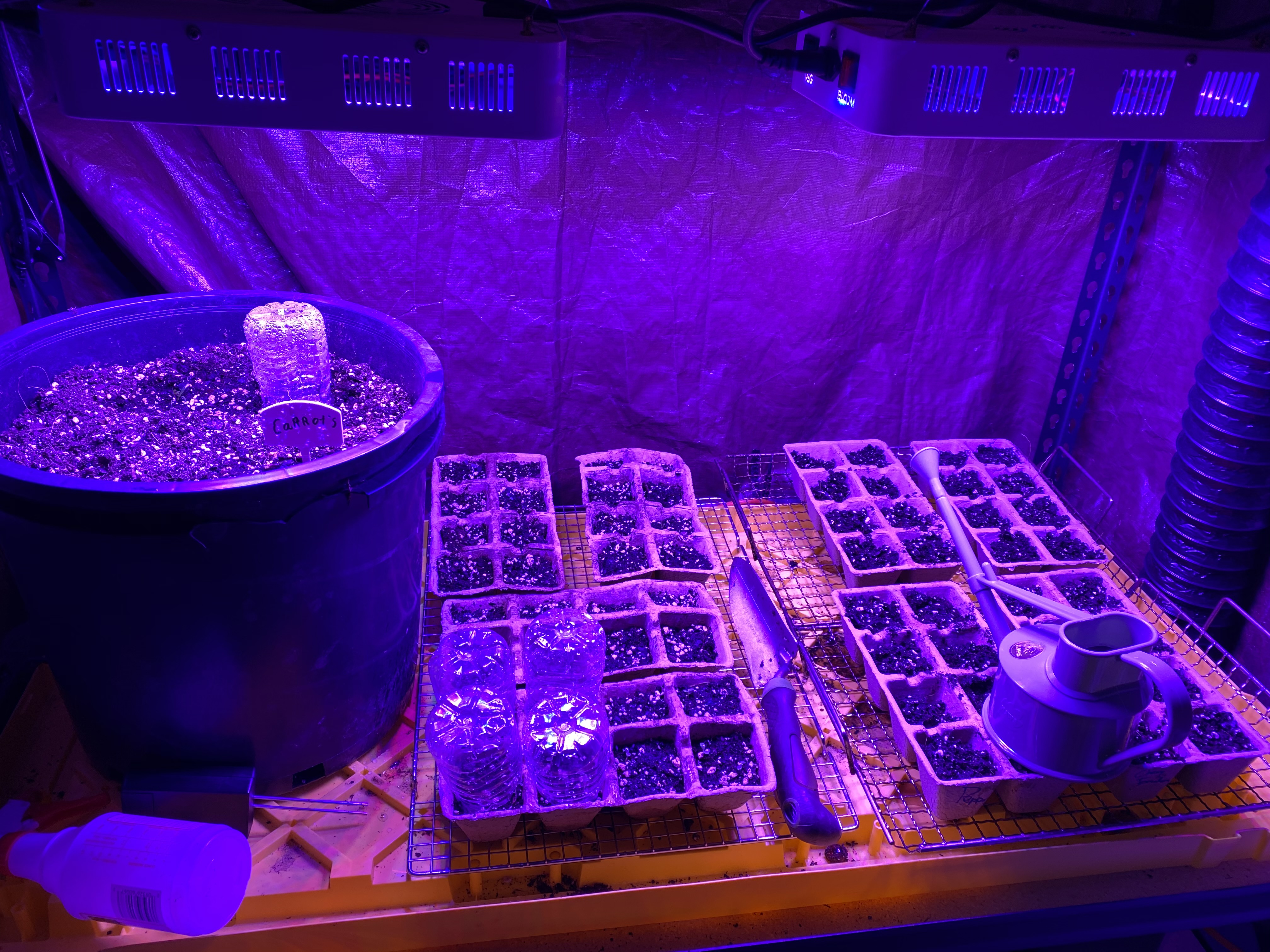
Growing things

Several weeks in, I’m starting to appreciate the data behind growing plants. There’s a lot to consider, from the temperature to types and amount of light, to humidity and how the plants react to humidity through a calculation to determine the vapor pressure deficit (VPD).

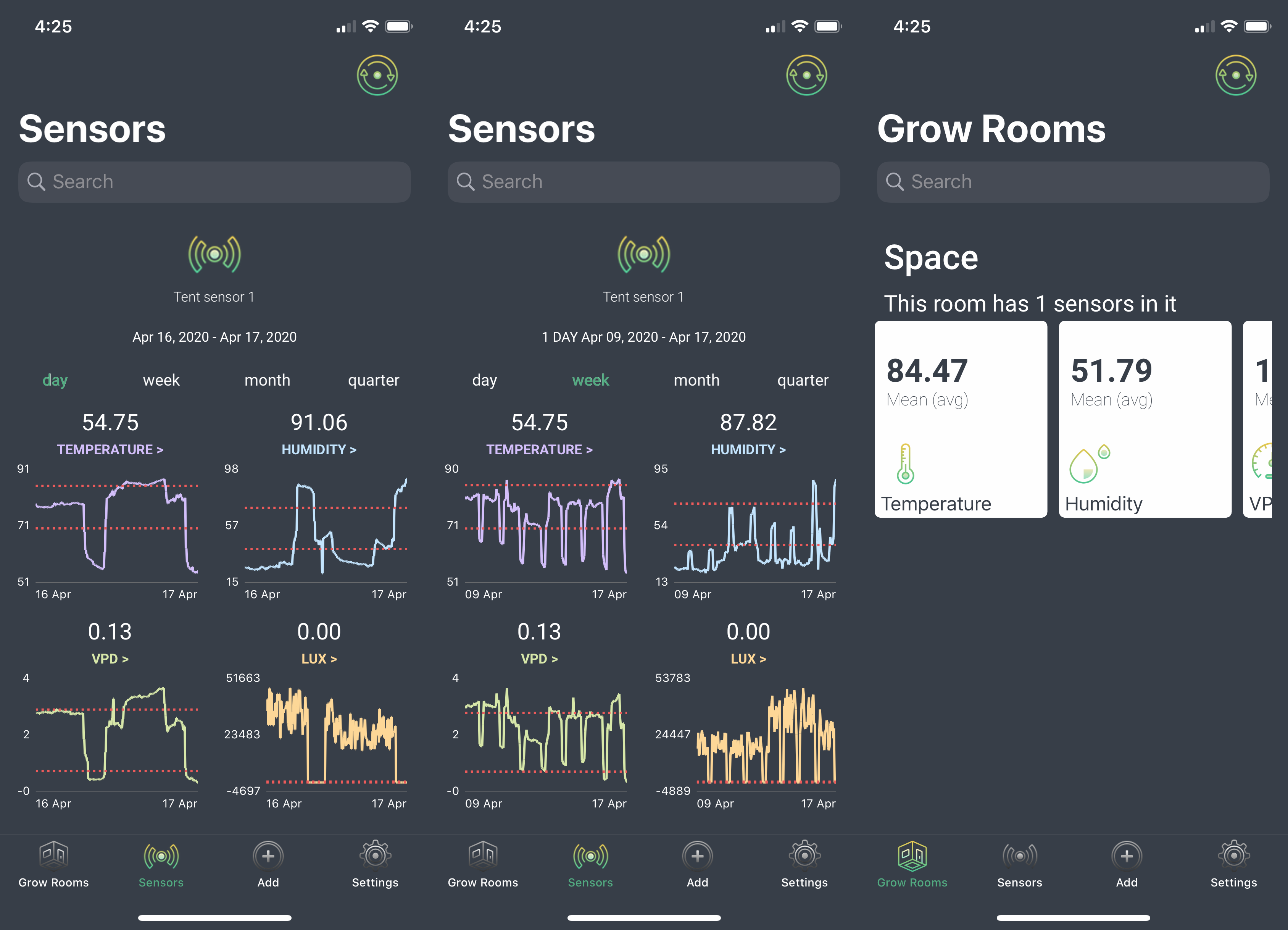
I have a Mendel Air Sensor hanging in one grow tent (pictured at the top), and it’s my new obsession. The small green device collects four data points every 15 minutes and displays the information through a web app or smartphone app. This is allowing me to fine-tune the controlled environment through exhaust fans, light placement and humidifier levels.

As I’ve found, it’s critical to watch this data throughout the day. I’ve yet to stabilize the environment to a point where I set it and forget it. About twice a day, because of the Mendel Air Sensor, I make slight changes to the growing tent, which results in dramatic changes to the environment. Without access to this data, I wouldn’t know something is off until the plant shows warning signs — and as I understand it, that’s when it’s too late.

At $99, it’s a good value, and there are only a few competitors in the space. Most are double or triple the price, though their charting products seem more mature.
CEO Nate Levine tells TechCrunch Mendel started as a 50/50 partnership with another bootstrapped company, RapidLED out of the Bay Area. This company has sold lights for indoor growers for the last few years and already has an established base of customers in this field. But Levine didn’t start to build a product for monitoring plants; instead, he created, FishBit, a product for monitoring aquariums.

The parallels between the two markets helped Levine’s team jump into the indoor gardening space. As Levine told TechCrunch, the consumer demands are similar, and like with aquariums, indoor growers are increasingly looking for ways to increase capabilities. Instead of keeping fish alive, though, they’re trying to get more tomatoes. Or weed.

Levine said that unlike with aquariums, indoor growers can be less stingy with their cash, though, right now, with cannabis, margins are slim. There isn’t a gold rush, he said, but noted that the cannabis market, in particular, is at the right spot for companies to launch new products.

The company is marketing the same product to home growers, and commercial growers thought this could be a challenge with the current web app. It lacks robust features found on other products. For a small grower like me, it’s okay, but I expect commercial customers expect better logging, more detailed analysis and a variable monitoring cycle instead of just every 15 minutes.

To make it available for international users, the company needs to swap out the USB power supply.

Don’t call this is a pivot. Or at least Levine doesn’t call it a pivot. As he told TechCrunch, if he goes back to the original pitch deck, the company is still driving at the same goal for FishBit, and everything the team learns on Mendel is implemented in FishBit, too. The goal is to build an entire product line of smart hardware and software for the indoor grower.

RapidLED approached Levine and the team at an aquarium conference and offered to build the hardware if Levine could make the software. My plants are happy that the two companies forged the partnership.

As for my plants, I’ve learned a few things because of the Mendel Air Sensor. First, my grow lights put out much more heat than I expected, and I need to dump the cheap set and get a name brand unit. Second, the humidity was much lower than I had expected, so I added a humidifier. Finally, monitoring the VPD is much easier than it seems if the calculations are automated.

Growing plants is hard, but it’s easier with the data from the Mendel Air Sensor.

Sales startup People.ai lays off 18% of staff, raises debt round amid COVID-19 uncertainty

Another startup has turned to downsizing and fund raising to help weather the uncertainty around the economy amid the global coronavirus health pandemic. People.ai, a predictive sales startup backed by Andreessen Horowitz, Iconiq, Lightspeed and other investors and last year valued at around $500 million, has laid off around 30 people, working out to about 18% of staff, TechCrunch has learned and confirmed.

Alongside that, the company has quietly raised a debt round in the “tens of millions of dollars” to make strategic investments in new products and potentially other moves.

Oleg Rogynskyy, the founder and CEO, said the layoffs were made not because business has slowed down, but to help the company shore up for whatever may lie ahead.

“We still have several years of runway with what we’ve raised,” he noted (it has raised just under $100 million in equity to date). “But no one knows the length of the downturn, so we wanted to make sure we could sustain the business through it.”

Specifically, the company is reducing its international footprint — big European customers that it already has on its books will now be handled from its U.S. offices rather than local outposts — and it is narrowing its scope to focus more on the core verticals that make up the majority of its current customer base.

He gave as an example the financial sector. “We create huge value for financial services industry but have moved the functionality for them out to next year so that we can focus on our currently served industries,” he said.

People.ai’s software tracks the full scope of communication touch points between sales teams and customers, supposedly negating the tedious manual process of activity logging for SDRs. The company’s machine learning tech is also meant to generate the average best way to close a deal — educating customer success teams about where salespeople may be deviating from a proven strategy.

People.ai is one of a number of well-funded tech startups that is making hard choices on business strategy, costs and staffing in the current climate.

Layoffs.fyi, which has been tallying those losing their jobs in the tech industry in the wake of the coronavirus (it’s based primarily on public reports with a view to providing lists of people for hire), says that as of today, there have been nearly 25,000 people laid off from 258 tech startups and other companies. With companies like Opendoor laying off some 600 people earlier this week, the numbers are ratcheting up quickly: just seven days ago, the number was just over 16,000.

In that context, People.ai cutting 30 may be a smaller increment in the bigger picture (even if for the individuals impacted, it’s just as harsh of an outcome). But it also underscores one of the key business themes of the moment.

Some businesses are getting directly hit by the pandemic — for example, house sales and transportation have all but halted, leaving companies in those categories scrambling to figure out how to get through the coming weeks and months and prepare for a potentially long haul of life and consumer and business behavior not looking like it did before January.

But other businesses, like People.ai, which provides predictive sales tools to help salespeople do their jobs better, is (for now at least) falling into that category of IT still in demand, perhaps even more than ever in a shrinking economy. In People.ai’s case, software to help salespeople have better sales conversations and ultimately conversions at a time when many customers might not be as quick to buy things is an idea that sells right now (so to speak).

Rogynskyy noted that more than 90% of customers that are up for renewal this quarter have either renewed or expanded their contracts, and it has been adding new large customers in recent weeks and months.

The company has also just closed a round of debt funding in the “tens of millions” of dollars to use for strategic investments.

It’s not disclosing the lender right now, but it opted for debt in part because it still has most of its most recent round — $60 million raised in May 2019 led by Iconiq — in the bank. Although investors would have been willing to invest in another equity round, given that the company is in a healthy position right now, Rogynskyy said he preferred the debt option to have the money without the dilution that equity rounds bring.

The money will be used for strategic purposes and considering how to develop the product in the current climate. For example, with most people now working from home, and that looking to be a new kind of “normal” in office life (if not all the time, at least more of the time), that presents a new opportunity to develop products tailored for these remote workers.

There have been some M&A moves in tech in the last couple of weeks, and from what we understand People.ai has been approached as well as a possible buyer, target and partner. All of that for now is not something the company is considering, Rogynskyy said. “We’re focused on our own future growth and health and making sure we are here for a long time.”

GM delivers first ventilators under 30,000-unit government contract

Ventilators assembled by GM and Ventec Life Systems were delivered to hospitals Thursday night with more making their way to facilities today and through the weekend, the first in a 30,000-unit order with the U.S. government.

The deliveries, which went to hospitals in Chicago and Olympia Fields, Ill., are a milestone for the two companies that launched an effort less than a month ago to make thousands of ventilators for hospitals during the COVID-19 pandemic.

GM and Ventec announced a partnership March 20 to help increase production of respiratory care products such as ventilators. The companies had initially focused on making Ventec’s critical care ventilators, called VOCSN, a higher-end multi-function device that includes a ventilator, oxygen concentrator, cough assist, suction and nebulizer. The device, which has more than 700 components, was cleared in 2017 by the FDA.

GM investigated the feasibility of sourcing the materials needed as well as what it would take to build a new clean room and production line within its Kokomo, Ind. factory. GM estimated it would cost about $750 million, a price that included retrofitting a portion of the engine plant, purchasing materials to make the ventilators and paying the 1,000 workers needed to scale up production, the source said. The remaining $250,000 of estimated costs came from Ventec.

The Trump Administration balked at the price tag, putting a contract with the U.S. government in limbo. GM and Ventec planned to push ahead anyway, even as President Trump used Twitter to criticize the automaker and its CEO, Mary Barra . Trump then signed a presidential directive ordering GM to produce ventilators and to prioritize federal contracts, just hours after the automaker announced plans to manufacture the devices.

In spite of the scuffle, GM did reach a $490 million contract with the federal government to produce 30,000 ventilators by the end of August. Under the contract, GM is producing a different critical care ventilator from Ventec called the VOCSN V+Pro, a simpler device that has 400 parts. The other more expensive and complex machine had a multi-function capability.

To speed its ability to build ventilators, the government contract calls for the VOCSN unit with ventilator capability only, according to GM.

Production began this week with one shift of workers and is ramping up. Eventually, GM has plans to add a second and then a third shift in the coming weeks, according to a company spokesperson. More than 1,000 workers will be needed over the three shifts.

To date, 10 ventilators have been delivered to Franciscan Health in Olympia Fields. Another 10 were expected to be delivered Friday afternoon to Weiss Memorial Hospital in Chicago. A third shipment of 34 ventilators will be delivered Saturday to the Federal Emergency Management Agency at the Gary/Chicago International Airport for distribution to other locations where the need is the greatest, according to GM.

The need for ventilators is urgent as cases of COVID-19 pop up with increasing frequency as widespread testing begins. While some people with COVID-19 reported more mild symptoms, others have experienced severe respiratory problems and need to be hospitalized. The shortage has prompted automakers, including Ford and Volkswagen, to investigate ways of ramping up ventilator production. Ford and GE Healthcare have licensed a ventilator design from Airon Corp and plan to produce as many as 50,000 of them at a Michigan factory by July.

Automakers are also making face masks, face shields and Powered Air-Purifying Respirators (PAPRs) for healthcare workers.

Early Monzo employee Simon Balmain is joining Sphere, the group chat app founded by ex-Yahoo Nick D’Aloisio

If you have ever attended (or tuned into) one of Monzo’s many community events, you are likely familiar with the work of Simon Balmain. An early employee of the challenger bank, he has played a long-term role in helping to build Monzo’s customer support and community efforts and was often seen emceeing events.

Now TechCrunch has learned that Balmain is departing to join Sphere, the perpetually stealthy startup founded by Nick D’Aloisio, who previously founded news summary app Summly, which he famously sold to Yahoo at the age of 17 for a reported $30 million.

According to sources, former “Monzonaught” Balmain will be tasked with helping bolster Sphere’s community efforts. Sphere began life as a question and answer app that let you find and instantly chat to paid experts on a range of topics but has since pivoted to a chat app built from the ground up for groups.

“Sphere is a chat app for groups to feel closer and achieve more, together,” reads the App Store’s description. Features listed for Sphere Group Chat include the ability to create multiple chats for a single group; send highlighted announcements so no one in a group misses important messages; and send notifications to individuals or everyone who hasn’t read your message “in just one tap”.

Meanwhile, we first reported on London-based Sphere’s existence back in October 2017, after being tipped off by sources and uncovering regulatory filings revealing that D’Aloisio had raised funding from Index Ventures, and LocalGlobe (the early-stage VC firm founded by Robin and Saul Klein). And in March last year, the FT reported that Sphere had raised a total of $30 million, adding Michael Moritz as a backer, and noting that the startup had unusually remained in stealth for a whopping 2.5 years.

That was a whole year ago. With a newly recruited community specialist, a less opaque launch is unlikely to be too far away.

Samsung’s new Galaxy Watch app reminds you to wash your damn hands, dummy

A few months ago, the idea of a hand-washing app would have seemed trivial, at best. We’re all adults here, right? We’ve been washing our hands our entire lives. But things change. It’s mid-April and we’re afraid to go outside and engage with other humans — and thorough hand-washing is one of very few tools we have in our collective arsenal.

Life, am I right?

According to Samsung, “a small group of designers and developers from Samsung Research Institute-Bangalore, or SRI-B’s UX and wearable teams, worked round-the-clock over the last two weeks to come up with a solution that helps you keep healthy and safe.”

They came out the other side with Hand Wash, a Galaxy Watch app designed to remind wearers to wash their hands for at least 20 seconds. There are preset intervals for the reminders, which can be customized by the wearer. The app gives a buzz at the end of 25 seconds — the extra five seconds were tacked on for the application of soap.

The app tracks washings and shows the amount of time that’s elapsed since you last washed. It’s the kind of things that would be absolutely crazy-making normally, but these days are anything but. It’s available now for download in the Galaxy Store.

Bradley Tusk on starting a company and seed investing in the coronavirus era

Bradley Tusk has carved a unique path in the VC investment landscape: A longtime political and communications operative, he has built a track record for Tusk Ventures by going after highly regulated industries, rather than shying away from them.

Whether it is ride-hailing, sports betting, cannabis or myriad other regulated sectors, Tusk takes the approach that laws are ultimately malleable, and if a service is popular, its users can mobilize to effect change.

Given his unique perspective, it was great to have him join us this week in an Extra Crunch Live call — our new initiative here at TechCrunch to bring tech-world thought leaders right to your screens.

In our conversation, Tusk talked about edtech, telemedicine, cannabis, mobile voting, biotech, pandemics and the future of regulated industries in this dastardly economic environment. We’ve transcribed a handful of his answers to our and our readers’ questions and have embedded the entire video below the fold.

We’ve edited his written answers for clarity and brevity.

Doist founder Amir Salihefendic explains why his remote team doesn’t try to do everything in real time

Does working from home have to mean sitting in a chatroom all day or always being available for a video call?

Real-time chat and video platforms are great for building camaraderie and maintaining a sense of connection with remote teams, but when you need to focus for a few hours, it can be tough to tune out the endless GIFs and notifications.

Some of the most successful fully remote companies (like GitLab, or Zapier) have promoted the benefits of asynchronous communication — a fancy way of saying that not every conversation needs to happen in real time. Your server is down? You probably need to have that conversation now. Brainstorming a new feature? That might work best when everyone has a bit more time to think between responses. The key is acknowledging the strengths of both synchronous and asynchronous communications — and finding the right mix.

Doist co-founder Amir Salihefendic has been an async advocate for years. After leading a team spread around the globe to build popular task management tool Todoist, he set out to build Twist, a tool specifically built for conversations that deserve a longer shelf life.

I chatted with Amir last week to hear his thoughts on the strengths and weaknesses of both approaches, how he balances the two (and handles emergencies) and why he has focused heavily on making async a part of his company’s culture. Here’s a transcript of our chat, lightly edited for clarity and brevity.

TechCrunch: How big is Doist now?

Amir Salihefendic: I think we are about 73 people spread around 30 different countries now. [We’re on] most of the continents around the world.

Why’d you go remote in the first place? What made you make that call?

Trump’s hype for state lockdown protests puts Twitter and Facebook’s new COVID-19 policies to the test

A new flurry of tweets from President Trump is pushing the limits of social platform policies designed explicitly to keep users safe from the spread of the novel coronavirus, both online and off.

In a series of rapid-fire messages on Friday morning, Trump issued a call to “LIBERATE” Virginia, Minnesota and Michigan, all states led by Democratic governors. Trump’s tweets promoted protests in those states against ongoing public safety measures, many designed by his own administration, meant to keep residents safe from the virus. Trump also shared the messages on his Facebook page.

In the case of Minnesota, the tweet was not a generic message to his supporters in the state — it referenced a Friday protest event by its name, “Liberate Minnesota.”

LIBERATE MINNESOTA!

— Donald J. Trump (@realDonaldTrump) April 17, 2020

LIBERATE VIRGINIA, and save your great 2nd Amendment. It is under siege!

— Donald J. Trump (@realDonaldTrump) April 17, 2020

In Minnesota, the in-person protest event gathered a group of Trump supporters outside the St. Paul home of Minnesota Governor Tim Walz to protest the state’s ongoing lockdown. According to a reporter on the scene Friday, the protest had attracted attendees in the “low hundreds” so far and few were practicing social distancing or wearing masks. The event was organized on Facebook.

Scheduled start time was noon and the crowd looks to be in the low hundreds. This is *only* an eyeball estimate. There’s also a fair number of drivebys – vehicles with flags or writing on the sides driving down Summit, honking, waving to protesters.

— Patrick Condon (@patricktcondon) April 17, 2020

“President Trump has been very clear that we must get America back to work very quickly or the ‘cure’ to this terrible disease may be the worse option!,” the event’s Facebook description states. In a later disclaimer, event organizers encourage attendees to exercise “personal responsibility” at the protest, stating that they “are not responsible for your current health situation or future health.”

The president’s tweets contradict his administration’s own guidance, detailed yesterday in coordination with health experts, on reopening state economies. Earlier this week, Trump claimed that a president has “total authority” to reopen the national economy, a sentiment that his tweets Friday appeared to undermine.

Trump’s calls to action in support of state-based protests would also appear to potentially contradict both Twitter and Facebook’s new rules specific to the pandemic, which in both cases explicitly forbid any COVID-19 content that could result in the real-world spread of the virus.

Over the last month, Facebook and Twitter both rolled out relatively aggressive new policies designed to protect users from content contradicting the guidance of health experts, particularly anything that could result in real-world harm.

In late March, Twitter updated its safety policy to prohibit any tweets that “could place people at a higher risk of transmitting COVID-19.” The stance banned tweets claiming social distancing doesn’t work as well as anything with a “call to action” that could promote risky behaviors, like encouraging people to go out to a local bar.

On April 1, Twitter again broadened its definition for the kind of harmful COVID-19 content it forbids, stating that it would “continue to prioritize removing content when it has a clear call to action that could directly pose a risk to people’s health or well-being.”

Facebook similarly expanded its platform rules to match the existential health threat posed by the coronavirus. In guidance on its policies for the pandemic, Facebook says that it “remove[s] COVID-19 related misinformation that could contribute to imminent physical harm.” As an example, the company noted that in March it began removing “claims that physical distancing doesn’t help prevent the spread of the coronavirus.”

Social media companies signaled early in the U.S. spread of the coronavirus that they would take health misinformation — and the safety of their users — more seriously than ever. In some instances, this tough talk appears to have manifested in improvements: Facebook, which has generally been more proactive about health misinformation compared to other topics, moved to promote health expertise and limit the spread of misleading coronavirus content on the platform, even announcing that it would notify anyone who had interacted with COVID-19 misinformation with a special message in their news feed.

Update: According to a Twitter spokesperson, the president’s tweets do not currently violate Twitter’s rules. Twitter does not consider the tweets as worded a “clear call to action” that could pose a health risk. Twitter also did not determine that the tweets were shared with harmful intentions.

In a statement to TechCrunch, Facebook did not say that the president’s posts violated the platform’s rules. “Unless government prohibits the event during this time, we allow it to be organized on Facebook,” a spokesperson said. “For this same reason, events that defy government’s guidance on social distancing aren’t allowed on Facebook.”


View, the dynamic glass company that raised $1.1 billion from SoftBank in 2018, is laying people off

View, a 13-year-old, Milpitas, Calif.-based company that makes dynamic glass designed to reduce heat and glare as well as lessen eyestrain, has cut an unknown number of employees, including at a plant in Olive Branch, Mississippi.

One employee of several years, an IT manager, wrote on LinkedIn that he was laid off owing to the pandemic. Another employee of the company — an engineer and project manager — wrote on LinkedIn that he has also been laid off and that the company “really cleaned house.”

This individual added that several other “long timers” had also lost their jobs.

One of the former View employees confirmed the layoff but offered that he was not authorized to speak on behalf of the company. A request for help from the company’s head of communications went unreturned today.

View — which touts its glass as a way for real estate owners to attract commercial tenants as well to improve energy consumption by up to 20 percent —  is among a large stable of companies that raised enormous amounts of capital from SoftBank’s Vision Fund over the last two years.

The funding that was provided by the outfit — $1.1 billion in early November 2018 — was notable at the time in part because it included no other investors.

The round was also announced at a trying time for the Vision Fund —  roughly one month after the journalist and Saudi dissident Jamal Khashoggi was murdered at the Saudi consulate in Istanbul, Turkey, drawing increased scrutiny of both Saudi Arabia and to the Vision Fund.

As many industry watchers will know, the Japanese conglomerate had raised nearly half the capital for its massive Vision Fund from the Public Investment Fund of Saudi Arabia. Though no one in Silicon Valley was willing to speak up at the time about the episode, SoftBank’s checks were presumably seen as radioactive in that moment to at least some founders.

Indeed, as the round was being announced, CEO Rao Mulpuri told Bloomberg that the deal predated Khashoggi’s murder, explaining that, “Obviously, what happened in the region there is quite concerning. But, at the same time, we’ve now built a relationship of getting to know SoftBank over a long period of time, and we are quite comfortable moving forward with this investment.”

View has been selling its glass to building owners and commercial real estate developers. On its site, it features a testimonial from a 14-person development firm in Utah named Cottonwood Partners, for example.

Real estate, as with transportation and fintech, has been a major area of interest for SoftBank. Other related portfolio companies include Katerra, a tech-driven construction company that had run into troubles well before this year, according to several reports by The Information, and Opendoor, the home-buying company that earlier today announced that it was laying off 35 percent of its employees.

Though the construction industry has been hard hit since the coronavirus first gripped the U.S. market and largely shut the nation down, it is still operating in some pockets, saved by the belief in some states and cities that certain projects constitute essential business.

Earlier this month, for example, crews were at work on apartment buildings just south of West Hollywood. Asked by the New York Times to explain, officials agreed the work was essential, while a spokesman for the Los Angeles Police Department called what was happening “uncharted territory for all of us.”

Before SoftBank came onto the scene, View had raised about $800 million over the years, including from Corning, Madrone Capital Partners, TIAA Investments and a New Zealand sovereign wealth fund.

Heading into its current layoff, which was announced to employees yesterday, View had roughly 600 employees, according to LinkedIn.

Financial tech startup Previse raises $11 million to help suppliers get paid faster

Previse, a fintech focused on helping suppliers get faster payment, announced that it has raised $11 million in new funding led by Reefknot Investments and Mastercard. Returning investors Bessemer Venture Partners, Hambro Perks and Augmentum Fintech also participated.

Founded in 2016, Previse says it currently processes about 100,000 invoices a day, and its goal is to handle payments for five million suppliers within the next five years.

This round brings Previse’s total raised so far to more than $21.8 million and will be used to expand its InstantPay product to more corporate buyers around the world. Previse is taking part in Mastercard’s Start Path accelerator program. Reefknot was founded by Temasek Holdings and Kuehne + Nagel last year to invest in logistics and supply chain startups.

Paul Christensen, the founder and CEO of Previse, told TechCrunch that InstantPay allows corporate buyers to send quick payments to suppliers by using machine-learning based technology to analyze historical data and predict which invoices can be paid immediately, and which ones are potentially higher risk and need to be checked manually.

Traditional invoice payment methods used by large buyers can take up to months to complete, putting pressure on the cash flow of small- to medium-sized businesses. Christensen said this is due to a combination of corporate policy, including the terms and conditions of a sale, and the amount of administrative tasks, including inputting, checking and approving invoices, that need to be performed. InstantPay can reduce that timeframe down to a day.

Rapid payment to suppliers is even more important during the COVID-19 pandemic, he added.

“The pandemic has put a huge strain on the working capital of companies, large and small, all over the world, causing a severe cash crunch. Previse’s platform can unlock working capital, meaning that the tens of thousands of SME suppliers who supply to a large corporate chain can be paid on day one, rather than having to wait weeks or months,” he said.

“This is critical now when supply chains have been disrupted, but it will also be critical when we come out the other side and there is a demand surge and supplier supplies have to fulfill large orders.”