Sure, emissions have fallen. But a closer look at how the global crisis is influencing the environment reveals some surprising dynamics.
Category: Tech news
hacking,system security,protection against hackers,tech-news,gadgets,gaming
The Pandemic Can Taint the Memory of Things We Love
Music, binge-watching, sourdough starters—these things are helping people cope. Will coronavirus also ruin them forever?
Portable Printers Bring Your Smartphone Photos to Life
These devices connect to your phone over Bluetooth and make wallet-sized prints you can hang on the fridge or sanitize and share.
The Supercilious Side Effects of F/X
Ah, blockbuster season—when the Hollywood hills come alive with the chorus of Criterion collectors huffing out their blanket disdain for CG magic.
Film Photography Can Never Be Replaced
Old-school image-making liberates us from algorithms—and helps us pursue an unfiltered connection with our own creativity.
Coders Who Survived Human Trafficking Rewrite Their Identities
At a Bay Area nonprofit, former abuse victims learn to code and level up their futures. A photographer and an artist weave together their stories.
Six-Word Sci-Fi: Formulate a Defense Against Digital-Age Autocrats
Each month we publish a six-word story—and it could be written by you.
The Literature of Plagues Gives Us Words to Live By
In dark times, we turn to stories in which history might be turned back. But it’s poetry and farce that will lead us through despair.
Clubhouse voice chat leads a wave of spontaneous social apps
Forget the calendar invite. Just jump into a conversation. That’s the idea powering a fresh batch of social startups poised to take advantage of our cleared schedules amidst quarantine. But they could also change the way we work and socialize long after COVID-19 by bringing the free-flowing, ad-hoc communication of parties and open office plans online. While “Live” has become synonymous with performative streaming, these new apps instead spread the limelight across several users as well as the task, game, or discussion at hand.
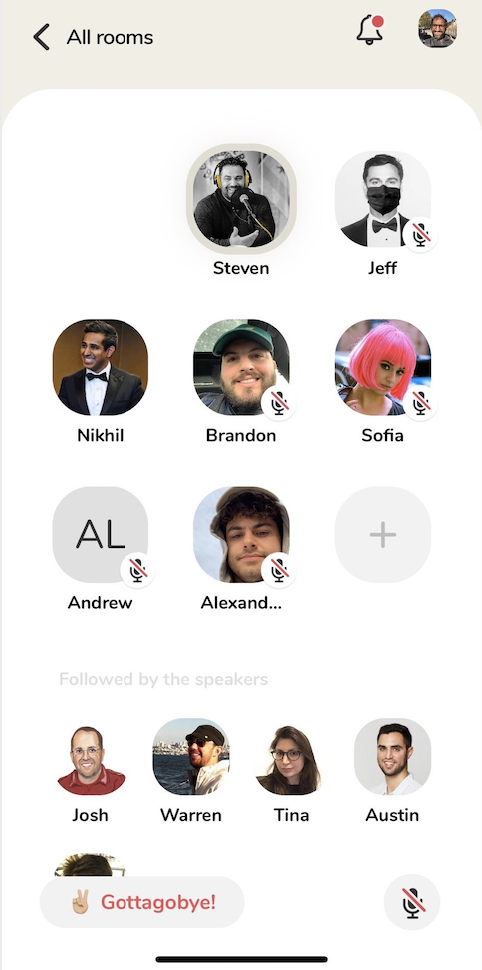 The most buzzy of these startups is Clubhouse, an audio-based social network where people can spontaneously jump into voice chat rooms together. You see the unlabeled rooms of all the people you follow, and you can join to talk or just listen along, milling around to find what interests you. High-energy rooms attract crowds while slower ones see participants slip out to join other chat circles.
Clubhouse blew up this weekend on VC Twitter as people scrambled for exclusive invites, humblebragged about their membership, or made fun of everyone’s FOMO. For now, there’s no public app or access. The name Clubhouse perfectly captures how people long to be part of the in-crowd.
Clubhouse was built by Paul Davison, who previously founded serendipitous offline people-meeting location app Highlight and reveal-your-whole-camera-roll app Shorts before his team was acquired by Pinterest in 2016. This year he debuted his Alpha Exploration Co startup studio and launched Talkshow for instantly broadcasting radio-style call-in shows. Spontaneity is the thread that ties Davison’s work together, whether its for making new friends, sharing your life, transmitting your thoughts, or having a discussion.
It’s very early days for Clubhouse. It doesn’t even have a website. There’s no telling exactly what it will be like if or when it officially launches, and Davison and his co-founder Rohan Seth declined to comment. But the positive reception shows a desire for a more immediate, multi-media approach to discussion that updates what Twitter did with text.
Sheltered From Surprise
What quarantine has revealed is that when you separate everyone, spontaneity is a big thing you miss. In your office, that could be having a random watercooler chat with a co-worker or commenting aloud about something funny you found on the internet. At a party, it could be wandering up to chat with group of people because you know one of them or overhear something interesting. That’s lacking while we’re stuck home since we’ve stigmatized randomly phoning a friend, differing to asynchronous text despite its lack of urgency.
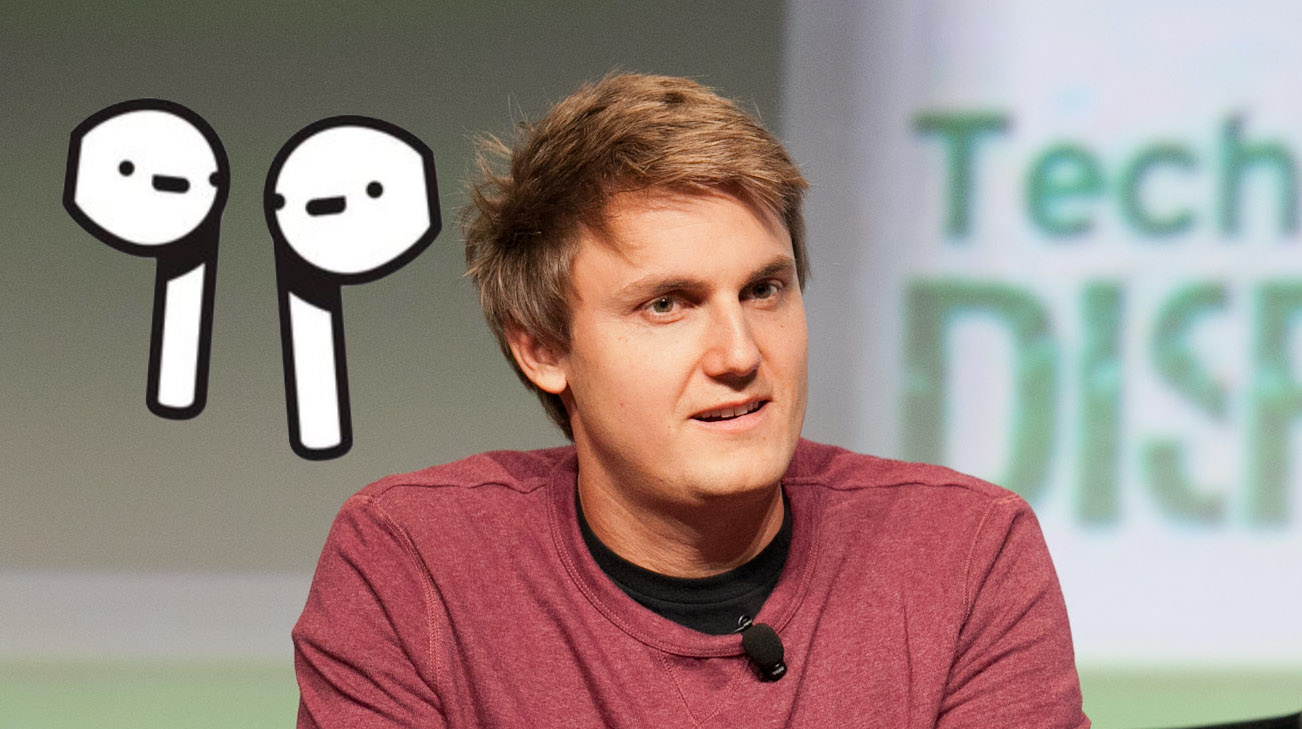
Clubhouse founder Paul Davison. Image Credit: JD Lasica
Scheduled Zoom calls, utilitarian Slack threads, and endless email chains don’t capture the thrill of surprise or the joy of conversation that giddily revs up as people riff off each other’s ideas. But smart app developers are also realizing that spontaneity doesn’t mean constantly interrupting people’s life or workflow. They give people the power to decide when they are or aren’t available or signal that they’re not to be disturbed so they’re only thrust into social connection when they want it.
Houseparty chart ranks via AppAnnie
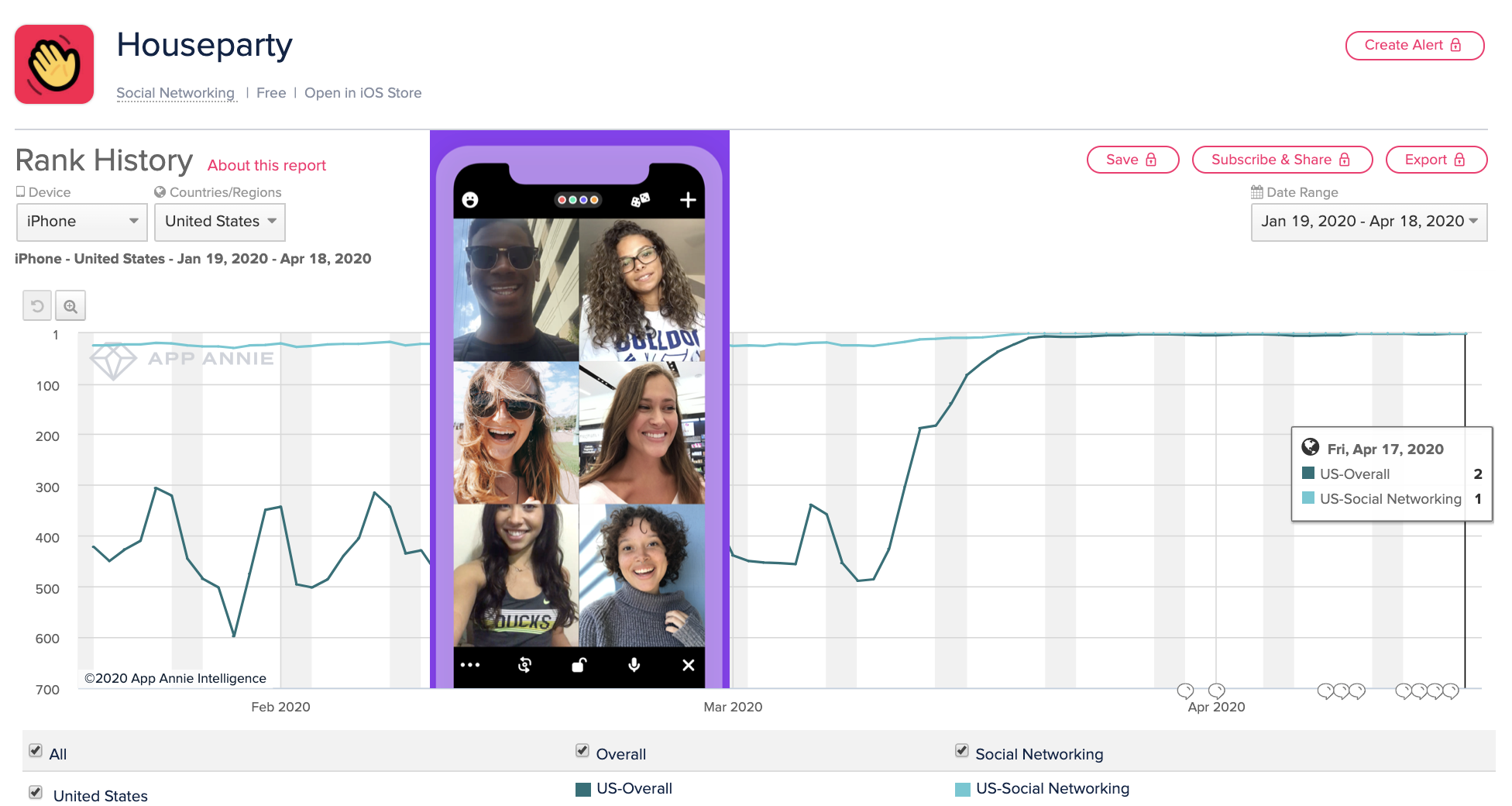
Houseparty embodies this spontaneity. It’s become the breakout hit of quarantine by letting people on a whim join group video chat rooms with friends the second they open the app. It saw 50 million downloads in a month, up 70X over its pre-COVID levels in some places. It’s become the #1 social app in 82 countries including the US, and #1 overall in 16 countries.
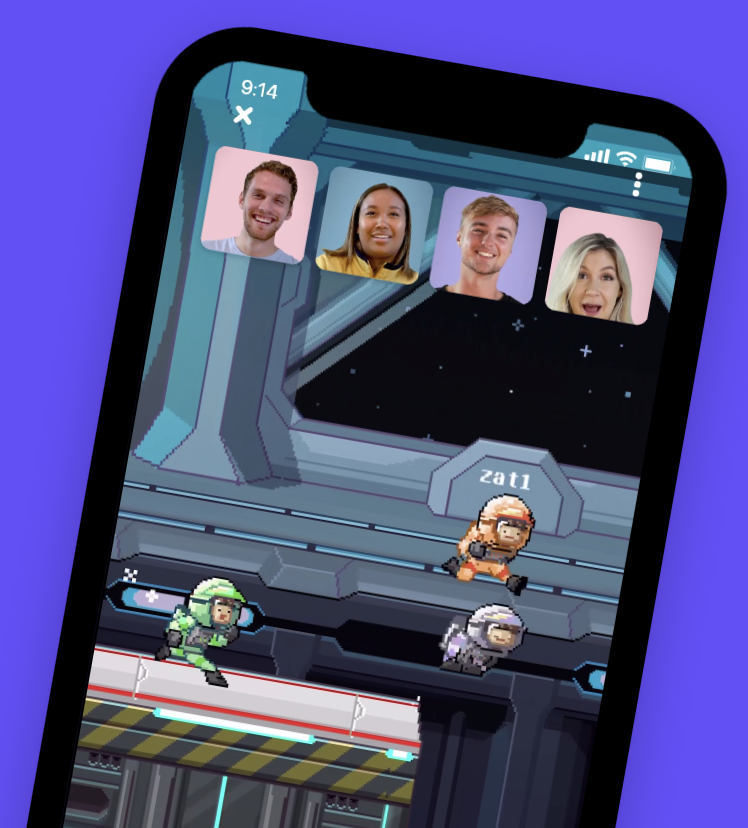
Originally built for gaming, Discord lets communities spontaneously connect through persistent video, voice, and chat rooms. It’s seen a 50% increase in US daily voice users with spikes in shelter-in-place early adopter states like California, New York, New Jersey, and Washington. Bunch, for video chat overlayed on mobile gaming, is also climbing the charts and going mainstream with its user base shifting to become majority female as they talk for 1.5 million minutes per day. Both apps make it easy to join up with pals and pick something to play together.
The Impromptu Office
Enterprise video chat tools are adapting to spontaneity as an alternative to heavy-handed, pre-meditated Zoom calls. There’s been a backlash as people realize they don’t get anything done by scheduling back-to-back video chats all day.
- Loom lets you quickly record and send a video clip to co-workers that they can watch at their leisure, with back-and-forth conversation sped up because videos are uploaded as they’re shot.
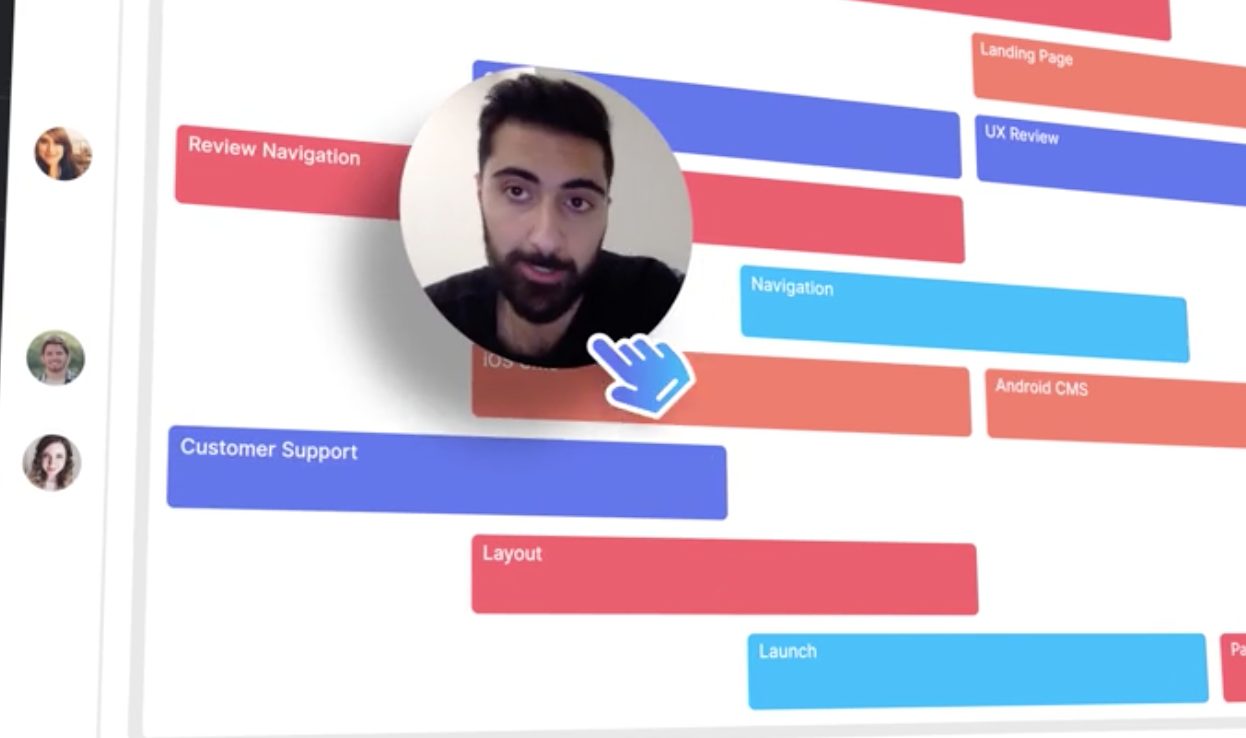
- Around overlays small circular video windows atop your screen so you can instantly communicate with colleagues while most of your desktop stays focused on your actual work.

- Screen exists as a tiny widget that can launch a collaborative screenshare where everyone gets a cursor to control the shared window so they can improvisationally code, design, write, and annotate.
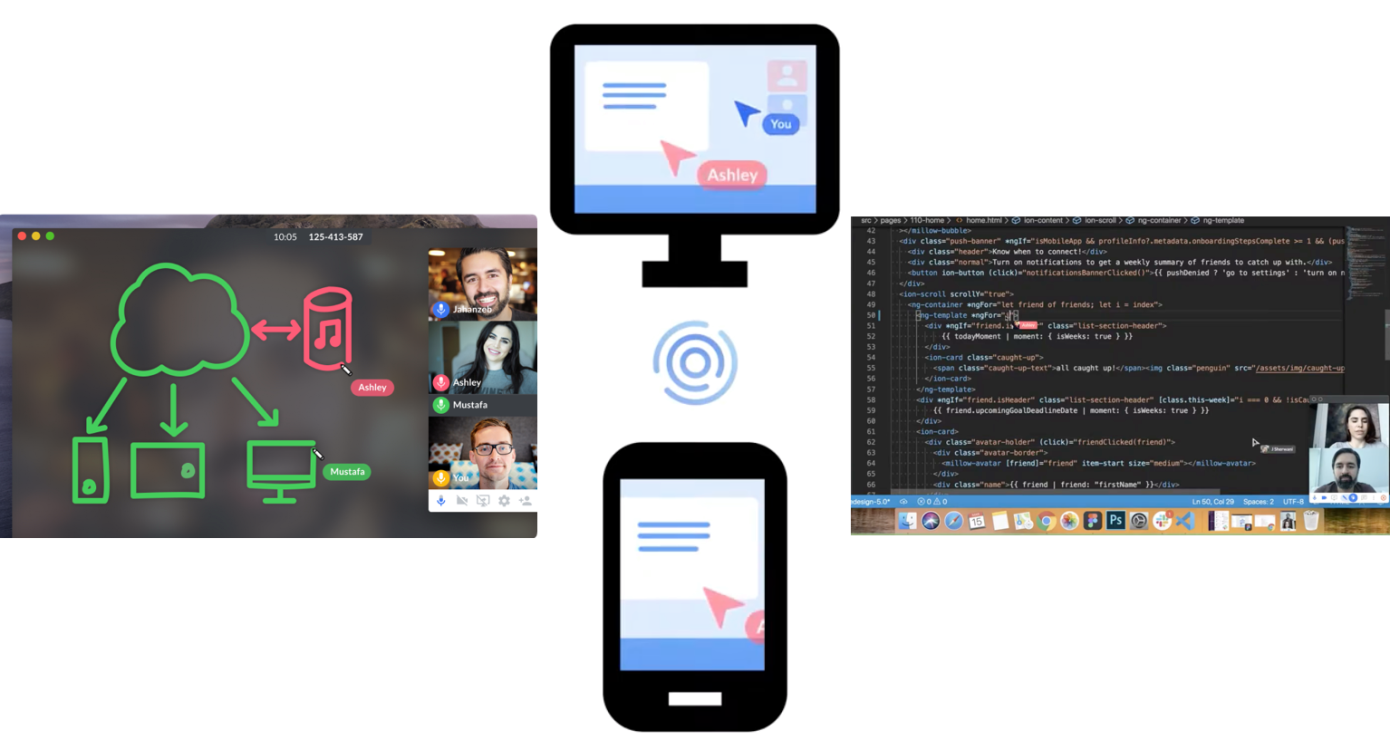
Screen
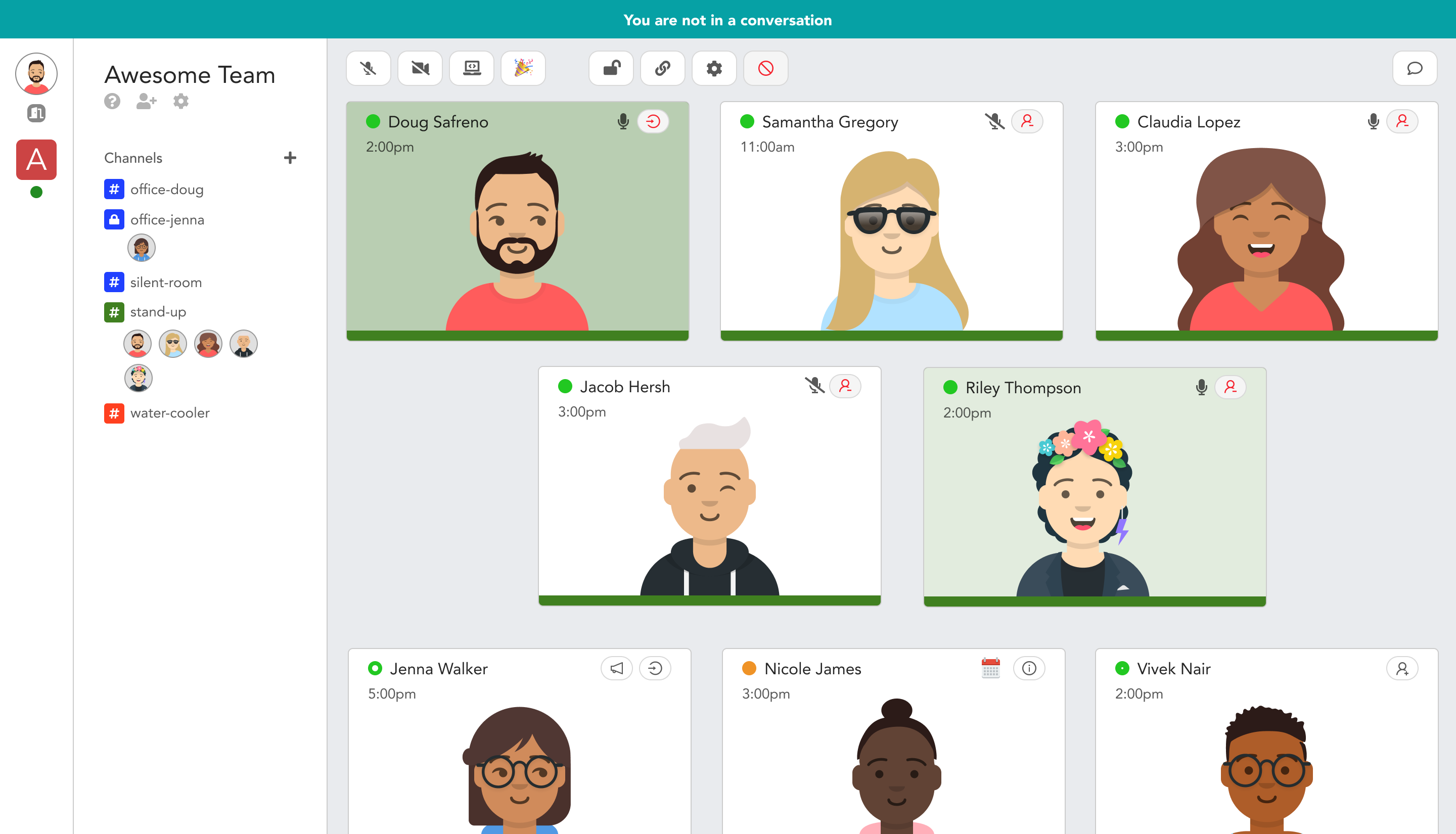
- Pragli is an avatar-based virtual office where you can see if someone’s in a calendar meeting, away, or in flow listening to music so you know when to instantly open a voice or video chat channel together without having to purposefully find a time everyone’s free. But instead of following you home like Slack, Pragli lets you sign in and out of the virtual office to start and end your day.
Raising Our Voice
While visual communication has been the breakout feature of our mobile phones by allowing us to show where we are, shelter-in-place means we don’t have much to show. That’s expanded the opportunity for tools that take a less-is-more approach to spontaneous communication. Whether for remote partying or rapid problem solving, new apps beyond Clubhouse are incorporating voice rather than just video. Voice offers a way to rapidly exchange information and feel present together without dominating our workspace or attention, or forcing people into an uncomfortable spotlight.
High Fidelity is Second Life co-founder Philip Rosedale’s $72 million-funded current startup. After recently pivoting away from building a virtual reality co-working tool, High Fidelity has begun testing a voice and headphones-based online event platform and gathering place. The early beta lets users move their dot around a map and hear the voice of anyone close to them with spatial audio so voices get louder as you get closer to someone, and shift between your ears as you move past them. You can spontaneously approach and depart little clusters of dots to explore different conversations within earshot.
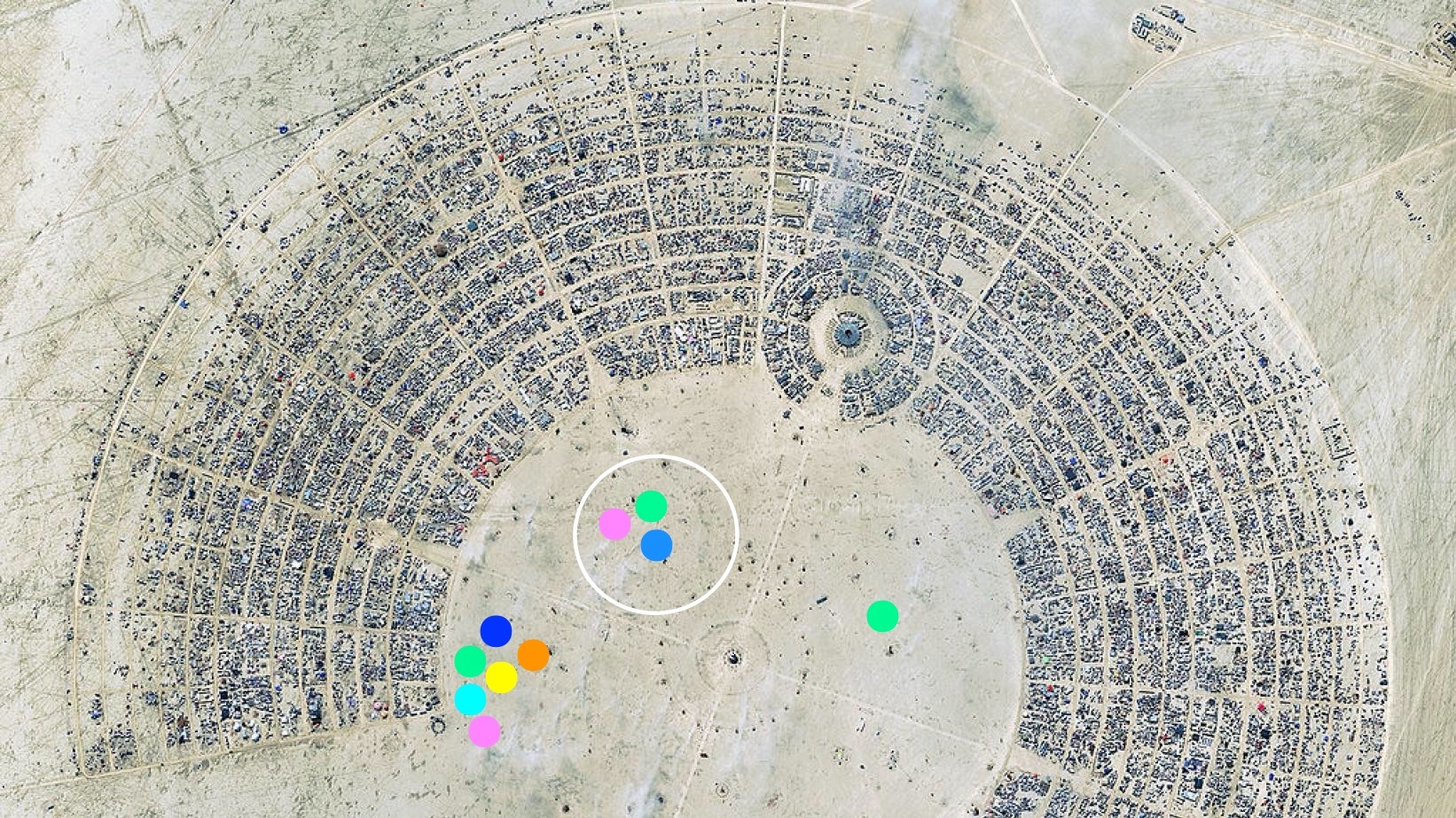
An unofficial mockup of High Fidelity’s early tests. Image Credits: DigitalGlobe (opens in a new window) / Getty Images
High Fidelity is currently using a satellite photo of Burning Man as its test map. It allows DJs to set up in different corners, and listeners to stroll between them or walk off with a friend to chat, similar to the real offline event. Since Burning Man was cancelled this year, High Fidelity could potentially be a candidate for holding the scheduled virtual version the organizers have promised.
Houseparty’s former CEO Ben Rubin and Skype GM of engineering Brian Meek are building a spontaneous teamwork tool called Slashtalk. Rubin sold Houseparty to Fortnite-maker Epic in mid-2019, but the gaming giant largely neglected the app until its recent quarantine-driven success. Rubin left.

His new startup’s site explains that “/talk is an anti-meeting tool for fast, decentralized conversations. We believe most meetings can be eliminated if the right people are connected at the right time to discuss the right topics, for just as long as necessary.” It lets people quickly jump into a voice or video chat to get something sorted without delaying until a calendared collab session.

Slashtalk co-founder Ben Rubin at TechCrunch Disrupt NY 2015
Whether for work or play, these spontaneous apps can conjure times from our more unstructured youth. Whether sifting through the cafeteria or school yard, seeing who else is at the mall, walking through halls of open doors in college dorms, or hanging at the student union or campus square, the pre-adult years offer many opportunities for impromptu social interation.
As we age and move into our separate homes, we literally erect walls that limit our ability to perceive the social cues that signal that someone’s available for unprompted communication. That’s spawned apps like Down To Lunch and Snapchat acquisition Zenly, and Facebook’s upcoming Messenger status feature designed to break through those barriers and make it feel less desperate to ask someone to hang out offline.
But while socializing or collaborating IRL requires transportation logistics and usually a plan, the new social apps discussed here bring us together instantly, thereby eliminating the need to schedule togetherness ahead of time. Gone too are the geographic limits restraining you to connect only with those within a reasonable commute. Digitally, you can pick from your whole network. And quarantines have further opened our options by emptying parts of our calendars.
Absent those frictions, what shines through is our intention. We can connect with who we want and accomplish what we want. Spontaneous apps open the channel so our impulsive human nature can shine through.
Instagram founders launch COVID-19 spread tracker Rt.live
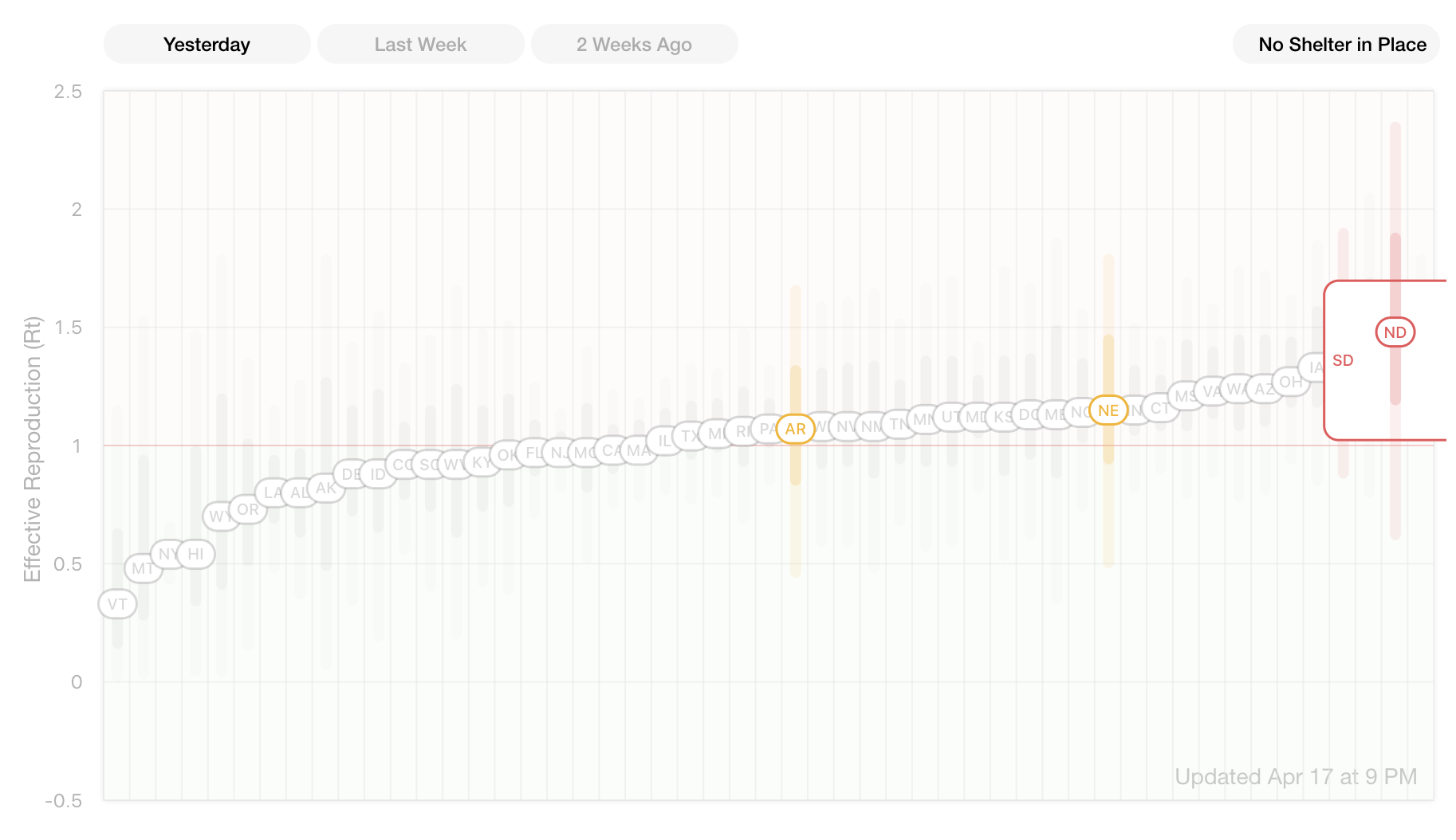
Instagram founders Kevin Systrom and Mike Krieger have teamed up to launch their first product together since leaving the Facebook mothership. Rt.live is an up-to-date tracker of how fast COVID-19 is spreading in each state.
“Rt” measures the average number of people who become infected by an infectious person. The higher above the number 1, the faster COVID-19 races through a population, while a number below one shows the virus receding. For example, Rt.live displays that Georgia has the highest, most dangerous Rt score of 1.5 while New York is down to 0.54 thanks to aggressive shelter-in-place orders.

Krieger tells me that “Kevin has been writing and publishing open-source data analysis notebooks on how to calculate Rt on a daily basis. We wanted to take that work and visualize it so anyone can see how their state is doing at curbing the spread.” Krieger had meanwhile been pitching in by building SaveOurFaves, a directory of local Bay Area restaurants that are selling gift cards so patrons can keep them afloat during quarantine. Built with his wife, the Kriegers open sourced it so people can build similar sites for their communities.
Rt.live shows that as of yesterday, Texas and California are at or just under 1 and Vermont has the best score at 0.33. The charts over time reveal how Washington and Georgia were successfully fighting COVID-19, dipping beneath 1 until the virus bounced back recently. Data is sourced from the COVID Tracking Project and you can examine Rt.live’s modeling system on GitHub.
“As states decide whether and how to open back up, they’ll have to manage their infection rate carefully, and we hope dashboards like rt.live will be helpful in doing so” Krieger says. By better illustrating how even small differences in shelter-in-place policy and compliance can exponentially change the severity of the impact of the virus, it could help convince people to stay inside. This kind of tool could also be helpful for determining where it’d be safe to reactivate some businesses, and quickly catch if virality is spiking and strict social distancing needs to be reinstated.
One fascinating feature of the site is the ability to filter by region so you can see how the Western states are doing better at suppressing COVID-19 than those in the South. You can also view the states with no shelter-in-place orders to see they’re doing worse on average. The charts could help identify how different political orientations and their subsequent policies translate to infection outcomes.
It might seem out of character for the photo app moguls to be building a medical statistics site. But Systrom has long studied virality as part of his work that helped Instagram grow so fast. He began publishing his own statistical models for tracking coronavirus infections and deaths on March 19th. “We’d been talking about ways of working together and this came out of that — my first job out of school was actually doing data visualizations / analysis at Meebo so a blast from the past in more ways than one” Krieger tells me. While Systrom did the data analysis, Krieger built the site, mirroring their old front-end and back-end Instagram roles.
“We built Rt.live because we believe Rt — the effective infection rate — is one of the best ways to understand how COVID is spreading” Kreiger explains. “It was great to work together again — we were able to take it from idea to launch in just a few days because of all our history & shared context.”
Cognizant confirms Maze ransomware attack, says customers face disruption
Cognizant, one of the largest tech and consulting companies in the Fortune 500, has confirmed it was hit by a ransomware attack.
Details remain slim besides a brief statement on its site, confirming the incident.
“Cognizant can confirm that a security incident involving our internal systems, and causing service disruptions for some of our clients, is the result of a Maze ransomware attack,” the statement read. “Our internal security teams, supplemented by leading cyber defense firms, are actively taking steps to contain this incident.”
The New Jersey-headquartered IT giant said it was engaging with the law enforcement.
The company, which offers a range of services including IT consultation to clients in more than 80 countries, posted $16.8 billion in revenue last year. The decades-old firm also maintains a business agreement with Facebook to help the social giant moderate content on its platform. Cognizant employs about 290,000 people, most of whom live in India.
When reached, Cognizant spokesperson Richard Lacroix declined to comment beyond the statement.
Maze is not like typical data-encrypting ransomware. Maze not only spreads across a network, infecting and encrypting every computer in its path, it also exfiltrates the data to the attackers’ servers where it is held for ransom. If a ransom isn’t paid, the attackers publish the files online. However, a website known to be associated with the Maze attackers, has not yet advertised or published data associated with Cognizant.
The FBI privately warned businesses in December of an increase in Maze-related ransomware incidents.
Since the warning, several major companies have been hit by Maze, including cyber insurer Chubb, accounting giant MNP, a law firm and an oil company.
According to Bleeping Computer, which first reported the attack, the Maze hackers denied responsibility for the attack.
“That does not mean Maze was not responsible,” said Brett Callow, a threat analyst and ransomware expert at security firm Emsisoft. “At some point in the last three weeks, Maze also hit two Manitoba law firms, neither of which has been listed.”
“It’s possible the group is holding off naming the firms and publishing any data pending the outcome of negotiations, and that could be the case with Cognizant too,” said Callow.
Startups Weekly: How will tech hubs weather the pandemic?
Cities around the world have become home this decade to distributed tech teams and homegrown startup successes. Each of these additional layers of experience and specialization help to make each local community stronger, like what began happening in Silicon Valley many decades ago.
Now layoffs are striking deep into these fragile, complex ecosystems.
Yes, companies in San Francisco and other tech metros are seeing big cuts, as you can read all about on TechCrunch this week. But the satellite offices also seem to be taking big hits, as Natasha Mascarenhas covered. Data from Layoffs.fyi shows thousands of jobs bleeding out in places like Salt Lake City, Las Vegas and Louisville to name a few.
The immediate reason this is particularly bad is that tech jobs have a multiplier on jobs in other local industries, particularly where there aren’t that many tech jobs. But the bigger long-term risk is that people who might be starting the next company in your city don’t get the hands-on experience and the connections locally and globally that come distributed teams. How long will it take many of the hubs that were going strong just a couple months ago to recover now?
Of course, the even bigger opposing trend is remote work now that everyone is doing it. Will the future founder who was going to move to San Francisco for networking purposes just stay in Louisville, and have a local HQ or just keep it remote-first? Will we still need all that commercial real estate in the Bay Area, actually?
TechCrunch is covering the downs-and-ups of startup hubs during the pandemic (see Extra Crunch for more on Salt Lake City this week, actually). Want to talk about what your city is doing to keep its startup scene strong? Email me at [email protected] and let’s discuss.

Investors rethink consumer and edtech investing
For our first investor survey this week, Josh Constine and Arman Tabatabai talked to 17 top social investors about the impact of COVID-19 on the category. Here’s Wayne Hu of SignalFire, excerpted from the full article on Extra Crunch.
There are, however, other social trends that were already picking up steam before COVID-19 that may further accelerate now. Many of these may be newer behaviors that sound dumb or are hard to explain, but ultimately provide value. Peloton sounded silly to many before they became popular, and there are several other companies now bridging the gap between consumers, trainers and fellow participants to bring the in-person social phenomenon of spin cycle and fitness boutiques into the living room. Tempo, a SignalFire portfolio company, is the first to offer high-intensity strength training complete with weights in the home. Beyond the convenience, 3D sensors automatically track reps and weights and users also receive targeted feedback on form from world-class trainers aided by real-time motion tracking — something that would be too expensive for most consumers otherwise. Coronavirus will be a catalyst for many to experience this and other accelerating trends for the first time.
EC members, don’t miss their social overview survey last week.
Next, Natasha and Arman talked to leading edtech investors for Extra Crunch about how the new coronavirus is impacting their companies. Many startups in the category have suddenly had much brighter futures — with some new challenges. Here’s Tetyana Astashkina of Learn Launch:
A lot of our companies across all segments are offering their products for free. User (teacher) training has always been key to successful product adoption. All of the training happens online now which is new and needs adjustment. Also, the timelines to respond to customer inquiries are very compressed which puts pressure on companies, especially because of eternally limited resources.
K-12 districts need to have budgets in place by the end of June for the next school year. So selling, while giving the product away for free and while supporting un-trained users is going to be a scramble. Now imagine being a cash-starved start-up trying to deal with your own homeschooling needs…
It also follows an overview edtech survey the previous week.

The latest venture shifts in the COVID-19 era
Many VCs continue to say they are open for biz while others say they are ‘focused on helping portfolio companies.’ So here’s what we’re seeing on the fundraising front this week.
First, leading seed-stage VC Y Combinator has scaled down its pro-rata program of recent years. It had taken a 7% stake in every company that has raised a priced seed or Series A round since it began the policy in 2015, totaling hundreds of rounds in hundreds of companies.
But it has also expanded its class size dramatically in recent years. Eventually, as described by CEO Michael Seibel, in a memo to companies this week obtained by Jon Shieber for TechCrunch, it couldn’t do both. So starting next month, it will be doing pro-rata for YC companies on a case-by-case basis and at a flat 4%.
This change likely would have happened anyway, but it happens right when more startups than ever are looking for sources of cash.
Overall, seed money appears to continue to be in sharp decline — a trend that had already accelerated before the pandemic, Alex Wilhem detailed on Extra Crunch.
The mortality rate continues to increase across the board, too. When investors give up on selling a company, they send them to Sherwood Partners, a “restructuring firm” that acts as a sort of startup undertaker (mainly selling off the IP and other parts). In an interview with Connie Loizos for Extra Crunch this week, founder Marty Pichinson says they are winding down two to three companies per day, up from two to four per week a few years ago. “We’re in companies that raised $10 million to $25 million, to companies that raised up to $1.5 billion,” he told her. “It doesn’t matter what size they are; when they come to us, they’re all broke. If we’re closing it down to clean up and monetize what we can, they are basically in the same position, whether they raised $20 million or they were once a billion-dollar business.”
Across the week
TechCrunch
Tech for good during COVID-19: Pivots and partnerships to help people deal
This venture firm is offering fast funding in a time of uncertainty
How I Podcast: First Draft and Track Changes’ Sarah Enni
Extra Crunch
As COVID-19 pummels global economy, 8 new companies join the $100M ARR club
Punitive liquidation preferences return to VC — don’t do it
Traditional sales and marketing strategies won’t see you through this crisis
How Adobe shifted a Las Vegas conference to executives’ living rooms in less than 30 days
Dear Sophie: How do I extend my visa status without leaving the US?
#EquityPod
Turning to the show, as has been the case every single week since we cannot recall when, we had a hell of a packed agenda.; there were new funds to talk about, there were rounds aplenty. As the unicorn era hands the baton to the COVID-19 downturn, there still more than we can get through each week.
But we did manage all that follows:
- Lightspeed raised a host of new funds worth billions of dollars, including $1.83 billion in capital for later-stage deals and $1.5 billion to pour more capital into its international investments.
- Andreessen Horowitz wants to put together a second crypto-focused fund worth $450 million. That’s more than last time, and we had questions.
- Corigin Ventures raised its first institutional fund at $36 million, effectively stepping out of complete control from its parent organization, Corigin Real Estate.
- Stripe raised $600 million more, at a flat valuation to its preceding round. The payments company is now worth around $36 billion. The news dropped out of nowhere, and probably means that the eventual Stripe IPO is far, far away.
- Robinhood is raising new capital, which caught our eye.
- Carta, which helps manage equity for startups, laid off 16 percent of its staff as detailed in an emotional memo by the company’s CEO Henry Ward. Then, the plot thickened when news broke that it’s raising a new round of funding that would value it at $3 billion.
- Lucid and Everee, two Utah-based companies raised capital this week, right after we saw Podium raise the week before. $52 million for Lucid, makers of Lucidchart, and $10 million fo Everee, a payroll software startup with a fun twist.
- But we weren’t done yet, as we had to talk about Airbnb’s new debt work; Danny made the point that it’s hardly cheap capital for the firm to raise, possibly adding pressure to Airbnb later on. This is another company that will not go public in 2020.
- Savi raised $6 million to help students pay student loans, while Frank raised $5 million to help students avoid racking them up.
- Despite tight school budgets, Labster landed a deal with the California Community Colleges which tells us a bit about how edtech optimism is turning into actual dollars.
What we’re up to:
Extra Crunch Live: Join Aileen Lee, Ted Wang for Q&A on 4/20 at 10:30am PT/1:30pm ET
Apply to compete in Startup Battlefield at Disrupt SF 2020
Extra Crunch members save money with Partner Perks and event discounts
Extra Crunch is now available in Puerto Rico, Guam and American Samoa
Original Content podcast: ‘Devs’ asks unsettling questions about free will
We discussed our initial impressions of “Devs” on an episode of the Original Content podcast a few weeks ago, shortly after the show launched on FX/Hulu. At the time, we observed that even the show made time for bits of Silicon Valley satire, the mood was mostly one of mystery and dread.
Now that we know the full story, it seemed like a good time to revisit our discussion. If anything, the dread increases over the course of the show’s first and only season, becoming oppressive and overwhelming as writer-director Alex Garland lays out the full implications of a mysterious quantum computing project known as Devs.
Our reactions to the story’s heady philosophical atmosphere varied — Jordan found the whole thing a bit ponderous, while Anthony and Darrell were completely happy to follow Garland into arguments about determinism versus free will, and to debate the implications of the show’s final episode.
At the very least, we all agreed that there’s nothing on television quite like it. Plus, the show features strong performances from Nick Offerman as a tormented tech CEO and Alison Pill as the Devs project’s steely leader.
You can listen to our review in the player below, subscribe using Apple Podcasts or find us in your podcast player of choice. If you like the show, please let us know by leaving a review on Apple. You can also send us feedback directly. (Or suggest shows and movies for us to review!)
And if you’d like to skip ahead, here’s how the episode breaks down:
0:00 Intro
0:18 “Devs” full season review
7:25 “Devs” spoiler discussion
This Week in Apps: Layoffs at VSCO, Google Play’s new guidelines, TikTok rolls out parental controls
Welcome back to This Week in Apps, the Extra Crunch series that recaps the latest OS news, the applications they support and the money that flows through it all.
The app industry is as hot as ever, with a record 204 billion downloads in 2019 and $120 billion in consumer spending in 2019, according to App Annie’s “State of Mobile” annual report. People are now spending 3 hours and 40 minutes per day using apps, rivaling TV. Apps aren’t just a way to pass idle hours — they’re a big business. In 2019, mobile-first companies had a combined $544 billion valuation, 6.5x higher than those without a mobile focus.
In this Extra Crunch series, we help you keep up with the latest news from the world of apps, delivered on a weekly basis.
This week we’re continuing to look at how the coronavirus outbreak is impacting the world of mobile applications, including a dig into Houseparty’s big surge, layoffs at VSCO, Google’s launch of a “Teacher Reviewed” tag, Bumble’s virtual dating, plus changes to Instagram in support of small business and live streaming, among other things. Also this week, Google changed its Play Store guidelines, TikTok launched parental controls, a report suggested Apple may be expanding its Search Ads and more.
Coronavirus Special Coverage
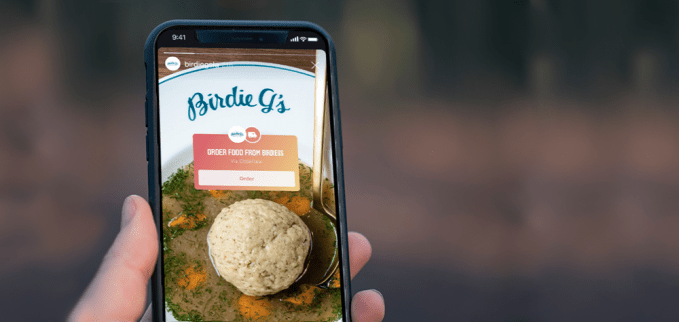
Instagram adds features for supporting small businesses during pandemic
What is contact tracing?
One of the best tools we have to slow the spread of the coronavirus is, as you have no doubt heard by now, contact tracing. But what exactly is contact tracing, who does it and how, and do you need to worry about it?
In short, contact tracing helps prevent the spread of a virus by proactively finding people at higher risk than others due to potential exposure, notifying them if possible, and quarantining them if necessary. It’s a proven technique, and smartphones could help make it even more effective — but only if privacy and other concerns can be overcome.
Contact tracing, from memory to RAM
Contact tracing has been done in some form or another as long as the medical establishment has understood the nature of contagious diseases. When a person is diagnosed with an infectious disease, they are asked whom they have been in contact with over the previous weeks, both in order to determine who may have been infected by them and perhaps where they themselves were infected.
Until very recently, however, the process has relied heavily on the recall of people who are in a highly stressful situation and, until prompted, were probably not paying special attention to their movements and interactions.
This results in a list of contacts that is far from complete, though still very helpful. If those people can be contacted and their contacts likewise traced, a network of potential infections can be built up without a single swab or blood drop, and lives can be saved or important resources better allocated.

You might think that has all changed now what with modern technology and all, but in fact contact tracing being done at hospitals right now is almost all still of the memory-based kind — the same we might have used a hundred years ago.
It certainly seems as if the enormous digital surveillance apparatus that has been assembled around us over the last decade should be able to accomplish this kind of contact tracing easily, but in fact it’s surprisingly useless for anything but tracking what you are likely to click on or buy.
While it would be nice to be able to piece together a contagious person’s week from a hundred cameras spread throughout the city and background location data collected by social media, the potential for abuse of such a system should make us thankful it is not so easy as that. In other, less dire circumstances the ability to track the exact movements and interactions of a person from their digital record would be considered creepy at best, and perhaps even criminal.
But it’s one thing when an unscrupulous data aggregator uses your movements and interests to target you with ads without your knowledge or consent — and quite another when people choose to use the forbidden capabilities of everyday technology in an informed and limited way to turn the tide of a global pandemic. And that’s what modern digital contact tracing is intended to do.
Bluetooth beacons
All modern mobile phones use wireless radios to exchange data with cell towers, Wi-Fi routers, and each other. On their own, these transmissions aren’t a very good way to tell where someone is or who they’re near — a Wi-Fi signal can travel 100 to 200 feet reliably, and a cell signal can go miles. Bluetooth, on the other hand, has a short range by design, less than 30 feet for good reception and with a swiftly attenuating signal that makes it unlikely to catch a stray contact from much further out than that.
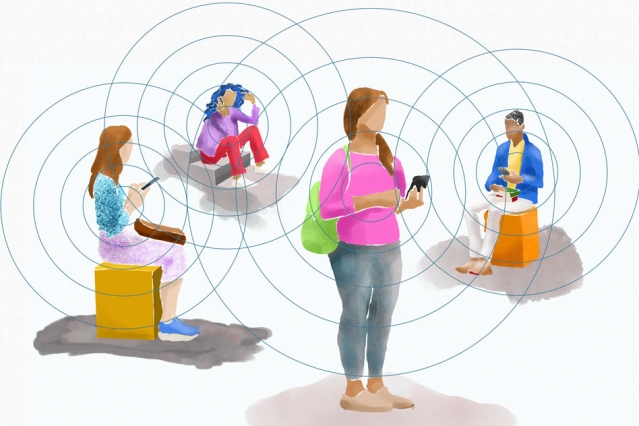
We all know Bluetooth as the way our wireless earbuds receive music from our phones, and that’s a big part of its job. But Bluetooth, by design, is constantly reaching out and touching other Bluetooth-enabled devices — it’s how your car knows you’ve gotten into it, or how your phone detects a smart home device nearby.
Bluetooth chips also make brief contact without your knowledge with other phones and devices you pass nearby, and if they aren’t recognized, they delete each other from their respective memories as soon as possible. But what if they didn’t?
The type of contact tracing being tested and deployed around the world now uses Bluetooth signals very similar to the ones your phone already transmits and receives constantly. The difference is it just doesn’t automatically forget the other devices it comes into contact with.
Assuming the system is working correctly, what would happen when a person presents at the hospital with COVID-19 is basically just a digitally enhanced version of manual contact tracing. Instead of querying the person’s fallible memory, they query the phone’s much more reliable one, which has dutifully recorded all the other phones it has recently been close enough to connect to. (Anonymously, as we’ll see.)
Those devices — and it’s important to note that it’s devices, not people — would be alerted within seconds that they had recently been in contact with someone who has now been diagnosed with COVID-19. The notification they receive will contain information on what the affected person can do next: Download an app or call a number for screening, for instance, or find a nearby location for testing.
The ease, quickness, and comprehensiveness of this contact tracing method make it an excellent opportunity to help stem the spread of the virus. So why aren’t we all using it already?
Successes and potential worries
In fact digital contact tracing using the above method (or something very like it) has already been implemented with millions of users, apparently to good effect, in east Asia, which of course was hit by the virus earlier than the U.S. and Europe.
In Singapore the TraceTogether app was promoted by the government as the official means for contact tracing. South Korea saw the voluntary adoption of a handful of apps that tracked people known to be diagnosed. Taiwan was able to compare data from its highly centralized healthcare system to a contact tracing system it began work on during the SARS outbreak years ago. And mainland China has implemented a variety of tracking procedures through mega-popular services like WeChat and Alipay.
While it would be premature to make conclusions on the efficacy of these programs while they’re still underway, it seems at least anecdotally to have improved the response and potentially limited the spread of the virus.
But east Asia is a very different place from the U.S.; we can’t just take Taiwan’s playbook and apply it here (or in Europe, or Africa, etc.), for myriad reasons. There are also valid questions of privacy, security, and other matters that need to be answered before people, who for good reason are skeptical of the intentions of both the government and the private sector, will submit to this kind of tracking.
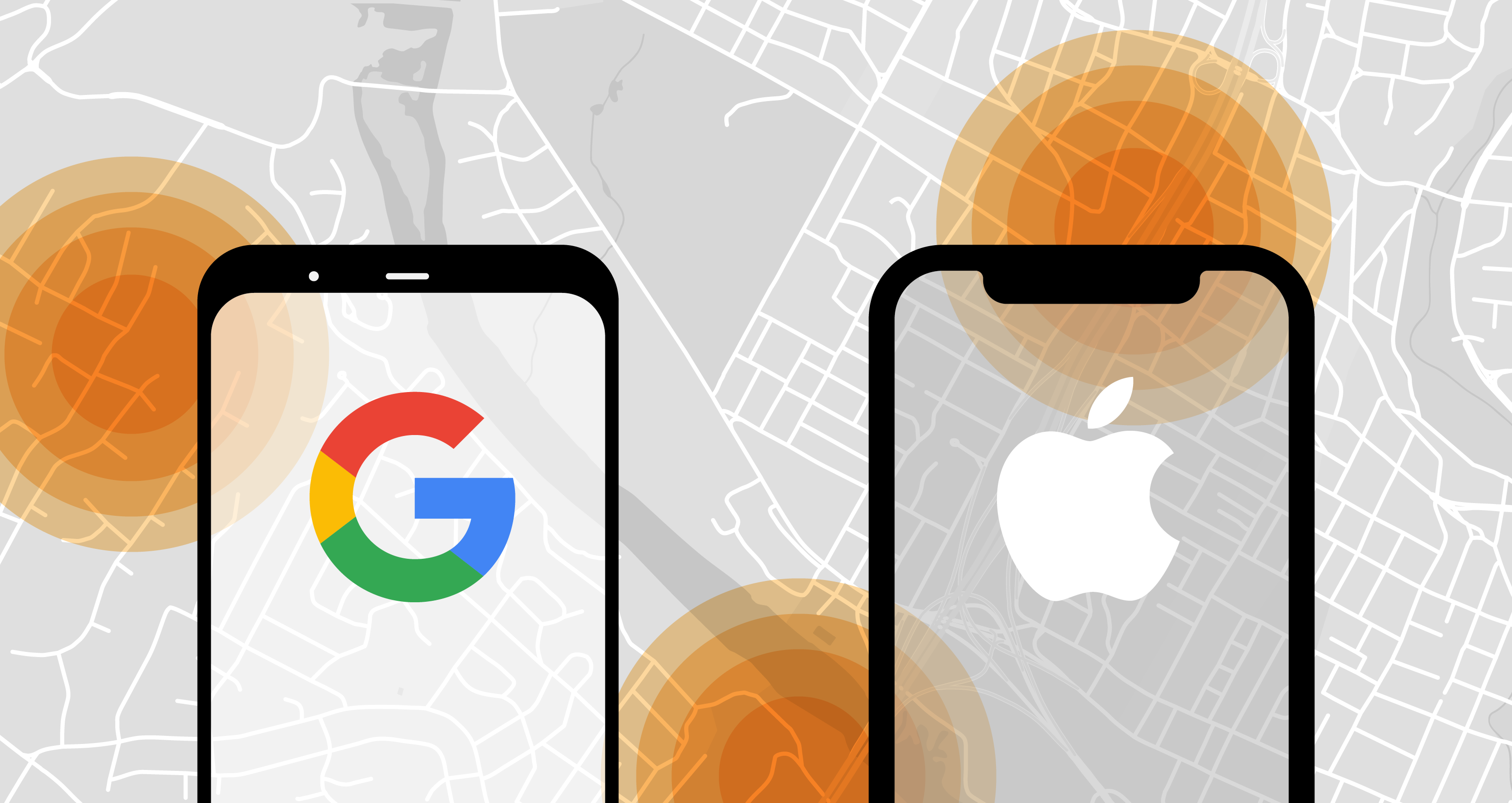
Right now there are a handful of efforts being made in the U.S., the largest profile by far being the collaboration between arch-rivals Apple and Google, which have proposed a cross-platform contact tracing method that can be added to phones at the operating system.
The system they have suggested uses Bluetooth as described above, but importantly does not tie it to a person’s identity in any way. A phone would have a temporary ID number of its own, and as it made contact with other devices, it exchanges numbers. These lists of ID numbers are collected and stored locally, not synced with the cloud or anything. And the numbers also change frequently so no single one can be connected to your device or location.
If and only if a person is determined to be infected with the virus, a hospital (not the person) is authorized to activate the contact tracing app, which will send a notification to all the ID numbers stored in the person’s phone. The notification will say that they were recently near a person now diagnosed with COVID-19 — again, these are only ID numbers generated by a phone and are not connected with any personal information. As discussed earlier, the people notified can then take whatever action seems warranted.
MIT has developed a system that works in a very similar way, and which some states are reportedly beginning to promote among their residents.
Naturally even this straightforward, decentralized, and seemingly secure system has its flaws; this article at the Markup gives a good overview, and I’ve summarized them below:
- It’s opt-in. This is a plus and a minus, of course, but means that many people may choose not to take part, limiting how comprehensive the list of recent contacts really is.
- It’s vulnerable to malicious interference. Bluetooth isn’t particularly secure, which means there are several ways this method could be taken advantage of, should there be any attacker depraved enough to do so. Bluetooth signals could be harvested and imitated, for instance, or a phone driven through the city to “expose” it to thousands of others.
- It could lead to false positives or negatives. In order to maintain privacy, the notifications sent to others would contain a minimum of information, leading them to wonder when and how they might have been exposed. There will be no details like “you stood next to this person in line 4 days ago for about 5 minutes” or “you jogged past this person on Broadway.” This lack of detail may lead to people panicking and running to the ER for no reason, or ignoring the alert altogether.
- It’s pretty anonymous, but nothing is truly anonymous. Although the systems seem to work with a bare minimum of data, that data could still be used for nefarious purposes if someone got their hands on it. De-anonymizing large sets of data is practically an entire domain of study in data science now and it’s possible that these records, however anonymous they appear, could be cross-referenced with other data to out infected persons or otherwise invade one’s privacy.
- It’s not clear what happens to the data. Will this data be given to health authorities later? Will it be sold to advertisers? Will researcher be able to access it, and how will they be vetted? Questions like these could very well be answered satisfactorily, but right now it’s a bit of a mystery.
Contact tracing is an important part of the effort to curb the spread of the coronavirus, and whatever method or platform is decided on in your area — it may be different state to state or even between cities — it is important that as many people as possible take part in order to make it as effective as possible.
There are risks, yes, but the risks are relatively minor and the benefits would appear to outweigh them by orders of magnitude. When the time comes to opt in, it is out of consideration for the community at large that one should make the decision to do so.