Porsche to produce a cheaper version of its all-electric Taycan

Porsche is producing three variants of its all-electric Taycan sports sedan with base prices that range from a skosh over $105,000 to $185,000.

Now, it seems the automaker is preparing to introduce a cheaper rear-wheel-drive version, according to an interview in Car Magazine with Porsche R&D chief Michael Steiner. This newer version, which will join the Taycan Turbo S, Taycan Turbo and 4S, will have a smaller battery and be sold in markets like China that don’t need all-wheel drive, Steiner said.

Porsche wouldn’t provide any specific details to TechCrunch about this mystery fourth variant of the Taycan. The German automaker said it doesn’t talk about future products, before adding that its “electrification initiative will not stop with just three Taycan variants.”

After years and more than $1 billion in initial investment, Porsche introduced in September two variants of its first all-electric vehicle — the Taycan Turbo S and Taycan Turbo, with base prices of $185,000 and $150,900, respectively.

The company revealed just seven weeks later the Taycan 4S, a third version of its all-electric vehicle.

All the Taycans, including the 4S, have the same chassis and suspension, permanent magnet synchronous motors and other bits. The 4S is lighter, cheaper and slightly slower than the high-end versions.

The standard 4S is, so far, the cheapest Taycan available, with a base price of  at $105,250, including a delivery fee. The standard 4S comes with a 79.2 kWh battery pack and a pair of electric motors that produce 482 horsepower (360 kW). With the launch control engaged, the horsepower jumps to 562.

There’s also a performance-battery-plus version of the 4S that adds $6,580 to the base price and comes with a 93.4 kWh battery and dual electric motors that can produce up to 563 hp (420 kW). Both of the 4S models have a top speed of 155 miles per hour and can travel from 0 to 60 mph in 3.8 seconds.

Senate passes new $484 billion relief bill to replenish small business loans, fund hospitals and testing

A new federal aid package designed to provide economic relief to businesses still immobilized by the coronavirus just passed in the Senate.

The $484 billion in total aid passed after two weeks of negotiations between Republicans, who wanted to press additional small business funding forward without much reevaluation, and Democrats, who were eventually able to secure additional relief measures beyond the small business funding at the heart of the bill.

The focal point of the new legislation is the $310 billion it will allocate to the Paycheck Protection Program, a key feature of the first relief package. That program was beset by problems from the outset, with a huge portion of small business owners failing to secure the forgivable loans through banks even with prompt applications in the program’s earliest moments.

Within a few days of going live, it became clear the application process was plagued by issues, and its massive $349 billion pool of funds had already dried up. Some small business owners also reported that they couldn’t find a bank to accept their application, as some banks prioritized existing customers.

Among those issues: Some of the money was sucked dry by entities that a program for small businesses probably shouldn’t be helping out to begin with. Remarkably, even hedge funds, major restaurant chains and Harvard University cashed in on the loans under the existing terms, while most owners of actually small businesses were left high and dry.

Companies with fewer than 500 employees were eligible for the loans, which become forgivable if the money is put toward payroll by hiring back or retaining employees. The maximum loan under the PPP is 2.5 times a company’s average monthly payroll, up to $10 million.

Out of the new $321 billion, $60 billion will go to smaller lenders and credit unions that can provide loans to small businesses that might not bank with major financial institutions. Other measures Democrats secured in the new legislation include an additional $75 billion for hospitals and $25 billion for a national COVID-19 testing strategy, funding that comes with a requirement that the Trump administration form a “strategic plan” for helping states with testing.

The interim bill does not include any funding for a vote by mail system — federal funds that some Democratic lawmakers and a bipartisan group of state election officials view as essential for conducting safe voting this fall. Additional funding to help adapt and administer the 2020 election is likely to be a big talking point in the next wave of relief legislation.

The latest relief bill, which President Trump has signaled he will sign, will now move to the House, where it is expected to pass on Thursday.

Casper winds down European operations and lays off 78 people

Mattress company Casper is shutting down its European operations and laying off 78 people as it focuses on “achieving profitability,” according to a statement by the company. The layoff impacts 21% of its corporate workforce globally.

In the statement, the company said that it is winding down European operations to “concentrate on the strength of the North American business.” The action out will result in more than $10 million in annualized savings, per the company.

The company also noted that Casper’s CFO and COO, Gregory Macfarlane, will be departing from the company on May 15.

Casper said it will give impacted employees in both North America and Europe severance, extended medical coverage, career coaching and new job placement support.The company did not immediately return a request for comment.

In the months since its lackluster IPO and troubled public market debut in February, the company has struggled amid the COVID-19 pandemic. Last month it announced it will shut down all retail locations and furlough all retail employees.

Ahead of going public, Casper hinted at some struggles. The company cut its valuation by more than 50% by lowering its expected price range from between $17 to $19 per share to between $12 and $13.

Casper was one of the recent tech unicorns to make it to the public market, and might be for a while given an increasingly tumultuous economic environment. Tech unicorns have not been immune to the massive number of layoffs seen around the world right now. GetAround, Knotel, Sonder, ZipRecruiter, TripActions and Bird are all among the second wave of unicorn layoffs.

As reported by Crunchbase News with data from layoffs.fyi, 46% of all reported layoffs for private companies come from unicorn companies. Roughly 36 private unicorn companies have laid off staff since the COVID-19 outbreak, according to the data.

It’s worth remembering that amid these massive layoffs, it is likely that employees in satellite offices will likely be affected. Casper is a clear example of this, as the New York-based company cuts its Europe team.

The company is throwing up warning signs ahead of Q1 earnings, which it will report on May 21, 2020.

Indian food delivery startup Swiggy is cutting about 1,000 jobs

Swiggy is cutting about 1,000 jobs, most from its cloud kitchen division, as India’s top food delivery startup scales back some of its businesses in response to the coronavirus pandemic that has drastically affected millions of firms.

In a statement, the Bangalore-based startup said it was “evaluating various means to stay nimble and focus on growth and profitability across our kitchens.”

“This will, unfortunately, have an impact on a certain number of kitchen staff who will be fully supported during this transition,” said the startup, which, according to an analysis on LinkedIn, employs about 12,000 people.

Swiggy did not reveal the number of people it was letting go, but a source familiar with the matter told TechCrunch that about 1,000 jobs were being cut. Indian news outlet Entrackr first reported the layoffs.

As the firm cuts its headcount, it is also looking to reduce its monthly burn rate to about $5 million, down from about $20 million it spends in winning customers currently, the source said, requesting anonymity as some of these matters remain private.

Swiggy — which has raised $1.42 billion to date, including $156 million as part of an ongoing Series I round this year — competes with Ant Financial-backed Zomato, which is also in talks to raise about $500 million by mid-May, Deepinder Goyal, the co-founder and chief executive of the Gurgaon-based startup, told TechCrunch last week.

Both the startups spend nearly the same amount of money in discounts and other incentives to sustain their customers and win new patrons. India’s food delivery market, valued at $4 billion (by research firm RedSeer), has become a duopoly as FoodPanda, owned by Ola, made a major strategic shift in recent years and Uber sold its Indian Uber Eats business to Zomato.

Swiggy and Zomato have, however, struggled to cut costs in fear that they might lose customers. And those fears are well founded.

Anand Lunia, a VC at India Quotient, said that the food delivery firms have little choice but to keep subsidizing the cost of food items on their platform, as otherwise most of their customers can’t afford them.

The lockdown that New Delhi ordered last month has created new challenges for both Swiggy and Zomato. Both the startups are now seeing fewer than a million orders placed on their platforms, down from nearly 3 million they were handling before the outbreak.

In the last year, both the startups have attempted to expand into new categories in search of additional revenue sources. Swiggy has expanded and doubled down on cloud kitchens, which allows its restaurant partners to launch in more locations with not as much investment.

Late last year, Swiggy executives said they had established 1,000 cloud kitchens for its restaurant partners in the country — more than any of its local rivals. The startup said it had invested in more than a million square feet of real estate space across 14 cities in the country in the last two years.

In the wake of pandemic, both Swiggy and Zomato have also started delivering grocery items to customers.

Will China’s coronavirus-related trends shape the future for American VCs?

Rocio Wu
Contributor

Rocio Wu is a second-year MBA candidate at Harvard Business School and a venture capitalist.

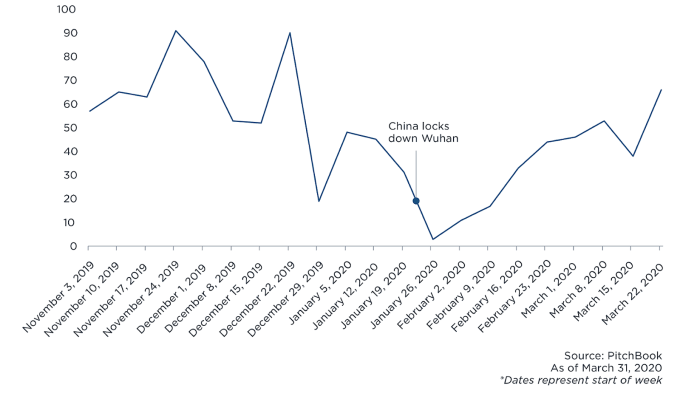
For the past month, VC investment pace seems to have slacked off in the U.S., but deal activities in China are picking up following a slowdown prompted by the COVID-19 outbreak.

According to PitchBook, “Chinese firms recorded 66 venture capital deals for the week ended March 28, the most of any week in 2020 and just below figures from the same time last year,” (although 2019 was a slow year). There is a natural lag between when deals are made and when they are announced, but still, there are some interesting trends that I couldn’t help noticing.

While many U.S.-based VCs haven’t had a chance to focus on new deals, recent investment trends coming out of China may indicate which shifts might persist after the crisis and what it could mean for the U.S. investor community.

Image Credits: PitchBook

The Dipp, a subscription-only entertainment news startup, is springing to life despite the pandemic

There is no shortage of coverage about the sprawling entertainment industry. There is a shortage of coverage for die-hard fans of reality TV shows, according to Kate Ward and Lindsay Mannering.

That opening in the market is why the two — former colleagues at the women’s website Bustle, where Ward was the founding editor-in-chief and Mannering ultimately became the SVP of editorial strategy at Bustle’s parent company — decided to take the plunge In January and start their own company.

Called The Dipp, the nascent, Brooklyn-based media company describes itself as a “personalized subscription website for TV’s biggest fans,” and the idea, says Ward, is to zero in on the “niche fandoms that are being created every day — especially now [that everyone is at home and online]. We want to focus on certain franchises that are underserved, then scale.”

They say they know what it takes. Both joined Bustle back in 2013 when it was itself a fledgling startup, and both say they helped grow the company on a variety of fronts, from writing, to organizing the site, to helping with PR and sales, to immersing themselves in its scaling strategy.

It was so exhilarating, says Ward, that when the company ballooned to 80 million unique monthly visitors across all its publications, the two found themselves missing those early days.

They also seemingly decided what from that experience they did not want to replicate, including to build a property that’s solely reliant on sponsored content and other advertising. (Like many other ad-driven media properties to grow quickly in recent years, Bustle has also been ratcheting back on staff dating back to last summer, with its most recent round of layoffs announced early this month.)

Of course, building a media property in the midst of a pandemic would seem to come with its own challenges. The Dipp was fortunate on the funding front; it just locked down $2.3 million in seed funding led by Defy Partners, helped by Ward’s previous relationship with Defy co-founder Neil Sequeira, who was formerly a managing director with General Catalyst and who sat on the board of Bustle in that role.

On the other hand, its founders — who live several miles apart — can’t work together right now owing to the coronavirus.

It’s a big change from the early days of Bustle when “we sat shoulder to shoulder together on a sofa,” acknowledges Ward, adding that the hardest part so far has been having to celebrate early milestones remotely. “Normally, something good happens and you go out to dinner or have a drink. Right now, it’s more like, ‘We got a term sheet, yay!’ over Gchat.” (Mannering sent Ward a bottle of champagne and Jell-O shots over the weekend, but it “doesn’t feel the same,” Ward says with a laugh.)

Luckily for both, hiring might not prove the same challenge as it might to other founders who are just getting a company off the ground, given that many journalists already work remotely. They also suggest they have an extensive network of people to tap given their own media backgrounds.

In fact, they insist that there are upsides to launching a new endeavor in these suddenly strange days.

Mannering notes, for example, that the two have more time to focus on what they are building, whereas before New York shut down, they were budgeting a lot of time for traveling and pitching — and spending a fair amount of each day on the subway.

Ward thinks the founders and VCs with whom they’ve talked have also been more earnest than they might have been six months ago, before the coronavirus struck the U.S. “There’s this sense that we’re all in this together now,” she says. “In the past, whereas there was a lot of puffing of chests and you might walk away thinking, ‘I hope I’ll be as good a founder as this person someday,’ everyone is sort of leveling with each other, including about what pitfalls to look for. Just trying to get through [this pandemic] kind of grounds every conversation, so you’re really getting to know people in that first meeting.”

As for next steps, stay tuned, say the co-founders. The idea is to launch their content this fall, with a snazzy user interface, an accompanying weekly newsletter and, later, podcasts. The Dipp also plans to focus heavily on community, says Ward. Comments will be their first area of focus, but subscribers can also expect online discussions and ask-me-anything-style forums with individuals from the franchises that The Dipp readers want to know more about, she says.

Users will be able to sign up for a free trial to start; after that, says Ward, they’ll be charged a monthly fee for an all-access pass, including, most importantly, to a home page that’s customized so members can see “only what you care about rather than rifling through shows and topics that don’t interest you in the least.”

Indeed, the secret sauce behind The Dipp will really be data, culled in part from social media, that informs which franchises and characters the outlet zooms into for its readers. As Ward notes, Bustle was early to recognize that what tastemakers like matters far less than what’s playing well with consumers.

As a result, Bustle knows what many women — including millennial moms — are searching to learn in much the same way that Netflix knows what its viewers prefer to watch.

It’s a long way from here to there, but if The Dipp’s plans work out, it will be an entertainment brand that knows better than most what its audience wants to read, too.


Amazon employees plan additional protests over COVID-19 working conditions

As much of the world has ground to a temporary halt over stay at home orders, Amazon has continued churning. The retail giant is nothing if not an essential business for many in the U.S. and abroad, as everyday tasks like going to the supermarket and drugstore have become hazardous.

While the company has continued providing necessary supplies for many, its labor policies have entered the spotlight — certainly not a first for Amazon. While the company has consistently batted away suggestions of unfair or unsafe working conditions during the COVID-19 pandemic, a group of workers this week have planned mass protests of policies.

Workers’ rights group United for Respect says more than 300 Amazon employees from 50 facilities plan to take part in the protest. The organization writes, “Amazon’s response to the Coronavirus outbreak has unnecessarily put the lives of Amazon employees at increased risk and exposure,” citing a large number of facilities where employees have contracted the virus.

The organization calls for additional transparency around confirmed COVID-19 cases, more sanitation and various additional benefits, including two weeks of paid sick leave and health for “part-time, drivers, temporary and contracted associates.”

Amazon sent a strongly worded denial to TechCrunch, calling reports of the protests overblown and reiterating its record.

“Reports of employee participation in today’s event organized by labor unions are grossly exaggerated,”  Amazon spokesperson Lisa Levandowski said in the statement. “Already today more than 250,000 people have come to work today, even more than last week to serve their communities. We couldn’t be more grateful and proud for their efforts during this time. The union organizers claims are also simply false – what’s true is that masks, temperature checks, hand sanitizer, increased time off, increased pay, and more are standard across our network because we care deeply about the health and safety of our employees. We encourage anyone to compare the health and safety measures Amazon has taken, and the speed of their implementation, during this crisis with other retailers.”

Last week, two additional employees reported firings they believed were tied to their public criticism of Amazon policy. In March, a Staten Island employee who was critical of working conditions was also fired.

Amazon denied the connection. “We support every employee’s right to criticize their employer’s working conditions,” it told TechCrunch, “but that does not come with blanket immunity against any and all internal policies. We terminated these employees for repeatedly violating internal policies.”

Netflix says 64M households ‘chose to watch’ the documentary hit ‘Tiger King’

How big a hit is Netflix’s “Tiger King”? In its latest earnings release, the streaming company says 64 million households have “chosen to watch” the docu-series its first four weeks of release.

You’ll note that it isn’t claiming that 64 million people actually watched the whole show (which tells the story of Joe Exotic, a big cat owner who’s accused of hiring a contract killer to murder his nemesis, an animal rights activist). That’s because the company recently switched to a new system for selectively reporting audience numbers.

Netflix now focuses on how many people chose to watch, which means how many people selected a given show or movie and watched at least two minutes (so they didn’t just click on it by accident). By the company’s own admission, this method increases viewer counts by an average of 35%, so it’s hard to do an apples-to-apples comparison with numbers that the streaming service has released in past years.

But among recent releases, “Tiger King” — which has already spawned a follow-up special — comes out way ahead of “Ozark” season 3 (29 million) and the reality show “Love Is Blind” (30 million), and is roughly as popular as “?La Casa de Papel?”/”?Money Heist?” (65 million).

The series was not, however, able to match the viewership of what Netflix says was its most popular show ever, “The Witcher” (76 million) — not to mention the Ryan Reynolds action movie “6 Underground” (83 million) and the Mark Wahlberg action movie “Spenser Confidential” (85 million).

And of course the viewership numbers should be seen in the context of a big spike in paid Netflix subscribers amidst the COVID-19 pandemic.

Patreon lays off 13% of workforce

Creative platform Patreon has laid off 30 employees, which is 13% of its workforce, TechCrunch has learned.

“It is unclear how long this economic uncertainty will last and therefore, to prepare accordingly, we have made the difficult decision to part ways with 13% of Patreon’s workforce,” a Patreon spokesperson said in a statement to TechCrunch. “This decision was not made lightly and consisted of several other factors beyond the financial ones.”

Patreon, which enables creators to build relationships with their fans via monthly subscriptions for content in exchange for perks and other benefits, had seen an uptick in new creators launching on the platform in light of the COVID-19 pandemic.

In March, Patreon wrote in a blog post, “Not only are patrons not leaving the platform, we’ve even seen many of them upgrade their tiers to support their favorite creators during this challenging time.” Additionally, the average income for creators was 60% higher in March than in previous months, according to the company.

Read a deep dive of Patreon on Extra Crunch

Around that same time, however, Patreon said it saw patrons exiting the platform more than usual due to financial hardships. Still, Patreon said churn rates were stable.

The startup ecosystem has been hit hard by the COVID-19 pandemic, with layoffs no longer the exception, but the rule. Still, it’s peculiar timing for Patreon, given the company touted an increase in new memberships during the first three weeks of March.

“This surge, along with years of continuous growth, has put Patreon in a strong financial position to help creators successfully manage creative businesses during this challenging time,” the spokesperson said. “Although the business is in a strong cash position, we want to ensure that we can continue to support creators for many years to come.”

Here’s Patreon’s full statement below:

Over the past six weeks, Patreon has experienced a significant influx of new creators launching on the platform along with increased financial support from both their new and existing patrons. In March alone, we onboarded 50,000 new creators to the platform of which the average income was 60% higher than previous months. This surge, along with years of continuous growth, has put Patreon in a strong financial position to help creators successfully manage their creative businesses during this challenging time.

Although the business is in a strong cash position, we want to ensure that we can continue to support creators for many years to come. It is unclear how long this economic uncertainty will last and therefore, to prepare accordingly, we have made the difficult decision to part ways with 13% of Patreon’s workforce. This decision was not made lightly and consisted of several other factors beyond the financial ones. Prior to the pandemic, we had completed an in-depth performance review cycle and deployed a new company strategy – both exercises highlighted the need for different skill sets moving forward.

It was this combination of economic uncertainty, performance reviews and a shift in strategy that prompted us to make this change. Patreon is now on a path to long-term success and the business will emerge from this layoff even stronger, both financially and strategically.

Software companies give back ground after an impressive rebound

Software as a service companies, modern software firms often referred to by the acronym “SaaS,” had a tough day in the public markets. The basket of companies, as tracked by Bessemer’s cloud index, dropped 4.49% during regular trading hours.

The losses gave back some of the software industry’s recent gains, advances that had followed a sharp decline in the value of their shares as concerns relating to a COVID-19-induced economy hit the richly valued cohort of companies hard; indeed, at one point earlier in the year, SaaS and cloud companies were down around 38% from the 2020 highs.

Those losses, however, largely proved transitory. A steep rally in SaaS and cloud shares brought their decline from all-time highs (set earlier this year) to just about 10% yesterday afternoon. Then, today, the firms lost over 4%. This puts SaaS and cloud shares in between a correction and a bear market.

Earlier today, TechCrunch covered a number of “green shoots” for software companies relating to churn, and some back-of-the-napkin funding data for the month of April thus far. To see SaaS firms drop as sharply as they did right after rings of comedic timing.

The impact of today’s trading was varied. Atlassian fell a modest 2.9%, Dropbox 3.3%, Zuora 5.99% and Slack a sharp 9.54%.

But despite all the worries about churn and changing sentiment, SaaS companies are still richly valued compared to historical norms. How rich? Bessemer notes on its website the companies it tracks in its index were valued at an enterprise value/revenue multiple of 12.9x.

It’s kind enough that SaaS trades on a multiple of revenue, and not EBITDA; to see that revenue multiple sit comfortably above 10 is a gift. So far, however, a durable one. Investors have not lost their shine to SaaS shares, today’s trading notwithstanding.

In broader indices, the day’s damage was less severe, with the Dow Jones Industrial Average falling 2.67%, the S&P 500 falling 3.07% and Nasdaq Composite dropping 3.48%.

Netflix beats growth predictions with 15.77M net new subscribers

With almost everyone stuck at home thanks to the COVID-19 pandemic, Netflix was widely expected to do well in the first quarter of 2020 — but it did even better than anticipated.

Before the current crisis, Netflix had forecast 7 million net new paid subscribers for its just-released earnings. With the dramatically changed landscape, growth was obviously going to beat the forecast, but Q1 came in at more than double expectations, with 15.77 million paid net additions. That brings Netflix’s total paid subscriber count to 182.86 million.

Meanwhile, the company also reported revenue of $5.77 billion and earnings per share of $1.57 — roughly in line with Wall Street predictions on revenue and slightly behind EPS predictions of $1.65.

In its investor letter, Netflix outlines three main impacts that the pandemic has had on its finances:

First, our membership growth has temporarily accelerated due to home confinement. Second, our international revenue will be less than previously forecast due to the dollar rising sharply. Third, due to the production shutdown, some cash spending on content will be delayed, improving our free cash flow, and some title releases will be delayed, typically by a quarter.

For now, Netflix is treating this growth as a short-term spike, with viewing and growth declining as “progress against the virus will allow governments to lift the home confinement soon.” So it’s forecasting a mere 7.5 million global net additions in Q2.

As for how the global halt to movie and TV production might affect the service’s content plans, the company says there will only be a “modest” impact in Q2, mostly in language dubbing. This quarter will also see the launch of just-announced acquisitions like the Kumail Nanjiani-Issa Rae comedy “The Lovebirds” (originally slated for a theatrical release) and the Millie Bobby Brown mystery “Enola Holmes,” as well as new shows like “Space Force” and “Hollywood.”

“No one knows how long it will be until we can safely restart physical production in various countries, and, once we can, what international travel will be possible, and how negotiations for various resources (e.g., talent, stages, and post-production) will play out,” the investor letter says. “The impact on us is less cash spending this year as some content projects are pushed out. We are working hard to complete the content we know our members want and we’re complementing this effort with additional licensed films and series.”

The letter also includes viewership numbers about some recent releases, using the “chose to watch” metric that Netflix announced last quarter — it’s now counting everyone who chose to watch a given show or movie and watched for at least two minutes. An impressive 64 million people chose to view “Tiger King.” But somehow, that didn’t quite match the 85 million people who chose to view the new Mark Wahlberg action movie “Spenser Confidential.”

As of 4:35pm Eastern, Netflix shares were fluctuating between a slight gain and a slight loss in after-hours trading — a sign, perhaps, that that spectacular growth is exactly what investors were expecting.

Update: During the earnings interview, Chief Content Officer Ted Sarandos spoke about how workflow fo the company and its production partners has changed dramatically.

“Our productions, our post productions, our offices are now distributed into people’s living rooms and bedrooms and kitchens around the world,” Sarandos said. “It’s just an incredible testimony to the innovation that literally within a few hours, but certainly within a few days of the shutdowns, we had production up and running remotely, post-production up and running remotely, animation up and running remotely, pitch meetings happening virtually, writers rooms assembling virtually.”

Meanwhile, CEO Reed Hastings emphasized the unpredictability of the long-term effects of the pandemic on Netflix’s growth.

“We don’t use the words ‘guess’ and ‘guesswork’ lightly,” he said. “We use them because it’s a bunch of us feeling the wind, and it’s hard to say. But again, will internet entertainment be more and more more important in the next five years? Nothing’s changed in that.”


Snap surges on earnings revenue beat and Q1 user gains

The coronavirus pandemic has presented plenty of challenges for ad-reliant social networks, but Snap made clear it was not yet feeling significant negative effects with its Q1 earnings release today.

Snap surged 17% after-hours on news of its Q1 results after dropping nearly 4% during trading today. The company reported revenue of $462 million in line with precious guidance and besting Wall Street’s tempered expectations around $430 million. EPS was -$0.08, slightly worse than analyst expectations of a 7-cent loss.

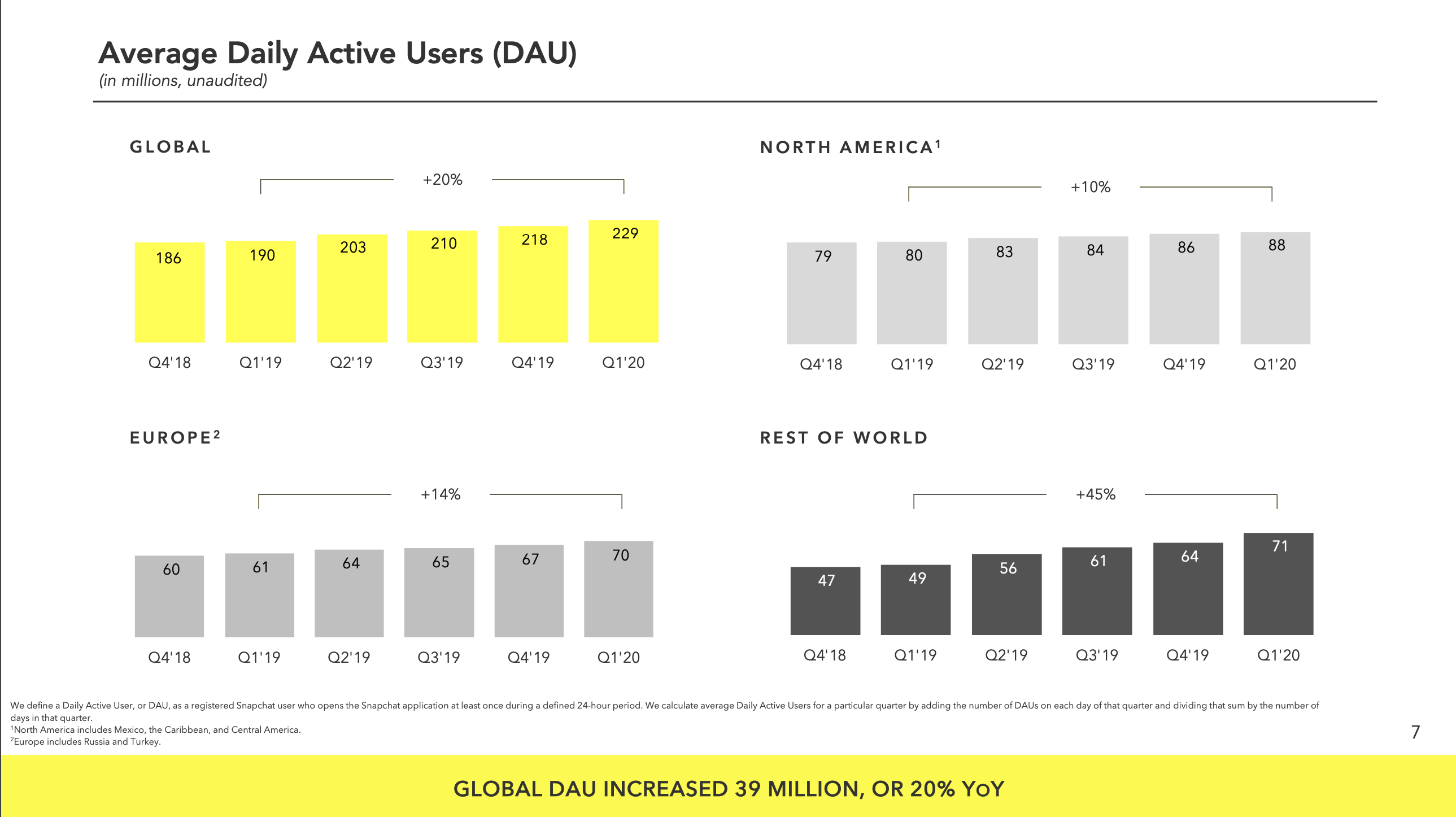
Daily active users reached 229 million in the first-quarter, representing a 20% year-over-year gain, higher than the 224.5 million users that had been expected. Another interesting tidbit from the release was the 35% year-over-year growth in daily time spent watching content in Discover.

“Snapchat is helping people stay close to their friends and family while they are separated physically, and I am proud of our team for overcoming the many challenges of working from home during this time while we continue to grow our business and support those who are impacted by COVID-19,” CEO Evan Spiegel said in a statement accompanying the release.

2019 was a redemptive year for the social media company, which had seen steady declines in its share price since entering public markets. Since its last earnings release in early February, Snap’s stock price has dropped more than 30%, echoing similar declines seen by other social media companies in the midst of a broader market plunge.

A positive Q1 earnings report is welcome news for the downward-trending stock.

The full impacts of COVID-19 will be fully evident in the second-quarter filings, as Q1 includes financial performance in a February and early March which were much less impacted by pandemic fallout on the broader digital ad market.

This was a relatively quiet quarter for Snap in terms of product updates. Late last month, the company announced that it would be enabling Stories syndication to other apps as the company aims to make its developer platform more attractive to third-parties.

We’ll be updating with more information from the investor call.

Houzz lays off 155 employees, cuts executive salaries

Houzz, an online platform for home renovation and design, has laid off 155 employees, roughly 10% of its staff, per an internal memo obtained by TechCrunch. Executive salaries also took a cut.

The company, last valued at $4 billion, confirmed the content of the memo in a statement to TechCrunch.

“Due to the impact of COVID-19 on small businesses in the home renovation and design space, and the resulting impact on our core business of pro subscriptions, we have made the incredibly difficult decision to part ways with 155 employees, which is approximately 10% of our team,” said a spokesperson.

In the internal memo, Houzz’s founders Adi Tatarko and Alon Cohen cite COVID-19’s impact on its core business: pro subscriptions. The subscriptions are for home remodeling and design professionals to find work. Due to COVID-19, many of those same professionals are facing project delays or cancellations as states promote social distancing and shelter in place.

Beyond serving as a marketplace for home renovators and customers, the company also sells furniture from third parties. Many consumers might not be thinking about renovating their bathroom or welcoming construction into their home as the pandemic shows up on doorsteps around the world.

While the layoffs are COVID-19 related, this isn’t the first sign of Houzz struggling as a business. Last month, Houzz fired 10 people and scrapped a plan to create furniture in-house. The move would have seen Houzz bring in-house some of the revenue it usually delegates to third-party manufacturers.

“At Houzz, we continually review our strategic investments, such as Private Label, to ensure that they are aligned to the current needs of our business and optimized for our continued growth,” the company said in a statement to TechCrunch back in March. “As a result of this process, we have made the difficult decision to discontinue our investment in Private Label at this time.”

The company also had some turbulence last year when it disclosed a data breach compromising 57 million records. A year prior, Houzz fired 10% of its staff to cut costs and restructure ahead of preparing for an IPO. And considering a number of factors, we’re guessing that plan to barrel toward the public markets may have changed.

Houzz will provide those laid off with severance packages based on tenure and will pay for benefits until the end of July. The company also said it will help those laid off find their next gig through resume writing, career coaching and network referrals.