FDA authorizes a ventilator developed by NASA’s JPL for emergency use in COVID-19 treatment

The U.S. Food and Drug Administration (FDA) has authorized for emergency use as outlined in the agency’s COVID-19 guidelines a new ventilator designed by engineers working at NASA’s Jet Propulsion Laboratory . The ventilator, which has an acronym because this is NASA we’re talking about, is called “VITAL” (Ventilator Intervention Technology Accessible Locally), and its design is being offered for free, licensed use for the duration of the coronavirus crisis.

The JPL-developed emergency use ventilator is an intubation ventilator, meaning that a patient has to be sedated, with a breathing tube inserted all the way down their airway to assist their breathing. It’s reserved for COVID-19 patients exhibiting the most serious symptoms, and even then is really designed for use only to free up availability of existing, fully approved ventilator hardware in the case of extreme shortages.

What makes VITAL most interesting is that it is made of “far fewer” parts than existing traditional ventilators, according to NASA, and it also can be assembled much more quickly, and maintained with less expertise and effort over time. The design provides for use for between three or four months, however, rather than years for traditional hardware, and is meant specifically for COVID-19 patient use, hence its simpler design versus models that are made to serve in a number of different medical situations.

NASA’s JPL is seeking commercial manufacturing partners for the hardware now that it has its authorization, however, in order to get it built in large numbers for distribution to hospitals in need.

This is one of a number of different emergency ventilator hardware design and development projects that have been spun up to address hardware needs in light of increased usage due to COVID-19. With NASA JPL’s pedigree, and its ability to serve in cases of most dire need, NASA’s definitely seems like one of the better engineered options out there.

Apple’s Q2 earnings show flat year-over-year revenue growth due to pandemic

Apple delivered a rough Q2 earnings report Thursday, besting investor expectations but showing a significant growth slowdown as the coronavirus pandemic deeply impacted the company’s business with year-over-year declines in iPhone, iPad and Mac sales.

Apple’s stock was largely unchanged in after-hours trading.

The company shared that in Q2 it earned $58.30 billion in revenue, better than the $54.54 billion investors were expecting. The figure represents 1% year-over-year revenue growth for the company.

In February, the company issued an update to its Q2 guidance, saying that it did not expect to meet its earlier estimates due to fallout driven by the COVID-19 pandemic. The company did not update its previous guidance, which said they expected to earn between $63 billion to $67 billion in Q2. Apple notably did not offer guidance for Q3 in this release.

In terms of earnings per share, the company delivered $2.55 compared to the $2.26 investors had expected. Apple also shared that they were increasing their share buyback program by $50 billion and would be hiking dividends by 6%.

Apple saw year-over-year declines in its iPhone, iPad and Mac categories, only showing gains in Services and its “Wearables, Home and Accessories” category. Hardware as a whole was down year-over-year. The company posted $28.96 billion in net iPhone sales compared to $31.05 billion in Q2 2019.

After a very rough March, most big tech stocks have been roaring back into growth in April. Apple is in a more difficult position than other ad-driven businesses given the global complexity of its hardware supply chain.

“We are proud of our Apple teams around the world and how resilient our business and financial performance has been during these challenging times,” Apple CFO Luca Maestri said in a statement accompanying the release.

AWS hits $10B for the quarter putting it on a $40B run rate

AWS, the cloud arm of Amazon, would be a pretty successful business on its own. Today, the company announced it has passed $10 billion for the quarter, putting the cloud business on an impressive run rate of more than $40 billion.

It was a bright spot for the company in an earnings report that saw it report net income of $2.5 billion, down $1 billion from a year ago.

Still, most companies would take that for the entire business, but AWS, which started off as kind of a side hustle for Amazon back in 2006, has grown into a powerful business all on its own. With a growth rate of 33%, it’s still growing briskly, even if it’s slowing down a bit as the law of large numbers begins to work against it.

Even though Microsoft has grown more quickly — in yesterday’s report Microsoft reported that Azure was growing at a 59% clip — AWS had such a big head start and controls a big chunk of the market share.

To give you a sense of how quickly this business has grown, Bloomberg’s Jon Erlichman tweeted the Q1 numbers for AWS since 2014, and it’s pretty amazing growth:

Amazon’s cloud revenue in Q1:
(Amazon Web Services)

Q1 2020: $10.2 billion
Q1 2019: $7.7 billion
Q1 2018: $5.4 billion
Q1 2017: $3.7 billion
Q1 2016: $2.6 billion
Q1 2015: $1.6 billion
Q1 2014: $1.1 billion

— Jon Erlichman (@JonErlichman) April 30, 2020

In 2014, it was a $4 billion a year business. Today it is 9.1x that and still going strong. The good news for everyone involved is that this is a huge market, and while nobody could ever characterize the pandemic and it’s economic fall-out as good news for anyone, the fact is that it is forcing companies to move to the cloud faster than they might have wanted to go.

That should bode well for all the cloud infrastructures vendors, even as the economy shrinks, the kinds of services these vendors offer should be in more demand than ever, and that means these numbers could just keep growing for some time.

OpenAI’s new experiments in music generation create an uncanny valley Elvis

AI-generated music is a fascinating new field, and deep-pocketed research outfit OpenAI has hit new heights in it, creating recreations of songs in the style of Elvis, 2Pac and others. The results are convincing, but fall squarely in the unnerving “uncanny valley” of audio, sounding rather like good, but drunk, karaoke heard through a haze of drugs.

Jukebox, the organization’s new music-generating system, was detailed in a blog post and paper published today. OpenAI produced some interesting work almost exactly a year ago with MuseNet, a machine learning system that, having ingested a great deal of MIDI-based music, was able to mix and match genres and instruments.

But MIDI is a simpler format than final recorded music with live instruments, since the former consists of discrete notes and key presses rather than complex harmonics and voices.

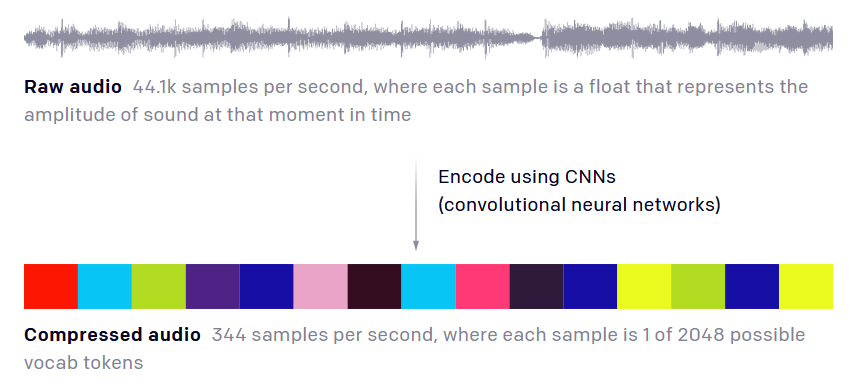
If you wanted an AI to examine the structure of a classical piano piece, the timing and key presses might only amount to a couple thousand pieces of information. Recorded audio is far denser, with (usually) 44,100 samples per second.

Machine learning systems that learn and imitate things like instruments and voice work by looking at the most recent words or sounds and predicting the next few, but they generally operate on the order of tens or a hundred pieces of data — the last 30 words or notes predict what the next 30 will be, for instance. So how can a computer learn how a tiny fraction of a waveform 10 seconds and 440,000 samples into a song compare with a sample 90 seconds and 4 million samples in?

OpenAI’s solution is to break down the song into more digestible parts — not quite key and chord, but something like that, a machine-palatable summary of 1/128th of a second of the song, picked from a “vocabulary” of 2,048 options. To be honest it’s hard to create an analogy because this is so unlike the way humans remember or understand things — as far as we even understand that.

It doesn’t actually use color swatches — that’s just to indicate that it’s breaking the waveform down into pieces.

The end result is that the AI agent has a reliable way to break down a song into digestible bits that are big enough that there aren’t too many to track, but small enough that they can reliably reconstruct the sound of a song. The process is much more complex than it sounds here; reliably breaking down a song to a series of “words” and then reconstructing it from them is the core of the new research, but the technical details I’ll let the OpenAI team to explain in their paper.

The system also had to learn how to parse the lyrics in a song, which like most things in this domain is more complicated than it sounds. Our ability to remember and use vocal patterns is partly innate and partly learned, and we tend to take for granted how powerful it is. Computers have no such ability and must learn how to pick out a voice from a mix, understand what it’s saying and match that to lyrics that are nothing more than a series of words with no information on key, tempo and all the rest. Nevertheless the OpenAI system does it to a satisfactory degree.

Jukebox is able to accomplish a variety of musical tasks, and while the results aren’t what you might call singing material, it must be kept in mind that there’s very little like this out there now, able to rebuild a song from scratch that’s recognizable as being like the target artist. Trained on 1.2 million songs, the system in the end has one multifaceted ability it accomplishes these tasks with: essentially, improvising a song given lyrics and the style it has learned from ingesting others by that artist.

So given its knowledge of how Ella Fitzgerald sings and the way instruments generally accompany her, it can sing a rendition of “At Long Last Love” in a way that sounds like her but definitely isn’t what Cole Porter had in mind. (Samples for these examples and more are included near the top of the OpenAI blog post.)

Jukebox can also sing entirely original lyrics in another’s style, like this truly strange Elvis song, “Mitosis,” written by another AI language model:

In case you didn’t catch that:

From dust we came with humble start;
From dirt to lipid to cell to heart.
With [mitosis] with [meiosis] with time,
At last we woke up with a mind.
From dust we came with friendly help;
From dirt to tube to chip to rack.
With S. G. D. with recurrence with compute,
At last we woke up with a soul.

Yes, it’s “Elvis” using cell division as a metaphor for life, as imagined by an AI. What a world we live in.

Lastly, there’s the “completion” task, where Jukebox learns (in addition to the base learning from its library) from the first 12 seconds of a song and uses that to generate the rest in a similar style. The switch from original to AI-generated sounds a bit like the ether just kicked in.

While MuseNet could be played with more or less in real time due to its lesser complexity, Jukebox is hugely computation intensive, taking hours to generate a single second of music. “We shared Jukebox with an initial set of 10 musicians from various genres… these musicians did not find it immediately applicable to their creative process,” the authors note dryly. Still, it’s fun and fascinating research and, given the current cadence, we can expect an even further improved version of the OpenAI music effort next April.

Amazon Q1 beats on net sales of $75.5B but posts net income of $2.5B, down $1B on a year ago

Amazon has been one of the biggest names synonymous with how the consumer masses are experiencing life under lockdown: its site lets you buy anything from soup to nuts, from books to baking pans for all your sourdough; and via its streaming services, it gives you many ways to stay entertained. But it can also be a source of major frustration when you find yourself unable to book slots for deliveries, or are facing an army of sellers trying to price gouge you for hot items like masks or toilet paper.

Today, the company reported first quarter earnings that bore out the first of these in spades, but at a cost to profitability as it works to serve a public under a whole new set of challenging conditions.

The company reported net sales of $75.5 billion, up 26% on a year ago, a huge boost on the $59.7 billion it made in net sales in the first quarter a year ago. Indeed, $41 billion of the sum was attributable to product sales and $33 billion to services (which includes AWS, but also streaming and other non-physical goods).

But earnings per share took a hit, with basic EPS at $5.09 and diluted EPS at $5.01, and net income declining down to $2.535 billion versus $3.561 billion a year ago.

Operating income was also down, to $4 billion versus operating income of $4.4 billion in the same quarter a year ago.

Analysts on average were expecting EPS of $6.25 on revenues of $73.61 billion in sales. It was a repeat of the pattern we saw from eBay’s earnings yesterday, albeit on a much, much bigger scale.

On top of all this, the company provided guidance that indicated that it could swing into an operating loss in Q2. It said it expected net sales of between $75.0 billion and $81.0 billion, or to grow between 18% and 28% compared with second quarter 2019 (but largely flat with this quarter). But operating income is expected to be between negative $1.5 billion and $1.5 billion, versus $3.1 billion a year ago. “This guidance assumes approximately $4.0 billion of costs related to COVID-19,” the company said. 

The results sent Amazon’s stock up nearly 5% in after-hours trading.

Jeff Bezos, Amazon’s colourful founder and CEO, acknowledged the challenges even the mighty Amazon is facing, but also reiterated, similar to Q2 guidance, that the company plans to double down on spending to face up to serving people during the COVID-19 pandemic, whatever it might bring. It’s a long statement (in what is a very, very wordy press release overall):

From online shopping to AWS to Prime Video and Fire TV, the current crisis is demonstrating the adaptability and durability of Amazon’s business as never before, but it’s also the hardest time we’ve ever faced. We are inspired by all the essential workers we see doing their jobs — nurses and doctors, grocery store cashiers, police officers, and our own extraordinary frontline employees. The service we provide has never been more critical, and the people doing the frontline work — our employees and all the contractors throughout our supply chain — are counting on us to keep them safe as they do that work. We’re not going to let them down. Providing for customers and protecting employees as this crisis continues for more months is going to take skill, humility, invention, and money. If you’re a shareowner in Amazon, you may want to take a seat, because we’re not thinking small. Under normal circumstances, in this coming Q2, we’d expect to make some $4 billion or more in operating profit. But these aren’t normal circumstances. Instead, we expect to spend the entirety of that $4 billion, and perhaps a bit more, on COVID-related expenses getting products to customers and keeping employees safe. This includes investments in personal protective equipment, enhanced cleaning of our facilities, less efficient process paths that better allow for effective social distancing, higher wages for hourly teams, and hundreds of millions to develop our own COVID-19 testing capabilities. There is a lot of uncertainty in the world right now, and the best investment we can make is in the safety and well-being of our hundreds of thousands of employees. I’m confident that our long-term oriented shareowners will understand and embrace our approach, and that in fact they would expect no less.

Of note: Amazon Web Services accounted for $10.2 billion in sales, up 33% on the same quarter a year ago. North America accounted for about $44 billion of the company’s net sales, versus $19 billion for the international segment.

And while services are not quite yet overtaking product sales, the company is seeing its services revenues are growing much faster, at 33% versus 22%. Services include not just video streaming, but grocery delivery and other non-physical paid products that Amazon provides.

At a time when we’ve seen tens of thousands of people laid off across the technology sector, Amazon has been one of the few companies to hire, specifically to staff up with 100,000 extra workers across warehouses and its logistics network to meet surging demand from buyers. That has not always been smooth sailing however, with accusations of poor and potentially health-threatening working conditions.

This has been a thorny issue for the company, so it’s no surprise that in its earnings report, it prominently reminded investors that it has made “over 150 significant process changes in our operations network and Whole Foods Market stores to help teams stay healthy — and we conduct daily audits of the measures we’ve put into place.”

It also noted that it has procured 100 million face masks (presumably not on Amazon itself, where economical ones have been very hard to find) and are requiring that they be worn by all associates, drivers and support staff in our operations network. “We purchased more than 1,000 thermal cameras and 31,000 thermometers, which we are using to conduct mandatory daily temperature checks for employees and support staff throughout our operations sites and Whole Foods Market stores,” it noted.

Those thermal cameras have also, however, been a point of contention: Reuters this week reported that those cameras were sourced from Dahua, a Chinese company currently blacklisted by the U.S. government.

More to come.


Extra Crunch Live: Join Hunter Walk for a Q&A May 7th at 1 pm ET/10 am PT

We are not slowing down the pace of our Extra Crunch Live discussions.

Fresh off our chat with Mark Cuban, we’re already gearing up for next week, which will bring us an investor from Sequoia, and, later in the week, Hunter Walk of Homebrew.

Homebrew is a seed-stage venture capital fund that has invested in startups like Plaid, Cheddar and Managed by Q, all of which sold for nine and 10-figure sums. Hunter is one of the firm’s investing partners along with Satya Patel.

TechCrunch’s Danny Crichton and Alex Wilhelm (two-thirds of the Equity crew) will host the chat, posing the first rounds of questions before we bring in the audience to help steer the conversation. (You can sign up for Extra Crunch in advance, so that you don’t have to do so last-minute.)

What’s on the agenda? A few things. Seed-deal pace is top of mind, as is changing seed-stage valuations. We’re also super curious about which verticals inside of seed are doing the best and the worst. We’ll also dial in on what’s changing at the Series A level for various types of seed-stage startups, what metrics are the new gospel and that sort of thing.

Homebrew last raised a $90 million fund in 2018, its third.

If there’s time, we’ll also nibble into what Homebrew is seeing from pre-seed investors and if Seed II (Mango Seed?) is still a thing or not. (Oh, and his firm’s per-fund returns. That will be fun.)

It’s going to be a jam, not only because Hunter is one of the more interesting investors in Silicon Valley, but also because in an industry of brashness and bravado, he’s more thoughtful than most. So bring your questions and we’ll see you next Thursday.

Extra Crunch fam hit the jump for calendar notes and the Zoom link (YouTube to follow).

Details

Here’s the information you’ll need:

  • May 7, 1 pm ET, 10 am PT, 5 pm GMT

New Red Hat CEO Paul Cormier faces a slew of challenges in the midst of pandemic

When former Red Hat CEO Jim Whitehurst moved on to become president at parent company IBM earlier this month, the logical person to take his place was long-time executive Paul Cormier. As he takes over in the most turbulent of times, he still sees a company that is in the right place to help customers modernize their approach to development as they move more workloads to the cloud.

We spoke to Cormier yesterday via video conference, and he appeared to be a man comfortable in his new position. We talked about the changes his new role has brought him personally, how he his helping his company navigate the current situation and how his relationship with IBM works.

One thing he stressed was that even as part of the IBM family, his company is running completely independently, and that includes no special treatment for IBM. It’s just another customer, an approach he says is absolutely essential.

Taking over

He says that he felt fully prepared for the role having run the gamut of jobs over the years, from engineering to business units to CTO. The big difference for him as CEO is that in all of his previous roles he could be the technical guy speaking a certain engineering language with his colleagues. As CEO, things have changed, especially during a time when communication has become paramount.

This has been an even bigger challenge in the midst of the pandemic. Instead of traveling to offices for meetings, chatting over informal coffees and having more serendipitous encounters, he has had to be much more deliberate in his communication to make sure his employees feel in the loop, even when they are out of the office.

“I have a company-wide meeting every two weeks. You can’t over communicate right now because it just doesn’t happen [naturally in the course of work]. I’ve got to consciously do it now, and that’s probably the biggest thing,” he said.

Go-to-market challenges

While Cormier sees little change on the engineering side, where many folks have been working remotely for some time, the go-to-market team could face more serious hurdles as they try to engage with customers.

“The go-to-market and sales side is going to be the challenge because we don’t know how our customers will come out of this. Everybody’s going to have different strategies on how they’re coming out of this, and that will drive a lot,” he said.

This week was Cormier’s first Red Hat Summit as CEO, one that like so many conferences had to pivot from a live event to virtual fairly quickly. Customers have been nervous, and this was the first chance to really reconnect with them since things have shut down. He says that he was pleasantly surprised how well it worked, even allowing more people to attend than might pay to travel to a live event.

Conferences are a place for the sales team to really shine and lay the groundwork for future sales. Not being there in person had to be a big change for them, but he says this week went better than he expected, and they learned a ton about running virtual events that they will carry forth into the future.

“We all miss the face-to-face for sure, but I think we’ve learned new things, and I think our team did an amazing job in pulling this off,” he said.

No favorites for IBM

As he navigates his role inside the IBM family, he says that new CEO Arvind Krishna has effectively become his board of directors, now that the company has gone private. When IBM paid $34 billion for Red Hat in 2018, it was looking for a way to modernize the company and to become a real player in the hybrid cloud market.

Hybrid involves finding a way to manage infrastructure that lives on premises as well as in the cloud without having to use two sets of tools. While IBM is all-in on Red Hat, Cormier says it’s absolutely essential to their relationship with customers that they don’t show them any favoritism, and that includes no special pricing deals.

Not only that, he says that he has the freedom to run the company the way he sees fit. “IBM doesn’t set our product strategy. They don’t set our priorities. They know that over time our open-source products could eat into what they are doing with their proprietary products, and they are okay with that. They understand that,” he said.

He says that doing it any other way could begin to erode the reason that IBM spent all that money in the first place, and it’s up to Cormier to make sure that they continue to do what they were doing and keep customers comfortable with that. So far, the company seems to be heading in the same upward trajectory it was on as a public company.

In the most recent earnings report in January, IBM reported Red Hat income of $1.07 billion, up from $863 million the previous year when it was still a private company. That’s a run rate of over $4 billion, putting it well within reach of the $5 billion goal Whitehurst set a few years ago.

Now it’s Cormier’s job to get them there and beyond. The pandemic certainly makes it more challenging, but he’s ready to lead the company to that next level, all while walking the line as the CEO of a company that lives under the IBM family umbrella and all that entails.

How this startup built and exited to Twitter in 1,219 days

By the summer of 2016, Marie Outtier had spent eight years as a consultant advising media agencies and martech companies on marketing growth strategy.

Pierre-Jean “PJ” Camillieri started as a music software engineer before joining one of Apple’s consumer electronics divisions. Inspired by Siri, he left to start Timista, a smart lifestyle assistant.

When the two joined forces to co-found Aiden.ai, the combination was potent — one was a consummate marketer, the other, a specialist in machine learning. Their goal: create an AI-driven marketing analyst that offered actionable advice in real time.

Humans who manage ad campaigns must analyze vast amounts of numbers, but Outtier and Camillieri envisioned a tool that could make optimization recommendations in real time. Analytics are vast and unwieldy, so theirs was a no-brainer proposition with a market crying out for solutions.

The company’s first office was at Bloom Space in Gower Street, London. It was just a handful of hot desks and a nearby sofa shared with four other startups. That summer, they began in earnest to build the company. A few months later, they had a huge opportunity when the still 100% bootstrapped company was selected for Techcrunch Disrupt’s Startup Battlefield competition.

Interviewed by TechCrunch, they explained their proposition: Marketers wanted to know where a digital marketing campaign was getting the most traction: Twitter or Facebook. You might need to check several dashboards across multiple accounts, plus Google analytics to compile the data — and even if you conclude that one platform is outperforming the other, that might change next week as users shift attention to Instagram, potentially wasting 60% of ad spend.

Aiden was intended to feel like just another co-worker, relying on natural language processing to make the exchange feel chatty and comfortable. It queried data from multiple dashboards and quickly compiled it into flash charts, making it easy to find and digest.

Eventually, instead of managing 10 clients, marketing analysts would be able to manage 50 using dynamic predictions as well as visualizations. Aiden incorporated Outtier’s expertise into its algorithms so it could suggest how to tweak a Facebook campaign and anticipate what was going to happen.

Was appearing at Disrupt a significant moment? “It was a big deal for us,” says Outtier. “The exposure gave us ammunition to raise our first round. And being part of the Disrupt Battlefield alumni gave us many meaningful networking and PR opportunities.”

A few weeks later the company had raised a seed round of $750,000. But not without difficulty. By this time Outtier was in the latter stages of pregnancy. Raising money under these circumstances was difficult, but, she says, “it can be done. It’s tougher than ‘normal circumstances.’ It’s a bit like running a marathon, but with a fridge on your back.”

Banjo suspends state surveillance contracts after report details founder’s white supremacist past

Following an explosive report about the dark past of its founder and CEO Damien Patton, Utah-based company Banjo is facing a backlash in its own backyard. After revelations of Patton’s former ties to a branch of the KKK came to light, Utah’s attorney general and the University of Utah froze their relationships with the company. Now, the company will suspend all of its contracts in the state.

Following the actions by the state AG’s office, Banjo announced that it would suspend all of its state contracts in Utah, “not ingesting any government data or providing any services to government entities” until an audit could be conducted. Banjo signed a $20.7 million contract with the state of Utah in 2019, a relationship set to span five years.

“The Utah Attorney General’s office is shocked and dismayed at reports that Banjo’s founder had any affiliation with any hate group or groups in his youth,” Utah Attorney General Sean Reyes’ office said in a statement provided to TechCrunch. “Neither the AG nor anyone in the AG’s office were aware of these affiliations or actions. They are indefensible. He has said so himself. ”

In the investigation on Patton, OneZero revealed that not only did Patton have ties to active KKK members at the age of 17, but that in 1990 he drove a car past a synagogue in a Nashville suburb while a KKK member shot at the building. Following the incident, he reportedly went into hiding at a white supremacist training camp. According to the reporting, Patton’s affiliation with white supremacists continued into his adulthood after he enlisted in the U.S. Navy, though Patton frames those ties as solely during his youth, after he “was taken in” by white supremacists while living on the street.

In a statement to TechCrunch and published on the company’s blog, Patton expressed remorse for his actions while not directly addressing how his violent, extremist past never came up when telling his own story as a founder:

I have worked every day to be a responsible member of society. I’ve built companies, employed hundreds and have worked to treat everyone around me equally. In recent years, I’ve sought to create technologies that stop human suffering and save lives without violating privacy. I know that I will never be able to erase my past but I work hard every day to make up for mistakes. This is something I will never stop doing.

Once a proximity social networking app, Banjo pivoted in recent years to become a real-time intelligence platform for police departments and public officials. Its core product, Live Time, purports to provide “life-saving information in seconds” in order to mobilize emergency responses, but has faced criticism for its surveillance-driven mission. As Vice recently observed, the company’s desire to conduct real-time AI-powered monitoring on public surveillance camera feeds is “something that has terrified security and civil liberties experts for years.”

Reyes noted that while he “believe[s] Mr. Patton’s remorse is sincere,” the Utah AG’s office would suspend its use of Banjo while a third-party investigates the state’s implementation for “issues like data privacy and possible bias,” suggesting that other state agencies using Banjo should follow suit.

“Banjo’s mission is to save lives and minimize human suffering to help first responders in emergency situations while not invading people’s civil liberties and rights,” the company wrote in a blog post announcing plans to pause state contracts. “We are looking forward to the audit to show that we can build technology to help save lives and protect people’s rights.”

Smart home startup Josh.ai raises $11 million to offer a home assistant alternative to Alexa

Directly taking on Google and Amazon generally seems to be an ill-advised strategy for a young startup. It’s even more complicated when you’re competing on the home assistants front, a technically complex, capital-intensive future platform into which both tech giants have dumped substantial sums.

Over the past few years, the small smart home startup Josh.ai has attempted to do just that, capitalizing on public distrust of the big voice platforms to sell an intelligent assistant to users weary of sticking a Google or Amazon-owned microphone in their homes. The company has built its business catering to customers seeking professionally installed pricey outfits in their home, costing upwards of $10,000 on the high end.

The company just secured its largest funding round to date, an $11 million Series A round, which brings the startup’s total funding to $22 million. A spokesperson for Josh.ai said their investors have asked not to be named, though he confirmed the round was led by corporate investors.

For people with an Echo Dot or Google Mini in their home, Josh.ai’s approach feels familiar. The platform boasts a number of third-party integrations, so you can use the platform to switch off lights, turn on devices, play music and answer some simple commands. Basically, the bulk of home-centric commands popular on Google Assistant and Alexa.

The startup recently introduced Josh Micro, its own take on the Echo Dot. It has a futuristic vibe and, because it’s installed by professionals, users are privy to a sleek look with wires neatly tucked away inside walls. CEO Alex Capecelatro says their competitors in the professionally installed space have been pushing wall-mounted screens with UIs that often aren’t updated and don’t age well. He hopes their more low-key display-free devices can keep less focus on the hardware and more attention on their software.

“Our philosophy is that you shouldn’t be talking to a puck, it should feel fully immersive,” he says.

Capecelatro had originally seen the best path to existing alongside Google and Amazon as working with them and leveraging their platforms, but he soon found that not working with them proved to be the startup’s biggest asset.

“In terms of direction, what became really clear in the past three years was the importance of privacy,” Capecelatro told TechCrunch. “A lot of our clients are just people who care about their privacy; it’s part of every conversation.”

On the tech side, Capecelatro says the startup’s platform is designed around its own natural language processing stack, so most voice requests can be processed locally, though the startup does leverage tech built by Google and Microsoft to handle speech-to-text processes. While the company uses anonymized data to improve its services, the startup has also introduced specific software features to keep privacy-focused users satisfied including their own take on a smart home incognito mode.

There are few silver bullets in smart home tech, and robust third-party support often leaves room for uncertainty, which in Josh’s case can mean the difference between lights turning on or staying off. Capecelatro says ensuring smooth compatibility with supported devices has been a pretty big focus for their engineering team.

“The more things we work with, the more things we have to QA and the more things that could be impacted,” he says.

While Capecelatro says that around 80-85% of their business goes to single-family homes, he says the startup is starting to find business in commercial sectors, outfitting hotels and condo buildings.

“The reality is we’ve found that the professional installed space is a really big market that the consumer companies don’t really think about,” Capecelatro says. “I think for us the likely future is that we’ll focus on areas where you have a professional installer in a non-residential arena.”

The company says the pandemic has actually given their business a bump, with April being their best month of sales to date as homeowners stuck in their houses look to finally act on long-considered home improvement projects.

Andreessen Horowitz just closed its second crypto fund

Two years ago, the venture firm Andreessen Horowitz (a16z) took the wraps off a dedicated crypto fund from a subset of its limited partners who provided the firm with $300 million in capital commitments. Now, the firm says it has closed a second fund in the same vein, this time with $515 million in capital commitments.

As general partner Chris Dixon — who leads the fund with general partner Katie Haun — tells Fortune: “It’s very rare that major, new computing paradigms come along, and we think this is on the scale of cloud and mobile for the Internet.”

Certainly, the firm has less competition for crypto deals at the moment than it might have back in 2018. Many VCs pulled back last year, with overall funding in 2019 down 28% from 2018’s peak of $4.3 billion, according to CB Insights.

Bitcoin and the cryptocurrency markets were also hammered along with the broader stock market in a downturn sparked by the COVID-19 crisis, causing some to conclude they are as vulnerable to a lot of other instruments to stock market shifts.

A big upswing since — along with this obvious endorsement by a16z — could turn those trends around, however. Indeed, the entire market capitalization of cryptocurrencies jumped $35.3 billion in 24 hours as of 2:19 p.m. Singapore time, according to data from CoinMarketCap.com and reported by CNBC.

Bitcoin, specifically, which fell below $4,000 last month, shot up to $9,388.30 by earlier today (though, as this is being written, it has slipped to $8,695.41).

Industry participants attribute the rally to central bank monetary policy and the “bitcoin halving” that’s expected next month, when for the third time in the network’s history, the reward for mining a block will be divided by two.

Andreessen Horowitz has invested directly in cryptocurrencies like Bitcoin and Ethereum, along with a range of other bets that include Coinbase, the crypto lender Compound and Anchorage, a cryptocurrency custody service.

It’s also a member of both the Libra Association and the Celo Alliance for Prosperity, both of which are inviting developers to build decentralized mobile apps that are based on their own cryptocurrencies.

To drum up even more deal flow, a16z last month kicked off a free, seven-week program for cryptocurrency startups that aims to educate and “supplement — not replace — the many other excellent programs and resources that help founders learn about building tech startups,” Dixon wrote of the school late last year.

The firm isn’t taking equity in the startups as part of the program, it says. Instead, it’s apparently looking to build connections to and between founders who it might want to work with it in the future.

In addition to Dixon and Haun, the firm this year added a third deal partner to its cryptocurrency practice: Arianna Simpson, the founder and managing director of the cryptocurrency-focused hedge fund Autonomous Partners.

COVID-19 quarantine boosts smart speaker usage among U.S. adults, particularly younger users

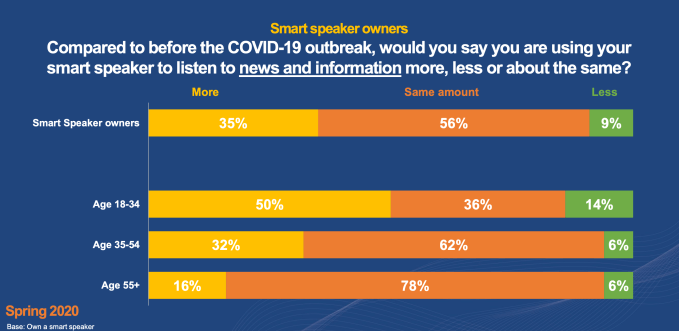
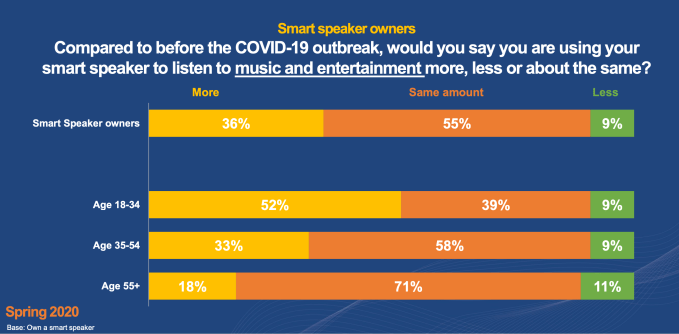
The coronavirus outbreak has driven more consumers to turn to their smart speakers for news, information, music and entertainment, according to new data released today by NPR and Edison Research. Around three-quarters of U.S. adults 18 and up said their routines have been impacted due to COVID-19 and their media habits have changed as a result. Since the outbreak, 35% of U.S. smart speakers owners say they’re listening to more news and information through their device, and 36% say they’ve increased their consumption of music and entertainment.

These figures skew even higher when looking at the 18-34 age group.

Here, 50% report an increase in news and information consumption and 52% said they’ve increased their listening of music and other sorts of entertainment.

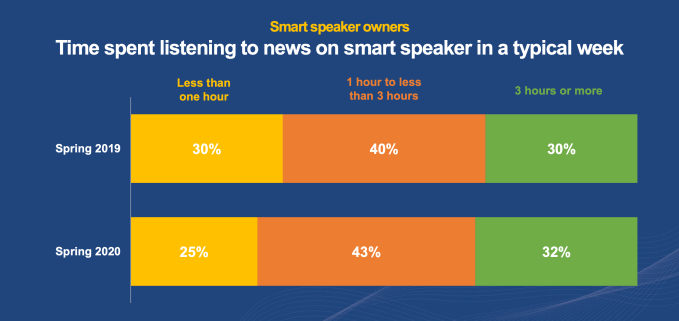
In addition, the report found the total time spent listening to news content via the smart speaker has increased since the same time last year. In Spring 2019, 30% said listened to 3 or more hours per week, 40% said 1 to less than 3 hours, and 30% said less than one hour.

In the quarantine-fueled Spring 2020, these numbers increased to 32% (3+ hrs.), 43% (1 to <3 hrs.), and 25%(<1 hr), respectively.

Smart speaker owners working from home during the COVID-19 outbreak were also more likely than smart speaker owners in general to make requests for news from their device on a weekly basis, but not as likely to ask for the weather, the time, or other updates.

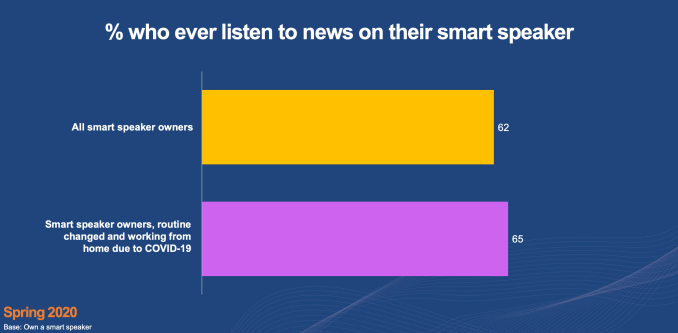
In the work-from-home group, 65% said they use the device — at some point — to listen to the news while 62% of all smart speaker owners said they do.

Quarantined adults may also help to drive increased sales of smart speakers as they realize the value in spreading out the devices in the home.

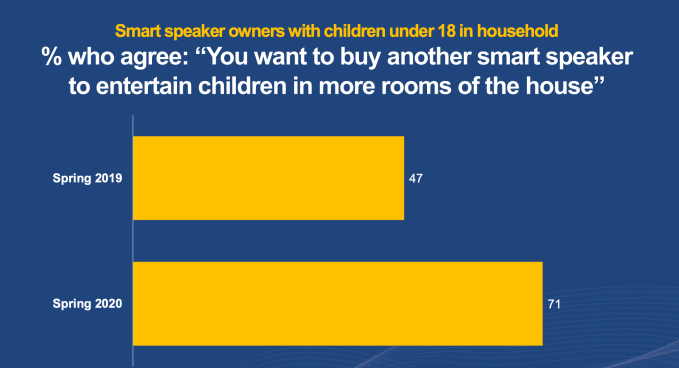
A large number of smart speaker owners who have children said they’re now thinking of buying another device to entertain their kids.

Last spring, only 47% said they were thinking of buying a new device for the kids. Now, it’s 71%.

The data in the report referencing the changes after COVID-19 comes from a survey that took place from March 31 through April 1, 2020, the organizations said.

“With tens of millions of Americans no longer commuting, smart speakers are becoming even more important as a conduit for news and information,” said Edison Research SVP Tom Webster, in a release, “and this increased usage and facility with voice assistants will likely increase demand for this technology in vehicles once our commutes resume.” he said.

The report also claimed that smart speaker adoption among U.S. adults has now reached 24% of the U.S. population, or 60 million users. This is a more conservative estimate than another recent report on smart speaker adoption from Voicebot.ai, which said one-third of U.S. adults have a smart speaker, or 87.7 million.

The further report examined other smart speaker trends, unrelated to COVID-19, including the use of smart devices with a screen and voice assistants on phones.

Cloud Foundry renews its focus on developer experience as it looks beyond the enterprise

The Cloud Foundry Foundation (CFF) just went through a major leadership change, with executive director Abby Kearns stepping down after five years (and becoming a CTO at Puppet) and the CFF’s CTO Chip Childers stepping into the top leadership role in the organization. For the most part, though, these changes are only accelerating some of the strategic moves the organization already made in the last few years.

If you’re unfamiliar with the open-source Cloud Foundry project, it’s a Platform-as-a-Service that’s in use by the majority of Fortune 500 enterprises. After a lot of technical changes, which essentially involved building out support for containers and adding Kubernetes as an option for container orchestration next to the container tools Cloud Foundry built long before the rise of Google’s open-source tool, the technical underpinnings of the project are now stable. And as Childers has noted before, that now allows the project to refocus its efforts on developer experience.

That, after all, was always the selling point of Cloud Foundry. Developers stick to a few rules and, in return, they can easily push their apps to Cloud Foundry with a single command (“cf push”) and know that it will run, while the enterprises that employ them get the benefits of faster development cycles.

On the flip side, though, actually managing that Cloud Foundry install was never easy, and required either a heavy lift from internal infrastructure teams or the help of outside firms like Pivotal, IBM, SAP, Suse and others to run and manage the platform. That pretty much excluded smaller companies, and especially startups, from using the platform. As Childers noted, some still did use it, but that was never the project’s focus.

Now, with the Kubernetes underpinnings in place, he believes that it will become easier for non-enterprise users to also get started with the platform. And projects like KubeCF and CF for K8s now offers a full Cloud Foundry distribution for Kubernetes, which makes it relatively easy to use the platform on top of modern infrastructure.

To highlight some of these changes, the CFF today unveiled its new tutorial hub that will not just explain what Cloud Foundry is, but also feature tutorials to get started. Some of these will be hosted and written by the Foundation itself, while community members will contribute others.

“Our community has created a learning hub, curated by the Cloud Foundry Foundation, of open-source tutorials for folks to learn Cloud Foundry and related cloud native technologies,” said Childers. “The hub includes an interactive hands-on lab for first-time Cloud Foundry users to experience how easy the platform makes deploying applications to Kubernetes, and is open for the community to contribute.”


DJI’s mini Mavic Air gets an upgrade with improved camera and battery life

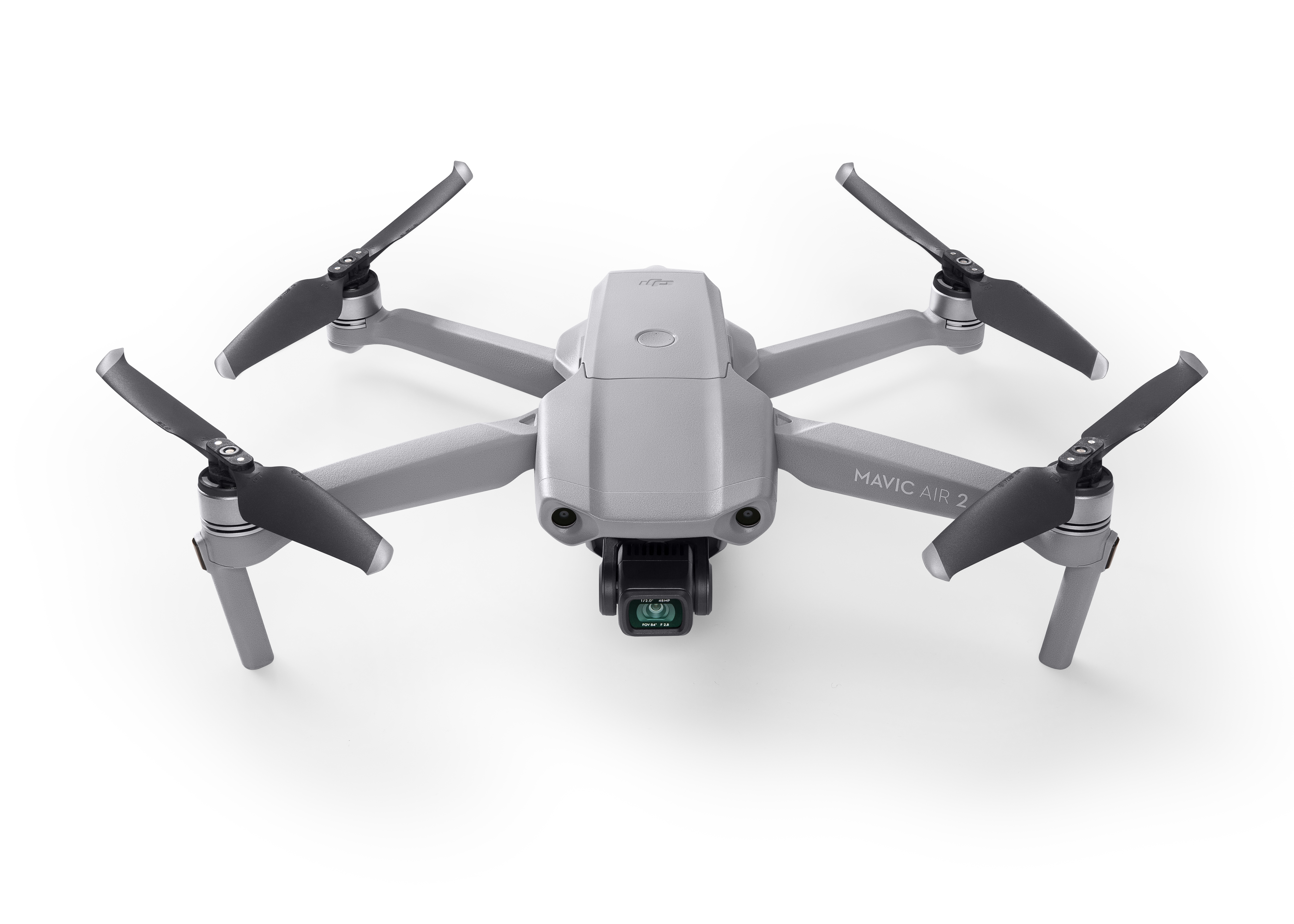
DJI had to kibosh its usual big unveil this time out, for obvious reasons, but the company won’t let a little thing like a global pandemic get in the way of an announcement. A little over two years after unveiling its lightweight Mavic Air, the drone giant is announcing the sequel.

When I reviewed the original shortly after the announcement, most of my complaints centered around the product’s usefulness. True, it was an impressive bit of engineering, but that only gets you so far. This time out, DJI looks to have addressed at least some of those issues. Among them, improved battery capacity.

The original’s 21 minutes of life was among my key frustrations with the product. The company says the drone should be able to get up to 34 minutes on a charge. We’re taking a system for a spin and will keep you updated on how that translates into real life.

I found a handful of usability errors the first time out, as well. There are, thankfully, some upgrades on the software front, including, most notable, a new version of ActiveTrack. The feature is said to have improved subject tracking on board, including the ability to relocate an something temporarily obscured by an object, like a tree. The Point of Interest and Spotlight features have gotten upgrades, as well.

Imaging is, once again, the thing here. As such, the biggest updates are on the picture and video front. The new Air is able to shoot 4K video at 60 frames a second. Stills can be shot at up to 49 megapixels, while the three-axis gimbal should help alleviate some of the drone’s shaking. The system can also do 8x slow motion and shoot photos and video in HDR. There are new low-light settings and scene recognition features, as well.

Other on board improvements include improved wireless transmission and upgraded obstacle avoidance. The latter is particularly useful for novice fliers, but is a welcome addition for any level.

The Mavic Air 2 is available today in China. Worldwide shipping (including the U.S.) has been significantly complicated by the COVID-19 crisis. Pre-orders are open today and it’s “expected” to ship in mid-May. DJI understandably doesn’t seem especially certain at this point. The system starts at $799. There’s also a $988 version that includes a charging hub, three batteries and a carrying case.