Otonomo raises $46 million to expand its automotive data marketplace

New vehicles today can produce a treasure trove of data. Without the proper tools, that data will sit undisturbed, rendering it worthless.

A number of companies have sprung up to help automakers manage and use data generated from connected cars. Israeli startup Otonomo is one such player that jumped on the scene in 2015 with a cloud-based software platform that captures and anonymizes vehicle data so it can then be used to create apps to provide services such as electric vehicle management, subscription-based fueling, parking, mapping, usage-based insurance and emergency service.

The startup announced this week it has raised $46 million to take its automotive data platform further. The capital was raised in a Series C funding round that included investments from SK Holdings, Avis Budget Group and Alliance Ventures. Existing investors Bessemer Venture Partners also participated. Otonomo has raised $82 million, to date.

The funds will be used to help Otonomo scale its business, improve its products and help it remain competitive, according to the company. Otonomo is also aiming to expand into new markets, particularly South Korea and Japan.

“We now have the expanded resources needed to deliver on our vision of making car data as valuable as possible for the entire transportation ecosystem, while adhering to the strictest privacy and security standards,” Otonomo CEO and founder Ben Volkow said in a statement.

Otonomo’s pitch focuses on creating opportunities to monetize connected car data while keeping it safe from the moment it is captured. Once the data is securely collected, the platform modifies it so companies can use it to develop apps and services for fleets, smart cities and individual customers. The platform also enables GDPR, CCPA and other privacy regulation-compliant solutions using both personal and aggregate data.

Today, Otonomo’s platform takes in 2.6 billion data points a day from more than 20 million vehicles through partnerships with more than automakers, fleets and farm and construction manufacturers. Otonomo has more than 25 partnerships, a list that includes Daimler, BMW, Mitsubishi Motor Company and Avis Budget Group. The company said it’s preparing to bring on seven more customers.

That opportunity for Otonomo is growing based on forecasts, including one from SBD Automotive that predicts connected cars will account for more than 70% of cars sold in North American and European markets in 2020.

Introducing the term-sheet grader

Jamie Goldstein
Contributor

Jamie is the founding partner of Pillar VC, a Boston-based seed-stage venture capital firm. He has spent the last 22 years investing in early-stage startups.

When we launched in 2016, we took the unusual approach of saying we’d buy common stock in startups. We believed then, and still do, that alignment with founders was more important than covering our downside in investments that didn’t work as planned. Said differently, we wanted to enhance our upside through alignment, rather than maximizing our downside through terms.

The world has changed a lot since that time. While we are actively making investments, and still buying common stock, we know that many entrepreneurs may be trying to raise money now — and it is very hard.

Fred Destin wrote a great piece about the ugly terms that can creep into term sheets during difficult times. If you have a choice between a good term sheet and a bad one, of course, you’ll take the good one. But what if you have no choice? And how can you compare term sheets in the first place?

To this end, we developed the term-sheet grader, a simple way to compare different term sheets or help characterize whether a term sheet is good or evil.

Let me first point out that none of this has anything to do with the valuation of the round (share price), the amount of capital, the likelihood of reaching a closing, the quality of the firm or the trust you have with the individual leading the investment, all absolutely critical pieces of the puzzle. Here, we are just looking at the terms and conditions, the legal structure of the investment.

We’ve listed nine key terms below — five that have to do with economics and four that relate to control and decision-making:

  • Each key term can earn +1 for being friendly and -1 for being tough.
  • There are a few really friendly terms that have a score of +2 each.
  • Likewise, there are a few really tough ones that earn a -2.
  • The best a term sheet could score is a +11, the worst is a -11.
  • The “Industry Standard” deal scores a 0.

FWIW, the Pillar common stock standard deal earns a +8 (shown below).

Valve drops VR support for macOS

Valve is calling it quits on macOS support for its virtual reality platform. A Valve employee posted an update to the company’s SteamVR forums, noting that “SteamVR has ended macOS support so our team can focus on Windows and Linux.”

Apple introduced “Metal for VR” back in June 2017 and highlighted a partnership with Valve. At the time, Valve was pushing VR as a platform and working with HTC on its Vive system; fast-forward to 2020 and Valve has its own high-end headset and has just released its highly-anticipated title “Half Life: Alyx.”

This impacts developers more so than actual gamers.

Almost no games supported Mac, and even Apple’s highest-end MacBook Pros failed to meet minimum specification requirements for Oculus or SteamVR. As the folks at Upload point out, Valve’s recent hardware survey showcases that just 4% of gamers on the platform use macOS to begin with, suggesting a pretty small sliver of actual gamers even fit in the Mac-owning VR user Venn diagram.

Game developers building VR content on Mac likely enjoyed the ability to develop and test on a single machine. As Apple aggressively chases professionals with high-priced gear like the Mac Pro and iMac Pro, it’s not a great look when a major software platform decides you’re not worth the effort.

Indian education startup Byju’s is fundraising at a $10B valuation

Byju’s, an education learning startup in India that has seen a surge in its popularity in recent weeks amid the coronavirus outbreak, is in talks to raise as much as $400 million in fresh capital at a $10 billion valuation, said three people familiar with the matter.

The additional capital would be part of the Bangalore-based startup’s ongoing financing round that has already seen Tiger Global and General Atlantic invest between $300 million to $350 million into the nine-year-old startup.

That investment by the two firms, though, was at an $8 billion valuation, said people familiar with the matter. Byju’s was valued at $5.75 billion in July last year, when it raised $150 million from Qatar Investment Authority and Owl Ventures.

If the deal goes through at this new term, Byju’s would become the second most valuable startup in India, joining budget lodging startup Oyo, which is also valued at $10 billion, and following financial services firm Paytm that raised $1 billion at $16 billion valuation late last year.

The talks haven’t finalized yet and terms could change, said one of the aforementioned people. This person, along with the other two, requested anonymity as the matter is private.

Spokespeople of Byju’s and Prosus Ventures, the largest external investor in the startup, declined to comment. A spokesperson for Tiger Global did not respond to a request for comment.

Byju’s, which has raised more than $1.3 billion to date, has seen a sharp surge in both its free users and paying customers in recent weeks as it looks to court students who are stuck at home because of the nationwide lockdown New Delhi ordered in late March.

The startup told TechCrunch last month that traffic on its app and website was up 150% in March and it added six million students to the platform during the month.

Other edtech startups, including Unacademy, which was recently backed by Facebook, and early-stage startups such as Sequoia Capital India-backed Classplus, and Chennai-based SKILL-LYNC, have also seen growth in recent weeks, they told TechCrunch last month.

Through its app, tutors on Byju’s help all school-going children understand complex subjects using real-life objects such as pizza and cake. The app also prepares students who are pursuing undergraduate and graduate-level courses.

Over the years, Byju’s has invested in tweaking the English accents in its app and adapted to different education systems. It had amassed more than 35 million registered users, about 2.4 million of which are paid customers as of late last year.

As COVID-19 dries up funding, only drought-resistant cannabis startups will survive

The COVID-19 crisis is creating an untold amount of uncertainty through every business sector, but for cannabis startups, it’s exacerbating a critical market that was already in decline.

TechCrunch spoke to Schwazze CEO Justin Dye following his company’s recent rebrand. He joined the company when it was Colorado’s Medicine Man Technologies (MMT) in late 2019 and is revamping the organization, including changing its name to Schwazze and acquiring a handful of companies to create a healthier, vertically integrated cannabis company.

The cannabis market is experiencing a correction after a period of rapid expansion. Shops are feeling the pain, and public valuations are settling under IPO levels — and this was before a pandemic swept the world. Cannabis media outlet Leafly laid off 91 employees in late March, and Eaze, an early mover in on-demand pot delivery, is experiencing major trouble after raising serious cash and recently losing a top partner in Caliva. In several states, efforts are underway to prop up the cannabis market by asking for the federal government to allow these businesses to be eligible for federal financial relief.

According to Dye, there are several things CEOs of cannabis companies of every size should work toward. His advice echoes what TechCrunch has heard in other verticals, as well: During the COVID-19 crisis, cannabis companies must hunker down and lean on strong teams to weather the storm. Once the skies start to clear, capital will be available to the survivors.

One, the cannabis market is looking for financially sustainable companies, Dye said.

“This next reset in the cannabis industry will not only be aspirational, but it’s going to be coupled with a requirement for performance in terms of executing against a plan and driving profits — or driving it to create free cash flow to be reinvested in the business and product experiences.”

Powerful House committee demands Jeff Bezos testify after ‘misleading’ statements

Amazon is in hot water with a powerful congressional committee interested in the company’s potentially anticompetitive business practices.

In a bipartisan letter sent Friday to Jeff Bezos, the House Judiciary committee demanded that the Amazon CEO explain discrepancies between his own prior statements and recent reporting from The Wall Street Journal. Specifically, the letter addressed Amazon’s apparent practice of diving into its trove of data on products and third-party sellers to come up with its own Amazon-branded competing products.

As the Journal notes, Amazon “has long asserted, including to Congress, that when it makes and sells its own products, it doesn’t use information it collects from the site’s individual third-party sellers—data those sellers view as proprietary.”

In documents and interviews with many former employees, the Journal found that Amazon does indeed consult that information when making decisions about pricing, product features and the kinds of products with the most potential to make the company money.

In the letter, the House Judiciary Committee accuses Bezos of making “misleading, and possibly criminally false or perjurious” statements to the committee when asked about the practice in the past.

“It is vital to the Committee, as part of its critical work investigating and understanding competition issues in the digital market, that Amazon respond to these and other critical questions concerning competition issues in digital markets,” the committee wrote, adding that it would subpoena the tech CEO if necessary.

While the coronavirus crisis has taken some of the heat off of tech’s mounting regulatory worries in the U.S., the committee’s actions make it clear that plenty of lawmakers are still interested in taking tech companies to task, even with so many aspects of life still up in the air.

An already struggling smartphone market takes a big hit from COVID-19

Quarter after quarter, familiar stories have appeared. The smartphone market, once seemingly bulletproof, has suffered. The list of factors is long, and I’ve written about them ad nauseam here, but the CliffsNotes version is: costs are too high, innovation is too incremental and most people already own a device that will be plenty good for the next few years.

But 2020 was going to be different. Smartphone makers were set to finally give consumers a reason to upgrade in the form of 5G. The first handsets appeared in earnest last year, but between a much wider carrier roll out, lower-cost 5G radios from Qualcomm and the arrival of a 5G iPhone, this was going to be the year the next-gen wireless technology helped reverse the smartphone slide.

And then COVID-19 disrupted everything. For many of us, life is on hold — and will likely continue to be for months. I’m writing this from my home in Queens, N.Y., the hardest-hit county in the hardest-hit country in the world. It still feels strange to type that, even though it’s been a reality for a month and half now.

Purchasing a smartphone is most likely the last thing on anyone’s mind during what is shaping up to be the worst global pandemic since the 1918 flu pandemic. With a number of key manufacturers reporting quarterly earnings this week, the numbers are starting to bear out this disconnect. Earlier this week, both Samsung and LG reported weak mobile numbers. Yesterday, Apple reported revenue of $28.96 billion, down from $31.1 billion the same time last year.

More troubling, all three companies appeared to be united in suggesting that the worst might be yet to come. Samsung suggested that both mobile and TV demand would “decline significantly” in the following quarter. LG used virtually the same exact wording, stating that, “market demand is expected to decline significantly YoY due to COVID-19 pandemic.” For its part, Apple simply didn’t issue guidance for the next quarter, a surefire indication of uncertainty in these uncertain times — to borrow a phrase from every commercial airing currently.

KlearNow raises $16 million to bring customs clearance industry into the digital age

Customs is the sieve of international supply chains. And yet despite its critical role, clearing customs for freight brokers can be a slow and opaque process reliant on manual data entry and prone to errors.

Silicon Valley-based KlearNow has developed a platform that aims to bring customs clearance into the digital age. Now, with $16 million new funding, KlearNow aims to expand its geographic reach and improve its product to cover increasingly complex export-import verticals and time-sensitive shipments.

The company has certification to handle any import into the U.S., no matter what the commodity is. KlearNow is close to getting certified in Canada and the U.K., and plans to expand to Netherlands, Belgium, Spain and Germany. KlearNow has about two dozen customers.

The Series A funding round was led by GreatPoint Ventures, with additional participation from Autotech Ventures, Argean Capital and Monta Vista Capital . Ashok Krishnamurthi, managing partner at GreatPoint Ventures, will join KlearNow’s board. Daniel Hoffer from Autotech Ventures is joining as a board observer.

“This is a significant opportunity to transform an archaic industry that is key to global commerce,” Krishnamurthi said in a statement.

The freight ecosystem is filled with different players from the factories and port authorities to the ship liners and the last-mile delivery companies. Each of them have their own systems.

“There’s no one system that you can transmit the data to,” KlearNow founder and CEO Sam Tyagi said in a recent interview. “So everybody dumps technology down to a PDF or a PNG or some sort of format that everybody can read. The broker gets those documents, and then they print it out — so now they become non-digital.”

If you go to any customs brokers office they look like the old doctor’s office where all those folders are there with nicely arranged, really organized but very manual process,” he added. From here, Tyagi said, a broker will read off from those printed documents and type the information into another system that is communicated to Customs and Border Patrol’s system.

“It is very manual, it’s very small, and they work in a siloed system,” Tyagi said. “There is no visibility for the customer, or the importer, and it’s very costly because of the manual intervention.”

KlearNow developed a digital customs clearance platform that aims to be agnostic. This allows importers, customs brokers and freight forwarders to integrate with local customs authorities and conduct business on a single digital platform remotely and in real time. The platform automates this process to eliminate errors and reduces the time to clear customs. KlearNow says it can slash customs clearance times from hours to minutes.

The startup is also betting that its platform will find new customers in this remote work era that was caused by the COVID-19 pandemic. Custom brokers, who might normally travel into central offices and manage physical paperwork, are now faced with completing that task from home.

“Remote work is impossible for these people,” because they often need to access large-format printers, Tyagi said. 

The company said its digital platform can funnel new clients, like these newly remote workers, directly to brokers for global customs clearance.

Tyagi said the company has also added new capabilities in response to COVID-19, such as expediting their FDA module to clear much-needed medical supplies, and is temporarily offering free clearance for nonprofit organizations that are importing masks, hand sanitizers and ventilators.

The ‘PuffPacket’ could help researchers learn when, how and why people vape

Vaping is a controversial habit: it certainly has its downsides, but anecdotally it’s a fantastic smoking cessation aid. The thing is, until behavioral scientists know a bit more about who does it, when, how much and other details, its use will continue to be something of a mystery. That’s where the PuffPacket comes in.

Designed by Cornell engineers, the PuffPacket is a small device that attaches to e-cigarettes (or vape pens, or whatever you call yours) and precisely measures their use, sharing that information with a smartphone app for the user, and potentially researchers, to review later.

Some vaping devices are already set up with something like this, to tell a user when the cartridge is running low or a certain limit has been reached. But generally when vaping habits are studied, they rely on self-report data, not proprietary apps.

“The lack of continuous and objective understanding of vaping behaviors led us to develop PuffPacket to enable proper measurement, monitoring, tracking and recording of e-cigarette use, as opposed to inferring it from location and activity data, or self-reports,” said PhD student Alexander Adams, who led the creation of the device, in a Cornell news release.

The device fits a number of e-cigarette types, fitting between the mouthpiece and the heating element. It sits idle until the user breathes in, which activates the e-cigarette’s circuits, and the PuffPacket’s as well. By paying attention to the voltage, it can tell how much liquid is being vaporized, as well as simpler measurements like the duration and timing of the inhalation.

An example using real data of how location and activity could be correlated with vaping

This data is sent to the smartphone app via Bluetooth, where it is cross-referenced with other information, like location, motion and other metadata. This may lead to identifiable patterns, like that someone vapes frequently when they walk in the morning but not the afternoon, or after coffee but not meals, or far more at the bar than at home — that sort of thing. Perhaps even (with the proper permissions) it could track use of certain apps — Instagram and vape? Post-game puff?

Some of these might be obvious, others not so much — but either way, it helps to have them backed up by real data rather than asking a person to estimate their own usage. They may not know, understand or wish to admit their own habits.

“Getting these correlations between time of day, place and activity is important for understanding addiction. Research has shown that if you can keep people away from the paths of their normal habits, it can disrupt them,” said Adams.

No one is expecting people to voluntarily stick these things on their vape pens and share their info, but the design — which is being released as open source — could be used by researchers performing more formal studies. You can read the paper describing PuffPacket here.

Smartphone shipments dropped 13% globally, and COVID-19 is to blame

We knew it was going to be bad — but not necessarily “lowest level since 2013” bad. As Apple was busy reporting its earnings, Canalys just dropped some of its own figures — and they’re not pretty. After two quarters of much-needed growing, the global smartphone market just took a big hit. And you no doubt already know who the culprit is.

The mobile industry joins countless others that have taken a massive hit due to the COVID-19 pandemic, with shipments dropping 13% from this time last year. Here’s a graph for those of you who are visual learners:

Analyst Ben Stanton used the word “crushed” to describe the novel coronavirus’s impact on the mobile market. “In February, when the coronavirus was centered on China, vendors were mainly concerned about how to build enough smartphones to meet global demand,” he writes. “But in March, the situation flipped on its head. Smartphone manufacturing has now recovered, but as half the world entered lockdown, sales plummeted.”

First it was impact on the global supply chain, which is centered in Asia, along with a drop in demand among consumers in China. As Europe, the U.S. and other locations continue to live under shelter in place orders, demand in those markets has taken a significant hit. People are stuck inside and many have lost jobs — it’s not really the ideal time to consider shelling out $1,000+ for what still seems a luxury for many.

Samsung regained the top spot, while still losing significant numbers. Both it and the number two company, Huawei, were down 17% for the quarter. Apple, at number three, dropped 8%. Chinese manufacturers Xiaomi and Vivo saw some gains, at 9% and 3%, respectively.

There are bound to be rough times ahead as well. Per Stanton, “Most smartphone companies expect Q2 to represent the peak of the coronavirus’ impact.” Apple noted the uncertainty of its own earnings by opting not to issue guidance for next quarter.

Walmart is piloting a pricier 2-hour ‘Express’ grocery delivery service

Record usage of grocery delivery services amid the COVID-19 pandemic has led to delayed orders, fewer open delivery windows and, on occasion, an inability to even book a delivery time slot. Walmart now hopes to capitalize on the increased demand for speedier delivery with the introduction of a new service that allows consumers to pay to get to the front of the line. The retailer confirmed today it’s launching a new Walmart Grocery service called “Express,” which promises orders in two hours or less for an upcharge of $10 on top of the usual delivery fee.

The service has been in pilot testing across 100 Walmart stores in the U.S. since mid-April. Walmart says it plans to expand the service to nearly 1,000 stores in early May and it will be offered in a total of nearly 2,000 stores in the weeks after.

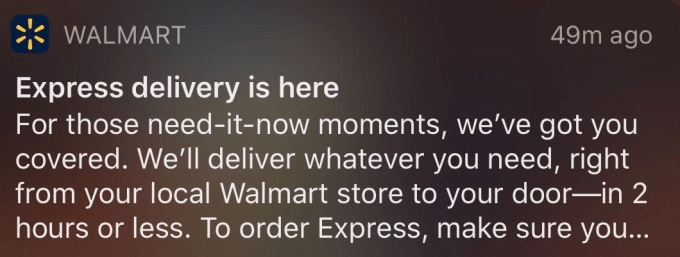
Some Walmart customers may have recently received a push notification alerting them to the launch.
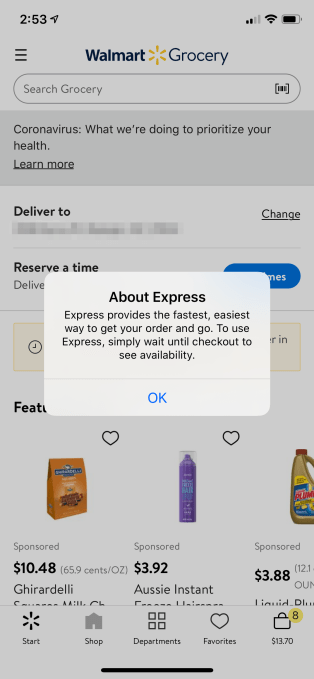
To use Express delivery, you first fill your online Walmart Grocery cart with the $30 minimum required for delivery orders or more. The Express service offers more than 160,000 items from across Walmart’s grocery, consumables and general merchandise categories. At checkout, you’ll see an option beneath the calendar where you pick a delivery date to select the Express service. In many cases, there may not be other standard delivery time slots available for the current day or even several days out, which makes the Express service even more appealing to shoppers who need their orders sooner.

Though Walmart is officially promoting Express as a “two-hour” delivery service, in the weeks it’s been piloting the program Walmart has been able to deliver these orders within 56 minutes, on average.

“In our tests, we were shown an Express fee of $18.90 to receive a delivery in 55 mins or less,” the app informed us today, April 30. There were no other fees. Without choosing the Express option, the next available time slot was not until next week, on Monday, May 4.
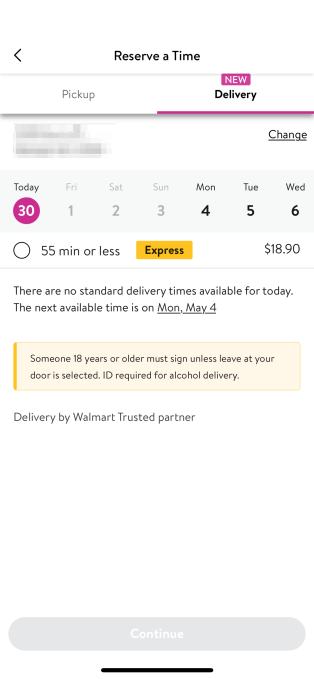
A price of $18.90 is close to — but is not exactly — a $10 increase over Walmart’s typical delivery fees of $7.95 or $9.95, depending on time of day. But we understand the plan is to make Express a flat $10 upcharge moving forward. (Walmart hadn’t been planning to officially announce the launch until next week, so pricing is being updated.)

Like Walmart’s other grocery deliveries, Express deliveries are handled by Walmart’s external network of delivery partners, which vary by market. The retailer won’t comment on if those additional fees are split with their partners, or how, if so.
There could be backlash against a system like this, given how it favors a wealthier customer at a time when food and other critical supplies have run short. During the pandemic, store shelves have often been bare as consumers hoarded things like toilet paper, hand sanitizer and Lysol cleaners. Now, consumers are being warned that meat shortages are expected soon.

In addition, the pandemic has already exposed the income divide between those who can afford to shop online and low-income customers, who can only use their SNAP benefits (food stamps) in physical stores — except in a handful of states where a USDA pilot has been running. And now those with the means will be able to gain another advantage: paying to get to the limited supplies first.

Walmart says it’s doing things to mitigate these types of concerns, however.

For items where the inventory is so limited it can’t guarantee delivery, it’s removing their availability from the online grocery service. Plus, the retailer says it’s not pushing back standard delivery orders to accommodate the high-paying Express customers. Instead, the Express service is being made available on top of Walmart’s existing grocery pickup and delivery capacity.
The Express service wasn’t dreamed up because of the pandemic, Walmart says, but it did play a role in terms of the timing of the launch.

“The demand that we’ve seen during the coronavirus pandemic is making us push forward and expedite the development of some services that we may have been thinking about,” a Walmart spokesperson explained. “But demand has pushed us to innovate more quickly,” they added.

Walmart is not alone in experiencing a crush of online grocery orders due to the COVID-19 pandemic.

The company and others have seen a record number of downloads for their grocery apps in recent weeks. In fact, demand for online grocery as well as other e-commerce orders has been so great that Walmart hired 150,000 new workers out of a pool of over a million applicants a full six weeks ahead of schedule, and is now hiring 50,000 more.

Meanwhile, Walmart’s online grocery rivals — Shipt, Instacart and Amazon — have also been hiring hundreds of thousands of new shoppers between them. Amazon had to implement a waitlist system for new Amazon Fresh and Whole Foods Market pickup and delivery customers due to the rise in online grocery shopping. And Instacart made several adjustments to its app to help better prioritize orders and open up more delivery windows.

In Walmart’s case, its ability to launch Express isn’t solely due to its new hires, we’re told.

The company already employs a workforce of 74,000 “personal shoppers” who dedicate themselves to pulling for online grocery orders. Walmart says Express is powered by these personal shoppers, only some of whom may be the newly hired store associates.

“We have an opportunity to serve our customers no matter what life calls for,” said Tom Ward, Walmart senior vice president, Customer Product. “Whether it be a last-minute ingredient, medicine when a fever hits or the item you didn’t know you needed when checking off your chore list, time matters. Express is a solve for that,” he said.

Updated 4/30/20, 6:35 PM ET with additional expansion details and exec quote. 

Microsoft opens registration for its free, online Build 2020 developer conference

Microsoft has now opened registration for the virtual edition of its online-only Build 2020 developer conference, which will take place from May 19 to 20.

Typically, the event draws more than 6,000 developers, but because of the coronavirus pandemic, that’s obviously not an option. In contrast to Google, which completely scrapped its I/O developer conference this year, Microsoft decided to go ahead with the virtual event. But this will be a very different kind of Build — and not only because it’s online-only.

Not only will the keynotes be shorter (though there will still be Day 1 and Day 2 keynotes), but in response to feedback from developers who have attended previous events, the Microsoft team also decided to focus solely on that audience. In previous years, Microsoft often used Build to announce consumer products, just like Google does at I/O. But that won’t happen this year. And instead of using the keynotes to put an early spotlight on features that won’t be available for half a year or more, the event will be more about providing content that’s immediately useful for developers and new products that are either immediately available or only a couple of months out from getting into the hands of developers.

That also likely means that even though Microsoft CEO Satya Nadella will still keynote, there will be less talk about big-picture company philosophy and more about developer tools and APIs.

Some of the keynotes and demos will be live, some will be pre-recorded, but overall, the look and feel of the event shouldn’t be all that different from what developers who previously watched Build from afar experienced. But it will be shorter and more focused than in previous years, which isn’t necessarily a bad thing.

Attendees sit in pods during the Microsoft Developers Build Conference in Seattle, Washington, U.S., on Monday, May 7, 2018. The Build conference, marking its second consecutive year in Seattle, is expected to put emphasis on the company’s cloud technologies and the artificial intelligence features within those services. Photographer: Grant Hindsley/Bloomberg via Getty Images

Apple News hits 125 million monthly active users

During the pandemic crisis, active users of Apple’s news platform hit an all-time high.

On an earnings call, Apple CEO Tim Cook shared that Apple News had reached 125 million monthly active users. Cook announced the number after revealing the company’s Q2 performance, which saw its Products revenue decline year-over-year while Services surged.

The company earned Services revenue of $13.35 billion in Q2, juicing the segment by about $1.9 billion since last year.

Apple launched a paid version of Apple News called Apple News+ last year, which offered users access to paywalled news sites and magazines for $9.99 per month. Apple has not delivered any users numbers on how that element of the platform is faring.

iPhone sales are down, ahead of uncertain times for the industry

Stop me if you’ve heard this one before: Apple device sales have taken a hit, but the company’s services are doing swell. The iPhone, the longtime cornerstone of the company’s hardware portfolio, hit $28.96 billion in revenue for Q2, down from $31.1 billion from this time last year. The iPad and Mac lines saw drops for the quarter, as well.

The company had already sounded the alarm bells for a weakened demand, due to the growing threat of COVID-19. Way back in February, Apple noted that the coming pandemic was set to both impact the global supply chain and weaken demand in China. “All of our stores in China and many of our partner stores have been closed. Additionally, stores that are open have been operating at reduced hours and with very low customer traffic,” it said at the time.

While aspects of life have returned to normal in China, the virus has subsequently delivered a huge hit to much of the rest of the world, including Apple’s home in the U.S., which continues to lead the world in COVID-19 cases.

Unsurprisingly, CEO Tim Cook struck a consolatory note in a press release, in spite of the company’s decision not to offer third-quarter guidance. “Despite COVID-19’s unprecedented global impact, we’re proud to report that Apple grew for the quarter, driven by an all-time record in services and a quarterly record for wearables,” he writes.

Wearables were, indeed, up. The category, which also includes home and accessory products like the HomePod, was up to $6.3 billion from $5.1 billion. The category continues to be a success on the strength of the Apple Watch and AirPods lines. Services, too, continue to grow steadily, up to $13.3 billion from $11.5 billion. That category seems to be a reasonably safe bet, as users turn to offerings like Apple Music and Apple TV+ during the ongoing stay at home period.

The future for smartphones continues to be a rocky one, going forward. The company recently introduced the SE in a bid to appeal to consumers put off by $1,000+ price tags. And Apple’s certainly not alone there. The entire industry has taken a hit in recent years, well before the arrival of the novel coronavirus.

Apple and other companies were expected to get a boost from the arrival of 5G, though everything is currently up in the air due to the pandemic. That reportedly also includes the arrival of a 5G iPhone, which is said to have potentially been pushed back a month over supply chain issues.

A new pro bono portal just launched for lawyers looking to help people hit hard by the pandemic

The coronavirus pandemic has laid low a lot of Americans, more than 62,000 of whom have already died since the beginning of March and 30 million more who are now out of work owing to the resultant shutdown of most businesses and public gathering places.

The ensuant crisis it has created is so massive that any type of coordinated effort is a challenge to pull together. Fortunately, that hasn’t stopped the American Bar Association and a justice tech company called Paladin that we introduced to readers last year. On the contrary, the SaaS startup — which helps legal teams sign up for pro bono opportunities, then makes their work and its impact easier to track — has teamed up with the ABA to help lawyers find pro bono opportunities specifically to help people affected by the coronavirus pandemic and other natural disasters.

It’s a way to accelerate work that the ABA has been doing for the last 13 years through its Young Lawyers Division’s Disaster Legal Services Program — because time, right now, is of the essence.

We were in touch yesterday with Paladin co-founder Kristen Sonday to learn more about the new portal, which helps lawyers filter opportunities by practice area, communities to serve, type of engagement and the ability to work remotely. We asked how it might better hep attorneys and those in need of their services to connect faster.

TC: How did this project come together? Who brought in whom to do what?

KS: The Paladin team saw a similar response to COVID-19 as previous legal emergencies in how volunteer attorneys were being recruited, which is mostly through online forms and spreadsheets [and] manual and ad hoc.

We had already built a version of a centralized opportunity guide for the Chicago Bar Foundation, and this seemed like a great opportunity to leverage that technology to help legal services organizations across the country recruit and manage disaster response volunteers seamlessly.

TC: Two other companies are involved here: LegalZoom and Clio. What role are they playing?

We approached LegalZoom and Clio to get involved given their reach on both the client and solo/small firm sides. They’re covering the costs of researching and developing this online resource, and we’re excited about the partnership because both organizations are well-known for their commitment to using technology to increase access to justice and improve legal services, [and] filter opportunities by practice area, communities to serve, type of engagement and the ability to work remotely.

TC: Who are some of the people, or businesses, you see this helping right now? What are some common cases?

KS: Vulnerable individuals are experiencing a range of legal issues at unprecedented levels. Common cases include individuals filing for unemployment benefits; navigating housing issues and unlawful evictions; victims of domestic violence who have sheltered-in-place with an abuser; nonprofits and small businesses navigating canceled contracts; and delays in court proceedings affecting thousands of Americans.

TC: And how did you put together this database?

KS: Paladin partnered its technology with the ABA DLS’s network to provide a centralized portal for state hotlines and disaster-related opportunities from legal services organizations across the country. All Legal Services Corporation grantees are able to post on the platform, and we look forward to seeing more organizations participating every day.

TC: Were there privacy concerns that needed to be addressed first?

KS: Opportunities have confidential information removed prior to posting, and attorneys are typically only provided confidential case information after they’ve been vetted by the referring organization.

TC: How do attorneys make themselves available on this portal?

KS: They sign up for specific pro bono opportunities that align with their interests and experience. Once they submit a form outlining their background to the referring organization, that organization will screen them and pair them with the most appropriate pro bono client.

TC: Are you generating any revenue from this project?

KS: Our mission is to increase access to justice by supporting pro bono legal services, so this project seemed like the perfect way to leverage Paladin’s expertise and increase impact. There is no cost for attorneys to use, nor cost to the legal services organizations posting opportunities. It is a great way to raise awareness of Paladin’s work more broadly.

Lawyers who are willing to provide pro bono legal services can sign up and view cases at here.