Original Content podcast: Netflix’s ‘Middleditch & Schwartz’ might change your mind about improv

We’ll admit it: Some of your Original Content podcast hosts are a little skeptical about improvised comedy.

Of course, we can enjoy improv when it’s done well. It’s just that we’ve seen it done less well, often by friends who are so enthusiastic without being particularly funny. And our friends aside, live improv has rarely been translated successfully into an on-screen show or special.

So we had some reservations going into “Middleditch & Schwartz” on Netflix, which consists of three hourlong improv specials. But our doubts were quickly demolished as we watched the mind-bogglingly talented Thomas Middleditch (“Silicon Valley”) and Ben Schwartz (“Parks & Recreation”) spin up dizzyingly complex plots based on just a few prompts from the audience, bringing to life dozens of characters and tying everything together into a big comedic climax right as their time is runs out.

And sometimes, the show is even better when things don’t go smoothly — when they’re forced to backpedal out of a narrative dead end, or when they struggle to remember the names of the character they’re playing at a given moment, or the accent they should be using.

Before we get to our review, we also discuss our thoughts on the current battle between NBCUniversal and big movie theater chains, over the studio’s decision to release “Trolls World Tour” directly to video-on-demand and potentially to follow suit with other films.

You can listen to our review in the player below, subscribe using Apple Podcasts or find us in your podcast player of choice. If you like the show, please let us know by leaving a review on Apple. You can also send us feedback directly. (Or suggest shows and movies for us to review!)

And if you’d like to skip ahead, here’s how the episode breaksdown:
0:00 Intro
0:30 NBCUniversal news
18:00 “Middleditch and Schwartz” review

Startups Weekly: SaaS companies should target burn to match ARR during pandemic

[Editor’s note: Get this weekly recap of TechCrunch news that any startup can use every Saturday morning by email (7am PT). Just subscribe here.] 

How well is SaaS overcoming business impacts of the pandemic? First, there’s no negative impact on the revenues of big cloud infrastructure providers visible so far, according to a new research report out that we covered on TechCrunch this week. While some spending may have pulled back, growth from more remote work and other activities have maintained the overall momentum.

However, startups across the category could be “looking at around a 30% miss to plan in Q2,” Alex Wilhelm concludes based on a long interview with Mary D’Onofrio, a growth investor focused on the category at Bessemer Venture Partners. “This has tempered investor growth expectations. But even more than raw growth figures, SaaS investors are looking for efficient growth. In Bessemer’s eyes, a 1:1 ratio of ARR add to burn is the target. It won’t be easy. Startups selling to SMBs are going to hurt worse by rising churn than enterprise-focused startups, while startups selling to larger customers may struggle with new customer adds given travel restrictions. So, enterprise-focused startups will likely lean more on upsells than new logo adds. Those will also prove difficult, even if they won’t slow completely.”

She and Bessemer had already developed a series of metrics to analyze the health of cloud companies, including a ‘Cash Conversion Score‘ and a Nasdaq emerging cloud index. Check out the rest of the article on Extra Crunch for how D’Onofrio sees those numbers being affected now.

A fond farewell to Josh Constine

This newsletter focuses on key meta topics for startups, and sometimes that means getting even more meta and talking about changes at TechCrunch. Josh Constine will be leaving us for the VC world, where he’ll be investing and heading up content with SignalFire.

If you have ever thought that Josh would be the one to really get your hot new consumer product idea first, you now have a new reason to talk to him. Read his thoughts on the new job in this personal post (and ongoing newsletter).

If you’re not familiar with the name, you’ve still read Josh quite a bit this decade if you’ve been reading TechCrunch — or tech news in general. He started here with me in late 2011 writing about Facebook and social trends, and has become one of the most influential writers on social and startup topics today. In addition to his traffic stats, top journalist rankings*, etc that one can measure most easily, we have watched his analysis regularly result in major changes to the main products of leading consumer internet companies in the world today.

His repertoire expanded over the years to include huge scoops (like Bing’s child-porn problem or Facebook’s secret VPN), memes (Zoombombing) and many appearances across global stages.

He has accomplished almost all of what great tech writers can accomplish and I cannot say I’m surprised that he wanted to try his hand at investing, having known him since before we first worked together last decade. I believe he’ll succeed as an investor, and be a force for good in that role like he has been here.

There is one thing I think he should still do as a professional writer, though — write a book. About his own life in the startup world this past decade. Trust me, you’d want to read it.
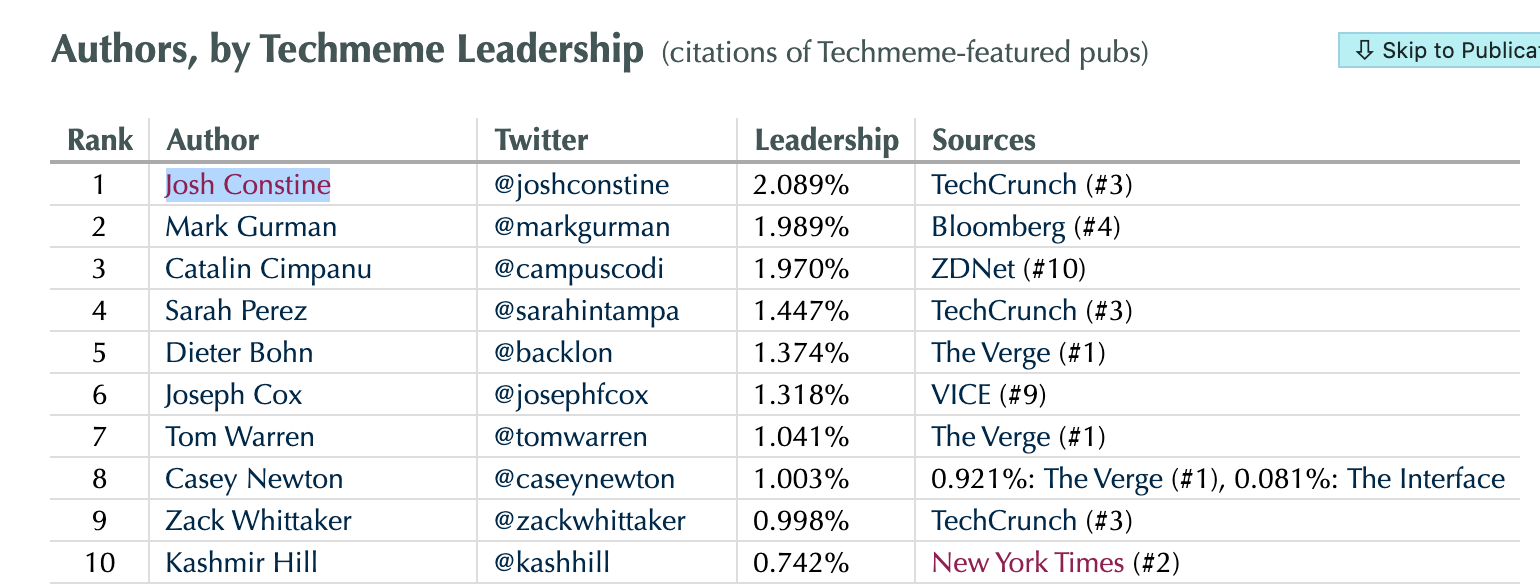
*Here’s how to find other great tech reporters who cover what you do

…Besides just reading this site, of course. Josh was the #1 ranked author on Techmeme, the news aggregator of record for the tech industry, by a number of measures. Want to find the right reporter to talk to, besides him? Go to Techmeme.com/lb to find expert TechCrunch authors and some of our most worthy competitors across 43 industry categories, including AI, e-commerce, enterprise software and many more. [Note: This is an unpaid plug for a great independent tech media product, we don’t normally run third-party shoutouts in here.]

Startup fundraising updates… keep those teeth gritted

We have a few writers tracking the latest ins and outs of fundraising during pandemic, here are notable updates from this week:

“Some of our peers in the Valley have up to 40% of their companies that need an infusion or some sort of bridge to get through,” Mike Janke, co-founder of early-stage cybersecurity investment firm Datatribe, told Jon Shieber. “These companies that had higher valuations that came out of the Valley have had to do more drastic cuts.” Startups that raised cash in markets outside the Bay Area have not had as much difficulty, he says, because they’re more efficient. “When you see regions like Boston, the DC corridor, Austin and Boulder, those companies don’t raise as big a round and they’re a little more financially conservative.”

One wonders if these hubs will see comparative growth sooner and stronger than the Valley itself? Meanwhile, the screws continue to twist in today’s term sheets.

“Let’s say you were a founder and you were doing great and you were on track and you were going to start raising your Series A or Series B, you know, in May,” Freada Kapor Klein of Kapor Capital explained to Megan Rose Dickey during an EC Live interview on Tuesday. “Well, you’re screwed. And so we see VCs sitting on the sidelines, waiting for the startups to almost go under and then put the most draconian term sheet in from of them where they wipe everybody off the cap table, where if you don’t put in your pro rata — we’ve got one of these going on right now — if you don’t put in your pro rata, we’re going to lose at least 90% of our investment.”

As Alex Wilhelm noted in a separate article, even if startups can keep revenue up and burn-rate down (see first item above), investors are slowing their pace of putting money in. Companies that should have been able to raise will no longer be able to at worthwhile terms.

Kapor suggested that some companies might want to consider broader options. For example, if a company thinks it is headed towards losing control to investors who have different motives, it may be able to re-establish itself as a public benefit corporation to spell out the mission and preserve it in the charter (to a degree).

A simpler answer for many startups is to drop all fundraising goals and focus on profitability. “Genuinely, it’s not rocket science,” Bryce Roberts of Indie.vc tells Megan in an interview. “Profitability isn’t this crazy, elusive thing. It’s literally more achievable than a Series A round. It’s way more achievable than a Series B round. If you look at the kind of fall-off between those rounds, most entrepreneurs would be better off finding their path to profitability and scale.” Instead, Roberts reminds us that you do not need anyone’s permission to do a startup. You can figure out how to do it yourself like countless great founders before you.

Immigration to the US still possible

Resident immigration lawyer Sophie Alcorn does a regular Q&A column for us, responding to reader questions about the US process. A one “Scientist in South San Francisco” asked her what the impact was of a recent attempt to suspend green cards in a TechCrunch column this week. We’re highlighting the answer because we know that Scientist is far from alone:

“The proclamation that President Trump signed last Wednesday falls far short of the outright suspension of immigration he tweeted about on Monday. The order places a very limited 60-day moratorium on issuing green cards to individuals seeking to come to the U.S. from abroad. Aimed at protecting job opportunities for unemployed Americans and relieving U.S embassies and consulates of the green-card processing workload, this “temporary suspension” has already begun. It’s possible that it could be extended beyond 60 days….

What this new policy actually means is that no employment- or family-based green cards will be issued to candidates living outside of the U.S. except for spouses and dependent children of American citizens, physicians, nurses, or other healthcare professionals who are coming to the U.S to perform research or work to combat COVID-19 in the next couple of months.”

She separately breaks down immigration issues combined with PPP loans for those facing such complexities in this Extra Crunch column.

Hopefully, in any case, this country will soon return to being a place where people want to move.

VCs talk startups in gaming during the pandemic

In our investor surveys this week, media analyst Eric Peckham caught up with top investors in gaming, part of an ongoing series he’s been doing since last year. But this time around, he talked about the COVID-19 impact on social gaming and MMOs, and separately on esports. Here’s one key part from Ryann Lai of Makers Fund:

Peckham: What’s different about MMO (massively multiplayer online) game studios founded recently versus those founded three or so years ago? Any distinct change in strategies, team composition, etc.?

Lai: I like to think that every game is becoming more MMO-esque with persistent social profiles and deeper social interactions. The “traditional” MMOs themselves are seeing ever-increasing player expectations on visuals, narratives, social systems, and accessibility (e.g., less grind, shorter sessions, cross-play, etc.).

On the supply side — we’ve seen a continued democratization of multiplayer-centric development driven by a) decrease in development and operating costs, as well as b) availability of talents and specialized backend solutions providers that empower smaller (both in size and budget) and more distributed teams to have “MMO” ambition.

Around TechCrunch

Extra Crunch Live: Join Roelof Botha for a live Q&A on May 6 at 2pm ET/11am PT

Extra Crunch Live: Join Hunter Walk for a Q&A May 7th at 1 pm ET/10 am PT

Atlassian co-founder and co-CEO Mike Cannon-Brookes is coming to Disrupt SF 2020

Across the week

TechCrunch

When regulation presents a (rare) opportunity

Quarantine creates new opportunities for video makers, according to a Butter Works report

A new pro bono portal just launched for lawyers looking to help people hit hard by the pandemic

Cleo Capital’s Sarah Kunst launches a fellowship for laid-off workers

Equity Monday: Startups run low on cash, and why some Internet tailwinds are fading

Extra Crunch

5 tips for starting a business with a stranger

How this startup built and exited to Twitter in 1,219 days

Precursor Ventures’ Charles Hudson on ‘the conversation no one has during an upmarket’

A full-time VC & part-time ER doctor shares his thoughts on COVID-19

Digging for dollar signs amid edtech’s current momentum

#EquityPod

There is money in design tools, but do designers have a target on their backs?

This Week in Apps: Zoom gets busted, TikTok’s new record, contact tracing API launches

Welcome back to This Week in Apps, the Extra Crunch series that recaps the latest OS news, the applications they support and the money that flows through it all.

The app industry is as hot as ever, with a record 204 billion downloads and $120 billion in consumer spending in 2019, according to App Annie’s “State of Mobile” annual report. People are now spending 3 hours and 40 minutes per day using apps, rivaling TV. Apps aren’t just a way to pass idle hours — they’re a big business. In 2019, mobile-first companies had a combined $544 billion valuation, 6.5x higher than those without a mobile focus.

In this Extra Crunch series, we help you keep up with the latest news from the world of apps, delivered on a weekly basis.

This week we’re continuing to look at how the coronavirus outbreak is impacting the world of mobile applications, including the latest on the U.S. and other international efforts to develop contact-tracing apps, plus the use of live-streaming apps as fundraising tools, the impact of quarantine on iPad apps and more. We’re also tracking news related to Zoom’s latest backtrack, WhatsApp’s plans to enter the credit market, the Instagram pods discovery, TikTok best quarter (better than any app… ever), Facebook’s plan for virtual dating and more.

Headlines

Apple News hits 125M monthly active users

The COVID-19 pandemic has driven a significant increase in how many people are using Apple’s News app on their mobile devices, tablets and Macs. During Apple’s earnings call this week, the company revealed Apple News now sees over 125 million monthly active users in the U.S., Canada, the U.K. and Australia, up from 100 million in January. Apple, however, did not note how many were subscribed to its $9.99/month premium news service, Apple News+.

Apple & Google release first version of the exposure notification API

Equity Shot: 1% is the new “growth”

Happy Saturday and welcome back to an Equity Shot, a short-form episode of Equity where we drill into one particular topic. There was so much news this week in our main areas of focus — startup funding rounds, new venture funds, that sort of thing — that we had to exclude earnings from the main show! (But really, check it out, as it was a good time.)

Sad, I know. Everyone surely noticed the loss, but we gathered once again on Friday afternoon to dig into the results all the same. A big thanks to Danny, Natasha and Chris for gathering ’round one more time to get through:

  •  SaaS and enterprise earnings: We dug into Microsoft’s results (TechCrunch coverage here), along with notes on quarterly results from Atlassian, Zendesk and ServiceNow. The gist is that big corp SaaS did fine in Q1, but there are varying levels of concern regarding the future.
  • Subscription content: Spotify is doing fine and Netflix smashed it, according to Danny (TechCrunch coverage here, and here, respectively). Spotify also managed to eke out the world’s funniest net income result, while Netflix shot forward like a hare from a trap. In short, we may be listening to fewer podcasts, but we sure as hell aren’t getting off the couch.
  • Advertising shops: While the advertising world melts down in spectacular fashion, tech shops that are ad powered did kinda OK. Facebook did what it always does, wowing with results and this time telling investors that April was looking better than March. Snap grew like hell, surprising investors, even if its overall cost structure is broken when compared to its revenue. Twitter was the miss of the bunch, struggling the most after telling investors it was still seeing COVID-19 issues in April. And, finally, Alphabet did Google things, so its stock went up, COVID-19 be damned.

We avoided Tesla because who can be bothered, and managed the shortest note on Apple ever recorded on a business podcast. All that and we had some fun. Hugs from Equity; we’ll be right back Monday morning!

Equity drops every Monday at 7:00 AM PT and Friday at 6:00 am PT, so subscribe to us on Apple PodcastsOvercastSpotify and all the casts.

Namely, a former high flier, slashes staff as demand for its HR software dries up in the pandemic

Namely, an eight-and-a-half-year-old, New York-based company that sells payroll, talent management and other HR services to mid-size businesses across the U.S. via subscription software, has let go of upwards of 40% of its roughly 400 employees.

The cuts are across the board, from high-ranking staffers, including a CFO who was brought on almost exactly two years ago, and a chief security officer who has spent just the last year with the company, to its entire customer success team.

In a call earlier today, Namely CEO Larry Dunivan said the company had reduced executive pay five weeks ago, hoping to avoid layoffs, but that the coronavirus and its impact on the business made that impossible. He also shared the difficulties of running a startup right now that depends largely on small- and medium-size businesses, noting that even though Namely’s customers sign up for between one- and three-year-long contracts — they also pay an additional amount for a minimum number of employees — many of those customers are finding it difficult to fulfill those contracts at the moment.

He pointed to one client who has numerous yoga studios and who earlier this year employed 500 people but has laid off all but 15 of them in the shutdown. Said Dunivan, “We just had a stark, painful conversation and you could tell I was one of many people she was calling. [But] because I care about that relationship, I waived that minimum for some period of time so she can conserve cash.”

Which means less revenue for Namely.

It’s a situation that many startups find themselves in. According to Layoffs.fyi, site that’s trying to track industry layoffs as they happen, at least 356 startups have now laid off 34343 employees. That’s saying nothing of the many companies and small businesses like yoga studios that don’t register as tech startups. In fact, nearly four million people filed for unemployment benefits last week alone, bringing to more than 30 million the nation’s number of unemployment claims.

While the deep cuts are understandable in the current context, they also represent one in a series of milestones at Namely that no startup wants to encounter. Though it was once among New York’s most promising businesses and accordingly raised at least $217 million from investors, including Matrix Partners, True Ventures, and Sequoia Capital, it has seen more than its share of transition at the top. In the most devastating development for the company until now, Namely’s board abruptly fired the company’s cofounder, Matt Straz, as its CEO in 2018.

Accused of actions “inconsistent with that which is expected of Namely leadership,” as the company told employees at the time, Straz has gone on to launch an employee benefits startup called Bennie.  But it cast a cloud over the company (which still isn’t talking about what happened).

Soon after, the board member who led the investigation into Straz —  longtime Silicon Valley executive Elisa Steele — was appointed as Namely’s permanent CEO, and at the time helped attract $60 million in new funding to the company led by GGV Capital.

Yet by last summer, she had also left as CEO, a decision that she made based on family commitments says one source, and owes partly to the relationship she had established with Dunivan, he said separately. Specifically, Dunivan said that in his previous role as the interim CEO of the human resources company ThinkHR, he was consulted by Steele on business and product strategy, and that “as sometimes happens, one thing led to the other and i joined” the company in her stead. (Steele remains on the company’s board.)

Certainly, he inherited a business that no longer enjoys the sheen it once did.

As says one person with a stake in the business, “I don’t think anyone is giving up on Namely but it had a modest growth plan at the start of 2020 and that’s now been made uncertain because of [COVID-19]. I think the company is just trying to control what it can and to structure itself so it can operate more efficiently with a major drop-off in revenue.” Adds this person, “It’s like a clean sheet of paper.”

It’s an optimistic perspective and surely one that remaining employees will need to embrace, at least until the fourth quarter, which is when Dunivan estimates that businesses across the board may pick up again.

“This is an extraordinarily difficult time, but we look at the world through a fairly conservative lens and we’re making certain assumptions about how new customers will buy, how existing customers will increase or decrease headcount, and how many businesses will be closed and never to come back,” said Dunivan when we spoke earlier.

“It’s my believe that the recovery will start to show signs of life in the fourth quarter and into the first quarter, and our current looks at it through that lens,” he added. “But in the meantime, employers will be paying fewer people.”

Faced with dwindling options, Namely is now among them.