This week, Andy Greenberg talks about his profile of hacker Marcus Hutchins, and we get an update on contact tracing programs helping to slow the pandemic.
Category: Tech news
hacking,system security,protection against hackers,tech-news,gadgets,gaming
I Enrolled in a Coronavirus Contact Tracing Academy
Health experts say we need up to 200,000 more people to track down the infected and anyone who crossed their path. I took the training to learn how it works.
How to Do Zoom Circle Time for Little Tiny Squirmy Kids
A veteran preschool teacher explains: Don’t expect they to sit still, but do expect them to share.
Silicon Valley Rethinks the (Home) Office
Some tech companies are adjusting to the pandemic with new WFH perks and even letting employees ditch their commutes forever.
This Week’s Cartoons: Virtual Meetings, Zoom Sports, and Monarchy Metrics
Come and see the violence inherent in the system!
The US Says Chinese Hackers Went Too Far During the Covid-19 Crisis
The FBI and DHS say that Beijing’s hacking “jeopardizes” the delivery of much-needed Covid-19 treatment options.
5 Free Digital Comics to Spend Time With During Lockdown
Looking for some comics to fill your quarantine hours? Lots of publishers are currently offering free issues. We suggest you start with these.
The Science of Temperature Is Weirder Than You Think
Getting warm is easy—like falling off a bike. So why is it so hard to be cool?
Why Is Facebook So Afraid of Checking Facts?
The biggest social network in the world has the wrong idea for how to fight Covid-19 conspiracies.
(Update: it’s back) Slack is currently fixing performance issues that prevented some users from connecting
Update: Slack says connection issues are now fixed for everyone.
Everyone should be able to connect to Slack now. Please let us know at [email protected] if you have any connection trouble. Thank you for being patient with us, we appreciate it. https://t.co/AALbQGsDHq
— Slack Status (@SlackStatus) May 13, 2020
Slack is currently fixing issues that are preventing some users from connecting or sending messages, according to its Status page. The company’s latest update on Twitter says some people may start seeing improvements, but that the company is still working on it.
Customers may be seeing performance improvements, although we still have some work to do. We’ll be back with more news shortly. https://t.co/AALbQGsDHq
— Slack Status (@SlackStatus) May 13, 2020
With so many working remotely because of the COVID-19 pandemic, Slack is the main way that many people keep in touch with their colleagues. The company has not announced if the current outage is related to increased demand (though, to be fair, they are busy right now).
Like other major online communication platforms, Slack has experienced outages in the past, and generally fixed them within a few hours while keeping users updated. For example, it experienced outages last summer, soon after the company performed a major update to its underlying technology to increase the speed of its desktop and web clients.
We will update this post when Slack’s connectivity is fully restored.
Sonantic is ready to convince listeners that synthetic voices can cry
When you think of voice assistants like Amazon’s Alexa and Apple’s Siri, the words “emotional” and “expressive” probably don’t come to mind. Instead, there’s that recognizably flat and polite voice, devoid of all affect — which is fine for an assistant, but isn’t going to work if you want to use synthetic voices in games, movies and other storytelling media.
That’s why a startup called Sonantic is trying to create AI that can convincingly cry and convey “deep human emotion.” The U.K.-based startup announced last month that it has raised €2.3 million in funding led by EQT Ventures, and today it’s releasing a video that shows off what its technology is capable of.
You can judge the results for yourself in the video below; Sonantic says all the voices were created by its technology. Personally, I’m not sure I’d say the performances were interchangeable with a talented human voice actor — but they’re certainly more impressive than anything synthetic that I’ve heard before.
Sonantic’s actual product is an audio editor that it’s already testing with game makers. The editor includes a variety of different voice models, and co-founder and CEO Zeena Qureshi said those models are based on and developed with actual voice actors, who then get to share in the profits.
“We delve into the details of voice, the nuances of breath,” Qureshi said. “That voice itself needs to tell a story.”
Co-founder and CTO John Flynn added that game studios are an obvious starting point, as they often need to record tens of thousands of lines of dialogue. This could allow them to iterate more quickly, he said, to alter voices for different in-game circumstances (like when a character is running and should sound like they’re out of breath) and to avoid voice strain when characters are supposed to do things like cry or shout.
At the same time, Flynn comes from the world of movie post-production, and he suggested that the technology applies to many industries beyond gaming. The goal isn’t to replace actors, but instead to explore new kinds of storytelling opportunities.
“Look how much CGI technology has supported live-action films,” he said. “It’s not an either-or. A new technology allows you to tell new stories in a fantastic way.”
Sonantic also put me in touch with Arabella Day, one of the actors who helped develop the initial voice models. Day remembered spending hours recording different lines, then finally getting a phone call from Flynn, who proceeded to play her a synthesized version of her own voice.
“I said to him, ‘Is that me? Did I record that?’ ” she recalled.
She described the work with Sonantic as “a real partnership,” one in which she provides new recordings and feedback to continually improve the model (apparently her latest work involves American accents). She said the company wanted her to be comfortable with how her voice might be used, even asking her if there were any companies she wanted to blacklist.
“As an actor, I’m not at all thinking that the future of acting is AI,” Day said. “I’m hoping this is one component of what I’m doing, an extra possible edge that I have.”
At the same time, she said that there are “legitimate” concerns in many fields about AI replacing human workers.
“If it’s going to be the future of entertainment, I want to be a part of it,” she said. “But I want to be a part of it and work with it.”
RenovAI helps retailers offer automated interior design advice to their customers
Alon Gilady, CEO of RenovAI, told me his startup is trying to solve the problem that many of us face when we’re moving into a new home — we aren’t interior designers, but we can’t afford to hire real designers, either.
Apparently Gilady’s co-founder and vice president of products, Alon Chelben, had this issue himself when he moved into a new apartment and tried to use DIY design applications, only to be disappointed by the “very ugly” results.
“He thought to himself, ‘I cannot design,’ ” Gilady said. “From that idea, we realized that there’s an opportunity here.”
While there are other online design services, Gilady said most of them are focused on creating 3D visualizations, or on connecting customers with human designers.
RenovAI (which is part of the current class of startups at Alchemist Accelerator) can also create visualizations, but its focus is on building AI tools that understand the principles of good design. And while the team started out by thinking of the consumer problem, they decided that the best path to market was by working with retailers.
RenovAI’s products can design an entire space based on a customer’s specifications and taste. There’s also RenovAI Scout, which recommends a specific product based on your taste and current room design; and Complete the Look, which recommends items that complement what you’re already buying.
But what does it mean for an AI to understand good design? Gilady said the team has trained its algorithms on “thousands of different floor plans” to understand the rules of how a room should be laid out, and also broken down design into 16 different “substyles.”
“Our picture recommendation engine goes through the images to understand the relations between the items, the color, the palette, the texture and material,” he said. “It does a statistical analysis to understand how things are matching each other, how to create the design rules of every substyle.”
RenovAI already has pilots with online furniture retailers like Made.com and Mobly. And Gilady said that there’s plenty of opportunity for growth, even during the COVID-19 pandemic, as plenty of people are stuck at home and wanting to make improvements.
“I think more and more retailers and mom-and-pop shops are paying more attention to online,” he said. “[They know] that if they offer a more fun and seamless experience online, in the long run, it’s a bigger opportunity and we can reach more customers.”
Slice, an online ordering and marketing platform for pizzerias, raises $43M
Global investment firm KKR is betting on the pizza business — it just led a $43 million Series C investment in Slice.
Formerly known as MyPizza, Slice has created a mobile app and website where diners can order a custom pizza delivery from their local, independent pizzeria.
And for those pizzerias, CEO Ilir Sela said Slice helps to digitize their whole business by also creating a website, improving their SEO and even allowing them to benefit from the “economies of scale” of the larger network, through bulk orders of supplies like pizza boxes.
Sela contrasted his company’s approach with other popular food delivery apps that he characterized as aggregators. For one thing, Slice “anchors” your favorite pizzerias in the app, giving them the top spots and making it easy to place your regular order with just a few taps. And it will be adding more loyalty features soon.
“Our job is to make loyal customers even more loyal,” he said.
In addition, while there’s been services like Grubhub have faced criticism for their steep fees, Sela said Slice’s fee is capped at $2.25 per order, allowing pizzerias to get all the upside from large orders.
Of course, the environment for restaurants has changed dramatically in the last few months, thanks to COVID-19. But most pizzerias are already set up for takeout and delivery, and Sela said that more than 90% of the 12,000-plus pizzerias that work with Slice have stayed open.
He also pointed to the company’s Pizza vs Pandemic initiative, which raises funds for pizzerias to feed healthcare workers. The program has raised more than $470,000 and fed an estimated 140,000 workers.
“Local independent pizzerias have been feeding Americans across communities for decades and we are excited to put our resources behind Slice as they help to move these businesses online,” said KKR Principal Allan Jean-Baptiste in a statement. “Slice charges small business owners a fraction of the fees charged by food delivery apps and offers a suite of vertical specific solutions to solve the challenges faced by independent pizza makers.”
Slice had previously raised $30 million, according to Crunchbase. Sela said he’ll be using the new funding to bring on more pizzerias and continue building a “vertically integrated solution for the small businesses, in order to solve more and more of their challenges.”
Snap’s Yellow accelerator debuts its third batch of investments
This morning, Snap joined a host of startup accelerators shifting its demo day online amid the COVID-19 quarantine. With its third class of startups, Yellow, Snap’s in-house startup accelerator that launched in 2018, brought investors and founders together in private slack channels after a live-streamed presentation.
The event kicked off with a few words from CEO Evan Spiegel and soon transitioned into a succession of live-streamed pitches from the 10 startups in Yellow’s latest batch. The group occupies some familiar spaces for past investments, with a focus on niche social communities, mobile media tools and augmented reality.
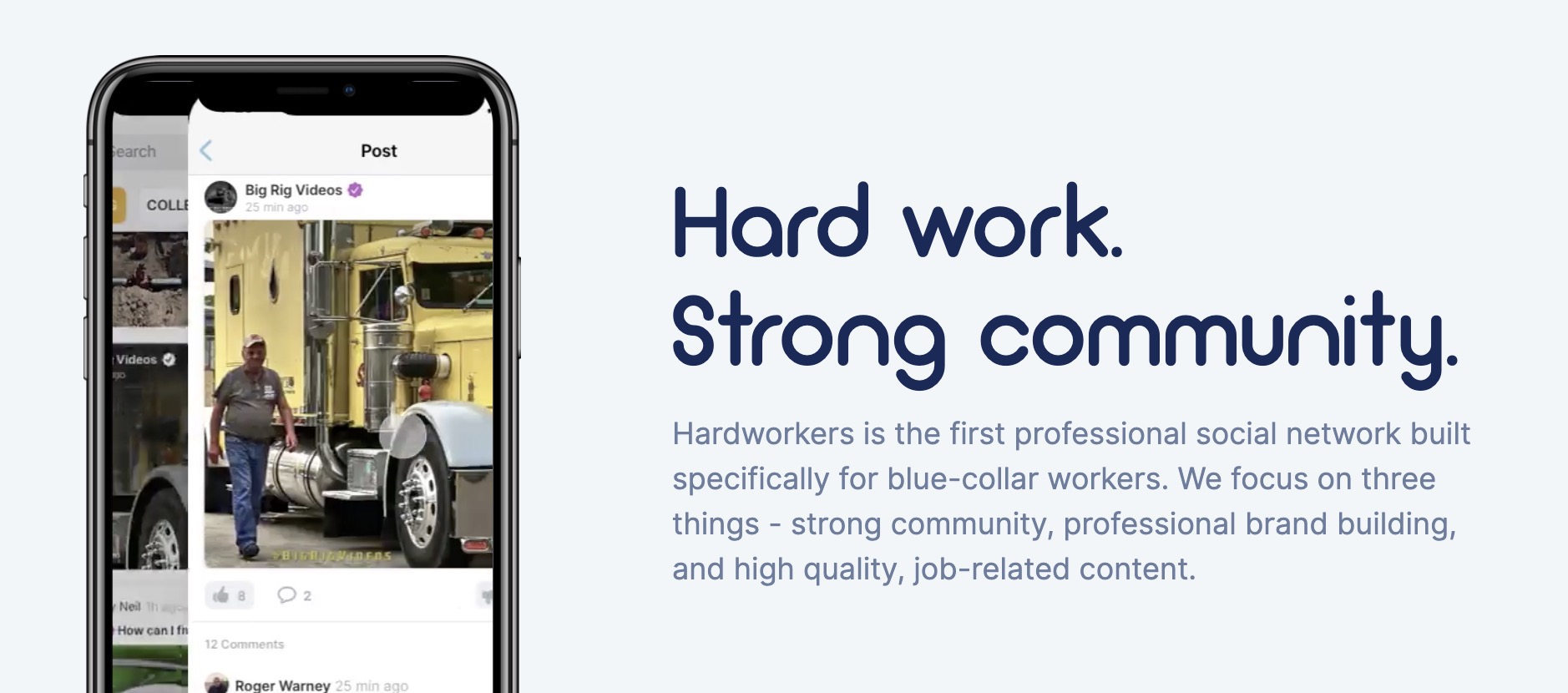
Snap investment Hardworkers
The 10 startups in Yellow’s third batch include:
- Brightly: a media platform and community that promotes ethical and sustainable brands.
- Charli Cohen: a “next-gen” streetwear fashion brand.
- Hardworkers: a professional network for blue-collar workers.
- Mogul Millennial: a media startup sharing professional resources for Black entrepreneurs.
- Nuggetverse: a web comics media startup.
- SketchAR: an augmented reality drawing app with social tie-ins.
- Stipop: a rich cross-platform chat sticker API.
- TRASH: an app for quickly editing social video cuts using machine learning.
- Veam: a social network built around AirDrop.
- Wabisabi Design: an augmented reality game studio focused on bit-sized titles.
Yesterday, I got the opportunity to chat with Mike Su, who leads the Yellow program at Snap. Su said that shifting to a fully online program was a bit of a shock to the program, which was about one month in when COVID-19’s impact worsened stateside.
Yellow’s small batches are much easier to manage than other accelerator behemoths like Y Combinator that are pushing hundreds of startups through their network. Nevertheless, Su says it was an interesting adjustment shifting the accelerator program to a remote setting, though a later program start date gave them the advantage of seeing how others wrapped up their programs. “We tuned into a bunch of different digital demo days; one of our advantages was being able to learn from others,” he says.
Yellow investment SketchAR
While emerging during a possible recession is far from ideal launch timing, Su believes this class of startups are still in a good position. “When you look across a lot of the companies, actually their work becomes more essential than it ever was before,” Su tells TechCrunch, particularly highlighting the program’s investment in Hardworkers, which is building a professional network for blue-collar workers who have been particularly affected by the pandemic. Another investment from this batch, Mogul Millennial, is building a media brand around connecting Black professionals with professional resources.
“If you look up and down the class, all the founders aren’t just taking after an opportunity, but personally are on a mission to solve a particular problem,” Su says. “So I think that foundation made them more predisposed I guess, to be able to push through this kind of environment.”
While web comics brands and AR sketching might not immediately seem like huge problems during trying times like the COVID-19 pandemic, many of the startups in Yellow’s recent batch are working to solve problems that have proven to be key opportunities for Snap, which has been on a redemptive growth spree since early 2019, locking down young users and seeing its share price surge.
Snap invests $150,000 in each Yellow startup for an equity stake, and while the program does not require batch participants to integrate with Snap’s services, the company has used the program to invest in strategic areas that it has also pushed on the product side.
Earlier Yellow bets skewed more toward content investments as Snapchat was scaling Discover. Now Su says he’s fielding plenty of augmented reality pitches. Su also notes that the accelerator had its most international batch to date this year, with startups from Lithuania, Korea, Mexico and the U.K. making their way to Los Angeles.
“We always start with top-level strategy, with [CEO Evan Spiegel], figuring out overall direction of where we see the world evolving, where we think there are real opportunities and where we think we can make a difference in supporting these companies,” Su says. “And then once we’re aligned on the top-level strategy I think Evan puts a lot of trust in myself and my partner in crime Alex Levitt to find good companies that we’re excited about.”
Facebook to pay $52 million to content moderators suffering from PTSD
Facebook has agreed in principle to pay $52 million to compensate current and former content moderators who developed mental health issues on the job.
The Verge reported Tuesday that the settlement will cover more than 11,000 content moderators who developed depression, addictions and other mental health issues while they worked moderating content on the social media platform.
In fact, it was The Verge that sparked the inquiry to begin with. Silicon Valley editor Casey Newton reported that Facebook content moderators, hired through outsourcing giant Cognizant in Phoenix and Tampa, were subject to hate speech, murders, suicides and other graphic content.
Facebook employs thousands of content moderators to sift through the vast number of posts, images and other content posted to the site. If a potentially rule-breaking post is flagged by other users, it’s often reviewed by a content moderator who makes the final call on whether it stays or is deleted.
One former content moderator, Selena Scola, said she developed post-traumatic stress disorder — or PTSD — and sued Facebook to start a fund to create a testing and treatment program for current and former moderators.
Cognizant later pulled out of the content moderation market altogether following The Verge’s investigations.
The preliminary settlement will cover moderators in Arizona, California, Florida and Texas from 2015, and each moderator will receive at least $1,000. Others could receive up to $50,000 in damages.
The California court overseeing the case will make the final call, expected later this year.
A Facebook spokesperson told TechCrunch: “We are grateful to the people who do this important work to make Facebook a safe environment for everyone. We’re committed to providing them additional support through this settlement and in the future.”
If you or someone you know needs help, call 1-800-273-8255 for the National Suicide Prevention Lifeline. You can also text HOME to 741-741 for free, 24-hour support from the Crisis Text Line. Outside of the U.S., please visit the International Association for Suicide Prevention for a database of resources.