The game engine won’t be released until next year, but man it looks nice.
Category: Tech news
hacking,system security,protection against hackers,tech-news,gadgets,gaming
Kevin Rose on health apps, crypto and how founders get through this time with their sanity intact
Kevin Rose has been in the spotlight since co-founding the early social news aggregation site Digg in late 2004. A genial whiz kid turned serial entrepreneur, he has since become as well-known for launching a whole lot of slickly designed products, some of them out of his startup incubator Milk (later acquired by Google), and North, an incubator that would later lead him to a site for watch enthusiasts called Hodinkee in New York.
Along the way, Rose has been investing, at times as an angel, for several years as a partner with Google Ventures (now GV) and on behalf of True Ventures, which invited Rose to join as a venture partner three years ago — and where Rose more recently began writing checks as a full-time general partner.
How long it will last is anyone’s guess, given Rose’s penchant for chasing the next. But we were able to catch up with him at his home in Portland, Ore., earlier this week to talk about who is managing his newest apps, why he is still bullish on crypto and what advice he has for founders who might be struggling right now. Our chat has been edited for length.
TC: There has been some fascination over the years with your moves from West to East. Now you’re back on the West Coast in Portland.
I moved to Oregon a couple years ago. We came back to the West Coast from New York. We were going to have our first child, so we knew we wanted to be close to the family, and my family is all up here in Portland. The plan was just to come back, then bounce down to the Bay Area as needed. It’s an hour and 20-minute flight, so it’s really easy to get back down there. and there’s just so much to love about Portland.
I have to make a joke here about whether or not there are as many raccoons up there. I’ll never forget seeing footage of you throwing a raccoon off your dog years ago. We had a raccoon in San Francisco that was very determined to scratch our dog’s eyes out.
It’s no joke that there are actually a lot of dogs that are blind because they get in fights with raccoons, and the raccoons immediately go for the eyes. It was a really scary night.
How are you dealing with COVID-19?
I feel very fortunate in that my daily job is intact and I’m still able to back entrepreneurs and take those meetings. So it’s a very lucky position to be in. But, you know, it’s a scary time. We have two little girls and we have one nanny, and today our nanny came down with a fever, and we sent her home early [because] fevers are no joke these days, even a slight fever. It’s just a little unsettling.
How has sheltering-in-place affected how you’re investing with True?
There are a lot of great people out there right now who have free time to think of new ideas. Whereas I would have thought that on the investing side, there would be a slowdown, I’m still continuing to meet with great entrepreneurs that are coming up with their next big idea, and they’ve got the downtime and the extra cycles now to have that focus to really put in some time to build prototypes. I would say if anything, [the rate at which I’m seeing companies] remains the same or is even a bit higher.
We’ve done a couple deals so far where we have never met the founders face to face, which is a first for us. But it’s all doable. I think you just spend more time on Zoom getting to know the people behind the camera prior to doing a deal.
Have you received any feedback from your LPs saying, ‘Why don’t you guys take a pause while we figure out how our portfolio is shaping up?’
No, we haven’t received any of that feedback. I think that they look at the instruction and the support that we’re giving our entrepreneurs.
One of the things that we do care a lot about is how we can help. We have over 300 different founders who we want to set up support systems and groups to help them get through this — not just financially but, you know, figuring out, for example, how to reopen responsibly. Like, how do you do that? What is the new norm? What does that look like? What are best practices that companies are putting into place? So we’ve been really doubling down on our education component and creating these weekly gatherings where dozens of founders get together via Zoom and communicate how and what they’re doing.
In terms of going back to the office, what are you hearing from True’s startups?
We have entrepreneurs that have storefronts — like actual physical storefronts. We have others who have distributed teams by default, so for them, it’s work as usual, except for figuring out [how to manage] family life [at the same time]. So it’s all over the place, but I would say that most the people who I’ve had a conversation with are being more cautious. They’d rather kind of sit and wait things out a little bit.
You’ve bounced between founding and investing roles. You most recently founded the fasting app Zero and the meditation app Oak. What’s happening with both of these?
I had a friend of mine, Mike Maser, who I’d worked with before — we worked together at Digg — and he actually created a [fitness coaching app] called Fitstar that he sold to Fitbit, so he was really into health and fitness. Then Mike was diagnosed with stage 4 non-Hodgkins lymphoma a little over five years ago, and as part of his treatment with chemotherapy, he was prescribed intermittent fasting; they’re doing fasting now in conjunction with chemo to help the outcomes.
Mike was able to beat back cancer. He is now five years cancer-free, which is amazing. And he’s a fantastic CEO and was the perfect person to take on the project and run with it, because it really started growing so fast. Zero now is adding 25,000 new users a day at zero paid acquisition. Millions of people use it a month. And it’s gotten to the stage where it needed someone who could just focus on it full time and build out a team around it.
Mike created [a holding company called] Big Sky Health with that app along with Oak, my meditation app, and he has also launched a third app called Less that’s about tracking your alcohol consumption and being more mindful about the number of drinks you’re consuming week over week and month over month.
That sounds timely, considering that a lot of people are seemingly wrestling with developing alcohol problems at this strange moment in time.
It’s a real thing. For anyone who likes to drink casually and socially, being cramped up indoors and especially with all of the stress around the things that are happening in the world and your savings accounts and your family and friends . . . unfortunately, it can be a trigger for people to consume more alcohol.
I also wanted to talk to you about cryptocurrency, which is now re-entering the mainstream business conversation, with Andreessen Horowitz having just closed its second crypto-focused fund and this Bitcoin halving event. Is it something you’re tracking closely still?
Yeah, it’s something where I have a personal passion . . . I believe that it is still extremely difficult and not mainstream enough to be used as a currency.
That said, I do believe that there’s no doubt that the future of currency is digital. If you had to create a brand new country today, you wouldn’t go out and start buying printing presses to create your currency; you would issue something digitally. So there will be something that comes into existence that is spendable and easy to understand and is based on some type of blockchain technology. Like, there is no doubt that will be the case. The problem is that 99% of the projects out there and a lot of the people who are behind them are just in this for the pure financial gain. And there’s a lot of garbage out there. And that’s unfortunate because it really drags down the high-quality projects, and it muddies the space quite a bit.
As a partner earlier on with Google’s venture arm, you led an investment in Ripple, which has grown controversial, in part because the co-founder has sold some of his shares and because CEO Brad Garlinghouse has sold some of his shares. It’s also not being used as the company intended. What do you think of what XRP has become and its utility in the future?
When I invested in Ripple, it would have been seven years ago, something like that. But Brad was not running the company. There was a different CEO. The original founders were all still in place. There was a very different world when Ripple was first getting off the ground. And the excitement that I had around Ripple was that cryptocurrency was so raw; there was no way for the enterprise to embrace it in any fashion.
Early Ripple reminded me of a company that could come in, put some standards in place, and have these uptime guarantees and work with commercial banks and create a backbone that was based on blockchain. So that was very exciting. I never really saw the use case for Ripple as a currency. I understood that it was going to be used as a way to handle settlement in some capacity. It’s been quite a few years since I was with Google Ventures and I haven’t tracked it closely, but those many years ago, the excitement was around creating something that commercial banks could understand and get comfortable with, because they weren’t comfortable with just random blockchain technology created by anonymous founders.
Do you think the number of cryptocurrencies needs to shrink before the cryptocurrency can be accepted in a more mainstream way, or is it possible for all these cryptocurrencies to survive ad infinitum?
It’s early days. I think that this is going to be a space that will continue to mature over the next couple of decades. There’s a good chance you won’t even know you’re using cryptocurrency. I could see something like a Square Cash moving to some type of stablecoin underneath the covers, to where we’re still using it today, and it’s connected to our bank accounts, and all of a sudden, all the settlements are happening on the blockchain. Things like that will most likely happen in a really simple and easy-to-use interface by a very trusted brand.
I noticed you tweeting the other day about the next iteration of Epic Games’ game engine, which will support VR. Talking about technologies that have gotten a lot of attention but are further out than anticipated a year or two ago . . .
Yeah, it’s gonna be in the new PlayStation, and the new Xbox. It’s beautiful.
Is VR something that now interests you as an investor?
I got a lot of flack from people because I did a blog post five years ago or so that said I thought the VR was a joke and [I was] basically dismissive of it, and I’ve avoided it altogether.
I don’t want to piss off people [but] It reminds me of when we all got the Nintendo Wii and we had so much fun swinging around the controllers and playing virtual tennis with each other. And then, after a couple weeks, the controllers just ended up in the drawer. You throw on a VR headset, you’re like, ‘Whoa, this is crazy.’ And then you get a little nauseous or get a little sweaty, and all of a sudden, you’re like, ‘I’m just kind of sticky and no one else can see what I was doing, and I look a little awkward.’
I don’t think we should abandon it altogether. I’m not a hater, but look what happened: we went into straight-up lockdown. It was the best possible time for VR sales to go through the roof. And what happened? The Nintendo Switch sold out.
Any advice for founders given that you’ve enjoyed extreme highs and some lows in your own career?
If there’s anything that I’ve learned as an entrepreneur it would be, number one, to seek out mentors and people that you can have an open and honest conversation — and hopefully those should be your investors, as well.
Some of my biggest mistakes [tied to] not admitting that I didn’t know something. I was scared, I thought it was weakness, like, ‘Gosh, they put me on the cover of BusinessWeek; I should know how to do X, Y or Z.’
But we’re all learning constantly, and that should never end. I’m a big advocate of lifelong learning and admitting when you’re wrong. Admitting that you don’t know something is just actually growing.
There’s also no shame in shutting something down. Some people won’t get through this, and they’ll have to start something new. You know, I’ve had many failed companies, tried a bunch of crazy stuff, but if you flip things a bit, that’s the excitement of this all. We’ve got this life to live and we’re going to die soon. Why not go try a bunch of crazy ideas and then [if it doesn’t work] it’s okay to cut bait sometimes and say, ‘I’m done’ and just move on to the next thing.
NASA’s ‘Artemis Accords’ set forth new and old rules for outer space cooperation
NASA’s plan to return to the Moon is ambitious enough on its own, but the agency is aiming to modernize international cooperation in space in the process. Today it published a summary of the “Artemis Accords,” a new set of voluntary guidelines that partner nations and organizations are invited to join to advance the cause of exploration and industry globally.
Having no national affiliation or sovereignty of its own, space is by definition lawless. So these are not so much space laws as shared priorities given reasonably solid form. Many nations already take part in a variety of agreements and treaties, but the progress of space exploration (and soon, colonization and mining, among other things) has outpaced much of that structure. A fresh coat of paint is overdue and NASA has decided to take up the brush.
The Artemis Accords both reiterate the importance of those old rules and conventions and introduce a handful of new ones. They are only described in general today, as the specifics will likely need to be hashed out in shared talks over months or years.
The NASA statement describing the rules and the reasoning behind each is short and obviously meant to be understood by a lay audience, so you can read through it here. But I’ve condensed the main points into bullets below for more streamlined consumption.
First, the rules that could be considered new. NASA and partner nations agree to:
- Publicly describe policies and plans in a transparent manner.
- Publicly provide location and general nature of operations to create “Safety Zones” and avoid conflicts.
- Use international open standards, develop new such standards if necessary and support interoperability as far as is practical.
- Release scientific data publicly in a full and timely manner.
- Protect sites and artifacts with historic value. (For example, Apollo program landing sites, which have no real lawful protection.)
- Plan for the mitigation of orbital debris, including safe and timely disposal of end-of-life spacecraft.
As you can imagine, each of these opens a new can of worms — what constitutes transparent? What operations must be disclosed, and under what timeline? Who determines what has “historic value”?
Anything arguable will be argued over for a long time, but setting some baseline expectations like “don’t be secretive,” or “don’t steal the Apollo 13 lander” is a great place to start the conversation.
It’s a new dawn for space exploration! Today I’m honored to announce the #Artemis Accords agreements — establishing a shared vision and set of principles for all international partners that join in humanity’s return to the Moon. We go, together: https://t.co/MnnskOqSbU pic.twitter.com/aA3jJbzXv2
— Jim Bridenstine (@JimBridenstine) May 15, 2020
Meanwhile, the Accords also reaffirm NASA’s commitment to existing treaties and guidelines. It and partners will:
- Conduct all activities only for peaceful purposes, per the Outer Space Treaty.
- Take all reasonable steps to render assistance to astronauts in distress, per the Agreement on the Rescue of Astronauts and other agreements.
- Register objects sent into space, per the Registration Convention.
- Perform space resource extraction and utilization according to the Outer Space Treaty Articles II, VI and XI.
- Inform partner nations regarding “safety zones” and coordinate according to Outer Space Treaty Article IX.
- Mitigate debris per guidelines set by U.N Committee on the Peaceful Uses of Outer Space.
The Artemis program aims to put the next American man and the first woman on the surface of the Moon in 2024, though that timeline is looking increasingly unlikely. The mission will lean on private launch providers and other commercial partners to an unprecedented degree in an effort to reduce costs and delays while maintaining the necessary levels of reliability and safety.
Buying Giphy Gives Facebook a New Window Into Its Rivals
The social media giant acquires another rich source of data, this time in the form of the internet’s favorite GIF library.
An Alien War Took Over Grand Theft Auto V. It Could End Tonight
A month-long battle between gangs of green and purple aliens has spilled beyond GTA V’s boundaries.
Tesla scouts head to Tulsa, Austin as hunt for Cybertruck gigafactory location nears end
Tesla officials visited two sites in Tulsa, Oklahoma this week to search for a location for its future and fifth gigafactory that will produce its all-electric Cybertruck and Model Y crossover, a source familiar with the situation told TechCrunch.
Company representatives also visited Austin. A final decision has not been made, but Austin and Tulsa are among the finalists, according to multiple sources. The AP also reported Tulsa and Austin as top picks for the gigafactory.
Tesla expects to make a decision as soon as next month, and “certainly within three months,” CEO Elon Musk said April 29 during the company’s first quarter earnings call.
Musk tweeted in March that Tesla was scouting locations for a so-called “Cybertruck Gigafactory.” Musk said, at the time, that the factory would be located in the central part of the U.S. and would be used to produce Model Y crossovers for the East Coast market as well as the cybertruck.
Not long after the tweets, TechCrunch learned that Tesla was eyeing Nashville and had been in talks with officials there. Tesla informed Nashville officials this week that the city is out of the running for its gigafactory location, according to one source.
An email was sent to Tesla requesting comment. The article will be updated if Tesla responds.
Tulsa Mayor G.T. Bynum’s office issued a statement neither confirms nor denies the talks.
“While I can not comment on potential projects, it is clear that Tesla and Tulsa were forged in the same spirit,” Bynum said in an emailed statement. “Both founded by pioneers who dreamt big and made it happen. Both trying to change the world with a new kind of energy. Both investing big in what matters most: people. Tulsa is a city that doesn’t stifle entrepreneurs – we revere them. And as Tesla continues to rapidly change transportation all around the world, I can’t imagine a better place for them to further that important work than Green Country.”
This next gigafactory, wherever it is located, will likely be larger and produce multiple products, CFO Zachary Kirkhorn said during the same April 29 call.
“That’s under a belief that there’s significant efficiencies by having as much as possible and similar product lines under the same roof and as much vertical integration as possible all in one facility,” Kirkhorn said.
Musk has referred to these as future plants as “tera” factories — a nod to terawatt, or more specifically a terawatt-hour of battery capacity. The company’s first “gigafactory” is in Sparks, Nevada. The massive structure, which has surpassed. 1.9 million square feet, is where Tesla produces battery packs and electric motors for its Model 3 vehicles. The company has a joint venture with Panasonic, which is making the lithium-ion cells.
Tesla dubbed the Sparks plant a “gigafactory” because the company said at the time it would be capable of producing 35 gigawatt-hours per year of battery cells.
Tesla assembles its Model S, Model X and Model 3 vehicles in Fremont, Calif. at a factory that was once home to GM and Toyota’s New United Motor Manufacturing Inc (NUMMI) operation. Tesla acquired the factory in 2010. The first Model S was produced at the factory in June 2012.
“Gigafactory 2” in Buffalo, New York, is where Tesla produces solar cells and modules. The company’s third gigafactory is located in Shanghai, China and started producing the Model 3 late last year. The first deliveries began in early January.
Tesla is now preparing to build another factory near Berlin. Once complete, this German factory will produce the Model 3 and Model Y for the European market.
CBS All Access greenlights ‘Strange New Worlds,’ a new Star Trek series about Pike and Spock
CBS All Access isn’t done launching new Star Trek shows.
After bringing the franchise back to TV with “Star Trek: Discovery” in 2017, then revisiting some beloved characters with “Star Trek: Picard” earlier this year, the streaming service has placed a straight-to-series order for “Star Trek: Strange New Worlds,” which will depict the early days of the Enterprise, before Captain Kirk took command.
We already got a glimpse of that in the second season of “Discovery,” which saw Captain Christopher Pike (Anson Mount) and a young Spock (Ethan Peck) join the cast — but they left Discovery and returned to the Enterprise at the season’s end, in what felt like an obvious set-up for a spin-off.
“Strange New Worlds” will star Mount and Peck, along with “Discovery” guest star Rebecca Romijn as Number One. The premiere will be written by Akiva Goldsman (also a writer and director on “Discovery” and “Picard”), with a story by Goldsman, Alex Kurtzman and Jenny Lumet.
“This is a dream come true, literally,” Goldsman said in a statement. “I have imagined myself on the bridge of the Enterprise since the early 1970s. I’m honored to be a part of this continuing journey along with Alex, [executive producer] Henry [Alonso Myers] and the fine folks at CBS.”
Until now, CBS All Access has been distinguished primarily for its willingness to greenlight a range of Star Trek spin-offs — it’s also developing an animated series called “Star Trek: Lower Decks”, along with a show focused on Michelle Yeoh’s Philippa Georgiou and the nefarious Section 31.
This summer, the newly re-merged ViacomCBS plans to launch a rebranded version of the streaming service, drawing on content from across ViacomCBS brands like Nickelodeon, MTV, BET, Comedy Central, Smithsonian and Paramount. But it still looks like Star Trek will remain a big part of that mix.
There’s no release date announced for “Strange New Worlds.” After all, it may be a while before any show can resume production.
3 views on the future of work, coffee shops and neighborhoods in a post-pandemic world
The novel coronavirus pandemic has disordered traditional notions of work, travel, socializing and the way we collaborate with colleagues.
It seems obvious that the future of work must evolve, given what we’re experiencing, but what will that future look like? Which changes are here to stay and which ones will revert the moment offices reopen?
TechCrunch has been a WFH employer for essentially its entire existence. Our staff is distributed across major startup hubs like SF and NYC, but we also have writers in smaller cities around the world, so we compiled reflections and thoughts from three of them about how remote work has changed our lifestyles and what we predict to see in the next few years, post-COVID 19.
Devin Coldewey talks about what’s going to change with coffee shops and co-working spaces, Alex Wilhelm discusses the future of the home office setup and Danny Crichton talks about the revitalization of urban and semi-urban neighborhoods.
Devin Coldewey on coffee shops and more flexible work arrangements
I’ve worked from home for over a decade and part of what makes it so lovely is the ability to do my work from a nearby cafe, or even a restaurant or bar. I’m lucky in that my part of the city is famously packed with excellent coffee shops, but in the time I’ve lived here I’ve seen them grow increasingly packed with — well, people like me. Some days they seem more like co-working spaces than cafes — and this is something business owners and neighborhoods are going to need to acknowledge one way or the other.
Most urban and suburban American communities were formed around the convention of commuting, which means fewer work-related resources where people live. Instead, we have all the restaurants, bodegas, thrift stores and all the other things that cater to people who aren’t working.
What’s the Strange Ailment Affecting Kids With Covid-19?
The spate of inflammatory symptoms has sparked anxiety in parents, but experts say the big picture hasn’t changed: The kids are still (mostly) alright.
How will Europe’s coronavirus contact-tracing apps work across borders?
A major question mark attached to national coronavirus contact-tracing apps is whether they will function when citizens of one country travel to another. Or will people be asked to download and use multiple apps if they’re traveling across borders?
Having to use multiple apps when travelling would further complicate an unproven technology which seeks to repurpose standard smartphone components for estimating viral exposure — a task for which our mobile devices were never intended.
In Europe, where a number of countries are working on smartphone apps that use Bluetooth radios to try to automate some contact tracing by detecting device proximity, the interoperability challenge is particularly pressing, given the region is criss-crossed with borders. Although, in normal times, European Union citizens can all but forget they exist thanks to agreements intended to facilitate the free movement of EU people in the Schengen Area.
Currently, with many EU countries still in degrees of lockdown, there’s relatively little cross-border travel going on. But the European Commission has been focusing attention on supporting the tourism sector during the coronavirus crisis — proposing a tourism and transport package this week which sets out recommendations for a gradual and phased lifting of restrictions.
Once Europeans start traveling again, the effectiveness of any national contact-tracing apps could be undermined if systems aren’t able to talk to each other. In the EU, this could mean, for example, a French citizen who travels to Germany for a business trip — where they spend time with a person who subsequently tests positive for COVID — may not be warned of the exposure risk. Or indeed, vice versa.
In the U.K., which remains an EU member until the end of this year (during the Brexit transition period), the issue is even more pressing — given Ireland’s decision to opt for a decentralized app architecture for its national app. Over the land border in Northern Ireland, which is part of the U.K., the national app would presumably be the centralized system that’s being devised by the U.K.’s NHSX. And the NHSX’s CEO has admitted this technical division presents a specific challenge for the NHS COVID-19 app.
There are much broader questions over how useful (or useless) digital contact tracing will prove to be in the fight against the coronavirus. But it’s clear that if such apps don’t interoperate smoothly in a multi-country region such as Europe, there will be additional, unhelpful gaps opening up in the data.
Any lack of cross-border interoperability will, inexorably, undermine functionality — unless people give up travelling outside their own countries for good.
EU interoperability as agreed goal
EU Member States recognize this, and this week agreed to a set of interoperability guidelines for national apps — writing that: “Users should be able to rely on a single app independently of the region or Member State they are in at a certain moment.”
The full technical detail of interoperability is yet to be figured out — “to ensure the operationalisation of interoperability as soon as possible,” as they put it.
But the intent is to work together so that different apps can share a minimum of data to enable exposure notifications to keep flowing as Europeans travel around the region, as (or once) restrictions are lifted.
“Whatever the approach taken with approved apps, all Member States and the Commission consider that interoperability between these apps and between backend systems is essential for these tools to enable the tracing of cross-border infection chains,” they write. “This is particularly important for cross-border workers and neighbouring countries. Ultimately, this effort will support the gradual lifting of border controls within the EU and the restoration of freedom of movement. These tools should be integrated with other tools contemplated in the COVID-19 contact-tracing strategy of each Member State.”
European users should be able to expect interoperability. But whether smooth cross-border working will happen in practice remains a major question mark. Getting multiple different health systems and apps that might be calculating risk exposure in slightly different ways to interface and share the relevant bits of data in a secure way is itself a major operational and technical challenge.
However, this is made even more of a headache given ongoing differences between countries over the core choice of app architecture for their national coronavirus contact tracing.
This boils down to a choice of either a decentralized or centralized approach — with decentralized protocols storing and processing data locally on smartphones (i.e. the matching is done on-device); and centralized protocols that upload exposure data and perform matching on a central server which is controlled by a national authority, such as a health service.
While there looks to be clear paths for interoperability between different decentralized protocols — here, for example, is a detailed discussion document written by backers of different decentralized protocols on how proximity tracing systems might interoperate across regions — interoperability between decentralized and centralized protocols, which are really polar opposite approaches, looks difficult and messy to say the least.
And that’s a big problem if we want digital contact tracing to smoothly take place across borders.
(Additionally, some might say that if Europe can’t agree on a common way forward vis-à-vis a threat that affects all the region’s citizens, it does not reflect well on the wider “European project”; aka the Union to which many of the region’s countries belong. But health is a Member State competence, meaning the Commission has limited powers in this area.)
In the eHealth Network “Interoperability guidelines” document, Member States agree that interoperability should happen regardless of which app architecture a European country has chosen.
But a section on cross-border transmission chains can’t see a way forward on how exactly to do that yet [emphasis ours] — i.e. beyond general talk of the need for “trusted and secure” mechanisms:
Solutions should allow Member States’ servers to communicate and receive relevant keys between themselves using a trusted and secure mechanism.
Roaming users should upload their relevant proximity encounter information to the home country backend. The other Member State(s) should be informed about possible infected or exposed users*.
*For roaming users, the question of to which servers the relevant proximity contacts details should be sent will be further explored during technical discussions. Interoperability questions will also be explored in relation to how a users’ app should behave after confirmed as COVID-19 positive and the possible need for a confirmation of infection free.
Conversely, the 19 academics behind the proposal for interoperability of different decentralized contact-tracing protocols do include a section at the end of the document discussing how, in theory, such systems could plug into “alternatives”: aka centralized systems.
But it’s thick with privacy caveats.
Privacy risks of crossing system streams
The academics warn that while interoperability between decentralized and centralized systems “is possible in principle, it introduces substantial privacy concerns” — writing that, on the one hand, decentralized systems have been designed specifically to avoid the ability of an central authority being able to recover the identity of users; and “consequently, centralized risk calculation cannot be used without severely weakening the privacy of users of the decentralized system.”
While, on the other, if decentralized risk calculation is used as the “bridge” to achieve interoperability between the two philosophically opposed approaches — by having centralized systems “publish a list of all decentralized ephemeral identifiers it believes to be at risk of infection due to close proximity with positive-tested users of the centralized system” — then it would make it easier for attackers to target centralized systems with reidentification attacks of any positive-tested users. So, again, you get additional privacy risks.
“In particular, each user of the decentralized system would be able to recover the exact time and place they were exposed to the positive-tested individual by comparing their list of recorded ephemeral identifiers which they emitted with the list of ephemeral identifiers published by the server,” they write, specifying that the attack would reveal in which “15-minute” period an app user was exposed to a COVID-positive person.
And while they concede there’s a similar risk of reidentification attacks against all forms of decentralized systems, they contend this is more limited — given that decentralized protocol design is being used to mitigate this risk “by only recording coarse timing information,” such as six-hour intervals.
So, basically, the argument is there’s a greater chance that you might only encounter one other person in a 15-minute interval (and therefore could easily guess who might have given you COVID) versus a six-hour window. Albeit, with populations likely to continue to be encouraged to stay at home as much as possible for the foreseeable future, there is still a chance a user of a decentralized system might only pass one other person over a larger time interval too.
As trade-offs go, the argument made by backers of decentralized systems is they’re inherently focused on the risks of reidentification — and actively working on ways to mitigate and limit those risks by system design — whereas centralized systems gloss over that risk entirely by assuming trust in a central authority to properly handle and process device-linked personal data. Which is of course a very big assumption.
While such fine-grained details may seem incredibly technical for the average user to need to digest, the core associated concern for coronavirus apps generally — and interoperability specifically — is that users need to be able to trust apps to use them.
So even if a person trusts their own government to handle their sensitive health data, they may be less inclined to trust another country’s government. Which means there could be some risk that centralized systems operating within a multi-country region such as Europe might end up polluting the “trust well” for these apps more generally — depending on exactly how they’re made to interoperate with decentralized systems.
The latter are designed so users don’t have to trust an authority to oversee their personal data. The former are absolutely not. So it’s really chalk and cheese.
Ce n’est pas un problème?
At this point, momentum among EU nations has largely shifted behind decentralized protocols for coronavirus contact-tracing apps. As previously reported, there has been a major battle between different EU groups supporting opposing approaches. And — in a key shift — privacy concerns over centralized systems being associated with governmental “mission creep” and/or a lack of citizen trust appear to have encouraged Germany to flip to a decentralized model.
Apple and Google’s decision to support decentralized systems for the contact-tracing API they’re jointly developing, and due to release later this month (sample code is out already), has also undoubtedly weighted the debate in favor of decentralized protocols.
Not all EU countries are aligned at this stage, though. Most notably France remains determined to pursue a centralized system for coronavirus contact tracing.
As noted above, the U.K. has also been building an app that’s designed to upload data to a central server. Although it’s reportedly investigating switching to a decentralized model in order to be able to plug into the Apple and Google API — given technical challenges on iOS associated with background Bluetooth access.
Another outlier is Norway — which has already launched a centralized app (which also collects GPS data — against Commission and Member States’ own recommendations that tracing apps should not harvest location data).
High-level pressure is clearly being applied, behind the scenes and in public, for EU Member States to agree on a common approach for coronavirus contact-tracing apps. The Commission has been urging this for weeks. Even as French government ministers have preferred to talk in public about the issue as a matter of technological sovereignty — arguing national governments should not have their health policy decisions dictated to them by U.S. tech giants.
“It is for States to chose their architecture and requests were made to Apple to enable both [centralized and decentralized systems],” a French government spokesperson told us late last month.
While there may well be considerable sympathy with that point of view in Europe, there’s also plenty of pragmatism on display. And, sure, some irony — given the region markets itself regionally and globally as a champion of privacy standards. (No shortage of op-eds have been penned in recent weeks on the strange sight of tech giants seemingly schooling EU governments over privacy; while veteran EU privacy advocates have laughed nervously to find themselves fighting in the same camp as data-mining giant Google.)
Commission EVP Margrethe Vestager could also be heard on BBC radio this week suggesting she wouldn’t personally use a coronavirus contact-tracing app that wasn’t built atop a decentralized app architecture. Though the Brexit-focused U.K. government is unlikely to have an open ear for the views of Commission officials, even piped through establishment radio news channels.
The U.K. may be forced to listen to technological reality though, if its workaround for iOS Bluetooth background access proves as flakey as analysis suggests. And it’s telling that the NHSX is funding parallel work on an app that could plug into the Apple-Google API, per reports in the FT, which would mean abandoning the centralized architecture.
Which leaves France as the highest-profile hold-out.
In recent weeks a team at Inria, the government research agency that’s been working on its centralized ROBERT coronavirus contacts-tracing protocol, proposed a third way for exposure notifications — called DESIRE — which was billed as an evolution of the approach “leveraging the best of centralized and decentralized systems.”
The new idea is to add a new secret cryptographically generated key to the protocol, called Private Encounter Tokens (PETs), which would encode encounters between users — as a way to provide users with more control over which identifiers they disclose to a central server, and thereby avoid the system harvesting social graph data.
“The role of the server is merely to match PETs generated by diagnosed users with the PETs provided by requesting users. It stores minimal pseudonymous data. Finally, all data that are stored on the server are encrypted using keys that are stored on the mobile devices, protecting against data breach on the server. All these modifications improve the privacy of the scheme against malicious users and authority. However, as in the first version of ROBERT, risk scores and notifications are still managed and controlled by the server of the health authority, which provides high robustness, flexibility, and efficacy,” the Inria team wrote in the proposal.
The DP-3T consortium, backers of an eponymous decentralized protocol that’s gained widespread backing from governments in Europe — including Germany’s, followed up with a “practical assessment” of Inria’s proposal — in which they suggest the concept makes for “a very interesting academic proposal, but not a practical solution”; given limitations in current mobile phone Bluetooth radios and, more generally, questions around scalability and feasibility. (tl;dr this sort of idea could take years to properly implement and the coronavirus crisis hardly involves the luxury of time.)
The DP-3T analysis is also heavily skeptical that DESIRE could be made to interoperate with either existing centralized or decentralized proposals — suggesting a sort of “worst of both worlds” scenario on the cross-border functionality front. So, er…
One person familiar with EU Member States’ discussions about coronavirus-tracing apps and interoperability, who briefed TechCrunch on condition of anonymity, also suggested the DESIRE proposal would not fly given its relative complexity (versus the pressing need to get apps launched soon if they are to be of any use in the current pandemic). This person also pointed to question marks over required bandwidth and impact on device battery life. For DESIRE to work they suggested it would need universal uptake by all Europe’s governments — and every EU nation agreeing to adopt a French proposal would hardly carry the torch for nation state sovereignty.
What France does with its tracing app remains a key unanswered question. (An earlier planned debate on the issue in its parliament was shelved.) It is a major EU economy and, where interoperability is concerned, simple geography makes it a vital piece of the Western European digital puzzle, given it has land borders (and train links into) a large number of other countries.
We reached out to the French government with questions about how it proposes to make its national coronavirus contact-tracing app interoperable with decentralized apps that are being developed elsewhere across the EU — but at the time of writing it had not responded to our email.
This week in a video interview with BFM Business, the president of Inria, Bruno Sportisse, was reported to have expressed hope that the app will be able to interoperate by June — but also said in an interview that if the project is unsuccessful “we will stop it.”
“We’re working on making those protocols interoperable. So it’s not something that is going to be done in a week or two,” Sportisse also told BFM (translated from French by TechCrunch’s Romain Dillet). “First, every country has to develop its own application. That’s what every country is doing with its own set of challenges to solve. But at the same time we’re working on it, and in particular as part of an initiative coordinated by the European Commission to make those protocols interoperable or to define new ones.”
One thing looks clear: Adding more complexity further raises the bar for interoperability. And development time frames are necessarily tight.
The pressing imperatives of a pandemic crisis also makes talk of technological sovereignty sound a bit of, well, a bourgeois indulgence. So France’s ambition to single-handedly define a whole new protocol for every nation in Europe comes across as simultaneously tone-deaf and flat-footed — perhaps especially in light if Germany’s swift U-turn the other way.
In a pinch and a poke, European governments agreeing to coalesce around a common approach — and accepting a quick, universal API fix which is being made available at the smartphone platform level — would also offer a far clearer message to citizens. Which would likely help engender citizen trust in and adoption of national apps — that would, in turn, give the apps a greater chance of utility. A pan-EU common approach might also feed tracing apps’ utility by yielding fewer gaps in the data. The benefits could be big.
However, for now, Europe’s digital response to the coronavirus crisis looks messier than that — with ongoing wrinkles and questions over how smoothly different nationals apps will be able to work together as countries opt to go their own way.

The US Will Help a Taiwan Firm Build a Chip Plant in Arizona
The announcement comes as the Commerce Department issues new restrictions on sales to Huawei, the latest sign of US-China friction.
Where to shop online that isn’t Amazon, Target or Walmart
As shutdown orders extend indefinitely, online shopping has become a lifeline for people forced to avoid the outside world. Often times opting to shop with a mega corporation like Amazon, Walmart or Target is the path of least resistance, but there are plenty of reasons to patronize an alternative.
There are the ethical questions currently swirling around things like worker safety, as COVID-19 takes a toll on the often low-paid essential workers who keep these businesses running. It’s also arguably now more important than ever to support small and local businesses, and more and more brick and mortars announce that they simply won’t be able to rebound after the disastrous economic effects of the shutdown.
Not every company listed below is a small business (Chewy, for example, is owned by pet supply giant PetSmart), but the below list compiled by our editorial team should offer a good variety to help you mix up your online shopping.
Groceries/Household

In this rear view, an unrecognizable woman stands with a shopping cart in front of a shelf full of food in the bread aisle of a grocery store.
Thrive Market: Organic and non-GMO brands of food, home and beauty products, including healthy food, clean beauty and bath products, safe supplements and non-toxic home cleaner.
Great for: Stocking up on healthier grocery items for the pantry and other household needs.
Grove Collaborative: Eco-friendly home essentials, including cleaners, personal care, bath, baby/kid and pet products.
Great for: Stocking up on concentrated cleaners that reduce plastic waste and save trips to the store.
Boxed: Online wholesale shopping on groceries, household products and health supplies.
Great for: An online alternative to Costco and Sam’s Club for items you like to buy in bulk. (T.P. is often out-of-stock though!)
Pet Supplies

A pet cat asleep on the doormat in a conservatory.
Chewy: Online pet store offering food, toys, litter and other pet needs, including both over-the-counter medicine and prescriptions.
Great for: High-quality foods and treats and skipping the vet for prescription refills.
The Farmer’s Dog: All-natural dog food delivery subscription service. Food is proportioned for your dog and delivered to your door.
Great for: Fresh food delivery and those who want a “set it and forget it” option for buying dog food.
Beauty/Baby Supplies
Image Credits: Vladmir Godnik / Getty Images
The Honest Company: Ethical baby and beauty supply company.
Great for: Diapers, baby needs and cruelty-free beauty, bath and body products.
Ulta: Beauty supply superstore offering ship-to-home and curbside pickup.
Great for: Makeup for your Zoom meetings; skincare products for all that indoor air you’re now living in.
Sephora: Online beauty store offering direct shipping.
Great for: Makeup, skincare and self-care items, as well as gift sets for someone who needs a boost.
Glossier: Online beauty brand that’s skin-first, makeup second.
Great for: Skincare, body and makeup.
Books & Entertainment

Image Credits: Andersen Ross/Blend Images
Bookshop.org: This newly launched offering is designed specifically to support independent bookstores in a post-Amazon age. You can browse a wealth of titles and designate the specific store you want to support and they’ll get all the profits. With so many bookstores struggling to stay afloat well before the COVID pandemic, this could be Bookshop’s moment.
Great for: Supporting independent bookstores while shopping online.
Powell’s: For book lovers, few things beat stepping foot inside this Portland mecca. Until things open back up, online shopping is the next best thing.
Great for: Used books galore.
Amoeba Records: For psychical music releases, going straight to the label is often your best bet. Record stores are a great option, too. California’s Amoeba is one of the greatest small music chains in the world, but it’s among those with an uncertain post-COVID future, having recently announced the expected closure of its Hollywood location.
Great for: New and used vinyl, CDs and books.
Forbidden Planet: This Manhattan mainstay has become a go-to for mainstream and indie comics lovers alike. The store is one of countless currently struggling to stay afloat during the COVID crisis. They’ve started a GoFundMe, but better yet, go order some comics.
Great for: Comics, from superhero to super indie.
Trident Bookstore: This gem of a Boston bookstore survived a fire and finals season, so you know it’s a special one. Its selling books all over the United States right now (and if you’re in Boston, it’ll add in brunch too).
Great for: Well-known titles as well as undercover ones. Also, pro tip: You can purchase a “creative add-on” in your package like a surprise puzzle or a bundle of greeting cards, depending on availability.
Athletic

Los Angeles Apparel: This site is selling three-pack face masks in a variety of colors, and all purchases help fund their ability to donate masks to essential services and provide living wages.
Great for: A comfortable cotton mask that also does good.
Donkaka.com: Fashionable face masks sold direct to consumer with free shipping.
Great for: Stylist, reusable comfort.
Tiny pleasures and knick-knacks

Participants play a Magic: The Gathering card game during a weekly tournament at the Uncommons hobby shop in New York, U.S., on Thursday, June 27, 2019. In the battle for gaming dominance, Hasbro Inc. has what it hopes is an ace up its sleeve in a deck of playing cards that hit the market 26 years ago. Photographer: Mark Abramson/Bloomberg via Getty Images
The Little Market: This nonprofit sells fair-trade goods made by people in need, from individuals with disabilities to women transitioning out of homelessness.
Great for: Candles, tote bags, soaps and sugar scrubs.
Uncommon Goods: Unique gifts, decor, games and more
Great for: Unusual items to break your quarantine boredom, especially kids’ crafts and toys for parents whose children have now tired of every toy in the house.
Daily Crunch: Facebook is acquiring Giphy
Facebook acquires a popular GIF search engine, video game sales see major growth and Sorrentino reports promising results for a COVID-19 treatment.
Here’s your Daily Crunch for May 15, 2020.
1. Facebook to acquire Giphy in a deal reportedly worth $400 million
Facebook will acquire Giphy, the web-based animated GIF search engine and platform provider. The company confirmed the deal but isn’t disclosing the terms; Axios reports that it’s worth around $400 million.
Giphy has grown to be a central source for shareable, high-engagement content, and its animated response GIFs are available across Facebook’s platforms, as well as through other social apps and services. Most notably, Giphy provides built-in search and sticker functions for Facebook’s Instagram, and it will continue to operate in that capacity.
2. US video game sales have record quarter, as consumers stay at home
New numbers from NPD confirm what we’ve known for a while: The first quarter of 2020 was a very good one for gaming companies. The new report notes that sales hit a record $10.86 billion in the U.S. between January and March of this year, marking a 9% increase over a year prior.
Therapeutics company Sorrento has made what it says could be a breakthrough in potential treatment of SARS-CoV-2, the virus that leads to COVID-19. The company released details of its preclinical research on Friday, announcing that it has found an antibody that provides “100% inhibition of SARS-CoV-2 virus infection of healthy cells after four days incubation.”
4. Indian food delivery startup Zomato cuts 13% of workforce
The 11-year-old firm did not disclose the exact number of people it was letting go, but the number is above 500. A Zomato spokesperson told TechCrunch that the startup employs about 4,000 people and the layoff impacts its workforce globally.
5. Big VCs stacked billions in Q1 while smaller firms saw their haul shrink
New data out today details how U.S.-based VCs fared in Q1 2020, giving us a window into how flush the financial class of startup land was as it headed into the COVID-19 era. The short answer is that big funds raised lots of cash, while smaller funds appear to have put in a somewhat lackluster quarter. (Extra Crunch membership required.)
At face value, this acquisition seems a little strange for Apple — the company has been pushing full-throttle on mobile AR, largely eschewing public activity or interest in the VR world. But virtual reality might feel like a safer investment at the moment.
It’s an equity-free, eight-week program that includes workshops, access to mentors from SoftBank and the WeWork community and sessions with SoftBank executives. It all culminates in a showcase event for investors and SoftBank partners.
The Daily Crunch is TechCrunch’s roundup of our biggest and most important stories. If you’d like to get this delivered to your inbox every day at around 9am Pacific, you can subscribe here.

Some investors turn to cutting fully remote checks while sheltering in place
By March 16, founder Janine Yancey was tired of playing the waiting game. After watching the stock market take yet another unprecedented nosedive due to coronavirus, she called up a potential investor.
“If this isn’t going to happen, let’s call it now,” Yancey said, referring to the close of her Series A round, the first capital her culture tech company, Emtrain, would have accepted in 14 years. “At that point, I put my nose to the grindstone; I didn’t have a lot of bandwidth in engaging in conversation that wasn’t going anywhere.”
She had the conversation on Monday, and the deal closed on Friday. “I remember thinking, ‘this is the only deal that is happening this month,’ ” she recalled.
As lockdowns extend to prevent the spread of the coronavirus, investors and startups are searching for new ways to connect with each other. At this moment, deals are happening between screens instead of over drinks at The Battery or coffee at The Creamery. A number of investors have already cut fully remote checks, saying it impacts everything from the due diligence process, to appetite, to who gets to access capital in the first place.
Biden campaign releases a flurry of digital DIY projects and virtual banners (yes, there are Zoom backgrounds)
2020 is a nightmare year by most metrics, and it’s also a worst-case scenario emerging out of a best-case scenario for Joe Biden . After trailing in early primary states, Biden came crashing back on a stunning wave of Super Tuesday support. Now the presumptive Democratic nominee in the midst of a global health crisis that’s immobilized the U.S. workforce and somehow even further polarized American politics, the former vice president will have to navigate completely uncharted waters to find a path to the presidency.
Biden — not the most internetty candidate out of 2020’s wide Democratic field by a long shot — is now tasked with getting creative, connecting with voters not at rallies or traditional events, the kind of thing the famously affable candidate excels at, but through screens. Making those connections is crucial for attracting less-engaged voters, wrangling straying progressives and even maintaining its body of existing supporters, who need to be kept energized to power the campaign into the general election.
To that end, the Biden campaign is rolling out a new collection of digital assets to energize supporters stuck at home and to communicate the Biden brand’s visual language to everybody else. The selection of “Team Joe swag” includes some DIY options for supporters like big “No Malarkey!” home window placards and “We want Joe” button templates.
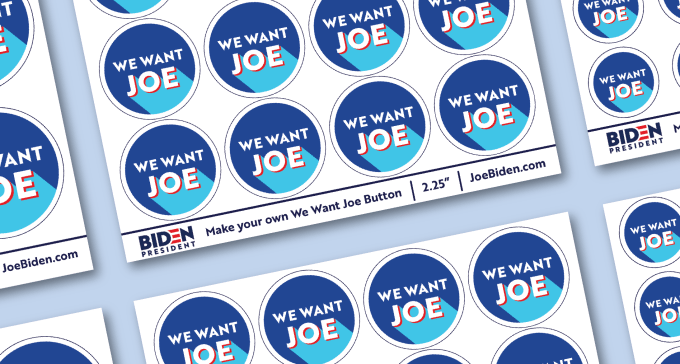
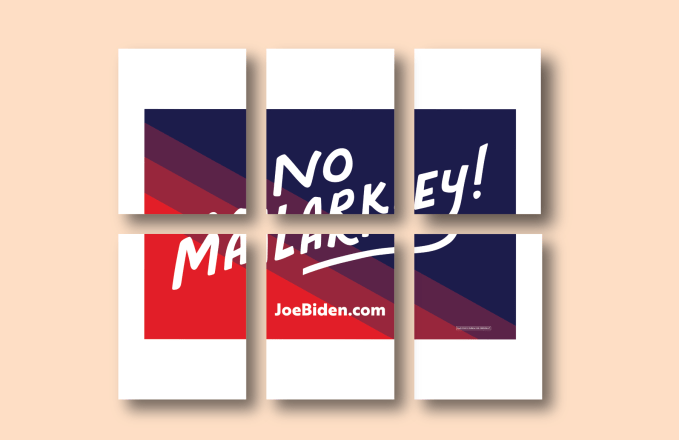
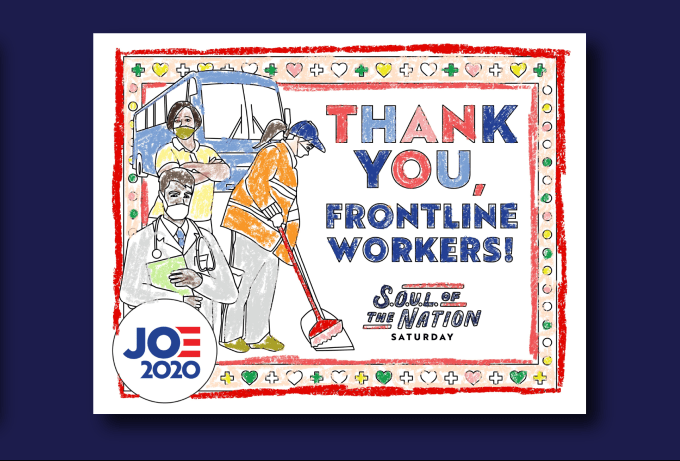
The campaign is also releasing an array of print-friendly coloring book pages to amuse idle politically inclined progeny. Some of the pages thank front-line workers and immortalize Biden’s two German Shepherds in crayon, while others depict Biden’s more meme-worthy symbols: ice cream cones and his trademark aviator sunglasses. (A viral moment from 2014 combined the two.)

For supporters who aren’t leaning into arts and crafts just yet, there’s “Joementum” phone wallpapers, banners optimized for social media and yes, a full set of Zoom backgrounds depicting Biden’s recent campaign stage: his home library.
Some critics say he needs to ditch his basement studio, but Biden said he plans to follow public health guidelines, hitting the virtual campaign trail from his now-expanded home setup in Delaware via virtual town halls and video chats, like his recent Instagram Live sit-down with U.S. soccer superstar and former Warrenite Megan Rapinoe.


The signs and wallpapers are just a tiny part of the campaign’s big picture, but depending on what comes after, a candidate’s visual signature can sear a political moment into the collective consciousness. Think Obama’s 2008 “Hope” poster by the artist Shepard Fairey, later acquired by the National Portrait Gallery (Fairey himself later denounced the Obama administration’s drone program). Or Trump’s telltale red MAGA hats, which no one will be forgetting any time soon, regardless of how the general election shakes out.
Warm and fuzzy
For a campaign stuck indoors, visual branding is more important than ever. Biden’s visual brand mostly seems to focus on positive feelings that bring people together — kindness, faith, togetherness — rather than policy specifics or even “dump Trump” style calls to action.
“We want to find ways to make people feel involved while they’re cooped up at home,” the campaign’s Deputy National Press Secretary Matt Hill said. “These are tools that are going to help everyone who is involved with the campaign communicate that visually in a time when everyone is particularly logged on.”
Much has been written about how the virtual race poses unique challenges for the Biden campaign. The presumptive Democratic nominee is a candidate best known for his affable, empathetic in-person demeanor. But empathy doesn’t always perform well online, particularly when cast against the sound and fury of the factually unencumbered, cash-flush Trump campaign.
“Branding communicates values, and during this crisis we want to let Joe Biden’s values shine through,” Hill said. “Yes, it’s of course ice cream and aviators, but it’s also decency, empathy, hope and everything that is just the polar opposite of Donald Trump.”
The campaign frames this in broad strokes, good-against-evil language, describing Biden’s online movement as one of “empathy and human connection” out to topple the dark forces at work on the internet. The campaign’s digital director Rob Flaherty has said that 2020 is not just a fight for America itself, but also a “battle for the soul of the internet.”
“Right now, people are craving empathy and good… it gives us an advantage,” Hill said. “You have one side that often fights to win the Twitterverse with vitriol, and then you have us.”
Joementum?
Biden’s campaign has come under some scrutiny in recent weeks for the perception that it’s been slow to adapt to the pandemic era. Obama campaign veterans David Plouffe and David Axelrod penned a New York Times op-ed in early May calling for Biden to step up his digital efforts, likening his current broadcasts to “an astronaut beaming back to earth.”
After weeks of concern from insiders worried the Biden campaign might not be building the online momentum it needs, the campaign just beefed up its previously lean team with a flurry of new hires. The new talent will particularly build out the campaign’s digital operations, which it plans to double in size.
The hires include former Elizabeth Warren staffer Caitlin Mitchell, who will advise the Biden camp on digital strategy and help it scale up, BuzzFeed Video and Kamala Harris campaign alum Andrew Gauthier, who joins the Biden campaign as its video director, and Robyn Kanner, previously Beto for America’s creative director, to lead design and branding.
It will be interesting to see what else emerges out of the “Biden brand,” which doesn’t translate as easily to organic virality as Bernie’s all-purpose “I’m once again asking” meme or the somehow-not-cloying antics of Elizabeth Warren’s lovable golden retriever Bailey. At least for now, the campaign doesn’t seem to view that as a problem.
But cracking virtual campaigning is not the only headwind for the Biden campaign at the moment. Sexual assault allegations by former Biden Senate aide Tara Reade made their way into mainstream reporting in April. And if formulating a response to such serious allegations would be delicate under normal circumstances, the Biden campaign has had to figure out how do it from a silo.
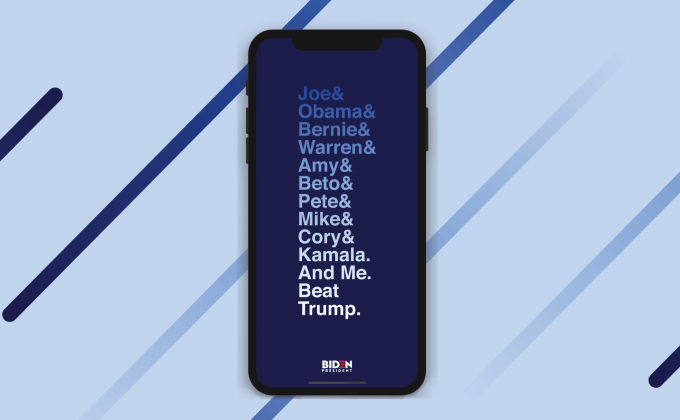
With its early technical difficulties ironed out, the Biden campaign may have a bit more breathing room to get creative. The campaign is focused on what it views as its “core platforms” for now — Facebook, YouTube, Instagram, Twitter and Snapchat — but it plans to both “invest more deeply” in those and also look at other platforms in the process of scaling up.
“We’ve already seen volunteers expand on Discord, Reddit, Pinterest and elsewhere,” Biden campaign Director of Digital Content Pam Stamoulis told TechCrunch.
Stamoulis also notes that the campaign is in “close communication” with the major social platforms where it focuses its efforts.
“… We have scheduled and consistent check in times to go over best practices, recommendations, new tools and brainstorm ideas and concepts to help optimize our use of their platforms,” Stamoulis said. “We anticipate working closely with platforms as we continue to move into the general.”
Biden’s stay-the-course digital strategy seems to reflect the thinking of his unlikely Super Tuesday coup, believing that you need the biggest coalition possible and you don’t necessarily build it through the buzziest politics or the flashiest moments. The campaign doesn’t want Biden to go viral as much as it wants him to connect with the most people in the broadest possible sense.
And to his credit, between the South Carolina comeback and his team-of-rivals Super Tuesday trick, Biden pulled it all off somehow. If there’s anything we can count on in 2020, whether it’s U.S. politics or a global health reckoning, it’s that we don’t know what the hell is going to happen. That lesson seems especially resonant for the extremely online among us, who seem to discover again and again that we are but a tiny, self-selecting sliver of the American electorate.
There’s no word on if we’ll see Biden trading island codes for Animal Crossing à la AOC or a virtual likeness of the candidate looming over Fortnite’s map psychedelic Travis Scott-style, but in a truly unusual election year, nothing is quite off the table.