What SoftBank’s Vision Fund results tell us about troubled startup sectors

A famous investor published notes today concerning its startup investments, detailing where they excelled and where they struggled. To understand why we care about this particular investor’s results, a little context helps.

The investor in question is Japanese telecom giant and startup benefactor SoftBank, which reported its fiscal year results this morning. SoftBank’s investments are famous because of its $100 billion Vision Fund effort, which saw it put capital to work in a host of private companies around the world in an aggressive manner.

The information it shared this morning included a slide deck detailing the conglomerate’s view of the future of unicorn health, and notes on the conclusion of the SoftBank Vision Fund’s investment into net-new companies.

SoftBank’s earnings have made headlines around the financial and technology press, especially regarding the performance of its investments into Uber, an American ride-hailing company, and WeWork, an American coworking startup. The former’s post-IPO performance has led to a lackluster outcome for SoftBank, while the implosion of WeWork after its failed IPO has continued; SoftBank’s results noted a new, lower value for WeWork.

The rest of the information painted a picture of mixed outcomes, with SoftBank recording wins in enterprise-focused deals and “Health Tech” investments. Other invested sectors saw less salubrious results, including the three we’ll focus on today: consumer-focused deals, transit-related investments and real estate-related outlays.

Let’s explore what SoftBank had to say about each. Then we’ll see what we can infer about the broader startup market itself.

Results

SoftBank’s Vision Fund made big bets into Uber and WeWork, two companies that fit into the sectors we are exploring. To provide investors with clarity of its outcomes outside of those two outsized and troubled bets, the company broke out sector performances less their outcomes.

As Jack Ma and SoftBank part ways, the open and globalized era of tech comes ever closer to an end

It would be one of the greatest startup investments of all time. Masayoshi Son, riding high in the klieg lights of the 1990s dot-com bubble, invested $20 million dollars into a fledgling Hong Kong-based startup called Alibaba. That $20 million investment into the Chinese e-commerce business would go on to be worth about $120 billion for SoftBank, which still retains more than a quarter ownership stake today.

That early check and the rise, fall, and rise of Son and Alibaba’s Jack Ma helped to cement an intricately connected partnership that has endured decades of ferocious change in the tech industry. Ma joined SoftBank’s board in 2007, and the two have been tech titans together ever since.

So it is notable and worth a minute of reflection that SoftBank announced overnight that Jack Ma would be leaving SoftBank’s board after almost 14 years.

In some ways, perhaps the news shouldn’t be all that surprising. Jack Ma has been receding from many of his duties, most notably leaving the chairmanship of Alibaba last year.

Yet, one can’t help connect the various dots of news that hovers between the two companies and not realize that the partnership that has endured so much is now increasingly fraying, and due to forces far beyond the ken of the two dynamos.

On one hand, there is a pecuniary point: SoftBank has been rapidly selling Alibaba shares the past few years after decades of going long as it attempts to shore up its balance sheet amidst intense financial challenges. According to Bloomberg in March, SoftBank intended to sell $14 billion of its Alibaba shares, and that was after $11 billion in realized returns on Alibaba stock in 2019 from a deal consummated in 2016. It’s just a bit awkward for Ma to be sitting on a board that is actively selling his own legacy.

Yet, there is more here. Jack Ma has become a figure in the fight against COVID-19, and has burnished China’s image (and his own) of responding globally to the crisis. In the process, though, there has been blowback, as concerns about the quality of face masks and other goods have been raised by health authorities.

And of course, there is the deepening trade war, not just between the United States and China, but also between Japan and China. Japan’s government is increasingly looking for a way to find a “China exit” and become more self-sufficient in its own supply chains and less financially dependent on Chinese capitalism.

Meanwhile, the Trump administration has been seeking out avenues of decoupling the U.S. from China. Overnight, the largest chip fab in the world, TSMC, announced that it would no longer accept orders from China’s Huawei following new export controls put in place by the U.S. last week and its announcement of a new, $12 billion chip fab plant in Arizona.

SoftBank itself has gotten caught up in these challenges. As an international conglomerate, and with the Vision Fund itself officially incorporated in Jersey, it has confronted the tightening screws of U.S. regulation of foreign ownership of critical technology companies through mechanisms like CFIUS. Its acquisition of ARM Holdings a few years ago may not have been completed if it had tried today, given the environment in the United Kingdom or the U.S.

So it’s not just about an investor and his entrepreneur breaking some ties after two decades in business together. It’s about the fraying of the very globalization that powered the first wave of tech companies — that a Japanese conglomerate with major interests in the U.S. and Europe could invest in a Hong Kong / China startup and reap huge rewards. That tech world and the divide of the internet and the world’s markets continues unabated.

Daily Crunch: Apple Stores begin to reopen

Apple outlines new safety measures as it reopens stores, Huawei responds to new U.S. chip curbs and Jack Ma departs SoftBank’s board of directors.

Here’s your Daily Crunch for May 18, 2020.

1. Apple begins reopening some stores with temperature checks and other safeguards in place

In mid-March, Apple closed all of its stores outside of China “until further notice.” In a statement issued today under the title, “To our Customers,” Retail SVP Deirdre O’Brien offered insight into the company’s plans to reopen locations.

Nearly 100 stores have already resumed services, according to O’Brien. Face covers will be required for both employees and customers alike. In addition, temperature checks are now conducted at the store’s entrance, coupled with posted health questions. Apple has also instituted deeper cleaning on all surfaces, including display products.

2. Huawei admits uncertainty following new US chip curbs

Following the U.S. government’s announcement that it would further thwart Huawei’s chip-making capability, the Chinese telecoms equipment giant condemned the new ruling for being “arbitrary and pernicious.” Adding to its woes, the Nikkei Asian Review reported that Taiwanese Semiconductor Manufacturing Co. has stopped taking new orders from the company. (Huawei declined to comment, while TSMC said the report was “purely market rumor.”)

3. Jack Ma to resign from SoftBank Group’s board of directors

The company did not give a reason for the resignation, but over the past year, Ma has been pulling back from business roles to focus on philanthropy. Last September, he resigned as Alibaba’s chairman, and is also expected to step down from its board at its annual general shareholder’s meeting this year.

4. Oculus surpasses $100 million in Quest content sales

Facebook-owned Oculus released a new sales figure as the company reaches the one-year anniversary of the release of the Quest headset. We didn’t get unit sales, but the company did share that it has sold $100 million worth of Quest content in the device’s first year — a number that indicates that although the platform is still nascent, a handful of developers are definitely making it work for them.

5. 3 views on the future of work, coffee shops and neighborhoods in a post-pandemic world

Devin Coldewey talks about what’s going to change with coffee shops and co-working spaces, Alex Wilhelm discusses the future of the home office setup and Danny Crichton talks about the revitalization of urban and semi-urban neighborhoods. (Extra Crunch membership required.)

6. India’s Swiggy to cut 1,100 jobs, scale down cloud kitchen operations

In an internal email, which the Bangalore-headquartered food delivery startup published on its blog, Swiggy co-founder and chief executive Sriharsha Majety said the company’s core food business had been “severely impacted.”

7. This week’s TechCrunch podcasts

The latest full episode of Equity looks at a funding round for pizza delivery company Slice and the possibility of Uber acquiring Grubhub, while the Monday news roundup takes a deeper look at the financials of the food delivery business. Meanwhile, Original Content is back on a weekly schedule, and we review the new Netflix series “Never Have I Ever.”

The Daily Crunch is TechCrunch’s roundup of our biggest and most important stories. If you’d like to get this delivered to your inbox every day at around 9am Pacific, you can subscribe here.

SoftBank’s Q1 2020 earnings presentation mixes comedy and drama

Hello and welcome back to our regular morning look at private companies, public markets and the gray space in between.

Today we’re digging into SoftBank’s latest earnings slides. Not only do they contain a wealth of updates and other useful information, but some of them are gosh-darn-freaking hilarious. We all deserve a bit of levity after the last few months.

The visual elements we quote below come from SoftBank’s reporting of its own results from its fiscal year ending March 31, 2020. Much of the deck is made up of financial reporting tables and other bits of stuff you don’t want to read. We’ve cut all that out and left the fun parts.

Before we dive in, please note that we are largely giggling at some slide design choices and only somewhat at the results themselves. We are certainly not making fun of people who’ve been impacted by layoffs and other such things that these slides’ results encompass.

But we are going to have some fun with how SoftBank describes how it views the world, because how can we not? Let’s begin.

Data, slides

TechCrunch has a number of folks parsing SoftBank’s deck this morning, looking to do serious work. That’s not our goal. Sure, this post will tell you things like the fact that there are 88 companies in the Vision Fund portfolio, and that when it comes to unrealized gains and losses, the portfolio has seen $13.4 billion in gains and $14.2 billion in losses. $4.9 billion of gains have been realized, mind you, while just $200 million of losses have had the same honor.

And this post will tell you that the “net blended [internal rate of return] for SoftBank Vision Fund investors is -1%.”

Hell, you probably also want to know that Uber was detailed as Vision Fund’s worst-performing public company, generating a $1.46 billion loss for the group. In contrast, Guardant Health is good for a $1.67 billion gain, while 2019 IPO Slack has been good for $605 million in profits. Those were the two best companies in the Vision Fund’s public portfolio.

But what you really want is the good stuff. So, shared by slide number, here you go:

Slide 11:

Uber lays off another 3,000 employees

Uber is laying off another 3,000 employees, the Wall Street Journal first reported. Uber is also closing 45 offices, and rethinking its approach in areas like freight and autonomous vehicle technology.

“I knew that I had to make a hard decision, not because we are a public company, or to protect or stock price, or to please our Board or investors,” Uber CEO Dara Khosrowshahi wrote to employees today in a memo, viewed by TechCrunch . “I had to make this decision because our very future as an essential service for the cities of the world — our being there for millions of people and businesses who rely on us — demands it. We must establish ourselves as a self-sustaining enterprise that no longer relies on new capital or investors to keep growing, expanding, and innovating.”

As part of the layoffs, Uber is expected to pay up to $145 million to employees via severance and other benefits, and up to $80 million in order to shut down offices, according to a filing with the SEC.

This comes just weeks after Uber laid off 3,700 employees in order to save about $1 billion in costs. Since the COVID-19 pandemic hit, Uber has laid off about 25% of its workforce.

Rides have been hit hard amid the coronavirus. More specifically, rides are down about 80%, according to the company. Food delivery, however, has been hot. In Q1, Uber Eats experienced major growth with gross bookings of $4.68 billion, up 52% from that same quarter one year ago.

“I will caution that while Eats growth is accelerating, the business today doesn’t come close to covering our expenses,” Khosrowshahi wrote in the memo today. “I have every belief that the moves we are making will get Eats to profitability, just as we did with Rides, but it’s not going to happen overnight.”

Meanwhile, Uber is in talks to buy GrubHub to beef up its food delivery business, UberEats, according to The WSJ and Bloomberg. Uber first approached Grubhhub earlier this year with an offer, but the two companies are still in talks, according to the WSJ. A Bloomberg report says the deal could be finalized sometime this month. Khosrowshahi. however, did not mention this deal in the memo today.

In an attempt to organize more around its core offering, Uber is shutting down Incubator after less than one year of launch. It’s also shutting down AI Labs and looking into alternatives for Uber Works, a service Uber launched in October to match workers with shifts.

Those not affected in these layoffs are drivers, which are not currently classified as employees but rather independent contractors. Still, many drivers have continued to be vocal amid the coronavirus pandemic, demanding better protections and benefits. Last week, rideshare drivers staged a caravan protest to demand Uber comply with AB  pay into the state’s unemployment insurance fund and drop the ballot initiative it proposed along with Lyft and DoorDash that aims to keep gig workers classified as independent contractors.

Call for EU state aid rules to flex for startups

European startups are calling for more flexibility in EU state aid rules to allow national governments to provide liquidity for the region’s fledgling digital businesses during the COVID-19 crisis.

In a joint letter addressed to Commission EVP Margrethe Vestager, more than a dozen startup associations from across the bloc have called for rules to be adapted to ensure digital businesses are not blocked from receiving any emergency state aid.

In March the Commission applied an update to EU state aid rules clarifying how Member States can provide support to homegrown businesses during the coronavirus emergency.

However the startup association representatives co-signing the latter — which include reps from Coadec in the UK, France Digitale, Germany’s Bundesverband Deutsche Startups, Startup Poland and several others  are concerned the framework is being too narrowly drawn where digital upstarts are concerned.

They point out that startups may be intentionally operating at a loss as a calculated bet on gaining scale down the line, making the current rules a poor fit.

Startups across Europe report that the Temporary Framework for State Aid is not yet giving enough flexibility to Member States to support startup ecosystems,” they write. “The definition of an ‘undertaking in difficulty’ is intended to apply to loss-making businesses. Such a definition will often be enough to deny support being given to such a business. However many startups are loss-making by design in their first years, as they are taking a calculated bet on exponential growth and associated job growth that will emerge in the following years.

“Only taking the current cash flow into account belittles the economic potential of these startups and prevents them from receiving much-needed support. In doing so it can undermine the post COVID-19 recovery, as it is today’s loss making startups which will be the driver for economic and job growth in the future.”

The letter goes on to call for startups to “receive the support that other economic actors are also receiving”.

“Startups provide a key opportunity for our economies and societies to recover as we come out of COVID,” they suggest, adding: “They will play a central part in re-growing our economy and crucially in doing so on a more carbon-neutral footing.”

We reached out to the Commission for a request for comment but at the time of writing it had not responded.

While it might a bit of a contradiction for VC-backed tech businesses which may choose to operate at a loss during ‘normal’ times to be calling for liquidity help now, Benedikt Blomeyer, EU policy director at Allied for Startups — one of a number of startup associations signing the letter — told us the argument is simply that Europe’s startups should be able to expect the same kind of support that is being extended to other types of businesses.

A number of EU Member States have laid out major support programs for startups to date — such as France’s $4.3BN liquidity support plan, announced in March; and a match fund revealed last month in the UK (which remains an EU member until the end of this year).

But the contention appears to be that liquidity isn’t flowing to all the European startups that need it, nor arriving in a timely enough way.

“For startups, loss-making doesn’t mean that it is necessarily a failing business,” Blomeyer told TechCrunch. “The bigger picture is that we are looking at startup ecosystems as key providers of jobs and economic growth coming out of the crisis. Some startups will fail, just like other businesses. But the question is whether startups should be able to access the same kind of support that other companies can to help them survive this crisis. We believe they should.”

Commenting on the issue in a statement, Paolo Palmigiano, head of competition, EU & trade for law firm Taylor Wessing, agreed the EU state aid rules may struggle to accommodate Internet businesses.

“The criteria introduced by the Commission in the Framework that a company must be viable as of 31 Dec 2019 makes sense in the old brick and mortar world. A company which would have gone in any case bankrupt, even without the current crisis, should not receive aid. The criteria start to be more complex and causes difficulties for tech companies which might not be profitable at the time although they could be in the future,” he said.

“The state aid rules were created in the 60s at a time when the single market did not exist and Europe had a lot of old-style industries (like steel). We need to see how the Commission react but I can see them struggling – how do you distinguish a loss making tech company which in any case would have gone bankrupt from a loss making company that will become profitable in the short term?”

Asked how it believes the Commission should replace the current viability criteria and assess which startups merit help and which don’t, Allied for Startups’ Blomeyer called for a blanket exemption for startups founded over the last half decade or more.

“There could be a clear exemption from the UID test for companies that have been set up in the last 5-7 years,” he suggested. “We need to underline that this is an unprecedented crisis that requires extraordinary measures. So while in normal times a regular process of assessing whether/how to assess startups might have worked, now the ecosystems that built them are melting away before our eyes because of the barriers. The basic conundrum is that it is unclear whether a loss-making startup is indeed not a viable business. This needs resolving.”

In what now feels like an earlier age late last year — as European Commission president Ursula von der Leyen was taking up her five-year mandate — tech-driven change was identified as one of her key policy priorities, with digitization and a green deal taking center stage, alongside a push for European tech sovereignty and support for homegrown startups to scale up.

So if Europe’s startups are feeling overlooked now, in the middle of an unprecedented economic shock, that hardly reflects well on the Commission’s claimed high tech policy goals.

The first Vision Fund is officially done investing (and spent $100M every day of its existence)

There is a flurry of news out of SoftBank this morning, which announced its Fiscal Year 2019 (ending March 31, 2020) financial results overnight. It’s been a bad year for the Vision Fund, with huge losses at WeWork and Uber due to corporate incompetence, intrigue, and of course, COVID-19.

But buried a bit in the footnotes of its financial statements is a note that the first Vision Fund officially closed its doors to new investments way back in September 2019 — having exhausted all of its investible capital.

Per the notes, on September 12, 2019, the managing entity that owns the first Vision Fund determined that the fund had spent 85% of its capital, with the remainder reserved for follow-on investments and covering mandatory disbursements and fund management fees. That triggered the early ending of the fund, which was otherwise contractually allowed to invest until November 20, 2022.

To put that in perspective: the Vision Fund, which announced its first close on May 20, 2017, raised a total of $98.6 billion according to SoftBank’s documents.

Which means that the fund spent $83.8 billion on investments and fees in just about 845 days.

That’s just shy of $100m per day.

Every day.

(Including weekends.)

The company last year unveiled its plans to launch a second, even larger Vision Fund totaling $108 billion — but fundraising has been slow according to reports, and that’s not likely to change given some of the other top line numbers SoftBank unveiled today about its Vision.

The Vision Fund officially lost $17.4 billion in value according to SoftBank’s financials for the year ending this past March 31. The year before, SoftBank had registered a positive gain in the Vision Fund’s value of $12.8 billion, which means that the damage of this year’s performance has completely wiped out all gains the fund had made in the previous year.

But the real shock is the performance of the fund’s underlying portfolio companies. The Vision Fund currently has 88 active portfolio companies that have not exited. Of those, 19 investments saw a gain in combined value of $3.4 billion according to SoftBank, while 50 companies saw a decline in value aggregating to $20.7 billion in losses. 19 portfolio companies were left unchanged in value.

It’s not uncommon for early-stage funds to see huge loss ratios of this sort, but it is extraordinarily rare within the context of a late-stage fund. Considering that these valuations were almost certainly assessed before COVID-19 fully unleashed its damage on the global economy, having 57% of portfolio companies drop in value in just one year is insane, particularly given that most of them were headed toward some form of exit in the short-to-medium term given their stage.

That’s not to say that there aren’t bright lights in the portfolio, or some realized wins. But ultimately, a portfolio is only as good as its parts, and right now, those parts don’t look all that good.

Oculus surpasses $100 million in Quest content sales

Despite a handful of devices and years of sales, Facebook has never shared unit sales of any of their VR headsets.

Today, Oculus released a new sales figure as the company reaches the 1 year anniversary of the release of the Quest headset. We didn’t get unit sales but the company did share that they’ve sold $100 million worth of Quest content in the device’s first year — a number that indicates that while the platform is still nascent, a handful of developers are definitely making it work for them.

Of that $100 million, Facebook says 20 titles have pulled in at least $1 million each with 10 of those eclipsing $2 million in sales. Just this past October, Facebook CEO Mark Zuckerberg had shared that Oculus had surpassed $100 million worth of content across all devices in its store, so this announcement seems to showcase that Quest titles are selling much faster than content for the company’s PC-based headsets.

Oculus has been struggling to keep supply chains open over the past several months in the midst of the COVID-19 pandemic — most of their headsets, like the Quest, have been sold out for most of 2020.

There are signs of growth though it’s clear the Quest is still a niche product. Facebook detailed on its most recent earnings call that the 80% year-over-year quarterly growth of its quarterly “Other” revenue [$297 million] was “driven primarily by Oculus products.”  Zuckerberg commented on sales of the company’s flagship VR device, “Quest has surpassed our expectations. I wish we could make more of them faster.”

Over the past year, Oculus has had good luck in pushing developers to downscale titles optimized for PC-based headsets to the Quest and many of the platforms winners have been titles that originally launched on Rift several years ago like Superhot VR.

Oculus has missed out on a small handful of hits that have landed on Steam’s VR storefront instead. The most notable of which was Valve’s recent launch of the heavily-hyped VR title Half Life: Alyx on its own Steam VR store. PlayTracker estimates that Valve has sold upwards of 650,000 copies, a number which could push that title’s revenue near $40 million. The title was compatible with the PC-powered Oculus Rift S, but is not optimized to run on the standalone Quest.

Oculus has recently been rumored to be working on a lighter, smaller version of its Quest headset which it had hoped to launch in late 2020, though that timeline may be pushed back by COVID-19.

Study launched into how startups will return to offices — will WFH continue?

A comprehensive study into how startups will work in the future, in the wake of the global COVID-9 pandemic, has been launched by UK non-profit Founders Forum. The initiative comes in the wake of a number of organizations announcing extended offices closures and ‘Work From Home’ policies.

The group hopes the COVID-19 Workplace Survey will give the startup community actionable data in order that founders can make critical decisions regarding their return to work strategy and service providers (including accelerator programmes, co-working spaces and investors) can best support startups in a “post-COVID-19” world.

The initiative was started by Brent Hoberman, co-Founder and Executive Chairman of Founders Forum, Founders Factory and firstminute capital.

Speaking to TechCrunch, Hoberman said: “Founders are having to make critical decisions about their return to work strategy in isolation”. He says the survey aims to measure “the current action being taken by founders of early-stage businesses regarding their office spaces and remote work strategies” as well as “employee sentiment about returning to the workplace”. This will then help “guide both founders and service providers on what can be done to improve the situation for these startups and their employees”.

The COVID-19 Workplace Survey is an anonymous survey designed to answer these core questions:

  • Are startups re-opening their offices?
  • If not, when do they plan to do so?
  • As soon as the UK government advises that it’s safe to do so?
  • This year? Next year?
  • What safety measures are they taking in order to do so?
  • Beyond this, how has COVID-19 changed thinking surrounding remote work policies?

Hoberman explained: “We want founders to know the answer to ‘How are other Founders changing their workplace strategy?’”.

He added that founders also need to understand how each employee’s remote work environment influences their opinion on remote work policies going forward, given there is no one-size-fits-all solution: “What do different demographics really want in the way of remote work?”.

For service providers like co-working spaces, they will also find out what startups will want from their workplaces (e.g flexible desk space, shared meeting rooms) in the post-lockdown environment.

The survey will run for the next 10 days and the results will be published on TechCrunch .

GO1, an enterprise learning platform, picks up $40M from Microsoft, Salesforce and more

With a large proportion of knowledge workers doing now doing their jobs from home, the need for tools to help them feel connected to their profession can be as important as tools to, more practically, keep them connected. Today, a company that helps do precisely that is announcing a growth round of funding after seeing engagement on its platform triple in the last month.

GO1.com, an online learning platform focused specifically on professional training courses (both those to enhance a worker’s skills as well as those needed for company compliance training), is today announcing that it has raised $40 million in funding, a Series C that it plans to use to continue expanding its business. The startup was founded in Brisbane, Australia and now has operations also based out of San Francisco — it was part of a Y Combinator cohort back in 2015 — and more specifically, it wants to continue growth in North America, and to continue expanding its partner network.

GO1 not disclosing its valuation but we are asking. It’s worth pointing out that not only has it seen engagement triple in the last month as companies turn to online learning to keep users connected to their professional lives even as they work among children and house pets, noisy neighbours, dirty laundry, sourdough starters, and the rest (and that’s before you count the harrowing health news we are hit with on a regular basis). But even beyond that, longer term GO1 has shown some strong signs that speak of its traction.

It counts the likes of the University of Oxford, Suzuki, Asahi and Thrifty among its 3,000+ customers, with more than 1.5 million users overall able to access over 170,000 courses and other resources provided by some 100 vetted content partners. Overall usage has grown five-fold over the last 12 months. (GO1 works both with in-house learning management systems or provides its own.)

“GO1’s growth over the last couple of months has been unprecedented and the use of online tools for training is now undergoing a structural shift,” said Andrew Barnes, CEO of GO1, in a statement. “It is gratifying to fill an important void right now as workers embrace online solutions. We are inspired about the future that we are building as we expand our platform with new mediums that reach millions of people every day with the content they need.”

The funding is coming from a very strong list of backers: it’s being co-led by Madrona Venture Group and SEEK — the online recruitment and course directory company that has backed a number of edtech startups, including FutureLearn and Coursera — with participation also from Microsoft’s venture arm M12; new backer Salesforce Ventures, the investing arm of the CRM giant; and another previous backer, Our Innovation Fund.

Microsoft is a strategic backer: GO1 integrated with Teams, so now users can access GO1 content directly via Microsoft’s enterprise-facing video and messaging platform.

“GO1 has been critical for business continuity as organizations navigate the remote realities of COVID-19,” said Nagraj Kashyap, Microsoft Corporate Vice President and Global Head of M12, in a statement. “The GO1 integration with Microsoft Teams offers a seamless learning experience at a time when 75 million people are using the application daily. We’re proud to invest in a solution helping keep employees learning and businesses growing through this time.”

Similarly, Salesforce is also coming in as a strategic, integrating this into its own online personal development products and initiatives.

“We are excited about partnering with GO1 as it looks to scale its online content hub globally. While the majority of corporate learning is done in person today, we believe the new digital imperative will see an acceleration in the shift to online learning tools. We believe GO1 fits well into the Trailhead ecosystem and our vision of creating the life-long learner journey,” said Rob Keith, Head of Australia, Salesforce Ventures, in a statement.

Working remotely has raised a whole new set of challenges for organizations, especially those whose employees typically have never before worked for days, weeks and months outside of the office.

Some of these have been challenges of a more basic IT nature: getting secure access to systems on the right kinds of machines and making sure people can communicate in the ways that they need to to get work done.

But others are more nuanced and long-term but actually just as important, such as making sure people remain in a healthy state of mind about work. Education is one way of getting them on the right track: professional development is not only useful for the person to do her or his job better, but it’s a way to motivate people, to focus their minds, and take a rest from their routines, but in a way that still remains relevant to work.

GO1 is absolutely not the only company pursuing this opportunity. Others include Udemy and Coursera, which have both come to enterprise after initially focusing more on traditional education plays. And LinkedIn Learning (which used to be known as Lynda, before LinkedIn acquired it and shifted the branding) was a trailblazer in this space.

For these, enterprise training sits in a different strategic place to GO1, which started out with compliance training and onboarding of employees before gravitating into a much wider set of topics that range from photography and design, through to Java, accounting, and even yoga and mindfulness training and everything in between.

It’s perhaps the directional approach, alongside its success, that have set GO1 apart from the competition and that has attracted the investment, which seems to have come ahead even of the current boost in usage.

“We met GO1 many months before COVID-19 was on the tip of everyone’s tongue and were impressed then with the growth of the platform and the ability of the team to expand their corporate training offering significantly in North America and Europe,” commented S. Somasegar, managing director, Madrona Venture Group, in a statement. “The global pandemic has only increased the need to both provide training and retraining – and also to do it remotely. GO1 is an important link in the chain of recovery.” As part of the funding Somasegar will join the GO1 board of directors.

Notably, GO1 is currently making all COVID-19 related learning resources available for free “to help teams continue to perform and feel supported during this time of disruption and change,” the company said.


UK angels still active during lockdown, but startups need to be quick

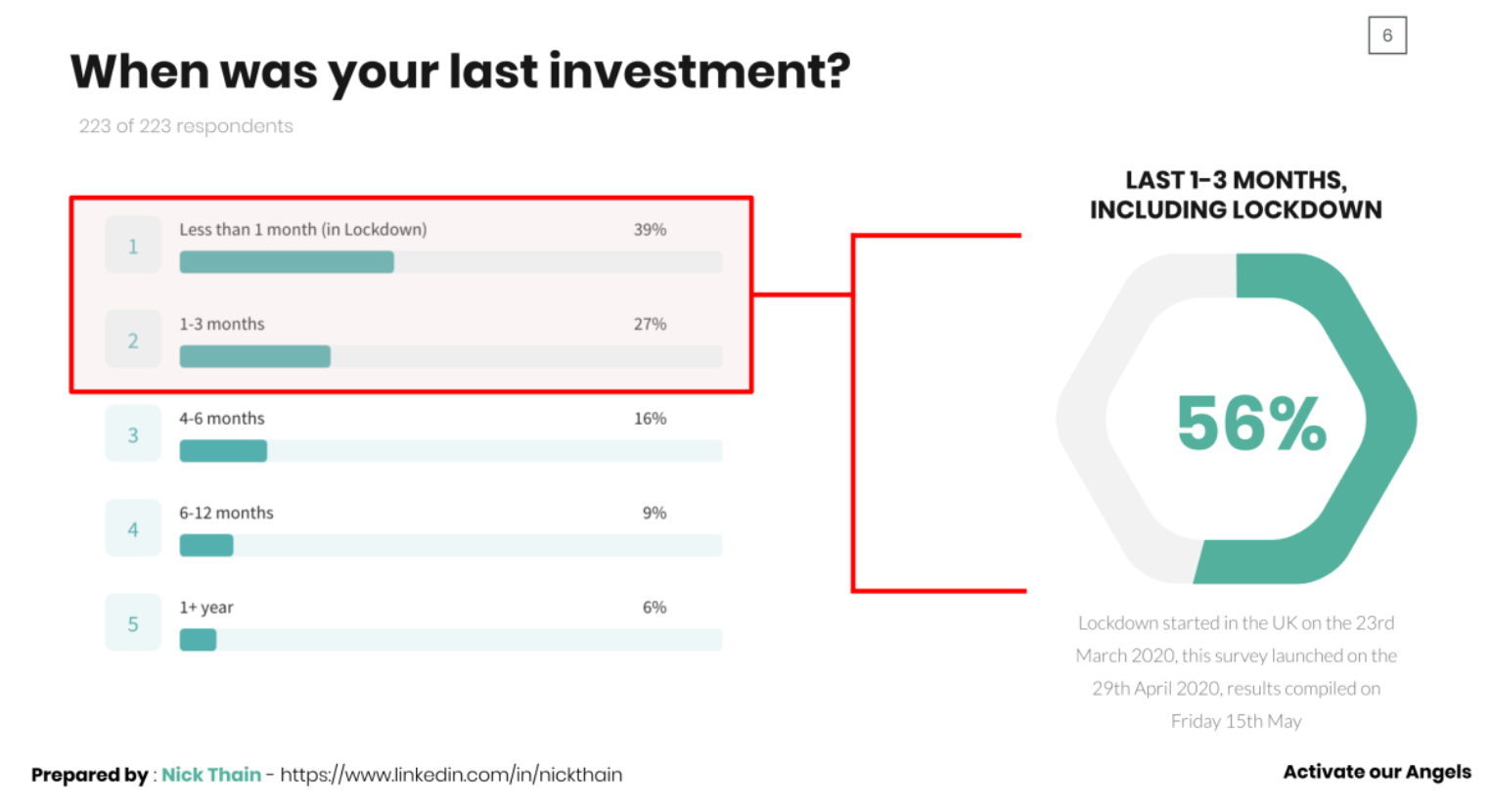
A survey of UK angel investors regarding their investment strategies during the COVID-19 pandemic has found that over 65% of angels investors are continuing to invest in startups during Lockdown, but with predominantly new deals. Many are completing more deals and increasing their cheque size by as much as 18%.

However, the pandemic has reduced their total capital to invest in 2020 by just over 61%, while just under 60% think the effects of COVID-19 will negatively affect their ability to invest for the rest of 2020. Over 250 angels completed the full survey in the last two weeks, after TechCrunch exclusively published it.

These are the findings of new UK initiative Activate our Angels (AoA). The initiative comes just as the UK government’s “Future Fund” for startups, which has been criticized as being inadequate for the needs of Angel and Seed-stage startups, is poised to be launched some time this week.

AoA was started by Nick Thain the former CEO and co-founder of GiveMeSport, which was acquired last year and includes representatives from 7percent Ventures, Forward Partners, Portfolio Ventures, ICE, Foundrs, Punk Money, Humanity, Culture Gene, Barndance, Bindi Karia and Stakeholderz.

Activate our Angels started its campaign just under two weeks’ ago with the goal to give founders actionable data to help them make funding decisions, during and post-lockdown.

The survey shows that while angels are currently investing, founders will need to lock this funding down fast, as 59% of angels surveyed says their future investing will be negatively affected the longer the lockdown goes on.

This becomes more important if a startup has raised under £250,000.

Furthermore, the survey concluded that angels are investing 18% more per deal and have increased the frequency of deals in Lockdown by over 122% from 0.27 deals per month in 2019 to 0.6 deals per month in the last 3 months.

Angels are looking for increased runway and revenue generative businesses, and they’re seeing reduced valuations and smaller rounds.

Additionally, angels are told the survey that they have 61% of the capital to invest in 2020 compared to 2019. This suggests that angels are “making hay while the lockdown-sun is shining” said the survey.

Consequently, angels will have significantly less money for the rest of 2020.

For start-ups that have not raised yet, the findings suggest they should do their first round as soon as possible.

For start-ups who have already raised, this impending angel capital crunch ?makes initiatives such as the forthcoming government-backed Future Fund as important as ever, says the survey.

“If angels are not investing in Lockdown, they are holding cash and waiting to be confident that COVID-19 is over. The best way to contact them is via an introduction/recommendation, email or linkedIn, not via Social Media,” it added.

The results from the survey have been summarised below.

?  66.7% of Angel investors are still investing during Lockdown

?  77% of those are investing in new deals

?  23% of those in existing portfolio deals

?  33.3% of angels are not investing in lockdown

?  71% of those are reviewing deals
?  29% of those are not investing at all
?  17.6% more is being invested per deal during Lockdown.
?  £23,071 invested per deal in Lockdown
?  £19,620 invested per deal in 2019
?  Angels completed an average of 1.81 deals during lockdown, angels completed an average of 3.24 deals in the whole of 2019
?  1 deal every 3-4 weeks (approx.), since Lockdown on 23rd March 2020
?  1 deal approximately every 7-8 weeks (approx.), in last 1-3 months
?  1 deal every 3-4 months (approx.) in last 4-12 months
?  1 deal every 3-4 months (approx.) in 2019
?  58.1% of angels believe that Covid-19 will have a negative impact on their ability to invest in 2020, 27.2% No Change and 14.7% said it would have a positive impact
?  51.4% of angels surveyed said they would be investing Less in 2020
? of those angels said they would invest 61% less capital in 2020 compared to
2019.
?  33.3% of angels are not investing in Lockdown
?  of those 47.6% are only going to invest again when they are confident Covid- ?19 crisis is over
?  of those 28.6% are not planning to invest again.
?  64.9% of angels are changing the business sectors they’re looking at including; Healthcare, Fintech and gaming
?  54.1% of angels have changed their investment requirements, with longer runway, revenue generative and recurring revenue being the most important factors.
? 46.9% of angels had no change in investment requirements
?  68% of angels have seen deal terms with reduced valuations as a result of Covid-19 and 35% have seen smaller Investment rounds.
?  When it comes to getting in contact with angels, 72% want to be contacted via recommendations/introductions. ?? 54% via email?? 32.6% LinkedIn?? 30.9% Angel network.?? Facebook and Twitter being the least effective way to contact angels with ?less than 3% of respondents selecting this.
?  70% of angels said SEIS/EIS was important, very important or critical to their investment decisions, of those 58% said they would not invest more if the SEIS allowance was increased to the £200k from the current £100k cap.

Users say Robinhood is down as stocks soar

Users are reporting that trading platform Robinhood was down during early morning trading that saw stock markets soar.

Robinhood’s status page says all systems are “operational,” but users on Twitter said they could not access the service. A Robinhood spokesperson would not comment on the record but referred TechCrunch to a company tweet.

Sorry about that, we had a brief issue where your app was delayed in displaying order updates. This has since been fixed so you should not have any issues placing your orders going forward.

— Robinhood Help (@AskRobinhood) May 18, 2020

Some users said Etrade was also experiencing problems. A spokesperson for Etrade said its platform is “fully operational” but declined to comment further.

After weeks of turbulent markets largely driven by coronavirus concerns, the Dow Jones Industrial Average (DJIA) is up 3% in early morning trading.

Robinhood, which earlier this month raised $280 million pushing its valuation to $8.3 billion, took heat in March after several days of outages saw users unable to trade on the platform. Users were left furious after the outage prevented access to the platform on what was one of the busiest trading days of the year.

The financial startup said it would offer case-by-case compensation to its 10 million users for their troubles. Months earlier, the company admitted a glitch that let users borrow more money than they were allowed.

Morgan Stanley bought Etrade earlier this year for $13 billion. Last year Etrade reported record revenue of $2.9 billion.

Updated with a response from Robinhood.

U.S. House approves remote voting, though the tech is unclear

Congress will allow remote voting for the first time in its history, after the U.S. House approved Resolution 965 late Friday in response to the coronavirus pandemic.

The measure — sponsored by Massachusetts Representative Jim McGovern — authorizes proxy voting by members for renewable periods of 45 days and allows for remote participation in committee hearings.

H.R. 965 could also permanently alter the way Congress operates through a provision that establishes a bi-partisan process to explore digital voting away from Capitol Hill.

Per the directive, “The chair of the Committee on House Administration, in consultation with the ranking minority member, shall study the feasibility of using technology to conduct remote voting in the House, and shall provide certification…that operable and secure technology exists.”

Previous House rules required in person voting only. The Senate still makes decisions by recording verbal “Yeas” and “Nays” on a tally sheet.

Friday’s congressional action is another example of how COVID-19 is forcing every organization in the U.S. to overhaul longstanding ways of doing things, usually through a mix of digital tools.

We still don’t have clear details on what tech the U.S. House will use to implement both the short and longer term provisions of H.R. 965.

The proxy voting arrangement will allow members to vote remotely through designated representatives on Capitol Hill — effectively a form of pinch-hitting for Congress. For remote participation in hearings, there are a range of options that could be selected — from Google Meet to Microsoft Teams. Last week, Dr. Anthony Fauci testified before the U.S. Senate using Zoom.

On determining long-term means for remote voting, that’s now up to the Chairperson of the Committee on House Administration —  representative Zoe Lofgren (D-CA) —  and the ranking minority member Rodney Davis (R-IL), who voted against H.R. 965.

Lofgren offered a preview of how it could shape up in a statement supporting H.R. 965 late Friday: “For voting on the floor, we will rely on a secure email system, coupled with member-driven, remotely-directed authorizations.  This system would use secure email for proxy votes: a solid, well known, resilient technology with very low bandwidth requirements that we understand very well from a cybersecurity standpoint.”

Of course, she and Republican Congressman Davis will have to find agreement on this during a time when both parties rarely agree on anything. The vote on H.R. 965 was split along party lines, with 217 Dems voting in favor and not a single Republican member supporting the measure.

In the past, Congress has resisted calls to allow for remote voting. There was discussion of the need for such provisions after the September 11 attacks and 2001 Anthrax attacks. These was overridden by a long time expectation that those elected to represent constituencies be physically present to vote.

Over the last two months, it appeared the House might become a last holdout in the U.S. for in person only workplaces, as much of the country has shifted to tech-enabled measures for remote operations.

Shortly after the coronavirus outbreak hit the U.S. in March, Congressman Eric Swalwell (D-CA) pressed a resolution with Arkansas Representative Rick Crawford (R-AR) that would allow members to participate virtually in hearings and vote remotely, under special circumstances.

US capitol building at night

Image Credits: Bill Dickinson/Getty Images

That was nixed by House Speaker Nancy Pelosi  who, at the time, wanted Congress to remain in session and present to pass the first coronavirus stimulus bill.

Two months and nearly one hundred thousand American deaths later, it appears COVID-19 could force one of the more significant procedural changes in the House’s 231 year history.

In person voting could soon be replaced with some form of two-factor authentication, digital voting. This could change longstanding patterns for how lawmakers travel, interact with constituencies, and divide their time between the Beltway and districts back home.

Work From Home is dead, long live Work From Anywhere

My colleagues and I published a couple of different views on the future of “work from home” and remote work last Friday — a story that, if analytics is any sign, really struck a nerve with many of you.

That shouldn’t be surprising particularly in the tech industry, where knowledge work fundamentally means we spend the vast majority of our time in an “office.” Everything from minor annoyances (they cut down the size of the Klondike bars in the mini-kitchen!) to massive complaints (I am trying to think through a complex ML algorithm as my open-office colleagues are having a Nerf war!) is magnified given the time we spend in these environments.

Understandably, the mandatory Work From Home situation that many of us find ourselves in is not ideal. Schools are closed, kids are home, internet is wonky since everyone else is home, the dog sitter isn’t coming and there are no cafés to find sojourn. It’s not surprising then that there is something of a popular revulsion and revolt to the whole WFH notion, even as large tech companies like Twitter say they will permanently offer Work From Home as an option.

That’s selling short what is really taking place though. “Work From Home” is terrible branding, precisely because it fails to communicate the fundamental freedom that comes with these new policies. It’s not about further imprisoning us in our homes — it’s about empowering us to think and work exactly where we are personally most productive.

Yes, I know that most of us are sequestered in our humble abodes due to COVID-19, but long-term, the whole point of the flexibility that “Work From Home” provides is precisely that you can work from anywhere. It may be your home — but it may as well be a café, the hospital where a sick family member is located, a beach, a friend’s house, a hotel. The point of flexibility here is to untether our schedules and the stress associated with them and allow our work to happen where we want it to.

Many of us will choose to work from home, and many of us will habitually return to the same working environment each day even if it isn’t our home. That’s fine. Flexibility doesn’t mean constantly changing everything up — it means we can change things when we want and need to.

One big question that has loomed over “Work From Home” policies is this: What if I like my office and the social life of meeting with colleagues? Again, we see the narrowness of the language. “Work From Anywhere” literally means anywhere, including the very office we would normally commute to.

Flexibility means adapting our schedules and our locations for the kinds of knowledge work we are trying to do. Some days are all meetings as we try to coordinate a number of projects. Some days we need to shut out the world and just dive down into writing our novels, or developing a new algorithm, or putting together that big presentation for the all-hands meeting next week. Some days we need a mix of both. Some days we need the comfort of home, while other days we need the comfort of colleagues.

In short, “Work From Anywhere” perfectly encapsulates that freedom and dynamism our schedules deserve.

For companies, the challenge is how to empower a true Work From Anywhere culture, which is way more than the binary of “in office” or “at home.” Many companies already have expense policies that allow employees to buy key equipment for their homes (a monitor, bringing a computer home, etc.) as well as subsidizing home internet access.

But in Work From Anywhere, should companies subsidize coffee purchases or Wi-Fi passes for employees at a nearby café? What about a day pass at a coworking facility? Should the company underwrite employee travel to different cities or places to freshen themselves up with new experiences? How should companies offer mechanisms for distant employees to connect in real life?

Sadly, much of the discussion among executives today is about cost (surprise!). Offices are expensive. Office space per employee has declined over the past five decades under cost pressure, which is one reason for the forced usage of open offices compared to offices with doors that close. There is more collaboration — and a nice savings to the bottom line. Work From Home itself got more popular as broadband internet expanded and companies were looking for new ways to minimize their expenses.

Work From Anywhere may not save a company any money whatsoever. What was once large office complexes may be a handful of smaller venues, with travel and food budgets that will more than make up for any real estate cost savings. This new workplace flexibility is not about saving money, nor long-term social distancing. In the end, it’s an investment in employee well-being, productivity, and ultimately, profitability.

With pandemic-era acquisitions, big tech is back in the antitrust crosshairs

With many major sectors totally frozen and reeling from losses, tech’s biggest players are proving themselves to be the exception to the rule yet again. On Friday, Facebook confirmed its plans to buy Giphy, a popular gif search engine, in a deal believed to be worth $400 million.

Facebook has indicated it wants to forge new developer and content relationships for Giphy, but what the world’s largest social network really wants with the popular gif platform might be more than meets the eye. As Bloomberg and other outlets have suggested, it’s possible that Facebook really wants the company as a lens into how users engage with its competitors’ social platforms. Giphy’s gif search tools are currently integrated into a number of messaging platforms, including TikTok, Twitter and Apple’s iMessage.

In 2018, Facebook famously got into hot water over its use of a mobile app called Onavo, which gave the company a peek into mobile usage beyond Facebook’s own suite of apps—and violated Apple’s policies around data collection in the process. After that loophole closed, Facebook was so desperate for this kind of insight on the competition that it paid people—including teens—to sideload an app granting the company root access and allowing Facebook to view all of their mobile activity, as TechCrunch revealed last year.

For lawmakers and other regulatory powers, the Giphy buy could ring two separate sets of alarm bells: one for the further evidence of anti-competitive behavior stacking the deck in the tech industry and another for the deal’s potential consumer privacy implications.

“The Department of Justice or the Federal Trade Commission must investigate this proposed deal,” Minnesota Senator Amy Klobuchar said in a statement provided to TechCrunch. “Many companies, including some of Facebook’s rivals, rely on Giphy’s library of sharable content and other services, so I am very concerned about this proposed acquisition.”

In proposed legislation late last month, Sen. Elizabeth Warren (D-MA) and Rep. Alexandria Ocasio-Cortez (D-NY) called for a freeze on big mergers, warning that huge companies might view the pandemic as a chance to consolidate power by buying smaller businesses at fire sale rates.

In a statement, a spokesperson for Sen. Warren called the Facebook news “yet another example of a giant company using the pandemic to further consolidate power,” noting the company’s “history of privacy violations.”

“We need Senator Warren’s plan for a moratorium on large mergers during this crisis, and we need enforcers who will break up Big Tech,” the spokesperson said.

News of Facebook’s latest moves come just days after a Wall Street Journal report revealed that Uber is looking at buying Grubhub, the food delivery service it competes with directly through Uber Eats.

That news also raised eyebrows among pro-regulation lawmakers who’ve been looking to break up big tech. Rep. David Cicilline (D-RI), who chairs the House’s antitrust subcommittee, called that deal “a new low in pandemic profiteering.”

“This deal underscores the urgency for a merger moratorium, which I and several of my colleagues have been urging our caucus to support,” Cicilline said in a statement on the Grubhub acquisition.

The early days of the pandemic may have taken some of the antitrust attention off of tech’s biggest companies, but as the government and the American people fall into a rhythm during the coronavirus crisis, that’s unlikely to last. On Friday, the Wall Street Journal reported that the Department of Justice and a collection of state attorneys general are in the process of filing antitrust lawsuits against Google, with the case expected to hit in the summer months.