The Trash app’s new features can create AI-edited music videos and more

The team behind Trash, an app that uses artificial intelligence to edit your video footage, launched a number of new features this week that should make it more useful for anyone — but especially independent musicians.

I wrote about the startup last summer, when CEO Hannah Donovan told me that her work as Vine’s general manager convinced her that most people will never feel like they have the technical skills to edit a good-looking video.

That’s why she and her co-founder Genevieve Patterson (the startup’s chief scientist) created technology that can analyze multiple video clips, identifying the most interesting shots and stitching it all together into a fun video.

Since then, Trash brought on more creators before opening up to a general audience last fall. Donovan explained that while she’d expected users to create “hyper-polished influencer videos,” the opposite has been true.

“The content on Trash is very personal, very authentic, very real,” she said. “For lack of better words, it’s what you’d see in your [Snapchat or Instagram] Stories.”

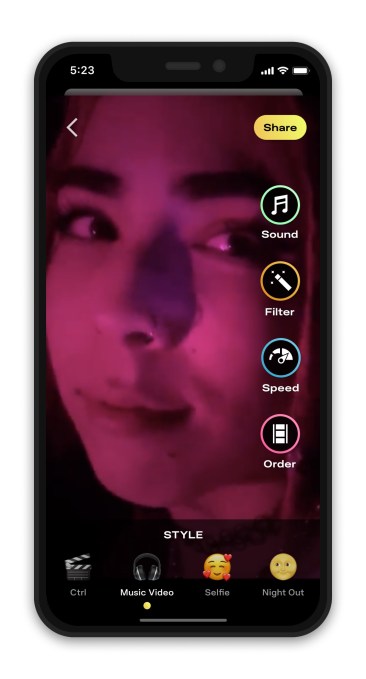
Trash is giving users more capabilities this week with the launch of Styles. This allows them to identify the type of video they want to create — whether it’s a recap (vacation recaps are big right now), a narrative video or something more artsy. The results are tailored accordingly, and then the user still has the option to further tweak things, for example by moving clips around.Trash music video style

Image Credits: Okayceci for TrashThere’s also a style for music videos. Many Trash videos already combine videos and music, but Donovan said this style is specifically designed for independent musicians who may not have editing skills, but who still need to create music videos — especially as YouTube has become one of the main ways people discover new music.

“The music video is more important than it’s ever been,” she argued.

Trash can’t give those musicians professional, studio-quality footage, but currently, everyone — no matter how famous — is largely limited to shooting themselves at home on smartphones right now. And even after the pandemic, Donovan expects the trend to continue.

“You’re seeing that in commercial videos as well, incorporating elements like text messaging,” she said. “What we’re seeing now is just this huge blend where it doesn’t matter [and you can mix] real life and virtual life, this hyper-polished, big-budget stuff and a super DIY, shot-on-an-iPhone aesthetic.”

To check it out, you can watch a playlist of some of the initial music videos created on Trash. The startup has also launched Trash for Artists, where musicians can upload their songs to create music videos and promo videos, while also offering them up as a soundtrack for other Trash users.

In addition to launching the new features, Trash also graduated last week from Snap’s Yellow accelerator program. (Other investors include the National Science Foundation, Japan’s Digital Garage and Dream Machine, the fund created by former TechCrunch Editor Alexia Bonatsos.)

Spotify will let employees work from home through the end of year

Spotify this week joined a growing number of tech giants expanding their work from home policies as the COVID-19 pandemic continues to drag on. While not as radical as Twitter’s recent decision to let staff work from home forever, the music streaming service’s move does represent increased openness to the arrangement.

As noted by Variety, the new policy allows staff to continue working from home through the end of the year. The new edict covers all employees across the globe. The streaming service is headquartered in Stockholm, with a number of regional offices, including New York, London and Tokyo. Spotify operates in 79 countries around the world.

A spokesperson for the company confirmed the move with TechCrunch:

Earlier today, we announced the extension of our work-from-home arrangement for all Spotify employees globally. We will continue to track local government guidelines city-by-city and take a phased approach of opening our offices when we deem it safe to do so. Our employees’ health and safety is our top priority. No employee will be required to come into the office and can choose to work from home through the end of the year.

The announcement follows similar moves from tech giants, like Facebook and Google. Many have long weighed the ups and downs of a remote workforce, but COVID-19 has caused an acceleration in that way of thinking. These past few months have been a kind of trial by fire for the model.

Even as many regions have begun to reopen, however, the potential for additional waves of the virus have made the option that much more appealing.

Netflix to start cancelling inactive customers’ subscriptions

Netflix said Thursday it will ask customers who have not watched anything on the on-demand video streaming service in a year or more if they wish to maintain their subscription — and will cancel their membership if it does not hear back.

The company said it has started to notify customers who have’t watched anything on the platform in 12 months since they became a subscriber to check if they wish to keep their membership. The company is also reaching out to those who haven’t streamed anything in more than two years, it said.

“You know that sinking feeling when you realize you signed up for something but haven’t used it in ages? At Netflix, the last thing we want is people paying for something they’re not using,” the company said.

The unusual move illustrates just how much confidence Netflix has on its loyal customer base. Most companies are happy to withdraw their cut from their members’ bank accounts or credit cards for as long as they can.

Netflix said these inactive accounts — more popularly known as zombie accounts in the industry — only represent a few hundred thousand users, or less than half of 1% of its overall member base — a fact that the company already factors into its financial guidance.

The streaming service, which had more than 182 million subscribers at the end of March 31, says it will be easier for those whose accounts have been cancelled to rejoin the platform should they want to return. Those who rejoin within 10 months will still have their favorites, profiles, viewing preferences and account details just as they left them.

“In the meantime, we hope this new approach saves people some hard earned cash,” Eddy Wu, director of Product Innovation at Netflix, said in a statement.

Skyflow raises $7.5M to build its privacy API business

Skyflow, a Mountain View-based privacy API company, announced this morning that it has closed a $7.5 million round of capital it describes as a seed investment. Foundation Capital’s Ashu Garg led the round, with the company touting smaller checks from Jeff Immelt (former GE CEO) and Jonathan Bush (former AthenaHealth CEO).

For Skyflow, founded in 2019, the capital raise and its constituent announcement mark an exit from quasi-stealth mode.

TechCrunch knew a little about Skyflow before it announced its seed round because one if its co-founders, Anshu Sharma is a former Salesforce executive and former venture partner at Storm Ventures, a venture capital firm that focuses on enterprise SaaS businesses. That he left the venture world to eventually found something new caught our eye.

Sharma co-founded the company with Prakash Khot, another former Salesforce denizen.

So what is Skyflow? In a sense it’s the nexus between two trends, namely the growing importance of data security (privacy, in other words), and API -based companies. Skyflow’s product is an API that allows its customers — businesses, not individuals — to store sensitive user information, like Social Security numbers, securely.

Chatting with Sharma in advance of the funding, the CEO told TechCrunch that many providers of cybersecurity solutions today sell products that raise a company’s walls a little higher against certain threats. Once breached, however, the data stored inside is loose. Skyflow wants to make sure that its customers cannot lose your personal information.

Sharma likened Skyflow to other API companies that work to take complex services — Twilio’s telephony API, Stripe’s payments API, and so forth — and provide a simple endpoint for companies to hook into, giving them access to something hard with ease.

Comparing his company’s product to privacy-focused solutions like Apple Pay, the CEO said in a release that “Skyflow has taken a similar approach to all the sensitive data so companies can run their workflows, analytics and machine learning to serve the customer, but do so without exposing the data as a result of a potential theft or breach.”

It’s an interesting idea. If the technology works as promised, Skyflow could help a host of companies that either can’t afford, or simply can’t be bothered, to properly protect your data that they have collected.

If you are not still furious with Equifax, a company that decided that it was a fine idea to collect your personal information so it could grade you and then lost “hundreds of millions of customer records,” Skyflow might not excite you. But if the law is willing to let firms leak your data with little punishment, tooling to help companies be a bit less awful concerning data security is welcome.

Skyflow is not the only API-based company that has raised recently. Daily.co picked up funds recently for its video-chatting API, FalconX raised money for its crypto pricing and trading API, and CNBC reported today that another privacy-focused API company called Evervault has also taken on capital.

Skyflow’s model, however, may differ a little from how other API-built companies have priced themselves. Given that the data it will store for customers isn’t accessed as often, say, as a customer might ping Twilio’s API, Skyflow won’t charge usage rates for its product. After discussing the topic with Sharma, our impression is that Skyflow — once it formally launches its service commercially– will look something like a SaaS business.

The cloud isn’t coming, it’s here. And companies are awful at cybersecurity. Skyflow is betting it’s engineering-heavy team can make that better, while making money. Let’s see.

Extra Crunch Live: Discuss work and raising cash in a downturn with Revolution’s Steve Case and Clara Sieg right now

This afternoon, we’re chatting with Steve Case and Clara Sieg of Revolution as part of our new interview series, Extra Crunch Live.

Topping our agenda, we will talk about jobs — in Silicon Valley, on the coasts and in the heartland. The technology sector is suffering through a contraction caused by the COVID-19 global health crisis, and layoffs are hitting nearly every company.

We hope you’ll join the conversation. During our hour-long chat, Extra Crunch members can submit questions directly in the Zoom Q&A.

Steve Case has a unique vantage point. He co-founded AOL and steered the company through the first dot-com bubble, where AOL emerged as a dominant force. Later, during the 2008 economic crisis, Case led investments with his then-new firm Revolution.

Likewise, Clara Sieg has managed Revolution’s Silicon Valley efforts for the last eight years and can directly speak to the current upheaval. While at Revolution, she helped the firm raise two significant funds, including its $450 million Growth fund and its first institutional fund of $200 million.

Together, Case and Sieg are well-qualified to offer advice on negotiating the current climate.

Since its inception, Revolution has strived to invest in startups in and out of Silicon Valley. With the COVID-19 crisis, this model is relevant more than ever. We’re curious to hear the pair’s take on companies experimenting with permanent work-from-home policies and what this means for real estate prices in hubs like San Francisco and New York. Do they think the pandemic will create a lasting effect on the technology sector’s workforce?

This chat is the latest in our ongoing series of discussions with notable investors, entrepreneurs and technologists. Previously, TechCrunch staff sat down (virtually, of course) with Cowboy Ventures’ Aileen Lee and Ted Wang, Sequoia’s Roelof Botha and Mark Cuban, to name a few.

Join us today at 3:00 p.m. EDT. It’s going to be a good time.

Details are below for Extra Crunch subscribers. If you need a pass, you can get an inexpensive trial here.

Details

Here’s the information you’ll need:

The future of flight can be energy-efficient

Damon Vander Lind
Contributor

Damon Vander Lind is general manager for Heaviside at Kitty Hawk, a company whose mission is to free the world from traffic with eVTOL vehicles.

We are at the dawn of a new era in transportation.

At the turn of the 20th century, cars began to replace horses. Now, a century later, we would like to see mobility move to the sky. Kitty Hawk has built several prototype vehicles that are electrically powered, take off and land vertically and fly in between like a fixed-wing plane. Collectively, these are called eVTOL (electric vertical takeoff and landing) aircraft.

eVTOLs — such as the ones built by Project Heaviside — show great potential for everyday transportation. With that as an eventual use case, a common question that comes up is: can eVTOL vehicles be green? Specifically, can eVTOL vehicles be more energy-efficient than cars?

Under the EPA’s standard freeway driving test, a 2020 Nissan Leaf Plus uses about 275 Watt-hours per mile when it averages 50 miles per hour. It can comfortably seat four, but its average occupancy is somewhere around 1.6. Thus, the Leaf’s energy consumption is about 171Wh per passenger mile across all trips.

Our current Heaviside prototype uses about 120Wh per passenger mile, and does so at twice the speed of the Leaf: 100 miles per hour (of course, we can fly much faster, if we choose). We can save another 15% of energy because while roads are not straight, flight paths usually are. All together, Heaviside requires 61% as much energy to go a mile.

Why is Heaviside this efficient — doesn’t it take more energy to go faster? Yes, and it makes the high efficiency we’ve achieved even more dramatic. The answer is that Heaviside can take advantage of slim and low-drag aerodynamic forms that are just not practical on cars.

The difference in drag between a clean, aerodynamic shape like the wing section below, and a bluff body like the cylinder, is vast. So vast in fact that the two shapes drawn will have about the same amount of drag.

                                              The cylinder can be hard to see, it’s over here  ? 

What is probably less obvious is that clean shapes like wings must make lift when they are put at an angle to the wind. This is not just observation, but can be mathematically proven.

Car manufacturers put tremendous effort into designing shapes that minimize drag, but will not make lift or side force in wind, which would result in poor and squirrelly handling — remember the last time you drove over a bridge in high winds, or in the opposite direction of a large truck on a narrow country road.

When a car drives by, it takes quite a bit of air along with it.

Image Credits: Kitty Hawk

Project Heaviside, in contrast, leaves a small disturbance in the air it passes through.

So, Heaviside is quite energy-efficient. But what if people choose to travel farther when this option exists? What I find personally surprising about the ranges we have been able to achieve is that Heaviside is a vehicle that, because of the extremely low power consumption, is more efficient than a car traveling for an equal amount of time.

This leaves out the most important element of eVTOL aircraft, which is that they are fully electric, and the cars we would like to see them replace are nearly all gas and diesel-powered. While it may be a hard sell to convince the average consumer to switch to an electric car simply because of emissions, it is likely to be much easier to convince them to use a device that gives them time back.

To put this another way, if your commute is the U.S. average of 16 miles, and if you commuted in a Heaviside-type vehicle, three standard rooftop solar panels would power your commute both ways.

While we have a significant road ahead of us in developing and fielding our aircraft commercially, and we cannot be sure the final products will be as efficient as our prototypes, we are still very excited to demonstrate that efficiency and personal flight need not be at odds.

VergeSense grabs $9M for its people-counting sensor tech as offices eye COVID changes

Facilities management looks to be having a bit of a moment, amid the coronavirus pandemic.

VergeSense, a U.S. startup that sells a “sensor as a system” platform targeted at offices — supporting features such as real-time occupant counts and foot-traffic-triggered cleaning notifications — has closed a $9 million strategic investment led by Allegion Ventures, a corporate VC fund of security giant Allegion.

JLL Spark, Metaprop, Y Combinator, Pathbreaker Ventures and West Ventures also participated in the round, which brings the total funding raised by the 2017-founded startup to $10.6 million, including an earlier seed round.

VergeSense tells TechCrunch it’s seen accelerated demand in recent weeks as office owners and managers try to figure out how to make workspaces safe in the age of COVID-19 — claiming bookings are “on track” to be up 500% quarter over quarter. (Though it admits business did also take a hit earlier in the year, saying there was “aftershock” once the coronavirus hit.)

So while, prior to the pandemic, VergeSense customers likely wanted to encourage so called “workplace collisions” — i.e. close encounters between office staff in the hopes of encouraging idea sharing and collaboration — right now the opposite is the case, with social distancing and looming limits on room occupancy rates looking like a must-have for any reopening offices.

Luckily for VergeSense, its machine learning platform and sensor-packed hardware can derive useful measurements just the same.

It has worked with customers to come up with relevant features, such as a new Social Distancing Score and daily occupancy reports. It already had a Smart Cleaning Planner feature, which it reckons will now be in high demand. It also envisages customers being able to plug into its open API to power features in their own office apps that could help to reassure staff it’s okay to come back in to work, such as indicating quiet zones or times where there are fewer office occupants on site.

Of course plenty of offices may remain closed for some considerable time or even for good — Twitter, for example, has told staff they can work remotely forever — with home working a viable job for much office work. But VergeSense and its investors believe the office will prevail in some form, but with smart sensor tech that can (for example) detect the distance between people becoming a basic requirement.

“I think it’s going to be less overall office space,” says VergeSense co-founder Dan Ryan, discussing how he sees the office being changed by COVID-19. “A lot of customers are rethinking the need to have tonnes of smaller, regional offices. They’re thinking about still maintaining their big hubs, but maybe what those hubs actually look like is different.

“Maybe post-COVID, instead of people coming into the office five days a week… for people that don’t necessarily need to be in the office to do their work everyday maybe three days a week or two days a week. And that probably means a different type of office, right. Different layout, different type of desks etc.”

“That trend was already in motion, but a lot of companies were reluctant to experiment with remote work because they weren’t sure about the impact on productivity and that sort of thing, there was a lot of cultural friction associated with that. But now we all got thrust into that simultaneously and it’s happening all at once — and we think that’s going to stick,” he adds. “We’ve heard that feedback consistently from basically all of our customers.”

“A lot of our existing customers are pulling forward adoption of the product. Usually the way we roll out is customers will do a couple of buildings to get started and it’ll be phased rollout plan from there. But now that the use-case for this data is more connected to safety and compliance, with COVID-19, around occupancy management — there’s CDC guidelines [related to building occupancy levels] — now to have a tool that can measure and report against that is viewed as more of a mission-critical type thing.”

VergeSense is processing some 6 million sensor reports per day at this point for nearly 70 customers, including 40 FORTUNE 1000 companies. In total it says it provides its sensor hardware plus SaaS across 20 million square feet in 250 office buildings in 15 countries.

“There’s an extreme bear case here — that the office is going to disappear,” Ryan adds. “That’s something that we don’t see happening because the office does have a purpose, rooted in — primarily — human social interaction and physical collaboration.

“As much as we love Zoom and the efficiency of that, there is a lot that gets lost without that physical collaboration, connection, all the social elements that are built around work.”

VergeSense’s new funding will go on scaling up to meet the increased demand it’s seeing due to COVID and for scaling its software analytics platform.

It’s also going to be spending on product development, per Ryan, with alternative sensor hardware form factors in the works — including “smaller, better, faster” sensor hardware and “some additional data feeds.”

“Right now it’s primarily people counting, but there’s a lot of interest in other data about the built environment beyond that — more environmental types of stuff,” he says of the additional data feeds it’s looking to add. “We’re more interested in other types of ambient data about the environment. What’s the air quality on this floor? Temperature, humidity. General environmental data that’s getting even more interest frankly from customers now.

“There is a fair amount of interest in wellness of buildings. Historically that’s been more of a nice to have thing. But now there’s huge interest in what is the air quality of this space — are the environmental conditions appropriate? I think the expectations from employees are going to be much higher. When you walk into an office building you want the air to be good, you want it to look nicer — and that’s why I think the acceleration [of smart spaces], that’s a trend that was already in motion but people are going to double down and want it to accelerate even faster.”

Commenting on the funding in a statement, Rob Martens, president of Allegion Ventures, added: “In the midst of a world crisis, [the VergeSense team] have quickly positioned themselves to help senior business leaders ensure safer workspaces through social distancing, while at the same time still driving productivity, engagement and cost efficiency. VergeSense is on the leading edge of creating data-driven workspaces when it matters most to the global business community and their employees.”

Personal finance tracker Copilot adds support for Apple Card spreadsheet imports

When Apple added the ability to export transactions via spreadsheet to its credit card, Matthew hit up the folks at Copilot, asking whether they planned to support the feature. The answer was essentially “not yet, but soon.” This week, however, it’s finally official.

The makers of the personal finance tracking app announced that users can now import the Apple Card’s CSV spreadsheet into Copilot. The app will then go to work categorizing the transactions into topics, like transportation, subscription services, shops and restaurants.

Those who manually manage their expenses can consolidate the information into a single place, while the app removes any duplicates from the list. From there, it will create a historical balance and utilization rate for the Apple Card.

Hey Apple Card users ? Copilot can now import your statements directly from the Wallet app!

This feature comes with improved categorization, automatic detection of duplicates (very useful if you're also logging expenses by hand), and historical balanceshttps://t.co/CkgtU8rdaP pic.twitter.com/4PAq2u5guP

— Copilot (@copilotmoney) May 21, 2020

Removing as much friction as possible from a daunting subject like expenses is the bread and butter of apps like Copilot, and the Apple integration looks to be a stupidly easy way to keep charges organized in one convenient spot. Copilot’s chief competitor Mint already accepts spreadsheet imports, as do other apps, including Clarity Money, YNAB and Lunch Money.

Unfortunately, there’s no automated way to import the sheets at the moment, meaning you’ll have do it manually for each. Copilot founder Andres Ugarte says the company is working on a fully automated process.

Per Ugarte, “Apple Card support has been a top request from our users since we launched. This integration required extensive backend development to ensure that upon import, Copilot could seamlessly integrate Apple Card data with the rest of a user’s financial life. We wanted to ensure we weren’t cutting any corners, and that Apple Card transactions could take advantage of the same algorithmic categorization and analysis that Copilot uses for other financial institutions.”