Google highlights accessible locations with new Maps feature

Google has announced a new, welcome and no doubt long-asked-for feature to its Maps app: wheelchair accessibility info. Businesses and points of interest featuring accessible entrances, bathrooms and other features will now be prominently marked as such.

Millions, of course, require such accommodations as ramps or automatic doors, from people with limited mobility to people with strollers or other conveyances. Google has been collecting information on locations’ accessibility for a couple years, and this new setting puts it front and center.

The company showed off the feature in a blog post for Global Accessibility Awareness Day. To turn it on, users can go to the “Settings” section of the Maps app, then “Accessibility settings,” then toggle on “Accessible places.”

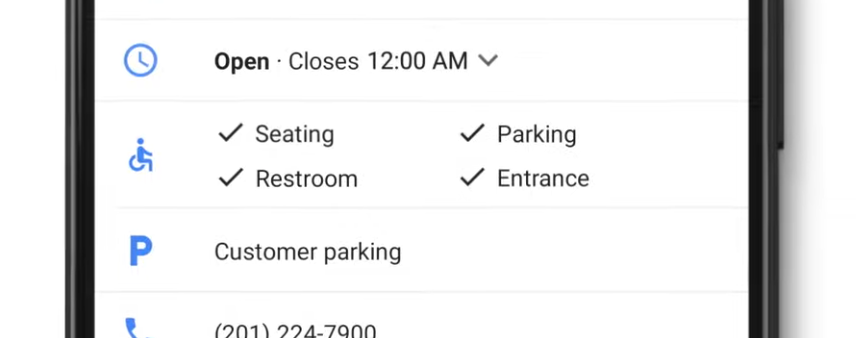
This will cause any locations searched for or tapped on to display a small wheelchair icon if they have accessible facilities. Drilling down into the details where you find the address and hours will show exactly what’s available. Unfortunately it doesn’t indicate the location of those resources (helpful if someone is trying to figure out where to get dropped off, for instance), but knowing there’s an accessible entrance or restroom at all is a start.

The information isn’t automatically created or sourced from blueprints or anything — like so much on Google, it comes from you, the user. Any registered user can note the presence of accessible facilities the way they’d note things like in-store pickup or quick service. Just go to “About” in a location’s description and hit the “Describe this place” button at the bottom.

Virtual events startup Run The World just nabbed $10.8 million from a16z and Founders Fund

Run The World, a year-old startup that’s based in Mountain View, Calif., and has small teams both in China and Taiwan, just nabbed $10.8 million in Series A funding co-led by earlier backer Andreessen Horowitz and new backer Founders Fund.

It’s easy to understand the firms’ interest in the company, whose platform features every functionality that a conference organizer might need in a time of a pandemic and even afterward, given that many outfits are rethinking more permanently how to produce events that include far-flung participants. Think video conferencing, ticketing, interactivity and networking.

We’d written about the startup a few months ago as it was launching with $4.3 million in seed funding led by Andreessen partner Connie Chan, who was joined by a slew of other seed-stage backers, including Pear Ventures, GSR Ventures and Unanimous Capital. Perhaps unsurprisingly given the current climate, Run The World has received a fair amount of traction since, according to co-founder and CEO Xiaoyin Qu, who’d previously led products for both Facebook and Instagram.

“Since we launched in February — and waived all set-up fees for events impacted by the coronavirus — we are receiving hundreds of inbound event requests each day,” Qu says. More specifically, she says the startup has doubled the size of its core team to 30 employees and enabled organizers from a wide variety of countries to oversee more than 2,000 events at this point.

Qu says that a lot of event planners who’ve used Zoom to run webinars are now choosing Run The World instead because of its focus on engagement and social features. For example, attendees to an event on the platform are invited to create a video profile akin to an Instagram Story that can help inform other attendees about who they are. It also organizes related “cocktail parties,” where it can match attendees for several minutes at a time, and attendees can choose who they want to follow up with afterward.

That heavy focus on social networking isn’t accidental. Qu met her co-founder, Xuan Jiang, at Facebook, where Jiang was a technical lead for Facebook events, ads and stories.

Of course, Run The World — which takes 25% of ticket sales in exchange for everything from the templates used, to ticket sales, to payment processing and streaming and so forth — still has very stiff competition in Zoom. The nine-year-old company has seen adoption by consumers soar since February, with 300 million daily meeting participants using the service as of April’s end.

Not only is it hard to overcome that kind of network effect, but Run The World is hardly alone in trying to steer event organizers its way. Earlier this week, for example, Bevy, an events software business co-founded by the founder of the events series Startup Grind, announced it has raised $15 million in Series B funding led by Accel. Other young online events platforms to similarly raise venture backing in recent months include London-based Hopin (whose recent round was also led by Accel, interestingly) and Paris-based Eventmaker.

Still, the fresh funding should help. While Run The World has grown “entirely organically through word of mouth” to date, says Qu, the startup plans to grow its team and will presumably start spending at least a bit on marketing.

It could well get a boost on this last front by its social media-savvy investors.

In addition to a16z and Founders Fund, numerous other backers in its Series A include Will Smith’s Dreamers VC and Kevin Hart’s Hartbeat Capital.

Magic Leap has apparently raised another $350 million, in spite of itself

Magic Leap has reportedly received a $350 million lifeline, a month after slashing 1,000 jobs and dropping its consumer business. Noted by Business Insider and confirmed by The Information, CEO Rony Abovitz sent a note to staff announcing the funding, courtesy of unnamed current and new investors.

The who — and more importantly, why — isn’t clear. A key healthcare company may be involved. Whatever the case, the company is withdrawing the WARN notice (a 60-day notification for large-scale layoffs) sent to staff in late April. The move represents an apparent reversal of the massive layoff round it previously announced.

In spite of the change, it seems that the lavishly funded augmented reality company still plans to turn all of its focus to the enterprise, as previously announced — a move that puts it in more direct competition with the likes of Microsoft’s HoloLens.

“We are making very good progress in our healthcare, enterprise, and defense deals,” Abovitz writes. “As these deals close, we will be able to announce them.”

Magic Leap cited COVID-19 as a key reason for April’s news. But the company wasn’t exactly the picture of consumer hardware success prior to the shutdown. In spite of raising an eye-popping $2.6 billion across nine rounds, the company’s early days were defined far more by hype than public progress. After years of teaser videos, its first device ultimately left much to be desired.

We’re reached out to the company for comment.

Extra Crunch Live: Join Box CEO Aaron Levie May 28th at noon PT/3 pm ET/7 pm GMT

We’ve been on a roll with our Extra Crunch Live Series for Extra Crunch members, where we’re talking to some of the biggest names in Silicon Valley about business, investment and the startup community. Recent interviews include Kirsten Green from Forerunner Ventures, Charles Hudson from Precursor Ventures and investor Mark Cuban.

Next week, we’re pleased to welcome Box CEO Aaron Levie. He is a well-known advocate of digital transformation, often a years-long process that many companies have compressed into a few months because of the pandemic, as he has pointed out lately.

As the head of an enterprise SaaS company that started out to help users manage information online, he has a unique perspective on what’s happening in this period as companies move employees home and implement cloud services to ease the transition.

Levie started his company 15 years ago while still an undergrad in the proverbial dorm room and has matured from those early days into a public company executive, guiding his employees, customers and investors through the current crisis. This is not the first economic downturn he has faced as CEO at Box; when it was still an early-stage startup, he saw it through the 2008 financial crisis. Presumably, he’s taking the lessons he learned then and applying them now to a much more mature organization.

Please join TechCrunch writers Ron Miller and Jon Shieber as we chat with Levie about how he’s handling the COVID-19 crisis, moving employees offsite and what advice he has for companies that are accelerating their digital transformation. After he’s shared his wisdom for startups seeking survival strategies, we’ll discuss what life might look like for Box and other companies in a post-pandemic environment.

During the call, audience members are encouraged to ask questions. We’ll get to as many as we can, but you can only participate if you’re an Extra Crunch member, so please subscribe here.

Extra Crunch subscribers can find the Zoom link below (with YouTube to follow) as well as a calendar invite so you won’t miss this conversation.

Fitbit launches a COVID-19 early detection study, and you can join from the Fitbit app

Fitbit’s activity-tracking wearable devices are already being used by a number of academic institutions to determine if they might be able to contribute to the early detection of COVID-19 and the flu, and now Fitbit itself is launching its own dedicated Fitbit COVID-19 Study, which users can sign up for from within their Fitbit mobile app.

The study will help the company figure out if it can successfully develop an algorithm to accurately detect a COVID-19 infection before the onset of systems. In order to gather the data needed to see if they can do this, Fitbit is asking users in either the U.S. or Canada who have either had or currently have a confirmed case of COVID-19, or flu-like symptoms that might be an indicator of an undiagnosed case, to answer some questions in order to contribute to its research.

The answer to these questions from participants will be paired with data gathered via their Fitbit to help identify any patterns that could potentially provide an early warning about someone falling ill. Pre-symptomatic detection could have a number of benefits, most obviously in ensuring that an individual is then able to self-isolate more quickly and prevent them from infecting others.

Early detection could also have advantages in terms of treatment, allowing health practitioners to intervene earlier and potentially prevent the worst of the symptoms of the infection. Depending on what treatments ultimately emerge, early detection could have a big impact on their efficacy.

Fitbit is asking those who would take part in the study to answer questions about whether or not they have or have not experienced COVID-19 or the flu, or its symptoms, as well as other demographic and medical history info. Participation in the study is voluntary, in case you’re not comfortable sharing that info, and once in, participants can decided to withdraw whenever they want.

COVID-19 early detection could be a big help in any safe, actually practical return-to-work strategy for reopening the economy. It could also serve as a means of expanding diagnosis in combination with testing, depending on how accurate it’s found to be across these studies, and with what devices. A confirmed COVID-19 diagnosis doesn’t actually have to mean a test result; it could be a physician’s assessment based on a number of factors, including biometric data and symptom expression. Depending on what a comprehensive mitigation strategy ends up looking like, that could play a much bigger role in assessing the scale and spread of COVID-19 in the future, especially as we learn more about it.

TechCrunch Disrupt 2020 is going virtual

The headline says it all. TechCrunch’s big yearly event, Disrupt, is going fully virtual in 2020. As you can imagine, this is largely due to the impact that the coronavirus has had on the world. But it also gives us a chance to make our event even more accessible to more people than ever before, and we’re incredibly excited about that. And Disrupt will stretch over five days — September 14-18 — in order to make it easier for everyone to take in all the amazing programming. 

This is a daunting and intense task for all of us, but we’re also insanely excited by the challenge. We know how to make great in-person events. Now, the rules are re-written and we get the chance to set that same high standard in the virtual events space.

This is a challenging time for the industry that we cover relentlessly. There are massive risks, and massive opportunities for companies, investors and entrepreneurs. That’s what this Disrupt will be all about, helping you to understand our new realities in order to build hardy, innovative companies that not only weather this storm, but flourish.

Some of the companies that were founded during the last financial crisis or in its aftermath include Uber, Slack, Pinterest, Airbnb, Square, Instagram and Stripe. We’ll look at lessons from those companies and founders, and talk to investors about what they’re looking for from the startups of the future.

Our job now is to build a stellar virtual experience for speakers, sponsors, attendees and, most importantly, the startups that depend on Disrupt. Just like at our physical events, you will be able to meet investors, bring your innovative products to market and connect with media. You will be able to check out hundreds of startups, listen to and interact with some of the most important people in the startup world and attend virtual networking events. You will be able to build new partnerships, talk about your programs and build awareness of what you’re making. 

One of the things we’re most excited about is that anyone from anywhere around the globe can join us in a virtual event. And, because of this, we expect this to be one of the largest and most diverse events in Disrupt history. 

Entrepreneurs from around the world have always gathered at Disrupt, but now the barriers to attend will be lower than ever. Great companies from San Francisco to Seoul can participate in the Startup Battlefield competition this year, making it more possible than ever for us to gather the most incredibly interesting companies together with no geographic or logistical restrictions.

When 2020 began, we didn’t expect to be taking on such a big project this year. But the truth is, we’re ready. As news of the true spread of the coronavirus broke, the TechCrunch team began taking action. We launched Extra Crunch Live, delivering virtual events with guests like Aileen Lee, Kirsten Green, Mark Cuban, Charles Hudson and Roelof Botha. We’re taking our learnings there and applying them to the programming of our two virtual stages at Disrupt. 

We launched the Disrupt Digital Pro Pass that offers live stream and video on demand access to all of the programming, great targeted networking opportunities, access to Startup Alley and access to our sponsors. We’ve launched virtual sponsorship options that will give our partners the opportunity to build their brand, deliver their content, network with interesting people and develop the critical relationships that will help their businesses thrive. 

Disrupt’s dates are coming up fast (September 14-18th, 2020) so register as soon as you can. 

Stepping off this ledge is one of the scariest and yet most thrilling things we’ve ever done at TechCrunch and we’re really glad that we have an audience that knows exactly how that feels. 

Thank you, and we’ll see you at the first-ever TechCrunch Disrupt online.


Joey Hinson, Director of Operations

Matthew Panzarino, Editor in Chief

Facebook makes big remote work moves with plan for new hubs in Dallas, Denver and Atlanta

In a live-streamed town hall, Mark Zuckerberg gave an overview for what he expects in the near future as Facebook pursues accommodations to keep workers productive and safe during the COVID-19 crisis. The move comes as large tech companies reassess the viability of their iconic Silicon Valley campuses, now empty as the pandemic keeps most employees at home.

Part of Zuckerberg’s vision, announced Thursday, includes the surprise announcement that Facebook will be setting up new company hubs in Denver, Dallas and Atlanta. Zuckerberg also noted that Facebook will focus on finding new hires in areas near its existing offices, looking to cities like San Diego, Portland, Philadelphia and Pittsburgh. The Facebook CEO estimated that over the course of the next decade, half of the company could be working fully remotely.

Zuckerberg also elaborated on what kinds of roles would and would not be eligible for all-remote work, noting that positions in divisions like hardware development, data centers, recruiting, policy and partnerships would not be able to shift away from a physical office due to their need for proximity.

“When you limit hiring to people who live in a small number of big cities, or are willing to move there, that cuts out a lot of people who live in different communities, have different backgrounds, have different perspectives,” Zuckerberg said.

For Menlo Park employees looking for greener pastures, there’s one sizable catch. Starting on January 1 of next year, the company will localize all salaries, scaling compensation to the cost of living in the enclaves Facebook employees may soon find themselves scattered to.

Enjoy some 4K TV with your nature on Samsung’s new outdoor sets

Like most of us, you’ve probably been stuck inside for months now. Sitting around, pacing your home, watching a lot of bad television. Would anything possibly be better than finally getting some time outdoors to commune with nature and catch a little ultra high-def television?

Up to now, outdoor sets have largely been the realm of specialty companies with names like SunBriteTV. Now Samsung’s getting in on the decidedly niche category, with the Terrace line. The sets also sport a fairly niche price tag, starting at $3,499 for the 55-inch model and going up to $6,499 for the 75-inch.

The lofty price tag gets you IP55 weather proofing, against the inevitable water and dust. The 2160p screen is an extremely bright 2000 nits — designed to be bright enough to watch in the sunlight. It’s got all of the necessary ports, but Samsung’s largely focused on wireless connectivity, so users (well, installers) only have to plug it into a power source. There’s also a separate Terrace sound bar that also carries the IP55 rating. That’s going to run you an additional $1,200 to complete the set up.

Maybe it’s just me, being grumpy and slightly unhinged from being stuck inside a New York apartment for months on end, but the last thing I want to do upon leaving the apartment is watch TV. Granted, this pandemic is starting to get to me. If you’ve got the inclination, outdoor space and several grand to spend, Samsung’s got you.

Facebook’s Workplace, now with 5M paying users, adds drop-in video Rooms and more

One of the biggest technology takeaways of the last couple of months has been that organizations need confident, wide-ranging digital strategies to stay afloat, and Facebook — in its wider bid to build products to serve businesses — is taking note. In the same week that the social network doubled down on business tools for small and medium enterprises with Shops, it is also sharpening its focus on larger enterprises and how they might use its platform.

Today, Facebook announced a number of new products coming to Workplace, its enterprise-focused chat and video platform, including Workplace versions of Rooms (its Houseparty video drop-in clone), Work Groups (a feature it launched on Facebook itself last October to create informal Groups for co-workers), more tools to make video conversations more interactive and enhanced tools for its Portal video hardware.

Alongside all that, Facebook also announced the general availability of Oculus for Business, an enterprise-focused version of its virtual reality headset and platform that plays on how spatial computing is starting to get adopted in a business setting, particularly in training and collaboration projects. It said that there are now more than 400 independent software vendors contributing products to the effort.

The new products are coming at a time when Facebook is focusing how its platform can be a natural tool for consumers who are already using it, to migrate to use it more for work purposes too.

This is something that Mark Zuckerberg has also been teasing out, with his own announcements and discussion today about moving more of Facebook’s staff to remote work. “This is all about a feeling of presence,” he said during his Live video, aimed at staff but broadcast publicly. “As we use these tools for work as well and eat our own dog food, we’ll advance the technology.”

Facebook is also responding to what is going on in the wider working world. Video conferencing and other communications services for remote teams are booming, a direct result of people having to work from home to fall in line with current COVID-19 social distancing measures.

That shift has led to a huge surge of usage and interest in communications tools like Zoom, Teams and Skype (from Microsoft) and Hangouts and Meet (Google’s video offerings).

Facebook itself has been no stranger to that trend: Workplace now has 5 million paying users (and millions more using it for free) — up by 2 million to the end of March. (For some, but not direct, comparison, Slack says it has 12 million daily users and more than 119,000 paying customers, which include many more individual users; Microsoft’s Teams most recent numbers from March are 44 million daily users, but it doesn’t break out which of those are paying.)

Interestingly, that number doesn’t include April or the first part of May, arguably the peak of measures for people to shelter in place in countries outside of Asia (where many put in measures earlier).

“We will see the impact of COVID-19 a few weeks from now,” Julien Codorniou, VP for Workplace, said in an interview. He added that he doesn’t think that the softened economy, and subsequent layoffs for some large employers, will have had an impact on growth, despite Facebook’s customer list including big players from the hospitality and retail sectors (Walmart, Virgin Atlantic and Booking.com are among its many customers in those sectors).

“Usage has stayed the same,” he said. “They know they will have to go back to work at some point and they have to keep their [employee] community engaged. Workplace became mission-critical overnight.”

The new features getting launched today are interesting in part because they are not necessarily so much about expanding the Workplace ecosystem with more links to outside apps — that was one strategy that Workplace has chased in previous iterations to keep up with Slack and enhance its toolset — as it is about enhancing the Facebook-native set of features that it would like people to use. It might speak to Facebook accepting that its strongest play is to accentuate its social features rather than try to position itself as an all-in-one productivity platform (which might come naturally as a result; or might not).

Work Groups — basically smaller groups you could create on Facebook to chat directly to your colleagues outside of your wider circle of friends — was an odd one to launch outside of Workplace, but Codorniou said it was very intentional: the idea was to give a wider set of Facebook users a taste of how they might use Facebook in a work context, and to hopefully drive more usage of Facebook as a result.

The fact that the Rooms feature is now coming to Workplace itself will be one way to entice more of those users — there are now 20 million (yes, that’s right: the power of Facebook scale) — to migrate their usage to Workplace to take up other tools on offer there. For those on Workplace already, it’s another way to boost engagement on the platform.

Rooms are also an import from the consumer side of the business. Rooms was Facebook’s informal attempt to bring in a bit of the spontaneity of other apps like Houseparty (which is a part of Epic Games), but tapping into the social graph that you already have on Facebook. It’s a relatively new feature, only getting launched at the end of April, so it’s interesting to see it making such a quick appearance on Workplace. (Live took significantly longer to get imported.)

The key element of Rooms that will stand out for Workplace users is that those who are on Workplace already can use it to create links that others can use to drop in, even if they’re not a part of the user’s Workplace group or on Facebook itself. Like Zoom or the others, essentially it’s a URL link that will let anyone with a camera, a microphone, a browser and a connection link in.

The tools that Facebook is adding to enhance how Workplace users are able to work with video, meanwhile, will also potentially improve engagement on the platform, but also more simply, give it needed parity with the other tools that have proven popular — necessary if Facebook hopes to get more traction with its native tools, even as it continues to offer integrations with the likes of Zoom.

Live Producer lets the host of a video live event start polls, share their screens and see “health” metrics to gauge responses to what they are saying. Q&A follows the same idea, a Slide-like system to queue, triage and select questions without the questions being necessarily visible to everyone watching. Lastly, the addition of captions will be especially welcome in international teams when you might not always be speaking to people fluent in whatever language you’re using. It’s starting first with live captions in English, Spanish, Portuguese, French, Italian and German.

PathSpot sells a scanner that fact checks your handwashing efficacy

The novel coronavirus disease has reminded millions that handwashing is a great way to avoid preventable diseases. Christine Schindler, the CEO and co-founder of PathSpot, has been preparing for the past three months for the past three years.

“I’ve been obsessed with handwashing,” Schindler said, who has a background in biomedical engineering and public health. Combine that obsession with her experience building low-cost resources in hospitals atop Mount Kilimanjaro in Tanzania and PathSpot was born.

Christine Schindler, CEO of PathSpot

PathSpot sells handwashing hygiene machinery to any place “where food is served, handled or stored,” according to Schindler. Its customers range from restaurants and packing facilities to cafeterias and farms.

PathSpot sells a scanner that mounts on a wall next to handwashing sinks. An individual can come to the hand hygiene machine, place their hands in it and get a green or red light depending on if their hands are clean.

Technology-wise, the company does not compete with Purell, but instead fact checks it to an extent. PathSpot uses visible light fluorescent spectral imaging to identify specific contaminants on someone’s hand that can carry bacteria and potentially make them sick. It shines a specific wavelength onto the hand, takes an image, and sends that image through a series of filters and algorithms to identify if unwanted contaminants are present.

Schindler says that the scanner takes less than two seconds to do a whole scan of someone’s hands.

It is looking for the most common transmission vectors, like fecal matter, for food-borne illnesses, like e.coli.

“It’s not identifying if your hand is washed or not in terms of whether it has water droplets,” she said. “Because most of the time people fail a wash, they wash their hands, but they didn’t wash for the full 20 seconds or didn’t use soap in the proper areas.”

But would it save someone from the coronavirus? Schindler says that the coronavirus is transmitted predominantly through respiratory droplets and fecal matter, as of now. PathSpot covers the latter, she said.

However, according to the CDC, it is still unclear if the virus found in feces can cause COVID-19. There has not been any confirmed report of the virus spreading from feces to a person, and scientists believe the risk is low.

So PathSpot can’t specifically detect the coronavirus right now, but instead can detect every-day and potentially infectious contaminants. Overall sentiment around sanitation has increased since COVID-19 began in the United States. Schindler said that usage of the machine has gone up 500% across their hundreds of customer

PathSpot’s second product is a live dashboard to help restaurants better manage and train their staff around sanitation. “We can tell if the hot spots were right under their right pinky fingernail, or underneath their jewelry,” she said. “We can see where all the hot spots are.”

Efficacy wise, the company sees a 75% reduction in contamination after a month of using PathSpot and 90% reduction after 6 months.

PathSpot charges a monthly subscription fee that includes the device itself and the data dashboard, as well as consultancy from its team to the customer regarding actionable insights. The pricing ranges based on size and number of devices, but on average it starts at $175 a month, Schindler said.

Competitors to PathSpot include FoodLogiQ, which has raised $31.8 million in funding to date; Nima Sensor, which has raised $13.2 million in funding to date; Impact Vision, which has raised $2.8 million in funding to date; and CoInspect, which has raised $5.2 million in funding to date. Schindler insisted that competitors focus more on the food and sourcing itself versus the individual handling of it.

Today, the startup announced it has raised $6.5 million in a Series A round led by Valor Siren Ventures, which is a fund formed by Starbucks and Valor Equity Partners . Existing investors FIKA Ventures and Walden Venture Capital also participated.

The new financing brings PathSpot’s total known venture capital to $10.5 million. Richard Tait, a partner at VSV, will take a seat on PathSpot’s board of directors.

PathSpot is raising during a time when its product is more palatable to the general public. Yet its main customer, restaurants, are reeling from the pandemic and are barely able to complete payroll for their entire staff. PathSpot, therefore, targets the next generation of restaurants that rise after the pandemic — the ones that have no choice but to be digitally enabled and adopt technology to keep sanitation in check.

Daily Crunch: Twitter tests limiting replies

Twitter is giving users tools to avoid abusive or annoying replies, MakeSpace raises $55 million and Sphero gets a new CEO and a new spinoff.

Here’s your Daily Crunch for May 21, 2020.

1. Twitter is testing a feature that limits who can reply to your tweets

Users can pick from one of three options: Everyone, People You Follow and Only People You Mention. If you opt for either of the latter, the reply function will be greyed out for all who don’t fit the description. They can view, like and retweet the thing, but they won’t be able to reply directly to the sender.

After all, one of Twitter’s greatest benefits and downsides is its openness relative to platforms like Facebook. Anyone and everyone can reply directly to a tweet — and that’s not always ideal for the sender.

2. On-demand storage startup MakeSpace picks up another $55M

On-demand storage startups have sprung up all over the world, hopeful that their new take on an antiquated, fragmented and valuable market would lead to big returns in a brave, new, Uberified world. But the industry has seen a lot of ups and downs, with various startups merging, closing, transferring and trying to pivot in the process. That’s left a consolidated space with fewer — hopefully better capitalized and better organized — competitors remaining.

3. Sphero appoints new CEO, spins off robotics startup for first responders

While still a robotics company at its heart, the underwhelmingly named Company Six will create robotic systems designed for first responders and other humans whose work requires them to put themselves in harm’s way — allowing its parent company to continue its focus on education-related products.

4. Salesforce Commerce Cloud releases four quick-start pandemic business packs

Salesforce decided to build four packages of services for customers, specifically designed to help conduct business during COVID-19. The company even has systems integration partners who will run everything for the first three months.

5. Why VCs say they’re open for business, even if they’re pausing new deals

This week, former TechCrunch editor Alexia Bonatsos of Dream Machine and Niko Bonatsos of General Catalyst swung by Extra Crunch Live to discuss where they are investing today and what the future might look like. (Extra Crunch membership required.)

6. Facebook introduces new Messenger safeguard aimed at combating scams and fake friends

The social network scans accounts for suspicious activity, leveraging machine learning to pick up anomalies like accounts sending a large number of requests in a short timespan or numerous message requests to users under 18.

7. Amazon launches food delivery service in India

The e-commerce giant, which has invested more than $6.5 billion in India, today launched its food delivery service Amazon Food in select parts of Bangalore. The company had originally planned to launch the service in India last year.

The Daily Crunch is TechCrunch’s roundup of our biggest and most important stories. If you’d like to get this delivered to your inbox every day at around 9am Pacific, you can subscribe here.