Notice you’ve been elongating your words lately? You’re actually loading them with a whooooole lot of meaning.
Category: Tech news
hacking,system security,protection against hackers,tech-news,gadgets,gaming
Tesla cuts prices across EV lineup, ends free supercharging for Model S, Model X
Tesla slashed prices across its electric vehicle portfolio overnight as the automaker aims to boost sales in an economy beaten down by the COVID-19 pandemic.
Reuters and Electrek were the first to report the changes. The base price of Model 3 standard range plus is now $37,990, a $2,000 reduction. But the biggest cuts were made to Tesla’s more expensive, luxury vehicles, the Model S sedan and the Model X SUV.
The Model S long range plus now starts at $74,990, a decrease of $5,000. The more expensive Model S performance as well as the two Model X configurations also saw prices slashed by $5,000.
The price cuts come as automakers seek ways to attract buyers after months of a lockdown prompted by COVID-19, which has dampened demand and upended the economy. The traditional big three U.S. automakers, Ford, GM and Fiat Chrysler Automobiles, have turned to 0% financing rates as well as deferred or longer-term payment options. Other automakers, including Hyundai Motor America, Kia Motors America, Nissan North America, Toyota Motor Sales U.S.A and Volkswagen of America, have also announced incentives and payment plans aimed at preventing existing owners from defaulting on loans as well as incentivizing new buyers.
Tesla has also removed mention of free unlimited supercharging for new Model S and Model X sales along with the price cuts.
The company has waffled on the free supercharging incentive before, removing it and bringing it back over the past several years.
In the early days, free unlimited supercharging was part of the package of buying a Tesla vehicle. The automaker began phasing out free unlimited access to its supercharger network when it announced that customers who buy cars after January 1, 2017 will have 400 kilowatt-hours, or about 1,000 miles, of free charging every year. Once owners surpassed that amount, they would be charged a small fee.
Tesla then narrowed the free unlimited access to superchargers through a referral program and only to buyers of performance versions of the Model S, Model X and Model 3. The free unlimited supercharger referral program is now set to end September 18.
BREAKING: All new Model S and Model X orders now come with
free
— Tesla (@Tesla) August 3, 2019
Tesla CEO Elon Musk, who has called the perk “unsustainable,” has brought back the perk several times since to drive sales. In August 2019, the company resurrected the benefit in an effort to boost sales of its more expensive electric vehicles.
Siren raises $11.8M for its limb-saving smart socks
Can a pair of socks help those with diabetes avoid foot amputations?
That’s one of the ideas behind Siren, a company that’s building smart, washable fabric wearables — the first of which is a pair of socks meant to help those with diabetes monitor their foot health and detect dangerous injuries early. They’ve just raised an $11.8 million Series B to help get it done.
The round was led by Anathem Ventures, and backed by Khosla, DCM and Founders Fund. As part of the raise, DCM’s Jason Krikorian (co-founder of Slingbox maker Sling Media) will be joining Siren’s board.
Siren co-founder Ran Ma tells me that amputations in patients with diabetes are largely the result of injuries that go undetected for too long. Over time, diabetes can cause nerve damage; when this nerve damage impacts the feet, patients can develop injuries and ulcers without noticing — out of sight, out of mind. Left untreated, these injuries can grow worse or become infected to the point that amputation is required. Tens of thousands of these amputations occur each year in the U.S. alone.
Siren’s socks help detect injuries that might otherwise go unnoticed by monitoring the temperature of six regions of the wearer’s foot. If one region seems to be getting considerably warmer than those around it, it could indicate ongoing inflammation caused by an injury. The socks can connect to the patient’s phone via Bluetooth to help them keep an eye on their feet — and, importantly, that information is beamed to their doctors, who can keep an eye out for red flags.
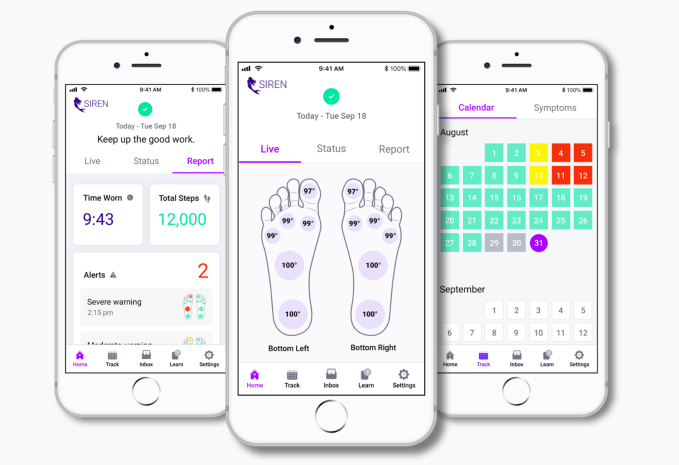
That last bit is particularly key right now. With the ongoing COVID-19 pandemic, many are avoiding doctors offices and hospitals in fear of being exposed to the virus; meanwhile, many offices have been limiting their more routine/less urgent or “non-essential” appointments — including, in this case, routine foot exams. Siren’s socks let a patient’s doctors monitor their foot health from afar.
We first met Siren back in 2017 when the company won the TechCrunch Hardware Battlefield at CES. Since then, the company has raised around $22 million in funding; this $11.8 million Series B, a previously undisclosed $6.5 million Series A in 2018 and a $3.4 million seed round.
Ran Ma tells me that they’ve made Siren Socks available in 10 states so far, with plans to expand nationwide by the end of this year.
CryptoKitties developer launches NBA TopShot, a new blockchain-based collectible collab with the NBA
When Dapper Labs launched CryptoKitties back in November 2017, the company’s take on Tamagotchi was seen as the first popular use of blockchain-based applications. It was the first popular use case outside of Bitcoin as a speculative investment.
Like all fads, CryptoKitties didn’t last, but the app proved that Dapper Labs could build a compelling collectible — and that brought the company the attention of the National Basketball Association.
Now Dapper Labs is finally launching a beta version of the NBA TopShot app it has worked on since it began discussions with the league and Players Association back in 2018.
Built on the company’s own blockchain, the app is the latest attempt from blockchain companies to take on the sports world’s fixation with collectibles. Bayern Munich signed an agreement with Stryking Entertainment to create digital tokens of its players — and that company is developing a fantasy sports platform called Football-Stars, according to the Website SportsTechie. Even the Sacramento Kings have their own blockchain-powered auction platform.
“At its core it’s digital collectibles,” said Caty Tedman, the vice president of partnerships at Dapper Labs. “They’re multimedia and data smashed together into a token. That includes heroic photography and a video as well through a partnership with SportRadar. We have all the metadata from the game. The box score … the context. Any everyday block might not be as memorable as when LeBron put someone on a poster.”
The collectible component is only one aspect of the game, which will include opportunities to showcase collections, get new tokens by completing in-app challenges and a challenge feature where players can use their team to engage in one-on-one games using the collective skills from the roster of NBA stars that a user has collected.
The first iteration is 2019 to 2020 moments of the season, but Dapper Labs expects to reach back into the archive to use historical all-stars.
The tokens will be sold in packs that range in price from $9 to the mid-$200 range, according to Tedman. The game will also include a peer-to-peer marketplace for trading the tokens.
“These digital moments are much closer to physical trading card collecting as opposed to an in-app purchase… they have that same feeling,” said Tedman.
Gmail’s new feature makes it easier to personalize your inbox
Google is introducing a new “quick settings” menu in Gmail aimed at helping users browse, discover and use different themes and settings to customize their Gmail experience. These options include the ability to change the density of text, select from different inbox types and add reading panes and options to theme your inbox. They are not new features, but before had been buried in Gmail’s settings. Many users may have not even known the options existed, unless they went digging.
From the new Quick Settings menu, Gmail will pop up these various options on the right side of the inbox for easier access. And as you make a selection, you can see your inbox update with the change immediately, allowing you to try out new settings and themes before making a commitment.
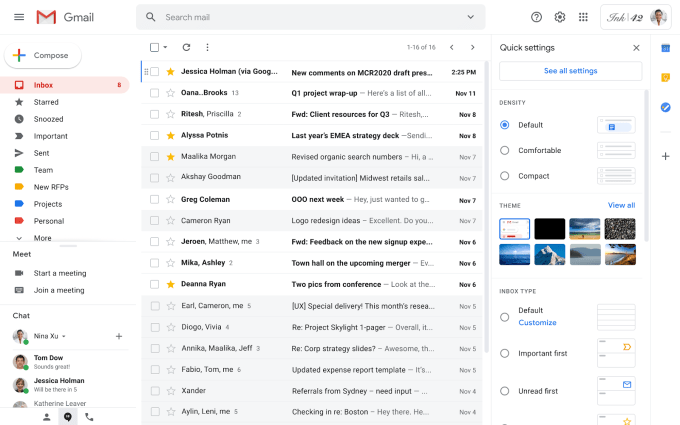
Included at launch is the ability to customize the density of the text and the information displayed and the ability to choose from different types of inbox layouts such as Priority Inbox, favored by powered users, Gmail’s default tabbed experience, or those where you want to see certain types of emails first — like unread or important.
You also can opt to turn on reading panes, to give your inbox more of the feeling of a traditional desktop client, or you can choose to apply one of Gmail’s colorful themes to brighten your space and personalize the look-and-feel.
The Quick Settings menu doesn’t disrupt access to Gmail’s full settings screen — that’s still available upon an extra click on the “See all settings” button at the top of the new Quick Settings menu.
“We’re making these options easier to find, and letting you explore them in real-time, so your actual inbox will update immediately to show you exactly what the setting will do. We hope this makes it easier to set up Gmail the way that works best for you,” the company said, in an announcement about the new feature.
The Quick Settings menu is rolling out to all G Suite customers, where it’s enabled by default, as well as all Gmail users with personal accounts.
Google began the release for G Suite customers on Rapid Release domains on May 26, 2020 with the rollout completing within 15 days. Those on Scheduled Release domains will see the feature rolling out starting on June 22, 2020. The company didn’t say when personal Gmail users would get the update, but they should soon.
French contact-tracing app StopCovid passes first vote
Following a debate in the National Assembly, the lower house of the French parliament, deputies have voted in favor of the release of contact-tracing app StopCovid and the decree related to the app.
While a vote in the parliament wasn’t a mandatory step, the government wants to rally as many people as possible around the contact-tracing app. At first, French President Emmanuel Macron said there would be a debate, but not necessarily followed by a vote. The government then reversed its stance and said deputies would vote.
“If members of the parliament vote against the release of the application, we won’t release StopCovid,” France’s digital minister Cédric O said in a radio interview earlier today.
It’s still unclear whether a contact-tracing app is efficient. But there’s one thing for sure — the app would be inefficient if only a small fraction of people living in France choose to download it. Hence today’s debate.
There were two important points discussed in the National Assembly. First, is StopCovid a surveillance app and is there a risk when it comes to privacy? Second, is StopCovid useful and efficient?
Privacy
“Tomorrow, I want to be free to download or not to download the application. I want to be free to protect myself,” France’s minister of health Olivier Véran said. It doesn’t really answer the privacy risks of a contact-tracing app, but it’s true that the government changed the decree at the last minute to say that there won’t be any negative consequence if you’re not using StopCovid, nor any privilege if you’re using it.
“StopCovid isn’t a project for peacetime. It’s a project for a historical crisis — it wouldn’t exist without it and it’s not going to exist after it,” Cédric O said.
StopCovid relies on Bluetooth like most contact-tracing apps. But a group of research institutes and private companies have worked on a homemade solution that doesn’t rely on Apple and Google’s contact-tracing API. It is based on a centralized contact-tracing protocol that computes matches on a central server. It isn’t anonymous, but pseudonymous.
It has been a controversial topic over the past few weeks. Cédric O defended France’s centralized solution by saying it guarantees the digital sovereignty of the country.
“Twenty-two countries have chosen to develop a contact-tracing app that relies on the interface developed by Apple and Google. Twenty-two countries, but not France and the U.K. And it’s not a coincidence because those two countries also have nuclear weapons,” Cédric O said.
Paula Forteza, a deputy from the same party who recently created a separate parliamentary group due to recent disagreements, rightfully said that it isn’t as straightforward as that.
“No, the debates on the centralized and decentralized design of the protocol don’t overlap with debates on digital sovereignty and reliance on tech giants,” Forteza said.
Effectiveness
Once again, the government and opponents didn’t have the same take on the potential effectiveness of an optional contact-tracing app.
“The app is systematically and linearly efficient as soon as a few percentage points activate it,” Cédric O said.
“It’s inefficient because 50 to 60% of French people have to install the application. It’s inefficient because 25% of French people don’t have a smartphone, unless you have decided to offer them one,” leader of far-left party La France Insoumise Jean-Luc Mélenchon said.
On this point, nobody really had a clear answer. Contact-tracing using Bluetooth is still uncharted territory. Moreover, on iOS, you’ll have to leave the app open to enable Bluetooth.
“The only ones who are able to decide whether this applications is efficient, useful or not useful, are epidemiologists,” Cédric O concluded after the debate.
Next steps
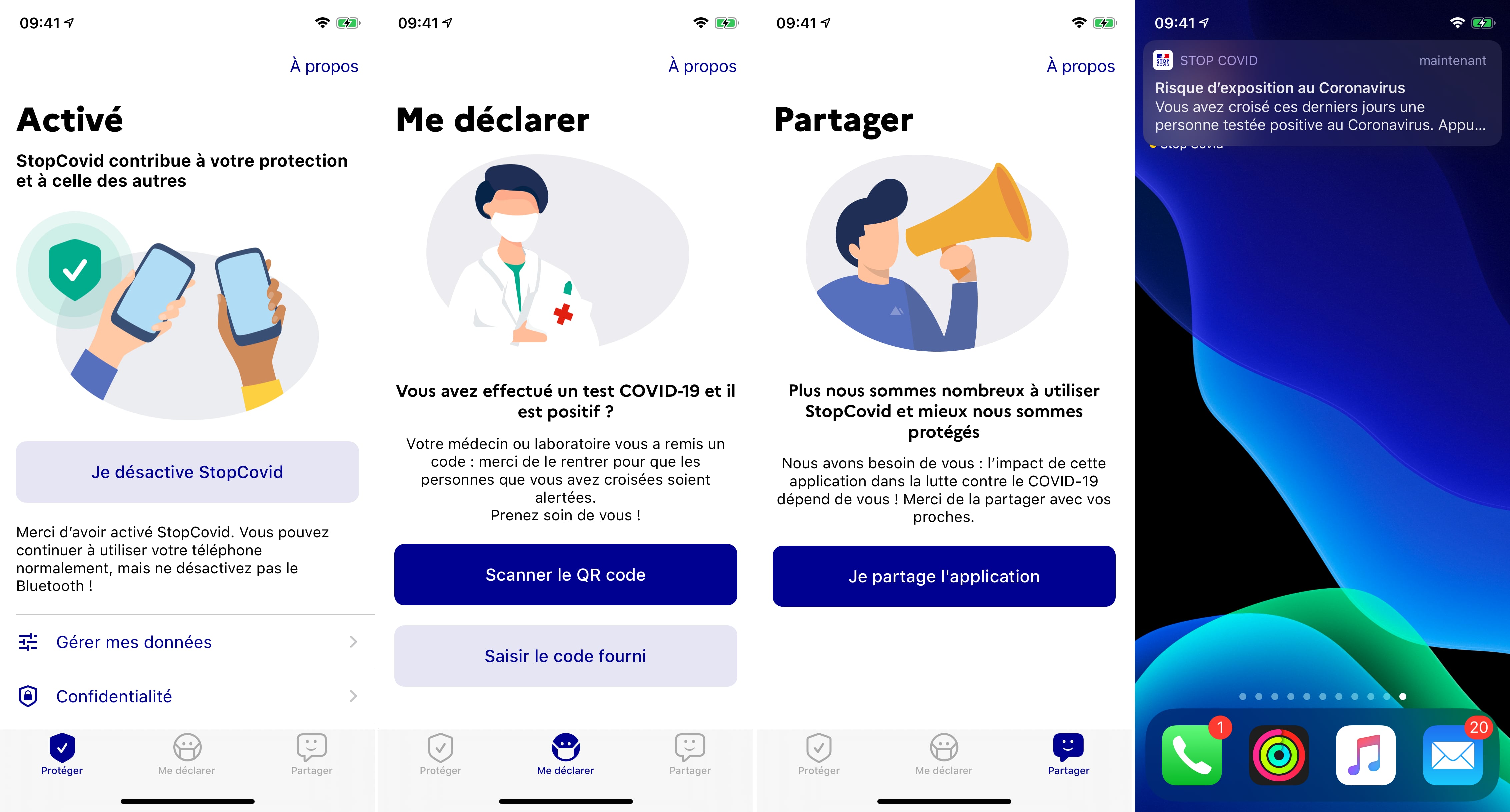
Later today, the upper house of the French parliament, the Senate, will also discuss the pros and cons of StopCovid, and will then vote. After that, StopCovid will be released on the App Store and Play Store early next week.
Here’s what it looks like:
Twitter Finally Fact-Checked Trump. It’s a Bit of a Mess
Less than six months from the election, social media platforms are still not ready to deal with political disinformation.
‘Crucible’ Review: Amazon Magicks Gaming Cliches Into Something Fresh
The debut offering from Amazon Game Studios combines familiar elements into a surprisingly delightful concoction.
Instagram Will (Finally) Pay Influencers
The company is rolling out new ways for its creators to make money—and they might sound familiar.
Google Chrome Is Getting a Bunch of New Privacy Features
The next version of the browser will be more secure than ever. Here’s what you need to know.
Now Is the Best—and Worst—Time to Launch HBO Max
People are stuck at home looking for movies and TV shows to watch. But the people who make the movies and shows are too.
The Coronavirus Is Democratizing Knowledge
Despite toxic misinformation, the pandemic has empowered us to become co-creators, co-producers, and co-distributors of what we know.
The 13 Best Running Gear (2020): Shoes, Clothes, Accessories
Your gym might be closed, but the roads and parks are full. Get started running with our favorite hot-weather picks.
Shadowserver, an Internet Guardian, Finds a Lifeline
Ten weeks ago, Shadowserver’s main source of funding dried up. Now it’s back on level footing.
The End of Handshakes—for Humans and for Robots
Researchers have spent years teaching robots to shake hands—an effort possibly doomed by a global turn against human contact.