SpaceX makes history with successful first human space launch

SpaceX made history today, flying NASA astronauts Doug Hurley and Bob Behnken to space aboard its Crew Dragon spacecraft using a Falcon 9 rocket. The launch, titled ‘Demo-2’, is for the final demonstration mission in the human rating process of SpaceX’s Crew Dragon and Falcon 9, meaning that once this mission is complete, the launch vehicle will finally be certified for operational use for regular transportation of people to space. This was the second attempt, after an initial launch try last Wednesday was scrubbed due to weather conditions.

This is the first time ever that humans have been aboard a SpaceX vehicle as it launched. To date, SpaceX’s Falcon 9 and Falcon Heavy rockets have succeeded in delivering multiple cargo payloads to orbit, but Behnken and Hurley are the first people to make the trip with the private spaceflight company.

SpaceX also successfully landed its first stage booster from the Falcon 9 used today – which means it will recover the first private spacecraft booster that has ever delivered human astronauts to space.

NASA created the Commercial Crew space program to spur the development of private launch vehicles that would also be able to serve commercial customers in addition to the agency, in order to defray the cost of launch overall. Both SpaceX and Boeing ended up placing winning bids on the Commercial Crew contracts, and have subsequently developed human launch systems, though SpaceX is the first to actually fly people on their vehicle after Boeing encountered some unexpected issues in their last uncrewed demonstration flight.
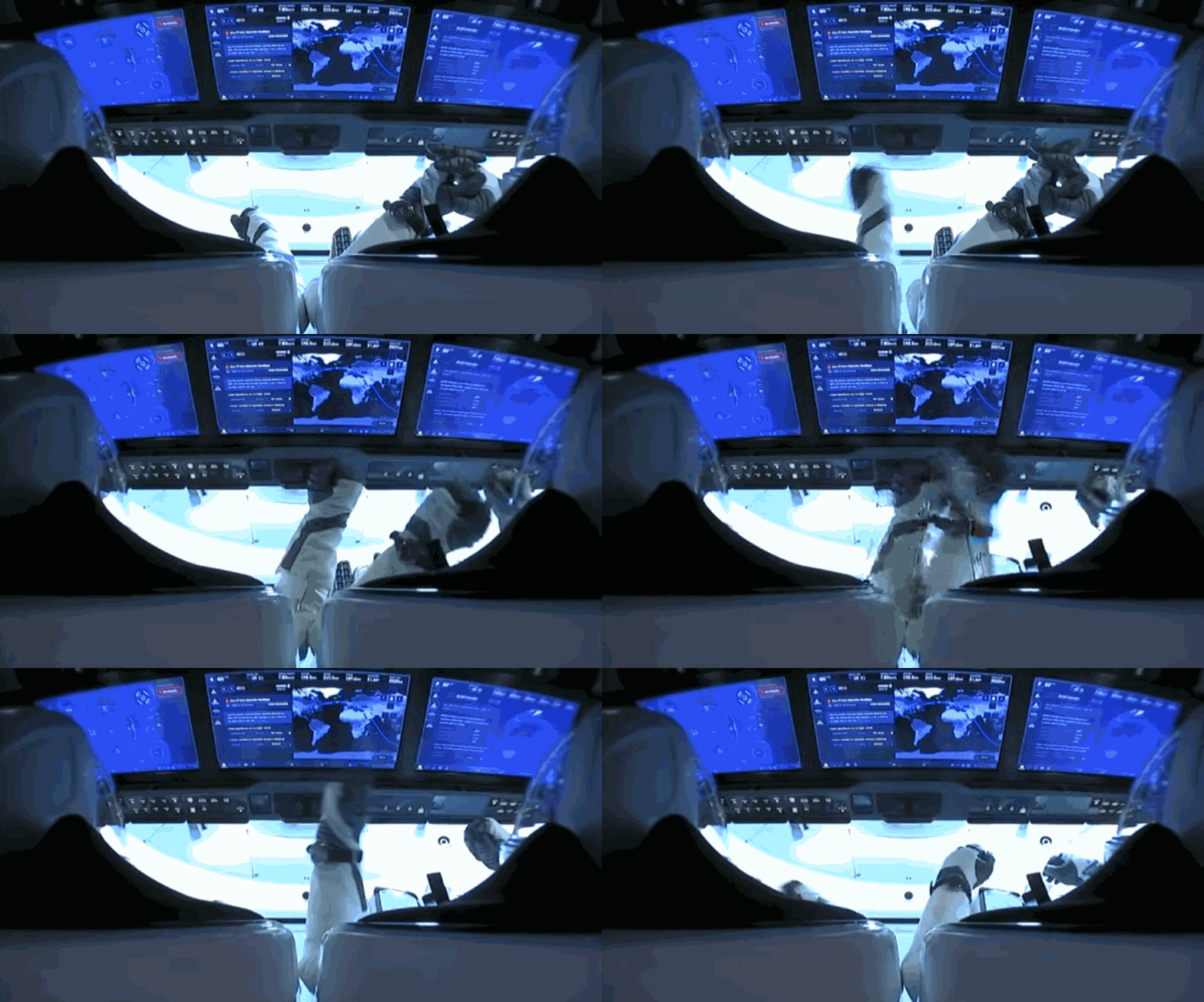
Astronauts Bob Behnken and Doug Hurley bump fists to celebrate their history-making launch on SpaceX’s Crew Dragon.

It’s been multiple decades since a human took off from U.S. soil on a brand new launch vehicle, and this is also the first time anyone has flown to space from an American launch site since the Space Shuttle program was officially retired in 2011. Returning U.S. spaceflight capabilities also means NASA won’t have to rely on Russia’s Roscosmos and its Soyuz spacecraft exclusively to transport its astronauts to the International Space Station (ISS) – could save more than $30 million per astronaut per trip as a result.

Today’s launch kicks off a multi-week mission for Behnken and Hurley, which next involves a rendezvous with the ISS around 19 hours from now. Crew Dragon will first take around 30 minutes to perform a manual control test, wherein Behnken and Hurley will take over and fly the spacecraft themselves. This isn’t what would normally happen on a normal Crew Dragon mission, since the spacecraft is designed to make the trip to ISS on its own operating entirely in an automated manner.

After that manual control test, Crew Dragon will once again take over and then fly the remainder of the way to the ISS, where it’ll dock itself with an entry hatch on the station. From there, Behnken and Hurley will transfer over to the station, where they’re set to stay for a period of between six and sixteen weeks, depending on NASA’s determination of how long the mission should last. This is somewhat dependent on staffing requirements on board the ISS, since currently there’s only one U.S. astronaut there in an operational capacity, and Hurley and Behnken will be tasked with assisting with experiments and maintenance on the station.
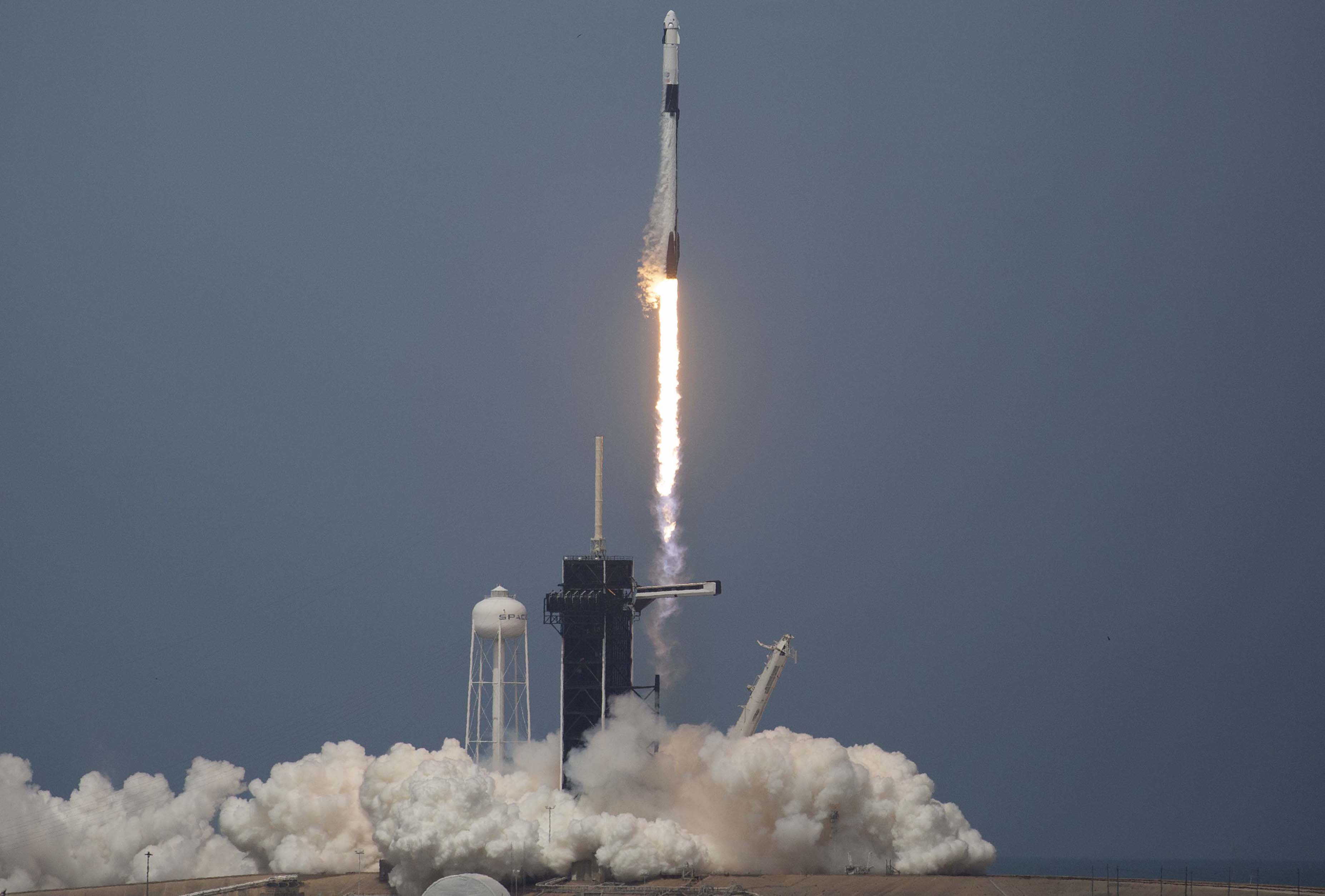
CAPE CANAVERAL, FLORIDA – MAY 30: The SpaceX Falcon 9 rocket launches into space with NASA astronauts Bob Behnken (R) and Doug Hurley aboard the rocket from the Kennedy Space Center on May 30, 2020 in Cape Canaveral, Florida. The inaugural flight is the first manned mission since the end of the Space Shuttle program in 2011 to be launched into space from the United States. (Photo by Saul Martinez/Getty Images)

Once it’s determined when they’re coming back, they’ll climb back aboard the Crew Dragon, seal it up and then detach from the station. This return part of the program is also designed to be fully automated, with the spacecraft preforming the necessary boost-back engine firing to control its re-entry and descent. Once in atmosphere, it’ll release its parachutes to slow the fall back to Earth, and coast to a landing in the Atlantic Ocean, where SpaceX crews will recover the capsule and provide the astronauts their ride back to dry land.

SpaceX plans to begin flying astronauts to the ISS for fully, regular operational missions later this year if all goes well, and it has also signed agreements to begin offering berths to paying passengers for Crew Dragon space tourist trips (likely with an extremely high price tag) as early as next year.

Startups Weekly: Remote-first work will mean ‘globally fair compensation’

Editor’s note: Get this free weekly recap of TechCrunch news that any startup can use by email every Saturday morning (7am PT). Subscribe here.

Most tech companies base compensation on an employee’s local cost of living, in addition to their skills and responsibilities. The pandemic-era push to remote work seems to be reinforcing that — if you only skim the headlines. For example, Facebook said last week that it would be readjusting salaries for employees who have relocated away from the Bay Area.

But Connie Loizos caught up with a few well-placed people who see something else happening. First, here’s Matt Mullenweg, CEO of Automattic (WordPress), which has been almost entirely remote for its long and successful history.

“Long term, I think market forces and the mobility of talent will force employers to stop discriminating on the basis of geography for geographically agnostic roles,” he told Connie for TechCrunch

Mullenweg went on to detail how the process was still complicated, and that his company did not yet have a universal approach. But ultimately, he thinks that for “moral and competitive reasons, companies will move toward globally fair compensation over time with roles that can be done from anywhere.”

Connie also talked to Jon Holman, a tech recruiter who is living and breathing the new world, in a separate article for Extra Crunch. The market forces will ultimately favor talent, he concurs, and companies that want talent will pay according to what they can afford. “If a good AI or machine learning engineer is working elsewhere and demand for those skills still exceeds supply,” Holman explained, “and his or her company pays less than for the same job in Palo Alto, then that person is just going to jump to another company in his or her own geography.”

Taking stock of the future of retail

Our weekly staff survey for Extra Crunch is about retail — will it exist? how? A few of our staffers who cover related topics weighed in:

  • Natasha Mascarenhas says retailers will need to find new ways to sell aspirational products — and what was once cringe-worthy might now be considered innovative.

  • Devin Coldewey sees businesses adopting a slew of creative digital services to prepare for the future and empower them without Amazon’s platform.

  • Greg Kumparak thinks the delivery and curbside pickup trends will move from pandemic-essentials to everyday occurrences. He thinks that retailers will need to find new ways to appeal to consumers in a “shopping-by-proxy” world.

  • Lucas Matney views a revitalized interest in technology around the checkout process, as retailers look for ways to make the purchasing experience more seamless (and less high-touch).

We also ran two investor surveys this week, with Matt Burns producing one on manufacturing and Megan Rose Dickey and Kirsten Korosec following up on their autonomous vehicles series.

How to think about strategic investors (in a pandemic)

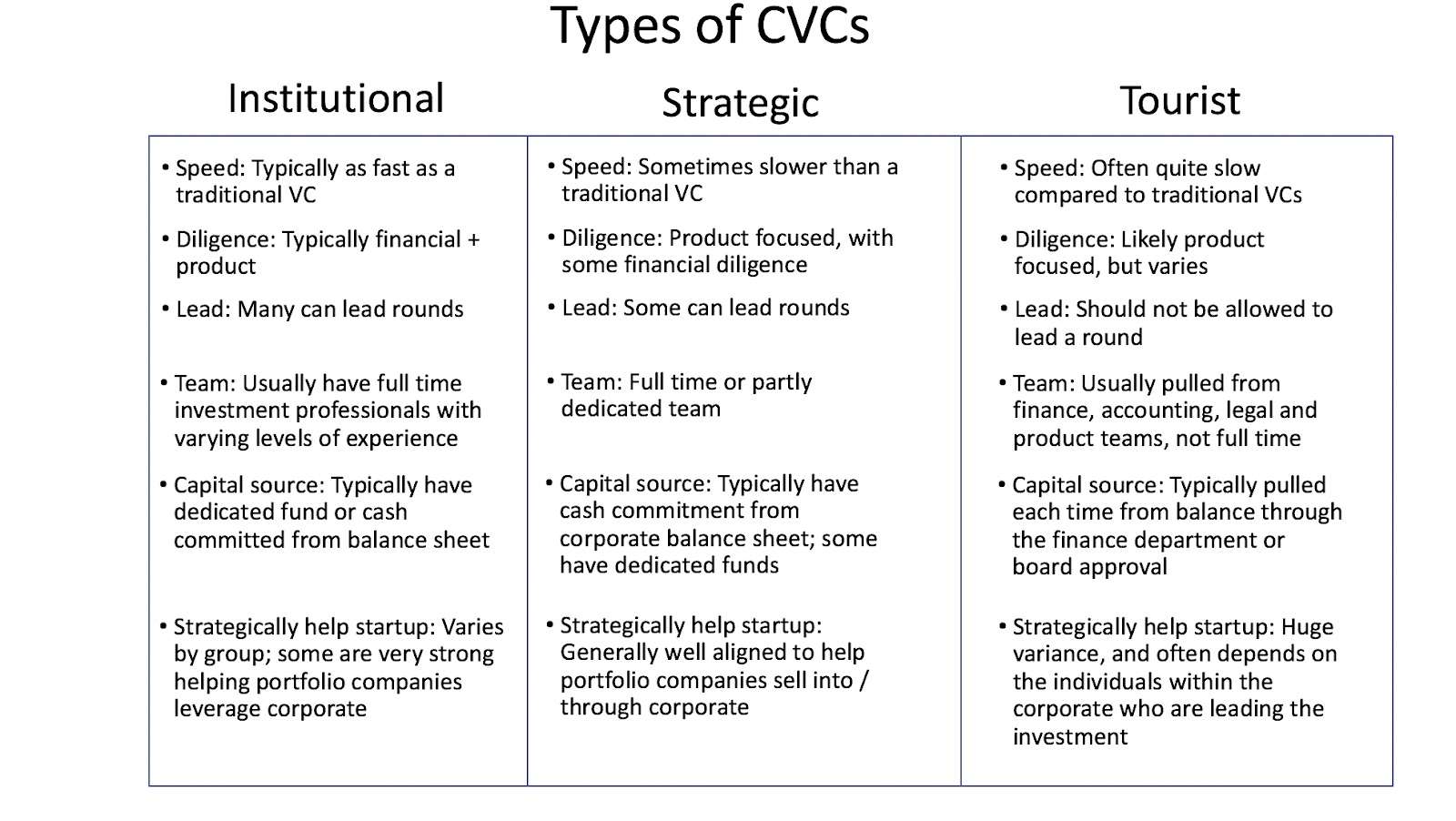
Maybe you could use some more money, distribution and partnerships these days? Those are the eternal lures of corporate venture funding sources, but each strategic VC has a different mandate. Some are there to help the parent company, some are just there to make money… and some may be on thin ice themselves given the way that they get money to invest.

If you’re taking a fresh look at getting strategic funding now, check out this set of overview articles from Bill Growney, a partner at top tech law firm Goodwin, and Scott Orn of Kruze Consulting. The first, for TechCrunch, goes over how corporate funds are typically structured (and motivated). The second, for Extra Crunch, covers questions for startup founders to anticipate and other recommendations for dealing with this type of VC.

Calm chooses a more enlightened path to growth

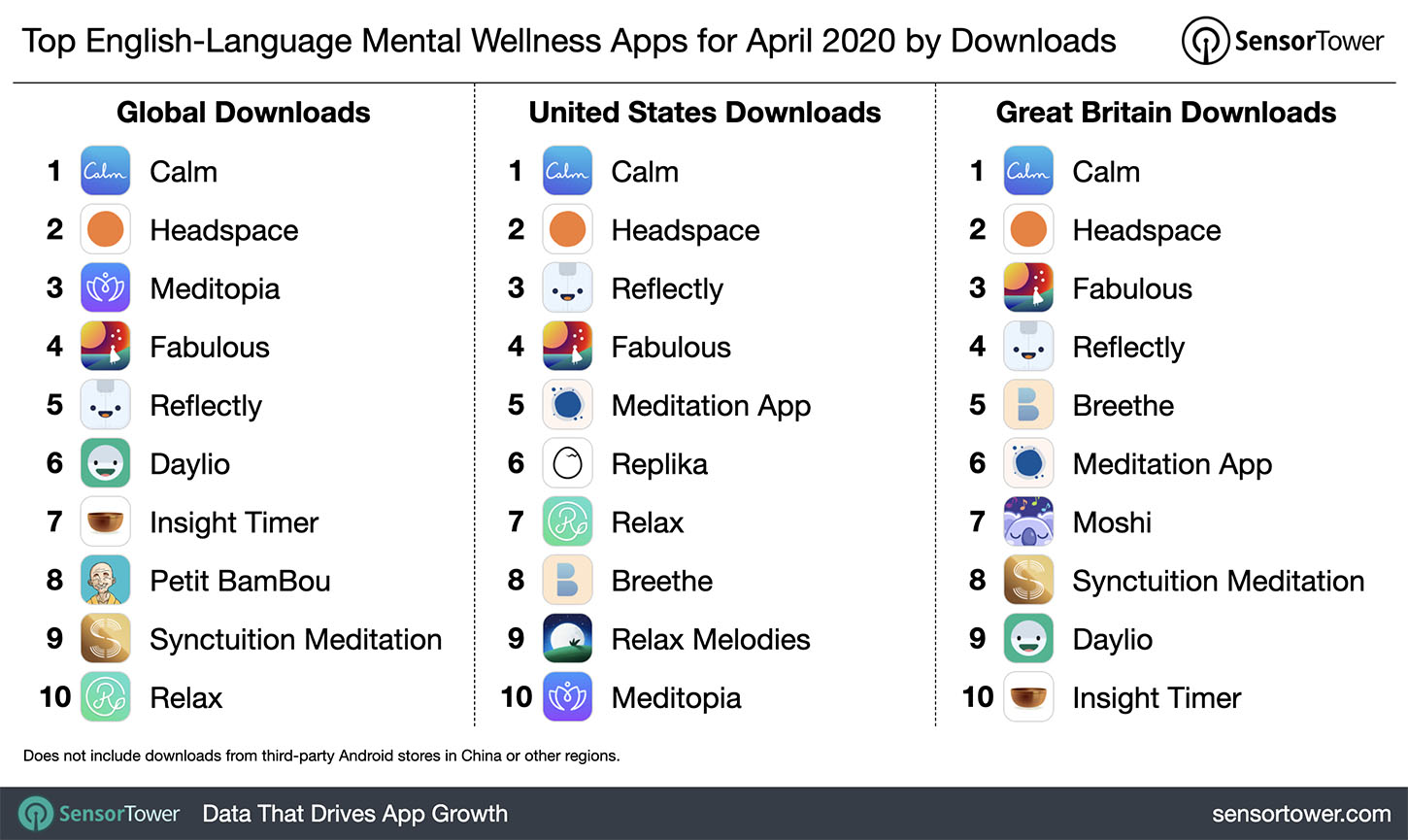
It is high times for meditation and “mindfulness” apps, as people look for ways to adjust to pandemic life. Sarah Perez, our resident app expert, took a look at a new app store analysis on TechCrunch, shredded some of the top-ranked companies for opportunistic marketing, and came away with a positive feeling about the global market leader.

Calm, meanwhile, took a different approach. It launched a page of free resources, but instead focused on partnerships to expand free access to more users, while also growing its business. Earlier this month, nonprofit health system Kaiser Permanente announced it was making the Calm app’s Premium subscription free for its members, for example — the first health system to do so.

The company’s decision to not pursue as many free giveaways meant it may have missed the easy boost from press coverage. However, it may be a better long-term strategy as it sets up Calm for distribution partnerships that could continue beyond the immediate COVID-19 crisis.

Mindfulness pays. On that note, subscribers can read her excellent This Week In Apps report every Saturday over on Extra Crunch.

Around TechCrunch

TechCrunch’s Early Stage, Mobility and Space events will be virtual, too

Win a Wild Card to compete in Startup Battlefield at Disrupt 2020

Extra Crunch Live: Join Initialized’s Alexis Ohanian and Garry Tan for a live Q&A on Tuesday at 2pm EDT/11am PDT

Join GGV’s Hans Tung and Jeff Richards for a live Q&A: June 4 at 3:30 pm EDT/12:30 pm PD

Across the week

TechCrunch

AI can battle coronavirus, but privacy shouldn’t be a casualty

Living and working in a worsening world

How to upgrade your at-home videoconference setup: Lighting edition

Equity Morning: Remote work startup fundings galore, plus a major court decision

Extra Crunch

API startups are so hot right now

Investors say emerging multiverses are the future of entertainment

Dear Sophie: Can I work in the US on a dependent spouse visa?

Fintech regulations in Latin America could fuel growth or freeze out startups

The secret to trustworthy data strategy

#EquityPod

From Natasha:

Hello and welcome back to Equity, TechCrunch’s venture capital-focused podcast, where we unpack the numbers behind the headlines. This week’s show took a break from regularly scheduled programming. Our co-host Alex Wilhelm, who usually leads us through the show, was on some much-deserved vacation, so Danny Crichton and Natasha Mascarenhas took the reigns and invited Floodgate Capital’s Iris Choi to join in on the fun. It’s Choi’s fourth time being on the podcast, which officially makes her our most tenured guest yet (in case the accomplished investor needs another bullet point on her bio page).

This week’s docket features scrappiness, a seed round and a Startup Battlefield alumnus.

Here’s what we chewed through:

  • LeverEdge raised seed funding to get you and your friends a volume discount on student loans. Fintech has been booming for years now, and startups often crop up around the painful world of student loans. Yet this startup still caught our eye, and it has a little something to do with its choice to use collective bargaining power as its modus operandi.
  • Stackin’ raised a $12.6 million Series B for a text-messaging service that connects millennials to money tips, and eventually other fintech apps. According to CEO Scott Grimes, Stackin’ wants to be the “pipes that port people around fintech.” We get into if the world needs a fintech app marketplace and how it targets younger users.
  • D-ID, a Startup Battlefield alumnus, digitally de-identifies faces in videos and still images and just raised $13.5 million. We’re all worried about our privacy concerns, so the funding news was a refreshing change of pace from the usual headlines we see around surveillance. Now the company just needs to find a successful use case beyond the goodness in people’s hearts.
  • ByteDance, the Chinese parent company that owns TikTok, hit $3 billion in net profit last year, reports Bloomberg. TikTok also recently snagged former Disney executive Kevin Mayer for its CEO. This one, as you can expect, made for an interesting conversation around privacy and bandwidth. We even asked Choi to weigh in on Donald J. Trump’s recent tweet threatening to regulate social media companies, as Floodgate was an early angel investor in Twitter.
  • We ended with a roundtable of sorts on how the future of work will look and feel in our new world, from college campuses to offices. We get into the vulnerability that comes with being on Zoom, the ever-increasing stupidity of “manels” and how tech talent might be flocking to smaller cities but investors aren’t just yet.

And that was the show! Thanks to our producer Chris Gates for helping us put this together, thanks to you all for listening in on this quirky episode and thanks to Iris Choi for always bringing a fresh, candid perspective. Talk next week.

Huawei’s terrible week

When news broke Friday morning that Britain is looking to propose an alliance of democracies to build a 5G alternative to Huawei, you might think that that was the worst thing to happen to the controversial Chinese telecoms giant this week. In fact, it just caps off a series of fast-moving events that surely makes this one of the most decisive weeks yet in the global fight over next-generation 5G networks.

So let’s go back a step. After all, readers who have been following the Huawei debate might recall that not long ago the UK had controversially agreed to allow Huawei to attain up to 35% market share in “non-core areas” of its 5G network. So what was behind London’s sudden about-face?

The answer is politics. There was always a loud group of China-skeptic dissenters in Parliament, but anger over China’s handling of the novel coronavirus pandemic pushed more MPs from Prime Minister Boris Johnson’s own Conservative Party into the anti-Huawei camp and made the government’s position untenable. Rather than face a large parliamentary rebellion and possible legislative defeat later this year, Johnson instead gave in and announced plans earlier this week to phase out Huawei’s participation in Britain’s 5G network by 2023.

Now, Johnson seems to be going a step further. Reports indicate that he is seeking to organize fellow G7 countries Canada, France, Germany, Japan, and the United States, as well as Australia, South Korea, and India on the issue. Skeptics of the U.S. campaign against Huawei have long lamented that Washington is asking governments to oppose Huawei without proposing a viable alternative. London’s so-called D10 alliance is the first attempt to explicitly try to answer that question.

Meanwhile on the legal front, British Columbia’s Supreme Court ruled on Wednesday that proceedings to extradite Huawei CFO Meng Wanzhou to the United States could go ahead. Instead of being released and on her way back to China, Meng, who is the daughter of Huawei founder Ren Zhengfei, is now one step closer to facing trial in the U.S. on fraud charges relating to Huawei’s circumvention of U.S. sanctions on Iran.

Huawei is used to geopolitical maneuvering, of course. After all, its plans to build an underseas cable last year connecting Papua New Guinea and the Solomon Islands with high speed internet were preempted when Australia, wary of growing Chinese influence in its South Pacific backyard, offered to pay for it instead.

When the Chinese ambassador to Denmark threatened to scuttle a trade deal with the Faroe Islands, a semi-autonomous Danish region, if Denmark didn’t choose it for its 5G network, Copenhagen responded by issuing tough new security requirements that Huawei has said would give it no choice but to leave the country entirely. And as I wrote in March, the question of Huawei has been increasingly debated at the highest levels of government around the world.

Yet, this week does seem to mark a dramatic turning point in the global 5G battle.

First, even limited access to the UK market had been a coup for Huawei. With its well-regarded Huawei Cyber Security Evaluation Centre, Britain’s seal of approval was a valuable signal to other governments on the fence about whether or not Huawei is worth the security risk. For Britain to not only reverse itself but then take the lead on coordinating an international alternative just a few days later marks a remarkable course correction.

A former British diplomat told me in March that the West’s lack of cooperation on the issue was “a striking failure” of political coordination. That’s certainly not the case anymore – and as other NATO, EU, and Five Eye intelligence allies consider whether or not to permit Huawei themselves, the existence of a democratic anti-Huawei consortium (should it truly develop) would make it that much harder for them to justify going against the U.S.

Second, the Meng case might be soundly based in international law, but to paraphrase Clausewitz: it’s international relations by other means. After all, U.S. investigators, concerned that Huawei was acting as an arm of the Chinese government, had been looking for an excuse to file charges against the company for years. Fittingly enough, the charges against Meng were linked to an unrelated geopolitical issue: violating U.S. sanctions on Iran.

A defeat for the U.S. in the British Columbia Supreme Court would have struck a blow to the U.S. government’s attempts to extend its legal reach around the globe. Instead, its victory solidifies an already escalating global sanctions regime that is proving devastating for any company caught in its dragnet. As if the Meng case weren’t enough, TSMC, one of the world’s largest semiconductors contractors, also announced that it would no longer sell to Huawei in order to comply with new US export controls.

The question is thus: if this does mark a turning point in the US-China global tech rivalry, what will the next stage look like?

Given its history, there’s not much suspense in what the Trump administration will likely do next. Certainly it will keep pursuing Huawei’s Meng in court. And count on a new round of pressure in Europe as the EU deadline for members to stake out their 5G security protocols fast approaches this summer. But America’s 5G diplomatic push has been seen as tone deaf in European capitals – now that Britain is onside, Washington would be smart to let London take the lead.

How China responds is the more important question. Its continued strong and vocal support for Huawei should be assumed, but what form will it take? Huawei’s conciliatory approach in the UK has now clearly failed. But so too did its attempts to strong-arm Denmark. Will the gloves now come off? Or will Beijing be forced to distance itself from its national champion for Huawei’s own good?

Huawei has tried to have it both ways, benefiting from the support it draws from the Chinese government while assuring foreign governments of its independence at the same time. But as global public opinion harden against Beijing in the wake of the COVID-19 pandemic and Western nations take stronger actions against his company, Huawei CEO Ren might consider just how hazardous being yoked to a superpower can be.

Original Content podcast: ‘The Lovebirds’ has charming leads and not much else

“The Lovebirds” was originally slated for a theatrical release, but with movie theaters closed, Paramount decided to release the film through Netflix instead.

But even without a global pandemic, a Netflix release was probably the right call. As we discuss latest episode of the Original Content podcast, this doesn’t feel like a movie that would have done well in theaters.

It is, to be clear, a funny and watchable, thanks in large part to the charming performances of Kumail Nanjiani and Issa Rae as a couple who have hit a rough patch in their relationship — right as they’re also embroiled in a murder mystery. (There seems to be a whole subgenre of movies about couples who are inadvertantly caught up in crime stuff.)

The plot, on the other hand, is pretty thin, and it becomes even more perfunctory as the movie tries to wrap everything up at the end. That’s particularly disappointing since “The Lovebirds” reunites Nanjiani with his “Big Sick” director Michael Showalter — do not expect it to be as good as “The Big Sick,” or even close.

Before our review, we also discuss the launch of WarnerMedia’s HBO-and-more streaming service HBO Max.

You can listen to our review in the player below, subscribe using Apple Podcasts or find us in your podcast player of choice. If you like the show, please let us know by leaving a review on Apple. You can also send us feedback directly. (Or suggest shows and movies for us to review!)

If you’d like to skip ahead, here’s how the episode breaks down:
0:00 Intro
0:25 HBO Max discussion
10:51 “The Lovebirds” review
23:41 “The Lovebirds” spoiler discussion

This Week in Apps: Facebook launches trio of app experiments, TikTok gets spammed, plus coronavirus impacts on app economy

Welcome back to This Week in Apps, the Extra Crunch series that recaps the latest OS news, the applications they support and the money that flows through it all.

The app industry is as hot as ever, with a record 204 billion downloads and $120 billion in consumer spending in 2019. People are now spending three hours and 40 minutes per day using apps, rivaling TV. Apps aren’t just a way to pass idle hours — they’re a big business. In 2019, mobile-first companies had a combined $544 billion valuation, 6.5x higher than those without a mobile focus.

In this Extra Crunch series, we help you keep up with the latest news from the world of apps, delivered on a weekly basis.

This week we’re continuing to look at how the coronavirus outbreak is impacting the world of mobile applications, with fresh data from App Annie about trends playing out across app categories benefiting from the pandemic, lockdowns and societal changes. We’re also keeping up with the COVID-19 contact-tracing apps making headlines, and delving into the week’s other news.

We saw a few notable new apps launch this week, including HBO’s new streaming service HBO Max, plus three new app experiments from Facebook’s R&D group. Android Studio 4.0 also launched this week. Instagram is getting better AR tools and IGTV is getting ads. TikTok got spammed in India.

Meanwhile, what is going on with app review? A shady app rises to the top of the iPhone App Store. Google cracks down on conspiracy theory-spreading apps. And a TikTok clone uses a pyramid scheme-powered invite system to rise up the charts.

COVID-19 contact-tracing apps in the news 

  • Latvia: Reuters this week reported that Latvia aims to become one of the first countries to launch a smartphone app, Stop Covid, using the new toolkit created by Apple and Alphabet’s Google to help trace coronavirus infections.
  • Australia: The role of the country’s Covidsafe app in the recovery appears to be marginal, The Guardian reports. In the month since its launch, only one person has been reported to have been identified using data from it. A survey even found that Australians were more supportive of using telecommunications metadata to track close contacts (79%) than they were of downloading an app (69.8%). In a second survey, their support for the app dropped to 64%. The app has been maligned by the public debate over it and technical issues.
  • France: The country’s data protection watchdog, CNIL, reviewed its contact-tracing app StopCovid, finding there were no major issues with the technical implementation and legal framework around StopCovid, with some caveats. France isn’t using Google and Apple’s contact-tracing API, but instead uses a controversial centralized contact-tracing protocol called ROBERT. This relies on a central server to assign a permanent ID and generate ephemeral IDs attached to this permanent ID. CNIL says the app will eventually be open-sourced and it will create a bug bounty. On Wednesday, the app passed its first vote in favor of its release.
  • Qatar: Serious security vulnerabilities in Qatar’s mandatory contact-tracing app were uncovered by Amnesty International. An investigation by Amnesty’s Security Lab discovered a critical weakness in the configuration of Qatar’s EHTERAZ contact-tracing app. Now fixed, the vulnerability would have allowed cyberattackers to access highly sensitive personal information, including the name, national ID, health status and location data of more than one million users.
  • India: India’s contact-tracing app, Aarogya Setu, is going open-source, according to Ministry of Electronics and Information Technology Secretary Ajay Prakash Sawhney on Tuesday. The code is being published on GitHub. Nearly 98% of the app’s more than 114 million users are on Android. The government will also offer a cash bounty of $1,325 to security experts who find bugs or vulnerabilities.
  • Switzerland: Several thousand people are now testing a pilot version of Switzerland’s contact-tracing app, SwissCovid. Like Lativia, the app is one of the first to use Apple and Google’s contact-tracing API. Employees at EPFL, ETH Zurich, the Army and select hospitals and government agencies will be the first to test the Swiss app before its public launch planned for mid-June.
  • China: China’s health-tracking QR codes, embedded in popular WeChat and Alipay smartphone apps, are raising privacy concerns, Reuters reports. To walk around freely, people must have a green rating. They also now have to present their health QR codes to gain entry into restaurants, parks and other venues. These efforts have been met with little resistance. But the eastern city of Hangzhou has since proposed that users are given a color-coded health badge based on their medical records and lifestyle habits, including how much they exercised, their eating and drinking habits, whether they smoked and how much they slept the night before. This suggestion set off a storm of criticism on China’s Weibo, a Twitter-like platform.

Watch continuing coverage of SpaceX crewed launch to the International Space Station

SpaceX is once again preparing to make history – the private spaceflight company is set to launch its Crew Dragon Demo-2 mission in collaboration with NASA today. This is the second time they’ve prepared to launch this mission, after an attempt on Wednesday last week was scrubbed due to bad weather. Today’s attempt is set for 3:22 PM EDT (12:22 PM PDT) and preparations, along with the launch itself, will be streamed above starting at 11 AM EDT (8 AM PDT).

The launch will take off from Cape Canaveral in Florida, and once again weather is a concern for today’s launch window. SpaceX and NASA have an instantaneous launch window today, which means they only have the one shot to take off – if the weather isn’t cooperating at 3:22 PM EDT, they’ll have to re-attempt the launch again, with the next possible window set for tomorrow, Sunday May 31.

This is the first time ever that SpaceX will be launching humans aboard one of its spacecraft – NASA astronauts Bob Behnken and Doug Hurley have the honor of being those first passengers. The mission itself is actually technically still a test, the final demonstration mission in the multi-year development of Crew Dragon, SpaceX’s first human-rated spacecraft. This launch will serve as the proof that Crew Dragon and the Falcon 9 rocket that carries it, is ready for human-rating, after which it will be ready for regular operational service, flying U.S. and allied astronauts to and from the International Space Station (ISS) in low Earth orbit.

That will mean the U.S. once again has domestic human launch capabilities, something it hasn’t been able to claim since it ended the Space Shuttle program in 2011. That’s a big deal for a number of reasons, but primarily because it means that NASA won’t rely on buying berths on Russian Soyuz spacecraft to get to the ISS, which will help it save money and ultimately control its own access to Earth’s orbital lab.

If successful, SpaceX will be the first of NASA’s two Commercial Crew partners to achieve this milestone. The other, Boeing, is still in the process of working out the kinks of its CST-100 Starliner human crew capsule, which encountered errors during its first uncrewed demonstration mission, resulting in the need to run that launch again sometime later this year, and then, depending on how that goes, fly its first human flight hopefully in 2021. SpaceX, meanwhile, is set to begin operational missions with Crew Dragon later this year, if all goes well with Demo-2.

Provided the launch occurs today, Behnken and Hurley will then spend 19 hours on orbit as they make their way to rendezvous with the Space Station for docking. They’ll then staff the station for a period of between a few weeks and a few months, depending on NASA’s decision regarding their ultimate mission length. That will involve helping with station maintenance and conducting experiments, and then they’ll re-enter Crew Dragon and make the trip back to Earth for an Atlantic Ocean splashdown and recovery once their time at the station is over.