Robotics startup lets machines get closer as humans keep their distance

Kyle S. Gibson
Contributor

Kyle S. Gibson is a writer and videographer in Boston, currently focused on robotics and industrial internet of things. Kyle has worked for publishers AmericanInno and MIT Technology Review, sales automation developer Pegasystems, and blockchain strategy group New Alchemy. He is currently writing for MIT Horizon, an emerging technology education platform. His work is supported by a regional awareness initiative of the New England Venture Capital Association.

As humans get used to working at a distance from each other, a startup in Massachusetts is providing sensors that bring industrial robots in close —  centimeters away, in fact. The same technology may support future social distancing efforts on commutes, in a pilot application to allow more subway trains to run on a single track.

Humatics, an MIT spinout backed by Lockheed Martin and Airbus, makes sensors that enable fast-moving and powerful robots to work alongside humans without accidents. If daily work and personal travel to work ever go back to normal, the company believes the same precision can improve aging and crowded infrastructure, enabling trains and buses to run closer together, even as we all may have to get used to working further apart.

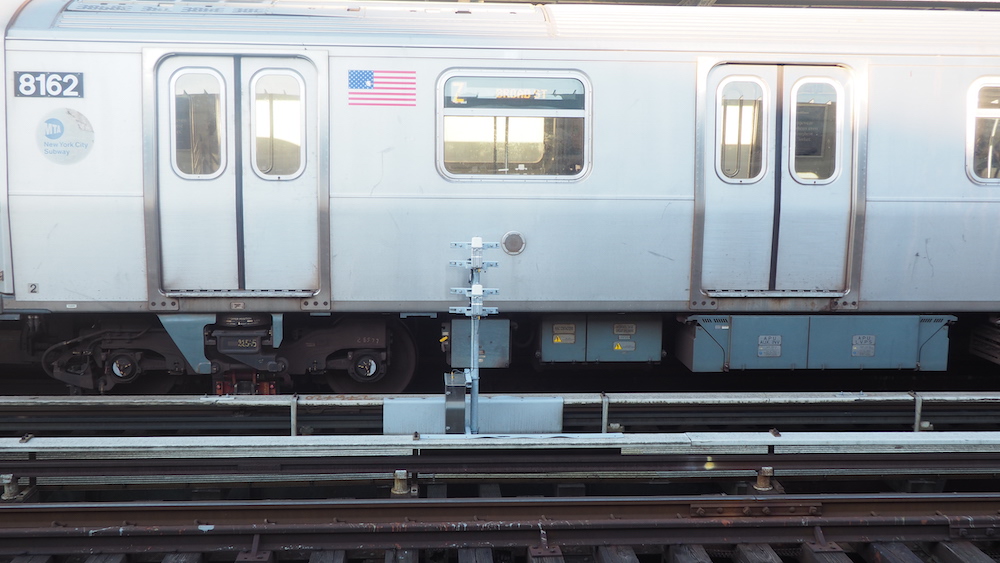
This is the emerging field of microlocation robotics — devices and software that help people and machines navigate collaboratively. Humatics has been testing its technology with New York’s MTA since 2018, and today is tracking five miles of a New York subway, showing the transportation authority where six of its trains are, down to the centimeter.

UWB sensors for microlocation

Humatics’ technology in the MTA pilot uses ultrawide band (UWB) radio frequencies, which are less failure-prone than Wi-Fi, GPS and cameras.

“A good example of a harsh environment is a subway tunnel,” said David Mindell, co-founder of Humatics and professor of engineering and aerospace at MIT. “They are full of dust, the temperatures can range from subzero to 100 degrees, and there is the risk of animals or people tampering with devices. Working inside these tunnels is difficult and potentially dangerous for crews, also.”

Humatics has sold more than 10,000 UWB radio beacons, the base unit for their real-time tracking system, to manufacturers of sensor systems, the company says. They pinpoint the location of hundreds of RFID tags at a range of 500 meters, using multiple tags on an object to measure orientation.

Watch SpaceX launch its latest batch of Starlink satellites, including one with a sun visor

SpaceX just executed its most important and historic launch ever this past weekend, flying NASA astronauts for the first time. On Wednesday, it’s set to follow that up with a less significant Falcon 9 rocket launch, but one that’s still vital to the company’s future. This mission is the latest of SpaceX’s Starlink launches, which the company is using to put up a vast network of small satellites to provide low-cost, high-bandwidth internet access to customers globally.

SpaceX’s Starlink mission today has a launch window of 9:25 PM EDT (6:25 PM PDT) and includes a payload of 60 more satellites for the constellation, which already has 420 operating in low Earth orbit. The goal is ultimately to launch as many as 40,000 of these small satellites in order to blanket the globe with connectivity that’s broadly available, and that provides rock-solid network consistency by handing off connections among the satellites as they make their way around the Earth.

This launch was originally scheduled to fly the week prior to SpaceX’s Demo-2 crewed mission, which carried NASA astronauts Bob Behnken and Doug Hurley to the International Space Station on Saturday and Sunday, but was bumped due to a scheduling conflict with a ULA launch, and then further postponed until after the astronaut flight. It’s still already the fifth batch of 60 Starlink satellites that SpaceX has flown in 2020. In total, SpaceX is hoping for up to two-dozen Starlink launches in total before year’s end, which will help it meet its goal of launching an initial beta service in Canada and the U.S. later this year, with a more global rollout following in 2021 or 2022.

This launch will take off from Cape Canaveral Air Force Station in Florida, and will use a Falcon 9 first stage that flew on four previous missions. SpaceX will attempt to recover the booster again through a controlled landing, and will also try to catch the fairing halves used to protect the satellite cargo using its “Ms. Tree” and “Ms. Chief” ships.

One key novel element for this flight is the test of a new technology SpaceX is hoping will help mitigate the impact of the Starlink constellation on night sky observation from Earth. Scientists have complained that Starlink is bright enough to interfere with sensitive optical instrumentation used to gather data from deep space bodies and phenomena. To address that, SpaceX has designed a deployable “visor” system that extends from Starlink satellites post-launch and attempts to block sunlight reflecting off their communications arrays.

SpaceX has equipped one of the 60 satellites on this launch with that system, as a way of testing its efficacy before making it a standard part of the Starlink satellite build going forward. Depending on results, it could become a permanent fixture on all of SpaceX’s Starlink spacecraft for future missions.

Should today’s launch be delayed (weather is currently looking around 60% favorable for the mission), there’s a backup opportunity tomorrow, June 4 at 9:03 PM EDT (6:03 PM PDT).

Black tech leaders issue call to action to fight racial injustice in the Bay Area

As a tumultuous week of protests draws broad attention to America’s open wounds of racist police violence, a coalition of Black founders, advocates, investors and other leaders are issuing a call to action for those in the tech industry to stand against the systemic forces that continue to claim Black lives.

The effort, called “Black Tech for Black Lives,” pulls together a set of specific, actionable commitments intended to “support frontline leaders working to create a more just world.” The pledge is designed to elevate Bay Area community leaders working in tech’s epicenter on specific policy goals regarding issues like policing reform, local elections and by hiring and supporting more Black talent in tech.

The pledge also calls for justice for George Floyd, an unarmed Black man pinned on the neck by a police officer for more than eight minutes in a brutal act of disproportionate police violence that killed him. The event set off a nationwide movement that’s resulted in historic demonstrations against police brutality in all 50 states.

The pledge’s core group of signers are ReadySet CEO Y-Vonne Hutchinson, Aniyia Williams of Black and Brown Founders and Zebras Unite, Fastly’s Maurice Wilkins and Darrell Jones III of Just Cities and the TechEquity Collaborative. In its announcement, the collective shared its unique perspective on the industry during this deeply painful moment — and on bearing the burden of the long tradition of racist violence that led up to it:

“Tech is complicit. We as Black people in tech have a unique position and opportunity to respond to violence against Black people’s bodies. While we’re proximate to the pain, we largely avoid its most brutal physical outcomes. But we, too, feel the blows. We carry the scars on our psyches and hearts as our voices go largely unheard in the workplace and beyond.”

The group asks for anyone joining its effort to commit to one or more of its five goals:

  • 1. Working toward swift prosecution for the individuals who killed George Floyd, Ahmaud Arbery, Breonna Taylor and Tony McDade by supporting groups like the Center for Policing Equity and Color of Change.
  • 2. Supporting police reform and accountability through signal boosting, volunteering and donating to organizations like the Ella Baker Center for Human Rights, Oakland’s Coalition for Police Accountability and SF Interrupting Racial Profiling.
  • 3. Applying pressure to Bay Area police chiefs and police union leaders.
  • 4. Pledging to hire and fund Black employees and founders, and also making real commitments to promote, mentor, sponsor them and support their success.
  • 5. Helping elect local leaders with a proven record advocating for racial and social justice by supporting races for key positions like mayorships, city council seats and district attorneys.

The full call to action, with links to organizations to support, is available on the Black Tech for Black Lives page.

The pledge has been signed by a growing list of more than 150 names, including Y Combinator’s Michael Seibel, Backstage Capital’s Arlan Hamilton, Erica Joy, Bärí A. Williams, Former Obama Foundation CTO Leslie Miley, Kapor Capital Partner Ulili Onovakpuri, Kaya Thomas of We Read Too, Wayne Sutton, PitchBlack founder Stephen Green, The Human Utility founder Tiffani Ashley Bell, TechEquity Collaborative Co-Founder Catherine Bracy and TechCrunch’s own Megan Rose Dickey.

“Recent events make it clear that we can’t go back to the way things were,” the collective writes. “Let’s unite to make sure that Black lives and Black futures both matter.”

The effort also calls on white allies to join the call to action, encouraging them to move away from more passive notions of allyship toward becoming “accomplices” — a framing in activism that evokes an active approach in working toward equity and justice, even if that means transgressing rules or laws in standing against systemic anti-Blackness.

In a conversation with TechCrunch, Jones shared some context for the pledge — and reason to believe that the present wave of protests against police injustice and systemic anti-Blackness, even more so than in past national movements, could drive a nation in pain toward lasting change.

“The material conditions of Black America today are undeniably more desperate than the material conditions of Black America during Ferguson, and that is largely due to the coronavirus at the moment,” Jones told TechCrunch.

“When we look at levels of unemployment … when we look at the disproportionate health effects that COVID is having on communities and we look at the levels of business loss and I bet even if we look at the level the distribution of businesses that receive funding from PPP or anything like that, odds are that we’re still disproportionately disadvantaged in all of those categories.”

Jones believes that like conversations around universal basic income — suddenly thrust into mainstream discourse as the pandemic ravages financial stability for millions of Americans — the coronavirus crisis is also accelerating the dialogue around systemic discrimination as it plays out in devastating health outcomes for Black Americans.

As those conversations move forward, Jones says that a “vacuum of reasonable, rational and compassionate leadership” in the federal government is driving more attention toward local change — where the real change happens.

“There will be this rush to the national conversation and to fill that vacuum of leadership nationally, but folks can see — or at least I hope they might see — that the biggest lever they have for change on these issues is right where they live, right here,” Jones said.

CES set for an in-person event in 2021

CES 2020 barely made it in under the wire, before COVID-19 gripped the world. The following month, Barcelona’s MWC was ultimately shut down, as the pandemic began to move across Europe. That was the first of many dominoes to fall, as events were either taken online or canceled altogether.

Seems CES won’t miss a beat, however. The CTA (CES’s governing body) announced recently that it plans to go forward with the Las Vegas event in January 2021. Unlike Berlin’s IFA, which is purposely scaling back attendance, CES does not appear to have anything like an attendance cap in the works — though organizers note they will continue to expand online events tied to the show, as it seems many would rather not risk the in-person event. 

The CTA also detailed the standard array of safeguards for show-goers. Those are as follows:

  • Regularly clean and sanitize spaces across the show venues and provide sanitization stations throughout;

  • Better enable social distancing, including widening aisles in many exhibit areas and providing more space between seats in conference programs and other areas where attendees congregate;

  • Issue best practices for attendees, such as wearing masks and avoiding shaking hands, and for exhibitors on product demonstrations;

  • Limit touch points throughout the facilities including through cashless systems for purchases and transactions;

  • Evaluate solutions for contactless thermal scans at key venue entry points;

  • Provide enhanced on-site access to health service and medical aid.

Organizers say they’re “working closely” with the Las Vegas community on other best practices. Vegas mayor Carolyn Goodman has been particularly vocal in her opposition to COVID-related shutdowns. She referred to safety measures as “total insanity” in mid-April and offered to make her city a “control group” by opening casinos and other businesses to domestic and international travelers. A  $980.3 million expansion to the LVCC is also nearly complete, presenting a key incentive to bring the show back to the city, even in less than ideal circumstances. 

Many event planners, on the other hand, continue to be cautious as fears of additional COVID-19 waves spread across the globe. Given how notorious these conventions are when it comes to the spread of colds and flus in non-pandemic years, it seems safe to assume that many regular attendees will opt to sit this one out. Notably, the CTA is using the word “plan” here. It’s hard enough to imagine what the world is going to look like tomorrow, let alone seven months from now. 

SpaceX’s astronaut launch marks the dawn of the commercial human spaceflight industry

SpaceX on Saturday launched two NASA astronauts aboard its Crew Dragon spacecraft, and the accomplishment is a tremendous one for both the company and the U.S. space agency. At a fundamental level, it means that the U.S. will have continued access to the International Space Station, without having to rely on continuing to buy tickets aboard a Russian Soyuz spacecraft to do so. But it also means the beginning of a new era for the commercial space industry – one in which private companies and individual buying tickets for passenger trips to space is a consistent and active reality.

With this mission, SpaceX will complete the final step required by NASA to human-rate its Falcon 9 and Crew Dragon spacecraft, which means that it can begin operationally transporting people from Earth essentially as soon as this mission concludes (Crew Dragon still has to rendezvous with the space station tomorrow, and make its way back to Earth with astronauts on board in a few weeks). Already, SpaceX has signed an agreement with Space Adventures, a private space tourism booking company that has previously worked with Roscosmos on sending private astronauts to orbit.

SpaceX wants to start sending up paying tourists on orbital flights (without any ISS stops) starting as early as next year aboard Crew Dragon. The capsule actually supports up to seven passengers per flight, though only four seats will ever be used for official NASA crew delivery missions for the space station. SpaceX hasn’t released pricing on private trips aboard the aircraft, but you can bet they’ll be expensive since a Falcon 9 launch (without a human rated capsule) costs around $60 million, and so even dividing that by seven works out to a high price of entry.

So this isn’t the beginning of the era of accessible private spaceflight, but SpaceX is the first private company to actually put people into space, despite a lot of talk and preparatory work by competitors like Virgin Galactic and Blue Origin. And just like in the private launch business, crossing the gulf between having a private company that talks about doing something, and a company that actually does it, will absolutely transform the space industry all over again.

Here’s how.

Tourism

SpaceX is gearing up to launch tourists as early as next year, as mentioned, and while those tourists will have to be deep-pocketed, as eight everything that SpaceX does, the goal is to continue to find ways to make more aspects of the launch system reusable and reduce costs of launch in order to bring prices down.

Even without driving down costs, SpaceX will have a market, however niche, and one that hasn’t yet really had any inventory to satisfy demand. Space Adventures has flown a few individuals by buying tickets on Soyuz launches, but that hasn’t really been a consistent or sustainable source of commercial human spaceflight, and SpaceX’s system will likely have active support and participation from NASA.

That’s an entirely new revenue stream for SpaceX to add to its commercial cargo launches, along with its eventual launch of commercial internet service via Starlink. It’s hard to say yet what kind of impact that will actually have on their bottom line, but it could be big enough to have an impact – especially if they can figure out creative ways to defray costs over successive years, since each cut will likely considerably expand their small addressable audience.

SpaceX’s impact on the launch business was to effectively create a market for small satellites and more affordable orbital payloads that simply didn’t make any economic sense with larger existing launch craft, most of which were bankrolled almost entirely by and for defence and NASA use. Similarly, it’s hard to predict what the space tourism market will look like in five years, now that a company is actually offering it and flying a human-rated private spacecraft that can make it happen.

Research

Private spacefarers won’t all be tourists – in fact, it could make a lot more financial sense for the majority of passengers to and from orbit to be private scientists and researchers. Basically, imagine a NASA astronaut, but working for a private company rather than a publicly-funded agency.

Astronauts are essentially multidisciplinary scientists, and the bulk of their job is conducing experiments on the ISS. NASA is very eager to expand commercial use of the ISS, and also to eventually replace the aging space station with a private one of which they’re just one of multiple customers. Already, the ISS hosts commercial experiments and cargo, but if companies and institutions can now also send their own researchers as well, that may change considerably how much interest their is in doing work on orbit, especially in areas like biotech where the advantages of low gravity can produce results not possible on Earth.

Cost is a gain a significant limiting factor here, since the price per seat will be – no pun intended – astronomical. But for big pharma and other large companies who already spend a considerable amount on R&D it might actually be within reach. Especially in industries like additive manufacturing, where orbit is an area of immense interest, private space-based labs with actual rotating staff might not be that farfetched an idea.

Marketing & Entertainment

Commercial human spaceflight might actually be a great opportunity to make actual commercials – brands trying to outdo each other by shooting the first promo in space definitely seems like a likely outcome for a Superbowl spot. It’s probably not anyone’s priority just now, given the ongoing global pandemic, but companies have already discussed the potential of marketing partnerships as a key driver of real revenue, including lunar lander startup ispace, which has signed a number of brand partners to fund the build and flight of its hardware.

Single person rides to orbit are definitely within budget for the most extreme marketing efforts out there, and especially early on, there should be plenty of return on that investment just because of how audacious and unique the move is. The novelty will likely wear off, but access to space will remain rarified enough for the forseeable future that it could still be part of more than a few marketing campaigns.

As for entertainment, we’ve already seen the first evidence of interest there – Tom Cruise is working on a project to be filmed at least in part in space, apparently on board the International Space Station. SpaceX is said to be involved in those talks, and it would make a lot of sense for the company to consider a Crew Dragon flight with film crew and actors on board for both shooting, and for transportation to ‘on location’ shoots on the ISS.

Cruise probably isn’t the only one to consider the impact of a space-based motion picture project, and you can bet at least one reality show producer somewhere is already pitching ‘The Bachelor’ in space. Again, it’s not going to be within budget for every new sci-fi project that spins up, but it’s within blockbuster budget range, and that’s another market that grew by 100% just by virtue of the fact that it didn’t exist as a possibility before today.

Novel industry

It’s hard to fully appreciate what kind of impact this will have, because SpaceX has literally taken something that previously wasn’t possible, and made it available – at costs that, while high, aren’t so high as to be absurd. As with every other such expansion, it will likely create new and innovative opportunities that haven’t even been conceived, especially once the economics and availability of flights, etc. are clarified. GPS, another great space-based innovation, formed the bedrock of an industry that changed just about every aspect of human life – private commercial spaceflight could do the same.

NASA astronauts successfully pilot SpaceX’s Crew Dragon spacecraft manually for the first time

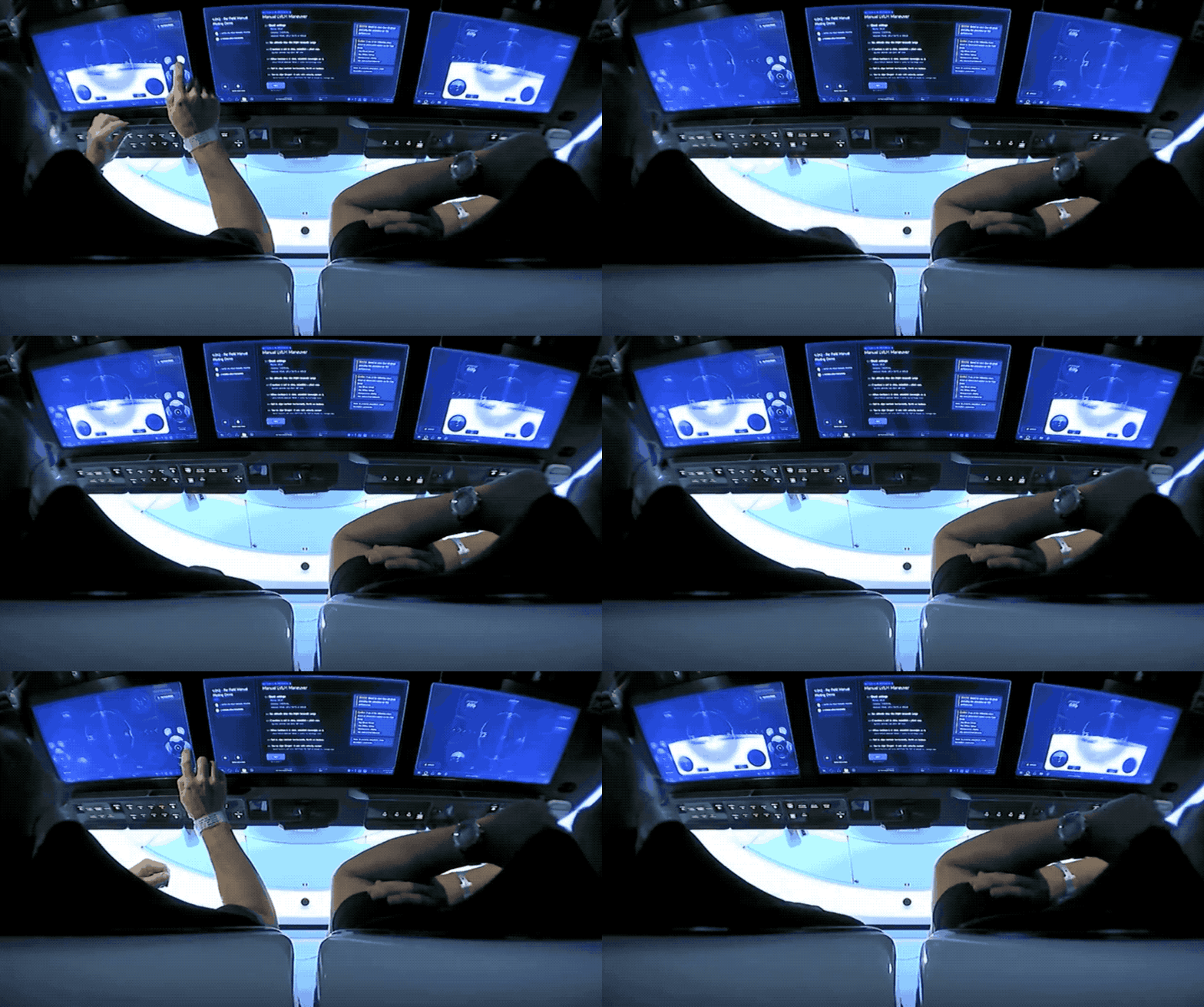
NASA astronauts Doug Hurley took over manual control of the SpaceX Crew Dragon spacecraft on Saturday, shortly after the vehicle’s historic first launch from Cape Canaveral in Florida. Crew Dragon is designed to fly entirely autonomous throughout the full duration of its missions, including automated docking, de-orbit and landing procedures, but it has manual control systems in case anything should go wrong and the astronauts have to take over. This test is the first time the manual controls have been used in space, and is a key part of certifying Crew Dragon for regularly operational human flight.

Astronaut Bob Behnken and Hurley removed their fashionable SpaceX space suits just before Hurley completed the manual maneuvers, which is also part of the plan. They’re able to go without the suits in the pressurized cabin during its transit to the ISS, only needing to put them back on for space station docking, and the interior of Crew Dragon actually provides them a fair amount of room to move around in. This also makes it easier for them to operate the spacecraft controls.

The manual maneuver testing including Hurley going through the process of using the spacecraft’s touchscreen controls to put the capsule into what’s called LVLH (local vertical local horizontal ) attitude, using Earth as a reference navigation point. That basically means putting Dragon in the same orientation as an airplane flying over Earth, with the planet located ‘underneath’ the Dragon as it flies. The test involves notifying the flight computer to not take over as Hurley conducts the maneuvers, but doesn’t involve actually finalizing the control orders by sending them to the flight computer, since it will be the one actually completing the automated flight and docking process.

Hurley will conduct two tests during the mission, the one he just did called a “far-field” flight test because it’s far away from the ISS, and one called the “near-field” test which will be conducted when they’re closer to the station.

You can actually try out the manual control system that Behnken and Hurley used yourself – no spaceship required. All you need is a browser, and this ISS Docking Simulator created and released by SpaceX. It’s a bit tricky, but not as hard as you might think thanks to an intuitive control interface design.


Director Ani Acopian breaks down her drone-shot video, ’A World Artists Love’

“A drone is a camera,” Ani Acopian begins simply. “And it can fly. It’s basically a flying super-camera! I’d love to see more film and TV productions embrace the nimble and magical nature of drones and use them for more than bird’s eye view establishing shots.”

The director’s video for London-based record label AWAL (Artists Without a Label) unfolds like a minute-long homage to the narrative potential of UAVs. It lifts off from a desk, flies out a sliding-glass window, up over the room, down a stairwell and through a car. There’s a restaurant, some skaters in an empty pool, a parking lot junk yard and a backyard pool party. It’s a bright, sun-shiny picture of Southern California in a time before social distancing turned us all into nocturnal weirdos.

The sequence is stitched together to give the appearance on long shot. That’s particularly the work of some editing magic, which pulled together a still-impressive five shots to create the final product. The result comes in no small part due to the flying of Robert McIntosh. The pilot, who had previously collaborated with director Spike Jonze on the 2012 skate video “Pretty Sweet,” custom built the drone.

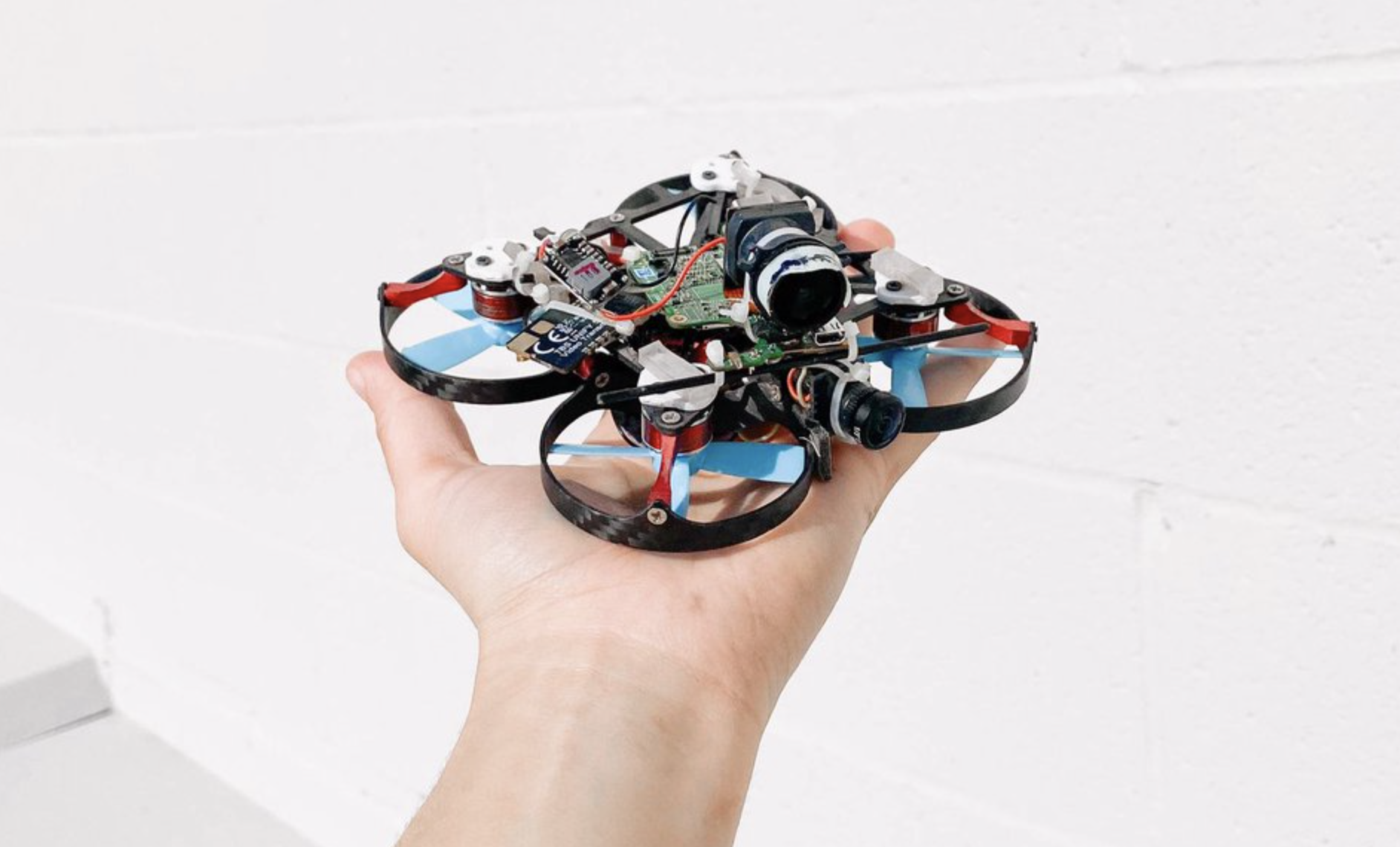
Weighing in at 120 grams, it was built by removing the camera from a GoPro Hero 6. That, along with the associated wires, were transferred onto the body of a racing drone. The result was palm-sized and fragile, with a dismal battery life of around three to five minutes a go. But the tiny size also allowed for an extremely nimble flying camera capable of shooting 4K video. The drone was flown at a slow speed, with McIntosh piloting through a pair of FPV racing goggles, with radio guidance from director of photography, Eric Maloney.

Acopian says the nature of the shoot required a fair bit of improvisation on the part of the crew, particularly with some scene utilizing up to 60 extras. Each were given a specific action to perform, while the director sat far away, giving directions through a bullhorn, so as to not be picked up through the camera’s wide-angle lens.

“We weren’t able to rehearse with the cast or block out a flight path with the drone ahead of time,” she explains, “so the biggest challenge was showing up at a new location each morning and figuring out what the drone path, talent blocking and VFX markers would be, then rehearsing as much we could up until around two hours before sundown, at which point we had as many takes as we could fit into that two-hour window to nail the shot. If something wasn’t working, we changed it because otherwise we put the whole scene at risk of not happening.”

Each scene naturally required multiple takes — up to 15 in some cases. And yes, that fragile little drone did crash a few times — though it was mostly no worse for wear.

“There was one crash that gave us all a scare, which happened while filming the scene where a partygoer gets caked,” Acopian adds. “The actress took a step back, directly into the path of the flying drone, and the drone got caught in their hair and turned off. Luckily, she was chill with getting a little bit of her hair snipped off so we could get the drone out, and the guys were able to patch it up in about 20 minutes. Twenty minutes later we were shooting again and she took another cake to the face. A true hero.”

After the shoot, the video was processed through ReelSteady — stabilization software created by McIntosh, which was acquired by GoPro back in March. Then it was effects company Alpha Studios’ job to help stitch things together into one continuous shot.

“We originally wanted to make every transition completely seamless and hidden, but locations and logistics meant that we had to make most of our transitions stylized. We worked closely with Alpha Studios to plot out where one shot would end and where the preceding shot would begin,” producer Jeremiah Warren says. “Kaitlyn Yang, from Alpha Studios, was the on-set VFX supervisor and was key in helping us figure out these transition points that her team blended with VFX in post-production.”

The result is a lovely little glimpse into how drones can extend beyond the customary establishing shot and take a deeper storytelling role in the process.

“I know that the future for droning is very bright, and I anticipate that we’ll start to see drones used in ways that don’t immediately give away their ‘drone-ness,’ like to feign camera movements that would otherwise be difficult to achieve,” says Acopian. “You don’t have to be high to fly! Drones, especially FPV drones, have this fluidity to them that beautifully mirrors the way memories feel to me and I’m excited to see more people play with this to recreate the inner experience so many of us have in a new, relatable way.”