Google and Walmart’s PhonePe establish dominance in India’s mobile payments market as WhatsApp Pay struggles to launch

In India, it’s Google and Walmart-owned PhonePe that are racing neck-and-neck to be the top player in the mobile payments market, while Facebook remains mired in a regulatory maze for WhatsApp Pay’s rollout.

In May, more than 75 million users transacted on Google Pay app, ahead of PhonePe’s 60 million users, and SoftBank -backed Paytm’s 30 million users, people familiar with the companies’ figures told TechCrunch.

Google still lags Paytm’s reach with merchants, but the Android -maker has maintained its overall lead in recent months despite every player losing momentum due to one of the most stringent lockdowns globally in place in India. Google declined to comment.

Paytm, once the dominant player in India, has been struggling to sustain its user base for nearly two years. The company had about 60 million transacting users in January last year, said people familiar with the matter.

Data sets consider transacting users to be those who have made at least one payment through the app in a month. It’s a coveted metric and is different from the much more popular monthly active users, or MAU, that various firms use to share their performance. A portion of those labeled as monthly active users do not make any transaction on the app. Paytm had over 50 million monthly active users in May, it said.

India’s homegrown payment firm, Paytm, has struggled to grow in recent years in part because of a mandate by India’s central bank to mobile wallet firms — the middlemen between users and banks — to perform know-your-client (KYC) verification of users, which created confusion among many, some of the people said. These woes come despite the firm’s fundraising success, which amounts to more than $3 billion.

In a statement, a Paytm spokesperson said, “When it comes to mobile wallets one has to remember the fact that Paytm was the company that set up the infrastructure to do KYC and has been able to complete over 100 million KYCs by physically meeting customers.”

Paytm has long benefited from integration with popular services such as Uber, and food delivery startup Swiggy, but fewer than 10 million of Paytm’s monthly transacting users have relied on this feature in recent months.

Two executives, who like everyone else spoke on the condition of anonymity because of fear of retribution, also said that Paytm resisted the idea of adopting Unified Payments Interface. That’s the nearly two-year-old payments infrastructure built and backed by a collation of banks in India that enables money to be sent directly between accounts at different banks and eliminates the need for a separate mobile wallet.

Paytm’s delays in adopting the standard left room for Google and PhonePe, another early adopter of UPI, to seize the opportunity.

Paytm, which adopted UPI a year after Google and PhonePe, refuted the characterization that it resisted joining UPI ecosystem.

“We are the company that cherishes innovation and technology that can transform the lives of millions. We understand the importance of financial technology and for this very reason, we have always been the champion and supporter of UPI. We, however, launched it on Paytm later than our peers because it took a little longer for us to get the approval to start UPI based services,“ a spokesperson said.
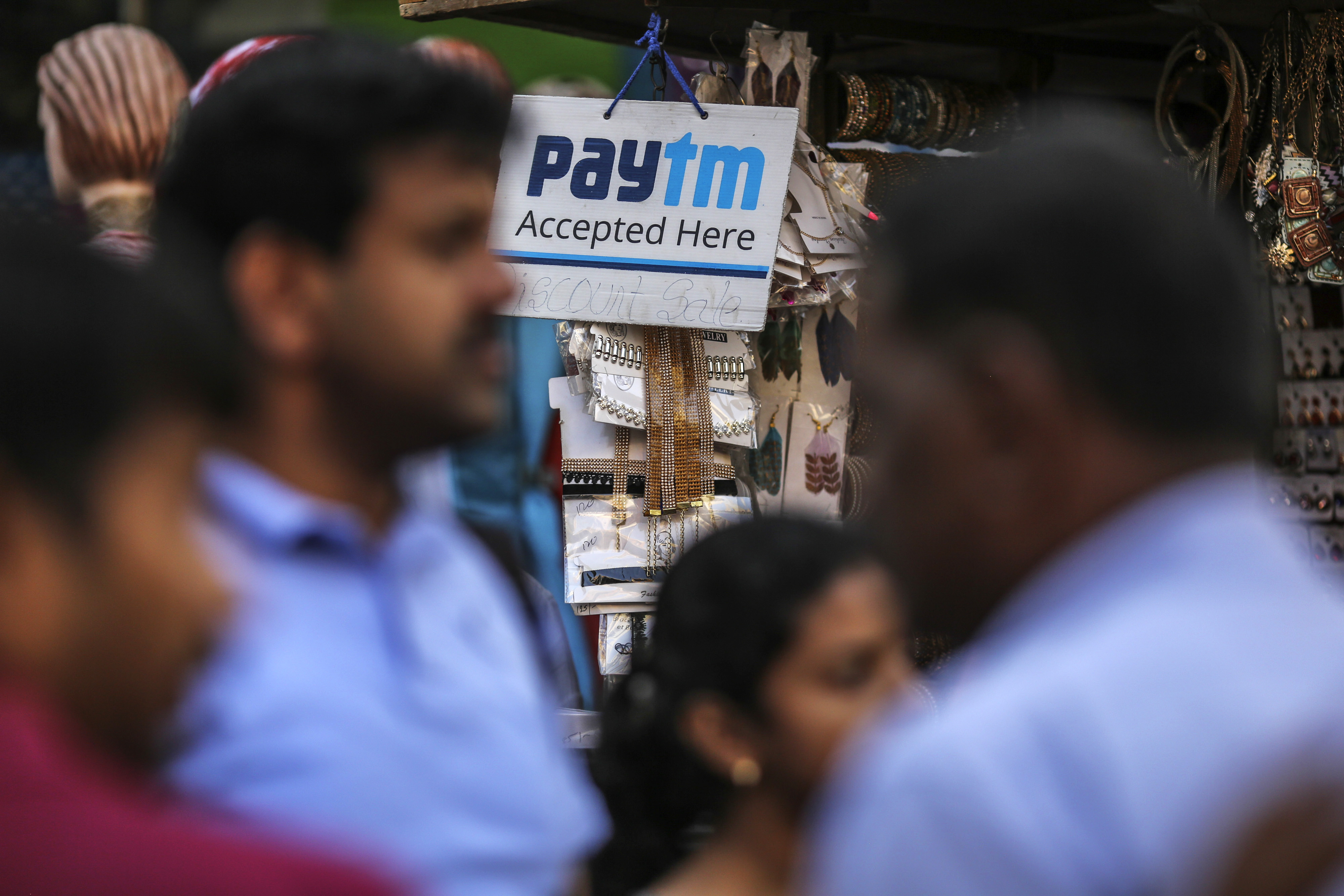
A sign for Paytm online payment method, operated by One97 Communications Ltd., is displayed at a street stall selling accessories in Bengaluru, India, on Saturday, Feb. 4, 2017. Photographer: Dhiraj Singh/Bloomberg via Getty Images

Missing from the fray is Facebook, which counts India as its biggest market by user count. The company began talks with banks to enter India’s mobile payments market, estimated to reach $1 trillion by 2023 (according to Credit Suisse), through WhatsApp as early as 2017. WhatsApp is the most popular smartphone app in India with over 400 million users in the country.

Facebook launched WhatsApp Pay to a million users in the following year, but has been locked in a regulatory battle since to expand the payments service to the rest of its users. Facebook chief executive Mark Zuckerberg said WhatsApp Pay would roll out nationwide by end of last year, but the firm is yet to secure all approvals — and new challenges keep cropping up. The company, which invested $5.7 billion in the nation’s top telecom operator Reliance Jio Platforms in April, declined to comment.

PhonePe, which was conceived only a year before WhatsApp set eyes to India’s mobile payments, has consistently grown as it added several third-party services. These include leading food and grocery delivery services Swiggy and Grofers, ride-hailing giant Ola, ticketing and staying players Ixigo and Oyo Hotels, in a so-called super app strategy. In November, about 63 million users were active on PhonePe, 45 million of whom transacted through the app.

Karthik Raghupathy, the head of business at PhonePe, confirmed the company’s transacting users to TechCrunch.

Three factors contributed to the growth of PhonePe, he said in an interview. “The rise of smartphones and mobile data adoption in recent years; early adoption to UPI at a time when most mobile payments firms in India were betting on virtual mobile-wallet model; and taking an open-ecosystem approach,” he said.

“We opened our consumer base to all our merchant partners very early on. Our philosophy was that we would not enter categories such as online ticketing for movies and travel, and instead work with market leaders on those fronts,” he explained.

“We also went to the market with a completely open, interoperable QR code that enabled merchants and businesses to use just one QR code to accept payments from any app — not just ours. Prior to this, you would see a neighborhood store maintain several QR codes to support a number of payment apps. Over the years, our approach has become the industry norm,” he said, adding that PhonePe has been similarly open to other wallets and payments options as well.

But despite the growth and its open approach, PhonePe has still struggled to win the confidence of investors in recent quarters. Stoking investors’ fears is the lack of a clear business model for mobile payments firms in India.

PhonePe executives held talks to raise capital last year that would have valued it at $8 billion, but the negotiations fell apart. Similar talks early this year, which would have valued PhonePe at $3 billion, which hasn’t been previously reported, also fell apart, three people familiar with the matter said. Raghupathy and a PhonePe spokesperson declined to comment on the company’s fundraising plans.

For now, Walmart has agreed to continue to bankroll the payments app, which became part of the retail group with Flipkart acquisition in 2018.

As UPI gained inroads in the market, banks have done away with any promotional incentives to mobile payments players, one of their only revenue sources.

At an event in Bangalore late last year, Sajith Sivanandan, managing director and business head of Google Pay and Next Billion User Initiatives, said current local rules have forced Google Pay to operate without a clear business model in India.

Coronavirus takes its toll on payments companies

The coronavirus pandemic that prompted New Delhi to order a nationwide lockdown in late March preceded a significant, but predictable, drop in mobile payments usage in the following weeks. But while Paytm continues to struggle in bouncing back, PhonePe and Google Pay have fully recovered as India eased some restrictions.

About 120 million UPI transactions occurred on Paytm in the month of May, down from 127 million in April and 186 million in March, according to data compiled by NPCI, the body that oversees UPI, and obtained by TechCrunch. (Paytm maintains a mobile wallet business, which contributes to its overall transacting users.)

Google Pay, which only supports UPI payments, facilitated 540 million transactions in May, up from 434 million in April and 515 million in March. PhonePe’s 454 million March figure slid to 368 million in April, but it turned the corner, with 460 million transactions last month. An NPCI spokesperson did not respond to a request for comment.

PhonePe and Google Pay together accounted for about 83% of all UPI transactions in India last month.

Industry executives working at rival firms said it would be a mistake to dismiss Paytm, the one-time leader of the mobile payments market in India.

Paytm has cut its marketing expenses and aggressively chased merchants in recent quarters. Earlier this year, it unveiled a range of gadgets, including a device that displays QR check-out codes that comes with a calculator and USB charger, a jukebox that provides voice confirmations of transactions and services to streamline inventory management for merchants.

Merchants who use these devices pay a recurring fee to Paytm, Vijay Shekhar Sharma, co-founder and chief executive of the firm told TechCrunch in an interview earlier this year. Paytm has also entered several businesses, such as movie and travel ticketing, lending, games and e-commerce, and set up a digital payments bank over the years.

“Everyone knows Paytm. Paytm is synonymous with digital payments in India. And outside, there’s a perceived notion that it’s truly the Alipay of India,” an executive at a rival firm said.


RiskIQ adds National Grid Partners as securing data becomes a strategic priority for utilities

RiskIQ, a startup providing application security, risk assessment and vulnerability management services, has added National Grid Partners as a strategic investor. 

The funding from the investment arm of National Grid, a multinational energy provider, is part of a $15 million new round of financing designed to take the company’s technology into critical industrial infrastructure — with National Grid as a point of entry.

More than 6,000 companies use the company’s services, and the roster list and technology on offer has attracted some of the biggest names in investing, including Summit Partners, Battery Ventures, Georgian Partners and MassMutual Ventures.

“We view NGP’s show of support as an incredible opportunity to help customers in new markets thrive as their attack surfaces expand outside the firewall, especially now amid the COVID-19 pandemic,” RiskIQ chief executive Lou Manousos said in a statement. 

RiskIQ has spent the past 10 years spidering the internet looking for all of the exploits that hackers use to penetrate networks and have built that into a database of threats. This inventory gives the company an ability to identify which assets within a company present the most obvious threats. Its automated services constantly scan third-party code, internet-connected devices and mobile applications for potential vulnerabilities, the company said.

As a staple platform in their core security environment, our cyber threat analysts use RiskIQ regularly to enrich and identify incoming threats,” said Lisa Lambert, president of National Grid Partners and chief technology and innovation officer of National Grid, in a statement.

National Grid’s investment is a piece of a deeper partnership that will see NGP providing strategic advice for the security company as it looks to expand its commercial operations among industrial and utility customers.


Decentralized identity management platform Magic launches from stealth with $4M

For developers looking to quickly build identity management into their platforms, the most readily available options don’t stray far from the internet’s biggest, most data-hungry platforms.

Magic, a small SF startup building a decentralized blockchain-based identity solution, wants to create a seamless experience that feels similar to login workflows from apps like Slack and Medium where users are sent a link to that they can click to immediately log-in. Magic’s SDK allows developers to craft similar experiences to Medium and Slack without building them from scratch, leveraging authentication via blockchain key pairs that allows users to securely log-in across devices.

“Our identity these days is mostly controlled by Facebook and Google, what’s cool about this identity solution is that it’s a decentralized identity,” Magic CEO Sean Li says.

The startup is launching out of stealth, rebranding from its previous company name Fortmatic,  and announcing that they’ve raised $4 million in a seed funding round led by Placeholder. A host of other investors participated in the company’s funding, including Lightspeed Ventures, SV Angel, Social Capital, Cherubic Ventures, Volt Capital, Refactor Capital, Unusual Ventures, Naval Ravikant, Guillermo Rauch, and Roham Gharegozlou.

Li has largely sought to minimize the blockchain aspect of the company’s tech in an attempt to keep the appeal more mass market, but Magic’s early customers are largely in the blockchain world, specifically Ethereum applications. The company is free for customers with less than 250 users, and past that subscription pricing scales from a $79/mo plan to custom pricing for full white-labeled enterprise roll-outs with custom integrations. Li says the Magic platform is SOC 2 compliant.

In the company’s security documentation, they note that any user keys completely bypass Magic servers and are stored encrypted on AWS’s Key Management Service, ensuring that Magic never sees private user keys. The company is currently building out their SDK to support authenticator apps and hardware-based authentication through YubiKeys

“One big difference that we have compared with something like Medium, is if you’re trying to log into your laptop and click on the link on your phone, you’d be logged in on your phone and that’s not the ideal place to edit an article,” Li says. “But with our Magic link login you’re logged into the laptop and you can click your magic link from anywhere.”

Alongside the funding news, Magic announced partnerships with front-end developer platform Vercel, Cryptokitties-maker Dapper Labs and the Max Planck Society research institute.

For more equitable startup funding, the ‘money behind the money’ needs to be accountable, too

As protests continue across the U.S. and beyond, there has been chatter this week in Silicon Valley and the venture industry more broadly about race and which venture firms have done a better job of diversifying their ranks and founder bets. There have been mea culpas, promises by firms to hold themselves more accountable, vows to “listen and learn.” SoftBank and Andreessen Horowitz have even announced new funds to invest in startups led by founders of color.

It’s heartening to see, but these efforts will only go so far in leveling the playing field for people who’ve largely been left out of the trillions of dollars of economic value produced by the global startup ecosystem. Let’s face it, the vast majority of VCs, like other business leaders, tend to forget about diversity when they aren’t being questioned about it.

In fairness, inertia is powerful. It’s also the case that venture teams are more fragile than they might appear to outsiders, and because they involve long-term partnerships of highly competitive alphas, changing their composition isn’t an overnight exercise. Still, the bigger obstacle is really perception: Investors won’t say so publicly, but many don’t buy the argument that diversity generates returns. They need proof.

One surefire way to get it? Legislation.

Consider that already, most VCs today sign away their rights to invest in firearms or alcohol or tobacco when managing capital on behalf of the pension funds, universities and hospital systems that fund them. What if they also had to agree to invest a certain percentage of that capital to founding teams with members from underrepresented groups? We aren’t talking about targets anymore, but actual mandates. Put another way, rather than wait for venture firms to organically develop into less homogeneous organizations — or to invest in fewer founders who share their gender and race and educational background — alter their limited partner agreements.

It may sound extreme, but study after study has shown that diversity pays dividends. Need one from an Ivy League economist to be persuaded? Try Paul Gompers of Harvard Business School, who has examined the decisions of thousands of venture capitalists and tens of thousands of investments in recent years and found that “diversity significantly improves financial performance on measures such as profitable investments at the individual portfolio-company level and overall fund returns,” as reported by HBR.

A separate Harvard-led study involving a broader basket of asset classes — hedge funds, mutual funds and private equity funds among them — found that, in most asset classes, women and people of color in the finance industry performed at levels equal to their non-diverse counterparts.

Critics might note here that the world of academia is one thing while the business world is another. It’s the very reason we propose legislation that, for starters, would force state pension funds to incorporate diversity-related caveats into their dealings with asset managers, including VCs.

As for the private universities like Stanford and Princeton and Yale that also help fund the venture industry — and which say they are committed to diversity yet refuse to share the demographic data that would prove it — they receive billions of dollars in federal funding each year (and as nonprofit institutions, they don’t pay taxes on investment gains their endowments might make).

In short, if there is a will, there are legal levers that could be applied here, too.

We aren’t talking about funding exclusively or even predominately emerging managers. We’re aware that the California Public Employees’ Retirement System, for example, recently ratcheted back its emerging manager program owing to slipping returns. Think instead of a hybrid approach that sees both new and existing managers required to diversify their teams and their portfolio companies in order to win over future commitments.

It’s seemingly the direction the U.S. needs to move in if it’s ever going to truly eradicate inequality and the conscious or unconscious bias that plagues many money managers. If the approach is codified into law, there might finally be enough data to establish with certainty that investing in more diverse teams pays, especially when investors are forced to make them work.

Some limited partners may lose access to certain venture managers, it’s true. But it wouldn’t be a good look for those managers. On the contrary, you can imagine how such moves would benefit both the institutions that implement them, and every asset manager they fund.

Talking and tweeting and carving out pools of dedicated capital is certainly better than nothing. But black Americans, women and other underrepresented groups have waited long enough for the powers that be to figure out solutions. It’s time to consider fundamental change within the power structures at the root of the startup world — the money behind the venture firms. It’s time to turn theory into practice.

Paperwork automation platform Anvil raises $5 million from Google’s Gradient Ventures

Remote work has changed the tools offices need for communicating asynchronously across meetings and chat, but not all collaboration takes place in neat little chat bubbles.

Anvil is a San Francisco startup that’s aiming to transform how businesses collaborate around the humble PDF. Anvil’s automation platform levels up Google Forms and allows customers to digitize tiresome PDFs through dynamic forms that unify processes customers might have typically needed to use several pieces of software to access previously. Users can leverage the platform to create, share, fill in, sign and download completed docs without picking up a pen.

Anvil announced today that it had raised $5 million in a seed funding round led by Google’s Gradient Ventures .

The startup is competing directly with rivals like DocuSign, a product that Anvil CEO Mang-Git Ng believes is “great for completing and executing a document,” but is “lacking when it comes to actually creating the document.” Anvil integrates directly with DocuSign for customers that have already integrated the service into their workflows, but Anvil is also replicating some of the service’s functionality as they look to build out an end-to-end solution for document automation.

Anvil is focusing early efforts on courting customers in the wealth and banking space. On the pricing side, they have both per-project and subscription plans, which start at $99 per month.

Anvil’s team

The startup recently tested their own abilities to get up-and-running quickly as they partnered with a bank to create an online portal for filling out applications for the Paycheck Protection Program (PPP). Ng says the startup helped Sunrise Bank customers apply for $127 million worth of PPP loans. “It was a whirlwind experience for us. We pretty much went from first conversation to deploying with them in six days,” Ng told TechCrunch.

As the COVID-19 pandemic has accelerated the digitization of paper processes, Ng says that the company has seen a bump in interest as more companies have gone remote and discovered new needs around making paperwork more collaborative and more digital-friendly, especially when it comes to areas like onboarding, compliance and internal applications.

“The overall trend that we’ve been seeing is that people in these industries are thinking about going more digital, but generally speaking, the people who are at the forefront of that tend to be in larger organizations where squeezing a little bit more operational efficiency will save a ton of money,” Ng says. “But as we’ve gone into lockdown, everybody has to figure out how to do things remotely and the solutions that help people do things remotely are definitely pushing to the forefront.”

Citi Ventures, Menlo Ventures, Financial Venture Studio and 122 West also participated in Anvil’s seed round.

A COVID-19 resilience test for B2B companies

TX Zhuo
Contributor

TX Zhuo is the managing partner of Fika Ventures, focusing on fintech, enterprise software and marketplace opportunities.

Colton Pace
Contributor

Colton Pace is an investor at Fika Ventures. He previously held roles investing at Vulcan Capital and Madrona Venture Labs.

COVID-19 has transformed the global business landscape.

So much so that in a matter of weeks after the onset of the pandemic in the United States, Congress provided more than $1.1 trillion in fiscal stimulus directly to businesses and distressed industries — four times more than was distributed during the 2008-09 financial crisis.

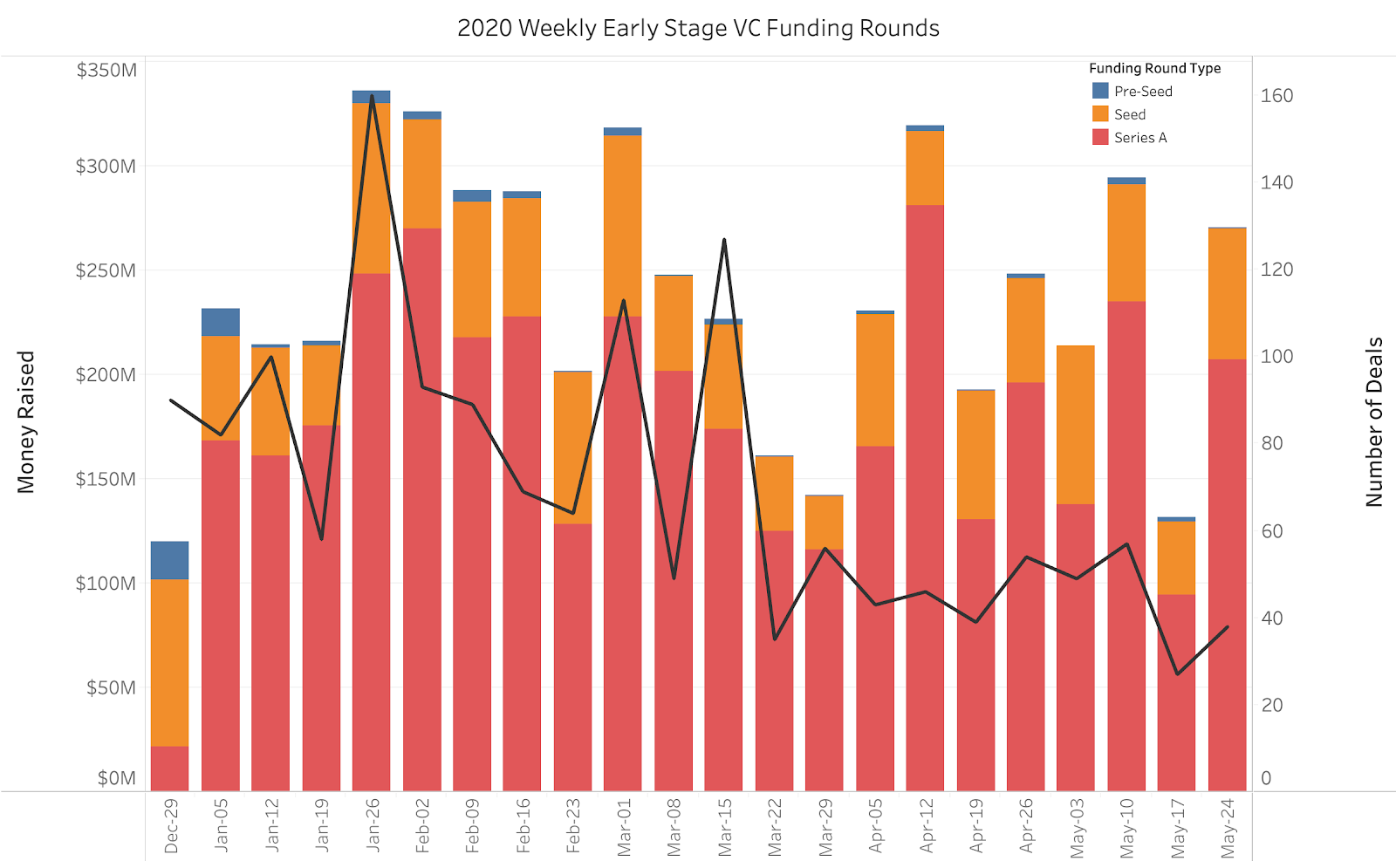
It came as no surprise when, at the start of COVID-19, venture capital investors largely went pencils-down for several weeks and shifted their focus to their existing portfolio companies. Extending company runways, preparing for longer funding cycles and managing operations in a novel business environment became the crux of company resilience. Now, moving into May, we can see this shift reflected in both the decline in number of early-stage companies funded and total capital invested.

As investors begin acclimating to this new normal, they have begun wading into new opportunities in time-proven, healthy industries and new emerging industries that are positioned to succeed during the pandemic. While we are seeing lower valuations, we believe certain B2B technology companies may be uniquely poised to thrive, and are pursuing investment opportunities in this space with a renewed focus.

Image Credits: Crunchbase Data via Tableau Public

*Excluding Biotech & Pharmaceuticals (Source: Crunchbase Data via Tableau Public)

Prior to COVID-19, early-stage B2B investors wanted to see strong growth and healthy unit economics; 3X year-over-year sales growth or 10% monthly growth was the gold standard. An LTV-to-CAC ratio over 3X signified a healthy payback cycle. There was less focus on capital efficiency; for every $1 million invested, investors were happy with $500,000 in generated revenues. Get to these numbers and your next funding round was guaranteed — but no longer.

During COVID, and likely beyond, company expectations and goalposts have been adjusted; 2X year-over-year growth may be the new 3X. While growth and unit economics are important, there are now new health indicators that will determine if a B2B company will thrive in a post-COVID world. With that in mind, we have put together a COVID reslience test that startups can use as a north star to grow their business in this new world.

This COVID-19 test is meant to be a gated checklist that will indicate where efforts should be focused, whether it be sales, product or finance. Before we leave you to your own devices, we wanted to walk through a couple of these new post-COVID questions that you should try to answer (and why they are relevant).

Andreessen Horowitz launches $2.2M fund to invest in underserved founders

Andreessen Horowitz announced today in a blog post that it is launching a fund designed to invest in underrepresented and underserved founders.

The Talent x Opportunity (TxO) fund, which a16z says was in the works for six months, starts with $2.2 million in donations from the firm’s partners. TxO will be invested in a small group of seed-stage startups the first year and expand in size going forward.

“We are looking for entrepreneurs who did not have access to the fast track in life but who have great potential. Their products can be non-tech or tech; they should be from underserved communities (all backgrounds welcome); and ideally, their business will have an interesting model, niche market, and/or a little traction to indicate the promise and potential,” the firm wrote in the post.

A16z says the goal of TxO is to be “much like an accelerator for the unseen, where the outcome is to go get VC money,” and will provide entrepreneurs with networks and training programs. The firm did not comment on whether it will invest in startup follow-on rounds.

A16z has $12 billion in assets under management across its funds, so a $2.2 million fund is not groundbreaking from a monetary perspective, but TxO is notable because of the way the firm wants to invest it.

The firm will invest the donation-based fund in exchange for equity in the businesses. Any returns will remain in the fund to finance future entrepreneurs.

The launch of TxO comes in the wake of the killing of George Floyd by Minneapolis police and the subsequent police violence during protests throughout the country over the last week.

Others in the venture capital community have rushed to show support for the Black Lives Matter movement, after days of protest. SoftBank, which had a racist controversy lately through one of its portfolio companies, launched a $100 million opportunity growth fund this week to invest in founders of color.

Black entrepreneurs and investors, who have been investing in diverse entrepreneurs day in and day out, are dubious of the flood of reactions from others, given the fact that the venture capital industry has been slow to change in the face of inequality.

Many say that it should not take the deaths of countless Black men and women for the tech community to change the way they invest in diverse entrepreneurs. The rush for initiatives thus can look more opportunistic than well-intentioned.

Fundamentally, the broader venture capital community needs to do two things: hire the people and wire the investment.

“It’s not complicated: Invest in Black founders. You don’t have to invest in ALL Black founders. You can keep your thesis and yes even your so-called ‘standards’ and find multiple Black founders to invest in,” Arlan Hamilton of Backstage Capital wrote to TechCrunch on Tuesday. “If you need help, I have 130 portfolio companies + I can introduce you to a curated list of a dozen Black investors to hire.”

Some firms are brainstorming pre-seed investment funds targeted for companies led by black founders. One firm, which declined to comment because the efforts are still too early in the planning stage, said the fund could focus exclusively on companies coming from historically Black colleges and universities (HBCUs).

A16z itself declined to share how it will source companies, and instead pointed to its blog post. In the post, the firm said that it has spent the past six months finding the “names on hidden genius founders you would not see in Silicon Valley.”

But the firm’s sourcing strategy is imperative to how successful it is in the fund’s goal to invest in more diverse entrepreneurs. Networks in venture capital are largely male and white, so specific pipelines are needed. Will it source from HBCUs? Will it attend Black tech conferences to find talent? Will it co-invest with Black-led firms like Cleo Capital, Backstage Capital, Precursor Ventures or Harlem Capital?

The answers to these questions will be imperative in understanding how the firm can support founders beyond a check.

The TxO fund will be led by Naithan Jones, who has been with the firm for five years. Jones was plucked by Ben Horowitz, a partner at Andreessen Horowitz, who had invested in his seed-stage company, AgLocal. In a blog post from 2017, Jones detailed what the conversation looked like.

“Ben was calling to find out if I’d be interested in working at one of the a16z portfolio companies or at a16z itself. I was shocked, stunned. The last thing I expected was for them to call me and see if I wanted a job. It turned out that as I was running my company into bankruptcy, the firm was getting to know me. They saw skills and talents that they believed they and their network could use. They looked into the real me. They didn’t see ‘black, no college degree, outsider.’ They saw Nait Jones.”

A16z has made dedicated monetary efforts to fund Black entrepreneurs previously. In 2018, the firm launched a Cultural Leadership Fund. The fund, which has an undisclosed size, was created with high-profile limited partners, including Will and Jada Smith, Chance the Rapper, Kevin Durant, Nasir Jones and Shellye Archambeau. The Cultural Leadership Fund donates all of its annual management fees to nonprofits that advance more African Americans into tech.

The TxO fund is different because, unlike CLF, it will not deliver returns to LPs. Any returns will go back into the fund to reinvest.

NetApp to acquire Spot (formerly Spotinst) to gain cloud infrastructure management tools

When Spotinst rebranded to Spot in March, it seemed big changes were afoot for the startup, which originally helped companies find and manage cheap infrastructure known as spot instances (hence its original name). We had no idea how big at the time. Today, NetApp announced plans to acquire the startup.

The companies did not share the price, but Israeli publication CTECH pegged the deal at $450 million. NetApp would not confirm that price.

It may seem like a strange pairing, a storage company and a startup that helps companies find bargain infrastructure and monitor cloud costs, but NetApp sees the acquisition as a way for its customers to bridge storage and infrastructure requirements.

“The combination of NetApp’s leading shared storage platform for block, file and object and Spot’s compute platform will deliver a leading solution for the continuous optimization of cost for all workloads, both cloud native and legacy,” Anthony Lye, senior vice president and general manager for public cloud services at NetApp said in a statement.

Holger Mueller, an analyst with Constellation Research says the deal makes sense on that level, but it depends on how well NetApp incorporates the Spot technology into its stack. “At the end of the day to run next generation applications successfully in the cloud you need to be efficient on compute and storage usage. NetApp is doing great on the latter but needed way to monitor and automate compute consultation. This is what Spot brings to the table, so the combination makes sense, but as in all acquisitions execution is key now,” Mueller told TechCrunch.

Spot helps companies do a couple of things. First of all it manages spot and reserved instances for customers in the cloud. Spot instances in particular, are extremely cheap because they represent unused capacity at the cloud provider. The catch is that the vendor can take the resources back when they need them, and Spot helps safely move workloads around these requirements.

Reserved instances are cloud infrastructure you buy in advance for a discounted price. The cloud vendor gives a break on pricing, knowing that it can count on the customer to use a certain amount of infrastructure resources.

At the time it rebranded, the company also had gotten into monitoring cloud spending and usage across clouds. Amiram Shachar, co-founder and CEO at Spot, told TechCrunch in March, “With this new product we’re providing a more holistic platform that lets customers see all of their cloud spending in one place — all of their usage, all of their costs, what they are spending and doing across multiple clouds — and then what they can actually do [to deploy resources more efficiently],” he said at the time.

Shachar writing in a blog post today announcing the deal indicated the company will continue to support its products as part of the NetApp family, and as startup CEOs typically say at a time like this, move much faster as part of a large organization.

“Spot will continue to offer and fully support our products, both now and as part of NetApp when the transaction closes. In fact, joining forces with NetApp will bring additional resources to Spot that you’ll see in our ability to deliver our roadmap and new innovation even faster and more broadly,” he wrote in the post.

NetApp has been quite acquisitive this year. It acquired Talon Storage in early March and CloudJumper at the end of April. This represents the twentieth acquisition overall for the company, according to Crunchbase data.

Spot was founded in 2015 in Tel Aviv. It has raised over $52 million, according to Crunchbase data. The deal is expected to close later this year, assuming it passes typical regulatory hurdles.

Join us to watch five startups pitch off at Pitchers & Pitches on June 10th

If you want to capture investor attention, you need a killer pitch. And that’s under normal circumstances. You’ve probably noticed that circumstances are anything but normal. With a global pandemic and the ensuing economic crisis, you’ll need to up your pitching game and get ready to bring the heat. We can help.

Register today for the second installment of our Pitchers & Pitches series. This interactive elevator pitch feedback session will take place on June 10 at 4pm ET / 1pm PT. Pour yourself a refreshing glass of something tasty and get ready to take your pitching game to the next level.

Note: The Pitchers & Pitches webinar series is free and open to all, but only companies that have purchased a Disrupt Digital Startup Alley Package get to pitch. If your startup wants to be in the running to pitch, you can purchase a ticket here.

We’ll choose five exhibiting startups at random to give their best 60-second pitch to the panel of judges. Who will hear those pitches and offer their sage advice? Excellent question.

Three people will evaluate each pitch and provide incisive feedback. Amish Jani, managing director at First Mark Capital is our featured VC judge for this session. Amish will join Darrell Etherington and Jordan Crook, two of our TechCrunch editors with years of experience coaching participants in the epic Startup Battlefield pitch competition.

Whether you watch or whether you pitch, you’ll come away with actionable tips, strategies and fresh ideas to improve the way you present your startup to the world.

Oh, and one more thing — there’s a prize package. Who doesn’t love prizes? The winning startup gets a consulting session with cela, an organization that connects early-stage startups to accelerators and incubators that can help them scale their business.

Early-stage startup founders rise to face challenges on the daily. And now you need to rise further and faster than ever before. Take advantage of every tool and every opportunity to adapt and move forward. The next Pitchers & Pitches session kicks off at 4pm ET / 1pm PT on June 10th. Don’t miss out — register today.

Is your company interested in sponsoring or exhibiting at Disrupt 2020? Contact our sponsorship sales team by filling out this form.

Challenger bank Varo, soon to become a real bank, raises $241M Series D

Mobile banking startup Varo Money has raised an additional $241 million in Series D funding, the company announced today. The investment was co-led by new investor Gallatin Point Capital and existing investor The Rise Fund, co-founded by TPG. Also participating in the round were Bono (yes, that one), along with entrepreneur, impact investor and movie producer Jeff Skoll; plus HarbourVest Partners and Progressive Insurance.

To date, Varo has raised $419.4 million in funding.

Launched in July 2017, Varo is now one of several digital banking apps that are taking on traditional banks. Its rivals include startups like Chime, Current, Space, Cleo, N26, Empower Finance, Level, Step, Moven and many more.

Similar to others in this space, Varo promises an easily accessible bank account with no monthly fees or minimum balance, plus high-interest savings, and a modern mobile app experience. Though it doesn’t have any brick-and-mortar branches, customers can access their money through a network of more than 55,000 fee-free Allpoint ATMs worldwide.

During the COVID-19 crisis, Varo served its customer base by providing early access to stimulus and unemployment relief funds, as it already does with users’ direct deposit paychecks. It also increased its deposit and ATM limits, and partnered with job platforms Steady and Wonolo to help connect its customers to new work opportunities.

Like most of its competitors, Varo itself is not a bank — its accounts to date have been provided by The Bancorp Bank, member FDIC.

That may soon change, the company says.

In September 2018, Varo received preliminary approval from the Office of the Comptroller of the Currency (OCC). In February 2020, Varo announced it was the first banking startup to win approval for FDIC insurance. Last month, the company said it was moving to the final stage of its bank charter journey.

“Varo was founded first and foremost to make a powerful impact on systemic financial inequality in communities across this country,” said Colin Walsh, founder and CEO of Varo, in a statement. “As the first fully digital bank, Varo will bring our mission of financial inclusion to life and create more financially resilient — and thus healthier and stronger — communities. This new investment will enable us to complete the chartering process and leverage our modern banking technology to build on our track record of innovation and inclusion,” he added.

Pending completion of the conditions required by the OCC, the FDIC and the Federal Reserve, Varo will receive approval to become a national bank.

The company expects this process to complete by summer 2020, at which point it will expand its lineup of services to include credit cards, loans and additional savings products.

Those expansions will help to further differentiate its mobile banking app from a number of competitors, as a large group today remain largely focused on offering checking and savings accounts, not a fuller range of financial products.

Varo is not the only fintech startup that’s moving toward becoming a real bank. In March, Square said it had also received approval from the FDIC to conduct deposit insurance. It aims to launch Square Financial Services, offering small business loans, in 2021.

These moves by fintech startups come at a time when the younger generation is ditching legacy banking in favor of tech. Millennials in particular don’t trust big banks, preferring instead the fee-free challenger banks offering modern mobile features they’ve come to expect from all their other apps.

“In the midst of all the economic challenges people are facing right now, the digital economy can still be a force for good. Varo’s focus on financial inclusion and the support they offer people to help manage their finances and reduce financial stress really matters at a time when so many American families are struggling in a volatile economy. And that’s why RISE chose to partner with the team at Varo,” said Maya Chorengel, co-managing partner of The Rise Fund.

In addition to its expansion into new products, Varo will hire across operations, marketing, risk, engineering and communications following the round’s close. It has recently added headcount to its customer care teams.

Varo today counts nearly 2 million banking and savings accounts and is growing rapidly. Since the beginning of 2020, account growth is up 60%, spend is up roughly 1.5x over the same period and deposits are up by roughly 3.5x.

Monzo to lay off up to 120 employees as the ‘economic situation’ remains challenging

Monzo, the U.K. challenger bank, continues to be faced with tough decisions linked to the coronavirus crisis and resulting economic downturn.

Following the shuttering of its Las Vegas-based customer support office and almost 300 staff being furloughed in U.K., the company has announced internally that up to 120 U.K. staff are being made redundant. Reuters first reported the news just moments ago — which I have now confirmed based on my own sources.

According to an internal memo written by new CEO TS Anil, following an all-hands earlier this afternoon led by Anil and Monzo co-founder and president Tom Blomfield, the bank is to make up to 120 roles redundant, despite previously stating that furloughs and pay cuts already carried out would mean further layoffs could be avoided. That no longer appears to be the case, with Anil explaining that the current economic situation isn’t expected to revert back to normal quickly.

I understand a full consultation period for those employees potentially affected will now take place, as is stipulated under U.K. employment law. In addition, Anil told staff that in order to recognise their contribution, the bank will be waiving the one year “cliff” from their vesting schedule so that they won’t lose out on any shares due to them.

The announced layoffs add to a turbulent time for Monzo in recent months, as it, along with many other fintech companies, has attempted to insulate itself from the coronavirus crisis and resulting economic downturn.

In April, I reported that Monzo was shuttering its customer support office in Las Vegas, seeing 165 customer support staff in the U.S. lose their jobs. And just a few weeks earlier, we reported that the bank was furloughing up to 295 staff under the U.K.’s Coronavirus Job Retention Scheme. In addition, the senior management team and the board has volunteered to take a 25% cut in salary, and co-founder and CEO Tom Blomfield has decided not to take a salary for the next 12 months.

Like other banks and fintechs, the coronavirus crisis has resulted in Monzo seeing customer card spend reduce at home and (of course) abroad, meaning it is generating significantly less revenue from interchange fees. The bank has also postponed the launch of premium paid-for consumer accounts, one of only a handful of known planned revenue streams, alongside lending, of course.

And just last week, it was reported that Monzo is closing in on £70-80 million in top-up funding, to help extend its coronavirus crisis runaway. However, as new and some existing investors play hardball, the company has reportedly had to accept a 40% reduction in its previously £2 billion valuation as part of its last funding round last June, with a new valuation of £1.25 billion.

Snapchat is no longer promoting Trump’s posts

Snap announced this morning that it will not be promoting content from President Trump’s Snapchat account in its Discover tab following statements from Trump last week on Twitter, which threatened that protestors could be met with “vicious dogs” and “ominous weapons.”

The move is notable for many reasons, but is particularly interesting because social media platforms have tended to only discipline popular accounts when they’ve violated the rules on their own platform. Snapchat users will still be able to access content from Trump’s feed if they subscribe to it or search specifically for the account. At this point Snap is simply limiting his account to organic reach and stripping him from their curated feed.

“We will not amplify voices who incite racial violence and injustice by giving them free promotion on Discover,” a Snapchat spokesperson said in a statement.

In response to the move, Trump’s campaign accused Snapchat of “actively engaging in voter suppression.”

Snapchat’s personalized Discover feed sources content from news publishers and accounts on the service but often skews more toward entertainment news compared to competing products like Twitter’s curated Moments threads, which focuses heavily on breaking news.

Earlier this week, Snap CEO Evan Spiegel shared a letter regarding the recent protests, noting that he was “heartbroken and enraged by the treatment of black people and people of color in America.” In the letter posted to Snap’s site, Spiegel also called for the establishment of a “diverse, non-partisan Commission on Truth, Reconciliation, and Reparations.”

Snap’s decision here comes after Twitter hid one of Trump’s tweets regarding the Minneapolis protests on the basis of it violating Twitter rules for “glorifying violence.” Twitter had previously added fact checks to two of Trump’s tweets related to mail-in voting. Facebook came under fire internally this week after CEO Mark Zuckerberg declined to remove the same content that Twitter had on the basis of newsworthiness, a move that prompted some employees to stage a remote walk-out and pushed company leadership, including Zuckerberg, to host a company meeting on the topic.

University entrepreneurship — without the university

Eric Tarczynski
Contributor

Eric Tarczynski is the Managing Partner at Contrary, a network-driven venture firm backed by founders from Facebook, Tesla, and many others.

Across the country, university campuses are in limbo.

The California State University system has committed to online classes in Fall 2020. Northeastern University is reopening as normal. UT Austin is taking a hybrid approach: in-person classes until Thanksgiving break, then online classes during flu season.

This presents a special set of circumstances for university entrepreneurs. The traditional resources and networks are nonoperational. But time and focus, historically the most scarce resources for ambitious students, is now at an all-time high.

It’s often noted that both Facebook and Microsoft were started during Harvard’s Reading Period, a week where classes are cancelled to let students study. This spring has been like one long Reading Period, sometimes with even less responsibility.

Deprioritizing classes

Stanford undergraduate Markie Wagner is taking advantage of the mandatory Pass/Fail policy that the school adopted. Since grades are no longer a consideration, Markie and her friends have free rein to put classes on the back burner to focus on talking to entrepreneurs and experimenting with business ideas.

She told us, “I’m going full hackathon mode this quarter. I’ve been reaching out to lots of founders and VCs to learn from them.” Planning on spending her upcoming senior year building a company, she’s getting a head start on exploration and network building.

If the pandemic forces school closings for the long-run, however, students will have to deal with more than a semester with an easier course load.

There’s near-universal resentment toward the idea of paying full tuition for online classes. Many of the students in Contrary’s network are planning gap years. Or, like Austin Moninger, even skipping senior year altogether. A senior at Rice studying computer science, he originally intended to graduate in spring of 2021. But given the virtual nature moving forward, he decided to accelerate graduation and is currently pursuing full-time software engineering roles. He notes, “We’ve all learned that we’re really paying for the experience and the network at the end of the day, so without it, I might as well take my time and money elsewhere.”

This puts universities in a precarious position: They must choose between letting students take breaks and defer admissions, which risks class size or financial issues (as an example, Dartmouth’s Tuck School of Business decided against this, refusing to allow students to defer), or pushing forward at full price and risking brand damage.

That said, some students are affected by shutdowns or online classes more than the schools themselves are. Research-focused entrepreneurs working in biotech, hardware or other sectors typically require expensive lab equipment to make progress. Pure software plays like Facebook and Snap usually come to mind first when talking about university entrepreneurship, but such lean operations are certainly not the only ones being built.

It’s also unclear how prolonged closures or online classes will impact education itself and how that will impact founders in the long run. Most founders have completed the majority of their degrees by the time they commit to their companies and attempt to raise money. We have not seen any meaningful skill gap in 2020, nor do we expect to throughout the rest of the year.

Unless building a deep-tech startup, company-building can continue as long as an entrepreneur has enough of a technical or financial foundation to self-educate and learn by doing. Malwarebytes CEO Marcin Kleczynski is an excellent example of this — he famously started his cybersecurity company as a freshman at the University of Illinois at Urbana–Champaign and did the bare minimum required to get C grades in school.

Virtualizing campus

Although seed funding for university entrepreneurs has not slowed down since school closings, company-building has certainly not gotten any easier.

The main challenge for 22-year-old talent is not having energy or being scrappy — it’s usually growing the network needed to recruit the right co-founder and hire an early team. In an on-campus environment, there’s enough serendipity to make this natural. But if school closings persist and virtual offerings don’t fill the vacuum, we’ll likely see a lag in new company formation.

It’s rare that founders embark on the startup journey without having known each other for at least a year. Right now, not enough time has passed to make this a problem. But at campuses where students can’t get to know peers at a deep level, it’s impossible to build bonds over a long time period.

To combat this, at Contrary, for example, we hosted a virtual community of founders this past spring with a simple premise: Put 100 people in a room (or Slack channel, more literally), make sure they spend time together and give them the tools to build.

Over the course of six weeks, 150+ collaborations occurred as people experimented on different ideas and projects. Seventy-five percent of the founders said they’d been more productive since the remote transition occurred, and at the end of the program, nearly 70% of the group planned to continue working on their companies or begin a fresh project.

Perhaps most notable is the diversity of connections made — most interactions between participants were between students enrolled in different schools. Since even the best institutions in the world each matriculate only a single digit percentage of talent nationwide, virtualizing the program made the talent pool far larger.

Successful entrepreneurs like Steve Huffman from Reddit and Paul English from Kayak (and now Lola) gave off-the-record talks, but it turned out that most of the value came from access to a highly curated group of peers that each member wouldn’t otherwise meet. The program forced the serendipity that school closures lost, then combined that with the other necessary ingredient: Tangible opportunities to build rather than talk.

You can treat a university like a bundle of tools: The education, network, credential and social learnings all compose into one holistic experience.

Over the past decade, much of that value-stack has been eaten by other organizations.

To prove that you’re a talented individual, you can try applying for the Thiel Fellowship, or lean on name-brand past internships. Or to learn about venture, you can read Scott Kupor’s book or Paul Graham’s blog.

Until very recently, the university’s main “network effect” was the fact that you had to be there to meet other great individuals. Since COVID-19 has shifted most interactions to the cloud, however, that’s no longer the default path.

Looking forward

Hopefully flattening the curve will soon become extinguishing the curve. But until then, university-based founders will have to focus on the alternative infrastructure that powers funding, networking, credentialing and learning.

Had Contrary, Slack, Y Combinator or free AWS credits not existed prior, the closure of schools may have dealt a death knell to founders. But given the abundance of options now available to plug into the Valley and build, surprisingly little has changed.

How to attract more than 10 million TikTok followers in 5 months

Adam Guild
Contributor

Adam Guild is a growth marketing expert and the founder of Placepull.

Imagine going from zero followers to 10,000,000+ followers in less than five months. I have watched somebody do exactly that.

My brother Topper Guild is already reaping the benefits of fame: People stop him in the street for photos and he’s been offered thousands of dollars to promote brands and befriend celebrities.

In less than 150 days, he went from being a high school sophomore to earning more than a Harvard MBA and working with his idols like boxer Ryan Garcia. In time, he also leveraged his following to score more than 100,000,000 views for direct-to-consumer brands like FashionNova and NUGGS.

How did he do it? And how would he advise you?

Consumer startups can apply these same strategies, tactics and ideas to grow quickly on TikTok, which is not nearly as saturated as Instagram and offers faster growth rates.

Let’s dive right into the principles he used to grow (that you can use too).

Do what works

Daily Crunch: Zoom reports spectacular growth

Zoom’s latest earnings report was even better than expected, SoftBank announces a new fund to invest in founders of color and Google pulls a trending app that targets apps from China.

Here’s your Daily Crunch for June 3, 2020.

1. Remote work helps Zoom grow 169% in one year, posting $328.2M in Q1 revenue

Zoom’s customer numbers were similarly sharp, with the firm reporting that it had 265,400 customers with more than 10 seats (employees) at the end of the quarter, which was up 354% from the year-ago period.

Not all of the news coming out of its latest earnings report was positive, however. CEO Eric Yuan confirmed that a plan to implement end-to-end encryption does not in fact extend to non-paying users.

2. SoftBank launches $100M+ Opportunity Growth Fund to invest in founders of color

The Opportunity Growth Fund “will only invest in companies led by founders and entrepreneurs of color,” according to an internal memo from SoftBank’s COO Marcelo Claure, who said the fund will initially start with $100 million — meaning there is room for SoftBank or other limited partners to add more over time.

3. Google pulls ‘Remove China Apps’ from Play Store

The top trending app in India, which was downloaded more than 5 million times since late May and enabled users to detect and easily delete apps developed by Chinese firms, was pulled from Android’s marquee app store for violating Google Play Store’s Deceptive Behavior Policy.

4. Facebook and PayPal invest in Southeast Asian ride-hailing giant Gojek

Facebook and PayPal are joining Google and Tencent as high-profile tech firms that have backed the five-year-old Southeast Asian ride-hailing startup, which also offers food delivery and mobile payments.

5. The fundraising marketplace has stabilized. Or has it?

DocSend CEO Russ Heddleston said the last two weeks could be establishing a new normal for fundraising this year. Even though most VCs aren’t taking in-person meetings, they were more active in the past month than they were in May of both 2019 and 2018. (Extra Crunch membership required.)

6. Venture firms rush to find ways to support Black founders and investors

Firms like Benchmark, Sequoia, Bessemer, Eniac Ventures, Work-Bench and SaaSTR Fund founder Jason Lemkin all tweeted in support of the cause and offered to take steps to improve the lack of representation in their industry. But some Black entrepreneurs and investors are questioning the firms’ motivations.

7. Lili raises $10M for its freelancer banking app

CEO Lilac Bar David suggested that no traditional banking solutions are really designed to solve the problems faced by freelancers — whether they’re designers, programmers, fitness instructors, chefs or beauty professionals. She described Lili as the first “all-in-one” solution, offering both a bank account and a broader suite of financial tracking tools.

The Daily Crunch is TechCrunch’s roundup of our biggest and most important stories. If you’d like to get this delivered to your inbox every day at around 9am Pacific, you can subscribe here.