Stop with the Vroom and gloom on Wall Street

Hello and welcome back to Equity, TechCrunch’s venture capital-focused podcast, where we unpack the numbers behind the headlines.

This time around we’re recording what we call an Equity Shot, a single-topic show that we pull together whenever there’s a news item of sufficient weight that it demands we break our regular cadence and record a little more.

So Danny and Tash and Alex got together to discuss the recent Vroom IPO and Lemonade filing to go public. These are topics that TechCrunch has covered quite a lot lately, so here’s a chronology to help you keep it all straight:

So you can catch up as you need to. What matters is that public investors have swooned over the Vroom IPO, pushing its pricing and, today, more than doubling its value as a public company. It’s a huge debut, and that bodes well for other gross-margin-light businesses — unicorns, even — that might want to go public.

The IPO window is pretty open, it appears. And best of all, we three disagreed quite a bit this week. It’s a fun show.

OK, that’s enough from us. We are back on Friday. Take care, and keep up the good fight.

Equity drops every Friday at 6:00 am PT, so subscribe to us on Apple PodcastsOvercastSpotify and all the casts.

Microsoft employees call for company to cancel its police contracts

In a new letter addressed to executive leadership, a group of Microsoft employees is demanding that the Seattle-area company end its existing law enforcement contracts.

As reported by OneZero, the letter, sent via email, emerged out of a Facebook group for young employees at the company. It addresses Microsoft CEO Satya Nadella and Executive Vice President Kurt DelBene directly and was copied to 250 supporters. In the past, Microsoft employees have organized other kinds of activism through the same Facebook group, which now has almost 10,000 members.

Among the demands, the email calls for the company to pull its contracts with law enforcement agencies, support the “defunding and demilitarization” of the Seattle Police Department and throw its support behind Black Lives Matter Seattle. The letter also requests that managers at the company relax productivity expectations and implement a four-day work week amid the dual crises of COVID-19 and ongoing civil unrest protesting the police killing of George Floyd, an unarmed Black man in Minneapolis.

The letter cites a number of local instances of police brutality and calls for “coworkers, managers, and leaders who live miles away outside of Seattle” to bridge the gap, connecting to the state-sanctioned violence unfolding in Seattle’s urban center, including “24/7 helicopter noise, teargassing, flashbanging, rubber bullets, gun shots, and vans/buses filled with armed law enforcement.”

“We need awareness and empathy across every level of management asap so that the burden of educating our coworkers doesn’t fall on those of us in the middle of a public safety and mental health crisis,” the authors urge.

Last week, Nadella outlined the company’s planned response to ongoing racial injustice in an email to employees, noting that the company would “look inside, examine our organization, and do better.” In the letter, Nadella committed to $1.5 million in additional donations to six racial justice and policing reform initiatives, including the Minnesota Freedom Fund, the Black Lives Matter Foundation and the Innocence Project.

Unpacking tech’s response to the killing of George Floyd

The brutal police killing of George Floyd, an unarmed Black man in Minneapolis, has prompted one of the greatest civil uprisings of the modern day. In the weeks following Floyd’s death, the conversation around diversity and inclusion, as well as tech’s role in upholding white supremacy, has returned to the forefront. 

But it is action, not words, that has the potential to effect real change in the tech industry. Otherwise, the hundreds of statements from tech companies and leaders in the industry won’t count for anything. Once society has moved on to its next distraction weeks, months or years from now, the words of today will have been forgotten. That’s why it’s essential the tech industry not let Floyd’s tragic death be just another statistic, but an impetus for a shift in representation in the tech industry and, ultimately, for a shift in power.

Amid this tragedy, many tech companies and leaders have spoken out against racism, saying things like, “We stand with our colleagues and the Black community” (LinkedIn), “We stand with the Black community against racism, violence, and hate” (Salesforce) or “we all have the responsibility to create change” (Facebook) — while simultaneously fostering an environment where employees defend racism, contracting with U.S. Custom Borders and Protection, which has been deployed to police protests, or enabling President Donald Trump’s post inciting violence to remain on its platform. These are just a few examples of many, but they all evoke one thing: complicity.

LinkedIn CEO Ryan Roslansky later addressed the town hall where employees were defending racism.

“Many of you shared the hardest part was realizing that this company we love and hold to such a high standard still has a lot of work to do to educate ourselves and our colleagues on how to create a culture that is truly anti-racist,” Roslansky wrote. “We will do that work.”

Beyond complicity, lip service has long been an issue in the realm of diversity, inclusion and equity in tech. Consider that those in the tech industry have made statements before about police killings of unarmed Black people. Also consider how little has changed in the industry in terms of representation of Black people and other people of color in tech, as well as policy changes to keep people safe from racism and other forms of harassment on the internet.

Thumbtack, for example, in a post about how the company stands with Black voices and wants to invest in the success of its D&I program, said it would hire a new head of diversity and inclusion. That’s in light of having just recently let go of Alex Lahmeyer, who served as the company’s diversity and inclusion lead for four years, in April. According to Lahmeyer’s LinkedIn, he was laid off along with 250 of his teammates amid the COVID-19 pandemic

“While it doesn’t surprise me, I’m upset that companies use DEI programs for PR strategy and then slash them like they’re deadweight,” Lahmeyer wrote in a post on LinkedIn. “Yes, some companies are facing difficult financial decisions, but there could not be a worse time to reduce the function that ensures your marginalized employees feel seen and heard.”

In a statement to TechCrunch, Thumbtack said its business “has bounced back from the effects of COVID-19” and has opened up hiring solely to find a new head of diversity, equity and inclusion.

“We are intentionally making this our first before any others as part of a plan to build a more diverse, equitable, and inclusive team,” a Thumbtack spokesperson told TechCrunch.

Lahmeyer has since told TechCrunch he’s aware Thumbtack is looking to hire, but that he is “not interested in returning.”

Google, similarly, has reportedly rolled back many of its diversity efforts over the last couple of years. Alphabet CEO Sundar Pichai spoke words of solidarity in light of Floyd’s death and changed the Google and YouTube homepages in support of racial justice. But actions speak louder than words.

Despite years of inaction and backtracking in the tech industry, this has the potential to be the moment when the tech industry finally turns a corner and starts to make meaningful change as it relates to racial justice. But in order for this to be that moment, tech companies need to double down on diversity and inclusion efforts, not scale them back. That means hiring more Black and brown people, implementing a consistent and equitable performance review process, closing the pay gap as it relates to race — not just gender — and laying out clear paths to raises and promotions. Again, action.

Already, there have been some promising first steps taken in the industry in light of Floyd’s death. For example, investor Jason Lemkin committed to trying to only meet Black founders in June and Andreessen Horowitz has a new program to financially support Black and other underrepresented founders in tech.

“I think there are some people who are doing a great job at this even though there is no perfect way of doing this,” Backstage Capital founder and Managing Partner Arlan Hamilton told me last week during a conversation for the Commonwealth Club. “And I think there is a disgusting silence from some people that it just tells me everything I need to know.”

The best thing an investor can do right now, according to Hamilton, is to do their job.

“It’s your job to look at these founders,” she said. “You’ve been able to hide in the shadows and not do your job because the boss hasn’t been walking around. But right now everybody’s watching and there are no tears for you if you can’t find the pipeline.”

In perhaps the boldest move to date, Reddit founder Alexis Ohanian announced his decision to step down from the board of directors. Reddit, which has long been a platform rife with racism, sexism and other problematic content, was founded by Ohanian back in 2005Now, he’s called for the company he founded to fill his position with a Black board member. Additionally, Ohanian said he would use future gains on his Reddit stock to serve the Black community. 

I've resigned as a member of the reddit board, I have urged them to fill my seat with a black candidate, + I will use future gains on my Reddit stock to serve the black community, chiefly to curb racial hate, and I’m starting with a pledge of $1M to @kaepernick7’s @yourrightscamp

— Alexis Ohanian Sr. ? (@alexisohanian) June 5, 2020

Boards of directors at tech companies have long been lacking Black people. It’s something Rev. Jesse Jackson has called for since at least 2014 and the Congressional Black Caucus has demanded since 2015. Over the years, tech companies have made slight progress in the area. In 2015, just months after the CBC called for more diversity at the board level, Apple appointed James Bell, former CFO and president of The Boeing Company, to its board of directors. In 2018, a handful of tech companies added Black people to their boards of directors, including Airbnb, Facebook and Slack. Still, boards of directors at tech companies are predominantly white and male.

That’s what makes Ohanian’s resignation and recommendation all the more important. It effectively removes himself from a position of power to make room for a Black person at the table. Now, Ohanian is making a shortlist of potential candidates to present to the board.

Tiffani Ashley Bell, founder of The Human Utility, is one person who has thrown her hat in the ring. As she noted, she “literally gave the entire technology industry (and some others based on messages I’ve gotten) the source code for eliminating white supremacy.”

It’s a great read, so be sure to check that out here. In it, she argues that dismantling white supremacy comes down to willingness. She presents a number of questions designed to foster self-reflection and enable people to examine their role in upholding white supremacy. She also emphasizes action.

She writes:

Are you willing to hold space for Black employees? As in, are any Black people even on your team?especially in leadership positions? If not, are you willing to treat hiring Black people as another growth challenge and hack it? Are you willing to recruit at historically Black colleges and universities (HBCUs) as enthusiastically as historically white colleges and universities? Has your company ever set up a table at the National Society of Black Engineers career fair?

As I mentioned earlier, this is not the first time the tech industry has responded to the brutal killing of a Black person. But something about this moment does feel different. Hamilton believes it’s because most people have been stuck at home for a long period of time in light of COVID-19.

“It is like the world and the country has a front-row seat to what Black people have to witness, take in, and feel all the time,” she told me. “And it was before they were seeing some of it, but they were seeing it kind of protected by us. We were kind of shielding them from some of it…It’s like a VR headset that the country is forced to be in because of COVID. It’s just in their face.”

At the moment, it’s hard to gauge what is performative and what might result in true change. But we’ll be following closely to see what, if anything, manifests from the latest platitudes from tech CEOs and investors.

TechCrunch has reached out to Salesforce. We’ll update this story if we hear back.

If you have any inside information about what some of these companies are doing, please get in touch. You can reach me at [email protected]. PGP: E0B2 45C7 5FC7 545B 46B8  269C 0F6C 1A7F FFB5 E031

Decrypted: DEA spying on protesters, DDoS attacks, Signal downloads spike

This week saw protests spread across the world sparked by the murder of George Floyd, an unarmed Black man, killed by a white police officer in Minneapolis last month.

The U.S. hasn’t seen protests like this in a generation, with millions taking to the streets each day to lend their voice and support. But they were met with heavily armored police, drones watching from above, and “covert” surveillance by the federal government.

That’s exactly why cybersecurity and privacy is more important than ever, not least to protect law-abiding protesters demonstrating against police brutality and institutionalized, systemic racism. It’s also prompted those working in cybersecurity — many of which are former law enforcement themselves — to check their own privilege and confront the racism from within their ranks and lend their knowledge to their fellow citizens.


THE BIG PICTURE

DEA allowed ‘covert surveillance’ of protesters

The Justice Department has granted the Drug Enforcement Administration, typically tasked with enforcing federal drug-related laws, the authority to conduct “covert surveillance” on protesters across the U.S., effectively turning the civilian law enforcement division into a domestic intelligence agency.

The DEA is one of the most tech-savvy government agencies in the federal government, with access to “stingray” cell site simulators to track and locate phones, a secret program that allows the agency access to billions of domestic phone records, and facial recognition technology.

Lawmakers decried the Justice Department’s move to allow the DEA to spy on protesters, calling on the government to “immediately rescind” the order, describing it as “antithetical” to Americans’ right to peacefully assembly.

These free tools blur protesters’ faces and remove photo metadata

Millions have taken to the streets across the world to protest the murder of George Floyd, an unarmed black man killed by a white police officer in Minneapolis last month.

Protesters have faced both unprecedented police violence and surveillance. Just this week, the Justice Department granted the Drug Enforcement Administration, an agency typically tasked with enforcing federal drug-related laws, the authority to “conduct covert surveillance” on civilians as part of the government’s efforts to quell the protests. As one of the most tech savvy government agencies, it has access to billions of domestic phone records, cell site simulators, and, like many other federal agencies, facial recognition technology.

It’s in part because of this intense surveillance that protesters fear they could face retaliation.

But in the past week, developers have rushed to build apps and tools that let protesters scrub hidden metadata from their photos, and mask or blur faces to prevent facial recognition systems from identifying protesters.

Everest Pipkin built a web app that strips images of their metadata and lets users blur faces — or mask faces completely, making it more difficult for neural networks to reverse blurring. The web app runs entirely in the browser and doesn’t upload or store any data. They also open-sourced the code, allowing anyone to download and run the app on their own offline device.

i built a tool for quickly scrubbing metadata from images and selectively blurring faces and identifiable features. it runs on a phone or computer, and doesn't send info anywhere.

process your images so that you and others are safe:https://t.co/GbQu5ZweDq pic.twitter.com/jKjABTgPRX

— everest (@everestpipkin) May 31, 2020

Pipkin is one of a few developers who have rushed to help protesters protect their privacy.

“I saw a bunch of discourse about how law enforcement is aggregating videos of the protests from social media to identify protesters,” developer Sam Loeschen told TechCrunch. He built Censr, a virtual reality app that works on the iPhone XR and later, which masks and pixelates photos in real-time.

The app also scrubs images of metadata, making it more difficult to identify the source and the location of the masked image. Loeschen said it was an “really easy weekend project.” It’s currently in beta.

?? Announcing censr: a simple camera app for protecting your identity!

available for iPhone XR and up

distributing to protestors and press through TestFlight. Send me a DM for the link! pic.twitter.com/J1Znd2ZKqN

— Sam Loeschen (@polygone_) June 5, 2020

Noah Conk built an iPhone Shortcut that uses Amazon’s facial recognition system and automatically blurs any faces it detects. Conk said in a tweet there was no way to blur images on the device but that he does not save the image.

The idea is smart, but it does mean any photos uploaded could theoretically (and if stored) be obtained by law enforcement with a legal order. You also need to “allow untrusted shortcuts”, which could open the door to potentially malicious shortcuts. Know the risks before allowing untrusted shortcuts, and keep it disabled when you don’t need it.

Helping protesters and others blur and anonymize photos is an idea that’s taking off.

Just this week, end-to-end encrypted messaging app Signal included its own photo blurring feature, one that couldn’t come soon enough as its user base spiked thanks to the massive adoption since the protests started.

Signal founder Moxie Marlinspike said in a blog post that the move was to help “support everyone in the streets,” including those protesting in the U.S. and around the world, in many cases defying social distancing rules by governments put in place to slow the spread of the coronavirus pandemic.

“One immediate thing seems clear: 2020 is a pretty good year to cover your face,” said Marlinspike.

Startups Weekly: The George Floyd protests come home to the tech industry

The tech industry has generally wished that structural discrimination would go away, while pretending that it already has. But technology can be used by anyone for anything. And so, the world has watched video after video of police brutality against Black people in a real-time stream that plays through the closing days of quarantine, culminating in the death of George Floyd and ongoing protests. As employees have left their remote offices to hit the streets, even executives at the largest tech companies —who would usually avoid such complications — have expressed their support officially, online.

What can we expect to change now? After all, diversity and inclusion programs have been getting cut during the pandemic, and stats on employee diversity and VC partner/portfolio demographics have not seemed to be improving quickly over the past decade, at least in aggregate.

First up, a group of Black tech leaders in the Bay Area, including TechCrunch’s Megan Rose Dickey, has put forward a widely-signed petition that specifies five goals including local support and accountability, and commitment to hiring and investing in Black employees and founders.

On the ground in the startup world, a considerable range of investors say they are setting aside dedicated time and resources for Black founders.

Specific proposals for changes to the status quo strike at the heart of of tech as we know it.

To address existing systemic bias, algorithmic and otherwise, contributor Will Walker writes that tech companies like Amazon, Yelp and Grubhub should find ways to feature and favor Black-owned businesses — even if that means re-writing the recommendation algorithms.

And to address systemic bias in who gets funding, Connie Loizos writes that legislation could be the best answer:

Consider that already, most VCs today sign away their rights to invest in firearms or alcohol or tobacco when managing capital on behalf of the pension funds, universities and hospital systems that fund them. What if they also had to agree to invest a certain percentage of that capital to founding teams with members from underrepresented groups? We aren’t talking about targets anymore, but actual mandates. Put another way, rather than wait for venture firms to organically develop into less homogeneous organizations — or to invest in fewer founders who share their gender and race and educational background — alter their limited partner agreements.

Perhaps tech leaders are responding so strongly today because they realize what’s at stake for them if change does not happen faster?

GettyImages 1168618863

The future of work, according to the people trying to invest in it

Meanwhile, the very nature of work as we know it is being re-evaluated. Megan caught up with top investors in a very popular investor survey for Extra Crunch this week, to better understand the problems and solutions. Here’s what Ann Muira-Ko of Floodgate Capital thinks will create unicorns, as a sample:

  • How do you enable solopreneurs to build businesses that are fully tech-enabled? We think of this as the ironman suit for the solopreneur. What financial products and software products can solopreneurs use to provide consumers or their customers with the tech-enabled experiences they have come to expect?
  • How does reputation follow someone? A resume or LinkedIn profile measures where you’ve worked and for how long. With people working more jobs at varied locales, measuring expertise will become a new challenge.
  • How does an organization maintain knowledge? If a company is reliant on its people to share its history and knowledge base, how can that be disseminated without relying on internal experts (who are on the decline)?
  • How should productivity tools (calendars & communication) and enterprise systems (CRM, HR, Finance, etc.) adapt to a multi-modal (work from anywhere) work environment? HR is perhaps the most out-of-date, but every tool will require better integration.

If you’re more interested in the cybersecurity aspects of remote work, you will want to check out security editor Zack Whittaker’s set of investor surveys this week, including this industry overview and this pandemic-focused one.

Data shows investors are in fact busy looking for deals

Are VCs actually open for business during the pandemic? Docsend, a key inside data source, has a new report out this week that shows investor interest has boomed in April. Here’s CEO Russ Heddleston on TechCrunch, talking about the activity on its document management platform:

After the initial decline in March, founders and VCs both bounced back fairly quickly. In fact, the next week VC interest increased 10% while the number of Founder Links Created increased by 12%. However, for the following few weeks the number of links created by founders either stayed flat or dropped. But that isn’t the case for VCs. Demand for pitch decks rose steadily all the way through the week of April 20th, which was 25% up year-over-year. In fact, seven of the top 10 best days for Pitch Deck Interest in 2020 were in the month of April.

The fundraising inactivity has been on the part of the founders! Meanwhile, in a separate article for Extra Crunch, he shares that investors are spreading themselves broadly.

In the recent weeks, as we’ve had higher than average supply and demand, we’ve watched as the average time spent reviewing a deal has declined. In fact, we’re at nearly a two-year low. The only other period when time spent dropped below where it is now was in early 2018 (which not coincidentally was also when demand was at its highest). Twice in 2018 we saw time spent go below three minutes and we’re currently at 3 minutes and 7 seconds.

How a growth marketer helped his high school brother win at TikTok

In a fascinating oral history of sorts for Extra Crunch, Adam Guild explains how he helped his young brother Topper get more than 10 million followers in under five months. Here’s a free excerpt:

At first, figuring out which content would go viral seemed random. There was no correlation between likes, comments, shares or engagement rate.

What made the difference in his successful content? Topper needed to find out to maximize growth, so he went through his TikTok analytics insights and noticed a trend: his most popular videos weren’t the ones with the highest engagement rates. They were the ones with the highest average view durations.

“I wanted to test if this guess was right,” said Topper, “so I posted a few videos with a longer length and teased people in the captions to watch until the end.”

It worked; his videos started getting more views, but it wasn’t a perfect correlation. Some videos with high view durations weren’t taking off.

When Topper asked me for advice, I suggested that the key metric to nail was actually average session duration. That’s what YouTube optimizes for, so it would make sense that TikTok would do the same. This metric measures how long people actually stay on the platform — not on the video — and it can be increased by single videos.

He posted another video to test: one that encouraged viewers to rewatch repeatedly because it had a cliffhanger ending — Topper poured hundreds of Mentos into a massive container of Coke before cutting out the ending.

That video was his most viewed yet, scoring more than 175,000,000 views. He decided to use that lesson in future videos by creating content that helped get viewers addicted to TikTok while also being fun to watch.

Around TechCrunch

Join us to watch five startups pitch off at Pitchers and Pitches on June 10th

Join Eventbrite CEO Julia Hartz for a live Q&A: June 11 at 3 pm EST/Noon PDT/7 pm GMT

Across the week

TechCrunch:

LinkedIn introduces new retargeting tools

The coronavirus has hastened the post-human era

Zynga acquires Turkey’s Peak Games for $1.8B, after buying its card games studio for $100M in 2017

Huawei’s terrible week

Extra Crunch:

Is Zoom the next Android or the next BlackBerry?

The IPO window is open (again)

Unpacking ZoomInfo’s IPO as the firm starts to trade

SaaS earnings rise as pandemic pushes companies more rapidly to the cloud

What grocery startup Weee! learned from China’s tech giants

#EquityPod

From Alex Wilhelm:

Hello and welcome back to Equity, TechCrunch’s venture capital-focused podcast, where we unpack the numbers behind the headlines.

This week, however, the Equity crew (DannyNatashaChris, and Alex) agreed it felt silly to drum up false enthusiasm for funding rounds and startups. Instead, we talked about a more critical topic: systemic racism in the United States. Venture firms and tech executives across the country are pledging to be better following the brutal murder of George Floyd and police brutality.

Better is long overdue.

What follows are the resources we mentioned — and a few more — on the show itself. We’ll be back. Now is the time for sustained momentum and change.

Donations

How to be a better ally

Equity drops every Friday at 6:00 am PT, so subscribe to us on Apple PodcastsOvercastSpotify and all the casts.

Indian online travel booking firm Yatra terminates merger deal with Ebix

Indian online travel booking company Yatra has terminated a pending merger agreement with Atlanta-based software firm Ebix and filed a litigation seeking “substantial damages” over alleged breach of deal terms.

In July last year, Ebix announced its plan to acquire Yatra, giving the Indian firm an enterprise value of $337.8 million, in a move to strengthen its position in India’s hotel and flight ticketing market.

Late Friday, Ebix said it had provided a notice to terminate the deal. In its complaint, Yatra said it seeks to “hold Ebix accountable for breaches of its representations, warranties and covenants in the merger agreement and an ancillary extension agreement, and seeks substantial damages,” it said in a statement.

“As detailed in the complaint, Ebix’s conduct breached material terms of the agreements and frustrated Yatra’s ability to close the transaction and obtain the benefit of Yatra’s bargain for Yatra’s stockholders,” it added.

Ebix did not respond to a request for comment.

On Friday, Yatra also shared an update on its financials, saying it had implemented several cost-saving measures including cutting management salaries by half across the company to steer through the coronavirus pandemic that has put a halt on most travel and hospitality activities worldwide.

The company said as of June 4 it had $32.5 million in total available liquidity and its current monthly run-rate operating fixed cost was about $1.2 million.

Yatra, which went public in 2016 following a reverse-merger with listed company Terrapin 3 Acquisition Corporation, counts India’s Network18, Reliance Capital, Macquarie Group and Rotation Capital among its shareholders. It handles real-time bookings for more than 108,000 hotels and home stays in India and over 1.5 million hotels around the world, it said.

This Week in Apps: Protests impact app stores, FTC fines app developer, kids’ app trends

Welcome back to This Week in Apps, the Extra Crunch series that recaps the latest OS news, the applications they support and the money that flows through it all.

The app industry is as hot as ever, with a record 204 billion downloads and $120 billion in consumer spending in 2019. People are now spending three hours and 40 minutes per day using apps, rivaling TV. Apps aren’t just a way to pass idle hours — they’re a big business. In 2019, mobile-first companies had a combined $544 billion valuation, 6.5x higher than those without a mobile focus.

In this Extra Crunch series, we help you keep up with the latest news from the world of apps, delivered on a weekly basis.

This week, we’re taking a look at how the civil unrest and George Floyd protests played out across the app stores. The events led some apps — including private messaging apps, police scanners and alerting apps, and other social communication apps — to surge, and even break records. Google decided to delay the launch of Android 11 beta 1 in light of the recent events.

We’re also keeping up with COVID-19 apps and how the pandemic is changing app usage and consumer behavior. Plus, the FTC fined an app developer over privacy violations in a warning shot for the app industry; Zoom faced criticism for its encryption plans; Apple launched an open-source resource for password managers; and more.

How the George Floyd protests impacted the app stores

Protests drive downloads of police scanners 

Downloads of police scanner apps, tools for private communication and mobile safety apps hit record numbers last weekend in the U.S., amid the nationwide protests over the police killing of George Floyd, as well as the systemic problems of racial prejudice that plague the American justice system. According to data from app store intelligence firm Apptopia, top U.S. police scanner apps were downloaded a combined 213,000 times last weekend, including Friday — a 125% increase from the weekend prior and a record number for this group of apps.

The group of top apps included those with similar, if somewhat generic, titles, such as Scanner Radio – Fire and Police Scanner, Police Scanner, 5-0 Radio Police Scanner, Police Scanner Radio & Fire and Police Scanner +.

Citizen, Signal and others spike during protests

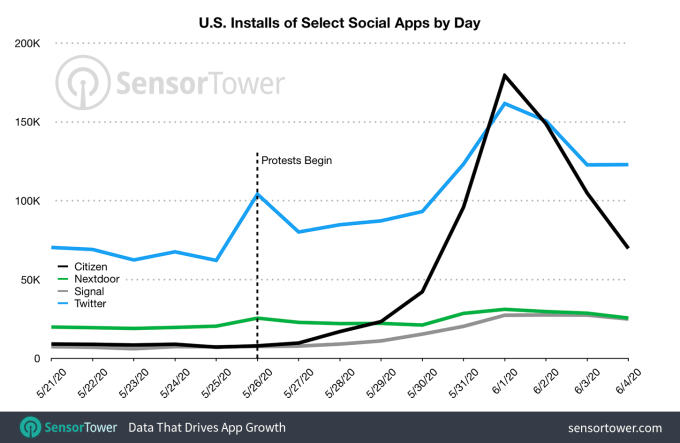
In addition to tracking police movements with scanners, protestors organized and communicated on secure messaging app Signal. Meanwhile, community safety app Citizen, which sends out police alerts, also saw a jump in usage. According to Apptopia, Citizen and Signal both set daily download records, Vox noted earlier this week.
Citizen

Citizen’s app lets users see “incidents,” based on radio communications with 911 dispatchers, police, fire departments and other emergency responders. The app uses high-powered scanners to tune into public radio channels, then digitizes and transcribes the audio, and turns those into incidents placed on the map. But the app is popular because it’s more than a police scanner; it includes a social networking layer where users can react and comment. 

Based on more recent data provided to TechCrunch by Sensor Tower, Citizen was installed around 620,000 times by first-time users in the U.S. during the past week, an increase of about 916% compared to the week prior. First-time installs reached a record 150,000 on June 2, nearly 12x the app’s average of 13,000 daily first-time installs during May. On average, the app was downloaded close to 86,000 times per day, or 6.6x larger than May’s daily average. The app grew to be as high as No. 4 on Tuesday, June 2 on the U.S. App Store, and is now No. 32 Overall on the top free charts.

Signal
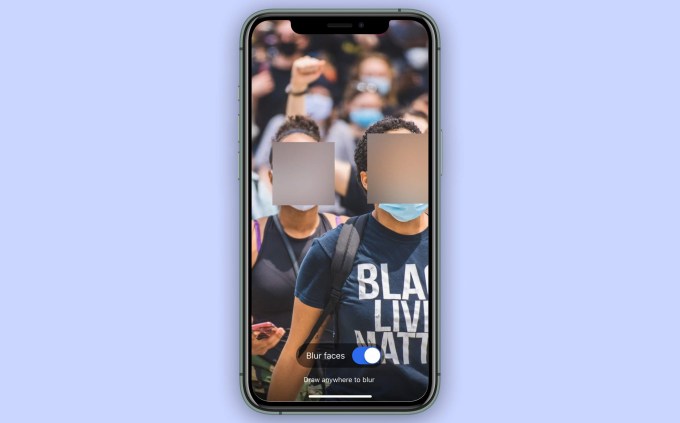
Image Credits: Signal

The firm also estimated that Signal had been installed by approximately 135,000 first-time users in the U.S. during the past week across the app stores. This figure represented growth of 165% from the preceding seven days, or about 2.6x that total of approximately 51,000 new installs. Signal averaged about 19,000 installs per day over the past seven days.

For comparison’s sake, Signal was downloaded around 269,000 times in all of May and its average daily number of installs was 9,000. That makes the average for the past week about 2x higher.

Signal is currently ranked at No. 137 among the top free iPhone apps on the U.S. App Store. Earlier, it was ranked at No. 107 on Tuesday, June 2.

This week, Signal also added built-in face blurring for photos, to help better secure the sharing of sensitive information across its network.

Nextdoor and Neighbors by Ring

The civil unrest also impacted neighborhood networking app installs, as communities looked to share information about the protests with one another. Social networking app for neighbors Nextdoor was installed by 185,000 first-time users in the U.S. over the past week, an increase of 26% from 147,000 installs in the week prior. The app also jumped up nearly 50 places in the U.S. App Store rankings, moving from No. 2,014 to No. 156 in the top free iPhone apps chart.

Amazon-owned Neighbors by Ring, where neighbors share alerts, including security camera footage, was installed by 36,000 first-time users in the past week, an increase of 89% from its approximately 19,000 installs the week prior.

Twitter has a record-breaking week as users looked for news of protests and COVID-19
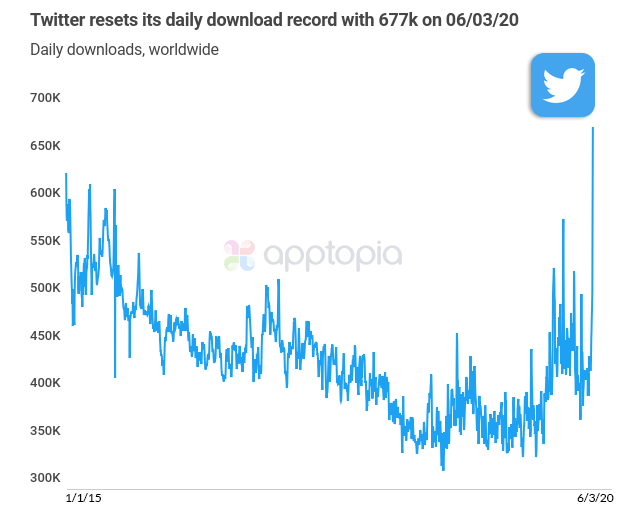
Civil unrest due to the nationwide George Floyd protests drove Twitter to see a record number of new installs this week, according to data from two app store intelligence firms, Apptopia and Sensor Tower. While the firms’ exact findings differed in terms of the total number of new downloads or when records were broken, the firms agreed that Twitter’s app had its largest-ever week, globally.

The app saw at least 677,000 installs at its highest point, Apptopia said. Sensor Tower said it topped 1 million. Twitter also broke a record for daily active users on Twitter in the U.S., when some 40 million people in the U.S. logged into the app on June 3, Apptopia noted. For comparison’s sake, Twitter reported its app had 31 million “monetizable” daily active users (mDAUs) in the U.S. in Q4 2019, which grew to 33 million in Q1 2020.

The spike in installs was attributed to the protests, which were being watched by a global audience, and COVID-19, which continued to spread in worldwide markets.

Apps turn their icons black in support of George Floyd protests 

A small handful of apps did the equivalent of the Instagram black square by turning their icons black this week as a gesture of support toward the protests and civil rights. Participating apps included Reddit, Joss & Main and Shop Avani, for instance. Moves like this can be criticized as being merely performative, but one of the companies involved — Reddit — later followed up with real action. Reddit co-founder Alexis Ohanion on Friday announced he was resigning as a member of the Reddit board, and is now urging them to fill his seat with a black candidate. He also said he would use his future gains from Reddit stock to serve the black community, starting with a $1 million pledge to Colin Kaepernick’s Know Your Rights Camp.

COVID-19 app updates and news