Transparent face mask startup inhales $1M seed round

A Swiss startup called HMCARE, spun out of the École polytechnique fédérale de Lausanne, has raised a million Swiss Francs (equivalent to about $105 million) to commercialize its transparent and relatively eco-friendly surgical masks.

The founders were inspired by healthcare workers in the 2015 Ebola outbreak and at children’s hospitals around the world working closely with patients but unable to show their faces. Likewise parents and relatives of immunocompromised people who must make a human connection with two-thirds of their face covered.

There were technically transparent masks available, but they were just regular masks with a plastic window in them, which can fog up and isn’t breathable. Thierry Pelet, now CEO of the company, approached his EPFL colleagues with a prototype of a transparent mask material meeting the rigorous demands of a medical environment. It must permit air through but not viruses or bacteria, and so on.

The team worked with Swiss materials center Empa to create a new type of textile. Using biomass-derived transparent fibers placed 100 nanometers apart to form sheets and then triple-layered, they made a flexible, breathable material that’s also nearly transparent — a bit like lightly frosted glass. They call it the HelloMask.

The material can be made in bulk and formed into mask shapes just like normal cloth, but there is the matter of spinning up manufacturing for it. Fortunately, the world is desperate for masks, and the idea of a transparent one was clearly catnip for investors. HMCARE easily raised a million-franc seed round, the R&D work having been done using nonprofit donations and grants.

While the HelloMasks could launch as early as the start of 2021, they’ll be primarily for the medical community, though public availability is certainly a possibility.

IBM Cloud suffers prolonged outage

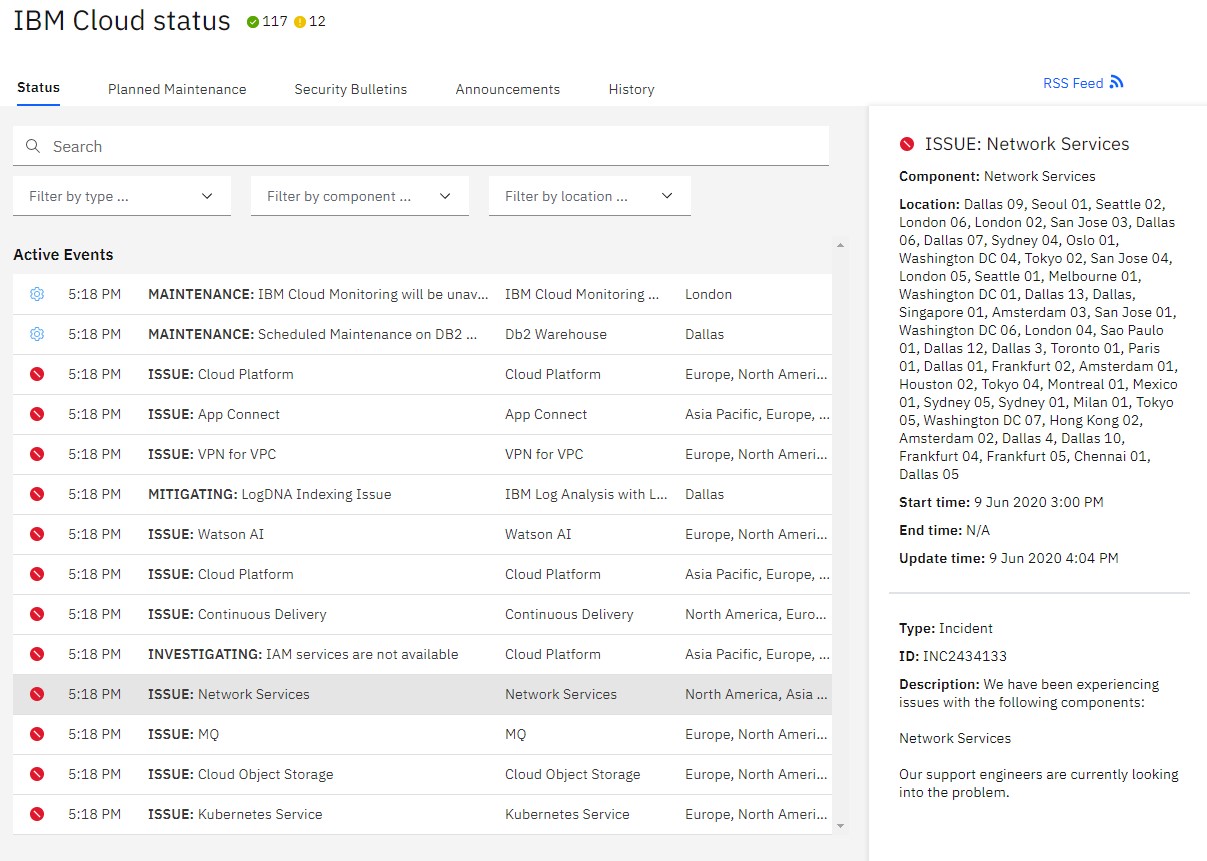
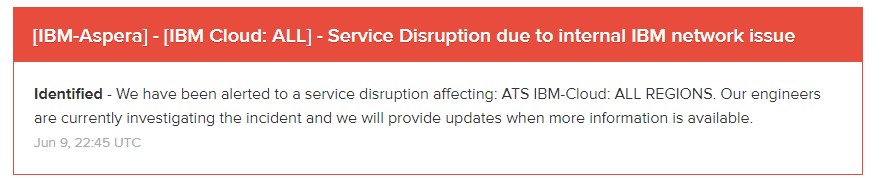
The IBM Cloud is currently suffering a major outage, and with that, multiple services that are hosted on the platform are also down, including everybody’s favorite tech news aggregator, Techmeme.

It looks like the problems started around 2:30pm PT and spread from there. Best we can tell, this is a worldwide problem and involves a networking issue, but IBM’s own status page isn’t actually loading anymore and returns an internal server error, so we don’t quite know the extent of the outage or what triggered it. IBM Cloud’s Twitter account has also remained silent, though we found a status page for IBM Aspera hosted on a third-party server, which seems to confirm that this is likely a worldwide networking issue.

IBM Cloud, which published a paper about ensuring zero downtime in April, also suffered a minor outage in its Dallas data center in March.

We’ve reached out to IBM’s PR team and will update this post once we get more information.

Update #1 (5:06pm PT): we are seeing some reports that IBM Cloud is slowly coming back online, but the company’s status page also now seems to be functioning again and still shows that the cloud outage continues for the time being.

Update #2 (5:25pm PT): IBM keeps adding additional information to its status page, though networking issues seem to be at the core of this issue.

Edtech is surging, and parents have some notes

Unlike most sectors, edtech has been booming over the last few months. Flashcards startup Quizlet is now a unicorn, digital textbook company Top Hat is finding unprecedented surges in usage and student success business Edsights raised nearly $2 million from high-profile investors, all from inbound interest. Investors are so confident that homeschooling might become a trend that they just invested $3.7 million in Primer, which creates a “full-stack infrastructure” to help parents get started.

But as tired parents juggle work, family and sanity all day, nearly every day, they say edtech is not a remedy for all education gaps right now.

Parents across all income groups are struggling with homeschooling.

“Our mental health is like whack-a-mole,” said Lisa Walker, the vice president of brand and corporate marketing at Fuze. Walker, who lives in Boston but has relocated to Vermont for the pandemic, has two kids, ages 10 and 13. “One person is having a good day. One person is having a bad day, and we’re just going throughout the family to see who needs help.”

Socioeconomically disadvantaged families have it even worse because resources are strapped and parents often have to work multiple jobs to afford food to put on the table.

One major issue for parents is balancing a decrease in live learning with an uptick in “do it at your own pace” learning.

Walker says she is frustrated by the limited amount of live interaction that her 10-year-old has with teachers and classmates each day. Once the one hour of live learning is done, the rest of the school day looks like him sitting in front of a computer. Think pre-recorded videos, followed up by an online quiz, capped with doing homework on a Google doc.

Asynchronous learning is complicated because, while it is not interactive, it is more inclusive of all socioeconomic backgrounds, Walker said. If all learning material is pre-recorded, households that have more kids than computers are less stressed to make the 8 a.m. science class, and can fit in lessons by taking turns.

“Even though I know there’s a lot of video fatigue out there, I would love there to be more live learning,” Walker said. “Tech is both part of the problem and part of the solution.”

TraLiza King, a single mother living in Atlanta who works full time as a senior tax manager for PWC, points out the downside of live video instruction when it comes to working with younger children.

One challenge is overseeing her four-year-old’s Zoom calls. King needs to be available to help her daughter, Zoe, use the platform, which isn’t intuitive for kids at that age. She helps Zoe log on and off and mute when appropriate so instruction can go on interrupted, ironically enough.

Her 18-year-old college freshman could supervise the four-year-old’s learning, but King doesn’t want her older daughter to feel responsible for teaching. It leaves King to play the role of Zoom tech support, and teacher, in addition to mom and full-time employee.

“This has been a double-edged sword; there’s beauty in it that I get to see what my girls are learning and be a part of their everyday,” she said. “But I am not a preschool teacher.”

Some parents are finding success in pretending it is business as normal. The moment that Roger Roman, the founder of Los Angeles-based Rythm Labs, and his wife saw that there was a shutdown, they scrambled to create a schedule for the children. Breakfast at 6 a.m., physical education right after, and then workbook time and homework time. If their five-year-old checks all the boxes, he can “earn” 30 minutes of screen time.
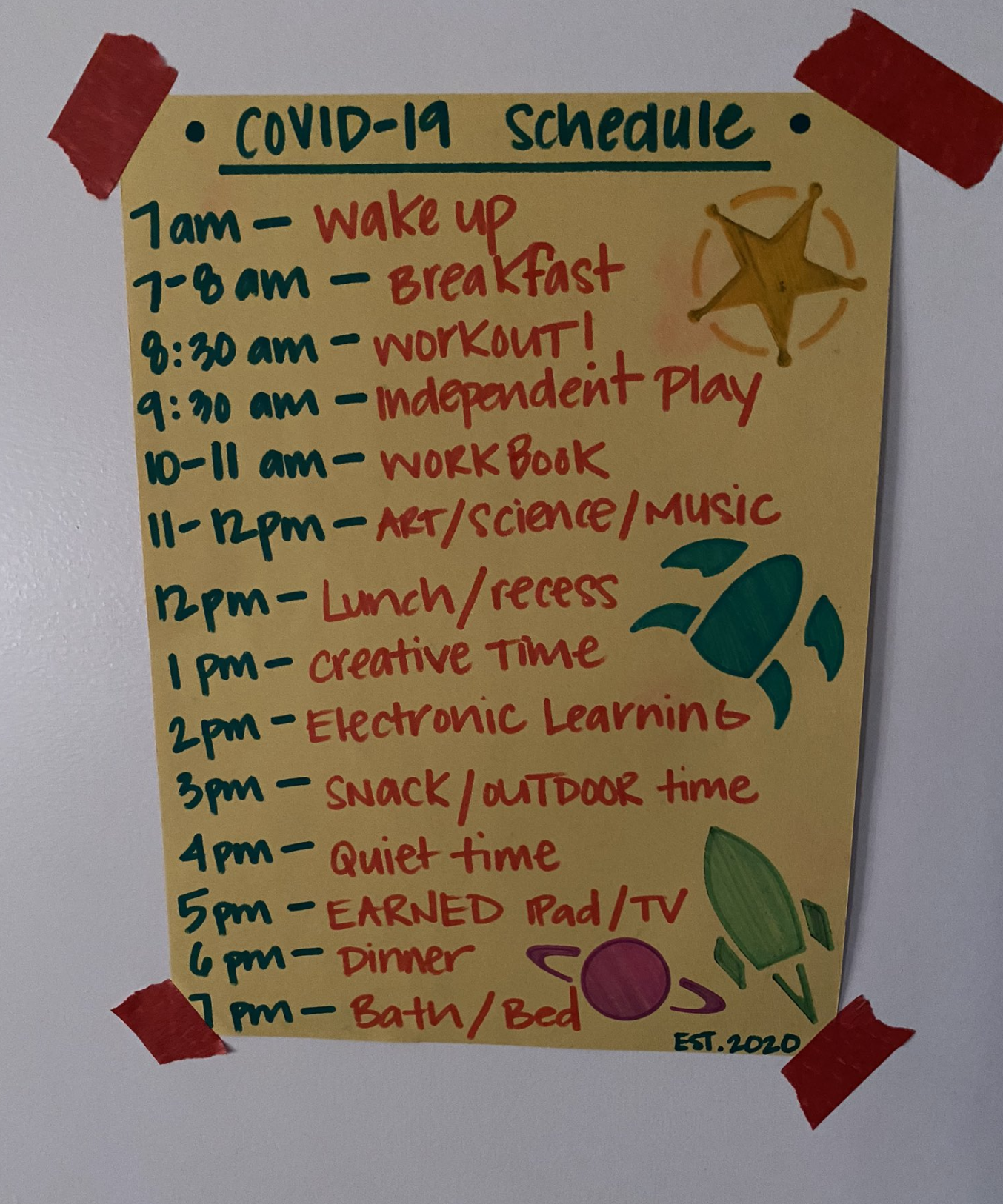
The Roman family’s schedule for their child.

Technology definitely helps. Roman says he relies on a few apps like Khan Academy Kids and Leapfrog to give him some time to take work calls or meetings. But he says those have been more like supplements instead of replacements. In fact, he says one big solution he found is a bit more low-tech.

“Printers have been a godsend,” he said

The kids being at home has also given the Roman family an opportunity to address the racial violence and police brutality in our country. The existing school curriculums around history have been scrutinized for lacking a comprehensive and accurate account of slavery and Black leaders. Now, with parents at home, those disparities are even more clear. Depending on the household, the gaps around education on slavery can either inspire a difficult conversation on inequality in the country, or leave the talk tabled for schools to reopen.

Roman says he doesn’t remember a time where he wasn’t aware of racism and injustice, and assumes the same will be true for his sons.

“The murders of Ahmaud, Breonna, and George have forced my wife and me to be brutally honest with my five-year-old about this country’s long, dark history of white supremacy and racial oppression,” he said. “We didn’t expect to have these discussions so soon with him, but he’s had a lot of questions about the images he’s been seeing, and we’ve confronted them head-on.”
Roman used books to help illustrate racism to his sons. Edtech platforms have largely been silent on how they’re addressing anti-racism in their platforms, but Quizlet says it is “pulling together programming that can make a real impact.”

What’s next for remote learning?

In light of the struggles parents and educators alike are seeing with the current set of online learning tools and their inability to inspire young learners, new edtech startups are thinking about how the future of remote learning might look.

Zak Ringelstein, the co-founder of Zigazoo, is launching a platform he describes as a “TikTok for kids.” The app is for children from preschool to middle school, and invites users to post short-form videos in response to project-based prompts. Exercises could look like science experiments — like building a baking soda volcano or recreating the solar system from household items — and the app is controlled by parents.

The first users are Ringlestein’s kids. He says they became disengaged with learning when it was just blind staring at screens, leading him to conclude that interaction is key. Down the road, Zigazoo plans to forge partnerships with entertainment companies to have characters act as “brand ambassadors” and feature in the short-form video content. Think “Sesame Street” characters starting a TikTok trend to help kids learn what photosynthesis is all about.

A preview of Zigazoo, a “TikTok for kids” and its video-based prompts“As an educator, I’ve been surprised at how little content exists for parents that is not just entertaining but is actually educational,” he said.

Lingumi is a platform that teaches toddlers critical skills, like learning English. The company began because preschool classes are packed with so many students that teachers can’t give one on one feedback during the “sponge-like years.” Lingumi uses another startup, SoapBox, and its voice tech to listen and understand children, assess how they are pronouncing words and judge fluency.

“Edtech products were designed to work in the classroom and a teacher was supposed to be in the mix somewhere,” said Dr. Patricia Scanlon, the CEO of SoapBox. “Now, the teacher can’t be with the kids individually and this is a technology that gives updates on children’s progress.”

Another app, Make Music Count, was started by Marcus Blackwell to help students use a digital keyboard to solve math equations. It serves 50,000 students in more than 200 schools, and recently landed a partnership with Cartoon Network and Motown records to use content as lessons for followers. If you log onto the app, you are presented with a math problem that, once solved, tells you which key to play. Once you solve all the math problems in the set, the keys you played line up to play popular songs from artists like Ariana Grande and Rihanna.

The app is using a well-known strategy called gamification to engage its younger users. Gamification of learning has long been effective in engaging and contextualizing studies for students, especially younger ones. Add a sense of accomplishment, like a song or a final product, and kids get the positive feedback they’re looking for. The strategy is found in the underpinnings of some of the most successful education companies we see today, from Quizlet to Duolingo.

But in Make Music Count’s case, it’s forgoing gamification’s usual trappings, like points, badges and other in-app rewards to instead deliver something far more fun than virtual items: music that kids enjoy and often seek out on their own.

Gamification, much like technology more broadly, is not all-encompassing of the deeply personal and hands-on aspects of school. Yet that is what parents need right now. We’re left with a reminder that technology can only help so much in a remote-only world, and that education has always been more than just comprehension and test-taking.

The missing piece to edtech: School isn’t just learning, it’s childcare

At the end of the day, if the future of work is remote, parents will need more support with childcare assistants. Some startups trying to help that include Cleo, a parenting benefits startup that recently partnered with on-demand childcare service UrbanSitter.

“As working moms desperate for a solution to the crisis facing parents today, we were focused on developing a solution that didn’t just work for our members and enterprise clients, but also one that we’d use ourselves. After experimenting and trying everything from virtual care to scheduling shifts to looking for new caregivers ourselves, we realized the only solution that would work for families would require a new model of childcare designed for the unique issues COVID-19 has created,” Cleo CEO Sarahjane Sacchetti told TechCrunch in May.

Sara Mauskopf, the co-founder of childcare marketplace Winnie, said that tech companies trying to help remote learning need to remember that “it’s not just the education aspect that has to be solved for.”

“School is a form of childcare,” she said.

“The thing that irks me is that I see these tweets all the time that ‘more people are going to homeschool than ever before,” Mauskopf said. “But no one is going to feed my toddler mac and cheese or change their diaper.”

Twitter starts putting fact-checking labels on tweets about 5G and COVID-19

Conspiracy theories claiming a connection between 5G technology and the coronavirus have been around since the pandemic’s early days, and apparently they’re still going strong.

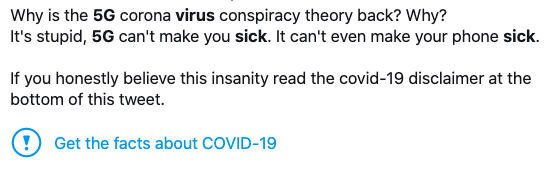
So strong, in fact, that Twitter began applying a label to some tweets about COVID-19 and 5G, encouraging users to “get the facts” about the virus. As Business Insider reported, clicking through the label leads to a page collecting sources debunking claims with links to pages like the BBC and Snopes. Earlier this year, the conspiracy was linked to a series of arson attacks on 5G towers.

Twitter’s latest wave of fact-checking labels appears to have been applied pretty broadly, even on some tweets making jokes or references to the label itself.

Expanding its fact-checking labels to apply to coronavirus 5G conspiracies is the latest instance of Twitter’s evolving platform moderation efforts. The labels stop a step short of screening or removing content altogether, instead offering up additional context and letting users reach their own conclusions. At the very least, even with its mild wording, the warning labels should help flag untrustworthy content for the platform’s most credulous users.

If you’re not investing in diverse founders, you’re a bad investor

BLCK VC
Contributor

BLCK VC is a nonprofit focused on empowering Black investors and increasing diversity in venture capital.

We won’t sit here as we have for so many years with strong faces and encouraging words and pretend that we’re not tired.

We’re tired because we’ve spent yet another week mourning our Black brothers and sisters who died unjust deaths. We’re tired because we spent half of that week holding the hands of White allies as they were reminded that racism still exists and that it is, indeed, sad. We’re tired because we’re a broken record, telling firms and companies what they can do to fight racism and rarely getting the action they so emotionally promise they care about. We’re tired of holding back anger and sadness as we talk about these issues, knowing our industry isn’t even doing the bare minimum to support Black investors. On top of advising allies, mourning lives lost and working full time jobs, we also raised over $100,000. And we’re tired of racism.

Last week, BLCK VC hosted We Won’t Wait, a day of action where we called on venture firms to discuss, donate and diversify. We asked these firms to discuss Venture’s role in combating institutional racism, to donate to nonprofits that promote racial equity and to release their data on the diversity of their investment teams and portfolio founders. These are the first steps. If you haven’t done these, you’re likely not ready for “Office Hours.” So before we get ahead of ourselves, let’s address why these steps aren’t straightforward or sufficient.

Discuss. It took nationwide uprisings for many VC firms to discuss how they could combat institutional racism. Yet, 80% of firms don’t have one Black investment professional who can identify with what we go through in both our professional and personal lives. BLCK VC held its own discussion to share that perspective, centered on the experiences of Black investors and entrepreneurs.

During this discussion, Terri Burns of GV said, “when a Black person is murdered yet again by police, it is not correct to say that the system has failed, because the system was designed that way.” It is clear that systemic racism leads to the maltreatment, dehumanization and unjustified deaths of Black people across the country. Van Jones of Drive Capital drew a fitting analogy: “Being Black is like being in lane eight with a weight vest and cement boots.” Sounds uncomfortable. But that’s how every Black person in America feels stepping out of bed everyday. For Black founders, discrimination by VCs is par for the course. Elise Smith is not alone when she puts on her daily armor to allow herself to show up in the White-dominated industries of venture capital and Silicon Valley tech.

But we’re not going to repeat what they said. Because you can watch the video, and you can do the research, and you can understand the problem on your own. Truthfully, we have no interest in explaining the problem to White VCs again and again when so many of my brothers and sisters have already spoken on it. If you’d like to know why institutional racism made venture capital so homogeneous and exclusive and racist, please see here, here, here, here and here.

What we are interested in explaining is that these are just examples of what Black investors and entrepreneurs deal with everyday. For almost every Black person in tech, these examples are not only relatable, they are commonplace. These are not the stories that shock and surprise the Black community, these are the stories of the everyday. We didn’t talk about the times we heard the N-word from your colleagues or the times they said our natural hair and beards were unprofessional. We talked about the systems.

There are so many more stories and experiences out there besides what was shared by those seven voices, so please think about what perspectives are missing when you have your discussions. Not just your discussion about racism, but your discussions about the future of venture capital, and about aerospace investing, and about COVID-19 and D2C businesses, and about hiring, and about mentoring and about golf. Black voices are so often left out of the conversations where relationships are built and investment decisions are made, but discussions that lack a Black perspective are incomplete.

Donate. Many VC firms and investors spoke last week about donating their time and resources to Black entrepreneurs and investors — what an interesting way to talk about your job. Please do not donate your time or your money to Black investors or entrepreneurs.

Invest in Black founders because they’re some of the best entrepreneurs. Invest in them because they understand an issue that you do not. Invest in them for the same reason you invest in all of your entrepreneurs — because they’re good. When you frame what you’re doing as a donation, it not only demeans what these entrepreneurs are doing and perpetuates some of the most racist aspects of venture capital, but it also prevents you from understanding that you’re bad at your job. Yes, if you don’t have a diverse pipeline or a diverse portfolio you are bad at your job. Making a separate space and separate fund for Black entrepreneurs removes firms from the responsibility they have to search for, invest in and support Black founders.

If you would like to donate money, donate money to nonprofits that fight institutional racism. If you would like to donate time, volunteer. If you would like to become a better investor, figure out why your pipeline is so homogeneous and fix it.

Diversify. Let’s circle back to an important statistic: More than 80% of venture capital firms don’t have a single Black investor. This statistic is interesting because, as much as it’s about industry trends, it’s really about the failings of individual firms. Most firms don’t have a diverse investing staff. They don’t have a diverse investing staff because they don’t understand the value of racial diversity. They don’t understand the value of racial diversity because there are no diverse investors to force them to think about diversity. Rinse. Repeat.

The single most important part of diversifying a VC firm and diversifying VC broadly is tracking the lack of diversity. Most firms do not routinely track data on their investor, deal pipeline, event or investment diversity. As a result, they rarely think about racial diversity. This is where we ask firms to start. Yes, mentorship can be helpful, office hours can be helpful, but if you’re not tracking your firm’s diversity metrics, they will not improve.

What now? Okay, you’ve discussed racism with your partners, you’ve donated money to nonprofits and you (hopefully) started tracking the diversity of your firm. Now what? Racism resolved? Probably not.

Hopefully these conversations made you realize where your firm’s specific shortcomings are, and you have to address those. Most firms will realize they have a pipeline problem, so start there. Do all of your events, dinners and programs have Black representation? When you’re trying to fill an investor role, did you post the job on your website and in different Black online communities? Did your final round of candidates reflect the diversity of our country? Did you support the diverse investors you already employ so they don’t feel disadvantaged, under-advocated and left out? When you’re trying to write new checks, did you utilize Black scouts and consider businesses that don’t address you directly?

When you’ve done all of that, ask yourself this: When the protests quiet down, and articles about racial oppression aren’t at the top of your timeline, what will you be doing? Don’t let it just be office hours. Don’t let the enormity of the work ahead paralyze you against taking action now. Your actions matter. Your inaction matters.

The resilience of the Black community is unparalleled. That resilience means that no matter how tired we are, we will still fight to change this country and to change this industry. It means that no matter how many times we don’t want to advise allies, we will. And it means that no matter how many times we face oppression and mourn for our brothers and sisters, we will still rise to the challenges. And while the stories of overt racism and microaggressions will continue, so too will our drive to move forward and our action to break down barriers. We will continue to build a home for ourselves in this industry. We will continue to work to ensure that Black Lives Matter.

What to consider before publishing your diversity memo

In the past few weeks, several venture capital firms have published different variations of the same pledge: we’ll do a better job supporting the Black community.

My timeline, and I’m assuming yours too, has been filled with statements from non-Black venture capitalists saying that they will rethink how to be more inclusive with their hiring and wiring.

There is no need to applaud firms for taking long overdue steps to treat others equally. What is more important is how we’re going to hold these firms accountable going forward, after a history of inaction.

In a memo published on Friday, Matchstick Ventures outlined a series of commitments to fight racism and underrepresentation. The firm, which manages nearly $37 million dollars and is led by Ryan Broshar and Natty Zola, turned to Black entrepreneur Clarence Bethea for advice on how to proceed.

The pledge stood out for two firm reasons: It is more robust than most promises we have seen by high-profile firms, and it has actual numbers and a deadline, which are key to benchmarking progress.

Disclose your current diversity statistics

Matchstick says 7% of the companies it has invested in have Black founders or founding team members, which is seven times the industry average. Portfolio diversity data needs to be more largely released by the VC community because it’s the only way to determine if progress is being made. So far, beyond Matchstick, we’ve only seen Initialized Capital release diversity metrics. Union Square Ventures said that of moe than 100 investments, only a few have been in self-identified Black founders.

Podhero launches a $5.99 subscription app where you can support your favorite podcasts

Podhero is offering listeners a new way to pay their favorite podcasters.

The startup behind the app is led by Pete Curley and Garret Heaton, who previously founded HipChat (sold to Atlassian) and launched Swoot last year, which was focused on helping you find new podcasts through sharing.

In a Medium post published today, Curley wrote that despite Swoot’s “great retention and passionate users,” the team realized that podcasters faced a bigger problem: “It’s really hard to make money,” with 97.2% of podcasts not monetizing at all.

You’re probably used to hearing ads in some of your favorite podcasts, but Curley said only 1.4% of podcasts have ads. Meanwhile, he suggested that “subscription services are the most fair and predictable way for creators to make money,” and that “if 50% of podcast listeners paid for ad-free shows — creators would make $3.7 billion/year, nearly 6x more than ads made in 2019.”

So Podhero has launched its own subscription podcast app, but unlike Luminary — which has been criticized for taking a more closed approach to the previously open podcast ecosystem — it’s not trying to lure listeners to pay for exclusive content. Instead, it’s taking something closer to the Patreon approach of financially supporting creators.

Of course, podcasters can already ask for support via Patreon, but Curley argued that the service isn’t right for many podcasters, due to the extra work involved, the 8% cut taken by Patreon, the pressure to create bonus content and the fact that they simply don’t like asking for money.

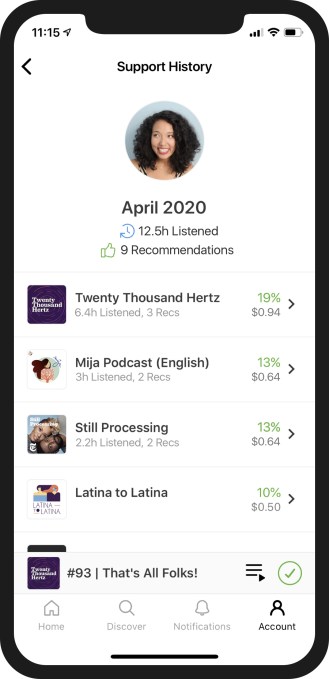
Podhero is supposed to make it easier for both the podcaster and the listener, who pays a $5.99 subscription fee every month. That includes an optional $1 fee for Podhero, plus $4.99 that’s divvied up among podcasts.

Podhero will automatically create a list of podcasts based on your listening activity, but you can adjust the list and the percentages at any time. And Curley isn’t fully giving up on sharing as a discovery mechanism — listeners can also recommend podcast episodes, which affects their payouts as well.

While Podhero is launching today, the company says it’s already populated with more than 1 million podcasts. Most of those podcasters don’t work with Podhero — for example, TechCrunch’s podcasts are in the app even though we don’t have a business relationship. Curley told me via email that if a podcaster isn’t working with the startup yet, any money contributed by fans will be saved for whenever they claim their Podhero profile.

“We may have to do something with unclaimed money at some point, but [that’s] not a problem we’ll be worrying about for some time,” he said.

Sign up for tomorrow’s Pitchers & Pitches session

We’re just 24 hours away from the second installment of Pitchers & Pitches. If you want to whip your elevator pitch into shape, select your favorite beverage and join us for an interactive pitch-off and feedback session. We kick off tomorrow, June 10 at 4pm ET / 1pm PT. It won’t cost you a penny, so register here today.

You’ll walk away with insightful advice and actionable tips to help you create a 60-second pitch that highlights the best of your business. The companies competing in the pitch-off will vie for a consulting session with cela, an organization that connects early-stage startups to accelerators and incubators that can help them scale their business.

Note: The Pitchers & Pitches webinar series is free and open to all, but only companies that purchased a Disrupt Digital Startup Alley Package are eligible to pitch. We randomly chose these five startups to compete:

  • Scanta protects machine learning algorithms and the businesses that use them.
  • Qualetics has developed a platform that helps Startups and SaaS companies scale AI-based solutions.
  • Findster gives pet parents peace of mind by monitoring pets’ health and safety 24/7.
  • Hiago is a hyperlocal social network that empowers cities to organize neighbors around shared interests.
  • Whip Mobility is a B2B SaaS platform for auto dealerships.

The VCs providing feedback for this session are Amish Jani, managing director at First Mark Capital and Merritt Hummer, partner at Bain Capital Ventures. On the TechCrunch side, we have Darrell Etherington and Jordan Crook, two TechCrunch editors with years of experience coaching founders in Startup Battlefield, the OG of startup pitch competitions. The four will evaluate the pitches and offer insightful feedback. The virtual audience will declare the pitch-off winner.

Whether you compete or simply watch and take copious notes, you’ll hear plenty of ideas and tips to help you craft the kind of pitch that captures investor interest, imagination and — not to be too crass about it — money.

Grab every opportunity to keep your startup moving forward. Register for Pitches & Pitchers today, and join us tomorrow, June 10 at 4pm ET / 1pm PT.

Is your company interested in sponsoring or exhibiting at Disrupt 2020? Contact our sponsorship sales team by filling out this form.

Republican senators ask FCC to examine Section 230, following Trump order

On May 29, the president of the United States of America tweeted, simply, “REVOKE 230!” The message was all caps, with an exclamation mark for good measure. The message was nothing, if not direct, following the issuing of an executive order, which, among other things, seeks to strip away key protections under Section 230 of the Communications Decency Act.

Today, four Republican senators sent an open letter to the FCC, urging chairman Ajit Pai to examine the “special status” afforded to social media sites under the statute. The letter, authored by Marco Rubio, Kelly Loeffler, Kevin Cramer and Josh Hawley reads, in part:

Social media companies have become involved in a range of editorial and promotional activity; like publishers, they monetize, edit, and otherwise editorialize user content. It is time to take a fresh look at Section 230 and to interpret the vague standard of “good faith” with specific guidelines and direction. In addition, it appears that courts have granted companies immunity for editing and altering content even though the text of Section 230 prohibits immunity for any content that the company “in part … develop[s].” These interpretations also deserve a fresh look. We therefore request that the FCC clearly define the framework under which technology firms, including social media companies, receive protections under Section 230.

The letter adds that, unlike Trump, who currently has around 82 million followers, “everyday Americans” are “sidelined, silenced, or otherwise censored by these corporations.” Trump himself has had a longstanding problem with the rule, which he and fellow Republicans have accused of enabling the censorship of conservative free speech. While he’s long been rumored to be interested in killing the legislation, Twitter’s decision to issue a warning label on a Trump tweet appears to have been the final straw.

Pai previously voiced a disinterest in regulating social media sites in that manner. Speaking to Reuters, the chairman declined to comment one way or the other, stating that he didn’t want to “prejudge a petition that I haven’t seen.”

Earlier today, the statute’s author, Senator Ron Wyden, penned an op-ed defending 230, writing:

Just look at Black Lives Matter and the protests against police violence over the past week as an example. The cellphone video that captured the officer kneeling on George Floyd’s neck spread across social media platforms — and it’s the reason Americans learned about his unjust killing in the first place. So many of these cases of unconscionable use of force against black Americans have come to light as a result of videos posted to social media.

Nikola Motor to open pre-orders for fuel cell pickup truck to compete with Ford, Tesla

Nikola Motor Company, the Arizona startup that made its debut as a publicly traded company June 4, will open reservations later this month for a hydrogen fuel cell electric pickup truck that was designed to compete with the Ford F-150.

Reservations, or pre-orders, will open June 29 for the hydrogen-electric pickup truck known as the Badger, Nikola Motor founder and chairman Trevor Milton tweeted Tuesday.

The company’s initial focus has been to design, develop and eventually produce hydrogen-electric Class 8 trucks and build out hydrogen station infrastructure throughout North America. Since its founding in 2014, the company has expanded its hydrogen-electric vision to powersports and more recently to pickup trucks. The company shared in February the first details about the Badger pickup truck, which will be available as a battery electric or fuel cell vehicle.

Nikola Motor has not produced any products yet. It doesn’t even have a factory. The company is building a factory in Coolidge, Ariz. The site has been cleared and construction will begin in 2020, Milton told TechCrunch in a recent interview, adding that he hoped for it to start this summer.

Against that backdrop of bold vision but no products — or even revenue — Nikola Motor is valued at $28.63 billion as of market close Tuesday. Nikola’s market capitalization eclipsed Ford at one point Tuesday.

I've wanted to say this my whole adult life; $NKLA is now worth more than Ford and FCA. Nipping on the heels of GM. It may go up or down and that's life but I'll do my part to be the most accessible and direct executive on Twitter. Others will follow.

— Trevor Milton (@nikolatrevor) June 9, 2020

Nikola became a publicly traded company through a reverse merger with VectoIQ, a publicly traded special purpose acquisition company led by GM’s former vice chairman Stephen Girsky. Since its June 4 debut, the stock has had a short volatile ride, trading at more than 112% higher than its debut price of $37.55. Shares closed Tuesday at $79.73.

Badger takes aim at Ford, Tesla

“We went directly after the Ford F-150 market and it’ll be a direct competitor to the Tesla Cybertruck as well,” Milton told TechCrunch.

Milton said the pickup truck won’t compete with Rivian, which is also planning to produce an electric pickup truck.

“The Rivian is a small truck like a Toyota Tacoma and will not compete in the construction world nor the Ford F-150, bigger pickup market that’s focused on home businesses, construction and things like that. The Rivian is more of a consumer model that is used for outdoor recreational activities.”

The Badger has some eye-popping specs, including up to a 600-mile range, 906 horsepower and 980 pound-feet of torque, according to Nikola Motor. The battery electric version will be able to travel 300 miles on a single charge and can be upgraded with fuel cells to double the range. The company expects the Badger to go into production in 2022.

But Nikola doesn’t plan to produce the Badger on its own, according to Milton. Instead, the company plans to partner with an OEM, which Milton said will be revealed later this year.

I wanted to post something no one has seen. @nikolamotor badger pre-production interior CAD. Notice the floor mounting system? It's throughout the truck and made to secure any loads within the vehicle safely. See quality of everything – waterproof. Hidden Fridge too:) pic.twitter.com/EttmrOuqA4

— Trevor Milton (@nikolatrevor) June 8, 2020

Grow Credit, which builds credit scores by paying for online subscriptions, gets Mucker cash

Grow Credit, the startup that launched last year to help customers build out their credit scores by providing a credit line for online subscriptions like Spotify and Netflix, has added Mucker Labs as an investor and closed its seed round with $2 million in total commitments.

The Los Angeles startup founded by serial entrepreneur Joe Bayen, had been bootstrapped initially and then received funding from a clutch of core angel investors before signing a deal with Mucker earlier this month, according to Bayen.

Using the Marqeta platform, Grow Credit can extend a loan to customers to expand their subscription services. Using the Mastercard network for payments, and Marqeta’s tools to restrict payment access, Grow offers credit facilities to its customers to pay for their monthly subscriptions. By using Grow Credit for those payments, users can improve their credit scores by as much as 61 points in a nine-month span, says Bayen.

The company doesn’t charge any fees for its loans, but users can upgrade their service. The initial tier is free for access to $15 of credit, once a user connects their bank account. For a $4.99 monthly fee, customers can get up to $50 of subscriptions covered by the service. For $9.99 that credit line increases to $150, Bayen said.

Increases to a user’s credit score can make a significant dent in their costs for things like lease agreements for cars, mortgages for houses and better rates on other credit cards, said Bayen.

“Everything is cheaper, you can get access to a credit card with lower interest rates and better rewards,” he said. “We’re looking at ourselves as the single best route to getting access to an Apple card.”

Additional capital for the new round came from individual investors like DraftKings chief executive, Jason Robins; former National Football League player and hall of famer Ronnie Lott; and Sebastien Deguy, VP of 3D at Adobe.

Coming up, Grow Credit said it has a deal in the works with one very large consumer bank in the U.S. and will be launching the Android version of its app in a few weeks.


Robocallers face $225M fine from FCC and lawsuits from multiple states

Two men embodying the zenith of human villainy have admitted to making approximately a billion robocalls in the first few months of 2019 alone, and now face an FCC fine of $225 million and a lawsuit from multiple attorneys general that could amount to as much or more — not that they’ll actually end up paying that.

John Spiller and Jakob Mears, Texans of ill repute, are accused of (and have confessed to) forming a pair of companies to make millions of robocalls a day with the aim of selling health insurance from their shady clients.

The operation not only ignored the national Do Not Call registry, but targeted it specifically, as it was “more profitable to target these consumers.” Numbers were spoofed, making further mischief as angry people called back to find bewildered strangers on the other end of the line.

These calls amounted to billions over two years, and were eventually exposed by the FCC, the offices of several attorneys general and industry anti-fraud associations.

Now the pair have been slapped with a $225 million proposed fine, the largest in the FCC’s history. The lawsuit involves multiple states and varying statutory damages per offense, and even a conservative estimate of the amounts could exceed that number.

Unfortunately, as we’ve seen before, the fines seem to have little correlation with the amounts actually paid. The FCC and FTC do not have the authority to enforce the collection of these fines, leaving that to the Department of Justice. And even should the DoJ attempt to collect the money, they can’t get more than the defendants have.

For instance, last year the FTC fined one robocaller $5 million, but he ended up paying $18,332 and the market price of his Mercedes. Unsurprisingly, these individuals performing white-collar crimes are no strangers to methods to avoid punishment for them. Disposing of cash assets before the feds come knocking on your door is just part of the game.

In this case the situation is potentially even more dire: the DoJ isn’t even involved. As FCC Commissioner Jessica Rosenworcel put it in a statement accompanying the agency’s announcement:

There’s something missing in this all-hands effort. That’s the Department of Justice. They aren’t a part of taking on this fraud. Why not? What signals does their refusal to be involved send?

Here’s the signal I see. Over the last several years the FCC has levied hundreds of millions in fines against robocallers just like the folks we have here today. But so far collections on these eye-popping fines have netted next to nothing. In fact, it was last year that The Wall Street Journal did the math and found that we had collected no more than $6,790 on hundreds of millions in fines. Why? Well, one reason is that the FCC looks to the Department of Justice to collect on the agency’s fines against robocallers. We need them to help. So when they don’t get involved—as here—that’s not a good sign.

While the FCC’s fine and the lawsuit will certainly put these robocallers out of business and place further barriers to their conducting more scam operations, they’re not really going to be liable for nine figures, because they’re not billionaires.

It’s good that the fines are large enough to bankrupt operations like these, but as Rosenworcel put it back in 2018 when another enormous fine was levied against a robocaller, “it’s like emptying the ocean with a teaspoon.” While the FCC and states were going after a pair of ne’er-do-wells, a dozen more have likely popped up to fill the space.

Industry-wide measures to curb robocalls have been underway for years now, but only recently have been mandated by the FCC after repeated warnings and delays. Expect the new anti-fraud frameworks to take effect over the next year.

Data startup Axiom secures $4M from Crane Venture Partners, emerges from stealth

Axiom, a startup that helps companies deal with their internal data, has secured a new $4 million seed round led by U.K.-based Crane Venture Partners, with participation from LocalGlobe, Fly VC and Mango Capital. Notable angel investors include former Xamarin founder and current GitHub CEO Nat Friedman and Heroku co-founder Adam Wiggins. The company is also emerging from a relative stealth mode to reveal that is has now raised $7 million in funding since it was founded in 2017.

The company says it is also launching with an enterprise-grade solution to manage and analyze machine data “at any scale, across any type of infrastructure.” Axiom gives DevOps teams a cloud-native, enterprise-grade solution to store and query their data all the time in one interface — without the overhead of maintaining and scaling data infrastructure.

DevOps teams have spent a great deal of time and money managing their infrastructure, but often without being able to own and analyze their machine data. Despite all the tools at hand, managing and analyzing critical data has been difficult, slow and resource-intensive, taking up far too much money and time for organizations. This is what Axiom is addressing with its platform to manage machine data and surface insights, more cheaply, they say, than other solutions.

Co-founder and CEO Neil Jagdish Patel told TechCrunch: “DevOps teams are stuck under the pressure of that, because it’s up to them to deliver a solution to that problem. And the solutions that existed are quite, well, they’re very complex. They’re very expensive to run and time-consuming. So with Axiom, our goal is to try and reduce the time to solve data problems, but also allow businesses to store more data to query at whenever they want.”

Why did they work with Crane? “We needed to figure out how enterprise sales work and how to take this product to market in a way that makes sense for the people who need it. We spoke to different investors, but when I sat down with Crane they just understood where we were. They have this razor-sharp focus on how they get you to market and how you make sure your sales process and marketing is a success. It’s been beneficial to us as were three engineers, so you need that,” said Patel.

Commenting, Scott Sage, founder and  partner at Crane Venture Partners added: “Neil, Seif and Gord are a proven team that have created successful products that millions of developers use. We are proud to invest in Axiom to allow them to build a business helping DevOps teams turn logging challenges from a resource-intense problem to a business advantage.”

Axiom co-founders Neil Jagdish Patel, Seif Lotfy and Gord Allott previously created Xamarin Insights that enabled developers to monitor and analyse mobile app performance in real time for Xamarin, the open-source cross-platform app development framework. Xamarin was acquired by Microsoft for between $400 and $500 million in 2016. Before working at Xamarin, the co-founders also worked together at Canonical, the private commercial company behind the Ubuntu Project.

3M files suit over third-party price gouging of N95 masks on Amazon

Amazon has promised vigilance against third-party price gouging since COVID-19 achieved global pandemic status. The company’s efforts have had mixed success, however, due in part to the sheer volume of vendors that utilize the company’s massive commerce platform. In a suit filed in California this week, 3M claims the seller was charging massively inflated prices for either damaged or counterfeit products.

“3M alleges that the defendants charged prices for the fraudulent respirators that exceeded as much as 20 times 3M’s N95 respirator list prices,” the company writes. “Amazon learned that the defendants misrepresented what would be delivered for these exorbitant prices, and that buyers had received non-3M respirators, fewer items than purchased, products in suspect packaging, and defective or damaged items. Amazon has blocked the accounts on its platform.”

N95 masks have become one of the most in-demand pieces of PPE during the ongoing crisis, due to their extreme filtration efficacy. The CDC recommends the respirators versus surgical masks, due to their ability to filter out small particles. The latter is mostly effective for large droplets and fluid. N95 masks, on the other hand, are capable of filtering out more than 95% of large and small air particles. For that reason, many groups have insisted the equipment be reserved for front-line responders.

Amazon confirmed its involvement in the suit, telling TechCrunch, “There is no place for counterfeiting or price gouging on Amazon and we’re proud to be working with 3M to hold these bad actors accountable. Amazon has longstanding policies against counterfeiting and price gouging and processes in place to proactively block suspicious products and egregious prices. When we find a bad actor violating our policies, we work quickly to remove the products and take action on the bad actor, as we’ve done here, and we welcome collaboration from brands like 3M.”

The site says it has removed more than half a million product offers and suspended more than 6,000 accounts over price gouging. In its own release, 3M claims to have been involved in the removal of more than 3,000 sites featuring counterfeit products or deceitful claims.


Facebook News launches to all in US with addition of local news and video

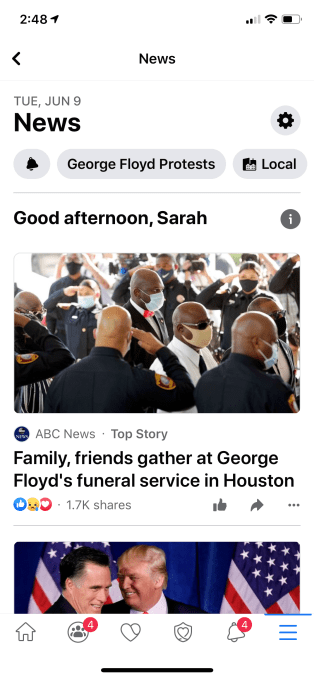
Facebook News, the social network’s dedicated section devoted to journalism, is today launching for all users in the U.S. The feature was first introduced in October 2019 as a limited test in the U.S. The product represents Facebook’s much-debated new effort in wooing publishers to its platform with the promise of increased distribution.

In addition to the nationwide launch, Facebook has also added local news to its News section.

It’s impossible to properly cover Facebook News without noting how the company has had a long and troubled history with regard to how it handles news. Years ago, Facebook offered a short list of trending stories across its network. But it later fired the human editors who curated that news, and its algorithms immediately posted fake news to the untended list. That feature was removed in June 2018.

Facebook has also over the years attempted to serve publishers with poor results.

It hosted “Instant Articles” that restricted advertising, subscriptions and the recirculation modules publishers relied on, leading many to abandon the feature. It touted the “shift to video,” but inflated its video metrics, and then pulled back on paying publishers, wiping out some businesses. In 2018, it decided to prioritize friends and family posts in its News Feed, shrinking referrals to news outlets.

Then there’s the not insignificant matter of Facebook’s role in spreading fake news — including for years the distribution of un-fact-checked links published by biased organizations. Its platform has also been used for the spread of propaganda and disinformation. It has been called out as being too favorable to one side or the other. (But all that’s a whole other kettle of fish.)

This time around, Facebook is trying a different tack with regard to News.

The new product uses journalists to program Facebook News in addition to algorithms to better personalize story selection. Users can react and share articles, but not comment. Users are also able to hide articles, topics and publishers they don’t want to see, which can become problematic in terms of broadening someone’s exposure to the “other side.”

To qualify for inclusion in Facebook News, publishers will have to serve a sufficiently large audience and abide by integrity standards. Facebook doesn’t detail exactly how it makes determinations around integrity but says it looks at signals such as misinformation as identified by third-party fact-checkers, clickbait, engagement bait or use of scraped content, for example.

The News tab will appear to all U.S. users as a bookmark (under the three-lined “more” menu) on mobile, Facebook says. Those who frequently visit the bookmark will see News available as a tab (a button in the Facebook app) sooner.

Since the announcement last fall, Facebook has added new features in Facebook News, including breaking news alerts, timely news digests (e.g. “COVID-19 News” or “Unrest in America”), targeted notifications and more.

The notifications will appear at the top and may include alerts of a live video or breaking news — for example, you may currently see live coverage of George Floyd’s funeral or perhaps a breaking news alert about coronavirus.

Facebook is also now testing news video, which it didn’t have last fall, and it has introduced a local news section to Facebook News. The latter brings thousands more local and regional publications into the news experience across more than 6,000 towns and cities.

The company tells TechCrunch the majority of its publishers are now local outlets, as a result. In addition, it has over 200 general news publishers.

Facebook already had a way for users to keep up with local stories by way of its “Today In” news discovery experience, which had been a separate tab. In the next several weeks, the company says it will combine that tab’s content with Facebook News to make its News section a single place for users to keep up with local news.

The News feature is live now on mobile, but the desktop tab has yet to launch.