Mark Zuckerberg and Priscilla Chan respond to Chan Zuckerberg Initiative scientists’ open letter on Trump

Mark Zuckberg and Priscilla Chan have penned a response to an open letter sent last week by a group of over 140 scientists who are working on projects funded by the Chan Zuckberberg Initiative. The letter, included in full below, expressed concerns about how Facebook manages misinformation and harmful, offensive and discriminatory language toward specific groups of people — and specifically around its treatment of Trump’s offensive, racist and dangerous rants.

The response from Chan and Zuckerberg thanks the scientists for expressing their concerns, and says specifically that both are “personally […] deeply shaken and disgusted by President Trump’s divisive and incendiary rhetoric,” and it also acknowledges that despite CZI and Facebook existing as wholly separate entities, they obviously share a common leader in Zuckerberg.

The letter goes on to point to some of the recent blog posts and resources that Facebook has published regarding its chosen position, as well as what it will be doing to review its existing policies around its products as they pertain to racial issues and social justice.

The response from CZI’s top leaders does say that Facebook’s policies are not its own, however, and goes on to suggest that from its perspective, it will be committing to doing more around addressing racial inequities and injustice.

NEW —

Mark Zuckerberg & Priscilla Chan have responded to the 270+ scientists at the @ChanZuckerberg Initiative who called on Zuckerberg to curb misinformation.

Zuckerberg says he and Chan are "deeply shaken and disgusted by President Trump’s
divisive and incendiary rhetoric." pic.twitter.com/j5ziU15Ik9

— Teddy Schleifer (@teddyschleifer) June 12, 2020

Ultimately, the letter from Chan and Zuckerberg doesn’t say very much of substance, and if anything actually re-emphasizes the problem at the core of the letter from the concerned scientists to begin with. It notes the contradiction in having the entities remain separate in terms of elements of their guiding principles while led by a common individual, but doesn’t directly address the main ask of the scientists, which is that Zuckerberg use his position at Facebook to wield the power of that platform for greater social good, not that the CZI change its behavior necessarily.

This is bound to be a recurring tension for CZI and Facebook going forward, given the relative positions and participants in each. It’s unlikely that responses like this one will do much to quell any long-term concerns on the part of CZI researchers and academics.

Volkswagen launches home EV charging system sales ahead of ID.3 vehicle deliveries

Volkswagen has started to sell a home-charging device as the automaker prepares to bring its new ID family of electric vehicles to market.

The ID.3 is the first electric vehicle under the ID label and will only be sold in Europe. Customers who made reservations for the launch edition, known as ID.3 1st, will be able to order their vehicle starting June 17. Volkswagen said this week that the deliveries for the ID.3 1st will begin in September.

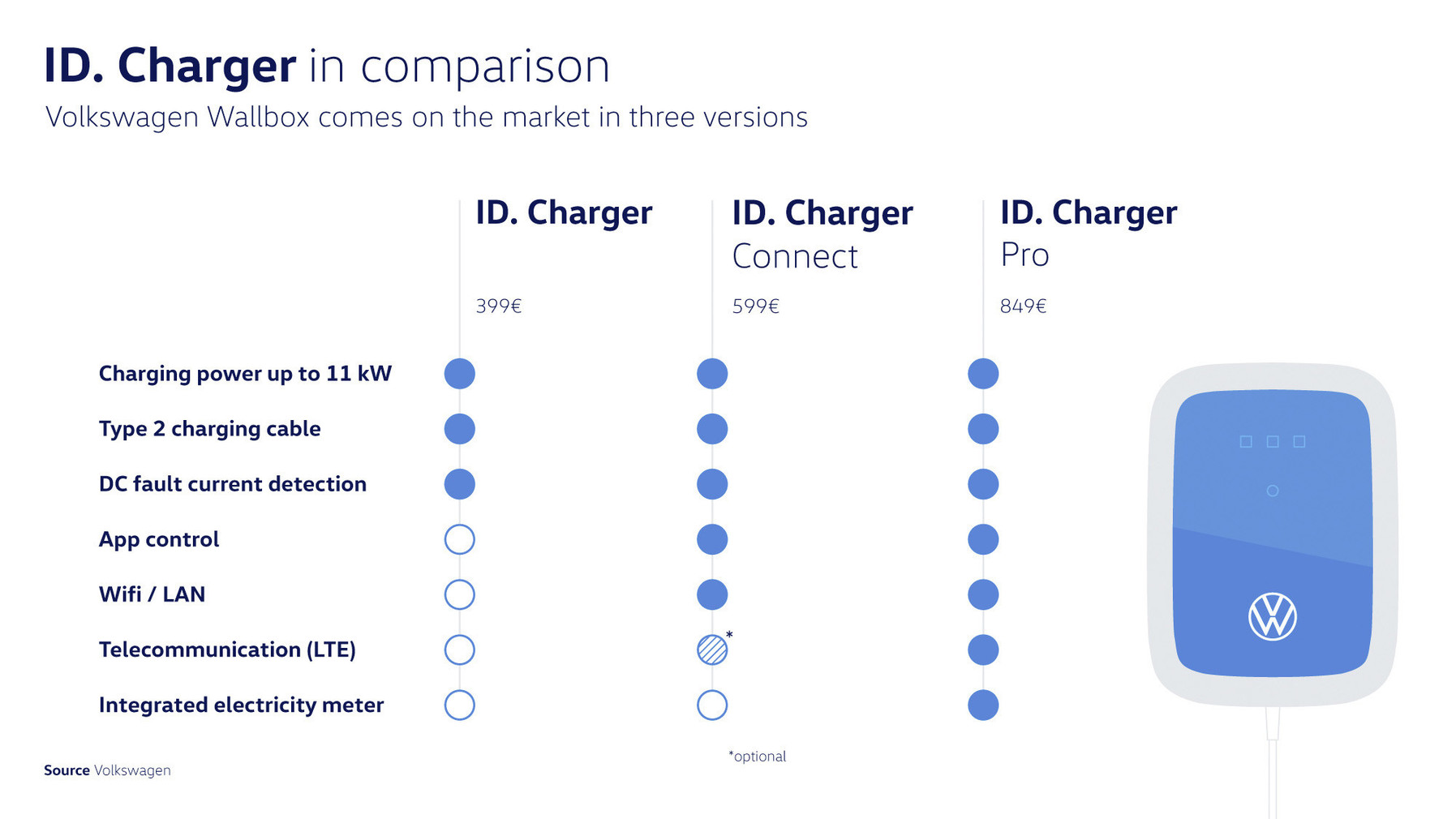
And that means that, at least for now, the home-charging device known as Wallbox will only be available for sale in eight countries in Europe. Volkswagen is making three versions of the Wallbox that will range in price between €399 and €849 ($448 to $953). Those prices don’t include the cost of installation.

All of the versions will have a charging capacity of up to 11 kilowatts, permanently mounted Type 2 charging cable and integrated DC residual current protection. For now, just the base model is available, according to VW.

The two premium models, the ID. Charger Connect and ID. Charger Pro, will be available later this year. These models come with additional software that allows for the kind of interaction and analytics that Tesla owners are more familiar with. The ID. Charger Connect will allow customers to link their smartphone to control charging processes. The ID. Charger Pro has that connectivity feature plus an integrated electricity meter designed for commercial uses. The integrated meter can be used to bill electricity costs for company car drivers, according to VW.

Wallbox Volkswagen ID. Charger

Image Credits: Volkswagen

The ID.3 is the first model in the company’s new all-electric ID brand and the beginning of its ambitious plan to sell 1 million electric vehicles annually by 2025. The ID.3 will only be sold in Europe. Other models under the ID brand will be sold in North America.

BLCK VC co-founder Sydney Sykes talks specific actions firms can take to be more inclusive

BLCK VC is on a mission to double the number of Black venture capitalists out there by 2024. The reason behind it shouldn’t need explaining — only 2% of all partner-level VCs are Black, and 81% of VC firms don’t have a single Black partner. It’s no surprise then, that the startup ecosystem that is built underneath the VC community is sadly and drastically homogeneous.

We sat down with BLCK VC co-founder and co-chair Sydney Sykes on an episode of Extra Crunch Live to talk about the ongoing protests, the state of the VC industry with regard to diversity and inclusion, and actionable insights and strategies around how we can be more inclusive across all facets of the tech ecosystem.

Because we believe this is a critical conversation to have and engage with, we’ve made this episode and the complete Q&A free.

Below, you’ll find a lightly edited transcript of highlights from the conversation, as well as a YouTube video of the entire chat. You’ll also find the video from BLCK VC’s “We Won’t Wait” day of action, as well as a list of resources focused on anti-racism education.

On whether tech companies’ energy in this moment will be sustained to foster long-lasting change:

You’re seeing all these tech companies saying ‘Black Lives Matter,’ and all these companies are donating. The truth is, in my mind, donating and posting statements doesn’t change the way your company works. It doesn’t change the way the industry works. So, when I hear those statements, that’s the part where I’m jaded and where I feel pessimistic and feel that things won’t change. Where I feel really optimistic is I’m seeing these employees at tech companies, and I’m seeing citizens saying, ‘No, you can’t just say Black Lives Matter. You need to actually live this.’

There’s a recognition now from the bottom up, a real grassroots effort to say, ‘you need to change what you’ve been doing because it hasn’t worked.’ I think these companies have been and they will need to continue to react to what their employees and what their customers are saying. So, I am more optimistic than I’ve ever been. That being said, I am still a black woman in America and I do not think that what’s going on right now will cure racism in any way. I’m optimistic, though, that things will be better in the future. In a month from now compared to where things were a month ago, how much better? We’ll have to wait and see. But I’m excited to see what the changes will be.

On creating and fostering change from within versus outside of an organization:

I first got interested in venture late in college. I was scrolling through the different pages of different VC firms, just black and white photos of white male investors. I felt that, just by being in this industry, just by joining a venture firm as an investor as a black woman, that I was initiating change and that I was making a difference. For me, I personally felt like the best way that I can cause action and that I can cause changes was from being on the inside. I don’t think that’s the right choice for everyone. I also don’t think that the onus should always be on people of color to put themselves in uncomfortable positions because they don’t think that those industries, those companies, will change without them being there. So I think it’s a balance.

On the one hand, you have boycotts that have worked in the past. That’s total abstinence. That’s total removal from a system that’s unjust. And on the other hand, you have people who are inside and they also are driving change in the environment.

I think there’s no right answer to how you drive change. If you are listened to and you have a voice, you need to speak up in the way that’s most powerful. So in the case of Alexis Ohanian, if he leaves, and him leaving is him raising his voice, that’s a powerful way to use your voice. There’s also a powerful way to use your voice from the inside. But at the same time, if he’s been speaking up all along and nothing’s changed, then maybe him leaving is speaking even louder, and maybe that is one approach. If you can’t make change from the inside, why should you waste your time there? Why not go somewhere else where you can actually drive change?

On the importance of tracking diversity numbers within VC firms:

It’s really important for people within firms, existing GPs and investors, to be aware of how big the issue is. If you don’t write it down, you don’t have to recognize what you’re missing and what is lacking. I’m not optimistic that, in the next couple of years as firms start writing down their data, that they will suddenly be representative of the U.S. population, or that they will be recognizing the value. But I also think it’s a bit of a snowball effect. If you get more diverse talent in the door or in the network, or at least on the radar, then you’re thinking about diversity more when you do your investment, when you host your events, when you’re expanding what the ecosystem looks like, even though it’s not going to change right away.

Frankly, a lot of the firms that reach out to us are already aware of and understand, to some extent, institutional racism. They understand implicit bias, and they understand that they are missing talent. It’s true that those are not the people or the firms who need the most help.

But when we do get firms who are willing to engage with us, or when we get in contact with firms that aren’t diverse or don’t have any diverse investors, it’s about talking about the value that diversity adds. In study after study, we see that businesses, investors and companies are better when they are more diverse, that their company will be better if they have that diversity. It’s just shown time and time again.

So even if you think your portfolio is as good as it could be, or your investor is as good as they could be, it’s probably not true. I also like to highlight the fact that it’s about having an informed perspective.

Your investors, the people you’re speaking with, the people you’re making investment decisions with, that perspective is only as informed as it is diverse. So if you don’t have diversity on that investment committee, making decisions about sending out those dollars, then you’re lacking a perspective and you’re missing information.

On best practices around tracking D&I:

On the VC firm side of things I recommend tracking top-level employees. What percent of your high-level employees represent diverse backgrounds, gender, LGBTQ and all that kind of data. Then, I also recommend tracking that at the seniority level, so associates, controllers, partners, GPs. How many of those people have diverse backgrounds. Then, beyond that, I think it’s also important to track your pipeline. How many of your candidates coming in are from diverse backgrounds or different schools. All those metrics are important, as well, because then you can see where the pipeline is falling short. When you host events, what do your speaker series look like? Do your panelists all look just like you?

I also think, on the entrepreneur side of things, it’s really important to look at the dollar amount spent. How many dollars are going towards founders from different backgrounds, rather than the number of diverse founders you’re investing in.

And lastly, and this is more of an intangible thing, but where are you going to find the entrepreneurs you’re investing in. Are they recommendations from other investors? Are they reaching out to you via cold calls and emails? Are you going to different colleges and universities and inviting them to your pitch days? So there’s also some pipeline tracking work that can be done there that is really important.

On increasing the number of Black partners at traditionally white VC firms versus encouraging Black VCs to start their own firms:

There are two approaches.

The first is the idea that these very large, predominantly white firms control a very large amount of the assets that are distributed in venture capital; $80 billion+ a year, and I’m sure a very large portion of that comes from the top 10 firms. So, it’s very difficult to parallel the amount of dollars being invested by the largest firms by starting up a brand new fund.

I also think it’s really important to have these Black-led VC firms that invest, without being beholden to any GPs above them. They have a very valuable perspective. We need both.

We need Black investors starting their own fund, starting their own firms, and investing in founders they believe in, whether they’re Black or not or brown or not. We also need people at the largest funds, making sure that the very, very large amount of wealth creation and job creation is being implemented and invested in a way that reflects the diversity of our country and reflects the perspectives of Black investors.

On separate funds dedicated to investing in underrepresented entrepreneurs, like the ones from SoftBank and a16z:

We always used to hear and still do sometimes hear the term ‘pipeline issue,’ which has always been a euphemism in the past to say that there’s not enough Black talent out there, which is just not true. There is a pipeline issue and it’s that these firms don’t have diverse pipelines because they don’t have diverse personal networks, and they haven’t tried to build out their networks. They tend to invest in people like them, and they tend to talk to people that look like them. That is the pipeline. I don’t know how these firms will change.

You mentioned SoftBank. There are a couple of funds right now dedicated to investing in underrepresented entrepreneurs, and I think any dollars put towards Black founders is a good thing. I’m having a hard time understanding the need for a separate fund to invest in diverse founders. If you have not been investing in diverse founders, how will a separate pile of money change anything? I don’t know. So you have to look at it and ask what is the issue? Why haven’t you been investing in diverse founders?

Do you think they don’t have good enough companies? That they don’t have enough good talent? They don’t have enough experience? I know none of those things are true. The approach I recommend is, above everything, change your pipeline. If it’s not working, change it. Go out there and meet founders, meet investors who are investing in diverse companies in a way that you haven’t. There are firms out there that are doing that. And if you feel like you can’t do that right away, then how about bringing in diverse scouts and giving them the money to invest? There are plenty of great Black founders, CEOs, investors, angel investors who would be wonderful scouts who can invest on a firm’s behalf and really put those dollars out there. That will instantaneously change things.

If you feel like you can’t do that, put your money into the funds that are actually doing it right now. Precursor is a great example. There are quite a few other funds that have been able to find incredible, diverse talent. Backstage Capital is another. There are quite a few of them. If you can’t do any of those things, I mean, I don’t know. I don’t think you’re trying.

On recommendations for aspiring Black investors who feel disillusioned or locked out of the VC community:

Don’t stop trying. You will not always get a response, but send cold emails, try to find the connections, a friend-of-a-friend in your network, and try to build up a network in venture. I know it’s difficult, but keep trying. I also recommend working with entrepreneurs to learn what that aspect of the job is like that will help you build up a skill set. So if there are any entrepreneurs around you, ask how you can work on a project with them, or interview them. There are a lot of accelerators and incubators that will offer opportunities for you to shadow or intern with them. That’s a really good approach and there can be more jobs on that side.

Truthfully, a lot of the jobs in venture go to somebody who comes from investment banking. That’s not the only approach, but being in the investment banking system or the startup ecosystem are helpful ways to get around venture capitalists that are a bit more accessible than the venture industry itself. It is a challenging road. The best approach for you is just trying to expand your network and putting your feet to the ground and
being proactive about it.

On firms that are waking up to this issue and want to make changes but are scared of coming off as opportunistic or performative:

Performative allyism is a problem.

You’re saying something that you don’t live. That is the only problem with all of this. If you live it, it’s not performative. It’s actual, if you genuinely believe what you say, what you put on social media, what you talk about. If you want to start recruiting in diverse ways, that won’t look opportunistic or performative. You will look enlightened. And maybe that’s a dramatic turn, but it’ll look like you finally understand. I don’t think any firm should be afraid to take action, especially on diversifying their networks.

Now, where you come into a risky space is when you start to think about the dollars you invest and the hiring you do as an act of, you know, good PR, or as an act of charity. There are incredible Black entrepreneurs out there and you should be investing in them because they will improve your portfolio. They will introduce you to even better investors. They will give you better opportunities to improve your funds. You should invest in hiring black investors because they will expand your network, they will provide you opportunities to think about problems in a different way. They will provide a different perspective and a different opinion, and they will be some of your best investors and investments. If you are hiring them, and you are not giving them the power to invest dollars, if you’re not giving them the opportunity to speak up and share their voice, that is performative. That is not helpful. It will not change lives, it will not change racism, it will not change the shape of this industry, and it will not make your portfolio and your firm better.

On the progress that’s been made in the past several years:

One great example is Elliott Robinson. He’s on our founding BLCK VC board, and now a GP at Bessemer. He is very well listened to in the VC community, not just in the Black VC community. I think that is a sign of progress. He has check-writing power.

I also like to see the movement of white allies stepping down from boards to make space for Black advisors to be on an independent board. That’s hugely important. It’s an important trend to keep continuing because board seats are an incredible source of influence and wealth and are very important to diversify.

I also am excited to see the groundswell of support from white allies from tech company employees, standing up and saying, ‘we just want to stand for your policies, we won’t stand for policies that don’t promote Black investors or Black employees at the same rate as their white counterparts, and we won’t stand for policies that support initiatives that promote institutional racism.’ I think that is all very empowering. Oh, I’m curious to see how this movement keeps going. I’m very hopeful. I think there is a tension and there’s action, and there is an excitement that I’ve never seen. I think we just need to try and keep moving that forward.

Following, you’ll find a list of resources for anti-racist education in the tech and VC industry and more broadly. This list is by no means comprehensive but is a great place to start.

On bias in tech:

Tech orgs focused on racial equality:

Reading List:

Movies:

TV Shows:

The complicated calculus of taking Facebook’s venture money

Facebook is reportedly getting into the venture capital game, but for young entrepreneurs working in social media, ignoring or deleting that particular friend request could be the right call.

According to a report in Axios, the company is building up a corporate fund under the auspices of its “New Product Experimentation” team, which launched last year. The company posted a job opening looking for a “head of investments” for the new division and now has new job openings in the group for two “founder” positions in New York City and Menlo Park, California. 

Axios reported that the role would “manage a multimillion dollar fund that invests in leading private companies alongside top venture capital firms and angel investors,” according to a now-deleted post. The new hire will join Shabih Rizvi, a former partner at the Alphabet-backed corporate venture firm, Gradient Ventures, who began his career in venture at KPCB.

While Facebook said that the new investment arm would complement the work that the company already does to support startups through accelerators and hackathons, investors at some of Silicon Valley’s venture capital firms were skeptical. Perhaps with good reason, since the group that houses Facebook’s new investment team is hiring its own “founders” and has already developed a few apps that could compete with existing startups.

“[Money] of last resort,” one investor wrote in a text. Another said it would be a way for Facebook to spot potential acquisitions early enough to avoid triggering antitrust concerns, which may be good for Facebook, but bad for startups. “[Facebook] can’t buy 100 million-user apps any more,” this investor wrote in a direct message. “It needs to buy them closer to 10 million.”

Daily Crunch: Snapchat is getting mini apps

Snap announces a bunch of new features, Moderna prepares for the final-stage trial of its coronavirus vaccine and Sony shows off the PlayStation 5.

Here’s your Daily Crunch for June 12, 2020.

1. Snapchat debuts Minis, bite-sized third-party apps that live inside chat

Snap Minis are lightweight third-party programs that users can quickly pull up in the Chat section. This allows them to complete tasks without switching apps, like ordering movie tickets, comparing class schedules, studying a flashcard deck or going through a guided meditation.

The news came at a virtual version of the Snap Partner Summit, in which the company also announced a number of AR updates, including Lens voice search, a bring-your-own machine learning model update to Lens Studio and a geography-specific AR system that will turn public Snaps into spatial data.

2. Moderna set to start final-stage trial of its coronavirus vaccine by July

Pharmaceutical company Moderna told Bloomberg that it’s on pace to begin by July the final-stage clinical trial of its vaccine for the novel coronavirus that causes COVID-19. The company has previously said that it could potentially begin offering experimental doses available to healthcare workers in limited capacities as early as this fall.

3. And finally … here’s Sony’s PlayStation 5

Sony finally revealed the PS5 tower in all its glory. It doesn’t look entirely un-router-like — but if so, it’s a sleek-looking router.

4. Chris Cox returns to the fold as Facebook’s chief product officer

After a very high-profile departure last year, Facebook’s former chief product officer Chris Cox will return to his long-held position. He said the unique national and global climate of 2020 influenced his decision, particularly the coronavirus pandemic, its subsequent economic devastation and the nation’s current focus on “a reckoning of racial injustice.”

5. Why are unicorns pushing back IPOs when the Nasdaq is near record highs?

Instacart just announced that it has raised fresh capital at a valuation north of $13 billion. DoorDash, meanwhile, is reportedly looking to add more cash at a pre-money valuation that exceeds $15 billion. Both announcements make it plain that late-stage unicorns are still able to attract huge sums despite a putatively uncertain IPO market. (Extra Crunch membership required.)

6. Microsoft’s Brad Smith says company will not sell facial recognition tech to police

Microsoft is joining IBM and Amazon in taking a position against the use of facial recognition technology by law enforcement — at least, until more regulation is in place.

7. UK competition watchdog launches investigation into Facebook’s $400M acquisition of Giphy

The UK Competition and Markets Authority — the country’s antitrust watchdog — announced that it has launched an investigation into Facebook’s acquisition of Giphy. Specifically, it’s looking to see how and if the deal will lessen competition in the two companies’ respective markets.

The Daily Crunch is TechCrunch’s roundup of our biggest and most important stories. If you’d like to get this delivered to your inbox every day at around 9am Pacific, you can subscribe here.

Two weeks left to save on TC Early Stage passes

Are you an early stage founder? Then listen up, because we created TC Early Stage just for you. This two-day virtual conference takes place on July 21-22. We’ll provide the details below, but first things first. Early bird tickets cost just $199 for early-stage founders, but this sweet deal flies south on June 26 at 11:59 p.m. (PDT). Avoid the price hike. Buy your ticket now and save $50.

TechCrunch Early Stage sprouted roots in Extra Crunch, our subscription-based editorial content that offers founders extensive analysis and advice on essential topics. Think about Early Stage along the lines of an accelerated accelerator for early founders — only with more experts across a bigger range of the startup ecosystem.

With more than 50 presentations from which to choose, you’ll get your burning questions answered by people who know the score. We’re talking actionable, how-to advice on crucial topics that every early stage founder needs to know — legal, investing, marketing, tech development, recruiting, pitching and a bunch more.

Here’s another reason to get your ticket sooner rather than later. We limit each breakout session to 100 people, and sign-up is on a first come, first serve basis. But don’t fret about missing something essential. Videos of all the sessions will be available on demand after the event.

Ready for a taste of what you can expect to experience at Early Stage? Check out these examples and be sure to check out the agenda here to find out which sessions you want to attend.

  • When it comes to fundraising, timing is everything — There are some shockingly common timing mistakes founders make that can turn an otherwise successful fundraise into a failure. Jake Saper, partner at Emergence, will discuss how to avoid them and how to sequence efforts from the time you close your seed to ensure you find the right partner (at the right price!) for Series A and beyond.
  • Growth marketing: Minimum viable email — Love it or hate it, email is here to stay. But understanding where it fits into the conversion funnel, and how to maximize its impact can be arduous. Learn from Sound Ventures partner Susan Su how to optimize open rates, deliverability, unsubscribes and conversions for consumer and enterprise products alike.
  • Think like a PM for VC pitch success — Your pitch deck is not just a reflection of your business, it’s a product unto itself. Your startup’s success, and avoiding the end of your runway, depends on the conversion rate of that product. Hear from Lo Toney, Plexo Capital founding partner, about how thinking like a PM when crafting your pitch deck can produce outstanding results.

TC Early Stage takes place on July 21-22. Want to keep some money in your pocket and score a seat at your choice of breakout sessions? Buy your early bird ticket now. Prices go up on June 26.

Is your company interested in sponsoring TC Early Stage? Contact our sponsorship sales team by filling out this form.

Snapchat looks to maintain its own friendships — with devs

Over the past few years, Snapchat has been building up an increasingly complex weave of partnerships.

They have their advertising partners that power the vast majority of their monetization efforts. They have app developers on Snap Kit that they are also selling new features like CameraKit and Minis too. They’re bringing game developers on board for their Snap Games initiative, including another partnership with Zynga, which they announced today. They’re also continuing to chase mobile-first original content programming for Snapchat Discover. Sometimes these distinctions can create grey areas. For instance, in a conversation with TechCrunch, Ben Schwerin, Snap’s VP of Partnerships, insists Snapchat isn’t competitive with Quibi, which is an advertising partner.

“Comparing Quibi and Snapchat — and I know it’s easy to do — is like comparing cable TV and Snapchat,” he says.

Snapchat is perhaps better positioned than any other app in the United States to replicate what Tencent’s WeChat has pulled off in China, turning a friend-to-friend messaging app into a national platform. Snap is still a long way from pulling that off, but on Thursday at their annual Snap Partner Summit, they shared some of the required building blocks for making that happen, namely richer third-party experiences via upgrades to their developer kit and a new initiative called Snap Minis.

Snap says they now have 800 developers that have integrated with Snap Kit and that a combined 150 million users access these integrations on a monthly basis.

In the U.S., developers have had a largely frayed relationship with social media companies. Companies like Facebook and Twitter have significantly locked down many of the developer capabilities they launched with, often turning off features that were key to developer experiences overnight. Snapchat’s dedicated developer platform Snap Kit is only two years old at this point, but witnessing the pitfalls faced by Facebook in regard to privacy has allowed Snap to build out a platform that brings developers into the fold with certain features but keeps the real treasure — Snapchat’s social graph — buried inside its walled garden.

Facebook’s ‘Deepfake Detection Challenge’ yields promising early results

The digitally face-swapped videos known as deepfakes aren’t going anywhere, but if platforms want to be able to keep an eye on them, they need to find them first. Doing so was the object of Facebook’s “Deepfake Detection Challenge,” launched last year. After months of competition the winners have emerged, and they’re… better than guessing. It’s a start!

Since their emergence in the last year or two, deepfakes have advanced from niche toy created for AI conferences to easily downloaded software that anyone can use to create convincing fake video of public figures.

“I’ve downloaded deepfake generators that you just double click and they run on a Windows box — there’s nothing like that for detection,” said Facebook CTO Mike Schroepfer in a call with press.

This is likely to be the first election year where malicious actors attempt to influence the political conversation using fake videos of candidates generated in this fashion. Given Facebook’s precarious position in public opinion, it’s very much in their interest to get out in front of this.

The competition started last year with the debut of a brand new database of deepfake footage. Until then there was little for researchers to play with — a handful of medium-size sets of manipulated video, but nothing like the huge sets of data used to evaluate and improve things like computer vision algorithms.

Facebook footed the bill to have 3,500 actors record thousands of videos, each of which was present as an original and a deepfake. A bunch of other “distractor” modifications were also made, to force any algorithm hoping to spot fakes to pay attention to the important part: the face, obviously.

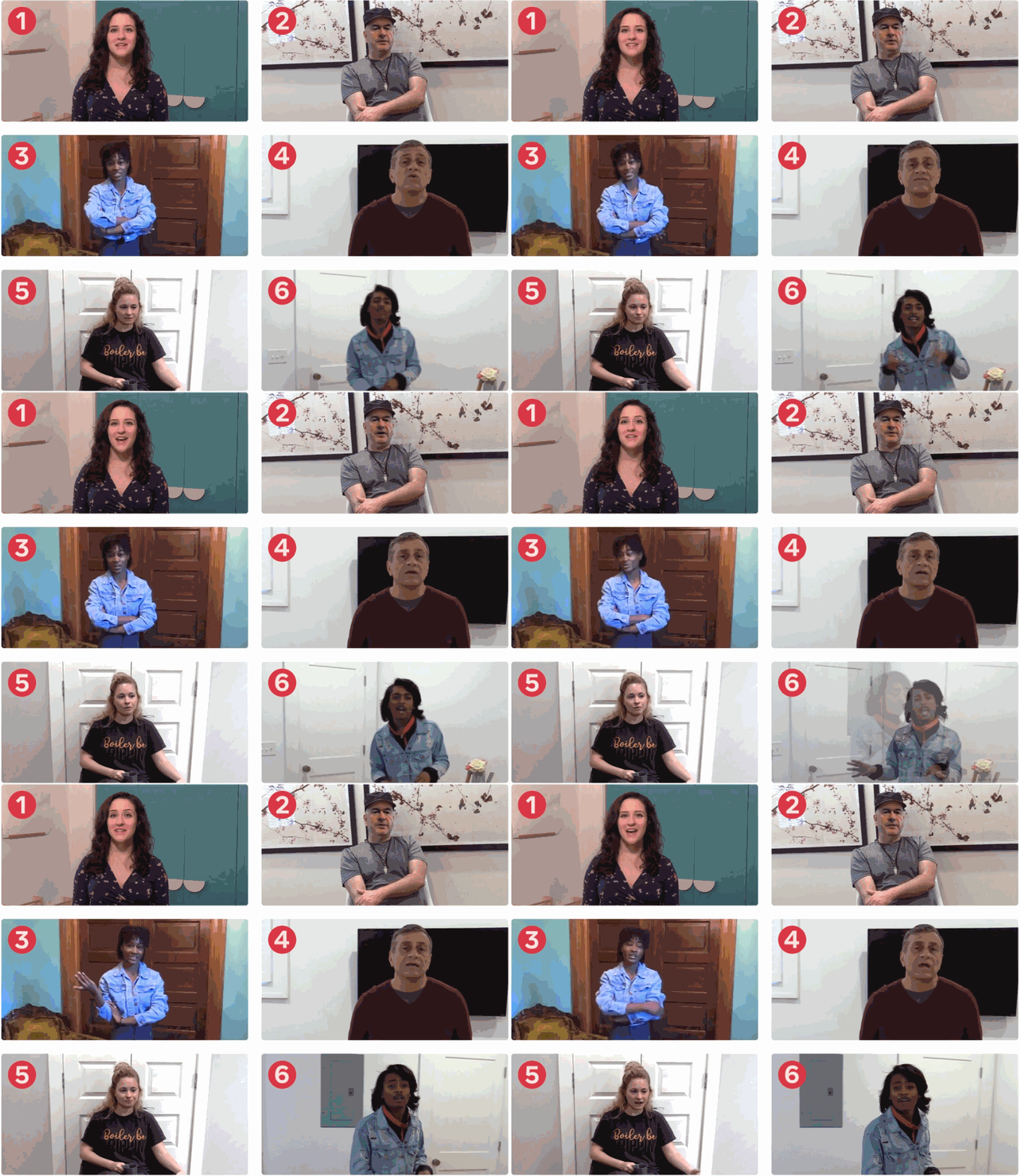
Researchers from all over participated, submitting thousands of models that attempt to decide whether a video is a deepfake or not. Here are six videos, three of which are deepfakes. Can you tell which is which? (The answers are at the bottom of the post.)

Image Credits: Facebook

At first, these algorithms were no better than chance. But after many iterations and some clever tuning, they managed to reach more than 80% accuracy in identifying fakes. Unfortunately, when deployed on a reserved set of videos that the researchers had not been provided, the highest accuracy was about 65%.

It’s better than flipping a coin, but not by much. Fortunately, that was pretty much expected, and the results are actually very promising. In artificial intelligence research, the hardest step is going from nothing to something — after that it’s a matter of getting better and better. But finding out if the problem can even be solved by AI is a big step. And the competition seems to indicate that it can.

Examples of a source video and multiple distractor versions. Image Credits: Facebook

An important note is that the data set created by Facebook was deliberately made to be more representative and inclusive than others out there, not just larger. After all, AI is only as good as the data that goes into it, and bias found in AI can often be traced back to bias in the data set.

“If your training set doesn’t have the appropriate variance in the ways that real people look, then your model will not have a representative understanding of that. I think we went through pains to make sure this data set was fairly representative,” Schroepfer said.

I asked whether any groups or types of faces or situations were less likely to be identified as fake or real, but Schroepfer wasn’t sure. In response to my questions about representation in the data set, a statement from the team read:

In creating the DFDC dataset, we considered many factors and it was important that we had representation across several dimensions including self-identified age, gender, and ethnicity. Detection technology needs to work for everyone so it was important that our data was representative of the challenge.

The winning models will be made open source in an effort to spur the rest of the industry into action, but Facebook is working on its own deepfake detection product that Schropfer said would not be shared. The adversarial nature of the problem — the bad guys learn from what the good guys do and adjust their approach, basically — means that telling everyone exactly what’s being done to prevent deepfakes may be counterproductive.

(Answers to deepfake detection image: 1, 4, and 6 are real; 2, 3, and 5 are deepfakes.)

Computex 2020 is officially canceled

In March, the Computex organizers delayed the trade show from June to late-September. At the time, the realities of COVID-19 were sinking in for many in the international community, while the trade show’s home of Taipei was dealing with a new flareup of the novel coronavirus. At the time, late-September also felt like a fairly safe bet for some return to normality.

Three months later, however, the timeline now feels overly optimistic. Today, the show’s organizers announced that Computex 2020 won’t be happening. Instead, the show has been “rescheduled” to June 2021. That’s a nicer way of saying that Computex will be missing a year, following in the footsteps of other large tech shows like Barcelona’s MWC, which was among the first to be felled by the virus.

A press release notes that Taiwan has largely been spared the virus. The country’s 443 confirmed cases and seven deaths are made all the more remarkable by its proximity to mainland China. Of course, a big part of containing the virus have involved travel lockdowns. Inviting some 43,000 people from around the world to attend an indoor event in your most populous city seems like a reasonably good recipe for spreading the highly contagious virus.

The show will happen June 1-5 2021, putting it back in line with previous years’ events. There also will be some online programming in the meantime. Other shows, meanwhile, have announced plans to go on as planned. Notably, IFA will once again be held in Berlin in September, albeit with a mandated cap on attendance. January’s CES, on the other hand, will go ahead as planned in Vegas.

Cue Health’s portable, fast COVID-19 test gains FDA emergency approval

Fresh off a $100 million Series C funding round, molecular diagnostics startup Cue Health has more good news — it has received an Emergency Use Authorization (EUA) for its rapid, point-of-care COVID-19 test. The company got a $13 million grant from BARDA in March to help it scale its development and deployment of rapid diagnostics, and its COVID-19 test is obviously a key focus of that effort given the current pandemic.

Cue’s test is portable and uses an RNA detection method to confirm the presence of the actual virus in a patient’s system using nasal swab samples. The company says that it can provide results in as little as 25 minutes, and it’s relatively simple to administer — both factors that make it potentially very useful in efforts to scale COVID-19 testing as the pandemic and its ensuing global health crisis continues.

The Cue Health test comes as a kit that includes the sample collection wand, along with a test cartridge. The cartridge connects to an app on a smartphone and transmits the diagnostic results to that device. Under the terms of the EUA granted by the FDA, the Cue test can be administered anywhere, so long as it’s done under the supervision of a qualified healthcare professional. Cue says it’s seeking additional authorizations from the FDA to expand use of the test to include allowing it to be done in settings including workplaces, schools and even in-home use.

To start, Cue Health’s COVID-19 test will be rolling out in partnership with “leading healthcare institutions,” according to the company, and then from there the plan is to expand it to a number of additional healthcare facility settings. Ultimately, Cue’s goal is to create a range of molecular diagnostic testing solutions for not only COVID-19, but also influenza and other viruses, with the ability to flexibly deploy and conduct them in basically any setting where they’re needed.

Pipo Saude raises $4.6 million to bring healthcare benefits management services to Brazil

Pipo Saude, a Brazilian provider of healthcare services for businesses and their employees, has raised $4.6 million in a new round of funding to expand its footprint in Brazil.

“The company’s platform offers recommendations for the healthcare products that fit the team, enabling businesses to improve the quality of life of their employees,” said chief executive and co-founder, Manoela Ribas Mitchell. “We go all the way to the end beneficiaries.”

Pipo Saude helps companies price their insurance appropriately and bring down the medical loss ratio that companies suffer. Medical inflation in Brazil may be worse than in the U.S., with prices rising at around 20% per year.

Like the U.S., people in Brazil often default to hospitals and urgent care facilities when they’re sick or injured; that “urgent care culture,” as Mitchell calls it, drives up the cost for providers and employers. “We try to move the needle toward preventive care and specialist doctors,” Mitchell said.

Backing the company with a $4.6 million round are two of Latin America’s top investment firms — Monashees and Kaszek Ventures . OneVC, the San Francisco-based investment firm that also invests in Latin American tech companies, also participated in the round.

Pipo Saude makes money off of commissions and has a few corollaries in companies like Zenefits (in its earliest days), Amino or the Canadian care benefit management company, Mitchell said.

The company currently has about 30 employees on staff, and some of the new cash will be used to scale the business.

For co-founders Mitchell, Vinicius Correa and Thiago Torres, the healthcare market was an obvious choice when they looked to start their own company. Torres and Mitchell had known each other as students at the University of São Paulo, where they both studied economics. Mitchell and Torres both pursued careers in private equity, where Mitchell worked at Temasek and then at Actis, focusing on healthcare, while Torres also went to Agavia Investimentos.

Correa worked in startups, initially as an employee at Nubank, where he met Mitchell through a mutual friend.

While healthcare may be a tough knot to unravel — especially for a startup — the size of the Brazilian market alone is enormous. “We’re talking about a $50 billion revenue pool,” says Mitchell. “If we want to build a very robust product we have to focus on Brazil for quite a while.”