Investors based in San Francisco? That’s so 2019

As coronavirus keeps offices closed, wealthy venture capitalists are moving out of apartments in San Francisco and New York and decamping to other vacation-friendly zip codes. In San Francisco, a city known for high housing costs, rates for a one-bedroom apartment have dropped 9% from a year ago.

As one investor said to me the other day: Will Lake Tahoe’s seed ecosystem have a resurgence?

Bourgeois bunker jokes aside, this new redistribution of investors could create some interesting — and perhaps more inclusive — changes in the way venture-backed businesses are funded.

If the wealthy are no longer a quick drive from San Francisco, are they more open to doing remote investments? Or will the newly distributed investors put their money where their mailing address is? The permanent change is contingent on if, nor when, the world reopens, but for now let’s get into the first wave of reactions.

Matchstick Ventures’ Natty Zola said most investors fall into two buckets: A crowd that only invests in their backyard, and those who are explicitly all-in on certain geographies outside their home base. Then, the coronavirus hit and everyone went remote.

For a firm like Zola’s, which invests in Minneapolis and Denver, the remote wave could mean a rush of generalist investors who are newly considering dipping their toes in the smallish ponds that Matchstick focuses on.

Daily Crunch: WhatsApp launches payments

WhatsApp is adding support for in-app payments, Apple is upgrading the MacBook Pro and Mac Pro desktop and we argue about the future of startup hubs.

Here’s your Daily Crunch for June 15, 2020.

1. WhatsApp finally launches payments, starting in Brazil

After months of talks and trials, WhatsApp has finally pulled the trigger on payments. Users in Brazil will be the first to be able to send and receive money through the messaging app, using Facebook Pay.

WhatsApp says that the payments service — which currently is free for consumers to use, but comes with a 3.99% processing fee for businesses receiving payments — will work by way of a six-digit PIN or fingerprint to complete transactions.

2. Apple adds new MacBook Pro graphics option and Mac Pro SSD upgrade kit

A week before kicking off WWDC, Apple introduced a pair of upgrades to its pro-level hardware lines. Both the 16-inch MacBook Pro and the Mac Pro desktop are getting select internal upgrades, starting today.

3. 3 perspectives on the future of SF and NYC as startup hubs

Three TechCrunch writers address one of the big questions about the future: Will tech continue to centralize in hubs like San Francisco and New York City, or will remote work and all the other second-order effects lead to a more decentralized startup ecosystem? (Extra Crunch membership required.)

4. Interstellar Technologies’ privately developed MOMO-5 rocket falls short of reaching space

The company first launched a vehicle in 2017, but the launch didn’t go exactly as planned and failed to reach space. In 2019, its MOMO-3 sounding rocket did break the Karman line, though just barely, and unfortunately its MOMO-5 sounding rocket launched over the weekend did not make space, as planned.

5. Introducing The Exchange, your daily dive into the private markets

The Exchange is Alex Wilhelm’s regular dive into the financial side of the startup world, and how the public markets exert gravity (or lift) on private companies. These themes might sound familiar to Daily Crunch readers, since we’ve linked to plenty of Alex’s pieces, but now it’s an official column with an official name.

6. Tesla’s US-made Model 3 vehicles now come equipped with wireless charging and USB-C ports

Tesla Model 3 vehicles produced at its Fremont, Calif. factory will reportedly come standard with a wireless charging pad and USB-C ports, upgrades that were first spotted by Drive Tesla Canada.

7. This week’s TechCrunch podcasts

The latest full-length episode of Equity discusses Facebook’s new startup venture fund, while the Monday news roundup covers the latest problems at Quibi. Over at Original Content, we review the latest season of “Queer Eye.”

The Daily Crunch is TechCrunch’s roundup of our biggest and most important stories. If you’d like to get this delivered to your inbox every day at around 9am Pacific, you can subscribe here.

SpaceX will have to demonstrate Starlink internet’s low latency within the next month to qualify for up to $16B in federal funding

SpaceX is in the process of building out its Starlink network of low-Earth orbit small satellites that will provide the backbone of a global, high-bandwidth, low-latency internet service — but there’s a clock running out in terms of at least one potential source of funding for it to recoup revenue from those efforts. The FCC requires that anyone participating in its $16 billion federal funding auction for rural broadband access demonstrate latency under 100 milliseconds, but anyone who hopes to qualify must meet that threshold within the next month.

The FCC has issued a report (via Engadget) on the Phase 1 auction for this lucrative funding, serving as advance notice ahead of its actual auction date of October 29, 2020 — but companies have to submit their applications to compete for said auction by July 15. In the report. the FCC acknowledges that any satellite provider operating at LEO has a potential advantage over providers who are using much higher altitude, geostationary satellites instead, but also qualifies that by noting that in order to pass the stated threshold they must also pass it taking into account delays introduced by relay stations, hubs and destination terminals.

SpaceX, for its part, believes that the FCC needn’t doubt its network’s abilities, and says that in fact it’s aiming for latency times under the 20 millisecond mark, which is better in some cases than traditional terrestrial cable-backed bandwidth networks.

In terms of deployment, SpaceX has been moving fast with Starlink, especially in 2020. Thus far, it has launched seven missions this year for the constellation, sending up a total of 418 satellites — which is actually more than any other private satellite operator even has currently working. The sprint is about building the network to the point where it can begin to serve customers in the U.S. and Canada by sometime later this year, and then expand to more customers globally later on.

SpaceX seems to be on track to make that happen, but the requirements for this more lucrative tranche of government funding might be too soon relative to those goals. Still, there are other federal contracts related to this initiative that it would be eligible for later on.

Silq is a new high-level programming language for quantum computers

Quantum computing hardware continues to improve to the point where we may actually see real-world use cases in the next few years and so it’s probably no surprise that we are also seeing a steady increase in research projects that focus on how to best program these machines. One of the newest efforts in this space is Silq, a high-level programming language for quantum computers out of Switzerland’s ETH Zurich.

The emphasis here is on “high-level programming language,” as the researchers behind the language note that existing quantum languages for programmers still work at a very low abstraction level, which makes life for quantum programmers a lot harder than necessary.

“The history of the project is that we wanted to solve a core problem in quantum computing,” ETH associate professor of computer science Martin Vechev told me. “And if you want to solve a core problem in quantum computing, for instance, if you want to analyze and reason about quantum programs, you need to have a language in which these problems are expressed — and there are existing languages. We looked at various problems in quantum computing but what kept coming up as a fundamental issue is that we looked at the programs and how they are expressed — and you see that this is not ideal, this is not optimal.”

So the team started looking into the different languages that people are currently using, including the likes of Microsoft’s Q# and SDKs like IBM’s Qiskit.

“Originally, we didn’t think we would need to create a new language,” Vechev’s Ph.D. student Benjamin Bichsel added. “And we didn’t even consider this in the very beginning. We wanted to solve much more advanced problems in quantum computing. We thought, okay, let’s quickly pick a language and then work with that. And then we realized that the existing languages are completely inadequate for the kind of more high-level properties that we are interested in reasoning about.”

One of the co-authors of the paper on Silq that the team is presenting this week at PLDI 2020 (which includes Timon Gehr and Maximilian Baader, together with Bichsel and Vechev, as co-authors), even said he wouldn’t work with any of the existing languages because they were too annoying for him.

So what’s wrong with the existing languages? “A great way to start entering this is looking at one of the fundamental challenges in quantum computation that doesn’t appear in classical languages, which is that of uncomputation,” Vechev noted. Indeed, uncomputation is at the core of Silq’s approach and built-in natively. While there is a classical analog to uncomputation, it’s not necessarily the most intuitive of concepts.

“In classical languages, if you compute ‘A OR B OR C,’ you would compute ‘A OR B’ first and then use this to compute ‘[the result of this] OR C,’ and just forget about this temporary value that you’ve computed in the meantime,” explained Bichsel. “If you do this in quantum, then you get unintended side effects. […] The bottom line is, what you would expect to happen won’t happen in this case. So you have to deal with this somehow. And what this means for essentially all existing quantum languages is that you are forced to work at a very low level of abstraction, where you have to think about all temporary values. And this essentially prevents any sort of high-level thinking.”

This means that even if you want to do something relatively trivial, like adding to integers, on a quantum machine, you have to think about all of the temporary values you create in the process and explicitly handle them.

“For quantum computation, because you always have to deal with this garbage, like the temporary values that you need to discard — you always have to deal with this. And this makes it extremely annoying to work in these languages,” said Bichsel. Current quantum languages try to work around this, but in a relatively convoluted way, while Silq enables safe, automatic uncomputation out of the box.

Vechev also added that writing low-level programs is more error-prone and makes it more difficult to understand what the algorithm is actually doing. In addition, Silq’s compiler type-checker also tries to prevent programmers from making common mistakes. The team also looked at recent developments in classical languages (like ownership types, linear type systems, etc.) and implemented them in the context of quantum computing — something that’s also a first in Silq.

It’s probably no surprise then that the team found that its language produced programs that were significantly shorter than those written in Q# and Quipper, for example, and used far fewer quantum primitives.

For the time being, Silq is still a research project that doesn’t yet run on any of the existing quantum hardware platforms. Instead, the researchers wrote their own quantum emulator to test their assumptions. “In our case, because we are more high-level, we envision the compilation as a two-step process, where first you express your high-level intent and then it’s the job of the compiler to decide which architecture will this run on and how to optimize for a particular architecture,” said Bichsel.

If you want to delve into all of the details of Silq, the teams paper is now available here.

Lo Toney has some ideas about how to (really) bring VC into the 21st century

Last week, we suggested that for a truly diverse venture industry, the limited partners who provide investing capital to VCs — institutions like universities and hospital systems — need to start incorporating diversity mandates into their work. Say a venture firm wanted to secure a commitment from the University of Texas System; it would first need to agree, in writing, to pour a certain percentage of its capital into startups founded by underrepresented groups.

Given how fragmented the world of institutional investing, the idea might sound impracticable. But Lo Toney, one of a small but growing number of black VCs in Silicon Valley, suggests it might actually be inevitable. He points, for example, to pension funds like the California Public Employees’ Retirement System, which manages the assets of 1.6 million employees, many of whom “look like me,” says Toney. Imagine what might happen if they started asking more questions about who is managing their money.

Not that Toney is waiting on this development. He doesn’t need to. As a former partner at Comcast Ventures, then GV, Toney was able to secure Alphabet as the anchor investor in his own investment firm, Plexo Capital, whose debut vehicle has been funding venture outfits, as well as making direct startup investments. Now, with renewed attention being paid to the dearth of people of color throughout the startup industry, Plexo has LPs knocking on its door again, and Toney’s plans for that second fund involve not just helping his current fund managers but helping more investors of color form venture firms of their own.

It’s an extension of work that’s already in progress. Plexo, which closed its debut fund last year with $42.5 million — including from the Ford Foundation, Intel, Cisco Systems, the Royal Bank of Canada, and Hampton University — already has stakes in 20 funds, including Precursor Ventures, Ingressive Capital, Kindred Ventures, Equal Ventures, Boldstart Ventures, and Work-Bench.

Almost all are run exclusively or in part by people of color. Meanwhile, Work-Bench has a female cofounder in Jessica Lin, a former Cisco Systems manager. “We have enough reports from the Harvard’s and the McKinsey’s of the world to show us that diversity at all levels matters,” says Toney. “We see better performance from companies with diverse boards, public companies with diverse management teams; when there are diverse managers, we see better performance.”

With his second fund, he’s hoping to turn the dial even further. More specifically, he says, to better assist those GPs in Plexo’s first fund and to fund more black GPs, it aims to help “develop a Y Combinator of sorts” that helps them understand some of the “nuances of making the transition from being a great investor to being a great fund manager.”

Part of the idea is to institutionalize the work that Plexo already does in an ad-hoc way around helping managers to prepare marketing materials, pitch their strategy to both high-net-worth individuals and institutions, and manage LP communications after that base of investors has been established. And those are just three aspects of the many elements of fund management with which Plexo can help, he says.

Plexo is also exploring “putting a strategy in place [to] help a lot of these younger GPs with working capital, to be able to incur the expenses that it takes to start a fund [given that] it can take, on average, a million dollars.” (That’s taking into account no salary, travel expenses, service providers, and the money that a general partner typically has to kick in to his or her own the fund, he adds.)

It’s a model that Plexo thinks it can use to move things along faster than were it solely investing in individual companies.

Still, Plexo can’t do it alone. Neither can its friends and allies, some of whom include Elliott Robinson of Bessemer Venture Partners, Frederik Groce of Storm Ventures and Sydney Sykes of the retail startup Dolls Kill, who separately steer a young organization called BLCK VC that works to connect and advance black venture investors.

Toney remains especially concerned over the few people of color at bigger and later-stage venture firms — investors who might otherwise have the networks and know-how to support black entrepreneurs as their startups mature. It’s a valid worry. According to a 2018 report in The Information, there were just seven black decision-makers at the then 102 venture firms with more than $250 million under management, and those numbers are relatively unchanged. The dearth is particularly glaring for black investors who are women.

The industry could, slowly, over time, grow less homogenous and more inclusive of underrepresented groups. But it would happen faster if institutions that accept federal funding or else manage the money of public employees decided to focus more on the issue. In fact, it’s conceivable that their constituents — including donors and employees through their pension fund contributions — might at some point insist on it.

“There’s often not really a collective realization of the power and influence that one can have within our asset class to actually affect change,” says Toney. “I suspect — and I don’t know this, and I’m not part of any initiatives — that we’ll see more of these [pension] funds take a stance, and that [this shift] will come from the bottom up, from their employee base.”

It might not take much to get the ball rolling. “They could put the pressure on our industry even simply asking questions [including]: ‘How many black partners do you have?’ ‘How many women do you have?’ ‘What does the composition of your portfolio look like?’”

“Even just asking those questions as a first step — that in and of itself would affect change,” he says, “because who wants to look bad when answering those questions?”


Forget the casino, bankrupt Hertz can now sell up to $1 billion in stock

Hertz, the rental car company that is going through Chapter 11 bankruptcy proceedings, can now sell up to $1 billion in stock as it seeks to tap into one of the hottest tickets in town: traders with an appetite for short-term speculative bets.

The decision Friday by the U.S. Bankruptcy Court for the District of Delaware gives Hertz permission to sell as up to 246.8 million unissued shares to Jefferies LLC. Hertz, which made the emergency request Thursday, has not entered into an agreement with Jefferies, the company noted in a regulatory filing.

Yes, that’s right. The company, which is fighting the New York Stock Exchange from being delisted, can sell stock that might soon be wiped out completely. And it appears there are plenty of retail investors willing and ready to jump in on this scheme.

Shares of Hertz closed at $2.83 Friday, a 37.38% rise from the previous day’s close. The company has seen its share price rise more than 400% since reaching a historical closing low of $0.56 on May 26.

Last month, Hertz filed for Chapter 11 bankruptcy protection. The filing was hardly a surprise. The rental company has been crushed by the COVID-19 pandemic. Once business trips and other travel was halted, Hertz was suddenly sitting on an unused asset — lots and lots of cars. It wasn’t just that the revenue spigot was turned off. Used car prices also went into free-fall, which further devalued the fleet.

The company said in its May filing that it had more than $1 billion in cash on hand, which it said it will use to keep the business operating through the bankruptcy process. Since then, another compelling source of capital has emerged. Robinhood traders, we’re looking at you.

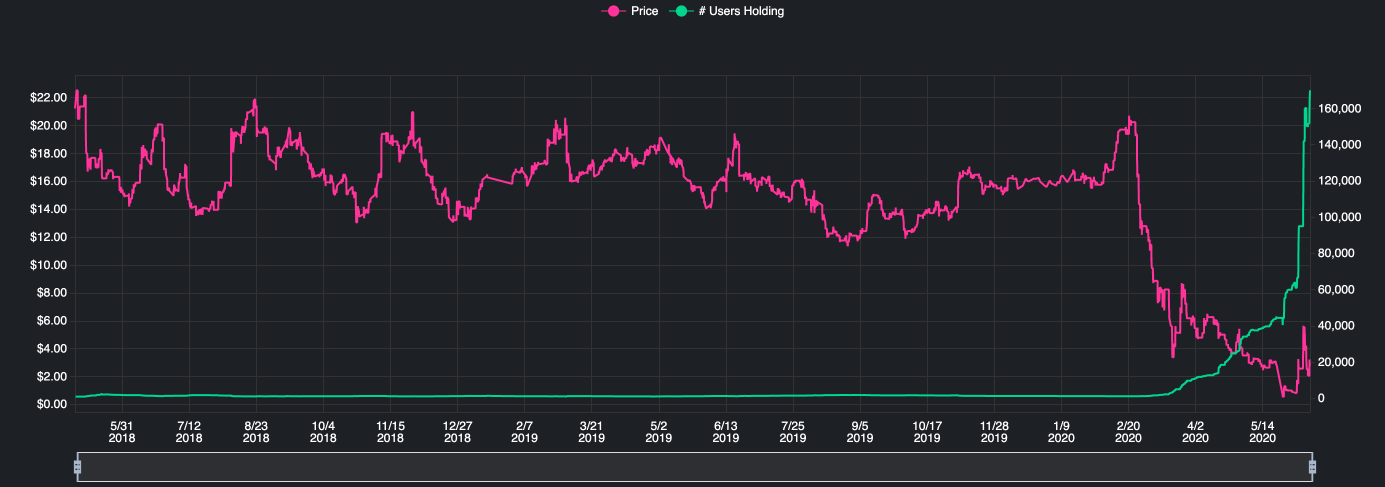
This week, Hertz was No. 2 on the popularity chart at Robintrack, a website that tracks Robinhood’s data. The chart tracks the number of Robinhood users holding a particular stock over a one-day, three-day, one-week and one-month periods. This week, the most popular stock in terms of increases in traders was Nikola Motor, a company that saw its share price skyrocket despite forecasting that it wouldn’t generate a drop of revenue until at least 2021.

To fully immerse ourselves in this puzzling trend, let’s go into the TechCrunch time machine — bleep bop bleep — and look at February 21, 2020. Hertz shares closed at $20.29, the highest closing price since January 2018. At that time, about 1,064 Robinhood users held Hertz stock.

As the COVID-19 pandemic sent the economy into a tailspin, Hertz stock followed suit and dropped more than 83% between February 21 and March 18. It rose briefly and then continued to slide until May 26 when shares closed at $0.56 (that’s down 97.24% from the closing high in February). Meanwhile, over at Robinhood, Hertz’s problems started to look like a buying opportunity. Robinhood traders began to invest in Hertz as the stock price fell. By March 18, more than 3,500 Robinhood users held Hertz stock. A month later, that number popped to more than 18,000, and then nearly doubled to surpass 43,000 users by May 21.

Robintrack - Hertz shares

Image Credits: Robintrack

Hertz filed for Chapter 11 bankruptcy May 22. And that’s when it got nutty. As of Friday, 170,046 Robinhood users held Hertz stock.

To be clear, Robinhood is just one of the many tools retail investors use. What’s popular on Robinhood might not reflect broader investor sentiment. However, it does provide a snapshot into what younger and newer investors are interested in.

Imaging startup Light is exiting the smartphone business

Light’s push into smartphones was an inevitability. Sure, the startup turned heads with its pricey L16 camera, but these days mobile photography is almost exclusively the domain of the handset. Early last year, the answer arrived in the form of the trypophobia-inducing Nokia 9 PureView.

In a category where manufacturers raced to add more cameras, the PureView had the most, with a five-hexagonal array. It was new, innovative and for most, it was overkill. At the very least, however, it gave Nokia/HMD some bragging rights and managed to set the handset apart in one of the most hotly contested corners of the smartphone hardware race.

But Light is getting out of the smartphone game. Ultimately, the competition may have just been too stiff for a small startup, especially with many manufacturers working on their own native hardware and software solutions.

Light confirmed the move this week in an email to Android Authority, writing simply that it was “no longer operating in the smartphone industry.” It’s a surprising bit of news, given that mobile partnerships seemed like the most logical way forward for the company, which drummed up a $121 million in a SoftBank-led round back in 2018. That Series D brought the Palo Alto-based company’s total funding up to more than $181 million.

More recently, it also signed deals with Sony and Xiaomi. No word on what such a move means for those partnerships going forward. Nor is it clear what life after smartphones looks like for Light. We’ve reached out to the company for more insight into its plans.

3 perspectives on the future of SF and NYC as startup hubs

It has been an incredibly tough period for everyone the past few months as the global COVID-19 pandemic has wiped out whole industries from the economic map.

While tech has been among the most resilient industries in the face of this cataclysm, the extreme mobility of the industry’s workforce begs large questions about what the future of startups and work will look like moving forward.

We’ve debated what COVID-19 will do to the rise of the college town as startup hubs and how the pandemic will change the way we work in coffee shops and neighborhoods. Now, we want to address one of the larger questions that has been bugging us: Will tech continue to centralize in hubs like San Francisco and New York City, or will remote work and all the other second-order effects lead to a more decentralized startup ecosystem?

We have three perspectives from our writers, with wildly different predictions about what the future has in store.

First, we have Danny Crichton, who believes that tech, and particularly the VC industry, will remain as concentrated as ever, although where it is concentrated will perhaps shift a bit. Meanwhile, Alex Wilhelm asserts that startup growth outside major hubs will actually accelerate, spreading tech wealth even farther outside the metropolises. Finally, Natasha Mascarenhas argues that the combination of the economic dislocation of COVID-19 and the increasing attention to equity in tech will lead to more intense investment outside core startup hubs.

Danny Crichton: A new Napa Valley café shows why in-person networks matter

First there was Sand Hill Road. Then there was South Park. And now there’s Solbar at Solage in Calistoga.

Despite the wide availability of remote work tools over the past two decades, VCs have always miraculously congregated in extraordinarily tight quarters. VCs weren’t attracted to Sand Hill’s low-slung office buildings for the architecture, which were and are a terror to eyes with a taste for anything more sophisticated than “here be four walls and a roof.” VCs didn’t head to South Park to enjoy what Google Maps calls a “tree-lined oval garden” nestled between light industrial buildings. And they aren’t heading to Solbar in Napa Valley for Californian cuisine and a dining room conveniently closed on Partner Mondays.

Internet Archive ends free e-book program, following publisher suit

The National Emergency Library is one of those well-intentioned ideas that was destined to get pushback. The brainchild of Internet Archive, the platform made north of 1.3 million books available for checkout, free of charge. The system was designed to supplement the book needs of educators, as libraries across the country remained closed during the COVID-19 pandemic.

Book publishers, on the other hand, weren’t having it. A consortium of four publishers filed suit against Internet Archive earlier this month. “Despite the ‘Open Library’ moniker, IA’s actions grossly exceed legitimate library services, do violence to the Copyright Act, and constitute willful digital piracy on an industrial scale,” Hachette, HarperCollins, Wiley and Penguin Random House wrote in the New York federal court suit.

The threat alone was enough. Internet Archive announced today that the library will close on June 15 — two weeks ahead of the original June 30 date.

“The complaint attacks the concept of any library owning and lending digital books, challenging the very idea of what a library is in the digital world,” the organization writes. “This lawsuit stands in contrast to some academic publishers who initially expressed concerns about the NEL, but ultimately decided to work with us to provide access to people cut off from their physical schools and libraries. We hope that similar cooperation is possible here, and the publishers call off their costly assault.”

Internet Archive goes on to cite all of the educators who have taken advantage of the offering, along with a librarian who utilized it to provide front-line workers with life-support manuals. In spite of those feel-good stories, however, publishers didn’t budge. Among other things, the companies took issue with IA’s lack of licensing fees and other agreed upon restrictions like traditional libraries.

It’s a longstanding complaint publishers have had against Internet Archive, going so far as accusing the organization of “willful digital piracy on an industrial scale.” Ultimately, it seems that packing up shop a couple of weeks early was the path of least resistance, though IA closes its post with hope for some collaboration going forward, writing, “Let’s build a digital system that works.”

‘The money is still there,’ says APX managing director Jörg Rheinboldt

APX is an early-stage accelerator in Berlin, but it’s not quite your average accelerator — it’s essentially a joint venture between giant European publishing house Axel Springer and Porsche, the German automaker. Earlier this month, we sat down with APX managing director Jörg Rheinboldt to discuss what makes APX different and how it’s weathering the coronavirus pandemic.

Rheinboldt has quite a bit of experience as both an entrepreneur and investor. He co-founded Alando.de, which was acquired by eBay in 1999 and donation platform betterplace.org in 2007. In 2013, he became CEO of Axel Springer Plug and Play and during his time as an investor, he put money into companies like N26, Zizoo, Blogfoster and Careship.

“We started APX because Plug and Play wanted to become more of a platform for matchmaking between startups and corporates,” Rheinboldt said when I asked him about the project’s origin. “We, the team, enjoyed investing in early-stage companies a lot and Axel Springer also enjoyed investing in early-stage startups a lot. So we decided to stop investing in new companies Axel Springer Plug and Play. We had invested in 102 companies — and focus[ed] on finding interesting teams to invest in with a new company that we needed to found.”

Image Credits: Dominik Tryba

Rheinboldt took this discussion to his boss, Mathias Döpfner, the current CEO of Axel Springer, who encouraged him to find another shareholder. “If it’s only us, you might have to do what we want — and maybe you don’t want that,” he said Döpfner told him. In looking for a partner, Rheinboldt approached the Porsche family, which he had met at some of his previous investor events. The family was looking to diversify its portfolio, so after a few more meetings, including a presentation at Porsche’s leadership summit, the two companies decided to get into this business together.

One interesting thing Rheinboldt noted — and this isn’t so much about the Porsche family as a general observation — is that family offices are often resistant to getting into venture capital, at least in Germany.

WarnerMedia tries to simplify HBO branding by sunsetting HBO Go and renaming HBO Now

WarnerMedia is hoping to make things simpler for anyone wondering whether to get HBO Max, HBO Go or HBO Now.

Back in simpler times, there were only two HBO streaming apps — Go for cable subscribers, and Now for viewers who wanted a standalone streaming subscription. Then the company launched launched HBO Max last month.

Content-wise, Max encompasses the HBO library plus a bunch of additional movies and shows. Meanwhile, from an app perspective, it was released as an update to HBO Now … except on Fire TV and Roku, where WarnerMedia has yet to reach a deal to offer Max, so the app is still HBO Now.

Just typing that out made me feel tired. And after all that, here’s what WarnerMedia announced today:

Now that HBO Max has launched and is widely distributed, we can implement some significant changes to our app offering in the U.S. As part of that plan, we will be sunsetting our HBO GO service in the U.S. We intend to remove the HBO GO app from primary platforms as of July 31, 2020. Most customers who have traditionally used HBO GO to stream HBO programming are now able to do so via HBO Max, which offers access to all of HBO together with so much more. Additionally, the HBO NOW app and desktop experience will be rebranded to HBO. Existing HBO NOW subscribers will have access to HBO through the rebranded HBO app on platforms where it remains available and through play.hbo.com. HBO Max provides not only the robust offering of HBO but also a vast WarnerMedia library and acquired content and originals through a modern product.

While the changes are tedious to explain, it sounds like they will actually result in a (somewhat) simpler set of consumer choices. Basically:

  • The HBO Max app is going to be the primary HBO app going forward.
  • If you subscribe to HBO through one of the supported cable providers (including AT&T, Comcast, Cox, DirecTV, Hulu, Optimum, Spectrum, Verizon Fios or YouTube TV), you should be able to use the HBO Max app at no additional cost.
  • If you’re trying to watch HBO on a device that doesn’t yet support HBO Max — namely, Fire TV or Roku — then you’re going to be using an app that doesn’t have all the extra content. That app has the no-frills name HBO.

See? Simple!

I've spent the last 30 min trying to turn this tweet into a story and I've just confused myself further https://t.co/SEbNhLWwtM

— Natalie Jarvey (@natjarv) June 12, 2020

NASA taps Kathy Lueders to lead its human spaceflight efforts

NASA has selected a new top official to oversee all of its efforts regarding human spaceflight — Kathy Lueders, who previously led NASA’s commercial crew program starting in 2014 and culminating in the successful first crewed demonstration launch of SpaceX’s Dragon spacecraft last month.

Lueders also previously worked on NASA’S Commercial Cargo program, which has led to the long and successful relationship between SpaceX and the agency to fly regular cargo supply missions using Dragon and SpaceX’s Falcon 9. In her new role, she’s overseen not just Commercial Crew, which includes both SpaceX and Boeing’s crewed flights, but also Artemis, the ambitious NASA program designed to bring the first American woman and the next American man to the surface of the Moon by 2024.

Officially, Lueders will now be Associate Administrator of the Human Exploration and Operations (HEO) Mission Directorate. The office was previously held by Doug Loverro, who resigned in May just ahead of the historic Demo-2 crewed launch, which it was later revealed was as a result of some kind of behavior during the contract award for the agency’s crew lunar lander program that was against its fairness rules.

The HEO is in good hands now with Lueders at the helm, given how much she’s accomplished during her tenure at NASA, and her excellent history of working in partnership with the agency’s private sector partners, including SpaceX and Boeing.

You can help a Mars Rover’s AI learn to tell rocks from dirt

Mars Rover Curiosity has been on the Red Planet for going on eight years, but its journey is nowhere near finished — and it’s still getting upgrades. You can help it out by spending a few minutes labeling raw data to feed to its terrain-scanning AI.

Curiosity doesn’t navigate on its own; there’s a whole team of people on Earth who analyze the imagery coming back from Mars and plot a path forward for the mobile science laboratory. In order to do so, however, they need to examine the imagery carefully to understand exactly where rocks, soil, sand and other features are.

This is exactly the type of task that machine learning systems are good at: You give them a lot of images with the salient features on them labeled clearly, and they learn to find similar features in unlabeled images.

The problem is that while there are lots of ready-made data sets of images with faces, cats and cars labeled, there aren’t many of the Martian surface annotated with different terrain types.

“Typically, hundreds of thousands of examples are needed to train a deep learning algorithm. Algorithms for self-driving cars, for example, are trained with numerous images of roads, signs, traffic lights, pedestrians and other vehicles. Other public datasets for deep learning contain people, animals and buildings — but no Martian landscapes,” said NASA/JPL AI researcher Hiro Ono in a news release.

So NASA is making one, and you can help.

Image Credits: NASA / JPL

To be precise, they already have an algorithm, called Soil Property and Object Classification, or SPOC, but are asking for assistance in improving it.

The agency has uploaded to Zooniverse thousands of images from Mars, and anyone can take a few minutes to annotate them — after reading through the tutorial, of course. It may not sound that difficult to draw shapes around rocks, sandy stretches and so on, but you may, as I did, immediately run into trouble. Is that a “big rock” or “bedrock”? Is it more than 50 centimeters wide? How tall is it?

So far the project has labeled about half of the nearly 9,000 images it wants to get done (with more perhaps to come), and you can help them along to that goal if you have a few minutes to spare — no commitment required. The site is available in English now, with Spanish, Hindi, Japanese and other translations on the way.

Improvements to the AI might let the rover tell not just where it can drive, but the likelihood of losing traction and other factors that could influence individual wheel placement. It also makes things easier for the team planning Curiosity’s movements, since if they’re confident in SPOC’s classifications they don’t have to spend as much time poring over the imagery to double check them.

Keep an eye on Curiosity’s progress at the mission’s webpage.