Tesla informs employees on Juneteenth that they can take off holiday unpaid

Just before 8 a.m. PT Friday, Tesla’s head of human resources sent an email telling U.S. employees they could take the day off to observe Juneteenth, the June 19 holiday that commemorates the end of slavery in the United States.

Moments later, HR head Valerie Capers Workman clarified that employees who chose to take the day off would be unpaid, according to an email viewed by TechCrunch. CNBC was the first to report the morning emails. The email was sent as workers on the west coast were starting their workday. For those in other time zones, including those who are employed at the company’s Buffalo, New York factory, the email arrived well into the work day.

Tesla did not respond to a request for comment.

The timing of the emails — sent on the day of the holiday — has prompted criticism. It’s also raised questions about how it might affect a planned Juneteenth demonstration at Tesla’s Fremont, Calif., factory, which employs more than 10,000 workers.

Later this morning, and perhaps in response to push back, Tesla CEO Elon Musk tweeted that Juneteenth will be considered a U.S. holiday at Tesla and SpaceX moving forward.

Juneteenth is henceforth considered a US holiday at Tesla & SpaceX

— Elon Musk (@elonmusk) June 19, 2020

In a later tweet, Musk confirmed that it would require employees to take a paid-time off or PTO. Employees are allotted a certain number of PTO days per year depending on length of employment and position. Several employees, who will remain unnamed because they’re not authorized to talk to the media, have told TechCrunch that they used up their PTO to stay home as a precaution during the COVID-19 pandemic.

It does require use of a paid-time-off day, which is true of many other holidays

— Elon Musk (@elonmusk) June 19, 2020

Juneteenth commemorates June 19, 1865, the day that slaves in Galveston, Texas became aware of their freedom when a Union general reached the region two months after Confederate Gen. Robert E. Lee surrendered in Virginia. This was more than two years after President Abraham Lincoln signed the Emancipation Proclamation.

This year, following nationwide protests about police brutality and systematic racism against Black people, dozens of tech companies have announced plans to recognize Juneteenth and offer it as a paid holiday, including Square and Twitter. Other companies have announced other plans to recognize the day.

French court slaps down Google’s appeal against $57M GDPR fine

France’s top court for administrative law has dismissed Google’s appeal against a $57M fine issued by the data watchdog last year for not making it clear enough to Android users how it processes their personal information.

The State Council issued the decision today, affirming the data watchdog CNIL’s earlier finding that Google did not provide “sufficiently clear” information to Android users — which in turn meant it had not legally obtained their consent to use their data for targeted ads.

“Google’s request has been rejected,” a spokesperson for the Conseil D’Etat confirmed to TechCrunch via email.

“The Council of State confirms the CNIL’s assessment that information relating to targeting advertising is not presented in a sufficiently clear and distinct manner for the consent of the user to be validly collected,” the court also writes in a press release [translated with Google Translate] on its website.

It found the size of the fine to be proportionate — given the severity and ongoing nature of the violations.

Importantly, the court also affirmed the jurisdiction of France’s national watchdog to regulate Google — at least on the date when this penalty was issued (January 2019).

The CNIL’s multimillion dollar fine against Google remains the largest to date against a tech giant under Europe’s flagship General Data Protection Regulation (GDPR) — lending the case a certain symbolic value, for those concerned about whether the regulation is functioning as intended vs platform power.

While the size of the fine is still relative peanuts vs Google’s parent entity Alphabet’s global revenue, changes the tech giant may have to make to how it harvests user data could be far more impactful to its ad-targeting bottom line. 

Under European law, for consent to be a valid legal basis for processing personal data it must be informed, specific and freely given. Or, to put it another way, consent cannot be strained.

In this case French judges concluded Google had not provided clear enough information for consent to be lawfully obtained — including objecting to a pre-ticked checkbox which the court affirmed does not meet the requirements of the GDPR.

So, tl;dr, the CNIL’s decision has been entirely vindicated.

Reached for comment on the court’s dismissal of its appeal, a Google spokeswoman sent us this statement:

People expect to understand and control how their data is used, and we’ve invested in industry-leading tools that help them do both. This case was not about whether consent is needed for personalised advertising, but about how exactly it should be obtained. In light of this decision, we will now review what changes we need to make.

GDPR came into force in 2018, updating long standing European data protection rules and opening up the possibility of supersized fines of up to 4% of global annual turnover.

However actions against big tech have largely stalled, with scores of complaints being funnelled through Ireland’s Data Protection Commission — on account of a one-stop-shop mechanism in the regulation — causing a major backlog of cases. The Irish DPC has yet to issue decisions on any cross border complaints, though it has said its first ones are imminent — on complaints involving Twitter and Facebook.

Ireland’s data watchdog is also continuing to investigate a number of complaints against Google, following a change Google announced to the legal jurisdiction of where it processes European users’ data — moving them to Google Ireland Limited, based in Dublin, which it said applied from January 22, 2019 — with ongoing investigations by the Irish DPC into a long running complaint related to how Google handles location data and another major probe of its adtech, to name two

On the GDPR one-stop shop mechanism — and, indirectly, the wider problematic issue of ‘forum shopping’ and European data protection regulation — the French State Council writes: “Google believed that the Irish data protection authority was solely competent to control its activities in the European Union, the control of data processing being the responsibility of the authority of the country where the main establishment of the data controller is located, according to a ‘one-stop-shop’ principle instituted by the GDPR. The Council of State notes however that at the date of the sanction, the Irish subsidiary of Google had no power of control over the other European subsidiaries nor any decision-making power over the data processing, the company Google LLC located in the United States with this power alone.”

In its own statement responding to the court’s decision, the CNIL notes the court’s view that GDPR’s one-stop-shop mechanism was not applicable in this case — writing: “It did so by applying the new European framework as interpreted by all the European authorities in the guidelines of the European Data Protection Committee.”

Privacy NGO noyb — one of the privacy campaign groups which lodged the original ‘forced consent’ complaint against Google, all the way back in May 2018 — welcomed the court’s decision on all fronts, including the jurisdiction point.

Commenting in a statement, noyb’s honorary chairman, Max Schrems, said: “It is very important that companies like Google cannot simply declare themselves to be ‘Irish’ to escape the oversight by the privacy regulators.”

A key question is whether CNIL — or another (non-Irish) EU DPA — will be found to be competent to sanction Google in future, following its shift to naming its Google Ireland subsidiary as the regional data processor. (Other tech giants use the same or a similar playbook, seeking out the EU’s more ‘business-friendly’ regulators.)

On the wider ruling, Schrems also said: “This decision requires substantial improvements by Google. Their privacy policy now really needs to make it crystal clear what they do with users’ data. Users must also get an option to agree to only some parts of what Google does with their data and refuse other things.”

French digital rights group, La Quadrature du Net — which had filed a related complaint against Google, feeding the CNIL’s investigation — also declared victory today, noting it’s the first sanction in a number of GDPR complaints it has lodged against tech giants on behalf of 12,000 citizens.

Nouvelle victoire !

Le @Conseil_Etat valide intégralement, en la reprenant à son compte, la sanction de 50 millions d'€ contre Google prononcée en janvier 2019 par la CNIL.https://t.co/6gJRL5ZM3r

— La Quadrature du Net (@laquadrature) June 19, 2020

“The rest of the complaints against Google, Facebook, Apple and Microsoft are still under investigation in Ireland. In any case, this is what this authority promises us,” it added in another tweet.

BMW, Mercedes Benz end ‘long term’ automated driving alliance, for now

BMW Group and Mercedes-Benz AG have punted on what was meant to be a long term collaboration to develop next-generation automated driving technology together, less than a year after announcing the agreement.

The German automakers called the break up “mutual and amicable” and have each agreed to concentrate on their existing development paths. Those new paths may include working with new or current partners. The two companies also emphasized that cooperation may be resumed at a later date.

The partnership, which was announced in July 2019, was never meant to be exclusive.  Instead, it reflected the increasingly common approach among legacy manufacturers to form loose development agreements in an aim to share the capitally intensive work of developing, testing and validating automated driving technology.

The two companies did have some lofty goals. The partnership aimed to develop  driver assistance systems, highly automated driving on highways, and automated parking and launch those technology in series vehicles scheduled for 2024.

It seems that the perceived benefits of working together were overshadowed by reality: creating a shared technology platform was a more complex and expensive task than expected, according to comments from the companies. BMW and Mercedes-Benz AG said they were unable to hold detailed expert discussions and talk to suppliers about technology roadmaps until the contract was signed last year.

“In these talks — and after extensive review — both sides concluded that, in view of the expense involved in creating a shared technology platform, as well as current business and economic conditions, the timing is not right for successful implementation of the cooperation,” the companies said.

BMW and Mercedes have other projects and partners. BMW, for instance, is part of a collaboration with Intel, Mobileye, Fiat Chrysler Automobiles and Ansys. Daimler and Bosch launched a robotaxi pilot project in San Jose last year.

Meanwhile, both companies are still working together in other areas. Five years, BMW and Daimler, the parent company of Mercedes-Benz, joined Audi AG to acquire location and technology platform HERE. That ownership consortium has since grown to include more companies.

And last year, BMW Group and Daimler AG also pooled their mobility services in a joint venture under the umbrella of the NOW family.

Separately, BMW said Friday it will cut 6,000 jobs in an agreement reached with the German Works Council. The cuts, prompted by sluggish sales caused by the COVID-19 pandemic, will be reportedly accomplished through early retirement, non-renewal of temporary contracts, ending redundant positions and not filling vacant positions, Marketwatch reported.

Only one week left to save on tickets to TC Early Stage

Early-stage founders, July 21 – 22 is coming up fast and that means it’s time get ready for TC Early Stage — the virtual startup conference designed with you in mind. We’ve packed this two-day event with more than 50 breakout sessions covering topics and issues early-stage startup founders need to succeed — even more so in these unprecedented times. You have just one week left to buy an early-bird ticket and save $50. Don’t wait — prices increase on June 26 at 11:59 p.m. (PT).

Early-stage founders have so much to learn. Building a startup is no mean feat under ordinary circumstances and, thanks to Covid-19, global circumstances are by no means ordinary right now. In addition to navigating a pandemic, there are plenty of other issues to keep you up at night:

How to hire the best talent? What’s the best time to raise funds? Crafting a media strategy? How to create the culture you want straight out of the gate? What the heck is wrong with my pitch deck? The questions are endless. Come to TC Early Stage and get answers to help you grow your business.

All breakout sessions feature leading experts from across the startup ecosystem. We’re adding sessions regularly to the agenda, and ticket holders receive 24-hour notice before we announce the next batch.

We’re limiting each session to about 100 people, and seats are available on a first come, first serve basis — sign up quickly to make sure you get the ones you want most.  Hot tip: If you run into a schedule conflict, you can drop a breakout session and choose another one. Plus videos of all the sessions will be available on demand to ticket holders exclusively.

Here’s a quick peek at just some of the breakout sessions.

  • How to get your first yes — Fundraising can be a bit like dominoes. Once you get one investor on board, it’s much easier to bring others along for the ride. But getting that first “yes” can be the most difficult part. Hear the do’s and don’ts of hyper early stage fundraising from Cyan Banister, venture partner  at Long Journey Ventures.
  • Hiring your early engineers — The first few employees determine a startup’s trajectory. Learn the dos and don’ts of hiring your early engineers from entrepreneur and investor Ali Partovi, founder and CEO of Neo. Hear how these hiring decisions can determine not only the type of culture you build for your employees, but also the overall success of your company.
  • How to avoid 1,000 landmines — When you’re starting your company, there are thousands of small, avoidable mistakes that can turn success into failure. Garry Tan, founder and managing partner at Initialized Capital, helps you learn how to navigate around them and maximize your chance of success.

TC Early Stage takes place on July 21 – 22, and you have just one week left to buy an early-bird ticket. Grab this rare opportunity to have your tough startup questions answered by the pros and save.

Is your company interested in sponsoring the TC Early Stage? Contact our sponsorship sales team by filling out this form.

Bandcamp is donating its share of sales to the NAACP for Juneteenth

The last several months have been full of corporate lip service, as companies have attempted to tailor responses to pressing issues like the COVID-19 pandemic and questions of social justice. Bandcamp, on the other hand, has presented some solid examples of how companies can and should respond during times of crisis.

The company has devoted a day a month to waiving fees in order to payout artists struggling as the pandemic has ground touring profits to a halt. It’s a solid gesture from a platform that’s already significantly better about paying musicians than other streaming platforms. And those days have consistently ranked among its most profitable.

Rather than waiving its fees outright for Juneteenth, however, Bandcamp will be donating 100% of its share of sales to the NAACP Legal Defense Fund from midnight to midnight, PDT. 

“The recent killings of George Floyd, Tony McDade, Sean Reed, Breonna Taylor, Ahmaud Arbery and the ongoing state-sanctioned violence against black people in the US and around the world are horrific tragedies,” co-founder and CEO Ethan Diamond rights in a blog post. “We stand with those rightfully demanding justice, equality, and change, and people of color everywhere who live with racism every single day, including many of our fellow employees and artists and fans in the Bandcamp community.”

What’s more, it’s not a one-time deal. The site is committing to doing so for the Juneteeth holiday, going forward. Beyond that, it’s also going to be donating $30,000 a year for partnerships with racial justice orgs.

Those looking for more insight into the relationship between tech co’s and Juneteeth should check out this post from my colleague, Megan. And if you’re looking to spend money on Bandcamp today, Black Bandcamp is a great place to start.

Reliance Jio Platforms says $15.2 billion fundraise is good for now

If your venture fund was not one of the ten investors that backed Reliance Jio Platforms in recent weeks, you won’t be able to plough cash into the fast-growing top Indian telecom network for at least a few quarters now as it is no longer scouting for fresh deals.

Reliance Jio Platforms, which has raised $15.2 billion in the past nine weeks, said today that Saudi Arabia’s PIF $1.5 billion investment on Thursday marked the “end of Jio Platforms’ current phase of induction of financial partners.”

Mukesh Ambani, who controls Reliance Industries (the parent firm of Jio Platforms and a range of other businesses), said that Jio Platforms and Reliance Retail, the largest retail chain in the country, “have received strong interest from strategic and financial investors,” but he will now “induct leading global partners in these businesses in the next few quarters.”

India’s richest man added that he plans to publicly list both Jio Platforms and Reliance Retail within the next five years. “With these initiatives, I have no doubt that your company will have one of the strongest balance sheets in the world.”

Mukesh Ambani, chairman and managing director of the Reliance Industries Ltd., arrives for the company’s annual general meeting in Mumbai, India, on Monday, Aug. 12, 2019. Photographer: Dhiraj Singh/Bloomberg via Getty Images

The announcement today caps perhaps the buzziest fundraising news cycle that lasted for nearly three months. Reliance Jio Platforms, which has amassed over 388 million subscribers in less than four years, announced in April that it had secured $5.7 billion from Facebook.

In the weeks since, the telecom operator has raised an additional $9.5 billion from a roster of nine high-profile investors including Silver Lake, KKR, and General Atlantic .

The huge capital infusion at the height of a global pandemic accounted for more than half of the investment into telecom companies globally this year, according to Bloomberg. By raising $15.2 billion, Jio Platforms, which Ambani describes as a “startup,” alone mopped up more capital than India’s entire tech startup ecosystem last year.

On Friday, Ambani also confirmed a market speculation about why Reliance Jio Platforms was raising money at all. Ambani said that the capital has helped him repay Reliance Industries’ net debt of $21 billion well ahead of schedule. The oil-to-retail giant, which was debt free in 2012, is now “net debt free,” he said.

Last August, Ambani promised shareholders that Reliance Industries, which is India’s most valued firm, would repay its debt by early 2021.

“Today I am both delighted and humbled to announce that we have fulfilled our promise to the shareholders by making Reliance net debt-free much before our original schedule of 31st March 2021,” he said.

4 months into lockdown, Eventbrite CEO Julia Hartz sees ‘exciting signs of recovery’

Eventbrite is in the unique club that nobody wants to be in,” says CEO and co-founder Julia Hartz. “Which is the first affected and one of the most directly affected businesses of the COVID-19 era.”

Hartz, who co-founded the company with her husband Kevin Hartz and Renaud Visage, joined ExtraCrunch Live recently to discuss moving forward when your core business isn’t just threatened, but wiped out completely.

“You never as a founder — at least I never — ever wondered what would happen if the whole basis of our mission was tested,” she said.

The events world was one of the first industries to feel the pandemic’s impacts and will likely be among the last to be restored. For Eventbrite, which was built on a core business of in-person events and event ticketing, it meant making swift decisions to stay afloat.

External data show some bright spots. According to an operational update from Eventbrite, paid ticket volume on its platform increased 33% in May compared to April 2020. Eventbrite is down 82% in paid tickets in May 2020 compared to the same month year ago.

“A massive market and industry dislocation and disruption. I mean, we’re a living example of that,” she said. “It’s not a victory lap. Certainly, we’re seeing some really exciting signs of recovery, but it’s still very sobering.”

Hartz offered founders at all levels advice on how to work on culture during a crisis and offered tips on communication and transparency.

We also chatted about how open consumers are to paying for virtual events, how the company curates and moderates political events and how Eventbrite plans to address racial injustice beyond, in Hartz’s words, “episodic outrage.”

We pulled out a couple of highlights for you to peruse.

How she sees events changing in the next 18 months

Structurally, events are pivoting to in-person. So it’s not just pivoting online. A good example is the Beanstalk Music Festival in Colorado, a two-day music festival that pivoted to an in-person drive-in night concert. They were wildly successful in selling tickets to this new format.

It was a testament to the strength of their community and the pent-up demand to get together and listen to great music. But what we’re seeing beyond sort of those really creative uses of new types of space and venues that are outdoors are smaller events. Classes, workshops, seminars, small meetups are starting to come back. I think that as creators start to think about how to bring their community back in person, there’s a huge element of trust that exists in this new world.

We’re helping our creators establish that trust and be very upfront about what their event goers and attendees can expect in that moment as you bring yourself together in-person again.

When she knew the business would be materially impacted  —  and what she did next

Clockwise CEO Matt Martin: How we closed an $18M Series B during a pandemic

Matt Martin
Contributor

Matt Martin is CEO and co-founder of Clockwise, a San Francisco-based software company.
More posts by this contributor

It all started with an email from a customer: “Do you know why Bain Capital Ventures is reaching out to me about Clockwise?”

That email would mark the beginning of a journey toward closing $18 million in new funding that will dramatically accelerate my company, Clockwise . It would require getting to know a partner in lockdown, long nights assembling a pitch deck and many bleary-eyed Zoom calls with some of the best VCs in the world.

Here’s how Ajay Agarwal from Bain Capital Ventures and I established trust online, how I made high-stakes decisions in extreme economic uncertainty and how we were able to turn the pandemic’s constraints into opportunities.

Let’s start at the beginning.

Building momentum: 2016 to 2020

Clockwise was founded in late fall of 2016. We realized that, as personal as time is, our schedules inside modern work environments are intertwined by a network of calendar events and attendees. People schedule meetings without considering the preferences of colleagues by simply hunting for any available “white space” (read: time to do real work). The net effect is that our most valuable resource, time, is easy to take and almost impossible to protect.

More than two years later, in June of 2019, we launched Clockwise to the public. After years of experimentation and refinement, we delivered to the world an intelligent calendar assistant that frees up your time so you can focus on what matters. Workers soon confirmed our hunch that they’re hungry for a tool that gives them more productive hours in their day. Our rapid user growth carried throughout 2019.

By January of 2020, we were on fire. Since January 1, our user base has grown by more than 90%, expanding at a clip of well over 5% week-over-week. As people sought remote tools during shelter-in-place, our rate of growth accelerated even further.

Our growth, incredible team, top-tier existing investors (Accel and Greylock) and strong cash position meant we didn’t need to raise additional capital until the fall of 2020. While COVID-19 certainly sent shock waves through the community, I was in regular communication with a few highly engaged investors who still seemed eager to invest in the future of productivity. I felt cautiously confident more capital could wait.

But, you know, best-laid plans.

Establishing trust while sheltering in place

Oracle’s BlueKai tracks you across the web. That data spilled online

Have you ever wondered why online ads appear for things that you were just thinking about?

There’s no big conspiracy. Ad tech can be creepily accurate.

Tech giant Oracle is one of a few companies in Silicon Valley that has near-perfected the art of tracking people across the internet. The company has spent a decade and billions of dollars buying startups to build its very own panopticon of users’ web browsing data.

One of those startups, BlueKai, which Oracle bought for a little over $400 million in 2014, is barely known outside marketing circles, but it amassed one of the largest banks of web tracking data outside of the federal government.

BlueKai uses website cookies and other tracking tech to follow you around the web. By knowing which websites you visit and which emails you open, marketers can use this vast amount of tracking data to infer as much about you as possible — your income, education, political views, and interests to name a few — in order to target you with ads that should match your apparent tastes. If you click, the advertisers make money.

But for a time, that web tracking data was spilling out onto the open internet because a server was left unsecured and without a password, exposing billions of records for anyone to find.

Security researcher Anurag Sen found the database and reported his finding to Oracle through an intermediary — Roi Carthy, chief executive at cybersecurity firm Hudson Rock and former TechCrunch reporter.

TechCrunch reviewed the data shared by Sen and found names, home addresses, email addresses and other identifiable data in the database. The data also revealed sensitive users’ web browsing activity — from purchases to newsletter unsubscribes.

“There’s really no telling how revealing some of this data can be,” said Bennett Cyphers, a staff technologist at the Electronic Frontier Foundation, told TechCrunch.

“Oracle is aware of the report made by Roi Carthy of Hudson Rock related to certain BlueKai records potentially exposed on the Internet,” said Oracle spokesperson Deborah Hellinger. “While the initial information provided by the researcher did not contain enough information to identify an affected system, Oracle’s investigation has subsequently determined that two companies did not properly configure their services. Oracle has taken additional measures to avoid a reoccurrence of this issue.”

Oracle did not name the companies or say what those additional measures were, and declined to answer our questions or comment further.

But the sheer size of the exposed database makes this one of the largest security lapses this year.

The more it knows

BlueKai relies on vacuuming up a never-ending supply of data from a variety of sources to understand trends to deliver the most precise ads to a person’s interests.

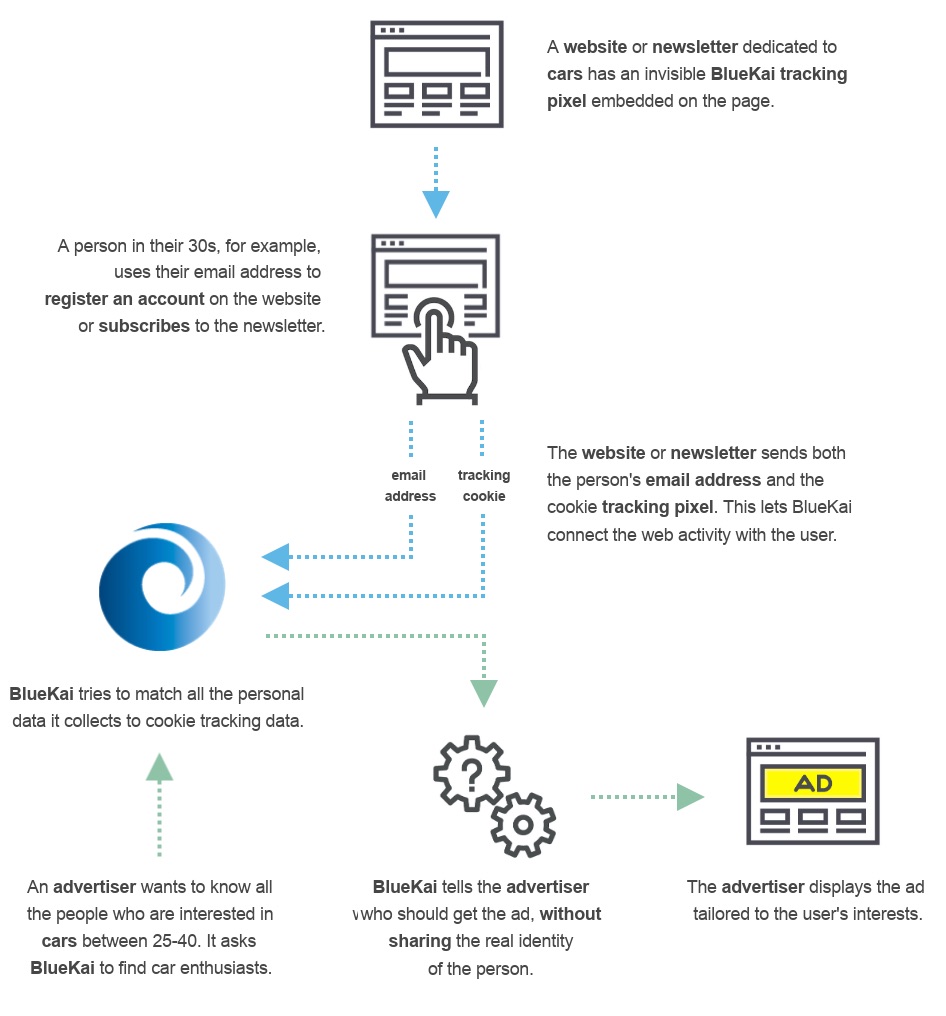
Marketers can either tap into Oracle’s enormous bank of data, which it pulls in from credit agencies, analytics firms, and other sources of consumer data including billions of daily location data points, in order to target their ads. Or marketers can upload their own data obtained directly from consumers, such as the information you hand over when you register an account on a website or when you sign up for a company’s newsletter.

But BlueKai also uses more covert tactics like allowing websites to embed invisible pixel-sized images to collect information about you as soon as you open the page — hardware, operating system, browser and any information about the network connection.

This data — known as a web browser’s “user agent” — may not seem sensitive, but when fused together it can create a unique “fingerprint” of a person’s device, which can be used to track that person as they browse the internet.

BlueKai can also tie your mobile web browsing habits to your desktop activity, allowing it to follow you across the internet no matter which device you use.

Say a marketer wants to run a campaign trying to sell a new car model. In BlueKai’s case, it already has a category of “car enthusiasts” — and many other, more specific categories — that the marketer can use to target with ads. Anyone who’s visited a car maker’s website or a blog that includes a BlueKai tracking pixel might be categorized as a “car enthusiast.” Over time that person will be siloed into different categories under a profile that learns as much about you to target you with those ads.

(Sources: DaVooda, Filborg/Getty Images; Oracle BlueKai)

The technology is far from perfect. Harvard Business Review found earlier this year that the information collected by data brokers, such as Oracle, can vary wildly in quality.

But some of these platforms have proven alarmingly accurate.

In 2012, Target mailed maternity coupons to a high school student after an in-house analytics system figured out she was pregnant — before she had even told her parents — because of the data it collected from her web browsing.

Some might argue that’s precisely what these systems are designed to do.

Jonathan Mayer, a science professor at Princeton University, told TechCrunch that BlueKai is one of the leading systems for linking data.

“If you have the browser send an email address and a tracking cookie at the same time, that’s what you need to build that link,” he said.

The end goal: the more BlueKai collects, the more it can infer about you, making it easier to target you with ads that might entice you to that magic money-making click.

But marketers can’t just log in to BlueKai and download reams of personal information from its servers, one marketing professional told TechCrunch. The data is sanitized and masked so that marketers never see names, addresses or any other personal data.

As Mayer explained: BlueKai collects personal data; it doesn’t share it with marketers.

‘No telling how revealing’

Behind the scenes, BlueKai continuously ingests and matches as much raw personal data as it can against each person’s profile, constantly enriching that profile data to make sure it’s up to date and relevant.

But it was that raw data spilling out of the exposed database.

TechCrunch found records containing details of private purchases. One record detailed how a German man, whose name we’re withholding, used a prepaid debit card to place a €10 bet on an esports betting site on April 19. The record also contained the man’s address, phone number and email address.

Another record revealed how one of the largest investment holding companies in Turkey used BlueKai to track users on its website. The record detailed how one person, who lives in Istanbul, ordered $899 worth of furniture online from a homeware store. We know because the record contained all of these details, including the buyer’s name, email address and the direct web address for the buyer’s order, no login needed.

We also reviewed a record detailing how one person unsubscribed from an email newsletter run by an electronics consumer, sent to his iCloud address. The record showed that the person may have been interested in a specific model of car dash-cam. We can even tell based on his user agent that his iPhone was out of date and needed a software update.

The more BlueKai collects, the more it can infer about you, making it easier to target you with ads that might entice you to that magic money-making click.

The data went back for months, according to Sen, who discovered the database. Some logs dated back to August 2019, he said.

“Fine-grained records of people’s web-browsing habits can reveal hobbies, political affiliation, income bracket, health conditions, sexual preferences, and — as evident here — gambling habits,” said the EFF’s Cyphers. “As we live more of our lives online, this kind of data accounts for a larger and larger portion of how we spend our time.”

Oracle declined to say if it informed those whose data was exposed about the security lapse. The company also declined to say if it had warned U.S. or international regulators of the incident.

Under California state law, companies like Oracle are required to publicly disclose data security incidents, but Oracle has not to date declared the lapse. When reached, a spokesperson for California’s attorney general’s office declined to say if Oracle had informed the office of the incident.

Under Europe’s General Data Protection Regulation, companies can face fines of up to 4% of their global annual turnover for flouting data protection and disclosure rules.

Trackers, trackers everywhere

BlueKai is everywhere — even when you can’t see it.

One estimate says BlueKai tracks over 1% of all web traffic — an unfathomable amount of daily data collection — and tracks some of the world’s biggest websites: Amazon, ESPN, Forbes, Glassdoor, Healthline, Levi’s, MSN.com, Rotten Tomatoes, and The New York Times. Even this very article has a BlueKai tracker because our parent company, Verizon Media, is a BlueKai partner.

But BlueKai is not alone. Nearly every website you visit contains some form of invisible tracking code that watches you as you traverse the internet.

As invasive as it is that invisible trackers are feeding your web browsing data to a gigantic database in the cloud, it’s that very same data that has kept the internet largely free for so long.

To stay free, websites use advertising to generate revenue. The more targeted the advertising, the better the revenue is supposed to be.

While the majority of web users are not naive enough to think that internet tracking does not exist, few outside marketing circles understand how much data is collected and what is done with it.

Take the Equifax data breach in 2017, which brought scathing criticism from lawmakers after it collected millions of consumers’ data without their explicit consent. Equifax, like BlueKai, relies on consumers skipping over the lengthy privacy policies that govern how websites track them.

In any case, consumers have little choice but to accept the terms. Be tracked or leave the site. That’s the trade-off with a free internet.

But there are dangers with collecting web-tracking data on millions of people.

“Whenever databases like this exist, there’s always a risk the data will end up in the wrong hands and in a position to hurt someone,” said Cyphers.

Cyphers said the data, if in the hands of someone malicious, could contribute to identity theft, phishing or stalking.

“It also makes a valuable target for law enforcement and government agencies who want to piggyback on the data gathering that Oracle already does,” he said.

Even when the data stays where it’s intended, Cyphers said these vast databases enable “manipulative advertising for things like political issues or exploitative services, and it allows marketers to tailor their messages to specific vulnerable populations,” he said.

“Everyone has different things they want to keep private, and different people they want to keep them private from,” said Cyphers. “When companies collect raw web browsing or purchase data, thousands of little details about real people’s lives get scooped up along the way.”

“Each one of those little details has the potential to put somebody at risk,” he said.


Send tips securely over Signal and WhatsApp to +1 646-755-8849.