Where to open a game studio

With the game industry booming, more entrepreneurs are evaluating where to base their new startup or open a new office for their existing company. The U.S. government’s block on H1-B and L-1 visas will encourage American game startups to add an office abroad much sooner than they otherwise would have. But where?

This spring, I surveyed a number of gaming-focused VCs about which cities are the best hubs for game studios targeting the Western games market. Several locales stood out as heavily recommended — which I’ve shared below — but the most interesting takeaway was the lack of consensus.

Game studios are far less geographically concentrated than other categories of VC-backed startups. While there are odes on Twitter and conference stages that “you can build a successful startup anywhere,” most investors will push founders to locate themselves in the SF Bay Area, or at least in LA, NYC or London. Meanwhile, the most common piece of advice from those I spoke to: You should probably not base a gaming startup in the San Francisco Bay Area.

Access to the right talent is the top priority, as is the ability to retain them. Proximity to investors matters, but a successful game quickly turns a profit, which reduces the need for outside funding beyond Series A (and U.S. and European VCs who focus on gaming tend to be very international in scope). Quality of life, ease of obtaining visas and access to strategic partners all play into the decision as well and will weigh these recommendations differently depending on who you are and the games you’re developing.

Three notes:

  • I focused on qualitative research, gauging the assessments of top investors who track new startups in the sector about where the action is right now. 
  • The scope of this survey is limited to studios targeting the Western gaming market, so leading hubs in Asia weren’t included.
  • I group cities by metropolitan area so, for example, San Francisco includes Redwood City and Seattle includes Bellevue.

North America

In North America, Los Angeles is the clear favorite with Montreal, Seattle, San Francisco, Toronto and Vancouver all receiving many endorsements as the other top hubs. Regarding cities with the most interesting gaming startups recently, Ryann Lai of Makers Fund said, “It is hard to name a single best location, but Toronto, Culver City (in Los Angeles), Orange County (next to Los Angeles) have gotten increasingly popular among gaming founders lately.”

Who really benefits from reskilling?

Nearly 40 million Americans are unemployed, and a recent study that examined more than 66,000 tech job layoffs found that sales and customer success roles are most vulnerable amid COVID-19. In response, some quarters of Silicon Valley are abuzz about a long-standing technology: reskilling, or training individuals to adopt an entirely new skillset or career for employment.

As millions look for a way to reenter the workforce, the question arises: Who really benefits from reskilling technology?

That depends on how you look at it, said Jomayra Herrera, a senior associate at Cowboy Ventures. Reskilling for a well-networked manager looks a lot different than it does for someone who doesn’t have as much leverage, and the vast majority of people fall into the latter. Not everyone has a friend at Google or Twitter to help them skip the online application and get right to the decision-makers.

Beyond the accessibility offered by live online classes, she pointed to the difference between assets and opportunities.

“You can give someone access to something, but it’s not true access unless they have the tools and structure to really engage with it,” Herrera said. In other words, how useful is content around reskilling if the company doesn’t support job placement post-training.

Herrera said companies must give individuals opportunities to test skills with real work and navigate the career path. Her mother, who did not go to college and speaks English as a second language, is looking to pursue training online. Before she can proceed, however, she has to surmount hurdles like language support, resume creation, job search and other challenges.

All of a sudden, content feels like a commodity, regardless of if it has active and social learning components. It’s part of the reason that MOOCs (massive open online courses) feel so stale.

Udacity, for example, was almost out of cash in 2018 and laid off more than half of its team in the past two years, according to The New York Times. Now, like other edtech companies, it is facing surges in usage.

YC to cut the size of its investment in future YC startups

In a blog post this Friday afternoon, Y Combinator’s president Geoff Ralston said that the accelerator would make two changes to its terms for startups.

The first would see the size of the standard deal for YC startups decline from $150,000 for 7% (roughly a $2.1 million post-money valuation) to $125,000 for the same equity (or roughly a $1.79 million post-money valuation). The deal will continue to be offered using a SAFE, which YC and a group of others pioneered as a simpler investment option compared to convertible notes.

Interestingly, the firm is always writing into its terms that it will only take pro rata up to 4% of a subsequent round’s size, which is obviously smaller than the 7% ownership that the company is buying in its financing. That 4% number is a ceiling — in cases where the accelerator has less ownership than 4%, the smaller percentage applies. Full terms of Y Combinator’s deal are available on its website.

The new deal will apply to startups who join Y Combinator in the Winter 2021 batch, and doesn’t include startups in the current summer batch (who have already presumably been funded)

YC’s deal has varied over the years. When it first launched more than a decade ago, it offered terms of $20,000 for 6%.

A Y Combinator spokeswoman said that the change was in line with the fundraising and budget realties of the accelerator going forward. “The future of the economy is unpredictable, and we feel it is prudent during these times to switch to a leaner model,” she said. “In our case, we want to be set up to fund as many great founders as possible — especially during a time that is creating an unprecedented change to consumer and business behavior; with these changes comes endless opportunities for startups. And with the changes made to our standard deal, we can fund as many as 3000 more companies.”

Outside of budget, at least a couple of factors are potentially at work here. One is the increased use of Work From Anywhere, which presumably can help lower some of the running costs of a startup, particularly in its earliest days (e.g., no need to pay for that WeWork flex desk).

Y Combinator has also invested more of its funds into emerging markets startups, which can have dramatically lower costs of development given prevailing wages for talent in local markets.

Yet, the cutback is also a sign that the flood of capital entering the Valley in recent years has receded — if ever so slightly — in the wake of COVID-19. Valuations are depressing, and while $25,000 is not a massive loss considering the scale of later venture financings, the 16% valuation haircut is in line with other numbers we have seen in the Valley in recent weeks.

As advertisers revolt, Facebook commits to flagging ‘newsworthy’ political speech that violates policy

As advertisers pull away from Facebook to protest the social networking giant’s hands-off approach to misinformation and hate speech, the company is instituting a number of stronger policies to woo them back.

In a livestreamed segment of the company’s weekly all-hands meeting, CEO Mark Zuckerberg recapped some of the steps Facebook is already taking, and announced new measures to fight voter suppression and misinformation — although they amount to things that other social media platforms like Twitter have already enahatected and enforced in more aggressive ways.

At the heart of the policy changes is an admission that the company will continue to allow politicians and public figures to disseminate hate speech that does, in fact, violate Facebook’s own guidelines — but it will add a label to denote they’re remaining on the platform because of their “newsworthy” nature.

It’s a watered-down version of the more muscular stance that Twitter has taken to limit the ability of its network to amplify hate speech or statements that incite violence.

Zuckerberg said:

A handful of times a year, we leave up content that would otherwise violate our policies if the public interest value outweighs the risk of harm. Often, seeing speech from politicians is in the public interest, and in the same way that news outlets will report what a politician says, we think people should generally be able to see it for themselves on our platforms.

We will soon start labeling some of the content we leave up because it is deemed newsworthy, so people can know when this is the case. We’ll allow people to share this content to condemn it, just like we do with other problematic content, because this is an important part of how we discuss what’s acceptable in our society — but we’ll add a prompt to tell people that the content they’re sharing may violate our policies.

The problems with this approach are legion. Ultimately, it’s another example of Facebook’s insistence that with hate speech and other types of rhetoric and propaganda, the onus of responsibility is on the user.

Zuckerberg did emphasize that threats of violence or voter suppression are not allowed to be distributed on the platform whether or not they’re deemed newsworthy, adding that “there are no exceptions for politicians in any of the policies I’m announcing here today.”

But it remains to be seen how Facebook will define the nature of those threats — and balance that against the “newsworthiness” of the statement.

The steps around election year violence supplement other efforts that the company has taken to combat the spread of misinformation around voting rights on the platform.


The new measures that Zuckerberg announced also include partnerships with local election authorities to determine the accuracy of information and what is potentially dangerous. Zuckerberg also said that Facebook would ban posts that make false claims (like saying ICE agents will be checking immigration papers at polling places) or threats of voter interference (like “My friends and I will be doing our own monitoring of the polls”).

Facebook is also going to take additional steps to restrict hate speech in advertising.

“Specifically, we’re expanding our ads policy to prohibit claims that people from a specific race, ethnicity, national origin, religious affiliation, caste, sexual orientation, gender identity or immigration status are a threat to the physical safety, health or survival of others,” Zuckerberg said. “We’re also expanding our policies to better protect immigrants, migrants, refugees and asylum seekers from ads suggesting these groups are inferior or expressing contempt, dismissal or disgust directed at them.”

Zuckerberg’s remarks came days of advertisers — most recently Unilever and Verizon — announced that they’re going to pull their money from Facebook as part the #StopHateforProfit campaign organized by civil rights groups.

These are small, good steps from the head of a social network that has been recalcitrant in the face of criticism from all corners (except, until now. from the advertisers that matter most to Facebook). But they don’t do anything at all about the teeming mass of misinformation that exists in the private channels that simmer below the surface of Facebook’s public facing messages, memes and commentary.

Only 12 hours left to apply for Startup Battlefield at Disrupt 2020

It’s now o’clock, founders. A mere 12 hours stands between you and a chance to compete in Startup Battlefield and launch your pre-Series A startup during Disrupt 2020 — in front of the world’s influential technorati.

You won’t find a bigger launching pad, and this window of extraordinary opportunity slams shut on June 26 at 11:59 pm (PT). Apply to Startup Battlefield right here, right now.

This year’s legendary pitch competition is virtual, but the benefits and opportunity that comes from competing are very real and often life changing — for all participants not just the ultimate winner. Let’s explore that a bit more.

The top prize — $100,000 equity free cash — will do wonders for your bottom line. The TechCrunch feature article – brings you into the league of legends. The Disrupt cup and the acclaim that comes with winning, well, who doesn’t love bragging rights? But it’s the huge exposure — on a global scale — to media, investors, potential customers and big tech players looking to acquire promising startups, that can take Battlefield competitors on a whole new trajectory.

Here’s a quick look at how Startup Battlefield works. We accept applications from founders of any background, geography and industry as long as your company is early stage, has an MVP with a tech component (software, hardware or platform) and hasn’t received much major media coverage.

Our editors screen every application and will choose only startups they feel possess that certain je ne sais quoi. The epic pitch-off takes place during Disrupt 2020, which runs from Sept. 14 – 18. Note: This opportunity is 100 percent free. TechCrunch does not charge any application or participation fees or take any equity.

You’ll receive six weeks of free pitch coaching from TC editors to whip you into prime fighting trim. Plus a virtual webinar series with industry experts. You’ll have just 6 minutes to pitch and demo to the judges — a panel of expert VCs, entrepreneurs and TechCrunch editors. Then you’ll answer their questions — and they’ll have plenty.

Founders who survive the first round move to the finals on the last day of Disrupt. It’s lather-rinse-repeat as you pitch to a fresh set of judges. Then it’s time for the big reveal: one startup takes the title, the Disrupt cup and the $100,000.

Have you clicked the application link yet? No? Here are more reasons to apply. If you earn a spot in the competition, you get a Disrupt Digital Pro pass and you get to exhibit to people around the world in Digital Startup Alley — for free.

You’ll network with CrunchMatch, our AI-powered platform, to set up virtual 1:1 meetings with investors, media, potential customers and the throngs of folks eager to meet a Battlefield competitor.

Need more perks? We got you covered.

  • A launch article featuring your startup on TechCrunch.com
  • Access to Leading Voices Webinars: Hear top industry minds share their strategies for adapting and thriving during and after the pandemic
  • A YouTube video promoted on TechCrunch.com
  • Free subscription to Extra Crunch
  • Free passes to future TechCrunch events

This no-cost, perk-packed opportunity disappears in just 12 hours. Do whatever it takes to keep your startup moving forward. Apply to compete in Startup Battlefield before the deadline expires on June 26 at 11:59 pm (PT).

Is your company interested in sponsoring or exhibiting at Disrupt 2020? Contact our sponsorship sales team by filling out this form.

Fleetsmith customers unhappy with loss of third-party app support after Apple acquisition

When Apple confirmed it had acquired Fleetsmith, a mobile device management vendor, on Wednesday, it seemed like a straightforward purchase, but Fleetsmith customers quickly learned a key piece of functionality had stopped working  — and many weren’t happy about it.

Apple systems administrators began complaining on social media on the morning of the acquisition announcement that the company was no longer allowing them to connect to third-party applications.

“Primarily Fleetsmith maintained a third-party app catalog, so you could deploy things like Chrome or Zoom to your Macs, and Fleetsmith would maintain security updates for those apps. This was the main reason we purchased Fleetsmith,” a Fleetsmith customer told TechCrunch.

The customer added that the company described this functionality as a major feature in a company blog post:

For apps like Chrome, which are managed through the Fleetsmith Catalog, we handle all aspects of testing, packaging, triage, and deployment automatically. Whenever there’s an update (including security patches), we quickly add them to the Catalog so that our customers can enforce the latest version. In this case, we had the Chrome 78.0.3904.87 patch up within a couple hours of the update dropping.

As one system administrator pointed out, being able to manage Chrome browser security in an automated way was a huge part of this, and that was also removed along with third party app support.

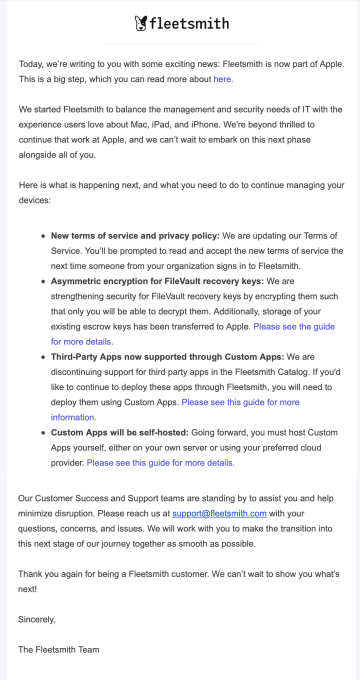
As it turned out, Apple had made it clear that it was discontinuing this feature in an email to Fleetsmith customers on the day of the transition. The email included links to several help articles that were supposed to assist admins with the transition. (The email is included in full at the end of this article.)

The general consensus among admins that I spoke to was that these articles were not terribly helpful. While they described a way to fix the issues, they said that Apple has turned what was a highly automated experience into a highly manual one, effectively eliminating the speed and ease of use advantage of having the update feature in the first place.

Apple did confirm that it had responded to some help ticket requests after the changes this week, saying that it would soon restore some configurations for Catalog apps, and was working with impacted customers as needed. The company did not make clear, however, why they removed this functionality in the first place.

Fleetsmith offered a couple of key features that appealed to Mac system administrators. For starters, it let them set up new Macs automatically out of the box. This allows them to ship a new Mac or other Apple device, and as soon as the employee powers it up and connects to Wi-Fi, it connects to Fleetsmith, where systems administrators can track usage and updates. In addition, it allowed System Administrators to enforce Apple security and OS updates on company devices.

What’s more, it could also do the same thing with third-party applications like Google Chrome, Zoom or many others. When these companies pushed a new update, system administrators could make sure all users had the most recent version running on their machines. This is the key functionality that was removed this week.

It’s not clear why Apple chose to strip out these features outlined in the email to customers, but it seems likely that most of this functionality isn’t coming back, other than restoring some configurations for Catalog apps.

Email that went out to Fleetsmith customers the day of the acquisition outlining the changes:


Attempts to reach Fleetsmith founders for comment were unsuccessful. Should that change we will update the article.

Unilever and Verizon are the latest companies to pull their advertising from Facebook

Advertiser momentum against Facebook’s content and monetization policies continues to grow.

Last night, Verizon (which owns TechCrunch) said it will be pausing advertising on Facebook and Instagram “until Facebook can create an acceptable solution that makes us comfortable and is consistent with what we’ve done with YouTube and other partners.”

Then today, it was joined by consumer goods giant Unilever, which said it will halt all U.S. advertising on Facebook, Instagram (owned by Facebook) and even Twitter, at least until the end of the year.

“Based on the current polarization and the election that we are having in the U.S., there needs to be much more enforcement in the area of hate speech,” Unilever’s executive vice president of global media Luis Di Como told The Wall Street Journal.

The effort to bring advertiser pressure to bear on Facebook began with a campaign called #StopHateforProfit, which is coordinated by the Anti-Defamation League, the NAACP, Color of Change, Free Press and Sleeping Giants. The campaign is calling for changes that are supposed to improve support for victims of racism, anti-Semitism and hate, and to end ad monetization on misinformation and hateful content.

The list of companies who have agreed to pull their advertising from Facebook also includes outdoor brands like REI, The North Face and Patagonia. (An important caveat: Gizmodo noted that it’s not clear whether these advertisers are also pulling their money from the Facebook Audience Network.)

We have taken the decision to stop advertising on @Facebook, @Instagram & @Twitter in the US.

The polarized atmosphere places an increased responsibility on brands to build a trusted & safe digital ecosystem. Our action starts now until the end of 2020.https://t.co/flHhKid6jD pic.twitter.com/QdzbH2k3wx

— Unilever #StaySafe (@Unilever) June 26, 2020

Facebook provided the following statement in response to Unilever’s announcement:

We invest billions of dollars each year to keep our community safe and continuously work with outside experts to review and update our policies. We’ve opened ourselves up to a civil rights audit, and we have banned 250 white supremacist organizations from Facebook and Instagram. The investments we have made in AI mean that we find nearly 90% of Hate Speech [and take] action before users report it to us, while a recent EU report found Facebook assessed more hate speech reports in 24 hours than Twitter and YouTube. We know we have more work to do, and we’ll continue to work with civil rights groups, GARM, and other experts to develop even more tools, technology and policies to continue this fight.

And Twitter provided a statement from Sarah Personette, vice president of global client solutions:

Our mission is to serve the public conversation and ensure Twitter is a place where people can make human connections, seek and receive authentic and credible information, and express themselves freely and safely. We have developed policies and platform capabilities designed to protect and serve the public conversation, and as always, are committed to amplifying voices from underrepresented communities and marginalized groups. We are respectful of our partners’ decisions and will continue to work and communicate closely with them during this time.

As of 1:57 p.m. EDT, Facebook stock was down more than 7% from the start of trading. CEO Mark Zuckerberg said he will also be addressing these issues at a town hall starting at 2 p,m. EDT today.


Tim O’Reilly makes a persuasive case for why venture capital is starting to do more harm than good

Tim O’Reilly has a financial incentive to pooh-pooh the traditional VC model, wherein investors gamble on nascent startups in hopes of seeing many times their money back. Bryce Roberts, who is O’Reilly’s longtime investing partner at the early-stage venture firm O’Reilly AlphaTech Ventures (OATV), now actively steers the partnership away from these riskier investments and into companies around the country that are already generating revenue and don’t necessarily want to be blitzscaled.

Yet in an interview with O’Reilly last week, he nonetheless argued persuasively for why venture capital, in its current iteration, has begun to make less sense for more founders who genuinely want to build sustainable businesses. The way he sees it, the venture industry is no longer as focused on finding small companies that might one day change the world but more on creating financial instruments for the wealthy — and that shift has real consequences.

Below, we’re pulling out parts of that conversation that may be of interest to readers who are either debating raising venture capital, debating raising more venture capital, and even those who have been turned away from VCs and perhaps dodged a bullet in the process. At a minimum, O’Reilly — who bootstrapped his own company, O’Reilly Media, 42 years ago and says it now produces “a couple hundred million dollars in revenue” yearly — provides a lot of food for thought.

TechCrunch: A lot of companies celebrated Juneteenth this year, which is a big deal. There’s been a lot of talk about making the venture industry more inclusive. How far — or not — do you think we’ve come in the venture industry on this front?

Tim O’Reilly: The thing that I would say about VC and about really everything in tech is, this concept of structural racism [is really the problem]. People think that all it matters is, ‘Well, my values are good, my heart’s in the right place, I donate to charities,’ and we don’t actually fix the systems that cause the problems.

With VCs, the networks from which they’re drawing entrepreneurs are not that different [than they have been historically]. But more importantly, the goals of the VC model are not that different. The industry sets a goal, and it has a certain kind of financial shape, which is inherently exclusionary.

How so?

The typical VC model is looking for this high-growth company with exit potential, because it’s looking for this big financial return from an IPO or acquisition, and that selects for a certain type of founder. My partner Bryce decided two funds ago [to] look for companies that are kind of disparaged as lifestyle companies that are trying to build sustainable businesses with cash flow and profits. They’re the kind of small businesses, and small business entrepreneurs, that have vanished from America, partly because of the VC myth, which is really about creating financial instruments for the wealthy.

He came up with a version of a SAFE note that allows the founders to buy out the VC at a predetermined amount if they ever become sufficiently profitable, but also gives them the optionality, because periodically, some of them do end up becoming a rocket ship. But the founder is not on the treadmill of: You have to get out.

When you start saying, ‘Okay, we’re going to look for sustainable businesses,’ you look all over the country, and Bryce ended up [with a portfolio] that’s made up of more than 50% women founders and 30% people of color, and it has been an incredible investment strategy.

That’s not to say that people who are African American or women can’t also lead companies that are part of the high-growth VC model that’s typical of Silicon Valley.

No, of course not. Of course they could lead. The talent pool is just much greater [when you look outside of Silicon Valley]. There’s a certain kind of bro culture in Silicon Valley and if you don’t fit in, sure [you could find a way], but there are a lot of impediments. That’s what we mean by structural racism.

To your point about insular networks, a prominent Black VC, Charles Hudson, has noted that a lot of [traditional VCs] just don’t have regular or professional associations with Black people, which hampers how they find companies. How has Bryce fostered some of these connections? Because it does feel like traditional VCs are right now trying to figure out how to better do this.

It’s breaking the geographic isolationism of Silicon Valley. It’s breaking the business model isolationism of Silicon Valley that says: Only things that fit this particular profile are worth investing in. Bryce didn’t go out there and say, ‘I want to go find people of color to invest in.’ What he said was, ‘I want to have a different kind of investment in different places in the United States.’ And when he did that, he naturally found entrepreneurs who reflect the diversity of America.

That’s what we have to really think about. It’s not: How do we get more Black and brown founders into this broken Silicon Valley model? It’s: How do we go figure out what the opportunities are helping them to grow businesses in their communities?

Are LPs interested in this kind of model? Does it have the kind of growth potential that they need to service their endowments?

It was a bit of a struggle when we did fund four, which was focused on [this newer model]. It was about a third of the size of fund three. But for fund five, the fundraising is [going] like gangbusters. Everybody wants in because the model has proven itself.

I don’t want to name names, but there are two companies [in the portfolio] that are kind of in similar businesses. One was in our third fund and was sort of a traditional Silicon Valley-style investment. And the other was an investment in Idaho, of all places. The first company, which involved a more traditional seed round, we’ve ended up putting in $2.5 million for a 25% stake. The one in Idaho we put in $500,000 for a 25% stake, and the one in Idaho is now twice the size of the Silicon Valley one and growing much faster.

So from what you’re seeing, the returns are actually going to be better than with a traditional Silicon Valley venture [approach].

As I said, I’ve been really disillusioned with Silicon Valley investing for a long time. It reminds me of Wall Street going up to 2008. The idea was, ‘As long as someone wants to buy this [collateralized debt obligation], we’re good.’ Nobody is thinking about: Is this a good product?

So many things that VCs have created are really financial instruments like those CDOs. They aren’t really thinking about whether this is a company that could survive on revenue from its customers. Deals are designed entirely around an exit. As long as you can get some sucker to take them, [you’re good]. So many acquisitions fail, for example, but the VCs are happy because — guess what? — they got their exit.

But now, because funds are raised so quickly, VCs have to show much more traction, which is where things like blitzscaling come in.

Just the way you’re describing it. Can’t you hear what’s wrong with that? It’s for the benefit of the VCs, the VCs have to show, not the entrepreneurs have to show.

Aren’t the LPs addicted to that crack? Don’t they want to see that quick financial traction?

Yeah, but you know that VC returns have actually lagged public markets for four decades now. It’s a little bit like the lottery. The only sure winners are the VCs because the VCs who don’t return their fund get their management fees every year.

A huge amount of the VC capital doesn’t return. Everybody just sees the really big wins. And I know when they happen, it’s really wonderful. But I think [those rare wins] have gotten an outsize place, and they’ve displaced other kinds of investment. It’s part of the structural inequality in our society, where we’re building businesses that are optimized for their financial return rather than their return to society.

Running a queer dating startup amid a pandemic and racial justice uprising

The events of the past few months have shaken the lives of everyone, but especially Black people in the U.S. COVID-19 has disproportionately impacted members of the Black community while police violence has recently claimed the lives of George Floyd, Tony McDade, Breonna Taylor, Rayshard Brooks and others. 

Two weeks ago, two Black transgender women, Riah Milton and Dominique “Rem’mie” Fells were murdered. In light of their deaths, activists took to the streets to protest the violence Black trans women face. Two days after Floyd’s killing, McDade, a Black trans man was shot and killed by police in Tallahassee, Florida. 

In light of Pride month coinciding with one of the biggest racial justice movements of the century amid a pandemic, TechCrunch caught up with Robyn Exton, founder of queer dating app Her, to see how her company is navigating this unprecedented moment. 

Exton and I had a wide-ranging conversation including navigating COVID-19 as a dating startup, how sheltering in place has affected product development, shifting the focus of what is historically a month centered around LGBTQ people to include racial justice work and putting purpose back into Pride month.

“Pride exists because there is inequality within our world and within our community and still there is no clear focus on what it is we should be fighting for as a community,” Exton says. “It almost feels like since equal marriage was passed, there’s a range of topics but no clear voice saying this is what everyone should focus on right now. And then obviously everything changed after George Floyd’s murder. Over the course of the following weekend, we canceled pretty much everything that was going out that talked still about Pride as a celebration. Especially for Black people within our community, in that moment of so much trauma, it felt completely wrong to talk about Pride just in general.”

Worldwide, Pride events have been canceled as a result of the pandemic. But it gives people and corporations time to reflect on what kind of presence they want to have in next year’s Pride celebrations.

Cambricon, once Huawei’s core AI chip supplier, eyes $400M IPO

One of China’s most valuable artificial intelligence chipmakers Cambricon is one step closer to its initial public offering, and its prospectus reveals a rare snapshot of where Chinese companies stand in relation to their international counterparts in this critical field.

Cambricon got the nod in early June to list on the Star Market, China’s new Nasdaq-like stock exchange conceived to attract high-potential tech startups. This week, the chipmaker received the final green light from the China Securities Regulatory Commission, the stock market watchdog, for its first-time sale.

The company is aiming to raise 2.8 billion yuan ($400 million) from its IPO and spend the proceeds on cloud-based algorithm training and inference, edge computing, and cash flow boost. It was last valued at 2.5 billion yuan in 2018 and expects its market cap to exceed 1.5 billion yuan when it floats.

Cambricon began life in a lab within the Chinese Academy of Sciences (CAS), the national institute for science and technology backed by government money. In 2016, the project spun out as a separate entity, making money by licensing intellectual property and selling chips for deep-learning acceleration. Before long, it had made its name as a major supplier of Huawei’s first AI chip-powered smartphones and other flagship models later on.

But the partners’ ties have weakened ever since Huawei began doubling down on its own semiconductor arm — HiSilicon — to hedge against U.S. sanctions. The direct consequence is a substantial revenue drop for Cambricon’s licensable IP, which slumped to an estimated 16-18 million yuan in 2018, down from 117 million yuan in 2018.

“Huawei Silicon has chosen to develop its own AI chips for end devices and has not extended the partnership with our company, and our AI chip business with other clients remains relatively small,” the company replied to regulators during the vetting process for its listing. Finding new clients at Huawei’s enormous scale is also challenging, as “most of the other well-known Chinese smartphone makers are using established handset chips and solutions from Qualcomm and MediaTek,” Cambricon noted.

The chipmaker also flagged that it remains “well behind” international competitors such as Nvidia, Intel, AMD in areas including “overall scale, capital reserve, resources for research and development and sales channels.” It’s also well aware of rising domestic competition from its old ally, Huawei, which has opted for chips from its home-grown HiSilicon unit.

Cambricon’s co-founders Chen Tianshi and Chen Yunji both hail from academia. The company still maintains close relationships with CAS and also works closely with Olivier Temam, a researcher at Inria, the French national institute for computer science and applied mathematics.

Cambricon is still operating in the red, adding up to a total loss of 1.6 billion yuan ($230 million) in the last three years in part due to large sums spent on research and development, according to its prospectus. It generated revenues of 444 million yuan ($63 million) in 2019, up from 7.84 million yuan in 2017.

The chipmaker is backed by a lineup of storied investors across the board. Besides the 41.7% stake Chen Tianshi commands, other shareholders include Zhongke Suanyuan, an asset management firm set up by CAS; Aixi Partners, an entity owned by Cambricon employees and controlled by Chen Tianshi; SDIC Venture Capital, a state-owned investment firm approved by China’s state council; e-commerce titan Alibaba; and voice recognition provider iFlytek.

Why AWS built a no-code tool

AWS today launched Amazon Honeycode, a no-code environment built around a spreadsheet-like interface that is a bit of a detour for Amazon’s cloud service. Typically, after all, AWS is all about giving developers all of the tools to build their applications — but they then have to put all of the pieces together. Honeycode, on the other hand, is meant to appeal to non-coders who want to build basic line-of-business applications. If you know how to work a spreadsheet and want to turn that into an app, Honeycode is all you need.

To understand AWS’s motivation behind the service, I talked to AWS VP Larry Augustin and Meera Vaidyanathan, a general manager at AWS.

“For us, it was about extending the power of AWS to more and more users across our customers,” explained Augustin. “We consistently hear from customers that there are problems they want to solve, they would love to have their IT teams or other teams — even outsourced help — build applications to solve some of those problems. But there’s just more demand for some kind of custom application than there are available developers to solve it.”

Image Credits: Amazon

In that respect then, the motivation behind Honeycode isn’t all that different from what Microsoft is doing with its PowerApps low-code tool. That, too, after all, opens up the Azure platform to users who aren’t necessarily full-time developers. AWS is taking a slightly different approach here, though, but emphasizing the no-code part of Honeycode.

“Our goal with honey code was to enable the people in the line of business, the business analysts, project managers, program managers who are right there in the midst, to easily create a custom application that can solve some of the problems for them without the need to write any code,” said Augustin. “And that was a key piece. There’s no coding required. And we chose to do that by giving them a spreadsheet-like interface that we felt many people would be familiar with as a good starting point.”

A lot of low-code/no-code tools also allow developers to then “escape the code,” as Augstin called it, but that’s not the intent here and there’s no real mechanism for exporting code from Honeycode and take it elsewhere, for example. “One of the tenets we thought about as we were building Honeycode was, gee, if there are things that people want to do and we would want to answer that by letting them escape the code — we kept coming back and trying to answer the question, ‘Well, okay, how can we enable that without forcing them to escape the code?’ So we really tried to force ourselves into the mindset of wanting to give people a great deal of power without escaping to code,” he noted.

Image Credits: Amazon

There are, however, APIs that would allow experienced developers to pull in data from elsewhere. Augustin and Vaidyanathan expect that companies may do this for their users on tthe platform or that AWS partners may create these integrations, too.

Even with these limitations, though, the team argues that you can build some pretty complex applications.

“We’ve been talking to lots of people internally at Amazon who have been building different apps and even within our team and I can honestly say that we haven’t yet come across something that is impossible,” Vaidyanathan said. “I think the level of complexity really depends on how expert of a builder you are. You can get very complicated with the expressions [in the spreadsheet] that you write to display data in a specific way in the app. And I’ve seen people write — and I’m not making this up — 30-line expressions that are just nested and nested and nested. So I really think that it depends on the skills of the builder and I’ve also noticed that once people start building on Honeycode — myself included — I start with something simple and then I get ambitious and I want to add this layer to it — and I want to do this. That’s really how I’ve seen the journey of builders progress. You start with something that’s maybe just one table and a couple of screens, and very quickly, before you know, it’s a far more robust app that continues to evolve with your needs.”

Another feature that sets Honeycode apart is that a spreadsheet sits at the center of its user interface. In that respect, the service may seem a bit like Airtable, but I don’t think that comparison holds up, given that both then take these spreadsheets into very different directions. I’ve also seen it compared to Retool, which may be a better comparison, but Retool is going after a more advanced developer and doesn’t hide the code. There is a reason, though, why these services were built around them and that is simply that everybody is familiar with how to use them.

“People have been using spreadsheets for decades,” noted Augustin. “They’re very familiar. And you can write some very complicated, deep, very powerful expressions and build some very powerful spreadsheets. You can do the same with Honeycode. We felt people were familiar enough with that metaphor that we could give them that full power along with the ability to turn that into an app.”

The team itself used the service to manage the launch of Honeycode, Vaidyanathan stressed — and to vote on the name for the product (though Vaidyanathan and Augustin wouldn’t say which other names they considered.

“I think we have really, in some ways, a revolutionary product in terms of bringing the power of AWS and putting it in the hands of people who are not coders,” said Augustin.

New York City could have an e-scooter pilot program by March

New York City is on the verge of approving a shared electric scooter pilot program, opening up a potentially lucrative market and new micromobility battleground in the United States.

The New York City Council is expected Thursday to vote on a bill that will require the New York Department of Transportation to create a pilot program for the operation of shared electric scooters in the city. The proposed legislation will first be taken up by the Committee on Transportation at 10 a.m. ET before moving to the full council, which has a meeting scheduled for 1:30 p.m. ET. The committee is expected to approve the measure.

The proposed legislation would require the DOT to issue by October 15, 2020 a request for proposals to participate in a shared e-scooter pilot program. The pilot program would need to launch by March 1, 2021.

“New Yorkers need more sustainable and safe ways to commute and get around during this pandemic–and that is especially true for our essential delivery workers who deserve our gratitude and our support for keeping this city running even through the darkest days of this crisis,” New York Council speaker Corey Johnson said in an emailed statement ahead of tomorrow’s vote. “E-bikes and scooters are going to be a major part of our city’s transit future, and I’m proud of the council’s work to ensure that future arrives safely and equitably.”

Lime is among several shared electric scooter companies eager to participate in the pilot. The micromobility company has spent the past two years working with elected officials, social justice organizations and advocates to finally make scooters available to New Yorkers, Phil Jones, the senior director of government relations for Lime, told TechCrunch in an email.

“The newfound urgency to offer car-alternative transportation options seems to have gotten us to this point,” Jones said.

A recent survey conducted by the New York League of Conservation Voters, the Tri-State Transportation Campaign and shared micromobility company Lime suggests there is support for electric scooters in New York City. The survey, which was administered between June 15 to June 19, found 92% of respondents would choose to use scooters as an alternative to cars during the COVID-19 crisis. (It should be noted that the survey was sent to more than 30,000 New Yorkers who are part of the NYLCV, TSTC and Lime networks; 394 people responded).

Spin confirmed that if approved, it plans to apply for a permit. Link, a new scooter startup that is the shared micromobility arm of Superpedestrian and that just officially launched about a month ago, also plans to apply.  Lyft, which already is one of the operators of New York City’s bikeshare program, also confirmed plans to apply.

Link founder and CEO Assaf Biderman is aiming to sell the city on its technology.

“With some of the busiest streets in the country, New York needs micromobility operators who can keep riders moving in bike lanes and out of no-ride zones,” Biderman said.

TechCrunch also reached out to a number of other e-scooter rental companies, including Bird and Skip. The article will be updated if these companies respond.

While the proposed legislation was first introduced two years ago, a pilot program wasn’t technically feasible until this April when New York Gov. Andrew Cuomo signed a bill to legalize the use of throttle-based electric scooters and bikes in the state. Under the state law, shared scooters will not be allowed in Manhattan and a pilot program must be approved by the NY City Council before shared scooter services can operate in the remaining boroughs of Brooklyn, the Bronx, Queens and Staten Island.

The proposed local law places some requirements on how the pilot program is structured. Neighborhoods that lack access to existing bike-share programs will be given priority in determining the geographic boundaries of the pilot program. Companies that receive permits will be required to meet operating rules, such as providing accessible scooter options.

It’s not clear how many companies will be issued permits or if there will be restrictions on the number of scooters in each fleet. Jones over at Lime said that “successful scooter programs strike a careful balance that allows for competition between a handful of operators, but not so many as it becomes oversaturated and unruly.”

In Lime’s view, a successful scooter program will allow for demand to dictate fleet size, include service zones in denser communities with nearby transit options, ensure the zones are expansive enough to connect residential and commercial districts, guarantee access for lower-income neighborhoods as well as provide and capitalize on its unprecedented growth of the bike lane network, Jones added.

The committee on transportation and full council is also expected to discuss and possibly approve rules about private use of electric bikes and scooters. One proposed law would allow for privately owned scooter use in Manhattan. Shared scooters are prohibited in Manhattan in accordance with state law.