Skygauge’s innovative tilting rotor drones are up for pre-order, with deliveries in 2021

I have had a few occasions to see Skygauge’s drones in-person, primarily on visits to Asia. The Canadian team is involved in HAX’s program and has spent time working out of their Shenzhen offices. In fact, they competed at our last hardware battlefield in the city late last year.

To a person, everyone I’ve spoken with seems impressed by the company’s tiltable rotor technology, which allows the massive industrial drones to maneuver in ways more traditional quadcopters can’t. I have little doubt the startup has had no trouble getting the attention of companies looking for an edge in the drone space, and like so many other robotics and robotics/drone/automation companies, it’s gotten a pretty significant boost in interest due to COVID-19.

Today the startup announced that it has opened pre-orders on its drones, with plans to launch in 2021 — it’s not disclosing pricing, but interested parties can plunk down a refundable $1,000 deposit. The company has already lined up “100 potential customers,” along with planned demos for 10 Fortune 500 companies. The pandemic, meanwhile, has opened up increased potential for these sorts of automated industrial inspection devices. The company notes a recent temporary FAA exemption for additional drone-based inspections of oil and gas sites in Texas, as workers are expected to stay home.

“Our goal is to get people out of dangerous environments and the need for this has never been greater because of COVID-19,” co-founder and CEO Nikita Iliushkin says in a statement.

Skygauge apparently maxed out its early adopter program during the pandemic. I’ll be curious to see if the company’s success ultimately lies in producing its own drones or licensing its impressive technology to third-parties. Meantime, it has raised $400,000 in pre-seed funding, with plans to raise more.

Dfinity demonstrates its TikTok clone, opens up its ‘Internet Computer’ to outside developers

Dfinity appeared in 2018, amid the flurry of investments in the blockchain space. It raised $102 million in funding at a $2 billion valuation in a round jointly led by Andreessen Horowitz and Polychain Capital, along with other investors, including KR1. I must admit that at the time it appeared for all intents and purposes as if it would be yet another attempt to replace Ethereum. Or at least something similar. But then something odd happened. It started behaving like an actual software company.

In January this year it didn’t talk about blockchain at all, but instead demonstrated an open social network called “LinkedUp,” sort of open version of LinkedIn. The demonstration didn’t go live, and technically speaking it was under-whelming — until you realized it wasn’t running on any server, and performed faster than a native mobile app. Dfinity, it turned out, wasn’t a traditional blockchain startup, but was taking a leaf out of that world’s championing of the move toward decentralization.

In fact, it was building its so-called “Internet Computer”: a decentralized and non-proprietary network to run the next generation of “mega-applications.”

Today it announced that the “Internet Computer” is now open to third-party developers and entrepreneurs to build that next generation. The vision is to “reboot” the internet in a way that destroys the ability to create virtual monopolies like Facebook, LinkedIn, Instagram and WhatsApp.

As its next technical demonstration, it launched “CanCan”, a TikTok-like app that will run in a browser (though it is not publicly available as such) and which is not owned by a company. The idea is that anyone could build their own TikTok.

The tantalizing part of Dfinity’s ideas is that because of the nature of the architecture, apps like CanCan can be built with less than 1,000 lines of code. Facebook, to take an example, contains more than 62 million lines of code.

To achieve this, Dfinity is drawing on the work of Andreas Rossberg, co-creator of WebAssembly, who has now created Motoko, a new programming language optimized for Dfinity’s Internet Computer.

The Internet Computer’s serverless architecture allows the internet to natively host software and services, eliminating — claims Dfinity — the need for proprietary cloud services. Without web servers, databases and firewalls, developers can create powerful software much more quickly, and that software then runs far faster than normal.

Dominic Williams, founder and chief scientist at Dfinity, said in a statement: “One of the biggest problems emerging in technology is the monopolization of the internet by Big Tech — companies that have consolidated near-total control over our technologies. They collect vast amounts of information about us that they sell for profit and leverage to amass greater market share, and acquire or bulldoze rivals at an alarming rate… The Internet Computer provides a means to reboot the internet — creating a public alternative to proprietary cloud infrastructure. It will empower the next-generation of developers and entrepreneurs to take on Big Tech with open internet services. It aims to bring the internet back to its free and open roots — not dominated by a handful of corporations.”

This “Tungsten” release of the Internet Computer means third-party developers and entrepreneurs will be able to start kicking the tyres on this platform and start spitting out web apps and even smartphone apps.

Projects currently being built include a decentralized payment application and a “pan-industry platform for luxury goods,” whatever that is. Successful and promising applications may also benefit from Beacon Fund, an ecosystem fund stewarded by the Dfinity Foundation and Polychain Capital that aims to support ‘DeFi’ apps and open internet services built on the Internet Computer.

Interested developers and enterprises can submit an application to access the Internet Computer starting July 1, 2020, via dfinity.org.

Facebook bans ‘violent network’ of far-right boogaloo accounts

Facebook took action to remove a network of accounts Tuesday related to the “boogaloo” movement, a firearm-obsessed anti-government ideology that focuses on preparing for and potentially inciting a U.S. civil war.

“As part of today’s action, we are designating a violent US-based anti-government network under our Dangerous Individuals and Organizations policy and disrupting it on our services,” Facebook wrote in the announcement. “As a result, this violent network is banned from having a presence on our platform and we will remove content praising, supporting or representing it.”

In its announcement, the company made a distinction between “the broader and loosely-affiliated boogaloo movement” and the violent group of accounts it identified and we’ve asked Facebook to clarify how or if it will distinguish between the two moving forward.

On Tuesday, Facebook removed 220 Facebook accounts, 28 pages, 106 groups (some public, some private) and 95 Instagram accounts related to the network it identified within the boogaloo movement.

A Facebook spokesperson clarified that today’s actions don’t mean all boogaloo content will be subject to removal. The company will continue concentrate on boogaloo activity that focuses on potential real-world violence, like the new cluster of content taken down. The new designation of some boogaloo networks as “dangerous organizations” does mean that Facebook will scan its platform for symbols connected to the accounts that meet that designation.

The company notes that it has been monitoring boogaloo content since 2019, but previously only removed the content when it posed a “credible” threat of offline violence, citing that the presence of that threat in its decision to more aggressively identify and remove boogaloo content.

“… Officials have identified violent adherents to the movement as those responsible for several attacks over the past few months,” the company wrote in its blog post. “These acts of real-world violence and our investigations into them are what led us to identify and designate this distinct network.”

Earlier this month, an Air Force sergeant found with symbols connected to the boogaloo movement was charged with murder for killing a federal security officer during protests in Oakland.

In an April report, the watchdog group Tech Transparency Project detailed how extremists committed to the boogaloo movement “[exchange] detailed information and tactics on how to organize and execute a revolt against American authorities” in Facebook groups, some private. Boogaloo groups appear to have flourished on the platform in the early days of the pandemic, with politicized state lockdowns, viral misinformation and general uncertainty fueling fresh interest in far-right extremism.

As the Tech Transparency Project report explains, the boogaloo movement initially used the cover of humor, memes and satire to disguise an underlying layer of real-world violent intent. Boogaloo groups have a mix of members with varying levels of commitment to real-world violence and race-based hate, but organizations studying extremism have identified overlap between boogaloo supporters and white supremacist groups.

Facebook’s action against the boogaloo movement come the same day that Democratic senators wrote a letter to the company demanding accountability for its role in amplifying white supremacy and other forms of far-right extremism. In the letter, addressed to Mark Zuckerberg, lawmakers cited activity by members of boogaloo groups as part of Facebook’s “failure to address the hate spreading on its platform.”

What ???.fm means for Silicon Valley

Ravi Mehta
Contributor

Ravi is a consumer tech leader who was most recently Chief Product Officer at Tinder. Previously, he was a product leader at Facebook, TripAdvisor and Xbox. He writes about scaling products and teams at http://ravi-mehta.com.

In 36 hours, a diverse group of young entrepreneurs and technologists raised more than $200,000 for three charities supporting people of color and the LGBTQ community: The Okra ProjectThe Innocence Project and The Loveland Foundation.

How did they do it? Why did they do it?

The answers are important to understanding the future of tech. This is the first real example of how and why Gen Z will build companies. ???.fm and the people behind it reflect broader trends in youth culture.

VCs should take note. These are the people who will build the next Facebook.

Everyone else should rejoice. Young technologists are building a new future on a new set of values. Their values are informed by the first-hand experience of growing up with the perverse incentives of yesterday’s social media and a genuine desire to create a better world — online and off.

It all began on Thursday night when a group of friends started riffing on a TikTok meme. In today’s world, language is constantly evolving — ??? emerged as a particular spin on the phrase: “It is what it is.” Josh Constine explains, “??? means you feel helpless amidst the chaotic realities unfolding around us, but there is no escape.”

The group of friends added the emojis to their Twitter handles and began tweeting about ???.fm, a nonexistent invite-only social app. Unexpectedly, the trend started gaining momentum and the inside joke got out of hand. Conversations erupted on the group’s Discord server as they discussed what to do next. Could they channel the hype into impact?

Vernon Coleman, founder of synchronous social app Realtime and “Head of Hype” at ???.fm reflected, “What started as a meme quickly gained steam! We realized the opportunity and felt that we had a responsibility to convert the momentum for social good. I think it’s amazing what can happen when skilled creatives get together and collaborate in real-time.”

Where should the team focus their efforts? The answer was clear. The group wrote in a post on Friday, ” … we didn’t have to think too hard: In this moment, there’s pretty much no greater issue to amplify than the systemic racism and anti-Blackness much of the world is only beginning to wake up to.”

Since Thursday, the group accumulated over 20,000 email sign-ups, more than 11,000 Twitter followers and raised over $200,000 in donations.

Cynics have called it a “well-executed marketing campaign” or suggested that it was an ill-intentioned prank. Not everything went perfectly, and the team has acknowledged the missteps. But, we shouldn’t trivialize or marginalize what they accomplished and why they did it.

In one fell swoop, the team chastised Silicon Valley’s use of exclusivity as a marketing tactic, trolled thirsty VCs for their desire to always be first on the next big thing, deftly leveraged the virality of Twitter to build awareness and channeled that awareness into dollars that will have a real impact on groups too often overlooked.

This group of 60 young tech leaders took the tools of the titans into their hands to make an impact while making a statement.

They weren’t the most connected people on Twitter. Many of the team have follower counts in the hundreds, not the hundreds of thousands. But, they understand the tools as well as the tech elite.

This is the latest in a string of movements created by Gen Z leaders and activists. Gen Z is able to amplify their voice — even on platforms, like Twitter and Facebook, considered the domain of millennials and Gen X.

We first saw this with the Parkland school shooting when high school students took over Twitter then Facebook then cable news to add a voice of reason to a gun debate that had devolved into partisan talking points.

Over the last three years, I’ve spent dozens of hours talking with young users and product builders — this has been an important part of my job as the chief product officer at Tinder, a product director on Facebook’s Youth team and an angel investor. Many of the sentiments expressed by the ???.fm team reflect broader feelings in Gen Z:

Gen Z is tired of a boomer generation that seems more focused on reaping their last bit from the world than passing it on in better shape.

Gen Z is fed up with exclusive clubs and virtual velvet ropes. The latest example is Clubhouse, an invite-only social app that raised at a $100 million valuation despite being only a few months old and catering to only a few thousand users — among them Oprah and Kevin Hart.

For tech insiders, Clubhouse is the place to be. For Gen Z outsiders, it’s the latest example of Black celebrity being used to make predominantly white founders and investors rich.

Gen Z entrepreneurs and tech leaders are tired of a tech industry that talks about inclusivity, but then uses exclusivity as a marketing ploy. This has been a practice for more than a decade. It started with Gmail, the first app to use private invites at scale — a tactic widely copied.

Today, Silicon Valley insiders are clamoring for invites to HEY, a recently released email app that notoriously charges for two- and three-letter email addresses ($999 per year for a two-letter address and $375 for a three-letter address). The short name up-charge is a cynical money-making scheme from a company whose founders, Jason Fried and David Heinemeier Hansson, evangelize a fairer and more empathetic approach to technology. Critics have pointed out that their business model unfairly — and likely unintentionally — targets ethnic groups who have a tradition of shorter names.

Finally, Gen Z is tired of a tech industry that talks about diversity, but doesn’t practice it. Black and Hispanic people continue to be underrepresented at major tech companies, particularly at the leadership level. This underrepresentation is even worse for entrepreneurs. Just 1% of venture-backed founders are Black.

Silicon Valley isn’t trying hard enough.

“We hear repeatedly that there’s a pipeline problem in tech VC and employment … that’s bullshit. We were able to bring together different age groups, cultural backgrounds, skills, genders and geographies … all based on a random selection process of people putting a meme in their profile … the Valley should realize that you can literally throw darts and get results,” said Coleman. “If the industry is about that action imagine the magic we’d all create together.”

The story of ???.fm highlights an important truth. If the tech industry doesn’t create the future Gen Z wants, there’s no need to worry. They’ll create it for themselves.

Will you help them?

Make the hire. Send the wire. — Tiffani Ashley Bell, founding executive director at The Human Utility.

The team behind ???.fm supports:

  • The Okra Project — a collective that seeks to address the global crisis faced by Black trans people by bringing home-cooked, healthy and culturally specific meals and resources to Black trans people wherever we can reach them.
  • The Innocence Project — its mission is to free the staggering number of innocent people who remain incarcerated, and to bring reform to the system responsible for their unjust imprisonment — a plight that disproportionately affects people of color.
  • The Loveland Foundation — makes it possible for Black women and girls nationally to receive therapy support. Black women and girls deserve access to healing, and that healing will impact generations.

Apple device management company Jamf files S-1 as it prepares to go public

Jamf, the Apple device management company, filed to go public today. Jamf might not be a household name, but the Minnesota company has been around since 2002 helping companies manage their Apple equipment.

In the early days, that was Apple computers. Later it expanded to also manage iPhones and iPads. The company launched at a time when most IT pros had few choices for managing Macs in a business setting.

Jamf changed that, and as Macs and other Apple devices grew in popularity inside organizations in the 2010s, the company’s offerings grew in demand. Notably, over the years Apple has helped Jamf and its rivals considerably, by building more sophisticated tooling at the operating system level to help manage Macs and other Apple devices inside organizations.

Jamf raised approximately $50 million of disclosed funding before being acquired by Vista Equity Partners in 2017 for $733.8 million, according to the S-1 filing. Today, the company kicks off the high-profile portion of its journey toward going public.

Apple device management takes center stage

In a case of interesting timing, Jamf is filing to go public less than a week after Apple bought mobile device management startup Fleetsmith. At the time, Apple indicated that it would continue to partner with Jamf as before, but with its own growing set of internal tooling, which could at some point begin to compete more rigorously with the market leader.

Other companies in the space managing Apple devices besides Jamf and Fleetsmith include Addigy and Kandji. Other more general offerings in the mobile device management (MDM) space include MobileIron and VMware Airwatch among others.

Vista is a private equity shop with a specific thesis around buying out SaaS and other enterprise companies, growing them, and then exiting them onto the public markets or getting them acquired by strategic buyers. Examples include Ping Identity, which the firm bought in 2016 before taking it public last year, and Marketo, which Vista bought in 2016 for $1.8 billion and sold to Adobe last year for $4.8 billion, turning a tidy profit.

Inside the machine

Now that we know where Jamf sits in the market, let’s talk about it from a purely financial perspective.

Jamf is a modern software company, meaning that it sells its digital services on a recurring basis. In the first quarter of 2020, for example, about 83% of its revenue came from subscription software. The rest was generated by services and software licenses.

Now that we know what type of company Jamf is, let’s explore its growth, profitability and cash generation. Once we understand those facets of its results, we’ll be able to understand what it might be worth and if its IPO appears to be on solid footing.

We’ll start with growth. In 2018 Jamf recorded $146.6 million in revenue, which grew to $204.0 million in 2019. That works out to an annual growth rate of 39.2%, a more than reasonable pace of growth for a company going public. It’s not super quick, mind, but it’s not slow either. More recently, the company grew 36.9% from $44.1 million in Q1 2019 to $60.4 million in revenue in Q1 2020. That’s a bit slower, but not too much slower.

Turning to profitability, we need to start with the company’s gross margins. Then we’ll talk about its net margins. And, finally, adjusted profits.

Gross margins help us understand how valuable a company’s revenue is. The higher the gross margins, the better. SaaS companies like Jamf tend to have gross margins of 70% or above. In Jamf’s own case, it posted gross margins of 75.1% in Q1 2020, and 72.5% in 2019. Jamf’s gross margins sit comfortably in the realm of SaaS results, and, perhaps even more importantly, are improving over time.

Getting behind the curtain

When all its expenses are accounted for, the picture is less rosy, and Jamf is unprofitable. The company’s net losses for 2018 and 2019 were similar, totaling $36.3 million and $32.6 million, respectively. Jamf’s net loss improved a little in Q1, falling from $9.0 million in 2019 to $8.3 million this year.

The company remains weighed down by debt, however, which cost it nearly $5 million in Q1 2020, and $21.4 million for all of 2019. According to the S-1, Jamf is sporting a debt-to-equity ratio of roughly 0.8, which may be a bit higher than your average public SaaS company, and is almost certainly a function of the company’s buyout by a private equity firm.

But the company’s adjusted profit metrics strip out debt costs, and under the heavily massaged adjusted earnings before interest, taxes, depreciation and amortization (EBITDA) metric, Jamf’s history is only one of rising profitability. From $6.6 million in 2018 to $20.8 million in 2019, and from $4.3 million in Q1 2019 to $5.6 million in Q1 2020, with close to 10% adjusted operating profit margins through YE 2019.

It will be interesting to see how the company’s margins will be affected by COVID-19, with financials during the period still left blank in this initial version of the S-1. The Enterprise market in general has been reasonably resilient to the recent economic shock, and device management may actually perform above expectations, given the growing push for remote work.

Completing the picture

Something notable about Jamf is that it has positive cash generation, even if in Q1 it tends to consume cash that is made up for in other quarters. In 2019, the firm posted $11.2 million in operational cash flow. That’s a good result, and better than 2018’s $9.4 million of operating cash generation. (The company’s investing cash flows have often run negative due to Jamf acquiring other companies, like ZuluDesk and Digita.)

With Jamf, we have a SaaS company that is growing reasonably well, has solid, improving margins, non-terrifying losses, growing adjusted profits and what looks like a reasonable cash flow perspective. But Jamf is cash poor, with just $22.7 million in cash and equivalents as of the end of Q1 2020 — some months ago now. At that time, the firm also had debts of $201.6 million.

Given the company’s worth, that debt figure is not terrifying. But the company’s thin cash balance makes it a good IPO candidate; going public will raise a chunk of change for the company, giving it more operating latitude and also possibly a chance to lower its debt load. Indeed Jamf notes that it intends to use part of its IPO raise to “to repay outstanding borrowings under our term loan facility…” Paying back debt at IPO is common in private equity buyouts.

So what?

Jamf’s march to the public markets adds its name to a growing list of companies. The market is already preparing to ingest Lemonade and Accolade this week, and there are rumors of more SaaS companies in the wings, just waiting to go public.

There’s a reasonable chance that as COVID-19 continues to run roughshod over the United States, the public markets eventually lose some momentum. But that isn’t stopping companies like Jamf from rolling the dice and taking a chance going public.

SpaceX successfully launches GPS III space vehicle on behalf of the US Space Force

SpaceX successfully launched a GPS III satellite for the U.S. Space Force today. The Space Force took over the U.S. in-space GPS assets from the Air Force when it became its own dedicated wing of the U.S. armed forces.

The launch employed a Falcon 9 rocket, the first stage of which was new and fresh from SpaceX’s factory floor. This launch did include a recovery attempt of the Falcon 9 booster, however, unlike the first GPS III launch that SpaceX launched in December 2018. SpaceX says that it was able to work with its customer to ensure that it could complete its mission as planned, while retaining enough reserve fuel for a recovery attempt — something that didn’t happen with the first launch.

That’s good news for SpaceX, as it means it won’t be losing that booster this time around, with a confirmed successful controlled burn and landing on its floating drone landing ship at sea. That booster can now be refurbished and used again for future Falcon 9 missions.

The GPS spacecraft launched on this flight includes greater capabilities, better security and the potential to impact up to 4 billion users worldwide, the Space Force notes. It’ll enter a geosynchronous orbit and work with other existing GPS III satellites on orbit, as well as other existing earlier-generation GPS satellites operated by the U.S.

SpaceX also says that its Ms. Tree and Ms. Chief ships will attempt fairing recovery at sea, not via catch but by fishing them out of the water. The fairing protects the satellite during the launch and on its trip to space, and then falls back to Earth — where SpaceX generally tries to recover the pieces for later refurbishment and re-use.

The deployment of the satellite will occur around an hour and a half after launch, so while the launch has been successful, the full mission status will only be determined then. We’ll update this post with the results of that maneuver.

Samsung will not exhibit at IFA 2020, opts for digital event instead

Stop me if you’ve heard this one before. A major company just announced that it will not be taking part in an in-person trade show, instead opting to go online only. After early reports from South Korean press, Samsung has just confirmed with TechCrunch that it will not be taking part in Europe’s largest consumer tech trade show. 

“We have taken the exciting decision to share our latest news and announcements at our own digital event in early September,” the company tells TechCrunch. “While Samsung will not be participating in IFA 2020, we look forward to our continued partnership with IFA in the future.”

The decision comes as the COVID-19 pandemic continues to surge. Earlier today, the European Union announced that it will be opening travel from 15 countries starting tomorrow, while continuing to ban travelers from the United States, Brazil and Russia, where COVID-19 remains an ongoing concern.

I’ve been in touch with individuals involved with the show recently, and it seems clear that everyone is monitoring the situation closely. I’ve also sent a followup in the wake of this Samsung news. Likely it won’t be enough to sink the show by itself, but we’ve seen the domino effect played out several times this years — most notably in the case of fellow European trade show Mobile World Congress, which seemed to die a bit of a slow death over the course of a month of so.

IFA’s organizers announced the planned return of the show back in mid-May, with a number of precautions. “While the organizers hope that the overall public health situation will improve between now and September,” the org wrote at the time, “they have decided to err on the side of caution and meet the strictest safety standards possible.” Amid the precautions are limiting attendance to 1,000 people a day, along with a strict invite-only press release.

The way things are going on the COVID-19 front, however, it seems likely that many attendees will simply opt to monitor the show from afar.

Oculus co-founder and games industry vets form Mountaintop Studios

Oculus co-founder Nate Mitchell is heading up a new game development house called Mountaintop Studios, joined by colleagues from around the gaming industry. The company aims to leave the crunch and toxic culture pervasive in game studios behind and make one that’s “collaborative, anti-crunch, diverse and inclusive.”

The founding team includes Mitchell’s former colleague Mark Terrano, who was creative director at Oculus, Matt Hansen, former COO of Double Fine, and artist Rich Lyons, who worked at Naughty Dog and Vigil.

According to its webpage, Mountaintop will be creating “multiplayer games for players who crave a challenge,” though when I chatted with Mitchell and Hansen, they cited mostly single-player titles. The theme they came back to was growth and a journey: mystery, but also mastery.

As the company’s initial blog post puts it:

It isn’t just the thrill of victory. It’s looking back and seeing how far you’ve come. How you were forced to grow, adapt and improve. It’s the satisfaction of knowing you’re better than you were before. And sometimes, it’s sharing the joy of the climb with your friends.

While it’s too early for the team to reveal details on their first game, “We think we’re onto something,” Mitchell said. Considering the time and effort it takes to create a AAA game these days, and the fact that Mountaintop is currently only five full-timers, we can probably expect the first details no earlier than next year.

But the founders were clear that the company is also about getting away from the culture problems in game development.

“What we really want to do is have a studio that is people first,” Mitchell said. “There are so many folks across the industry who have just been burnt out by endless crunch. And the expectations around hours don’t allow for any sort of work-life balance. We want Mountaintop to be a place where people can come and still have that.”

But it isn’t just labor issues of crunch and overtime plaguing gaming. Racism and sexism that are endemic and evident in both the final products and companies themselves. And it must be said that the founders themselves follow one of the most common and unfortunate trends in the industry: All four are white men.

Mitchell and Hansen declined to make any specific commitments as far as diversity and inclusion go, despite those values being central to the new studio. They did, at least, acknowledge the difficulty and complexity of this pursuit.

“There’s no silver bullet for inclusivity, a lot of it is long-term work,” Mitchell said. “Because it’s a fresh studio, a fresh culture, we can start from scratch with the right foundation. We never thought when we kicked off the studio that we’d be launching in the middle of not just a pandemic, but a global conversation about institutionalized racism, police violence and injustice. So talking about that stuff internally, where we stand as individuals and as a company, that informs how we act as a company.”

“One of the earliest conversations we had was around getting the culture right. Our founders are all aligned in this,” added Hansen.

“There’s a bunch of micro things we can do every day,” continued Mitchell. “Setting our cultural values, making sure people understand those, driving toward inclusivity and diversity training, excellent hiring practices, working with community groups and integrating and supporting them, maybe recruiting from there.”

It’s a lot of promises and few concrete commitments, a common theme in tech and gaming these days. Having one’s heart in the right place is nice, but what the industries need is action. Hopefully the promises are preludes to lasting decisions, but only time (plus real and sustained effort on Mountaintop’s part) will tell.

Dear Sophie: Is immigration happening? Who can I hire?

Sophie Alcorn
Contributor

Sophie Alcorn is the founder of Alcorn Immigration Law in Silicon Valley and 2019 Global Law Experts Awards’ “Law Firm of the Year in California for Entrepreneur Immigration Services.” She connects people with the businesses and opportunities that expand their lives.

Here’s another edition of “Dear Sophie,” the advice column that answers immigration-related questions about working at technology companies.

“Your questions are vital to the spread of knowledge that allows people all over the world to rise above borders and pursue their dreams,” says Sophie Alcorn, a Silicon Valley immigration attorney. “Whether you’re in people ops, a founder or seeking a job in Silicon Valley, I would love to answer your questions in my next column.”

“Dear Sophie” columns are accessible for Extra Crunch subscribers; use promo code ALCORN to purchase a one- or two-year subscription for 50% off.


Dear Sophie:

What is going on with recent USCIS furloughs and Trump’s H-1B ban?

I handle recruitment for several tech companies. Is immigration happening? Who can I hire?

—Frustrated in Fremont

Dear Fremont:

Immigration is still possible and I will explain how below. The administration continues to miss the mark with immigration policy. Trump’s U.S. unemployment “solution” of cutting off the stream of global talent to the U.S. is short-sighted. The administration is shooting America in the foot by walling off the promise of post-COVID economic revitalization and job-creation for Americans through the talent of immigrant entrepreneurs, investors and talent.

USCIS just provided a 30-day furlough notice to more than 70% of its employees. Reporters have been reaching out to me every day requesting stories of affected immigrants and HR professionals; please sign up to share your immigration story with journalists.

To promote diversity, rewire your broken corporate culture

Travis Montaque
Contributor

Travis Montaque is CEO of Holler and made Entrepreneur Magazine’s 2018 Most Daring Entrepreneur’s list for his work in branding consumer conversations. He was also named as one of Forbes’ 30 under 30 in 2016.

We have a problem. In tech, our companies are not diverse.

This is something we’ve known for a long time, but in an industry where we’ve innovated and solved some of the world’s most challenging problems, we have continued to fail here. I am one of few Black tech CEOs and I too have historically not done as much as I should have to harness the power of diversity in my business. I have been fast at work to change this, but I’ve learned that it requires rewriting the entire playbook.

To better approach the lack of diversity in tech, one-dimensional diversity agendas will not cut it. Company cultures across the board need to be rewired at their core. Change has to happen at every level, from leadership to individual employees — even how a corporation behaves as an entity.

Diversity is advantageous both for employees and the bottom line, but static, siloed diversity programs will not create systemic change. Shifting the company mindset around diversity means creating excitement around our differences, changing the idea that diversity is a zero-sum game and approaching diversity like every other challenge we face.

It can be tempting to introduce a diversity agenda and say you’ve solved the problem. A step beyond this involves diversity and inclusion initiatives that aim to get more people in the door and create support networks within the company walls. It’s not just about meeting D&I standards; the goal is to foster a sense of belonging for all employees.

Everyone should feel that their individuality, sexual orientation, gender and heritage are celebrated within the workplace, not just tolerated. Through diverse viewpoints, ideas can be challenged and made better. Without this level of acceptance and genuine excitement at every level of the organization, diversity initiatives will continue to fall flat.

When thinking about diversity, inclusion and belonging, leaders must consider ways to engage the full group instead of creating support groups for small portions of your staff. True diversity in the workplace requires a holistic approach where the entire team is participating and engaged.

It shouldn’t come as a surprise that on the most basic level, people want to feel seen and appreciated. Personally, I’ve always leaned into diverse cultural experiences. I would go to my friend’s Passover even though I am not Jewish. My friends and other guests didn’t care that I didn’t know what was about to happen — they appreciated that I was there and willing to learn. I’m trying to take this same emotional interaction and apply it to Holler’s culture. We need to look for ways to acknowledge that we are here and ready to learn about experiences other than our own. And remember — we don’t have to have all the answers.

To address this, we’ve recently started to create holidays (or as we call them, Hollerdays) where we as a company will acknowledge and honor the holidays from various heritages, races and religions that our employees celebrate. This is not just a free day off. This is an opportunity for all of us to learn and celebrate cultures outside of our own.

Education is the key element in diversity-focused activities having real impact. We need to create normalcy around educational opportunities. Through education, opportunities to acknowledge and celebrate diverse life experiences begins to be baked into the company culture.

When introducing new educational opportunities, we must show that they are beneficial for everyone, not just catered to minority groups or hosted in order to meet a diversity standard. Corporate diversity can often feel like a box that can be checked by hiring more ethnically diverse candidates or implementing a program to help those individuals assimilate. What’s worse is that anything beyond these initiatives is perceived as special treatment or a chore to the full team. If an educational moment feels like a negative to employees, the outcome will be negative and mass adoption of equitable and inclusive company cultures will be slow.

To introduce new educational programs at Holler, we recently asked one of the BLM founders, Opal Tometi, to speak with our employees in a live Q&A. This was during work hours and highly encouraged, but not required. It was a communal activity where we were able to discuss different perspectives and continue thinking about how we can each do better on an individual level. We created excitement around it and reinforced that these types of discussions are a company priority.

The language we use around diversity also has a hand in creating real change. We need to focus on diversity as a way of lifting the entire ship and creating an equitable society. In tech specifically, team members who can think outside of their own lived experiences have a stronger sense of emotional intelligence. They can build algorithms or projects that address a larger collective — mitigating issues like biased machine learning solutions. They become more competitive as employees.

A community focused on diversity, inclusion, and belonging will have a competitive advantage. Frankly, it’s the morally right thing to do. Business leaders should monitor the execution of diversity and inclusion programs to ensure equity and belonging are a part of the conversation as well.

We as leaders in technology need to treat diversity and inclusion the same way we do any other tech challenge — with agility and openness to iteration. Many companies use agile methodology to yield the best results. To solve complex problems, agile practices encourage adaptability and promote continuous improvement, flexibility, collaboration and high quality. We must do the same for diversity.

With so much pressure to change and do better, it is tempting to implement new policies and say that you are automatically diversity focused. Immediately stating how your company will “fix the problem” is a band-aid approach that often misses the larger task at hand. It also does not involve enough follow through. Rewiring your company culture to be more inclusive and diverse requires continuous effort, a commitment to hearing feedback and evolving as you learn.

As a CEO, I’m trying to understand how each and every person within my company views diversity. Yes, this even includes white males. We need the perspectives of everyone in order to foster a sense of belonging and create company cultures that systematically embrace diverse backgrounds. We all need to be a part of the conversation and willing to grow.

I’m also continuing to speak and listen to other business leaders to hear how they are approaching change. Not a single one of us has the answer, but through sharing ideas and really listening to what is working (and what’s not), we can start to make sustainable change.

Think of diversity as an industry-wide open-source project. We cannot work in silos. Isolation will lead to furthering our fragmented industry and leave us without a standard for how all humans should be treated within the tech community.

Sharing ideas and progress can be intimidating, but it’s okay to fail. The agile methodology promotes the idea of failure as an outcome and empowers iteration. We need to allow companies to miss the mark sometimes, as long as they are trying and iterating. Businesses inevitably won’t get this right every time.

I’ve heard from white male executives that one of their biggest fears is rolling out well-intentioned initiatives and getting “canceled” when it doesn’t work out perfectly. If we do not allow today’s business leaders to make mistakes, we’ll suffocate progress. We need to focus on the good intent and keep moving forward.

We each have to take on the responsibility to make change happen — at a corporate and an individual level. Once we learn to celebrate everyone at our companies for who they truly are, shift the rhetoric away from who wins and who loses in the fight for equity, and evolve our approach to problem solving, we can begin to make systemic changes to our company cultures. The process is only beginning and it is going to take all of us doing our part to fundamentally alter how we approach corporate diversity conversations.

We must take our next steps together.

With advertiser boycott growing, lawmakers press Facebook on white supremacy

In a new letter to Mark Zuckerberg, three Democratic lawmakers pressed the Facebook chief executive for accountability on his company’s role in amplifying white supremacy and allowing violent extremists, like those in “boogaloo” groups, to organize on its platform.

Citing the “long-overdue” national reckoning around racial injustice, Senators Mazie Hirono (D-HI), Mark Warner (D-VA), and Bob Menendez (D-NJ) wrote to Zuckerberg in an effort to highlight the rift between Facebook’s stated policies and its track record.

“The United States is going through a long-overdue examination of the systemic racism prevalent in our society. Americans of all races, ages and backgrounds have bravely taken to the streets to demand equal justice for all,” the senators wrote.

“While Facebook has attempted to publicly align itself with this movement, its failure to address the hate spreading on its platform reveals significant gaps between Facebook’s professed commitment to racial justice and the company’s actions and business interests.”

The letter demands answers to a number of questions, some of which are relatively superficial asks for further commitments from Facebook to enforce its existing rules. But a few hit on something more interesting, calling on Zuckerberg to name the Facebook employee whose job explicitly addresses the spread of white supremacy on the platform and asking the company to elaborate on the role that Joel Kaplan, vice president of global public policy and Facebook’s most prominent conservative voice, played in shaping the company’s approach to extremist content.

The senators also ask if Kaplan influenced Facebook’s puzzling decision to include The Daily Caller, the right-wing news site co-created by Tucker Carlson and linked to white supremacists, as a partner in its fact-checking program. A recent petition from racial justice group Color of Change also singled out Kaplan, calling for Facebook to fire him. “Change starts at the top and Joel Kaplan needs to go,” the petition’s authors wrote in their own letter to Zuckerberg.

The senators’ final question includes a thinly veiled threat to Section 230 of the Communications Decency Act, a law protecting platforms from legal liability for user generated content. Last month, President Trump launched his own attack against the vital legal shield, which makes internet businesses possible and also undergirds the modern social internet as we know it.

The letter from lawmakers comes as Facebook faces a fresh wave of scrutiny around its platform policies from the #StopHateforProfit campaign. Launched by a group of civil rights organizations like the Anti-Defamation League, Color of Change and the NAACP, the Facebook advertising boycott has swelled to encompass a surprising array of huge mainstream brands including Coca-Cola, Best Buy, Ford and Verizon. Other brands on board include Adidas, Ben & Jerry’s, Reebok, REI, Patagonia and Vans.

While the unlikely mix of companies likely represents a similarly heterogenous mixture of motivations for temporarily suspending their Facebook ad spending, the initiative does make specific policy demands. On its webpage, the campaign advocates for some specific product changes, calling on Facebook to remove private groups centered on white supremacy and violent conspiracies, disable its recommendation engine for more hate and conspiracy groups and to hire a “C-suite level executive” who specializes in civil rights.

Health class is outdated, so Lessonbee wants to fix it

Sex education in the United States is complicated.

One example: For decades, the United States invested billions into abstinence-only programs. Eventually, schools rejected government funding for these programs and pushed a more comprehensive and medically accurate agenda. Even with progress, schools across the country continue to reckon with a legacy of inaccuracy. And the government is still funding abstinence-only programs.

It’s bad news for students, and for founder of Lessonbee Reva McPollom, a change is long overdue. She can personally vouch for how non-comprehensive education in health classes can isolate students.

As a child, McPollom said she was called a tomboy and felt confused because she identified as a female. There was no lesson teaching the danger of gender stereotypes and norms.

“I felt wrong for liking sports, for wanting to play drums, I felt wrong for everything that I loved or liked or attached myself too as part of my identity,” she said.

The silent suffering, she says, continued through high school: “If you look at my senior yearbook, like I’m not even in it, I just totally erased myself by that point.”

Reva McPollom, the founder of Lessonbee (Image Source: Lessonbee)

After working as a journalist, digital marketer and a software engineer, McPollom returned to her past with a new idea. She founded Lessonbee, a more comprehensive health education curriculum provider to express diverse scenarios in schools. The company’s goal is to help students avoid what she had to go through: missing out on the joy of education and feeling worthy enough to learn.

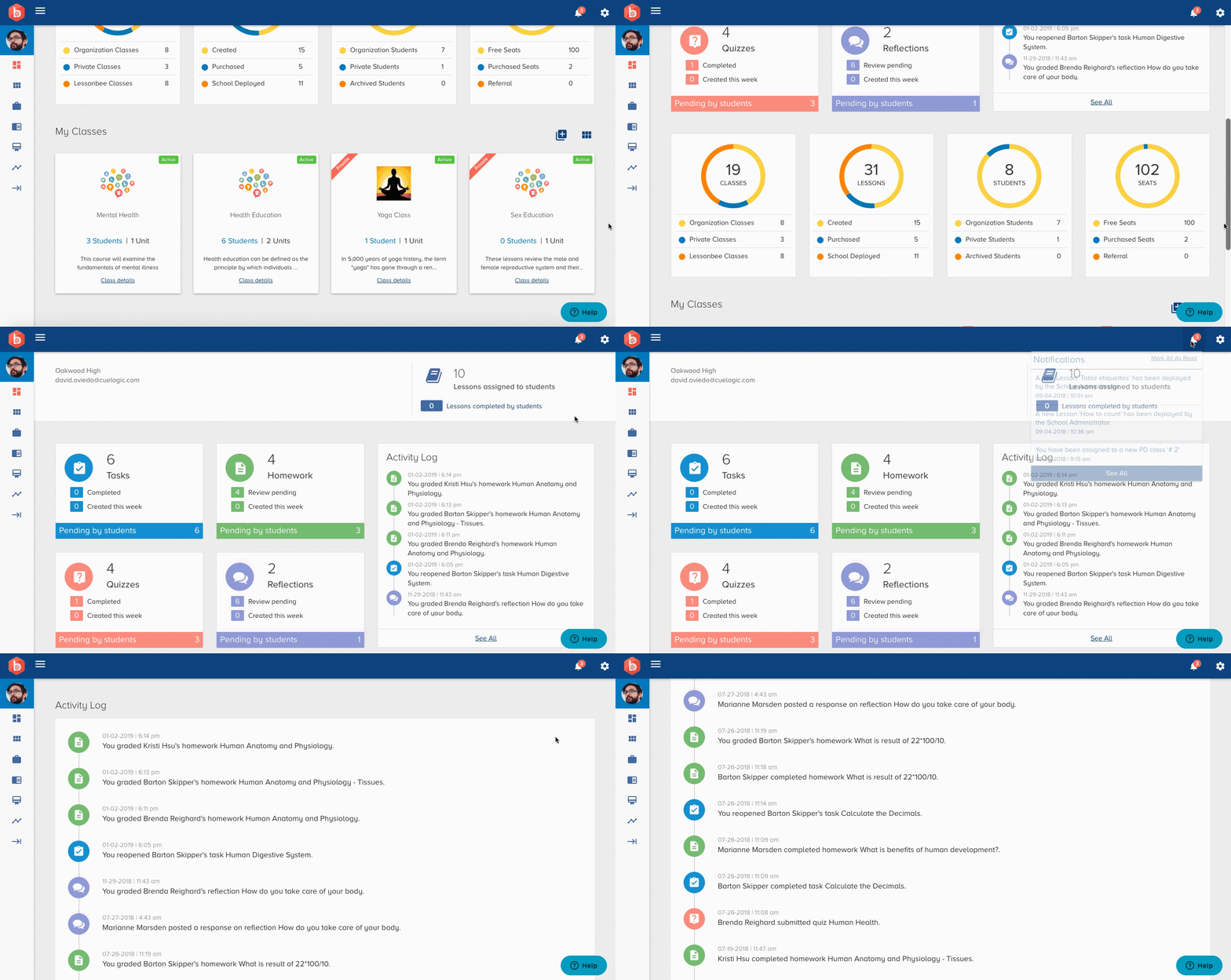
The company sells a curriculum that covers a range of topics, from sex education to race to mental health, that integrates into existing K-12 school districts as a separate standalone course. The topics themselves then break down into smaller focus areas. For example, with the race unit launching soon Lessonbee will tackle the effects of race and ethnicity on quality of care, maternal health and food insecurity.

Lessonbee has hundreds of educational videos and interactive lessons created by teachers and the company, updated regularly. Each lesson also comes with a downloadable guide that describes content, objectives and recommendations for homework and quizzes. Lessonbee gives a guide for how to create culturally inclusive education, in line with standards put out by National Health Education and National Sexuality Education.

Image Source: Lessonbee

“It needs to meet all types of kids, regardless of where they’re at,” McPollom said.

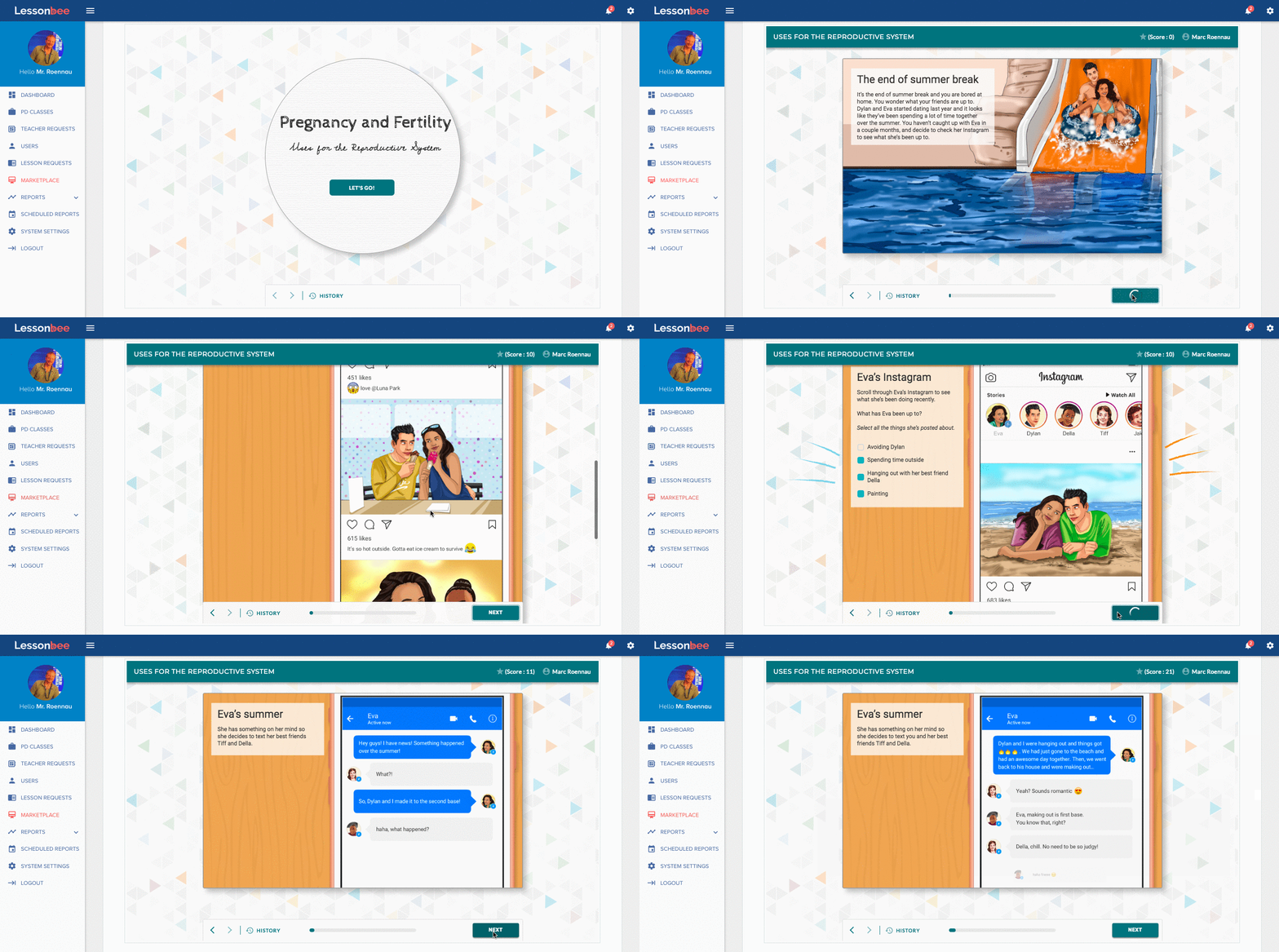
One example scenario in the curriculum includes a student who starts having sex and then misses her period. Learners are then responsible for choosing what to do next, who to talk to and what they should do next time. It’s a “choose your adventure”-style learning experience.

Students can log onto the platform and take self-paced classes on different health units, ranging from sex education to mental health and racism. The lessons are taught through text-message scenarios or gamified situations to make sure students are actively engaging with the content, McPollom tells TechCrunch.

Image Source: Lessonbee

State policy regarding education is often a nightmare of intricacies and politics. This is part of the reason so few startups try to solve it. If Lessonbee were to pull off its goal, it would initiate bigger conversations around racism and health into a kid’s day-to-day.

McPollom is currently pitching the service to school districts, which have tight budgets, and venture capitalists, who say they are open for business. So far, the company has 600 registered schools on its platform.

“It’s a non-core academic subject so it’s the last priority, and there’s just inequity all over the place,” she said. “There’s a mismatch of privacy policies across the United States handled differently and it kind of dictates the quality of health education that you’re going to receive.”

Lessonbee subscription is priced low to be more accessible, starting at $16 per learner annually. Individual courses start at $8 per learner annually.

Today, McPollom announced that she has raised $920,000 in financing.

As for the future, McPollom views her go-to market health class strategy as Lessonbee’s “Trojan horse.” She wants to integrate the culturally diverse curriculum into social studies or science classes, and cover how interconnected the subjects are and their ties to inequity and health.

McPollam says the team is developing an anti-racism course to introduce for the fall in the wake of the recent protests against police brutality. Topics in the anti-racism course include the effect of race and ethnicity on quality of care, ways racism impacts maternal health and structural racism and food insecurity.

“We’re hoping to evolve to this idea of health across the curriculum,” she said. “For health to be effective, for you to actually move the needle, health needs to be holistic.”

NASA sets path for up to six more Artemis moon exploration missions with SLS booster order

NASA has laid the groundwork for an order of up to six additional SLS solid core booster rockets, from supplier Northrop Grumman, the agency announced this week. The six additional boosters would join the existing three that NASA previously locked in for use on Artemis 1, Artemis 2 and Artemis 3, which includes the targeted 2024 mission that will bring the next American man and the first American woman to the lunar surface.

While this is essentially a long-lead declaration of intent to help partner Northrop Grumman ensure its supply pipeline can supply the additional boosters in a timeline needed by NASA, rather than an actual order for the boosters themselves, it’s still a big step with a potential total contract value of $49.5 million, with initial funding unlocked now. The schedule currently calls for those additional boosters to be delivered sometime before December 31, 2030, to provide some kind of idea about when Artemis missions 4-9 might potentially actually fly.

Solid boosters are used with the SLS (Space Launch System) in pairs, with one on each side flanking the SLS Core stage to provide around 75% of the total thrust power used during the take-off phase of its launch. They essentially take their design from those used during the Space Shuttle program, but with added oomph to help the heavier and larger SLS out of Earth’s atmosphere and into space.

NASA has also been in the process of procuring new RS-25 engines and core stages needed for missions in the Artemis program beyond the initial three, and continues to prepare for Artemis 1, with the rocket assembly process for that at the point where the boosters are nearly ready to stack. Artemis 1 is currently targeting a November 2021 timeframe for launch.

Discord now has a $3.5B valuation and $100M for a sales pitch lighter on the gaming

Discord wants to be more than just a place for gamers and is now billing itself as the Slack for users’ social lives.

The new pitch, and a new funding round of $100 million at a reported valuation of $3.5 billion, will help the company as it looks to erase its legacy as a home for gamers (and a virtual townhall for white nationalists).

Now, the company has more money at its disposal to monitor its user base and promote the image that the service isn’t just for gamers. “It turns out that, for a lot of you, it wasn’t just about video games anymore,” write co-founders Jason Citron and Stanislav Vishnevskiy in a blog post.

The two men frame their company as “a place designed to hang out and talk in the comfort of your own communities and friends.” Discord, they say, is “a place to have genuine conversations and spend quality time with people, whether catching up, learning something or sharing ideas.”

It hadn’t always been that way. Three years ago, the company tried to boot a number of its most racist users, but their ability to use the platform to disseminate hate speech has stubbornly persisted. Up until mid-2019 white nationalists were comfortable enough using the service to warrant a shoutout from Daily Stormer founder, Andrew Anglin, who urged his fellow travelers to stop using the service.

“Discord is always on and always present among these groups on the far-right,” Joan Donovan, the lead researcher on media manipulation at the Data & Society Research Institute, told Slate. “It’s the place where they do most of the organizing of doxing and harassment campaigns.”

Discord says these users are a small (and dwindling) fraction of a user base that now also includes Black Lives Matter organizers, social media influencers, and, of course, gamers.

There are now more than 100 million active users on the service that spend 4 billion minutes in conversation on 6.7 million active servers, according to a statement from the company.

If anything, Discord’s success is both a function and feature of the rapid rise of social gaming and social media. The company’s servers enabled real-time communication across gaming platforms that turned them into the dominant social experience for a generation of players. They also enabled influencers on a variety of social media platforms to have a more direct relationship with their fans.

As Taylor Lorenz noted in her reporting on Discord’s newfound fan base among social media entrepreneurs and celebrities:

Last March, Ninja, one of the most popular video game live-streamers in the world, taught Drake how to use Discord while playing Fortnite. YouTube A-listers such as Philip DeFranco, Grace Helbig and the Try Guys all have their own servers, and subreddits such as those dedicated to discussing “The Bachelor” and “The Real Housewives” have their own Discord groups too. More than 200 million people use the service.

“We designed Discord for talking. There’s no endless scrolling, no news feed and no tracking likes. No algorithms decide what you ‘should’ see. We designed Discord to enable the experience and feelings we wanted to recreate: being together with your community and friends. You’ve made your servers into personal spaces filled with people you invited and set the topics of discussion,” the founders write.

The kinder, gentler Discord belies both the company’s name and its roots. But it is a sign of its efforts to shift the perceptions of investors and woo potential new users to the service.

In addition to its new cash, the company is highlighting a new user experience and added server video so that users can communicate more readily. There are templates available to help users create servers, and the company has increased its voice and video capacity by 200%.

As part of this new focus on product, Discord has launched what it calls a “Safety Center” that clearly defines the company’s rules and regulations and what actions users can take to monitor and manage their use of service for hate speech and abuse.

We will continue to take decisive action against white supremacists, racists and others who seek to use Discord for evil,” the founders write. 

Danny Rimer, the co-founder of Index Ventures, which led the investor group that invested in Discord’s latest $100 million cash infusion, is an advocate for the company’s expanded vision for itself.

“I believe Discord is the future of platforms because it demonstrates how a responsibly curated site can provide a safe space for people with shared interests,” Rimer wrote in a statement. “Rather than throwing raw content at you, like Facebook, it provides a shared experience for you and your friends. We’ll come to appreciate that Discord does for social conversation what Slack has done for professional conversation.”

The parallels to Slack are interesting and begin with the fact that both companies began their lives as gaming studios before moving to become communications services.

“In France this year, Discord was adopted as the primary app for distance learning after the government’s official service failed. As a result, Discord reached the top 10 app downloads in France in March and is still in the top 50 in the U.S. and U.K. today,” Rimer noted in his explanation of Index’s latest investment. “As Discord plans its next phase of growth, it will become even more inclusive and welcoming for new users and communities and it will continue to be guided by the users that have informed its development from the start.”