Intel to invest $253.5 million in India’s Reliance Jio Platforms

Intel said on Friday it will invest $253.5 million in Jio Platforms, joining a roster of high-profile investors including Facebook, General Atlantic, and Silver Lake that have backed India’s top telecom operator in recent months.

The American chipmaker’s investment arm said it is acquiring a 0.39% stake in Jio Platforms, giving the Indian firm a valuation of $65 billion. Intel Capital is the 12th investor to buy a stake in Jio Platforms, which has raised more than $15.5 billion by selling a 25% stake since April this year.

“Jio Platforms’ focus on applying its impressive engineering capabilities to bring the power of low-cost digital services to India aligns with Intel’s purpose of delivering breakthrough technology that enriches lives. We believe digital access and data can transform business and society for the better,” said Wendell Brooks, Intel Capital President, in a statement.

The announcement today comes weeks after Mukesh Ambani, who controls Reliance Industries — the parent firm of Jio Platforms — suggested that Saudi Arabia’s PIF $1.5 billion investment on June 18 in his digital unit had marked the “end of Jio Platforms’ current phase of induction of financial partners.”

Ambani, who is India’s richest man, said on Friday that he was excited to “work together with Intel to advance India’s capabilities in cutting-edge technologies that will empower all sectors of our economy and improve the quality of life of 1.3 billion Indians.”

The new deal further illustrates the opportunities foreign investors see in Jio, a four-year-old subsidiary of Reliance Industries (India’s most valuable firm) that has upended the telecommunications market in India with cut-rate voice calls and mobile data tariffs. Jio has about 400 million subscribers.

Analysts at Bernstein said last month that they expect Jio Platforms to reach 500 million customers by 2023, and control half of the market by 2025. Jio Platforms competes with Bharti Airtel and Vodafone Idea, a joint venture between British giant Vodafone and Indian tycoon Kumar Mangalam Birla’s Aditya Birla Group.

Jio Platforms also operates a bevy of digital apps and services, including music streaming service JioSaavn (which it says it will take public), on-demand live television service JioTV and payments app JioMoney, as well as smartphones and broadband business. These services are available to Jio subscribers at no additional charge.

On Thursday evening, Jio Platforms launched JioMeet, a video-conferencing service that offers unlimited calls with “up to 24 hours” time limit on each session. The service, which currently has no paid plans, looks uncannily like Zoom.

Good artists borrow, great artists steal ? pic.twitter.com/r7KpIfwIFC

— Avinash Raghava (@avinashraghava) July 3, 2020

Last month, Ambani said the funds in Jio Platforms had helped him clear oil-to-retail giant Reliance Industries’ net debt of about $21 billion. Ambani had originally pledged to clear Reliance’s debt due by early 2021.


Festo’s latest biomimetic robots are a flying feathered bird and ball-bottomed helper arm

You could be excused for thinking that German robotics company Festo does nothing but put together fabulous prototype robots built to resemble kangaroos, jellyfish, and other living things. They do in fact actually make real industrial robots, but it’s hard not to marvel at their biomimetic experiments; Case in point, the feathered BionicSwift and absurd BionicMobileAssistant motile arm.

Festo already has a flying bird robot — I wrote about it almost 10 years ago. They even made a flying bat as a follow-up. But the BionicSwift is more impressive than both because, in an effort to more closely resemble its avian inspiration, it flies using artificial feathers.

Image Credits: Festo

“The individual lamellae [i.e. feathers] are made of an ultralight, flexible but very robust foam and lie on top of each other like shingles. Connected to a carbon quill, they are attached to the actual hand and arm wings as in the natural model,” Festo writes in its description of the robot.

The articulating lamellae allow the wing to work like a bird’s, forming a powerful scoop on the downstroke to push against the air, but separating on the upstroke to produce less resistance. Everything is controlled on-board, including the indoor positioning system that the bird was ostensibly built to demonstrate. Flocks of BionicSwifts can fly in close quarters and avoid each other using an ultra wideband setup.

Festo’s BionicMobileAssistant seems like it would be more practical, and in a way it is, but not by much. The robot is basically an arm emerging from a wheeled base — or rather a balled one. The spherical bottom is driven by three “omniwheels,” letting it move easily in any direction while minimizing its footprint.

The hand is a showcase of modern robotic gripper design, with all kinds of state of the art tech packed in there — but the result is less than the sum of its parts. What makes a robotic hand good these days is less that it has a hundred sensors in the palm and fingers and huge motility for its thumb, but rather intelligence about what it is gripping. An unadorned pincer may be a better “hand” than one that looks like the real thing because of the software that backs it up.

Not to mention the spherical movement strategy makes for something of an unstable base. It’s telling that the robot is transporting scarves and not plates of food or parts.

Of course, it’s silly to criticize such a machine, which is aspirational rather than practical. But it’s important to understand that these fascinating creations from Festo are hints at a possible future more than anything.

Sprint 5G is no more, as T-Mobile focuses on its own network

A day after formally completing the sale of Boost, Virgin and other Sprint prepaid networks to Dish, T-Mobile is pulling the plug on Sprint 5G. The move is one in a long list of issues that need sorting out in the wake of April’s $26.5 billion merger. And like a number of other moves, it’s set to leave some customers in the lurch.

The end of Sprint’s 2.5 GHz 5G comes as T-Mobile opts to focus on its own network. T-Mobile already started the process in New York City, a few weeks after the merger and has since completed it in a handful of other cities, including Atlanta, Chicago, Dallas-Fort Worth, Houston, Kansas City, Los Angeles, Phoenix and Washington, D.C.

As CNET notes, while most of the Sprint 5G handsets won’t be able to make the transition, Samsung Galaxy S20 5G users are in the clear here. For everyone else, T-Mobile is offering up credits on leases for new 5G handsets.

T-Mobile told TechCrunch in a statement, “We are working to quickly re-deploy, optimize and test the 2.5GHz spectrum before lighting it up on the T-Mobile network.”

Along with the sale of Boost, 5G was a big selling point for T-Mobile’s Sprint acquisition. The carriers argued that the deal was necessary to keep them competitive with first and second place carriers AT&T and Verizon when it came to the next-generation wireless technology.

At the time FCC chairman Ajit Pai agreed stating, “This transaction will provide New T-Mobile with the scale and spectrum resources necessary to deploy a robust 5G network across the United States.”

Earlier this week, OpenSignal awarded T-Mobile the top spot in availability, noting, “In the U.S., T-Mobile won the 5G Availability award by a large margin with Sprint and AT&T trailing with scores of 14.1% and 10.3%, respectively.”

Update: The language of the post has been updated to reflect the impact on specific unsupported devices, rather than user base figures.

Uber adds another director to its board: Flex CEO Revathi Advaithi

Uber has a new, independent board member, shows a new SEC filing: CEO Revathi Advaithi of 51-year-old Flex, which is among the world’s largest electronic manufacturers and competes against Taiwan’s Foxconn Technology.

Advaithi, a mechanical engineer who grew up in India with four sisters, was appointed to the top job in February of last year after spending roughly 10 years with the electronic manufacturing company Eaton, where she was COO and oversaw its global electrical business.

Before that, she spent six years as a VP at Honeywell.

Advaithi came to the job at a tough time. Specifically, Flex once counted among its biggest customers the Chinese company Huawei, for which it provided contract services for products like smartphones and 5G base stations. But the U.S. government last year banned U.S. firms — and non-U.S. firms with more than 25% American components in their products — from doing business with Huawei after it was deemed a national security risk.

Indeed, Flex, which today enjoys a market cap of $5 billion, saw its shares trading in the high teens in 2018, but they’d fallen to around $10 a share before Advaithi was brought aboard, and they have largely stay there since.

The coronavirus has also put pressure on Flex’s supply chains, even while the company has been diversifying its factories. (It noted to analysts earlier this year that it doesn’t have a factory in China’s Hubei province, which, at the time, was the epicenter of the virus.)

Advaithi is currently Uber’s third female director. In February, it announced that Mandy Ginsberg had been appointed to the board.  GInsberg was CEO of the dating app company Match Group until January of this year, reportedly stepping down from the role after a tornado hit her home in Dallas and she separately underwent surgery. (Publicly traded Match Group was already expected at the time to be spun away from its majority shareholder, IAC, a maneuver that was completed yesterday.)

In 2017, Uber also appointed then Nestlé executive Wan Ling Martello to its board. Martello left Nestlé in 2018.

Entrepreneur Arianna Huffington was the first woman brought into Uber’s boardroom back in 2016 by then CEO Travis Kalanick. She left her seat last year, citing the growth of her media company, Thrive Global, as the reason for her departure.

Advaithi began her career in the U.S. decades ago as a shop floor supervisor in Shawnee, Oklahoma. She took over as Flex CEO last year when its longtime chief, Michael McNamara, resigned to join the venture capital firm Eclipse.

‘Westworld’ creators are developing a ‘Fallout’ TV series for Amazon

“Fallout,” the post-apocalyptic video game franchise published by Bethesda Softworks, is being turned into a TV series by Kilter Films, the production company of Jonathan Nolan and Lisa Joy.

The series, which began in 1997, takes place in an alternate future with a retro tone, after a nuclear war has turned most of the world into a wasteland. The games have continued in the two decades since, most recently with the release of “Fallout 76.”

The show — currently in development, with a series commitment from Amazon Studios — is part of Nolan and Joy’s overall deal with streaming service, which they signed last year for a reported $150 million.

The husband-and-wife team is best known for creating HBO’s new version of “Westworld” (based on a Michael Crichton film from the 1970s). They’re also working on an adaptation of William Gibson’s novel “The Peripheral.”

“Fallout is one of the greatest game series of all time,” Nolan and Joy said in a statement. “Each chapter of this insanely imaginative story has cost us countless hours we could have spent with family and friends. So we’re incredibly excited to partner with Todd Howard and the rest of the brilliant lunatics at Bethesda to bring this massive, subversive, and darkly funny universe to life with Amazon Studios.”


Police roll up crime networks in Europe after infiltrating popular encrypted chat app

Hundreds of alleged drug dealers and other criminals are in custody today after police in Europe infiltrated an encrypted chat system reportedly used by thousands to discuss illegal operations. The total failure of this ostensibly secure method of communication will likely have a chilling effect on the shadowy industry of crime-focused tech.

“Operation Venetic” was reported by various police agencies, major local news outlets, and by Motherboard in especially vibrant form, quoting extensively people apparently from within the groups affected.

The operation involved hundreds of officers working across numerous agencies in France, the Netherlands, the U.K., and other countries. It began in 2017, and culminated two months ago when a service called EncroChat was hacked and the messages of tens of thousands of users exposed to police scrutiny.

EncroChat is a step up in some ways from encrypted chat apps like Signal and WhatsApp. Rather like Blackberry once did, EncroChat provided customized hardware, a dedicated OS, and its own servers to users, providing an expensive service costing thousands per year rather than a one-time purchase or download.

Messages on the service were supposedly very secure and had deniability built in by letting conversations be edited later — so theoretically a user could claim after the fact they never said something. Motherboard’s Joseph Cox has been following the company for some time and has far more details on its claims and operations.

Image Credits: EncroChat /

Needless to say those claims were not entirely true, as at some point in early 2020 police managed to introduce malware into the EncroChat system that completely exposed the conversations and images of its users. Because of the trusted nature of the app, people would openly discuss drug deals, murders, and other crimes, making them sitting ducks for law enforcement.

Throughout the spring criminal operations were being cracked open with alarming (to them) regularity, but it wasn’t until May that users and EncroChat managed to put the pieces together. The company attempted to warn its users and issue an update, but the cat was out of the bag. Seeing that its operation was now exposed, the Operation Venetic teams struck.

Arrests across the several countries involved (there were numerous sub-operations but France and the Netherlands were the primary investigators) total near a thousand, but exact numbers are not clear. Dozens of guns, tons (metric, naturally) of drugs and the equivalent of tens of millions of dollars in cash were seized. More importantly, the chat logs seem to have provided access to people higher up the food chain than ordinary busts would have.

That the reportedly most popular of encrypted chat companies focused on illegal activities could be so completely subverted by international authorities will likely put a damper on its competition. But like other, more domestic challenges to encryption, such as the perennial complaints by the FBI, this event is more likely to strengthen the tools in the long run.

Velodyne becomes latest tech company to go public using a SPAC, eschewing the traditional IPO path

Velodyne Lidar, the leading supplier of a sensor widely considered critical to the commercial deployment of autonomous vehicles, said Thursday it has struck a deal to merge with special-purpose acquisition company Graf Industrial Corp., with a market value of $1.8 billion.

The company said it was able to raise $150 million in private investment in public equity, or PIPE, from new institutional investors as well as existing shareholders of Graf Industrial. Through the transaction, Velodyne will have about $192 million in cash on its balance sheet.

Velodyne’s founder David Hall along with backers Ford, Chinese search engine Baidu, Hyundai Mobis and Nikon Corp. will keep an 80% stake in the combined company. Hall will become executive chairman and Anand Gopalan will keep his CEO position.

The merger is expected to close in the third quarter of 2020. The combined company will remain on the NYSE and trade under a new ticker symbol VLDR following the close of the business combination, Velodyne said.

The agreement marks the latest company to turn to SPACs in lieu of a traditional IPO process. Earlier this week, online used car marketplace startup Shift Technologies announced an agreement to merge with SPAC Insurance Acquisition Corp. The newly combined company will be listed on NASDAQ under a new ticker symbol. Nikola Motor also went public via a SPAC earlier this year.

Velodyne will become a publicly traded company amid a period of consolidation in the broader autonomous vehicle industry. Startups, automakers and tech giants have extended their timelines in the capitally intensive pursuit of developing and deploying AVs. Some startups have been swallowed up by larger companies, while others have become defunct. It has also prompted automakers in the past 18 months to shift more resources and attention toward advanced driver assistance systems in passenger cars, trucks and SUVs.

Lidar is perhaps one of the most crowded sub categories in the autonomous vehicle industry. Lidar is a sensor that measures distance using laser light to generate highly accurate 3D maps of the world around the car. The sensor is considered by most in the self-driving car industry a key piece of technology required to safely deploy robotaxis and other autonomous vehicles.

Velodyne is best known for its “KFC bucket” spinning-laser lidar. The design was inspired by sensor failures in vehicles competing in the DARPA Grand Challenge in 2004. Hall developed the spinning laser lidar and sold the sensors to teams competing in a future autonomous vehicle DARPA competition. The KFC buckets were the go-to lidar sensors for companies working on autonomous vehicles. Waymo, back when it was just the Google self-driving project, even used Velodyne LiDAR sensors until 2012.

However, Spinning lidar units are expensive and mechanically complex. It spurred a new generation of lidar startups to try new approaches. Today, there are dozens of lidar companies — some counts track upwards of 70 — trying to convince automakers and AV developers to use their sensors. And they’re all aiming for Velodyne.

This new generation of companies has prompted Velodyne to evolve, as well. The company announced at CES 2020 in January new sensors, including a tiny $100 lidar unit called Velabit, as well the VelaDome and a software product called Vella.

“There’s no argument about the market opportunity for lidar,” Gopalan told TechCrunch reporter Devin Coldewey back in January. “I think the right conversation is about what you want to do with it. Others are focused on level 2+ or 3 [autonomy, i.e. above simple driver assistance] — what we want to do is short-circuit that approach. The only reason it’s not being adopted at lower levels is price. If I say you can have lidar for a hundred dollars, of course you’re going to use it. Under a hundred dollars, you can’t even imagine the applications you open up: drones, home robotics, sidewalk robots.”

The company has spent the past several years focused on reducing the cost of its lidar, as well as diversifying its portfolio. The Velabit is just one example of the company’s efforts to lock in customers outside of the AV industry. The small sensor doesn’t have the capabilities needed for autonomous vehicles. Instead, Velodyne sees an application for the sensor to be used on smaller industrial robots.

Project M acquires punk rock satire site The Hard Times

Matt Saincome knows that compared to many of the startup acquisitions that we write about on TechCrunch, selling a website for a little over $1 million (mostly cash, with a little stock) isn’t a huge deal.

“But in the world of punk comedy media? Whoo boy!” he said.

Saincome is happy to poke fun at himself — he is the co-founder and CEO of a satirical punk news website, after all — but he also sounded genuinely proud of what he’s built with The Hard Times. He never raised outside funding, and while there have been acquisition offers in the past, he was always afraid that they might threaten the site’s voice.

“I had always been the financial backstop,” Saincome told me. Still, at a certain point, “That started to become irresponsible.”

So he’s happy that there will be a bit of a financial windfall (not to mention health care and benefits) for himself, his co-founder and editor-in-chief Bill Conway and their editorial staff, plus a pay bump for freelancers. He also suggested that the acquisition will allow The Hard Times to invest more seriously in its editorial strategy, for example by building out its podcast network.

“If you like The Hard Times, it’s just going to be The Hard Times on steroids,” he said. “It’s very much the same direction, but better and secured.”

The acquiring company is Project M Group, a digital media and e-commerce company founded in 2016 that has also acquired Revolver Magazine and Inked Magazine.

Here’s how founder and CEO Enrique Abeyta laid out the Project M model: “We go out and acquire existing media properties with an audience, and we reinvigorate or relaunch or put some capital behind them to grow those audiences. Then we tie that into a vertically integrated e-commerce platform.”

After all, it’s no secret that many online publishers have struggled to make the digital advertising model work. Given Revolver’s focus on heavy metal and rock, and Inked’s focus on tattoos, there are some natural commerce opportunities — for example, if you’re reading an article about Metallica, you might also want to buy a Metallica T-shirt.

At the same time, Abeyta emphasized the importance of authenticity in the publications that Project M acquires, and he said that post-acquisition, they don’t become any more corporate.

“I’m a tattooed, mohawked guy running this company out of my house in Cave Creek, Arizona,” he said. “We’re the least corporate thing on Planet Earth … Our whole vibe when we partner with these entrepreneurs is, we want to work with the entrepreneur and the brand.”

So the entire Hard Times team, including Saincome, will remain involved. At the same time, the site’s old parent company will continue to own and operate the related gaming and technology site Hard Drive.

Saincome said he’ll also continue running OutVoice, a separate startup building freelancer payment tools. In fact, one of the results of the deal is that all of Project M’s publications will be using OutVoice.

“My role at Hard Times is going to be the visionary, brand-builder sort of guy,” he said. That should free up a lot of his time and energy from worrying about day-to-day business concerns, and he promised, “I’m going to take that energy and pump it back right into OutVoice .”

Extra Crunch Live: Join Jason Green of Emergence Capital for a live Q&A on July 9 at 2 pm EDT/11 am PDT

2020 may feel so far like the year of living dangerously, but for many of us it has also been the year of working remotely. Led by the stick of COVID-19 rather than the carrot of the benefits of more flexible work life, a lot of organizations, and the people who power them, have only relatively recently started to get to grips with this concept. But some have had their finger on the pulse of cloud computing and how that relates to enterprise productivity for years.

Come join us on Thursday, July 9, at Extra Crunch Live to hear from Jason Green of Emergence Capital, one of the leading investors (and VC firms) promoting and funding some of the biggest startups in this space.

Extra Crunch Live is open exclusively to Extra Crunch subscribers. If you’re not already an Extra Crunch member, you can join here.

For the uninitiated, the EC Live format is at once direct and wide-ranging, an hour-long conversation that not only covers some of the biggest issues in tech, building startups and investing today — and boy do we have a lot of issues right now — but gets to the heart of them, in a lighter format that’s actually fun to watch — as you can see from past talks with Sequoia’s Roelof Botha and Homebrew’s Hunter Walk.  (See the whole schedule of Extra Crunch Live talks here.)

July 9 should be an especially good one because, well, Green is full of beans.

That is to say, he’s been very outspoken in the last few months, leading the (reassuring? alarming?) charge for startups to just write off the last quarter and focus on the future.

Sounds flippant? Not really. Green has years of experience to draw on — a long track record backing some of the most game-changing and successful startups of the last decade+ in the areas of cloud computing, enterprise and enterprise productivity, and specifically in how they cross over. They include Box, SalesLoft, ServiceMax, SteelBrick, SuccessFactors, Gusto (formerly ZenPayroll) and Yammer, with Emergence itself also an early backer of Zoom, Salesforce, Crunchbase and Clearbanc.

For founders, other investors and anyone involved in any aspect of deal-making, especially for enterprise startups, it’s a must-watch.

Join Jason and me next week. We’re looking forward to it.

Extra Crunch Live is open exclusively to Extra Crunch subscribers, and so if you want to watch, join here. You can find the full details of the call below the jump!

Details:

Cendana Capital, which has been backing seed funds for a decade, has $278 million more to invest

When in 2010, former VC Michael Kim set out to raise a fund that he would invest in a spate of micro VC managers, the investors to which he turned didn’t get it. Why pay Kim and his firm, Cendana Capital,  a management fee on top of the management fees that the VC managers themselves charge?

Fast forward to today, and Kim has apparently proven to his backers that he’s worth the extra cost. Three years after raising $260 million across a handful of vehicles whose capital he plugged into up-and-coming venture firms, Kim is now revealing a fresh $278 million in capital commitments, including $218 million for Cendana’s fourth flagship fund, and $60 million that it will be managing expressly for the University of Texas endowment.

We talked with Kim last week about how he plans to invest the money, which differs slightly from how he has invested in the past.

Rather than stick solely with U.S.-based seed-stage managers who are raising vehicles of $100 million or less, he will split Cendana into three focus areas. One of these will remain seed-stage managers. A smaller area of focus — but one of growing importance, he said — is pre-seed managers who are managing $50 million or less and mostly funding ideas (and getting roughly 15% of each startup in exchange for the risk).

A third area of growing interest is in international managers in cities where seed-stage startups can now reliably find follow-on financial support. In fact, Kim says Cendana has already backed small venture firms in Australia (Blackbird Ventures), China (Cherubic Ventures, which is a cross-border investor that is also focused on the U.S.), Israel (Entree Capital), and India (Saama Capital), among other spots.

Altogether, Cendana is now managing around $1.2 billion. For its services, it charges its backers a 1% management fee and 10% of its profits atop the 2.5% management fee and 20% “carried interest” that his fund managers collect.

“To be extremely clear about it and transparent,” said Kim, “that’s a stacked fee that’s on top of what our [VC] fund managers charge. So Cendana LPs are paying 3.5% and 30%.” An observer “might think that seems pretty egregious,” he continued. “But a number of our LPs are either not staffed to go address this market or are too large to actually write smaller checks to these seed funds. And we provide a pretty interesting value proposition to them.”

That’s particularly true, Kim argues, when contrasting Cendana with other, bigger fund managers.

“A lot of these well-known fund of funds are asset gatherers,” he says. “They’re not charging carried interest. They’re in it for the management fee. They have shiny offices around the world. They have hundreds of people working at them. They’re raising billion-dollar-plus kind of funds. And they’re putting 30 to 50 names into each one, so in a way they become index funds.” The problem, says Kim: “I don’t think venture is really an asset class. Unlike an ETF that’s focused on the S&P 500, venture capital is where a handful of fund managers capture most of the alpha. Our differentiation is that we’re creating very concentrated portfolios.”

How concentrated? Cendana typically holds anchor positions in up to 12 funds, plus makes $1 million bets on another handful of more nascent managers that it will fund further if they prove out their theses.

Some of the managers that Cendana has backed have outgrown the outfit from an assets standpoint. Cendana caps its investments in funds that are $100 million or less in size. Over time, however, it has backed 22 seed-stage managers, including 11.2 Capital, Accelerator Ventures, Angular Ventures, Bowery Capital, Collaborative Fund, Forerunner Ventures, Founder Collective, Freestyle Capital, IA Ventures, L2 Ventures, Lerer Hippeau, MHS Capital, Montage Ventures, Moxxie Ventures, Neo, NextView Ventures, Silicon Valley Data Capital, Spider Capital, Susa Ventures, Uncork VC (when it was still SoftTech VC), Wave Capital and XYZ Ventures.

As for its pre-seed fund managers, Cendana has been the anchor investor in roughly 10 outfits, including Better Tomorrow Ventures, Bolt VC, Engineering Capital, K9 Ventures, Mucker Capital, Notation Capital, PivotNorth Capital, Rhapsody Venture Partners, Root Ventures, and Wonder Ventures.

For those curious about its returns, Kim says that Cendana’s very first fund, a $28.5 million vehicle, is “marked at north of 3x” and “that’s net of everything.”

He’s optimistic that the firm’s numbers will look even better over time.

According to Kim, Cendana currently has 38 so-called unicorns in its broader portfolio. It separately hold stakes in 160 companies that are valued at more than $100 million.

Facebook shuts down Hobbi, its experimental app for documenting personal projects

Facebook’s recently launched app, Hobbi, an experiment in short-form content creation around personal projects, hobbies, and other Pinterest-y content, is already shutting down. The app first arrived on iOS in February as one of now several launches from Facebook’s internal R&D group, the NPE Team.

Hobbi users have now been notified by way of push notification that the app is shutting down on July 10, 2020. The app allows users to export their data from its settings.

In the few months it’s been live on the U.S. App Store, Hobbi only gained 7,000 downloads, according to estimates from Sensor Tower. Apptopia also reported the app had under 10K downloads and saw minimal gains during May and June.

Though Hobbi clearly took cues from Pinterest, it was not designed to be a pinboard of inspirational ideas. Instead, Hobbi users would organize photos of their projects — like gardening, cooking, arts & crafts, décor, and more — in a visual diary of sorts. The goal was to photograph the project’s progress over time, adding text to describe the steps, as needed.

The end result would be a highlight reel of all those steps that could be published externally when the project was completed.

But Hobbi was a fairly bare bones app. There was nothing else to do but document your own projects. You couldn’t browse and watch projects other users had created, beyond a few samples, nor could you follow top users across the service. And even the tools for documentation were underdeveloped. Beyond a special “Notes” field for writing down a project’s steps, the app experience felt like a watered-down version of Stories.

Image Credits: Hobbi

Facebook wasn’t alone in pursuing the potential of short-form creative content. Google’s internal R&D group, Area 120, also published its own experiment in this area with the video app Tangi. And Pinterest was recently spotted testing a new version of Story Pins, that would allow users to showcase DIY and creative content in a similar way.

It’s not surprising to see Hobbi wind down so quickly, given its lack of traction. Facebook already said its NPE Team experiments would involve apps that changed very rapidly and would shut down if consumers didn’t find them useful.

In addition to Hobbi, the NPE Team has launched a number of apps since last summer, including meme creator Whale, conversational app Bump, music app Aux, couples app Tuned, Apple Watch app Kit, audio calling app CatchUp, collaborative music app Collab, live event companion Venue, and predictions app Forecast. Before Hobbi, the only one to have shut down was Bump. (Some are not live in the U.S., either.)

Of course, Facebook may not intend to use these experiments to create a set of entirely new social apps built from the ground-up. Instead, it’s likely looking to collect data about what features resonate with users and how different creation tools are used. This is data that can inform Facebook’s development of features for its main set of apps, like Facebook, Messenger, WhatsApp and Instagram.

We’ve reached out to Facebook for comment but one had not been provided at the time of publication.

Lyft’s self-driving test vehicles are back on public roads in California

Lyft’s self-driving vehicle division has restarted testing on public roads in California, several months after pausing operations amid the COVID-19 pandemic.

Lyft’s Level 5 program said Tuesday some of its autonomous vehicles are back on the road in Palo Alto and at its closed test track. The company has not resumed a pilot program that provided rides to Lyft employees in Palo Alto.

The company said it is following CDC guidelines for personal protective equipment and surface cleaning. It has also enacted several additional safety steps to prevent the spread of COVID. Each autonomous test vehicle is equipped with partitions to separate the two safety operators inside, the company said. The operators must wear face shields and submit to temperature checks. They’re also paired together for two weeks at a time.

Lyft’s Level 5 program — a nod to the SAE automated driving level that means the vehicle handles all driving in all conditions — launched in July 2017 but didn’t starting testing on California’s public roads until November 2018. Lyft then ramped up the testing program and its fleet. By late 2019, Lyft was driving four times more autonomous miles per quarter than it was six months prior.

Lyft had 19 autonomous vehicles testing on public roads in California in 2019, according to the California Department of Motor Vehicles, the primary agency that regulates AVs in the state. Those 19 vehicles, which operated during the reporting period of December 2018 to November 2019, drove nearly 43,000 miles in autonomous mode, according to Lyft’s annual report released in February. While that’s a tiny figure when compared to other companies such as Argo AI, Cruise and Waymo, it does represent progress within the program.

Lyft has supplemented its on-road testing with simulation, a strategy that it relied on more heavily during COVID-related shutdowns. And it will likely continue to lean on simulation even as local governments lift restrictions and the economy reopens.

Simulation is a cost-effective way to create additional control, repeatability and safety, according to a blog post released Tuesday by Robert Morgan, director of engineering, and Sameer Qureshi, director of product management at Level 5. The pair said simulation has also allowed the Level 5 unit to test its work without vehicles, without employees leaving their desks and, for the last few months, without leaving their homes. Level 5 employs more than 400 people in London, Munich and the United States.

Using simulation in the development of autonomous vehicle technology is a well-established tool in the industry. Lyft’s approach to data — which it uses to improve its simulations — is what differentiates the company from competitors. Lyft is using data collected from drivers on its ride-hailing app to improve simulation tests as well as build 3D maps and understand human driving patterns.

The Level 5 program is taking data from select vehicles in Lyft’s Express Drive program, which provides rental cars and SUVs to drivers on its platform as an alternative to options like long-term leasing.

TransferWise to offer investment products but has ‘no plans’ to become a bank

TransferWise, the London-headquartered international money transfer service recently valued at $3.5 billion, has secured an additional license with U.K. regulators to enable it to offer investment products in the future.

This will mean that U.K. customers who have money deposited in a TransferWise multi-currency or so-called “borderless” account will be given the option to make that money work harder on their behalf. Total deposits currently sit at £2 billion, so there is quite a lot of customer cash potentially idle.

However, the company isn’t revealing much detail on its future investments product, except to say that it will initially offer “simple, affordable funds from reputable providers” so that customers can earn a return on their balances. Up to £85,000 of money held as investments within a TransferWise account per customer will be protected under the Financial Services Compensation Scheme. The new offering is still in development and will launch “in the next 12 months.”

Zooming out further, TransferWise says an increasing number of its 8 million customers are using the borderless account as an international banking solution. Around one million TransferWise debit cards have been issued since 2018, and the TransferWise account now also supports direct debits, instant international payments to friends, and Apple and Google Pay. With the addition of savings and investments, TransferWise says its vision is for the borderless account to replace “expensive, old-world international banking” for expats, freelancers and travelers.

“You and I have been talking since 2011, when you first reported that TransferWise was going live, and I think you’ll appreciate that over time we’ve expanded the features that TransferWise offers our customers, for sure,” co-founder and current CEO Kristo Käärmann tells me on a call. “We launched the borderless account to let people receive money in-roads and to hold money. We added the debit cards so that they can use that money that they hold in places where they can use the card. And this is, in some ways, no different.”

Sticking to broad brush strokes rather than specific product details (despite my persistent questioning), Käärmann says that after listening to customers TransferWise wants to help them hold their balance in a smarter way.

“Clearly they’ve already figured out that TransferWise works for them,” he says. “And not merely as a medium of sending money from one country to another but also to get paid internationally, to kind of run their international part of banking, if you like. For businesses, for freelancers, for ex-pats, for people that have just moved countries. So this is another feature along the same string of things that people want us to do for them.”

That, of course, begs the question: Does TransferWise have any plans to become an actual bank, with a full banking license, further adding to its existing permissions from regulators. Käärmann gives a pretty emphatic answer.

“No, we don’t have any plans to apply for a banking license,” he says. “We haven’t applied for any banking licenses anywhere in the world… The only thing that the banking license in Europe lets banks do is lend out the deposits that customers give them, and that’s not what our customers are asking for. They’re not asking us, you know, can you please lend out our deposits?”

In fact, Käärmann confesses to not being a huge fan of the predominant current account business model, which he believes serves the interests of banks, not account-holding customers. “I do think the way current accounts work with banks is not sustainable in the long term. That the money we keep in banks is being lent out to mortgages and business loans and overdrafts and so on, yet the customers holding that money, they’re not really getting much benefit from it. So why do it?” he asks, somewhat rhetorically.

Returning to the forthcoming investment product — and after a little more prodding from me — he says to expect it to have the same transparency as the company’s core money exchange offering, with clear pricing and working as hard for customers as possible. In line with TransferWise’s existing modus operandi, I would also expect it to be financially sustainable, rather than being cross-subsidised in order to pull customers in or grab easy headlines, which is common practice amongst many investments and savings products.

Adds the TransferWise CEO: “We want to be clear what the problem is we’re solving. [It] comes back to giving people a choice of where and how they hold their balances. And that might give you a hint of the product that we’re building. I can say now that we’re not building an active trading product, that’s not the goal. Our customers aren’t asking how can they speculate on the markets. There are tools for this, and they are increasingly [getting] better for this purpose. What we’re solving with the investments product is going to be a much more passive way of choosing where your balances sit.”

Elementary Robotics is making its quality assurance robots commercially available

Two years and more than $17 million after it first began working on its robots for quality assurance, the Los Angeles-based Elementary Robotics has finally made its products commercially available.

The company already boasts a few very large initial customers in the automotive industry, consumer packaged goods and aerospace and defense, including Toyota, according to chief executive Arye Barnehama. Now, the robotics technology that Barnehama and his co-workers have been developing is broadly available to other companies beyond its six initial pilot customers.

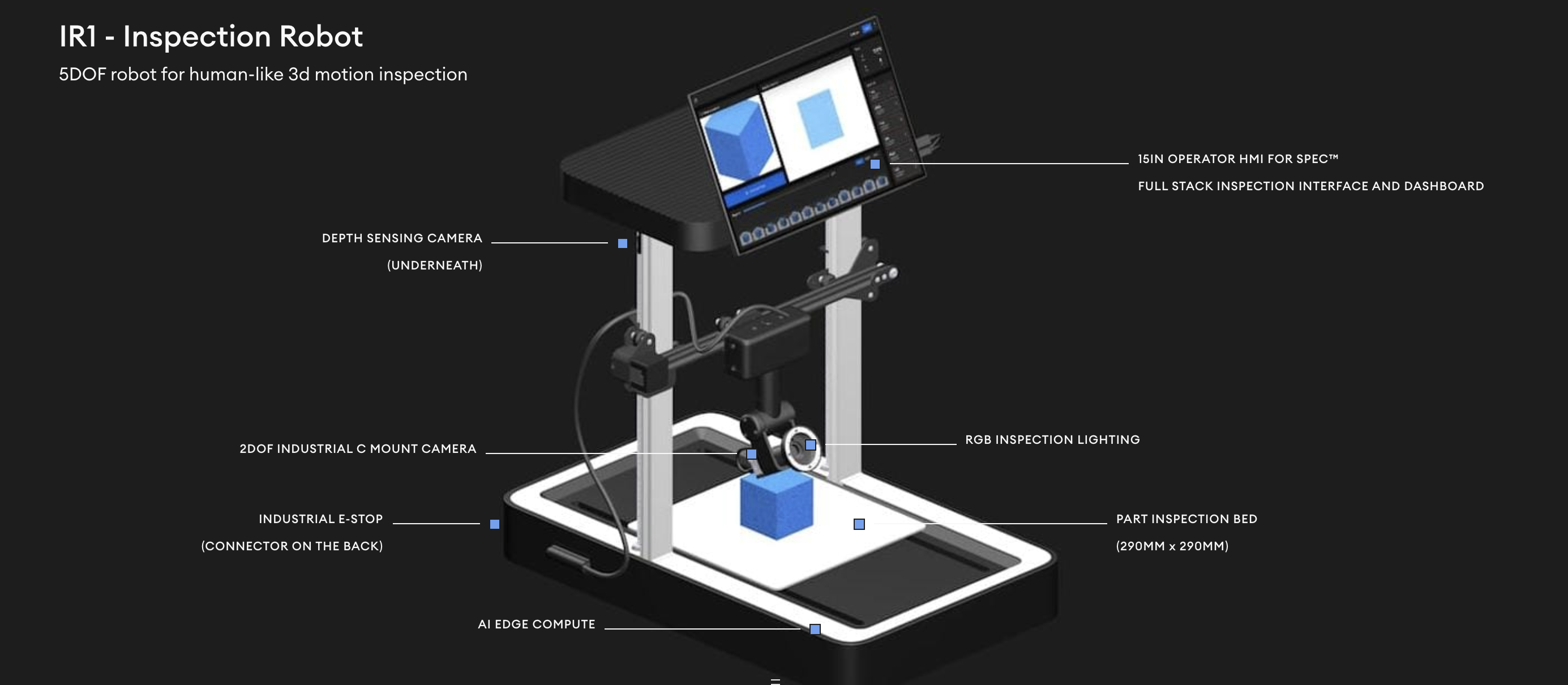
The company’s robots look like a large box with a gantry system providing three degrees of freedom, with vertical and horizontal movement as well as a gimbal-mounted camera that can visualize products.

Image credit: Elementary Robotics

As objects are scanned by the robots they’re compared against a taxonomy of objects provided by the companies that Elementary works with to determine whether or not there’s a defect.

Barnehama also emphasizes that Elementary’s robots are not designed to replace every human interaction or assessment in the manufacturing process. “Machine learning paired with humans always performs better,” says Barnehama. “At the end of the day the human is running the factory. We’re not really a lights-out factory.”

Behind the new commercialization push is a fresh $12.7 million in financing that Elementary closed at the end of 2019.

The lead investor in that round was Threshold Ventures, and the firm’s partner, Mo Islam, has already taken a seat on the Elementary Robotics board of directors. Existing investors Fika Ventures, Fathom Capital, Toyota AI Ventures and Ubiquity Ventures also participated in the round, which will be used to allow Elementary Robotics to continue developing and deploying its automation products at scale, the company said.

“Robotics and particularly robotics applied to manufacturing has been an interest of mine,” said Islam. In Elementary Robotics, Islam saw a company that could compete with large, publicly traded businesses like Cognex. The low complexity and ease of deployment of Elementary’s hardware was another big selling point for Islam that convinced him to invest. 

Elementary says that it can be up and running at a site in a matter of days and with businesses emphasizing cost-cutting and enabling remote work to ensure worker safety, companies are embracing the technology.

“That’s where we’re really excited to be launching it,” said Barnehama. “If we get parts or data examples we can get that up and running the same day. We can usually show customers within that week we can start showing them the value of that as we get more and more data through the system.”

NASA pays out $51 million to small businesses with big ideas

NASA has announced its latest batch of small business grants, providing more than 300 businesses a total of $51 million in crucial early-stage funding. These “phase I” projects receive up to $125,000 to help bring new technologies to market.

The Small Business Innovation Research/Technology Transfer programs help entrepreneurs and inventors transition their work from lab to commercial availability. The money is like a grant, not an investment, and Phase I recipients are eligible for larger Phase II grants if they’re warranted.

This year’s selections, as always, cover dozens of disciplines and apply to a wide range of industries. Among NASA’s own highlights in a news release are high-power solar arrays, a smart air traffic control system for urban flight, a water purification system for use on the moon and improved lithium-ion batteries.

There’s even one award for a company making “a compact sterilizer for use on spacecraft materials” that could also be employed by health workers.

Perusing the lists I was struck by the number of neuromorphic computing efforts, from radiation-hardened chips to software techniques. I take these to be chips and approaches that utilize and accelerate machine learning methods, rather than attempts at computers that truly employ the spikes and plasticity of actual neuronal networks.

The 2020 Phase II announcements won’t come for a while — NASA just released 2019’s last month.

The SBIR program is one of the federal government’s inadvertently best-kept secrets, with billions allocated to a dozen agencies to distribute to small businesses. You can learn more at SBIR.gov.