The coronavirus pandemic is expanding California’s digital divide

Kevin Frazier
Contributor

Kevin Frazier, a Masters of Public Policy student at the Harvard Kennedy School and JD candidate at the UC Berkeley School of Law, uses his spare time to advocate for better government.

If every California student without an adequate internet connection got together and formed a state, it would contain more residents than Idaho or Hawaii.

A total of 1,529,000 K-12 students in California don’t have the connectivity required for adequate distance learning.

Analysis from Common Sense Media also revealed that students lacking adequate connection commonly lack an adequate device as well. The homework gap that separates those with strong connections from those on the wrong side of the digital divide will become a homework chasm without drastic and immediate intervention.

To raise awareness of the enormity and immediacy of the digital divide, I started No One Left Offline (NOLO) in San Francisco. It’s an all-volunteer nonprofit that’s creating a coalition of Bay Area organizations focused on giving students, seniors and individuals with disabilities access to high-speed, affordable Internet.

During the week of July 27, the NOLO coalition will launch the Bridge the Divide campaign to raise $50,000 in funds that will be used to directly cover broadband bills for families on the edge of the digital divide.

At this point in our response to COVID-19, emergency measures have only stopped the homework gap from growing rather than actually shrinking it. That’s precisely why we need a new form of addressing students’ lack of adequate internet and devices. The digital “haves” should embrace directly covering the broadband bills and upgrades required by the “have nots.” This form of direct giving is both the most effective and efficient means of giving every student high-speed internet and a device to make the most of that connection.

But too few people are aware of just how dire life can be on the wrong side of the digital divide. That’s why I’m hoping you — as a fellow member of the digital “haves” — will join me in taking a day off(line) on July 17. I’m convinced that it will take a day (if not more) in the digital dark for more Americans to recognize just how difficult it is to thrive, let alone survive, without stable internet, a device and a sufficient level of digital literacy.

The increased attention to the digital divide generated by this day off(line) will spur a more collective and significant response to stopping the formation of a homework chasm.

Current efforts to close the homework gap have at once been laudable and limited. For example, internet service providers (ISPs) deserve praise for taking a voluntary pledge to limit fees, forgive fines and remove data caps. But that pledge expired at the end of June, months before school starts and in the middle of an expanding economic calamity.

It’s true that many ISPs are still going to extraordinary lengths to help those in need — look no further than Verizon donating phones to Miracle Messages to help individuals experiencing homelessness connect with loved ones. However, even these extraordinary measures will not fully make up for the fact that hundreds of thousands of Californians are experiencing greater financial insecurity than ever before. They want and require a long-term solution to their digital needs — not just voluntary pledges that end in the middle of a pandemic.

In the same way, many school districts in the Bay Area have rapidly loaned hotspots and devices to students and families in need. In fact, even before COVID-19, the Oakland Unified School District and the 1Million Project were providing hotspots to students in need. These sorts of interventions, though, do not afford students on the wrong side of the homework gap the same opportunity to fully develop their digital literacy as those that have devices to call their own and internet connections sufficient to do more than just homework.

Every student deserves a device to call their own and a connection that allows them to become experts in safely and smoothly navigating the internet.

Direct giving is the solution. Financially secure individuals across the Bay Area can and should “sponsor” internet plans and devices for families in need. By sponsoring a family’s high-speed internet plan for a year or more, donors will provide students and parents alike with the security they need to focus on all of the other challenges associated with life in a pandemic. What’s more, sponsored devices would come without strings attached or “used” labels.

Students would have a fully equipped laptop to call their own as well as one that didn’t lack key functionalities, which is common among donated devices.

Because access to the internet is a human right, the government should be solving the homework gap. So far, it hasn’t been up to the task. So, in the interim, we’ll need a private sector solution. The good news is that we collectively seem up for the task. According to Fidelity, most charitable donors plan to maintain or increase their giving this year.

Consider that even 46% of millennials plan to increase their philanthropy. Unfortunately, one inhibitor to giving is the fact that “many donors don’t feel that they have the information they need to effectively support efforts” to address the ramifications of COVID-19.

That’s where NOLO and other digital inclusion coalitions step in. We’re sounding the bell: The public sector isn’t closing the homework gap; it’s on us to make sure kids have the connections and devices they need to thrive. NOLO is also providing the means to act on this information — during its Bridge the Divide campaign, donors will have a chance to sponsor broadband bills for community members served by organizations across the Bay Area including the SF Tech Council, BMAGIC and the Mission Merchants Association.

Our collective assignment is making the homework gap a priority. Our due date is nearing. The first task is taking a day off(line) on July 17. The next is donating to the Bridge the Divide campaign during the week of the 27th.

Let’s get to work.

Gaming network Venn will launch with 20 hours of live programming on August 5, 2020

Venn, the company looking to be gaming’s answer to ’80s-era MTV, has revealed the first slate of shows to premier on the network when it launches August 5, 2020.

Working out of studios in Playa Vista in Los Angeles and New York’s World Trade Center (coming in 2021), Venn intends to use 1,000 square feet and 30 million pixels of LED walls and floors to create its interactive shows and narratives.

The company is planning a slate of news and talk shows, game shows and documentaries, according to a statement.

“From conception, Venn has been laser-focused on elevating the creators of this generation with production leadership, a chance to flex new creative muscles and grow their audiences via our broad distribution,” said Ariel Horn, co-chief executive of Venn. “As we close in on our August launch, we’re thrilled to pull back the curtain on the first wave of programming — and the unique blend of talent curated from the worlds of gaming and cutting edge digital storytelling.”

The first slate of shows from the company include:

  • VENN ARCADE LIVE — A daily variety show centered on gaming themes (and unfortunately not inspired by the seminal Hüsker Dü album, “Zen Arcade”) to be hosted by James “Dash” Patterson, Venn Arcade will feature guest appearances, live performances, interactive gameplay and audience participation from the hottest gamers, streamers, celebrities, athletes, musicians and rising stars.
  • DARE PACKAGE — An extreme challenge version of unboxing where loot crates filled with mystery challenges are delivered to streamers’ homes hosted by @AustinOnTwitter.
  • GUEST HOUSE — On weekday afternoons celebrity guests will take over the Venn studios to craft their own streaming show for live audiences.
  • THE SUSHIDRAGON SHOW — Hosted by the eclectic and eccentric performance artist and streamer, “The SushiDragon Show” will feature interviews, performances and entertainers alongside SushiDragon’s own signature dancing set against digital backdrops and avatars.
  • LOOKING FOR GAINS — Hosted by the entertainer known as CashNasty this show will be an interactive fitness show designed to showcase guest’s ultimate quarantine workout.

“We’re disrupting the traditional television business model and giving birth to a powerful voice in GenZ and millennial entertainment. We identify and curate fan favorite talent, develop and elevate their content with a world-class TV production infrastructure, then rapidly scale it all via our universally distributed network”, said Ben Kusin, Venn’s other co-chief executive, in a statement. “There’s a currency in generational talents and a currency in generational movements, and that timeliness can’t wait for traditional TV to adapt. The time for Venn is now.”

Hear from James Alonso and Adam Zagaris how to draw up your first contracts at Early Stage

You just got your first customer! You just hired your first employee! You just got your first VC investor! These are huge milestones in the life of a startup and are extraordinarily exciting. That is, until that first draft of the contract arrives in your inbox and you suddenly realize you are 30 pages of legalese away from getting your deal done.

Contracts are the foundation for any business, and getting good at negotiating and understanding these instruments is critical for any startup founder. Asking the right questions at just the right moment can be the difference between signing a deal today (and saving those legal fees!) and losing a deal and ending up in a courtroom in the Eastern District of Texas.

Adam ZagarisGiven how critical this skill is, we’re excited to bring two seasoned and complementary attorneys to TC Early Stage on July 21 and 22 who are experts at the legal issues facing startups to offer their advice and answer your questions about how to think about business law and how to balance getting the right advice with the financial constraints of early-stage startups.

James Alonso is founder and partner at Magnolia Law where he specializes in company formation, venture financing and the law around scaling startups. Meanwhile, Adam Zagaris is the founder and partner of Moonshot Legal, where he specializes in startup laws around areas like commercial transactions, intellectual property and human resources.

James AlonsoTogether, the two will go into all the different facets of the modern legal environment for startups, and help founders understand their role in the legal process. If you can save even 15 minutes of your lawyer’s time in the future from their combined advice, you will already have paid for the entire entry fee for TC Early Stage in the first place. So come join us and become an interested party.
TC Early Stage (July 21 and 22) has so much to offer. The show will bring together 50+ experts across startup core competencies, such as fundraising, operations and marketing. Cyan Bannister is set to explain how to get an investor to say yes to your startup. Asher Abramson will be sharing how to create growth assets for paid channels, lawyers James Alonso and Adam Zagaris will share how to draw up your first contracts, and Priti Choksi is hosting a session on how to get a company acquired rather than selling.

The two-day show features more than 50 sessions, but don’t worry; attendees will get access to the videos on demand for all of them. What’s more, most of the speakers, who happen to be investors, are participating in TechCrunch’s CrunchMatch, our platform that connects founders to investors based on shared interests. 

Here’s the fine print: Each of the 50+ breakout sessions is limited to around 100 attendees. We expect a lot more attendees, of course, so signups for each session are on a first-come, first-serve basis.

Buy your ticket today, and you can sign up for the breakouts we are announcing today, as well as those already published. Pass holders will also receive 24-hour advance notice before we announce the next batch. (And yes, you can “drop” a breakout session in favor of a new one, in the event there is a schedule conflict.)

Get your TC Early Stage pass today and jump into the inside track on the sessions we announced so far, as well as the ones to be published in the coming weeks.


K Fund’s Jaime Novoa discusses early-stage firm’s focus on Spanish startups

Earlier this month, Spanish early-stage venture capital firm K Fund officially launched its second fund, which sits at €70 million, up from €50 million the first time around.

Targeting Spanish startups with an international outlook, the seed-stage firm plans to invest from €200,000 to €2 million, writing first checks in 25-30 companies. Meanwhile, a portion of the fund will also be set aside for follow-on funding for the most promising of its portfolio.

Described as business model- and sector-agnostic, K Fund currently has a mix of B2B and B2C companies in its portfolio across a wide variety of sectors, such as travel, fintech, insurtech and others. They include online travel agency Exoticca, HR software Factorial, insurtech startup Bdeo and Hubtype, a conversational messaging tech provider.

I caught up with K Fund’s Jaime Novoa to delve deeper into the firm’s investment remit, how the Spanish startup and tech ecosystem has developed over the last few years and to learn more about “K Founders,” the VC’s new pre-seed funding program.

TechCrunch: K Fund’s first fund was announced in late 2016 to back startups in Spain with an international outlook at seed and Series A. At €70 million, this second fund is €20 million larger but I gather the remit remains broadly the same. Can you be more specific with regards to cheque size, geography, sector and the types of startups you look for?

Jaime Novoa: We’re both agnostic in terms of business models and industries. Since our focus is, for the most part, Spain, we do not believe that the Spanish market is big enough to build a vertically focused fund, either in terms of business model or sector.

With our first fund we invested in 28 companies, with a slightly larger number of B2B SaaS companies than B2C ones, and across a wide variety of sectors. We do have a bit of exposure to travel and fintech/insurtech, but that’s because we’ve found several interesting companies in those spaces, not because we proactively said, “let’s invest in fintech/travel.”

In terms of check sizes, the core of the fund will be to make the same type of investments as in our first fund: first cheques from €200k to €2m and then sufficient capital for follow-on rounds. We’ll probably do a similar number of deals compared to the previous fund, but we want to have additional capital for follow-on purposes.

Docker partners with AWS to improve container workflows

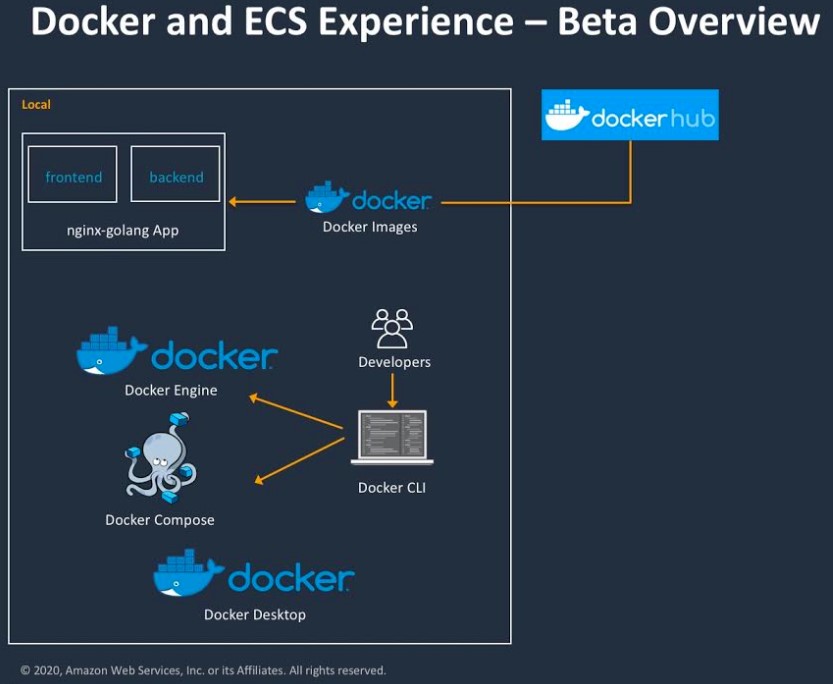
Docker and AWS today announced a new collaboration that introduces a deep integration between Docker’s Compose and Desktop developer tools and AWS’s Elastic Container Service (ECS) and ECS on AWS Fargate. Previously, the two companies note, the workflow to take Compose files and run them on ECS was often challenging for developers. Now, the two companies simplified this process to make switching between running containers locally and on ECS far easier.

docker/AWS architecture overview“With a large number of containers being built using Docker, we’re very excited to work with Docker to simplify the developer’s experience of building and deploying containerized applications to AWS,” said Deepak Singh, the VP for compute services at AWS. “Now customers can easily deploy their containerized applications from their local Docker environment straight to Amazon ECS. This accelerated path to modern application development and deployment allows customers to focus more effort on the unique value of their applications, and less time on figuring out how to deploy to the cloud.”

In a bit of a surprise move, Docker last year sold off its enterprise business to Mirantis to solely focus on cloud-native developer experiences.

“In November, we separated the enterprise business, which was very much focused on operations, CXOs and a direct sales model, and we sold that business to Mirantis,” Docker CEO Scott Johnston told TechCrunch’s Ron Miller earlier this year. “At that point, we decided to focus the remaining business back on developers, which was really Docker’s purpose back in 2013 and 2014.”

Today’s move is an example of this new focus, given that the workflow issues this partnership addresses had been around for quite a while already.

It’s worth noting that Docker also recently engaged in a strategic partnership with Microsoft to integrate the Docker developer experience with Azure’s Container Instances.

Creandum backs Amie, a new productivity app from ex-N26 product manager Dennis Müller

Amie, a new productivity app from ex-N26 product manager Dennis Müller, has picked up $1.3 million in pre-seed funding to “kickstart” development and hiring.

Backing 23-year-old Müller is Creandum — the European VC best known for being an early investor in Spotify — along with Tiny.VC and a plethora of angels. They include Laura Grimmelmann (Ex-Accel), Nicolas Kopp (CEO, N26 U.S.), Roland Grenke (Dubsmash co-founder) and Zachary Smith (SVP of product at U.S. challenger bank Chime).

Founded early this year and with a planned launch in early 2021, Berlin-based Amie is developing a productivity app that combines a person’s calendar and to-dos in one place. Previously called coco, it promises to work across all devices, with an interface that “works just like you think.”

“Back in the day, you had a calendar on your office wall, and a to-do list on a notepad,” Müller tells me. “You could take your list with you elsewhere, but not your calendar. Those were digitized instead of rethinking the flow. Most productivity apps solve very specific problems, creating a new one, [and] users need too many tools.”

Amie pre-release app screenshot.

Müller says Amie is built on the principle that “to-dos, habits and events all take time, and all belong in the same place.” Many people already schedule to-dos and the startup wants to offer the fastest way to create to-dos, schedule events, check your calendar “and even jump into Zoom calls.”

As a glimpse of what’s to come, Amie promises to let you drag ‘n’ drop to-dos into your day, or turn links and screenshots into to-dos. “With Amie’s Alfred-like app, you can create an event and invite people in a different timezone, all while other apps are still loading,” says the young company.

More broadly, Amie wants to act as a central workspace, letting you also do things like join video calls, take notes and do email, without the need to open extra browser tabs and therefore avoid “context switching.”

“Amie will target professionals who are currently using Google Calendar, due to our integration,” adds Müller. “The waitlist already counts thousands of users, who are mostly professionals working in the tech industry (e.g., designers, developers, bizdevs, etc.”

Coronavirus impact sends app downloads, usage and consumer spending to record highs in Q2

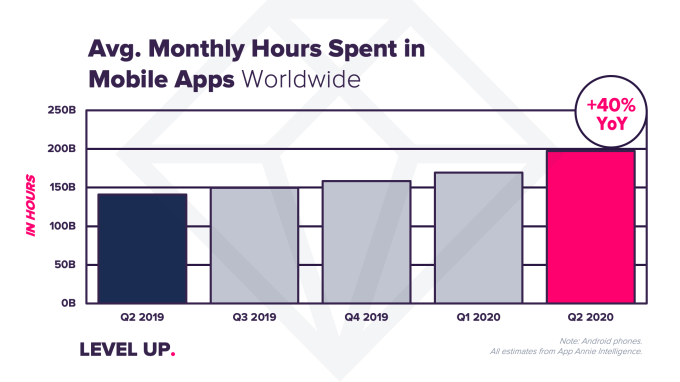
As the world continued to cope with the impact of the coronavirus outbreak, the second quarter of 2020 became the largest yet for mobile app downloads, usage and consumer spending. According to new data from app store intelligence firm App Annie, mobile app usage grew 40% year-over-year in the second quarter of 2020, even hitting an all-time high of over 200 billion hours during April. Consumer spending in apps, meanwhile, hit a record high of $27 billion in the second quarter. And app downloads reached a high of nearly 35 billion.

The growth in app usage has been fueled by social distancing and lockdown measures, as countries around the world try to quell the spread of the novel coronavirus.

Image Credits: App Annie

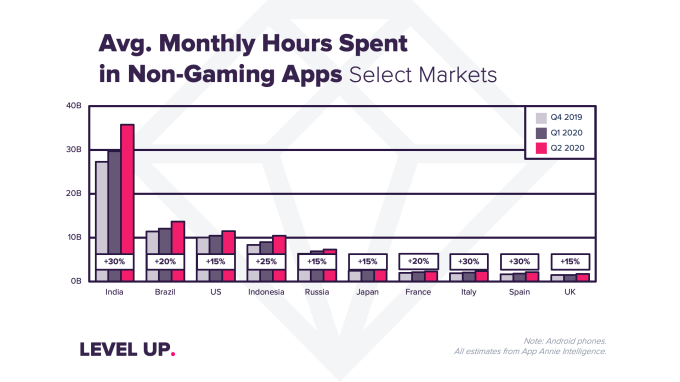
In India, for example, time spent in apps grew 35% in Q2 2020 from Q4 2019. Italy and Indonesia saw growth of 30% and 25%, respectively. In the U.S., time spent in apps grew 15%.

App Annie says now the average user is spending 4 hours and 20 minutes per day on their smartphones.

Image Credits: App Annie

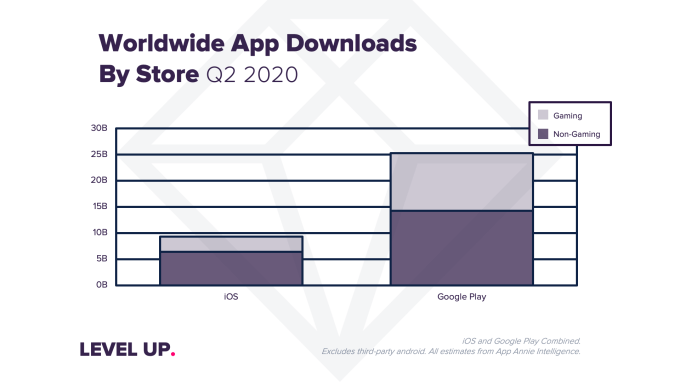
But consumers aren’t just launching apps they already have installed on their phones — they’re also downloading new ones. In the second quarter, consumers downloaded nearly 35 billion new apps, an all-time high.

Google Play accounted for 25 billion of those downloads, representing 10% year-over-year growth. India and Brazil were the the two largest markets for Google Play in the quarter.

Image Credits: App Annie

iOS downloads grew 20% year-over-year to reach nearly 10 billion. The U.S. and China were iOS’s biggest markets for downloads, but the U.S. and Saudi Arabia saw the most quarter-over-quarter growth. The latter was likely attributed to a nationwide lockdown and school closures, driving app downloads in the country to a all-time high in April and 100% year-over-year growth on iOS.

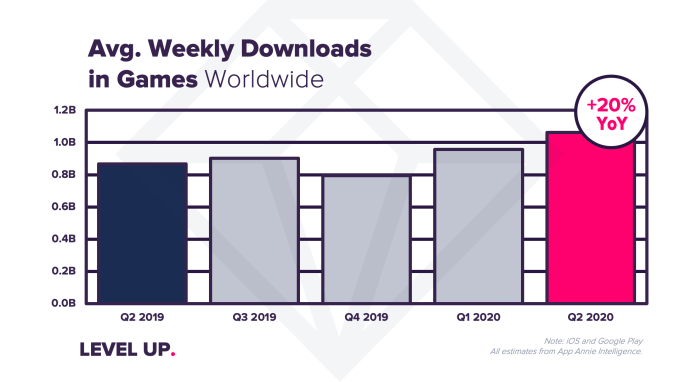
Games were downloaded at record levels in the quarter, App Annie noted, totaling 14 billion games. In the first week of Q2, weekly mobile game downloads broke records at over 1.2 billion, and weekly download levels remained at 1 billion on average throughout the quarter, up 20% year-over-year.

Image Credits: App Annie

Non-gaming apps represented over half (55%) of the new downloads on Android and 70% of those on iOS.

More specifically, top categories outside of games included “Tools” and “Entertainment” on Google Play and “Photo and Video” and “Entertainment” on iOS. But other categories saw strong growth, including “Business,” “Health & Fitness” and “Education,” which saw quarter-over-quarter growth in downloads of 115%, 75% and 50% respectively on Google Play.

On iOS, “Health and Fitness,” “Shopping” and “Medical” apps saw strong quarter-over-quarter growth of 30%, 25% and 20%, meanwhile.

With record downloads and usage, consumer spending also grew significantly as a result, particularly among streaming video services.

Image Credits: App Annie

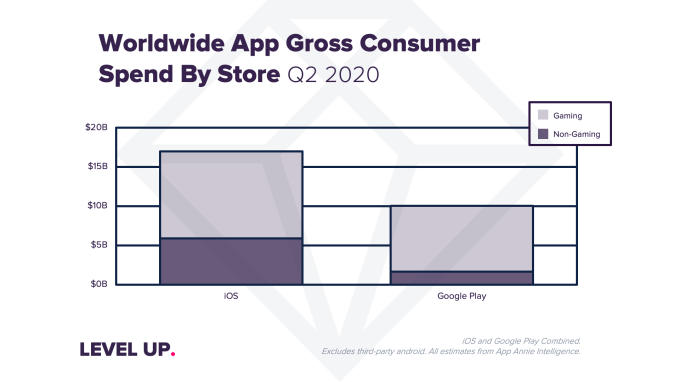
In the second quarter, consumers spent a record $27 billion in apps, up 15% year-over-year to $17 billion on iOS and up 25% to $10 billion on Android.

Games accounted for $19 billion of the spend, up 15% quarter-over-quarter. Google Play saw sizable growth at 25% quarter-over-quarter, which was 2x the growth rate on iOS.

Image Credits: App Annie

Non-gaming apps were 35% of the spend on iOS. The U.S. and China the largest contributors in both games and non-game apps on iOS in the quarter. However, the U.S. notably took back the top position as the largest market for consumer games — a spot previously held by China — with 30% quarter-over-quarter growth in Q2.

Non-games were 15% of the spend on Google Play. The U.S., Japan, and South Korea were the largest markets in both non-games and games alike on Google Play.

Top Google Play categories in addition to “Games” included “Social” and “Entertainment.” Growth in the “Entertainment” category was driven largely by Disney+ and Twitch, App Annie noted.

On iOS, “Entertainment” and “Photo and Video” were the largest categories by consumer spend, in addition to “Games.” Here, TikTok drove growth for the “Photo and Video” category, becoming the No. 1 top-grossing app on iOS App Store globally in Q2 2020 thanks to sales of virtual gifts used to tip streamers.

Image Credits: App Annie

While much of the activity taking place on mobile devices during the pandemic is related to having fun — like watching videos or playing games, for example — several of the top apps in the quarter were work-related.

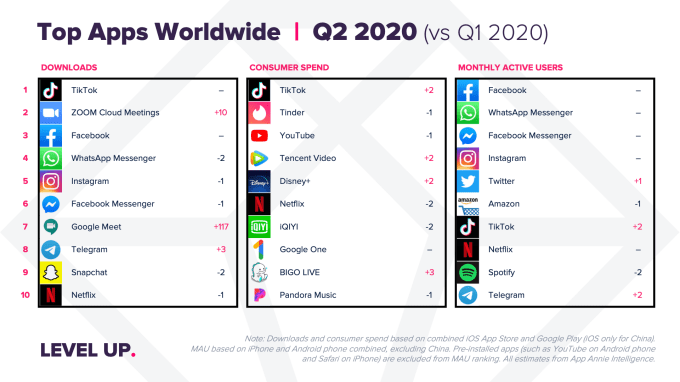
Zoom, for instance, became the No. 2 of most downloaded app globally in Q2 2020. Google Meet was No. 7.

TikTok, meanwhile, was the top app by downloads and spending, and the No. 7 by monthly active users. That will likely change in the months ahead, due to its ban in India. A proposed U.S. ban has also recently seen TikTok rivals gaining ground. Amid this disruption, local competitors in India have seen increased usage, and elsewhere, competitors like Byte and Likee have surged.

Amazon’s Alexa heads Toni Reid and Rohit Prasad are coming to Disrupt

It’s hard to believe that Alexa was only announced in November 2014. In fewer than six years, the smart assistant has gone from consumer electronics curiosity to a nearly ubiquitous tech phenomenon. Launched alongside the first Echo device, Alexa has helped define a new paradigm of voice computing, alongside Apple’s Siri and Google’s Assistant.

According to recent numbers, 29% of U.S. internet users also use a smart speaker. With that demographic Amazon has been utterly dominant, with roughly 70% of all U.S. smart speaker owners using an Echo. Alexa’s reach spread far beyond that, of course, to all manner of smart home devices, laptops, cars, phones, wearables and TVs. We’re excited to announce today that the heads of Amazon’s Alexa team will be joining us at Disrupt this September to discuss the smart assistant’s growth and the future of voice computing.

Toni Reid is the vice president of Alexa Experience & Echo Devices at Amazon, a company she’s been with for over a decade. She’s being a driving force in Alexa’s dominance of the category. Rohit Prasad is the vice president and head scientist, Alexa Artificial Intelligence. He’s an expert in natural language understanding, machine learning, dialog science and machine reasoning.

Together the pair have been the driving force in Alexa’s growth and domination of the smart assistant category. Hear how it all got started from Reid and Prasad at Disrupt 2020 on September 14-18. Get a front-row seat with your Digital Pro Pass for just $245 or with a Digital Startup Alley Exhibitor Package.

As pandemic drags on, interest in automation surges

Today, the U.S. exceeded three million COVID-19 cases and 132,000 deaths. In several states, new hotspots have rolled back plans to reopen businesses. The novel coronavirus has — and will continue — to profoundly impact the way we live and work.

For the moment, that includes a shift in the employment status of many Americans. More than 50 million people have filed for unemployment since mid-March. And while many states have made efforts to reopen businesses and return some sense of normality, these moves have led to a spike in cases and may prolong the pandemic and its ongoing economic impact.

Technology has been a lifeline for many, from food delivery to the 3D printing I highlighted last week, which has worked to address a nation suffering from personal protective equipment shortages. Automation and robotics have also been a constant in conversations around tech’s battle against COVID-19.

Robots don’t get sick, tired or emotionally burnt out, and unlike us, they aren’t walking, talking disease vectors. Automation advocates like to point to the “three Ds” of dull, dirty and dangerous jobs that will eventually be replaced by a robotic workforce, but in the age of COVID-19, nearly any essential job qualifies.

The robotic invasion has already begun in earnest. The service, delivery, health care and sanitation industries in particular have all opened a massive gap over the past several months that automation has been more than happy to roll right through. A recent report from The Brookings Institute notes that automation arrives in the workforce in fits and starts — most notably, during times of economic downturn.

“Robots’ infiltration of the workforce doesn’t occur at a steady, gradual pace. Instead, automation happens in bursts, concentrated especially in bad times such as in the wake of economic shocks, when humans become relatively more expensive as firms’ revenues rapidly decline,” the study found. “At these moments, employers shed less-skilled workers and replace them with technology and higher-skilled workers, which increases labor productivity as a recession tapers off.”

Secretive data startup Palantir has confidentially filed for an IPO

Secretive big data and analytics startup Palantir, co-founded by Peter Thiel, said late Monday it has confidentially filed paperwork with the U.S. Securities and Exchange Commission to go public.

Its statement said little more. “The public listing is expected to take place after the SEC completes its review process, subject to market and other conditions.”

Palantir did not say when it plans to go public nor did it provide other information such as how many shares it would potentially sell or the share price range for the IPO . Confidential IPO filings allow companies to bypass the traditional IPO filing mechanisms that give insights into their inner workings such as financial figures and potential risks. Instead, Palantir can explore the early stages of setting itself up for a public listing without the public scrutiny that comes with the process. The strategy has been used by companies such as Spotify, Slack and Uber. However, a confidential filing doesn’t always translate to an IPO.

A Palantir spokesperson, when reached, declined to comment further.

Palantir is one of the more secretive firms in Silicon Valley, a provider of big data and analytics technologies, including to the U.S. government and intelligence community. Much of that work has drawn controversies from privacy and civil liberties activists. For example, investigations show that the company’s data mining software was used to create profiles of immigrants and consequently aid deportation efforts by the ICE.

As the coronavirus pandemic spread throughout the world, Palantir pitched its technology to bring big data to tracking efforts.

Last week, Palantir filed its first Form D in four years indicating that it is raising $961 million. According to the filing, $550 million has already been raised and capital commitments for the remaining allotment have been secured.

With today’s news, the cash raise looks complementary to the company’s ambitions to go public. One report estimates that the company’s valuation hovers at $26 billion.

Palantir’s filing is another example of how the IPO market is heating up yet again, despite the freeze COVID-19 put on so many companies. Last week, insurance provider Lemonade debuted on the public market to warm waters. Accolade, a healthcare benefits company, similarly is sold more shares than expected.

Victress Capital, a fund founded by women to back women founders, just closed its second fund

Women start 40 percent of the businesses in the U.S., but they receive just 3% of venture funding. It doesn’t take a math whiz to recognize that such an extreme funding gap could spell opportunity, but it might help if you are math minded, a longtime investor, and happen to be woman and so conceivably understand certain products and pitches better than some men.

That was certainly the thinking of both Lori Cashman and Suzanne Norris, who came together in 2016 to form Boston-based Victress Capital, a consumer-focused, seed- and early-stage firm that just closed its second fund with nearly $22 million in funding to back gender diverse teams, meaning there is at least one woman on the founding team.

Cashman is a Duke grad who has spent her career as an investor, including previously cofounding a private equity firm, Linear Capital, to invest exclusively in owner-managed businesses. Norris, meanwhile, with two degrees Harvard, has been an investment banking analyst, a management consultant, and spent nearly four years as a VP focused on e-commerce with the company Kate Spade.

The two friendly acquaintances originally joined forces to enhance their “cognitive diversity,” says Cashman, scraping together a total of $2 million from friends and family so they could establish a track record.

Ultimately, they used that money to fund 14 startups by writing checks ranging from $100,000 to $150,000. A couple of them have already been acquired. Moxxly, which sold silent, wearable breast pumps, was acquired by Medela, a leading breast pump maker, in 2017. Last summer, it was shut down, but Cashman and Norris suggest that investors (another of whom was Randi Zuckerberg) got their money back and that they were happy to see it acquired by what seemed at the time like a strong strategic partner. A second portfolio company, Werk, more recently sold to a Chicago-based startup called The Mom Project for undisclosed terms.

Others of their bets include Daily Harvest, a direct-to-consumer organic food delivery business that has so far raised $43 million from investors, according to Crunchbase; Mented Cosmetics, a cosmetics company catering to women with darker skin tones that has raised $4 million to date; and Copper Cow Coffee, a young L.A.-based startup that makes organic Vietnamese coffee and has raised $3 million, per Crunchbase.

The idea all along was to raise a larger fund so that as Victress’s young portfolio matures, it can invest more into its breakout winners, as well as to fund other innovative young startups.

In fact, toward that end, Victress — whose newest fund came largely came from family offices — has added to its team in recent years. In February, it brought in Kate Castle, a longtime marketing partner at Flybridge Capital Partners who later cofounded XFactor Ventures as a partner. In 2018, it also hired HBS alum Madeline Keulen, who previously interned with Victress and is now a vice president. (Because of Norris’s background and network, Victress receives some of its deal flow from Harvard and HBS and typically brings in HBS students as interns.)

It wasn’t easy assembling its team — or its new fund. Norris half-kiddingly calls $20 million “no man’s land” in the eyes of institutional investors. Though they are just now closing the vehicle, they began assembling checks for it in late 2018 and have already funded seven startups that represent 25% of their new investing capital.

Still, they’re playing the long game and think the relationship-building they’ve done will pay off — both with institutional investors that will be tracking this second fund with an eye toward its third, and with venture firms around the country with whom they’ve syndicated deals and that now keep Victress in mind when meeting nascent startups with diverse founding teams.

A big win would help grow the outfit from here, too, of course. Only time will tell if they’ll have one, but Norris and Cashman talks enthusiastically about numerous portfolio companies, including Minneapolis-based Rae, which makes what it markets as libido-enhancing vegan vitamins. Rae sells its products directly to consumers but they’re also available at Target, a retail giant that, notably, has remained open throughout the pandemic.

Rae was able to secure such valuable real estate partly because its cofounder and CEO, Angie Tebbe, spent the previous 12 years as a senior director in merchandising at Target, where she oversaw the private label products in the chain’s beauty and wellness aisles. But Rae’s products are also priced affordably, with a 30-day supply of vitamins costing $14, compared with many alternatives that cost twice as much and more.

That’s partly what drew Victress to the company. Victress is focused on tech-enabled consumer services, marketplaces and digitally native brands. But if a startup in the last camp wants its attention, its products can’t be priced for the most affluent consumers with money to burn. Victress is far more interested in startups that aim to sell at an “authentic, accessible price point for the majority of America,” says Cashman.

Email is broken and Hey’s Jason Fried is here to fix it

Email is a critical tool in modern-day communications, so it’s natural that many entrepreneurs have tried to overhaul it over the years.

In the last decade, email client Mailbox came and went, Slack launched to try to give people an alternative to email and Superhuman emerged to help people more easily reach the promised land of Inbox Zero.

The latest startup to tackle email is project management software maker Basecamp, which launched Hey last month. Within its first 11 days of release, Hey received 125,000 signups, Basecamp founder and CEO Jason Fried tells TechCrunch. Those initial days also included some drama with the Apple App Store, but that’s not what this story is about. Instead, it’s about Hey’s approach, why Fried felt the need to try to rebuild email from the ground up and how he approaches product development.

“The last time people were really excited about email, really, in a broad scale was 16 years ago when Gmail came out in 2004,” Fried says. “I remember it feeling different in a lot of ways. It was really fast, they had archiving, which was a new concept at the time. It worked differently than what I was coming from, which was Yahoo Mail, which was sort of stuck in the past. And I think that’s where Gmail is today — stuck in the past and we’re trying to bring out something brand new with new thinking and new philosophies and a new point of view.”

At its core, Hey is about giving people control over their email and minimizing clutter so users can hear from the people who matter most, Fried says. But control comes at a price: Hey costs $99 per year, with additional fees for three- and two-character email addresses (two-character email addresses are $999 per year and three-character addresses are $349 per year).

“We got a taste of our own medicine because it was not cheap to buy hey.com,” Fried says. “So anything that short in the domain world just costs more. It’s like beachfront property almost, because it’s scarce — more desirable. So given that we have a three-letter domain, two- and three-letter email addresses are just going to cost more. There’s fewer of them and they’re more desirable.”

Hey’s current iteration is targeted toward individual users, but by the end of the year, the plan is to launch a formal enterprise version with collaborative features like shared messages and inboxes. In this unified Imbox (not a typo), people will be able to specify that they don’t want to see work email past a certain time or on weekends.

“A lot of email is collaborative in nature,” Fried says. “People end up forwarding emails around to show someone to get their take. We think that’s totally broken and really antiquated. So we have some stuff built into Hey for work, which lets people share threads with one another in a very different way and be able to have backchannel conversations about threads without having to have those conversations in another product or somewhere that is separate from the actual thread itself.”

There’s much more to this conversation, like how Hey landed on its hypothesis, why control is so important, how email shouldn’t feel like work and more. Below are Fried’s insights.

Daily Crunch: Uber confirms Postmates acquisition

You may have noticed that The Daily Crunch is publishing about six hours later than usual. Do not be alarmed! We decided that sending the newsletter later in the day was a better fit for the TechCrunch news cycle — hopefully, there will be fewer days when we hit Publish and then groan when we see a giant story break five minutes later.

We’re also taking the opportunity to rethink the newsletter format. The mission hasn’t changed — the goal is to deliver the day’s big tech headlines in an email that you can read in just a couple of minutes. But we know that different readers are focused on different areas of TechCrunch’s coverage, so moving forward, The Daily Crunch will be organized to make it easier to find the news that interests you.

Without further ado: Here’s your Daily Crunch for July 6, 2020.

The big story: Uber confirms Postmates acquisition

The reports last week were true: Uber announced today that it’s acquiring Postmates in an all-stock deal worth $2.65 billion. It looks like the restaurant delivery market is consolidating — Uber previously tried to acquire Grubhub, which ended up selling to the European company Just Eat Takeaway instead. The company said Postmates will continue to operate as a standalone app, but tech and delivery operations will be consolidated.

Meanwhile, Alex Wilhelm took a close look at Uber’s finances to help Extra Crunch readers understand why the company’s stock is up today, arguing that the acquisition could help Uber Eats “grow more quickly while bringing down its losses as a percent of revenue.”

The tech giants

US tech giants halt Hong Kong police help — After the Chinese government has passed a new security law undermining protections for Hong Kong, both Facebook and Twitter said that they will no longer process demands for user data from Hong Kong authorities. (In Facebook’s case, this also applies to WhatsApp.)

Instagram Reels tested in India following TikTok’s ban — Instagram may be taking advantage of India’s decision to ban TikTok by expanding its Reels feature, which allows users to create 15-second videos set to music.

Intel to invest $253.5 million in India’s Reliance Jio Platforms — Intel joins General Atlantic, Facebook and Silver Lake as an investor in India’s top telecom operator.

Startups, funding and venture capital

Here’s a list of tech companies that the SBA says took PPP money — Bolt Mobility, Getaround, Luminar, Stackin, TuSimple and Velodyne all took loans of $150,000 or more from the Paycheck Protection Program, according to the U.S. Treasury Department. But confusingly, some of the firms on the list (including Bird and Index) denied taking any loans.

Sequoia announces $1.35 billion venture and growth funds for India and Southeast Asia — Sequoia Capital India made more than 50 investments in India last year, putting it ahead of any other VC firm in the country.

Payfazz gets $53 million to give more Indonesians access to financial services — This Indonesian startup offers a number of mobile financial services, including bill payments and loans.

Advice and analysis from Extra Crunch

Four views: Is edtech changing how we learn? — Devin Coldewey, Natasha Mascarenhas, Alex Wilhelm and Danny Crichton have thoughts about whether digital learning can make quality education more accessible, or will simply widen existing divides.

As COVID-19 surges, 3D printing is having a moment — 3D printing has fallen out of the spotlight over the past couple of years, but the COVID-19 pandemic has changed all that.

(Reminder: Extra Crunch is our subscription membership program, designed to democratize information about startups. You can sign up here.)

Everything else

‘Hamilton’ gives Disney+ a holiday weekend bump in US, with app downloads up 74% — That’s according to data from Apptopia.

Original Content podcast: ‘Eurovision Song Contest: The Story of Fire Saga’ is a goofy delight — Every week, Darrell Etherington, Jordan Crook and I review the latest streaming movies and shows in a freewheeling discussion. In this episode, we were all pleasantly surprised by the new Will Ferrell movie on Netflix.

The Daily Crunch is TechCrunch’s roundup of our biggest and most important stories. If you’d like to get this delivered to your inbox every day at around 3pm Pacific, you can subscribe here.

Tech shares set fresh records despite uncertain economy

Despite record-setting COVID-19 infections, American equities rose today. All major indices gained ground during regular trading, while tech stocks did even better.

The Nasdaq Composite set new 52-week and all-time highs, touching 10,462.0 points before closing at 10,433.65, up 2.21% on the day. Similarly, a basket of SaaS and cloud companies that has risen and fallen more sharply than even the tech-heavy Nasdaq closed this afternoon at 1,908.30 after touching 1,952.39 points. Both results were 52-week and all-time highs.

Such is the mood on Wall Street regarding the health of technology companies. It’s not hard to find bullish sentiment, jockeying to push tech shares higher. Some examples of today’s enthusiasm paint the picture:

  • The recent IPO for Lemonade is now worth $4.7 billion, according to Yahoo Finance. That price gives it a Q1-annualized revenue run rate multiple of around 45x. For a SaaS company, that would boggle the mind. As we’ve written, however, Lemonade has very un-SaaS-like gross margins, and has higher churn. The company’s stock rose around 17% today for no clear reason.
  • Tesla rose over 13% today to $1,371.58 per share, another huge day of gains for the company now worth in excess of $250 billion. Analysts expect the firm to report $4.83 billion in revenue in its most recent quarter, according to Yahoo Finance. That’s less than the company reported in its year-ago June quarter when it saw $6.35 billion in revenue. Since July 1, 2019, Tesla shares have appreciated in excess of 450%, despite the company prepping to report what the market anticipates will be revenue declines.
  • Amazon and Netflix also set new records today to toss a few more names into the mix.

You can’t swing your arms without running into a reason why it makes sense for SaaS stocks to be trading at record valuation multiples, or why one company or another is actually reasonably valued over a long-enough time horizon.

It’s worth noting that this putatively rational public investor thinking doesn’t fit at all with what the tech set used to pound into my head about the public markets, namely that they are infamously impatient and thus utter bilge for most long-term value creation. Going public was garbage, I was told; you have to report every three months and no one looks out a few years.

Now, I’m being told by roughly the same people that the market is doing the very thing that they said it didn’t do, namely price firms for future results instead of trailing outcomes. Fine by me either way, frankly, but I’d like to know which story is true.

Happily, we’re about to see if all this high-fiving and enthusiasm is real.

Earnings season beckons, and it should bring with it a dose or two of clarity. If the digital transformation has managed to accelerate sufficiently that most tech companies have managed to greatly boost their near-term value, hats off to the cohort and bully for the startups that must also be enjoying similar revenue upswells.

But that doesn’t have to happen. There are possible earnings result sets that can cause investors to dump tech shares, as Slack learned a month ago.

The background to all of this is that there are good reasons to have some doubts about the current health of the national economy. And, sure, most people are willing to allow that the stock market and the aggregate domestic economy are not perfectly linked — this is no less than partially true — but each day the stock market steps higher and COVID-19 surges again leading to re-closings around the nation makes you to wonder if this is all for real.

Earnings season is here soon. Let’s find out.

Logistics are key as NYC startup prepares to reopen office

The future of offices will require “hot desks,” contact tracing and a volunteer task force run by employees to make sure their colleagues are washing their damn hands.

SquareFoot CEO Jonathan Wasserstrum says he’s bullish on the future of office spaces because his startup helps growing companies find office space. Since COVID-19 hit, his firm has spent the past four months talking to tenants and landlords to figure out what’s next.

But as the country reopens, Wasserstrum says offices will return. Business has already resumed in some capacity, so SquareFoot is soon heading back to its office with half of its staff and physical distancing plans in place. I spoke to Wasserstrum about what it’s like to return to the office amid a pandemic, from biggest hurdles to price tag.

Transportation is the biggest hurdle

Wasserstrum said his team is returning in shifts and has asked volunteers to be a part of the first cohort. “This is not about recruiting everyone back; it’s a methodical process to enable everyone to get what they need,” he told TechCrunch. “The complicating factor here that still needs to be grappled with is how each of these individuals will get to and from the office daily.”