Societal upheaval during the COVID-19 pandemic underscores need for new AI data regulations

Bradford K. Newman
Contributor

Mr. Newman is the chair of Baker McKenzie’s North America Trade Secrets Practice. The views and opinions expressed here are his own.

As a long-time proponent of AI regulation that is designed to protect public health and safety while also promoting innovation, I believe Congress must not delay in enacting, on a bipartisan basis, Section 102(b) of The Artificial Intelligence Data Protection Act — my proposed legislation and now a House of Representatives Discussion Draft Bill. Guardrails in the form of Section 102(b)’s ethical AI legislation are necessary to maintain the dignity of the individual.

What does Section 102(b) of The AI Data Protection Act provide and why the urgent need for the federal government to enact it now?

To answer these questions, it is first necessary to understand how artificial intelligence (AI) is being used during this historic moment when our democratic society is confronting two simultaneous existential threats. Only then can the risks that AI poses to our individual dignity be recognized, and Section 102(b) be understood as one of the most important remedies to protect the liberties that Americans hold dear and that serve as the bedrock of our society.

America is now experiencing mass protests demanding an end to racism and police brutality, and watching as civil unrest unfolds in the midst of trying to quell the deadly COVID-19 pandemic. Whether we are aware of or approve of it, in both contexts — and in every other facet of our lives — AI technologies are being deployed by government and private actors to make critical decisions about us. In many instances, AI is being utilized to assist society and to get us as quickly as practical to the next normal.

But so far, policymakers have largely overlooked a critical AI-driven public health and safety concern. When it comes to AI, most of the focus has been on the issues of fairness, bias and transparency in data sets used to train algorithms. There is no question that algorithms have yielded bias; one only need to look to employee recruiting and loan underwriting for examples of unfair exclusion of women and racial minorities.

We’ve also seen AI generate unintended, and sometimes unexplainable, outcomes from the data. Consider the recent example of an algorithm that was supposed to assist judges with fair sentencing of nonviolent criminals. For reasons that have yet to be explained, the algorithm assigned higher risk scores to defendants younger than 23, resulting in 12% longer sentences than their older peers who had been incarcerated more frequently, while neither reducing incarceration nor recidivism.

But the current twin crises expose another more vexing problem that has been largely overlooked — how should society address the scenario where the AI algorithm got it right but from an ethical standpoint, society is uncomfortable with the results? Since AI’s essential purpose is to produce accurate predictive data from which humans can make decisions, the time has arrived for lawmakers to resolve not what is possible with respect to AI, but what should be prohibited.

Governments and private corporations have a never-ending appetite for our personal data. Right now, AI algorithms are being utilized around the world, including in the United States, to accurately collect and analyze all kinds of data about all of us. We have facial recognition to surveil protestors in a crowd or to determine whether the general public is observing proper social distancing. There is cell phone data for contact tracing, as well as public social media posts to model the spread of coronavirus to specific zip codes and to predict location, size and potential violence associated with demonstrations. And let’s not forget drone data that is being used to analyze mask usage and fevers, or personal health data used to predict which patients hospitalized with COVID have the greatest chance of deteriorating.

Only through the use of AI can this quantity of personal data be compiled and analyzed on such a massive scale.

This access by algorithms to create an individualized profile of our cell phone data, social behavior, health records, travel patterns and social media content — and many other personal data sets — in the name of keeping the peace and curtailing a devastating pandemic can, and will, result in various governmental actors and corporations creating frighteningly accurate predictive profiles of our most private attributes, political leanings, social circles and behaviors.

Left unregulated, society risks these AI-generated analytics being used by law enforcement, employers, landlords, doctors, insurers — and every other private, commercial and governmental enterprise that can collect or purchase it — to make predictive decisions, be they accurate or not, that impact our lives and strike a blow to the most fundamental notions of a liberal democracy. AI continues to assume an ever-expanding role in the employment context to decide who should be interviewed, hired, promoted and fired. In the criminal justice context, it is used to determine who to incarcerate and what sentence to impose. In other scenarios, AI restrict people to their homes, limit certain treatment at the hospital, deny loans and penalize those who disobey social distancing regulations.

Too often, those who eschew any type of AI regulation seek to dismiss these concerns as hypothetical and alarmist. But just a few weeks ago, Robert Williams, a Black man and Michigan resident, was wrongfully arrested because of a false face recognition match. According to news reports and an ACLU press release, Detroit police handcuffed Mr. Williams on his front lawn in front of his wife and two terrified girls, ages two and five. The police took him to a detention center about 40 minutes away, where he was locked up overnight. After an officer acknowledged during an interrogation the next afternoon that “the computer must have gotten it wrong,” Mr. Williams was finally released — nearly 30 hours after his arrest.

While widely believed to be the first confirmed case of AI’s incorrect facial recognition leading to the arrest of an innocent citizen, it seems clear this won’t be the last. Here, AI served as the primary basis for a critical decision that impacted the individual citizen — being arrested by law enforcement. But we must not only focus on the fact that the AI failed by identifying the wrong person, denying him his freedom. We must identify and proscribe those instances where AI should not be used as the basis for specified critical decisions — even when it gets it “right.”

As a democratic society, we should be no more comfortable with being arrested for a crime we contemplated but did not commit, or being denied medical treatment for a disease that will undoubtedly end in death over time, as we are with Mr. Williams’ mistaken arrest. We must establish an AI “no-fly zone” to preserve our individual freedoms. We must not allow certain key decisions to be left solely to the predictive output of artificially intelligent algorithms.

To be clear, this means that even in situations where every expert agrees that the data in and out is completely unbiased, transparent and accurate, there must be a statutory prohibition on utilizing it for any type of predictive or substantive decision-making. This is admittedly counter-intuitive in a world where we crave mathematical certainty, but necessary.

Section 102(b) of the Artificial Intelligence Data Protection Act properly and rationally accomplishes this in the context of both scenarios — where AI generates correct and/or incorrect outcomes. It does this in two key ways.

First, Section 102(b) specifically identifies those decisions which can never be made in whole or in part by AI. For example, it enumerates specific misuses of AI that would prohibit covered entities’ sole reliance on artificial intelligence to make certain decisions. These include recruitment, hiring and discipline of individuals, the denial or limitation of medical treatment, or medical insurance issuers making decisions regarding coverage of a medical treatment. In light of what society has recently witnessed, the prohibited areas should likely be expanded to further minimize the risk that AI will be used as a tool for racial discrimination and harassment of protected minorities.

Second, for certain other specific decisions based on AI analytics that are not outright prohibited, Section 102(b) define those instances where a human must be involved in the decision-making process.

By enacting Section 102(b) without delay, legislators can maintain the dignity of the individual by not allowing the most critical decisions that impact the individual to be left solely to the predictive output of artificially intelligent algorithms.

Ban or no ban, Facebook wins in U.S. threats against TikTok

On Tuesday, U.S. Secretary of State Mike Pompeo said that the U.S. is “looking at” banning Chinese social media apps, including the Chinese-owned company TikTok, comparing it to other Chinese companies like Huawei and ZTE that have been deemed national security threats by the current administration. “With respect to Chinese apps on people’s cell phones, I can assure you that the United States will get this one right, too,” Pompeo said.

The fear is the app could be used to surveil or influence Americans, or else that TikTok parent ByteDance could be made to provide the Chinese government with TikTok’s data on its U.S.-based users — of which there are at least 165 million. India, calling TikTok a “threat to sovereignty and integrity,” decided to ban the app late last week, saying it had similar concerns.

Though security experts disagree over how concerned the U.S. should be about TikTok, the move would would undoubtedly hobble what has become one of the fastest-growing social media businesses on the planet, with 800 million monthly active users worldwide, half of whom are under age 24. In the meantime, the mere suggestion of a ban is proving a boon to TikTok’s biggest rival, Facebook — and notably at a time when the U.S. company faces growing scrutiny over its decision not to take action on multiple controversial posts from Donald Trump.

The threat is already prompting some to speculate that Pompeo’s warning was politically motivated. In a new interview with Axios, for example, L.A.-based talent manager John Shahidi observes that TikTok users have said they were partially responsible for a Trump rally in Oklahoma two weeks ago that failed to deliver huge crowds.

Shahidi — whose agency currently oversees nine “channels” on TikTok that collectively enjoy than 100 million followers — doesn’t doubt the two are related. “I’m on TikTok a lot,” Shahidi says, and “there are no Trump supporters, no official Trump account; no one who is from his team is on TikTok.” Is it “just coincidence that we’re heading toward [the election], and the one app that doesn’t support him — with everything happening in the world — we’re going to talk about taking down TikTok?” he adds.

A shifting landscape

Either way, TikTok influencers are more actively promoting their other social media channels, including Facebook’s Instagram, to their followers as a kind of contingency plan. Soon to join them is rising social media star Pierson Wodzynski, a 21-year-old who ran track in high school and was taking a break from studying communications in college when, in January, a friend invited her to participate in a show on AwesomenessTV, a YouTube channel that has more than 8 million subscribers.

The show’s set-up centered around nabbing a date with social media star Brent Rivera, who has 13 million YouTube subscribers, 19.8 million Instagram followers, and more than 30 million TikTok fans.

Afterward, Wodzynski found herself with the L.A.-based talent agency that Rivera cofounded two years ago called Amp Studios and in recent months, aided by special guest appearances by Rivera, she has built a substantial fanbase herself, with 500,000 subscribers on YouTube, 455,000 Instagram followers, and 4.1 million fans on TikTok.

Wodzynski says her followers seem to like the comedy bits she develops, such a recent series on the “things that go wrong when you’re running late,” and another on the “Appdashians,” wherein each character she plays is a different social media company. (Notably, Facebook is the old grandmother character.)  Says Wodzynski, who comes across as both confident and affable, “I’m so unbelievably myself [on social media], it’s crazy.”

Little wonder that she’s concerned about the TikTok’s future in the U.S. Partly, she simply enjoys it. (“It’s just a great app to escape, and it’s so different, with a vast music library and editing software that other apps don’t have.”) But it’s also the source of most of her income, she says, explaining that she helps promote the brands with which Amp Studios works, including Chipotle. (“A lot of times, it’s me dancing to a popular song and holding the product, or developing a creative advertisement so it looks enjoyable.”)

Wodzynski says she is “ready for anything,” and that if the U.S. bans the platform, she trusts it will do so for legitimate reasons. Besides, she says, “There are many other roads to take your content.”

It’s a sentiment that’s echoed by Max Levine, who cofounded Amp with Rivera, and who advises all of the firm’s talent to diversify across social platforms. “Diversify is a good mantra for life,” says Levine, who learned this lesson early when Vine — the once-popular video app that Twitter acquired, then subsequently shut down — “fizzled and died.”

Land and expand

Levine points to early Vine stars like Logan Paul and Rivera himself who “were smart and focused on building platforms on Instagram and YouTube” and who not only emerged unscathed when Vine was shuttered but whose popularity ballooned afterward. He says that Amp’s clients have always “promoted other socials on TikTok,” and that he’d prefer that they not start becoming too aggressive on this front. “I think if every other TikTok mentions [a call to action], it could be a lot.”

Yet it’s starting to happen, and with the threat of a ban in the air, Wodzynski — who says she saw her view count go down with India’s recent ban of TikTok — isn’t immune to the impulse. “Actually, later today I will be posting something on Tiktok about this whole banning thing and reminding people that if they want to follow my Instagram and Youtube that ‘this is what I post there,’” she says.

“I do that pretty regularly, but I’m going to step it up in more in the coming days and weeks.”

In the meantime, Facebook will be ready. Yesterday in India, Instagram rolled out a video-sharing feature called Reels to fill the void left by TikTok that sounds very much like a clone. The in-app tool invites users to record 15-second videos set to music and audio, then upload them to their stories.

As CNN notes, Facebook began testing the feature in Brazil last November. The feature is now available in France and Germany, too.

Indeed, though Tiktok was not India’s sole target  — it also indefinitely banned 58 other apps and services provided by Chinese-based firms, including Tencent’s WeChat — the country’s government enjoys a good relationship with Facebook, which recently nabbed a 10% stake in local telecom giant Jio Platforms. In fact, in February, before a trip to India, Donald Trump talked about Facebook and the ranking that both he and India’s Prime Minister Narendra Modi enjoy on the platform.

He said Modi is “number two” on Facebook in terms of followers, and that he is number one as told to him directly by Facebook CEO Mark Zuckerberg.

As reported in the Economic Times, Trump said at the time: “I’m going to India next week, and we’re talking about — you know, they have 1.5 billion people. And Prime Minister Modi is number two on Facebook, number two. Think of that. You know who number one is? Trump. You believe that? Number one. I just found out.”

Daily Crunch: Apple releases public beta of iOS 14

A beta version of Apple’s latest mobile operating system is available to the public, Coinbase may go public and researchers discover a frightening smartwatch vulnerability. Here’s your Daily Crunch for July 9, 2020.

The big story: Apple releases public beta of iOS 14

Developers are no longer the only ones who can try out the newest version of Apple’s mobile operating system — beta versions of iOS 14 and iPadOS 14 are now available to the general public.

Romain Dillet has already been playing around with the new iOS, and he said the biggest change is a rethinking of the home screen, with widgets that can be stacked and flipped, along with an App Library that groups all the apps on your phone by category.

The tech giants

WhatsApp Business, now with 50M MAUs, adds QR codes and catalog sharing — The Facebook-owned messaging app is introducing new tools for businesses to connect digitally with their customers.

Apple says it’s ‘committed’ to supporting Thunderbolt on new Macs after Intel details latest version — “We remain committed to the future of Thunderbolt and will support it in Macs with Apple silicon,” Apple said.

Amazon’s Alexa heads Toni Reid and Rohit Prasad are coming to Disrupt — Two of the main executives behind Amazon’s leading smart assistant are coming to Disrupt 2020, which will run (virtually) from September 14 to 18.

Startups, funding and venture capital

Coinbase reported to consider late 2020, early 2021 public debut — The cryptocurrency exchange platform may be considering a direct listing instead of a traditional IPO, according to Reuters.

Kernel raises $53 million for its non-invasive ‘Neuroscience as a Service’ technology — The startup says it has created non-invasive technology for recording brain activity.

TikTok likes and views are broken as community worries over potential US ban — As of this afternoon, the company said a fix was in progress.

Advice and analysis from Extra Crunch

VCs are cutting checks remotely, but deal volume could be slowing — In a new survey from OMERS Ventures, 69% of VCs said they were willing to make a fully remote investment, but most of them haven’t actually done so.

As the pandemic drags on, interest in automation surges — Brian Heater looks at some of the ways COVID-19 may permanently alter the job market.

K Fund’s Jaime Novoa discusses early-stage firm’s focus on Spanish startups — The firm officially unveiled its €70 million second fund earlier this month.

(Reminder: Extra Crunch is our subscription membership program, which aims to democratize information about startups. You can sign up here.)

Everything else

Smartwatch hack could trick patients to ‘take pills’ with spoofed alerts — The vulnerabilities were found in SETracker, a cloud system that powers smartwatches and vehicles.

Coronavirus impact sends app downloads, usage and consumer spending to record highs in Q2 — Mobile app usage grew 40% year-over-year, according to App Annie.

The Daily Crunch is TechCrunch’s roundup of our biggest and most important stories. If you’d like to get this delivered to your inbox every day at around 3pm Pacific, you can subscribe here.

PC shipments rebound slightly following COVID-19-fueled decline

PC shipments had a rough first quarter for all of the same reasons as everything that isn’t a Clorox wipe or N95 mask. People just weren’t ready to drop a ton of money on a new device. The impact of COVID-19 was lessened slightly by IT departments and individuals adapting to the new remote working realty, but the numbers were far from ideal overall, due in no small part to issues with the supply, as the virus hit China and other parts of Asia.

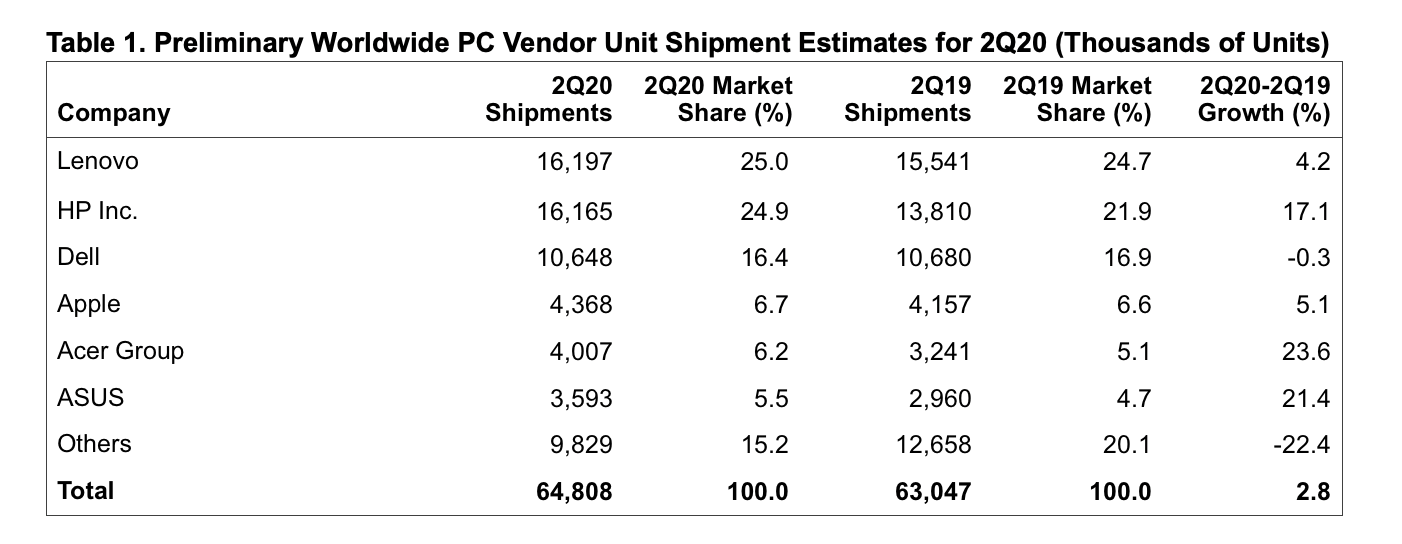
According to numbers from Gartner, Q2 has seen the beginning of a rebound. It’s not a huge bump, mind, but at 2.8% year-over-year, it’s a notable increase after a rough first quarter. There are a couple of reasons for the growth here. First is the aforementioned interest in upgrading home setups for work and school. Second is from retailers, which have reopened in a number of locations and have begun to refill shelves after being cut off via the supply chain.

Source: Gartner

Lenovo stayed at the number one spot, with HP following close behind. The companies saw 4.2% and 17.1% increase in shipments, respectively. Dell, Apple and Acer rounded out the top five. All told, the U.S. market is up 3.5% for the quarter, as well. Mobile computers in particular saw the biggest growth, helping to curb some of the attrition among desktops.

Notably, Gartner believes the growth will only be temporary, so take the good news where you can get it, PC makers. “[T]his uptick in mobile PC demand will not continue beyond 2020, as shipments were mainly boosted by short-term business needs due to the impact of the COVID-19 pandemic,” Gartner analyst Mikako Kitagawa says in the release.

Amazon will pay $135,000 to settle alleged US sanction violations

In a statement issued this week, the U.S. Treasury Department notes that Amazon has agreed to pay $134,523 to settle potential liability over alleged sanctions violations. The charges specifically pertain to goods and services sent to people located in Crimea, Iran and Syria, which are covered by Office of Foreign Assets Control (OFAC) sanctions, between November 2011 and October 2018.

The Treasury Department also states that the retail giant failed to report “several hundred” transactions in a timely manner. The department adds:

Amazon also accepted and processed orders on its websites for persons located in or employed by the foreign missions of Cuba, Iran, North Korea, Sudan, and Syria. Additionally, Amazon accepted and processed orders from persons listed on OFAC’s List of Specially Designated Nationals and Blocked Persons (the “SDN List”) who were blocked pursuant to the Narcotics Trafficking Sanctions Regulations, the Weapons of Mass Destruction Proliferators Sanctions Regulations, the Transnational Criminal Organizations Sanctions Regulations, the Democratic Republic of the Congo Sanctions Regulations, the Venezuela Sanctions Regulations, the Zimbabwe Sanctions Regulations, the Global Terrorism Sanctions Regulations, and the Foreign Narcotics Kingpin Sanctions Regulations.

The settlement is, of course, fairly insubstantial, compared to the massive market cap of the online retail giant. The transactions, were, however, for fairly low-level retail goods and services. In all, the violations only amounted to around double the settlement price of $134,523. 

The department doesn’t believe there was anything malicious going on, rather an issue with Amazon’s system, which failed to flag shipments to sanctioned areas. There appear to be a number of reasons this occurred. One example involves the site failing to note when product was shipped to the Iranian embassy in a different country.

Amazon opted not to offer a comment on the story, though the company notably self-disclosed what it believed to be potential violations of the aforementioned laws back in July of 2016. As The Wall Street Journal notes, a number of other tech giants have been hit with similar issues. Last year, Apple agreed to a $467,000 settlement for similar violations.

Harley-Davidson’s ‘Rewire’ plan starts with 700 jobs cuts, ousted CFO

Harley-Davidson, the storied and struggling Milwaukee-based company that last year launched its first production electric motorcycle in an effort to reboot sales and appeal to a younger customer base, is cutting 700 jobs from its global operations. About 500 workers will be laid off before the end of the year, the company said Thursday.

The company’s CFO John Olin is also out, effective immediately. Harley-Davidson’s current VP Treasurer Darrell Thomas has taken over as interim CFO until a successor is appointed. “Significant changes are necessary, and we must move in new directions,” Harley-Davidson chairman, president and CEO Jochen Zeitz said in a statement.

Harley-Davidson has branded its job cuts and restructuring plan “The Rewire,” which Zeitz spoke about in the company’s first-quarter earnings call back in April. At the time, Zeitz said the company was still committed to its other strategic plan known as “More Roads” that aimed to make the manufacturer an accessible, global brand through marketing and dealership initiatives and a series of new products that included small-displacement motorcycles for Asia markets and EVs, starting with the LiveWire.

Still, Zeitz declared back in April it was time for a change.

“As a result of my observations and assessment, I’ve concluded that we need to take significant actions and rewire the company now in terms of priorities, execution, operating model and strategy to drive sustained profit and long-term growth,” he said in April. “We are calling it The Rewire. And it’s our playbook for the next few months, leading to a new five-year strategic plan, which we will share when visibility to the future returns.”

Visibility into the future has apparently returned, and in Harley-Davidson’s view it’s time to cut costs and possibly get back to its core products. Initial Rewire actions are expected to result in restructuring costs of about $42 million in the second quarter of 2020, Harley-Davidson said in its announcement Thursday. The company plans to share a summary of The Rewire, including additional costs and expected savings, when it releases its Q2 results. The Rewire will set the foundation for a new 2021-2025 strategic plan, which is expected to be shared in the fourth quarter.

Harley-Davidson has seen its sales drop in recent years in the U.S., its largest market, as its core Baby Boomer customers have gotten older. The COVID-19 pandemic dampened sales further and the company has already cut back production, which resulted in dozens of job cuts last month at its factories in Wisconsin and Pennsylvania. The push into EVs and products for Asian countries aimed to expand into new markets and breathe new life into Harley-Davidson.

It’s unclear how “The Rewire” might affect the company’s push into EVs. The LiveWire, which launched last fall, was supposed to lead a future line-up of EVs planned by Harley-Davidson — spanning motorcycles, bicycles and scooters. Harley-Davidson has not responded to a request for comment; TechCrunch will update the article if the company responds.

The statement from Harley-Davidson makes no specific mention of EVs. It only said the key elements of its restructuring plan were to enhance core strengths and better balance expansion into new spaces, prioritize the markets that matter, reset product launches and build up its accessories and merchandising businesses.

TikTok likes and views are broken as community worries over potential US ban

TikTok likes and views are broken for some unknown portion of the video app’s user base this afternoon. The impacted users are seeing a “zero” like count on TikTok posts, including their own and those of other app users, as well as “zero” views. The company has acknowledged the issue and says it’s working on a fix, but declined to explain what was causing the problem.

The TikTok Support account responded to the problem at 2:43 PM ET, noting it was working quickly to fix things, and then posted again at 3:35 PM ET to say a fix was in progress.

The company said that users should soon see their app experience return to normal as the problem was resolved on the company’s end.

what’s going on with the tiktok likes and views? is this a sign tiktok is getting removed soon? i have so many questions. i really hope it means nothing and tiktok is just glitching. if this is happening to you, or if you know anything about it, comment because im clueless. pic.twitter.com/MJlwE5ICMz

? (@usedforopinions) July 9, 2020

While typically a bug like this isn’t much cause for concern — online apps do break, on occasion — the problem with TikTok comes at a time when the app is under fire in the U.S. for its ties to China.

This week, reports emerged that the U.S. was considering banning TikTok and other Chinese-owned social media apps, according to statements made by U.S. Secretary of State Mike Pompeo. TikTok has already been banned in India, along with 58 other Chinese apps, for similar reasons.

Today, The Wall Street Journal reported that executives at TikTok parent ByteDance are considering changing the corporate structure of TikTok’s business or even establishing a headquarters for the company outside of China, in order to further distance TikTok from China and the potential for the app being compromised by Chinese authorities. This is not the first time such discussions have taken place.  

In this context, the issues around Like counts were seen by some users today as a signal that a ban was imminent. But that’s not the case.

A few users theorized TikTok was making some sort of change to its algorithms, because their “For You” page seemed to no longer reflect their interests when Like counts returned. But this is impossible to confirm at this time.

The news of TikTok’s demise in the U.S., however, has concerned the TikTok community. As a result, they’ve already begun fleeing to rival apps like Byte, Dubsmash and Likee in the U.S. Byte, for example, jumped from No. 210 in Social Networking in the U.S. App Store on July 5 to No. 1 in Social and No. 1 Overall as of today, thanks to an exodus of primarily Gen Z TikTok users.

Update 8:49 PM ET: TikTok says the problem is resolved.

Update: we're back! Apologies for the issues, feel free to enjoy your regularly scheduled For You feed. https://t.co/A5UYhOzHCA

— TikTok (@tiktok_us) July 10, 2020


Apple expands its free coding courses and materials for educators

Apple today announced its plans for a new, free resource aimed at helping educators of all skill levels gain the ability to teach both Swift and Xcode — the latest in Apple’s educational initiatives focused on encouraging more students to learn app development. On July 13, Apple will begin offering free online training to educators that will serve as an introduction to its Develop in Swift curriculum.

This curriculum has also been completely redesigned to meet students learning styles, based on user feedback, says Apple.

The new series will now include four books, “Develop in Swift Explorations,” “Develop in Swift AP CS Principles,” and “Develop in Swift Fundamentals,” all of which are available today. A fifth book, “Develop in Swift Data Collections,” will become available later this fall. All are available in Apple Books.

The curriculum is geared toward high school and higher education students and focuses on the open-source programming language Swift, designed by Apple, and using Xcode on the Mac.

Image Credits: Apple

For younger learners, grades 4 through 8, Apple’s Everyone Can Code curriculum instead uses puzzles and games to teach the building blocks of coding in Swift through the Swift Playgrounds app. This course is now being expanded, as well.

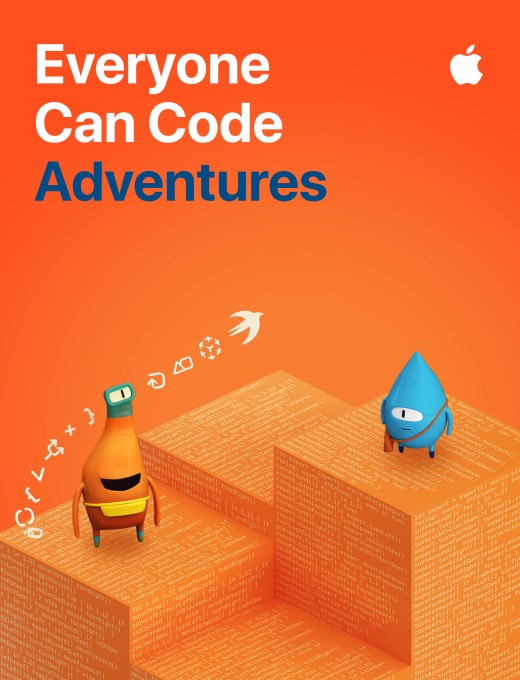
For all the students who have already completed the “Everyone Can Code Puzzles” book, they can now move on to a new book, “Everyone Can Code Adventures.” This book includes more advanced activities where students can practice building with Swift while also learning about important programming concepts.

The company says its intention with the new and expanded courses is to supplement the need for computer science instructors in the U.S., where there is often a need.

Apple noted that The Computer Science Teachers Association claims that fewer than 50% of all American high schools offer computer science classes today and many college students aren’t able to get into the computer science courses needed to graduate, due to a teacher shortage.

In addition, the courses are also being offered to parents, many of whom are now making the transition to become homeschool teachers amid the coronavirus pandemic.

Also for parents of homeschoolers, Apple added a new set of remote learning resources for ages 10 and up, including “A Quick Start to Code” with 10 coding challenges on iPad or Mac. Plus, there are resources on Apple’s Learning from Home website, launched this spring. The site includes on-demand videos and virtual conferences on remote learning, and options to schedule free one-on-one virtual coaching sessions, hosted by educators at Apple.

The long-term impacts of Apple’s push for increased coding education still remain to be seen. “Everyone Can Code” was only launched in 2016, for example, and the “Develop in Swift” curriculum arrived just last year. Combined, the programs today reach 9,000 schools and higher education institutions worldwide.

The idea that “everyone” can and should learn to code is still somewhat controversial. While many may be able to learn coding fundamentals, not everyone will enjoy coding or excel at it. Plus, people often turn to coding for the wrong reasons or get duped by coding bootcamps into thinking that a few weeks of training will have them sailing into six-figure careers with ease.

On the other hand, exposing more kids to coding concepts may help to uncover the potential talent and interest in programming that would have otherwise been overlooked. That interest can then be nurtured by future courses and education as the child grows.

“Apple has worked alongside educators for 40 years, and we’re especially proud to see how Develop in Swift and Everyone Can Code have been instrumental in helping teachers and students make an impact in their communities,” said Susan Prescott, Apple’s vice president of Markets, Apps and Services, in a statement. “We’ve seen community college students build food security apps for their campus and watched middle school educators host virtual coding clubs over summer break. As part of our commitment to help expand access to computer science education, we are thrilled to be adding a new professional learning course to help more educators, regardless of their experience, have the opportunity to learn coding and teach the next generation of developers and designers,” she added.

Could the VR headset be the next Peloton?

Funding for virtual reality startups has grown more sparse over the past couple years, as investors have grappled with extended timelines for mainstream adoption. Meanwhile, connected fitness has exploded, gaining attention amid shelter-in-place as companies like Peloton have seen huge user gains with Mirror recently selling to Lululemon for $500 million.

FitXR wants the virtual reality headset to become the next hot-seller in the connected fitness space.

The startup, which develops the popular VR exercise app BoxVR, tells TechCrunch it has just closed $7.5 million in Series A funding led by Hiro Capital. The funding was structured with $6.3 million in equity investment alongside a $1.2 million loan from Innovate UK, a UK government org. Other investors include Adam Draper’s BoostVC, Maveron and TenOneTen Ventures.

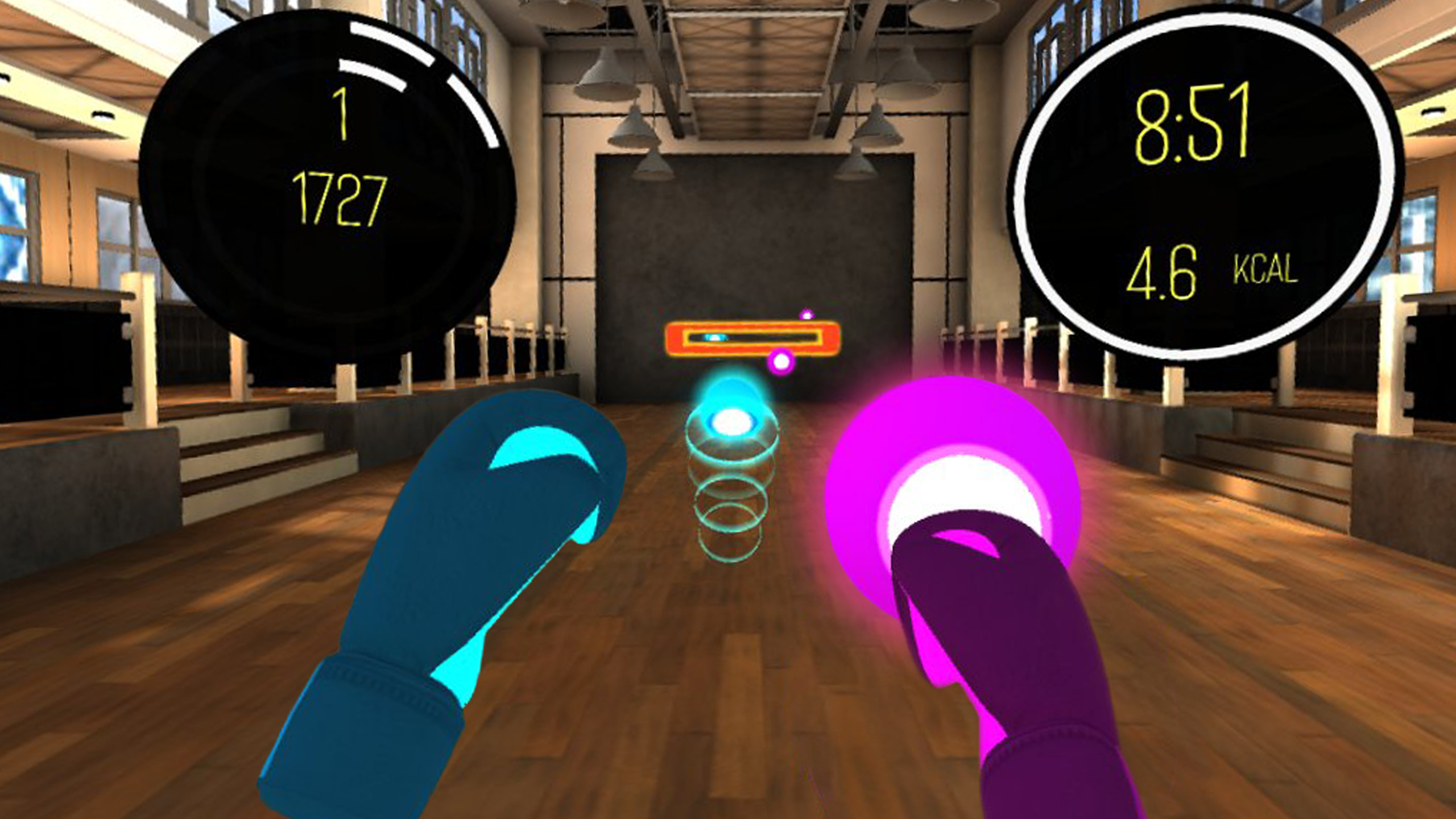
FitXR’s game BoxVR, has become one of the better-known purpose-built exercise apps available for VR devices. The boxing title adopts a Guitar Hero-esque interface influenced by Beat Saber but focuses on more physically demanding movements like quick uppercuts and jabs. The startup sells the app, which is available in the Oculus Store, PlayStation Store and Steam, for $29.99, with additional content packs going for $9.99.

screenshot of BoxVR, via FitXR

Working out in VR has slowly grown into a common use case for headsets thanks to the physical movement required for some of the more frantic titles.

Beat Saber, which Facebook acquired last year for an undisclosed amount, was one of the first titles to fully realize the opportunity.

Earlier this year, a16z-backed VR studio Within launched a subscription exercise app called Supernatural. Late last year, SF-based YUR raised $1.1 million in pre-seed funding for their VR exercise software.

The virtual reality market has had a lot to gain from shelter-in-place, but supply chain problems with the industry’s top backer, Oculus, left VR studios with plenty of missed opportunities. All of Oculus’s headsets, including its $399 standalone Quest headset, have been sold out or in low supply since the beginning of the year, a development that has negatively impacted the growth of an industry that is increasingly reliant on Facebook.

VR headsets don’t have heart rate monitors or other fitness-tracking capabilities, but VR developers do have access to plenty of motion data from how much and how quickly a user’s headset and controllers are moving.

FitXR uses this data to calculate calories burned and lets users set personal goals for how many calories they’d like to burn in-app on a daily basis.

For now, FitXR’s BoxVR sits solely inside the VR headset, but as the company looks to scale its team of 20 further with this funding, the company’s leadership is teasing an interest in having its world grow beyond the headset.

“We look at our own usage of the product and we don’t think it should be constrained to virtual reality,” FitXR CEO Sam Cole told TechCrunch. “But I think the sticking point for us is that we believe the most fun way to work out is in a VR headset. And therefore the strong focus from us as a company is to continue to build and innovate in that space.”

Founding partner Hjalmar Winbladh is leaving EQT Ventures

EQT Ventures, the Stockholm-headquartered venture capital firm that invests in Europe and the U.S., is losing founding partner Hjalmar Winbladh, TechCrunch has learned.

Rumours that he was leaving the “multistage, sector-agnostic” VC fund that he helped launch in 2016, begun circulating within the European startup ecosystem last week, with multiple sources telling TechCrunch that Winbladh has his heart set on starting something new.

A serial entrepreneur, in the real sense, Winbladh is a seven-time founder, having previously built and managed global technology companies such as Wrapp, Rebtel and Sendit. Described as the world’s first mobile internet company, Sendit was acquired by Microsoft in 1999.

He joined EQT a decade ago to help establish its venture arm, when Europe barely had a venture capital ecosystem and was dwarfed by the U.S. in terms of available capital. In late 2019, EQT Ventures raised its second fund, with commitments totaling €660 million, making it one of the largest VC funds in Europe.

One of the firm’s investments, Small Giant Games, was acquired by Zynga in 2018 in a deal valued at $700 million. Other portfolio companies include 3D Hubs, Varjo, Natural Cycles, Permutive, Codacy, Peakon and Tinyclues.

Confirming Winbladh’s departure, EQT’s Head of Communications, Nina Nornholm, provided the following statement:

Hjalmar has been with EQT for almost 10 years and has played an instrumental role on our digital transformation journey. Over the last five years, he has also built and led the Ventures team into a very successful business and with a strong portfolio and dedicated team. He is now longing to get back to his entrepreneurial roots and has decided to leave his role within EQT Ventures. He remains on the boards of EQT Ventures’ portfolio companies Banking Circle, Wolt and Peltarion so we are not separating ways entirely.

In a brief call with Winbladh — interrupting his vacation, no less — he said he was excited to take some time to figure out what’s next, although he stressed that it was too early to go into any detail and that he was leaving EQT Ventures in very good hands.

Painting broad brush strokes, Winbladh told me he wants to continue giving back to the European ecosystem but that the challenges it faces today are very different to 10 years ago. With the tech landscape more competitive than ever, he wants to create a way for seasoned entrepreneurs and investors like himself to better support the next generation of founders, hinting at something earlier stage than EQT Ventures’ Series A, B and C focus. However, he said he wasn’t currently raising a fund of his own.

As always, watch this space.

iOS 14 gets rid of the app grid to help you find the app you’re looking for

Apple unveiled the next major version of iOS a few weeks ago. I’ve been playing around with beta versions of iOS 14 and here’s what you should expect when you update your iPhone to the final release of iOS 14 this fall.

The most interesting change is something you’re not going to notice at first. The home screen has been rethought. In some ways, the iPhone now works more like Android devices. You can add widgets to the home screen and there’s a new app launcher called the App Library.

If you’ve been using a smartphone for many years, chances are your device is cluttered with a dozen apps you frequently use, some apps you only need a few times a year and a ton of apps that are no longer useful.

Maybe your home screen is perfectly organized and you’re thinking that this doesn’t apply to you. Arguably, you’re part of the minority. Many people tell me they don’t even know where app icons are located anymore and they just pull down to use the search feature.

With iOS 14, changes are not immediately visible. If you want to keep using your phone just like before, nobody is stopping you. But the home screen is now more customizable.

Image Credits: Apple

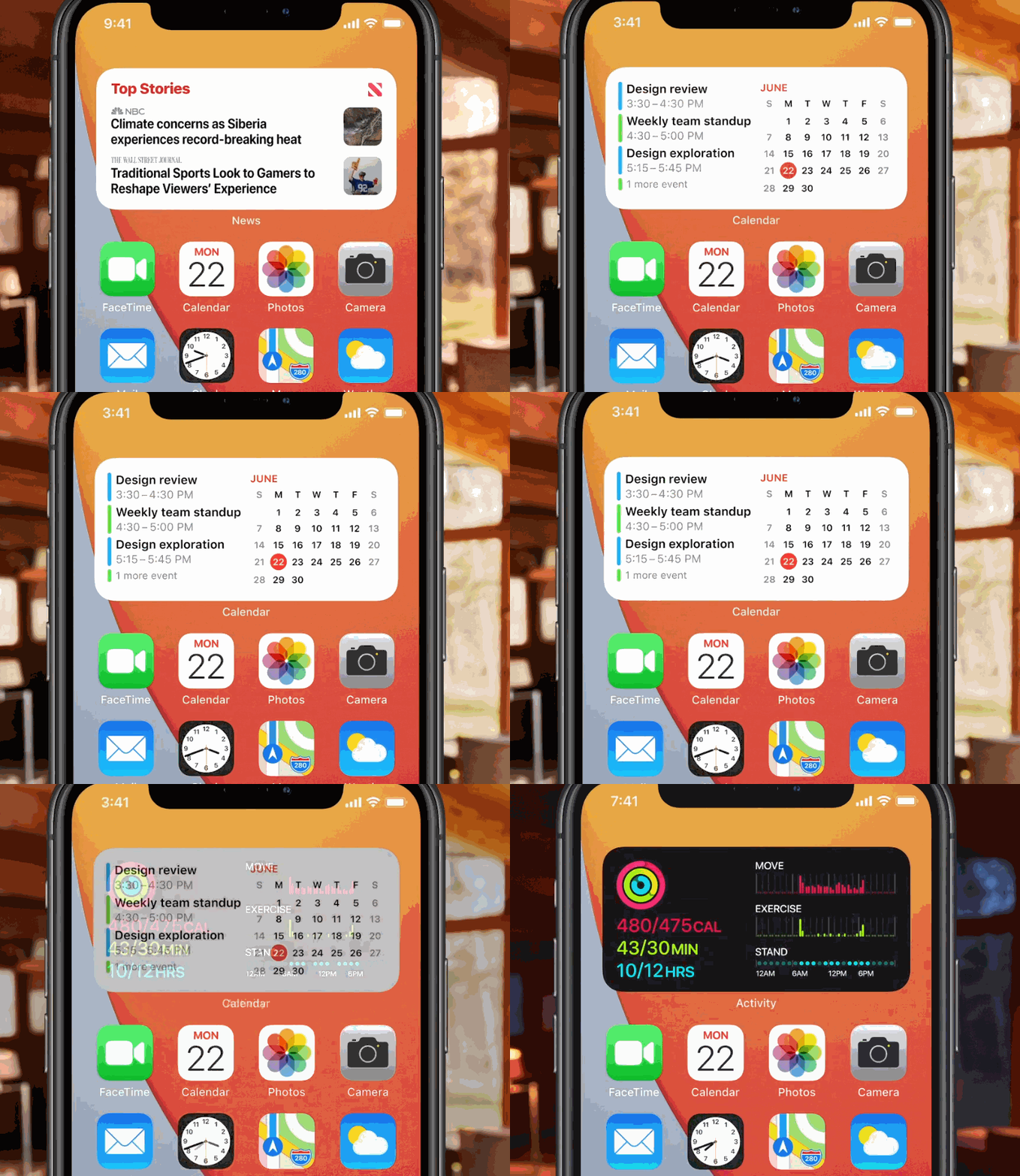
When you tap and hold on a home screen icon, there’s a new menu that lists all the widgets you can install on your home screen. Many default apps already support widgets, such as Reminders, Calendar, Stock, Weather, Music, etc. And each widget comes in multiple sizes if you want to see more or less info.

The most interesting thing about widgets is that you can stack them and flip through them. Otherwise, they’d quickly take over your entire home screen. Apple also tries to surface the widget that is more relevant to the time of the day and what you’re doing.

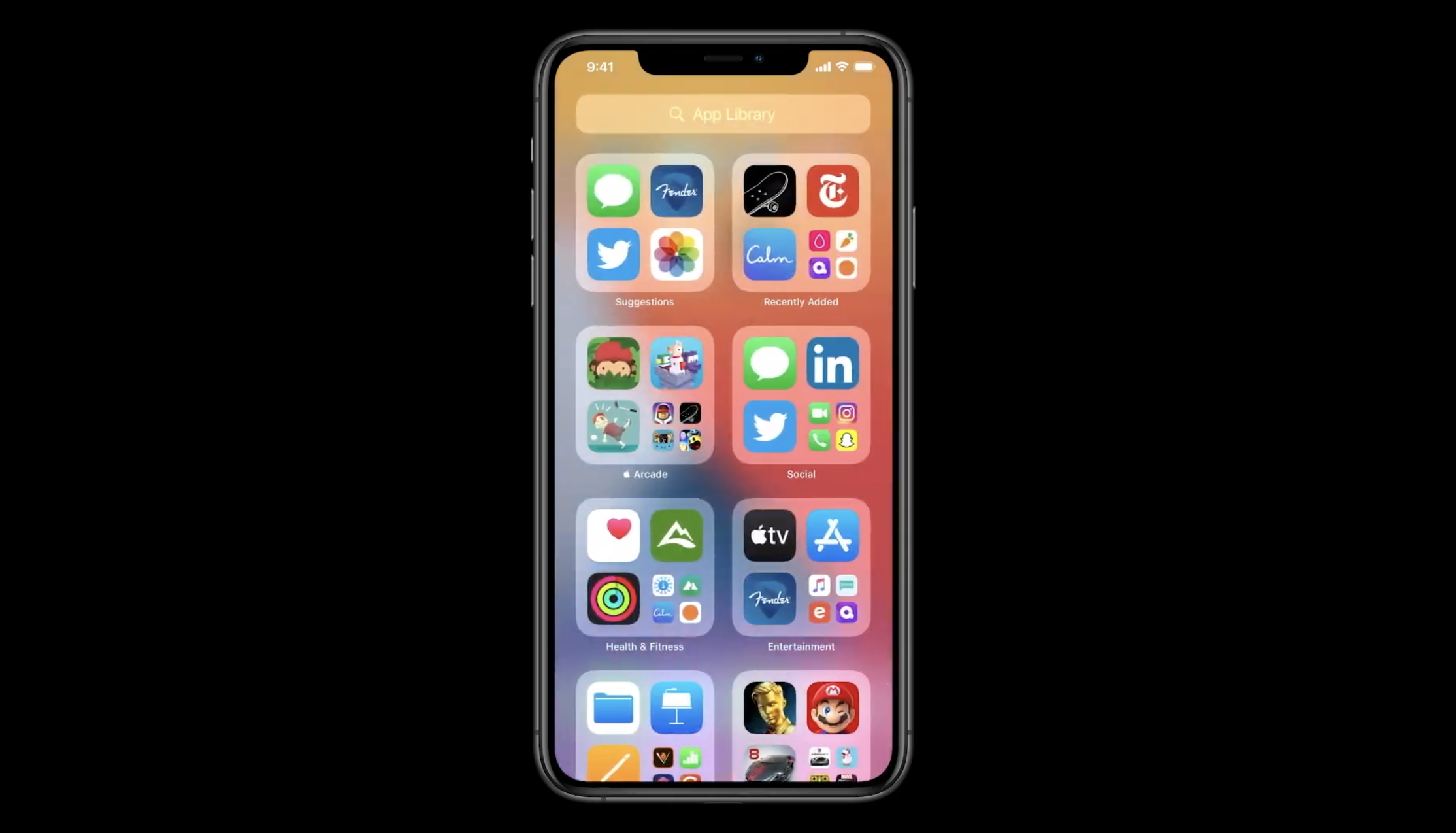
The second big change with the home screen is that there’s a new page at the right of your last page. The App Library groups all your apps on your phone by category. Some icons are bigger than others as Apple tries once again to surface the most important apps to you.

In my experience, categories don’t work that well as they’re based on the broad categories of the App Store. But you can always tap on the search bar at the top to display an alphabetical list of your apps. It could be useful if you can’t remember the name of an app, for instance.

Image Credits: Apple

Fighting app fatigue

Those changes for the home screen might seem minor, but they are important to change the current app paradigm. People simply don’t want to download new apps. They don’t want to create a new account and they don’t want to have another icon.

Now that you can hide pages of apps and that there’s the App Library, downloading new apps has become less intimidating. If you combine that with Sign in with Apple, you can go from no app to interacting with content in no time.

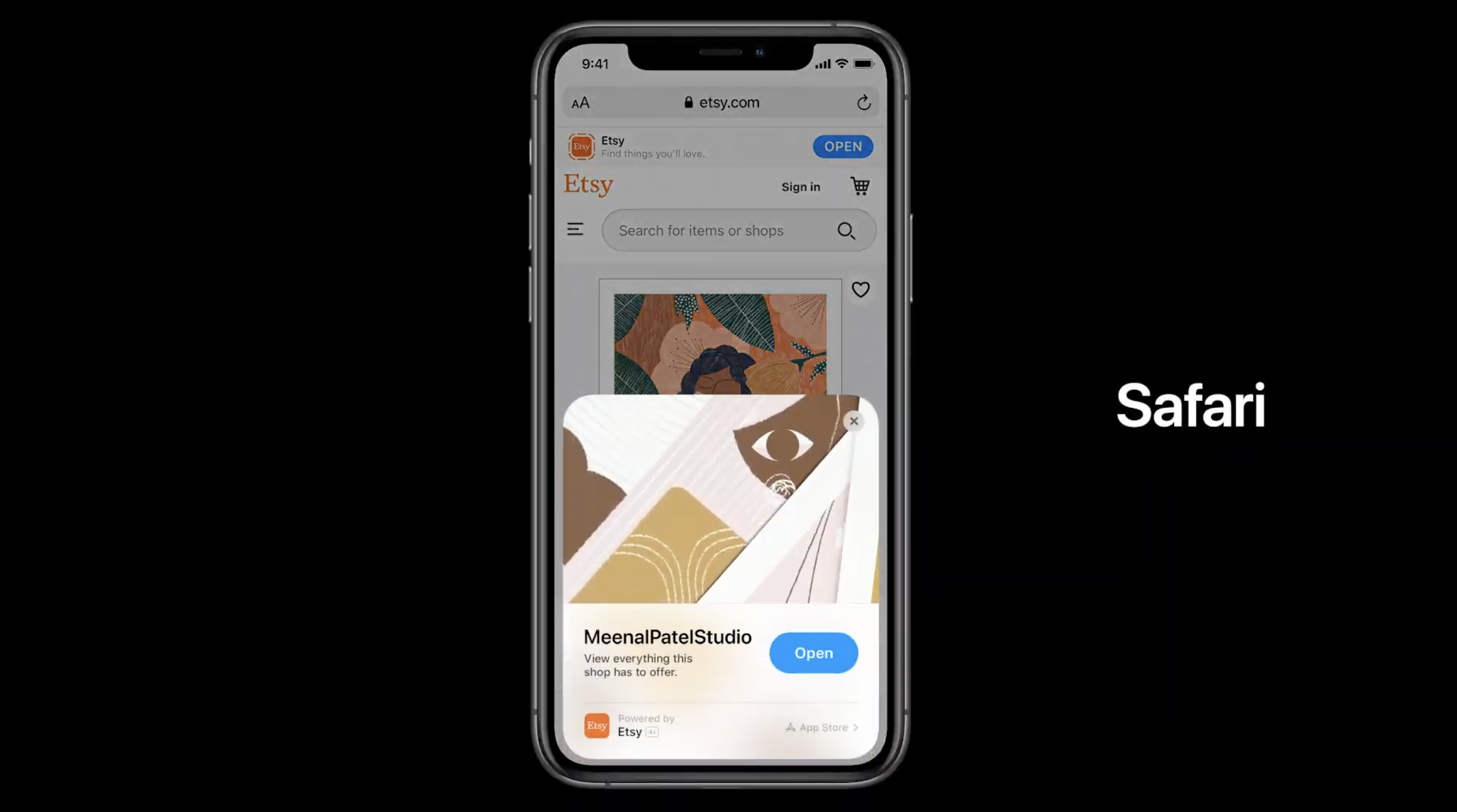
In addition to that, Apple is introducing App Clips. They are sort of mini apps that you can launch without installing an app. It’s a small part of an app that you can easily share. I haven’t had the chance to try it out yet as third-party developers have yet to take advantage of App Clips.

There are many ways to share App Clips. You can launch those apps from the web, from Messages, from Maps, from NFC tags or from QR codes. Get ready to see stickers at cafés, on scooters or in museums. Scan a code or tap your phone on it and you get an app-like experience. If you want to dive deeper, you can download the full app from the App Library.

But it’s also going to have some major impacts on utility apps, apps that you don’t use that often or travel apps for instance. Sure, you may keep your favorite social app on your home screen. But you’re going to forget about apps that only live in the App Library.

Developers will be happy that downloading apps is easier. And yet, it is going to be harder to make people come back to your app after the first launch.

Image Credits: Apple

Some app refinements

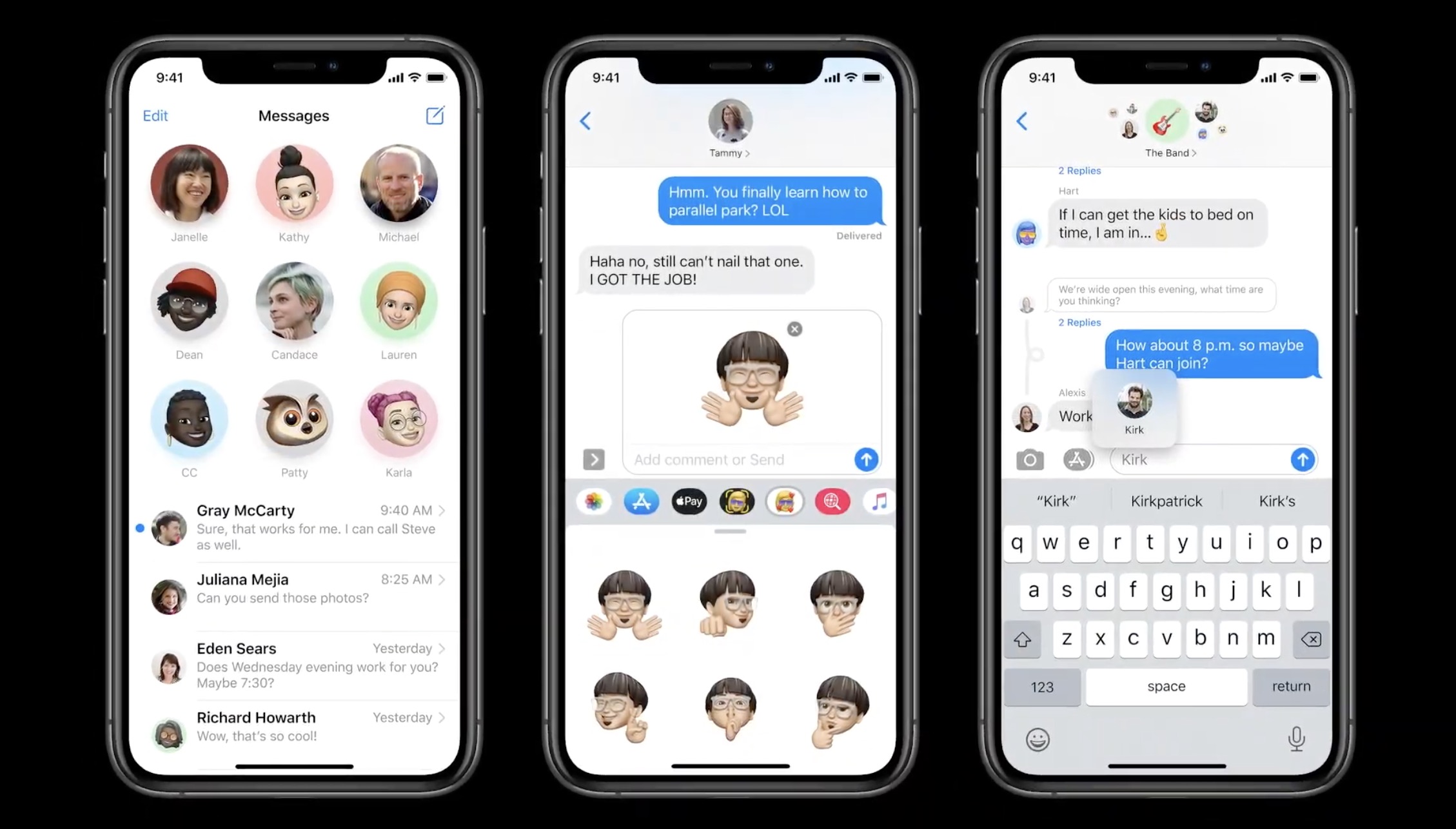
Let me list some quality-of-life improvements that are going to make your phone work better. In Messages, you can now pin conversations to the top. Group conversations are also receiving a major update with the ability to @-mention people, reply to specific messages and set a group of photos. Once again, Apple is bringing Messages closer to WhatsApp and Telegram. But it’s not a bad thing.

In Maps, there are many new features that I already detailed in a separate post. I encourage you to read it if you want to learn more about guides, electric vehicle routing, cycling directions and more.

The Home app has been improved with a new row of icons that describe the status of your home. For instance, you can see the temperature, see if a door is open, see if lights are on, etc.

Like every year, Notes and Reminders are getting some small improvements. For instance, document scanning has been improved, search has been improved, you can assign reminders to others and more. Those apps have become really powerful with these small incremental updates.

Image Credits: Apple

All the rest

There are many things that I haven’t mentioned yet or that I haven’t tried because I can’t use those features yet. Similarly, it’ll take some time before developers start adopting those features. Here’s a quick rundown:

  • Incoming calls don’t take over the entire screen anymore. You get a notification at the top of the screen, which is so much better if you don’t want to answer a call.
  • Similarly, Siri doesn’t overtake the screen. Your display fades out. I think more people are going to use Siri because of this as it doesn’t feel as invasive.
  • Your AirPods will automatically switch between your iPhone, iPad, Mac, etc.
  • When you’re on a FaceTime call or watching a video, you can switch to another app and keep the video in a corner. There’s not much else to say other than it’s nice.
  • Cycling directions in Apple Maps: I’m a bike lover, but the feature isn’t available in Paris. It’s hard to know whether directions make sense in San Francisco or New York as I don’t know cycling infrastructure that well in those cities.
  • When you pull down to search for something, iOS now automatically highlights the first result. You can tap Go on the keyboard to hit the first result. It’s so much better.
  • HomeKit-compatible security cameras can now recognize faces based on tags in Photos.
  • You can unlock cars with your phone using NFC if you have a compatible car.
  • Following the acquisition of Dark Sky, you’ll be able to see next-hour precipitation in Apple’s Weather app.
  • You’ll be able to choose a different web browser and email client as default apps with iOS 14.

What about stability?

The big issue of iOS 13 was that it was quite buggy when it launched in September 2019. It’s hard to know whether iOS 14 is going to perform better on this front as it’s still a beta.

But, as you can see, Apple didn’t try to reinvent the wheel with default apps. There are a ton of improvements across the board, but no big redesign of Photos or Messages for instance. And I think it’s a good thing.

Changes on the home screen as well as App Clips could have wider implications for developers. It could change the way you discover and install apps today. So it’s going to be interesting to see if the developer community embraces App Clips.

Apple just released the first iOS 14 beta to everyone

This is your opportunity to get a glimpse of the future of iOS — and iPadOS. Apple just released the first public beta of iOS 14 and iPadOS 14, the next major version of the operating systems for the iPhone and iPad. Unlike developer betas, everyone can download these betas without a $99 developer account. But don’t forget, it’s a beta.

The company still plans to release the final version of iOS and iPadOS 14.0 this fall. But Apple is going to release betas every few weeks over the summer. It’s a good way to fix as many bugs as possible and gather data from a large group of users.

As always, Apple’s public betas closely follow the release cycle of developer betas. And Apple released the second developer beta of iOS and iPadOS 14 earlier this week. So it sounds like the first public beta is more or less the same build as the second developer build.

But remember, you shouldn’t install an iOS beta on your primary iPhone or iPad. The issue is not just bugs — some apps and features won’t work at all. In some rare cases, beta software can also brick your device and make it unusable. You may even lose data on iCloud. Proceed with extreme caution.

But if you have an iPad or iPhone you don’t need, here’s how to download it. Head over to Apple’s beta website and download the configuration profile. It’s a tiny file that tells your iPhone or iPad to update to public betas like it’s a normal software update.

You can either download the configuration profile from Safari on your iOS device directly, or transfer it to your device using AirDrop, for instance. Reboot your device, then head over to the Settings app. In September, your device should automatically update to the final version of iOS and iPadOS 13 and you’ll be able to delete the configuration profile.

The biggest change of iOS 14 is the introduction of widgets on the home screen, a new App Library to browse all your apps and the ability to run App Clips — those are mini apps that feature a small part of an app and that you can run without installing anything.

There are also many refinements across the board, such as new features for Messages, with a big focus on groups with @-mentions and replies, a new Translate app that works on your device, cycling directions in Apple Maps in some cities and various improvements in Notes, Reminders, Weather, Home and more.

If you want to learn more about iOS 14, I looked at some of the features in the new version: