Creating a robust churn-reversal system

Julian Shapiro
Contributor

Julian Shapiro is the founder of BellCurve.com, a growth marketing team that trains startups in advanced growth, helps hire senior growth marketers and finds vetted growth agencies. He also writes at Julian.com.

We’ve aggregated many of the world’s best growth marketers into one community. Twice a month, we ask them to share their most effective growth tactics, and we compile them into this Growth Report.

This is how you stay up-to-date on growth marketing tactics — with advice that’s hard to find elsewhere.

Our community consists of startup founders and heads of growth. You can participate by joining Demand Curve’s marketing training program or its Slack group.

Without further ado, on to our community’s advice.


Creating a robust churn-reversal system

Insights from Matthew Morley of Savvy

Generally, it’s far more efficient to keep a current client than it is to close a new one. You’ll want a system to help you identify which users are at risk of churning. This way, you can proactively reach out to them before they leave.

Start by identifying your high-value customers at risk of churning:

Who is:

  • Spending within the top 10% of time using your app?
  • Has a substantial number of seats of your product?
  • Or, say, has a company size of at least 50 people — reflecting their upselling potential?

But also:

  • Is using the product 30% less in a given month
  • Has submitted at least one non-trivial support ticket in the last month
  • And has their subscription renew in less than 90 days

And so on.

You can stitch this information together from multiple sources like Stripe, Mixpanel, Crunchbase and Intercom. Then, set up an alert to notify your team once someone falls into these buckets.

Then reach out with something personal to win back their enthusiasm. It can be high leverage to get them on the phone to uncover what’s keeping them around.

Is your net worth too closely tied to your company’s success?

Peyton Carr
Contributor

Peyton Carr is a financial advisor to founders, entrepreneurs and their families, helping them with planning and investing. He is a managing director of Keystone Global Partners.

Now that I’ve offered an overview to help you think through where concentrated stock sits in your overall plan, let’s take a closer look at why selling can be challenging for some.

In the following section, I reveal the facts of the concentrated stock “get rich” myths that reside in the minds of many first-time concentrated stock owners, and I show why it is prudent to consider greater diversification.

Keep reading to learn more about the benefits of diversification, discover how much company stock is likely too much to hold, and the options you have when it comes to diversifying strategically.

Dangers of concentration

There are several hard facts to keep in mind in contemplating maintaining a concentrated position:

  1. It’s stating the obvious, but not all stocks are AAPL or AMZN. Hendrik Bessembinder published research that found the best performing 4% of listed companies explained the returns for the entire U.S. stock market since 1926. The remaining 96% of stocks collectively matched the performance of U.S. Treasury bills. Since 1926, 58% of stocks have failed to beat one-month Treasury bills over their lifetimes. Forty percent of all Russell 3000 (an index of the 3000 largest publicly traded companies in the U.S.) have lost at least 70% of their value from their peak since 1980.
  2. Despite all this, broad-based equities have returned 9%+ a year, beating most other asset classes, ultimately due to the top 4% of stocks. Although there is no guarantee anyone can single out any of the top 4% going forward, diversification will guarantee you will own the top 4%.
  3. Even if the concentrated stock you own will be another AAPL/AMZN, both stocks have experienced declines of 90%+ at some point throughout their lifetimes. Most investors would not be able to have conviction and stay invested, especially if that concentrated stock was driving the majority of their portfolio returns and net worth. Sometimes catastrophic declines are a function of the industry or existential threats that have little to do with the company itself. Other times, it has everything to do with the company and nothing to do with external factors.

The odds of any new IPO being among the top 4% is just slightly better than hitting your lucky number on the roulette wheel. But is your investment portfolio success and the odds of achieving your long-term financial goals something you want to spin the wheel on?

Benefits of diversification

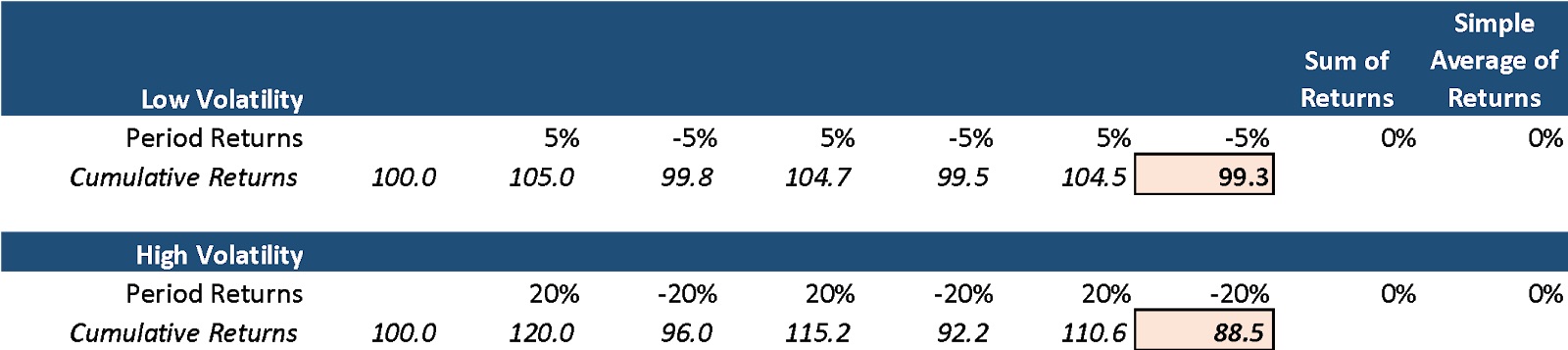
Excess volatility can harm returns. Note the example below that shows the comparison between a low-volatility diversified portfolio versus a high-volatility concentrated portfolio. Despite the same simple average return, the low-volatility portfolio below materially outperforms the high-volatility portfolio.

Image Credits: Peyton Carr

Beyond the math, unexpected spikes in volatility can cause significant price declines. Volatility increases the chances that an investor reacts emotionally and makes a poor investment decision. I’ll cover the behavioral finance aspect of this later. Lowering your portfolio volatility can be as simple as increasing your portfolio diversification.

The Russell 3000, an index representing the 3,000 largest U.S.-based publicly traded companies, has lower volatility when compared against 95%+ of all single stocks. So, how much return do you give up for having lower volatility?

According to Northern Trust Research, the 5.96% annualized average return of the Russell 3000 is 0.73% more than the 5.23% return of the median stock. Additionally, owning the Russell 3000, rather than a single stock, eliminates the likelihood of catastrophic loss scenarios — more than 20% of shares averaged a loss of more than 10% per year over a 20-year time frame.

If this establishes that the avoidance of overly concentrated portfolios is important, how much stock is too much? And at what price should you sell?

How much of your company’s stock is too much?

We consider any stock position or exposure greater than 10% of a portfolio to be a concentrated position. There is no hard number, but the appropriate level of concentration is dependent on several factors, such as your liquidity needs, overall portfolio value, the appetite for risk and the longer-term financial plan. However, above 10% and the returns and volatility of that single position can begin to dominate the portfolio, exposing you to high degrees of portfolio volatility.

The company “stock” in your portfolio often is only a fraction of your overall financial exposure to your company. Think about your other sources of possible exposure such as restricted stock, RSUs, options, employee stock purchase programs, 401k, other equity compensation plans, as well as your current and future salary stream tied to the company’s success. In most cases, the prudent path to achieving your financial goals involves a well-diversified portfolio.

What’s stopping you?

Facts aside, maintaining a concentrated position in your company stock is far more tempting than taking a more measured approach. Token examples like Zuckerberg and Bezos tend to outshine the dull rationale of reality, and it’s hard to argue against the possibility of becoming fabulously wealthy by betting on yourself. In other words, your emotions can get the best of you.

But your goals — not your emotions — should be driving your investment strategy and decisions regarding your stock. Your investment portfolio and the company stock(s) within it should be used as tools to achieve those goals.

So first, we’ll take a deep dive into the behavioral psychology that influences our decision-making.

Despite all the evidence, sometimes that little voice remains.

I want to hold the stock.

Why is it so hard to shake? This is a natural human tendency. I get it. We have a strong impetus to rationalize our biases and not believe we are vulnerable to being influenced by them.

Becoming attached to your company is common, since after all, that stock has made you, or has the potential of making you wealthy. More often than not, selling and diversifying is the tough, but more rational decision.

Numerous studies have furnished insights into the correlation between investing and psychology. Many unrecognized psychological barriers and behavioral biases can influence you to hold concentrated stock even when the data shows that you should not.

Understanding these biases can be helpful when deciding what to do with your stock. These behavioral biases are hard to spot and even harder to overcome. However, awareness is the first step. Here are a few more common behavioral biases, see if any apply to you:

Familiarity bias: Familiarity is likely why so many founders are willing to hold concentrated positions in their own company’s stock. It is easy to confuse the familiarity with your own company with the safety in the stock. In the stock market, familiarity and safety are not always related. A great (safe) company sometimes can have a dangerously overvalued stock price, and terrible companies sometimes have terrifically undervalued stock prices. It’s not just about the quality of the company but the relationship between the quality of a company and its stock price that dictates whether a stock is likely to perform well in the future.

Another way this manifests is when a founder has less experience with stock market investing and has only owned their company stock. They may think the market has more risk than their company when in actuality, it is usually safer than holding just their individual position.

Overconfidence: Every investor is exhibiting overconfidence when they hold an overly concentrated position in an individual stock. Founders are likely to believe in their company; after all, it already achieved enough success to IPO. This confidence can be misplaced in the stock. Founders often are reluctant to sell their stock if it has been going up since they believe it will continue to go up. If the stock has sold off, the opposite is true, and they are convinced it will recover. Often, it is challenging for founders to be objective when they are so close to the company. They commonly believe that they have unique information and know the “true” value of the stock.

Anchoring: Some investors will anchor their beliefs to something they experienced in the past. If the price of the concentrated stock is down, investors may anchor their belief that the stock is worth its recent previous higher value and be unwilling to sell. This previous value of the stock is not an indicator of its real value. The real value is the current price where buyers and sellers exchange the stock while incorporating all presently available information.

Endowment effect: Many investors tend to place a higher value on an asset they currently own than if they did not own it at all. It makes it harder to sell. An excellent way to check for the endowment effect is to ask yourself: “If I did not own these shares, would I purchase them today at this price?” If you are not willing to purchase the shares at this price today, it likely means you are only holding onto the shares because of the endowment effect.

A fun spin on this is to look into the IKEA effect study, which demonstrates that people assign more value to something that they made than it is potentially worth.

When framed this way, investors can make more intentional decisions on whether to continue holding concentrated stock or selling. At times, these biases are hard to spot, which is why having a second person, a co-pilot, or an advisor, is helpful.

Take control

Congratulations to those of you with a concentrated stock position in your company; it is hard-earned and likely represents a material wealth. Understand, there is no “right” answer when it comes to managing concentrated stock. Each situation is unique, so it is essential to speak with a professional about options specific to your situation.

It starts with having a financial plan, complete with specific investment goals that you want to achieve. Once you have a clear picture of what you want to accomplish, you can look at the facts in a new light and gain a deeper appreciation for the dangers of holding a concentrated position in company stock versus the benefits of diversification, considering all of the implications and opportunities involved in rational decision-making and investment behavior.

What are my choices if I want to diversify?

Most individuals understand they can simply and directly sell their equity, but there are a variety of other strategies. Some of these opportunities may be far better at minimizing taxes or better at achieving the desired risk or return profile. Some might wonder what the best timing is to sell. I will cover these topics in the final article of the series.

Chef Marcus Samuelsson teams up with Sage Digital to launch Project Bento fundraising platform

In the wake of the COVID-19 pandemic, as well as the ongoing protests for racial justice, people have been looking for different ways to contribute, which in turn has led tech companies to launch new features and campaigns.

Now there’s a new fundraising platform called Project Bento, created by chef and restauranteur Marcus Samuelsson (best known as the chef behind Red Rooster Harlem), Derek Evans (CEO of the Marcus Samuelsson Group) and the team at Sage Digital (a startup creating tools for reviewers, chefs and other experts to publish content and build a following).

Samuelsson told me that he’d already been working with Sage Digital to create a presence on the platform. Then he mentioned Harlem Serves Up, this year’s version of the annual Harlem EatUp festival — Samuelsson and his team reinvented the event during the pandemic as as a fundraising telethon for nonprofits fighting food insecurity.

But, Samuelsson said that when he surveyed the options available to manage the online fundraising, he wasn’t quite satisfied with any of the available options.

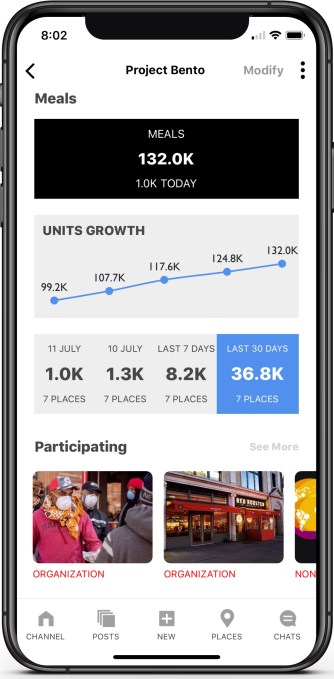
Project Bento

Image Credits: Project Bento

“We were thinking very much about our needs — what were we building, how do we want consumers to utilize it,” he said.

So the Sage Digital team ended up building Project Bento in seven or eight weeks, on top of the startup’s existing platform. Sage CEO Samir Arora said that along with allowing nonprofits to collect funds (without having to pay a platform fee), publish content, promote on social media and track their campaigns, the platform also includes tools for managing sponsorships and matching donors.

The rapid development, Samuelsson said, was a perfect demonstration of “what entrepreneurship is.” Thus far, Project Bento has been used to raise more than $350,000 for Harlem Serves Up, as well as $4.8 million for the Project Bento Fund (which Arora described as a “completely new nonprofit whose purpose is to create matching funds” for campaigns on the platform).

There are several other campaigns live already, as well as links to employee relief fundraisers on other platforms, but Project Bento is also accepting applications from other nonprofits that want to fundraise on the platform. Samuelsson said he wants the website to be a place that can bring many of these campaigns together.

“There are communities not just in Harlem, but across the country, that need a campaign, they need to connect,” Samuelsson said. “[Project Bento] will continue because that need, raising money and connecting a community, will continue.”

US charges two Chinese spies for a global hacking campaign that targeted COVID-19 research

U.S. prosecutors have charged two Chinese nationals, said to be working for China’s state intelligence bureau, for their alleged involvement in a massive global hacking operation that targeted hundreds of companies and governments for more than a decade.

The 11-count indictment, unsealed Tuesday, alleges Li Xiaoyu, 34, and Dong Jiazhi, 33, stole terabytes of data from high-technology companies, around the world — including the United States, the prosecutors said.

More recently, the prosecutors accused the hackers of targeting the networks of over a dozen U.S. companies in Maryland, Massachusetts and California developing vaccines and treatments for COVID-19.

The indictment comes just weeks after both the FBI and Homeland Security warned that China was actively trying to steal U.S. research data related to the coronavirus pandemic.

The FBI’s “wanted” poster for Li Xiaoyu and Dong Jiazhi. Image Credits: FBI.

The hackers were first discovered after they targeted a U.S. Department of Energy network in Hanford, Washington, the Justice Department said. The hackers also targeted companies in Australia, South Korea and several European nations. The hackers used known but unpatched vulnerabilities in widely used web server software to break into their victims’ networks. By gaining a foothold onto the network, the hackers installed password-stealing software to gain deeper access to their systems. The prosecutors said that the hackers would “frequently” return to the networks — in some cases years later.

According to the indictment, the hackers stole “hundreds of millions of dollars” worth of trade secrets and intellectual property. The prosecutors also allege that the hackers stole data related to military satellite programs, military wireless networks and high-powered microwave and laser systems from defense contractors.

The hackers are said to have targeted their victims on behalf of China’s intelligence services, but also hacked for personal financial gain. Prosecutors said in one case, the hackers “sought to extort cryptocurrency” from a victim company by threatening to publish the victim’s stolen source code online.

John C. Demers, U.S. assistant attorney general for national security, said that the indictments were “concrete examples” of how China used hackers to “rob, replicate and replace” non-Chinese companies in the global marketplace.

Demers also accused China of providing a safe-haven for the hackers.

“China has now taken its place, alongside Russia, Iran and North Korea, in that shameful club of nations that provide a safe haven for cyber criminals in exchange for those criminals being ‘on call’ to work for the benefit of the state, here to feed the Chinese Communist party’s insatiable hunger for American and other non-Chinese companies’ hard-earned intellectual property, including COVID-19 research,” said Demers.

Mandiant, the incident response division of security firm FireEye, said it has tracked the hackers since 2013 and the tactics, techniques and procedures used by the hackers is “consistent” with its findings.

“The Chinese government has long relied on contractors to conduct cyber intrusions,” said Ben Read, senior manager of analysis at Mandiant, in an email. “Using these freelancers allows the government to access a wider array of talent, while also providing some deniability in conducting these operations.”

“The pattern described in the indictment where the contractors conducted some operations on behalf of their government sponsors, while others were for their own profit is consistent with what we have seen from other China-nexus groups such as APT41,” he said, referring to the Chinese advanced persistent threat group associated with the indictment.

If prosecuted, the hackers could each face more than 40 years in prison. But since the hackers are believed to still be in China, any extraditions to the U.S. are unlikely.

Combining social shopping rewards and personal finance apps, ex-Snap product gurus launch Meemo

After Wisam Dakka and André Madeira left Snap in 2018, the two longtime product developers and coders cast about for a new app to build. 

Looking around they realized there was no financial product that spoke to the generation of consumers they’d spent the last bit of their professional lives working to build for, so they decided it would be their next project.

“Our insight is that an individual’s relationship with money is a delicate and an emotional one. Most financial apps are not adopted by the masses because they are strict, lack empathy, and are unconsciously perceived as judgmental, which is why they are often downloaded and then ignored,” said Madeira, in a statement. 

Their solution, launching today, is Meemo .

It’s a combination of a personal financial monitoring, rewards and gifting, and social shopping app all rolled into one.

“One of the things we learned at Snap, if you want to reach the masses you need to change how you create an app. It has to be effortlessly,” said Madeira. “It has to be automatic and social as well so we want to build an app that is all of that combined.”

Once a user downloads Meemo and connects their main bank account or credit card to the app, Meemo will give that person insights into their spending history and potential rewards.

For most users, the initial experience will be through a gift card. Gifting, it turns out is what Dakka and Madeira think will be the secret sauce for the company’s growth (although getting people to use something if they’re being given money or free stuff is hardly rocket science).

There’s also the social element, which the two men think will be a draw as well. Meemo provides recommendations and social validation from friends by harvesting their buying history and sharing it with you.

Once a user downloads Meemo and has the history of their transactions, the app will surface the places where users spend the most money. They can then send gift cards to their friends for their favorite restaurants. The goal, eventually, is to get restaurants to subsidize the gifting portion and have their shoppers act as a direct marketing channel.

Shops won’t be able to see who’s getting the gifts until they come into the store. What Meemo hopes to do is gather a profile of a user’s shopping behavior based on their purchases and offer them discounts to places that they may not frequent as often, but match their consumer profile.

Backing the company are investors including Saama Capital, Greycroft, monashees and Sierra Ventures, along with individual investors Amit Singhal, Hans Tung and serial entrepreneurs and the co-founders’ colleagues from Google and Snap.

Madeira and Dakka first met working on Google Search and went on to found Snap’s San Francisco office. The team is rounded out by long-time friends like Robson Araújo and Ranveer Kunal.

“We are very excited to back Dakka and Madeira in their creation of a new age finance app at Meemo that will combine improved financial management with deeper social engagement for today’s generation,” said Ash Lilani, managing partner at Saama Capital, in a statement. “With Dakka and Madeira’s past experience of assembling talented teams and building viral products, we believe Meemo has an opportunity to become a leader in this space.” 

The company’s name is taken from a Portuguese word “mimo,” which means an affectionate treat, according to a statement. It’s available to download on iOS and Android.


Microsoft introduces Customer Voice, a real-time customer feedback tool

At Microsoft Inspire today, the company made several Dynamics 365 announcements, including Dynamics 365 Customer Voice, a real-time customer feedback tool that could compete with Qualtrics, the company SAP bought in 2018 for a cool $8 billion.

Microsoft General Manager Brenda Bown says that as more customers move online during the pandemic, it’s more important than ever to capture real-time customer feedback that you can combine with other data to build a more complete picture of the customer that could lead to more successful interactions in the future.

“Customer Voice is a feedback management solution, and it’s designed to empower businesses and organizations to build better products, deliver better experiences to customers and really build the relationships for the customers with that feedback management tool,” Bown told TechCrunch.

The data gets shared with Microsoft’s customer data platform (CDP), and is built on top of Dynamics 365 and the Power Platform. The latter provides a way to customize the Customer Voice tool to meet the needs of an individual company.

Brent Leary, partner and co-founder at CRM Essentials, says this solves the problem of getting feedback as the interaction is happening. He adds that being able to share that data directly with the CDP makes it even more valuable.

“Customer feedback has to be done as close to the interaction/transaction as possible and as frictionless as possible for it to really work, or else customers won’t give it to you. And then the data has to be integrated into the CDP with all the other data automatically to really be of use. And having a platform to handle both the feedback capture and the data integration optimizes the likelihood of this happening,” Leary said.

The company also announced Dynamics 365 Connected Store, a set of tools designed to help stores manage in-store and curbside traffic, among other things. As the pandemic limits the number of people in a store at one time, using sensors and cameras, Connected Store can help managers understand and manage the number of people inside the store at any given time to help aid in social distancing.

It can also help add a level of automation to curbside pickup, letting an employee know when the customer has pulled up. “It alerts the employee and they can bring out the order for a more seamless and quick pickup. And obviously this scenario is super important today because of [more people wanting] contactless pickup,” Bown said.

Finally, the company announced a fraud protection component. She says that Dynamics 365 Fraud Protection helps protect businesses online or in physical stores from fraudulent activities, which she says is even more important as more transactions are conducted digitally. New capabilities include account protection and loss prevention tooling.

Inspire is the company’s annual partner conference, which is being held virtually this year. Bown says by running it virtually, the company can involve even more partners than a typical in-person conference because companies that couldn’t previously attend because of cost and distance are able to participate this year.

Sora raises $5.3M to power its HR automation service

Think back to the last time you onboarded at a new job. Was it a mishmash of documents and calendar invites and calls and, generally speaking, a mess?

Probably. That’s likely because onboarding is a process that often depends on disparate, unconnected HR tools. Sora, a startup that today announced $5.3 million in collected fundraising, wants to shake up the HR software world with a low-code service that helps companies connect their tooling and automate their HR processes. The startup might be able to make things like onboarding better for employees and companies alike.

Low-code, no-code

Startups looking to bring low, and no-code tooling to non-engineering teams have become a trend in recent quarters. TechCrunch recently covered a $2.2 million round for no-code text analysis and machine-learning shop MonkeyLearn, for example. There have been hundreds of millions of dollars raised by low, and no-code tools in 2020 alone.

By building tools to assist non-engineers do more, faster without developer help — be it analysis, or visual programming — some technology upstarts are helping non-technical teams do what only technical teams were able to in previous years.

Sora fits into the trend because its service allows non-developers to create workflows, to use a term that the startup’s co-founder and CEO Laura Del Beccaro employed when she walked TechCrunch through her company’s product.

The Sora workflows can be built from templates, and employ triggers to fire off various processes (sending emails, pulling in data from other apps and services, that sort of thing), allowing non-engineers to create visual logic flows. The Sora system is “like a no-code workflow builder,” Del Beccaro said in an interview, allowing users to “add tasks where you have to tell someone to do something, and automate the follow-up. That’s actually one of our biggest pain point relievers. A lot of HR teams right now are manually tracking people down: Did you set up this laptop yet? Did you set up this new hire launch for these three people?”

Sora CEO Laura Del Beccaro, via the company.

The Sora workflow system is slick in practice, allowing, for example, customization around a single employee. Del Beccaro explained that her startup’s software can do things like ask a manager who a new hire’s work-buddy might be, and then send that person an email later saying that the hire has arrived.

According to Del Beccaro, Sora, wants to help “democratize your [HR] processes.” Today’s HR denizens are too dependent on data analysts for “people analytics reporting” she said, adding that once a company has all its HR “data in one place, which again, is our core offering, you can set up all these automations that you want by yourself, you don’t have to go to IT or engineering.”

And because Sora can handle swapping out different providers as needed, Sora should help HR teams at growing companies lower the “risk of changing systems,” helping them “stay flexible no matter what [their] processes look like.”

It’s a neat tool.

Money

Sora has raised $5.3 million in capital to date, a funding total that includes a pre-seed round from September, 2018. First Round and Elad Gil led its most recent round, which makes up a majority of its capital raised thus far.

With 11 employees today, Sora has around “25 people on [its] cap table,” the CEO said, telling TechCrunch that it was “pretty important to [her] to have a relatively diverse set of investors.” Del Beccaro provided this publication with a full list, which we’ve included below.

Sticking to the subject of money, after Mixpanel served as an early customer, Sora opened to more customers earlier this year. The CEO said that its customers are on one or two-year contracts, and charges per-employee, per-month, which seems reasonable. With its new cash, Sora has around 2.5 years of runway she said.

First Round’s Bill Trenchard liked Sora’s approach to building its service, saying in an email that the company was “never interested in scaling for the sake of scaling,” highlighting its work in concert with “a development partner to make sure what they were working on was actually solving real HR pain points before they took it to the market” as evidence of its “thoughtful and intentional” product approach.

Today, thanks to that method, in his view “what’s compelling about Sora is their sales momentum this year after launching,” the investor said. The next question for Sora, then, is how fast it can grow now that it has more capital in the bank than it has likely ever had before.

For fun, here’s the full investor list that Del Beccaro provided, which I’m including as it’s rare to get a full cap table:

  • Sarah Adams (Plaid)
  • Shan Aggarwal (Coinbase, Greycroft)
  • Scott Belsky (Adobe)
  • Mathilde Collin (Front)
  • Cooley Investment Fund
  • David Del Beccaro & Arleen Armstrong (Music Choice/Legal)
  • Viviana Faga (Emergence Capital)
  • Avichal Garg (Electric Capital)
  • Elad Gil
  • Kent Goldman (Upside VC)
  • Jonah Greenberger (Bright)
  • Daniel Gross (Pioneer, YC)
  • Charles Hudson (Precursor Ventures)
  • Todd Jackson (First Round Capital)
  • Oliver Jay (Asana)
  • Nimi Katragadda (BoxGroup)
  • Nicky Khurana (Facebook)
  • Brianne Kimmel (Work Life Ventures)
  • David King (Curious Endeavors)
  • Fritz Lanman (ClassPass)
  • Lisa & Mat Lori (Perfect Provenance/New Mountain Capital)
  • Shrav Mehta (SecureFrame)
  • Sean Mendy (Concrete Rose)
  • Jana Messerschmidt (#ANGELS, Lightspeed)
  • Katie Stanton (Katie Stanton, #ANGELS, Moxxie Ventures)
  • Erik Torenberg (Village Global)
  • Bill Trenchard (First Round Capital)
  • Jeannette zu Fürstenberg (La Famiglia VC)

Instagram is testing a ‘Personal Fundraiser’ feature

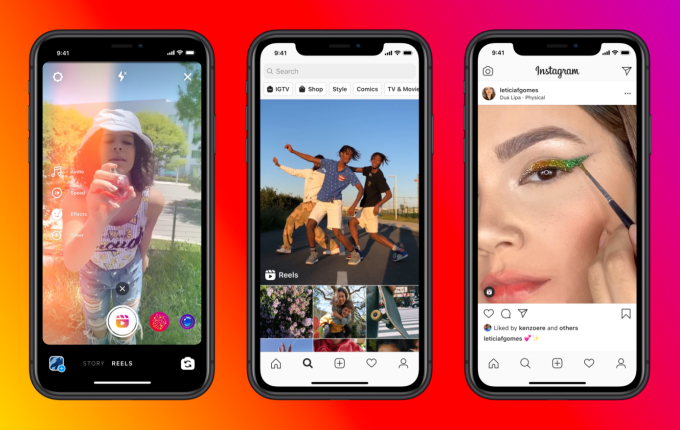
Instagram today announced a new tool for personal fundraisers. The company says it’s beginning a small test of the feature, which will allow users to link directly to a fundraiser from their profile page. The test will initially run in the U.S., U.K. and Ireland on Android, followed by iOS. While users can choose to either start a cause or support an existing one, Instagram says all fundraisers will be first vetted to ensure they meet the existing guidelines and rules.

These rules include a list of supported fundraising categories, and detail in which cases a fundraiser would not be approved. The same rules also apply to Facebook fundraisers.

To get started with Personal Fundraisers, users with access to the feature will tap “Edit Profile,” “Add Fundraiser,” followed by “Raise Money.” You’ll then choose a photo, select the fundraiser category and enter further details to tell the story and encourage donations. When approved, you’ll be able to raise funds for 30 days with the option to extend fundraising just once for 30 more days.

In other words, the feature is meant to support more time-sensitive causes, rather than serve as a replacement for ongoing fundraising efforts.

Donations to the fundraiser itself will be powered by Facebook Pay, which also powers Instagram’s new shopping features. 

In the next several months, Instagram says it will expand the feature to allow users to share their fundraiser in both their Feed and within Stories.

The addition isn’t the only way Instagram is supporting fundraising.

The company had already offered eligible nonprofits and supporters to raise money for charity with Donation Stickers for Stories, and more recently with a Live Donations feature for live streams. While the company covers fees made to nonprofits, it does charge fees for personal fundraisers based on the country where the creator of the fundraiser is located.

Fundraising has become a popular activity across Facebook’s platforms. Already, users have raised more than $100 million for COVID-19 initiatives and causes on Instagram and Facebook combined since January, for example. And in the last 30 days, donations on Instagram have doubled in the U.S.

The test of Personal Fundraisers is rolling out to a small number of users, but Instagram says the plan is to expand the feature in the months ahead.

Updated, 7/21/20, 1:50 PM ET: Facebook previously reported users had raised $65M+ for COVID and racial justice fundraisers. It corrected this figure to $100M+ for COVID fundraisers, after publication. We’ve updated the text accordingly. 

Bang & Olufsen’s Beoplay E8 Sport offer the best sound in workout-friendly true wireless earbuds

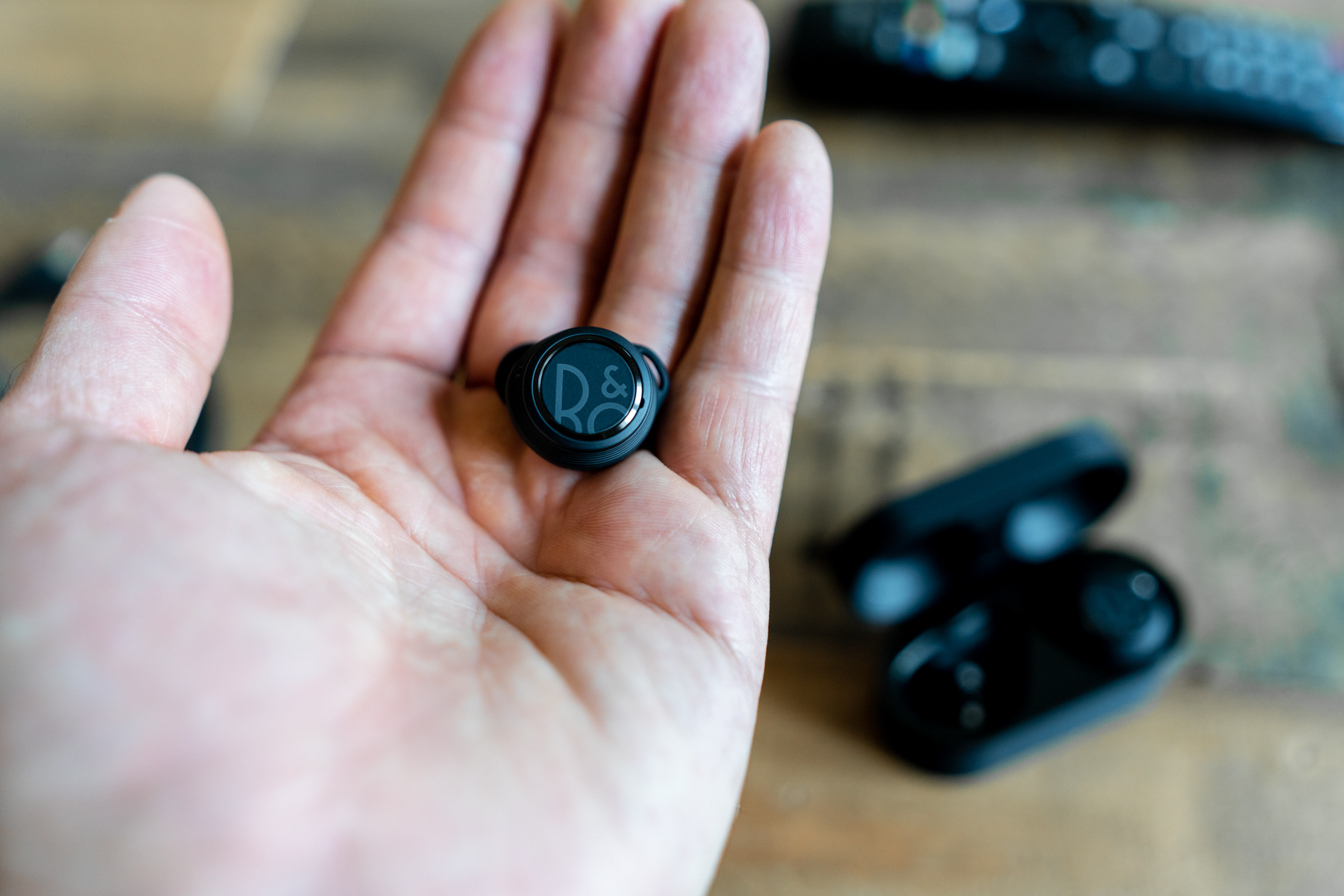
Bang & Olufsen is taking its excellent track record for delivering maximum quality, natural-sounding audio and wrapping it in a sports-oriented package with the Beoplay E8 Sport ($350). These totally wireless earbuds come with a long list of great features, including IP57 water resistance, 30 total hours of battery life, including up to seven hours on a single charge, and transparency mode for external audio pass-through.

The basics

The E8 Sport is a new version of the third-generation E8 totally wireless earphone that Bang & Olufsen has produced for a while now. It’s the first in the series to feature sport-specific water and sweat-resistance. That’s not to say you couldn’t probably get away with using the existing E8 headphones for exercise (I definitely have), but with the E8 Sport’s IP57 rating, you can be confident they’ll stand up to a run in the rain or any amount of sweat, since they’re technically able to be fully submerged in shallow water for as long as 30 minutes.

These aren’t for swimming, however; that water resistance gets you durability, as well as the option to quickly run them under water to clean them off if you so desire. It’s basically a peace-of-mind feature, but a welcome one.

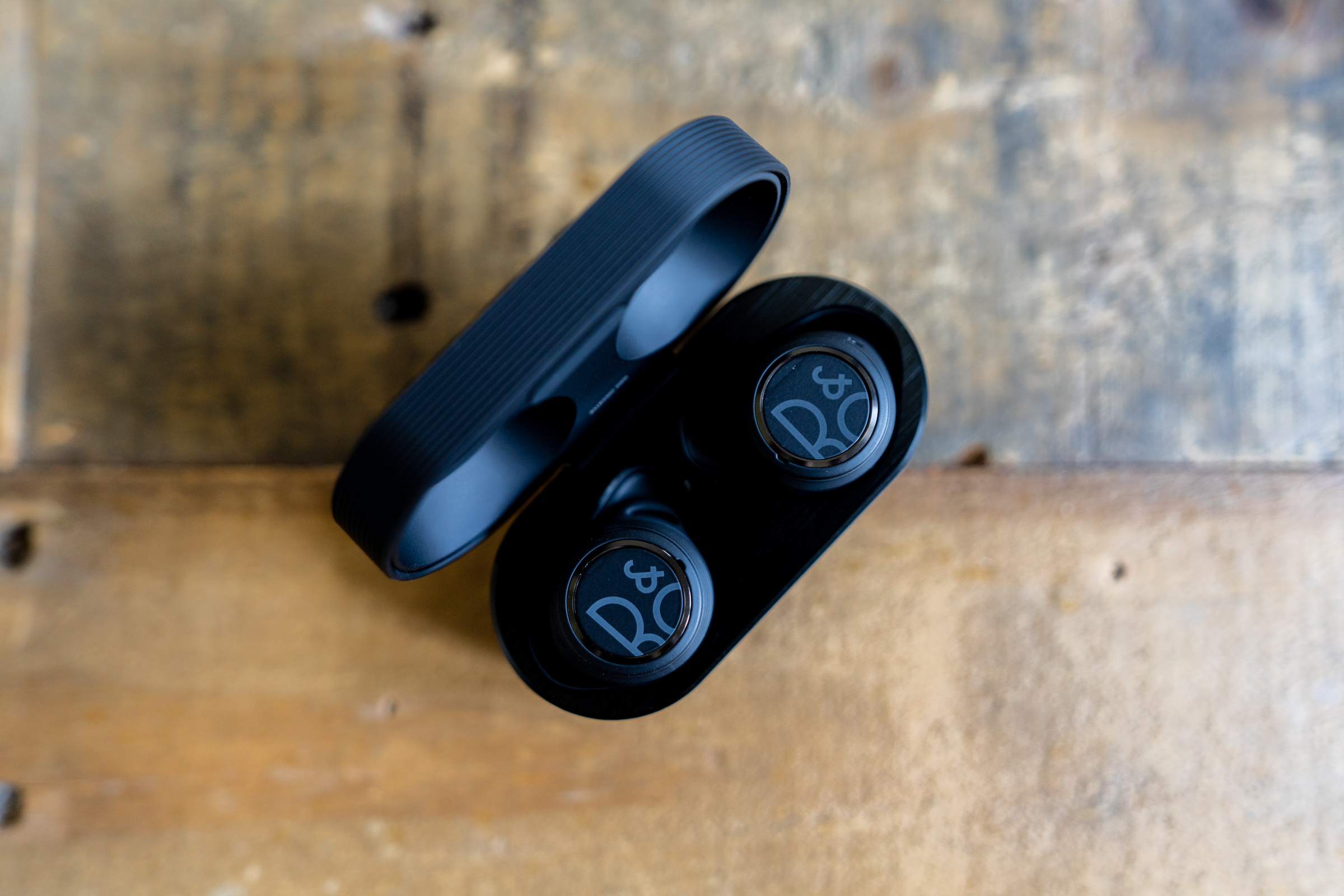
Image Credits: Darrell Etherington

The E8 Sport also includes a new more rubberized exterior finish, a charge case that offers just slightly less reserve power (only by around 30 minutes) but that provides USB-C and wireless charging as well as 23 hours of backup battery life on top of the seven contained in the earbuds themselves.

You’ll also get four different sizes of silicone earbuds, as well as one set of Medium Comply memory foam tips, and there are three sets of different sized silicone fins that provide a bit more anchor stability in your ear for when you’re using these while running or doing other vigorous exercise. The Beoplay E8 Sport is available in two basic colors, including a pastel turquoise called “oxygen blue” and black. There’s also a new special edition created with partner On, the Swiss running brand.

Inside, Bang & Olufsen has used mostly the same internals as you’ll find in the standard, non-sport E8 — which means you can expect the same great sound for which B&O is known.

Design and performance

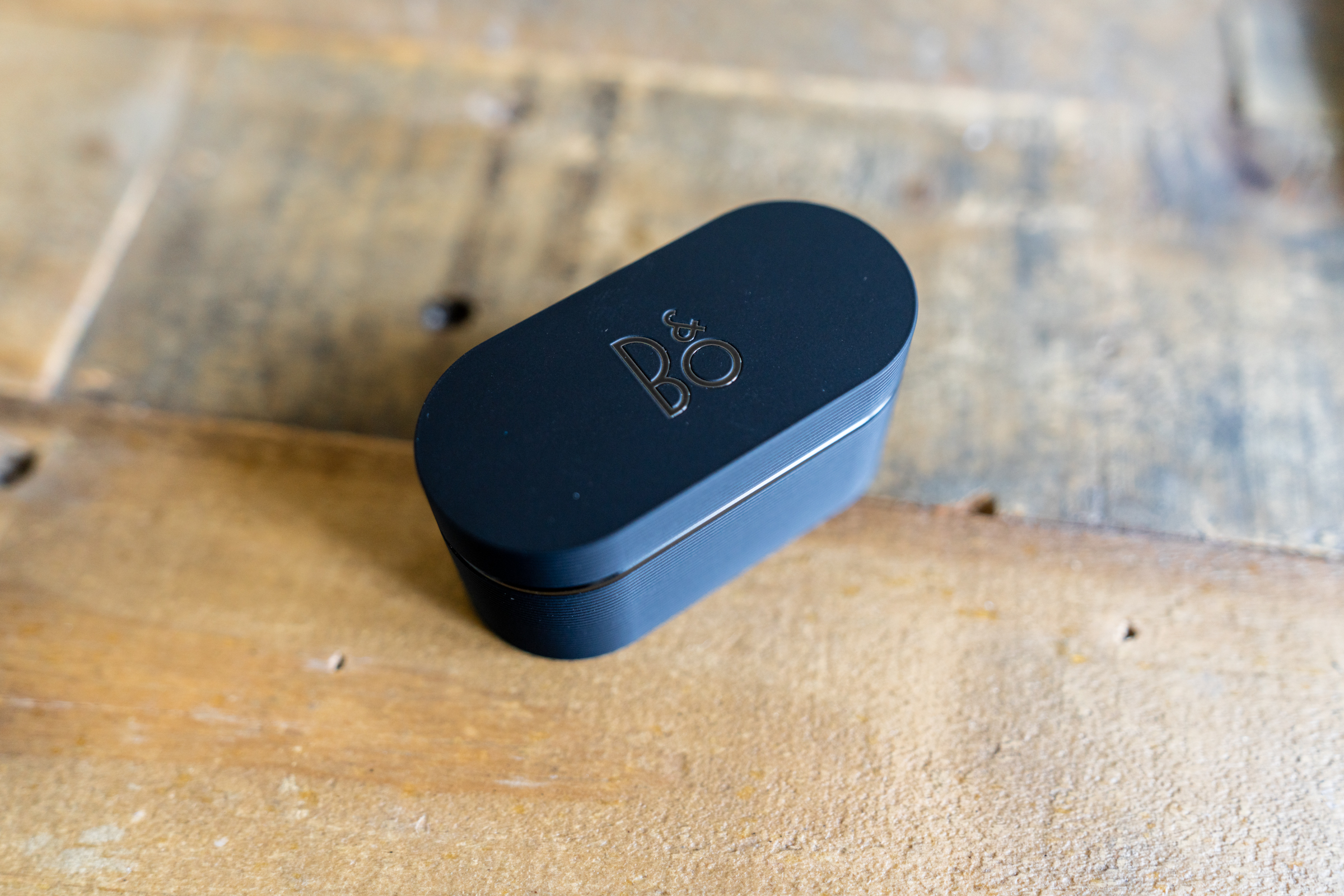
The E8 Sport is a new approach to design for Bang & Olufsen, featuring a more rugged, rubberized exterior versus the smooth finish of the E8. The case of the E8 is also finished in leather, but the E8 Sport is likewise rubberized plastic. Both feature narrow ridges in their construction, which helps with grip, especially when there’s sweat involved.

Image Credits: Darrell Etherington

Unlike a lot of other sport-specific products, the Beoplay Sport E8 still manages to feel mostly understated and refined, however. The buds themselves are pretty low profile when in the ear, and the black version especially will definitely fly under the radar. The “oxygen blue” version has a little more flare, but still presents softer rather than bold or bright.

Inlaid on the face of each bud is an aluminum ring, along with the B&O logo overprinted on the touch-sensitive button faces. The overall look definitely distinguishes them from the standard E8, but doesn’t venture so far afield that you’re left wondering whether they were actually made by the same company.

Performance-wise, the E8 Sport lives up to all its promises, providing long-lasting battery life, excellent passive sound isolation, remarkable clarity and sound separation and a super secure fit. I used them in a variety of different situations, including during 30-minute runs, and they offered great connection quality and sound throughout. Especially for a set of sport buds, I was really impressed by the sound quality — normally, I find that in this category manufacturers sacrifice quality for muddy bass, but not so with the E8 Sport.

That’s what really makes these great: They’re all-around earbuds that you can use for exercise, in all weather conditions, and for quiet enjoyment at home, too, thanks to their supreme audio quality. If you want one set of wireless earphones that can do it all, without compromises, these are it.

Image Credits: Darrell Etherington

The B&O app allows you to fine-tune the sound profile to your preferences, as well, and you can easily control playback and access the built-in transparency features using the touch-sensitive earbud control surfaces. All of this works whether you’re in the middle of a run or a conference call, and the call quality is excellent, too. In my testing, people I spoke with on the phone said it was a vast improvement over even using the handset held up to my face, and even approached the sound quality of my podcast (where I use pro audio equipment).

Bottom line

The wireless earbud market is very crowded and getting busier all the time, with plenty of options at a variety of price points. Bang & Olufsen has already delivered what I consider to be the best audio quality on the market with their current third-generation E8, and the new E8 Sport provides all that great sound along with awesome durability, too.

It’s time to build against pandemics

Rish Joshi
Contributor

Rish is an entrepreneur and investor. Previously, he was a VC at Gradient Ventures (Google’s AI fund), co-founded a fintech startup building an analytics platform for SEC filings and worked on deep-learning research as a graduate student in computer science at MIT.

We’re a few years out from the call to action Bill Gates made in his TED Talk on preparing for pandemics back in 2015, yet the state of scalable software for important workflows like data collection and contact-tracing has greatly lagged expectations during the current pandemic.

The Trump administration’s letter to health agencies regarding data-sharing guidelines asked for daily Excel uploads, and manual contact-tracing efforts without software have proven difficult given the scale of the current pandemic. 

Everything is being built right now. 

Research universities are helping build models used by the CDC for case prediction, and that’s brought to light the dire issues around incomplete data sharing between health institutions and governments. 

Dozens of contact-tracing apps are springing up, surfacing design decisions around privacy, the need for newer technologies beyond Bluetooth for near-field communication and leading companies like Google and Apple to strike partnerships to power cross-platform mobile capabilities.

The good news is that the current efforts are taking seriously the need for better software and driving necessary innovation to help society better prepare for pandemics.

How can detailed case data be shared by hospitals with governments to better predict case and mortality numbers, and used to better allocate medical and labor resources? 

How can software help local and state governments make better policies, and help digitize contact tracing while appeasing privacy concerns?

Software has the ability to power many of these capabilities, and it is creating new opportunities for startups to vet the newly formed appetite for better data and digitized workflows on the part of health agencies, local and state governments and other organizations involved in fighting pandemics.

Startups Weekly: The TechCrunch List reveals investors who founders love to work with

Editor’s note: Get this free weekly recap of TechCrunch news that any startup can use by email every Saturday morning (7am PT). Subscribe here.

We’re pleased to kick off this week’s newsletter by sharing an important new project: The TechCrunch List. It’s a database of investors who have shown a commitment to first checks and leading rounds from seed through growth, based on founder recommendations we’ve received as well as learnings from our own research.

Our goal is to quickly help founders talk to the investors who are serious about writing them checks when they need it most. You can filter by industry vertical, round size and location to find the best people for you. Today you’ll see 391 investors based on more than 1,200 recommendations across 23 main verticals. Since launch on Tuesday, we’ve received another 600 recommendations and counting fast, so we’ll be providing another big update next week.

My colleague Danny Crichton, who leads the project, has written up an FAQ for people who want to know more about the methodology, or how they might submit a recommendation. For Extra Crunch subscribers, he also put together a list of the 11 investors who have had the most positive recommendations, and an explainer about why certain investors earn great ‘founder NPS’ scores.

Now stop reading this for a minute and check it out.

Brad Feld

Image Credits: Dani Padgett / StrictlyVC

Brad Feld on how to influence your odds of success

Connie Loizos caught up with long-time VC Brad Feld of Foundry Group, who has a new book out about startup ecosystems. Some of it is theoretical, as you can read about in the full interview, but Feld connects his points to more tactical advice. Here’s a great example:

TC: Your new book talks about complex systems. How do founders balance the need to manage these complex systems with the fact that controlling these complex systems is sometimes out of their hands?

BF: The first step is getting rid of the notion that you can control the systems, and instead focus on what you can influence [because] in the context of what you can influence, that starts to become a place to focus where you put your energy.

An example of this would be in the current moment. If you have existing investors, and if you have not asked your existing investors directly how much money they have reserved for you for future financings and what you need to do to get that money from them, you’re not focusing on what you can influence.

The worst thing your investor can do is say, ‘I’m not going to tell you that.’ But if your investor is really on your side and wants to see you be successful, it’s likely your investor will say, ‘All right, well, you know . . .’ There might be some wishy-washy [talk] and [dollar] ranges and non-committal language, but you’ll at least have a frame of reference whether that’s zero dollars, a little bit of money, or a lot of money. And you can start to understand, ‘Well, what do we need to do given this moment?’

Edtech goes back to school

Natasha Mascarenhas surveyed eight leading edtech investors for Extra Crunch about the latest changes happening in the space, especially as its importance has grown during the pandemic. “Investors differed on which subcategories benefitted the most,” she writes, “but it’s clear that the pandemic didn’t lift up the entirety of the edtech space. One investor noted that the pandemic made them even less interested in ISAs, while other venture capitalists noted how valuable the financing instrument is now, more than ever before.” She also took a look at a flurry of acquisitions happening globally in the vertical.

(Photo by Pat Greenhouse/The Boston Globe via Getty Images)

A pledge to support international students

The Trump administration backed down from forcing international students to leave the country if their courses went online-only this week, shortly after being sued by some leading universities and 17 state attorneys general. Following the push against most worker visas and other anti-immigration measures, everyone affected expects more problems. To that end, resident TechCrunch immigration legal expert Sophie Alcorn cofounded a new effort to support international students. Here’s more detail:

We proudly announce the Community for Global Innovation (CFGI), a movement centralizing how companies and individuals around the world can stand in solidarity with international students and the belief that everybody deserves a chance to succeed. CFGI is a constellation of top startups, VCs, professionals, nonprofits, international students and grads. We pledge to support international students, create awareness and effect change.

Through the platform, companies take the CFGI Pledge to support international students: ‘If you’re international, no problem. In our team, everybody has a chance.’ We also teamed up with Welcoming America, a leading U.S. nonprofit, accepting donations to make the U.S. more inclusive toward immigrants and all residents. We’re actively seeking the support of volunteers, corporate donors and community members such as international startup founders who know it’s time to share their stories.

An immersive chat future

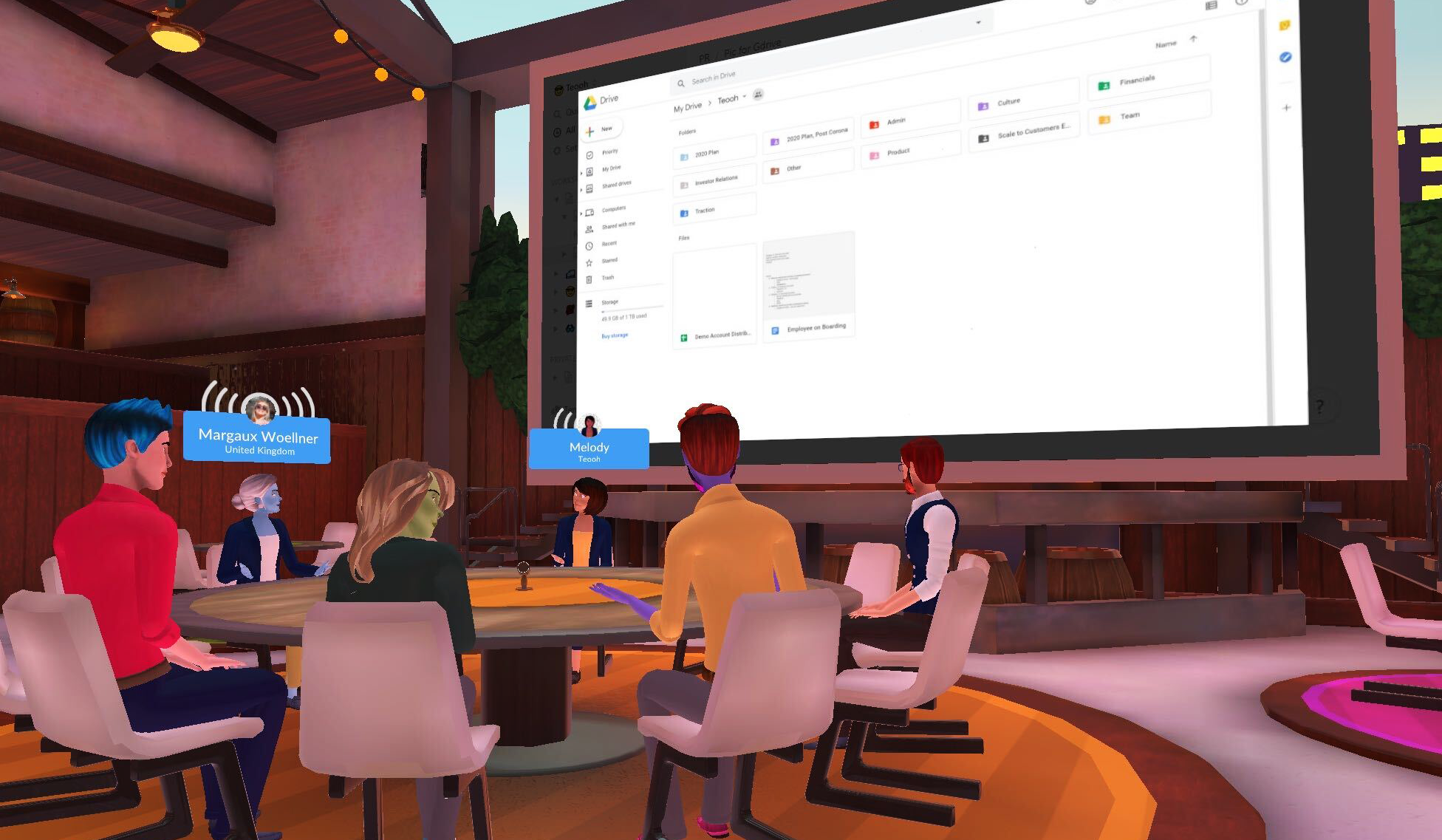
Podcasting, social audio and virtual reality are combining into a potentially new trend, Lucas Matney writes for Extra Crunch this week. “As audio-centric platforms garner investor interest, virtual reality founders of old are trying to push 3D audio as the next evolution, presenting the tech in a way that looks entirely different from today’s voice chat platforms. Though some of these efforts have been in the works for a while, the fledgling platforms are a lot more interesting, as social efforts like Clubhouse take flight and investors continue to eat up audio startups.” Top early examples so far include High Fidelity and Teooh. 

Around TechCrunch

Ready, set, network! CrunchMatch is now open for Early Stage 2020

Everything you could possibly want to learn about fundraising will be covered at TC Early Stage

Marketing, PR and brand building, oh my! TechCrunch Early Stage goes down July 21 and 22

Here’s your chance to meet with Sequoia’s partners at TC Early Stage

Sign up for next week’s Pitchers & Pitches competition on 7/23

TechCrunch talks virtual events and event technology

Learn how to build a company that puts profits and users first, and VCs last, at Disrupt 2020

Bumble founder Whitney Wolfe Herd is coming to Disrupt 2020

Emily Heyward will teach you how to make your brand awesome at TC Early Stage

Across the week

TechCrunch

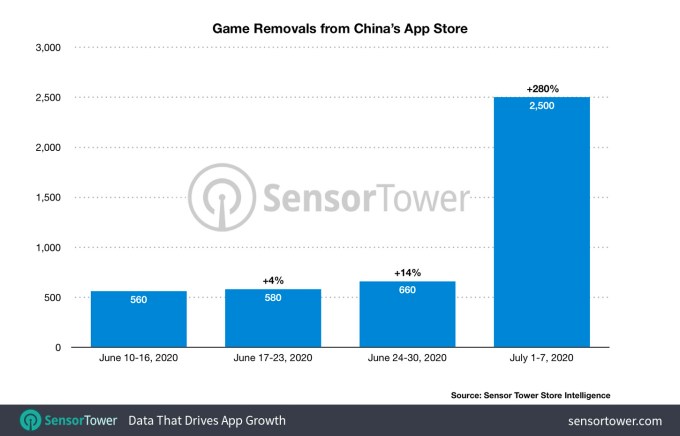
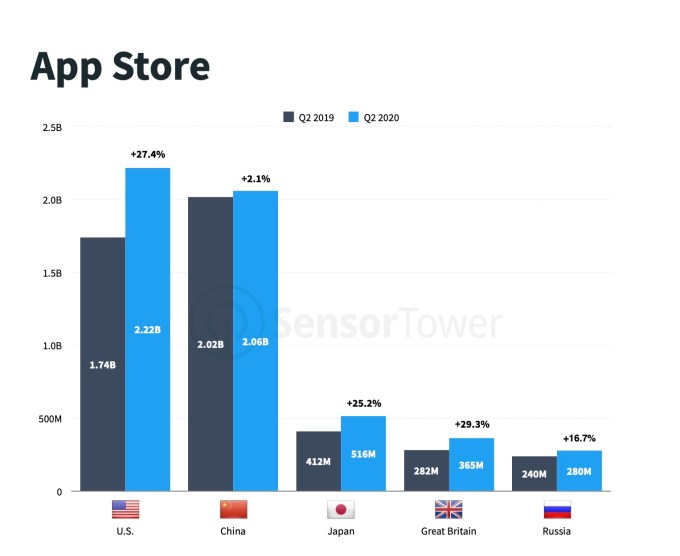
US beat China on App Store downloads for first time since 2014, due to coronavirus impact

China Roundup: Tech giants take stance on Beijing’s data control in Hong Kong

Legal clouds gather over US cloud services, after CJEU ruling

India smartphone shipments slashed in half in Q2 2020

Equity Monday: India’s digital economy attracts ample attention, three funding rounds and earnings season

Extra Crunch

Extension rounds help some startups play offense during COVID-19

How Thor Fridriksson’s ‘Trivia Royale’ earned 2.5M downloads in 3 weeks

Investors are browsing for Chromium startups

As companies accelerate their digital transitions, employees detail a changed workplace

An unsurprising wave of video-focused startups is trying to make video calls better

#EquityPod

From Alex Wilhelm:

Hello and welcome back to Equity, TechCrunch’s venture capital-focused podcast, where we unpack the numbers behind the headlines.

This week was full of news of all sorts, but as we recorded, both Danny and Natasha “not Tash” Mascarenhas were still locked out of their Twitter accounts after a proletariat revolution on the social platform saw the ruling Blue Checkmark Class forced into silence. That’s not really what happened, but it sounds better than what actually went down at Big Social.

Anyway, Twitter accounts or not, the three of us gathered to parse through a wave of news:

It was a lovely time and there is a bit of show news. Namely that Equity is coming back to YouTube either this week or the next. So if you want to see us talk, soon you will be able to! Again!

Oh, and follow the show on Twitter. If you can, that is.

Equity drops every Monday at 7:00 a.m. PT and Friday at 6:00 a.m. PT, so subscribe to us on Apple PodcastsOvercastSpotify and all the casts.

For Seattle’s cop-free protest zone, tech is both a revolutionary asset and disastrous liability

The police killings of George Floyd and Breonna Taylor were sparks that reignited smoldering fury against authorities across the globe. One of the most watched locations has been Seattle, where protestors barricaded off a cop-free zone, drawing outsize attention and, in the process, forming a new case study in the uses of technology both to advance a cause and to drown it in disinformation.

From the actual recording of Floyd’s killing and the protests and riots that followed, to documenting the police’s brutal response and sudden withdrawal, to the establishment of and widespread commentary on an improvised community, technology has played a crucial role throughout. But to center things properly, it is how people are using technology, not the technology itself, that has become more important.

More than ever before, information truly is power, and imbalances in who holds that power have been both reinforced and challenged in the course of events here. It’s heartening to see live streaming and instant distribution of video lead to accountability, but it’s also sickening to see deliberate campaigns to manipulate and subvert reality — and I say reality because it’s what I’ve seen with my own eyes.


As a brief preamble, I should disclose some things.

First, I support the causes being advanced by protestors in Seattle. It would be useless to deny that I have taken sides here — partly because claims of objectivity are little more than a fig leaf for editorial decisions in matters of grave injustice and obvious abuses of power; but my presence at the protests has unavoidably been documented whether I like it or not, so there’s no sense in denying it.

Because second, I live on Capitol Hill, just blocks away from the zone. I’ve been eyewitness to important events, (with a built-in tech angle at that) and it would be irresponsible for me not to use the privilege of this platform to share aspects of them that have been only sporadically covered.

And third, these protests have been organized and led by people of color, and I am a white guy who, comparatively, has only barely taken part. On issues of race, policing, and inclusion I will defer to others better equipped to educate: writers like Ijeoma Oluo (whom we recently interviewed), researchers like Joy Buolamwini, and publications like Blavity.

With that out of the way, this article will focus on three topics: The collection and use of digital media on both sides of police clashes; the use of social media and battle of information versus disinformation in the cop-free zone; and the emergence of live streaming as an indispensable medium for this and future movements.

A matter of perspective

Image Credits: JASON REDMOND/AFP / Getty Images

The initial protests in Seattle in late May, which devolved in some locations into riots involving the despoliation and destruction of police cruisers (somehow left unattended and filled with weapons), are difficult to track because they were full of movement and chaos. But they were thoroughly, if haphazardly, documented by attendees with the presence of mind to record what they were seeing.

It’s telling that there has been little or no attempt at a counter-narrative from Seattle authorities when their officers were repeatedly (and continually as of this writing) filmed employing plainly excessive force against unarmed, often unresisting protestors, or indiscriminately firing tear gas, pepper spray, and flashbangs into crowds. One woman’s heart stopped three times after being struck by a blast ball that appeared to be deliberately aimed at her, while thousands watched.

Where, one wonders, is the exonerating footage from the police side showing the protestors being described as aggressive, or non-compliant, or whatever key words officers use to justify brutality during a melee of their own creation? And yet the police are at a loss. Presented with innumerable examples of bad behavior, the force seems to have decided day after day to stand fast and let it blow over.

But it’s hard to do that when you have something like a video going viral of a child who’s been maced:

This image, which came to represent the Seattle PD’s inhumane treatment of protestors (they stand by wielding batons as the crying kid is treated), was taken by a local named Evan Hreha. It’s hard to erase such a powerful image — so they arrested him.

Hreha was arrested a week later by a dozen officers and booked into jail for, supposedly, pointing a laser at police. It hardly needs to be said that this account strains credibility. For one thing, Hreha says he was running a hot dog stand with friends at the time of the alleged offense. But it is absurd that police would or could identify one person in a crowd at a distance, then investigate and arrest them — for anything, let alone a fleeting non-violent laser use. And it just happens to be the man behind a viral video that makes the cops look bad.

This seems to be plainly a case of retaliation, but the police have made themselves unaccountable by controlling the information available. I contacted the records department to ask for anything related to the investigation and arrest of Hreha (among others), but it will be months before the police will release anything, if indeed they ever do.

Hreha was released two days later with no charges filed. But the chilling effect of intimidating someone who caught police in an act of brutality on camera had been accomplished. The officer who maced the kid, incidentally, has yet to be officially identified or disciplined.


This is exemplary of the power imbalance in conflicts of this type: On one side, voluminous documentation from people on the ground that is disorganized and difficult to bring to bear; on the other, documentation that is carefully organized and tightly controlled, allowing the exertion of authority using that control as leverage. Police have also begun the process of repurposing news and protestor footage for their own purposes.

But this story doesn’t always play out the way the cops would prefer.

In the first week of June, protestors were marching up Pine to confront the police for this and other acts, after which they would have, like many similar protests, moved on to rally in Volunteer Park and then gone home, to do it again another day. But police blocked them at 11th and Pine with a barricade and line of police in riot gear.

SEATTLE, WA – JUNE 08: A person holds flowers as demonstrators clash with police near the Seattle Police Departments East Precinct shortly after midnight on June 8, 2020 in Seattle, Washington.

The group did not disperse as ordered, saying they would stay and protest peacefully until the police moved out of the way. Predictably, when curfew came, the police were liberal in their deployment of tear gas and flashbangs, causing serious harm to some protestors and terror across the entire neighborhood. This continued and grew in intensity for several days and nights. (In many cities these clashes are ongoing.)

The justification for using their “less lethal” tools with such gusto was predictable: The crowd was violent, throwing bricks and even improvised explosives at officers. But these claims were repeatedly and firmly dismantled, because these encounters were filmed in high definition from multiple angles, practically from start to finish.

One particularly revealing video was shot by a person on a roof directly over the barriers. It quite clearly shows a peaceful crowd chanting and definitely not throwing rocks and bottles. Anyone can review it and see that there was not only no violence on the part of protestors, but that the flashpoint moment occurred (documented in other videos as well) when a cop tore a now-famous pink umbrella from the grip of a person, who in offering any resistance provided the excuse for the police to retaliate — indiscriminately and utterly disproportionately.

Huge volumes of evidence of police brutality have resulted almost solely from the oft-mocked habit of young people to always have their phone in hand. (We’re not far from the always-recording situation I posited nearly 10 years ago.)

“They picked the wrong generation to pull this shit on,” said TK, a protest organizer I spoke with. “Because governments didn’t create this power — this was created by normal, regular-smegular people just like all of us. The only people that can stop it is the people that created it.”

Rarely have the police released images or footage of their own, and when they do it is often a brutal self-own. They posted images of the aforementioned “improvised explosive” on Twitter shortly after one group assault on protestors, and within seconds people had pointed out it was a prayer candle, probably from a nearby memorial smashed during the melee. The police revised their reference to it as an “incendiary device,” which, while technically true, exposes the type of willful obscuration of the truth that was frequently to be found in the department’s communications.

Following another incident, body cam footage was released to support the narrative that a “violent crowd” had prevented the police from reaching a shooting victim in the protest zone and were therefore culpable in his death. People soon pointed out that timestamps visible in the video show that the cops arrived 20 minutes after the shooting, and after the victim had been taken to the hospital in a private car — because EMTs (for good reason) would not enter the scene before police secured it.

We now know that the public statement put out by Seattle Police following the shooting at CHOP on Friday night, was mostly fictitious, as revealed by their own bodycam footage. They showed up 10 minutes later than they claim, after the victim had been transported to Harborview. pic.twitter.com/wN62gQxX8c

— Spek the Lawless (@spekulation) June 22, 2020


When the police chief made claims of rape and violence in the protest zone, it was pointed out that the SPD’s own crime reports system showed no such thing. Then her claim that armed gangs were extorting local businesses was quickly put down as well, by the businesses themselves — embarrassingly, the source of that claim was a totally invented account on a right-wing blog. (Ironically, once the police retook the zone, businesses quickly complained that their presence had forced them to close.)

And of course there are the innumerable videos, here as elsewhere, of extreme force being used on unresisting protestors, frequently with the apparently now requisite knee on the neck. These will hopefully prove useful later as counterbalance to police claims, and while officers still obscure their badges and refuse to identify themselves, the quality of the video makes identifying them by other means trivial.

Cops attack peaceful protestors at Broadway and Pine. 5:30pm July 2nd. Dive tackled the kid next to me, put a knee on his neck. Can’t stress enough he did nothing.

Please share.#SeattleProtests #SeattleProtestComm #Seattle pic.twitter.com/mI5DTASEI4

— eli (@sre_li) July 3, 2020

The digital record has resulted in officers, the department and the chief being caught in lie after lie after lie. These are not misunderstandings or honest mistakes but misrepresentations deliberately crafted to discredit protestors and shield the department. It’s clear that if others were not carefully documenting every encounter, and critically investigating police statements and evidence, the lies would have shortly become the only, and therefore the true, record of what happened.

What I’ve described took place in Seattle, but others have compiled abuses in L.A., New York, Portland, and Chicago — where cops have just been caught in another type of large-scale manipulation of the record.

Now in many cities these departments are facing cuts or total defunding, as much as the result of their failure to successfully falsify the narrative as their more fundamental failures as institutions.

“This generation is not dumb, as much as they want to believe that. ‘You guys are just a bunch of dumb kids.’ Okay, well, this bunch of dumb kids is about to get the city to take half of your budget,” said TK. “So we ain’t that dumb, apparently.”

A last example of the power of social media in the pursuit of problematic police came late in the writing of this piece. After two protestors were struck and one killed on a closed highway after a driver circumvented police barriers, a detective from the King county Sheriff’s office made several brutally offensive posts on Facebook — public ones.

These were spotted by concerned citizens, who took screenshots not just of the content but also the list of people who had liked or commented positively on the posts, looking them up, as well. This proved to be a shrewd tactic, for when the posts began to make waves online, Brown’s entire Facebook page was deleted.

Turns out Detective Brown is not only Governor Jay Inslee’s cousin, but reportedly also the head of county executive Dow Constantine’s security detail and his sometime driver; a 40-year veteran of the force who has been accused of abusive behavior before. Within 48 hours Detective Brown was on leave and being investigated. One hopes that the officers and public officials who publicly endorsed Brown’s behavior will soon be confronted, as well. But how quickly this avenue of recourse would have disappeared had they been tipped off.

Keeping the cops honest is a welcome application of what might be termed citizen forensics, but social media would soon provide a counter-example of technology being deployed to discredit the protestors and mislead millions.

In the Zone

A rally at the cop-free zone on Capitol Hill on June 10.

Believe it or not, the Capitol Hill Autonomous Zone wasn’t anyone’s idea.

The now infamous cop-free area barricaded off by protestors has been profiled frequently and, almost without exception, incompletely and inaccurately, in mainstream news and on social media. It’s an instructive but deeply frustrating example of how, as the old saying goes, “A lie can travel halfway around the world before the truth can get its boots on.”

A very brief origin story is as follows: On June 8, following a particularly violent yet ultimately unsuccessful attempt to purge the area of protestors the previous night, the police abruptly announced they would be leaving the East Precinct building, taking all valuables, weapons, and sensitive documents with them.

Protestors were astonished. They had not asked for this and had no reason to — their demands were about defunding the police, investing in the community, and releasing jailed protestors. Incredibly, even now no one has taken responsibility for ordering the abandonment; the mayor and police chief have both denied doing so. But abandon it, they did.

Protestors immediately continued marching, some continuing to Volunteer Park and others remaining behind, citing the need to protect the precinct from anyone who might want to damage it, for days on end if necessary and at all hours. If you’re skeptical, remember: This is all on video. People learned early on that many people only believe what they have seen, and even then only sometimes.

Since a car had nearly plowed through protestors the previous day and the driver actually shot someone (before being gently taken into custody by police), and hearing reports of right-wing agitators in the area, the protestors redeployed the barriers to make a safe zone at the ends of nearby streets. Someone spray painted “Capitol Hill Autonomous Zone” on one, inadvertently branding the whole movement.

What followed in the CHAZ (later the CHOP) was several days and nights of compelling events, speakers and tributes to lost lives, attended by thousands, including myself.

But what followed online was a nonstop deluge of wild exaggerations, manipulated media, racist vitriol and, of course, innumerable death threats. It would be impossible to list even a fraction of the information online that I could contradict with what I saw with my own eyes, but here are a few examples.

The most glaring one has to be, of course, Fox News photoshopping a gunman into multiple unrelated scenes of destruction and dishonestly using those as evidence of chaos in the zone. This was done so poorly it would be comical if it were not part of a larger, continuing narrative seeking to discredit the protests and zone as an antifa-run separatist state.

One of the images run by Fox News, a combination of one by David Ryder (whose photos for Getty illustrate this piece) with two by Karen Ducey.

The separatist narrative, which persists even today, was invented and amplified by lazy or traffic-hungry outlets and pundits with little evidence besides the tongue-in-cheek name.

There was not always the need to invent controversial imagery (indeed, the gunman Fox used really existed). Video of one person handing out rifles to his crew quickly made the rounds and, combined with the police chief’s irresponsible rumor-mongering, word of a “warlord” emerged.

Without getting into the complex and largely improvisational politics of the zone, this character and his heavily armed presence were generally not approved of. But for the weeks following this event I saw the image, his name and the warlord trope posted thousands of times, coming up every single day.

It’s tempting to say it’s hard to misconstrue a guy distributing assault rifles from the back of his car. But it is testament to the fractured narrative presented online that crucial context was almost always left out or substituted by falsehoods. Not only had a gunman actually shot a protestor after driving his car into the crowd the previous day, but at the very moment of the video, the police were suspected to have been engaged in a disinformation campaign intended to provoke conflict.

Public police scanner frequencies that night (which it was known protestors were monitoring) were full of reports of a group of 20-30 armed “Proud Boys” (a far-right group) moving toward the protest zone. Bike police on scanners said they followed the group for blocks, asked where they were headed (the CHAZ), tried to dissuade them from going there, and eventually reported that they spontaneously dispersed before reaching their destination.

Now, a large group of armed men working their way up from Downtown to Capitol Hill would be a rather conspicuous sight even in those days when record numbers of armed men walked the streets. Yet none of the thousands of protestors and allies spread throughout the city watching for them saw anything matching that description during or after. No communications from known Proud Boys (some of whom would in fact show up later to attack a protestor on video) indicated a presence. More directly, police descriptions of the group crossing certain intersections were contradicted by live traffic cameras showing those intersections, which showed no such thing.

But once again the apparent police intention of provocation via misinformation had been achieved. People at the CHAZ, already justifiably worried about violence, were put on high alert and armed themselves, producing a spectacle that even now persists on social media as a way to paint the entire protest with one brush.

The repeated amplification of individual images had some troubling commonalities, in particular the barely veiled parlance of racism. People in the protest zone and especially Black men, images of whom frequently accompanied these tweets and other posts, were invariably described as “thugs,” “savages,” “animals,” “feral,” and all the rest. Tellingly, those employing this vile lexicon were seldom Seattle or Capitol Hill residents; Twitter is very efficient at importing hate.

Indeed it did not take long for the CHAZ, having achieved the dubious distinction of attracting what is called national interest, to become the target of coordinated interference, harassment and disinformation campaigns by people all over the country. The resulting mess is a concise illustration of the incredible promise and complete inadequacy of online platforms in times like these.

The number of people and groups involved in these protests had made Twitter, with its accessibility and relative permanence, an invaluable tool for the dissemination of important information. While private groups on Signal, WhatsApp and Discord were also used, it was clearly better for things like police positioning, march updates, attacks on protestors and other crucial live communications to make the information as prominent and public as possible.

“There was a lot of momentum being built up, people learning and educating themselves. So this was the chance to finally put everything we’d learned into action.”

TK and her fellow organizer Tatii explained that social media was at the heart of their work, though the end result of taking to the streets was always the ultimate goal.

“Social media is a huge part because without it, we can’t do shit,” Tatii said bluntly. “When it comes to finding the information that we need and finding resources to help Black people, all of that is through technology. That’s how we network with people, that’s how people reach out to us. That’s how we get people telling us about police scanners. There are a lot of group chats, like with our medics, our car brigade, our bike brigade. It’s all through social media.”

“Scouts let us know if like there’s 30 bike cops coming down Broadway. It’s crucial when you are trying to strategically plan around that type of stuff, to keep from being cornered and boxed in,” said TK.

“At least on the Black side of social media, it’s constantly been talked about, Black Lives Matter,” added Tatii. “There was a lot of momentum being built up, people learning and educating themselves. So this was the chance to finally put everything we’d learned into action.”

It’s easy to take Twitter for granted, so we should be sure to give the platform due credit for the fundamental capability it provides. Many I’ve spoken to here emphasized that they trusted what they read from accounts with a verifiable track record more than what they saw in the perennially out-of-date local news. In fact, as Tatii and TK noted, many of their fellow organizers came to Seattle specifically to learn for themselves the truth behind mainstream reports that didn’t pass a gut test.

But the choice to publicly organize via hashtag, for all that it made important information available quickly to as many people as possible, had two major consequences.

First, it fragmented that information almost to the point of usability: One never knew whether it was #seattleprotest or #seattleprotests, #seattleprotestcomms, #seatleprotest (yes), plain old #seattle, #defundSPD, or a handful of others. This was only exacerbated with the creation of the CHAZ, which birthed a dozen new hashtags of varying quality and population. Instagram provided powerful amplification effects but little verification or network building.

Twitter also exposed this stream of important information to eager antagonists across the country, who flooded those hashtags with abuse and misinformation. Posts with images from other or past protests were used to mislead or misrepresent the present ones, and pictures of police around the area from other times were used in an attempt to spook those who had learned to be wary of SPD’s presence. Fake names and events were publicized, fake demands issued and met, and fake accounts claiming to represent protestors or the zone.
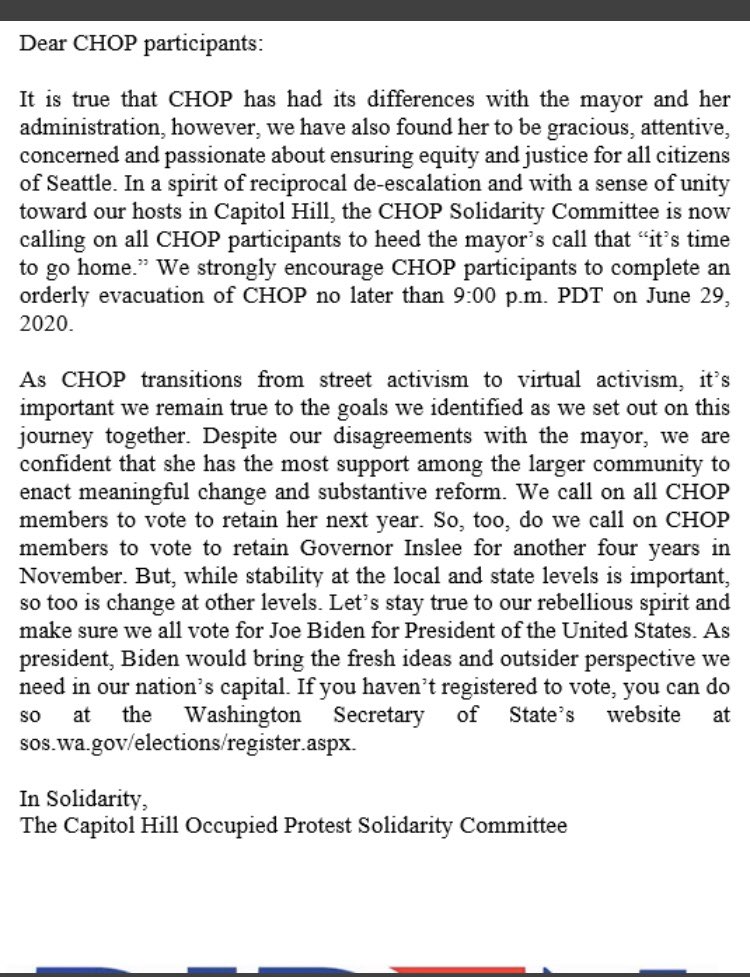
This post, though seen by many, was heeded by few.

The ownership of one particular account was hotly contested, and confused by such tantalizing hints as it following Huawei leadership (you can imagine the theories this spawned), and for an “official” statement ending with what appeared to be a few stray pixels from a Biden presidential campaign graphic.

Later, when attempting to provoke a “mission accomplished”-style early exit from the zone after the Mayor cut $20 million from the police budget, the account exhorted its readers to vote for Biden. Needless to say this was not among the commonly agreed-upon demands or positions of the protests. Unless whoever was behind this strange yet prominent account exposes themselves, we may never know if it was a government plant, an agent provocateur or a practical joker, or what their intentions really are.

The enduring, chaotogenic myth that the CHAZ was an attempt to secede and form a socialist, anarchist utopia led to rebranding efforts. The misconception had become so widespread that it was decided to “officially” (as far as that concept existed in the space) change the name to the Capitol Hill Occupied Protest — then, noting the fact that Seattle itself is an “occupation” of native land, change the O to Organized.

This led to a further fragmentation of information channels: No one on the ground wanted to use #CHAZ and its relatives because it was no longer what organizers wanted to call it. But the name had entered the common parlance. So posts now needed to be #CHAZ, #CHOP, #CHOPCHAZ, and others like #CHAZSeattle and so on. It became very difficult to track an event — be it positive, like a march or speaker, or negative, like a fight or shooting — never knowing where to look or how to parse the information there.

It’s hard to overstate how effective the fractured narrative and opposing efforts were at shaping the national and global understanding of events surrounding these protests.

As they say you can never step into the same river twice, so it was on social media around the protest and the zone. The ever-shifting flow of Twitter sometimes produced absolutely vital data unavailable anywhere else, but always polluted with incomplete or premature judgments, ignorance, racism and false reports.

When I asked what digital tools were needed to better organize and avoid interference, protestors I spoke with generally said some sort of centralization and interoperability. Being able to colocate multiple feeds, authors, videos, images and static links in a dynamic, accessible way would save them huge amounts of time and effort. Certainly it would have helped to alleviate some of the problems noted above.

Stream of conscience

“Live streaming and having our phones out every single day is our best form of self defense.”

Despite the shortcomings of social media at large, one digital medium that has proven itself truly indispensable to this protest and others to come is live streaming.

Although the technology has risen to mainstream popularity as a new form of passive entertainment on Twitch and other live platforms, it quickly became clear that it was the technology of choice for documenting these and other protests and social movements.

As TK put it: “People are visual learners; until they see it for themselves they don’t really believe it. And when it’s live, it’s live. You’re not seeing the cut, clipped and edited version. You can’t dispute what you see in raw live footage. You can’t ignore it.”

In Seattle, two people have become familiar faces, or voices, as they have doggedly documented every step of the protests this way, from before the CHOP to well after: Omari Salisbury and Joey Wieser.

Image Credits: Jake Gravbot

Salisbury runs Converge Media, an independent web-distributed news organization. He comes from a broadcast and networking background, and when the CHOP emerged literally outside his doorstep — the studio door opened onto the police line before officers left — he took the opportunity to share the story, as objectively as possible. To him, the only tool that fit the bill was live streaming.

“The viewer needs to be able to see the context, because if the viewer can’t see the context, then it becomes something else,” he said. “People appreciate us because the stream is long, we keep the camera there and we let people make their own decisions.”

He was there not just for the controversial or terrifying moments, like clashes between provocateurs and protestors, or the shootings that occurred later on, but for the huge number of peaceful hours when people would share their own experiences at Salisbury’s prompting. The result is an incredibly valuable archive of hundreds of hours of live footage, ground truth from inside the zone that has been watched by millions.

Joey Wieser has no media background, but rather just a passing familiarity with the systems and social media methods that can grab people’s attention. Yet his stream came to be relied on by many, and the events he captured also racked up millions of views, simply because he decided to take advantage of the tools at his disposal.

“It's not that we don't have umbrellas. We just never met a storm worthy of one.

Until this week.” -Seattle pic.twitter.com/STGnwIc3sZ

? Joey Wieser ? (@itsjosephryan) June 8, 2020

“Live streaming and having our phones out every single day is our best form of self defense. Every day that I walk out my doorstep, I hold my phone as if it is my ultimate shield, my ultimate weapon,” he said. “Without it, I feel like I don’t have a role in this movement. It’s not like I’m some prolific live streamer, or that I know what Black communities need best. I’m just some white guy and I happen to work in tech. Having an understanding of what social media best practices look like, understanding analytics and social amplification — that combined with my community activism allowed me to come out here and do this.”

For Wieser, having the right connections or network was less important than being in the right place at the right time, even if it put him in danger. (He and Omari were both tear gassed multiple times and near shootings and other altercations.)

“I think it really puts the viewer at home in the driver’s seat,” he said. “Because they’re able to not only watch an uninterrupted stream, but to engage and have a real live conversation with somebody that’s there on the ground. You know, they can say, hey, turn to the left. What was that? It’s a participatory experience in a way watching the news doesn’t allow.”

One such incident I saw play out almost defies belief. Wieser was streaming the protest when a truck blasted through, nearly hitting several people. Minutes later, a person watching the stream was surprised when that very truck pulled up outside their apartment — it was their DoorDash driver, who announced proudly that they had just run down some protestors. (The driver’s plates and info were quickly sent through the proper channels.)

THE PLOT THICKENS: The man in this truck is a driver for @DoorDash and was making a delivery. The customer was literally watching the livestream as the silver truck pulled up outside their home. pic.twitter.com/di1eI9bQjE

? Joey Wieser ? (@itsjosephryan) July 1, 2020

Being a two-way medium, it provides new opportunities for interference as well as engagement. Both Salisbury and Wieser experienced repeated attempts to pollute their comment sections or attack them personally.

“It’s not lost on me that this amplification can be used against us, but I think one of the important things about live streaming is that you can inject your own narrative, rather than let it be to the whim of, you know, Fox News or Sinclair,” said Wieser. “Regardless of whether or not the trolls take it over in the comment sections or in the hashtags, if you’re actually listening to the content, and if you’ve got someone out here who has the right heart and the right passion and the right analysis, you can reclaim that narrative.”

“The citizen journalist has always existed. They just never had the tools to be on equal footing with national news.”

Salisbury, for his part, expressed that it is not always sufficient to simply document — one has to report, and that’s what he does.

“People rock with me because just turning on the camera and streaming, it’s not enough. Knowing the history of Seattle, the history of the neighborhood, understanding political positions… and you got to put paint where it ain’t, you know what I’m saying? The citizen journalist has always existed. They just never had the tools to be on equal footing with national news,” he said.

“People underestimate the tech that’s out there, especially the free stuff,” he continued. “I know people have their views about platforms and privacy. And I think that’s a different discussion. But I will say that what’s going on here allows for citizen journalists to touch the world. I used to build OTT and streaming platforms in Europe and across Africa. So understanding the actual technology that goes into this, man, I really don’t take no stream for granted. I’ve got people in Australia who’ve been on since day one. What if I had to cultivate that through my own contacts, do my own server, do my own everything? How would I reach them? It doesn’t work that way.”

He credits live streaming with putting pressure on local and national outlets to up their game, as well — being showed up by one person with a phone doesn’t look good for a major news organization.

“Citizen journalists and streamers came out here and forced the local media to change their whole game,” he said. “I mean, a guy with a cell phone didn’t get no respect back in the day. But I had my interviews with the mayor before anybody, my interviews with Chief Best before anybody. You see what I’m saying? I’m just a guy with a phone. Now the Seattle Times has a streamer out here. This situation has made the media adapt new technology.”

While live broadcasts have been part of local and national news for decades, it was in truth a totally different medium. But it’s now difficult to imagine coverage of events like these without modern live streaming, and legacy media have begun to recognize that.


Technology has always been a double-edged sword. The events in Seattle and across the country have illustrated this powerfully, and it seems unarguable that whatever happens in terms of policy and politics, the nature of protesting and the power dynamic that has defined it for decades has begun to change.

Ultimately, though, the power does not belong to the tech, but to the people.

“Technology plays a big part in all this, but I’m gonna be real with you, what you need is more old fashioned beating your feet to the streets,” concluded TK. “It’s not that the technology is insufficient, but that people are choosing not to use technology to understand.

“We’ve proven it time and time again that the only ones that really got our back is us.”

The Exchange: Which VCs are the most popular, why enterprise startups are hot, and how patient are public investors?

Welcome to The Exchange, an upcoming weekly newsletter featuring TechCrunch and Extra Crunch reporting on startups, money and markets. You can sign up for it here to receive it regularly when it launches on July 25th, and catch up on prior editions of the column and newsletter here

It’s Saturday, July 18, and this is The Exchange. Today we’re wrapping our look at second-quarter VC, capping off the recent IPOs of some venture-backed startups, and digging into the hottest VCs while peeking at a new startup trend.

Venture capital activity by the numbers

As July rubs along we’re getting deeper into the third quarter of 2020, meaning it’s time to close the books on Q2. To that end The Exchange combed through all the second-quarter VC data that we could this week.

But, despite working to grasp the health of the global venture scene, the United States’ own venture capital totals, and diving more deeply into AI/ML startups and how women-founded startups fundraised in Q2, there’s still more data to sift.

Keeping brief as we are a bit charted-out, New York City-based venture capital group Work-Bench released a grip of numbers detailing the city’s enterprise-focused startups’ Q2 VC results. Given that Work-Bench invests in enterprise tech, the data’s focus was not a surprise.

The numbers, per the firm, look like this:

  • NYC enterprise tech startups raised 51 rounds in Q2 worth $1.5 billion, above Q1 totals of 44 deals worth $1.3 billion
  • Those quarterly results were the best recorded, according to a Work-Bench historical analysis of enterprise tech deals since at least the start of 2014
  •  Q1 and Q2 2020 were so active in the sector and city that the first half of this year saw nearly as many deals and dollars ($2.7 billion in 95 total deals) than the same cohort and metropolis managed in all of 2019 ($3.3 billion in 114 total deals).

The data is not surprising. B2B startups are raking in a larger share of venture capital rounds as time goes along, so to see NYC’s own enterprise-focused startups doing well is not shocking. (And if you add in the recent $225 million UIPath round, the Big Apple’s enterprise startups are even closer to their 2019 venture dollar benchmark, though the UIPath deal came in Q3.)

One last bit of data and we are done. Fenwick & West, a law firm that works with startups, released a report this week concerning Silicon Valley’s own May VC results. Two data points in particular from the digest stood out. Chew on these (emphasis TechCrunch):

The percentage of up-rounds declined modestly from 71% in April to 67% in May, but continued [to be] noticeably lower than the 83% up-rounds on average in 2019. […] The average share price increase of May financings weakened noticeably, declining from 63% in April to 43% in May. The results for both April and May were significantly below the 2019 average increase of 93%.

The Q2 data mix then shakes out to be better than I would have expected with plenty of highlights. But if you look, it isn’t hard to find weaker points, either. We are, after all, in the midst of a pandemic.

Going public in a pandemic

nCino and GoHealth went public this week. TechCrunch got on the blower afterwards with nCino CEO Pierre Naudé and GoHealth CEO Clint Jones. By now you’ve seen the pricing pieces and notes on their companies’ early performance, so let’s instead talk about why they chose to pursue traditional IPOs.

Our goal was to understand why CEOs are going public through initial public offerings when some players in the venture space have soured on traditional IPOs. Here’s what we gleaned from the leaders of the week’s new offerings:

nCino: Naudé didn’t want to dig into nCino’s IPO process, but did note that he read TechCrunch’s coverage of his company’s IPO march. The CEO said that his firm was going to have an all-hands this Friday, and then get back to work. Naudé also said that becoming a public company could help the nCino brand by helping others understand the company’s financial stability. The company’s larger-than-expected IPO haul (one point for the old-fashion public offering, we suppose) could provide it with more options, we learned, including possibly upping its sales and marketing spend.

  • The Exchange’s take: It’s very hard to get a CEO to say on the record that a different approach to the public markets than the one they took was enticing. Nothing that Naudé was off-script for a newly public company.

GoHealth: Jones told TechCrunch that GoHealth’s IPO was oversubscribed, implying good pre-IPO demand. When it came to pricing, GoHealth worked through a number of scenarios according to the CEO, who didn’t have anything negative to share about how his company finally set its IPO valuation. He did bring up the importance of collecting long-term investors.

  • The Exchange’s take: GoHealth shares dipped after the company went public, so its offering won’t engender the usual complaints about mispricing. nCino, in contrast, shot higher, making it a better poster child for the direct-listing fans out there.

The method by which a company goes public is only a piece of the public-markets saga that companies spin. Once public, either through a direct listing or SPAC-led reverse-IPO, all companies become lashed to the quarterly reporting cycle. Even more common than complaints about the IPO process among Silicon Valley is the refrain that public investors are too short-term-focused to let really innovative companies do well once they stop being private.

Is that true? TechCrunch spoke with Medallia CEO Leslie Stretch this week to get notes on the current level of patience that public investors have for growing tech companies; are public markets as impatient as some claim? 

According to Stretch, there can be enough space in the public markets for tech shops to maneuver. At least that was his take a year after Medallia’s own 2019 IPO (transcript edited by TechCrunch for clarity; additions denoted by brackets):

[Our] partnership with public investors has been phenomenal. They really test you, you know? They really test your proposition, [and] they test your operational resilience in a way that just makes you better. And they give you feedback. Our philosophy is feedback always makes you better.

What people want to do is they want to crest the really big growth rate [that] is unassailable, it can’t be challenged. And then you come out in public, and it’s a no brainer. And some companies managed to do that. But of the [thousands of Series] A rounds that took place in early 2000s, you know, only 75 companies made it public. Right? We’re one of them.

I’m not fearful. I don’t think people should be fearful of [going public]. They should partner with public investors. The stock price, and the quarter-to-quarter, will be what it will be. Don’t worry about that. It’s what are you building for the long term, and make sure you have enough cash, of course, to meet your ambitions. [But] also a bit of fiscal discipline actually makes your products better, because you think how about how you invest, and harder about your priorities. That’s my view on [the] public piece.

Who wants to bet that unicorns keep putting off their IPOs anyways?

Odds & Ends: Popular VCs, extensions, and more

Let’s wrap with some fun stuff, kicking off with the TechCrunch List, a dataset that set out to figure out which VCs were the most likely to cut first checks. I’ve already used it to help put together an investor survey (stay tuned). It’s in front of the Extra Crunch paywall, so give it a whirl.

If you are part of Extra Crunch, Danny also pulled out an even more exclusive list that we built off the back of thousands of founder comments.

And I have two trends for you to think on. First, a wave of startups are trying to make our new, video-chatting based world a better place to be. It will be super interesting to see how much space is left in the market by the incumbent players currently battling for market leadership.

Second, some startups are raising extension rounds not only because they need defensive capital, but because they’ve caught a tailwind in the COVID era and want to go even faster. So, from a somewhat safe move, some extension rounds these days are more weapons than shields.

And that’s all we have. Say hi on Twitter if there’s something you want The Exchange to explore. Chat soon!

This Week in Apps: US tops China on downloads, EU regulates app stores, Instagram takes on TikTok

Welcome back to This Week in Apps, the TechCrunch series* that recaps the latest OS news, the applications they support and the money that flows through it all.

The app industry is as hot as ever, with a record 204 billion downloads and $120 billion in consumer spending in 2019. People are now spending three hours and 40 minutes per day using apps, rivaling TV. Apps aren’t just a way to pass idle hours — they’re a big business. In 2019, mobile-first companies had a combined $544 billion valuation, 6.5x higher than those without a mobile focus.

In this series, we help you keep up with the latest news from the world of apps, delivered on a weekly basis.

This week, we’re looking at the political intersections between the app stores and international relations, with news of app censorship in Hong Kong and the potential for a TikTok ban in the U.S. and how rivals are preparing their alternatives. There’s other big news around regulations and lawsuits hitting this week, including one over Firebase-powered app tracking and another that changes how app marketplaces have to operate in the EU. For a bit of fun, we’re also taking a look at some of the new emoji shipping in iOS and Android later this year.

* This Week in Apps was previously available only to Extra Crunch subscribers. Starting this week, we’re making these reports available to all TechCrunch readers.  

Headlines

Over 2,500 games removed from China’s App Store in early July

Image Credits: Sensor Tower

More than 2,500 mobile games have been removed from China’s App Store during the first week of July, according to a new report from app store intelligence firm Sensor Tower. The removals were expected due to a planned crackdown on unlicensed games, but this data is the first to demonstrate the impact on the app economy. For comparison, the July figure is four times the number of games that were delisted during the first week of April, five times higher than the first week of May and more than four times higher than the first week of June. Combined, the removed games generated $34.7 million in lifetime gross revenue, with one game accounting for more than $10 million and six that earned more than $1 million. More details are on TechCrunch here.

Longer-term, the fallout from the crackdown may show up in Apple’s bottom line as China has been the most lucrative mobile games market in the world. In 2019, games on China’s App Store generated an estimated $12.6 billion, or 33.2% of all global games spending on the Apple App Store.

Snap launches a developer program for app makers 

Snap this week debuted a 13-week remote program, Yellow Collabs, focused on helping developers create deeper Snap Kit integrations. The company wants more developers to integrate its technology into their own apps. Through the new program, companies can choose to work with Snap to integrate the full Snap Kit platform, or they can narrow in on verticals like Snap Minis, Dynamic Lenses, Scan or Snap ML features. The program will run September 21-December 18 this year. Snap had earlier tried to get its technology in front of smaller startups by way of its Yellow accelerator. But this program hadn’t required integrations. The new effort puts a more direct focus on finding developers who want to build in partnership with Snap.

Microsoft xCloud to launch in September with 100+ titles  

Image Credits: Microsoft

Microsoft’s xCloud — a cross-platform game streaming service and a competitor to Google’s Stadia — is arriving in September. The company this week announced a round of updates for the new service, which allows Xbox users to play their games on mobile devices or even move between consoles and mobile as they continue a game. The blog post says xCloud will first be offered to Xbox Game Pass Ultimate subscribers, a $15/mo service, and will include more than 100 Game Pass titles at launch. Over time, the service will become more broadly available.

The growing trend of moving between devices to play favorite games has already led to mobile hits like Fortnite, Minecraft, Roblox and others. For game developers, this trend matters to the bottom line, as mobile gaming’s lead over consoles and PC has been growing in recent years.

Data from App Annie and IDC indicates that mobile gaming first overtook both home game consoles and PC and Mac gaming for consumer spend in 2014. But in 2020, mobile is extending its lead to more than 2.8x over desktop gaming and 3.1x more than home game consoles. In other words, console makers have to figure out how to bring the mobile market into the fold because that’s where consumers are spending the majority of their money.

Image Credits: App Annie/IDCApple updates coding technology to replace non-inclusive language 

Apple on Thursday announced it’s now working to remove and replace non-inclusive language across their developer ecosystem, including within Xcode, platform APIs, documentation and open source projects. The changes began on June 22 with its beta software, including iOS 14, and related developer documentation. For example, it will now replace words like “whitelist” and “blacklist” with “allow list” and “deny list.” The word “main” will take the place of “master” in the default SCM branch in Xcode 12. The word “Black,” when referring to ethnicity or cultural identity, will now be capitalized. These and other changes are available in Apple’s updated Style Guide.

New regulations in EU limit Apple’s and Google’s power over apps

On July 12, a new EU regulation came into effect that creates more rules around why and when apps are removed from their marketplaces, and more. The platforms will now have to provide 30 days notice to publishers before removing apps and terminating services, allowing developers the time to appeal or make changes to their software to come into compliance with the violation or violations in question. That means the platforms won’t be able to just ban apps and pull them down with no warning or explanation — unless the app involves illicit or inappropriate content, safety concerns, counterfeiting, fraud, malware, spam or it has suffered a data breach, MacRumors reported.

Highlights:

• Mandatory 30 days notice before app can be removed from the App Store by Apple
• Apple needs to disclose any preferential treatment it gives to big developers & publishers
• Apple must have an external mediator for disputes that can't be resolved by App Review https://t.co/vC2aCyCPzu

— Steve Troughton-Smith (@stroughtonsmith) July 14, 2020

The platforms also have to provide more insight into rankings and explain how “trending” apps are chosen, disclose any differentiated treatment between sellers (like better deals that large publishers receive) and share information about their rules and terms in “plain and intelligible language.” Platforms will also have to offer third-party mediation for disputes that can’t be resolved through an app review process.

The regulations apply to platform owners who cater to businesses that sell products through their marketplaces. Apple and Google are large examples of this, but the rules could also apply to Amazon and Valve, notes Macworld.

The regulation goes into effect as both Apple and Google are under scrutiny in the U.S. for anti-competitive behavior. Apple, in particular, has been increasingly held accountable for the way it wields power over its App Store where it takes commissions on businesses — including those it competes with — and forces developers to offer Apple’s own in-app purchase system, when the developers have something to sell.

Microsoft and Google team up on PWAs 

Image Credits: PWABuilder

Microsoft’s PWABuilder, an open-source developer tool for building PWAs and Google’s Bubblewrap, a command line and utility for generating Play Store packages from PWAs announced this week they’re working together to help developers publish PWAs in the Google Play Store. Now, PWAs packaged for Google Play via PWABuilder will support the new web shortcuts standard. In addition, PWABuilder now supports the full range of trusted web activity options to make apps better on Android devices. From the PWABuilder, developers can customize the appearance of the Android status bar and nav bar in a PWA, customize the Android splash screen, change their launcher name, use an existing signing key, utilize deeper push notification support, configure their package’s ID and versioning, fallback behavior and more.

Google launches new Kotlin Basics course

Apple isn’t the only one rolling out free educational training for would-be mobile developers. This week, Google announced the launch of Android Basics in Kotlin, a new online course for people without programming experience to learn how to build Android apps. Today, 60% of professional Android developers use Kotlin, and Kotlin powers 70% of Google Play’s top 1,000 apps. The course complements Google’s existing Android Basics curriculum, launched in 2016, which aims to teach programming to non-developers.

U.S. beat China on App Store downloads for first time since 2014, due to coronavirus impacts

Image Credits: Sensor Tower

The U.S. App Store’s downloads surpassed China’s downloads for the first time since 2014. According to data from Sensor Tower’s Q2 2020 report, the U.S. App Store saw 27.4% year-over-year growth in the quarter, compared to the 2.1% growth for the China App Store. During the quarter, the U.S. App Store generated 2.22 billion new installs compared with China’s 2.06 billion downloads, to regain the top position. This then translated to the U.S. beating China on App Store consumer spend, as well.

The shift was attributed to the surge in downloads for mobile apps that came as U.S. consumers were forced to stay home under shelter-in-place orders. Leading the downloads were education and business apps, as mobile users and their families had to shift to remote work and online learning. More details are here on TechCrunch.

U.S. Federal court rules Facebook can sue mobile surveillance software makers 

A federal court ruled this week that WhatsApp and its parent, Facebook, could proceed with a lawsuit against Israeli mobile surveillance software company NSO Group. Facebook last October had filed a complaint alleging that NSO Group exploited an audio-calling vulnerability in WhatsApp to send malware to about 1,400 mobile devices, which then extracted messages, browser history and contacts from phones. NSO Group argues it has previously been granted immunity from U.S. lawsuits about its dealings with foreign governments, which uses its technology to fight terrorism, under the Foreign Sovereign Immunity Act (FSIA).

Messenger adds Screen-Sharing feature

Image Credits: Facebook

Facebook Messenger may be better known for casual conversations among friends and family, but its latest feature borrows from more professional business communication apps. The mobile messenger this week introduced screen-sharing on iOS and Android — meaning you no longer need a desktop or web app to share your screen. Instead, in a video call, you can use screen-sharing to do things like scroll through your photos, use social media apps together (like Instagram, of course) or go online shopping (which you can also do in Instagram — see below).  Screen-sharing will also now support up to 16 users in Messenger Rooms on web and desktop, as well.

Instagram launches new Shop, nears U.S. launch of Reels

Image Credits: Instagram

Instagram is making some changes. The company had already begun testing swapping the Activity tab for a Shopping icon. Now, it’s rolling out its newly redesigned Instagram Shop, too. The Instagram Shop is described as a place to browse products from favorite brands and creators, as well as curated collections published by the Instagram-run @shop account. Users can also now check out directly with Facebook Pay on their purchases.

In addition, Instagram confirmed on Thursday it will bring its TikTok rival, Reels, to the U.S. next month.

The company expects to bring the new video feature — which is designed specifically for short-form, creative content — to its platform in early August, a spokesperson said. The U.S. launch comes shortly after Reels’ arrival in India this month, following a ban of TikTok in that market. Reels has also been tested in Brazil, France and Germany. The U.S. won’t be the only country to see Reels’ arrival, but Instagram didn’t say which other markets are on the list.

Image Credits: Instagram

The move to more quickly roll out Reels to more markets comes as TikTok has come under intense scrutiny for its ties to China. India banned the app, along with 58 other mobile applications designed by Chinese firms, in June. The Trump administration more recently said it was considering a similar ban on TikTok, for reasons related to national security. This week, it said such a decision could be just weeks away.

Meanwhile, Rep. Stephen Lynch, chairman of the subcommittee on national security, sought assurances from both Apple and Google this week that they would warn users about applications that are developed, operated or owned by foreign entities and could pose privacy risks to Americans.

Instagram has a real chance at scooping up millions of users around the world if TikTok is removed in more markets outside of India. Already, India’s Roposo, a TikTok rival, says it has seen as many as 500,000 new users joining its app every hour since the ban, and expects to have 100 million by month’s end. Meanwhile in the U.S., Snapchat is testing out a more TikTok-like way to scroll videos.

Apple accused of censorship over Hong Kong pro-democracy app 

Apple is accused of denying an App Store release to a pro-democracy app PopVote, a voting platform designed by protest organizers, which also works on Android. While Google Play quickly approved the release, Apple rejected the app for issues with the code. The issues were fixed and the app was resubmitted, but never approved. Developers were unable to reach anyone at Apple about the delay, either.

Hong Kong is still fighting back against the draconian national security law imposed last month by Beijing. Over the past weekend, more than 600,000 voted in the opposition’s primaries, according to Quartz, which broke news of the censored app. The unofficial election had served as a protest against the new law. Local officials had warned that the democratic polls could be illegal, which is why PopVote believes it has been censored and not merely delayed.

Google sued for tracking users in apps via Firebase

Google is being sued for tracking user activity through hundreds of thousands of apps, even after users opted out of information sharing. The suit specifically complains that Google tracks users’ app activity through the Firebase SDK, which can log “the user’s interactions with the app, including viewing content, creating new content, or sharing content.”

App Annie launches ad analytics 

Blog Hero Banner 1440x610

Image Credits: App Annie

App Annie is building on last year’s acquisition of analytics company Libring with this week’s launch of a new version of Libring, TechCrunch reported this week. The new product is rebranded as App Annie Ascend and aims to reach a different market, including game publishers and others on the supply side of the ad industry, for example. The launch arrives just as Apple introduced a new way for users to limit ad tracking, which opens up a market for third-party providers of this data. Ascend uses hundreds of connectors to pull data from platforms like AdColony, Unity and Chartboost, allowing customers to see these data sets “side by side.” Reddit and Jam City are among Ascend’s early adopters.

Nextdoor makes it easier to donate to local nonprofits

Neighborhood social networking app Nextdoor has made it easier to donate to local nonprofits with the launch of its new “Sell for Good” feature. The option allows users to sell items on the platform, for example on the For Sale and Free section, then donate the proceeds. The option gives community members other ways to raise funds and saves them a trip to Goodwill, too.

New emoji are on the way

Image Credits: Google

New emoji are arriving on iOS and Android in 2020. For World Emoji Day on Friday, Apple and Google showed off how their respective platforms have designed the new characters. Emojipedia has a first look at Apple’s new emoji, like the ninja, boomerang, piñata and bubble tea, among others. Tim Cook also tweeted a video of the new Memoji. Google shared its plan to bring 117 new emoji to Android 11 this fall, as well as an update to its Gboard app that makes it easier to pick an emoji.

With new headwear options and masks in iOS 14 — we’ve got you covered! Happy #WorldEmojiDay! pic.twitter.com/AqQp0QVefV

— Tim Cook (@tim_cook) July 17, 2020

Funding and M&A

  • Istanbul and Berlin-based startup Meditopia, which has become a top meditation app in non-English speaking markets, raised $15 million in Series A funding co-led by Creandum and Highland Europe.
  • Lo-fi, text-based social app for queer women, Lex, raised $1.5 million from in seed funding from Corigin Ventures, X-Factor Ventures, Tusk Ventures and various angels. The app offers text-based personal ads as an alternative to mainstream dating apps.
  • Google invests $4.5 billion in India’s Reliance Jio Platforms, India’s largest telco, in order to develop a low-cost smartphone to bring new mobile users online. The phone will run a modified version of Android OS and the Play Store. The deal is unusual for the fact that Google and Facebook have invested in the same business. Facebook is the largest minority stakeholder, with a 9.99% share.
  • Robinhood raised $320 million more for its stock trading app, bringing its latest round to $600 million. The app is now valued at $8.6 billion.
  • SiriusXM bought podcast app Stitcher from E.W. Scripps in a deal worth up to $325 million. SiriusXM previously acquired Pandora for $3 billion.

Downloads

Mozilla’s VPN for Android

Image Credits: Mozilla

Mozilla’s new VPN app has launched on both Windows and Android this week, after having previously run a pilot program to test the software. The cross-platform app has since been rebranded as Mozilla VPN and is available for $4.99/mo in the U.S., Canada, the U.K., Singapore, Malaysia and New Zealand, to start. iOS, Mac and Linux aren’t yet available, but the latter two are in development. The iOS app was included in the pilot but didn’t launch. Unlike many VPN apps, Mozilla’s generates revenue only through its subscriptions — not selling user data, it claims. However, because of its requirement to signup with a Firefox account, users will have to share their email, location and IP address with the service.

Brief

Image Credits: Brief

Founded by former Google engineers, Brief is a newly launched news app that aggregates and summarizes the news in hopes of tackling a number of problems with today’s news cycle, including information overload, burnout, media bias and algorithms that prioritize engagement over news accuracy. The app uses a format that involves short summaries, timelines and key quotes to balance reporting from both sides, while keeping the information flow minimal and the data un-personalized so as not to cater to the reader’s bias.

Tweet of the Week:

Apple Beta Seed Cycle:

Beta 1: denial
Beta 2: anger
Beta 3: bargaining
Beta 4: depression
beta 5+: acceptance

— Daniel Yount (@dyountmusic) July 17, 2020

Investing in the hidden generation

Ilse Calderon
Contributor

Ilse Calderon is an investor at OVO Fund where she specializes in pre-seed investments across capital-efficient markets. Prior to OVO, Ilse spent a year at Silicon Valley Bank rotating across consumer and software teams.

While it’s no secret Hispanics represent unparalleled growth opportunities for the U.S. economy, most startups don’t realize Hispanic youth means an abundance of prime spending years (translation: dollars for businesses). The average age of a Hispanic living in the U.S. is 28. Meanwhile, the average age of their white counterpart is 42. Nearly one in every five people in the U.S. identifies as Hispanic. 

Those few companies that do notice Hispanics and their massive purchasing power (~$1.5 trillion) tend to be legacy companies doing a subpar job at capturing the Hispanic consumer. Furthermore, they don’t target the most valuable member of the Hispanic community — what I call, the “Hypercultural Latinx.” They are where tons of unspent dollars lie. 

As an investor and member of the Hispanic community, I’m confident the startups solving problems for this Hypercultural Latinx member will have the potential to create companies with venture-like returns. 

Who is the Hypercultural Latinx?

The Hypercultural Latinx is a second-generation Hispanic who is 100% Hispanic and 100% American. And while that might sometimes lead to misunderstandings and conflicts with her white counterparts, it also means she excels by creating a pseudo culture where she can thrive best. She brings her unique characteristics to this self-created culture — a culture where her customs, language and values shine through. Furthermore, this person, who often identifies as a Gen Zer or young millennial, is a fanatic of mobile. After all, across socioeconomic classes, their disposable income is disproportionately going to screens (of all types) and tech toys.

I mean, just go into your Hispanic friend’s home: They are likely to have more TV screens than people residing in that household. In fact, a bewildering 29% of U.S. Hispanics planned to purchase a new TV set just ahead of the Super Bowl (guilty as charged). For reference, of the 30% of overall Americans that planned to buy a TV in 2017, only 2.8% purchased in the days before the Super Bowl. Heck, when my family moved, we bought TV screens for every room even before the living room was furnished. Technology — especially newer tech, is significantly more tempting to Hispanics. 

The Hypercultural Latinx should be top of mind for venture investors and founders. She desires to test the untested, and thus, is likely to cross the chasm before the early majority. This makes her an ideal customer segment for consumer startups.

Image Credits: Ilsa Calderon

Startup founders and VCs alike are missing out. As an investor, I often find myself reduced to frustration with the lack of founders and investors committed to exploring audience segments outside cookie-cutter ones. We might not need another consumer vertical product solving a half-felt pain point for the highly educated, white female with a $100,000+ salary living in NYC, SF or LA. However, we do need more products catered toward the Hypercultural Latinx who, by the way, outspend their white counterparts across most categories. In the same way Fenty Beauty exists to solve the make-up needs of primarily Black women, we need that for the Hypercultural Latinx population.

Numbers aside, investors should care about Hypercultural Latinx because they are tech-forward trendsetters who adopt social media at higher rates than their white peers. For example, a Hispanic youth is 87% more likely to use WhatsApp. Additionally, they produce an exorbitant amount of videos on Tik Tok. Several Tik Tok Hispanic-centric hashtags, such as #hispanicmom, are wildly popular and boost over 44 million views. For reference, the most followed Tik Tok stars, like Addison Rae, have just over 47 million followers. In fact, one Hispanic Tik Tok queen, Rosa, has already reached pop culture peak

Facebook ad experiment

Examples of ads I ran. (Image Credits: Ilse Calderon )

If you are more driven by quantitative data, know that paid spend targeting this Hypercultural Latinx could result in lower click cost rates and higher engagement. I ran a two-week experiment on Facebook to prove out this hypothesis. I created a landing page for a fake sunscreen brand, Bounce Skin, with a fake first product, an SPF mist. I created a couple of ads. Then, I ran ads on Facebook targeting two audiences: young Hispanic girls (the Hypercultural Latinx audience) and white girls. The average click cost for the young Hispanic girl audience was $0.06 per click; for white girls, it was $0.33 per click. Of course, my experiment was limited, but it did demonstrate that the Hypercultural Latinx is out there and craving content that tells the narrative of her life. (For more details, please check out this Medium post).

Why is the tech community decades behind when it comes to this Hispanic segment? 

Three key reasons: fear, the subpar state of Hispanic marketing and white men cannot relate to the Hypercultural Latinx. 

Fear. There’s always risk associated with offending the same audience you are trying to captivate. Just take a look at the beauty industry and its frequently associated race problem. The world is not white, and beauty brands that think it is have lived through PR nightmares. Even beyond beauty, tech startups fear negative press cutting short the life of their business. However, it is this gap that creates opportunity.

I encourage the right set of up and coming startups to authentically pursue the Hypercultural Latinx. Even though legacy companies might have heavier balance sheets, they don’t have the clout to lure this young, bicultural consumer. Let’s just say, no 18-year-old is going to be rushing to the Walmarts of the world looking for aspirational goods. They are even less likely to browse Walmart.com for content. 

The state of U.S. Hispanic marketing is ridiculous. In fact, there’s a graveyard of failed marketing attempts to the Hispanic community. Most recently, there was a Mother’s Day Kmart ad that blended two Spanish words (Mama + Namaste) to accidentally create a word translating into a very vulgar and offensive word. Furthermore, given most businesses’ “one size fits all” approach to Hispanic marketing, it’s no surprise they keep getting it wrong. However, if anyone is best positioned to take Hispanic marketing out of the 20th century, it’s small, nimble startups with no history of bad marketing or image problems. 

Perhaps the biggest reason the tech community isn’t approaching the Hypercultural Latinx is because most venture-backed founders and investors are white men. These white men cannot possibly relate to the life experiences of young, biracial teenagers and young adults living in white America. Last year, a measly less than 2% of venture funding went to Hispanic founders — those are the founders best suited to be able to genuinely capture the eyeballs and wallets of this Hispanic youth. On the investor side, it’s even worse with only 1% of venture investors identifying as Hispanic. 

The solution is complex, and frankly, I can’t provide a solution with clarity. However, we can start by building goodwill and non-transactional relationships with those role models Hypercultural Latinx admire. I’ve found that these role models are usually under-the-radar influencers, like Glenda. We as investors can also diversify our top of funnel deal flow to include more underrepresented founders. Lastly, founders with a reach and network of Hispanic youth should consider diving deep into the pain points of Hypercultural Latinx lives.

The new darling of the VC world will be solving problems for the Hypercultural Latinx

In order to become this new VC darling, founders approaching the Hypercultural Latinx should consider two suggestions: a platform play and an army of social guides.

The platform approach entails creating an organization of brands that later spew out new brands horizontally or vertically. An example of this is the company behind my favorite over-priced lemon drink, Iris Nova, or Glossier-team spin-off, Arfa.

The second approach, an army of social guides, means combining elements of affiliate marketing with a kick-ass referral program to create loyal fans that are financially incentivized to sell your products. Sequoia-backed Stella & Dot built out their version of social guides that ultimately became its most defensible strategy. Additionally, in a post-coronavirus world, this strategy is a way for an ever-increasing labor force to get back on their feet. 

At the end of the day, the Hypercultural Latinx demographic is only increasing, and so are its needs. For founders who truly care about the U.S. Hispanic market, pay attention to this hidden generation. For investors, look beyond solutions for your own problems. Winning over the multi-faceted Hypercultural Latinx is not easy, but startups that successfully do so attract my attention and my investment dollars.