The new smartphone glass is the first significant improvement in scratch prevention from Corning’s team in seven years.
Category: Tech news
hacking,system security,protection against hackers,tech-news,gadgets,gaming
The 3 Best VR Headsets to Try and a Few Games to Play (2020)
Virtual reality is more accessible than ever and these headsets can take you there, whether you want a standalone, room-scale, or PC-based experience.
Leica M10-R Digital Rangefinder Review: Dreamy but Decadent
The latest entry in the company’s legendary M-series is a luxurious camera for a different world.
A Wisconsin City Experiments With a Faster, DIY Covid-19 Test
In a former boxing gym in Racine, firefighters are trying out a spit test that’s simpler and cheaper than PCR. Could it change how we screen for the virus?
Carta’s former marketing VP is suing over gender discrimination after spearheading report on unequal pay
Emily Kramer joined the Silicon Valley company Carta to build up the company’s brand. Now, the company’s former VP of marketing is looking to shine a light on Carta for another reason: in a new lawsuit against Carta, which makes equity management software, Kramer accuses the eight-year-old outfit of gender discrimination, retaliation, wrongful termination, and of violating the California Equal Pay Act.
Carta declined an interview request today, saying through a spokesperson that it isn’t commenting because the suit is a “pending legal matter.” But we spoke earlier this afternoon with Kramer, who has separately outlined her side of the story in detail in a Medium post, where she accuses the company of both unfair labor practices and of being disingenuous in its stated “commitment to transparency and equality in equity.”
The equality piece is certainly the bigger of the two issues, by Kramer’s own telling. She says she learned that she was underpaid when, in the summer of 2018, roughly six months after she joined Carta, it partnered with the women-led investment collective #ANGELS to produce a report that highlighted ownership of venture-backed companies’ equity by gender.
The suspicion driving the report — and later proved out by its findings — is that as with salary, where women continue to earn less than their male peers, they are also given less equity ownership in the startups for which they work. Kramer, who says she spearheaded the effort, posted the report, which included internal analysis that showed that Carta too, was allocating less equity to women than men.
In response, says the report, 40% of the women at Carta received an equity fix, compared to 32% of the men.
Perhaps unsurprisingly, Kramer, the only female executive at Carta at the time, says she discovered she was herself underpaid by $50,000 relative to her peers, and that her original equity grant was just one-third of the same amount of shares paid to comparable employees, who she says were all men.
Indeed, at the crux of her suit against Carta is that equity grant. While on the heels of the report, the company bumped up her pay by $50,000 and provided her nearly 300,000 more stock options in addition to the 150,000 options she was originally provided, it declined to backdate or accelerate the options to account for the previous six months of her tenure.
That might not seem like such a big deal. But given Carta’s ever-soaring valuation — it was marked at half a billion dollars when Kramer joined the company and it was more recently assigned a $3 billion valuation by its investors — that’s tantamount to a “significant” amount money, notes Kramer. And she wasn’t about to leave it on the table.
The disparity wasn’t a complete shock to Kramer, who’d previously worked in marketing at Ticketfly, Asana, and Astro Technology (acquired by Slack) . According to her lawsuit, filed by attorney Sharon Vinick, Kramer emailed Carta’s founder and CEO, Henry Ward, when she was initially offered the job, noting that the equity offered was “lower than my expectations.”
According to Kramer, Ward told her that any more equity would be “unfair,” as compensation at her level was uniform for all employees. He also said Carta planned a company-wide review of its salaries and stock options later in the year, and that if it revealed that she was being underpaid, her compensation would be adjusted.
Clearly, Ward and Kramer have different views on whether or not that ultimately happened.
In our call with Kramer, she said still believes in the company’s mission to make equity more understandable for its users and that “therefore I believe it’s a solid product.”
She declined to say whether she has exercised any of her shares, but she said that Carta gives its employees a longer window to do this than many other startups. (How much time is is based in part on their tenure with the company, she’d added.)
Kramer also said that she hopes the company can “live up to” how it markets itself externally, as an ally of women who are paid less for the same amount of work.
Kramer says her experience inside of Carta — which still has an exclusively male board of directors — was not of a company that values women as much as men. She alleges that not only was she the only woman who reported directly to Ward during her tenure, but that two other VP-level execs who joined at roughly the same were promoted to C-level positions despite having “less, and less relevant” work experience in their respective fields, whereas her efforts to be promoted went nowhere. (Asked if there were other VP-level male colleagues who were also not promoted during the same period, Vinick said that no one at the time had a comparable role to Kramer, who grew to oversee 27 other people.)
Kramer adds that she stopped being included in meetings where a marketing head would normally be included, fundraising meetings among them, and believes that her efforts to remedy what she perceived as a “sexist culture” within the male-dominated company were at the root of all of these developments.
Eventually, Kramer says, she felt she was forced to resign after a meeting with Ward turned heated and he said Kramer was in violation of the company’s “no asshole policy.” When she wrote him two days later to resign, he wrote back within eight minutes, accepting her resignation and suggesting that both might learn from their experience working together.
Vinick, Kramer’s attorney, tells us Carta is being sued for emotional, punitive, and economic distress and says that now that her law firm has filed the suit, Carta will be served officially with the complaint within another week or two, at which point the discovery process can begin.
Carta does not ask its employees to sign arbitration clauses in their employment agreements, so unless it settles with Kramer or a judge finds some reason to dismiss the case, which seems unlikely, it could eventually head to trial.
In the meantime, the decision to sue is a big gamble for Kramer, but Vinick says she is proud of her client. “Standing up to these situations is an extraordinarily difficult and potentially career-limiting move to take,” but will ultimately help “shine a light on the problem of this equity gap.”
Carta has raised more than $600 million from investors to date, including Andreessen Horowitz, Lightspeed Ventures, and Goldman Sachs.
In April, as it was sealing it up its newest round of funding, it also conducted its first major layoff, parting ways with 161 employees. At the time, Business Insider spoke with eight former employees and one investor who described Carta as a “quickly changing company with huge vision but little focus, where hiring and hypergrowth” had become its core priorities.
Twitter cracks down on QAnon conspiracy theory, banning 7,000 accounts
Twitter announced Tuesday that many accounts spreading the pervasive right-wing conspiracy theory known as QAnon would no longer be welcome on its platform.
Citing concerns about “offline harm,” the company explained that it would begin treating QAnon content on the platform differently, removing related topics from its trending pages and algorithmic recommendations and blocking any associated URLs. Twitter also said that it would permanently suspend any accounts tweeting about QAnon that have previously been suspended, coordinate harassment against individuals or amplify identical content across multiple accounts.
We will permanently suspend accounts Tweeting about these topics that we know are engaged in violations of our multi-account policy, coordinating abuse around individual victims, or are attempting to evade a previous suspension — something we’ve seen more of in recent weeks.
— Twitter Safety (@TwitterSafety) July 22, 2020
Twitter says the enforcement will go into effect this week and that the company would continue to provide transparency and additional context as it makes related platform policy choices going forward. According to a Twitter spokesperson, the company believes its action will affect 150,000 accounts and more than 7,000 QAnon-related accounts have already been removed for breaking the rules around platform manipulation, evading a ban and spam.
QAnon emerged in the Trump era and the conspiracy’s adherents generally fervently support the president, making frequent appearances at his rallies and other pro-Trump events. QAnon’s supporters believe that President Trump is waging a hidden battle against a secretive elite known as the Deep State. In their eyes, that secret battle produces many, many clues that they claim are encoded in messages sprinkled across anonymous online accounts and hinted at by the president himself.
QAnon is best known for its connection to Pizzagate, a baseless conspiracy that accused Hillary Clinton of running a sex trafficking ring out of a Washington D.C. pizza place. The conspiracy inspired an armed believer to show up to the pizza shop, where he fired a rifle inside the restaurant, though no one was injured.
While the conspiracy theory is elaborate, odd, and mostly incoherent, it’s been popping up in other mainstream places. Last week, Ed Mullins, the head of one of New York City’s most prominent police unions, spoke live on Fox News with a mug featuring the QAnon logo within clear view of the camera. In Oregon, a QAnon supporter won her primary to become the state’s Republican nominee for the Senate.
Daily Crunch: Apple commits to carbon neutrality
Apple says it’s going fully carbon neutral by 2030, Spotify adds video to its podcast strategy and the U.S. charges two alleged Chinese spies in what it describes as a global hacking campaign. Here’s your Daily Crunch for July 21, 2020.
The big story: Apple commits to carbon neutrality
Apple announced today that it plans to make its entire business — including its supply chain and resulting products — carbon neutral by 2030. This strategy includes reducing emissions from the production process, removing carbon from the atmosphere and working with renewable energy suppliers.
In addition to its climate change-focused announcement, Apple said it’s launching an Impact Accelerator that invests in minority-owned businesses.
“Systemic racism and climate change are not separate issues, and they will not abide separate solutions,” VP Lisa Jackson said in a statement. “We have a generational opportunity to help build a greener and more just economy, one where we develop whole new industries in the pursuit of giving the next generation a planet worth calling home.”
The tech giants
Spotify launches video podcasts worldwide, starting with select creators — Spotify says its users will be able to seamlessly move between the video version and the audio of a podcast.
Netflix tests new low-cost subscription plan in India — The new Mobile+ plan costs 349 Indian rupees ($4.70) per month.
Instagram is testing a ‘Personal Fundraiser’ feature — Instagram says all fundraisers will be first vetted to ensure they meet the existing guidelines and rules.
Startups, funding and venture capital
Gett raises $100M more to double down on its B2B on-demand ride business — The company says its B2B business has been growing in the midst of the global health pandemic.
Robinhood, the stock trading app, postpones UK launch ‘indefinitely’ — “As a company, we are refocusing our efforts on strengthening our core business in the US,” a spokesperson said.
Diaspora Ventures wants to invest in French founders with a global mindset — Founders Ilan Abehassera and Carlos Diaz grew up in France but have been in the U.S. for more than a decade.
Advice and analysis from Extra Crunch
The future of work is human — Human Ventures CEO (and former TechCrunch CEO) Heather Hartnett says her firm is calling for entrepreneurs who are building companies that reimagine the way we work.
Edtech startups flirt with unicorn-style growth — How will a boost in later-stage funding affect the edtech landscape?
All B2B startups are in the payments business — BlueSnap’s Jeff Coppolo argues that whether they know it yet or not, B2B tech platforms are becoming payments companies.
(Reminder: Extra Crunch is our subscription membership program, which aims to democratize information about startups. You can sign up here.)
Everything else
US charges two Chinese spies for a global hacking campaign that targeted COVID-19 research — The 11-count indictment alleges that Li Xiaoyu and Dong Jiazhi stole terabytes of data from high-tech companies around the world.
NBCU’s Peacock streaming service hits 1.5M app downloads in first 6 days — That’s 25% more than the 1.2 million installs Quibi saw during the same period post-launch in the U.S., but only 12% of the 13 million downloads Disney+ generated within its first six days, according to Sensor Tower.
The Daily Crunch is TechCrunch’s roundup of our biggest and most important stories. If you’d like to get this delivered to your inbox every day at around 3pm Pacific, you can subscribe here.

Elon Musk is one board approval away from another $2.1 billion in stock options
Tesla’s six-month average trailing market capitalization hit $150 billion on Tuesday after a four-month run up of the automaker’s share price that theoretically unlocks a multi-billion-dollar vesting option for CEO Elon Musk.
Once Tesla hit the six-month average trailing market cap of $150 billion, which Reuters first reported, Musk became eligible to access the second of 12 levels of options granted to him in an unprecedented pay package approved by shareholders in 2018. The board must still certify the milestone before the vesting option is triggered.
The milestone was met the day before Tesla is scheduled to report its second-quarter earnings.
The compensation plan consists of 20.3 million stock option awards broken up into 12 tranches of 1.69 million shares. These options will vest in increments if Tesla hits specific milestones on market cap, revenue and adjusted earnings (excluding certain one-time charges such as stock compensation). Once the board certifies each milestone, Musk is able to buy the 1.69 million shares at a steeply discounted price of $350.02 per share.
Based on today’s share price of $1,568.36, Musk could then sell 1.69 million shares for about $2.1 billion. Keep in mind that Tesla’s board certified in May the first milestone, which unlocked the first tranche. So, combined, Musk would theoretically profit about $4.2 billion, based on today’s share price. However, there is an important caveat to all of this. Musk must hold for at least five years post-exercise any shares that he acquires upon exercise of the 2018 CEO performance award.
Musk has yet to exercise any of these options, according to SEC filings.
To access the first tranche of stock options, Tesla’s market value had to reach a six-month average of $100.2 billion and either $20 billion in annual revenue or $1.5 billion in adjusted EBITDA. To meet the next milestone, Tesla’s market cap had to increase another $50 billion in value and $35 billion in revenue or $3 billion in adjusted EBITDA.
To qualify for the third tranche, Tesla’s market value must reach a six-month average of $200 billion and either $55 billion in revenue or $4.5 billion in adjusted EBITDA.
Bangladesh regulator orders telcos to stop providing free access to social media
Bangladesh’s regulator has ordered telecom operators and other internet providers in the nation to stop providing free access to social media services, becoming the latest market in Asia to take a partial stand against zero-rating deals.
Bangladesh Telecommunication Regulatory Commission, the local regulator, said late last week that it had moved to take this decision because free usage of social media services had spurred their misuse by some people to commit crimes. Local outlet Business Standard first reported about the development. Bangladesh is one of the largest internet markets in Asia with more than 100 million online users.
Technology companies such as Facebook and Twitter have struck partnerships, more popularly known as zero-rating deals, with telecom operators and other internet providers in several markets in the past decade to make their services free to users to accelerate growth. Typically, tech companies bankroll the cost of data consumption of users as part of these deals.
In Bangladesh, such zero-rating deals have been popular for several years, said Ahad Mohammad, chief executive of Bongo, an on-demand streaming service, in an interview with TechCrunch (Extra Crunch membership required) .
Grameenphone and Robi Axiata, two of the largest telecom operators in Bangladesh, enable their mobile subscribers to access a handful of services of their partners even when their phones have run out of credit. Both telecom firms have said they are in the process to comply with Dhaka’s order.
It remains unclear whether Free Basics, a program run by Facebook in dozens of markets through which it offers unlimited access to select services at no cost, will continue its presence in Bangladesh after the nation’s order. Facebook relies on telecom networks to offer data access for its Free Basics program.
In Bangladesh, Facebook struck deals with Grameenphone and Robi Axiata, according to its official website, where Facebook continues to identify Bangladesh among dozens of markets where Free Basics is operational.
Several nations in recent years have balked at zero-rating arrangements — though they have often cited different reasons. India banned Free Basics in early 2016 on the grounds that Facebook’s initiative was violating the principles of net neutrality.
Free Basics also ended its program in Myanmar and several other markets in 2017 and 2018. Facebook did not respond to requests for comment.
Nielsen is revamping the way it measures digital audiences
Audience measurement company Nielsen announced today that it plans to change the methodology behind its digital products, including Digital Content Ratings, Total Content Ratings, Digital in TV Ratings, Digital Ad Ratings and Total Ad Ratings.
The company plans to start rolling out the new methodology in phases in 2021. It isn’t sharing the full details yet, but the goal is to respond to the ways that regulation, platform shifts and other factors are changing the landscape for user privacy and data collection (for example, the growing browser practice of blocking third-party cookies).
“In the next chapter — even in the current chapter — moving data around is not easy anymore,” Chief Operating Officer Karthik Rao told me. “It takes a talent base, it takes skills, it takes technology, it takes partnering with the right cloud partners.”
Rao suggested that Nielsen is uniquely suited to adapting to this new, more privacy-centric world, partly because of the company’s historic roots in collecting data through consumer panels, which he said are “the most privacy compliant way” to gain “the most robust understanding” of audience and consumer behavior.
“Our ability to understand media behaviors is unparalleled,” he said.
Rao added that Nielsen’s new methodologies will place an additional emphasis on the portability of data and data models, as well as on de-duplicating audiences, so that the firm isn’t inadvertently counting the same people on different platforms.
“I can’t stress enough the need for de-duplication in the industry,” he said. “We wake up thinking about it, it’s the [company’s] new mantra. It’s existed for a long time, but it’s a really important mantra in this evolution, and beyond as well.”
Shelf Engine has a plan to reduce food waste at grocery stores, and $12 million in new cash to do it
For the first few months it was operating, Shelf Engine, the Seattle-based company that optimizes the process of stocking store shelves for supermarkets and groceries, didn’t have a name.
Co-founders Stefan Kalb and Bede Jordan were on a ski trip outside of Salt Lake City about four years ago when they began discussing what, exactly, could be done about the problem of food waste in the U.S.
Kalb is a serial entrepreneur whose first business was a food distribution company called Molly’s, which was sold to a company called HomeGrown back in 2019.
A graduate of Western Washington University with a degree in actuarial science, Kalb says he started his food company to make a difference in the world. While Molly’s did, indeed, promote healthy eating, the problem that Kalb and Bede, a former Microsoft engineer, are tackling at Shelf Engine may have even more of an impact.
Food waste isn’t just bad for its inefficiency in the face of a massive problem in the U.S. with food insecurity for citizens, it’s also bad for the environment.
Shelf Engine proposes to tackle the problem by providing demand forecasting for perishable food items. The idea is to wring inefficiencies out of the ordering system. Typically about a third of food gets thrown out of the bakery section and other highly perishable goods stocked on store shelves. Shelf Engine guarantees sales for the store, and any items that remain unsold the company will pay for.

Image: OstapenkoOlena/iStock
Shelf Engine gets information about how much sales a store typically sees for particular items and can then predict how much demand for a particular product there will be. The company makes money off of the arbitrage between how much it pays for goods from vendors and how much it sells to grocers.
It allows groceries to lower the food waste and have a broader variety of products on shelves for customers.
Shelf Engine initially went to market with a product that it was hoping to sell to groceries, but found more traction by becoming a marketplace and perfecting its models on how much of a particular item needs to go on store shelves.
The next item on the agenda for Bede and Kalb is to get insights into secondary sources like imperfect produce resellers or other grocery stores that work as an outlet.
The business model is already showing results at around 400 stores in the Northwest, according to Kalb, and it now has another $12 million in financing to go to market.
The funds came from Garry Tan’s Initialized and GGV (and GGV managing director Hans Tung has a seat on the company’s board). Other investors in the company include Foundation Capital, Bain Capital, 1984 and Correlation Ventures .
Kalb said the money from the round will be used to scale up the engineering team and its sales and acquisition process.
The investment in Shelf Engine is part of a wave of new technology applications coming to the grocery store, as Sunny Dhillon, a partner at Signia Ventures, wrote in a piece for TechCrunch’s Extra Crunch (membership required).
“Grocery margins will always be razor thin, and the difference between a profitable and unprofitable grocer is often just cents on the dollar,” Dhillon wrote. “Thus, as the adoption of e-grocery becomes more commonplace, retailers must not only optimize their fulfillment operations (e.g. MFCs), but also the logistics of delivery to a customer’s doorstep to ensure speed and quality (e.g. darkstores).”
Beyond Dhillon’s version of a delivery-only grocery network with mobile fulfillment centers and dark stores, there’s a lot of room for chains with existing real estate and bespoke shopping options to increase their margins on perishable goods, as well.
Five ways to bring a UX lens to your AI project
Debbie Pope
Contributor
Contributor
Debbie Pope (she/her) is senior manager of product at The Trevor Project, the world’s largest suicide prevention and crisis intervention organization for LGBTQ youth. A 2019 Google AI Impact Grantee, the project is building an AI system to identify and prioritize high-risk contacts while simultaneously supporting more youth.
As AI and machine-learning tools become more pervasive and accessible, product and engineering teams across all types of organizations are developing innovative, AI-powered products and features. AI is particularly well-suited for pattern recognition, prediction and forecasting, and the personalization of user experience, all of which are common in organizations that deal with data.
A precursor to applying AI is data — lots and lots of it! Large data sets are generally required to train an AI model, and any organization that has large data sets will no doubt face challenges that AI can help solve. Alternatively, data collection may be “phase one” of AI product development if data sets don’t yet exist.
Whatever data sets you’re planning to use, it’s highly likely that people were involved in either the capture of that data or will be engaging with your AI feature in some way. Principles for UX design and data visualization should be an early consideration at data capture, and/or in the presentation of data to users.
1. Consider the user experience early
Understanding how users will engage with your AI product at the start of model development can help to put useful guardrails on your AI project and ensure the team is focused on a shared end goal.
If we take the ‘”Recommended for You” section of a movie streaming service, for example, outlining what the user will see in this feature before kicking off data analysis will allow the team to focus only on model outputs that will add value. So if your user research determined the movie title, image, actors and length will be valuable information for the user to see in the recommendation, the engineering team would have important context when deciding which data sets should train the model. Actor and movie length data seem key to ensuring recommendations are accurate.
The user experience can be broken down into three parts:
- Before — What is the user trying to achieve? How does the user arrive at this experience? Where do they go? What should they expect?
- During — What should they see to orient themselves? Is it clear what to do next? How are they guided through errors?
- After — Did the user achieve their goal? Is there a clear “end” to the experience? What are the follow-up steps (if any)?
Knowing what a user should see before, during and after interacting with your model will ensure the engineering team is training the AI model on accurate data from the start, as well as providing an output that is most useful to users.
2. Be transparent about how you’re using data
Will your users know what is happening to the data you’re collecting from them, and why you need it? Would your users need to read pages of your T&Cs to get a hint? Think about adding the rationale into the product itself. A simple “this data will allow us to recommend better content” could remove friction points from the user experience, and add a layer of transparency to the experience.
When users reach out for support from a counselor at The Trevor Project, we make it clear that the information we ask for before connecting them with a counselor will be used to give them better support.
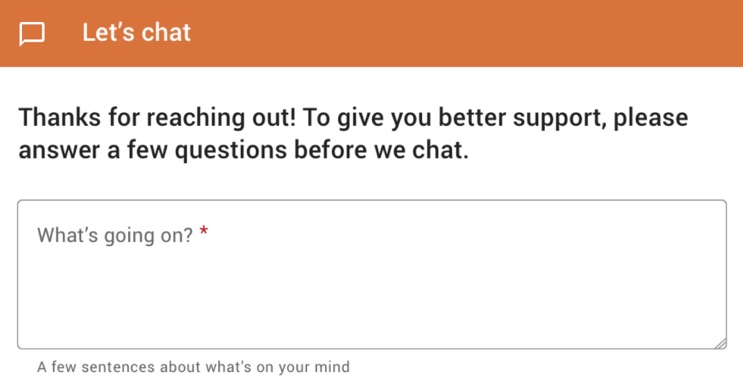
Image Credits: Trevor Project (opens in a new window)
If your model presents outputs to users, go a step further and explain how your model came to its conclusion. Google’s “Why this ad?” option gives you insight into what drives the search results you see. It also lets you disable ad personalization completely, allowing the user to control how their personal information is used. Explaining how your model works or its level of accuracy can increase trust in your user base, and empower users to decide on their own terms whether to engage with the result. Low accuracy levels could also be used as a prompt to collect additional insights from users to improve your model.
3. Collect user insights on how your model performs
Prompting users to give feedback on their experience allows the Product team to make ongoing improvements to the user experience over time. When thinking about feedback collection, consider how the AI engineering team could benefit from ongoing user feedback, too. Sometimes humans can spot obvious errors that AI wouldn’t, and your user base is made up exclusively of humans!
One example of user feedback collection in action is when Google identifies an email as dangerous, but allows the user to use their own logic to flag the email as “Safe.” This ongoing, manual user correction allows the model to continuously learn what dangerous messaging looks like over time.
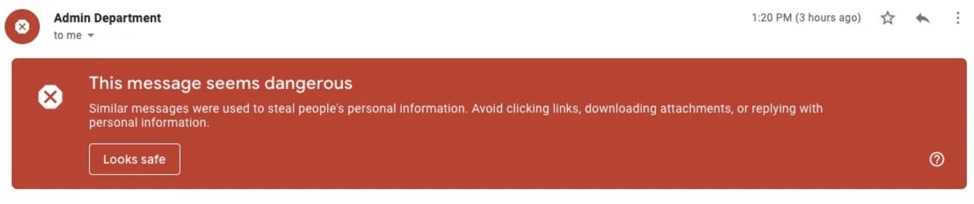
Image Credits: Google
If your user base also has the contextual knowledge to explain why the AI is incorrect, this context could be crucial to improving the model. If a user notices an anomaly in the results returned by the AI, think of how you could include a way for the user to easily report the anomaly. What question(s) could you ask a user to garner key insights for the engineering team, and to provide useful signals to improve the model? Engineering teams and UX designers can work together during model development to plan for feedback collection early on and set the model up for ongoing iterative improvement.
4. Evaluate accessibility when collecting user data
Accessibility issues result in skewed data collection, and AI that is trained on exclusionary data sets can create AI bias. For instance, facial recognition algorithms that were trained on a data set consisting mostly of white male faces will perform poorly for anyone who is not white or male. For organizations like The Trevor Project that directly support LGBTQ youth, including considerations for sexual orientation and gender identity are extremely important. Looking for inclusive data sets externally is just as important as ensuring the data you bring to the table, or intend to collect, is inclusive.
When collecting user data, consider the platform your users will leverage to interact with your AI, and how you could make it more accessible. If your platform requires payment, does not meet accessibility guidelines or has a particularly cumbersome user experience, you will receive fewer signals from those who cannot afford the subscription, have accessibility needs or are less tech-savvy.
Every product leader and AI engineer has the ability to ensure marginalized and underrepresented groups in society can access the products they’re building. Understanding who you are unconsciously excluding from your data set is the first step in building more inclusive AI products.
5. Consider how you will measure fairness at the start of model development
Fairness goes hand-in-hand with ensuring your training data is inclusive. Measuring fairness in a model requires you to understand how your model may be less fair in certain use cases. For models using people data, looking at how the model performs across different demographics can be a good start. However, if your data set does not include demographic information, this type of fairness analysis could be impossible.
When designing your model, think about how the output could be skewed by your data, or how it could underserve certain people. Ensure the data sets you use to train, and the data you’re collecting from users, are rich enough to measure fairness. Consider how you will monitor fairness as part of regular model maintenance. Set a fairness threshold, and create a plan for how you would adjust or retrain the model if it becomes less fair over time.
As a new or seasoned technology worker developing AI-powered tools, it’s never too early or too late to consider how your tools are perceived by and impact your users. AI technology has the potential to reach millions of users at scale and can be applied in high-stakes use cases. Considering the user experience holistically — including how the AI output will impact people — is not only best-practice but can be an ethical necessity.
NBCU’s Peacock streaming service hits 1.5M app downloads in first 6 days
NBCU’s Peacock appears to be having a somewhat better launch than Quibi did, based on data from app store intelligence firm Sensor Tower. While numbers pointing to new app downloads aren’t a complete picture of consumer adoption for a cross-platform service, they can provide a window into early traction outside of any official numbers provided by the companies themselves.
In Peacock’s case, Sensor Tower says the mobile app has now been downloaded around 1.5 million times across the U.S. App Store and Google Play within its first 6 days on the market.
For comparison, that’s 25% more than the 1.2 million installs Quibi saw during the same period post-launch in the U.S., but only 12% of the 13 million downloads Disney+ generated within its first six days.
Sensor Tower chose not to compare Peacock with HBO Max due to the fact that HBO’s new service replaced the existing HBO Now app, which was already preinstalled on consumer devices. That would not be as apt a comparison.
Peacock, of course, doesn’t have the brand-name recognition of Disney. And arguably, its name doesn’t translate into consumers’ minds as “NBC,” despite its connection to the classic peacock logo. Disney, meanwhile, had a built-in fan base before its streaming service’s launch. And, more broadly, there was pent-up consumer demand for a more family-friendly offering, as well.
Before last week’s launch, Peacock had been available on parent company Comcast’s Xfinity X1 and Flex platforms, but that didn’t include its mobile companion. The mobile app instead officially launched on July 15, and quickly shot up to No. 1 on the iPhone App Store, where it remained through the following day. On iPad, it ranked No. 1 between July 16 and July 18.
Today, the app has since dropped to No. 26 on iPhone (among nongame apps). Meanwhile, on Google Play, it has ranked No. 2 since July 17, and is No. 1 among nongame apps.
Quibi had also seen early traction on the app stores’ top charts shortly after its launch, ranking as high as No. 4 on iPhone on its launch day, April 6. But just over a week later it had rapidly fallen out of the U.S. iPhone app rankings, App Annie’s data indicated, dropping out of the top 50. That saw it coming in behind Netflix, Hulu, Disney+ and Amazon Prime Video.
Peacock hasn’t yet fallen that far, which could be a good signal.
There was also much discussion that Quibi’s failure to gain significant early traction had to do with its lack of support for TV viewing, despite launching in the middle of a pandemic when users were staying at home and watching on their living room big screens.
However, it’s worth pointing out that Peacock hasn’t yet rolled out to the two most widely adopted living room platforms in the U.S.: Amazon Fire TV and Roku. That lends more support to the idea that Quibi hasn’t been struggling to grow because of its mobile-only nature, but because its content wasn’t drawing in viewers.
For what it’s worth, Quibi has disputed recent reports of its slow traction, noting earlier this month its app had gained 5.6 million downloads since launch — more than the 4.5 million Sensor Tower had claimed at the time.
Even if Sensor Tower’s estimates aren’t an exact science, the overall trend its figures paint is one where neither Peacock nor Quibi have become overnight sensations at launch. Of course, the growth trajectory for any Netflix rival is sure to be tough in today’s crowded market. But these companies have made it even more difficult for consumers to connect due to their lack of a recognizable brand name and their failure to offer dedicated apps for top living room devices at launch.
Diaspora Ventures wants to invest in French founders with a global mindset
Meet Diaspora Ventures, a new VC fund based in the U.S. founded by two partners who grew up in France but have been in the U.S. for more than a decade — Ilan Abehassera (pictured above, right) and Carlos Diaz (pictured above, left). As the name suggests, Diaspora Ventures wants to invest in the French diaspora, and especially French founders who want to create a startup in the U.S. from the early days of their companies.
The fund’s website lays out this investment thesis in just a few sentences. “We are convinced that France is full of talented and ambitious entrepreneurs and is home of some of the best engineers and product designers in the world. We have realized that most of the time, they do not have the opportunity to expand beyond their borders because they don’t have access to the right funding, talent pool, playbooks or network,” the website reads.
Ilan Abehassera has been an entrepreneur for a while. He first founded Producteev, a task-management product that was acquired by software giant Jive in 2012.
He later launched Ily, a family-friendly communication device. The device looks an awful lot like an Amazon Echo Show, but the device was announced a couple of years before Amazon took over this market. He’s now working on Willo, a robot that could replace your toothbrush.
Carlos Diaz co-founded Carlos Diaz, a European digital agency that was acquired by Atos. More recently, he’s been working on The Refiners, a San Francisco-based seed fund that helps international founders get started in Silicon Valley. In March, Diaz was in the process of raising a second fund for The Refiners but couldn’t close the deal.
“The original idea of The Refiners was to identify ambitious European startups willing to move to the U.S. and help them become global leaders in their category. The global pandemic, the economic uncertainty combined with travel restrictions, and the absurd immigration policies of the Trump administration suddenly made the investment thesis of The Refiners impossible to execute four years after its launch,” Diaz wrote in a blog post.
With Diaspora Ventures, Diaz and Abehassera want to differentiate themselves from French VC funds that already invest in the U.S. According to Diaz, working with a French fund in the U.S. requires a lot of back and forth to close a deal. Diaspora Ventures wants to be able to close deals more quickly.
Diaspora Ventures will focus on early-stage rounds with an average check between $100,000 and $200,000. The firm wants to participate in 10 to 20 deals per year.
Interestingly, Diaspora Ventures is taking advantage of AngelList’s Rolling Venture Funds. It means that the two partners have raised $3 million from various limited partners, such as Kima Ventures, Breega, Alexis Bonillo, Christophe Courtin, Salomon Aiach, Frédéric Laluyaux and others. But the fund is always raising, so the list will become longer and the total amount of capital raised will grow over time.
That’s how Diaspora Ventures managed to close their first investment deal just a couple of months after coming up with the idea for the new fund.
Both of them have also been active angel investors over the past few years. They have invested in some well-known names, such as Algolia, Sunrise, Tempow, Yolo, Double, Cowboy, etc.

Image Credits: Diaspora Ventures
Edtech startups flirt with unicorn-style growth
When Quizlet became a unicorn earlier this year, CEO Matthew Glotzbach said he’d prefer to distance the company from the common nomenclature for a startup valued at or above $1 billion.
“The way Quizlet has gotten to this point is by building and growing a very responsible business,” he said. “It’s the result of the hard work of the team for a decade. We’re much more like a camel.”
It’s clear, though, that the tides might be changing. In edtech, the rich are getting richer. Last week, Mountain View-based Coursera announced it had raised a $130 million Series F round a day after The Information broke a story about Udemy reportedly raising new financing at a $3 billion valuation.
For anyone who has been following my edtech coverage in recent few months, this momentum is hardly surprising. Earlier in the pandemic, MasterClass raised $100 million, Quizlet became a unicorn and Byju’s became India’s second-most-valuable startup.
While edtech’s boom is predictable, the industry is known — to the chagrin of founders and to the benefit of long-time investors — for being conservative. Today we’ll look to understand how a boost in late-stage funding may impact the market on a broader scale.
High-flying camels
Ian Chiu, an investor at Owl Ventures, tells TechCrunch that the rise of big rounds brings a “watershed moment” to the $6 trillion education market. Owl Ventures was founded in 2014 and is one of the biggest edtech-focused firms out there, but Chiu says the recent strong capital flow shows that the sector is finally emerging as a sector other investors are noticing.