California is investigating concerns about COVID-19 safety at Amazon centers

According to a new court filing, multiple California state offices are actively investigating Amazon over worker safety concerns as the coronavirus continues to rage throughout the U.S.

In the filing, reported by Reuters, San Francisco Superior Court Judge Ethan Schulman writes that California Attorney General Xavier Becerra, California’s Division of Occupational Safety and Health and San Francisco’s Department of Public Health have all opened investigations into the online retail giant’s workplace practices in light of the pandemic. The attorney general’s office declined to comment when reached by TechCrunch.

While Amazon faced frequent criticism for worker well-being before the pandemic, the ongoing crisis has made those concerns even more stark. With white-collar workers sent home, the virus has spread quickly through clusters of employees at factory floors and warehouses nationwide where social distancing isn’t enforced. Amazon’s own shipping centers have reported outbreaks, including one in the Pocono Mountains and another in Oregon, and by May eight Amazon warehouse workers had died from the virus.

The disclosure of the three California state investigations came out of a court case accusing Amazon of failing to adequately protect workers in a San Francisco Amazon Fresh Fulfillment Center. In the lawsuit, filed in March, Amazon Fresh worker Chiyomi Brent accuses the company of taking risks, including sharing the suits they wear into freezers without cleaning them after each use. Brent also filed a complaint with California’s Division of Occupational Safety and Health, which is now looking into Amazon’s distribution center practices.

‘Tenet’ will get an international release before hitting US screens in September

“Tenet” has long been expected to be a bellwether for filmgoers’ readiness to return to theaters. Director Christopher Nolan is a blockbuster machine, and if anyone can get butts in seats amid the worst pandemic in modern memory, it’s probably him. And to be fair, the film really has served as a kind of litmus test — just not the kind Warner Bros. was hoping for.

After numerous delays, Tenet has a new release date. Not a final release date, mind. If there’s one thing that COVID-19 has taught us, it’s that things can always get worse. For now, however, the mysterious sci-fi thriller is slated to hit theaters in select North American cities on September 3, for the Labor Day weekend.

Notably, however, the film will receive an international release in 70 territories next month. The list includes Australia, Canada, France, Germany, Italy, Japan, Korea, Russia and the U.K. While U.S. theater owners have eagerly been awaiting the film’s arrival, shutdowns in too many key markets have continued to make a wide release untenable. Among other things, the move can be viewed as a kind of indictment of the United States’ ongoing inability to curb the virus’s spread.

And while, as Variety notes, global day-and-date releases aren’t unheard of for these kinds of blockbusters, much of Tenet’s appeal has hinged on the film’s mysterious nature. The trailers thus far released for the film have remained purposefully obtuse. An international release ahead of the U.S. will almost certainly go a long ways toward removing some of that mystery through piracy and online spoilers.

Other upcoming releases “Mulan” and “A Quiet Place 2” have also seen further delays in recent days.

BMW to sell all-electric versions of its 5 Series sedan and X1 SUV

BMW said it will offer the all-electric versions of X1 compact SUV and the 5 Series as part of the German automaker’s plans to have 25 electrified models in its portfolio by 2023.

BMW didn’t say exactly when an all-electric X1 or 5 Series might be available (TechCrunch reached out and will update if we get an answer). The all-electric drive train will be one of four options to buyers of the BMW X1 and BMW 5 Series vehicles. The sedan and SUV are also available as a plug-in hybrid, as well as diesel or gas with 48-volt mild hybrid technology.

The two vehicles are the latest to join BMW’s expanding electrified portfolio. Earlier this year, the automaker said its flagship 7 series sedan would also be offered with an all-electric drive train.

BMW has said that half of the 25 “electrified” models slated to be on roads by 2023 will be fully electric. The term electrified can also mean a hybrid and plug-in hybrid. The company’s longer-term goal is to have more than 7 million electrified BMW Group vehicles on the road by 2030. BMW has said it wants two-thirds of those to have a fully-electric drive train.

The automaker is bringing five all-electric vehicles to market by the end of 2021, including the BMW i3, the Mini Cooper SE, the BMW iX3, the BMW iNEXT and the BMW i4. The i3 is a well-known member of the wider EV industry. But the others likely less so. The Mini Cooper SE has the i3 motor and with 110 miles of EPA-rated range from its 32.6-kWh battery, the vehicle is marketed as a fun-to-drive urban commuter.

The iX3, which is based off the X3, is an electric crossover that will be assembled in China. The iX3 is not coming to the United States. Instead, the vehicle will go on sale in the first half of 2021 in China.

The BMW i4, an all-electric four-door Gran Coupe with an estimated EPA range of 270 miles and the ability to produce 530 horsepower, is slated to enter production in 2021. The iNEXT, which is meant to be the flagship of its EV lineup, is expected to be in production next year.

Google will continue to let employees work from home through the end of June 2021

Following earlier reporting, Google has confirmed that it will continue to allow employees to work from home through the end of June of next year. The company told TechCrunch that Sundar Pichai announced the plan in an email sent to staff earlier today.

“To give employees the ability to plan ahead, we are extending our global voluntary work from home option through June 30, 2021 for roles that don’t need to be in the office,” the CEO wrote.

The move marks the company’s most aggressive extension of its remote work policy to date. Like many other tech companies, it appeared cautiously optimistic that things might return to normal after a couple of months. Lately, however, it’s clear that the threat of the COVID-19 pandemic won’t be going away any time soon.

Back in May, Pichai outlined plans to allow a small number of employees to return to various offices this month, all while maintaining social distancing and keeping buildings at around 10% occupancy. That same month, Twitter sent a memo noting that staff would be able to continue working from home on a permanent basis.

Depending on how long the pandemic continues to rage on, it seems reasonable to expect that even the largest tech corporations are rethinking their approach to remote work.

Top mobile apps see declines in consumer engagement amid increased competition

Mobile consumers are downloading and using more apps than ever before. According to recent data from App Annie, mobile users now have 93 apps on their phone as of the end of 2019, up from 85 apps at the end of 2015. They also now use around 41 apps per month, up from 35 in 2015. Related to this increase, users are now also spending more hours per day using apps. Worldwide, daily time spent in apps has grown to 3.1 hours per day in 2019, up from 2.1 hours per day in 2015, for instance.

But with that growth has also come increased diversity among the top apps, the report found. That means top apps now make up a smaller proportion of consumers’ total time spent in apps, compared with five years ago.
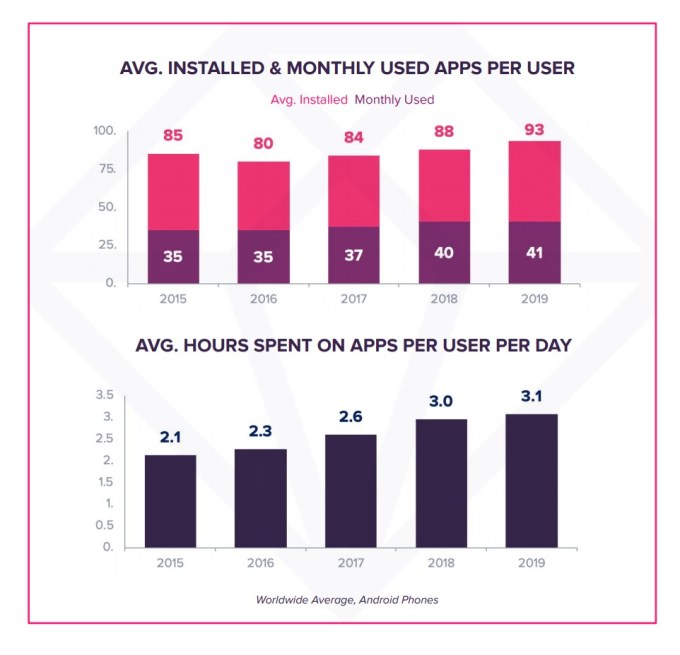
Image Credits: App Annie

It’s worth noting that this report was commissioned by Facebook, App Annie says, with a goal of offering a more detailed look at the evolving app ecosystem over the past five years. The report aims to determine how growth is playing out in terms of popular app categories, among the top publishers, and how quickly newly successful apps are achieving sizable growth.

Facebook, in the past, had generated this sort of market research data first-hand by way of its Onavo VPN application — now shuttered over privacy concerns — and other similar efforts.

Turning to App Annie’s data team is just a new way for the company to get at the same sort of data.

App Annie’s market analysis, in part, is similarly derived by way of third-party apps. The company acquired Distimo in 2014, and as of 2016 has run the VPN app Phone Guardian under the Distimo brand. It also acquired Mobidia in 2015 and has operated My Data Manager (now on the App Store under Distimo). Both apps disclose their relationship with App Annie and explain that the apps are used for market research purposes, with specific examples of the type of data collected.

The new report’s findings may not be all good news for Facebook and other top app publishers. As the app economy evolved, users now have more places to spend time on mobile.
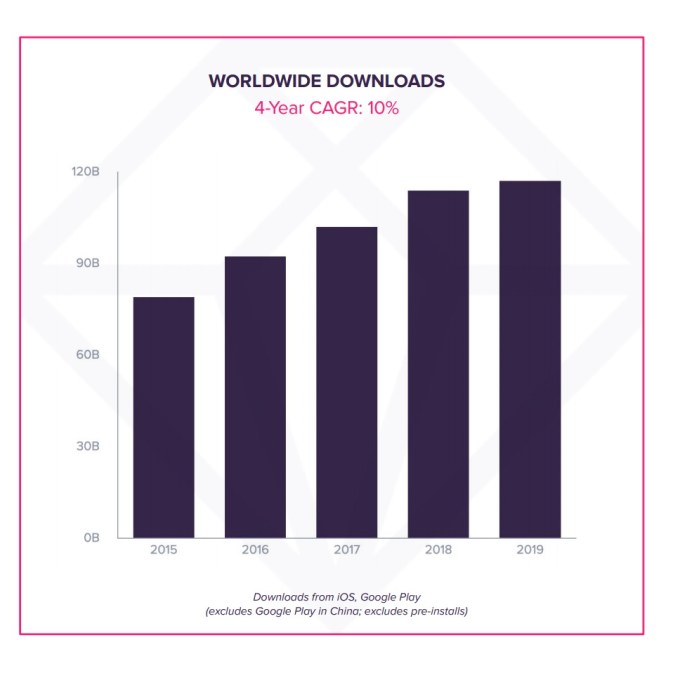
Image Credits: App Annie

Over the past five years, worldwide downloads continued to grow to reach a record of 120 billion in 2019, with several key countries now driving growth, including India (10% year-over-year growth in 2019), Brazil (9%), Indonesia (8%) and Russia (7%).

Downloads in mature economies also hit record levels in 2019, including the U.S. (12.3 billion), Japan (2.5 billion), U.K. (2.1 billion), South Korea (2 billion), Germany (1.9 billion), and France (1.9 billion).

As users grew their time in app to 3.1 hours per day, they also began to use more of a variety of apps. According to the report, 35 of the top 100 apps were new entrants in 2019, up from 27 in 2016 across categories that included social, photography, video, communications, entertainment and more.
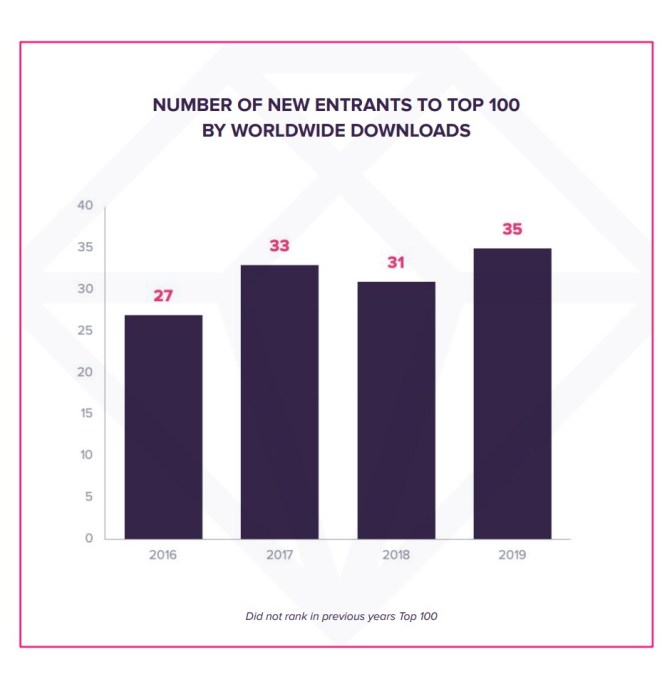
Image Credits: App Annie

This is likely worrisome data for top app publishers, like Facebook, which has for years maintained a suite of top apps, including not only its flagship app, but also Instagram, Messenger and WhatsApp. As the competitive pressure increases, these top apps make up a smaller proportion of the time spent on mobile devices as users have grown more comfortable trying out newcomers — particularly across gaming, entertainment and video categories.

The top 30 non-game apps accounted for 69.4% of U.S. users’ total time spent in 2016 among non-games. That dropped to 65.5% in 2019, a nearly 4% decline. Among games, the share fell from 49% to 39%, a 10% drop. (This data was sourced from Google Play in the U.S.)
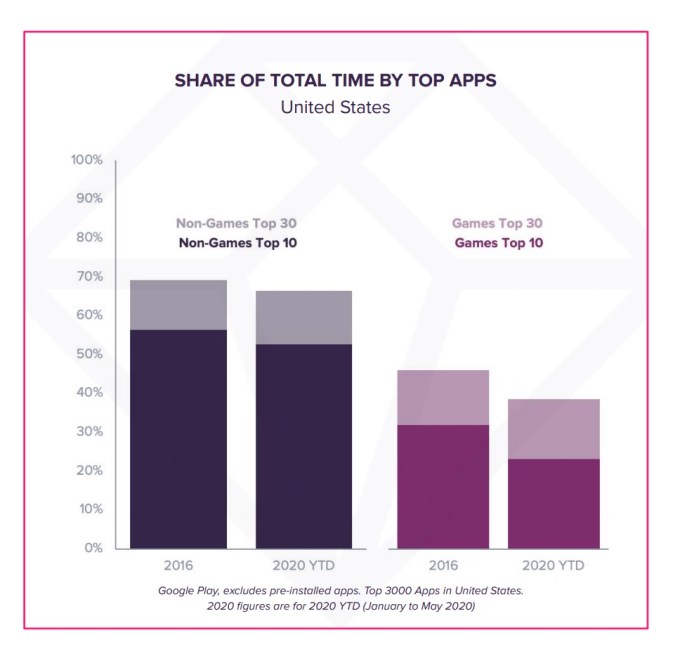
Image Credits: App Annie

Not only are consumers more open to trying new apps, the report found that new apps can also quickly achieve app store success. In the U.S., for example, more than 60% of apps are able to reach their category’s Top 30 in their first six months.

This is aided by larger initial marketing pushes as well as improvements in terms of consumer’s devices themselves — like more storage and processing power, which encourages more downloads.
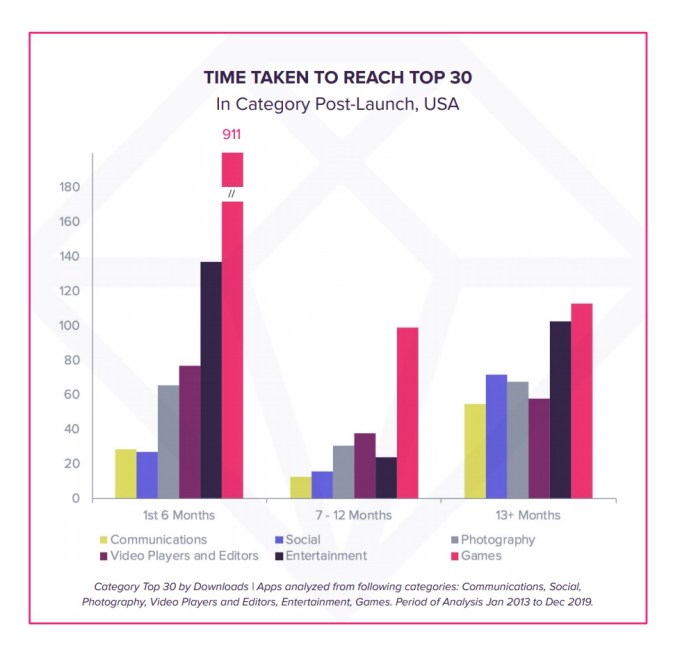
Image Credits: App Annie

There are also more apps capable of achieving the once milestone metric of 1 million monthly active users (MAUs). In 2019, more than 4,600 apps saw 1 million MAUs, including those outside of social and communications like Netflix, Roku, Disney, CBS, Amazon, Alibaba, Walmart, Target, PayPal, Venmo, Chase, Capital One, Uber, DoorDash, McDonald’s and Starbucks.
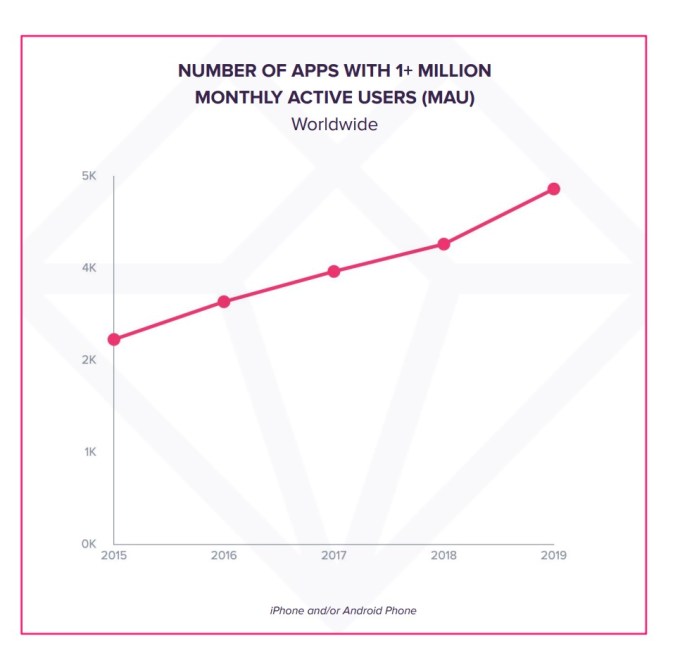
Image Credits:App Annie
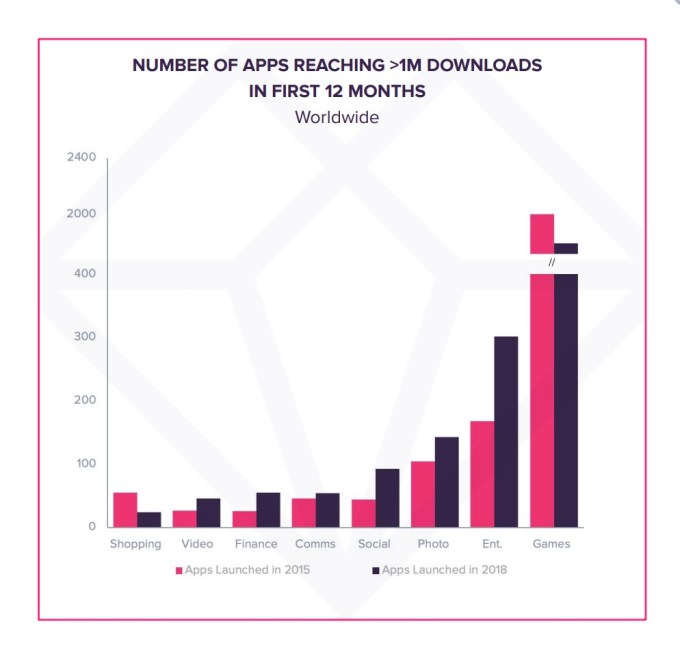
Image Credits: App Annie

Apps are also achieving the 1 million downloads milestones more quickly, in data analyzed from 2015 to 2018. In the video, finance, communications, social, photo and entertainment categories, 67% of apps achieved the 1 million downloads milestone within their first 12 months, App Annie says.

Because of the increases, there’s now a lot of overlap in between top apps. Today, mobile consumers will often choose and use multiple apps within and across categories to address similar needs, including on social, the report found.

For example, 89% of Snapchat’s users also used YouTube in April 2020 in the U.S., and 75% also used Instagram.
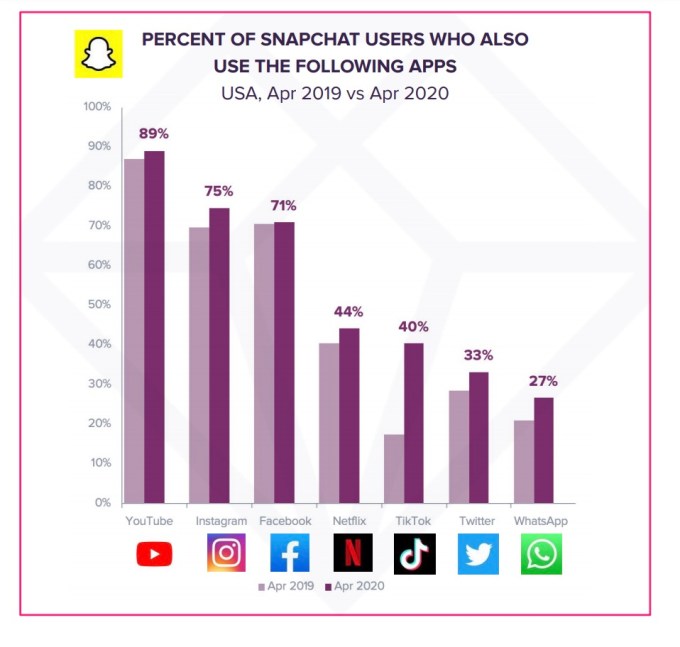
Image Credits: App Annie

TikTok saw the greatest year-over-year increase in cross-app usage of Snapchat, rising from 17% in April 2019 to April 2020 — an indication of how much it has captured the youth demographic.

Meanwhile, video apps and gaming are taking up more of users’ time spent in apps. This broad category of “play”-focused apps accounted for 22% of the growth in time spent in apps in 2019.
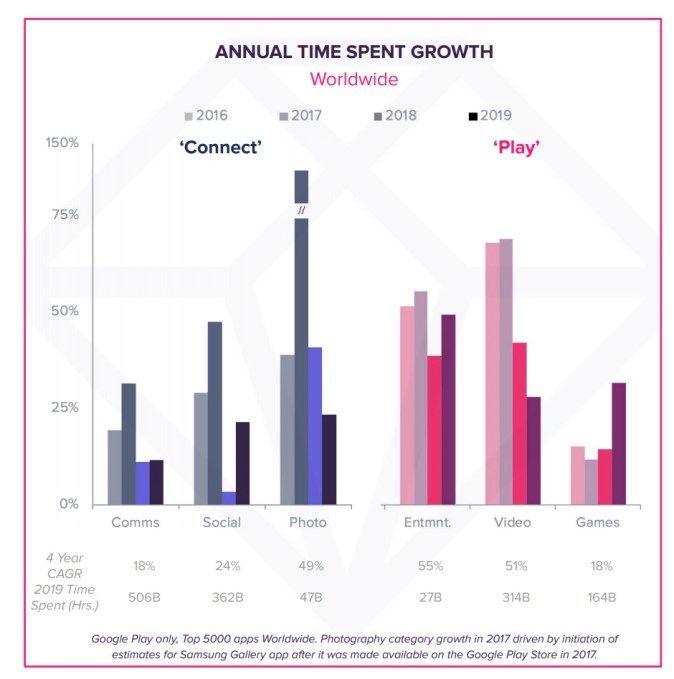
Image Credits: App Annie

Plus, top gaming apps are also implementing social features, including Top 50 games like Fortnite, Clash of Clans, Call of Duty: Mobile, Township, Star Wars: Galaxy of Heroes, New Yahtzee with Buddies, Golf Clash and Slotomania, for example.

More than two-thirds of the Top 50 games have added at least one social feature, whether that’s inviting friend to play, social assists for progressing, guilds or clans or in-app chat. This, in turn, has led to players spending more time in games as they can connect with friends there.
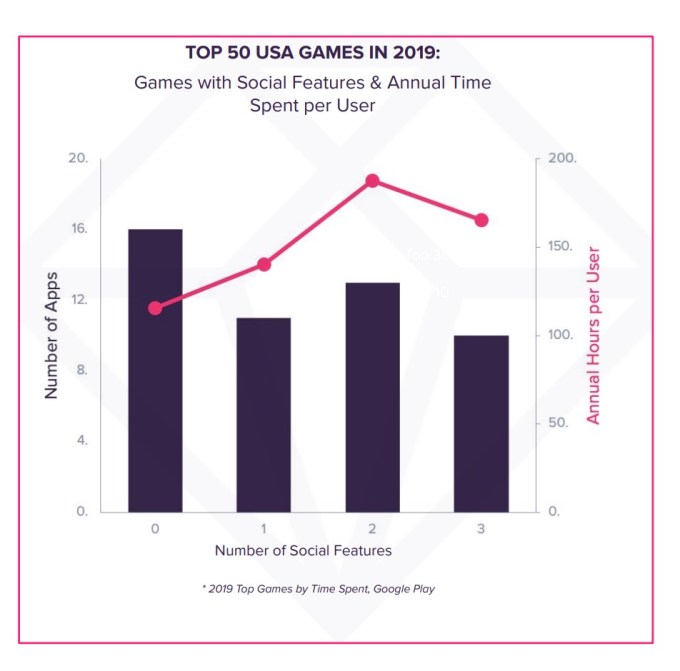
Image Credits: App Annie

Fortnite, as one key example of this trend, rolled out Party Hub based on its acquired Houseparty technology, in September 2019. In the three months after the rollout, time spent in Fortnite grew 130%.
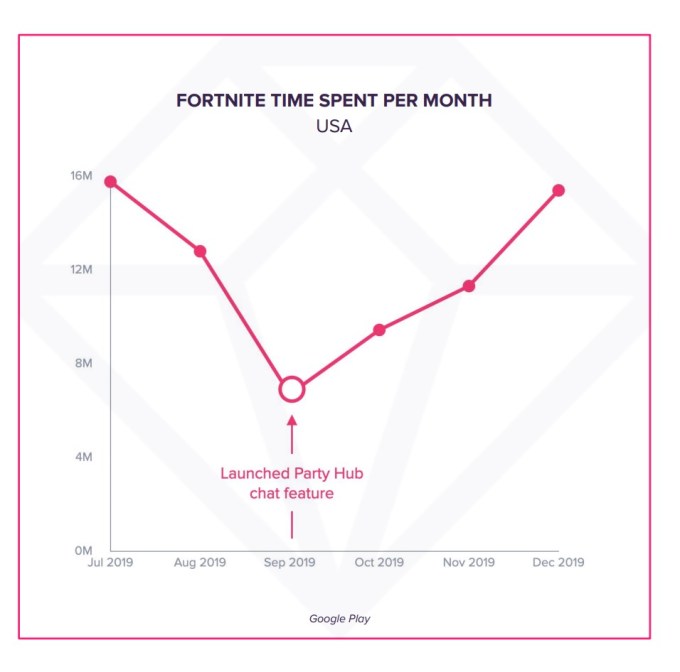
Image Credits: App Annie

Outside of games, TikTok has risen by blending elements of top categories like social, video and entertainment. After merging with Musical.ly, it has rapidly rolled out more video editing features and increased ad spend aggressively to grow its user base and drive engagement. By December 2019, U.S. users were spending 16 hours, 20 minutes in the app per month, on average, up from 5 hours, 4 minutes in August 2018.
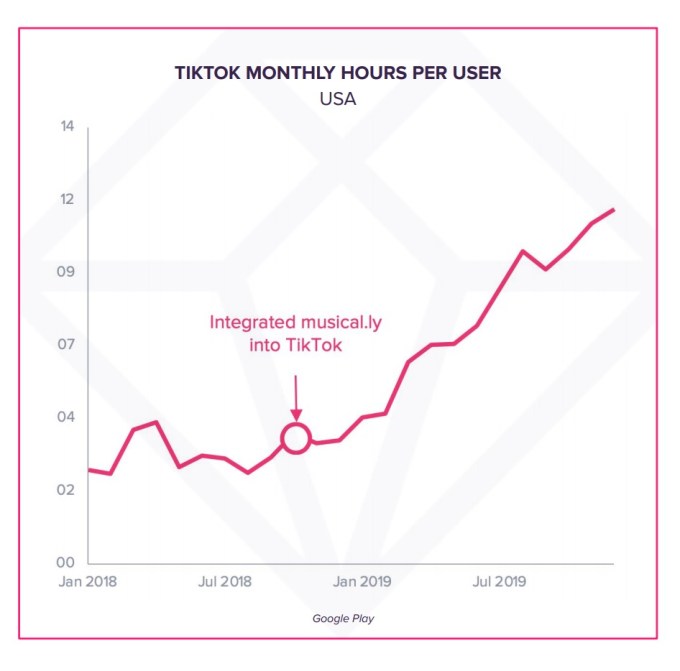
Image Credits: App Annie (note above chart only showcases Google Play data)

The full report also delves into country-by-country breakdowns but, overall, found that most countries saw record downloads in 2019 and similar trends in terms of app usage frequency increases and time spent.

One notable point of comparison is that U.S. users have more apps installed than in other markets (97 versus 93), but tend to use fewer apps compared with worldwide trends (36 versus 41). They also spend slightly fewer hours per day in apps, on average, than the worldwide average at 2.7 hours versus 3.1 hours.

“This report shows that the app industry is more competitive today than ever. New companies are succeeding with innovative apps that meet needs people might not even know they have,” said Ime Archibong, head of Facebook’s New Product Experimentation team, an internal team at Facebook looking to find new models for social apps. “All of this choice and competition fuels innovation, and that’s the heart of our work at Facebook,” he added.

App Annie’s report is available upon request here.

Amazon revamps its Alexa app to focus on first-party features, more personalization

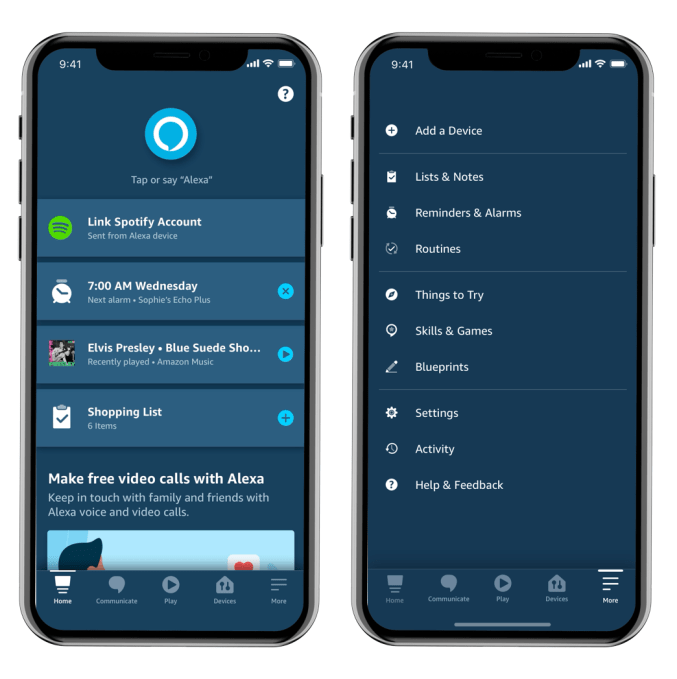
After launching a number of new developer tools for Alexa last week, Amazon today is introducing an updated version of its Alexa mobile app for consumers. The new app aims to offer a more personalized experience, particularly on users’ home screens, and offers more instructions on how and when consumers can use the digital assistant, among other changes. Notably, the app has moved its third-party skill suggestions off the main screen, to increase focus on how consumers are actually using Alexa.

The redesign offers an updated home screen, with a big Alexa button now at the top informing users they can either tap or say “Alexa” to get started.

Image Credits: Amazon

This is followed by a list of personalized suggestions based on what consumers’ usage of the app indicates is important to them — whether that’s reminders, a recently played item like their music or an Audible book, access to their shopping list and so on.

Users may also see controls for features that are frequently accessed or currently active, like the volume level for their Echo devices, so they can pick up where they left off, Amazon says. It’s worth noting that these Echo devices could include Echo Buds, Amazon’s Alexa-powered wireless earbuds, which could be key to its plans of enabling Alexa’s newly announced capabilities for controlling mobile apps.

For first-time users, the Alexa app will offer more tips on what to do on mobile. For instance, new users may see suggestions about playing songs with Amazon Music or prompts to manage their Alexa Shopping List.

Meanwhile, the app’s advanced features — like Reminders, Routines, Skills and Settings — have been relocated under the “More” button as part of the redesign.

The changes don’t necessarily mean Amazon has decluttered the Alexa home screen, however.

Because the update moved the Alexa button to the top of the screen, it has left room in the navigation bar for a new button: “Play,” which encourages media playback.

The revamp also suggests that Alexa’s dedicated app hasn’t exactly found its sweet spot to become part of users’ daily lives.

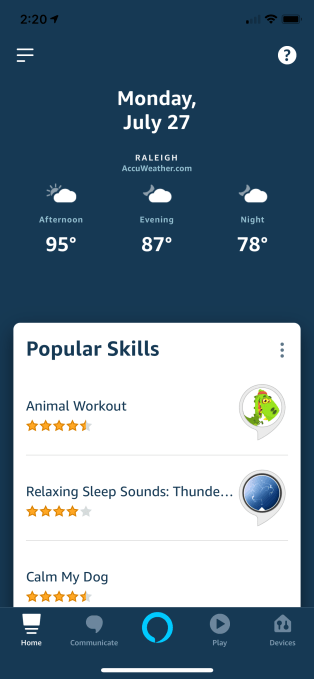
Before, the app had featured the date and weather at the top of the screen — an indication that Amazon had hoped the app would be something of a daily dashboard. (See below). Now, the company seems to understand that users will launch the app when they want to do something Alexa-specific. That’s why it’s making it easier to get to recent actions, so they can effectively pick up where they left off on whatever they were doing on their Echo smart speaker, for example.

Image Credits: Current Alexa app, screenshot via TechCrunch

In addition, the new app notably deprioritizes Alexa’s third-party voice apps (aka “skills”), which have not yet evolved into an app ecosystem to rival its mobile counterparts, like the Apple App Store for iOS apps or Google Play. Studies have indicated a large number of Alexa skills weren’t being used, and as a result, the pace of new skills releases has slowed.

Instead of showcasing popular skills on the home screen, as before, the app’s “Skills & Games” section has been shuffled off to the “More” tab. Amazon’s first-party experiences, like shopping, media playback and communications, now take up this crucial home screen real estate.

Amazon says the new app is rolling out worldwide over the month ahead on iOS, Android and Fire OS devices. By late August, all users should be migrated to the new experience.

Crisis management tips from startup whisperer Margit Wennmachers

When it comes to building a company, lots of things can and do go wrong. Margit Wennmachers — an operating partner at Andreessen Horowitz and long one of the most powerful public relations pros in the startup world — knows this firsthand.

Thankfully for all of you, Wennmachers was able to join us for our recent Early Stage event, where she shared some of her tips and tricks for dealing with everything from fast-ballooning crises that reporters catch wind of, to laying off people during a pandemic, to why lawsuits can actually fuel some companies’ growth.

It’s advice you might save for future reference. As she noted, how a crisis is handled can make or break a startup, and the list of things that can go wrong at even the smallest outfit is “long,” including a product needing to be recalled, a site going down, a cyber breach, a founding team that doesn’t get along, inappropriate behavior, lawsuits and cultural issues.

Some of her most actionable advice included:

Prepare for the inevitable crisis

First, said Wennmachers, spend time modeling out the scenarios, and “let your imagination run wild” as you do. Spend a month on this if necessary. As you’re thinking of worst-case scenarios, also figure out the team that would be involved in a crisis response. Legal will always have to be involved but also, often, HR, outside counsel, and, if a startup can afford it, the help of an outside crisis communications team. If it’s a product failure, you’ll also need the product lead, too, she noted.

Boston’s Q2 shows that the startup rebound isn’t ahead of us, it’s upon us

The coronavirus caused some disagreement amongst Boston’s venture capital community. Looking back at our mid-2020 survey of its VCs, some saw the city’s strength in biotech and healthcare as a competitive advantage, while others saw Boston’s diverse startup ecosystem as key to its survival.

And some were worried that activity was about to clamp down. Jeff Bussgang, Flybridge Ventures, put it most frankly: “Q2 financing for Boston is going to fall off a cliff. The biotech industry may see some bright spots […] but the financing market has frozen up as solid as the Charles River in February.”

With fresh data in hand, it appears that the more bullish were more right than the bears and that, in a good turn of affairs for Boston startups, Bussgang was wrong.

The city, much like the country, did not see the sharply negative quarter that many anticipated. Boston posted record venture capital investment in the period, its highest total since at least Q3 2018 according to CB Insights data.

The same dataset also says that Boston-area companies raised $3.7 billion across 126 deals. Indeed, the good news from Boston’s Q1 bested better-than-anticipated-results from both the global venture capital community, and the domestic VC world in Q2.

Bussgang sent an updated metaphor to the TechCrunch team in response to this data: “It was a tundra in March and April but, as happens in Boston, April showers and May flowers kicked in and the financing markets started to gush again in the late spring/early summer, just in time to save Q2 .”

While the data isn’t historically definitive due to reporting lags, it can be used as a directional sign that Boston’s rebound isn’t ahead of us, it’s upon us.

The solid numbers are a sign that COVID-19 and economic turmoil have put many startups in greater demand than before, which means that they need to amass money to meet growth needs.

Tech’s top CEOs will face Congress in antitrust hearing now set for Wednesday

A rare public showdown between Congress and the CEOs of tech’s biggest companies is still on track after being postponed last week. The House Judiciary Committee hearing, originally set for Monday, will now take place Wednesday, July 29 at 12 PM Eastern Time. The date was changed in light of the death of the civil rights leader and Georgia Representative John Lewis, who will be honored in a ceremony Monday in the Capitol building.

The hearing, titled “Online Platforms and Market Power, Part 6: Examining the Dominance of Amazon, Apple, Facebook, and Google,” will see an unusually comprehensive cast of tech’s most powerful leaders face off with lawmakers.

Any hearing that manages to drag a single tech CEO to Washington, D.C. — even virtually, in this case — is notable, and Wednesday’s hearing will hear testimony from four of them. In the hearing, Amazon’s Jeff Bezos, Apple’s Tim Cook, Google’s Sundar Pichai and Mark Zuckerberg of Facebook will all face questions about their company practices and concerns that anti-competitive behavior is impacting some of tech’s key markets for the worse.

The hearing is the latest chapter in the House Judiciary Antitrust Subcommittee’s ongoing antitrust investigation targeting many of tech’s largest, most powerful companies that was first announced last year.

“Since last June, the Subcommittee has been investigating the dominance of a small number of digital platforms and the adequacy of existing antitrust laws and enforcement,” House Judiciary Committee Chairman Jerrold Nadler and Antitrust Subcommittee Chairman David Cicilline said in a joint statement.

“Given the central role these corporations play in the lives of the American people, it is critical that their CEOs are forthcoming. As we have said from the start, their testimony is essential for us to complete this investigation.”

We’ll be following the hearing closely on Wednesday. If you stumble onto this page the day of, the link below should provide a reliable stream.

Tech at Work: Black gig workers speak out, Uber’s commitment to being anti-racist and Facebook’s diversity report

Welcome back to Tech at Work, a bi-weekly roundup and analysis of labor, and diversity and inclusion in tech. 

This week, we’re looking at Uber’s anti-racism commitment, Shipt shoppers walking off the job, Facebook’s diversity report and Black gig workers organizing against tech companies. Also, hear from CODE2040 CEO Karla Monterroso on tech’s response to the recent racial justice uprising in the U.S.

“There are a lot of really well-intentioned people, but they’re like, ‘Hey, put me in touch with all your Black and Latinx people,” Monterroso told me. “We have definitely gotten requests for free access to our talent pool. What we are talking through with people is even if you had access to that, your ability to make something of that is incredibly limited because the competencies needed to get people into the workforce, promote and retain them are not had by tech companies at this moment.”


Stay woke


Uber commits to being an anti-racist company

Uber’s track record with diversity and inclusion was especially rocky in the days of former CEO Travis Kalanick. The company’s new CEO Dara Khosrowshahi seems to recognize that, saying “you’re probably thinking that Uber is not exactly the company you’d expect to be speaking up on this front.” Still, Uber has made a number of commitments on its journey to being an anti-racist company.

But first, let’s define anti-racist. From Ibram X. Kendi’s book, How to Be An Antiracist:

To be antiracist is to think nothing is behaviorally wrong or right — inferior or superior — with any of the racial groups. Whenever the antiracist sees individuals behaving positively or negatively, the antiracist sees exactly that: individuals behaving positively or negatively, not representatives of whole races. To be antiracist is to deracialize behavior, to remove the tattooed stereotype from every racialized body. Behavior is something humans do, not races do.

Here are some of the most notable of Uber’s commitments:

  • Double Black representation in leadership (director roles and higher) by 2025. Currently, Black people make up just 3.3% of Uber’s leadership team, while white people make up 59.9% of it.
  • Expand diversity report to include data on intersectionality and self-identification. Race, gender, class, sexual orientation and disability status are highly connected for folks. Intersectionality is the concept that people face multi-faceted layers of discrimination as a result of these intersecting identities.
  • Create more opportunities for drivers, delivery people and support staff to advance their careers. Uber has been talking about this at least since 2018.

Related: This past year marked the most interest in anti-racism in the last five years, according to Google Search Trends. 

Image Credits: Google Trends/MRD

Building your startup’s customer advisory board

A customer advisory board (CAB) can be an invaluable resource for startups, but many founders struggle with putting together the right group of advisors and how to incentivize them. At our TechCrunch Early Stage event, Saam Motamedi, a general partner at Greylock Partners, talked about how he thinks about putting together the right CAB.

“We encourage all of our early-stage companies to put this in place,” Motamedi said. The goal here is to speed up the process to get to product/market fit since your CAB will provide you with regular feedback.

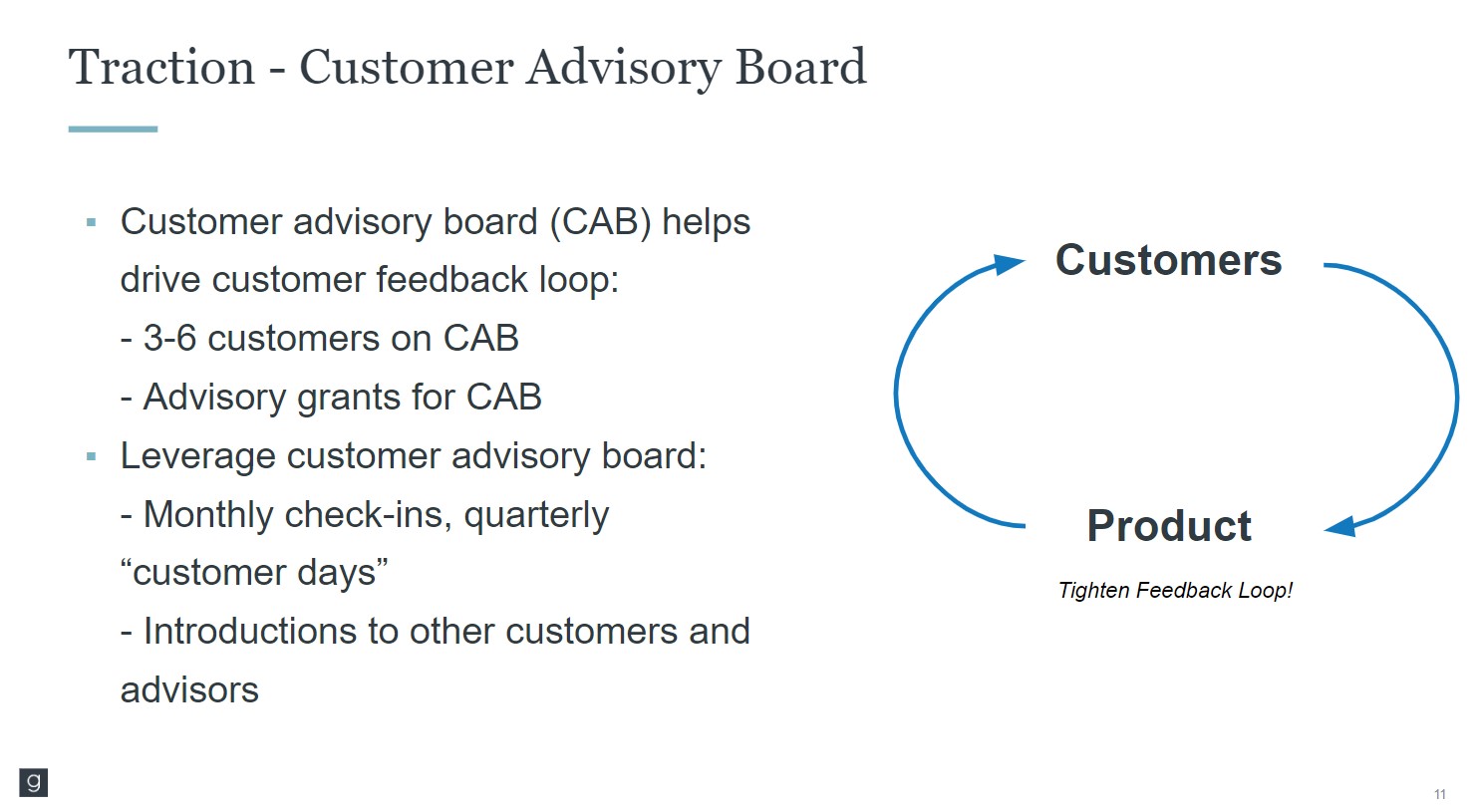
“The idea here is [that] you have this feedback loop from customers back to your product where you build, you go get feedback, you iterate — and the tighter this feedback loop is, the faster you’ll get to product-market fit. And you want to do things structurally to make this feedback loop tighter, starting with a CAB.”

Motamedi said a CAB should consist of about three to six customers. These should be “luminaries or forward thinkers” in the market you are serving. “You add them to the CAB — you might give them small advisory grants — and they become stakeholders and give you feedback as you work through the early stages of product development.”

Image Credits: Greylock Partners

As for the people who you put on the CAB, Motamedi suggests first setting the right expectations for the board.

“There are three components. Number one, the most valuable thing you can get from these customer advisors is their time. So the first piece is you want them to commit to a monthly cadence, that could be 60 minutes, it could be 90 minutes, where you’re going to say, ‘Hey, I’m going to come to the meeting, I’m going to bring two of my teammates, we’re going to show you the latest product demo, and you’re going to drill us with feedback. We’re going to do that once a month.’  […] And then piece two is this notion of customer days, you could do quarterly, you could also do twice a year.

“The idea is you want to bring the customers together. Because if you and I are both CIOs at Fortune 500 companies and we independently react to a product, that’s one thing, but if we sit in a room together, we all look at the product together, there’s going to be interesting data amongst us as customers and the founder is going to learn a lot from that.[…] And I think the third piece is just an expectation that as the company progresses and product maturity increases, that folks on the CAB are going to be advocates and evangelists for the company with their customer networks.”

Motamedi recommends outlining those expectations in a short document.

Space Force debuts official logo and motto, both reminding you that it’s ‘always above’

Earlier this year, the oft-mocked but actually pretty important new branch of the military, the Space Force, revealed an image that was suspiciously reminiscent of Star Trek. Now the Space Force has revealed a new, sharper graphic that is the force’s actual logo — and a motto to go with it: “Semper Supra,” or “always above.”

To be clear, the image revealed in January, which everyone thought looked quite a bit like Starfleet’s, is the seal for the Space Force branch of the military. The new, simpler one is the logo for the organization as a whole, which is the one we’ll see communications and recruiting branded with. You can tell them apart because the new one looks like the Pontiac logo.

In a series of tweets, the Space Force explained the various elements of the logo. It’s not exactly esoteric stuff, but it’s nice to know the chrome is there for a reason and not just because it looks cool.

Image Credits: U.S. Space Force

The silver border of the skyward-pointing delta shape, they said, “signifies defense and protection from all adversaries and threats emanating from the space domain.”

The middle part is black because it “embodies the vast darkness of deep space. Some feel fear and dread but we prefer to be inspired and stand up to the challenge.”

And in the very center is a star. It’s Polaris, the north star, which “guides. That’s why it is in the center of our logo.”

The “beveled elements,” being quadpartite, symbolize the four armed forces supporting the branch: Air Force, Army, Navy and Marines. They’re spiky because it makes them look a bit like rockets shooting into space.

As for the motto: “Semper Supra,” meaning “always above,” could be construed as either reassuring or menacing, depending on which end of the Space Force you’ve got pointing at you. It represents “establishing, maintaining, and preserving” the U.S. presence in space, and of course to a soldier on the ground, it’s nice to think that they have operational support from the always-above Space Force. For others, it brings to mind spy satellites or orbital lasers.

Expect to see this logo a lot over the next few years as this new branch matures and recruits.

More importantly, the Space Force has horses:

You have heard of a MW? but what about a MW??

Protecting our access to space involves many unique aspects, including welcoming @30thSpaceWing's newest Military Working Horse to their Conservation Military Working Horse program. Ghost is a 5 year old @BLMNational Mustang. pic.twitter.com/r1dAd0plsc

— United States Space Force (@SpaceForceDoD) July 23, 2020

Congratulations to the Space Force on their new logo, and to Ghost for being beautiful and strong.

Extra Crunch Live: Join Playground Global co-founder Peter Barrett for a live Q&A on July 28

Peter Barrett might be best known today as co-founder and CTO of Playground Global. But his experience in the technology world stretches back to when he was a teenager.

Barrett’s first security program got the attention of the NSA when he was just 19 years old. His career has been an adventure ever since, starting with his first company, Rocket Science Games. Barrett went on to build an IPTV platform at Microsoft, cloud intelligence for automotive at CloudCar and now quantum and optical computing, robotics and artificial intelligence at Playground. Barrett also holds more than 100 patents.

Despite all the technological progress the industry has made in the past three decades, Barrett believes the computing revolution has yet to begin — hence his interest in startups, particularly around robotics, automation and AI. Playground, which has $825 million under management and 39 active portfolio companies, has made more than 20 investments in robotics and automation. The five-year-old firm has chalked up at least 10 exits, including Canvas Technology to Amazon, DeepScale to Tesla, zippy to Cruise, Lighthouse to Apple and Nervana, which was acquired by Intel.

Barrett also is on the boards of PsiQuantumFathomLacuna, Anjuna, Artificial, Next Silicon and NVision, and is a board observer of Virta. Despite all of this investor activity, Barrett says he still finds time to code everyday. Perhaps it’s because Barrett believes code is the new concrete, essentially becoming the basis of tomorrow’s infrastructure. Plus, he says coding is fun.

These are just a few of the reasons we’re thrilled to have Barrett join us at 11 a.m. PT/ 2 p.m. ET July 28 as part of our Extra Crunch Live series, which connects some of the best and brightest minds in tech with our Extra Crunch audience. We’ve had a stacked agenda of speakers, a group that has included Mark Cuban, Aileen Lee and Ted Wang, Aaron Levie of Box, Julia Hartz of Eventbrite and Hans Tung and Jeff Richards at GGV Capital.

Barrett will sit down with us virtually to discuss a multitude of topics, from future of computing, life sciences and automation and why robotics is misunderstood to the potential for automation beyond humanoid robots and whether quantum computing is ready for the spotlight. 

We’ll also talk about today, namely COVID-19 and the affect it’s had on his portfolio companies, the challenges of investing in entrepreneurs remotely and how venture capitalists are chasing the wrong kinds of companies and not prioritizing real progress.

In short, we plan to cover a lot, and you don’t want to miss it.

Scheduling details

SaaS startup Swoop raises $3.2M to modernize mom-and-pop transportation companies

Chauffeured group transportation — the vehicles used for corporate outings, special events and even weddings — is a fragmented industry, with hundreds of small operators that rely on analog systems to book customers. Now in this era of COVID-19, these operators are being squeezed as travel and tourism have dwindled and companies have opted to have employees work from home.

One Los Angeles-based transportation booking startup called Swoop aims to bring these small, local operators into the digital age with a new software-as-a-service platform that it says is helping them adapt in this COVID-19 era. The startup, loaded with an injection of capital, is ramping up its SaaS product in hopes of tapping into a marketplace where customers spend $40 billion annually.

Swoop has raised $3.2 million in a seed funding round led by Signia Venture Partners, South Park Commons and several angel investors, including former Uber CPO Manik Gupta; Kevin Weil, co-creator of Libra at Facebook; Kim Fennel, a former Uber executive; and Elizabeth Weil, former partner at Andreessen Horowitz and 137 Ventures.

“I’m fascinated about how operators are still running most of their business with pen and paper,” Swoop CEO and co-founder Amir Ghorbani said in a statement. Ghorbani has witnessed firsthand the constraints of these small operators. During high school and college, Ghorbani helped with his parents’ limousine business. The experience prompted him to seek a solution. 

“I saw a huge opportunity to help these small mom and pop shops, in an under-digitized industry, where no operator has more than 1% market share,” Ghorbani added.

Ghorbani began by building a group transportation booking platform used by companies like Airbnb, Google and Nike. Through those bookings the companies saw an opportunity to build business management software for vehicle operators.

Swoop’s SaaS platform lets companies book and dispatch rides, track vehicles and communicate with customers. It also acts as a central hub for payments and other bookkeeping. The tool is designed to smooth out the booking process as well as increase vehicle utilization, which is currently at 4.9%, according to the company. Swoop also passes on to the operators using its SaaS tool leads from companies that use the booking platform.

For now, the focus is on local transportation companies, not public transit, which is a sector that Uber is chasing.

COVID-19, which has suspended most group outings, has upended these local transportation operators. Swoop says it has adjusted its platform to help these operators survive. The company told TechCrunch that it is helping operators repurpose their vehicles to ship goods rather than people. For instance, large vans once used for corporate outings can now be marketed to food wholesalers or companies that need local package delivery. The platform is also being used to connect operators with companies like Amazon that provide transportation to shuttle essential factory workers.

Swoop said COVID-19 might end up accelerating its business ramp as operators are being forced to evaluate their businesses and seek new ways to generate revenue and reduce costs.

Lo Toney’s product manager playbook for pitch deck success

The cold email worked — you’ve landed a meeting with your dream investor. Hell, you even set aside $40,000 for a pitch deck consultant to make sure your presentation looks suave.

One thing to figure out before you pick out a Zoom background: what information actually goes into those slides?

Lo Toney, founding managing partner at Plexo Capital, has advice for founders looking to raise money: think like a product manager while crafting your pitch deck. Toney has helped shape products at Zynga, Nike and eBay, and currently serves as both a GP and an LP at Plexo Capital, which invests in funds and startups. He’s done a ton of pitching and gotten pitched himself, which is why we invited him to TechCrunch Early Stage 2020.

“The framework of product management is very similar to the same playbook used by an early-stage investor and early-stage investors in the absence of an abundance of data,” Toney said. “They’re really thinking very similar to a product manager to evaluate an opportunity.”

Crafting a solid pitch deck is critical to the success of a startup seeking venture capital. Investors, however, spend less than four minutes on average per deck, and some even tell you that you have half that much time (so either talk fast or pick your favorite slides). Even if you have the business to prove that you’re the next Stripe, if you butcher the story behind the numbers, you could lose the potential to get the capital you need.

Toney said adopting a product manager mindset helps refine what that story looks and feels like.

“The story is not your product. It’s not your company, and it’s not the entrepreneur. It’s how your customer’s world is going to be better when your product has solved their problem,” he said, quoting Rick Klau from GV.

In action, Toney broke down the framework into four key slides: problem, market, solution and, of course, team.

Problem

First up, most investors say they want to see the problem you’re trying to solve up high. Toney is no different.

“I like to see an entrepreneur describing the desired outcome first, and then what are some of those roadblocks that come along the way to that desired outcome?” he asked. Similar to a product manager, founders could illustrate the different challenges that could come to executing a solution on a specific problem.