Not only is the app many Americans’ primary means of communicating with China, it’s also been the mobilizing arm of Chinese Trumpism.
Category: Tech news
hacking,system security,protection against hackers,tech-news,gadgets,gaming
How I accidentally gatecrashed a startup’s morning meeting
There’s a certain kind of panic that at some point gets us all.
You just got to work but did you leave the oven on at home? The gut-punch “call me ASAP” message from your boss but now they’re not answering their phone. Or that moment you unexpectedly see your camera light flash on your computer and you’re suddenly in a video call with a ton of people you don’t know.
Yes, that last one was me. In my defense it was only slightly my fault.
I got a tip about a new security startup, with fresh funding and an idea that caught my interest. I didn’t have much to go on, so I did what any curious reporter would do and started digging around. The startup’s website was splashy but largely word salad. I couldn’t find basic answers to my simple questions. But the company’s idea still seemed smart. I just wanted to know how the company actually worked.
So I poked the website a little harder.
Reporters use a ton of tools to collect information, monitor changes in websites, check if someone opened their email for comment, and navigate vast pools of public data. These tools aren’t special, reserved only for card-carrying members of the press, but rather are open to anyone who wants to find and report information. One tool I use frequently on the security beat lists all the subdomains on a company’s website. These subdomains are public but deliberately hidden from view, yet you can often find things that you wouldn’t from the website itself.
Bingo! I immediately found the company’s pitch deck. Another subdomain had a ton of documentation on how its product works. A bunch of subdomains didn’t load, and a couple were blocked off for employees only. (It’s also a line in the legal sand. If it’s not public and you’re not allowed in, you’re not allowed to knock down the door.)
I clicked on another subdomain. A page flashed open, an icon in my Mac dock briefly bounced, and the camera light flashed on. Before I could register what was happening, I had joined what appeared to be the company’s morning meeting.
The only saving grace was my webcam cover, a proprietary home-made double layer of masking tape that blocked what looked like half a dozen people from staring back at me and my unkempt, pandemic-driven appearance.
I didn’t stick around to explain myself, but quickly emailed the company to warn of the security lapse. The company had hardcoded their Zoom meeting rooms to a number of subdomains on their company’s website. Anyone who knew the easy-to-guess subdomain — trust me, you could guess it — would immediately launch into one of the company’s standing Zoom meetings. No password required.
By the end of the day, the company had pulled the subdomains offline.
Zoom has seen its share of security issues and forced to change default settings to prevent abuse, largely driven by greater scrutiny of the platform as its usage rocketed since the start of the coronavirus pandemic.
But this wasn’t on Zoom, not this time. This was a company that connected an entirely unprotected Zoom meeting room to a conveniently memorable web address, likely for convenience, but one that could have left lurkers and eavesdroppers in the company’s meetings.
It’s not much to ask to password-protect your Zoom meetings, because next time it probably won’t be me.
Daily Crunch: Trump bans transactions with ByteDance and Tencent
Trump escalates his campaign against Chinese tech companies, Facebook extends work from home until the middle of 2021 and Netflix adds support for Hindi. Here’s your Daily Crunch for August 7, 2020.
The big story: Trump signs orders banning US business with TikTok owner ByteDance and Tencent’s WeChat
Both orders will take effect in 45 days, but its specific impact is unclear since Secretary of Commerce Wilbur Ross will apparently not identify what transactions are covered until then.
This comes after Trump had already said that he was banning TikTok unless the app is sold to an American owner. (Specifically Microsoft, which has acknowledged that it’s in acquisition talks.)
TikTok hit back against the order by saying that it was “issued without any due process” and would risk “undermining global businesses’ trust in the United States’ commitment to the rule of law.”
The tech giants
Facebook extends coronavirus work from home policy until July 2021 — Facebook has joined Google in saying it will allow employees to work from home until the middle of next year as a result of the coronavirus pandemic.
Netflix’s latest effort to make inroads in India: Support for Hindi — Netflix has rolled out support for Hindi, a language spoken by nearly half a billion people in India.
Judge says Uber, Lyft preliminary injunction ruling to come in ‘a matter of days’ — Lyft argued that reclassifying drivers as employees would cause irreparable harm.
Startups, funding and venture capital
The rules of VC are being broken — The latest episode of Equity discusses “rolling funds” and how they could change the VC landscape.
Mashroom raises £4M for its ‘end-to-end’ lettings and property management service — The startup pitches itself as going “beyond the tenant-finding service” to include the entire rental journey.
Wendell Brooks has resigned as president of Intel Capital — Anthony Lin, who has been leading mergers and acquisitions and international investing, will take over on an interim basis.
Advice and analysis from Extra Crunch
How to pick the right Series A investors — It’s important for founders to get to know the people coming onto their board, and Jake Saper of Emergence Capital has some thoughts on how to do that.
IoT and data science will boost foodtech in the post-pandemic era — Three “must-dos” for post-pandemic retail grocers: rely on the data, rely on the biology and rely on the hardware.
Survey: Tell us what you think of Extra Crunch — Like Extra Crunch? Don’t like Extra Crunch? Tell us why!
(Reminder: Extra Crunch is our subscription membership program, which aims to democratize information about startups. You can sign up here.)
Everything else
Civic tech platform Mobilize launches a census hub for the 2020 count’s critical final stretch —The new site, GetOutTheCount.com, will amplify nonprofits’ census efforts and collect them in one place.
Federal judge approves ending consent decrees that prevented movie studios from owning theaters — U.S. District Court Judge Analisa Torres cited the rise of streaming services like Netflix as one of the reasons for her decision.
The Daily Crunch is TechCrunch’s roundup of our biggest and most important stories. If you’d like to get this delivered to your inbox every day at around 3pm Pacific, you can subscribe here.

Samsung Galaxy Tab S7+ hands-on
During an Unpacked event that featured the announcement of five key new devices, the Galaxy Tab S7 didn’t get a ton of love. Understandable, perhaps. It doesn’t quite have the star power of the Note line, nor does it have the novelty of a new foldable or Bluetooth earbuds. Tablets in general just aren’t exciting the way they once were.
But Samsung’s continued to plug away. The company makes a lot of tablets. That’s just kind of its thing. Why make one when you can make a dozen, each with different price points and target audiences? It’s the Galaxy Tab line, however, that’s always been the one to watch, providing a premium slate experience designed to complement its Galaxy handsets.

Image Credits: Brian Heater
In fact, in a world where Android tablets are largely the realm of budget devices, Samsung remains one of the few out there still manufacturing a device that can go head-to-head with the iPad. The latest model brings a number of key features, though the biggest of all isn’t available on the Tab S7+ review unit the company sent along.
The device will be among the first tablets to receive 5G connectivity. Pricing and availability are still forthcoming on that SKU, though, honestly, I don’t imagine a ton of people are going to be demanding cellular connectivity on their tablets as long as so many people continue working from home. When travel finally starts up again, that might be a different story.
That said, the model Samsung sent along just after the Unpacked event is a beast. It’s the specced-up version of the Tab S7+, which starts at $849. The higher tier bumps the RAM up from 6GB to 8GB and the storage from 128GB to 256GB. Add in the bleeding-edge Snapdragon 865+, and you’ve got an extremely capable machine on your hands here.
The design matches the premium specs. Gone is the plasticky design of early models, traded up for a sleek and sturdy glass and aluminum design. It’s a tablet that looks and feels as premium as its price tag indicates. It’s a bit heavy, though, at 1.26 pounds for the 12.4-inch model, versus 1.41 pounds for the 12.9-inch iPad Pro. The truth about these devices is they’re no longer designed to be held up above your face as you lie in bed.

Image Credits: Brian Heater
They are, of course, intended to be real multitasking work/play machines. I should note that I’m writing this as someone who continues to use a laptop for all of his work, but I can certainly appreciate the advances the category has made in recent years. I also know a handful of people who have mostly successfully traded in their work machines for a tablet, be it an Android device, Surface or iPad.
A tablet’s worth as a work machine is, of course, only as good as its case — a statement you can’t reasonably make about most products. Along with the device itself, Samsung has upgraded the case in a couple of nice ways. The typing experience doesn’t quite match a devoted laptop keyboard, but it’s been pretty well refined. The keys have a decent amount of travel and a nice spring for a laptop cover. The leather case also detaches into two pieces, so the back can be used as a stand, without the keyboard present. Of course, the trade-off for this sort of case is the fact that it can’t really be used on one’s lap without things falling and pieces detaching.
It wouldn’t be a Samsung tablet without the S Pen, of course. The peripheral is, thankfully, included. There’s no slot for the stylus (something I keep asking for but never get; life’s hard sometimes), but it does snap magnetically to the top of the device, albeit a bit weakly. Samsung has certainly built up a nice little ecosystem for the input device, and I’m pretty consistently impressed that it’s able to recognize and convert my chicken scratch. Seriously, my already terrible penmanship has only atrophied over time.
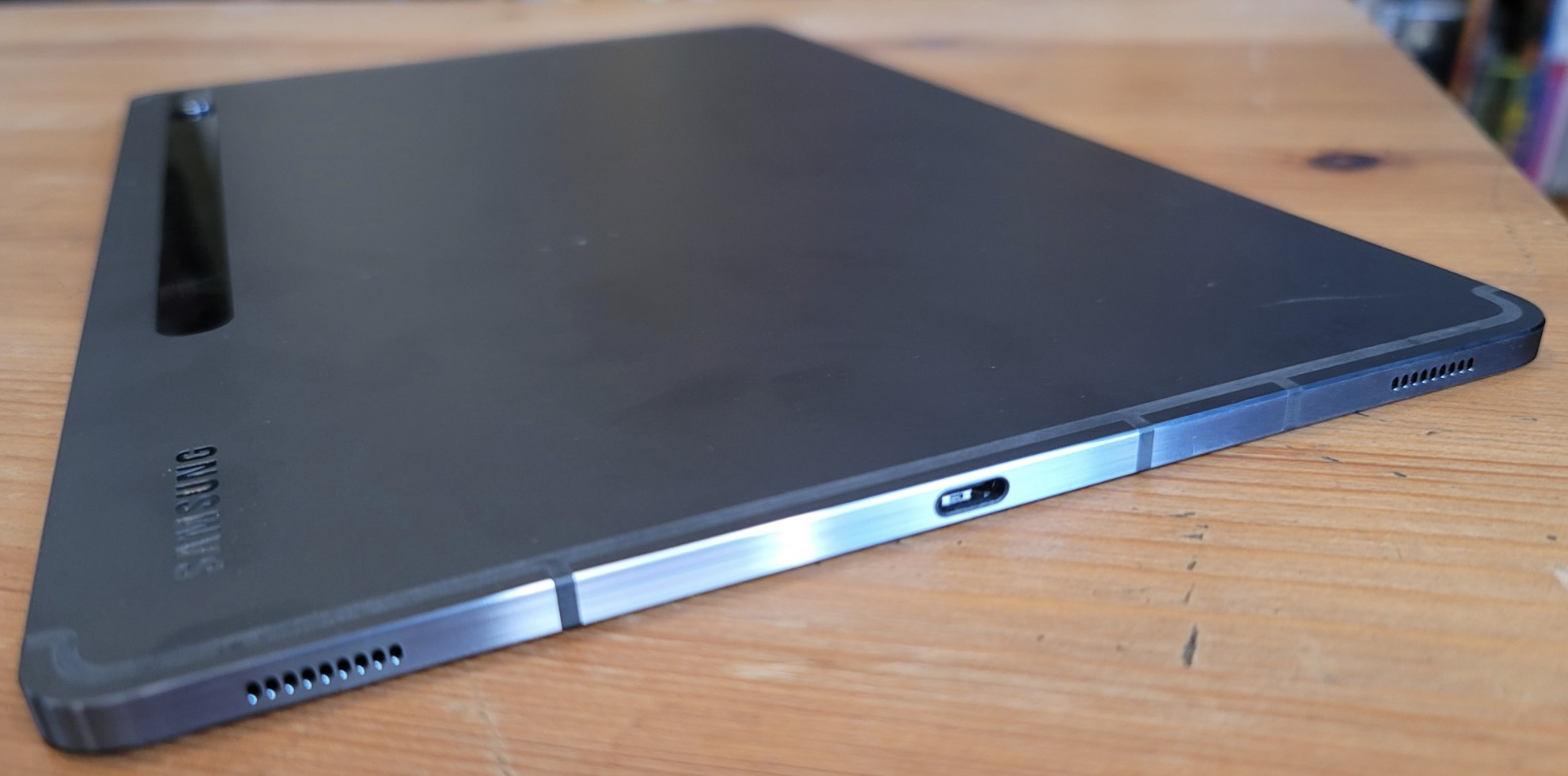
Image Credits: Brian Heater
Points, too, for a beautiful OLED display with a 120Hz refresh rate. Depending on what you’re looking to do with it, you might need to toggle that to save on battery life. Both models are pretty solid on that front, with 8,000 and 10,900 mAh, respectively, but the 5G models will no doubt take a hit.
Samsung is really pushing DeX hard — even harder than it has in the past. You can set it to automatically trigger the desktop approximation when you plug in the keyboard. The interface is an attempt to approximate something akin to the Windows desktop experience, but a number of apps still don’t support the interface and overall it still feels clunky. It’s easy to extrapolate a bit and imagine how it will improve things like multitasking, but it doesn’t feel like it’s quite all the way there.
Human Capital: Uber and Lyft’s ongoing battle with the law and a brief history of diversity at Snap
Welcome back to Human Capital (formerly known as Tech at Work), which looks at all things labor in tech. This week presented Uber and Lyft with a fresh labor lawsuit as a judge heard arguments from Uber, Lyft and lawyers on behalf of the people of California in a separate suit brought forth by California’s attorney general. Meanwhile, Snap recently released its first-ever diversity and inclusion report — something the company had been holding off on doing for years.
Below, we’ll explore the nuances and the significance of these lawsuits, as well as Snap’s track record with diversity and inclusion. Let’s get to it.
Gig life
CA Superior Court Judge Ethan P. Schulman heard arguments regarding a preliminary injunction that seeks to force Uber and Lyft to reclassify their drivers as employees
In May, California Attorney General Xavier Becerra, along with city attorneys from Los Angeles, San Diego and San Francisco, sued Uber and Lyft, alleging the companies gain an unfair and unlawful competitive advantage by misclassifying workers as independent contractors. The suit argues Uber and Lyft are depriving workers of the right to minimum wage, overtime, access to paid sick leave, disability insurance and unemployment insurance. In June, plaintiffs filed a preliminary injunction in an attempt to force Uber and Lyft to comply with AB 5 and immediately stop classifying their drivers as independent contractors.
This week, more than 100 people tuned in to the hearing regarding the preliminary injunction. The hearing, held on Zoom, initially was only able to hold just 100 people. But the interest in the case forced the court to increase its webinar capabilities to 500. There hasn’t been a ruling yet, but Judge Schulman said we could expect one likely within a matter of days, rather than weeks.
In the hearing, Schulman expressed how hard it is to determine the impact of a preliminary injunction in this case. For example, how Uber and Lyft would comply with the injunction is unknown, as are the economic effects on drivers, such as their ability to earn income, the hours they would be able to work and their eligibility for state benefits, Schulman said.
“I feel a little bit like I’m being asked to jump into a body of water without really knowing how deep it is, how cold the water is and what’s going to happen when I get in,” he said.
Here are some other key quotes from the hearing:
Rohit Singla, counsel for Lyft
The proposed injunction would cause irreparable injury to Lyft and Uber, and would actually cause massive harm to drivers and harm to riders.
Matthew Goldberg, deputy city attorney for San Francisco
We think the parties have drastically overstated precisely what they would need to do to be in compliance with the law.
The other lawsuits against Uber and Lyft
Earlier in the week, California Labor Commission sued Uber and Lyft in separate lawsuits. The goals of the separate suits are to recover the money that is allegedly owed to these drivers. By classifying drivers as independent contractors rather than employees, both Uber and Lyft have not been required to pay minimum wage, overtime compensation, nor have they been required to offer paid breaks or reimburse drivers for the costs of driving.
What these lawsuits share is a core focus and argument that Uber and Lyft are misclassifying their drivers as independent contractors and breaking the law. These two companies have been sued many, many times for their labor practices, specifically as they pertain to the classification of their respective drivers as independent contractors. What’s different about the latest string of lawsuits is that they’re coming in light of a new law that went into effect in California earlier this year that is supposed to make it harder for these gig economy companies to classify their workers this way. The lawsuits are also coming from legislative bodies, rather than from drivers themselves.
This moment has been a long time coming. Uber faced its first high-profile labor lawsuit back in 2013, when Douglas O’Connor and Thomas Colopy sued Uber for classifying them as 1099 independent contractors. Uber settled the lawsuit several years later in 2019 by paying out $20 million to O’Connor and Colopy, as well as the other class members.
Stay Woke
Snap finally releases a diversity report
Snap, after declining to release diversity numbers for years, finally decided now was the time to make them public. Before we jump in, let’s take a quick look at Snap’s history with diversity.
2016: Snap came under fire for a couple of filters that many people called out as being racist. The first was a Bob Marley filter that basically enabled some sort of digital blackface. The second time it had to do with a lens that was supposed to be a take on anime characters. Instead, there was an outcry about Snapchat enabling yellowface.
2017: “We fundamentally believe that having a team of diverse backgrounds and voices working together is our best shot at being able to create innovative products that improve the way people live and communicate. There are two things we focus on to achieve this goal. The first—creating a diverse workplace—helps us assemble this team. We convene at the conferences, host the hackathons, and invest in the institutions that bring us amazing diverse talent every year. The second—creating an inclusive workplace—is much harder to get right, but we believe it is required to unleash the potential of having a diverse team. That’s because we believe diversity is about more than numbers. To us, it is really about creating a culture where everyone comes to work knowing that they have a seat at the table and will always be supported both personally and professionally. We started by challenging our management team to set this tone every day with each of their teams, and by investing in inclusion-focused programs ranging from community outreach to internal professional development. We still have a long and difficult road ahead in all of these efforts, but believe they represent one of our biggest opportunities to create a business that is not only successful but also one that we are proud to be a part of” – Snap’s S-1
2018: A former Snap engineer criticized the company for a “toxic” and “sexist” culture. Snap CEO Evan Spiegel later said the letter was “a really good wake-up call for us.”
2019: Snap hired its first head of diversity and inclusion, Oona King. King previously worked at Google as the company’s director of diversity strategy.
June 2020: Spiegel reportedly said in an all-hands meeting the company will not publicly release its numbers. Snap, however, disputed the report, saying it would release that data.
August 2020: Snap releases its first-ever diversity report showing its global workforce is just 32.9% women, while its U.S. workforce is 4.1% Black, 6.8% Latinx and less than 1% Indigenous.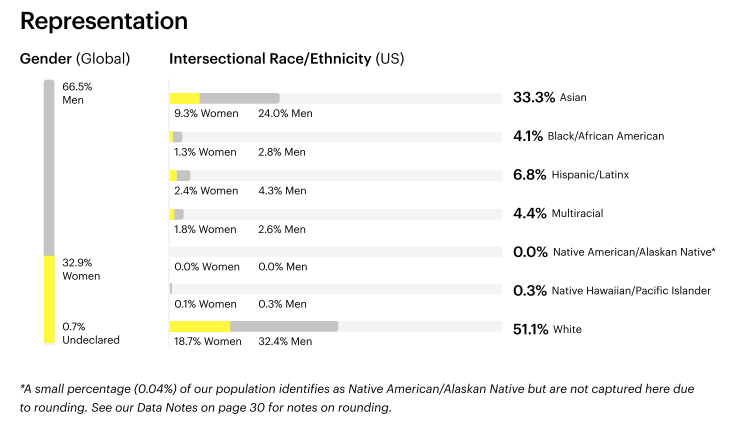
Snap’s numbers are not good, but also nothing out of the ordinary for the tech industry. What’s novel about Snap’s report, however, is the intersectional data breakdown. You’ll note that the representation of Black women (1.3%) is lower than the representation of Black men (2.8%). The same goes for all race/ethnicity categories. Across all distinct races, there are more men than women. Again, this is not good, but it’s to be expected, unfortunately.
Don’t miss
- Black Founders Matter, a fund focused on Black entrepreneurs, makes first investment
- Gig workers for Target’s delivery service say tipping glitches are cutting into pay
R&D Roundup: Supercomputer COVID-19 insights, ionic spiderwebs, the whiteness of AI
I see far more research articles than I could possibly write up. This column collects the most interesting of those papers and advances, along with notes on why they may prove important in the world of tech and startups. This week: supercomputers take on COVID-19, beetle backpacks, artificial spiderwebs, the “overwhelming whiteness” of AI and more.
First off, if (like me) you missed this amazing experiment where scientists attached tiny cameras to the backs of beetles, I don’t think I have to explain how cool it is. But you may wonder… why do it? Prolific UW researcher Shyam Gollakota and several graduate students were interested in replicating some aspects of insect vision, specifically how efficient the processing and direction of attention is.
The camera backpack has a narrow field of view and uses a simple mechanism to direct its focus rather than processing a wide-field image at all times, saving energy and better imitating how real animals see. “Vision is so important for communication and for navigation, but it’s extremely challenging to do it at such a small scale. As a result, prior to our work, wireless vision has not been possible for small robots or insects,” said Gollakota. You can watch the critters in action below — and don’t worry, the beetles lived long, happy lives after their backpack-wearing days.
The health and medical community is always making interesting strides in technology, but it’s often pretty niche stuff. These two items from recent weeks are a bit more high-profile.
One is a new study being conducted by UCLA in concert with Apple, which especially with its smartwatch has provided lots of excellent data to, for example, studies of arrhythmia. In this case, doctors are looking at depression and anxiety, which are considerably more difficult to quantify and detect. But by using Apple Watch, iPhone and sleep monitor measurements of activity levels, sleep patterns and so on, a large body of standardized data can be amassed.
Federal judge approves ending consent decrees that prevented movie studios from owning theaters
A federal judge has approved the Department of Justice’s efforts to end the Paramount Consent Decrees — 70-year-old court orders that prevented movie studios from engaging in a variety of anti-competitive behaviors, including ownership of movie theaters.
U.S. District Court Judge Analisa Torres cited the rise of streaming services like Netflix as one of the reasons for her decision:
Motion picture distributors that are not subject to the Decrees have entered the market since the 1940s — most significantly, The Walt Disney Company, the leading movie distributor in 2018 with about $3 billion in domestic box office revenues … Other motion picture distributors not subject to the Decrees include Lionsgate (20 films released in 2018), Focus Features (13 films), Roadside Attractions (12 films), and STX Entertainment (10 films). …None of the internet streaming companies — Netflix, Amazon, Apple and others — that produce and distribute movies are subject to the Decrees. Thus, the remaining Defendants are subject to legal constraints that do not apply to their competitors.
It’s not clear whether this decision will have any impact on the big streaming services. Torres acknowledged the argument that even when the decrees do not apply to a given studio, they “serve as a yardstick of acceptable behavior, exerting a normative effect on industry actors who are not parties to them.”
But it’s hard to imagine anyone in 2020 thinking it’s a good idea to get into the theatrical business in a big way. Domestic attendance was already on the decline, even before the COVID-19 pandemic forced most theaters to close.
Netflix and Amazon had shown some interest in owning theaters before this. Amazon was reportedly in the running to acquire Landmark Theatres a couple of years ago, and rumors that it might acquire AMC sent the theater chain’s stock shooting up earlier this year — but no acquisition has been announced, and in the meantime AMC appears to have stabilized its finances.
Netflix, meanwhile, signed a long-term lease for New York City’s Paris Theatre last year, and it may also have been interested in the Egyptian Theatre in Los Angeles. However, these seem less like the first steps in a broader theatrical strategy and more like one-off deals designed to provide the streamer locations that it can use for screenings and fancy premieres.
The real impact of the ruling may be in other areas, like the elimination (after a two-year sunset period) of restrictions on block booking and circuit dealing. Without those restrictions, studios could potentially require theaters that want access to lucrative franchise titles to screen their less popular movies as well.
How to pick the right Series A investors
Early-stage startup founders who are embarking on a Series A fundraising round should consider this: their relationship with the members of their board might last longer than the average American marriage.
In other words, who invests in a startup matters as much — or more — than the total capital they’re bringing with them.
It’s important for founders to get to know the people coming onto their board because they’ll likely be a part of the company for a long time, and it’s really hard to fire them, Jake Saper of Emergence Capital noted during TechCrunch’s virtual Early Stage event in July. But forging a connection isn’t as easy as one might think, Saper added.
The fundraising process requires founders to pack in meetings with numerous investors before making a decision in a short period of time. “Neither party really gets to know the other well enough to know if this is a relationship they want to enter into,” Saper said.
“You want to work with people who give you energy,” he added. “And this is why I strongly encourage you to start to get to know potential Series A leads shortly after you close your seed round.”
Here are the best methods to meet, win over and select Series A investors.
Identify industry experts
Saper recommends extending the typically short Series A time frame by identifying a handful of potential leads as soon as a founder has closed their seed round. Founders shouldn’t just pick any one with a big name and impressive fund. Instead, he recommends focusing on investors who are suited to their startup’s business category or industry.
IoT and data science will boost foodtech in the post-pandemic era
Sunny Dhillon
Contributor
Contributor
Sunny Dhillon is an early-stage investor at Signia Ventures in San Francisco where he invests in retail tech, e-commerce infrastructure and logistics, alongside consumer and enterprise software startups.
More posts by this contributor
Even as e-grocery usage has skyrocketed in our coronavirus-catalyzed world, brick-and-mortar grocery stores have soldiered on. While strict in-store safety guidelines may gradually ease up, the shopping experience will still be low-touch and socially distanced for the foreseeable future.
This begs the question: With even greater challenges than pre-pandemic, how can grocers ensure their stores continue to operate profitably?
Just as micro-fulfillment centers (MFCs), dark stores and other fulfillment solutions have been helping e-grocers optimize profitability, a variety of old and new technologies can help brick-and-mortar stores remain relevant and continue churning out cash.
Today, we present three “must-dos” for post-pandemic retail grocers: rely on the data, rely on the biology and rely on the hardware.
Rely on the data

Image Credits: Pixabay/Pexels (opens in a new window)
The hallmark of shopping in a store is the consistent availability and wide selection of fresh items — often more so than online. But as the number of in-store customers continues to fluctuate, planning inventory and minimizing waste has become ever more so a challenge for grocery store managers. Grocers on average throw out more than 12% of their on-shelf produce, which eats into already razor-thin margins.
While e-grocers are automating and optimizing their fulfillment operations, brick-and-mortar grocers can automate and optimize their inventory planning mechanisms. To do this, they must leverage their existing troves of customer, business and external data to glean valuable insights for store managers.
Eden Technologies of Walmart is a pioneering example. Spun out of a company hackathon project, the internal tool has been deployed at over 43 distribution centers nationwide and promises to save Walmart over $2 billion in the coming years. For instance, if a batch of produce intended for a store hundreds of miles away is deemed soon-to-ripen, the tool can help divert it to the nearest store instead, using FDA standards and over 1 million images to drive its analysis.
Similarly, ventures such as Afresh Technologies and Shelf Engine have built platforms to leverage years of historical customer and sales data, as well as seasonality and other external factors, to help store managers determine how much to order and when. The results have been nothing but positive — Shelf Engine customers have increased gross margins by over 25% and Afresh customers have reduced food waste by up to 45%.
How to access ‘America’s Seed Fund,’ the $3 billion SBIR program
One of the best-kept secrets in the world of capital is that the federal government has billions of dollars it’s dying to give away to early-stage founders and inventors — and all you have to do is ask. Well, there’s a bit more to it than that, so here’s a guide to getting in the door of the massive Small Business Innovation Research program.
First, as a bit of background: SBIR is a large network of programs, spread across a dozen federal agencies and the military, established some 40 years ago as a way to help out any American with a great idea but little access to capital.
Over time it has grown to impressive proportions, with a total award budget in 2019 of nearly $3.3 billion. To be clear, this is money intended to be essentially given away to qualified recipients, and not as license fees, or orders, or equity; these cash awards, which range from hundreds of thousands to over a million dollars, come with remarkably few strings attached.
That said, it’s not as if you just reach into the SBIR cookie jar and pull out a million bucks. As with anything involving the federal government, there’s a process — and not a short or simple one. There are extensive official tutorials for later, but this article (informed by tips from officials in the program) should help get you up and running.
It should be noted that this is not the only tech-related government grant program by a long shot, but it is the largest, broadest and arguably the most accessible to small business entrepreneurs and inventors like you — or it will be once you read this guide. Just be ready to put in a little work.
Step 1: Check yourself

Image Credits: Maskot / Getty Images
The first thing you should know is that the SBIR program operates with a specific (though not uncommon) type of entrepreneur in mind: Someone who needs money to develop and commercialize a new technology or intellectual property, but isn’t yet at the stage where they can attract traditional investment, and the risk or cost is too high for an ordinary loan.
SBIR awards (some agencies offer “grants,” others “contracts,” but you can just say “awards”) are basically cash to bring something from idea to commercialization. They are not for footing manufacturing down payments, repaying earlier loans or other miscellaneous operating costs.
If your company or invention needs help to cover R&D to get from experiment to working prototype, or prototype to commercialization, you might be a good fit. It doesn’t matter whether it’s software or hardware, your first product or your tenth — just as long as you’re a self-owned, U.S.-based small business and you’re building a new technology that needs some cash to get started.
A second, lesser-known benefit of the program is that if you get selected, your company is eligible to skip the line for some government procurement processes that would otherwise require competitive offers. If you picture the U.S. government as a potential client down the road, this benefit alone may be worth the toil.
The program is generally divided into phases, which you’ll probably want to do in order.
Phase I is for people demonstrating proof of concept — anywhere on the line from whiteboard to prototype. Awards range from tens of thousands to over $200,000, over a period of six to 12 months, depending on what is warranted for the specific development costs.
Phase II is for those doing deeper R&D on a proven concept and may be more than a million dollars over a two-year period; as you can see, this is a long-term play, not a quick cash grab.
Phase III is where a project may transition to actual paid contracts and purchases — but you can worry about that when you get there.
In other words, while the money has few catches once you get it, the program isn’t a free-for-all. If it sounds like a match and you’re willing to do a little legwork, proceed.
Step 2: Figure out where to apply

Image Credits: Imaginima / Getty Images
Here’s where it starts getting complicated. There isn’t actually just one SBIR program, there are a dozen, spread across as many federal agencies, from Defense and Energy to NASA and NOAA. Each has its own budget and application process — making this already complex enough that many a grant-seeker has bounced right off it (or closed this tab). But don’t worry, it’s not as bad as it sounds. You’ve got three things going for you.
First, not every technology or business is a fit for every agency.
This is actually a good thing. Think about who the “customer” is for your technology: Your rocket engine isn’t going to be of much use to Health and Human Services; a collision avoidance system for a drone might be good for the Defense Department, but it also might be helpful to the Department of Energy in a different way. What specifically does your tech enable, and why would it be helpful to the work of specifically one agency? That should help narrow it down considerably — but don’t be afraid to think outside the box a little. You might be surprised what some of these departments get up to.
Second, each agency has specific things it’s looking for, both right now and perennially.
This means there’s not much in the way of guesswork. These numerous and various “solicitations” range from general areas of interest to highly detailed requests, are listed publicly (see the links below) and can usually be searched through or sorted by topic. Once you’ve decided that your tech might be useful to either the EPA or NOAA, for example, look through their solicitations — they’re updated regularly, though the schedule differs by agency — and see if one is already asking for what you’re offering or uses similar keywords. You can and should also search through previous years to see if they’ve requested something like your tech in the past.
Third, there are people whose job it is to help businesses through this process.
Procurement Technical Assistance Centers, or PTACs, exist in every state, as well as D.C., Guam and Puerto Rico. These are staffed with people whose job it is to help small businesses navigate the complexities of government grant programs. You can find your local office by selecting it from the list here.
PTACs are more focused on contracts, however, and for these awards you may want to look up your local Small Business Development Center instead. These SBA-funded organizations are also here to help, and there are several in and around most cities (select them in the drop-down menu here and hit search).
Though each program has its own requirements and solicitations, they’re all public. Here are the agencies with active SBIR programs, starting with the largest, with links to their starting pages for SBIR applicants. The second link is to their solicitations page (though it may use different terminology), which should list or itself link to current topics of interest.
- Dept. of Defense (DoD): SBIR — Solicitations
- Dept. of Health and Human Services/National Institutes of Health (HHS/NIH): SBIR — Solicitations
- Dept. of Energy (DoE): SBIR — Solicitations
- National Science Foundation (NSF): SBIR — Solicitations
- National Air and Space Administration (NASA): SBIR — Solicitations
- Dept. of Homeland Security (DHS): SBIR — Solicitations
- Dept. of Education: SBIR — Solicitations
- Dept .of Transportation (DoT): SBIR — Solicitations
- Dept. of Agriculture (USDA): SBIR — Solicitations
- Environmental Protection Agency (EPA): SBIR — Solicitations
- National Oceanic and Atmospheric Administration (NOAA): SBIR — Solicitations
- National Institute of Standards and Technology (NIST): SBIR — Solicitations
Current solicitations are also centrally listed here in a different format. Please note that these addresses may at any time be rendered obsolete, as the government has no standard format for these programs or websites. Even the promotional materials I was given directly by SBIR officials were already out of date. But a little hunting around should get you to the right place. (And feel free to tell us in the comments if something seems off.)
Some of the programs are more similar than others, but there are a couple of notable exceptions. The NSF, for instance, has more open-ended solicitations for basic research rather than development. But NASA and Defense are definitely the most complicated.
NASA’s SBIR program is divided up among its various research centers — Ames, Goddard, etc. — each of which specializes in different technologies. While the specifics are too many and various to list here, a good way to get started is to look at a list of recent awards for similar or related technologies to your own, and find which center is the lead for it — for example robotic sampling is led by JPL, but small satellite propulsion is at Glenn. Then you can reach out to the SBIR contact for that center.
NASA also has a particularly robust Phase II program, with extended and expanded options for space-based work that necessarily takes longer or costs more money.
Defense has numerous grant programs under several umbrellas, including each branch of the military. To be honest, it’s kind of a mess, but they are working to simplify and accelerate the process. The actual DoD SBIR program, however, overlaps the most with the others and as such should be considered alongside them. You may want to rely on your PTAC or SBA representative to point the way.
Others will have their own idiosyncrasies, but getting started looks similar for all of them.
Step 3: Paperwork

USA, New York, New York City
Once you’ve decided to apply, you’ll want to register at SBIR.gov first thing — you have to get in the system in the first place to be eligible for participation in the process.
The SBIR officials I spoke to emphasized that while understanding the program and finding the right agency or agencies to submit to are important steps, it all falls down if you phone in the actual application — something they’ve seen over and over, apparently.
The applications differ agency to agency, and different topics demand different information, naturally. But in all of them you should be ready to articulate at least the following:
- Detailed but concise explanation of the technology you’re developing
- Company budget, financials and investors
- Commercial applications and plan to achieve them
Although the applications may only be 10 or so pages long, companies should budget at least 80 full-time hours to complete them. For companies with little experience with this sort of thing, hiring a professional grant writer is a perfectly valid option, but by no means required. This is also something that PTACs and SBDCs can help with.
It’s important, officials said, not to focus just on selling the technology or science itself — you must also show that there is a viable path forward for the team and company that the government’s funding will enable. They may not want much in return, but they’d like some assurance that they’re not throwing money down a well.
There is nothing stopping you from applying to multiple programs, though be aware that you probably won’t be able to copy-paste your application from one to the other. You can also apply year after year or quarter after quarter if you like, or to multiple solicitations within the same agency. It’s not uncommon for a company to be accepted only after multiple attempts.
Lastly, if you have any questions about any of this, find and contact the SBIR representative for the agency you’re applying to. These folks are there to liaise and connect you with the right resources, so don’t hesitate to reach out. Just don’t try to pitch them directly — it won’t work.
As you can see, applying to SBIR is not a simple process, but if you know the basic steps and resources, you can frontload the hard work while your project is still at an early stage. And while it may sound like a lot of winnowing is being done, recall that there really is a ton of money going into these programs and the whole point is to support American small businesses. That’s you!
Trump signs orders banning US business with TikTok and WeChat parent Tencent
President Donald Trump signed an executive order on Thursday banning transactions with ByteDance, the parent company of popular app TikTok . The White House also announced that he signed a similar order banning transactions with Tencent-owned WeChat, a messaging app that is ubiquitous in China, but has a much smaller presence than TikTok in the United States, where it is used mainly by members of the Chinese diaspora. Both orders will take effect in 45 days.
INBOX: @realDonaldTrump has signed an executive order to ban TikTok in 45 days. pic.twitter.com/1zR4HgCPVj
— Andrew Feinberg (@AndrewFeinberg) August 7, 2020
MORE: @realDonaldTrump has also signed a similar order banning transactions with WeChat. pic.twitter.com/Y4nVlCVBke
— Andrew Feinberg (@AndrewFeinberg) August 7, 2020
The orders cite the International Emergency Economic Powers Act and the National Emergencies Act. It is important to note that naming the apps’ operations in the United States as a national emergency is an act that is highly unprecedented and the legality of the orders will likely be challenged. ByteDance is currently pushing back against the Indian government’s July decision to ban TikTok along with 59 other apps; like the U.S., India also cited national security concerns around user data collection.
Microsoft announced over the weekend that it is in negotiations to buy TikTok from ByteDance, naming September 15 as a deadline for negotiations. The order would take effect shortly after the deadline set by Microsoft for the deal. ByteDance reportedly agreed to give up its entire ownership in the app even though it had previously wanted to maintain a minority stake.
Trump announced at the end of last month that he planned to ban TikTok through the use of an executive order. The president and government officials, including Secretary of State Michael Pompeo, have made escalating comments over the past few weeks alleging that TikTok is a threat to national security. While TikTok is owned by ByteDance, the Beijing-based company (which also operates a Chinese version of the app called Douyin) has taken steps to distance TikTok from its Chinese operations, and claims that its data is stored outside of China.
The executive order on ByteDance said that “the spread in the United States of mobile applications developed and owned by companies in the People’s Republic of China…continues to threaten the national security, foreign policy, and economy of the United States. At this time, action must be taken to address the threat posed by one mobile application in particular, TikTok.”
In 45 days, transactions by any person or property subject to U.S. jurisdiction with ByteDance or any of its subsidiaries will be prohibited “to the extent that they are permitted under applicable law.” The order claims that TikTok’s access to user data including location, browsing and search histories “threatens to allow the Chinese Communist Party access to American’s personal and proprietary information–potentially allowing China to track the locations of Federal employees and contractors, build dossiers of personal information for blackmail, and conduct corporate espionage.”
Sweeping Tencent ban
Trump’s executive order on WeChat was less expected, but not a complete surprise because Pompeo named the messaging app earlier this week when he said Trump was planning to take action “shortly” on TikTok and other Chinese companies. Like ByteDance, Trump claims WeChat’s data collection is a national security threat and may give the Chinese Communist Party access to user information. The order also cites WeChat’s censorship of material deemed politically sensitive by the Chinese government.
The scope of the order reaches beyond WeChat, restricting U.S. companies from conducting transactions with Tencent as well as its subsidiaries.
The big myth is how the Secretary of Commerce will define ‘transaction’ in 45 days. Trump might have just inadvertently dealt a blow to some of the biggest tech and entertainment companies in the U.S. backed by Tencent. The Chinese giant is often compared to SoftBank for its extensive investment footprint. What kinds of financial agreements are there in the majority stake cases? Dividends? Bonuses payable to board members?
Over the years, Tencent has taken stakes in Spotify, Snap, Reddit, Tesla, Warner Music, Universal Music, and lucrative games makers in the U.S. including Fortnite maker Epic Games and Riot Games, the studio behind League of Legends.
WeChat declined to comment. TechCrunch has also contacted ByteDance, Microsoft and the White House for comment.
This story is developing and will be updated.
Judge says Uber, Lyft preliminary injunction ruling to come in ‘a matter of days’
California Superior Court Judge Ethan P. Schulman heard arguments from Uber and Lyft, as well as lawyers representing the people of California, regarding the request for a preliminary injunction that seeks to force Uber and Lyft to immediately reclassify their drivers as employees. Schulman did not make a ruling today but said we could all likely expect one to come within a matter of days, rather than weeks.
In the hearing, Schulman expressed how hard it is to determine the impact of a preliminary injunction in this case. For example, how Uber and Lyft would comply with the injunction is unknown, as are the economic effects on drivers, such as their ability to earn income, the hours they would be able to work and their eligibility for state benefits, Schulman said.
“I feel a little bit like I’m being asked to jump into a body of water without really knowing how deep it is, how cold the water is and what’s going to happen when I get in,” Schulman said.
Today’s hearing was the result of California Attorney General Xavier Becerra, along with city attorneys from Los Angeles, San Diego and San Francisco, filing a preliminary injunction in an attempt to force Uber and Lyft to comply with AB 5 and immediately stop classifying their drivers as independent contractors.
The new law codifies the 2018 ruling established in Dynamex Operations West, Inc. v Superior Court of Los Angeles. In that case, the court applied the ABC test (more on that a bit later) and decided Dynamex wrongfully classified its workers as independent contractors based on the presumption that “a worker who performs services for a hirer is an employee for purposes of claims for wages and benefits…”
In the hearing today, lawyers on behalf of the people of the state of California, and Uber and Lyft, discussed the classification of workers as independent contractors versus employees, gig worker protections bill AB 5, the definition of a “hiring entity,” unemployment benefits, paid sick leave, workers’ compensation insurance and more.
Uber and Lyft maintained that an injunction would require them to restructure their businesses in such a material way that it would prevent them from being able to employ many drivers on either a full-time or part-time basis. Uber and Lyft’s argument, effectively, is that classifying drivers as employees would result in job loss.
“The proposed injunction would cause irreparable injury to Lyft and Uber, and would actually cause massive harm to drivers and harm to riders,” Rohit Singla, counsel for Lyft, said at the hearing. For example, Lyft estimates it would cost hundreds of millions of dollars simply to process the I-9 forms, which verify employment eligibility. It doesn’t cost anything to file that form, but it would require Uber and Lyft to further invest in their human resources and payroll processes.
Additionally, Singla argued that a preliminary injunction at this stage of the case would be drastic. His argument resonated with the judge.
“It’s not every day that a judge is asked to issue an injunction on a preliminary basis, as he emphasizes, that could potentially affect hundreds of thousands of people. And that’s what we’re dealing with here.”
But the plaintiffs disagreed. That vast number of people affected is a key reason to issue the injunction, Matthew Goldberg, deputy San Francisco city attorney argued. Additionally, Goldberg argued it would be quite feasible for Uber and Lyft to reclassify its drivers.
“It’s very doable,” he said. “[…] Both of these businesses already have very large, white-collar workforces at their corporations. I can assure you that every one of those workers is getting workers’ compensation insurance” and other benefits.
He added, “extending this set of benefits to more workers, administratively, is not as difficult as they allege, given they already do this for thousands of workers.”
Additionally, there are elements of Uber and Lyft-backed Prop 22 (details below) that are similar to what AB 5 requires, so plaintiffs argue there would not be irreparable harm for Uber and Lyft to comply with AB 5. Uber and Lyft, however, disagree.
In Uber’s opening arguments, Uber counsel Theane Evangelis pointed to a number of product changes that should remove “any doubt about the compliance and demonstrate Uber is a technology platform” that operates a multi-sided marketplace she said. For example, Uber began allowing drivers in June to set their own prices.
Still, Judge Schulman pressed on Uber’s ability to satisfy Prong B of the ABC test. According to the ABC test, in order for a hiring entity to legally classify a worker as an independent contractor, it must prove (A) the worker is free from the control and direction of the hiring entity, (B) performs work outside the scope of the entity’s business and (C) is regularly engaged in an “independently established trade, occupation, or business of the same nature as the work performed.”
“If you look at Uber or Lyft, they’re not in the business of maintaining an online app by itself,” Schulman said. “That’s the technology by which they perform. Their business is providing rides to people for compensation. In plain English, that’s what they do? Isn’t it?”
Evangelis quickly replied, “No.” She argued that what Uber and Lyft do is simply connect drivers and riders through their technology platform. She also pointed to the variety of services Uber offers, such as Uber Eats and Freight. Evangelis went on to ask the judge if he would put this on pause until November, when Californians will vote on Prop 22, which is backed by Uber, Lyft and others.
The ballot measure looks to implement an earnings guarantee of at least 120% of minimum wage while on the job, 30 cents per mile for expenses, a healthcare stipend, occupational accident insurance for on-the-job injuries, protection against discrimination and sexual harassment and automobile accident and liability insurance. Most notably, however, it would keep drivers classified as independent contractors.
Judge Schulman, however, seemed flummoxed by the basis of the argument to wait until November to see what voters decide.
“It seems to me that’s not my role,” he said. “And more significantly, it seems to me, if any of us learned anything from the 2016 election, is many of us are unable to predict the outcome of elections…I just wonder about the legitimacy of an argument like that.”
Evangelis closed her time by saying that Uber believes it passes the ABC test today.
The motion for a preliminary junction was filed as part of the suit filed in May, which asserted Uber and Lyft gain an unfair and unlawful competitive advantage by misclassifying workers as independent contractors. The suit argues Uber and Lyft are depriving workers of the right to minimum wage, overtime, access to paid sick leave, disability insurance and unemployment insurance. The lawsuit, filed in the Superior Court of San Francisco, seeks $2,500 in penalties for each violation, possibly per driver, under the California Unfair Competition Law, and another $2,500 for violations against senior citizens or people with disabilities.
Meanwhile, Uber and Lyft are both facing another lawsuit from the office of the California Labor Commissioner alleging wage theft. Filed yesterday in Oakland, the suit similarly aims to enforce the labor practices set forth by AB 5.
Cadillac reveals Lyriq, its all-electric SUV flagship loaded with luxury and tech
GM unveiled Thursday the Cadillac Lyriq, an all-electric crossover dripping in luxury, tech-forward touches and promising more than 300 miles of range that aims to propel the brand into a new electrified era.
That new era for Cadillac will have to wait though. The company said the Lyriq will go into production in the U.S. in late 2022, more than two years after its reveal date. The Cadillac Lyriq will be a global product, meaning it will be headed to China as well. Production in China will begin ahead of the U.S., according to Cadillac.
The Lyriq is just one in a roster of 20 electric vehicles that GM plans to bring to market by 2023. But it will be a critical one for the Cadillac brand. “The Lyriq sets benchmark for future Cadillacs,” Michael Simcoe, GM’s vice president of global design, said during the reveal.
The Lyriq embodies the kinds of luxury touches a Cadillac customer has come to expect, from the “black crystal” grille and jewelry box-styled drawer to the 33-inch vertical LED touchscreen display and AKG sound system.
Cadillac aimed for a modern and aggressive design that it achieved by giving the Lyriq a low, fast roofline and wide stance. That “black crystal” grille is a dynamic feature with “choreographed” LED lighting that greets the owner as they approach the vehicle. The LED lighting continues in the rear with a split taillamp design.
Inside the vehicle are backlit speaker grilles, curved screens with hidden storage and orchestrated lighting features similar to the dynamic lighting outside.
The Lyriq will be available in rear-wheel drive and performance all-wheel drive configurations. The 100 kilowatt-hour battery pack will provide more than 300 miles of range, according to the company’s internal testing. It will come with DC fast charging rates over 150 kilowatts and Level 2 charging rates up to 19 kW.

Image Credits: Cadillac
The tech inside the Lyriq includes the latest version of the hands-free driver assistance system called Super Cruise that first debuted in the Cadillac CT6 several years ago. Super Cruise uses a combination of lidar map data, high-precision GPS, cameras and radar sensors, as well as a driver attention system, which monitors the person behind the wheel to ensure they’re paying attention. Unlike Tesla’s Autopilot driver assistance system, users of Super Cruise do not need to have their hands on the wheel. However, their eyes must remain directed straight ahead.
The Lyriq will also come with a dual-plane augmented reality-enhanced head-up display. The head up display, which is projected on the windshield in the sight line of the driver, shows a near plane indicating speed and direction and a far plane that displays navigation signals and other important alerts. The effect is a layered look.
A vehicle has to be compelling visually to attract buyers. But the underlying foundation of the Lyriq is where GM has placed its biggest bet. Earlier this year, the automaker revealed a sweeping plan to produce and sell EVs that hinges on a new scalable electric architecture called Ultium that will support a wide range of products across all of its brands, including Buick, Cadillac, Chevrolet and GMC. The EV portfolio will include everything from compact cars and work trucks to large premium SUVs and performance vehicles.
This modular architecture, called “Ultium,” will be capable of 19 different battery and drive unit configurations, 400-volt and 800-volt packs with storage ranging from 50 kWh to 200 kWh, and front-, rear- and all-wheel drive configurations. At the heart of the new modular architecture will be the large-format pouch battery cells manufactured at this new factory.
Ultium battery has a nickel-cobalt-manganese-aluminum chemistry that uses aluminum in the cathode to help reduce the need for rare-earth materials such as cobalt, according to GM. The company said it has been able to reduce the cobalt content by more than 70%, compared to current GM batteries.
GM recently started construction on a 3-million-square-foot factory that will mass produce Ultium battery cells and packs. The Ultium Cells LLC battery cell manufacturing facility in Lordstown, Ohio is part of a joint venture between GM and LG Chem that was announced in December. At the time, the two companies committed to invest up to $2.3 billion into the new joint venture, as well as establish a battery cell assembly plant on a greenfield manufacturing site in the Lordstown area of Northeast Ohio that will create more than 1,100 new jobs. The factory will be able produce 30 gigawatts hours of capacity annually.
Google to roll out its digital learning platform to 23 million students and teachers in India’s Maharashtra state
Google has partnered with one of the largest states in India to provide its digital classroom services to tens of millions of students and teachers, the search giant said today, as it makes a further education push in the world’s second largest internet market.
The company, which recently announced plans to invest $10 billion in India, said it had partnered with the government of the western state of Maharashtra that will see 23 million students and teachers access Google’s education offering at no charge.
Thursday’s announcement follows a recent survey by the Maharashtra government in which it had sought teachers’ interest in digital classroom alternatives. More than 150,000 teachers signed up for the program in less than 48 hours, Google said.
Maharashtra is the worst hit Indian state by COVID-19, with more than 460,000 confirmed cases. The state, like others in India, complied with New Delhi’s lockdown order in late March that prompted schools and other public places to close across the nation.
“All of us had questions regarding the future of education. We have come a step closer to answering these questions due to the pandemic,” said Uddhav Thackeray, chief minister of Maharashtra, in a statement.
Varsha Gaikwad, the education minister of Maharashtra, said the partnership with Google will help her department roll out tech solutions to students in about 190,000 schools.
“Our goal is to make Maharashtra the most progressive state in education by making effective use of online resources, platforms, bandwidth and technology, using the power of the internet to reach out to the masses and bridge the gap in education,” she said.
The pandemic, which has brought several sectors to their knees in the country, has accelerated the growth of startups that operate digital learning platforms in the country. Byju’s, Facebook -backed Unacademy, Vedantu and Toppr among other startups have amassed tens of millions of new students since March this year.
Google is providing students and teachers with a range of services, including G Suite for Education, Google Forms for conducting quizzes and tests, access to Google Meet video conferencing services and Google Classroom, which enables educators to create, review and organize assignments, as well as communicate directly with students.
The company said it has also made Teach from Anywhere, a hub for educators, in Marathi, a very popular language in the state of Maharashtra.
“Our teachers and schools have the huge responsibility in shaping the future of our new generation, and we continue to be honored to play a role in offering digital tools that can enable more teachers to help even more students stay firmly on their journey of learning, during these times and beyond,” wrote Sanjay Gupta, country head and vice president of Google India, in a blog post.
The company has rushed to work with educators in India in recent months. Last month, Google announced that it had partnered with the Central Board of Secondary Education, a government body that oversees education in private and public schools in India, to provide its education offerings to more than 1 million teachers across 22,000 schools in India.
It also unveiled a grant of $1 million to Kaivalya Education Foundation (KEF), a foundation in India that works with partners to provide underprivileged children with education opportunities from Google.org, Google’s philanthropic arm.
Google’s global rival, Facebook, also partnered with CBSE last month to launch a certified curriculum on digital safety and online well-being, and augmented reality for students and educators in the country.
Daily Crunch: Twitter and Facebook take action against Trump
Facebook and Twitter are taking a stronger stand against pandemic misinformation, we preview the latest version of macOS and a mental health startup raises $50 million. Here’s your Daily Crunch for August 6, 2020.
The big story: Twitter, Facebook take action against Trump misinformation
Facebook and Twitter both took action against a post from President Donald Trump and his campaign featuring a clip from a Fox News interview in which he misleadingly described children as “almost immune” to COVID-19. Facebook took down the offending post, while Twitter went further and locked the Trump campaign out of its account (separate from Trump’s personal account).
“The @TeamTrump Tweet you referenced is in violation of the Twitter Rules on COVID-19 misinformation,” Twitter’s Aly Pavela said in a statement. “The account owner will be required to remove the Tweet before they can Tweet again.”
Meanwhile, Twitter also announced today that it will be labeling accounts tied to state-controlled media organizations and government officials (but not heads of state).
The tech giants
macOS 11.0 Big Sur preview — Big Sur is the operating system’s first primary number upgrade in 20 years, and Brian Heater says it represents a big step forward in macOS’ evolution.
Apple 27-inch iMac review — This will be one of the last Macs to include Intel silicon.
Uber picks up Autocab to push into places its own app doesn’t go — Uber plans to use Autocab’s technology to link users with local providers when they open the app in locations where Uber doesn’t offer rides.
Startups, funding and venture capital
On-demand mental health service provider Ginger raises $50 million — Through Ginger’s services, patients have access to a care coordinator who serves as the first point of entry into a company’s mental health plans.
Mode raises $33 million to supercharge its analytics platform for data scientists — Mode has also been introducing tools for less technical users to structure queries that data scientists can subsequently execute more quickly and with more complete responses.
Crossbeam announces $25 million Series B to keep growing partnerships platform — Crossbeam is a Philadelphia startup that automates partnership data integration.
Advice and analysis from Extra Crunch
Can learning pods scale, or are they widening edtech’s digital divide? — In recent weeks, the concept has taken off all across the country.
Eight trends accelerating the age of commercial-ready quantum computing — Venrock’s Ethan Batraski writes that in the last 12 months, there have been meaningful breakthroughs in quantum computing from academia, venture-backed companies and industry.
5 VCs on the future of Michigan’s startup ecosystem — According to the Michigan Venture Capital Association (MVCA), there are 144 venture-backed startup companies in Michigan, up 12% over the last five years.
(Reminder: Extra Crunch is our subscription membership program, which aims to democratize information about startups. You can sign up here.)
Everything else
More Chinese phone makers could lose US apps under Trump’s Clean Network — The Trump administration’s five-pronged Clean Network initiative aims to strip away Chinese phone makers’ ability to pre-install and download U.S. apps.
UK reported to be ditching coronavirus contact tracing in favor of ‘risk rating’ app — Reports suggest a launch of the much-delayed software will happen this month, but also that the app will no longer be able to automatically carry out contact tracing.
The Daily Crunch is TechCrunch’s roundup of our biggest and most important stories. If you’d like to get this delivered to your inbox every day at around 3pm Pacific, you can subscribe here.