Labster lands new cash to bring its virtual reality science lab software to Asia

You could Zoom call into your science class, or you could conduct a lab experiment in virtual reality. During the coronavirus pandemic, the latter has never felt more full of potential.

The global need for learning solutions beyond Zoom is precisely why Labster, a Copenhagen-based startup that helps individuals engage in STEM lab scenarios using virtual reality, is growing rapidly. Since March, the usage of Labster’s VR product has increased 15X.

On the heels of this unprecedented momentum, Labster joins a chorus of edtech startups raising right now, and announced it has brought on $9 million in equity venture funding. The round was led by GGV, with participation from existing investors Owl Ventures, Balderton and Northzone.

“COVID-19 has been a great awareness builder of Labster, opening teachers’ eyes to the good sides of online learning as opposed to Zoom-only learning, which is largely failing,” CEO and co-founder Michael Jensen told TechCrunch.

Labster sells its e-learning solution to support and enhance in-person courses. Based on the subscription an institution chooses, participants can get differing degrees of access to a virtual laboratory. Imagine a range of experiments, from understanding bacterial growth and isolation to exploring the biodiversity of an exoplanet. Along with each simulation, Labster offers 3D animations for certain concepts, re-plays of simulations, quiz questions and a virtual learning assistant.
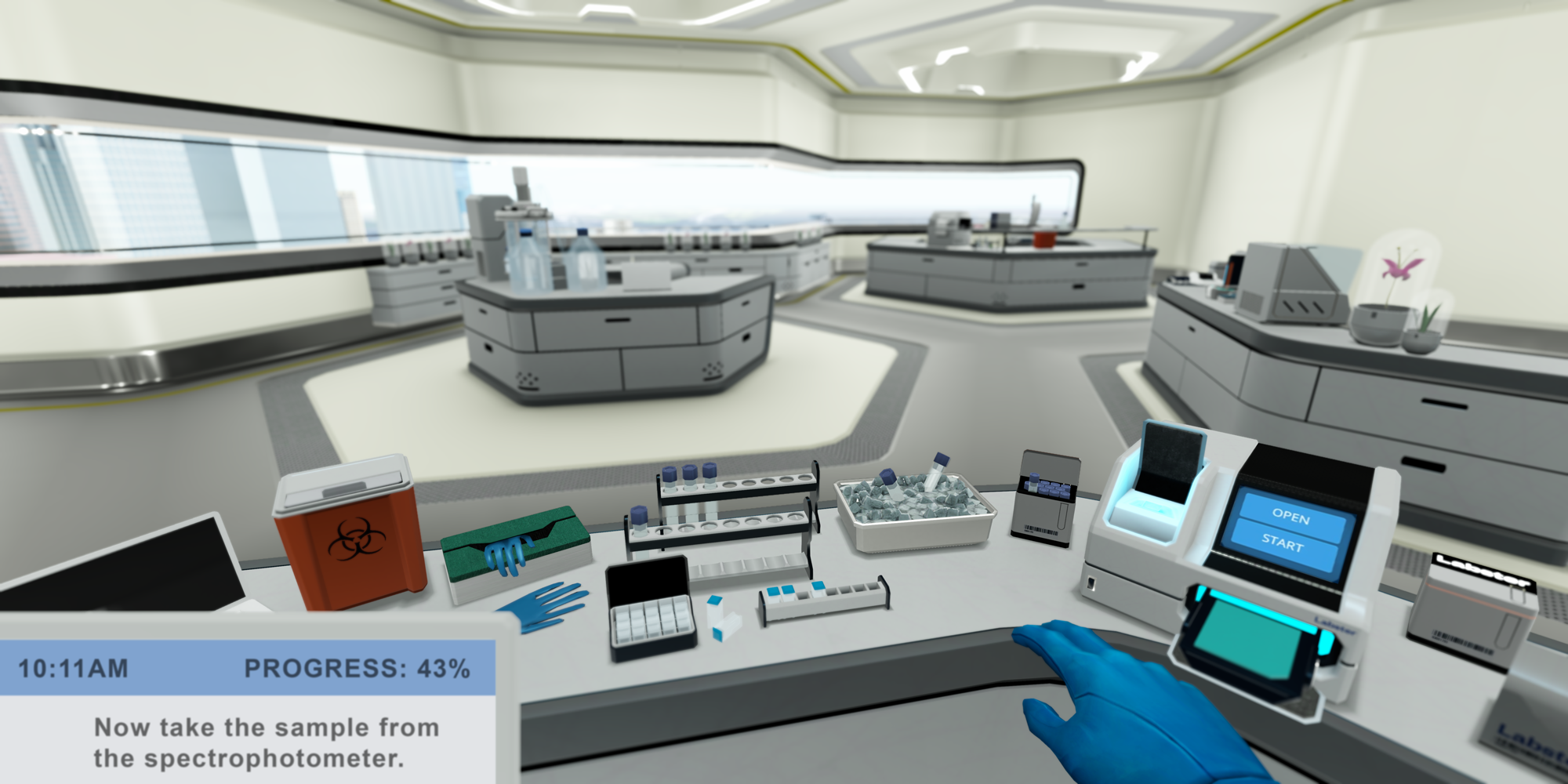
Photo credit: Labster.

While the majority of Labster’s customers are private institutions, the company landed a deal with all of California’s community colleges during the pandemic. The partnership added 2.1 million students to Labster’s customer base, which Jensen said has been bolstered by a broader growth in annual license deals and partnerships.

With GGV on board, Labster is looking to strengthen position in Asia. Breaking into new markets often requires a strategic investor with eyes on the ground on how that market works, thinks and, most importantly, learns. Asian markets are specifically lucrative for edtech companies because consumer spend is higher compared to the North American market.

Jenny Lee, a Shanghai-based partner with GGV, will take a board seat at Labster.

Lee has expressed interest in how automation, virtual and AI-based teachers can help bridge the gap between K-12 markets and lack of good-quality teachers everywhere.

Jensen said that the capital will also be used to bolster the company’s mobile offering, since Asian markets have high mobile usage compared to North American and European markets.

The round is significantly smaller than Labster’s previous $21 million Series B, closed in April of 2019. And it contrasts sharply to the momentum that has benefited edtech companies like MasterClass, Coursera and, reportedly, Udemy into raising nine-figure rounds.

So naturally, I asked Jensen: why the conservative raise?

Jensen says that the $9 million check was a strategic growth check to bring on GGV (all existing investors in Labster also participated in the round). Since being founded in 2012, the company has been relatively conservative in raising cash. To date, inclusive of this round, Labster has raised $40 million in venture capital.

He argues the new money, thus, is offensive capital instead of defensive capital. It’s a strategic check to open a global door.

This isn’t the first time an edtech company has raised a smaller round than expected during the coronavirus pandemic. In April, edtech unicorn Duolingo raised a short $10 million to expand into Asia and bring on General Atlantic as an investor to expand into global markets.

Duolingo, however, is cash-flow positive. Jensen did not comment on if Labster has turned a profit, but adds that it was a “significant up round” that brought the company’s valuation to above $100 million.

“Our primary objectives continue to be rapid growth and global impact, not profits,” he told TechCrunch.

Lyft shares get small bump after reporting 61% Q2 revenue decline

Today after the bell, Lyft reported its second-quarter financial performance. The American ride-hailing company’s results helped illustrate just how much the economy has changed in the wake of COVID-19 and its resulting disruptions to life, travel and work.

Uber’s own results, which were shared last week, provided hints of what was coming for Lyft. The upshot: a sharply reduced ride-hailing business.

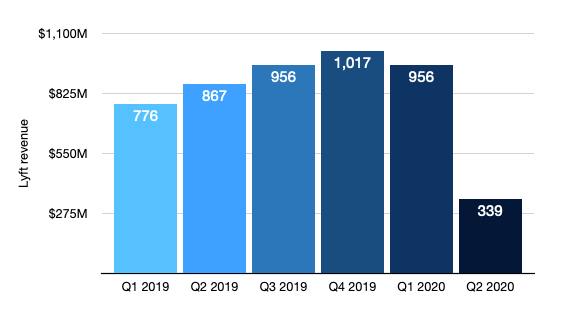
In the second quarter, Lyft reported revenue of $339.3 million and earnings per share of negative $1.41. Analysts had anticipated the company reporting revenues of $336.77 million, and a per-share loss of $0.99, according to Yahoo Finance averages.

In after-hours trading, the company’s shares are up more than 4%.

Compared to its year-ago results, Lyft’s quarter was a mess. Revenue fell from $867.3 million, or 61%, in the quarter, and its adjusted net loss in Q2 came to $265.8 million, worse than its year-ago adjusted net loss of $197.3 million. Adjusted EBITDA slipped from a $204.1 million loss in Q2 2019 to a deficit of $280.3 million in the company’s most recent quarter.

Notably, Lyft did improve its GAAP net loss compared to the year-ago period, though the company has stressed other profitability metrics in recent quarters.

Kirsten and Alex’s great How To Chart adventure.

Why are Lyft shares higher in after-hours trading? Because investors knew that Lyft’s quarter was a write-off. What they were looking for instead was a return-to-form, and a note on how much cash the company had on hand at the end of the period. Up top, Lyft answered both questions, saying that it wrapped Q2 “with $2.8 billion of unrestricted cash, cash equivalents and short-term investments,” and that “monthly rideshare rides in July were up 78% compared to April.”

That’s enough for the company to get a jolt from the public markets, despite Lyft’s operating cash flow for the first two quarters of 2020 coming to a stunning -$958.6 million.

Before we close, some other bits and bobs that stood out while we were reading the report:

  • Laying off people is expensive. Per Lyft, the company saw “restructuring charges in the second quarter of 2020 included $32.1 million of severance and related employee benefit costs” in Q2.
  • But only kinda. Later in the same paragraph, Lyft wrote that it “incurred a stock-based compensation benefit primarily related to the reversal of previously recognized stock-based compensation expenses for unvested awards of $49.8 million, resulting in a net restructuring benefit of $14.5 million” in the period.
  • Debt isn’t always bad. As of June 30, 2020, Lyft has $623.4 million in long-term debt, net of current portion. The company raised a bunch of debt earlier this year at rock-bottom monetary rates, giving it more cushion during this period of business.

We’re keeping tabs on the company’s share price and digging into rider numbers. More to come.

Sarah Cooper — known for her impressions of Donald Trump on TikTok — just landed a Netflix deal

For writer-comedian Sarah Cooper, the pandemic hasn’t been so terrible. In fact, by making the best of a lousy situation — in this case, opening a TikTok account while sheltering in place and lip syncing to the often-bizarre ramblings of Donald Trump to underscore their absurdity — she has become an outlet for a country that has often found itself asking while watching a Trump presser: “Is this real, what I’m seeing?”

Now, in addition to the millions of online followers she has amassed since March, Cooper — a Jamaican American who once worked at Google — has landed a Netflix comedy special.

Titled “Sarah Cooper: Everything’s Fine,” the writer and producer Natasha Lyonne is set to direct the production, and it will be executive produced by the comic-actor Maya Rudolph (who will herself be increasingly busy, reprising her role on “Saturday Night Live” as Senator Kamala Harris).

It’s just the latest — and biggest — feather in the cap for Cooper, who lives in New York with a software engineer husband whom she has kiddingly described as running out of patience with her Trump schtick. He “has to hear Donald Trump’s voice over and over again,” as she told Vanity Fair this summer. “I think he’s probably going to jump out the window at some point.”

Cooper also recently signed with the talent agency WME, appeared on “The Tonight Show” with Jimmy Fallon in June, and yesterday, even guest-hosted “Jimmy Kimmel Live.”

Her monologue (below) hilariously skewers her former employer, incidentally. “People always ask me if it was fun to work at Google, and it was fun. I knew I was having fun because they kept telling me how much fun I should have each quarter, or else I would be fired.”

According to that VF interview, Cooper’s other TV ambitions include writing a show about an overly confident boss who “fucks up all over the place and still somehow fails up.”

It isn’t clear if this Netflix special scratches that itch, but no doubt plenty of Trump detractors — and some supporters — will be keeping an eye out to see what it does feature. While Netflix isn’t sharing many specifics, it does say the production will be a variety special whose various vignettes deal “with issues of politics, race, gender, class, and other light subjects.”

India’s first private space launch startup Skyroot succeeds with upper-stage engine fire test

The private space launch industry has expanded significantly since the debut of SpaceX, but some markets, like India, are just now getting the regulatory support to clear the way for private players to participate. Now that those barriers are coming down, however, private launch startup Skyroot is leaping ahead on its way to becoming the first private space launch vehicle maker in the country, making significant technical progress with a new, successful upper-stage engine burn test.

Skyroot was founded two years ago by a team that includes rocket engineers who previously worked at the Indian Space Research Organization (ISRO), including CEO and co-founder Pawan Kumar Chandana . The startup has raised $4.3 million to date, including from space and defence contractor Solar Industries, and it’s currently going through the funding process again in hopes of securing another $15 million by 2021.

On the technical side, Skyroot is currently focused on developing its very first launch vehicle, the “Vikram-I,” which is in the process of being manufactured and is on track for its first launch sometime around December 2021. This successful test fire of the upper-stage engine, which is nicknamed “Raman” after Indian physicist and Nobel prize winner C.V. Raman, is an important step in validating this key component, which will handle the final insertion of any payload satellites into their target orbit once Vikram-I is operational.

This is also a key step for Skyroot’s overall rocket building technology, as it represents full qualification of its 3D-printed propellant injector, which the company says reduces the mass of the engine by 50%, and drops the components required in its construction, as well as its lead time for manufacturing, by 80%.

Next up for Skyroot are test fires of two full stages of its rocket under development, to take place over the course of the next six months. The company is also concurrently already at work on Vikram-2 and Vikram-3, next-generation launch vehicles that are set to follow in terms of availability sometime around 2022-2023, and offer cost-competitiveness with existing, larger rideshare rockets already available form private companies, including SpaceX.

Samsung Galaxy Watch 3 review

Samsung makes good smartwatches. The fact tends to get lost in discussions about a category that’s traditionally been so dominated by a single player. Things have shifted a bit of late, globally. Apple’s market share has slipped somewhat and Huawei and Samsung have been there to pick up some of the pieces.

Here in the States, Huawei is less of a player for reasons that should be painfully obvious. Google’s Wear OS is — for now at least — a non-starter. Acquisition target Fitbit has made a dent with its solid smartwatches, though it’s not quite a juggernaut. Same goes for Garmin, which does well, but commands a relatively small niche. For those looking for Android compatibility — or just an Apple alternative, generally — Samsung continues to be your best shot.

The company has long approached its wearables with a similar philosophy to the one that governs its smartwatches: lots of options, plenty of features and a big, flashy footprint. For my money, however, the top-line feature on the Galaxy Watch 3 is the return of the rotating bezel. The company recently abandoned it for its Active line, attempting to convince us that a haptic approximation was just as good. It wasn’t.

The ability to toggle between screens by spinning the border of the display has long been the Gear line’s most distinguishing characteristic — and the best smartwatch input by far. The Apple Watch crown isn’t even close. It was an odd choice for Samsung to drop it, even for a splinter line of watches. It’s back, thankfully, made from the same stainless steel casing as the rest of the watch body and sporting a perforated ridge for a better grip. There’s something satisfying in the ability to smoothly spin between screens.

The bezel is a bit thinner this time out, matching an overall reduction in case size. All told, the 3 is 14% thinner, 8% smaller and 15% lighter than the original Galaxy Watch. The 45mm model is still large, compared to other smartwatches, but this goes a ways toward addressing what’s long been one of my chief complaints with the line. Ditto for the availability of a 41mm version. Past Galaxy Watches have felt needlessly bulky — an issue with a device intended to wear on one’s person all day and night.

Image Credits: Brian Heater

The watch is still a bit big for my personal tastes, but outside of the Active line, this is definitely the most comfortable Samsung watch in some time. The metallic casing also has a fairly timeless design, as far as smartwatches go, maintaining a sporty look that’s been a standard of the line for a few generations now. I tend to prefer something a bit more minimalistic. For me, the S2 was and continues to be the pinnacle of design language for the line, but I recognize that plenty of people prefer something a bit more…complex.

The screen measures 1.4 inches on the 45mm and 1.2 inches on the 41mm — a touch smaller than the 1.65/1.5 inches found on the Apple Watch. Though, obviously the round design also offers up a different form factor. The screen is nice and clear and reads pretty well in daylight, thanks in part to the ambient light sensor. The model ships with a nice leather band, and thanks to its standardized fit, can be swapped out with an essentially infinite list of different third-party bands.

Tizen has always seemed like an odd choice, but Samsung’s very much made the operating system its own here, as Google has struggled for wider adoption with its own wearable OS. The watch’s app selection continues to lag Apple, including some bigger-name developers. There are some important partners here — most notably Spotify. With Apple making major plays on both the watch and streaming front, the partnership makes a lot of sense for both parties. Among other key features is the ability to download playlists directly to the device, so you can leave the phone at home for a workout, if you’re so inclined.

And what the Galaxy Store lacks in apps, it more than makes up for in watch faces, with more than 80,000 currently available. There are also some 40 different modular complications. You can also create custom faces by taking an image of real world patterns.

Battery life is decent, as long as you turn off the always-on display. By doing so, I was able to get a couple of hours short of two full days of life. That’s not exceptional, but it should help you take advantage of the sleep tracking a few days a week, assuming you’re comfortable falling asleep with a sizable watch on your wrist. That admittedly takes some getting used to. With always-on enabled, you can expect to get about half that total.

Image Credits: Brian Heater

The watch does a good job autodetecting select workouts. Running analysis goes a bit deeper, adding to a feature introduced with the Active 2. After a run is complete, it breaks down the specifics of your run mechanics (as best it can as a wrist-worn monitor) in an attempt to help reduce running-related injury. As a current former runner, I can attest to the fact that poor form is a really good way to injure yourself.

As Apple is finally getting serious about sleep tracking on its watch, Samsung is smoothing out its own experience. The watch breaks down light, deep and REM sleep, offering up a score for the night. I found myself getting scores in the 40s — not great, given that people in my age range apparently score around a 70. Samsung also offers up features like mindfulness and stress management to get that under control. Personally, I think getting better sleep on my end is going to take a “not constantly thinking about COVID” feature.

Image Credits: Brian Heater

Two key health additions aren’t ready out of the box here in the States: both the EKG reader and blood pressure detector will have to wait for all of the standard regulatory approval, so I’ll hold off judgment accordingly.

Samsung’s certainly not attempting to price competitively here. At $400 and $430 for the 41mm and 45mm versions, respectively, it’s a premium price tag. It’s clear that the company doesn’t see companies like Huawei or even Fitbit as its primary competitors. As with its flagship smartphones, Samsung’s got Apple firmly in its sights, and it’s priced to match. Apple is far and away still the best option for iOS users, but when it comes to Android, not many can compete with Samsung’s premium offering.


What’s different about hiring data scientists in 2020?

Michael Li
Contributor

Tianhui Michael Li is founder of The Data Incubator, an eight-week fellowship to help PhDs and postdocs transition from academia into industry. Previously, he headed monetization data science at Foursquare and has worked at Google, Andreessen Horowitz, J.P. Morgan and D.E. Shaw.

It’s 2020 and the world has changed remarkably, including in how companies screen data science candidates. While many things have changed, there is one change that stands out above the rest. At The Data Incubator, we run a data science fellowship and are responsible for hundreds of data science hires each year. We have observed these hires go from a rare practice to being standard for over 80% of hiring companies. Many of the holdouts tend to be the largest (and traditionally most cautious) enterprises. At this point, they are at a serious competitive disadvantage in hiring.

Historically, data science hiring practices evolved from software engineering. A hallmark of software engineering interviewing is the dreaded brain teaser, puzzles like “How many golf balls would fit inside a Boeing 747?” or “Implement the quick-sort algorithm on the whiteboard.” Candidates will study for weeks or months for these and the hiring website Glassdoor has an entire section devoted to them. In data science, the traditional coding brain teaser has been supplemented with statistics ones as well — “What is the probability that the sum of two dice rolls is divisible by three?” Over the years, companies are starting to realize that these brain teasers are not terribly effective and have started cutting down their usage.

In their place, firms are focusing on project-based data assessments. These ask data science candidates to analyze real-world data provided by the company. Rather than having a single correct answer, project-based assessments are often more open-ended, encouraging exploration. Interviewees typically submit code and a write-up of their results. These have a number of advantages, both in terms of form and substance.

First, the environment for data assessments is far more realistic. Brain teasers unnecessarily put candidates on the spot or compel them to awkwardly code on a whiteboard. Because answers to brain teasers are readily Google-able, internet resources are off-limits. On the job, it is unlikely that you’ll be asked to code on a whiteboard or perform mental math with someone peering over your shoulder. It is incomprehensible that you’ll be denied internet access during work hours. Data assessments also allow the applicants to complete the assessment at a more realistic pace, using their favorite IDE or coding environment.

“Take-home challenges give you a chance to simulate how the candidate will perform on the job more realistically than with puzzle interview questions,” said Sean Gerrish, an engineering manager and author of “How Smart Machines Think.”

Second, the substance of data assessments is also more realistic. By design, brainteasers are tricky or test knowledge of well-known algorithms. In real life, one would never write these algorithms by hand (you would use one of the dozens of solutions freely available on the internet) and the problems encountered on the job are rarely tricky in the same way. By giving candidates real data they might work with and structuring the deliverable in line with how results are actually shared at the company, data projects are more closely aligned with actual job skills.

Jesse Anderson, an industry veteran and author of “Data Teams,” is a big fan of data assessments: “It’s a mutually beneficial setup. Interviewees are given a fighting chance that mimics the real-world. Managers get closer to an on-the-job look at a candidate’s work and abilities.” Project-based assessments have the added benefit of assessing written communication strength, an increasingly important skill in the work-from-home world of COVID-19.

Finally, written technical project work can help avoid bias by de-emphasizing traditional but prejudicially fraught aspects of the hiring process. Resumes with Hispanic and African American names receive fewer callbacks than the same resume with white names. In response, minority candidates deliberately “whiten” their resumes to compensate. In-person interviews often rely on similarly problematic gut feel. By emphasizing an assessment closely tied to job performance, interviewers can focus their energies on actual qualifications, rather than relying on potentially biased “instincts.” Companies looking to embrace #BLM and #MeToo beyond hashtagging may consider how tweaking their hiring processes can lead to greater equality.

The exact form of data assessments vary. At The Data Incubator, we found that over 60% of firms provide take-home data assessments. These best simulate the actual work environment, allowing the candidate to work from home (typically) over the course of a few days. Another roughly 20% require interview data projects, where candidates analyze data as a part of the interview process. While candidates face more time pressure from these, they also do not feel the pressure to ceaselessly work on the assessment. “Take-home challenges take a lot of time,” explains Field Cady, an experienced data scientist and author of “The Data Science Handbook.” “This is a big chore for candidates and can be unfair (for example) to people with family commitments who can’t afford to spend many evening hours on the challenge.”

To reduce the number of custom data projects, smart candidates are preemptively building their own portfolio projects to showcase their skills and companies are increasingly accepting these in lieu of custom work.

Companies relying on old-fashioned brainteasers are a vanishing breed. Of the recalcitrant 20% of employers still sticking with brainteasers, most are the larger, more established enterprises that are usually slower to adapt to change. They need to realize that the antiquated hiring process doesn’t just look quaint, it’s actively driving candidates away. At a recent virtual conference, one of my fellow panelists was a data science new hire who explained that he had turned down opportunities based on the firm’s poor screening process.

How strong can the team be if the hiring process is so outmoded? This sentiment is also widely shared by the Ph.D.s completing The Data Incubator’s data science fellowship. Companies that fail to embrace the new reality are losing the battle for top talent.

Does ??? illustrate the power of meme culture in fundraising?

Fundraising was once a formal process.

A decade ago, founders would make pilgrimages to the stodgy investor offices that line Sand Hill Road. Now, as the coronavirus ravages the world and venture capital grows as an asset class, a first “yes” can come from an investor-matching tool built on Notion, or an entire fund can come together over a Zoom call. In this era, Twitter DMs are better for deal flow than walking around a conference.

As startup-land becomes more informal, a new generation of early-stage founders are searching for ways to make the relaxed new world work in their favor. One way this is happening?

Meme culture as a signaling mechanism.

Before Gefen Skolnick, founder of Couplet Coffee, launched her company and Slack channel for underrepresented and underresourced groups in tech, she established credibility in a unique way.

Skolnick was part of the Eye Mouth Eye ( ???) campaign that rocked Silicon Valley in June 2020. The cryptic effort was a statement on how FOMO and hype culture dominate venture capital conversations. Participants in the campaign changed their Twitter names, tweeted cryptically and earned more than 20,000 email subscribers for a product that did not even exist.

Skolnick says Eye Mouth Eye gave her a larger platform, which she’s leveraging by stepping up the pace of posting new content and launching products. She said the stunt gave her “sign-offs” from high-profile individuals, and investors have been blowing up her inbox.

“My fundraising experience has just been angel investors DMing me to tell me they’re investing,” she said.

Meme culture, she says, is the “best way the younger generation can showcase their insights, humor and commentary in a more digestible and shareable format.”

The Philips Hue Play HDMI Sync Box makes any home theater a bit more theatrical

Philips has steadily expanded its Hue line of smart lighting products to cover the entire home, inside and out. But while the ability to remotely control your lighting, including adjusting color, intensity and brightness is great, one of its more recent products focuses more on how to turn all those connected lights into a dynamic, at-home interactive entertainment experience. The Philips Hue Play HDMI Sync Box is a relatively simple device that sits between your video sources, including things like game consoles and the Apple TV, and your television, enabling synced light shows that can take advantage of a wide range of Hue products.

The basics

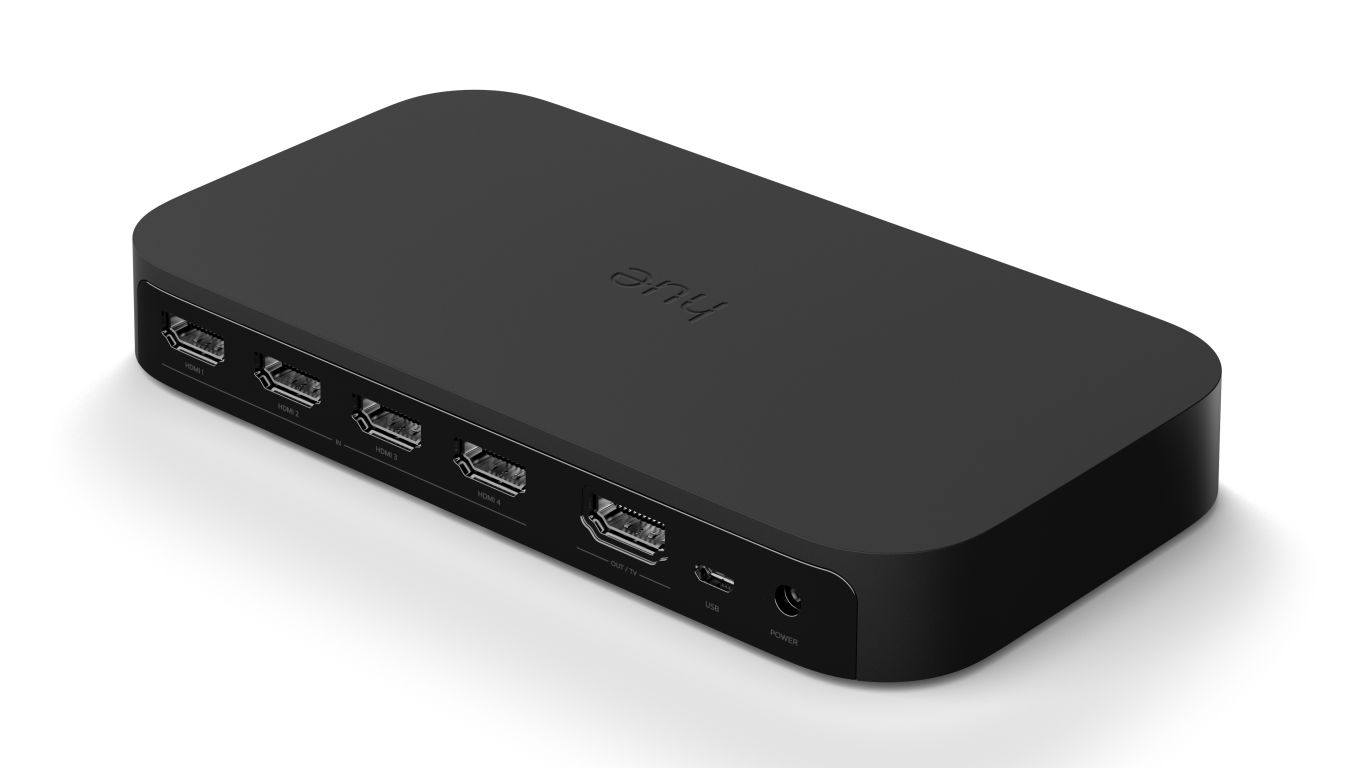
The Hue Play HDMI Sync Box is at its core an HDMI switcher, offering four HDMI inputs and a single HDMI output. Signals from your input devices (e.g., Apple TV, Roku, Xbox, PS4, etc.) go into the box and are passed through to the TV, with switching happening automatically depending on which device was most recently active (you can also change them manually with the app and with voice controls).

The Sync Box supports a range of modern quality standards for display and audio. It supports 4K 60Hz resolution, HDR10+ and Dolby Vision standards, as well as Dolby Atmos surround sound. It also supports HDMI 2.0b with HDCP 2.2 compliance for copyright protection.

You will need not only Hue colored lights, but also a Hue Bridge (the second-generation, rounded-square version) to ensure that the Hue Sync Box is more than just a particularly expensive HDMI hub, but it does that job very well, too. If you do have Hue products, like the Hue Play light bars that can easily mount on top of your TV stand or to the back of your TV itself, or the Hue Signe multicolored floor or table lamps, then you can use the Sync companion app to ensure your lights reflect what’s going on on screen — for any video that plays through the box from any source.

Image Credits: Philips

Design and performance

Why would you want this? Well, mostly because it looks really, really cool. Hue Sync has already been available as a software feature for you to use with video played back on Macs and PCs when used in combination with a monitoring tool. But that has a lot of limitations, including not being able to work with official Netflix apps and Netflix in the browser. The Sync Box eliminates any potential roadblocks and also means you can use regular streaming and gaming sources without having to run a media center PC.

The box itself is relatively large, but that seems like it’s mostly to accommodate the multiple HDMI ports. It’s very short, despite being about twice the surface area of an Apple TV, so it should be very easy to integrate into your existing home theatre setup, whatever that entails.

Setting up the Hue Play HDMI Sync Box is very easy and requires only installing the app and pressing the sync button on your Hue Bridge when instructed to do so. As mentioned, you can plug in up to four sources and the box will switch between them automatically when you use an input device or you can also manually change the input (and rename them) using the app. The app also allows you to tweak the intensity, brightness and responsiveness of the light, making it more subtle or more extreme, depending on your preferences and your activity. A “Game” setting, for instance, sets it to maximum intensity and responsiveness for a more dynamic effect befitting fast-paced interactive content.

Image Credits: Philips

I found that the lighting was extremely good at mimicking the colors and brightness of a scene, especially if you take the time to accurately set up the position of your Hue lights for a dedicated “entertainment area” in the official main Hue app. It’s an effect that, when used in its most subtle settings, can basically fade away but still provide genuine enhancement for the watching experience, making it feel more immersive. At its maxed out settings, it’s much more noticeable, but still something that basically fades away into the background over an extended period of use, in a good way.

Especially since the firmware update, the Hue Play Sync Box has proven a fantastic addition to my home theater setup, providing an extra bit of flair to every TV watching experience. It’s obviously more effective in dark rooms, but it really seems to especially complement high-quality OLED screens that produce vibrant colors and true, deep blacks.

Bottom line

The Hue Play HDMI Sync Box is a bit of an extravagance at $229.99, but it definitely adds to the overall home TV-watching experience, for movies, streaming and for gaming. The four HDMI inputs mean you can also use it to add more ports to your TV, if that’s something you need, and the recent updates mean you’re not going to sacrifice any video quality while doing so.


Save with group discounts to TC Sessions: Mobility 2020

If you’re tech-obsessed about the future of moving people, products and packages around the world, you do not want to miss TC Sessions: Mobility 2020 on Oct. 6-7. Two packed days of online programming feature the people leading the charge — creative thinkers, innovative makers, dedicated engineers and savvy investors across the mobility and transportation startup ecosystem.

Join your tribe and dive into the conversation. Early bird tickets cost $145 but, like they say, the more the merrier. Take advantage of our group discount, bring your crew and save $25 per ticket when you buy four or more passes before prices go up on Sept. 4 at 11:59 p.m. PDT.

We’ve built a stellar lineup of speakers, breakout sessions and demos, and we’ll announce a few more additions in the weeks ahead. Read on for a taste of what you can expect, and you can check out the agenda here.

  • Roll in the autonomous scooters! Dmitry Shevelenko is the co-founder of Tortoise, a startup focused on automatic repositioning for micromobility vehicles. He’ll join us to talk about, among other things, using autonomous technology in tandem with remote human intervention.
  • Let’s talk investing, shall we? You’ll be hard-pressed to find anyone with more experience in mobility investment than Olaf Sakkers, general partner at Maniv Mobility, a global investment fund. We can’t wait to hear his expert perspective.
  • Porsche, always an electrifying car, is set to take on electric cars in a big way — expanding on the Taycan, which the sports car manufacturer unveiled in September. Where is Porsche headed next? That’s what we’ll ask Klaus Zellmer, the president and CEO of Porsche Cars North America, when he joins us on stage.

In a classic “but wait there’s more” moment, we’ll also have dozens of exhibiting startups and plenty of opportunity to network and recruit. CrunchMatch — our free business matchmatching platform — makes setting up meetings with the right investors, founders, engineers and students easier, faster and more productive. You never know who you’ll meet at a TechCrunch event — or where that connection will lead.

Meet, greet, connect and learn at TC Sessions: Mobility 2020 on Oct. 6-7. Grab your posse and jump on this group discount opportunity. You’ll save $25 off the early bird ticket price when you buy four or more passes before Sept. 4 at 11:59 pm PDT. Save, adapt and keep moving forward.

Is your company interested in sponsoring or exhibiting at TC Sessions: Mobility 2020? Contact our sponsorship sales team by filling out this form.

Uber CEO says service faces temporary shutdown in California over worker reclassification ruling

Uber could be forced to shut down its ride-hailing app in California for several months if a court doesn’t overturn a recent ruling that classifies its drivers as full-time employees, CEO Dara Khosrowshahi said in an interview with MSNBC.

“It’s hard to believe we’ll be able to switch our model to full-time employment quickly,” Khosrowshahi said, noting it would force the company to temporarily shut down. Khosrowshahi’s comments are consistent to language in a motion filed Tuesday by Uber following the court’s ruling.

Uber shares were down about 1.4% in midday trading.

On Monday, California Superior Court Judge Ethan Schulman granted a preliminary injunction forcing Uber and Lyft to reclassify its drivers as employees. This order is set to go into effect in 10 days. The judge acknowledged that the order would change the nature of Uber and Lyft’s business practices in “significant ways” and implementing the injunction would be “costly.” However, those hardships weren’t enough to sway the court from classifying drivers as employees, a decision that would force Uber and Lyft to provide unemployment insurance and other benefits.

California Attorney General Xavier Becerra, along with city attorneys from Los Angeles, San Diego and San Francisco, brought the lawsuit against Uber and Lyft to force the companies to comply with AB 5.

Uber’s attorneys requested in its motion filed Tuesday that an injunction should be stayed while the Court of Appeals makes its decision over whether the ruling should stand. The attorneys argued that “Uber will almost certainly be forced to shut off the Rides platform in California if the injunction goes into effect, which would irreparably harm Uber and all who rely on its Rides app to generate income for them and their families — particularly in the midst of a pandemic.”

Dog food startup Sundays launches its air-dried kibble alternative

Michael Waxman, co-founder and CEO of dog food startup Sundays, acknowledged that dog owners have no shortage of options when it comes to feeding their beloved pets — but he still thinks there’s room for something new.

“There’s a sort of ‘Water everywhere, but not a drop to drink’ phenomenon,” Waxman said. “There are over 3,000 dog foods, and yet I think there isn’t really one that is the no-brainer, compelling answer.”

Sundays “soft launched” its first product in February and now has around 1,000 paying customers. It’s launching more broadly today and is also announcing that it has raised $2.27 million in funding from Red Sea Ventures, Box Group, Great Oaks Ventures, Matt Salzberg, Zach Klein and others.

Waxman’s past startups include dating app Grouper, while his wife/co-founder Tory Waxman is a veterinarian (and serves as the startup’s chief veterinary officer). He told me that the two of them became interested in pet food a couple years ago when one of their dogs started to have stomach issues, and they “went down this rabbit hole of trying to find the best dog food.”

The market can be divided two broad categories, Waxman said. There’s kibble, which is relatively cheap and affordable but not as healthy. Then there’s refrigerated food, including direct-to-consumer options like The Farmer’s Dog, which are healthier but also pricier and require more preparation.

“Those are so unbelievably inconvenient,” Waxman argued. “You’re not going to find too many people crazier about their dogs than we are, and we would do literally anything for our dogs — except prepare their food for an hour a day.”

Sundays

Image Credits: Sundays

So he’s pitching Sundays as a “new, third category of dog food between kibble and refrigerated.” It’s supposed to be human-grade dog food that’s 90% fresh meat, organs and bones, created through a unique air drying process.

For dog owners who rely on kibble, Waxman said the startup offers “a much higher-quality product that tastes much better and doesn’t compromise on the convenience that you’re used to,” while for owners who currently pay for refrigerated options, he promised “an all-around unbelievable increase in convenience, without any compromise in quality and taste.”

Several early customers compared the food to beef jerky in their reviews. Waxman added that in taste tests, dogs preferred Sundays to premium kibble 40-to-0.

The food is available for both one-time and subscription purchase. A single 40-ounce box currently costs $75, while the same box costs $59 via subscription.

Waxman suggested that it hasn’t been easy getting to this point — with a new process for creating dog food, “there were no supply chains set up for this.” Ultimately, he said Sundays selected a “USDA-monitored jerky kitchen in the U.S. to create this new form factor.”

“It took us much longer than we expected,” he admitted. “However, the short-term headache is a long-term feature that we’re really excited about. Ultimately, it should serve as a pretty deep moat to prevent would-be competitors from offering similarly high quality and differentiated products.”

Triplebyte incubates ColorStack to increase Black and Latinx representation in CS programs

Triplebyte, a technical recruiting platform that emphasizes a candidate’s skills rather than background, has incubated nonprofit ColorStack, which aims to increase the number of Black and Latinx people enrolled in computer science programs.

ColorStack, a mentorship-driven community of Black and Latinx engineering students, officially launched in May, but got its bearings at Cornell, where founder Jehron Petty successfully worked to triple Black and Latinx enrollment in the school’s computer science program within three years. Now, as ColorStack, the goal is to produce similar outcomes at additional schools throughout the country.

Currently, ColorStack’s community consists of more than 600 students across more than 250 schools.

“The main source of impact we can drive is getting them to persist through the major,” Petty (pictured below) told TechCrunch.

Image Credits: Jehron Petty

From there, Petty leans on other organizations, such as dev/color, which looks to get Black and Latinx folks into careers at tech companies.

“What we’re solving for them is this next level of growth — where the next set of engineers they support come from,” Petty said.

For Triplebyte, its general mission operative is to increase access to opportunities. When the company first launched, a major goal was to have a significant impact on diversity in terms of race and gender, TripleByte co-founder and CEO Ammon Bartram told TechCrunch.

“One-and-a-half years in, I was surprised and unhappy to see that, in terms of race and gender, our results looked pretty much identical to startups. We had a big impact on socioeconomic opportunity, but the big identity categories of race and gender were in the same depressing ratios of Silicon Valley’s traditional ratio.”

Bartram said he began talking to his advisors about the issue and that’s when Y Combinator CEO and partner Michael Seibel, who is a board member at Triplebyte, encouraged Bartram to think outside of the box. Seibel encouraged Bartram to treat the problem like a startup and to try new things, Bartram said.

Triplebyte considered things like sponsoring Grace Hopper, or bringing in a head of diversity, “but the truth of the matter is, the majority of larger companies do these things but the percentage of Black and Latinx engineers has barely increased over the years,” Bartram said.

“The status quo is broken and not working,” Bartram said. “People have done great work but it’s still not working.”

This is how Triplebyte found its way to ColorStack. What stood out about them was the success they were already having.

“It can be a bleak field — diversity and inclusion,” Bartram said. “There’s been so little change in the stats. But one thing that has been shown to work is mentorship. Role models, people who look like you, have a huge impact on people staying in tech and not leaving. But the mentorship role model, with people who look like them, has a huge impact on people choosing a mentor, staying involved and not leaving.”

Through the incubation, ColorStack will remain independent while also not having to worry about funding. Additionally, Triplebyte pays Petty a salary and provided ColorStack with operating funds for two years.

“If it goes well, we might extend it,” Bartram said. “My goal here is for Jehron to succeed. There’s lots of synergy between what we’re doing. We’re a for-profit company but we’re pretty mission driven. I’m doing this because I want to do something more impactful than the work I did in the past. Success would be ColorStack having an impact and doing the work that worked at Cornell and duplicating that at even 10% of the colleges out there. That’s a huge increase in representation of Black and brown folks in engineering.”

The race to building a fully functional quantum stack

David Cowan
Contributor

David Cowan is a partner at Bessemer Venture Partners and one of the world’s leading investors across cloud infrastructure, cybersecurity, consumer and space technology.

Tomer Diari
Contributor

Tomer Diari is a vice president at Bessemer Venture Partners, where he focuses primarily on cybersecurity, big data and deep tech opportunities.

Quantum computers exploit the seemingly bizarre yet proven nature of the universe that until a particle interacts with another, its position, speed, color, spin and other quantum properties coexist simultaneously as a probability distribution over all possibilities in a state known as superposition. Quantum computers use isolated particles as their most basic building blocks, relying on any one of these quantum properties to represent the state of a quantum bit (or “qubit”). So while classical computer bits always exist in a mutually exclusive state of either 0 (low energy) or 1 (high energy), qubits in superposition coexist simultaneously in both states as 0 and 1.

Things get interesting at a larger scale, as QC systems are capable of isolating a group of entangled particles, which all share a single state of superposition. While a single qubit coexists in two states, a set of eight entangled qubits (or “8Q”), for example, simultaneously occupies all 2^8 (or 256) possible states, effectively processing all these states in parallel. It would take 57Q (representing 2^57 parallel states) for a QC to outperform even the world’s strongest classical supercomputer. A 64Q computer would surpass it by 100x (clearly achieving quantum advantage) and a 128Q computer would surpass it a quintillion times.

In the race to develop these computers, nature has inserted two major speed bumps. First, isolated quantum particles are highly unstable, and so quantum circuits must execute within extremely short periods of coherence. Second, measuring the output energy level of subatomic qubits requires extreme levels of accuracy that tiny deviations commonly thwart. Informed by university research, leading QC companies like IBM, Google, Honeywell and Rigetti develop quantum engineering and error-correction methods to overcome these challenges as they scale the number of qubits they can process.

Following the challenge to create working hardware, software must be developed to harvest the benefits of parallelism even though we cannot see what is happening inside a quantum circuit without losing superposition. When we measure the output value of a quantum circuit’s entangled qubits, the superposition collapses into just one of the many possible outcomes. Sometimes, though, the output yields clues that qubits weirdly interfered with themselves (that is, with their probabilistic counterparts) inside the circuit.

QC scientists at UC Berkeley, University of Toronto, University of Waterloo, UT Sydney and elsewhere are now developing a fundamentally new class of algorithms that detect the absence or presence of interference patterns in QC output to cleverly glean information about what happened inside.

The QC stack

A fully functional QC must, therefore, incorporate several layers of a novel technology stack, incorporating both hardware and software components. At the top of the stack sits the application software for solving problems in chemistry, logistics, etc. The application typically makes API calls to a software layer beneath it (loosely referred to as a “compiler”) that translates function calls into circuits to implement them. Beneath the compiler sits a classical computer that feeds circuit changes and inputs to the Quantum Processing Unit (QPU) beneath it. The QPU typically has an error-correction layer, an analog processing unit to transmit analog inputs to the quantum circuit and measure its analog outputs, and the quantum processor itself, which houses the isolated, entangled particles.

Abandoned mall department stores may become Amazon’s next fulfillment centers

One of the largest owners of shopping mall real estate in the United Stages, Simon Property Group, has been talking to Amazon about transforming its anchor department stores into Amazon distribution hubs, according to the Wall Street Journal.

In the case of Simon Property, the anchor tenants like J.C. Penney and Sears that used to be stable sources of revenue are now weights around the neck of the retail real estate manager, and transforming their ghostly halls of pale mannequins into warehouses for Amazon orders simply makes sense.

The transformation from showroom to storehouse for everything from books and sweaters to kitchenware and electronics won’t be too much of a stretch for the vacant storefronts of businesses that hvae both filed for Chapter 11 bankruptcy protection.

Simon’s holdings include some 63 JC Penney and 11 Sears stores, according to the Journal’s reporting citing a May public filing from the real estate developer.

This wouldn’t be the first time that Amazon had turned to mall real estate for fulfillment centers. in 2019, the online retailer acquired a massive physical footprint in Akron, Ohio that it turned into a distribution center.

Gone are the days when gum smacking tweens and teens and their beleaguered parents would head to the local mall for a stroll around the retail block. Now shoppers prefer to peruse online and kids find Fortnite to be the Hot Topic to hang in. 

The deal, if it goes through, would be another nail in the coffin for a staple of late twentieth century culture that now mostly exists in the memory of baby boomers and Gen X consumers (thanks millennials and Gen Z).

Malls these days are lifestyle affairs that promise boutique branded shops than the sprawling department stores that had something for everyone. The big-box spaces that the Journal reported Amazon is negotiating for are the 100,000 square foot, multi-story behemoths, that are likely not long for the long tail world of niche commerce anyway.

These days, consumers are looking for brands that appeal to a persona or the bottom line of a pocketbook, and not the mass casual one-stop-shop of late twentieth century department store off-the-rack identities.

The Journal reported that, if the deals went through, Simon would like rent the space at a considerable discount to what it would charge another retailer. The paper estimated that rents could be as low as $4 per square foot to $19 per square foot, while warehouse rents average about $10.

At this point, shopping malls are looking for anything to bring in money. They’ve already tried schools, medical offices and senior living facilities, but the COVID-19 epidemic has thrown all of those plans into the abyss.

And, as the Journal notes, malls are already located in places that make them attractive distribution hubs. Amazon has bought some sites already and FedEx and DHL have done the same, according to the paper.

At this point, Amazon ownership may be a better fate for the real estate than totally abandoning it to empty space and the lingering soundtrack of 80s rock.


Gillmor Gang: Tic Talks

The Gillmor Gang — Frank Radice, Michael Markman, Keith Teare, Denis Pombriant, Brent Leary, and Steve Gillmor . Recorded live Sunday, August 2, 2020. For more, subscribe to the Gillmor Gang Newsletter and join the notification feed here on Telegram.

Produced and directed by Tina Chase Gillmor @tinagillmor

@fradice, @mickeleh, @denispombriant, @kteare, @brentleary, @stevegillmor, @gillmorgang
The Gillmor Gang on Facebook

The latest G3: