This week, we look at the Microsoft Surface Duo and wonder if an expensive, dual-screen device like this one feels relevant, or just needlessly extravagant.
Category: Tech news
hacking,system security,protection against hackers,tech-news,gadgets,gaming
Making a Covid-19 Vaccine Is Hard. Making One for Kids Is Harder
As researchers deepen their understanding of children’s role in the pandemic, some argue they are being overlooked in the race to a vaccine.
Makeup Classes Have Gone Virtual—and We Tried One Out
Many small companies and beauticians have updated in-store lessons for the new stay-at-home world. Think beauty YouTube, but better.
‘Project Power’ Is a Secret Lesson About Science’s Dark Side
Netflix’s new film updates a played-out superhero trope with a hidden message about the evils of human experimentation.
Epic Games’ Lawsuits Fire a Shot at Apple and Google’s App Store ‘Monopolies’
The Fortnite developer filed suits today in California that suggest it may even want to launch its own app stores on iOS and Android.
ISIS Allegedly Ran a Covid-19 PPE Scam Site
The Justice Department says that an agent of the terrorist organization operated FaceMaskCenter.com, in part of a series of cryptocurrency-related complaints.
Motorola Edge and Edge Plus Review: 2-Day Battery (and Some Quirks)
Motorola’s first flagships in years are fantastic in many ways, but the Edge and Edge Plus have high price tags and too many quirks.
The Logic Around Contact Tracing Apps Is All Wrong
Rather than tracking individual exposures, we should be using them for real-time info on what activities and locations may be responsible for the spread.
Stream, whose APIs help product teams build chat and activity feeds fast, just raised a $15 million Series A round
Earlier this year, the founders of Stream, a five-year-old, 60-person startup with offices in Boulder and Amsterdam, weren’t feeling so great about their prospects. As COVID-19 began its spread in the U.S., some smaller customers of the startup — whose APIs enable product teams to build chat and activity feeds for their applications — began to fold.
“It was really scary when [the virus] initially hit, because a lot of our smaller customers went out of business, which made us worry about what would happen to the larger ones,” recalls Thierry Schellenbach, who started Stream with Tommaso Barbugli, the lead engineer at his last startup.
“One [larger customer] did go bankrupt, which impacted our numbers.” But then a strange thing happened, he says. Companies in education and healthcare and online events and even religious communities began beefing up their online operations, and turning in part to Stream to do it.
Schellenbach understood the impulse He and Barbugli created Stream to address a pain they felt firsthand at Schellenbach’s first company out of college — a social network that was ultimately acquired for a modest sum by a private equity firm in the Netherlands, says Schellenbach. Though it grew to “millions of users,” he says, its activity feed was routinely failing as the network scaled, given its many moving partners involved, and it took a “ton of engineering resources to keep it working well.” The two knew the world needed more off-the-shelf software and specifically software focused on activity feeds, so they began building it themselves.
But that’s not the only reason the company is gaining traction. Schellenbach attributes Stream’s resiliency in the pandemic to a decision 10 months ago to also begin developing a chat API (after seeing customers trying to build their own atop their activity feeds). Now, not only are schools like Harvard, social media companies like Dubsmash, and the health information site Healthline customers nowbut investors are beginning to take more notice.
Indeed, today the company is announcing it has closed a $15 million Series A round that was led by GGV Capital and included 01 Advisors, Knight, seed round lead investor Arthur Ventures, and other backers, including Datadog CEO Olivier Pomel and GitHub cofounder Tom Preston-Werner. The round brings the company’s total funding to $20.25 million.
It was also raised from many individuals who Schellenbach (based in Boulder), and Barbugli (based in Amsterdam), have never met in person, including the GGV team.
Schellenbach credits GGV for not hewing too closely to old models during these socially distanced days, as did “three or four” VCs with whom he’d spoken and who said he’d have to meet them in San Francisco in order to make a deal happen.
He also credits Stream’s fundraising success to the accelerator program TechStars, which Stream entered when it was just two months old back in 2015. As he explains, his first startup — that social network — was based in the Netherlands, and launching Stream, he and Barbuglihad “no VC connections. So TechStars was important to open up the fundraising side of things.”
Those references have only bred more references — and now, more than ever — it makes a difference, he observes. “We’re lucky,” he says. Stream was introduced to GGV. GGV then introduced the team to Dick Costolo of 01 Advisors.
Meanwhile, for “companies trying to raise a seed round, if you don’t have clear references, right now, it’s tough.”
Photo of Schellenbach and Barbugli, circa 2015, courtesy of Stream.
Moka, the HR tool for Arm and Shopee in China, closes $43M Series B
Investors are betting on the automation of human resources management in China. We reported last year that Moka, one of the key players in the space, secured roughly $27 million for its Series B led by Hillhouse Capital. This week, the startup announced closing a Series B+ at over 100 million yuan ($14.4 million), lifting its total raise for the B round to 300 million yuan ($43.2 million).
The startup declined to disclose its investors in the latest round, saying the proceeds will go towards recruitment, product innovation and business expansion. GGV Capital invested in its Series A round.
Chinese investors have in recent years shifted more attention to enterprise-facing products as the consumer tech market becomes crammed. Moka makes software to aid HR managers’ day-to-day operations, from posting job openings, discovering potential candidates, to managing current staff. For instance, Moka will alert the HR manager when employees update their resumes, a sign that they could be sniffing out new opportunities.

Moka’s newly appointed CEO Li Guoxing, a former engineer at Facebook
As the new round closed, Moka also appointed its co-founder Li Guoxing as its new chief executive officer. The five-year-old Beijing-based startup was founded by Li, a Facebook veteran, and Zhao Oulun, who was previously the CEO of the company. Zhao worked at the car-sharing service Turo in San Francisco before returning to China.
The new CEO claimed that Moka acquires users at two-third of the industry average cost, with subscription renewal rate for its software-as-a-service hovering above 100%. “The future of business competition definitely lies in the fight for talent,” he said. “So hiring will surely become a company strategy in the future.”
As of June, Moka had accumulated over 700 paid clients, from tech giants like Xiaomi, Didi, Arm China, Shopee, Alibaba, to fast-food giants Burger King and McDonald’s. Its team of 300 staff operates out of five major cities in China.
How China’s ACRCloud detects copyrighted music in short videos
Music is front and center in the rise of TikTok and other short-video apps. It’s not just the video platforms that are harvesting the fruit of their surging popularity. Music rights holders are also prepared to extract money from the millions of songs found in snappy user-generated videos.
To detect copyrighted content, record labels and publishers summon a technology called audio fingerprinting, a tool pioneered by now Apple-owned Shazam. ACRCloud, a five-year-old startup based in Beijing and Düsseldorf, competes with the likes of Audible Magic and Nielsen-owned Gracenote to provide that service. It can quickly match a target song’s “fingerprint” or ID — key acoustic features like the tempo and tones of a piece — with a reference database of millions of tracks.
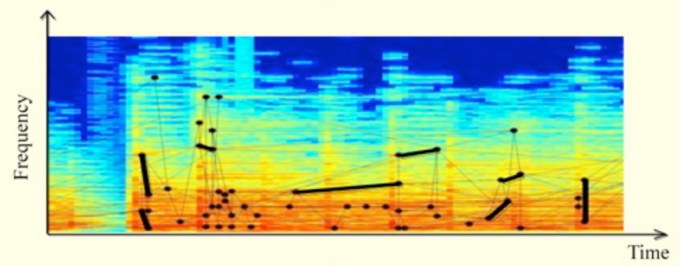
The audio fingerprint, or digital summary of an audio signal (Source: ACRCloud)
ACRCloud helps monitor copyright usage for some of the largest music labels in the West, names of which the company cannot disclose because the partnerships are confidential. The record labels apply the startup’s automated content recognition (hence its name ACRCloud) algorithms to monitor works present in radio and TV programs, user-generated content on platforms like YouTube and TikTok, or whichever service that should be paying the copyright holders.
It’s not just the publishers and labels that keep tabs on their intellectual property. For compliance purposes, broadcasters and UGC services also proactively track the music that gets played through their channels.
In the nascent short-video industry, big labels normally charge an astronomical flat fee from UGC platforms, ACRCloud co-founder Tony Li said, and the rate is often disproportionately larger than the cost of actual usage. To cut down expenses, several major Chinese short video apps recently began using ACRCloud’s acoustic algorithms to log what tunes users insert in their videos.
On the other hand, many small copyright holders and labels hardly earn any royalties because they lack a system that can automatically match music usage to royalties.
That’s where content identification can play a role. “UGC platforms use an audio fingerprinting service to generate royalty reports, making music usage more transparent to both UGC platforms and rights owners,” Li told TechCrunch.
UGC services can face huge fines if they are found plagiarizing. Earlier this year, a group of music publishers and songwriters reportedly threatened to sue TikTok over copyright infringement. It’s unsurprising to see TikTok’s parent company ByteDance doubling down on music licensing and even developing its own artists to be less dependent on big labels.
The other obvious use case of acoustic fingerprinting is song recognition, a technology pioneered by Shazam, where Li worked from 2012 to 2014 to help the company expand to China. Phone makers like Huawei, Xiaomi and Vivo have integrated ACRCloud’s music recognition technology into their devices.
Li has always been in the space of audio technology. Aside from his stint with Shazam in China, the entrepreneur also previously worked on Huawei’s ringtone business in African markets. Li has never raised outside funding for ACRCloud and has kept the team small, with only 10 employees.
ByteDance in talks with India’s Reliance for investment in TikTok
Chinese giant ByteDance is engaging in early discussions with Reliance Industries Limited, the parent firm of telecom giant Jio Platforms, for financially backing TikTok’s business in India in a move to potentially save the popular video app’s fate in its biggest market by users, two people familiar with the matter told TechCrunch.
The two companies began conversations late last month and have yet to reach a deal, the sources said, requesting anonymity as the talks are private. TikTok’s business in India, where it had amassed over 200 million users before it was banned in late June, is being valued at more than $3 billion, one of the sources said.
ByteDance did not respond to a request for comment.
An investment in TikTok could help the oil-to-retails giant Reliance, the most valuable firm in India, make deeper connections with consumers. Even as Jio Platforms has amassed nearly 400 million users in India in less than four years of its existence, its consumer-facing apps have struggled to replicate that appeal.
Since late April this year, the Indian giant’s digital venture has raised about $20 billion from 13 high-profile investors, including Facebook and Google. Google said it would work with Jio Platforms to launch a customized version of its Android mobile operating system to power low-cost Android smartphones. Facebook said it would collaborate with Reliance to help digitize the country’s 60 million small and medium-sized businesses.
The preliminary talks between the two companies comes as ByteDance also struggles to retain some key employees in India. A handful of high-level executives at the company, including a policy head and Rohan Mishra, who oversaw ByteDance-owned Helo app’s operations in India, have left the company in recent weeks, according to people familiar with the matter. Mishra did not respond to a request for comment Wednesday noon.
ByteDance has assured employees that it is in conversation with the Indian government to resolve New Delhi’s concerns and does not plan to layoff employees in the country. ByteDance employs about 2,000 people in India.
ByteDance is separately engaging with Microsoft to sell its business in select markets, including the U.S., the Windows-maker confirmed earlier this month. Financial Times reported last week that the two companies had broadened the scope of the deal to include TikTok’s business in other markets, including Europe and India.
Any deal with Reliance — owned by Mukesh Ambani, India’s richest man and who is an ally of India’s Prime Minister Narendra Modi — could help ByteDance allay concerns of the Indian government, which banned TikTok and 58 other apps developed by Chinese firms citing security concerns in late June.
Scores of local startups, including Twitter-backed ShareChat and Times Internet’s Gaana and MX Player, have launched standalone apps or integrated features to replicate the social experience TikTok provided to users. The local apps have claimed to have added tens of million of new users in recent weeks.
Facebook, which launched Reels in Instagram in India last month, has seen the daily engagement across its family of services surge more than 25% since the ban on TikTok, according to a person familiar with the matter.
Minted.com CEO Mariam Naficy shares ‘the biggest surprise about entrepreneurship’
At TechCrunch Early Stage, Minted CEO and serial founder Mariam Naficy got into the weeds with us on some of the topics founders don’t often discuss. What’s the difference between expectations and reality when it comes to entrepreneurialism? How do you split responsibilities between co-founders? What’s the key to being great at hiring?
We also talked about some of the harder parts of being a leader, including how to handle layoffs and what to do with an employee who likes to rock the boat.
Minted is an e-commerce platform that connects indie designers with customers for products like stationary, art and home goods. The company has raised nearly $300 million and generates hundreds of millions in revenue. And it’s not Naficy’s first stint as a founder: she previously co-founded Eve, which she eventually sold for $100 million+, according to reports.
We covered a lot of ground in the interview, including some questions from the audience, which you can check out in the video below. You’ll also find a lightly edited transcript of the conversation.
The most surprising part of being an entrepreneur
I didn’t realize what was, I think, one of the biggest differences, which is how much, if you are successful, you become a leader of people, whether you are a reluctant leader of people or an enthusiastic leader of people. If you’re successful, your company will inevitably grow and you end up, believe it or not, being a role model for people. People actually look at you and they emulate your behavior and that is not something that I expected.
I thought I was just going to be making products and selling products. I just didn’t think that it was gonna be such a people job — a management job, a talent development job, a leadership job — and that people would care when you walked in the building every day whether you said hello to them in the morning. They would actually notice whether you said “hi” or not to them at the coffee bar when you’re half asleep. What you do every minute actually matters. Every minute of the day. So I think that’s probably the biggest surprise about entrepreneurship.
Being a sole founder versus starting out with a co-founder
Daily Crunch: Uber CEO says CA shutdown may be necessary
Uber’s CEO pushes back against a potential reclassification of drivers, a former COO sues Pinterest and Microsoft reveals details about the Surface Duo. This is your Daily Crunch for August 12, 2020.
The big story: Uber CEO says CA shutdown could be necessary
Uber CEO Dara Khosrowshahi appeared on MSNBC today and claimed that if a recent California court ruling reclassifying drivers as full-time employees is not overturned, the company might have to suspend services in that state for several months.
“It’s hard to believe we’ll be able to switch our model to full-time employment quickly,” Khosrowshahi said.
In a recent New York Times op-ed, the chief executive argued that making drivers full-time employees would make things worse for both drivers and riders. Instead, he advocated for other legislative solutions like requiring gig economy companies to create benefits funds for their workers.
The tech giants
Former COO sues Pinterest, accusing it of gender discrimination, retaliation and wrongful termination — Françoise Brougher, who says she was abruptly fired from the company in April, is suing the company to hold it “accountable for discrimination, retaliation, and wrongful termination in violation of the Fair Employment and Housing Act (FEHA), and the Labor Code.”
Microsoft’s dual-screen Surface Duo arrives September 10 for $1,399 — Microsoft’s dual-screen mobile device took an important step closer to reality, with a release date and price.
Square’s Cash App tests new feature allowing users to borrow up to $200 — You’ll be expected to pay the loan back in four weeks, along with a flat fee of 5%.
Startups, funding and venture capital
Court dismisses Genius lawsuit over lyrics-scraping by Google — The lawsuit, filed in December, accused Google of violating Genius’s terms of use and unjustly enriching itself by scraping lyrics on the site to be displayed on searches for songs.
Gong raises another $200M on $2.2B valuation — Gong CEO Amit Bendov says his company is trying to create a category he described as “revenue intelligence.”
Personal training sessions come to ClassPass — These personal training sessions will be virtual and follow the same UX flow as ClassPass’s recently introduced virtual classes.
Advice and analysis from Extra Crunch
Does 
 illustrate the power of meme culture in fundraising? — The cryptic effort was a statement on how FOMO and hype culture dominate venture capital conversation.
Dear Sophie: How can we sponsor H-1B transfers and extensions? — A startup asks about job applicants who need to get their H-1B visas renewed.
(Reminder: Extra Crunch is our subscription membership program, which aims to democratize information about startups. You can sign up here.)
Everything else
Sarah Cooper, known for her impressions of Donald Trump on TikTok, just landed a Netflix deal — Titled “Sarah Cooper: Everything’s Fine,” the production will be directed by Natasha Lyonne and executive produced by the Maya Rudolph.
Save with group discounts to TC Sessions: Mobility 2020 — If you’re tech-obsessed about the future of moving people, products and packages around the world, you do not want to miss TC Sessions: Mobility 2020 on October 6-7.
The Daily Crunch is TechCrunch’s roundup of our biggest and most important stories. If you’d like to get this delivered to your inbox every day at around 3pm Pacific, you can subscribe here.

Digitizing Burning Man
For decades, Burning Man has represented an escape from the current reality. An event for free-er spirits to rethink new age ideals inside a stateless entity where art, music and partying reign supreme on the desert plains.
Over the years, the Bay Area-founded event has dealt with an internal clash as the gathering has grown larger and attracted a heavy presence from Silicon Valley’s wealthy tech class, with tales of turnkey experiences, air-conditioned camps, helicopters and lobster dinners. Now, under the shadow of a historic pandemic, the organization behind the massive, iconic event is desperately working to stick to its roots while avoiding financial ruin as it pivots the 2020 festival to a digital format with the pro bono help of some of its tech industry attendees.
With just a few weeks before the event is set to kick off, the organization is bringing together a group of technologists with backgrounds in virtual reality, blockchain, hypnotism and immersive theatre to create a web of hacked-together social products that they hope will capture the atmosphere of Burning Man.
Going virtual is an unprecedented move for an event that’s mere existence already seems to defy precedent.
Burning Man is held in late August every year inside Nevada’s Black Rock Desert. For nine days, the attendees, who refer to themselves as Burners, fill up the desolate landscape with massive art installations, stages and camps. Attendance has been climbing over the past several decades, to the point that the federal government got involved, creating a more than 170-page report arguing why the event’s attendance should be capped. More than 78,000 people attended in 2019.
It’s an escape from society in a shared social experience that doesn’t seem to be replicable elsewhere.
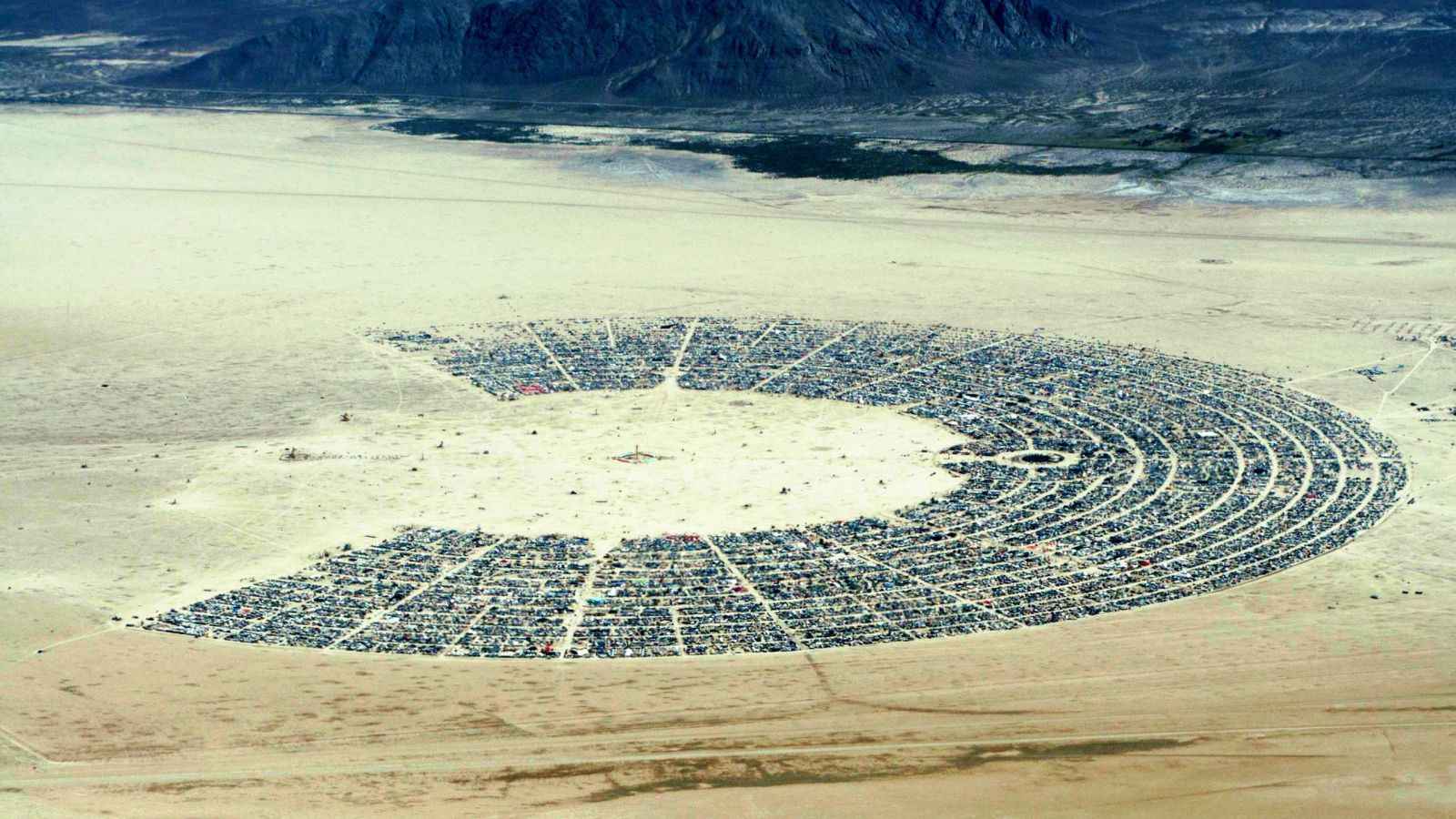
Black Rock City irl. // Viaggio Routard (opens in a new window) / Flickr (opens in a new window) under a CC BY 2.0 (opens in a new window) license.
The Multiverse
Steven Blumenfeld became the CTO of Burning Man days before the org’s leaders publicly announced that, due to the COVID-19 pandemic, the physical event was being abruptly canceled and the team was going all-in on a virtual gathering. Though the serial CTO expected the position to largely involve crusty tasks maintaining the event’s media infrastructure, he soon was pressed to rethink the front-end of a sprawling event that’s decades old and steeped in lore.
“My first inclination is, ‘Great! Let’s go build a big 3D VR world blah blah blah… So then I spent the first two weeks looking at what I had for staff, what I had for time frame, and what we could actually do,” Blumenfeld says. “There was just no way. And you know, I actually still wanted to do it. I wanted a challenge… but the reality was it just wasn’t going to happen.”
Burning Man is a massive undertaking, with a particularly deep emotional hold inside San Francisco, where it was first held in 1986, and by extension Silicon Valley. It isn’t all that surprising that when the Burning Man Project announced the event was making the move to a digital format, there was a rapid influx of community input to help decipher what an on-the-grid virtual Burning Man might look like.
“We had 14,000 people tell us they wanted to contribute in some way to a virtual Black Rock City,” said Kim Cook, the org’s director of art and civic engagement. “Some of them said what they wanted to contribute was love; so that’s cool. We also had around a thousand of them say they wanted to do developer-type work.”
Some of the groups that reached out to the Burning Man Project were companies that were willing to build a Burning Man experience but wanted official branding present. Despite a precarious financial position, Burning Man’s organizers declined help from these sponsors, citing the org’s adherence to “de-commodification” — a desire to prevent corporate infiltration of the event, eschewing advertising, branded stages and corporate partnerships.
Turning away from the professional studios, Blumenfeld and others settled on a network of small indie teams filled with Burners that were willing to develop the official digital experiences for the event on their own time.
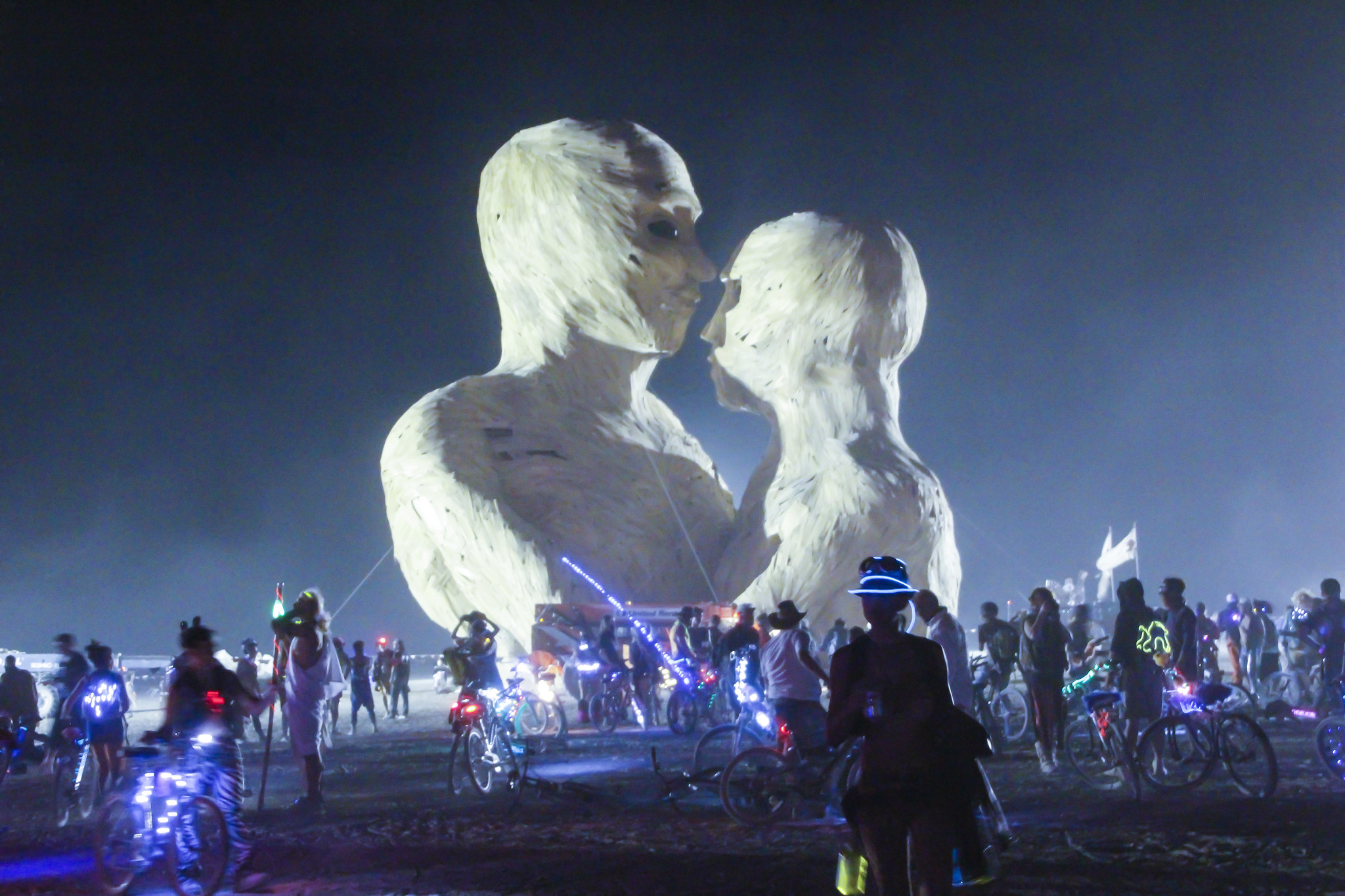
Image Credits: BLM Nevada (opens in a new window) / Flickr (opens in a new window) under a CC BY 2.0 (opens in a new window) license.
A new moment for social networking
Eight projects eventually emerged as official “recognized universes,” each taking drastically different approaches to what a virtual Burning Man should look like. While some focus their efforts on virtual reality, others add social layers to video chat or build 3D environments on top of existing platforms like Second Life or Microsoft’s AltspaceVR .
During the pandemic, revamped developer conferences and trade shows have been able to port keynote addresses or panels to a Zoom format fairly seamlessly, but there are plenty of elements of the Burning Man experience that the teams involved realize might be impossible to replicate with online platforms. The developers creating the event’s virtual worlds are determined to rethink the conventions of online social networking to ensure that Burners make new friends this year.
“The sense of awe and scale is tricky,” says Ed Cooke, who is building one of the official apps. “One way of explaining Burning Man is that it’s a state of mind that you access as a side effect of all the things that happen on the way there.”
Cooke, a London startup founder who also boasts the title of Grand Memory Master, earned for — among other things — memorizing the order of 10 decks of cards in less than an hour, has been building SparkleVerse with his friend Chris Adams, whose daytime gig is as a senior software manager at Airbnb.
Their web app, which pairs a 2D map interface with video chat windows, is primarily focused on advancing how shared context can facilitate and better frame social relationships.
Amid quarantine, the pair tells TechCrunch they have been creating deeply complicated video chat parties for their friends. One example is a moon-themed party where they created a clickable map of the lunar surface that guided the 200 attendees through 16 separate virtual spaces with their own themes. Before the party kicked off, the hosts walked people through the “experience of traveling to the moon” by guiding them through the effects of zero gravity and instructing them to play along with experiencing it. Another hot tub-themed party invited guests to jump into their bath tub before firing up Zoom.
Cooke and Adams are leaning on some of these mechanics to create a Burning Man theme, hoping that taking cues from immersive theatre will enable people to commit more deeply to the experience. The acts of driving, losing your phone connection and growing tired and hungry on the way to the physical event add to a “spaciousness in your consciousness” that allows people to act more freely, Cooke says. He wants participants to replicate these experiences by taking steps outside their normal life in the run-up to the event, whether that’s sitting through an obscenely long video chat session to simulate a drive to the desert or setting up a tent in their living room, or cutting off their water line and avoiding showers during the nine days.
“All of this is embedding you further and further into this distant context, miles away from your normal life, where effectively in the course of this, you’re just becoming a radically less boring person,” Cooke explains in a nine-minute video outlining the platform.
Many of the apps are building on the idea of how spatial interfaces can feed greater social context and make it easier to approach people and make new friends.
Another official app, Build-a-Burn, takes the idea of a stylized 2D interface for video chat even further with a sketched-out grayscale map of Black Rock City that users can navigate little stick figures across. As a user moves through different camps and their avatars get physically close to each other, new video chat screens fade in and users can gain the experience of venturing into a new social bubble.
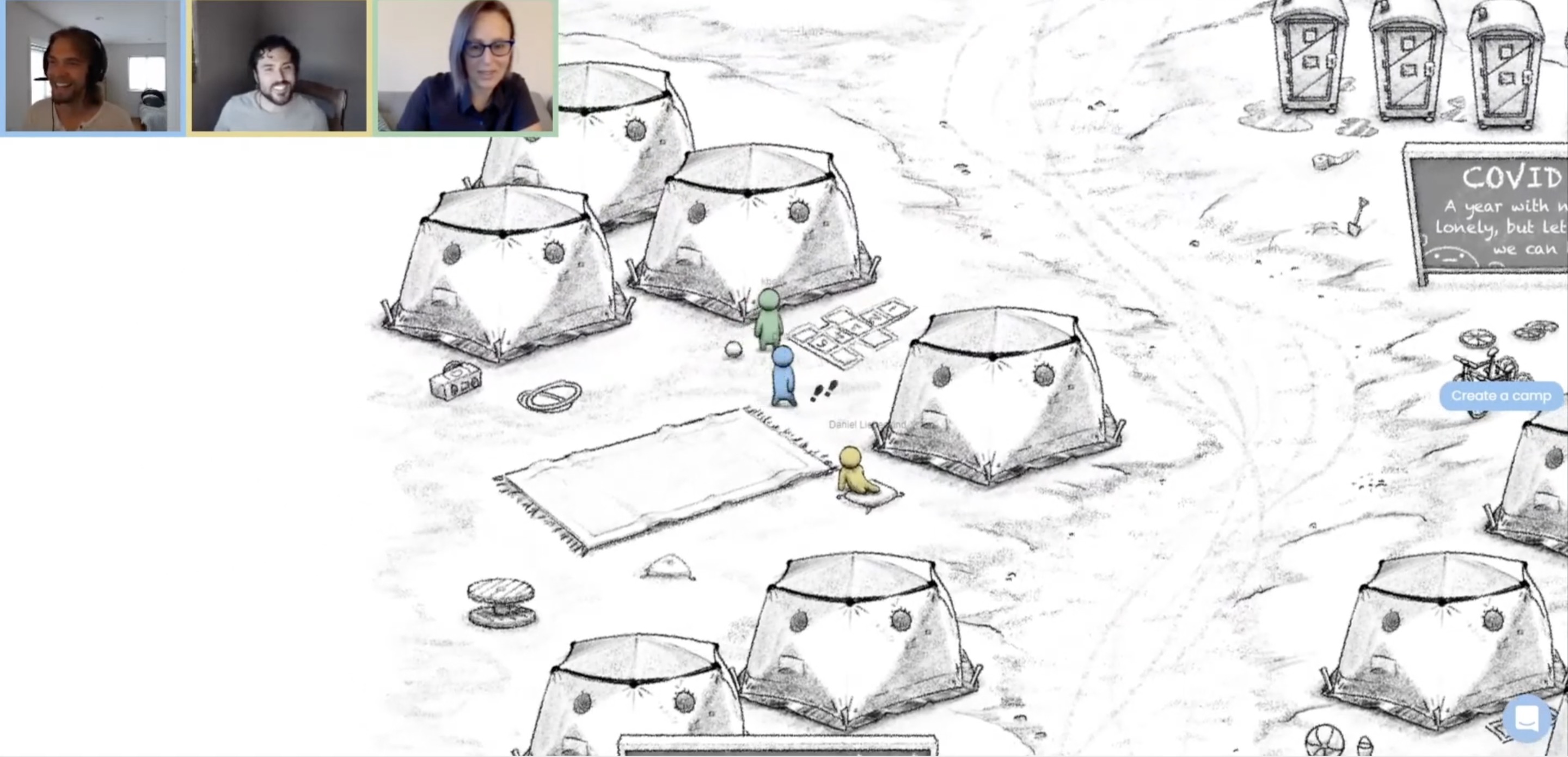
A screenshot of Build-a-Burn
While Build-a-Burn and SparkleVerse are leaning more heavily on video chat, other experiences hope that creating massive 3D landscapes that match the scale of the real-world event will help people get into the spirit of the event.
Other than Burn2, which is wholly contained within the Second Life platform, most of the 3D-centric apps integrate some level of virtual reality support. Projects that support VR headsets include The Infinite Playa, The Bridge Experience, MysticVerse, BRCvr (which taps into Microsoft’s AltspaceVR platform) and Multiverse.
Each of the VR experiences will also allow users to join on mobile or desktop, an effort to ensure that the apps are more widely accessible.
Over on Extra Crunch, read about how a new generation of chat apps are leaning on game-like interfaces
Multiverse creator Faryar Ghazanfari, who runs an AR startup and previously worked on Tesla’s legal team, says that the motivations for building his app were a bit on the selfish side, telling TechCrunch that he became “extremely sad” after the physical event’s cancellation and felt the need to help build a place where he could reunite with his own camp.
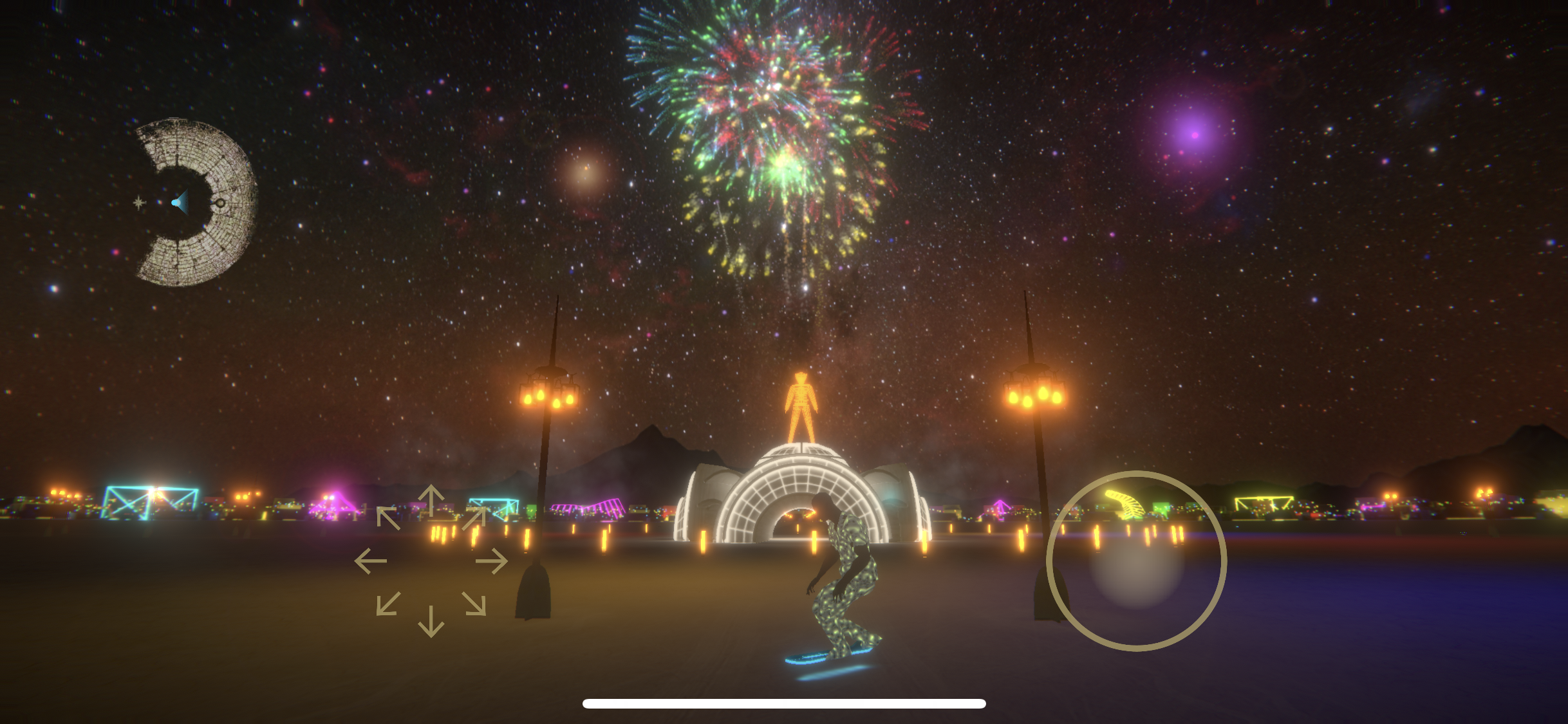
Screenshot from a demo of Multiverse.
Ghazanfari tells TechCrunch he feels a responsibility in creating the environment that other Burners will experience; he says his chief concern is capturing the event’s complexity. Compared to the other apps, Multiverse focuses primarily on providing a photorealistic 3D playground where avatars can zoom around.
“As Burners, we don’t think of Burning Man as just a music festival or art festival; it is much more than that. Burning Man is a social experiment of creating a community out of a shared struggle,” Ghazanfari says.
Each of the Burning Man-approved apps seem to engage with evoking that shared struggle differently, which appears to be the most looming challenge of moving this event to a virtual format. While the apps hope to bring elements of the physical event into their virtual spaces, the creators also seem to realize that aiming to compete with attendees’ past memories is unwise. It’s a challenge that has been faced by dozens of startups in the virtual reality space over the past several years.
“I think the main challenge is taking something that exists in reality and then porting it into a different platform,” said Adam Arrigo, CEO of Wave, a venture-backed startup that initially launched a VR app for music concerts but has since shifted focus to mobile and desktop experiences. “When you’re in these digital spaces, the agency that you have as a user and the experiences you can create are so different than something that could exist, even at a concert.”

Image Credits: Burning Man 2012 Hawaii Savvy (opens in a new window) / Flickr (opens in a new window) under a CC BY 2.0 (opens in a new window) license.
Financial uncertainty
Perhaps the biggest unknown, as the organization readies for Burning Man’s August 30 start date, is that nobody really has any idea how many people are going to show up. While Blumenfeld pointed me to suggestions the entire digital event could attract up to 30,000 people over its nine-day run, Ghazanfari hopes that hundreds of thousands or millions of users will come into the fold of his experience.
Another point of contention internally is how exactly the groups plan to monetize these digital experiences.
In 2020, the standard ticket price for Burning Man was $475. The organization postponed the “main sale” of tickets prior to this year’s physical event’s cancellation, but they had already sold tens of thousands of tickets. Ticket holders will have the option of being refunded, but the organization has encouraged those who “have the means” to consider making a full or partial donation of the ticket price instead.
In 2018, Burning Man cost $44 million for the organization to produce, according to tax documents. The Burning Man Project reported about $43 million in ticket sales from that event, with other donations and revenue streams bringing the nonprofit’s total revenue for that fiscal year to about $46 million. In a blog post, the event’s organizers noted that though the group had event insurance, they were not covered for a cancellation caused by a pandemic. Burning Man Project says it has $10 million in cash reserves, but that it anticipates draining through that funding by the end of the year to stay afloat. The organization is listed as having received a loan from the federal government’s Paycheck Protection Program for between $2-5 million.
While some like Ghazanfari are pushing to make their experiences free to access with the option of giving a donation later, others expressed desire for a single digital ticket that would give attendees access to all eight digital experiences. Cooke says users will need to pay a $50 entrance fee to access the SparkleVerse.
The disparate nature of the experience being built this year — with some being shipped as native apps, others in HTML5 and others inside existing tech platforms — meant that a unified ticketing platform just wouldn’t work, Blumenfeld told TechCrunch. Not all of the developers were thrilled with this outcome, which they fear could fracture attendance at events on certain platforms. The biggest concern seemed to be ensuring that all of this effort pays off in some way for the organization so that they can continue to host the Burning Man event post-pandemic.
“One of the biggest reasons we’re all doing this is to help Burning Man survive, because the Burning Man organization unfortunately was really badly hit because of COVID,” Ghazanfari says. “The organization is in kind of a precarious situation financially.”
The organization has attracted criticism in recent years for the event’s inclusiveness. Some of the developers acknowledge that planning for a nine-day trip to the middle of the desert can be daunting and prohibitively expensive for people that want to join the community, and they hope that this year’s shift to a digital format will open up the event to more people and that these apps can be a less intimidating way for skeptics to get a taste of the community.

Image Credits: BLM Nevada (opens in a new window) / Flickr (opens in a new window) under a CC BY 2.0 (opens in a new window) license.
Thinking of the future
None of the developers behind the digital experiences are being paid for their efforts building these apps. However, the Burning Man Project has given at least some of them perpetual licenses to continue operating these digital platforms with the Burning Man name and an option to monetize, though a percentage of proceeds will be kicked back to the organization.
While getting this event across the finish line by the end of the month is daunting enough, the Burning Man Project is also trying to consider how its rapid learnings will apply to next year, though they hope that the physical event returns for 2021.
Blumenfeld says he plans to spend the next year working on the background infrastructure so that items like gating and ticketing functions for a virtual Burning Man can all be centralized.
While having eight distinct experiences this year could complicate the goal of getting one big group together, developers concerned about troubleshooting their new apps or having a sudden influx of virtual Burners overwhelm their infrastructures view multiple entry points to the festival as a necessary logistical move. Organizers hope the diversity of options will keep things interesting for attendees.
“I think we’ve got a good mix, and part of it is, we want to learn,” Blumenfeld says. “What we’re trying very hard to avoid is being in Zoom meeting hell.”
Whether users are connecting via video chat or as avatars inside a large virtual world, the developers building Burning Man’s virtual experiences believe they are operating on the cutting edge of virtual interaction and that they are rethinking elements of modern social networking to create a virtual Burning Man where people will be able to form new social bonds.
“I’ve fallen in love with this idea that at some point in the future, some Ph.D. student in 300 years time is going to write a thesis on the first online Burning Man, because it does feel like an extraordinary moment of avant garde imagineering for what the future of human online interaction looks like,” Cooke tells TechCrunch.