Netflix test puts a ‘Shuffle Play’ button right on your home screen

Don’t know what you’re in the mood to watch? Netflix’s new “Shuffle” feature could help. The company confirms it’s currently testing a feature that puts a big button labeled “Shuffle Play” right on the Netflix home screen, beneath your user profile icon. When pressed, Netflix will randomly play content it thinks you’ll like. This could be a movie or show you’re currently watching, something you’ve saved to your list or a title that’s similar to something you’ve already watched, the company says.

The new button is currently showing up on the Netflix app for TV devices, much to many users’ surprise. Some users thought the addition could be fun or useful, while others just seem confused.

Interesting new feature @netflix … but what kind of insane person just says, “yolo, let’s spin the Netflix wheel of fortune” pic.twitter.com/6WDJrmd7pG

— Turner Levison (@TurnerLevison) August 18, 2020

Whoa whoa what is this cool “shuffle play” feature on Netflix?!? It’s amazing and helpful for my indecisive self

— Melissa Nathan (@mnathannn) August 18, 2020

why the fuck does netflix have a shuffle play option lmfaoooo

— angel (@stylesperiodt) August 18, 2020

My TV has a Netflix shuffle play option. The definition of chaotic evil.

— KD (@kgdobs) August 11, 2020

Why does my Netflix have a ‘shuffle play’ option? Who would ever use this and why?

— Siphokazi Kayana (@SiphokaziKayana) August 13, 2020

Skskskdjdjsj Netflix has a shuffle play option now. And it played Modern Family from the start. Bitch fuckoff I watched all 9 seasons back in 2018 already???

— ???????? (@ThatOnePoes) August 18, 2020

The company tells TechCrunch the idea behind the feature is to help its members quickly and easily find content that’s tailored to their tastes. This is a challenge Netflix has addressed over the years through a variety of features and tests, like screensavers on its TV apps, pre-roll videos and even promotional content showcased on the home screen. Ultimately, the company wants the experience of using Netflix to feel more like watching traditional TV — meaning you can just turn it on and something starts playing. (Of course, that’s also what gave us the annoying auto-playing feature, which Netflix finally allowed users to disable with an update earlier this year.)

The new “Shuffle Play” button is the latest in a long series of tests where Netflix has tried to make a shuffle concept work. Last year, for example, Netflix tried out a shuffle mode that let you click on a popular show to start playing a random episode. This may have worked well when users wanted to play a random episode of their default pick, like the “The Office” or “Friends,” but Netflix is losing the former in 2021 and it has already lost the latter.

More recently, some Netflix users discovered a shuffle option called “Play Something” in their TV app’s sidebar navigation. (See below)

Lol Netflix now has a “shuffle” button. This is something I needed that I didn’t even know I need. pic.twitter.com/JEEsF65Bc0

— Chaby Digital (@Chabz_Classic) July 14, 2020

Netflix confirmed these are all variations on the general “shuffle mode” concept, which it’s been trying out across surfaces, including what it calls the “profile gate,” as well as the side menu and the main screen. Currently, the “Shuffle Play” button on the profile screen is the only test that’s still underway, we’re told.

The company said it started to roll out the new test to members worldwide last month and only on TV devices. Netflix has yet to make a decision about if or when it will launch a shuffle feature publicly, as it needs to first collect feedback from each different test and compare the results.

If Oracle buys TikTok I’ll go to Danny’s house and eat his annoying Stanford sweatshirt

Hey everyone, how are you? Are you doing well? Great. Or, condolences, depending.

Anyway, last week the Equity crew was discussing bankers, and how they love to talk up stuff.

The topic matters as there is a big impending transaction out there in the world, namely the shotgun sale of TikTok. And all sorts of folks are nattering about who might just be interested in making a bid for the Facebook competitor.

Danny did a blog about the situation. He said that TikTok is possibly worth “tens of billions of dollars,” but only if the social giant can “find a number of deep-pocketed buyers who are willing to bid the price up.” In short, if only Microsoft rocks up with checkbook, TikTok could go on the cheap given that there would be precisely no one to counter-bid.

Danny then made an interesting point. What might a grievance of bankers do when they want to sell an asset, say, not for $5 billion, but for $10 billion? AstroTurf some FOMO by adding more chatter and names to the mix, of course: (bolding: TechCrunch):

So what do the investment bankers at the heart of the deal do? They run the deal around to every corporate development department in the country, and they leak the information to reporters to try to drum up FOMO in other departments, all in the hope that a board member somewhere starts asking, “Hey, why aren’t we taking a deep look at this?” Heck, I’m sure even Oracle is taking a look — they have data centers and “synergy” potential, and its CEO Safra Catz is a major Trump supporter as well, and could navigate the coming policy shenanigans.

And then later on, CNBC reported that “Oracle is in talks to acquire TikTok’s U.S. operations, challenging Microsoft,” according to a source. And the FT wrote a piece entitled “Oracle enters race to buy TikTok’s US operations.”

So it’s time to put our little theory to the test with a wager. If Oracle buys TikTok then I, Alex Wilhelm, will convince my partner to let me take a train to New York, where I will eat Danny’s annoying Stanford sweatshirt that he always wears when we record the podcast.

Here’s Danny wearing it earlier today:

Photo via Danny “I Hate You” Crichton, and his lovely partner.

If Oracle does not buy TikTok, then, well, nothing. Good job Microsoft, we guess. But here’s a marker in the sand.

And just to be clear, this is nothing against Alex Sherman (whom I like and read) or the CNBC tech crew (which is stacked with great folks). The FT was also great, back when I could read it.

The wager is good until TikTok gets the boot or sells to someone. Let’s go.

Xos Trucks raises $20M to put more of its electric commercial trucks on the road

Commercial electric vehicle startup Xos Trucks has raised $20 million, funding it will use to ramp up production ahead of potential new demand fueled by a landmark emissions rule adopted by California that will require more than half of all trucks sold in the state to be zero-emissions by 2035.

The startup, which was formerly known as Thor Trucking, raised the funds from a group of investors including Proeza Ventures, a mobility-focused VC firm backed by Metalsa’s holding company, and BUILD Capital Group. Xos also gained a few new board members along with the capital. Rodolfo Elias Dieck of Proeza Ventures and Mark Lampert, a former Daimler executive who is now at BUILD Capital, have joined the board. Xos has beefed up its executive ranks as well, including hiring Kingsley Afemikhe as its CFO and Rob Ferber, employee number one and science director at Tesla, as its CTO.

“We’re excited to continue growing our operations to provide best-in-class last-mile electric vehicles for our customers,” said Dakota Semler, co-founder and CEO of Xos Trucks. “It’s our goal to provide reliable, affordable, and sustainable transportation as the volume of e-commerce demands are increasing, and have accelerated during the pandemic.”

Funding will be used to expand operations and scale up production of its electric skateboard chassis that is designed for Class 6 trucks, the medium-duty commercial vehicles that are often used in last-mile delivery in dense urban areas. This skateboard, known as the X-Platform, was designed to accommodate a variety of medium-duty bodies, wheelbases and range requirements up to 200 miles. Metalsa, the Mexico-based automotive supplier, helped Xos with the design and is providing components to the chassis.

Xos vehicles have been used by UPS on customer routes in the Los Angeles area for the past eight months, according to the company. Loomis, an existing customer of Xos, has ordered another 20 trucks following a pilot program in 2019.

TikTok’s big UnitedMasters deal is the way forward for creators looking to secure their bag

TikTok is right in the jaws of a thorny situation with the U.S. government regarding its ownership, but it’s sending a clear message today that it is not sitting on its heels with big deals. Yesterday, it announced a deal with UnitedMasters to allow artists on TikTok to distribute their songs directly to streaming services and other partners directly.

UnitedMasters is the un-record-label label — in fact, a direct distribution company founded by former president of Interscope Records, Steve Stoute. The firm allows musicians (especially budding ones) to pay a competitive distribution rate to get access to Spotify, YouTube, SoundCloud, Apple Music and other services. It also gets them access to analytics, retargeting, CRM tools and individual deals that UM makes with brands like ESPN and the NBA.

Normally, the path between an artist being able to go viral on TikTok and be included in the next NBA 2K or before an official game on the air would be a long one involving a lot of knives out for pieces of the pie. UnitedMasters shortcuts all of this.

The simple scenario is this:

  • An aspiring artist or songwriter puts out a song or riff on TikTok (likely one of many).
  • This one has something and it catches on the algorithm and generates numbers.
  • The creator opts in to participating in UnitedMasters’ program.
  • They give up a cut of 10% but get direct distribution into the major streaming buckets and potential A-grade partners. (There’s also a $5/mo subscription option.)
  • They can also market things like tickets, merch and more directly to fans using UM’s customer tools.
  • The artist keeps 100% of their royalties.

Which is why a tie up with TikTok makes a hell of a lot of sense. One of the biggest issues with viral social platforms has been the way that they reward creators. Twitter’s Vine, of course, squandered their opportunity there. Even YouTube has had major problems providing consistent revenue to many of its top creators, with a long trend toward big hitters monetizing off a platform in order to earn consistent, durable money.

TikTok has already announced a creators fund with a significant purse, but it needs to go beyond that. We’ve seen over and over how young creators on the platform create viral waves of attention for TikTok and millions of re-enactments and remixes. Often, though, those creators are offered little recourse to monetize or benefit from their creations. Dance creators and musical talents, often young Black women, are literally crafting culture in real-time on TikTok and the pathways for them to benefit materially are very rare. Sure, it’s great when an originator gets called out by a Times reporter willing to do the work to trace the source, but what about the thousands of others being minted as a real voice on the platform every month?

It’s beyond time for the creators of The Culture to benefit from that culture. That’s why I find this UnitedMasters deal so interesting. Offering a direct pipeline to audiences without the attendant vulture-ism of the recording industry apparatus is really well-aligned with a platform like TikTok, which encourages and enables “viral sounds” with collaborative performances. Traditional deal structures are not well-suited to capturing viral hype, which can rise and fall within weeks without additional fuel.

In terms of overall platforms, TikTok clearly has the highest concentration of incredible and un-tapped musical talent on the market. It’s just wild how many creators I see on there that are just flat out as good if not better than what you hear on the radio. Opera, rap, soul, folk, comedy, songwriting… it runs the gamut.

TikTok CEO Kevin Mayer came to the company after a long stint at Disney ending with a very successful Disney+ launch. Almost immediately, he was dropped into a political firestorm between China and the U.S. government. Parent company ByteDance must sell within 90 days, says Trump, or get shut down. Microsoft might buy them. Other tech companies are circling. This deal is a pretty crisp forward-looking signal that TikTok sees a way through this and is not waiting to innovate on one of the trickier components of this era of user-generated businesses.

And on top of that, it charts a course for how user-generated platforms should look to service creators and keep them in their universe. All UGC plays garner significant value from the creative energies of their users, but few have found a way to make that relationship reciprocal in a way that feels sustainable.

This UnitedMasters deal feels different, and the start of a larger trend that could pay big dividends to platforms and, finally, creators.

Radio Flyer teams up with Tesla to launch a tyke-sized Tesla Model Y

If, like me, you can’t afford a full-sized Tesla because your life has been a series of bad investments (one day my early Fyre Festival backing will pay off), then Radio Flyer’s newest product might be just the thing for you. It’s a scaled-down Model Y, designed for use by kids aged 18 months to four years old — but I can play pretend and yell “vroooommm” just as well, if not better, than they can.

Dubbed “My First Model Y,” this is a collaborative effort between the Tesla Design Studio and Radio Flyer’s product team. It’s a ride-on version, which is not true of the standard Model Y, and it includes a honking horn, as well as black induction wheels (an upgrade option on the real car) and a functional steering wheel, with a price point of $99. There’s only one trim level.

Unlike the first collaboration between Radio Flyer and Tesla, the Tesla Model S for Kids, this one doesn’t have a built-in battery — it requires kid power to function. That means a lot more affordability, and makes it suitable for much younger kids.

I might pick up one of these instead of just continuing to scrawl “Tesla” in block letters on the rear window of my 1998 Toyota Camry in grease pencil.

India’s Reliance Retail acquires a majority stake in online pharmacy Nedmeds’ parent firm for $83.2M

Reliance Retail has bought a 60% stake in pharma marketplace Netmeds’ parent firm Vitalic for about $83.2 million, it said today, as India’s largest retail chain looks to expand into new categories and compete more closely with American e-commerce group Amazon.

Reliance Retail said the deal, which grants it a 100% ownership of Vitalic’s subsidiaries (Netmeds, Tresara, and Dadha Pharma), valued the parent firm at about $134 million. Netmeds, which connects customers to pharmacists and enables door step delivery of medicines, serves 5.7 million customers in more than 670 cities and towns and online.

Through Netmeds, which had raised about $99 million prior to today’s announcement, consumers get access to more than 70,000 prescription drugs for chronic and recurring ailments as well as enhanced lifestyle drugs and thousands of non-prescription goods for wellness, health and personal care.

Reliance Retail plans to expand its ownership in Vitalic to at least 80% by April 2024 and holds the rights to own 100% in the future.

“This investment is aligned with our commitment to provide digital access for everyone in India. The addition of Netmeds enhances Reliance Retail’s ability to provide good quality and affordable health care products and services, and also broadens its digital commerce proposition to include most daily essential needs of consumers,” said Isha Ambani, director of Reliance Retail, in a statement.

You know what I like about this? Local M&A is becoming a real thing. Mahindra bought a bunch earlier, like Firstcry, but those were super-distress. Reliance is like bring it on.

Great for founders, one more beyond Inter-VC-deals and Softbank.

— Deepak Shenoy (@deepakshenoy) August 18, 2020

Reliance Retail, like its sister telecom venture Jio Platforms, is a subsidiary of Reliance Industries, the most valued firm in India. Reliance Industries is run by Mukesh Ambani, Asia’s richest man.

The announcement late Tuesday evening (local time) comes days after Amazon struck a deal with Netmeds, 1mg, PharmEasy and Medlife to sell medicines online in Bangalore. It was the first time Amazon had expanded into this category, it said. The coronavirus pandemic has accelerated the adoption of telemedicine and pharma marketplaces in the country, analysts said.

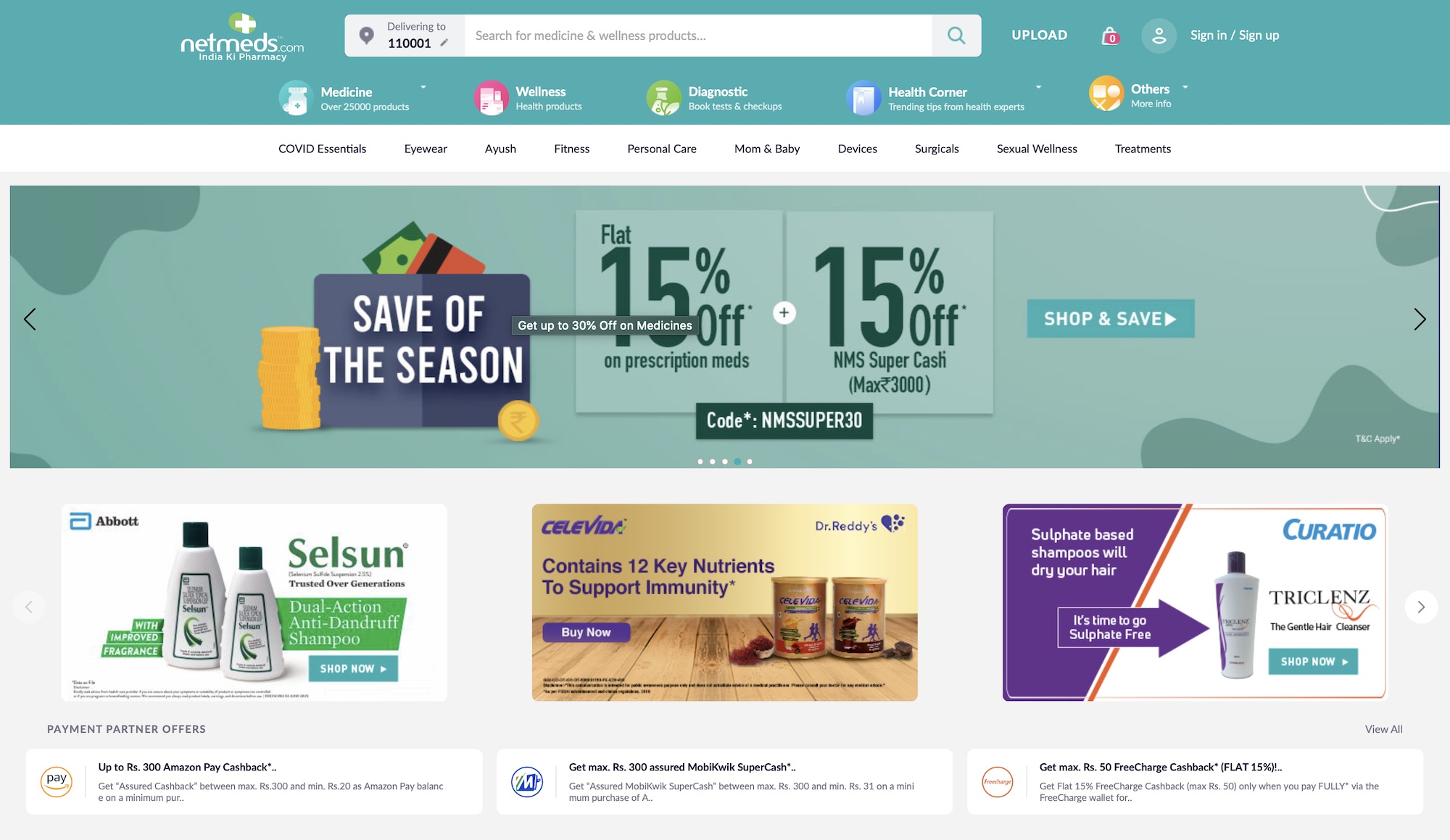
Netmeds is one of the largest online pharmacies in India (Image: Netmeds)

Online sales of medicine in India, for which New Delhi currently does not have clear regulations, presents yet another major opportunity for Reliance Retail, which has expanded its new e-commerce venture — called JioMart — to more than 200 cities and towns in the recent quarters.

Local media has reported that Reliance is also in talks to acquire online furniture store Urban Ladder, milk delivery startup MilkBasket and Bangalore-based lingerie maker Zivame. TechCrunch reported last week that Reliance Industries was also in talks to acquire the India business of TikTok.

“It is indeed a proud moment for ‘Netmeds’ to join Reliance family and work together to make quality healthcare affordable and accessible to every Indian. With the combined strength of the group’s digital, retail and tech platforms, we will strive to create more value for everyone in the ecosystem, while providing a superior Omni Channel experience to consumers,” said Pradeep Dadha, founder and chief executive of Netmeds, in a statement.

Google Maps adds street-level details in select cities, more colorful imagery worldwide

Google Maps is getting a significant update that will bring more detail and granularity to its map, with changes that encompass both natural features and city-level details alike. For the former, Google says it’s leveraged computer vision techniques to analyze natural features from satellite imagery, then color-coded those features for easier visual reference. Meanwhile, select cities (including New York, San Francisco and London) will gain more detailed street information, like the location of sidewalks, crosswalks and pedestrian islands, for example.

These additions will help people better navigate their cities on foot or via alternative modes of solo transportation, like bikes and scooters, which some have opted for amid the pandemic. The supported cities will also show the accurate shape and width of a road to scale to offer a better sense of how wide or narrow a street is, in relation to its surroundings.

Image Credits: Google (before: left, after: right)

While the added granularity won’t include more accessibility features, like curb cuts for example, Google says that having the crosswalks detailed on the map will help in that area. The company also notes that Google Maps today displays wheelchair-accessible routes in transit and wheelchair attributes on business pages.

The updated city maps won’t show up immediately in the Google Maps app, we understand. Instead, Google says the new maps will roll out to NY, SF and London in the “coming months.” The vague time frame is due to the staged nature of the release — something that’s often necessary for larger apps. Google Maps reaches over a billion users worldwide, so changes can take time to scale.

The company notes that after the first three cities receive the update, it plans to roll out more detailed city maps to additional markets, including those outside the U.S.

Meanwhile, users both inside and outside big cities around the world will benefit from the changes to how natural features are presented in Google Maps.

Image Credits: Google

Google utilized a color-mapping technique to identify natural features from its satellite imagery, looking specifically at arid, icy, forested and mountainous regions. These features were then assigned a range of colors on the HSV color model. For instance, a dense forest will now appear as a dark green while patchier shrubs may appear as a lighter green. You’ll be able to differentiate between beaches and greenery, see where deserts begin and end, see how much land is covered by ice caps, see where snowcapped mountain peaks appear or view national park borders more easily, among other things.

These changes will reach all 220 countries and territories that Google Maps supports — over 100 million square kilometers of land, from bigger metros to rural areas and small towns.

Image Credits: Google

The update comes at a time when Google’s lead as everyone’s default mapping app is being challenged on iOS and Mac. While Apple Maps started out rough, a 2018 redesign and subsequent updates have made it a more worthy rival. Apple even took on Google’s Street View with its higher-resolution 3D feature, Look Around, which particularly targets big city users. More recently, Apple introduced a clever trick that allows you to raise your phone and scan the skyline to refine your location. And Apple is battling Google Maps’ explore and discovery features through its expanded, curated guides built with the help of partners. These updates have pushed Google to race ahead with improvements of its own in order to maintain its lead in maps.

Google says the new features and updates will roll out across Android, iOS and desktop in the months ahead.

Piggyback on popular Tweets to get brand awareness

Julian Shapiro is the founder of BellCurve.com, a growth marketing team that trains startups in advanced growth, helps hire senior growth marketers and finds vetted growth agencies. He also writes at Julian.com.

We’ve aggregated many of the world’s best growth marketers into one community. Twice a month, we ask them to share their most effective growth tactics, and we compile them into this Growth Report.

This is how you stay up-to-date on growth marketing tactics — with advice that’s hard to find elsewhere.

Our community consists of startup founders and heads of growth. You can participate by joining Demand Curve’s marketing training program or its Slack group.

Without further ado, on to our community’s advice.


Analysis of YouTube trending videos

Insights from Ammar Alyousfi.
We reviewed an analysis of every trending YouTube video from 2019. Here are some of our learnings:
  • 95% of videos took less than 13 days to appear on the trending list. The minimum number of views needed for a video to trend was 53,796.
  • Videos stay on the trending list for ~5.6 days after publishing.
  • The top three categories for trending videos are entertainment (28.6%), music (14%) and sports (10.4%).
  • Videos posted on Saturday are the least likely to trend.
To dive deeper, check out the full report.

Don’t forget to transcribe podcasts

Attending a remote startup accelerator is absolutely worth it

SkyDeck Spring 2020 Cohort
Contributor

UC Berkeley SkyDeck is the startup accelerator of the University of California at Berkeley.

We are members of the UC Berkeley SkyDeck startup accelerator spring 2020 cohort — the first to attend remotely.

Many of us were looking forward to visiting Berkeley because one aspect of SkyDeck is a focus on helping teams with international founders connect to the Bay Area and crack the U.S. market.

So, we planned to fly in from not only other parts of the U.S., but places like Taiwan, Russia, Turkey, Chile, India, Israel and even Canada to enjoy the California sunshine and do California stuff, like drink wine in Napa, eat saltwater taffy in Santa Cruz, see some redwoods and maybe go to Yosemite or whatever? Yeah okay, maybe we wouldn’t have time for all that. We are startup founders after all. But it’s always nice to be given a chance to say no to something.

No matter what, we were sure we were going to get a chance to meet a lot of really smart and cool people, brainstorm together and make a lot of friends. All while putting in a lot of hard but rewarding work to achieve product-market fit, learn how to pitch and then raise some fat rounds from world famous venture capital firms after Demo Day. Bling bling bling!

But then this spring, just before our cohort was set to start the program, the pandemic got serious. No flights, no desks, all virtual meetups, and soon (September 15, mark your calendars people) a virtual Demo Day. Most of the international founders couldn’t even come to the United States.

No matter where we are in the world, we all ended up working from home just like the rest of the planet. No Napa wine, no salt water taffy, no redwoods or Yosemite. Some of us even still have imperfect weather to contend with. Sigh.

But despite missing out on what would have been an amazing experience, we want to leave no doubt in the minds of your readers that the program has been fantastic. The SkyDeck team has provided us with:

  • VIP access to an extraordinary network of contacts that has gone beyond what we could have imagined: Picture this network in your mind right now … it is even better than that.
  • A network of quality advisors: SkyDeck does an amazing job of getting Berkeley alumni with extraordinary professional profiles to function as 1:1 advisors. This high-touch approach to mentoring has worked out smoothly during COVID-19 times because everyone is at home and eager to jump on a call. They have been there to provide advice, make connections, help us recruit, you name it.
  • Info sessions that are fun and informative: Bad internet access was sometimes annoying, but on the bright side, nobody had to fight traffic to get there. These sessions included everything from nuts and bolts organizational advice and war stories with Q&As from founders of famous companies to important new perspectives for building 21st-century companies such as DEI training. The speakers are also willing to have a call or hold office hours to discuss specific topics in-depth. It never stops.
  • Support from other cohort founders and alums: There is an incredible sense of family in the program. Tough times foster deep experiences and meaningful connections. The SkyDeck team did a great job setting up virtual events so we could all get to know each other, and alums are very active on Slack, responsive to requests for 1:1 mentorship, helping with recruiting and giving other free advice. We have all made new friends that can provide us with social and professional support for many years ahead.
  • Full access to UC Berkeley’s diverse ecosystem including brilliant interns, faculty and industry connections. This has really helped us to boost productivity while pushing for product-market fit. Unfortunately, laboratories have been closed during the pandemic so some biotech and hardware founders, in particular, missed out on a perk they were really looking forward to. However, with everyone available online, bioinformatics, machine learning and other computational-focused collaborations have worked out great. Go Bears!
  • And of course, a $100,000 investment that was highly appreciated during a pandemic when everyone needs cash to adapt to a completely transformed environment.

While flight restrictions did cause some international founders to pull crazy hours from our home countries to participate in the sessions, virtual sessions allowed additional members of our teams to participate that would otherwise not have been able to do so. We are also hearing chatter that Demo Day will be larger than ever before because virtual events are much more scalable. But you didn’t hear that from us.

We are just starting investor month, and the meetings SkyDeck has been arranging leading up to Demo Day also feel more engaging and efficient. Investors do not have alternative options to communicate with founders, and it’s so much easier to jump from call-to-call than to physically jump around the Valley. Even super rich and famous investors seem to think it is fun to be in Zoom calls with us since, just like everyone else, they are probably kind of bored being at home all the time and just want somebody to talk to.

So yes, we did miss out on a lot we were hoping for when we joined SkyDeck, but even with virtual desks and virtual Demo Day, SkyDeck is absolutely worth it.

Signed,

SkyDeck Cohort 2020 founders:

How to diagnose and treat machine learning models afflicted by COVID-19

Anupam Datta
Contributor

Anupam Datta is co-founder, president and chief scientist of Truera, and also a professor at Carnegie Mellon University.

Justin Lawyer
Contributor

Justin Lawyer is chief product officer of Truera and was formerly head of product on Google’s Cloud AI Platform.

COVID-19 has disrupted the lives of millions of people and affected businesses across the world. Its impact has been particularly significant on many machine learning (ML) models that companies use to predict human behavior.

Companies need to take steps to deeply examine ML models and acquire the insights needed to effectively update models and surrounding business rules.

The economic disruption of COVID-19 has been unprecedented in its swiftness, upsetting supply lines, temporarily closing retail stores and changing online customer behaviors. It has also dramatically increased unemployment overnight, increasing financial stress and systemic risks of both individuals and businesses. It is forecasted that global GDP could be affected by up to 0.9%, on a par with the 2008 financial crisis. While the nature of our recovery is unknown, if the 2008 crisis is any indicator, the impact of COVID-19 could be felt for years, through both short-term adjustments and long-term shifts in consumer and business behaviors and attitudes.

This disruption impacts machine learning models because the concepts and relationships the models learned when they were trained may no longer hold. This phenomenon is called “concept drift.” ML models may become unstable and underperform in the face of concept drift. That is precisely what is happening now with COVID-19. The effects of these drifts will be felt for quite some time, and models will need to be adjusted to keep up. The good news is that there have been significant developments in model intelligence technology, and through judicious use, models can nimbly adjust to those drifts.

As the effects of COVID-19 (and economic closure and reopening) play out, there will be distinct stages in the impact on social and economic behaviors. Updates to business rules and models will need to be done in sync with overall behavior shifts in each of these stages. Companies need to adopt an approach of measure-understand-act and to constantly examine, assess and adjust ML models in production or development and surrounding business rules.

Examining how ML models have been impacted means going through an exercise to both measure and understand how the models behaved prior to the coronavirus, how they are behaving now, why they are behaving differently (i.e., what inputs and relationships are the drivers of change), and then to determine if the new behavior is expected and accurate, or is no longer valid. Once this is determined, the next step is naturally to act: “So, what can we do about it?”

The ‘right’ way to downsize

Isaac Roth
Contributor

Issac Roth is a seasoned entrepreneur who advises founders on open source technology and keeping communities engaged. Over this career, he’s created and sold multiple enterprise software companies and stays active as an advisor and investor.

A little over a year into launching StrongLoop, an enterprise API startup eventually acquired by IBM, we were out over our skis. It was my doing — having built a vast top of funnel, we expected our product to have a specific sell-through rate and I’d optimistically hired in engineering, customer support, marketing and sales. However, the sales cycles were long, burn rate was too high and we had too many highly skilled people who were a little bored. It was time to orchestrate a reduction in force.

I’d been laid off a few times myself, once from a pivoting startup and again during the downturn of 2001, so I knew what it felt like. I’d also been a manager at a larger company that laid off employees, so I’d seen the corporate playbook. But as the CEO, I had personally sold these people on our vision, cramming into a small substandard office with them for months or years — it felt very personal. Back then, the job market was robust: I didn’t worry about team members finding new jobs. Today is more uncertain.

With many startups under the pressure of a pandemic-fueled economic crisis, I interviewed several CEOs who have had to orchestrate COVID-19-related layoffs to capture (what I believe) are some best practices to downsize correctly and compassionately.

Put people before projects

One company had a pending product launch, yet a few renewals were pushed due to COVID-19-based uncertainty. Meanwhile, the board had decided to extend runway to have more options. The question was: Should the company complete the product launch and let employees know they’re losing their jobs after? Or should they tell employees ahead of time, risking a loss in focus while some members of the team (correctly) start looking for jobs?

InVision refreshes its Design System Manager, brings on Eleanor Morgan as CPO

InVision, the design firm that’s raised more than $350 million from investors FirstMark, Spark, Battery and Tiger Global Management, has today announced the appointment of Eleanor Morgan as chief product officer. The company is also introducing a brand new Design System Manager, giving teams much more flexibility and control in both creating and maintaining their design system.

New features include the ability to import reusable design elements in bulk, as well as the ability to upload native Sketch libraries directly to the InVision DSM, allowing design system owners to create and manage their libraries in Sketch and seamlessly move them into InVision. The new DSM also allows for one-click updating of all libraries when a company is going through a rebrand, allowing for the entire design system to get updated at once rather than a process where each individual design asset has to be deleted and replaced with a new one.

InVision is also launching a new, more flexible documentation site for richer web editing and brand customization, with the purpose of ensuring there is a single, trusted system of record across the entire organization.

The Design System Manager flies a bit under the radar among InVision’s portfolio of products, which includes its cloud tools (such as Prototype, Inspect and Freehand) and Studio (its design tool). But the Design System Manager is critical for InVision’s broader goal of enabling collaborative design across any type of company, from early-stage startups to Fortune 500 firms.

As the design industry itself matures, with more and more companies focusing on digital experiences and more functions within the organization involving themselves in the design process, a solid experience around design systems is the unsexy backbone of the entire workflow.

“At the most essential level, it’s an accelerator of digital product development,” said Morgan. “I think the second thing is, it helps ensure quality and consistency in a customer experience by creating a shared set of components that teams can leverage at scale. Those two things are fundamental to our platform going forward.”

Prior to joining InVision, Morgan was a product designer at Volkswagen, a project lead and location director for IDEO, and most recently the chief experience officer at Casper.

Morgan says that the biggest challenge for InVision is not just capitalizing on the immense shift toward digital experiences that was already underway before the pandemic, and now ballooning further because of it, but to think two or three years ahead of this moment about where collaborative design and product development will be.

InVision faces steep competition in a growing category, with Canva serving the nondesign designers, Figma looking to move further into the consumer space, Sketch raising a fresh $20 million and Adobe moving hard into collaborative editing.

Whether the design space is gearing up for a “winner-takes-all scenario” or there’s room for several behemoths at the top is still yet to be determined. But design may very well be the next entrepreneurial gold rush, and InVision, with a valuation of $1.9 billion and 7 million users on the platform, is here for the showdown.

SpaceX raises $1.9 billion in largest funding round to date

SpaceX has raised $1.9 billion in new funding, per a filing with the SEC from Tuesday which was first spotted by Reuters. The company had been reported by Bloomberg to be in the funding process earlier, which pegged the post-money valuation of SpaceX at $46 billion following this raise.

The new funding for the still-private SpaceX hardly comes as a surprise; the Elon Musk -led private launch company has been seeking funding since earlier this year, but Bloomberg reported last week that it increased the size of investment it was seeking owing to strong demand from the investment community.

The round was reportedly oversubscribed, though there isn’t yet much information available about who participated in the round (Bloomberg’s report said Fidelity Investments was among the largest in, but they did not confirm). SpaceX might be better positioned than ever to seek significant resources from investors, given the string of high-profile successes it has recorded recently.

Those include completing the first-ever private human spaceflight mission to take off from U.S. soil. That mission, Demo-2, took off from Florida in May and returned to Earth earlier this month the astronauts it carried after a two-month stint at the International Space Station. Its successful completion means SpaceX can now regularly supply transportation services to and from the ISS — and puts them closer than ever to offering commercial spaceflight services for private tourists, researchers and more.

SpaceX has also made good progress on its Starlink spacecraft development program, with a successful short test flight of the prototype this month, and it won multiple multi-year contracts from NASA and the U.S. government for launch services this year.

It’s currently in the process of a very capital-intensive endeavor, too, which could explain the size of the round: deploying Starlink, the massive satellite constellation that it will own and operate, and that will provide commercial and residential broadband internet services to customers in hard to reach areas once it’s active. Just this morning, SpaceX launched 58 more Starlink satellites, but it will have to launch many more before it can achieve its goal of global coverage.

Gillmor Gang: VP Live

The Gillmor Gang — Frank Radice, Michael Markman, Keith Teare, Denis Pombriant, Brent Leary, and Steve Gillmor . Recorded live Tuesday, August 11, 2020. For more, subscribe to the Gillmor Gang Newsletter and join the notification feed here on Telegram.

Produced and directed by Tina Chase Gillmor @tinagillmor

@fradice, @mickeleh, @denispombriant, @kteare, @brentleary, @stevegillmor, @gillmorgang
The Gillmor Gang on Facebook
…and here’s our sister show G3 on Facebook

Liquid unicorns, accelerating transitions, and Gen Z’s venture impact

Welcome back to The TechCrunch Exchange, a weekly startups-and-markets newsletter for your weekend enjoyment. It’s broadly based on the daily column that appears on Extra Crunch, but free, and made for your weekend enjoyment.

Ready? Let’s talk money, upstart companies and spicy IPO rumors.

Sadly the best news of the week isn’t a fit here

So far this little newsletter has bested performance expectations, and has quickly become my favorite thing to write each week. Sadly, however, it has a theme and a genre and a remit. Which means that I will not be writing its opening column on the Epic-Apple payment brouhaha. Alas.

But don’t worry. In our world of markets and startups there was a lot to get through.

Namely that a number of unicorns that you know by name appear to be edging closer and closer to going public. There are some big names that are either about to file, or are trending in the direction of public debuts, and we’re getting more and better information than before.

I tried to summarize a bit of this on Thursday, but let’s narrow and just talk IPO mechanics:

  • Palantir may direct list in September. Is it a consultancy? Is it a software company? Is it a mix of both? Don’t know? Don’t want to price it? Just direct list it! Jokes aside that we are this close to a Palantir IPO is a combination of this and exciting. (More on its growth history here.)
  • Airbnb’s IPO is not only back on, it could file this month and go public before the end of the year. And its second-quarter financials leaked. The damage in perspective: After $842 million in Q1 2020 revenue, the firm had a reported $341 million Q2. And in the year-ago Q2 it did north of a flat billy in top line.
  • A coda on Airbnb. Lyft and Uber have not seen their value drop as far as their revenue has in 2020. So, there is a comeback story to be made that investors are willing to buy. That Uber and Lyft are still talking about adjusted profitability, of course, has helped their case. Still, if Airbnb can chart a path back to its former financial position, investors might be willing to overlook its summer results.
  • Stripe hired a CFO. That’s a game-on, though we’re not really expecting a release inside of 2020.

Adding a little more, Coinbase is still expected to debut in perhaps early 2021, and DoorDash is somewhere in the wings.

And then there are the companies that are IPO-scale and just… not going public because they are enjoying extended grand tours of the late-stage startup market funded by the largesse of wealthy relatives. Or late-stage venture funds. Whatever. You get what I mean. Snowflake has annual recurring revenue of $400 million, and it is private. Wild.

We, the S-1-reading public, are hungry for the f****** numbers. Give them to us!

Market Notes

This week’s Market Notes is a bit different than usual as we have two longer topics, instead of a number of little notable entries.

The Exchange caught up with the CEOs of Wix and Cloudinary recently, to chat about their companies (the former is public, the latter is private) and how they are faring during COVID-19.

I know we’re all a bit tired of talking about the pandemic, but how it has changed the business landscape is probably the single biggest story of the year inside of our world. So, let’s see what we learned talking to the execs.

Cloudinary

  • TechCrunch spoke with media-management service Cloudinary in January of 2020 because it was a company that had reached $60 million ARR without external capital. It has sold secondary shares here and there to external parties (Bessemer, Salesforce Ventures), but has paid for its own growth. In January, CEO Itai Lahan said that his company had never lacked what it needed to keep growing and “get to the next level.”
  • So, what’s happening over at Cloudinary now that we are deep in the pandemic business cycle? Likening his company to a bulldozer when discussing how Cloudinary operates compared to some startups, Lahan said that his market was varied: E-commerce as a segment is not growing as fast as the company had expected, but social customers had grown quickly in April, and so forth.
  • Cloudinary itself is still growing, and its CEO stressed that it has not had to lay off staff during the pandemic. Cloudinary did burn a little cash for a few months earlier in the year, but remains self-powered with sufficient resources in the CEO’s view.
  • Cloudinary’s marketing VP Sanjay Sarathy was on the call as well, so I asked him if he agreed with Lahan about having all the resources he needs. He predictably agreed, but stressed something that stayed in my head. According to Sarathy, having both self-serve and enterprise sales has been useful; with two paths to market Cloudinary can balance one with the other, making me wonder why more companies don’t do the same.
  • Finally the three of us riffed on the impact that high valuations have on some startup choices. If ARR is highly valued by investors, then startups might pursue less-efficient growth than they otherwise might because they are in some way incentivized to do so. Cloudinary isn’t chasing VC markups in the same way, so it’s world is a bit different. The company remains hugely interesting, and we’ll check back in with them in a few months.

Wix

  • Wix recently reported earnings, and I got on the phone with its CEO Avishai Abrahami to chat about its results, and most notably its pandemic-era marketing spend. When some companies are cutting costs and lowering spend, Wix put $119.3 million into sales and marketing in Q2, up from $95.2 million in Q1 2020 and $71.3 million in Q2 2019.
  • What up with that? In short Wix caught the digital transformation acceleration tailwinds and decided instead of just enjoying a boost to invest lots in growing even faster. That cost money, but the firm is pretty stoked about how short its payback cycle is for those expenses. The company said that more than half of its Q2 marketing spend (60%) has been returned to the company in cash terms (some of the revenue is unearned, of course, and will be prorated over time).
  • “We are responding to this continued heightened demand by increasing our investment in marketing, which based on our historical data, will drive continued collections and revenue growth in the near future,” the company said during its earnings cycle.
  • During our conversation Abrahami said that even in places where the pandemic has settled down a bit, the world has not gone back to what it was pre-pandemic. The acceleration of the digital transformation then, is perhaps not a short-term bump, but a whole-cloth reordering of how business happens.
  • Wix also launched a number of products include some ecommerce tooling towards the end of 2019, which Abrahami described as well-timed. He also stressed that COVID-19 is awful and that good business results don’t mean that he’s happy with the state of the world.

So, Cloudinary is chugging along with a slightly uneven growth profile depending on the niche in question. Wix is seeing a perhaps broader acceleration. But both companies are going to come out on the other side of COVID-19 in fine shape. We just hope that Cloudinary still goes public in due time. We want that S-1!

Various and Sundry

  • On Equity this week we dug into how Gen Z is changing fundraising by making it fun and good and bringing attention into the matrix of things that prove market-fit.
  • I covered Cube’s $5 million seed round, which stood out for the part of the market they are tackling, and Mux’s $37 million Series C. Mux does video APIs so that any company can bring video into their service natively. As you can imagine, it’s been busy.
  • Duck Creek priced its IPO at $27 per share after raising its range earlier this week to $23  to $25 per share. The company’s stock opened at $42 per share, up 56%.
  • This week The Exchange was super happy to welcome another author for the first time: Natasha Mascarenhas whom you might know from the Equity podcasting crew. You can read her first entry here, as she was kind enough to fill in for me on my day off.
  • The fintech software-and-card world took a neat turn this week when Ramp added more code to its corp card business. It’s a startup we’ve kept tabs on since its launch earlier this year, and it has managed to grow during the spend-reducing pandemic, which is neat.
  • The Gong round was cool, with the company valued at $2.2 billion after a fresh $200 million in capital. Oh, and it has grown 2.5x this year.

And we have to cut it there as we’re out of room. Thanks for hanging out with us today!

Hugs, fistbumps, and good vibes,

Alex