Human Capital: What’s next in Uber and Lyft’s court battle and a look at board diversity in Silicon Valley

Welcome back to Human Capital, where we unpack the latest in diversity, equity and inclusion, and labor issues in the tech industry.

In this week’s edition, we’re looking at the latest in Uber and Lyft’s court battle to keep their drivers classified as independent contractors, Pinterest’s well-timed announcement of a Black board member, overall board diversity in tech and the Kapor Center for Social Impact’s action campaign to advance racial justice.


Gig Life


Appeals judge grants Uber and Lyft a temporary stay

The Uber-Lyft versus people of California saga continued this week. The latest is that Uber and Lyft will not be shutting down their respective ride-hailing services today. That decision came following an appeals court judge’s decision to grant them a temporary stay on the preliminary injunction order that seeks to force them to immediately reclassify their drivers as employees. 

There’s no saying when this will all be resolved, but here’s what happens next:

8/25: Uber and Lyft must file written statements by 5 p.m. PT agreeing to expedited procedures in the appeals process. If they agree, the stay will remain in place until the appeal is resolved.

9/4: Both Uber and Lyft must submit sworn statements with implementation plans for complying with the law within 30 days if the court upholds the trial court’s injunction order and if their California ballot measure that aims to keep drivers classified as independent contractors, Prop 22, doesn’t pass.

10/13: Oral arguments in the appeal case begin. 

Meanwhile, as Uber and Lyft were threatening to shut down and awaiting a ruling from the judge, rideshare drivers held an action outside of Uber’s San Francisco headquarters. At the rally, San Francisco Supervisor Matt Haney showed his support for drivers.

This is an incredible speech from @MattHaneySF. Listen to all of it. He breaks down so clearly how the inequality we have in the US is crystal clear in the gig economy. #NoOnProp22 pic.twitter.com/2faHNjzZQn

— Gig Workers Rising (@GigWorkersRise) August 20, 2020


Stay Woke


100 days of action for racial justice 

The folks over at the Kapor Center for Social Impact are urging people to take action for racial justice

“The murders of Ahmaud Arbery, Breonna Taylor, George Floyd and Rayshard Brooks, the most recent in a long history of police brutality against Black men and women have inspired protests and uprisings in support of the Black Lives Matter movement,” they write. “In doing so, it has challenged America to confront the systemic racism that has been embedded in every institution, from education to policing to the economy, from its inception.”

As part of the organization’s 100 days of action for racial justice campaign, they’re urging people to participate across three areas: educational equity, civic engagement and economic justice. That last area, economic justice, is what is especially geared toward the tech industry. The campaign calls for tech leaders to deploy capital to Black and Indegenous people of color, renegotiate the terms of their employee resource groups, support paths into tech jobs and more. 

As Kapor Capital Partner Brian Dixon outlined in June, there are three immediate actions VC firms can take to make headway:

  • Hire Black investors
  • Fund Black founders
  • Hold your firm accountable

Pinterest appoints first Black board member

Andrea Wishom became the first Black board member at Pinterest earlier this week. The announcement came a couple of days after Pinterest employees staged a virtual walkout to demand systemic change as it relates to gender and racial discrimination. The walkout was a direct response to former Pinterest employees speaking out against gender and racial discrimination. Last week, former Pinterest COO Françoise Brougher sued the company, alleging gender discrimination, retaliation and wrongful termination. Prior to that, Aerica Shimizu Banks and Ifeoma Ozoma also accused Pinterest of discrimination.

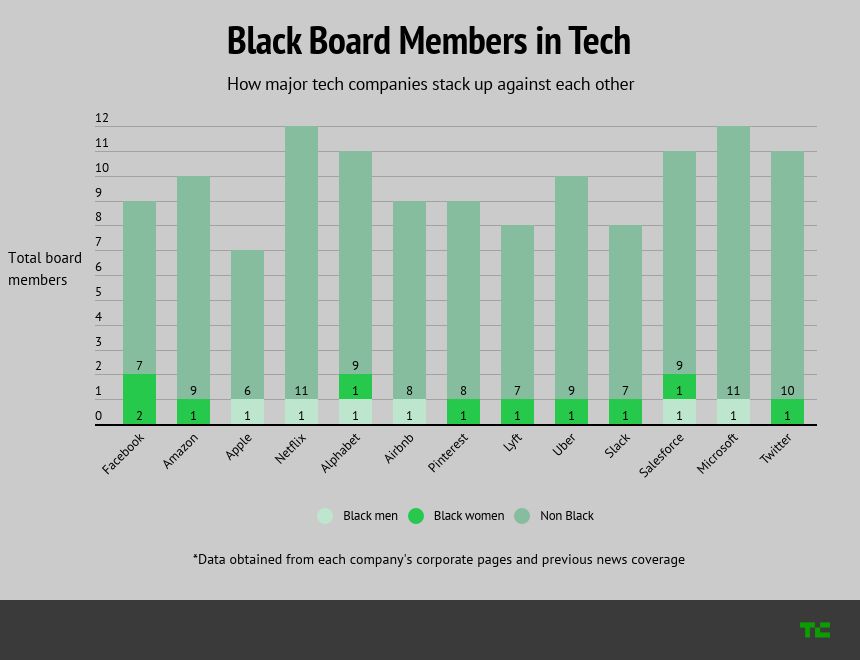
Over the last few years, tech companies have done a better job than usual around diversity at the board level. Following Reddit co-founder Alexis Ohanian stepping down from its board of directors and urging the company to add a Black person to its board, Reddit appointed Y Combinator CEO Michael Seibel. Other companies that have added Black board members in recent years include Facebook, Airbnb, Slack, Twitter and Apple.

Here’s a quick scorecard of racial diversity at big tech companies. Below, you can see how these major tech companies all have at least one Black board member, but how Black people are still underrepresented on boards of directors.

Image Credits: TechCrunch


Don’t Miss


Rocket Lab sets return to flight with next launch as early as August 27

Rocket Lab has made a remarkable recovery after losing a payload during a mission failure on July 4 — just eight weeks later, the company has set a launch window for its next dedicated commercial mission that spans 12 days beginning August 27 at 3:05 PM local New Zealand time.

At the end of July, Rocket Lab revealed it had received crucial FAA clearance to resume its launch activities, following an internal investigation that lasted a month and identified the root cause — a component that had performed fine previously, but that somehow hadn’t undergone rigorous and thorough testing. Rocket Lab founder and CEO Peter Beck noted that they’d be able to mitigate the problem with a relatively simple change to their production process, and even remedy the component on existing Electron launch vehicles.

Rocket Lab’s quick turnaround on this resolution and return to active launch status also has to do with the nature of the problem — the error actually resulted in an early, but safe shutdown of the Electron’s engines, which meant that it didn’t reach its target orbit. The rocket didn’t explode, however, or cause any kind of safety risk. That also meant Rocket Lab was able to easily pull data about the issue that caused the failure after the engines cut off.

Other companies have endured much longer shutdown times following launch vehicle failures: SpaceX took four months to return to active flights after its 2016 pre-flight loss of a Falcon 9 with a Facebook internet satellite on board. That was a very different kind of failure, however, for all the reasons mentioned above.

Still, it’s a sign of the resilience and flexibility of Rocket Lab’s model that it’s already set to begin serving paying customers again the month following its own ordeal. This launch won’t further its efforts to develop a partly reusable launch system with a booster recovery process, however.

Apple contends Epic’s ban was a ‘self-inflicted’ prelude to gaming the App Store

Apple has filed legal documents opposing Epic’s attempt to have itself reinstated in the iOS App Store, after having been kicked out last week for flouting its rules. Apple characterizes the entire thing as a “carefully orchestrated, multi-faceted campaign” aimed at circumventing — perhaps permanently — the 30% cut it demands for the privilege of doing business on iOS.

Epic last week slyly introduced a way to make in-app purchases in its popular game Fortnite without going through Apple. This is plainly against the rules, and Apple soon kicked the game, and the company’s other accounts, off the App Store. Obviously having anticipated this, Epic then published a parody of Apple’s famous 1984 ad, filed a lawsuit and began executing what Apple describes quite accurately as “a carefully orchestrated, multi-faceted campaign.”

In fact, as Apple notes in its challenge, Epic CEO Tim Sweeney emailed ahead of time to let Apple know what his company had planned. From Apple’s filing:

Around 2am on August 13, Mr. Sweeney of Epic wrote to Apple stating its intent to breach Epic’s agreements:
“Epic will no longer adhere to Apple’s payment processing restrictions.”

This was after months of attempts at negotiations in which, according to declarations from Apple’s Phil Schiller, Epic attempted to coax a “side letter” from Apple granting Epic special dispensation. This contradicts claims by Sweeney that Epic never asked for a special deal. From Schiller’s declaration:

Specifically, on June 30, 2020, Epic’s CEO Tim Sweeney wrote my colleagues and me an email asking for a “side letter” from Apple that would create a special deal for only Epic that would fundamentally change the way in which Epic offers apps on Apple’s iOS platform.

In this email, Mr. Sweeney expressly acknowledged that his proposed changes would be in direct breach of multiple terms of the agreements between Epic and Apple. Mr. Sweeney acknowledged that Epic could not implement its proposal unless the agreements between Epic and Apple were modified.

One prong of Epic’s assault was a request for courts to grant a “temporary restraining order,” or TRO, a legal procedure for use in emergencies where a party’s actions are unlawful, a suit to show their illegality is pending and likely to succeed, and those actions should be proactively reversed because they will cause “irreparable harm.”

If Epic’s request were to be successful, Apple would be forced to reinstate Fortnite and allow its in-game store to operate outside of the App Store’s rules. As you might imagine, this would be disastrous for Apple — not only would its rules have been deliberately ignored, but a court would have placed its imprimatur on the idea that those rules may even be illegal. So it is essential that Apple slap down this particular legal challenge quickly and comprehensively.

Apple’s filing challenges the TRO request on several grounds. First, it contends that there is no real “emergency” or “irreparable harm” because the entire situation was concocted and voluntarily initiated by Epic:

Having decided that it would rather enjoy the benefits of the App Store without paying for them, Epic has breached its contracts with Apple, using its own customers and Apple’s users as leverage.

But the “emergency” is entirely of Epic’s own making…it knew full well what would happen and, in so doing, has knowingly and purposefully created the harm to game players and developers it now asks the Court to step in and remedy.

Epic’s complaint that Apple banned its Unreal Engine accounts as well as Fortnite related ones, Apple notes, is not unusual, considering the accounts share tax IDs, emails and so on. It’s the same “user,” for their purposes. Apple also says it gave Epic ample warning and opportunity to correct its actions before a ban took place. (Apple, after all, makes a great deal of money from the app as well.)

Apple also questions the likelihood of Epic’s main lawsuit (independent of the TRO request) succeeding on its merits — namely that Apple is exercising monopoly power in its rent-collecting on the App Store:

[Epic’s] logic would make monopolies of Microsoft, Sony and Nintendo, just to name a few.

Epic’s antitrust theories, like its orchestrated campaign, are a transparent veneer for its effort to co-opt for itself the benefits of the App Store without paying or complying with important requirements that are critical to protect user safety, security,
and privacy.

Lastly Apple notes that there is no benefit to the public interest to providing the TRO — unlike if, for example, Apple’s actions had prevented emergency calls from working or the like, and there was a serious safety concern:

All of that alleged injury for which Epic improperly seeks emergency relief could disappear tomorrow if Epic cured its breach…All of this can happen without any intervention of the Court or expenditure of judicial resources. And Epic would be free to pursue its primary lawsuit.

Although Apple eschews speculating further in its filings, one source close to the matter suggested that it is of paramount importance to that company to avoid the possibility of Epic or anyone else establishing their own independent app stores on iOS. A legal precedent would go a long way toward clearing the way for such a thing, so this is potentially an existential threat for Apple’s long-toothed but extremely profitable business model.

The conflict with Epic is only the latest in a series going back years in which companies challenged Apple’s right to control and profit from what amounts to a totally separate marketplace.

Most recently Microsoft’s xCloud app was denied entry to the App Store because it amounted to a marketplace for games that Apple could not feasibly vet individually. Given this kind of functionality is very much the type of thing consumers want these days, the decision was not popular. Other developers, industries and platforms have challenged Apple on various fronts as well, to the point where the company has promised to create a formal process for challenging its rules.

But of course, even the rule-challenging process is bound by Apple’s rules.

You can read the full Apple filing below:

Epic v. Apple 4:20-cv-05640… by TechCrunch on Scribd

How to raise your first VC fund

Charles Yu
Contributor

Charles is a principal at Bling Capital and manages his own angel investment vehicle. Previously, he was an investor at TI Platform Management and Manhattan Venture Partners. He has quarterbacked investments in nine unicorns over the course of his career.

As a founding member of TI Platform Management, I have quarterbacked more than $200 million in investments into first-time fund managers around the world. That portfolio includes being one of the first institutional checks into Atomic Labs ($170+ million, SaaStr ($160+ million) and Entrepreneur First ($140+ million), among many others.

Having seen successful returns as a fund manager and an early-stage VC (as well as recently raising my own angel fund), I’ve formulated several best practices and strategies for investing in fund managers. If you want to raise your first fund, here’s how.

Understand the mentality of an LP

Just as VCs bucket startup founders into categories, limited partners (the investors in your venture fund, also known as “LPs”) have an unwritten way of categorizing venture managers. The vast majority fit one of three archetypes:

  • Former founder/operator turned VC
  • Spin-off manager from a mega fund
  • Angel investor with a strong track record

Here’s how each is perceived by institutional LPs and the unique blockers they have to overcome:

Former founder/operator turned VC

Having been through the journey of starting a company, former founders/operators often have strong intuition in identifying founders and an empathy/rapport that raises their win-rate on deals. Additionally, having built an innovative company, they can bring special insights in where the market is headed. Building a company, however, requires different skills from founding a fund.

If you’re a former founder/operator turned VC, expect LPs to ask questions that suss out:

OpenUnit aims to be Shopify for self-storage facilities

So you’re looking for a storage unit to put some stuff in for a few months. Maybe you’re moving and your new place isn’t ready yet — or maybe you’re just looking to declutter and want to tuck some stuff away for a while and see if you’re really ready to part with it.

As you may find, the process of finding a storage unit can be… not great. While there are a few big storage chains in the market, a huge chunk of the self-storage industry is made up of independent/mom-and-pop shops that don’t necessarily have the time/budget to keep up as tech has evolved. It can involve a lot of poking around out-of-date websites, a lot of phone calls and a lot of paperwork.

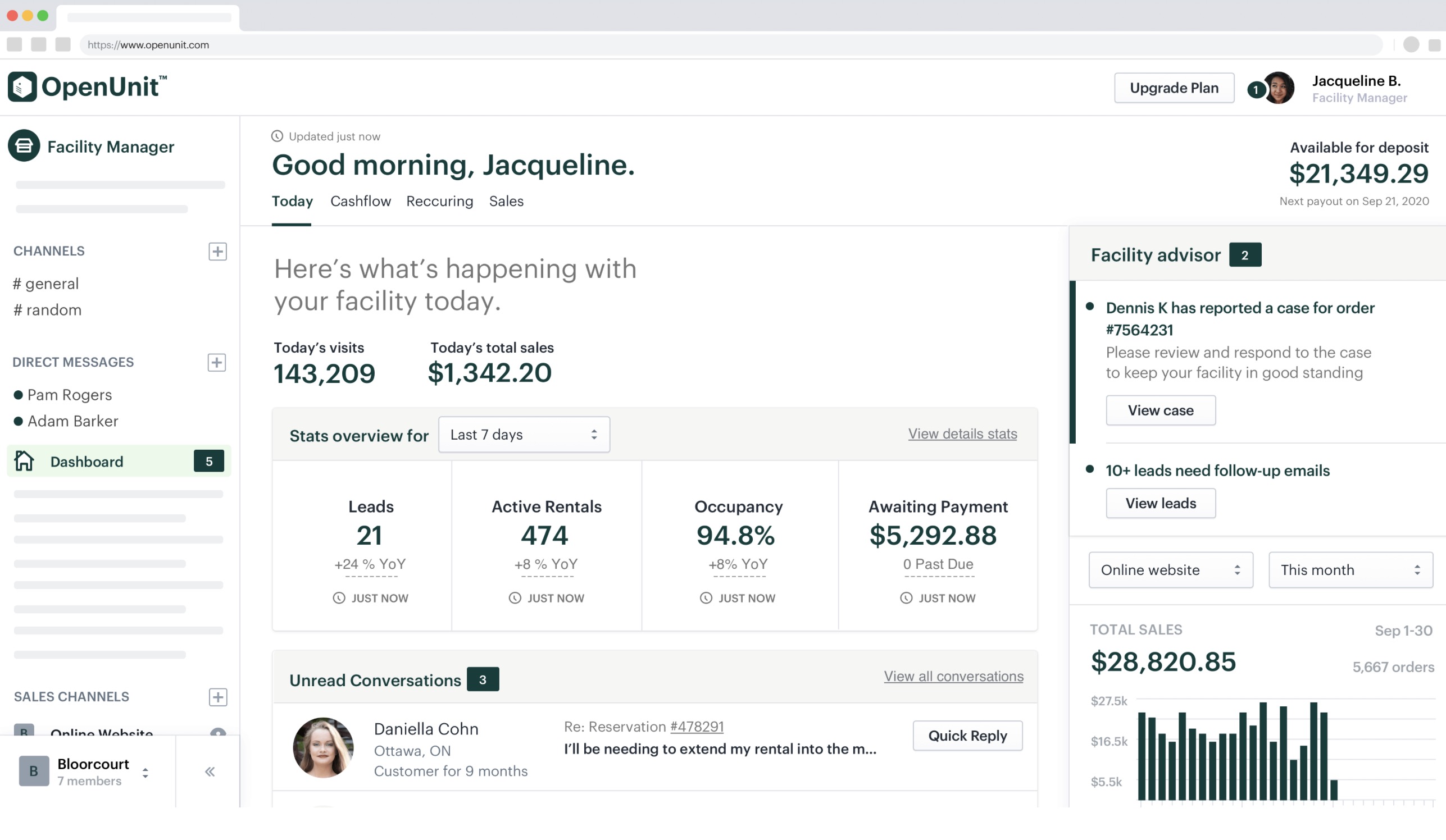
OpenUnit, a startup out of Toronto, wants to fix that. They’re aiming to be Shopify for the self-storage industry, with an all-in-one solution that provides a modern interface to help customers make reservations on the front end, and gives facility managers everything they need to keep things running on the back end.

Their management tool provides things like:

  • A white-labeled site for making reservations
  • Unit inventory management
  • Expense tracking
  • Group chats/DMs to give employees and managers a place to keep in touch
  • Pricing/revenue analytics
  • Digital lease signing
  • A CRM for managing leads and existing relationships

The company isn’t charging facility managers a monthly fee; instead, they’re handling credit card payment processing and taking a cut of 2.9% (+ 30 cents) per transaction.

Co-founders Taylor Cooney and Lucas Playford found their way into self-storage when Taylor’s landlords came to him with an offer: they wanted to sell the place he was renting, and they’d give him a stack of cash if he could be out within just a few days. Pulling that off meant finding a place to keep all of his stuff while he looked for a new home, which is when he realized how antiquated the self-storage process could be.

Image Credits: OpenUnit

The two initially set their sites on something a bit different: a Hotwire-style search system that would find deals on local storage units, negotiating the monthly cost on a customer’s behalf for a small one-time fee. The more they worked with facility managers, the more gaps they found in the tools and systems on the market, so they shifted focus to this facility management suite.

OpenUnit was part of the Winter 2020 Y Combinator class which ended back in March, but the team opted to defer their demo day debut until YC’s Summer 2020 event next week. As March came to an end and the severity of the pandemic was becoming more clear, Canadian Prime Minister Justin Trudeau called upon any citizens abroad to return home sooner than later. Launching a company while rushing to get back home is hardly ideal, so the two chose to hold off their launch until now.

After a few weeks of private testing, OpenUnit is now starting to bring more storage facilities on board. Run a storage company and want to give it a look? They’ve got a waiting list here.

Anu Duggal on COVID-19, promoting diversity and building a fund

It has been nearly a decade since Anu Duggal, founding partner of Female Founders Fund, started raising money to invest in women-led startups. In 2020, the investor says her thesis — that there will be a generation of successful venture-backed businesses built by women — is one you can’t avoid.

“You can’t argue with that anymore,” she said. “There are going to be some people who take a little longer to kind of accept that this is a long-term development, and there’s some that have recognized this is the future.”

We brought Duggal on to Extra Crunch Live on Thursday to discuss how her work is changing amid unprecedented times.

She, like many investors, says she has taken on the “new normal as the new normal” and is invested in startups without ever meeting founders in-person. But how does the breakdown of traditional networks impact female founders?

“I wouldn’t say we’re seeing new tailwinds yet,” she said, on the focus to invest in female founders. “I think we’re still kind of in the early innings of corona. I will say, though, that there’s reason to be optimistic.”

Duggal talks about bright spots in this dumpster fire of a year, scout programs and the “lipstick effect” in the full session, which is available below. You can sign up for Extra Crunch here if you still need access.

Should investors publicly share portfolio diversity data?

We felt strongly about disclosing diversity data because, you know, we invest 100% in companies started by women and so we’re already at somewhat of an advantage compared to most of the industry. I think the reason we did it was to show that we’re not patting ourselves on the back. We still have more work to do. And here’s what we’re going to do, here are the action steps we’re taking.

Box CEO Aaron Levie says thrifty founders have more control

Once upon a time, Box’s Aaron Levie was just a guy with an idea for a company: 15 years ago as a USC student, he conceived of a way to simply store and share files online.

It may be hard to recall, but back then, the world was awash with thumb drives and moving files manually, but Levie saw an opportunity to change that.

Today, his company helps enterprise customers collaborate and manage content in the cloud, but when Levie appeared on an episode of Extra Crunch Live at the end of May, my colleague Jon Shieber and I asked him if he had any advice for startups. While he was careful to point out that there is no “one size fits all” advice, he did make one thing clear:

“I would highly recommend to any company of any size that you have as much control of your destiny as possible. So put yourself in a position where you spend as little amount of dollars as you can from a burn standpoint and get as close to revenue being equal to your expenses as you can possibly get to,” he advised.

Don’t let current conditions scare you

Levie also advised founders not to be frightened off by current conditions, whether that’s the pandemic or the recession. Instead, he said if you have an idea, seize the moment and build it, regardless of the economy or the state of the world. If, like Levie, you are in it for the long haul, this too will pass, and if your idea is good enough, it will survive and even thrive as you move through your startup growth cycle.

Sources say Palantir will have a lockup period after its direct listing

This morning, we published exclusive, leaked details about Palantir’s much anticipated S-1 filing, including the company’s revenues, margins, operating loss and government/commercial contract breakdown.

One aspect that we didn’t cover much though was the actual process the company intends to use to float its shares on the stock exchange. Rumors have flown for weeks that the company intends to pursue a direct listing, probably targeting mid-to-late September.

Direct listings are different from the standard IPO process in that there are no new shares offered to the public, the company doesn’t raise money, and typically, employees and insiders have no lockup period. The lockup period in a typical IPO is around six months, although it can be a year or longer in special cases. Given there are no new shares and no lockups, trades after a direct listing are literally any shares offered for sale by insiders.

That can lead to volatility, and that volatility is one reason why some companies have been hesitant to go the direct listing route — without lockups, employees and venture capitalists could theoretically quickly dump their shares, tanking the stock straight out of the gate and harming the perception of its long-term value.

For strong companies though, the open free-for-all makes sense. For instance, when Spotify executed its direct listing in early 2018, the company had no lockup period for its insiders except for one large shareholder (Tencent). Slack, which pursued a direct listing in mid-2019, similarly had effectively no lockup. Both companies have performed admirably since their public debuts.

However, according to multiple sources who have seen its prospectus documents, Palantir intends to have a lockup period on its shares. One source did confirm that the company will pursue a direct listing, although we have not been able to verify that with multiple sources.

The combination of a direct listing and a lockup period would be novel, and represents a turn away from the more employee-friendly tactics that have been pioneered by Slack and Spotify.

The lockup will almost certainly help stabilize Palantir’s stock post-debut, which will be less volatile since insiders won’t be able to trade their shares. However, it is definitely not a vote of confidence that a 17-year-old company thinks it needs to control the selling decisions of its workforce and investors in order to maintain its share price on the public markets.

As before, the company’s S-1 is clearly in the offing, and we will have more details on the specifics when the official docs are filed with the SEC.

This subscription social network is happy to be an Albatross in a pandemic

In discussions of ethically dubious social networks, Facebook is the usual reference choice. But spare a thought for subscribers of InterNations, a Munich-based social networking community for expats, who have found themselves unable to obtain refunds for full-year payments charged in the middle of the coronavirus crisis.

InterNations has operated an expat networking experience since 2007, offering a free “Basic” tier of membership that gives users some access to site content and community-organized events (if they pay an entry fee); or a premium tier which requires shelling out for a year’s subscription up front to get free/reduced price entry to networking events, plus access to some additional site features.

The German company appears to be a fan of nominative determinism — having named the subscription tier of membership “Albatross,” given how difficult it is for users to exit once they upgrade from Basic to paying, perpetually renewing contract.

Several former members told us their memberships were auto-renewed for a full year without any warning in the middle of the pandemic. When they contacted InterNations to request a refund they were point-blank refused — with the company saying they were bound by the terms of the contract they’d entered into when they paid to upgrade the year before.

In emails we’ve reviewed between users and InterNations’ staff, the company repeatedly ignores requests for refunds.

One U.K.-based user, who told us she had signed up to use the service to attend networking events in London and Paris, where she traveled regularly for work, found herself put on furlough in March when the U.K. went into lockdown. She only noticed the InterNations subscription had auto-renewed when she saw a charge as she was checking her bank statement.

She contacted InterNations to request a refund — pointing out there were now no physical events near her, nor would she be able to attend in-person networking events for the foreseeable future due to shielding as a result of personal vulnerability to the health risk posed by COVID-19. But InterNations still refused to refund her subscription.

Instead it offered to put the year’s Albatross membership on hold until 2022 — suggesting she might be able to make use of the services she’d just been billed for in two years’ time.

“Many of the people complaining feel aggrieved by InterNation because the entire event offering is very much voluntary and community based. It relies on people stepping forward to organise groups of people to attend events, walks, screening etc. Most of them do not make financial gain out of it,” she told us.

“So for this organisation not to be looking after its very own community feels like a slap on our faces.”

“My local gym froze my membership from April 2020 without any of its members having to request it. They informed us by email they would do this. I was able to cancel in July without any question asked,” she added. “If my small gym is able to do this, how come InterNations is not stopping the auto-renewal of the membership at such a time?

“When everyone almost worldwide is worrying about their health, their livelihood, their relatives, we are not remembering to cancel or to stop memberships.”

Another user, who signed up to the service after moving from the U.S. to Singapore, told us he was sent repeated payment demands in the middle of the coronavirus crisis after his on-file credit card had expired — which meant InterNations couldn’t auto-collect his payment.

He told it he wanted to cancel the subscription but it told him he would only able to delete his account if he paid up for a full second year. Eventually he said he felt he had no choice but to pay the demand for around $100 in order that he could downgrade from Albatross to Basic and have his account deleted.

“I was (and still am) a paid subscriber and during the height of the pandemic I never received an offer of ‘free months’ of membership,” he said. “Instead, all I got was a deluge of threatening emails about how they couldn’t process my credit card information. Nothing even remotely about whether I was sick or even still alive. They just wanted my credit card details.”

A third user, who signed up for the service after moving to Hanoi, summed up her experience as “not the best.” She pointed us to a blog post in which she recounts a similar story — finding herself charged for a renewal in the middle of the coronavirus without any advance warning and having forgotten to cancel the subscription herself.

“I didn’t realise I’d been charged until a notification from PayPal arrived in my inbox,” she writes. “Say, what? Where was the email reminder? Where was the ‘now due’ invoice that is the hallmark of good business? Turns out InterNations don’t send them.”

This user was finally able to obtain a refund — but only via disputing the charge through PayPal. She got no joy asking for her money back from InterNations itself.

A deluge of similar complaints about the company can be seen on Trustpilot — where InterNations has an 81% “bad” rating at the time of writing.

“An annual membership was taken from my account, and refund was refused. A year on and I am being threatened with non payment of a new invoice,” writes one reviewer.

“I cancelled my membership the past two years and every year it shows that I didn’t and their records conveniently show no record of my cancellation. Then they will refuse refunds,” recounts another.

“InterNations contacted me via automated email about my membership payment being due. When I responded, asking to cancel membership since I haven’t logged in in months and can’t afford membership during these times, they refused to help,” says another irate reviewer. “They make it impossible to do this simple task. They’re greedily unable to help with anything other than take your money. No empathy. All they have to do is cancel the membership.”

“They don’t even send a reminder for end of membership. Some people have seen their credit card debited, without any reminder. And if your credit card you registered has expired, they keep harassing you and threaten you,” runs another despairing former user.

In emails to users who are requesting a refund which we’ve seen, InterNations simply points them to German law — which does appear to be the legal sticking point here. As a number of expat blogs warn, service contracts in Germany can be a lot harder to get out of than into.

Though, of course, it’s unlikely to have been immediately clear to people signing up to a global social network in cities like Hanoi and Singapore that they needed to understand German contract law before hitting “subscribe.”

BEUC, the European consumer rights group, told us there’s no pan-EU requirement for a notification to be actively sent to users ahead of an auto-renewal of a services contract — and the lack of such a notification ahead of the InterNations subscription renewal is one of the key recurring complaints.

“EU law only requires the consumer to be informed of the final price and the contractual conditions,” a spokesperson said, noting that consumer rights can vary substantially from member state to member state as the area isn’t harmonised at EU level.

So, while BEUC noted that, for example, Belgium law does have a specific provision which allows the consumer to terminate a contract at no cost after its tacit renewal — Germany, self evidently, does not. Although domestic pressure appears to be growing for reform of its one-sided contract rules.

When we put the various complaints we’d heard about refunds and cancellations (and indeed dark patterns) to InterNations, its founder and co-CEO, Malte Zeeck, said the company does not breach consumer law — and further claimed it “clearly communicates” subscription renewals to users.

“InterNations is operating on a standard subscription model like many other businesses, which is at no point in breach of consumer protection laws,” he said. “Subscriptions are renewed automatically, which is clearly communicated at the beginning of each subscription period, in each invoice, and in every user’s membership and account settings. This is also where a subscription can be canceled at any time, without a notice period that has to be observed.

“Our members have a continual visual reminder of their membership status through the Albatross symbol found on their profile picture. They can also always see their current membership status by visiting their membership page.”

And while he conceded that InterNations had had to cancel in-person events “during the height of the pandemic” he said it substituted this reduction in service by offering “additional free months of membership” and “working very hard to respond to the situation and find ways for our members to still meet and spend time together online.”

“After only a few weeks, we already offered over 500 online activities worldwide to help expats and global minds connect and share experiences — more online events were being added every day,” he added. “In addition, our users continued to benefit from other online networking and information features our premium membership offers. Since restrictions on in-person events are being lifted around the world, we have started to offer many opportunities for our members again to meet in person.”

EU consumer protection rules do bake in requirements that contract terms be fair — with provisions intended to protect against things like one-sided changes to a service without a valid reason. But it’s pretty clear that InterNations could argue a pandemic is a valid reason for canceling in person events and replacing them with online networking. So angry users are unlikely to find much solace there.

Still, maintaining such an inflexible and user hostile attitude during a pandemic does look risky for InterNations and its reputation, given new users are likely to be far less easy for it to net now that the coronavirus has settled like a dead calm on so much foreign travel.

So while it might be legally entitled to sit and claw in revenue from people who — living through a pandemic and worried about things like their jobs, health and loved ones — forgot to cancel a subscription that only comes round once a year, it’s hardly a recipe for long-term customer loyalty.

Indeed, we’ve seen these kind of auto-renewing subscription gigs crop up in the e-commerce space in years past. And none of those dubious tactics went the distance.

Tricking consumers into recurring payments is never a good long-term business strategy, and it certainly isn’t now that reputational damage can scale all over social media in seconds. (To wit: Irate InterNations users have been organizing via Twitter and have set up a website to amplify negative reviews where they urge people to boycott the service.)

None of the people who’ve been stung by InterNations’ auto-renewing subscription are likely to forget to cancel a second time so won’t be a source of recurring revenue in future. And treating users like so much chum when the company also relies upon their community spirit to power its service looks like a rotten business model long past its sell-by-date. (However many members InterNations claims have contacted it “to say how much our online events have helped them to stay in touch with people and also stay positive during a period of self-isolation,” a minority of satisfied customers are being drowned out by all the angry online views.)

In the meanwhile, it’s certainly curious to encounter a niche social network that’s happy operating with as little regard for users’ wishes as some of the far more maligned giants of the category. To the point where its website displays information regarding the European Commission’s “online dispute resolution” platform in small print right on the contacts page. Er, perhaps Facebook should take note.

On unhappy users, Zeeck only had this to say: “We are sorry that some of our former members perceive this differently and were not happy with the benefits our membership offered them. We are always taking our users’ feedback seriously and are working hard to provide a great experience for them. At the same time, we are aware that it is hard to have the perfect solution for everybody, and there will always be detractors.”

But perhaps he’s been taking cues from Mark Zuckerberg’s neverending apology tours.

How one founder leveraged debt to drive early growth and avoid dilution

Avi Freedman is like any other founder: He wants to build a great company. In this case network analytics platform Kentik, and he needs venture capital to do it. Like pretty much all founders, he doesn’t like the dilution that comes from taking vast sums from VCs in order to grow. There’s always been an alluring solution to this dilemma, but one that comes with its own tradeoffs.

Debt.

The word has negative connotations, but the reality is that just like equity capital, debt is a key tool in the corporate finance toolbox. Judicious use of debt with the right terms and conditions can cut the cost of capital for a startup significantly, saving founders and early-stage investors from serious dilution as a company scales. Used too heavily or improperly however, and debt can turn a bad financial quarter into a dead company, stat.

Founders, particularly those who run companies with recurring revenues, are increasingly hearing the debt pitch from bankers and peers, leading many to consider debt options much earlier than has traditionally been the norm. Boards are also getting more comfortable with the idea of a startup taking on early debt to extend runways and double down on growth.

Let’s walk through how a founder sees debt today and discuss what the market looks like for debt options. Freedman was helpful in illuminating his recent fundraise, including the range of term sheets he got, and was willing to share his experience and thinking on how he approached his latest financing.

Debt and COVID-19

Some context to get started. Kentik is a six-year-old SaaS platform that has raised more than $60 million in venture capital, according to Crunchbase, including a seed round led by First Round Capital and a Series A led by the now-defunct August Capital (plus the company’s most recent equity/debt round we’re talking about today). Freedman himself has been a long-time entrepreneur, building the first ISP in Philadelphia back in 1992. Kentik was his first true “venture-backed” business in the Silicon Valley startup model.

Submit your pitch deck to Disrupt 2020’s Pitch Deck Teardown

Disrupt 2020 is a few weeks away and we’re looking for founders to submit their pitch decks. In the Pitch Deck Teardown, top venture capitalists and entrepreneurs will evaluate and suggest fixes for Disrupt 2020 attendees’ pitch decks.

First impressions are everything, and pitch decks are often the first glimpse of companies by investors and business partners. It’s critical that these decks accurately present and illustrate the company’s goals and potential, concisely and effectively.

We’ve enlisted the help of some of the best venture capitalists. During these sessions, VCs will step through each slide, talking about what works, what doesn’t work and what needs to be changed to make the most impact. Along the way, expect to hear valuable insight on how investors evaluate pitch decks and the red flags that can shut down a potential investment.

What’s more, we’re looking for pitch decks to feature in these sessions. We want to showcase real pitch decks from actual companies. Anyone can submit their deck, though we’re looking for decks from early-stage companies. Submit your pitch deck here.

Some guidelines:

  • When submitting, please use the email you used when you registered for Disrupt 2020
  • Only pitch decks of registered Disrupt attendees will be selected
  • Early-stage companies are more likely to be selected for this session
  • If selected, you’ll be notified and told in which session your deck will be featured

Here are the investors signed up for the Pitch Deck Teardown:

  • Aileen Lee (Cowboy Ventures)
  • Charles Hudson (Venture Forward)
  • Niko Bonatsos (General Catalyst)
  • Megan Quinn (Spark Capital)
  • Cyan Banister (Long Journey Ventures)
  • Roelof Botha (Sequoia)
  • Susan Lyne (BBG)

Pitch Deck Teardown is part of a much larger event focused on all aspects of building technology companies. For the first time, TechCrunch’s big yearly event, Disrupt, is going fully virtual in 2020, allowing more people to attend and interact with speakers, investors and founders. And Disrupt will stretch over five days — September 14-18 — in order to make it easier for everyone to take in all the amazing programming. Prices increase soon, so get your pass now and then submit your pitch deck for invaluable feedback from our panel of VCs.

Leaked S-1 screenshots show Palantir losing $579M in 2019

Palantir filed an S-1 confidentially to the SEC in early July, but we have so far been waiting for the final document to be published for weeks now with nary a murmur. Now, thanks to some leaked screenshots to TechCrunch from a Palantir shareholder, we might have some top-line numbers.

Full-year revenues and losses

In screenshots of a draft S-1 statement dated yesterday (August 20), Palantir is listed as generating revenues of roughly $742 million in 2019 (Palantir’s fiscal year is a calendar year). That revenue was up from $595 million in 2018, a gain of roughly 25%. That’s growth, although not particularly great, given some of the massive SaaS growth we have seen in recent IPOs like Datadog.

The company’s revenue is a disappointment, after the company was reported to have been on the cusp of $1 billion in revenue for years. Private companies, of course, do not normally disclose their financial results, but the company’s size falls far short of expectations, leaks and other reports.

The real shocker though in these numbers is when you head to the bottom of the company’s revenue statement. In the screenshots of the company’s financials, Palantir lists a net loss of roughly $580 million for 2019, which is almost identical to its loss in 2018. The company listed a net loss percentage of 97% for 2018, improving to a loss of 78% for last year.

The company’s $580 million loss during the period shows at once why the company has needed to raise billions to date, and how far it has yet to go until it can self-sustain.

Gross profit for 2019 was roughly $500 million, about 16% higher than in 2018. The company’s big expense is around sales and marketing, which was roughly $450 million for both years and represented 61% of revenue in 2019.

First half of 2020 is looking slightly better

The story gets a little better in 2020. For the first six months of 2020, Palantir recorded revenues of $481 million, a 49% gain compared to the same period last year. More importantly, Palantir has worked hard to maintain its level of expenses in sales and marketing, research and development as well as general and administrative costs.

Palantir kept expenses in check in the first half of 2020 despite its increase in revenue. In relative numbers, operating expenses changed from 157% of revenues in the first half of 2019 to 107% of revenues in the first half of 2020.

To be clear, that is still really high for a 17-year-old company.

Palantir is increasingly a government contractor, despite attempts to enter the commercial arena

The company’s revenue breakdown is particularly interesting because it finally answers the question about how much it relies on government contracts and if it’s trying to diversify. Palantir is widely known for its government contracting, but in recent years, the company has tried to expand its data products into the private sector.

According to the leaked screenshots shown to TechCrunch, Palantir disclosed its revenue breakdown for the first six months of 2019 and the first six months of 2020. For the first half of this year, Palantir generated $258 million in government-derived revenue (53.5%), compared to $224 million in commercial revenue (46.5%). In 2019, government revenue was $146 million (45%) and commercial revenue was $177 million (55%). Together, that means that government revenue increased by 76%, versus just 27% growth in its commercial business.

That’s actually quite out-of-sync with some of the public comments the company has made about reducing reliance on government contracts for its revenues. The company’s government revenues are higher today both in absolute totals and relatively speaking, begging the question whether its products are competitive in the enterprise space outside of its traditional bastion in government services.

What’s interesting is that almost all of that revenue growth is from existing customers (dated to the end of 2019) rather than new customers in 2020 (despite all that S&M spending). On the government side, $102 million of the $112 million revenue increase (91%) came from existing clients, while $43 million of the $47 million of growth in commercial revenues (91% as well) came from existing customers.

In other words, Palantir remains heavily reliant on its existing customer base — and particularly its government clients — for new growth.

While there is no firm date for the Palantir S-1 that we know of, given the financials are apparently floating around out there, expect it to come sooner rather than later.

We reached out to a Palantir PR contact, who declined to comment.

Updated with more numbers for 2020 and better breakdowns of new versus existing customers.