Mastercard acquired and shut down IfOnly, an experiences marketplace hit by COVID-19

Travel has undoubtedly been one of the industries hardest hit in the coronavirus pandemic, constrained by restrictions on how people can move between and within countries, many venues closing, new rules to minimise gatherings, shrinking economies, and a general reluctance among consumers to engage in getting out and about. One startup in the space has been acquired in the wake of that.

IfOnly — an “experiences” marketplace based around access to exclusive, and often expensive, events and people, with a portion of the proceeds that a guest pays for the experience going towards good causes — was quietly acquired and shut down by credit giant Mastercard for an undisclosed sum. Mastercard told TechCrunch that it has folded the tech and team into Priceless — its own experiences marketplace — after initially leading a strategic investment in the company in 2018.

“At the end of last year, IfOnly, whose technology helps to power Priceless.com, became part of the Mastercard family, bringing their expertise and know-how in-house,” a spokesperson said. “The IfOnly platform will continue to help advance our Priceless strategy and our combined team will be even better positioned and equipped to deliver exclusive experiences for cardholders globally.”

IfOnly had been founded and previously led by Trevor Traina, a businessman, member of one of the wealthiest families in the US, and a well-connected Trump supporter. Traina eventually left the role of CEO when Trump appointed him ambassador to Austria in 2018. He was replaced by John Boris, who had been the CMO of Shutterfly. He still lists the CEO role of IfOnly as his current gig.

Mastercard had been just one of IfOnly’s big strategic investors; others were Hyatt Hotels, Sotheby’s and American Express, while financial backers investors included the likes of Founders Fund, NEA and Khosla. Together, investors had collectively put nearly $50 million into the startup. IfOnly was last valued at about $105 million, according to PitchBook data.

While Mastercard said that it had acquired the company at the beginning of the year, it turned out to be a soft landing for the startup, given the global turn of events and how it has impacted the travel industry.

It was only in July of this year that IfOnly had posted a notice on its site announcing the closure and acquisition. (A reader tipped us on the development last week.)

But before that, IfOnly’s business had ground to a halt in the wake of the coronavirus pandemic. In the archived pages of the site (via the Internet Archive’s Wayback Machine) the company announced months ago that it would be pausing the availability of its experiences “due to the COVID-19 situation”, saying it would update as it learned more.

The sale (and closure) puts an end to a startup that began life with exclusive experiences that appeared to be aimed squarely at the one percent. One offer (on an archived page) for example offered “a family weekend feasting in Florence, Italy” starting at €62,851 (about $74,000) for four people, and tours of the Champagne region in France.

But the startup appeared to want to widen that out. Another offer included a session with the founders of “Goat Yoga” in Las Vegas for a private feeding and yoga session with baby goats (yes, this is a thing), starting at about $33 per person, depending on group numbers and presumably the number of goats and other parameters. Each experience was tied to a particular charity that would benefit from the purchase.

It also looks like IfOnly had also expanded into single, virtual experiences and those that could be bid on, both directly on its site and in partnership with auctioneers Sotheby’s. These included having customised voicemails created by Susan Sarandon, or bidding on a lunch with Mary Kay Place.

But the writing may have been on the wall, with the startup not formulating any kind of “plan B” on its site in the wake of the global health pandemic. Others that have built businesses around experiences — visiting places, going on tours, meeting famous people and doing other things to engage people in something new either close to home or further afield — have had to completely rethink their approach.

Airbnb — which had moved aggressively into experiences some years ago to complement and expand its accommodation booking platform — in April launched Airbnb Online Experiences, offering virtual tours and other video-based engagements to users.

GetYourGuide, the very well-capitalised Berlin-based startup offering unique tours and other travel-based experiences, has brought in pay cuts and reassessed its business model essentially around the idea of writing off 2020 (that is, assuming no one books for this year), in hopes of a turnaround in the longer term.

Meanwhile, Klook resorted to cutting staff. And yet others like Omaze — which like IfOnly also ties in its experiences with raising money for charity — are still raising money and operating, albeit currently needing to delay some of the experiences they’re selling.

For Mastercard, the Priceless platform is part of the company’s wider efforts to expand its business beyond basic card services. (That’s something that has seen companies like Mastercard, Visa and Amex expand into services for businesses, too, such as Mastercard’s purchase of B2B payments company Nets, and Amex’s purchase of SMB loans platform Kabbage.) Services like Priceless also help Mastercard create more brand loyalty with its customers, and to potentially make better revenues per user through more direct retailing.

As with other experience purveyors like Airbnb, it seems like the Priceless offerings have moved into the completely virtual sphere, selling people a chance to meet sports celebrities online, go backstage at famous theatres, and learn how to mix drinks with well-known mixologists. These may now be powered by IfOnly, but only in part: the option to give to charities doesn’t appear to have carried over with the deal.

With $11 million in fresh capital, Bolt Bikes rebrands to Zoomo

Bolt Bikes, the electric bike platform marketed to gig economy delivery workers, has a new name and a fresh injection of $11 million in capital from a Series A funding round led by Australian Clean Energy Finance Corporation.

The round also included equity from Hana Ventures and existing investors Maniv Mobility and Contrarian Ventures, together with venture debt from OneVentures and Viola Credit.

The Sydney, Australia-based startup that launched in 2017 is now called Zoomo, a change that aims to better reflect a customer base that has expanded beyond gig economy workers to include corporate clients and everyday consumers. Mina Nada, co-founder and CEO of the newly named Zoomo, also told TechCrunch that he wanted to ensure the company wouldn’t be confused by other similarly named businesses.

“When we set up Bolt back in 2017, the name was fine in Australia, but as we’ve gone international we’ve come up against at least three other companies called Bolt, two of them in the mobility space,” Nada explained. On-demand transportation company Taxify rebranded as Bolt in May 2020. Another company known as Bolt Mobility provides shared-scooter services.

Zoomo, which has operations in Australia, the U.K., New York and soon in Los Angeles, sells its electric bikes or offers them as a subscription. Its primary business has been subscriptions for commercial use, which includes the electric bike, fleet management software, financing and servicing. Subscribers get 24-hour access to the bike. A battery charger, phone holder, phone USB port, secure U-Lock and safety induction is included.

Zoomo has sales and service centers in the markets where it offers subscriptions, which includes Sydney, New York and the U.K. The company plans to use the new funding to expand its subscription footprint — which means adding physical sales and service centers — to Los Angeles and Brisbane as well as within New York.

The company’s strategy is to slowly expand where its subscription service is offered, while ramping up direct sales. The need for physical locations limits how quickly Zoomo can expand its subscription product. Selling the bikes to corporations and other users allows the company to generate more revenue, grow its geographic reach and build brand recognition as it slowly expands its more capitally intensive subscription service.

Zoomo also plans to use the funding to add new corporate categories such as parcel, mail and grocery deliveries that its bikes can be used for as well as other models better suited for individual consumers.

Extra Crunch discount now available for military, nonprofits and government employees

We’re excited to announce that government, nonprofit and military employees can get an Extra Crunch membership at a discounted rate of $50 per year, plus tax. If interested in claiming the deal, please contact our customer service team from your .org, .gov, .mil or similar work-related email domain. We’ll also accept other forms of verification, such as proof that the organization is a 501c3 or an employment ID. Our customer service team can be reached at [email protected].

Extra Crunch unlocks access to our weekly investor surveys, daily private market analysis and in-depth interviews with experts on fundraising, growth, monetization and other core startup topics. Find answers to your burning questions about startup and investing through Extra Crunch Live, and stay informed with our members-only Extra Crunch newsletter. Other benefits include a faster-loading and cleaner TechCrunch.com experience, 20% off future TechCrunch event tickets and savings on software services like DocSend, Typeform, Crunchbase and more.

Learn more about Extra Crunch benefits here.

Earn the best backlinks with high-quality content and digital PR

Amanda Milligan
Contributor

Amanda Milligan is the marketing director at Fractl, a prominent growth marketing agency that’s helped Fortune 500 companies and boutique businesses alike earn quality media coverage, backlinks, awareness and authority.

A lot is debated in the SEO world, but nearly everyone can agree that links are and will continue to be vitally important to the health and rankability of a website.

Luckily, link building and brand awareness goals can be built into your content marketing strategy, which can be vastly elevated by combining your efforts with digital PR.

I’ll walk through how creating high-quality content and pitching it correctly to top publishers can earn you the valuable backlinks you’ve always wanted (and if you employ this strategy on an ongoing basis, the increase in organic traffic you’ve always wanted, too).

Choosing the right content idea

I have to start by saying that the most important thing about being cited in news sources is that you have to be newsworthy. Now that might go without saying, but what we as marketers might consider newsworthy about our brands isn’t necessarily newsworthy to a writer or to the greater public.

Content ideation tip #1: The best way to ensure your newsworthiness is to gather and analyze data. Even if the data set already exists, if it hasn’t been analyzed and presented in a straightforward, applicable, easy-to-understand way, your illustration of the data could be considered new and valuable.

I’ll touch on this again in a moment. But first, let’s dive into the content example I’ll be using throughout this piece.

Startup Alley exhibitors: Register for VC-led Fundraising & Hiring Best Practices webinar

It’s a classic “last but not least” moment for the all the savvy early-stage startup founders exhibiting in Digital Startup Alley at Disrupt 2020. The final webinar in our three-part interactive series takes place on August 26 at 1 p.m. PT / 4 p.m. ET. Don’t forget to register right here.

Pro tip: You must be a Digital Startup Alley exhibitor to access this webinar (and other Disrupt 2020 events coming soon to the internet near you). Not an exhibitor yet? Buy a Digital Startup Alley Package and the webinar will be the first of many benefits coming your way. More on those in a minute.

Bonus pro tip: Curious about the look and feel of Disrupt 2020? Check out the video of our latest Ask Me Anything session: How TechCrunch turned Disrupt into a virtual event.

Got your pass? Tune in, bring your questions and get ready for a masterclass called Fundraising and Hiring Best Practices. Every startup founder needs to understand how these essential aspects work to mount a successful startup, and we have seasoned experts to guide the way.

The panel, moderated by our own Natasha Mascarenhas, includes Sarah Kunst (Cleo Capital) and Brett Berson (First Round Capital). Learn tips and effective strategies to help you secure funding for your startup. Learn to avoid pitfalls when you begin to hire — getting it right is one of those make or break moments.

Exhibiting in Digital Startup Alley can be one of the smartest investments you’ll ever make. Exhibit and demo your tech and talent to thousands of global Disrupt attendees. Use your custom exhibit page to feature your pitch deck or marketing video and collect leads from people who visit the page.

CrunchMatch, our free AI-powered networking platform, helps you find and connect with people who can help grow your business — investors, potential customers, media and other influencers. It helps them find you, too. Even better, CrunchMatch is live right now. Translation: more time to pitch, demo and schedule 1:1 virtual meetings.

Your exhibitor status also gives you exclusive access to upcoming speed networking and interview sessions with accelerators and founder organizations. Connect with the likes of iFundWomen, Backstage Capital, Techstars, Plug and Play and Global Startup Ecosystem. There’s no telling where one conversation with any of these groups might take you.

Don’t miss out on our Fundraising & Hiring Best Practices webinar on August 26 at 1 p.m. PT / 4 p.m. ET. Already an exhibitor? Register to attend here.

And don’t miss out on the opportunities that come from exhibiting in Startup Alley. Be savvy. Buy a Digital Startup Alley Package, register for the webinar, and do everything in your power to drive your business forward.

Is your company interested in sponsoring or exhibiting at Disrupt 2020? Contact our sponsorship sales team by filling out this form.

Ever, once accused of building facial recognition tech using customer data, shuts down consumer app

Cloud photo storage app Ever is shutting down, citing increased competition with the default services offered by Apple and Google as the cause. The company, however, had other issues beyond the plight of a small startup trying to compete with tech giants. Last year, NBC News reported the company had been using its customers’ photos to develop facial recognition technology that it turned around and offered for sale by way of the Ever API to business clients, including law enforcement and the military.

The company’s real business model wasn’t properly disclosed to consumers who visited the Ever website or app, the report said.

Ever had argued at the time it wasn’t sharing people’s private photos or any identifying information with its facial recognition customers. Instead, it had used the billions of images its customers had uploaded to build an algorithm that can learn from matches and is now able to train itself on other data.

The American Civil Liberties Union (ACLU) of Northern California said the business was an “egregious violation of people’s privacy,” as few knew their family photos were being used to build surveillance technology.

While other companies, including Amazon and Microsoft, have built out facial recognition technology products of their own in recent years, they do so using public data sets. Ever had used its own users’ photos and without informed consent. (A line was added to Ever’s privacy policy only after NBC News had begun to investigate and reached out to the company, the report said.)

After the news report came out, Ever rebranded its Ever AI as Paravision to distance itself from the controversy.

As of last month, Paravision was continuing to tout its product. In a July press release, the company announced it had achieved top-two accuracy globally on the National Institute of Standards and Technology (NIST) Face Recognition Vendor Test (FRVT) July 27 report focused on face recognition with masks. The company also sells a suite of activity recognition tools in addition to its face-detection solutions. It appears this business lives on, despite the consumer app closure.

Unfortunately, 2019 was not the first time Ever had made headlines for its poor business practices.

Amid the increased pressure from Google and Apple’s photo technology advances, Ever back in 2016 began to spam its users’ contacts over SMS with invites to check out its app. SMS invite spam had been a popular, if generally disliked, growth hack technique for social apps at the time. In Ever’s case, it helped the app climb the iOS charts ahead of its Android release.

It’s also notable that Ever is attempting to use the current focus on tech company monopolies as a way to redirect blame for the Ever app shutdown.

Today, Apple, Google and other tech giants are under antitrust investigations in the U.S., as the government works to determine if these companies have used their platform status to damage or even eliminate their competition.

Ever specifically calls out Apple and Google in its announcement, saying that:

The service has been around for over seven years, but with increasing competition over the last several years from Apple and Google’s photo storage products (excellent products in their own right, and worth checking out as an alternative), the Ever service is no longer sustainable.

The implication here is that Ever didn’t have a chance when faced with such steep competition, and now its business is over.

The announcement fails to mention how Ever’s own behavior may have played a role in eroding its users’ trust over the years or how it has later found success as a B2B technology solution provider.

However, the company’s shutdown FAQ makes reference to its facial recognition technology. Here, the company explains that once Everalbum shuts down the Ever service, users’ photos and videos will “never be used for any purpose, including improving computer vision capabilities such as face recognition.” It says also it will delete user data, except in cases where it’s required by law to keep it, and confirms users’ actual photos were never sold to third parties.

That’s too little, too late for Ever’s customers, who would never had agreed to allowing their photos to be used to build facial recognition technology in the first place. Now that the technology is built, it seems Ever has no further need for the initial training data collected over the years.

The Ever service shuts down at 11:59 p.m PDT on August 31, 2020. Customers will be able to export data and delete their account before then, the company says.

Paravision, as the remaining part of Ever’s company is called, has raised $29 million in venture funding, according to data from Crunchbase. (This includes funds raised as Everalbum.) Investors in the company to date include Icon Ventures, Felicis Ventures, Khosla Ventures, Trinity Capital Investment, UpHonest Capital, Atomic and several others. Typically, Atomic functions as both co-founders and investors.

Facebook to pay $125 million in back taxes in France

Facebook France is going to pay $125 million (€106 million) in back taxes. Business magazine Capital first reported the agreement. French tax authorities raided Facebook’s offices in Paris in 2012 and later opened an investigation on unpaid taxes covering activities between 2009 and 2018.

“This year, we also reached an agreement with the tax authorities covering the years 2009 – 2018, under which we will pay a settlement of 106 million euros. We take our tax obligations seriously and work closely with tax authorities around the world to ensure compliance with all applicable tax laws and to resolve any disputes, as we have done with the French tax authorities,” a Facebook spokesperson told TechCrunch.

According to the investigation, Facebook allegedly optimized its effective tax rate in France by funneling sales to other subsidiaries in different European countries.

It’s a grey area, as funneling sales to a different country is legal. But you have to prove that there wasn’t any sales person based in France selling to a French customer. Those contracts can be reclassified as French contracts.

Many tech companies have had to pay back taxes in France for the same issue. For instance, Google agreed to pay a $549 million fine and $510 million in back taxes in 2019. Similarly, Apple settled a dispute covering $572 million in back taxes.

This is a new strategy for French authorities. Companies can avoid a public fight if they settle with tax authorities directly. This way, companies avoid some public backlash and it speeds up the process. Amazon was the first company to settle in 2018.

“We pay the taxes we owe in every market we operate. Since 2018, we have changed our selling structure so that revenue from advertisers supported by the team in France is now recorded in this country. This year, we are paying EUR8.46m in tax revenue in France, a nearly 50% increase on last year,” a Facebook spokesperson told TechCrunch.

Even more significant, the company’s revenue in France has jumped from €56 million to €389 million between 2017 and 2018, representing a nearly 600% revenue increase in 12 months.

Sequoia strikes gold with Unity’s IPO filing

A big payday is on the way for Sequoia and its partners, assuming they beat the final boss.

Today after much anticipation, video game engine Unity filed its Form S-1 with the SEC as it prepares a roadshow to go public in the coming weeks. We discussed quite a bit about Unity’s business fundamentals, product design, origin story and more late last year on Extra Crunch, so definitely check out that deep dive article for more background on the game engine and simulation company.

Now that the ownership information is out though, it’s clear there is going to be one huge winner in the IPO, and that is Sequoia.

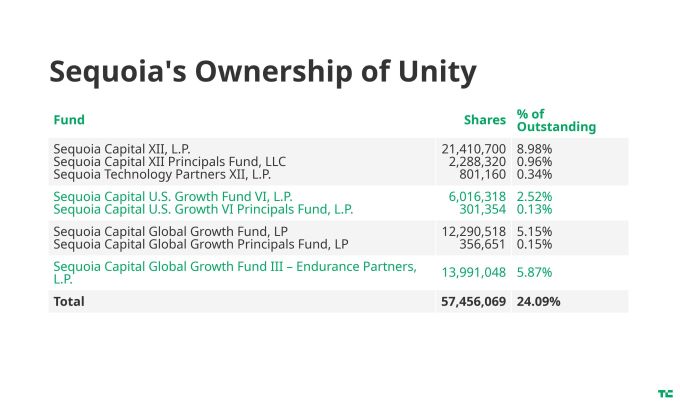
According to the docs, Sequoia’s total ownership of the company is roughly 24.1% today. The company was last valued at around $6 billion in mid-2019, and we will see how the shares perform with investors in the coming week. But owning nearly one-quarter of billions of dollars is a huge return for the venture capital firm.

The other major VC investor was Silver Lake, which owns 18.2% of the company after an initial 2017 investment that was labeled as “up to $400 million.” Among founders and execs, David Helgason, Unity’s founder and current board member, owns 4.4%, and John Riccitiello, Unity’s current CEO, owns 3.4%. The filing says there are a total of 782 shareholders on record.

What’s interesting about Sequoia’s stake is how much it has grown over the years since the firm’s initial Series A investment into Unity more than a decade ago (back in 2009). Take a look at this table of all of Sequoia’s investments from its various funds over the years:

While Sequoia did indeed get in early with the video game platform, what’s been key for it over the years has been buying up additional shares through growth investing, as well as buying out common shares, presumably from earlier investors, employees and perhaps founders as well. Its original investment out of its twelfth fund owns 10.28%, but its growth funds collectively own another 13.82%.

Finally, here’s a chart of Unity’s share price growth since its Series A all the way up to the present day:

Unlike Palantir’s numbers, which we reported on Friday from a leaked copy of its S-1 filing, Unity has shown a relatively up and to the right exponential growth curve in price over the last 10 years, with a huge gap in funding between its Series B in 2011 and Series C in 2016. Now, let’s see how the public markets react.

Red Antler’s Emily Heyward explains how to get people obsessed with your brand

If you’re currently building a startup, you know what product you want to build. But do you know if people are actually going to notice you? That’s the question I asked of Red Antler co-founder Emily Heyward during our virtual TechCrunch Early Stage event.

In case you’re not familiar with Red Antler, Heyward’s branding company has worked with some of the most iconic startups of the past decade, such as Casper, Allbirds, Brandless and Prose. She knows her topic so well that she just wrote a book on branding called “Obsessed.”

Let me break down the key takeaways of her presentation and responses to questions from our virtual audience — we’ve embedded a video below with our entire conversation.

Branding matters — anybody can launch a startup

It has never been easier to launch a startup. If it’s a software company, your infrastructure will be managed by a cloud hosting company. If you’re selling consumer goods, you can find manufacturing partners more easily than ever before.

“There are fewer traditional gatekeepers standing in your way. You don’t need to be able to afford a national TV campaign to get people to notice you and to hear about you. It’s a lot easier to get it out there and start selling directly to people,” Heyward said.

The result is that there are many companies competing in the same space, launching around the same time. Casper isn’t the only online mattress company anymore for instance. Brand obsession can set you apart from the rest of the crowd.

Gather helps teams streamline things like onboarding, offboarding, and parental leave over Slack

Adding a new employee to a team tends to involve more than saying “You’re hired!” and tossing them into the company Slack. You’ve got to get them trained, ship them any hardware they might need, get them set up on all of your internal tools and check in regularly to make sure everything is going smoothly. Then there’s a whole separate process to follow when someone leaves, unless you want to find out that the guy who left a year ago still digs around in the company back end sometimes.

It’s easy enough to keep track of in a spreadsheet when you’re a small team growing one or two hires at a time — but when you start to grow rapidly, that spreadsheet can become a maze. As the processes grow more complicated and more people are involved, it’s easy for steps to get skipped along the way.

Gather, a company out of Y Combinator’s Summer 2020 batch, is building a tool specifically meant to help automate and streamline these types of “people ops” tasks, providing an at-a-glance view of the process at each step of the way.

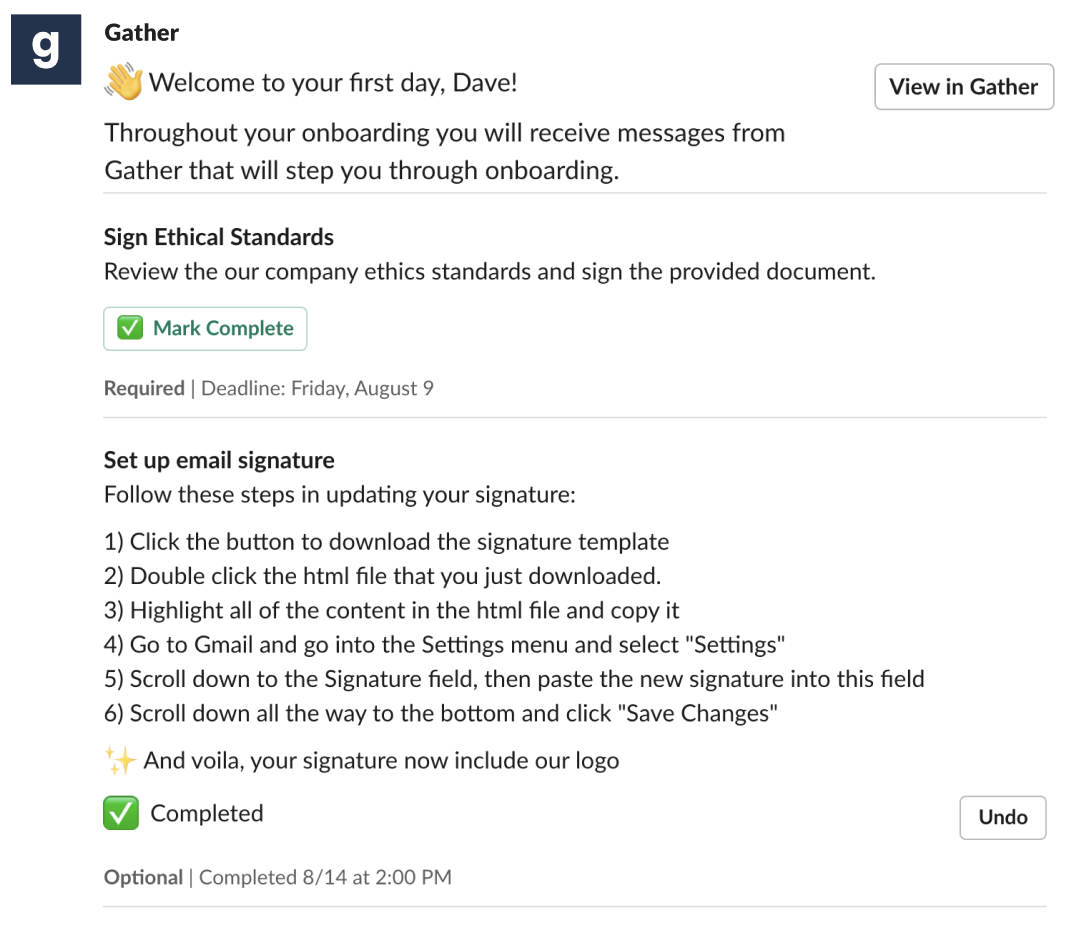
Gather taps your existing employee databases on services like ADP and Gusto, turning information or changes in these databases into workflows, reminders and tasks via Slack.

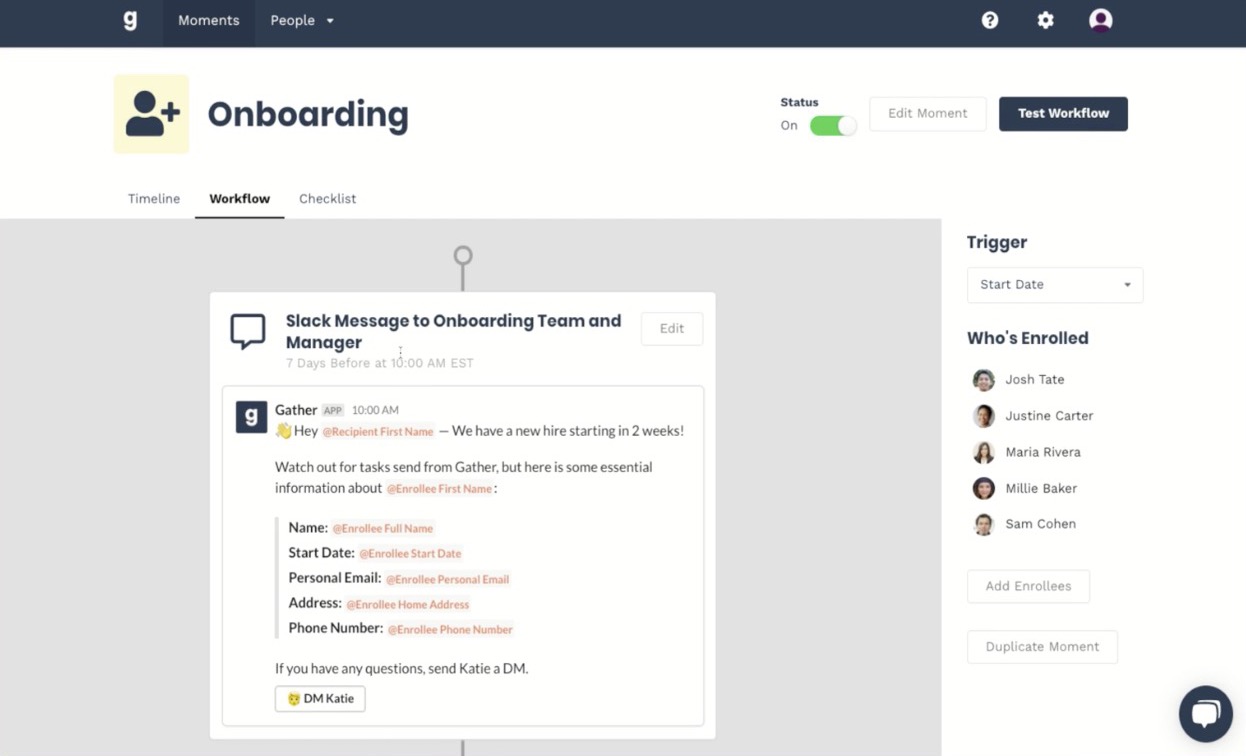
When a new employee is added, for example, it can kick off an onboarding workflow that pings their manager to remind them of their start date, and messages the security team to let them know they’ll need accounts set up. It can help to set up an “onboarding buddy” and send said buddy tips on how to get their new hire up to speed. A few days after the hire’s start date, it can message them to make sure they’ve read through the various orientation documents. It can provide a timeline style overview of to-dos for each employee, letting you quickly check to make sure nothing got skipped along the way — and see who might need a reminder.

Image Credits: Gather

Someone’s five-year work anniversary is approaching? It can remind their manager to drop them a note of congratulations and maybe send a gift. When someone is about to return from parental leave, Gather can ping their teammates to let them know to get ready. Or when someone is leaving the company permanently, it can reach out to the folks who need to know and set up tasks like ensuring their internal accounts are shut off and their equipment is accounted for.

Image Credits: Gather

Gather’s co-founders Alex Hilleary, Brooks Sime and John Wetzel met during a fellowship with Venture for America, the program founded by Andrew Yang that aims to help recent college graduates learn to build companies by placing them at startups in cities like Birmingham, Charlotte, Miami and Philadelphia. As they watched companies grow, Hilleary tells me, they started “recognizing how important People Ops is. In our respective roles, we had the toolkits that we needed to scale communications and relationships — like for sales and marketing, you have CRMs. […] We started talking to a bunch of people in People Ops, and they just don’t have these same sorts of tools for themselves. They have nothing that helps them scale their communication and coordination, and that’s one of the key pain points of why a company can’t scale their culture from like 30 people to 300. The People Ops teams just don’t have the tools they need to make it work at scale.”

The team is currently running a private pilot with a handful of companies. They’re still working out exactly what they’ll charge for Gather, though they tell me they expect to charge on a per-employee, per-month basis. Interested in checking it out? You can find more details here.

Image Credits: Gather

Daily Crunch: Palantir docs show $579M net loss

We dive into Palantir’s finances, Apple fires back against Epic Games and Lambda School raises funding. This is your Daily Crunch for August 21, 2020.

The big story: Palantir docs show $579M net loss

Danny Crichton got a hold of the confidential S-1 filing for secretive data analytics company Palantir and has been unpacking the details. As far as the top-line numbers go, Palantir reported revenue of $742 million in 2019, up 25% from the previous year, with a net loss of $579 million. And it had exactly 125 customers at the end of the first half of 2020.

In addition, multiple sources have told us that Palantir will have a lockup period after its direct listing. The combination of both a direct listing and lockup period is unusual, as Danny explains:

The lockup will almost certainly help stabilize Palantir’s stock post-debut, which will be less volatile since insiders won’t be able to trade their shares. However, it is definitely not a vote of confidence that a 17-year-old company thinks it needs to control the selling decisions of its workforce and investors in order to maintain its share price on the public markets.

The tech giants

Apple contends Epic’s ban was a ‘self-inflicted’ prelude to gaming the App Store — Apple characterizes the entire controversy as a “carefully orchestrated, multi-faceted campaign” aimed at circumventing the 30% cut it demands for the privilege of doing business on iOS.

Sony WH-1000XM4 headphone review — Brian Heater says they’re still the best in class at $350.

Facebook trials expanding portability tools ahead of FTC hearing — Facebook is considering expanding the types of data its users are able to port directly to alternative platforms.

Startups, funding and venture capital

Lambda School raises $74M for its virtual coding school where you pay tuition only after you get a job — Payments for Lambda School courses are based on a sliding scale that only kicks in after you land a job that makes at least $50,000 a year.

Triller threatened to sue over report suggesting it inflated its downloads — Triller has been pushing to capitalize on the recent turn of events regarding its chief competitor, TikTok.

No parties allowed at the Airbnb IPO — The latest episode of Equity covers Airbnb’s decision to ban parties, and also its private filing to go public.

Advice and analysis with Extra Crunch

How to raise your first VC fund — For starters, understand the mindset of an LP.

Anu Duggal on COVID-19, promoting diversity and building a fund — In 2020, the investor says her thesis that there will be a generation of successful venture-backed businesses built by women is one you can’t avoid.

Box CEO Aaron Levie says thrifty founders have more control — “Put yourself in a position where you spend as little amount of dollars as you can.”

(Reminder: Extra Crunch is our subscription membership program, which aims to democratize information about startups. You can sign up here.)

Everything else

Trump’s official campaign app had to reset its rating after being trolled by TikTokers — An effort by TikTok users to troll President Trump’s official campaign app with thousands of one-star reviews appears to have had an impact, if not the impact the pranksters had wanted.

Submit your pitch deck to Disrupt 2020’s Pitch Deck Teardown — In the Pitch Deck Teardown, top venture capitalists and entrepreneurs will evaluate and suggest fixes for attendees’ pitch decks.

The Daily Crunch is TechCrunch’s roundup of our biggest and most important stories. If you’d like to get this delivered to your inbox every day at around 3pm Pacific, you can subscribe here.

Palantir targeting 3 class voting structure according to leaked S-1, giving founders 49.999999% control in perpetuity

We are continuing to make progress through Palantir’s leaked S-1 filing, which TechCrunch attained a copy of recently. We have covered the company’s financials this morning, and this afternoon we talked about the company’s customer concentration. Now I want to talk a bit about its ownership and stock valuation.

First, let’s talk about ownership. Having read through our leaked copy of the S-1 the past few hours, I can only summarize the situation as: wow, this is a really complicated ownership structure.

At the highest level, the founders of the company — Peter Thiel, Alex Karp, and Stephen Cohen — own 30.2% of the stock of the company as of the end of July of this year. Thiel controls much more than that though through his myriad investments made through Founders Fund, Mithril Capital, Clarium Capital, and quite literally dozens of other investment management funds listed in the filing.

In terms of overall corporate voting power today, Thiel has 28.4% at his disposal, Karp 8.9%, and Cohen 3.1% according to the company’s calculation.

This is where things get interesting. As is typical with most modern tech IPOs, the founders of the business are looking to create multiple voting classes of stock in order to protect their voting power even while their total ownership of the company diminishes. It is pretty common today to see a two-class structure where the plebian stock class for retail investors offers one vote, and a special class is offered to founders that has 10 votes. This allows a founder with 5% of the company through these special shares to control a majority of a company’s voting authority.

Palantir wants to push the envelope further though with a three-class structure that would prioritize Thiel, Karp, and Cohen above all others. In Palantir’s model, there would be a Class A share with 1 vote, a Class B share with 10 votes, and a special “Class F” share with variable votes.

Class F shares would share 49.999999% (six 9s in the decimal – I counted twice) of the voting power of Palantir at all times, regardless of the underlying ownership of shares. Important to note that that is not a “majority” and thus they will not have literally a controlling stake in the public company.

In fact, Palantir has spent much of the last few months building the case for why it needs this special tripartite system of corporate governance. It hired several new members to its board of directors including Alexandra Schiff, Spencer Rascoff, and Alexander Moore earlier this year in order to build a “Special Governance Committee” that would make these changes to the company’s Delaware charter. Given that the founders were practically the only directors of the company outside of Adam Ross, it was hard to give themselves control by their own vote.

Palantir’s leaked S-1 has dozens of pages of the timeline and discussions that resulted, and why the committee ended up deciding to go with what can only be described as Byzantine method of voting.

That resolution still has to be supported by shareholders and of course, Wall Street. Much in the way that Palantir is going to have a lockup on its employees in a novel variant of the direct listing model, it seems it wants to pioneer a new model of founder ownership as well.

Stock valuation

Now, let’s switch over to a little chart showing Palantir’s preferred stock prices since inception and the current carrying value of those shares:

Immediately, we can see here that Palantir starting in 2013 really came into its own. The company, which was founded in 2003, showed little sign of deep outside investor interest for much of its early history. Its preferred stock share price grew linearly and slowly from its Series C in 2008 to its Series H in 2013.

Then, something interesting happens. There is almost immediately a radically increasing growth in the value of the stock with new issues in the Series H through K showing quick growth in value.

Recent stock sales have been common shares, and not preferred.

According to the company’s leaked S-1 we attained, only three shareholders passed the 5% threshold required for SEC disclosure. Founders Fund is listed as owning 12.7% of the company’s Class B shares, Japanese insurance giant SOMPO Holdings is listed as owning 20.3% of the company’s Class A shares, and investment bank UBS is at 5.7% of Class A shares. The company said that it had 529 million Class A shares and 1.09 billion Class B shares outstanding as of the end of June this year.

Leaked Palantir S-1 shows company has 125 customers after 17 years

We are still walking through Palantir’s leaked S-1, which as of the time of this writing, hasn’t yet been filed and published by the SEC. This morning, we discussed some of Palantir’s financials, including its revenues, margins, and net losses.

The company’s customer base — and it’s high-degree of concentration — is a recurring theme in the leaked S-1 filing that TechCrunch has been reading all day.

Palantir has precisely 125 customers as of the end of the first half of 2020. Palantir notes that customers from different parts of the same government department or company are considered separately (Palantir’s example is that the CDC and NIH are both part of the Department of Health and Human Services, but would be billed separately and are thus considered separate customers for the purpose of its calculation).

As of the end of 2019, the average revenue per customer for Palantir was $5.6 million. In comparison to many other SaaS stocks, that is a gargantuan number, but mostly driven by the fact that Palantir doesn’t have the soft onboarding strategies of products like Slack or Amazon Web Services, where small organizations can start using a product even though they aren’t massive moneymakers.

Palantir notes that over the past decade, average revenue per customer has increased 30%.

What’s perhaps more worrying though is the sheer revenue concentration of Palantir. The company’s top three customers — which aren’t disclosed — together represented 28% of the company’s revenue for 2019. Its top twenty customers represented 67% of total revenues, with each one of those customers averaging $24.8 million in revenue.

As we reported this morning, 53.5% of the company’s revenue is derived from government contracts, with the balance from commercial clients.

Palantir’s filing says that 40% of revenue is generated in the U.S., with 60% generated internationally. The company says that it has clients in 150 countries (of course, reconciling 150 countries with 125 customers is left as a math exercise for the reader).

Palantir sees great growth opportunities in both its government and commercial businesses. On the government side, the company said in its note to shareholders that:

The systemic failures of government institutions to provide for the public — fractured healthcare systems, erosions of data privacy, strained criminal justice systems, and outmoded ways of fighting wars — will continue to require both the public and private sectors to transform themselves. We believe that the underperformance and loss of legitimacy of many of these institutions will only increase the speed with which they are required to change.

Palantir argues that its total addressable market is $119 billion.