Elon Musk demonstrates Neuralink’s tech live using pigs with surgically implanted brain-monitoring devices

Elon Musk -founded Neuralink has made headlines over the past many years around it efforts to develop a new kind of interface between the human brain and computing devices. On Friday, the company provided a demo of the technology, and Musk kicked off the demo by saying that the purpose of the entire presentation was recruiting — not fundraising or any other kind of promotion.

“We’re not trying to raise money or do anything else, but the the main purpose is to convince great people to come work at Neuralink, and help us bring the product to fruition — make it affordable and reliable and and such that anyone who wants one can have one,” he said.
Musk then went on to say that the reason he wants to make it generally available is that just about everyone will have some kind of neurological problem over time, including memory loss, anxiety, brain damage, depression and a long list of other ailments. Of course, there’s no clear evidence that any of this long list of problems can be quickly and easily “solved” with any one solution, so it’s a bit challenging to see this as a reasonable end goal for the company.

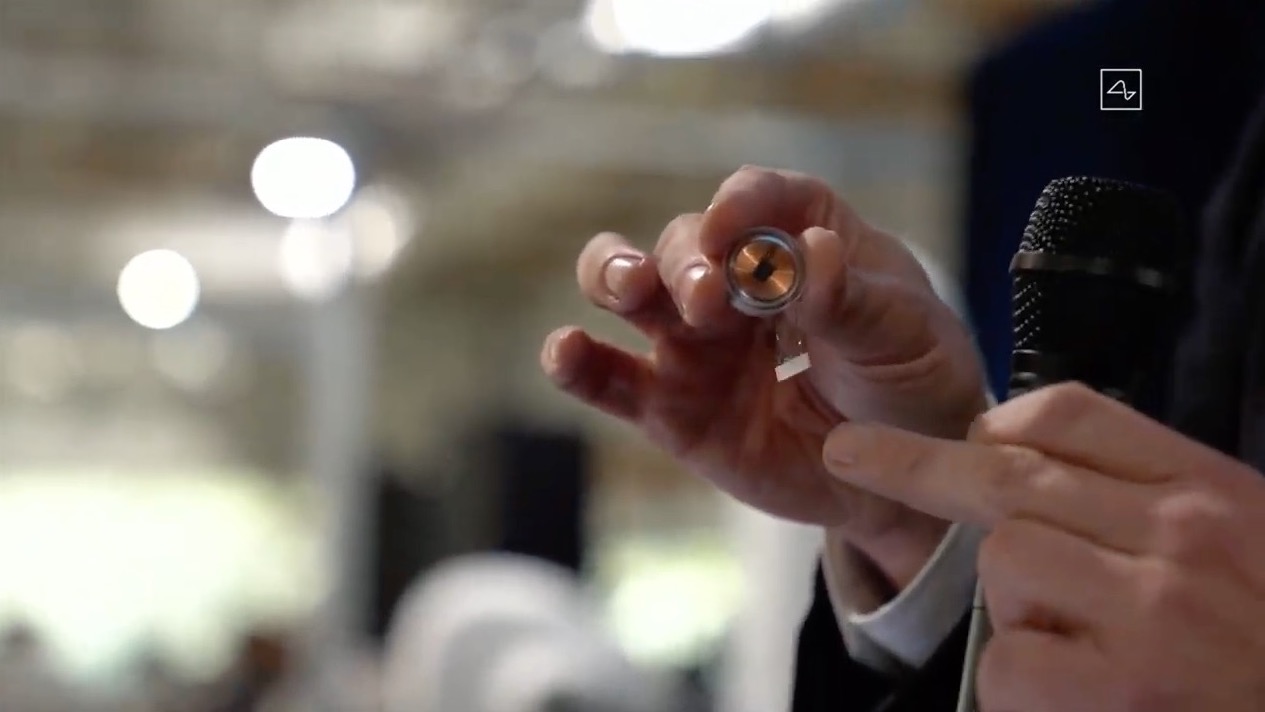
The goal may be ambitious — and definitely subject to a lot of ethical and medical debate — but the technology that Musk actually demonstrated was much less so. Musk first noted that Neuralink had changed design since the reveal last year, with a smaller physical device profile that he said can be fully hidden under hair once installed in the skull. He had a physical device in-hand to show its size.
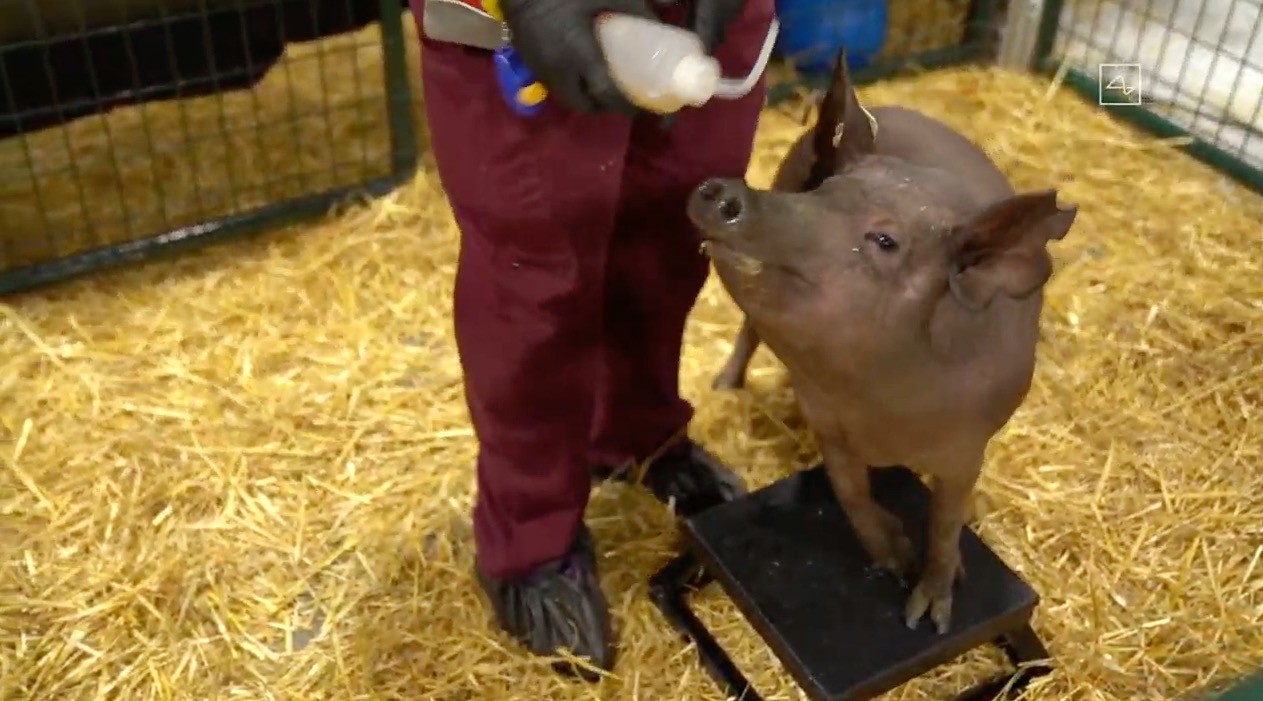
Image Credits: Neuralink

Musk then turned the audience’s attention to three pigs that were in attendance in nearby pens, with handlers nearby. The three pigs were one that was untreated, the second (“Gertrude”) was installed with a Neuralink device, called the “Link,” and the third had previously had one installed but then subsequently had it removed. Musk at first had trouble coaxing Gertrude to come out and perform for the small, socially distanced crowd in attendance (who were seated at bar-height tables as if they were at a comedy club). Eventually, however, he skipped Getrude to show that the pig who had her Link removed was very healthy and normal-looking.

Image Credits: Neuralink

Back to Gertrude, Musk showed a display that played a sound and showed a visual spike whenever the Link detected that Gertrude made contact to something with her snout while rooting around for food.

“For the initial device, it’s read/write in every channel with about 1024 channels, all-day battery life that recharges overnight and has quite a long range, so you can have the range being to your phone,” Musk said. “I should say that’s kind of an important thing, because this would connect to your phone, and so the application would be on your phone, and the Link communicating, by essentially Bluetooth low energy to the device in your head.”
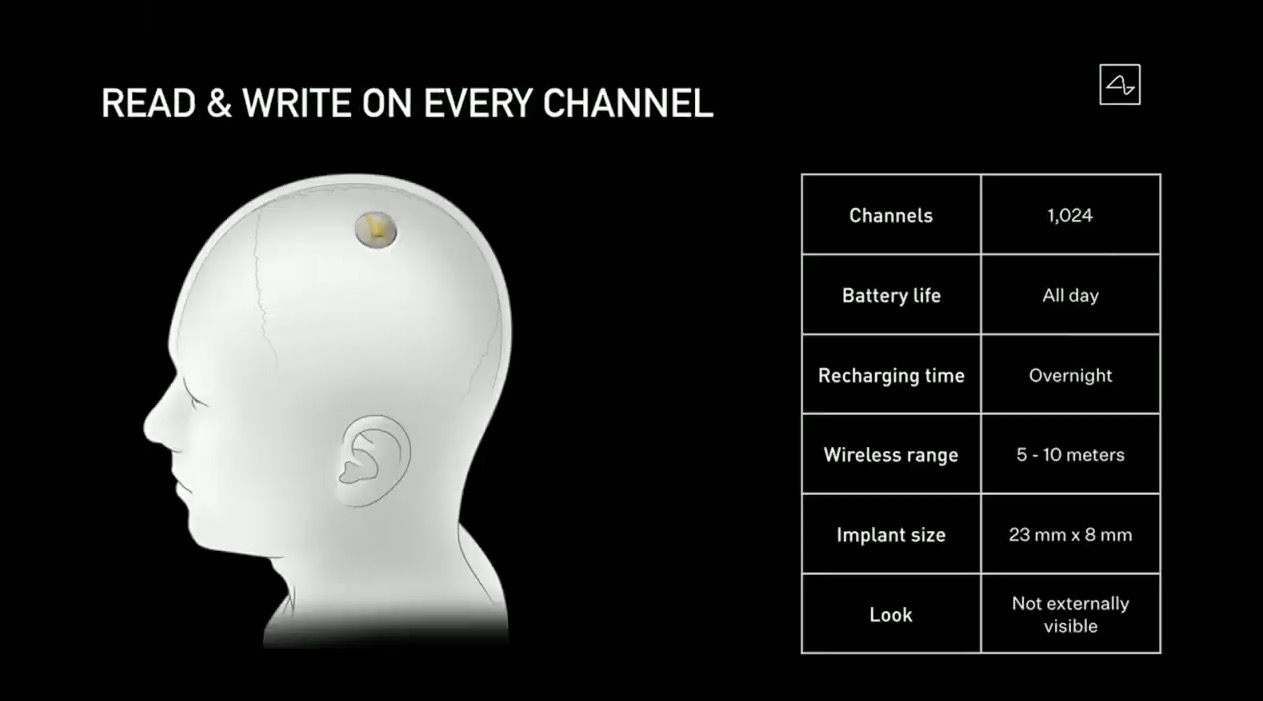
Image Credits: Neuralink

Musk closed the prepared portion of the presentation by noting that the company had received a Breakthrough Device designation from the U.S. Food and Drug Administration in July, and that the company is “preparing for first human implantation soon, pending required approvals and further safety testing.”

While the device demonstrated was only a read-device, receiving data from the signals in the pig’s brain, the plan is to provide both read and write capabilities with the goal of being able to address neurological issues as mentioned above. Musk also stressed that why he showed the pig which had had its implant removed safely was because the plan is to provide updates to the hardware over time as better versions become available. Ultimately, Musk said during a later Q&A that Neuralink hopes to get the cost down to somewhere in the thousand-dollar range, with a minimal cost for the hardware itself along the line of modern wearable devices.

Musk actually referred to the Neuralink devices as a “Fitbit in your skull with tiny wires” at multiple points during the presentation, which actually seems like a pretty dystopian proposition, depending on your perspective. Capabilities he teased eventually include the ability to summon your Tesla with a thought, and video game control interfaces — including complete control of Starcraft. Musk also said in the future he expected people with Link to be able to “save and replay memories,” adding the caveat that “this is obviously sounding increasingly like a Black Mirror episode, but well, I guess they’re pretty good at predicting.” He even went so far as to say that “you could potentially download [memories] into a robot body.”

The first clinical trial will focus on individuals with paraplegia or tetraplegia, resulting from cervical spinal cord injury. The plan for a first trial is to enroll a “small number” of these individuals in order to test the efficacy and safety of the technology.

Take a closer look at Elon Musk’s Neuralink surgical robot

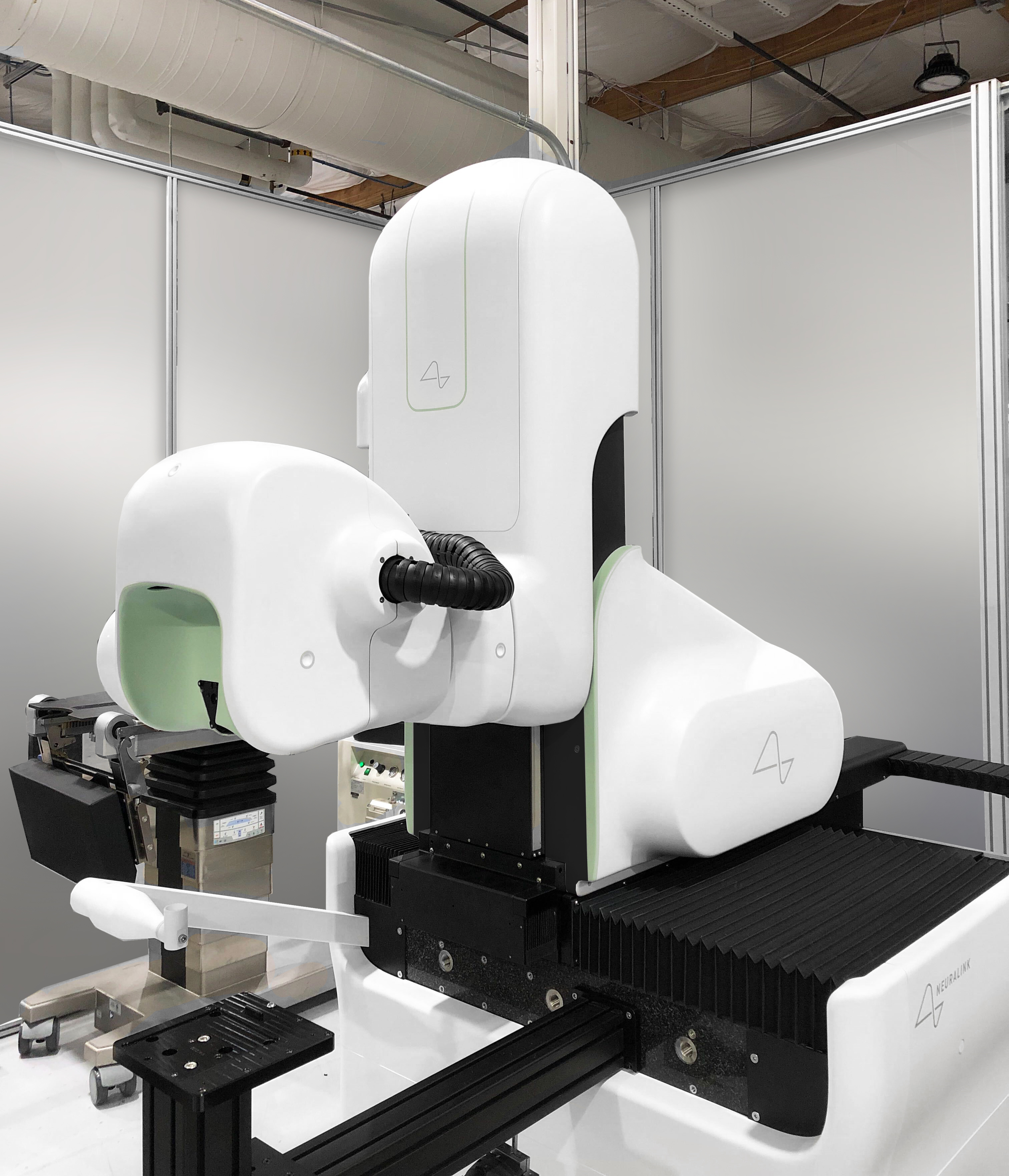
While the science was front-and-center in Elon Musk’s presentation about Neuralink, his human brain computer inference company, the surgical robot the company debuted made a splash of its own. The rounded polycarbonate sci-fi design of the brain surgeon bot looks like something out of the Portal franchise, but it’s actually the creation of Vancouver-based industrial design firm Woke Studio. To be clear, Musk’s engineers and scientists have created the underlying technology, but Woke built the robot’s look and user experience, as well as the behind-the-ear communication end piece that Neuralink has shown in prior presentations.

Neuralink’s bot features clean white (required for ensuring sterility, per Woke), arcing lines and smooth surfaces for a look that at once flags its advanced technical capabilities, but also contains some soothing and more approachable elements, which is wise, considering what the machine is intended to do.

“While the patient may not be awake to see the machine in action, it was still important to design a non-intimidating robot that can aesthetically live alongside the iconic machines in Musk’s portfolio,” the company explains in a press release. “It also needed to meet a long list of medical requirements in terms of sterility and maintenance, and provide safe and seamless utilization for its operators.”

Image Credits: Woke Studio

Woke says the Neuralink surgical robot can be separated into three main parts: The head, the body and base. The head of the robot is that helmet-like piece, which actually holds the head of the patient. It also includes a guide for the surgical needle, as well as embedded cameras and sensors to map the patent’s brain. The intent of the design of this piece, which includes a mint-colored interior, is to give the robot “an anthroprmorphic characteristic” that helps distract from the invasive nature of the procedure. There are also single-use disposable bags that line the interior of the helmet for sterile operation.

The Neuralink robot also has a “body,” that humped rear assembly, which includes all the parts responsible for the motion of the robot as it sets up from the procedure. The third element is the base, which basically keeps the whole thing from tipping over, and apparently also contains the computing brains of the brain-bot itself.

Neuralink is an Elon Musk-founded company that’s seeking to mitigate what Musk sees as a potential existential threat to human life: The ascendancy of general artificial intelligence. While its near-term goals are aimed at helping address medical conditions incurred by damage to brain tissue, Musk ultimately hopes that Neuralink will be able to help humans keep up with advanced AI by providing them with a latency-free, direct high-bandwidth connection to their computers — using direct thought input.

Daily Crunch: Tesla targeted in ransomware attack

The Justice Department reveals a thwarted malware attack on Tesla, Facebook tests linking your news subscriptions to your social network account and Xiaomi has plans for under-screen cameras. This is your Daily Crunch for August 28, 2020.

The big story: Tesla targeted in ransomware attack

The Justice Department released a complaint Thursday describing a thwarted malware attack against an unidentified company in Sparks, Nevada, where Tesla has a factory. And Elon Musk confirmed in a tweet that Tesla was the target: “This was a serious attack.”

In the complaint, the Justice Department alleged that Russian national Egor Igorevich Kriuchkov attempted to recruit and bribe a Tesla employee to introduce malware in the company’s network — specifically ransomware, which encrypts a victim’s files and, in this case, would also have exfiltrated the data to the hacker’s servers.

The tech giants

Facebook tests linking your FB account to your news subscriptions — Once you’re linked, if you encounter a paywalled article on Facebook, you’ll be able to read it without hitting the paywall or having to log in again.

Xiaomi plans to bring under-screen cameras to its smartphones next year — The company says it’s been able to effectively double the pixel density of competing technology, letting light through to the camera without sacrificing the uniformity of the screen.

Startups, funding and venture capital

Railsbank is buying Wirecard Card Solutions, the UK arm of the disgraced fintech — Wirecard collapsed into insolvency earlier this year after facing a huge accounting scandal and subsequently failing to make payments on $1.5 billion in loans.

Steno raises $3.5 million led by First Round to become an extension of law offices — Steno’s first offering lines up court reporters and pays them, removing both potential headaches from lawyers’ to-do lists.

Femtech poised for growth beyond fertility — That’s according to an analyst note from PitchBook, which identifies opportunities for entrepreneurs in broadening out from a traditional focus on reproductive health.

Advice and analysis from Extra Crunch

SaaS stocks survive earnings, keeping the market warm for software startups, exits — We’re on the other end of nearly every single SaaS earnings report that you can name (with the exception of Slack).

Podcast is social: How China’s Lizhi makes audio interactive — “I learned from my days working in radio that interaction is the best monetization model in the audio business,” founder Marco Lai told us.

What does GPT-3 mean for the future of the legal profession? — Rudy DeFelice of Keesal Propulsion Labs argues that GPT-3 might be a game changer in legal and other knowledge-focused organizations.

(Reminder: Extra Crunch is our subscription membership program, which aims to democratize information about startups. You can sign up here.)

Everything else

GM shifts Corvette engineering team to its electric and autonomous vehicle programs — Specifically, the team responsible for the the mid-engine Chevrolet Corvette.

Android security bug let malicious apps siphon off private user data — App security startup Oversecured found the flaw in Google’s widely used Play Core library.

Laura Deming, Frederik Groce, Amish Jani, Jessica Verrilli and Vanessa Larco are coming to Disrupt — They’re just five of this year’s Startup Battlefield judges.

The Daily Crunch is TechCrunch’s roundup of our biggest and most important stories. If you’d like to get this delivered to your inbox every day at around 3pm Pacific, you can subscribe here.

Apple terminates Epic Games’ App Store account

Epic Games has been removed from Apple’s App Store.

If you’ve already downloaded Fortnite to your Mac or iOS device, it should still work, but Epic’s termination means the Fortnite developer will no longer be able to submit new apps or updates.

MacStories Managing Editor John Voorhees noted the termination on Twitter, as well as the fact that the App Store is currently featuring Fortnite competitor PUBG.

Apple confirmed the move in a statement:

We are disappointed that we have had to terminate the Epic Games account on the App Store. We have worked with the team at Epic Games for many years on their launches and releases. The court recommended that Epic comply with the App Store guidelines while their case moves forward, guidelines they’ve followed for the past decade until they created this situation. Epic has refused. Instead they repeatedly submit Fortnite updates designed to violate the guidelines of the App Store. This is not fair to all other developers on the App Store and is putting customers in the middle of their fight. We hope that we can work together again in the future, but unfortunately that is not possible today.

You missed your chance. Epic is off the App Store now.

Also, this fight has gotten very petty. Today’s featured app? PUBG https://t.co/evp2R6qRxC pic.twitter.com/2vyRj6Oy1U

— John Voorhees (@johnvoorhees) August 28, 2020

Apple also said that Epic has been creating support issues by directing frustrated users toward AppleCare.

This is the latest development in the Epic-Apple dispute, which began earlier this month when the developer introduced support for direct payments in Fortnite, attempting to circumvent the 30% cut that Apple takes on App Store payments. This prompted Apple to boot Fortnite from the App Store, with Epic immediately launching a lawsuit and a publicity campaign that accused Apple of abusing its market power.

Earlier this week, a federal district court judge ordered Apple not to block access to Epic’s Unreal Engine for developers, but she said that Fortnite could stay out of the App Store until it complied with the rules.

Today’s removal should not affect the Unreal Engine, which Epic manages through a separate account.

IFA’s executive director discusses why the tech show must go on

In June, the CTA announced that CES 2021 would go forward in-person. The event was set to have slipped under the wire — having narrowly avoided a COVID-19-related shutdown two years in a row. A month later, however, its organizers reversed course, announcing the January show was going virtual. Disappointing, perhaps, but not surprising.

The past five months have seen one in-person show cancellation after another, from MWC to E3, from WWDC to Computex to our own Disrupt, which is going online-only for the first time. One major consumer electronics trade show, on the other hand, has long planned to buck that trend. On September 3, IFA will kick off in-person in Berlin. Though this year’s event will look dramatically different.

“Usually, we have more than 40 halls serving IFA . This year, at the moment, we have two halls for the press conference with the stages, one exhibition hall, one press center hall and one hall for IFA Next and Shift Mobility,” the organization’s executive director Jens Heithecker explains on the phone from Germany. “We will have around 170-180 exhibitors, compared to 2,300 last year.”

Heithecker doesn’t mask the melancholy in his voice when discussing this year’s version of the show. “To be a little poetic, usually in the late summer, there’s a special air in Berlin and you go out in the morning, you feel this air,” he says. “This year for me, the air’s the same, but whenever I see the halls, the area of our exhibition site, it’s empty, more or less.”

I’ve attended IFA several times over the years, and have always been struck by the organizational chaos. Every tech trade show has some element of this, of course, but IFA opens itself up the public, filling the maze like halls of the Messe Berlin convention center with a peculiar mix of industry professionals and local families with small children. It’s alternately amusing and maddening, depending on how much time you give yourself to get from point A to point B.

This year’s show has been designated IFA 2020 Special Edition. It’s essentially a nice way of noting that the show will be significantly smaller than in years past. Heithecker notes that some 1,100 members of the press have registered for the show, all from a limited invite list. I was on the invite list as well, but, like many, simply opted not to go. Frankly, the idea of flying to German to stand inside an event hall with exhibitors and fellow journalists sounds far less appealing than following along from home.

I’m sure my own sense of safety is colored by my home country’s less-than-ideal handling of the pandemic. But with 24.5 million global cases and 833,000 deaths to date from the virus, there’s still cause for concern, as numbers continue to rise around the globe. Germany has, of course, largely done well in its own handling of the novel coronavirus, but there’s cause for concern even there. With numbers rising, the country has put reopening plans on pause while other European countries like Norway have added German travelers to a quarantine list.

“By end of March, we started to create our statistics on our own, to understand the situation a better way than in the public media only,” says Heithecker. “The rising number in Germany — at least in the northern part of Germany — is created mainly by the double number of tested people. This means the ratio of positively tested people is the same like before. So we will find more people by the situation, the general situation is not going worse in the northern part. We have more tested because the German government is fearing, at the moment, all the people coming back from their holidays in the south, especially, in the south of Europe. That’s the main reason at the moment that we are following so close all the figures every day.”

The nature of the limited guest list means that social distancing will be significantly easier for attendees to practice than they have been in past years, when members of the press have been elbowing small children out of the way in order to get a good show of the latest ASUS gaming laptop. Of course, simply having more space doesn’t necessarily mean that guests will keep to the mask and social distance requirements (1.5 meters) that IFA posts.

“We have so many additional people watching out for our attendees, that they will wear masks, that they will keep the distances,” Heithecker explains. He adds that attendees will be removed from the premises for refusing to adhere to such social safety rules, but that such a move, understandably, is a last resort.

The organization notably pulled the plug on the Global Markets portion of the show, citing “persistent travel restrictions prevent Asian companies from joining the live event.” The event, launched in 2016 for OEMs/ODMs, retailers and distributors, drew a significant portion of exhibitions and attendees from Asian countries. In late June, Samsung announced that it would be pulling out of the show, opting instead for its own Unpacked event just ahead of IFA.

Heithecker believes that Samsung’s decision was based on word from the hardware giant’s U.K. offices. “Two months, three months ago, they couldn’t imagine that any journalist would attend IFA,” he tells TechCrunch. “And even if you told them, ‘Hey, we have all the registrations already, they will come,’ they didn’t believe.”

He adds that he thinks the company is essentially riding the show’s presence to add views, but that Samsung will ultimately regret not directly taking part in the show. “Samsung is doing the press conference in front of this year’s IFA, using the attention we create for the industry, for new products, using the power, the activity of IFA as well, even if they’re not inside our show,” Heithecker says. “We create this and we will bring the proof that whoever is attending or using our new platform, even for online presentations, will see a bigger impact and much more viewers and much more investment than if you do it on your own.”

TikTok’s rivals in India struggle to cash in on its ban

For years, India has served as the largest open battleground for Silicon Valley and Chinese firms searching for their next billion users.

With more than 400 million WhatsApp users, India is already the largest market for the Facebook-owned service. The social juggernaut’s big blue app also reaches more than 300 million users in the country.

Google is estimated to reach just as many users in India, with YouTube closely rivaling WhatsApp for the most popular smartphone app in the country.

Several major giants from China, like Alibaba and Tencent (which a decade ago shut doors for most foreign firms), also count India as their largest overseas market. At its peak, Alibaba’s UC Web gave Google’s Chrome a run for its money. And then there is TikTok, which also identified India as its biggest market outside of China.

Though the aggressive arrival of foreign firms in India helped accelerate the growth of the local ecosystem, their capital and expertise also created a level of competition that made it too challenging for most Indian firms to claim a slice of their home market.

New Delhi’s ban on 59 Chinese apps on June 30 on the basis of cybersecurity concerns has changed a lot of this.

Indian apps that rarely made an appearance in the top 20 have now flooded the charts. But are these skyrocketing download figures translating to sustaining users?

An industry executive leaked the download, monthly active users, weekly active users and daily active users figures from one of the top mobile insight firms. In this Extra Crunch report, we take a look at the changes New Delhi’s ban has enacted on the world’s second largest smartphone market.

TikTok copycats

Scores of startups in India, including news aggregator DailyHunt, on-demand video streamer MX Player and advertising giant InMobi Group, have launched their short-video format apps in recent months.

Steno raises $3.5 million led by First Round to become an extension of law offices

The global legal services industry was worth $849 billion in 2017 and is expected to become a trillion-dollar industry by the end of next year. Little wonder that Steno, an LA-based startup, wants a piece.

Like most legal services outfits, what it offers are ways for law practices to run more smoothly, including in a world where fewer people are meeting in conference rooms and courthouses and operating instead from disparate locations.

Steno first launched with an offering that centers on court reporting. It lines up court reporters, as well as pays them, removing both potential headaches from lawyers’ to-do lists.

More recently, the startup has added offerings like a remote deposition videoconferencing platform that it insists is not only secure but can manage exhibit handling and other details in ways meant to meet specific legal needs.

It also, very notably, has a lending product that enables lawyers to take depositions without paying until a case is resolved, which can take a year or two. The idea is to free attorneys’ financial resources — including so they can take on other clients — until there’s a payout. Of course, the product is also a potentially lucrative one for Steno, as are most lending products.

We talked earlier this week with the company, which just closed on a $3.5 million seed round led by First Round Capital (it has now raised $5 million altogether).

Unsurprisingly, one of its founders is a lawyer named Dylan Ruga who works as a trial attorney at an LA-based law group and knows first-hand the biggest pain points for his peers.

More surprising is his co-founder, Gregory Hong, who previously co-founded the restaurant reservation platform Reserve, which was acquired by Resy, which was acquired by American Express. How did Hong make the leap from one industry to a seemingly very different one?

Hong says he might not have gravitated to the idea if not for Ruga, who was Resy’s trademark attorney and who happened to send Hong the pitch behind Steno to get Hong’s advice. He looked it over as a favor, then he asked to get involved. “I just thought, ‘This is a unique and interesting opportunity,’ and said, ‘Dylan, let me run this.’ ”

Today the 19-month-old startup has 20 full-time employees and another 10 part-time staffers. One major accelerant to the business has been the pandemic, suggests Hong. Turns out tech-enabled legal support services become even more attractive when lawyers and everyone else in the ecosystem is socially distancing.

Hong suggests that Steno’s idea to marry its services with financing is gaining adherents, too, including amid law groups like JML Law and Simon Law Group, both of which focus largely on personal injury cases.

Indeed, Steno charges — and provides financing — on a per-transaction basis right now, even while its revenue is “somewhat recurring,” in that its customers constantly have court cases.

Still, a subscription product is being considered, says Hong. So are other uses for its videoconferencing platform. In the meantime, says Hong, Steno’s tech is “built very well” for legal services, and that’s where it plans to remain focused.

Human Capital: ‘People were afraid of being critical with me’

Welcome back to Human Capital, where we break down the latest in labor, diversity and inclusion in tech. This week, we’re looking at the launch of the Diversity Riders initiative in venture capital and how it can go further, Instacart’s labor practices and some alternative, more inclusive approaches to running a startup. Also, Y Combinator CEO Michael Seibel recently shared a compelling anecdote about his experience as a Black founder raising money back in 2016.

Justice for Jacob Blake and Breonna Taylor.


Stay Woke


Diversity Riders commitment needs to go further

Earlier this week, Act One Ventures launched a new diversity and inclusion initiative called The Diversity Term Sheet Rider for Representation at the Cap Table. The purpose of the Diversity Rider is to increase the number of Black and other underrepresented investors in deals by making them co-investors. 

Already, firms like Greycroft Partners, First Round Capital, Maveron, Fifth Wall, Plexo Capital and Precursor Ventures have committed to it. What that means is firms will include boilerplate language in their standard term sheets:

In order to advance diversity efforts in the venture capital industry, the Company and the lead investor, [Fund Name], will make commercial best efforts to offer and make every attempt to include as a co-investor in the financing at least one Black [or other underrepresented group including, but not limited to LatinX, women, LGBTQ+] check writer (DCWs), and to allocate a minimum of [X]% or [X] $’s of the total round for such co-investor.

This is certainly a good step on the road to creating additional wealth opportunities for Black, Latinx and Indigenous people, as well folks from other underrepresented groups in tech. However, a stronger step would be to remove the parts about “best efforts” and “make every attempt” because, as it’s currently written, the commitment hedges on rather subjective conditions. Instead, the following would be better:

In order to advance diversity efforts in the venture capital industry, the Company and the lead investor, [Fund Name], will make commercial best efforts to offer and make every attempt to include as a co-investor in the financing at least one Black [or other underrepresented group including, but not limited to LatinX, women, LGBTQ+] check writer (DCWs), and to allocate a minimum of [X]% or [X] $’s of the total round for such co-investor.

Y Combinator CEO Michael Seibel on raising funding as a Black founder

At All Raise’s second annual event for Black female founders, When Founder Met Funder, Planet FWD CEO Julia Collins interviewed YC CEO Michael Seibel about his experience in tech and tips for founders. 

“When I started doing startups, it was 2006 and there weren’t many people who looked like any of us that were doing startups,” he told the audience. “I think what you would’ve expected was overt discrimination but actually I got something else, which was no feedback.”

He went on to say that people were afraid to be critical of him, for fear of being perceived a certain way. 

“People were afraid of being critical with me,” he said. 

That’s partly why Seibel says he’s become the type of person who will tell founders what everyone is thinking. 

“Agree with it or disagree with it, I want you to have a good mental model of what people are thinking and not saying,” Seibel said. 


Gig Work


Instacart is under fire again 

Instacart shoppers, via Gig Workers Collective, made their voices heard again this week. In light of the wildfires and other anticipated climate change-related disasters, Instacart workers want the company to provide disaster pay at a daily rate equal to the average rate of daily pay, including tips, over the previous 30 days for each day Instacart’s operations are shutdown. Additionally, GWC wants Instacart to shut down its operations in markets where a city has declared a state of emergency or issued evacuations.

The demands came shortly after Instacart agreed to distribute $727,985 among some San Francisco-based Instacart workers as part of a settlement pertaining to healthcare and paid sick leave benefits.

Meanwhile, Instacart is also facing a new lawsuit from DC’s attorney general over its “deceptive” service fees. The suit seeks restitution for consumers who paid those service fees, as well as back taxes and interest on taxes owed to D.C.


Alt VC


Tech cooperatives have the potential to upset wealth inequality 

We began exploring earlier in the year the case for cooperative startups, where workers and users have the opportunity to gain true ownership and control in a company, and where any profits that are generated are returned to the members or reinvested in the company.

The way many tech companies are built today don’t need to be that way. Start.coop, a tech accelerator for cooperatives, is trying to help build this new future. This week, Start.coop, received a $150,000 commitment to help fund two new classes of startups per year. Start.coop invests $15,000 in each startup and all graduates become shareholders in Start.coop, which is a cooperative itself that distributes ownership among workers, investors, advisors and startups that go through the accelerator.

Start.coop founder Greg Brodsky previously told me:

Technology has disrupted almost every part of the economy. It’s disrupted the gig economy, gaming, shopping and how to book hotels. But the one thing that the technology sector has not been willing to touch is ownership itself. That is, who gets rich and who benefits from the growth of these companies. That really hasn’t changed. In some ways, the tech sector is just recreating the wealth inequality in every other part of the economy.

There’s more to an exit than IPOs and acquisitions 

Meanwhile, the folks behind the Exit to Community movement are gearing up to release a zine outlining startup paths to outcomes other than IPOs and acquisitions. E2C is a working project that explores ways to help startups transition investor-owned to community ownership, which could include users, customers, workers or some combination of all stakeholders. 

“The purpose of the zine is to provide an initial roadmap to all of the aspects of the conversation that need to happen so we can save founders pain in recognizing and validating they’re in the wrong fit and we need to co-create what does fit,” Zebras Unite co-founder and zine co-author Mara Zepeda told TechCrunch. “It’s not a silver bullet. It’s not like there’s this other perfect thing that everyone needs to do. I describe it as running a Cambrian explosion of experiments in order to figure out what this future is. It’s not just one thing. That’s how what we’re doing is really different. Sometimes there are these niche products or movements that pop up and say, “this is the answer. There isn’t one answer for this moment.” 

Be on the lookout for a deeper-dive into this next week. For now, here’s some additional reading on the topic.


Don’t miss


Watch Elon Musk’s Neuralink brain computer interface progress update live

Elon Musk is set to deliver a progress update for Neuralink, the company and technology he founded that aims to create a direct, ultra-low latency connection between our brains and our computers. The update will kick off at 3 PM PT (6 PM ET), and will be streamed live above.

Based on Musk’s tweets, what we should see is an actual product demo of a Neuralink device in action. The multi-CEO has said that it will be a version 2 of the robot that Neuralink revealed last year during a similar update. That robot is a surgical automated platform that’s designed to perform the highly precise brain surgery that implants the internal part of Neuralink’s tech, which will ultimately communicate wirelessly with a receiver on the outside of the skull that can then transmit thought-based input to computers — if development reaches its lofty goals.

Musk has tempered expectations somewhat — what we’ll see is still very much an “experimental medical device for use only in patients with extreme medical problems,” and not the ultimate vision of an interface designed for general consumer user that he hopes to someday achieve. But expectations are still high, given that last year the company had embarked on animal testing, and was talking about potentially entering human testing within the next 12 months.

Presenting TechCrunch Disrupt’s Asia sessions

As you know by now, Disrupt is going completely virtual for its 10th anniversary. TechCrunch’s Asia team (me, Rita Liao and Manish Singh) will miss seeing everyone in Moscone Center, but this will be the most accessible Disrupt ever, and we are excited to bring a full roster of Asia-focused sessions to its agenda for the first time. The sessions, with people from some of Asia’s most influential tech companies, startups and investment firms, will be broadcast during the day in this part of the world, followed by live Q&A sessions. And of course, all Disrupt attendees will get full access to everything TechCrunch’s team has spent months working to bring online: the Disrupt and Extra Crunch stages, virtual networking at CrunchMatch and Digital Startup Alley.

Many of the most important recent startup trends and tech stories have come from Asia, or were driven by Asian companies. The continent is home to several of the world’s most complex and dynamic markets: China, India and Indonesia, to name just some of the biggest ones.

Available at a time that works best for you, catch these sessions Sept 15-18th from 1:00 PM – 2:00 PM HKT. Immediately after each interview, join the speakers for a live Q&A. So come with your questions!

India is Facebook’s biggest market by number of users, and our speakers will include its head of India, Ajit Mohan.

We also have Russell Cohen, regional head of operations at Grab, the ride-hailing company that acquired Uber’s Southeast Asia operations two years ago and is now also one of the region’s largest on-demand delivery platforms.

Byju Raveendran, founder of BYJU’s, India’s most highly-valued edtech startup, will talk about online learning, one of this year’s most important topics.

As another example of how tech innovations in Asia influence other parts of the world, we will speak to Kaisei Hamamoto, co-founder and chief operating officer of SmartNews, which runs versions of its news aggregator app in two very different markets, Japan and the United States.

Our lineup of founders include Sonny Vu, whose last startup, Misfit, was acquired by Apple, and is currently the chief executive officer of continuous carbon-fiber 3D printing company Arevo.

We’ll also talk to Steven Yang of Anker about how he built his company into one of the most popular and well-regarded smartphone charger and power bank brands.

Gillian Tee, founder of Singapore-based caregiving and telehealth startup Homage, will share insights about how tech can serve the world’s most vulnerable people.

On the investment side, we will hear from Edith Yeung, general partner at Race Capital, about emerging technology trends in China and Silicon Valley.

East Ventures, one of the most prolific and influential investment firms in Indonesia, Southeast Asia’s largest market, will be represented by Melisa Irene, the firm’s first female partner.

And Karthik Reddy, co-founder of Blume Ventures, will be on hand to talk about the challenges and opportunities of helping build India’s startup ecosystem.

Each session will be followed by a live Q&A, so attendees will get a chance to ask each speaker questions. Stay tuned for the final schedule. In the meantime, make sure to get your pass to attend these sessions and a whole bunch more! If you move quickly, you can take advantage of savings on your pro pass if you buy before Friday, September 11 at 11:59pm PT.

Elon Musk confirms Tesla was target of foiled ransomware attack

Elon Musk called an attempted cyberattack against Tesla “serious,” a comment that confirms the company was the target of a foiled ransomware attempt at its massive factory near Reno, Nevada.

The Justice Department released a complaint Thursday that described a thwarted malware attack against an unnamed company in Sparks, Nevada. Tesla has a factory in Sparks that makes battery cells, packs and electric motors; while Tesla was not named in the complaint several blogs, including Electrek and Teslarati, reported that the company was the target.

Much appreciated. This was a serious attack.

— Elon Musk (@elonmusk) August 27, 2020

The Justice Department alleged that Russian national Egor Igorevich Kriuchkov, 27, attempted to recruit and bribe a Tesla employee to introduce malware in the company’s network.

The malware was designed to install ransomware, a kind of malware that encrypts a victim’s files in exchange for a ransom. Prosecutors said the ransomware used an increasingly popular new tactic that not only encrypt a victim’s files but also exfiltrates the data to the hacker’s servers. The hackers typically threaten to publish the victim’s files if the ransom isn’t paid.

An unnamed employee at the Tesla factory, known as the Gigafactory, met with Kriuchkov, who allegedly offered to pay him $1 million to introduce malware into the computer network. The employee informed Tesla, which then notified the Federal Bureau of Investigations. The FBI used the employee in a sting operation.

Kriuchkov was arrested August 22.

Daily Crunch: TikTok’s CEO resigns

Turmoil continues at TikTok, Salesforce lays off 1,000 people and Warby Parker is now valued at $3 billion. This is your Daily Crunch for August 27, 2020.

The big story: TikTok’s CEO resigns

Kevin Mayer, the former Disney executive who joined TikTok as CEO just over 100 days ago, announced yesterday that he’s resigning. While Mayer was likely brought on to reassure U.S. legislators about the app’s Chinese owners, it seems he wasn’t expecting this level of conflict, with President Donald Trump signing an executive order that would ban TikTok in the U.S. unless it’s sold to another company.

“We appreciate that the political dynamics of the last few months have significantly changed what the scope of Kevin’s role would be going forward, and fully respect his decision,” a TikTok spokesperson said in a statement. “We thank him for his time at the company and wish him well.”

As for which company might acquire TikTok, Walmart has confirmed that it’s interested in teaming up with Microsoft to acquire the popular video app.

The tech giants

Salesforce confirms it’s laying off around 1,000 people in spite of monster quarter — Salesforce says it’s “reallocating resources to position the company for continued growth.”

Google Assistant app now uses your searches to make personalized recommendations — Those recommendations could include podcasts, restaurants, recipes and more.

Facebook isn’t happy about Apple’s upcoming ad tracking restrictions — The company says Audience Network revenue could decline by more than 50%.

Startups, funding and venture capital

Warby Parker, valued at $3 billion, raises $245 million in funding — The eyewear startup has launched a telehealth service for New York customers, allowing them to extend an existing glasses or contacts prescription.

Instacart faces lawsuit from DC attorney general over ‘deceptive’ service fees — The suit alleges that Instacart misled customers into thinking the 10% service fee was a tip for the delivery person.

Narrative raises $8.5 million as it launches a new data marketplace — The goal is to make buying data as easy as buying something on Amazon.

Advice and analysis from Extra Crunch

Alexa von Tobel: Eliminating risk is the key to building a startup during an economic downturn — Von Tobel says that one of the most important exercises in forming LearnVest was writing out a business plan.

To reach scale, Juni Learning is building a full-stack edtech experience — The startup’s path to $10 million in annual recurring revenue is inspired by Peloton, not Kumon.

What can growth marketers learn from lean product development? — Andrea Fryrear argues that marketers should begin creating minimum viable campaigns.

(Reminder: Extra Crunch is our subscription membership program, which aims to democratize information about startups. You can sign up here.)

Everything else

A faster, easier, cheaper way of going public — The latest episode of Equity discusses direct listings and SPACs.

Here’s how you can get a second shot at Startup Battlefield — Your second chance comes in the form of two Wild Card entries for the upcoming Battlefield at Disrupt.

The Daily Crunch is TechCrunch’s roundup of our biggest and most important stories. If you’d like to get this delivered to your inbox every day at around 3pm Pacific, you can subscribe here.

LG is releasing a ‘wearable air purifier’

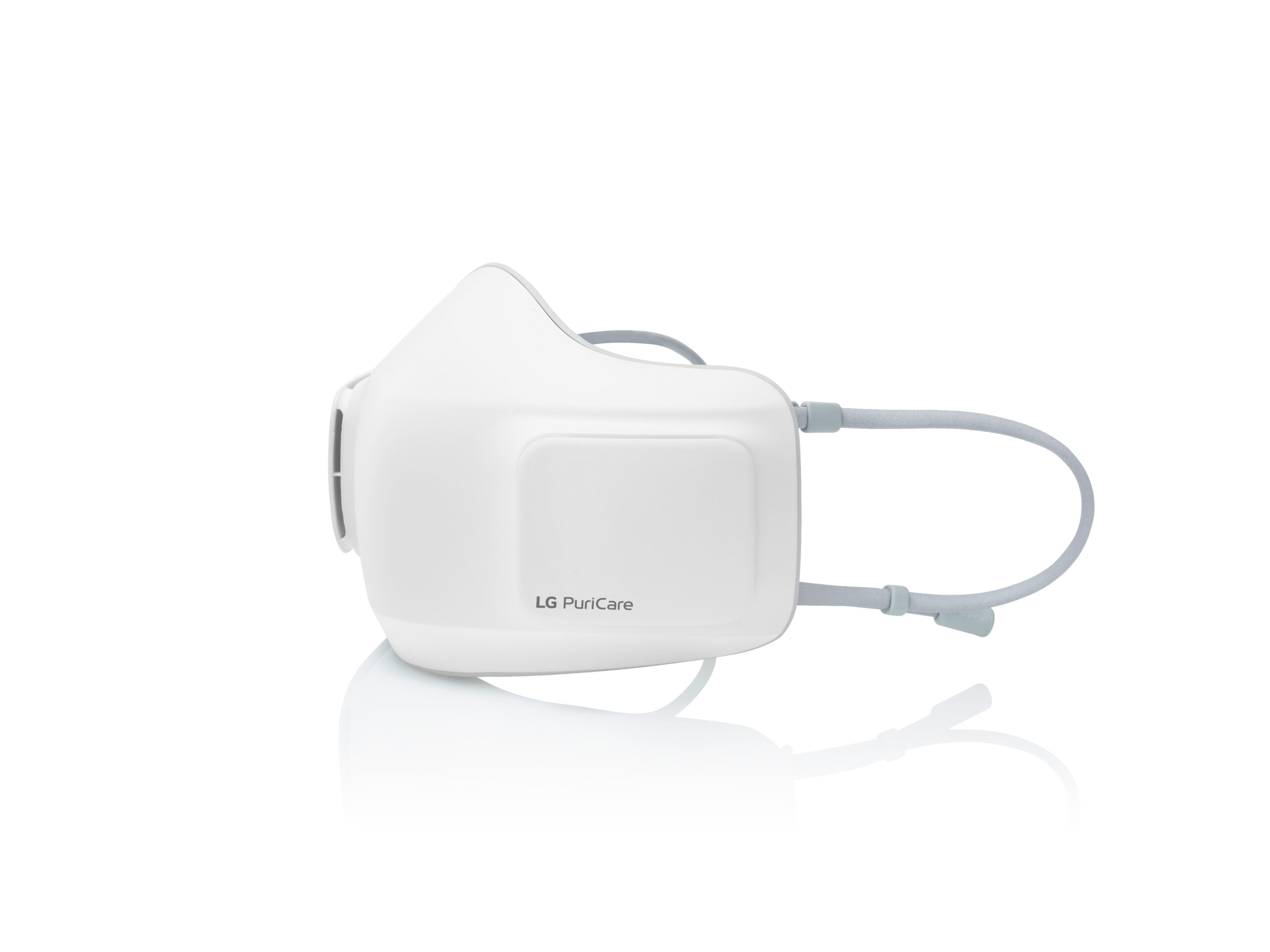
Frankly, the most surprising thing about the PuriCare is that more tech companies haven’t launched a similar product in recent months. LG is showing it off as part of the upcoming IFA press conference in Berlin — though the company is opting for a virtual presence at this year’s show.

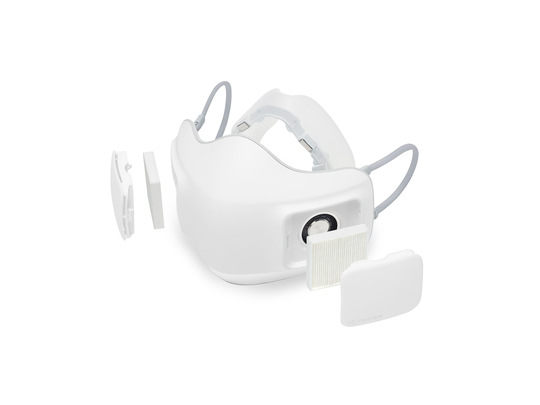
There’s a lot going on in the press release for the “wearable air purifier.” As it notes, “LG PuriCare Wearable Air Purifier resolves the dilemma of homemade masks being of inconsistent quality and disposal masks being in short supply. The PuriCare Wearable Air Purifier employs two H13 HEPA filters, similar to the filters used in the company’s home air purifier products.”

The company seemingly goes out of its way not to mention COVID-19. After all, specific health claims are often subject to different regulations. It’s true, of course, that masks have, at various points, been in short supply during the pandemic. And likely that was the case when LG really started pushing the idea in earnest.

That said, it’s also worth noting that even professionally made masks offer a pretty wide range of efficacy against the virus’s transmission. There are plenty of questions here. For starters, the filter and the question of how effective it might potentially be for both the wearer and the people around them. The latter, after all, is the real argument for wearing masks — to protect the people around.

LG’s response to the COVID-19 question defers to potential future approval; “We’re waiting until further testing is complete before we’re able to share full details.” Hopefully we’ll get some more concrete answers before it goes on sale in “the fourth quarter in select markets.” Though there are certainly non-coronavirus-related reasons to wear a mask, including pollution and other environmental contaminants.

Image Credits: LG

Also worth asking is what happens when the battery runs down. The mask is capable of running eight hours on “low” and two hours on “high,” courtesy of an on-board 820mAh battery, according to figures from LG. But stuff happens. Sometimes you’re out longer than expected, or maybe you just forgot to charge it in full before leaving the house.

There are two H13 HEPA filters on-board, similar in nature to the kind the company uses for its in-home air filtration system. There are also UV-LED lights designed to kill bacteria — an added level of protection beyond the filtration system. In addition to the aforementioned home filtration systems, LG also manufacturers UV light wands for disinfecting purposes. The company has been working on a lot of this stuff already and clearly saw an opportunity to capitalize on it in mask form.

There’s a fair bit of on-board technology, including the ability to regulate the speed of the filtration based on the wearer’s breath. Overkill? Almost certainly. From the looks of the images, it’s also potentially cumbersome. And then there’s the matter of the still unknown price.

Electric moped startup Revel returns to New York with helmet selfie, other in-app safety features

Shared electric moped startup Revel has resumed operations in New York City a month after shutting down its service following several deaths. The startup’s blue mopeds that had become a familiar sight in New York City are back, but with a number of new protocols and features aimed at boosting safety and assuaging city officials.

Revel voluntarily shut down its service in New York City on July 28. Revel restarted its 3,000-strong fleet of mopeds in four boroughs (Brooklyn, the Bronx, Manhattan and Queens) after the city of New York approved its relaunch plan. Revel, which was founded in March 2018 by Frank Reig and Paul Suhey, is leaning heavily on its app to improve safety, including training videos and tests, a helmet selfie feature that requires photographic evidence the user is wearing a helmet and a community reporting tool.

Revel said it partnered with behavioral science experts at The Behavioral Insights Team to develop a new mandatory in-app safety training designed to improve users’ knowledge of safety measures and compliance with those practices. The company will now require all Revel users, including long-time users of the service, to take a 21-question safety training quiz and watch an instructional video before they can start their first ride. The training covers rules of the road, proper pre-ride protocol as well as prohibited activities and consequences of violating the rules.

Revel is expanding this training feature to other markets where it operates, including Austin, Oakland and Washington, DC. Users in these markets outside of NYC will have until September 1 to complete the training. Riders in Miami will also have to take the training once COVID-19-related shut downs are lifted and the service resumes.

The company, which raised $27.6 million in a Series A round announced last fall, has added a helmet selfie feature which riders will have to use before beginning their rental. If a passenger is indicated, they will also be required to take a selfie. The helmet case unlocks when the user selects “start ride,” but the power to the moped won’t come on until the selfie has been submitted.

Revel is also rolling out a feature that any New Yorker can use, with or without a company account. Starting Thursday, Revel said anyone can open the Revel app and report bad behavior of riders in the city. Revel said it also has limited hours of operations for 60 days and will shut down between midnight and 5 a.m. and has beefed up its suspension policies and added more free lessons, which anyone with an account can book through the app or website.