WhatsApp reveals six previously undisclosed vulnerabilities on new security site

Facebook-owned WhatsApp has revealed six previously undisclosed vulnerabilities, which the company has now fixed. The vulnerabilities are being reported on a dedicated security advisory website that will serve as the new resource providing a comprehensive list of WhatsApp security updates and associated Common Vulnerabilities and Exposures (CVE).

WhatsApp said five of the six vulnerabilities were fixed in the same day, while the remaining bug took a couple of days to remediate. Although some of the bugs could have been remotely triggered, the company said it found no evidence of hackers actively exploiting the vulnerabilities.

Around one-third of the new vulnerabilities were reported through the company’s Bug Bounty Program, while the others were discovered in routine code reviews and by using automated systems, as would be expected.

WhatsApp is one of the world’s most popular apps, with more than two billion users around the world. But it’s also a persistent target for hackers, who try to find and exploit vulnerabilities in the platform.

The new website was launched as part of the company’s efforts to be more transparent about vulnerabilities targeting the messaging app, and in response to user feedback. The company says the WhatsApp community has been asking for a centralized location for tracking security vulnerabilities, as WhatsApp isn’t always able to detail its security advisories in an app’s release notes due to app store policies.

The new dashboard will update monthly, or sooner if it has to warn users of an active attack. It will also offer an archive of past CVEs dating back to 2018. While the website’s main focus will be on CVEs in WhatsApp’s code, if the company files a CVE with the public database MITRE for a vulnerability it found in third-party code, it will denote that on the WhatsApp Security Advisory page, as well.

Last year, WhatsApp went public after fixing a vulnerability allegedly used by Israeli spyware maker NSO Group. WhatsApp sued the spyware maker, alleging the company used the vulnerability to covertly deliver its Pegasus spyware to some 1,400 devices — including more than 100 human rights defenders and journalists.

NSO denied the allegations.

John Scott-Railton, a senior researcher at Citizen Lab, whose work has included investigating NSO Group, welcomed the news.

“This is good, and we know that bad actors make use of extensive resources to acquire and weaponize vulnerabilities,” he told TechCrunch. “WhatsApp sending the signal that it’s going to move regularly to identify and patch in this way seems like yet another way to raise the cost for bad actors.”

In a blog post, WhatsApp said: “We are very committed to transparency and this resource is intended to help the broader technology community benefit from the latest advances in our security efforts. We strongly encourage all users to ensure they keep their WhatsApp up-to-date from their respective app stores and update their mobile operating systems whenever updates are available.”

Facebook also said Thursday that it has codified its vulnerability disclosure policy, allowing the company to warn developers of security vulnerabilities in third-party code that Facebook and WhatsApp rely on.

Facebook to warn third-party developers of vulnerable code

Facebook has announced a policy change that will see the company notify third-party developers if it finds a security vulnerability in their code.

In a blog post announcing the change,Facebook said it “may occasionally find” critical bugs and vulnerabilities in third-party code and systems. “When that happens, our priority is to see these issues promptly fixed, while making sure that people impacted are informed so that they can protect themselves by deploying a patch or updating their systems.”

Facebook has previously notified third-party developers of vulnerabilities, but the policy shift formally codifies the company’s policy toward disclosing and revealing security vulnerabilities.

Vulnerability disclosure programs, or VDPs, allow companies to set the rules of engagement for finding and disclosing security bugs. VDPs also help guide the disclosure and publication of vulnerabilities once a bug is fixed. Companies often use a bug bounty to pay hackers who follow the company’s reporting and disclosure rules.

The policy change is not entirely altruistic. Facebook, like many other tech companies, relies on a ton of third-party code and open-source libraries. But by putting the change in writing, it also puts third-party developers on notice if they don’t fix vulnerabilities in a timely fashion.

Casey Ellis, founder and chief technology officer at vulnerability disclosure platform Bugcrowd, said the policy shift was becoming increasingly popular for companies with a “large, user-centric, third-party attack surface,” and echoes similar efforts by Atlassian, Google and Microsoft.

Facebook said when it finds a vulnerability, it will give third-party developers 21 days to respond and 90 days to fix the issues, a widely accepted time frame to report and remediate security issues. The company says it will make a reasonable effort to find the right contact for reporting a vulnerability, including, but not limited to, emailing security reporting emails, filing bugs without confidential details in bug trackers or filing support tickets. But the company said it reserves the right to disclose sooner if the vulnerability is actively being exploited by hackers, or delay its disclosure if it’s agreed that more time is needed to fix an issue.

Facebook said it will generally not sign a non-disclosure agreement (NDA) specific to the security issues it reports.

Katie Moussouris, founder of Luta Security, told TechCrunch that the “devil will be in the details.”

“The test will be the first time they have to pull the trigger and drop a zero-day — with mitigation guidance — on a competitor,” she said, referring to unpatched vulnerabilities where companies have zero days to patch them.

The new policy is focused specifically on how Facebook handles disclosure of issues in third-party code. If researchers find a security vulnerability on Facebook, or within its family of apps, they will continue to report it through the existing Bug Bounty Program.

As part of the policy change, Facebook said it would also disclose vulnerabilities once they are fixed. In a separate blog post, Facebook, which owns WhatsApp, disclosed six vulnerabilities in the messaging app — since fixed.

Oracle loses $10B JEDI cloud contract appeal yet again

Oracle was never fond of the JEDI cloud contract process, that massive $10 billion, decade-long Department of Defense cloud contract that went to a single vendor. It was forever arguing to anyone who would listen that that process was faulty and favored Amazon.

Yesterday it lost another round in court when the U.S. Court of Appeals rejected the database giant’s argument that the procurement process was flawed because it went to a single vendor. It also didn’t buy that there was a conflict of interest because a former Amazon employee was involved in writing the DoD’s request for proposal criteria.

On the latter point, the court wrote, “The court addressed the question whether the contracting officer had properly assessed the impact of the conflicts on the procurement and found that she had.”

Further, the court found that Oracle’s case didn’t have merit in some cases because it failed to meet certain basic contractual criteria. In other cases, it didn’t find that the DoD violated any specific procurement rules with this bidding process.

This represents the third time the company has tried to appeal the process in some way, four if you include direct executive intervention with the president. In fact, even before the RFP had been released in April 2018, CEO Safra Catz brought complaints to the president that the bid favored Amazon.

In November 2018, the Government Accountability Office (GAO) denied Oracle’s protest that it favored Amazon or any of the other points in their complaint. The following month, the company filed a $10 billion lawsuit in federal court, which was denied last August. Yesterday’s ruling is on the appeal of that decision.

It’s worth noting that for all its complaints that the deal favored Amazon, Microsoft actually won the bid. Even with that determination, the deal remains tied up in litigation as Amazon has filed multiple complaints, alleging that the president interfered with the deal and that they should have won on merit.

As with all things related to this contract, the drama has never stopped.

Twitter and Facebook wrestle with Trump telling Americans to vote twice

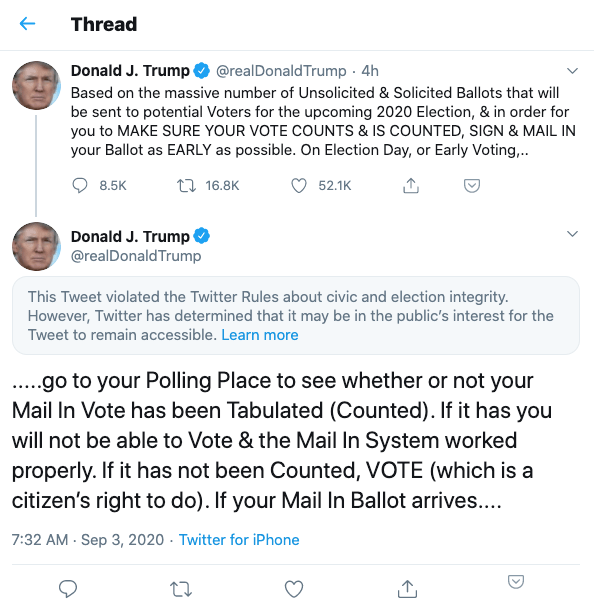
President Trump’s recent suggestion that North Carolina voters should cast multiple ballots has run afoul of Twitter’s election integrity rules. In a series of tweets Thursday morning, the president elaborated on previous statements in which he encouraged Americans to vote twice to “check” vote-by-mail systems.

Trump made the initial comments in a local television interview Wednesday. “They will vote and then they are going to have to check their vote by going to the poll and voting that way because if it tabulates then they won’t be able to do that,” Trump said.

“So let them send it in, and let them go vote. And if the system is as good as they say it is, then they obviously won’t be able to vote.”

Twitter added a “public interest notice” to two tweets related to those comments Thursday, citing its rules around civic and election integrity. The tweets violated the rules “specifically for encouraging people to engage in a behavior that could undermine the integrity of their individual vote,” according to Twitter spokesperson Nick Pacilio. Twitter has limited the reach of those tweets and restricted its likes, replies and retweets without comment.

Trump’s latest attack on vote-by-mail also crossed a line for Facebook . The company will remove any video of Trump’s recent voting comments that are shared without context or those that support the president’s statements, though it has yet to identify any so far.

“This video violates our policies prohibiting voter fraud and we will remove it unless it is shared to correct the record,” Facebook Policy Communications Director Andy Stone said.

Facebook added its own fact-checking notice to the same statement that Twitter deemed in violation of that platform’s rules. Now, a label at the bottom of Trump’s Facebook post contradicts the president’s suggestion that Americans try to vote twice to make sure “the mail in system worked properly.”

The fact-checking label, which reads “Voting by mail has a long history of trustworthiness in the US and the same is predicted this year,” is more specific than the generic voting info label the platform attaches to other election-related content.

The president’s comments were his latest attempt to cast doubt on the vote-by-mail systems that the U.S. will rely on in November’s election. In recent months, Trump has made many unfounded or outright false claims criticizing the safety of mail-in voting, a system that the U.S. already relies on for absentee voting. As November gets closer, those claims have voting rights organizations concerned.

“While this is a step in the right direction, the fact remains that Facebook refuses to enforce its own Terms of Use where Donald Trump is concerned,” VoteAmerica founder Debra Cleaver said.

“Yesterday, Trump outright urged voters in North Carolina to commit voter fraud. This is part of a larger and dangerous pattern of Trump using social media and other platforms to distribute disinformation, with what appears to be the goal of undermining faith in US elections.”

While the COVID-19 crisis means that more Americans than ever will be using mail-in voting to cast a ballot, the voting method is widely regarded as safe and reliable by experts.

In response to Trump’s remarks, North Carolina’s Board of Elections issued a statement clarifying that voting twice is a Class I felony in the state.

“It is illegal to vote twice in an election,” said Karen Brinson Bell, executive director of the North Carolina State Board of Elections.

“… Attempting to vote twice in an election or soliciting someone to do so also is a violation of North Carolina law.”

Rocket Lab secretly launched its very first satellite, ‘First Light’

Rocket Lab’s 14th mission, “I Can’t Believe It’s Not Optical,” had a stowaway aboard. The New Zealand launch company quietly included its first fully functioning satellite next to its paying customer’s payload. First Light, as it’s called, is a sort of tech demo intended to show how access to orbit doesn’t have to be, as CEO and founder Peter Beck put it, “kind of a pain in the butt.”

Rocket Lab has telegraphed this move for some time; the Photon satellite platform was announced early last year, and in March it acquired spacecraft maker Sinclair Interplanetary. It was just a matter of when the company would choose to press the button, and it has now done so.

As Beck explained in a live broadcast today (now that First Light has successfully deployed into orbit), the company felt that “access to space” is, in many ways and despite the inherent risks, a solved problem. The next biggest pain point, he said, is that “it’s just really painful to go from an idea to getting something in orbit.”

It’s cause for celebration, he said, when a project can go from idea to orbit in 18 months. That’s far too slow to keep up with innovation on the ground, especially for startups, which may not have 18 months of runway. “We need to fix that,” Beck said.

CG render of a photon satellite in orbit.

Image Credits: Rocket Lab

Photon and First Light represent Rocket Lab’s new business proposition of providing a flexible platform for a modern satellite, and one that fits hand-in-glove with its Electron launch vehicle and other services. Acting as a partner throughout the process rather than just the launch provider is of course more work and money for Rocket Lab, and if things go well it could be much faster and cheaper for the customer as well.

There will be other, new versions of Photon as well, as cislunar and interplanetary space become targets for Electron launches. Rocket Lab is already signed on for a lunar mission, NASA’s experimental CAPSTONE craft, which will be based on Photon and help clear the way for later Artemis missions.

SpaceX completes another successful short test flight of its Starship spacecraft prototype

SpaceX has done it again — a second “hop” flight in less than a month for its Starship prototype. This was a 150 meter (just under 500 foot) test flight from its Boca Chica, Texas development site. The prototype used in this instance was SN6, a more recent model than the SN5 test article that SpaceX used to complete a similar test at the beginning of August.

The hop flight is a key part of its testing program for Starship, and its Raptor engine. These prototypes are equipped with only one such engine, but the final production version will have six, including three designed to fly in Earth’s atmosphere, and three to be used while the vehicle is in space.

SpaceX accomplishing two of these flights with a controlled, upright landing in rapid succession is a very good sign for the spacecraft’s development program, since there have been a number of previous prototypes which never made it to this point. Earlier versions encountered pressurization failures under load when simulating what the conditions would be with fuel on board.

These short hops help SpaceX gather data bout Raptor performance, as well as the performance of a full-sized prototype Starship (though without elements including the nosecone and eventual landing legs). All of this will inform later tests, including a much higher sub-orbital atmospheric flight intended to go around as high as commercial airplanes fly, and eventually, the first orbital Starship launch, which is currently likely to take place next year at the earliest.

SpaceX is pursuing a rapid iteration development plan for Starship, creating multiple generations of prototype at once at its Boca Chica site, with the aim of testing and improving the design quickly, while also learning from failures. The goal had been to fly Starship’s first operational missions sometime next year, but it will be incredibly impressive if the company manages that, considering where they are in the rocket’s development cycle.

Media Roundup: Patreon joins unicorn club, Facebook could ban news in Australia, more

Welcome to the very first edition of Extra Crunch’s Media Roundup. Over the past few months, we’ve launched features like Decrypted, Deep Science and The Exchange, which aggregate and analyze the latest news in a given sector, so it seemed overdue to do something similar for media.

The goal is to provide a regular update on what entrepreneurs in the content or advertising business should be thinking about. That doesn’t just mean startup funding — we’ll track the broader landscape, including platform policies that could affect everyone — which is just as important as knowing who’s getting checks.

If you have any thoughts on what you’d like to see included in future roundups, please let me know in the comments below.

Let’s get started.

Facebook may ban news sharing in Australia

This is part of an ongoing dispute between Facebook and the Australian government, which has created a plan that would require Facebook and Google to share revenue with Australian news publishers whose content appears on their services. Both companies have a complicated relationship with the news business, with many publishers both relying on large platforms for traffic while also resenting the fact that those platforms take the vast majority of digital ad revenue.

In an attempt to improve that relationship, Google and Facebook have committed in recent years to investing hundreds of millions of dollars in journalism — and while those efforts are commendable, it’s worth asking whether publishers should be entitled to more by law, not just as a gift.

Exhibitors at Disrupt 2020: Register now to meet accelerators next week

Disrupt 2020 is all about helping startups find and create ways to drive their business forward in these most challenging times. We partnered with cela to give exhibitors in Digital Startup Alley one sweet opportunity — networking with 13 accelerators.

If you’re exhibiting — or plan to — don’t miss out on your chance to meet with up to 13 accelerators and pre-interview for their upcoming virtual cohorts. The first in our series of accelerator sessions — where you’ll gather information and pitch your product — takes place next week. Here’s everything you need to know.

Date: September 8

Time: 1 p.m. – 3 p.m. (PT)

Accelerator focus: The following four accelerator programs are designed for the more established startups. You have a customer base. If that describes your startup, review the accelerator websites below. If you’re interested in scheduling a meeting — and you meet the program’s requirements — you can register now on CrunchMatch.

Participating accelerators

  • NUMA helps early and growth-stage international tech startups fast-track their growth and scale in the U.S. through virtual and in-person startup acceleration programs. You’ll find application requirements here.
  • Techstars helps grow entrepreneurial ideas into world-changing businesses. You’ll find application requirements here.
  • Entrepreneurs Roundtable Accelerator combines seed capital and hands-on help with an expert team to positively impact the trajectory of early-stage startups. You’ll find application requirements here.
  • Plug and Play’s health program connects the best startups in the world to corporations that want to disrupt the healthcare industry. You’ll find application requirements here.

It’s not too late to take advantage of our accelerator speed networking sessions and reap the benefits that come with exposing your startup to thousands of Disrupt attendees from around the world. Simply purchase a Digital Startup Alley Exhibitor Package, and you’re eligible to meet and potentially pitch your way into an accelerator cohort that could change the trajectory of your business.

None of the above-mentioned accelerators fit your startup? Don’t worry, we have two more accelerator sessions on tap.

Date: September 9

Time: 1 p.m. – 3 p.m. PT

Accelerators: She Gets Sh!t DoneHalo Incubator, Startup Boost Pre- AcceleratorGlobal Startup Ecosystem (Her Future Summit)

Date:  September 10

Time: 1 p.m. – 3 p.m. PT

Accelerators: Plug and Play (IoT),  Backstage Capital,  Plug and Play (enterprise tech), StartEd AcceleratorQuake Capital 

Don’t miss your chance to connect with accelerators — and apply to their virtual programs. The first opportunity takes place on September 8, and it’s available only to startups exhibiting in Startup Alley at Disrupt 2020. Want in? Grab a Digital Startup Alley Exhibitor Package today and crack open a giant can of possibility.

Is your company interested in sponsoring or exhibiting at Disrupt 2020? Contact our sponsorship sales team by filling out this form.

Apple won’t force developers to let users opt out of tracking until next year

At its global developer conference in June, Apple said its forthcoming iOS 14 update would allow users to opt out of in-app ad tracking, a privacy feature that quickly drew ire from advertising giants over fears that it would make it harder to deliver targeted ads to users.

But now Apple is delaying enforcing the feature until “early next year,” the company confirmed.

Expected out later this year, iOS 14 will contain a new prompt that asks users whether they would like to opt into this kind of targeted ad tracking. Developers will be able to integrate this prompt into their apps as soon as iOS 14 is released, but they will not be required to, as Apple indicated they would earlier.

In a statement, Apple said:

We believe technology should protect users’ fundamental right to privacy, and that means giving users tools to understand which apps and websites may be sharing their data with other companies for advertising or advertising measurement purposes, as well as the tools to revoke permission for this tracking. When enabled, a system prompt will give users the ability to allow or reject that tracking on an app-by-app basis. We want to give developers the time they need to make the necessary changes, and as a result, the requirement to use this tracking permission will go into effect early next year.

Although Apple cites the necessity of giving developers time, major advertising companies like Facebook have warned that the change could severely impact their operations. “Apple’s updates may render Audience Network so ineffective on iOS 14 that it may not make sense to offer it on iOS 14,” the company said in a statement last week.

Putting these lucrative partnerships in jeopardy could hit Apple’s bottom line as well and may even affect whether some apps or services are available at all.

The exact date when the policy would be enforced, and other details of this compromise, will be announced later.

Explore micromobility’s next opportunities at TC Sessions: Mobility

Micromobility, like many other industries, has faced a lot of uncertainty this year. Many shared electric scooter operators paused their services in the earlier days of the COVID-19 pandemic, but resumed operations after putting some safety measures into place. Meanwhile, some industry analysts have pointed to micromobility as a savior for cities where public transit is suffering as a result of low ridership.

Although there have been many layoffs and consolidation across the market, micromobility as a technological tool may be poised to come out of this year stronger than before. And despite the over-saturation of companies in the micromobility market, there are still opportunities for new players.

That’s what we’ll be exploring at TC Sessions: Mobility with Tortoise co-founder Dmitry Shevelenko, Elemental Excelerator director of Innovation, Mobility, Danielle Harris and Superpedestrian VP of Strategy and Policy, Avra van der Zee.

Tortoise co-founder and president Dmitry Shevelenko 

Given the volume of micromobility operators in the space today, Tortoise aims to make it easier for these companies to more strategically deploy their respective vehicles and reposition them when needed. Using autonomous technology in tandem with remote human intervention, Tortoise’s software enables operators to remotely relocate their scooters and bikes to places where riders need them, or, where operators need them to be recharged.

On an empty sidewalk, Tortoise may employ autonomous technologies, while it may rely on humans to remotely control the vehicle on a highly trafficked city block. Shevelenko will walk us through his company’s approach to building an operating system for micromobility providers.

Elemental Excelerator director of Innovation, Mobility, Danielle Harris

Given the challenges the COVID-19 pandemic has created in cities, there is room for electric bikes and scooters to provide alternative transportation options to cities. Additionally, there is growing interest in charging stations as well as the direct-to-consumer market, as society still grapples with ways to live among a deadly virus.

Harris, who used to work as an innovation strategist for San Francisco’s Municipal Transportation Agency’s Office of Innovation, has a a plethora of knowledge about how startups can best work with cities and provide them with relevant and effective mobility solutions.

Superpedestrian VP of Strategy and Policy, Avra van der Zee

Superpedestrian first came on the scene with its vehicle diagnostics platform for shared electric scooters. This year, the company launched its own electric scooter provider, LINK, in partnership with Zagster. Avra van der Zee, who came on board to Superpedestrian after working at JUMP, is tasked with ensuring Superpedestrian continues to work well with cities in providing them micromobility services that fit their needs.

At TC Sessions: Mobility, you’ll hear from these experts about what’s next in micromobility.

Get your tickets for TC Sessions: Mobility to hear from these thought-leaders along with several other fantastic speakers from Waymo, Lyft, Nuro and more. Tickets are just $145 until September 4 at 11:59 p.m. PDT, with discounts for groups, students and exhibiting startups. We hope to see you there!

France to spend $8.4 billion on digital as part of stimulus plan

The French government unveiled a massive $120 million (€100 billion) stimulus package earlier today to recover from the economic downturn — it represents 4% of the country’s GDP. As part of this support plan, the government plans to spend a significant chunk of money on all things digital — startup investment, infrastructure investment and digital transformation.

I interviewed France’s digital minister Cédric O earlier today to get some details on how it’s going to work. Overall, France will spend $8.4 billion (€7 billion) on digital investments. This is a new investment plan for the next two years.

It’s different from the economic rescue plan that was rolled out earlier this year. That one was designed as a stopgap for the early days of the economic crisis.

“With €7 billion, I think the digital sector is the sector that is receiving the biggest investment overall compared to all other sectors except the environmental sector,” Cédric O said.

France's digital minister Cédric O

France’s digital minister Cédric O. Image Credits: Ludovic Marin / AFP / Getty Images.

Investing in tech startups

Ten years ago, the French government launched an investment program dedicated to innovation, from scientific research to R&D spendings. The government is launching the fourth iteration of this program (Programme d’investissements d’avenir).

It’s a $13 billion investment plan (€11 billion) and it covers a ton of stuff. But nearly $1 billion (€800 million) will be dedicated to state aid for French startups over the next couple of years.

“It represents a volumetric increase,” Cédric O said. “If we look at innovation aids managed by Bpifrance, we have a 60% increase. Startups already know those schemes really well, so it’s going to have an immediate impact.”

In addition to that, as part of the innovation program, France will spend $3 billion (€2.5 billion) over the next five years to invest in startups with Bpifrance acting as a traditional VC firm, and in VC funds directly as limited partners.

There will be more details on the direct investment strategy, but you can expect vertical-focused investments in cybersecurity, quantum computing, green tech, etc.

For the fund of fund investment strategy, the goal here is two-fold — maintaining investments in small VC funds that focus on seed rounds and Series A rounds and filling a gap when it comes to late-stage funds.

“Crises are transition periods with more entrepreneurs, more consolidation and opportunities. We want to make sure that French companies merge rather than foreign companies [acquiring French companies],” Cédric O said.

Injecting cash in the tech ecosystem means bigger French tech companies with more funding will be able to acquire smaller ones. According to the government, boosting bigger French startups through public investment could benefit the tech ecosystem at large. Otherwise, tech giants, such as Google and Facebook, will acquire the most promising French startups.

Bridging the gap between the tech sector and the economy at large

Over the past three years, many have criticized President Emmanuel Macron for helping French startups through generous policies and leaving a large portion of the population behind. That’s why today’s stimulus plan isn’t just about tech startups.

“We have to keep investing massively because it’s the future of work but we have to make sure everyone benefits from those investments,” Cédric O said.

While startups hire more people than other companies, they’re often looking for engineers, data scientists and customer success managers. Given that many people are going to face unemployment, France will spend $360 million (€300 million) on education for the tech sector.

Most French companies aren’t tech companies, so the French government is going to contribute to the digital transformation of small and medium companies with a $460 million investment (€385 million) as well.

“We have to keep investing massively because it’s the future of work but we have to make sure everyone benefits from those investments.” Cédric O

Digital transformation is quite broad; it covers anything from switching to digital invoices to launching an e-commerce branch and buying modern equipment for industrial production. This is going to be one of the toughest parts of the stimulus plan as it’s a highly fragmented market.

“Operationalizing this plan will be one of the main challenges we’ll face. There are 3 million companies in France, 1.5 million small and medium businesses. And reaching those companies has been a challenge for previous governments,” Cédric O said.

In addition to small and medium businesses, car manufacturers and the aviation industry will receive $240 million (€200 million) for digital transformation.

The government is also going to spend $300 million (€250 million) on digital inclusion with public agents helping elderly citizens and simpler administrative services. France already allocated some money for digital inclusion in the past, but the previous plan was only $18 million (€15 million).

And then there are some public spendings on infrastructure, such as an additional $290 million (€240 million) for fiber network and $2 billion (€1.7 billion) to modernize public information systems.

Overall, it’s an ambitious stimulus package. I’m sure startups will find a way to take advantage of new state aid and investment opportunities. I hope traditional companies will also see the benefits.

OrCam Technologies co-founder Amnon Shashua to speak at Sight Tech Global

If the measure of progress in technology is that devices should become ever smaller and more capable, then OrCam Technologies is on a roll. The Israeli firm’s OrCam MyEye, which fits on the arm of a pair of glasses, is far more powerful and much smaller than its predecessor. With new AI-based Smart Reading software released in July, the device not only “reads” text and labels but also identifies people by name and describes other important aspects of the visual world. It also interacts with the user, principally people who are blind or visually impaired, by means of an AI-based smart voice assistant.

At the upcoming Sight Tech Global virtual event, we’re pleased to announce that OrCam’s co-founder and co-CEO, Professor Amnon Shashua, will be a featured speaker. The event, which will take place virtually on December 2-3, is focused on how AI-related technologies will influence assistive technology and accessibility in the years ahead. Attendance is free and pre-registration is open now.

Shashua is a towering figure in the technology world. He is not only the co-founder of OrCam but also Mobileye, the company that provides the computer-vision sensors and systems for automotive safety and autonomous navigation. Intel acquired Mobileye for $15.3 billion in 2017, the single-largest acquisition of an Israeli company ever.

Shashua started OrCam at the prompting of his aunt, who was losing her sight and hoped that her technologist nephew could apply his prodigious talents as a scientist and AI expert to help. With that goal in mind, he started OrCam in 2010 with co-founder Ziv Aviram. The firm has gone on to raise $130.4 million dollars from investors, including Intel, and sell the OrCam MyEye device to tens of thousands of users in over 50 countries. At $3900 per device in the U.S., the OrCam MyEye is far from affordable for most people, but the firm says the device price will come down as production increases.

At the start of a new era for assistive technology, OrCam’s approach with the lightweight, offline-operating OrCam MyEye is nothing if not thought provoking (the device was recognized as a TIME Best Invention of 2019). Will miniaturization of sophisticated sensors and electronics lead to unobtrusive sensor arrays as the foundation of assistive tech? Will the AI-based natural-language processing lead to an all-purpose, customizable personal assistants that work with abilities as needed?

“In OrCam’s roadmap,” says Shashua, “the ultimate AT must have the right balance between computer vision and natural language processing. For example, the “smart reading” feature recently launched harnesses NLP (natural language processing) in order to guide the device to which text information to extract and communicate to the user. NLP allows the user to specify precisely what he/she needs to know. For example, the “orientation” feature recently launched allows the user to prompt the device to describe the objects in the scene and to provide audible guidance to those objects. We see the “orientation” feature growing with respect to vocabulary, with respect to search (e.g., “notify me when you see a Toilet sign”), and with respect to obstacle avoidance (where is the free-space in the scene). The technological challenge in bringing these desires into reality critically depends on the progress of compute and algorithms.

“By ‘compute,’” says Shashua,  “I mean the ever-growing trend to miniaturize processing power enables more sophisticated algorithms to reside on smaller and battery-powered footprint. By “algorithms” I mean the ever-increasing sophistication of deep-tech to mimic human intelligence. Combining the two creates a powerful impact on the future of assistive tech for people who are blind and visually impaired.”

Shashua received a B.Sc in mathematics and computer science from Tel-Aviv University in 1985 and his M.Sc in computer science in 1989 from the Weizmann Institute of Science. He received a Ph.D in brain and cognitive sciences in 1993 from the Massachusetts Institute of Technology (MIT), while working at the Artificial Intelligence Laboratory.

Sight Tech Global is a virtual event on December 2-3 and attendance is free. Pre-registration is open now. 

Sight Tech Global welcomes sponsors. Current sponsors include Verizon Media, Google, Waymo, Mojo Vision and Wells Fargo, The event is organized by volunteers and all proceeds from the event benefit The Vista Center for the Blind and Visually Impaired in Silicon Valley.

As it awaits its US fate, TikTok rolls out new marketing tools and Stitch to let users sample other videos

There’s a big question mark hanging over the future of TikTok right now, in the form of what exactly will happen to its U.S. business come September 20, when President Trump said he plans to shut down the Chinese-owned app over security concerns.

But in the meantime, it seems to be business as usual for the app.

Today, TikTok — which has 100 million users in the U.S. — announced a slate of marketing partners to help brands create and measure the impact of campaigns on the app, and a little later the company announced a new feature: Stitch, which lets users sample up to five seconds of video from another user in their own TikTok posts.

Stitch looks like it’s been in testing in some form since April, and the basic idea is to give users an easier way of “quoting” pieces of other videos in their work. For a platform where viral content, and specifically making videos based on popular TikTok memes makes up a huge part of activity and engagement on the site, it makes a lot of sense.

TikTok says that whether a video can be Stitched or not is up to the creator: you can change the default settings for all videos in your privacy settings, or you can toggle whether you want to use it or not each time you create a new video for the platform.

Those who chose to make a Stitch based on your video credit and link to your original video by default, which is a handy and nice way of making sure the original work or creator do not get too lost in the mix — unlike quite a lot of other viral content on social media.

Users who want to Stitch a video do so from the video itself. Hitting the sharing “send to” button, you will now get a Stitch option, which then takes you to an editing screen to create a clip of up to five seconds.

Here is how it looks:

@nigelwhittington##stitch with @nasouin go check out his content btw 🙂 ##fyp

? original sound – nigelwhittington

TikTok is keeping an eye on the money. For the marketing program, the company, owned by ByteDance in China, is kicking off with 20 partners that include companies for campaign management (e.g. Sprinklr and Bidalgo); for creative development (e.g. QuickFrame and Shuttlerock); branded effects around VR and AR (e.g. Bare Tree Media and Byte); and measurement (Kantar). The full list is below.

This is the latest expansion of TikTok for Business, the company’s advertising platform, which launched officially in June to bundle together TikTok’s existing marketing products alongside a new AR product it launched to rival Snapchat’s.

TikTok confirmed to us that this is a global initiative — that is, it’s set up to create marketing campaigns for wherever TikTok is available.

In the case of both the new Stitch feature, and in the new marketing program, I’m going to be honest: It feels a little like an alternate TikTok reality, like the kind you might see in a split-screen meme on the app itself.

Taking the marketing announcement, adding in marketing partners is very, very standard for a social media app that’s doubling down on making money through adtech based on its growing and engaged (and young) audience. Facebook (and the apps in its stable like Instagram) did it. Twitter did it. Snapchat did it.

And now TikTok is doing it. It speaks to the company’s ambition to expand its platform to work with the biggest brands and at scale, leveraging its strong audience growth to build advertising units to sell brands and products to them in innovative and sticky ways that are uniquely “TikTok.”

On the other side, of course, TikTok is having anything other than a standard growth trajectory right now.

It’s in the middle of a messy bidding process for ByteDance to sell TikTok’s U.S. assets (along, potentially, with others) to U.S. owners. The company has had to deal with the abrupt departure of its U.S. head. And now the situation seems to be spilling over into speculation over what might happen in other parts of the world, such as India. All of this means that it’s unclear what will happen to marketing relationships, and where advertisers and partners will be left if and when the app has to splinter.

Or indeed, how ad products and other IP like the new Stitch feature would be passed on in a potential sale. (Right now, reportedly, one of the sticking points for a deal has been the possibility that China might limit which algorithms, which form the basis of how TikTok works, would be passed on in a sale.)

“With the launch of TikTok For Business, we’re building new opportunities for marketers to be creative storytellers and meaningfully engage with the TikTok community,” Melissa Yang, head of Ecosystem Partnerships, TikTok, noted in the blog post. “We’re thrilled to collaborate with some of the most strategic and trusted leaders in the advertising industry and continue giving marketers access to more tools to successfully create, measure and optimize ad campaigns on TikTok. We can’t wait to collaborate with partners to bring a creative and joyful experience to our brand partners and the broader TikTok community.”

We asked TikTok if it can comment on how new features like these would be affected if and when the company does split up into regional operations, and it declined to comment specifically. “Unfortunately we’re not able to comment on speculation,” said a spokesperson. “In general we along with our partners are excited to kick off these partnerships and continue bringing more solutions to the marketing community.”

Here’s the full list of partners in the meantime, per TikTok:

Campaign Management to plan, create, optimize and measure marketing campaigns

  • Bidalgo – Bidalgo drives growth and reduces user acquisition complexity for mobile marketers, leveraging AI to generate actionable insights and powerful automation capabilities for creative production and media buying.
  • BidShake – Empowers fast, efficient and reliable campaign management by enabling real-time, automated cross-channel actions based on aggregated data all from one platform.
  • Sprinklr – The world’s leading Customer Experience Management (CXM) platform.
  • WinClap – The marketing company that provides advanced AI analytics, expertise and creative production to boost the performance of your campaigns.
  • MakeMeReach – Multi-channel ads management platform optimized for scale.

Creative Development to build assets like videos that work on TikTok

  • QuickFrame – More than a marketplace connecting brands to video creators. We help businesses grow by transforming the way they produce video content at scale.
  • Shuttlerock – Transforms existing brand assets into stunning handcrafted video ads.
  • VidMob – Leading creative analytics & post-production platform that uses data to understand your creative, improve your ads and increase marketing performance.
  • Vidsy – Helping brands achieve their business goals with effective digital ad creative.
  • Cohley – Helps brands and agencies cost effectively scale the creation of UGC videos for ads.

Branded Effects for AR and VR content

  • Bare Tree Media – A full-service creative agency enabling brands to reach, engage and entertain consumers through the creation and digital publishing of augmented reality (AR), emojis, messaging stickers and GIFs within popular messaging platforms.
  • Byte – Global specialists in branded AR, Byte is a martech agency that combines technology and creativity to  help solve brands’ challenges.
  • Happy Finish – Global creative production collective studio, creating realities. We specialise in cross-platform services including Retouch, CGI, Animation, VFX, VR, AR & Mixed Reality and Creative AI, and craft experiences for some of the biggest brands and agencies in the world.
  • IgniteXR – Ignite XR is an end-to-end creative solutions group for augmented reality, creating integrated AR campaigns for brands and translating ideas into engaging immersive creative experiences.
  • Poplar Studio – A global creative platform that makes the creation of 3D and AR campaigns easier, faster, affordable and fun — including face filters, world effects, mini-games, portals and image trackers.
  • Subvrsive – Subvrsive is an immersive innovation studio focused on creating content, software and experiences that transform businesses on a global scale.
  • Tommy – A modern communications agency that uses technology, strategy and award-winning design to help brands earn the attention of their audiences.
  • Unit9 – A production studio focusing on AR/VR, Digital, Experiential, Gaming, Innovation and Film projects.

Measurement to target and analyse campaigns

  • Kantar –  The world’s leading data, insights and consulting company.

TikTok is opening the program to other interested partners, it said.

Triller CEO Mike Lu to talk taking on TikTok at Disrupt 2020

Several months ago, before the world became so much more complicated, it was still crystal clear that TikTok was a force to be reckoned with and that its massive growth signaled big things for both Silicon Valley and the global tech scene. As the ByteDance-owned social media app has been drawn into a political crisis after the Trump administration made aggressive moves to force the app under new ownership, the conversation around the future of the app has grown even more intense.

As tech giants mull bids for the app, competitors in the space see room to swoop in and capture its momentum, convincing users to embrace what they’ve built. The usual suspects are pushing clones, including new features inside Snapchat and Facebook’s Reels product, but plenty of venture-backed startups are making their case as well. Perhaps the most convincing seems to be Los Angeles-based Triller, which is itching to capitalize on the uncertainty and claims that its own app has more than 65 million monthly active users.

We’re excited to share that Triller CEO Mike Lu is joining us at TechCrunch Disrupt in September to discuss his company’s ambitions and how social media is finding new ways to transform the music industry.

As TikTok’s geopolitical theater plays out, Triller is aiming to reach the throne by nabbing more outside investment. The company has been aiming to raise a round of funding valuing it at $1 billion, even as it sues ByteDance, claiming that TikTok’s app design violates patents that Triller owns. Triller’s existing backers include institutional firms like Lowercase Capital and Pegasus Tech Ventures, but also musicians like Snoop Dogg, The Weekend, Marshmello and Lil Wayne.

Hear how it all got started, and what’s next for Triller, from Lu at Disrupt 2020 on September 14-18. Get a front-row seat with your Digital Pro Pass for just $245 during our Labor Day Flash Sale  or with a Digital Startup Alley Exhibitor Package. Prices increase next week, so grab your tickets today!