The 2019 TechCrunch Include Report

It’s no secret that the tech industry is historically white, straight and male.

Despite promises to examine and reform hiring practices so that tech companies big and small better reflect the world we all live in, diversity reports chart a different path: Black, brown, female and LGBTQIA+ folks aren’t getting their representative seats at the table.

And now, in the wake of a national response to the killings of George Floyd, Breonna Taylor and Tony McDade by police that has seen millions engage in protests and a seemingly sudden awareness of just how racist the world is, the tech industry has found itself dealing with a crisis of conscience.

Leadership in companies everywhere have held meetings — sometimes putting folks of color in the hot seat — to discuss ways to improve awareness around race and devise plans to implement those initiatives (disclosure: I attended one hosted by TechCrunch’s parent company Verizon). HR departments are checking in with staff to somehow ascertain how to improve their modes of operation.

It is in this climate that TechCrunch is reporting our 2019 events and staff diversity numbers – the fourth such report since we started tracking – which you can see below. To collect this data, we distributed anonymous, volunteer surveys to the panelists, judges and Battlefield competitors at all of our events. We also distributed a form to staff, which was also volunteer and anonymous.


TechCrunch Events

In 2019, we produced six events in three countries in 2019: Disrupt in San Francisco and Berlin; Sessions Robotics, Mobility and Enterprise were held in the Bay Area; and a regional Battlefield in Shenzhen.

Our events draw folks from every corner of the startup world. Whether a founder, an investor onstage or an attendee interested in technology, our events have long served as a place where people could come together to get advice, network, watch the best startups compete on our Battlefield stage and hear from the biggest names in tech.

Our priority at our events is to amplify the voices that have been silenced by the majority. While we continue to see an increase in the number of people of color and white women at our events, we acknowledge that we are still not where we want to be.

Below are the demographic data on panelists, judges and Battlefield competitors from our 2019 events.

Disrupt

For almost 10 years, TechCrunch Disrupt has provided a space for startup founders and investors to exchange ideas, make connections, examine the tech industry and compete on the Battlefield stage. Hundreds of startups across a variety of categories tell their stories to the 10,000 attendees from all around the world.
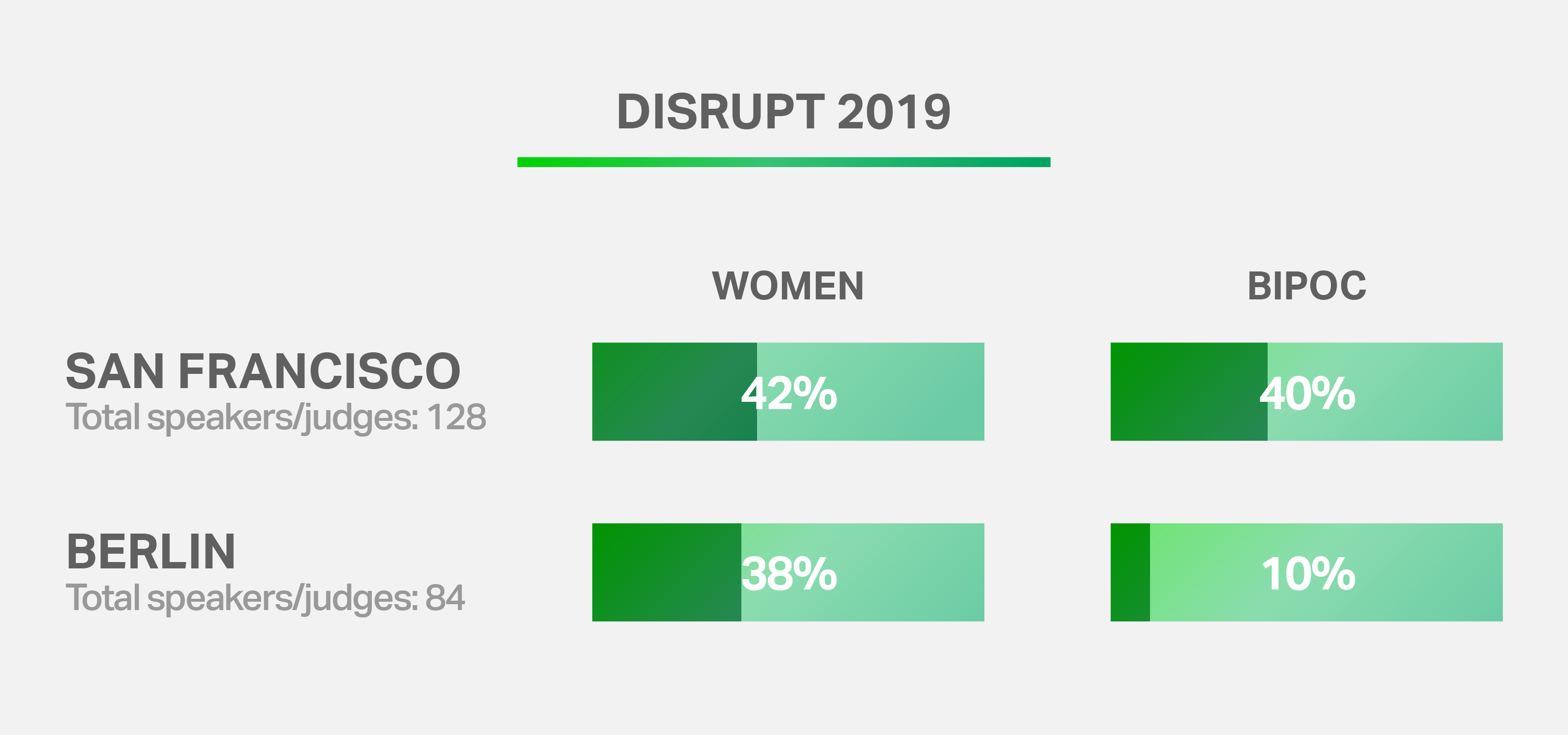
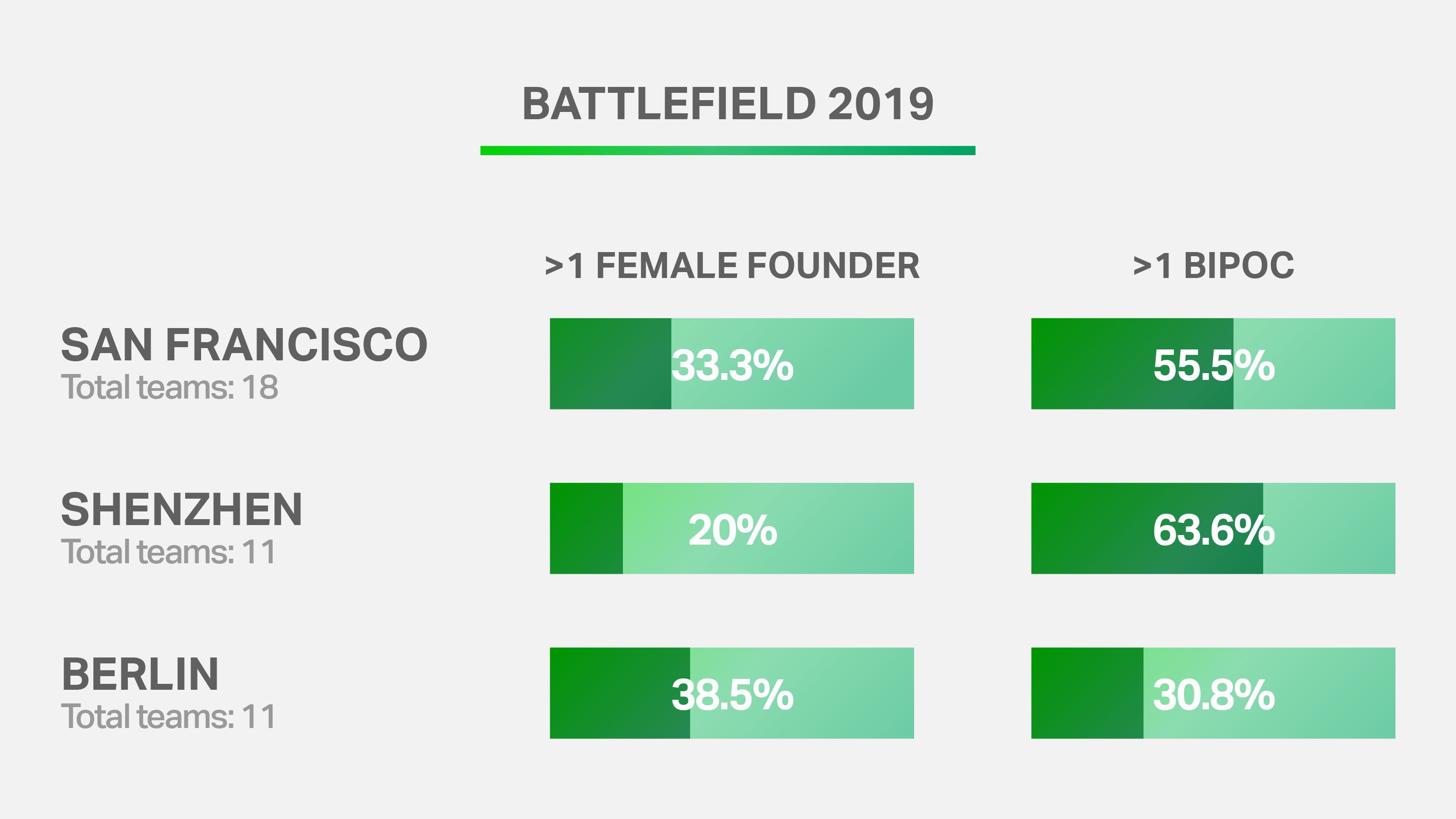
For the first time, in 2019, we hosted Disrupt SF at a bigger venue, Moscone West. Of the 128 speakers and Startup Battlefield judges who self-reported, 54 identified as women (42%) and 52 identified as people of color (40%). On the Battlefield stage at Disrupt SF, 18 companies competed for the Disrupt Cup. There were six self-identified female founders (33%) and 10 (56%) founders who self-identified as a person of color.

At Disrupt Berlin, of the 84 speakers and Startup Battlefield judges who self-reported, 32 (38%) identified as women and nine (10%) identified as people of color. Of the 13 companies that competed in Startup Battlefield, four (31%) founders identified as a person of color and five founders (38%) identified as female.

In 2019, we hosted our Hardware Battlefield competition in Shenzhen, which saw 11 companies take the stage and pitch to a panel of judges. Three (27%) of the 11 founders identified as female and seven (64%) identified as a person of color.

To complement the pitch competition and highlight the issues faced by those in the Chinese ecosystem, we invited top speakers from the startup world in China and beyond to grace our stage. Of the 39 speakers and judges who self-reported, four (10%) identified as women and 26 (66%) identified as a person of color.
Sessions

Our Sessions events are daylong programs dedicated to the popular topics that bring founders, engineers, investors and academics to one place.

TechCrunch Sessions: Robotics continues to be a popular event no matter where we host it. In 2019, Robotics returned to Zellerbach Hall on the campus of UC Berkeley. Of the 32 speakers who self-reported, eight (25%) identified as female and 11 (34%) identified as a person of color.

In 2019, we launched TechCrunch Sessions: Mobility in San Jose. Of the 38 speakers who self-reported, 10 (26%) identified as female and 8 (21%) identified as a person of color.

We also launched TechCrunch Sessions: Enterprise in 2019. Of the 40 speakers who self-reported, 12 (30%) identified as female and 12 (30%) identified as a person of color.

TechCrunch Include 3.0

TechCrunch Include aims to promote diversity by applying resources uniquely available to TechCrunch, including our editorial and events platforms, and by exemplifying the diversity mission in TechCrunch’s own staffing and culture.

In 2014, we launched the Include program as a donation vehicle. It evolved from that into version 2.0, during which we realized the fulfillment of our plan to be transparent and remain proactive about our diversity and inclusion efforts at our events, on our staff, and in our editorial.

Now, Include 3.0, which launches at Disrupt 2020, we will continue to pursue a collaborative and open relationship with the broader community through partnerships with founder and support organizations, and investor groups.  Founder organizations will have the opportunity to nominate early-stage founders to participate in the program as well as serve as advisers to TechCrunch Include. Investor groups commit to establishing lasting relationships with founders in the program and to uphold accountability for representation within their organizations and their investment portfolios. And support organizations provide educational resources and mentorships to strengthen and advise the program including all who participate.

TechCrunch Staff

Everyone should have access to the immense possibilities that the tech industry provides, but for the actual numbers to reflect this requires actively addressing the very unconscious biases that have contributed to rampant inequality.

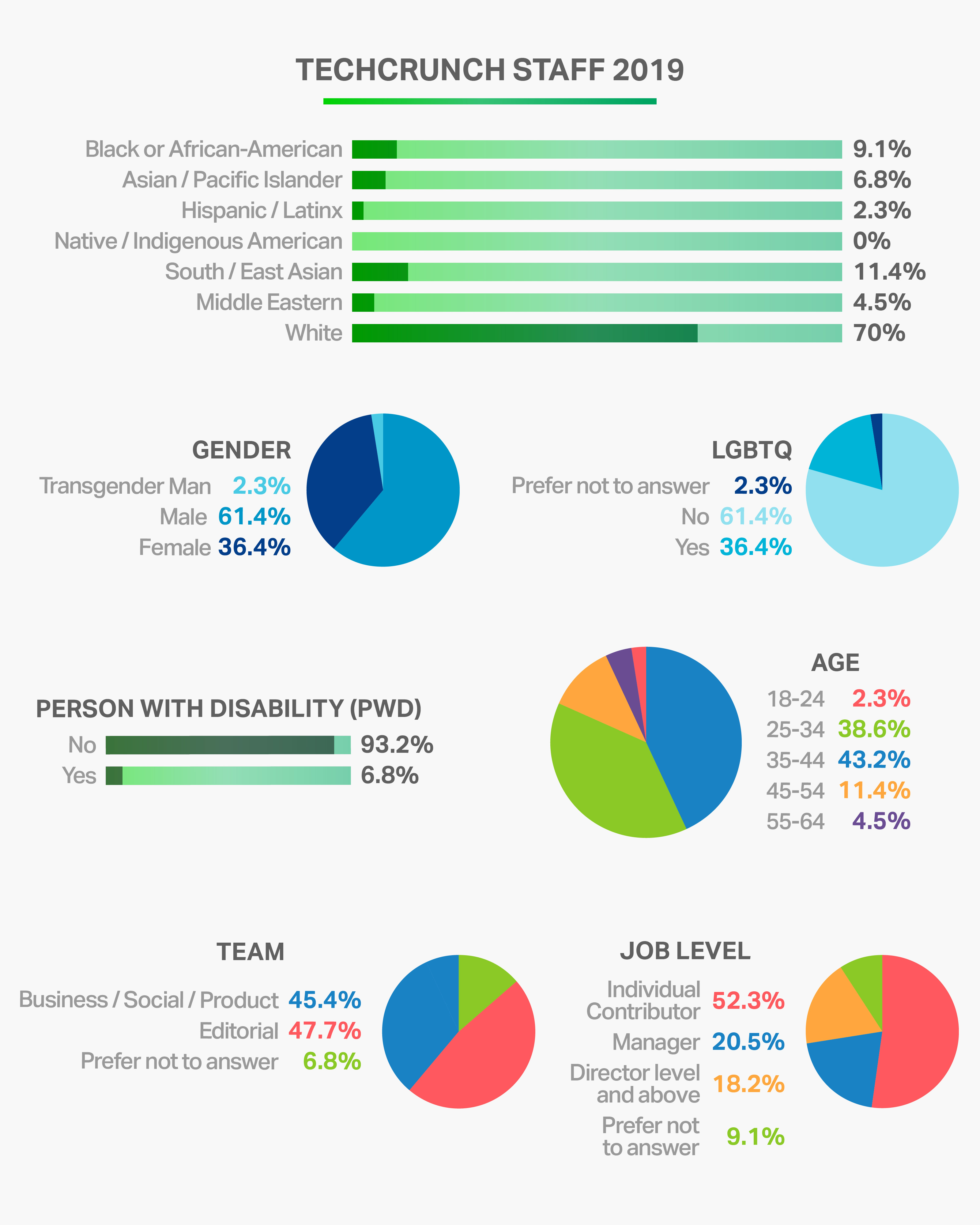
At TechCrunch, our own diversity does not yet reflect this. In 2019, we surveyed our staff, and the results tell us that we have fallen well short of the goal we set. Of 71 editorial, events, business and sales staff, 44 completed the voluntary survey: 70% of the respondents identified as white, 36% identified as women, and 18% identified as LGBTQ+.
 

We understand that diversity is vital to the pursuit of equality, and while we can look at the last few years and see slight improvement, it is just that: slight. We need to focus our efforts so that our stages and our staff represent more accurately the world in which we live. We are not there yet.

Already in 2020 we have produced two events: Sessions: Robotics in at UC Berkeley — just before California Gov. Gavin Newsom ordered the state to shelter-in-place — and Early Stage, which we produced virtually. We are on track to improve our diversity numbers not only in events but also on staff and we will report them in January 2021.

As Black Lives Matter protests in response to police brutality continue amid a worsening global pandemic, TechCrunch will continue to produce events that showcase the diverse talent in the startup community.

And at the foundation will be a small but mighty team focused on the present so we can bring you the future.
 

Toucan raises $3M to teach you new languages as you browse the web

Toucan has developed a Chrome browser extension designed for anyone who wants to learn a new language but hasn’t found the motivation or the time.

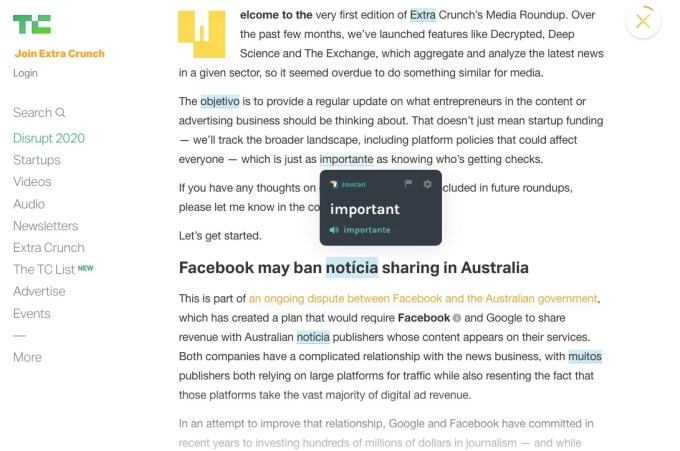
Once installed, the extension scans the text of any (English-language) website you’re visiting and will automatically translate some of the words into the language you’re trying to learn. If you mouse over the word, you’ll see the original English word. Think of it as a browser-based version of language flashcards.

The startup was founded by CEO Taylor Nieman, CTO Shaun Merritt and CPO Brandon Dietz. Today, it’s announcing that it has raised $3 million in seed funding led by GSV Ventures, with participation from Amplifyher Ventures, Wonder Ventures, Golden Ventures, Halogen Ventures, Vitalize Ventures and strategic angel investors.

Nieman’s past roles include business development roles at Headspace (where Dietz was a senior product manager), startup studio Science and car leasing startup Fair.com (where Merritt was an iOS developer). She told me that one thing she learned from across all those experiences is “habit formation — how hard it actually is to do anything that steals people’s time.”

Dietz made a similar point, arguing that while language learning software like Rosetta Stone and Duolingo has had its share of success, “It’s just such a high ask to get people to change their behavior and go to this one website,” particularly on a daily basis.

So Toucan is designed to help users learn a new language (it currently supports Spanish, French, Italian, German and Portuguese) while they browse the web as they normally would, without having to change their behavior.

Toucan screenshot

Image Credits: Toucan

Nieman said the extension can be used to solidify and expand your vocabulary as you take digital or in-person classes. Or if you’re not taking classes, you can still use Toucan on its own, and it can help you achieve (as Dietz put it) “that magic moment of realizing you know a few words in other people’s languages.”

To ensure accuracy, the company works with teams of translators, including college professors and students, while also employing natural language processing to understand the context in which words are appearing. Users can also report words that are incorrectly translated.

And Toucan is experimenting with fun ways to promote itself, including the ability to “own” a word, so that for a week, your name appears anytime a word is translated by Toucan. In fact, the Toucan team has gifted me the word “writer” — but since ownership is currently free, I guess it’s not a bribe?

Eventually, the company could charge people and businesses to own (a.k.a. sponsor) certain words. In addition, users can sign up for a premium subscription that gives them access to additional vocabulary. Dietz suggested that Toucan will continue exploring different business models, but he said the team is committed to “accessible” education and will keep “a large chunk” of the offering free.

Looking ahead, Toucan is planning to add new languages and to launch browser extensions for Firefox and Safari. And eventually, Nieman said the startup could apply the same approach to other subjects, “history or science or math or general knowledge.”

Five more reasons you should attend Disrupt 2020

There are just a few days until we kick off five days of Disrupt 2020 (September 14-18). It’s time to dig in, dig deep and do whatever it takes to discover hidden opportunities. Disrupt is a vehicle for success for all who are playing the startup game. Buy your pass and drive it like you stole it.

If it’s reassurance you need, we’ve got you covered. Here are five more reasons to attend Disrupt 2020.

1. Hone essential founder skills at the Extra Crunch Stage

Every early-stage startup founder needs to master a daunting slate of business skills. Truth be told, building a successful startup is a never-ending learning curve. Head to the Extra Crunch Stage for real-world tips from experts in marketing, business development and investing. They’ll cover topics like how to craft a pitch deck, how to raise your first dollars and how to iterate your product.

“I like Disrupt’s approach. It combines demos with educational components that help you learn new trends and tactics. It’s more like a tech summit.” — Daniel Lloreda, general partner at H20 Capital Innovation.

2. Insight from world-class speakers on the Disrupt Stage

Disrupt features the best and brightest minds and makers. They span the tech, investment and entertainment industries to deliver their experience, advice and inspiration in one-on-one interviews and moderated panels discussions:

  • CRISPR in the post-COVID Era: What has the global COVID-19 pandemic changed about the biotech industry in general, and CRISPR in particular? Dr. Jennifer Doudna, who co-discovered the revolutionary CRISPR-Cas9 gene editing technology, joins us to discuss the immediate and lasting implications of the novel coronavirus and transformations in genetic science.
  • Cuckoo for CoCo: Conan O’Brien is one of the most recognizable faces on television. But his company, Team CoCo Digital, is hoping you recognize his voice just as much. With podcasting on the rise over the past few years, hear from O’Brien on what it takes to dominate the audio landscape.
  • Startup Battlefield Pitch Competition: The OG of startup pitch competitions. Seen in HBO’s show, Silicon Valley. Launchpad for more than 900 companies, including Vurb, Dropbox, Getsround, Mint, Yammer, Fitbit. Here are our international startup champions hitting the stage next week — which one do you think will go home with the ultimate bragging rights and $100,000 in cool equity-free cash?

3. Global coverage with programming convenient to your time zone

The virtual nature of Disrupt 2020 equals a global scope — and our biggest Disrupt ever. Anyone from anywhere can participate, and the event agenda includes time zone-friendly programming for attendees in Europe and Asia:

4. Multiple ways to expand your social graph

Don’t underestimate the benefits that come from meeting people outside of your social graph. Inspiration and ideas cut across industries, and you never know who you’ll meet at Disrupt — and where those connections might lead. There will be plenty of ways to make those connections at Disrupt 2020. With curated meetings on CrunchMatch and randomized virtual meetings and chat functionality on Hopin, you will not run out of opportunities to promote your business and meet your networking goals.

“Disrupt was a great place to look for potential partners beyond our blockchain world. We got to meet and collaborate with founders in complimentary technologies like IoT and AI. Building those relationships will help all of us provide customers with better solutions. It’s a win-win.” — Joel Neidig, founder of SIMBA Chain.

5. Different access levels, more affordable prices

We recently re-launched the Disrupt Digital Pass that gives you an entry-level look into Disrupt 2020. Just want to peruse Startup Alley or pop into some Breakout Sessions? This pass is for you, and, at $45 for a limited time, it’s a steal. Or if you are looking for the full Disrupt 2020 experience, grab a Disrupt Digital Pro Pass where you’ll be able to get live and video-on-demand access to both stages, curated matchmaking with CrunchMatch plus a complementary Extra Crunch subscription (a $99 value).

Disrupt 2020 takes place September 14-18. Buy your pass today, dig deep and discover the people, tools and advice that can help your business thrive.