Illumina buying cancer-screening spinout Grail in blockbuster $8B biotech deal

Biotech has become one of the hottest areas of venture investment in recent years, as progress in machine learning, genetics, medical devices and biology fuse together into new products for the gargantuan health industry.

Case in point: Grail, which began in 2016 as a spinoff from genetic sequencing giant Illumina and co-founded by longtime Google executive Jeff Huber (who was involved in the creation of the company’s experimental laboratory Google[x]), is now being spun back in to the tune of an $8 billion acquisition announced this morning.

Illumina originally invested $100 million in the spinout, and Grail would go on to raise about $2 billion in funding from prominent biotech firm ARCH, one of China’s top VCs Hillhouse Capital, among many others according to Crunchbase. Illumina currently owns 14.5% of the company’s outstanding shares, making the effective purchase price for Grail closer to around $7 billion.

Grail’s technology was designed to use modern genetic sequencing tools coupled with data science to detect cancer earlier than other competing products on the market.

As we discussed on TechCrunch back in 2017 when the company raised $900 million, “while liquid biopsies to detect cancer aren’t anything new and GRAIL will have to compete with several other contenders both large and small, the technology to take a blood sample and detect the early, free-floating cancer DNA floating in your bloodstream is revolutionary in the industry and only made possible through new DNA sequencing machinery.”

Cancer screening is a $100 billion market and growing rapidly, particularly internationally as countries like China and India develop economically and more patients require active screening. Detecting cancer early is pivotal for reducing mortality risk, and so Grail’s promise was to offer the “holy grail” (couldn’t help myself) for saving these lives. According to the U.S. government, roughly 600,000 people will die this year from cancer, and it is a leading cause of death.

As part of the deal, Grail will receive $3.5 billion in cash, with another $4.5 billion earmarked for Illumina stock. The company set a deadline of December 20th for consummating the acquisition, at which point Illumina will begin offering Grail $35 million per month in cash payments until the deal closes. The two companies have signed a $315 million merger termination agreement as part of the deal.

The acquisition is subject to customary regulatory review.

Update Sept 21, 2020: Added Illumina’s current ownership of Grail numbers.

NBCUniversal’s Peacock is now live on Roku

NBCUniversal and Roku announced late last week that they’d resolved the dispute that was keeping NBCU’s streaming Peacock app off Roku’s smart TV platform. And as of this morning, Peacock has launched on Roku .

When Peacock launched in July, it was not available on either Roku or Amazon Fire TV — in Roku’s case, the reported issue was how much of Peacock’s ad inventory Roku would be able to sell.

The dispute escalated on Friday, with NBCU threatening to pull its TV Everywhere apps from Roku as well. Instead, the day ended with the companies announcing a deal.

“We are pleased to have reached an agreement with [NBCU parent company] Comcast that will bring Peacock to Roku customers and maintains access to NBCU’s TV Everywhere apps,” Roku said in a statement. “We look forward to offering these new options to consumers under an expanded, mutually beneficial relationship between our companies that includes adding NBC content to The Roku Channel and a meaningful partnership around advertising.”

NBCU still hasn’t announced a deal that would bring Peacock to Fire TV. And HBO Max, the other new streaming app from a major media company, still isn’t available on either Roku or Fire TV.

Peacock is available in a number of different tiers, with a free, ad-supported plan offering a select library of NBCU content, with more content (including Peacock originals like “Brave New World”) available for $4.99 a month, and then an ad-free tier that costs $9.99 per month.

“We are excited to bring Peacock and its unrivaled catalog to millions of Americans who enjoy entertainment on their favorite Roku devices,” said Maggie McLean Suniewick, Peacocck’s president of business development and partnerships, in a statement. “Roku customers are engaged streamers and we know they’ll love access to a wide range of free and paid content.”

A meeting room of one’s own: Three VCs discuss breaking out of big firms to start their own gigs

One of the more salient trends in the tech world — arguably the engine that propels it — has been the recurring theme of people who hone talents at bigger companies and then strike out on their own to found their own startups.

(Some, like Max Levchin, even hire entrepreneurial types intentionally to help perpetuate this cycle and get more proactive teams in place.)

It turns out that trend doesn’t just apply to companies, but also to the investors who back them. At Disrupt we talked with three venture capitalists who have followed that path: Making their names and cutting their teeth at major firms, and now building their own “startup” funds on their own steam.

On the macro level, the whole world has been living through a challenging time this year. But as we’ve seen time and again the wheels have continued to turn in the tech world.

IPOs are returning, products are being rolled out, people are buying a lot online and using the internet to stay connected, there has been a lot of M&A and promising startups are getting funded.

Indeed, if entrepreneurs and their innovations are the engine of the tech world, money is the fuel, and that is the opportunity that Dayna Grayson (formerly of NEA, now founder at Construct Capital), Renata Quintini (formerly at Lux Capital, now founder at Renegade Partners) and Lo Toney (formerly GV, now founder at Plexo Capital) have zeroed in to address.

Grayson said that part of the reason for striking out to start Construct Capital with co-founder Rachel Holt was what they saw as an opportunity to create a firm that specifically funded startups tackling the industrial sector:

“Half the U.S. economy’s GDP, half the GDP of this country, hasn’t really been digitized,” she said. “[Firms] haven’t been tech enabled. They’ve been way under invested … The time is now to build with early stage entrepreneurs.”

While Construct is focusing on a sector, Renegade was founded to focus on something else: The stage of development for a startup, and specific the Series B, which the firm refers to as “supercritical,” essential in terms of getting team and strategy right after a startup is no longer just starting out, but before and leading to scaled growth.

“We saw through our boards over and over again companies that figured out how to scale their organizations, put in the processes,” said Quintini, who co-founded Renegade with Roseanne Wincek. “On the people side, they actually went further and captured a lot more market cap and market share faster. Once we saw this opportunity, we could not let it go.”

She compares the current imperative to really focus on how to build and scale companies at the “supercritical” stage to the focus on early stage funding that typified an earlier period in the development of the startup ecosystem 15 years ago. “You could get a million dollars and be in business, a lot more people could, and you had less time to figure out what really resonated with customers,” she said. “That really gave rise to today.”

Toney has taken yet another approach, focusing not on sector, nor stage, but using capital to help germinate a whole new demographic of founders, the premise being that funding a more diverse and inclusive mix of founders is not just good for creating a more level playing field, but also for the good of more well-rounded products that speak to a wider population of users.

“I was having a great time at GV, but I just saw this opportunity as being one that was too hard to resist,” said Toney of founding Plexo, which invests not just in startups but in funds that are following a similar investment principle to his. Investing in both funds and founders is something GV did as well, but the added ability to turn that into investing with a social imperative was important. “To have this byproduct of increasing diversity and inclusion in the ecosystem [is something] I’m super passionate about,” he said. 

We are living through a time when the tech world seems to be awash in capital. One of the byproducts of having so many successful tech companies has been limited partners rushing in to back more VCs in hopes of also getting some of the spoils: Many firms are closing funds in record times, oversubscribed and that’s having a knock-on effect not just in terms of startups getting funded, but VCs themselves also multiplying with increasing frequency. All three said that the fact that they all identify as more than just “another new VC”, with specific purposes, also makes it easier for them to get themselves noticed to get involved in good deals.

Grayson said that the challenge of starting a firm in the midst of a global pandemic turned out to be a piece of good fortune in disguise in an industry that thrives on the concept of “disruption” (as we at TechCrunch know all too well … ).

“We were really lucky that we started investing in a COVID world,” she said. “So many things have been up ended. And I think, you know, software adoption and technology adoption have been moved up 10-20 years in industry. [And] the way that we work together really has changed.” She also said that they’ve found themselves almost looking for companies “created in a COVID environment,” which indeed would qualify as a battle-tested business model.

In terms of raising funds themselves, Toney also recalled the period when we saw a real surge of VCs emerging to fund companies at the seed stage and the growth of “solo capitalists” around that.

“I think what’s really interesting about solo capitalists is [how] they take their understanding of operations, and a deep network of other technologists, both from big companies as well as entrepreneurs, and … leverage access to all that deal flow by going out and actually raising capital from other sources, whether that be high net worth individuals or family offices or even institutions,” he said.

In its 5th filing with the SEC, Palantir finally admits it is not a democracy

Palantir is not a democracy, and it really, really, really wants you to know that.

Palantir’s governance has been under an exacting lens from regulators the past few weeks as it prepares for a public direct listing on September 29th. In revision after revision of its S-1 filing to the SEC — now totaling eight including its draft registration statements — the company has had to continuously explain and re-explain what exactly it is trying to do to prevent retail investors from controlling the company.

Little surprise then that its fifth amended S-1 filing, published this morning, shows even more disclosures about the pitifully small governance control that retail investors will have upon the company’s public market debut.

In a newly added line, the company admits that “holders of our Class A common stock [i.e. the stock that will trade on NYSE starting September 29th] will hold approximately 3.4% of the voting power of our outstanding capital stock.”

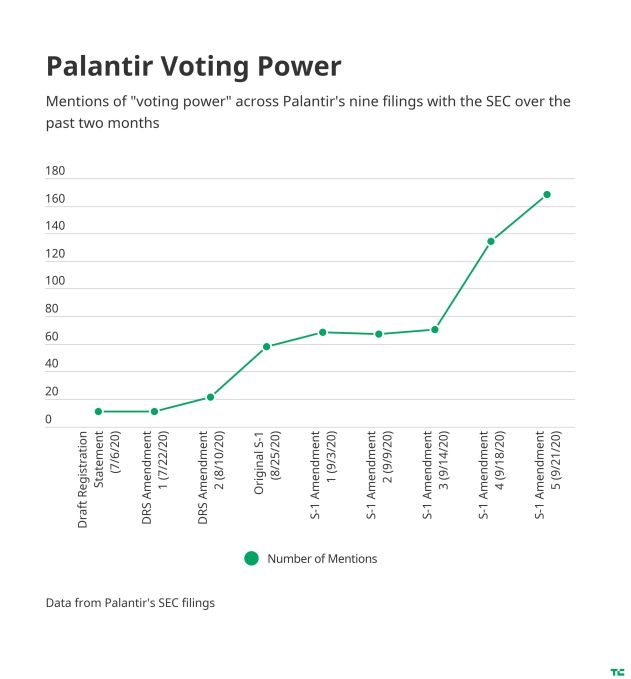
“Voting power” is clearly very important to regulators — the term is now used 168 times in Palantir’s latest amended S-1 filing, up from just 58 in its original filing just a few weeks ago. In fact, take a look at this amazing chart on just how much Palantir has had to explain voting power to regulators over the past few weeks in filing after filing:

Indeed, just to prove how much voting power retail investors are giving up, the company published another column to its infamous founder-ownership table that I discussed at length on Friday. As part of the three-class voting share structure Palantir is using, its founders will retain outsized voting control of the company through what are known as Class F or founders shares, so long as they meet a minimal ownership threshold.

How unbalanced can that voting be? In the most extreme scenario according to Palantir’s newly updated table, its founders could control 68.099999% of the company’s vote while owning just 0.5% of the company’s shares.

In addition, the company has also added a new risk factor reminding owners of the company’s stock that Palantir can issue new stock at any time, and those newly issued shares will dilute retail investors even further in their voting rights relative to founders, who are offered a variable number of votes to ensure they maintain control of the company.

It gets worse though. Palantir has been promulgating this arcane mechanism over the last few amendments to the SEC that would allow its three founders — Alex Karp, Stephen Cohen and Peter Thiel — to designate certain shares to be held outside of their “founder shares” and therefore increase their overall voting power. In its last amendment, the only founder to designate shares in this way was Peter Thiel, who designated a huge bulk of his shares (13.4% of Palantir) as excluded from the founders share calculation.

Now in its latest update, Palantir says that founders will be able to increase their votes essentially willy-nilly by designating any or all of their shares as “Stockholder Party Excluded Shares,” which will be voted separately from their founder shares. And the right to do this will last from the company’s public debut all the way to “in the future.” In short, Palantir’s founders will hold 49.999999% control through their founder shares, plus the votes of any excluded shares, to be determined at any time. As of today, no shares have been designated as excluded, according to the filing.

That leads to one of my new favorite admissions in this whole governance saga: Palantir won’t be able to tell anyone what their actual voting power is, even when they are just about to vote. From its newly amended filing:

In addition, it may be very difficult for our Class A common stockholders to determine from time to time, including in advance of a meeting of stockholders, their individual or aggregate voting power due to the unique features of our multi-class capital structure, such as the variable number of votes per share of our Class F common stock and the ability of our Founders who are then party to the Founder Voting Agreement to unilaterally adjust their total voting power, for example, by designating shares as Stockholder Party Excluded Shares, as described in more detail herein.

The complexity of Palantir’s three-class voting system means that no one basically knows what the hell is going on. “Unilaterally adjust their total voting power” is not a democracy, indeed.

There’s good news though! Palantir might actually add — I kid you not — another class of voting shares just to make all of this even more complicated!

In another new disclosure this morning, the company writes that “In addition, in the future we could create a new class of equity securities with different economic or voting rights than existing classes,” and explains how that could upend the voting for the company further.

I joked last week that “For a company vaunted for its clandestine government work and strong engineering culture, you can’t help but wonder if the government’s bureaucratic norms and paperwork pushing are starting to flood into the Shire.” Well, the complexity is only getting worse and worse, and it doesn’t look good.

Tech companies, even those publicly traded, aren’t democracies. The two-class voting system most tech companies offer their founders and early investors are not democratic — some people get one vote per share while others get 10 votes per share. But it has become a norm whether we like it or not, and it’s directionally helped tech companies avoid the sort of hostile investor scenarios that have plagued other companies in the market.

Now, Palantir is stretching these notions to the extreme, trying to present as a shareholder-centered corporation when it is — let’s just admit it — an oligarchy of three.

It’s a bit like reading the People’s Republic of China constitution and finding this section in Chapter 2: “All citizens of the People’s Republic of China are equal before the law. The State respects and preserves human rights. … Citizens of the People’s Republic of China enjoy freedom of speech, of the press, of assembly, of association, of procession and of demonstration.” And you are like, what?

Words don’t mean anything when the votes and the system aren’t there.

Facebook’s new Rights Manager tool lets creators protect their photos, including those embedded elsewhere

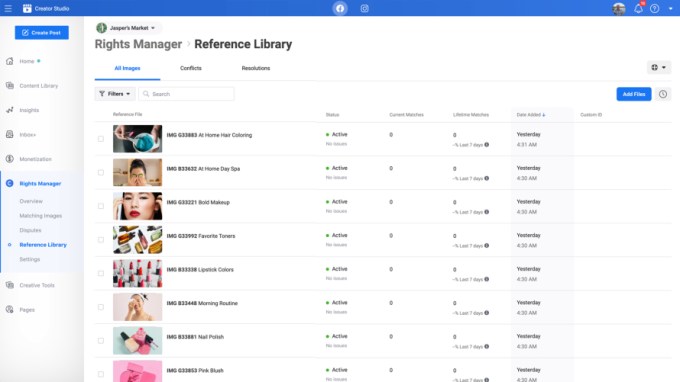
Facebook today is introducing a new tool that will allow rights holders to protect and manage their photos across both Facebook and Instagram. With the newly launched “Rights Manager for Images,” Facebook is offering creators and publishers access to content-matching technology similar to what it introduced in 2016 to combat stolen videos. The new feature, which is available in Facebook’s Creator Studio, will allow rights owners to assert control over their intellectual property across Facebook and Instagram, including when the image is embedded on an external website.

As with Facebook’s existing Rights Manager for video content, creators who want to assert their control over their images will have to provide Facebook with a copy of the images they want to protect, as well as a CSV file with image metadata, as a first step. These are uploaded to a reference library that Rights Manager uses to locate matches across both Facebook and Instagram.

The creator doesn’t have to publicly post their images on Facebook or Instagram for this process to work.

When matching content is found on a Page or a profile, the rights holder can choose whether to simply monitor the content, block its use through a takedown request or attribute credit to themselves via an ownership link. Creators can also choose whether or not they want their ownership to apply worldwide or only in certain geographic locations.

Image Credits: Facebook

The new feature is designed more for those who maintain a large catalog of images or who post new content on a regular basis. For individuals who only occasionally encounter issues around misuse of their images, Facebook offers an IP reporting form instead, which even allows users to report more than one piece of matching content at a time.

The topic of who has the rights to use a photo that’s been posted on Facebook, and in particular, the image-heavy site Instagram, has become more controversial in recent months.

Many had long believed that embedding an Instagram post on their own website was a perfectly legal use case. But when Newsweek asked to feature a photographer’s image and they declined, the publication ran it as an embed, which then opened them up to a copyright lawsuit, filed this summer.

Newsweek had assumed the embed was legally permissible, given that Mashable recently won a similar copyright case in the recent past. But following the Newsweek case, Instagram clarified that its embedding feature didn’t include a license — if someone wanted to use the photo, they would need to ensure they had the proper license to do so. That bit of information came as something of a surprise and the case with Mashable was reopened as a result.

Until now, photographers had limited means of protecting their content across Facebook’s platforms. They could only take actions like enabling or disabling embedding entirely or making their account private, for example, to ensure their content wasn’t used and distributed without their permission. Of course, neither solution was ideal for a photographer trying to gain exposure and grow their career.

The Rights Manager for Images will now allow them a third option, as it’s capable of finding and matching images that have been used as embeds. At that point, the creator could choose to monitor, block or allow the image as they choose, a Facebook spokesperson told TechCrunch.

Facebook says access to the new Rights Manager for Images will be opened up initially to those who apply here.

Unity Software has strong opening, gaining 31% after pricing above its raised range

Whoever said you can’t make money playing video games clearly hasn’t taken a look at Unity Software’s stock price.

On its first official day of trading, the company rose more than 31%, opening at $75 per share before closing the day at $68.35. Unity’s share price gains came after last night’s pricing of the company’s stock at $52 per share, well above the range of $44 to $48 which was itself an upward revision of the company’s initial target.

Games like “Pokémon GO” and “Iron Man VR” rely on the company’s software, as do untold numbers of other mobile gaming applications that use the company’s toolkit for support. The company’s customers range from small gaming publishers to large gaming giants like Electronic Arts, Niantic, Ubisoft and Tencent.

Unity’s IPO comes on the heels of other well-received debuts, including Sumo Logic, Snowflake and JFrog .

TechCrunch caught up with Unity’s CFO, Kim Jabal, after-hours today to dig in a bit on the transaction.

According to Jabal, hosting her company’s roadshow over Zoom had some advantages, as her team didn’t have to focus on tackling a single geography per day, allowing Unity to “optimize” its time based on who the company wanted to meet, instead, of say, whomever was free in Boston or Chicago on a particular Tuesday morning.

Jabal’s comments aren’t the first that TechCrunch has heard regarding roadshows going well in a digital format instead of as an in-person presentation. If the old-school roadshow survives, we’ll be surprised, though private jet companies will miss the business.

Talking about the transaction itself, Jabal stressed the connection between her company’s employees, value  and their access to that same value. Unity’s IPO was unique in that existing and former employees were able to trade 15% of their vested holdings in the company on day one, excluding “current executive officers and directors,” per SEC filings.

That act does not seemed to have dampened enthusiasm for the company’s shares, and could have helped boost early float, allowing for the two sides of the supply and demand curves to more quickly meet close to the company’s real value, instead of a scarcity-driven, more artificial figure.

Regarding Unity’s IPO pricing, Jabal discussed what she called a “very data-driven process.” The result of that process was an IPO price that came in above its raised range, and still rose during its first day’s trading, but less than 50%. That’s about as good an outcome as you can hope for in an IPO.

One final thing for the SaaS nerds out there. Unity’s “dollar-based net expansion rate” went from very good to outstanding in 2020, or in the words of the S-1/A:

Our dollar-based net expansion rate, which measures expansion in existing customers’ revenue over a trailing 12-month period, grew from 124% as of December 31, 2018 to 133% as of December 31, 2019, and from 129% as of June 30, 2019 to 142% as of June 30, 2020, demonstrating the power of this strategy.

We had to ask. And the answer, per Jabal, was a combination of the company’s platform strength and how customers tend to use more of Unity’s services over time, which she described as growing with their customers. And the second key element was 2020’s unique dynamics that gave Unity a “tailwind” thanks to “increased usage, particularly in gaming.”

Looking at our own gaming levels in 2020 compared to 2019, that checks out.

This post closes the book on this week’s IPO class. Tired yet? Don’t be. Palantir is up next, and then Asana .

Conan O’Brien on how to embrace an ever-changing media landscape

“Like most of the best things in my life,” Conan O’Brien explains, with a wry smile, “the success of the podcast was a complete surprise.” The answer is a typically self-effacing one from the comedian. Since launching “Conan O’Brien Needs a Friend” nearly two years ago, the show has quickly risen up the podcasting charts to become one of the country’s most popular.

For those who have followed his 30-odd-year career in entertainment, it’s easy to see why. Quick-witted and almost superhumanly affable, the transition to podcasting seems almost a given in retrospect. After all, hosting a series of late-night network talk shows for decades isn’t exactly starting from scratch when it comes to launching a new entertainment venture. Nor, for that matter, is having tens of millions of Twitter followers and your own online media company, Team Coco.

Not that things have always been easy. A long-promised Tonight Show slot wasn’t all he’d hoped for, leading to a very public exit from the most-coveted show in late night after just under eight months. It was the shortest tenure in the series’ history, culminating in a televised “exit interview” with Steve Carrell that found The Office star shredding his NBC badge. But O’Brien’s late-night hiatus was short-lived. Later that year, he returned with TBS’ Conan, which will celebrate its 10th year on the air in November (and is renewed at least through 2022).

The 2018 launch of “Conan O’Brien Needs a Friend” found the comedian embracing the new-found freedom of podcasting.

“There are a couple of things about doing podcasts that are superior or more fun than doing a talk show,” a quarantine-haired O’Brien said in an interview at TechCrunch Disrupt this week. “When I’m doing the traditional talk show, I’m limited. For years and years and years, when it was on network television, I had to take six- and seven-minute turns, which mean I’m having a conversation with you or I’m having a conversation with someone I’ve always dreamed of talking to, whether it’s Tom Hanks or Jim Carrey or Robin Williams. Then after six or seven minutes, there has to be a laugh and we’ll take a break and we’ll be right back.

“That’s not a natural conversational flow,” he continues. “What you can do with a podcast is really incredible. I can talk to someone for an hour and 15 minutes. We try and trim them back, but for the most part, people let their guard down. The other thing I prefer: no hair and makeup. It sounds like I’m kidding. But after almost 30 years of people caking my very white face with makeup so that I look like I’m still alive.”

Team Coco has produced 10 shows in all, including shows from longtime sidekick Andy Richter and actor Rob Lowe, writers Mike Sweeney and Jessie Gaskel’s intimately titled Inside Conan and a six-part mini-series interview with SNL alum, Dana Carvey.

“I don’t want to set a number goal,” O’Brien says. “I’m amazed — in two years, we’ve rolled out 10 different podcasts, some of them unscripted, but some scripted ones, as well. I’m not sitting around saying, ‘hey, we’ve got to get to 35 podcasts by this point.’ Because I’d like them to be good.”

As my hair grows, so do my powers… pic.twitter.com/BqVGj4s8VI

— Conan O'Brien (@ConanOBrien) September 17, 2020

The talk show has soldiered on, as well, undergoing its own transformations in the process.

In 2019, the program was retooled for a half-hour format. O’Brien dropped the desk and the suit, adopting a looser format perhaps inspired in part by the new freedoms afforded by his podcasting ventures. When COVID-19 made the in-person show an impossibility, he started working from home like so many others, switching to remote Zoom interviews. Throughout it all, “Conan O’Brien Needs a Friend” continued posting weekly interviews.

Asked whether he planned to continue his late-night show after the contract runs out in a couple of years, O’Brien seemed unsure.

“I think it’s a mistake to think of it as, will you stop doing the show, and only do the podcast? Or will you retire and then quietly work on your letters in a shack? I love to create things. I have a lot of energy. I love to try and make people laugh. And so I see All of this converging, I think the message that I would have for everybody watching TechCrunch Disrupt right now is that people need to open up their minds a little bit. If I’m making podcasts, it doesn’t prohibit me from also maybe do maybe doing something, it doesn’t have to necessarily be for Turner, it could be for anybody.”

Image Credits: Bryce Durbin

Multiple decades of success, it seems, have put O’Brien in the relatively unique position of being able to be somewhat platform-agnostic. Not being tied to a single medium is a strong place to be when it comes to bracing oneself for the unexpected technological changes that will continue to disrupt and upend the entertainment industry.

“Five years from now our entertainment may come in pill form,” he says. “You could binge The Sopranos. You could just take a whole bottle of Sopranos and then just drink a lot of water and then, you know, just don’t need any red meat.

“This is gonna sound far-fetched, but I think this is the most excited I’ve been in my career, because there were so many ways to be creative. There are so many ways to make people laugh, and I enjoy these new opportunities. I think when you’re someone who has been around as long as I have, you have a choice. You can be afraid of change, or you can be delighted by it.”

Chamath launches SPAC, SPAC and SPAC as he SPACs the world with SPACs

SPACs are going to rule the world, or at least, Chamath’s future portfolio.

Chamath Palihapitiya, the founder of Social Capital, has already tripled down on SPACs, the so-called “blank check” vehicle that takes private companies and flips them onto the public markets. His first SPAC bought Virgin Galactic last year, and his second SPAC bought Opendoor this week in a blockbuster deal valuing the instant home sale platform at $4.8 billion, less cash. His third SPAC officially fundraised in April, and has yet to announce a deal.

Now, it looks like he’s going to double down on his triple down. After the bell rung on Wall Street this Friday, the venture capitalist filed three new SPAC vehicles with the SEC. Social Capital Hedosophia Holdings Corp. IV has a headline value of $350 million, Social Capital Hedosophia Holdings Corp. V has a headline value of $650 million and Social Capital Hedosophia Holdings Corp. VI has a headline value of $1 billion.

Those headline values are targets: each SPAC will need to go through an investor roadshow process and officially raise capital before they can begin trying to find an acquisition target. Each SPAC is independent, and may share investors or have entirely independent investors around the table.

The three new SPACs share similar managers: Palihapitiya himself; Ian Osborne, who manages Hedosophia; Steven Trieu, the CFO of Social Capital; and Simon Williams, the chief administration officer of Hedosophia.

However, each has a different fifth director, who perhaps sheds some light on how each SPAC differs in strategy. Nirav Tolia, a co-founder and CEO of popular social network Nextdoor, is joining the fourth SPAC. Jay Parikh, a former head of engineering at Facebook, who left earlier this year, is joining the fifth SPAC. And finally, Dick Costolo, the former CEO of Twitter and current venture capitalist, is joining the sixth SPAC.

We’ve been talking about the accelerating pace of SPACs this year, and that appears in microcosm here around these Social Capital vehicles. It seems as though Palihapitiya and Hedosophia not only have great ambitions for these vehicles, but are increasingly mechanizing the process of fundraising them and taking advantage of markets that seem excited for any avenue toward growth.

Daily Crunch: Partial US TikTok ban is imminent

The Trump administration moves forwards with plans to ban TikTok and WeChat (although TikTok gets a partial extension), Unity goes public and we announce the winner of this year’s Startup Battlefield. This is your Daily Crunch for September 18, 2020.

The big story: US TikTok ban is imminent

The U.S. Commerce Department has released details about how it will be implementing the Trump administration’s domestic ban of TikTok and WeChat. Both apps will no longer be available (and will not be able to distribute updates) in U.S. app stores starting this Sunday, September 20.

At the same time, TikTok will be able to continue operations in the country until November 12, leaving the door open for a deal with Oracle or another partner.

TikTok, WeChat and their users aren’t the only ones unhappy about this decision. Instagram CEO Adam Mosseri said a TikTok ban would be “bad for US tech companies which have benefited greatly from the ability to operate across borders,” while the ACLU said the order “violates the First Amendment rights of people in the United States.”

The tech giants

Salesforce announces 12,000 new jobs in the next year just weeks after laying off 1,000 — Salesforce CEO and co-founder Marc Benioff announced in a tweet that the company would be hiring 4,000 new employees in the next six months, and 12,000 in the next year.

It’s game on as Unity begins trading — Unity Software, which sells a game development toolkit primarily for mobile phone app developers, raised $1.3 billion in its initial public offering.

Apple will launch its online store in India on September 23 — Apple currently relies on third-party online and offline retailers to sell its products in India.

Startups, funding and venture capital

And the winner of Startup Battlefield at Disrupt 2020 is … Canix — After five days of fierce pitching in a wholly new virtual Startup Battlefield arena, we have a winner.

Amid layoffs and allegations of fraud, the FBI has arrested NS8’s CEO following its $100+ million summer financing — Adam Rogas, the co-founder and former executive at the Las Vegas-based fraud prevention company NS8 was arrested by the Federal Bureau of Investigation.

Outschool, newly profitable, raises a $45 million Series B for virtual small group classes — Outschool’s services, which range from engineering lessons through Lego challenges to Spanish teaching by Taylor Swift songs, are now high in demand.

Advice and analysis from Extra Crunch

Are high churn rates depressing earnings for app developers? — RevenueCat’s Jacob Eiting writes that for all the hype around Apple’s 85/15 split for subscription revenue, very few developers are going to see a meaningful increase.

The stages of traditional fundraising — What you think when you hear “seed funding” and “A rounds” might be different from what investors think.

3 VCs discuss the state of SaaS investing in 2020 — Commentary from Canaan’s Maha Ibrahim, Andreessen Horowitz’s David Ulevitch and Bessemer’s Mary D’Onofrio.

(Reminder: Extra Crunch is our subscription membership program, which aims to democratize information about startups. You can sign up here.)

Everything else

How the NSA is disrupting foreign hackers targeting COVID-19 vaccine research — “The threat landscape has changed,” the NSA’s director of cybersecurity Anne Neuberger said at Disrupt 2020.

NASA to test precision automated landing system designed for the moon and Mars on upcoming Blue Origin mission — The “Safe and Precise Landing – Integrated Capabilities Evolution” (SPLICE) system is made up of a number of lasers, an optical camera and a computer.

The Daily Crunch is TechCrunch’s roundup of our biggest and most important stories. If you’d like to get this delivered to your inbox every day at around 3pm Pacific, you can subscribe here.

SaaS Ventures takes the investment road less traveled

Most venture capital firms are based in hubs like Silicon Valley, New York City and Boston. These firms nurture those ecosystems and they’ve done well, but SaaS Ventures decided to go a different route: it went to cities like Chicago, Green Bay, Wisconsin and Lincoln, Nebraska.

The firm looks for enterprise-focused entrepreneurs who are trying to solve a different set of problems than you might find in these other centers of capital, issues that require digital solutions but might fall outside a typical computer science graduate’s experience.

Saas Ventures looks at four main investment areas: trucking and logistics, manufacturing, e-commerce enablement for industries that have not typically gone online and cybersecurity, the latter being the most mainstream of the areas SaaS Ventures covers.

The company’s first fund, which launched in 2017, was worth $20 million, but SaaS Ventures launched a second fund of equal amount earlier this month. It tends to stick to small-dollar-amount investments, while partnering with larger firms when it contributes funds to a deal.

We talked to Collin Gutman, founder and managing partner at SaaS Ventures, to learn about his investment philosophy, and why he decided to take the road less traveled for his investment thesis.

A different investment approach

Gutman’s journey to find enterprise startups in out of the way places began in 2012 when he worked at an early enterprise startup accelerator called Acceleprise. “We were really the first ones who said enterprise tech companies are wired differently, and need a different set of early-stage resources,” Gutman told TechCrunch.

Through that experience, he decided to launch SaaS Ventures in 2017, with several key ideas underpinning the firm’s investment thesis: after his experience at Acceleprise, he decided to concentrate on the enterprise from a slightly different angle than most early-stage VC establishments.

Collin Gutman from SaaS Ventures

Collin Gutman, founder and managing partner at SaaS Ventures (Image Credits: SaaS Ventures)

The second part of his thesis was to concentrate on secondary markets, which meant looking beyond the popular startup ecosystem centers and investing in areas that didn’t typically get much attention. To date, SaaS Ventures has made investments in 23 states and Toronto, seeking startups that others might have overlooked.

“We have really phenomenal coverage in terms of not just geography, but in terms of what’s happening with the underlying businesses, as well as their customers,” Gutman said. He believes that broad second-tier market data gives his firm an upper hand when selecting startups to invest in. More on that later.

Gaming companies are reportedly the next targets in the US government’s potentially broader Tencent purge

Some of the biggest names in online gaming in the United States have received letters from the U.S. government requesting information about their relationship with the multibillion-dollar Chinese technology company, Tencent, according to reports.

Even as the U.S. Department of Commerce moves to block new downloads of the Chinese company’s popular messaging and payment app, WeChat, it has sent out letters to U.S. gaming companies like Epic Games, Riot Games, and others about their data-security protocols and their relationship to Tencent, according to a report in Bloomberg.

Citing people familiar with the matter, Bloomberg reports that the Committee on Foreign Investment in the U.S., which is chaired by the Treasury Department, is looking for information about how these companies handle the personal data of their U.S. customers.

Tencent is the world’s largest gaming company, with stakes in multiple U.S. gaming companies, including the Los Angeles-based Riot Games and a 40 percent stake in Epic Games, the maker of Fortnite, which is one of the most popular multiplayer online games in the U.S.

The requests could presage a push by the United States to force Tencent to sell off its gaming interests in America and would follow similar steps taken to crack down on the Chinese-owned social media network, TikTok.

The tumultuous TikTok saga has centered on the ways in which the wildly popular social media company handles user data and how that data could be misused by TikTok’s Chinese parent company, Bytedance. And the announcement earlier today from Commerce Secretary Wilbur Ross uses language that could be applied to Tencent’s gaming holdings just as easily as TikTok’s social media service.

“Today’s actions prove once again that President Trump will do everything in his power to guarantee our national security and protect Americans from the threats of the Chinese Communist Party,” said Ross in a statement. “At the President’s direction, we have taken significant action to combat China’s malicious collection of American citizens’ personal data, while promoting our national values, democratic rules-based norms, and aggressive enforcement of U.S. laws and regulations.”

Technology companies account for an increasing share of global economic output, and social media companies like Facebook have been denied access to the Chinese market. Some have speculated that the forced sale of TikTok’s U.S. assets could be an attempt to impose the same restrictions on Chinese companies that U.S. companies experience in China’s domestic market.

Security concerns have been at the heart of U.S. trade restrictions against other Chinese technology companies — like the networking and communications technology developer Huawei.

Extending the same argument to gaming may open another front in the ongoing trade war that’s been waged between the U.S. and China for the duration of the Trump presidency. But it would be yet another unprecedented step to wall off what historically has been unfettered commercial access to U.S. markets by foreign competitors in most of the tech arena (excluding things like weapons systems).

Tencent has over 300 investments in its portfolio, including Riot Games which it acquired outright in 2015 after buying a 93% stake in the business back in 2011. The Chinese company also owns a huge stake in Epic Games, the $17 billion game technology developer that created the runaway multiplayer smash hit, Fortnite, and Activision/Blizzard, which produces the Call of Duty franchise (among others).

Any movement by the Trump Administration to further restrict the economic activity of foreign companies operating in the U.S. could have unintended consequences for the nation’s technology industry, as well.

Even the top executives at some of the companies that would ostensibly benefit from TikTok’s disappearance from the competitive social media landscape have decried the approach taken by the US government.

Earlier today, Instagram CEO Adam Mosseri took to Twitter to decry the announcement. The ACLU also wasted no time in criticizing the announcement. Hina Shamsi, the director of the agency’s National Security Project, said in a statement: “This order violates the First Amendment rights of people in the United States by restricting their ability to communicate and conduct important transactions on the two social media platforms.”

Check out this never-before-seen clip from HBO’s The Perfect Weapon

At Disrupt 2020, we got a chance to see some never-before-seen footage from HBO’s upcoming documentary The Perfect Weapon.

The documentary, which was executive produced by John Maggio, is based on the book by the same(ish) name written by David Sanger, Washington correspondent for the New York Times.

We got to sit down for an interview with Sanger where we discussed the cybersecurity threats the United States faces, the definition of an appropriate response, and in general, whether or not we should be worried.

You can check out the full interview below, as well as a never-before-seen clip from the upcoming documentary.

The conversation was an excellent lead-in to Zack Whittaker’s interview with the NSA’s Cybersecurity Chief Anne Neuberger, which you can check out here.

Salesforce announces 12,000 new jobs in the next year just weeks after laying off 1,000

In a case of bizarre timing, Salesforce announced it was laying off 1,000 employees at the end of last month just a day after announcing a monster quarter with over $5 billion in revenue, putting the company on a $20 billion revenue run rate for the first time. The juxtaposition was hard to miss.

Earlier today, Salesforce CEO and co-founder Marc Benioff announced in a tweet that the company would be hiring 4,000 new employees in the next six months, and 12,000 in the next year. While it seems like a mixed message, it’s probably more about reallocating resources to areas where they are needed more.

Salesforce will add 4K jobs over the next 6 mos & 12K over the next year. Join our 54K employee strong Ohana defining the future of software. Salesforce is the worlds fastest growing Top 5 enterprise software company. [email protected] @salesforcejobs https://t.co/ffzlmeHhCz

Marc Benioff (@Benioff) September 18, 2020

While Salesforce wouldn’t comment further on the hirings, the company has obviously been doing well in spite of the pandemic, which has had an impact on customers. In the prior quarter, the company forecasted that it would have slower revenue growth due to giving some customers facing hard times with economic downturn time to pay their bills.

That’s why it was surprising when the CRM giant announced its earnings in August and that it had done so well in spite of all that. While the company was laying off those 1,000 people, it did indicate it would give those employees 60 days to find other positions in the company. With these new jobs, assuming they are positions the laid-off employees are qualified for, they could have a variety of positions from which to choose.

The company had 54,000 employees when it announced the layoffs, which accounted for 1.9% of the workforce. If it ends up adding the 12,000 news jobs in the next year, that would put the company at approximately 65,000 employees by this time next year.

And the winner of Startup Battlefield at Disrupt 2020 is… Canix

We started this competition with 20 impressive startups. After five days of fierce pitching in a wholly new virtual Startup Battlefield arena, we have a winner.

The startups taking part in the Startup Battlefield have all been hand-picked to participate in our highly competitive startup competition. It was an unprecedented year as we moved all of the nail-biting excitement of our physical contest to a virtual stage. They all presented in front of multiple groups of VCs and tech leaders serving as judges for a chance to win $100,000 and the coveted Disrupt Cup.

After hours of deliberations, TechCrunch editors pored over the judges’ notes and narrowed the list down to five finalists: Canix, Firehawk AerospaceHacWare, Jefa and Matidor.

These startups made their way to the finale to demo in front of our final panel of judges, which included: Caryn Marooney (Coatue Management), Ilya Fushman (Kleiner Perkins), Michael Seibel (Y Combinator), Sonali De Rycker (Accel), Troy Carter (Q&A) and Matthew Panzarino (TechCrunch).

We’re now ready to announce that the winner of TechCrunch Battlefield 2020 is…

Winner: Canix

Canix has built a robust enterprise resource planning platform designed to reduce the time it takes cannabis growers to input data. It integrates nicely with common bookkeeping software, as well as Metrc, an industry-wide regulatory platform. The founders say their platform can help growers increase margins through improved labor costs.

You can read more about Canix here.

Runner-up: Matidor

Matidor is building a project platform for consultants and engineers to keep track of projects and geospatial data in a single dashboard. It offers an all-in-one data visualization suite for customers in the energy and environmental services fields.

You can read more about Matidor here.

Watch the announcement below:

Are high churn rates depressing earnings for app developers?

Jacob Eiting
Contributor

Jacob Eiting is CEO of RevenueCat, a platform for managing cross-platform in-app purchases, products and subscribers and analyzing in-app-purchase data.

Ever since Apple opened up subscription monetization to more apps in 2016 — and enticed developers with an 85/15 split on revenue from customers that remain subscribed for more than a year — subscription monetization and retention has felt like the Holy Grail for app developers. So much so that Google quickly followed suit in what appeared to be an example of healthy competition for developers in the mobile OS duopoly.

But how does that split actually work out for most apps? Turns out, the 85/15 split — which Apple is keen to mention anytime developers complain about the App Store rev share — doesn’t have a meaningful impact for most developers. Because churn.

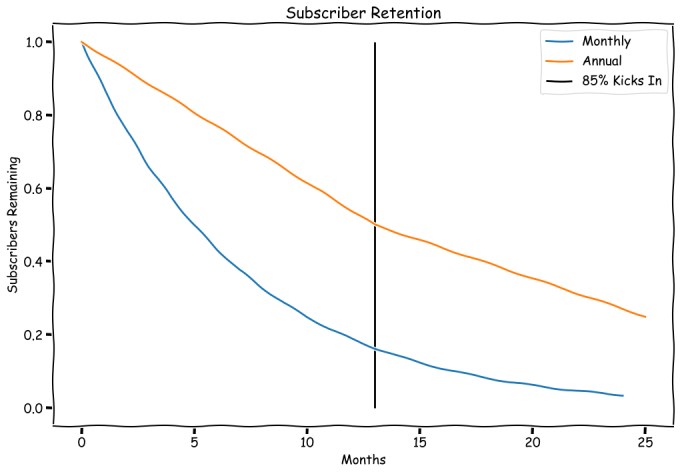
No matter how great an app is, subscribers are going to churn. Sometimes it’s because of a credit card expiring or some other billing issue. And sometimes it’s more of a pause, and the user comes back after a few months. But the majority of churn comes from subscribers who, for whatever reason, decide that the app just isn’t worth paying for anymore. If a subscriber churns before the one-year mark, the developer never sees that 85% split. And even if the user resubscribes, Apple and Google reset the clock if a subscription has lapsed for more than 60 days. Rather convenient… for Apple and Google.

Top mobile apps like Netflix and Spotify report churn rates in the low single digits, but they are the outliers. According to our data, the median churn rate for subscription apps is around 13% for monthly subscriptions and around 50% for annual. Monthly subscription churn is generally a bit higher in the first few months, then it tapers off. But an average churn of 13% leaves just 20% of subscribers crossing that magical 85/15 threshold.

In practice, what this means is that, for all the hype around the 85/15 split, very few developers are going to see a meaningful increase in revenue: