Impossible Foods nabs some Canadian fast food franchises as it expands in North America

After rolling out in some of Canada’s most high-falutin burger bistros, Impossible Foods is hitting Canada’s fast casual market with new menu items at national chains like White Spot and Triple O’s, Cactus Club Cafe and Burger Priest.

While none of those names mean anything to yours truly, they may mean something to our friendly readers to the North. However, I have heard of Qdoba, Wahlburgers and Red Robin. And Canadian customers can also pick up Impossible Foods -based menu items at those chains too.

Since its debut at Momofuku Nishi in New York in 2016, the Impossible Burger is now served in 30,000 restaurants across the U.S. and is available in 11,000 grocery stores across America.

The Silicon Valley manufacturer of meat substitutes expects that Canada, the company’s first market outside of Asia, may become its largest market — second only to the U.S.

Daily Crunch: This TikTok deal is pretty confusing

Companies send out conflicting messages about the TikTok deal, Microsoft acquires a gaming giant and the WeChat ban is temporarily blocked. This is your Daily Crunch for September 21, 2020.

The big story: This TikTok deal is pretty confusing

This keeps getting more confusing. Apparently TikTok’s parent company ByteDance has reached a deal with Walmart and Oracle that will allow the Chinese social media app to continue operating in the United States, and the deal has been approved by Donald Trump. But it’s hard to tell exactly what this agreement entails.

ByteDance said it would retain 80% control of TikTok, while selling 20% of the company to Walmart and Oracle as “commercial partner” and “trusted technology partner,” respectively. However, Oracle released a seemingly conflicting statement, claiming that Americans will have majority ownership and “ByteDance will have no ownership in TikTok Global.”

So what’s going on here? We’re trying to figure it out.

The tech giants

Microsoft set to acquire Bethesda parent ZeniMax for $7.5B — ZeniMax owns some of the biggest publishers in gaming, including Bethesda Game Studios, id Software, ZeniMax Online Studios, Arkane, MachineGames, Tango Gameworks, Alpha Dog and Roundhouse Studios.

Trump administration’s WeChat ban is blocked by US district court — More news about the Trump administration’s efforts to ban some high-profile Chinese apps: A district court judge in San Francisco has temporarily stayed the nationwide ban on WeChat.

Nikola’s chairman steps down, stock crashes following allegations of fraud — This comes in the wake of a report from a noted short-seller accusing the electric truck company of fraud.

Startups, funding and venture capital

With $100M in funding, Playco is already a mobile gaming unicorn — Playco is a new mobile gaming startup created by Game Closure co-founder Michael Carter and Zynga co-founder Justin Waldron.

Indian mobile gaming platform Mobile Premier League raises $90 million — Mobile Premier League operates a pure-play gaming platform that hosts a range of tournaments.

A meeting room of one’s own: Three VCs discuss breaking out of big firms to start their own gigs — We talked to Construct Capital’s Dayna Grayson, Renegade Partners’ Renata Quintini and Plexo Capital’s Lo Toney.

Advice and analysis from Extra Crunch

Edtech investors are panning for gold — At Disrupt, investors told us how they separate the gold from the dust.

Despite slowdowns, pandemic accelerates shifts in hardware manufacturing — China continues to be the dominant global force, but the price of labor and political uncertainty has led many companies to begin looking elsewhere.

The Peloton effect — Alex Wilhelm examines the latest VC activity in connected fitness.

(Reminder: Extra Crunch is our subscription membership program, which aims to democratize information about startups. You can sign up here.)

Everything else

Ireland’s data watchdog slammed for letting adtech carry on ‘biggest breach of all time’ — The Irish Council for Civil Liberties is putting more pressure on the country’s data watchdog to take enforcement action.

Pandemic accelerated cord cutting, making 2020 the worst-ever year for pay TV — According to new research from eMarketer, the cable, satellite and telecom TV industry is on track to lose the most subscribers ever.

Original Content podcast: ‘Wireless’ shows off Quibi’s Turnstyle technology — I interviewed the director of the new Quibi series.

The Daily Crunch is TechCrunch’s roundup of our biggest and most important stories. If you’d like to get this delivered to your inbox every day at around 3pm Pacific, you can subscribe here.

CDC removes updated guidelines around COVID-19 aerosol transmission, but this expert explains why it should reverse the reversal

Last week at TechCrunch Disrupt 2020, I got the chance to speak to Dr. Eric Feigl-Ding, an epidemiologist and health economist who is a Senior Fellow of the Federation of American Scientists. Dr. Feigl-Ding has been a frequent and vocal critic of some of the most profound missteps of regulators, public health organizations and the current White House administration, and we discussed specifically the topic of aerosol transmission and its notable absence from existing guidance in the U.S.

At the time, neither of us knew that the Centers for Disease Control (CDC) would publish updated guidance on its website over this past weekend that provided descriptions of aerosol transmission, and a concession that it’s likely a primary vector for passing on the virus that leads to COVID-19 — or that the CDC would subsequently revert said guidance, removing this updated information about aerosol transmission that’s more in line with the current state of widely accepted COVID research. The CDC cited essentially an issue where someone at the organization pushed a draft version of guidelines to production — but the facts it had shared in the update lined up very closely with what Dr. Feigl-Ding had been calling for.

“The fact that we haven’t highlighted aerosol transmission as much, up until recently, is woefully, woefully frustrating,” he said during our interview last Wednesday. “Other countries who’ve been much more technologically savvy about the engineering aspects of aerosols have been ahead of the curve — like Japan, they assume that this virus is aerosol and airborne. And aerosol means that the droplets are these micro droplets that can float in the air, they don’t get pulled down by gravity […] now we know that the aerosols may actually be the main drivers. And that means that if someone coughs, sings, even breathes, it can stay in the air, the micro droplets can stay in the air anywhere from, for stagnant air for up to16 hours, but normally with ventilation, between 20 minutes to four hours. And that air, if you enter into a room after someone was there, you can still get infected, and that is what makes indoor dining and bars and restaurants so frustrating.”

Dr. Feigl-Ding points to a number of recent contact-tracing studies as providing strong evidence that these indoor activities, and the opportunity they provide for aerosol transmission, are leading to a large number of infections. Such studies were featured in a report the CDC prepared on reopening advice, which was buried by the Trump administration, according to an AP report from May.

“The latest report shows that indoor dining, bars, restaurants are the leading leading factors for transmission, once you do contact tracing,” he said, noting that this leads naturally to the big issues around schools reopening, including that many have “very poor ventilation,” while simultaneously they’re not able to open their windows or doors due to gun safety protocols in place. Even before this recent CDC guideline take-back, Dr. Feigl-Ding was clearly frustrated with the way the organization appears to be succumbing to politicization of what is clearly an issue of a large and growing body of scientific evidence and fact.

“The CDC has long been the most respected agency in the world for public health, but now it’s been politically muzzled,” he said. “Previously, for example, the guidelines around church attendance — the CDC advised against church gatherings, but then it was overruled. And it was clearly overruled, because we actually saw it changed in live time. […] In terms of schools, gatherings, it’s clear [that] keeping kids in a pod is not enough, given what we know about ventilation.”

Following TechCrunch reporting, Palantir rapidly removes language allowing founders to ‘unilaterally adjust their total voting power’

Well, that was fast.

This morning, I analyzed Palantir’s newly published fifth amendment of its S-1 filing with the SEC as it pursues a public direct listing on the NYSE. I called the company “not a democracy” after it added new provisions to create a special mechanism called “Stockholder Party Excluded Shares” that would, in the language of Palantir, allow the company’s trio of founders to “unilaterally adjust their total voting power” at will, now and into the future.

Well, Palantir has now filed a sixth amendment with the SEC just a few hours after it filed its previous amendment, and the company has removed all references to this special mechanism from its SEC filing.

The 19 mentions of “Stockholder Party Excluded Shares” and multiple sections where the mechanism were discussed and explained have now been entirely excised. In addition, the company’s line about its founders having the capability to “unilaterally adjust their total voting power” has also been similarly removed.

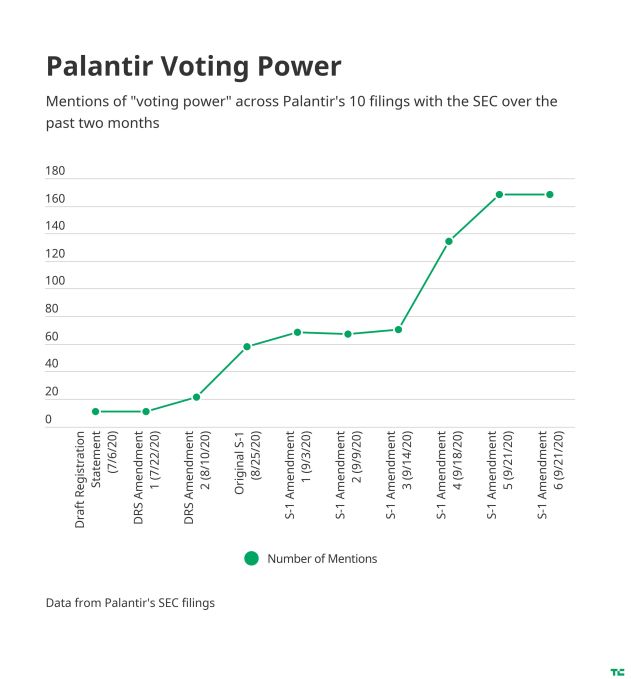
Outside of those changes, the two different versions of the company’s S-1 filing are essentially identical. And for those keeping score from this morning, in this tenth rendition of the company’s public offering documents including its previous draft registration statements, the latest filing includes 168 mentions of “voting power” — identical to the number this morning. Here’s an updated chart:

It’s a quick about-face for the enterprise software company, which has spent weeks prepping for its direct listing, originally scheduled for September 23 and which has since been moved back to September 29. While corporate governance has certainly gotten weaker over the past few years, Palantir’s newly introduced language this morning stretched the definition of shareholder governance quite frankly to its breaking point. Walking back those changes was the right call.

There’s no telling whether the SEC, NYSE, potential investors in the direct listing, executives or insiders pushed for these changes. However, companies rarely make such rapid changes with their SEC filings (then again, I’ve never seen an IPO with so many amendments in the first place, so we are in uncharted territory). Palantir remains in an SEC-mandated quiet period.

We’ll continue to monitor developments as Palantir heads to the public markets, presumably next week.

Edtech investors are panning for gold

The spotlight on edtech grows brighter and harsher: On one end, remote-learning startups are attracting millions in venture capital. On the other, many educators and parents are unimpressed with the technology that enables virtual learning and gaps remain in and out of the classroom.

It’s clear that edtech’s nebulous pain points — screen time, childcare and classroom management — require innovation. But as founders flurry to a sector recently rejuvenated with capital, the influx of interest has not fostered any breakout solutions. As a result, edtech investors must hone their skills at sorting the innovators from the opportunists amid the rush.

Lucky for us, investors shared notes during TechCrunch Disrupt and offline regarding how they are separating the gold from the dust, giving us a peek into their due diligence process (and inboxes).

Putting profitability over growth

The pandemic has broadly forced founders to get more conservative and prioritize profitability over the usual “growth at all costs” startup mentality. Growth still matters, but within edtech, the boom comes with a big focus on profitability, efficacy, outcomes and societal impact.

“The goal of all of education is personalized learning, when every student receives exactly the instruction in the way that they need it at the time that they need it. And that’s really, really difficult to do if you’re trying to have one person teach 180 students,” said Mercedes Bent of Lightspeed Venture Partners. “And so I’ve been excited to see more solutions that are focused on creating smaller class sizes that are also focused on allowing students to connect with people outside of their homes as well.”

During Disrupt, Reach Capital’s Jennifer Carolan brought up a recent Netflix documentary, “The Social Dilemma,” which illustrates the impact screen time can have on society. When vetting companies, Carolan said she wanted to see founders who have considered how their products may impact young users.

Twitter and Zoom’s algorithmic bias issues

Both Zoom and Twitter found themselves under fire this weekend for their respective issues with algorithmic bias. On Zoom, it’s an issue with the video conferencing service’s virtual backgrounds and on Twitter, it’s an issue with the site’s photo cropping tool.

It started when Ph.D. student Colin Madland tweeted about a Black faculty member’s issues with Zoom. According to Madland, whenever said faculty member would use a virtual background, Zoom would remove his head.

“We have reached out directly to the user to investigate this issue,” a Zoom spokesperson told TechCrunch. “We’re committed to providing a platform that is inclusive for all.”

pic.twitter.com/1VlHDPGVtS

— Colin Madland (@colinmadland) September 19, 2020


When discussing that issue on Twitter, however, the problems with algorithmic bias compounded when Twitter’s mobile app defaulted to only showing the image of Madland, the white guy, in preview.

“Our team did test for bias before shipping the model and did not find evidence of racial or gender bias in our testing,” a Twitter spokesperson said in a statement to TechCrunch. “But it’s clear from these examples that we’ve got more analysis to do. We’ll continue to share what we learn, what actions we take, and will open source our analysis so others can review and replicate.”

Twitter pointed to a tweet from its chief design officer, Dantley Davis, who ran some of his own experiments. Davis posited Madland’s facial hair affected the result, so he removed his facial hair and the Black faculty member appeared in the cropped preview. In a later tweet, Davis said he’s “as irritated about this as everyone else. However, I’m in a position to fix it and I will.”

Twitter also pointed to an independent analysis from Vinay Prabhu, chief scientist at Carnegie Mellon. In his experiment, he sought to see if “the cropping bias is real.”

(Results update)
White-to-Black ratio: 40:52 (92 images)
Code used: https://t.co/qkd9WpTxbK
Final annotation: https://t.co/OviLl80Eye
(I've created @cropping_bias to run the complete the experiment. Waiting for @Twitter to approve Dev credentials) pic.twitter.com/qN0APvUY5f

— Vinay Prabhu (@vinayprabhu) September 20, 2020

In response to the experiment, Twitter CTO Parag Agrawal said addressing the question of whether cropping bias is real is “a very important question.” In short, sometimes Twitter does crop out Black people and sometimes it doesn’t. But the fact that Twitter does it at all, even once, is enough for it to be problematic.

This tweet and thread get to the crux of what happens in work places. Marginalized folks point out traumatizing outcomes, majority group folks dedicate themselves to proving bias does not show up in 50+1% of the occasions as if 49% or 30% or 20% of the time doesn’t cause trauma. https://t.co/7GRgJyAiGH

— Karla Monterroso #BLM #ClosetheCamps (@karlitaliliana) September 20, 2020

It also speaks to the bigger issue of the prevalence of bad algorithms. These same types of algorithms are what leads to biased arrests and imprisonment of Black people. They’re also the same kind of algorithms that Google used to label photos of Black people as gorillas and that Microsoft’s Tay bot used to become a white supremacist.


Hailing a self-driving taxi when blind. Learn how Waymo answers that challenge at Sight Tech Global

Imagine yourself unable to see well enough to drive, and how that would change your life. I witness that scenario every day at home with my wife, who is legally blind, and a very busy person. She reveres Uber and Lyft because they provided her with the still remarkable option to get up and go whenever she wants, wherever she wants.  So imagine her excitement a year ago when she was treated to a brief ride in a self-driving Waymo taxi. The safety driver asked my wife to buckle up and hit the “start” button. Yes, exactly! Where is that start button?

We all had a chuckle because the point of the excursion was to talk about Waymo’s commitment to accessibility in the development of self-driving taxis, which are already in service in Phoenix. Waymo is working closely with the Foundation for Blind Children (FBC) in Phoenix to get feedback on the experience, and also consulting with The Lighthouse for the Blind in San Francisco. We are delighted to announce that Waymo’s work on accessibility will be featured at Sight Tech Global, which is a virtual event (December 2-3) focused on how AI-related technologies will influence assistive technology and accessibility in the years ahead. Attendance is free and registration is open.

Joining the Waymo accessibility session are three key figures helping to guide Waymo’s work. Clement Wright is the Waymo product manager responsible for Waymo’s user experience and accessibility efforts. His focus is on ensuring all Waymo riders, including those with disabilities, can enjoy safe, comfortable and convenient rides in Waymo’s fully driverless service. Marc Ashton is CEO, Foundation for Blind Children, which is a Phoenix-based and nationally recognized leader in the education of blind children. Ashton’s son is blind, which led to his interest in the field and in 2007 to the role of CEO. Bryan Bashin is the CEO of Lighthouse for the Blind in San Francisco, which offers education, training, advocacy and community for blind individuals in California and around the world. Blind since college, Bashin has dedicated much of his career to advocating for equality, access, training and mentorship for individuals who are blind or low vision. 

Waymo’s quest for a highly accessible, self-driving ride is no easy challenge. “Today, ride-hailing and taxi drivers fulfill certain duties outside of strictly driving the car,” says Wright. “They may roll down the window at pickup to speak to a rider and help them find the car. One of our largest challenges as we work to build the Waymo Driver is ensuring that we understand all of the rider’s additional needs without a human driver in the car.”

The Waymo team has worked with adult members of the FBC to get feedback on the mobile app used to summon a Waymo taxi, for example, by using the way-finding mechanism of honking the taxi’s horn through the app. Time and again,” says Wright, “we’ve seen that a feature built to help a specific group of people, the visually impaired for example, is actually very helpful for the rest of our rider base as well. This has led us to a broader focus on inclusive design — looking at specific rider’s needs to understand key challenges, and then building solutions that help everyone.” 

Autonomous vehicles have the potential to help people with disabilities, including the 1.3 million Americans who are legally blind, get where they need to go safely and efficiently.  We will dive into how Waymo accounts for accessibility throughout its product development cycle and explore the critical role that feedback, from both blind and low-vision users, as well as partner organizations who represent those groups, plays in that process. Join us at Sight Tech Global on December 2-3 to join the session.  Get your free pass now.

Sight Tech Global welcomes sponsors. Current sponsors include Verizon Media, Google, Waymo, Mojo Vision and Wells Fargo. The event is organized by volunteers and all proceeds from the event benefit The Vista Center for the Blind and Visually Impaired in Silicon Valley.


How to make the most of iOS 14 widgets and iPhone home screen customization

You’ve probably seen the screenshots going around that show iOS home screens that differ considerably from the stock options that Apple provides. Yes, if you’re an Android user you’re probably laughing at iPhone owners for finally (nearly) catching up to the customization features they’ve had for years, but if you’re an iOS fan, you probably just want to know how to join in. It’s actually relatively easy — provided you’ve got some time to spare, and you don’t mind a few slightly hacky workarounds (don’t worry, no jailbreaking required).

Widgets

The big new addition that’s prompting all the shared screens across social media are home screen widgets, which are supported under iOS 14 for the first time. These can be either first or third-party, and are included with apps you download from the App Store. There are a number of developers who pushed to ensure they were ready at or near the launch of iOS, and Sarah has created a growing list of some of the best for you to check out if you’re not sure where to start.

One of my personal favorite widget apps is Widgetsmith, an app that, as its name suggests, was created pretty much entirely for the purpose of making them. It allows you a range of customization options, has a number of handy, useful functions, including calendar, weather and clock, and comes with different font choices to best suit your style. I’ve always aimed to create a clean, single-tone look with iOS as much as possible, and Widgetsmith is the best I’ve found so far for creating home screen displays that look like they’re borderless (provided your iOS wallpaper is a solid color that matches one of those the app supports).

Widgets are great at providing right on your home screen (where you need it) at-a-glance information that you don’t typically want to dive into an app to retrieve. Some can shortcut to useful features, like the search widget built into Google’s iOS app, but most are made primarily to reduce the amount of time you spend actually inside the apps themselves.

Custom app icons

While Widgets are new, another big component of this customization push is not: the ability to create custom home screen icons for iOS apps. That’s been around ever since Apple introduced its Shortcuts app on iOS a couple of years ago. But many people are discovering the feature for the first time as a result of the increased attention around home screen customization with the introduction of Widgets in iOS 14.

Creating custom icons on iOS isn’t actually doing that, strictly speaking — what you’re in fact doing is creating new Shortcuts that trigger the launch of an app, and using a custom image for that bookmark that then lives on your home screen instead.

This is not an ideal solution, because it means that A) you won’t have any notification badges on your “apps,” and B) the system first directs you to Apple’s Shortcuts app, which opens for a split-second before bumping you into the actual app you selected for the shortcut.

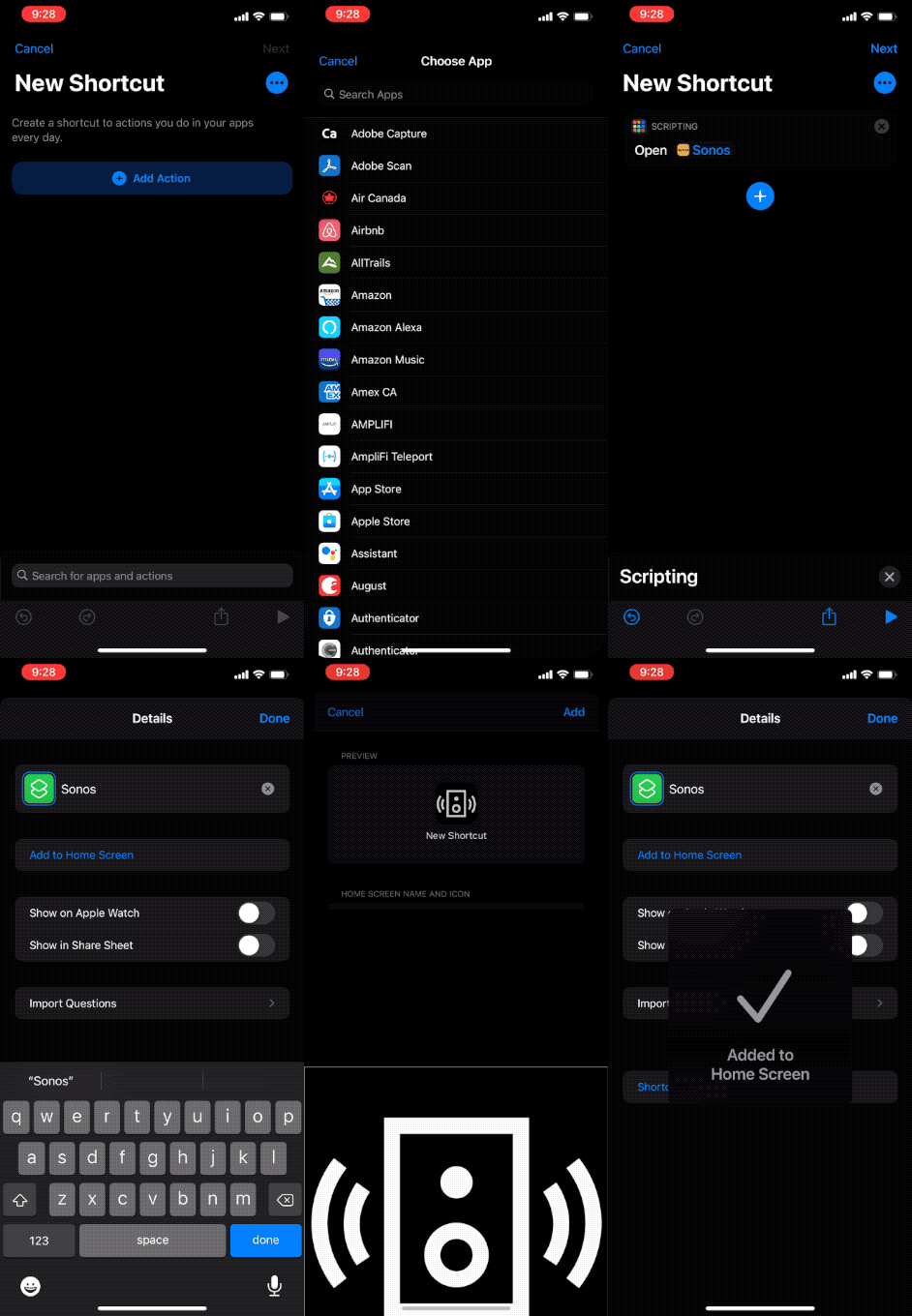
Apple clearly didn’t design this Shortcuts feature for this use (opening a target app is meant to be the start of a string of automated actions), but Apple also hasn’t really ever seemed interested in letting users choose their own custom icons, so it’s the best we can do for now. Luckily, the process is relatively simple. Unluckily, there are a lot of steps involved, so it’s pretty time-consuming to customize your entire home screen.

Here’s a video of how to do this as simply as possible:

Image Credits: Darrell Etherington

There are some fantastic examples out there of what creative individuals have been able to do with this, given a little time and some elbow grease. With more widget options coming online all the time, we’ve probably only begun to see the limits of testing the boundaries of what’s possible under Apple’s rules, too.

Launcher brings its powerful widget-making app to iOS 14

Launcher is bringing its customizable widgets to iOS 14 with new functionality, including the ability to rotate a widget’s icons by date, time or even location. It also supports customizable widget backgrounds, icons of different sizes or those with no labels for a cleaner look.

The app, which first debuted in 2014, had been well-known for being one of the few to push the envelope when it came to the functionality offered by Apple’s classic Today View widgets. In the years since, the app served as the launchpad for common tasks — like messaging a favorite contact, calling home, getting directions, playing your favorite music and much more right from the Today View.

Now you can do the same from your home screen, but with a more customizable experience that matches your current iOS 14 theme.
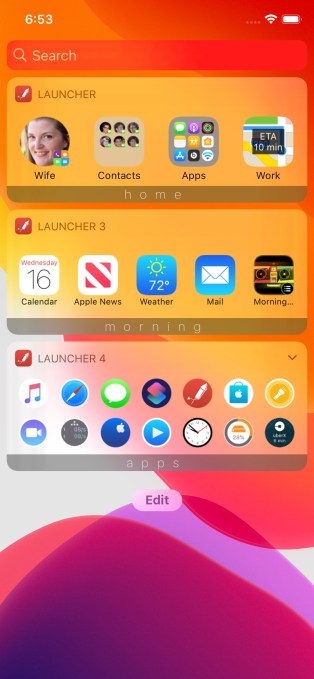
Image Credits: Cromulent Labs

Apple wasn’t quite sure what to think of Launcher back in 2014.

The app had once been banned from the App Store for several months because its sole reason for existence was to be a Today View widget provider, without offering other functionality beyond widget configuration. Apple eventually decided that Launcher had value, despite this limitation, and allowed it back in.

What’s more, Apple later realized there was a market for workflow automation and eventually acquired a Launcher competitor of sorts, Workflow, which was turned into Apple’s Shortcuts app and expanded to include additional functionality — like Siri integration, for instance.

Now, with the release of iOS 14, Apple has fully embraced the idea of customizable widgets for the home screen. Meanwhile, users are leveraging Shortcuts to create custom icons, then building creative home screen themes using a custom combination of widgets, icons and wallpapers.

Launcher, however, offers a simpler alternative for those who don’t want to spend hours creating a customized experience.

Instead, you can create a widget with favorite apps and tasks, change the widget’s background color and adjust the icons’ size in one go.

For example, you can now create Launcher widgets that let you tap an icon to immediately call, message, FaceTime or email a favorite contact; get directions to a location; start playing an artist, album or playlist in Apple Music; access a favorite website; launch actions within apps (like Compose Tweet or Run Shortcut); turn common phone settings on or off (like WiFi, Bluetooth, Low Power Mode, DND, Airplane mode, etc.); or launch any other app on your device.
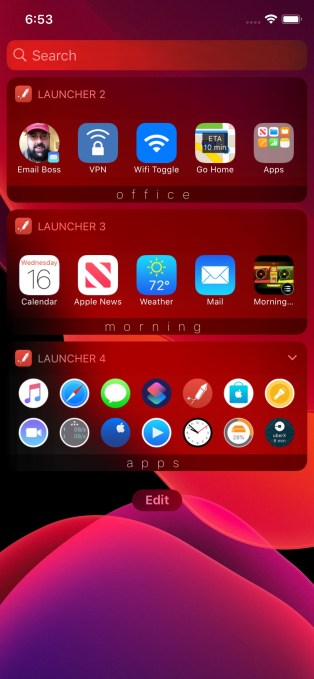
 

Image Credits: Cromulent Labs

Launcher aims to tap into the growing iOS 14 home screen customization trend as its app lets you customize the icons and widget background, even allowing for tiny icons within the widget or removing icon labels. (See above). The widget’s background can be styled to match the existing wallpaper or can be configured using images.

Widgets can also be stacked for better space utilization and the icons they contain can change based on the day of the week, time of day or your location. That way, you could have a widget that shows up only when you hit the gym, for example, or one that appears when you’re in the office. Your home screen widget could also be different during the work week than on the weekend.
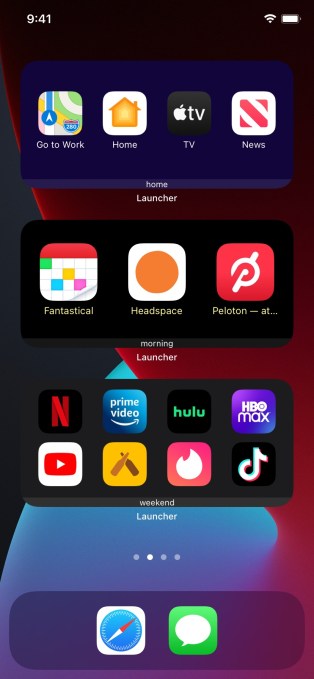
Image Credits: Cromulent Labs

Many of the app’s features were previously offered in the classic Today View widgets, but the home screen widgets work differently. Where before, you were limited to a fixed number of widgets that could be shown or hidden based on time or location, the new widgets support different icon sets that appear at different times. However, you can’t configure a home screen widget to automatically disappear as that would cause the home screen itself to rearrange.

Launcher’s creator, Greg Gardner, says he’s seen a surge of interest in his app due to the iOS 14 release, even before its update, out today, which delivers the iOS 14 widget support.
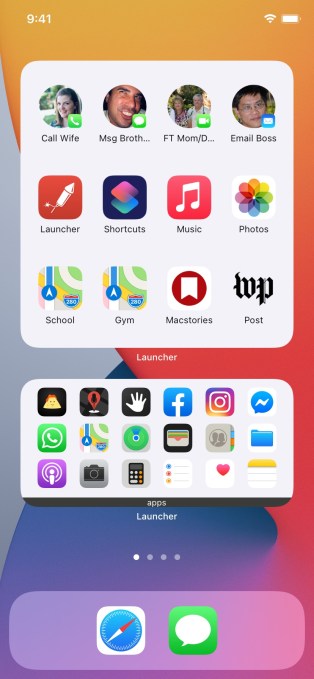
Image Credits: Cromulent Labs

“People on iOS 14 seem to be pretty excited about home screen widgets, so they are searching the App Store for widgets and are finding my app. Unfortunately some of them have been disappointed that the app didn’t have home screen widgets,” he says. “I hope that now that it has home screen widgets the downloads will continue to increase and the new users won’t be disappointed any longer,” Gardner adds.

The surprise release of iOS 14 probably didn’t help things on this front. Apple gave its developers less than 24 hours notice of iOS 14’s arrival this year, even making its announcement before the necessary developer tools (e.g., Xcode) were available for download. That means some developers’ iOS 14-compatible apps weren’t ready and available on the iOS launch day, as in years past.

In addition to the expanded functionality, there’s another reason to appreciate Launcher’s new app: Its business model.

The app doesn’t monetize by way of subscriptions but instead only charges its users a one-time fee for an expanded feature set. While the earlier version of the app had offered two different pricing tiers, Launcher 5 has simplified pricing to just the one.

Its new “Premium” in-app purchase will unlock all the new home screen widgets and customization options. However, existing users only have to pay $2.99 for the upgrade while new users will pay the full price of $7.99.

“The amount of work required to implement the new widgets was enough that I thought it justified a new in-app purchase,” says Gardner. Plus, he notes, the App Store also doesn’t offer any official means of charging upgrade pricing for scenarios like this.

Launcher 5 is rolling out now on the App Store. (If you don’t see the app with an updated date of Sept. 21, 2020, just try again later as the update may not have reached your region yet.)


Despite slowdowns, pandemic accelerates shifts in hardware manufacturing

The COVID-19 pandemic didn’t hit every factory in China at once.

The initial impact to China’s electronics industry arrived around the time the nation was celebrating its new year. Two weeks after announcing 59 known cases of a new form of coronavirus, the national government put Wuhan — a city of 11 million — under strict lockdown.

As with most of the rest of the word, the manufacturing sector was caught somewhat flat-footed. according to Anker founder and CEO Steven Yang .

“Nobody had a great reaction,” said Yang, whose electronics company is based in Shenzhen. “I think this all caught us by surprise. In our China office, everybody was prepared to go on vacation for the Chinese New Year. I think the first reaction was that vacation was prolonged the first week and then another several days.

People were just off work. There wasn’t a determined date for when they could come back to work. That period was the most concerning because we didn’t have an outlook. They had to find certainties. People had to work from home and contact supplies and so forth. That first three to four weeks was the most chaotic.”

Numbers from early 2020 certainly reflect the accompanying slowdown in the manufacturing sector. In February, the Purchasing Manager’s Index (PMI) — a metric used to gauge the health of manufacturing and service sectors — hit a record low.

These bottlenecks resulted in product shortages — a fact that was rendered relatively moot in some sectors as demand for nonessentials dropped, many small businesses shuttered and COVID-19-related layoffs began. The U.S. lost 20.5 million jobs in April alone, hitting a record high 14.7% unemployment. (When you suddenly find yourself indefinitely unemployed, a smartphone upgrade seems much less pressing.) Such events only served to compound existing mobile trends and has delayed the adoption of 5G and other technologies.

It seems likely, too, that COVID-19 will accelerate other trends within manufacturing — notably, the shift toward diversifying manufacturing sites. China continues to be the dominant global force in electronics manufacturing, but the price of labor and political uncertainty has led many companies to begin looking beyond the world’s largest workforce.

Pandemic accelerated cord cutting, making 2020 the worst-ever year for pay TV

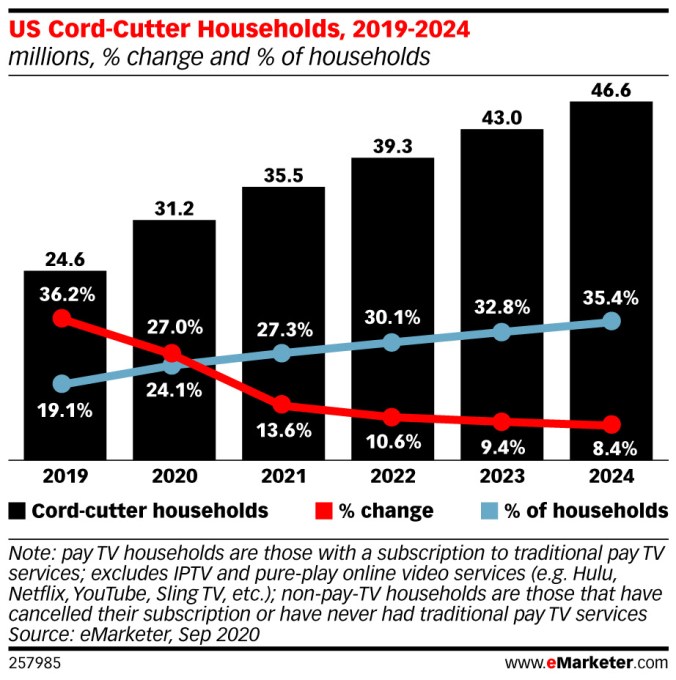
The pandemic has accelerated adoption of a number of technologies, from online grocery to multiplatform gaming to streaming services and more. But one industry that has not benefited is traditional pay TV. According to new research from eMarketer, the cable, satellite and telecom TV industry is on track to lose the most subscribers ever. This year, over 6 million U.S. households will cut the cord with pay TV, bringing the total number of cord-cutter households to 31.2 million.

The firm says that by 2024, the number will grow even further, reaching 46.6 million total cord-cutter households, or more than a third of all U.S. households that no longer have pay TV.

Despite these significant declines, there are still more households that have a pay TV subscription than those that do not. Today, there are 77.6 million U.S. households that have cable, satellite or telecom TV packages. But that number has declined 7.5% year-over-year — its biggest-ever drop. The figure is also down from pay TV’s peak in 2014, the analysts said.

Image Credits: eMarketer

The pay TV losses, as you may expect, are due to the growing adoption of streaming services. But if anything, the pandemic has pushed forward the cord-cutting movement’s momentum as the health crisis contributed to a down economy and the loss of live sports during the first part of the year. These trends may have also encouraged more consumers to cut the cord than would have otherwise.

“Consumers are choosing to cut the cord because of high prices, especially compared with streaming alternatives,” said eMarketer forecasting analyst at Insider Intelligence Eric Haggstrom. “The loss of live sports in H1 2020 contributed to further declines. While sports have returned, people will not return to their old cable or satellite plans,” he added.

Pay TV providers have been attempting to mitigate their losses by shifting their focus to more profitable internet packages, which help power the services that consumers are turning to, like Netflix and Hulu.

Related to the pay TV decline, the loss in TV viewership is also impacting the advertising industry.

Image Credits: eMarketer

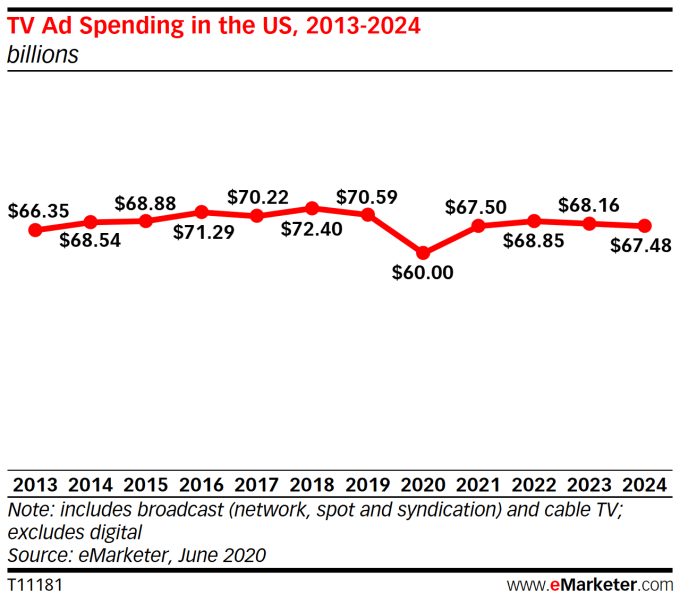
Total TV ad spend will drop 15% in 2020 to $60 billion — the lowest-ever figure the industry has since since 2011.

Some of this is pandemic-related, however, so TV ad dollars are expected to rebound some in 2021. But, overall, TV ad spending will continue to remain below pre-pandemic levels through at least 2024, the analysts said.

But it may never get back to “normal” levels in the future.

“While TV ad spending will rebound in 2021 with the broader economy, it will never return to pre-pandemic levels,” Haggstrom stated. “Given trends in cord-cutting, audience erosion and growth in streaming video, more ad dollars will shift from TV to digital video in the future.”


Microsoft commits to putting more water than it consumes back into the ecosystems where it operates by 2030

One good trend in 2020 has been large technology companies almost falling over one another to make ever-bolder commitments regarding their ecological impact. A cynic might argue that just doing without most of the things they make could have a much greater impact, but Microsoft is the latest to make a commitment that not only focuses on minimizing its impact, but actually on reversing it. The Windows-maker has committed to achieving a net positive water footprint by 2030, by which it means it wants to be contributing more energy back into the environment in the places it operates than it is drawing out, as measured across all “basins” that span its footprint.

Microsoft hopes to achieve this goal through two main types of initiatives: First, it’ll be reducing the “intensity” of its water use across its operations, as measured by the amount of water used per megawatt of energy consumed by the company. Second, it will also be looking to actually replenish water in the areas of the world where Microsoft operations are located in “water-stressed” regions, through efforts like investment in area wetland restoration, or the removal and replacement of certain surfaces, including asphalt, which are not water-permeable and therefore prevent water from natural sources like rainfall from being absorbed back into a region’s overall available basin.

The company says that how much water it will return will vary, and depend on how much Microsoft consumes in each region, as well as how much the local basin is under duress in terms of overall consumption. Microsoft isn’t going to rely solely on external sources for this info, however: It plans to put its artificial intelligence technology to work to provide better information around what areas are under stress in terms of water usage, and where optimization projects would have the greatest impact. It’s already working toward these goals with a number of industry groups, including The Freshwater Trust.

Microsoft has made a number of commitments toward improving its global ecological impact, including a commitment from earlier this year to become “carbon negative” by 2030. Meanwhile, Apple said in July that its products, including the supply chains that produce them, will be net carbon neutral by 2030, while Google made a commitment just last week to use only energy from carbon-free sources by that same year.

Group discounts let you bring the team to TC Sessions: Mobility 2020

There’s a lot of virtual ground for one person to cover — and real opportunities to uncover — during the two days of TC Sessions: Mobility 2020 (October 6-7). Take advantage of our group discounts, bring the whole team and multiply your results and your ROI.

Buy four or more passes, and you’ll trim $25 off the price of each pass — but only if you buy them before the deadline: October 5 at 11:59 p.m. (PDT).

With all hands on deck, you can attend interviews, breakout sessions and panel discussions — and interact with top industry leaders — to get a handle on emerging trends. Here’s just one prime example and be sure to check out the Mobility 2020 agenda for the full scoop.

Building an AV Startup: Ike co-founder and chief engineer Nancy Sun will share her experiences in the world of automation and robotics, a ride that has taken her from Apple to Otto and Uber before she set off to start a self-driving truck company. Sun will discuss what the future holds for trucking and the challenges and the secrets behind building a successful mobility startup.

“Attending TC Sessions: Mobility helps us keep an eye on what’s coming around the corner. It uncovers crucial trends so we can identify what we should be thinking about before anyone else.” — Jeff Johnson, vice president of enterprise sales and solutions at FlashParking.

Other team members can explore and connect with more than 40 early-stage mobility startups exhibiting in the expo — who knows what opportunities they’ll find? With thousands of attendees from around the world, the networking potential will be off the hook. Good news: We don’t have an app for that — we have a full-blown AI-powered platform: CrunchMatch.

It’s the perfect tool for networking at a virtual conference. When you register, simply answer a few quick questions, and CrunchMatch gets to work connecting you with the people who can help grow your business. The rest is up to you — schedule 1:1 video calls and begin building the relationships that can change the course of your business.

“TC Sessions: Mobility isn’t just an educational opportunity, it’s a real networking opportunity. Everyone was passionate and open to creating pilot programs or other partnerships. That was the most exciting part. And now — thanks to a conference connection — we’re talking with Goodyear’s Innovation Lab.” — Karin Maake, senior director of communications at FlashParking.

So much vital information and incredible opportunity awaits at TC Sessions: Mobility 2020. Don’t go it alone. Grab a group discount, take your whole team and do whatever it takes to drive your business forward.

Is your company interested in sponsoring or exhibiting at TC Sessions: Mobility 2020? Contact our sponsorship sales team by filling out this form.

Miami-based Marco Financial is launching a revenue-based lending service for Latin American SMEs

Marco Financial, a new Miami-based startup, is looking to take a piece of the roughly $350 billion trade finance market for Latin American exporters with its novel factoring services business. 

Small and medium-sized businesses in Latin America can have trouble getting the financing they need to launch export operations to the U.S. and Marco said it aims to bridge that gap with new risk modeling and management tools that can make better decisions on who should receive loans.

For smaller businesses in Latin America, accessing trade finance to export their goods is a major concern and a top reason why many dont succeed,” said Javier Urrutia, director of Foreign Investments at PROCOLOMBIA, an organization that promotes foreign investment and non-traditional exports in Colombia, in a statement from the company. In Colombia alone, a 1% increase in exporter productivity in our textile industry would result in 500,000 new jobs for the country.

The company is backed by a small seed round from Struck Capital and Antler and over $20 million in a credit facility underwritten by Arcadia Funds.  

As a former owner of a small business in Latin America, I saw firsthand how difficult it is for SMEs in this region to access trade financing that will let them export their goods while retaining enough capital to keep their business running,” said Peter D. Spradling, COO and co-founder of Marco, in a statementAccess to trade finance is one of the greatest hurdles in business operations and the traditional system dominated by banks is simply not working anymore, disproportionately hurting SMEs and further restricting economic mobility and job creation in emerging markets. Equity funding and a material credit facility let us serve this underserved market in Latin America and help build a healthier, more equitable trade ecosystem reflective of an increasingly borderless global economy.

Spradling met his co-founder Jacob Shoihet through the Antler accelerator, a Singapore and New York-based early-stage investment and advisory services program that connects entrepreneurs and tech operators to launch new businesses. 

Shoihet, a classically trained musician who fell in with the startup scene in New York through work at Yelp, was eager to launch his own company and connected with Spradling over shared interests in intermittent fasting and sports.

Small and medium businesses have a hard time receiving loans from traditional lenders thanks to tighter regulations and capital controls dating back to the 2008 financial crisis, according to Marco’s founders. And the long periods that companies have to wait between when goods are shipped and orders are payed can put undue pressure on business operations. Factoring solves the gap by lending to merchants based on their receivables.

Marco said that it can reduce the length of the loan origination process from over two months to one week and provide funding to approved exporters within 24 hours.

The company is initially focused on Mexico, Uruguay, Chile, Colombia and Peru, and chose those markets because of Spradling’s previous experience as an importer and exporter across the region.

“We look for companies that not only target massive, sleepy industries but also for ones that are led by management teams with fresh perspectives and asymmetric information that position them to upend incumbents,” said Yida Gao, partner at Struck Capital, in a statement. “In short order, Marco has assembled a world-class team to tackle the multi trillion-dollar trade finance market in a post-Covid time when SMEs around the world need, more than ever, reliable capital to fund operations and growth. We are excited to be part of Marco’s journey to support the suppliers that are the backbone of global trade.”

The Peloton effect

During the most recent quarter, only a few earnings reports stood out from the rest. Zoom’s set of results were one of them, with the video-communications company showing enormous acceleration as the world replaced in-person contact with remote chat.

Another was Peloton’s earnings from the fourth quarter of its fiscal 2020, which it reported September 10th. The company’s revenue and profitability spiked as folks stuck at home turned to the connected fitness company’s wares.


The Exchange explores startups, markets and money. Read it every morning on Extra Crunch, or get The Exchange newsletter every Saturday.


Shares of Peloton have rallied around 4x since March, roughly the start of when the COVID-19 pandemic began to impact life in the United States, driving demand for the company’s at-home workout equipment. In late June, the leisure company Lululemon bought Mirror, another connected fitness company aimed at the home market for around $500 million.

With Peloton’s 2019 IPO and its growth along with Mirror’s exit in 2020, connected fitness is demonstrably hot, and private-market investors are taking notice. A recent Tweet from fitness tech watcher Joe Vennare detailing a host of recent funding rounds raised by “digital fitness” companies made the point last week, piquing our curiosity at the same time.

Is there really some sort of Peloton effect driving private investment into lots of connected fitness startups? How hot is the more nascent side of connected fitness?

This morning let’s take a look through some recent funding rounds in the space to get a feel for what’s going on. (If you’re a VC who cares about the sector, feel free to email in your own notes, subject line “connected fitness” please.) We’ll then execute the same search for Q3 2019 and see how the data compares.

Hot Wheels

To start with the current market I pulled a Crunchbase query for all Q3 funding rounds for companies tagged as “fitness” and then filtered out the cruft to get a look at the most pertinent funding events.

Here’s what I came up for for Q3 2020, to date: