Following Apple’s Sidecar launch, Astropad announces Luna Display for Windows

In June, Luna Display creator Astropad wrote a blog post titled, “Why Getting Sherlocked by Apple Was a Blessing in Disguise.” It arrived on the one-year anniversary of Apple’s launch of Sidecar for macOS, which let Mac owners use an iPad as a second display — thus making Luna’s functionality redundant.

The rose-colored post detailed how the company planned to pivot by diversifying its portfolio — in the case of Luna, that specifically meant launching a Windows version. “Later this summer, we’ll open up Astropad Studio for a free public beta on Windows,” the company wrote. “Not long after, we’ll be launching a Kickstarter campaign for an HDMI version of Luna Display.”

Today the company launched a Kickstarter for its Windows version, two years after launching the original Mac dongle on the crowdfunding platform. Delivery is set for May 2021. Early-bird supporters can get on-board with the device for as low as $49 (down from a retail price of $80).

Image Credits: Astropad

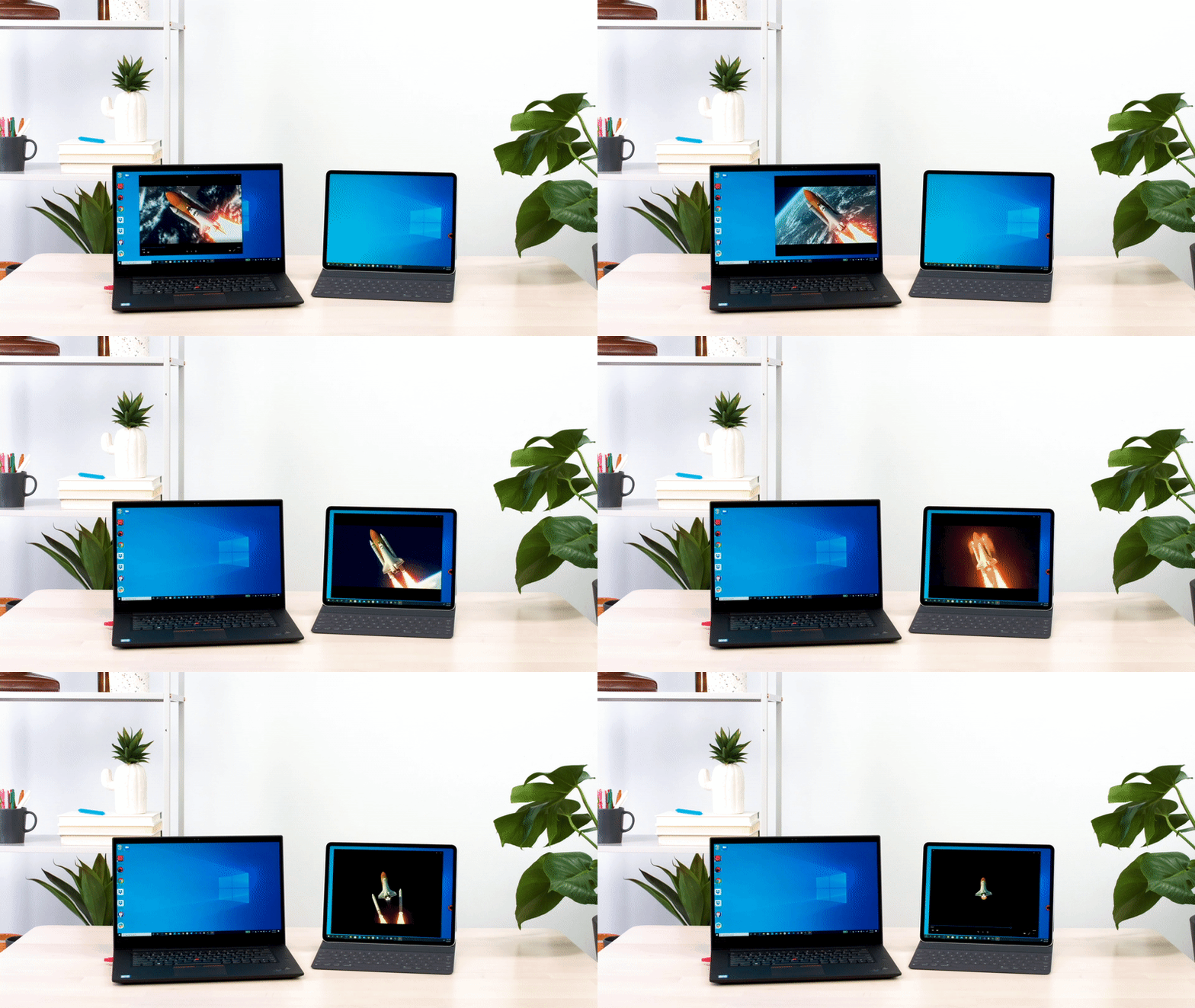
The dongle turns an iPad into a second display for a Windows PC, either wirelessly or tethered. The model comes in either USB-C of HDMI models, depending on the ports available on your machine. The second tablet can be used as a touchscreen for the extended monitor, which should work well with Windows 10, given how much Microsoft has tailored it to a touch experience.

I was a fan of the original Luna for Mac — though, like many, had less interest in the product as soon as Apple announced native support for Sidecar. Following the launch of Windows support, owners of the original Mac version will be able to use their existing device with PCs, as well. The device will work for Mac to iPad, Windows to iPad, Mac to Mac (with one laptop serving as a second screen) and a “headless mode,” with uses the iPad as a display for the Mac Mini and Mac Pro.

Aurora Labs ramps ‘self-healing’ software with $23M from LG Technology Ventures, Porsche SE, Toyota Tsusho

The automotive market is grappling with increasingly complex software systems, and in turn greater risks of glitches that can cause costly and unsafe disruptions and damage an automaker’s credibility.

Just look at today’s new cars, trucks and SUVs compared to their counterparts a decade ago. New vehicles coming off assembly lines today contain tens of millions of lines of code, a statistic that continues to rise as automakers invest more in software.

This upward trend has created risks for automakers; it’s also opened up opportunity for burgeoning startups like Aurora Labs, which developed a platform that can spot problems with software in cars and fix it on the fly. The company is now preparing to ramp up operations, even beyond automotive, as software takes a central role in shared mobility, cities and homes.

Aurora Labs developed a platform designed to detect and predict problems and then fix any issues in real-time. The platform also enables automakers to update software in vehicles wirelessly — a feature often referred to as over-the-air software updates that was popularized by Tesla. The ability to conduct OTAs allows automakers to make changes quickly and without requiring owners to visit a dealership for service.

Earlier this month, the Tel Aviv-based startup raised $23 million in a Series B round jointly led by LG Group’s investment arm LG Technology Ventures and Marius Nacht, co-founder of Check Point Software Technologies. Porsche SE, majority owner of the VW group, Toyota Tsusho, a member of Toyota Group and the venture arm of global safety certification company UL also participated. Porsche SE invested $2.5 million and Toyota Tsusho put $1.5 million into Aurora Labs, according to the companies.

The funds will be used to double the size of Aurora Labs’ 30-person team to support going into series production with two of its automotive customers. Aurora Labs is working with a total of four global automakers and an electronics company.

While Aurora Labs’ primary customer base is automotive, the company says it’s also preparing to enter new markets such as connected homes and smart cities with support from its investors that have products across several industries, including Porsche SE, Toyota Tsusho, LG Tech Ventures and UL Ventures.

‘The Real Facebook Oversight Board’ launches to counter Facebook’s ‘Oversight Board’

Today a group of academics, researchers and civil rights leaders go live on with ‘The Real Facebook Oversight Board’ which is designed to criticize and discuss the role of the platform in the upcoming US election. The group includes Facebook’s ex-head of election security, leaders of the #StopHateForProfit campaign and Roger McNamee, early Facebook investor. Facebook launched its own ‘Oversight Board’ last November to deal with thorny issues of content moderation, but Facebook has admitted it will not be overseeing any of Facebook’s content or activity during the course of the US election, and will only adjudicate on issues after the event.

The press conference for the launch is streamed live today, below:

Facebook founder Mark Zuckerberg claimed last November that the Oversight Board was “an incredibly important undertaking” and would “prevent the concentration of too much decision-making within our teams” and promote “accountability and oversight”.

The move was seen as an acknowledgment of the difficulty of decision-making inside Facebook. Decisions on what controversial posts to remove fall on the shoulders of individual executives, hence why the Oversight Board will act like a ‘Supreme Court’ for content moderation.

However, the Oversight Board has admitted it will take up to three months to make a decision and will only make judgments about content that has been removed from the platform, not what stays up. 

Facebook has invested $130 million in this board and announced its first board members in May, including ex-prime minister of Denmark, Helle Thorning-Schmidt and the ex-editor-in-chief of the Guardian, Alan Rusbridger.

The activist-led ‘Real Facebook Oversight Board’ includes the ex-President of Estonia, Toomas Henrik Ilves, an outspoken critic of Facebook and Maria Ressa, the journalist currently facing imprisonment in the Philippines for cyberlibel.

Board members also include Shoshana Zuboff, author of Surveillance Capitalism, Derrick Johnson, president of the NAACP, Yael Eisenstat, former head of election integrity at Facebook, Rashad Robinson, president of Color of Change, and Jonathan Greenblatt, CEO of the Anti-Defamation League .

This issue of how Facebook moderates its content and allows its users to be targetted by campaigns has become ever more pressing as the US election looms closer. It’s already been revealed by Channel 4 News in the UK that 3.5 million Black Americans were profiled and categorized on Facebook, and other social media, as needing to be deterred from voting by the Trump campaign.

Asana up 37% and Palantir up 50% as both direct listings hit the public markets

Two direct listings in one day. Lots to talk about.

Asana started trading just a bit after noon Eastern today, quickly zooming to roughly about $29 a share in early trading this afternoon. Meanwhile, Palantir is running like a herd of bulls straight out of the gate, jumping to almost $11 a share in the first trades — a first day jump of nearly 50%.

Asana’s reference price was revealed yesterday by the NYSE, and it was set for $21 a share. The company had roughly 150 million shares of stock outstanding on a fully diluted basis, which gave it a pre-market reference value of $3.2 billion. Palantir for its part was assigned a reference price of $7.25 a share, giving it a $16 billion implied valuation. At its current share price, Asana is valued at roughly $4.4 billion, and Palantir comes out to about $24 billion give or take.

The two companies trade on the NYSE, with Asana under ticker ASAN and Palantir under the ticker PLTR. Early trading is heavy according to Yahoo Finance, with 156 million shares of Palantir and nearly 32 million shares of Asana already changing hands.

For both companies, which are well capitalized, a direct listing seemed to be the right approach to give early employees and other insiders a liquidity option while continuing to maintain tight control of the ship. One difference between the two initiatives is that Asana has no lockup for employee and other insider shares as is typically customary with a direct listing. Palantir pioneered a lockup provision with a direct listing that will allow only roughly 29% of the company’s shares to be available potentially for trading today. The remainder of those shares become eligible for sale over the coming months.

As with all direct listings, no shares are offered by the company upon market debut, and the reference prices published by the NYSE are imaginary if important mental benchmarks for where bankers believe a hypothetical price lies for these two companies.

As my colleague Jon Shieber described a few weeks ago, Asana is an interesting entry into the markets as a long-time SaaS company stalwart that continues to lose buckets of revenue. Despite fast revenue growth of roughly 71%, the company lost $118.6 million on revenues of $142.6 million in fiscal 2020 (Asana has a Feb 1 fiscal year calendar, so those figures are for the bulk of 2019).

The company was last valued at $1.5 billion in late 2018. It secured a bit more than $200 million in venture financing since its founding in 2009, and its founders Dustin Moskovitz and Justin Rosenstein hold large stakes in the company of roughly 36% and 16.1% respectively.

Over at Palantir, which we have covered extensively the past few weeks, the company is even more of an outlier, with large-contract government sales that accrue over many years. The company reported a total of 125 customers, losses of $580 million on revenues of $743 million last year, and projected revenues of just above $1 billion for 2020.

While Palantir’s reference price was below the final secondary trades held by the company in early September before it closed the window in the run up to its IPO, that price was well-above the average trading of the past 18 months.

For both companies now, the public markets beckon, and the first public quarterly results are coming due here in a few weeks. You can read more about Asana on the company’s investor relations page. Like so much else at Palantir, it doesn’t have an investor relations page (yet?) as of the time of writing this article, but presumably the company will want to connect with investors at some point in the near future, one would hope.

Updated September 30th at 2pm EDT: Added Palantir trading data, and early volumes for both Asana and Palantir.