Which neobanks will rise or fall?

Denis Barrier
Contributor

Denis Barrier is co-founder and CEO of Cathay Innovation, a global venture capital firm investing across North America, Europe, Asia and Africa.

Alex Lazarow
Contributor

Alex Lazarow is an author, a global venture investor with Cathay Innovation and is an adjunct professor with the Middlebury Institute for International Studies MBA program.

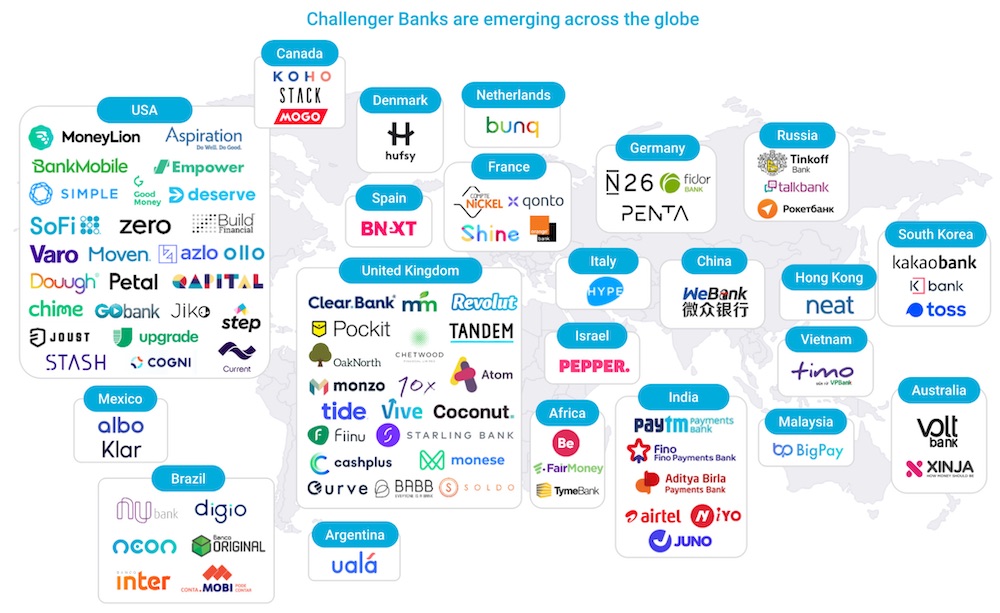
The neobank, or digital bank, phenomenon continues to take the world by storm, with global winners, from Brazil’s Nubank valued at $10 billion and Berlin’s N26 valued at $3.5 billion, to Chime, now valued at $14.5 billion as the most valuable consumer fintech in the United States.

Neobanks have led the charge of the $3.6 billion in venture capital funding for consumer fintech startups this year. And as the coronavirus-fueled acceleration of digital transformation continues, it seems the digital bank is here to stay, with some estimates pointing to neobanks reaching 60 million customers in North America and Europe by the end of 2020, and surpassing 145 million by 2024.

The space is also becoming more crowded, a trend which will only accelerate with fintech eating the world and creating greater infrastructure that enables any company to include a bank account as a product extension.

As a result, neobanks are not a monolithic model and not all are created equal. Looking underneath the hood of business models across the globe reveals remarkable operational differences and highlights specific features that are more likely to succeed in the long-term.

Five global models of neobanks

Today there are five distinct models that are leading globally:

Interchange-led: Relies on payments revenue, sourced through interchange as the revenue driver. Every time a customer uses the neobank’s card as a payment method they get paid [e.g. Chime / US; Neon (hybrid of 1 & 2) / Brazil].

Credit-led: Leverages a credit-first model, starting off with a credit card or similar offering, and later providing a bank account [e.g. Nubank, Neon (hybrid of 1 & 2) / Brazil].

Plaid improves its account linking flow

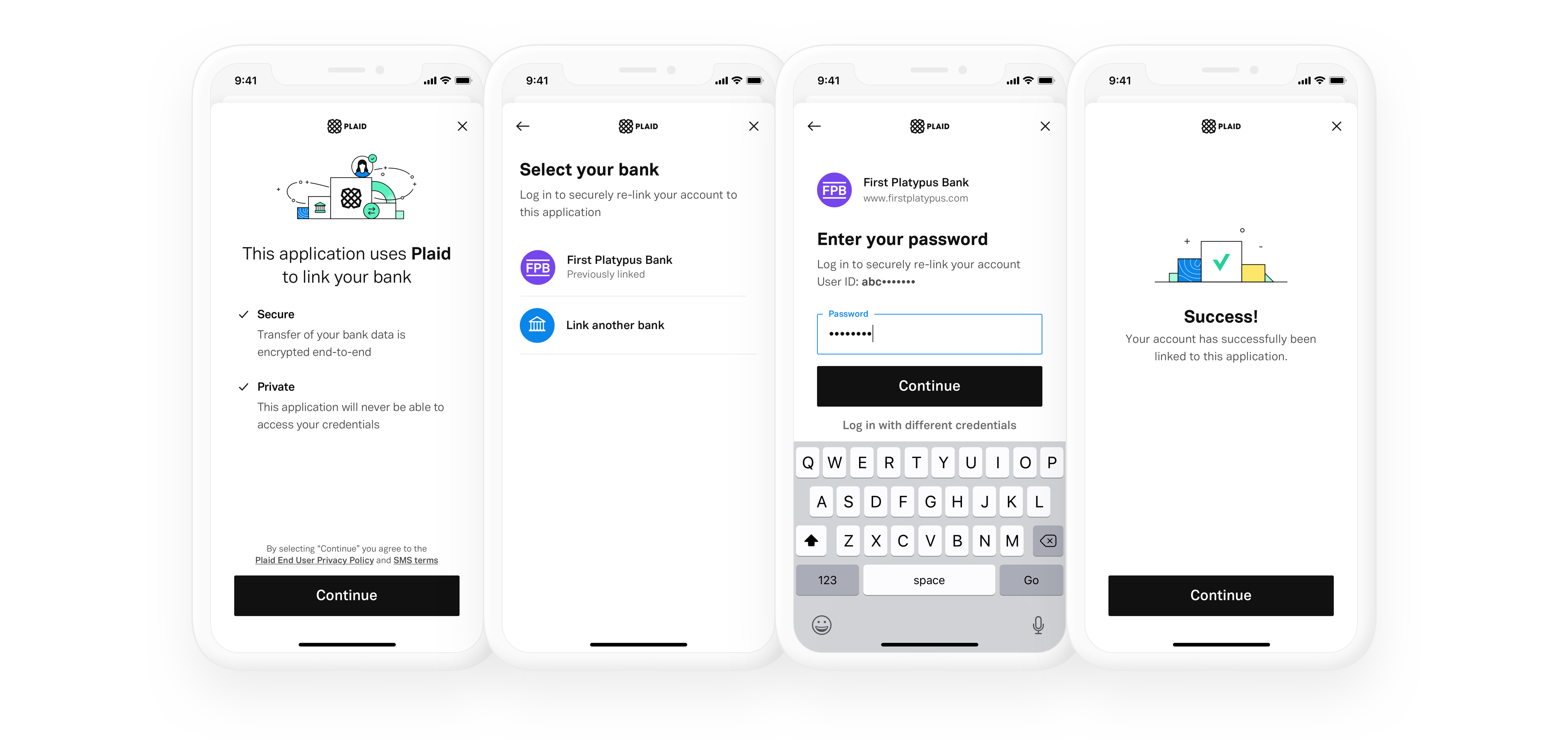
Plaid, the company building a universal banking API that lets you connect an app or service with a bank account, has updated Plaid Link. Plaid Link is the interface you see when you add your bank account to any app or service that uses Plaid, such as Venmo, Acorns or Chime.

Given that 3,000 apps have been using Plaid, chances are you’ve seen Plaid Link in the past. According to the company, one in four people in the U.S. have used Plaid to connect their accounts.

And today’s update is all about using Plaid with multiple apps. The first time you connect your bank account, you search for your bank, you enter your credentials and you log in.

The second time you need to add your bank account, Plaid shows you previously added bank accounts. You don’t have to scroll through a list of financial institutions and you don’t have to enter you user ID. Plaid might ask you for your password again or a one-time code.

Image Credits: Plaid

When you buy something on an e-commerce platform, you can save your card so that you don’t have to enter your card details again. With today’s update to Plaid Link, the company is doing the same thing with bank account information.

Payment cards thrived in part because it is much easier to pay with your card than connecting to your bank account to send money. Polishing Plaid Link reduces friction for fintech startups when it comes to connecting your accounts.

Plaid also says that Plaid Link is a bit faster. Each panel loads 30% faster. The list of banks now changes depending on your location. Local banks appear closer to the top of the list so you don’t have to scroll as much.

Writer pens a $5M seed round for its AI style guide that flags bias and tone

Anyone who writes online or in a word processor has likely gotten used to the inevitable squiggly line denoting a misspelled word or clumsy phrase. But what if you use a word that’s loaded, a phrase that’s too formal or not formal enough, or refer to a group of people in an outdated way? Writer is a service that watches as you type, flagging language that doesn’t match up with your style guide and values, and it just raised $5 million to scale up.

Both people and the companies they work for want to improve the way they write, but not just in terms of grammar and spelling. If a company says it’s inclusive, but the language in its press releases or internal blogs are peppered with anachronisms and bias, it suggests their concern only goes so far.

“Companies are hungry to put actions behind their words,” said Writer founder and CEO May Habib. “They want to be able to tell a consistent story to their users everywhere that they’re interacting with them. What Writer does is let people know when they’re using insensitive language, or things that could be considered negative, and let companies set brand guidelines.”

Right off the bat let us admit that there is a whiff of the sinister about the idea of a company dictating how its employees speak, though that’s nothing new when it comes to content and official communications. But this isn’t about controlling speech for power — it’s about recognizing that we are all flawed communicators and could use a hand keeping ourselves honest. Less thought police and more a well-informed angel sitting on your shoulder whispering things like, “Hey. Are you sure you want to describe that lawyer as ‘exotic’?”

Examples of things Writer checks for. Image Credits: Writer

There are tons of slip-ups we all make along those lines; less obvious, but no less potentially offensive. It’s important in public communications, among other things, to refer to a group by the term they prefer, not the first one that pops into your head; Writer has up-to-date libraries of this information sourced from the communities themselves. Some phrases may have become politically loaded in the last couple of years, but you’re not aware; no problem, it has alternatives. You want to avoid unnecessarily gendered language, great, but everyone slips up now and then; Writer can spot it — or make the connection with previous pronouns to make sure you don’t, for example, gender an anonymous source.

Accusations of “political correctness” will dog the service, but as Habib put it: “This is beyond politics; this is about respect for people who live a certain way, or are a certain way, and prefer to use certain terms. We’re trying to help companies create communities of belonging.” And as we’ve seen over and over again in tech, there is often a serious disconnect between the stated aspiration of a company and how people are treated within them. Just using the right words is a pretty low bar to start with, honestly.
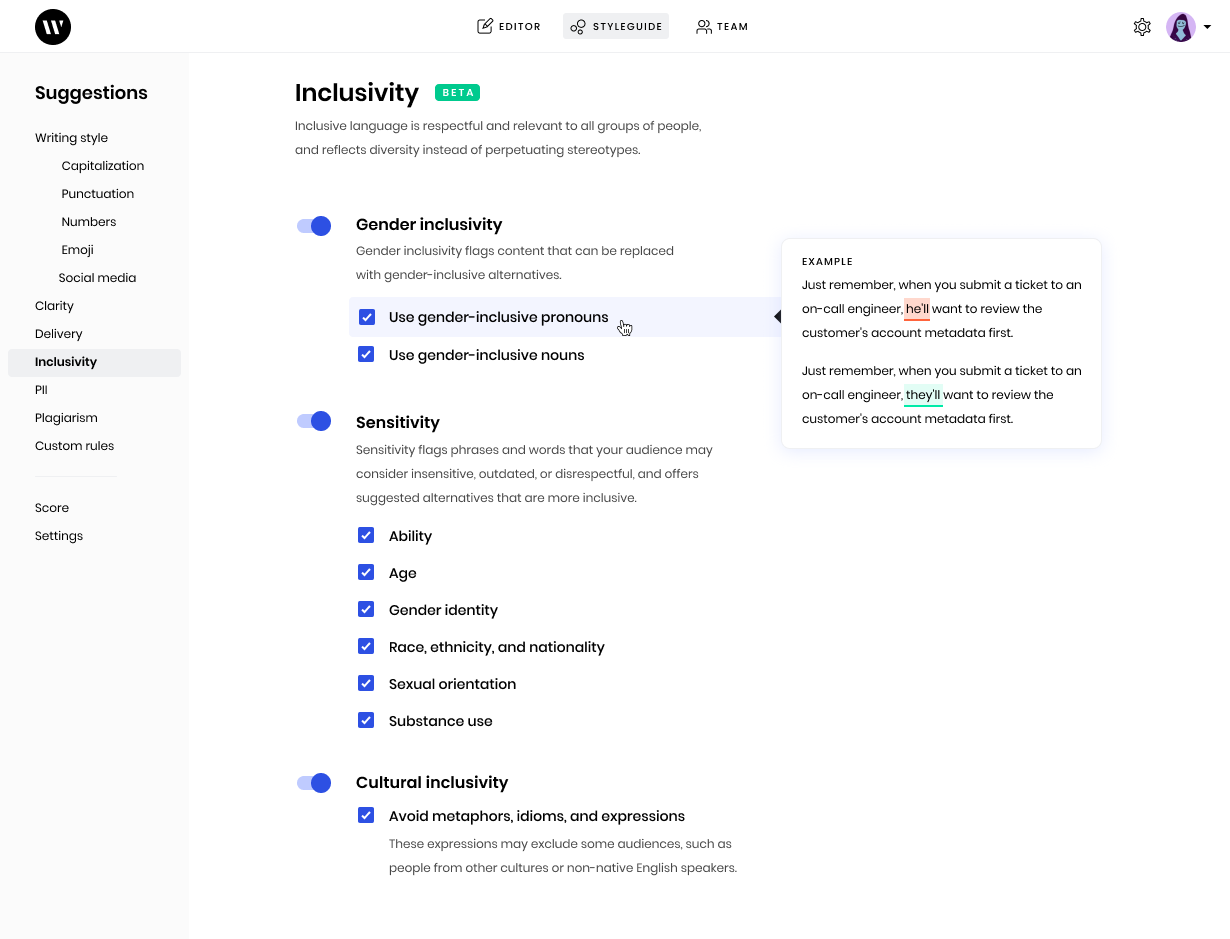
Image Credits: Writer

Writer isn’t just a growing blacklist of words you should think twice about using, though. The natural language processing engine at the heart of it is also very concerned with things like sentence complexity, paragraph length and tone. It has to have this deeper understanding, Habib explained, because “it’s not enough to underline — you need to know what to replace it with, and when you replace it, you need to fit it into the sentence. These are actually hard NLP problems.”

That lets it fit into a variety of roles in addition to promoting inclusive language. It can watch for the usual spelling and grammar mistakes, as well as things like formality, active voice, “liveliness” (whatever that is, I don’t have it) and other metrics that help define a brand.

And of course you can bring in your own style guide so your editors don’t have to roll their eyes at serial commas in headlines, double dashes instead of em dashes, e-mail instead of email and all the rest of the little nips and tucks that keep a brand’s writing in a generally recognizable shape.

Image Credits: Writer

The service can also switch between style guides or adjust or disable itself in different apps and sites — so internal emails aren’t given the same guidelines as press releases, or a blog post’s style can be differentiated from a newsletter’s.

Obviously Grammarly is a big competitor here, but Habib feels that it and the growing number of in-browser or in-app checking services are very focused on the technical piece. Writer is less about preventing an individual writer’s errors, and more about creating consistency among groups of writers and making sure they are working from the same high-level linguistic standards.

Of course security is also a concern — no one wants a keylogger running on their machine, however helpful it may be. Habib was careful to emphasize that Writer runs locally in the browser as a plug-in, integrating with Word or Chrome for now but with other apps and services on the way. “None of that data ever hits a writer server, and no metadata — all the processing is done in the text area,” she said. The only data that’s sent back is the fact that a given suggestion was used, such as changing “should of” to “should have” or “illegal aliens” to “undocumented immigrants.” No user data is used to train the models and no content apart from the correction itself is sent or stored on Writer’s servers.

Writer is available now, for $11/person/month (with the obligatory free trial period, of course) for a basic version and some unspecified amount for enterprise deals with multiple style guides, plagiarism detection, and so on. It’s only available in English, and although there is of course demand for the service in other languages, the depth of the NLP model and the specificity of what it recognizes to the language mean it does not generalize well. To take on Spanish or Korean would be to develop an entirely new product. So English it is for now.

The company is new, and has been developing its NLP engine (on the back of a previous effort, which monitored user-facing language in GitHub repos) for 18 months in something like stealth. The $5 million seed round, led by Upfront Ventures, Aspect Ventures, Bonfire Ventures, and Broadway Angels should help the company scale, though it already has some top-tier, household-name customers, so with that and the money, its immediate future seems to be secure.

Propy, a blockchain-verified platform for selling houses, raises funding from Tim Draper

For several years, blockchain technology has been touted as a way to verify the sale of property. Any kind of property. And so entrepreneurs busily began the process of trying to create a startup that could complete a property deal on the blockchain.

One that stood out from the start was Propy, started by Natalia Karayaneva, an experienced, real-world property developer who had subsequently joined the blockchain world. Propy’s other co-founder is Denitza Tyufekchieva (pictured). 

Propy has now raised an undisclosed funding round from venture capitalist investor Tim Draper, best known for his early investments into Tesla, Skype, Twitter, Coindesk and Robinhood. TechCrunch understands this is part of a wider, ongoing fundraise. 

Propy’s platform uses blockchain technology to, it says, simplify the home-purchasing experience and eliminate fraudulent transactions. The idea is to close a traditional real estate deal entirely online. Thus, the offer, signed purchase agreements with DocuSign, secure wire payments and title deeds are all taken care of. Propy claims its platforms saves 10 hours of paperwork, per transaction.

“My vision for Propy is to bring self-driving real estate transactions to the world, with all of the logistics seamlessly executed on the back-end,” Karayaneva said in a statement. “Our platform offers a terminal to observe transactions in real-time, making the process transparent for real estate executives, title companies, homebuilders, buyers, and REITs. With this new investment we are excited to bring much-needed change to the industry, satisfy consumers and empower real estate professionals all over the world.”

But this is not some out-there, wacky crypto-play. Most of the transactions are done in dollars on Propy, meaning it could be used by mainstream users from day one, as it’s able to process wire transfers via integration with a money transmitter connected to 70 banks.

Speaking to TechCrunch, Karayaneva added: “We do not replace lawyers, but rather help them, closing attorney’s share documents with consumers and agents via Propy. With DocuSign integrated, they can sign the documents on Propy and all parties get notified. In the U.S., agents have ready forms in Propy to fill out and they don’t need lawyers in a transaction at all.”

Crucially, Propy has an enterprise play going on here as well. Its platform can provide the back-office system to real estate enterprises with real-time transaction reports and automated compliance.

Draper said: “Propy has the potential to transform real estate, making transactions and titles simpler, more secure, and less expensive through innovative use of blockchain technology. [It] eliminates fraud and makes the closing process more secure, effective and streamlined.”

According to one survey, almost one-fifth of millennials have now thought about buying a home because of the lock-downs induced by the COVID-19 pandemic, meaning that many will be looking for an easy way to transact, especially if it has the ease of use Propy has. 

Propy has some fellow-travelers in the blockchain prop-tech space. ShelterZoom is a Blockchain platform used for virtual and remote collaboration with offices and clients, while StreetWire is a Blockchain-based data service for the real estate industry.

Coinbase lets you withdraw funds to your debit card

Cryptocurrency exchange Coinbase is adding a new way to withdraw funds from your Coinbase account. If you’ve added a compatible debit card to your account, you can transfer USD, EUR or GBP to your bank account nearly instantly.

There are some drawbacks, and the main one is that you’ll pay a lot of fees. In the U.S., Coinbase deducts 1.5% from the transaction, or a minimum $0.55 if it’s a small transaction. In the U.K. and Europe, you pay 2% in fees or a minimum fee of £0.45/€0.52, respectively.

You also need to have a compatible card. Not all debit cards support incoming transfers. You need to have a Visa card that supports Visa Fast Funds. In the U.S., you can also use a Mastercard card with Mastercard Send.

It’s hard to know whether your bank or card issuer support those features. The best way to figure it out is probably by adding your card to Coinbase and seeing what Coinbase says.

Coinbase isn’t removing other withdrawal methods. For instance, if you’re looking for a cheaper way to withdraw your funds in Europe, a SEPA bank transfer costs €0.15 per transfer. And Coinbase supports instant SEPA transfers if your bank has enabled that.

The company also lets you link your PayPal account with your Coinbase account. Your funds should hit your PayPal account within a few seconds, and there are no fees on Coinbase’s side.

As you can see, there are many ways to move money from your bank account to your Coinbase account. Some of them are slower than others, some of them are more expensive than others. Crypto-to-crypto transactions are a bit simpler by comparison, as you only need your recipient’s wallet address to send tokens.

Image Credits: Coinbase

Indian startups explore forming an alliance and alternative app store to fight Google’s ‘monopoly’

Google, which reaches more internet users than any other firm in India and commands 99% of the nation’s smartphone market, has stumbled upon an odd challenge in the world’s second-largest internet market: Scores of top local entrepreneurs.

Dozens of top startups and firms in India are working to form an alliance and toying with the idea of launching an app store to cut their reliance on Google, five people familiar with the matter told TechCrunch.

The list of entrepreneurs includes high-profile names, such as Vijay Shekhar Sharma, co-founder and chief executive of Paytm (India’s most valuable startup), Deep Kalra of travel ticketing firm MakeMyTrip, and executives from PolicyBazaar, Sharechat and many other firms.

The growing list of founders expressed deep concerns about Google’s “monopolistic” hold on India, and discussed what they alleged was unfair and inconsistent enforcement of Play Store’s guidelines in the country.

The conversations, which began in recent weeks, escalated on Tuesday after Google said that starting next year developers with an app on Google Play Store must give the company a cut of as much as 30% of several app-related payments.

Dozens of executives “from nearly every top startup and firm” in India attended a call on Tuesday to discuss the way forward, some of the people said, requesting anonymity. A 30% cut to Google is simply unfeasible, people on the call unanimously agreed.

Vishal Gondal, the founder of fitness startup GOQii, confirmed the talks to TechCrunch and said that an alternative app store would immensely help the Indian app ecosystem.

TechCrunch reached out to Paytm on Monday for comment and the startup declined the request.

In recent months, several major startups in India have also expressed disappointment over several of the existing industry bodies, which some say have failed to work on nurturing the local ecosystem.

The tension between some firms and Google became more public than ever late last month after the Android-maker reiterated Play Store’s gambling policy, sending a shockwave to scores of startups in the country that were hoping to cash in on the ongoing season of Indian Premier League cricket tournament.

Google temporarily pulled Paytm’s marquee app from the Play Store citing repeat violation of its Play Store policies. Disappointed by Google’s move, Paytm’s Sharma said in a TV interview, “This is the problem of India’s app ecosystem. So many founders have reached out to us… if we believe this country can build digital business, we must know that it is at somebody else’s hand to bless that business and not this country’s rules and regulations.”

Google has sent notices to several firms in India including Hotstar, TechCrunch reported last month. Indian newspaper Economic Times reported on Wednesday that the Mountain View giant had also sent warnings to food delivery startups Swiggy and Zomato.

Vivek Wadhwa, a Distinguished Fellow at Harvard Law School’s Labor and Worklife Program, lauded the banding of Indian entrepreneurs and likened Silicon Valley giants’ hold on India to the rising days of East India Company, which pillaged India. “Modern day tech companies pose a similar risk,” he told TechCrunch.

Some of the participating members are also hopeful that the government, which has urged the citizens in India to become self-reliant to revive the declining economy, would help their movement.

Other than its reach on Android, Google today also leads the mobile payments market in India, TechCrunch reported earlier this year.

The giant, which has backed a handful of startups in India and is a member of several Indian industry bodies, invested $4.5 billion in Mukesh Ambani’s telecom giant Jio Platforms earlier this year.

Ambani, who runs oil-to-retails giant Reliance Industries and is India’s richest man, is an ally of Indian Prime Minister Narendra Modi. Jio Platforms has attracted over $20 billion in investment from Google, Facebook, and 11 other high-profile investors this year.

The voluminous investment in Jio Platforms has puzzled many industry executives. “I see no business case for Facebook investing in Jio beyond saying we need regulatory help,” said Miten Sampat, a high-profile angel-investor on a podcast published Wednesday.

Google said in July that it would work with Jio Platforms on low-cost Android smartphones. Jio Platforms is planning to launch as many as 200 million smartphones in the next three years, according to a pitch the telecom giant has made to several developers. Bloomberg first reported about Jio Platform’s smartphone production plans.

These smartphones, as is the case with nearly 40 million JioPhone feature phones in circulation today, will have an app store with only a few dozen apps, all vetted and approved by Jio, according to one developer who was pitched by Jio Platforms. An industry executive described Jio’s store as a walled-garden.

A possible viable option for startup founders is Indus OS, a Samsung-backed third-party store, which last month said it reaches over 100 million monthly active users. As of earlier this week, Paytm and other firms had not reached out to IndusOS, a person familiar with the matter said.

Lots of happy people as Palantir and Asana spike on first day of trading

The markets are closed and the verdicts are in: investors liked what they saw in Palantir and Asana .

The two companies, which debuted this morning in dual (and duel) direct listings, continued to prove that enterprise tech companies without the brand recognition of Spotify (which conducted its own direct listing back in 2018) can make direct listings work. So far, the evidence is decent that the mechanism isn’t throwing off investors.

Michael Nagle/Bloomberg via Getty Images

Asana closed its first trading day at $28.80 a share — a gain of 37% against its reference price of $21 a share. The company’s first trade was at $27. Meanwhile, Palantir closed the day at $9.73, a gain of 34% against its reference price of $7.25. Its first trade was at $10. Asana is valued at about $4.3 billion at close, while Palantir reached $24.8 billion, based on its fully diluted share count, including recent securities sold.

As an aside, my Equity co-host Natasha Mascarenhas and I did an “Equity Shot” talking more about these early numbers. Tune in if you want to hear our discussion and analysis:

That done, with big bold numbers on the board, there were a number of winners.

First and foremost, Founders Fund, which is the only major investor shared between the two companies, has a lot of capital incoming. The firm owns 5.8% of Asana and approximately 6.6% of Palantir, netting it somewhere around $1.8 billion given today’s valuations (that’s definitely back-of-the-envelope math mind you).

Meanwhile, Benchmark owns 9.3% of Asana, and a number of other investors including Japanese insurer SOMPO, Disruptive Technology Solutions, UBS, and 8VC own significant stakes in Palantir.

The other winners are the founders of these companies. Dustin Moskovitz retains a 36% stake in Asana, while his cofounder Justin Rosenstein holds a 16.1% stake. Over at Palantir, the trio of founders of Alex Karp, Stephen Cohen, and Peter Thiel now have liquid billions at their collective disposal.

Asana founders Justin Rosenstein and Dustin Moskovitz. Photo via Asana

Of course, employees will be happy to get liquidity as well. Asana does not have a lockup period, and so its employees and insiders are free to trade. Palantir coupled a direct listing with a lockup, and so only about 28% of the company’s shares are eligible for sale today. The remainder will be authorized to be sold over the next year.

In an interview with Moskovitz shortly after the markets closed today, he said that “it’s been an exciting morning, but ultimately it’s just one step in a much longer journey towards fulfilling our mission” (you can read more of our interview with Moskovitz on Extra Crunch).

While it’s just one trading day, it was a positive one for both companies, and that provides even more evidence that the classic IPO now has stiff competition from direct listings and other alternative methods like SPACs.

Dustin Moskovitz discusses Asana’s first trading day

It’s a big day for Asana, the work management tool that debuted on the NYSE this morning in a direct listing. Founded back in 2009 by Dustin Moskovitz and Justin Rosenstein, the company has assiduously grown over the years, taking in about $213 million in venture capital the past decade and reaching almost $100 million in subscription revenue for the first six months of 2020.

TechCrunch sat down this afternoon with CEO Moskovitz and Asana’s head of product Alex Hood at the tail end of the company’s first trading day to talk about its early success, its future and how it feels to go public in a direct listing.

This Q&A has been edited and condensed for clarity.

TechCrunch: Tell me how you’re feeling today — it’s been 10, 11 years since the company’s founding, what are your emotions on this first day?

Dustin Moskovitz: It’s been an exciting morning, but ultimately it’s just one step in a much longer journey towards fulfilling our mission and so, you know, we’re definitely pausing to celebrate but also looking ahead to what comes next because there’s going to be a lot more stuff to come after this.

What’s next?

Alex Hood: We really just feel like we’re getting started. The way that a billion and a quarter information workers work together really hasn’t changed all that much in the last 25 years — it’s really kind of based on the Microsoft Office suite form factor. We think that there’s a collaboration piece that really helps teams know who’s doing what by when and reduce the back and forth required to get work done.

Everything Google announced at its hardware event

This year, Google’s annual hardware event consisted of a brisk 30 minutes of pre-recorded promotional videos, but the company managed to pack a number of new product announcements into that time.

To make things easy for you, here’s a quick rundown of everything that Google announced, including the Google Pixel 5, a new TV interface and an upgraded smart speaker.

Google Pixel

Google’s latest mobile flagship, the Pixel 5, comes in a 100% recycled aluminum body and offers reverse wireless charging — in other words, you can use the Pixel 5’s battery to charge other devices. There’s a 6 inch display and the whole package costs $699. Pre-orders started today, with the phone available in nine countries on October 15.

In addition to the Pixel 5, Google also announced the 5G version of the Pixel 4a, which will cost $499, with specs that are closer to the Pixel 5 than the existing 4a. This one will be available in Japan on October 15, then launches in the United States and elsewhere sometime in November.

Both phones come with improved cameras, including a new ultrawide lens in the back. And beyond the hardware, Google also said it’s introducing a new Google Assistant feature, which will stay on the line for you when you make a call and then get put on hold, then send you an alert when someone picks up.

Google TV and Chromecast

Image Credits: Google

Google TV — at least in this iteration — is the company’s name for a new interface bringing streaming, live TV and other services together in one place. It includes most existing streaming services while also offering live TV via YouTube TV. And Google seems to be putting a lot of resources into the voice search experience.

The interface is included as part of the new Chromecast with Google TV, which also adds a remote control to Google’s streaming dongle and costs $49.

Nest Audio

Image Credits: Google

Nest Audio is the successor to Google Home, the company’s mid-range smart speaker. Google said the device will offer more bass, increased volume and clearer sound. And the form factor is closer to the Google Home Mini and Google Home Max. The Nest Audio smart speaker will cost $99 and will be available starting on October 5.

How 3 remote-friendly tech companies plan to return to the office

Six months ago, millions of workers left their offices for the last time without realizing it.

Many would be laid off because of the pandemic, but for those fortunate to keep their jobs, some of their employers still haven’t determined whether they will open their workplaces again.

Some of the biggest tech employers in the United States, like Facebook and Google, have vowed to keep their offices closed until at least 2021, which experts say is a realistic timeframe to develop a vaccine. Twitter went all in, allowing its employees to work from home for as long as they choose, even permanently.

Although the pandemic helped propel the work from home revolution, not all companies are calling it a day on office life just yet. Flexible working is here to stay and is likely to be as important to prospective employees as more traditional company benefits.

TechCrunch spoke with three tech companies that have long embraced flexible work — Auth0, Duo Security and Yubico — about how they adapted during the pandemic and their plans to return to the office.

What’s clear is that although flexible working has been an important part of their culture, it’ll take more than a pandemic to end the office era for good.

Auth0 plans to reopen its six offices

Before the pandemic hit, more than half of Auth0’s employees worked from home. Even its chief executive Eugenio Pace split his time between working from the office and his home.

“Since day one, our employees have had the freedom to do work on their own terms,” said Pace. He said that flexible working helped make his employees more productive, while allowing the company to expand its pool of talent — where more restrictive companies might demand an employee relocate.

“It’s also important to recognize that remote work isn’t for everyone,” he said. But the pandemic made working from the office impossible. Now, the company’s more than 700 employees are working from home.