Brian Armstrong’s new problem: 60-plus free agents

A lot has been made of the open memo that Coinbase CEO Brian Armstrong published nearly two weekends ago, essentially barring political activism at work because he sees it as a distraction. He also made it clear that employees who disagreed with the decision — and he foresaw that some would not be happy — were free to leave.

“I recognize that our approach is not for everyone, and may be controversial. I know that many people may not agree, and some employees may resign. I also know that some of what I’ve written above will be misinterpreted, whether accidentally or on purpose. But I believe it’s the right approach for Coinbase that will set us up for success long term, and I would rather be honest and transparent about that than equivocate and work in a company that is not aligned,” he wrote.

Perhaps owing to an almost immediate backlash, Armstrong sent a separate, internal memo the next day detailing separation packages for employees who might be upset and looking for the exits. Coinbase was willing to be very generous, too, offering four months’ severance pay for those who have been at the exchange for less than three years, and paying longer-term employees six months of severance. (Worth noting: Coinbase also gives employees up to seven years to exercise their stock options.)

Whether Armstrong expected that more than 60 employees of Coinbase’s staff of 1,200 would take him up on the offer is something only he knows. As he disclosed in a follow-up post yesterday, that’s how many people have alerted the company by its October 7th deadline that they are quitting, and Coinbase expects the number to inch higher, based on a “handful” of ongoing conversations.

Either way, if I were Armstrong, I might be a little nervous about that number. Though small in the grand scheme of the company’s ambitions, that’s 60-plus people who have Coinbase on their resume, institutional knowledge about the company in their head, and potentially money in the bank, between their severance and equity.

More worrisome, they might also have a bit of an axe to grind against a company that told them it was changing the world, then changed the terms of its pact with them in the middle of an already trying time for most people.

That frustration — if it exists — could come out in potential leaks to the press, though presumably every employee had to sign a lengthy non-disparagement agreement on their way out the door.

The bigger threat is that one or numerous of these employees might now start their own crypto-related business, or else join rival companies that could use their skills. (Non-compete agreements are famously difficult to enforce in the state of California.) As crypto enthusiasts like to say, it’s still early innings when it comes to decentralized finance.

Certainly, taking on Coinbase is a very tall order at this point. Two years ago, when the company closed on $300 million in Series E funding, it did so at a post-money valuation of more than $8 billion, putting it leaps and bounds ahead of numerous other crypto exchanges.

No matter what you think of Armstrong’s new policy, there aren’t a lot of founders with the stuff to grow a company as strong and fast as he has, either.

Still, it happens all the time that people launch companies to take down other companies. It’s human nature.

Given that a number of former Coinbase employees has already raised funding for projects after leaving Coinbase, combined with so many investing dollars sloshing around out there looking to be put to use, the risk of this happening to Coinbase because of Armstrong’s memo and its aftermath may be small. But it isn’t zero.

Judge denies Epic’s request to force Apple to bring Fortnite back to App Store

The California judge in the legal skirmish between Epic Games and Apple has denied Epic’s request that Apple be forced to reinstate Fortnite in the App Store, but did affirm that Apple cannot take action against the Epic Games developer accounts used to bring Unreal Engine developers access to Apple devices.

The court’s decision re-affirmed its proclamation from late August in a court hearing where Epic Games’ lawyers sought to obtain a temporary restraining order after Apple informed the Fortnite developer that they would be kicking the company off the App Store and terminating all of their company accounts.

The judge noted that “[p]reliminary injunctive relief is an extraordinary measure rarely granted,” and detailed that they were granting in part and denying in part Epic’s request, noting that “Epic Games bears the burden in asking for such extraordinary relief.”

From the filing:

Epic Games has strong arguments regarding Apple’s exclusive distribution through the iOS App Store, and the in-app purchase (“IAP”) system through which Apple takes 30% of certain IAP payments. However, given the limited record, Epic Games has not sufficiently addressed Apple’s counter arguments. The equities, addressed in the temporary restraining order, remain the same.

This confirms that Fortnite will not return to the App Store before the trial begins; a court filing this week signaled that the two companies will go to trial on May 3, 2021.

Both sides aimed to take their win and ignore their loss in the mixed decision.

“Epic Games is grateful that Apple will continue to be barred from retaliating against Unreal Engine and our game development customers as the litigation continues. We will continue to develop for iOS and Mac under the court’s protection, and we will pursue all avenues to end Apple’s anti-competitive behavior,” an Epic Games spokesperson said in a statement.

“Our customers depend on the App Store being a safe and trusted place where all developers follow the same set of rules,” an Apple spokesperson told TechCrunch in an emailed statement. “We’re grateful the court recognized that Epic’s actions were not in the best interests of its own customers and that any problems they may have encountered were of their own making when they breached their agreement. For twelve years, the App Store has been an economic miracle, creating transformative business opportunities for developers large and small. We look forward to sharing this legacy of innovation and dynamism with the court next year.”

Dear Sophie: How can employers hire & comply with all this new H-1B craziness?

Sophie Alcorn
Contributor

Sophie Alcorn is the founder of Alcorn Immigration Law in Silicon Valley and 2019 Global Law Experts Awards’ “Law Firm of the Year in California for Entrepreneur Immigration Services.” She connects people with the businesses and opportunities that expand their lives.

Here’s another edition of “Dear Sophie,” the advice column that answers immigration-related questions about working at technology companies.

“Your questions are vital to the spread of knowledge that allows people all over the world to rise above borders and pursue their dreams,” says Sophie Alcorn, a Silicon Valley immigration attorney. “Whether you’re in people ops, a founder or seeking a job in Silicon Valley, I would love to answer your questions in my next column.”

Extra Crunch members receive access to weekly “Dear Sophie” columns; use promo code ALCORN to purchase a one or two-year subscription for 50% off.


Dear Sophie:

I’ve been reading about the new H-1B rules for wage levels and defining what types of jobs qualify that came out this week. What do we as employers need to do to comply? Are any other visa types affected?

— Racking my brain in Richmond! ?

Dear Racking:

As you mentioned, the Department of Labor (DOL) and the Department of Homeland Security (DHS) each issued a new interim rule this week that affects the H-1B program. However, the DOL rule impacts other visas and green cards as well. These interim rules, one of which took effect immediately after being published, are an abuse of power.

The president continues to fear-monger in an attempt to generate votes through racism, protectionism and xenophobia. The fatal irony here is that companies were in fact already making “real offers” to “real employees” for jobs in the innovation economy, which are not fungible and are actually the source of new job creation for Americans. A 2019 report by the Economic Policy Institute found that for every 100 professional, scientific and technical services jobs created in the private sector in the U.S., 418 additional, indirect jobs are created as a result. Nearly 575 additional jobs are created for every 100 information jobs, and 206 additional jobs are created for every 100 healthcare and social assistance jobs.

The DOL rule, which went into effect on October 8, 2020, significantly raises the wages employers must pay to the employees they sponsor for H-1B, H-1B1 and E-3 specialty occupation visas, H-2B visas for temporary non-agricultural workers, EB-2 advanced degree green cards, EB-2 exceptional ability green cards and EB-3 skilled worker green cards.

The new DHS rule, which further restricts H-1B visas, will go into effect on December 7, 2020. DHS will not apply the new rule to any pending or previously approved petitions. That means your company should renew your employees’ H-1B visas — if eligible — before that date.

The American Immigration Lawyers Association (AILA) has formed a task force to review the rules and help with litigation. Although both the DOL and DHS rules will likely be challenged, they will likely remain in effect for some time before any litigation has an impact. They are actively seeking plaintiffs, including employees, employers and representatives of membership organizations who will be hurt by the new rules.

Human Capital: Uber engineer explains why he spoke out against Prop 22

Welcome back to Human Capital, where we discuss the latest in labor, diversity and inclusion in tech.

This week’s eyebrow-raising moment came Wednesday when the U.S. Department of Labor essentially accused Microsoft of reverse racism (not a real thing) for committing to hire more Black people at its predominantly white company.

And that wasn’t even the most notable news items of the week. Instead, that award goes to Uber engineer Kurt Nelson and his decision to speak out against his employer and urge folks to vote no on the Uber-sponsored ballot measure in California that aims to keep drivers classified as independent contractors. I caught up with Nelson to hear more about what brought him to the point of speaking out. You can read what he had to say further down in this newsletter.

But first, I have some of my own news to share —  Human Capital is launching in newsletter form on Friday, October 23. Sign up here so you don’t miss out.

Now, to the tea.


Stay Woke


Coinbase loses about 5% of workforce for its stance on social issues

Remember how Coinbase provided an out to employees who no longer wanted to work at the cryptocurrency company as a result of its stance on social issues? Well, Coinbase CEO Brian Armstrong said this week that about 5% of employees (60 people) have decided to take the exit package, but that there will likely be more since “a handful of other conversations” are still happening.

Armstrong noted how some people worried his stance would push out people of color and other underrepresented minorities. But in his blog post, Armstrong said those folks “have not taken the exit package in numbers disproportionate to the overall population.”

Trump’s DOL goes after Microsoft for committing to hire more Black people

Microsoft disclosed this week that the U.S. Department of Labor Office of Federal Contract Compliance Programs contacted the company regarding its racial justice and diversity commitments made in June. Microsoft had committed to double the number of Black people managers, senior individual contributors and senior leaders in its U.S. workforce by 2025. Now, however, the OFCCP says that could be considered as unlawful discrimination in violation of Title VII of the Civil Rights Act. That’s because, according to the letter, Microsoft’s commitment “appears to imply that employment action may be taken based on race.”

“We are clear that the law prohibits us from discriminating on the basis of race,” Microsoft wrote in a blog post. “We also have affirmative obligations as a company that serves the federal government to continue to increase the diversity of our workforce, and we take those obligations very seriously. We have decades of experience and know full well how to appropriately create opportunities for people without taking away opportunities from others. Furthermore, we know that we need to focus on creating more opportunity, including through specific programs designed to cast a wide net for talent for whom we can provide careers with Microsoft.”

This comes shortly after the Trump administration expanded its ban on diversity and anti-racism training to include federal contractors. While this does not fall into the scope of that ban, it’s alarming to see the DOL going after a tech company for trying to increase diversity. However, it does seem that the effects of the ban are making its way into the tech industry.

Joelle Emerson, founder and CEO of diversity training service Paradigm, says she lost her first client as a result of the executive order. While it’s not clear which client it was, many of Paradigm’s clients are tech companies.

We just lost our first client as a result of the executive order on diversity training. I'm sure it won't be our last. Seems it's having exactly its intended impact. I wish I could say I feel proud to be on the right side of history, but I just feel scared.

— Joelle Emerson (@joelle_emerson) October 1, 2020

Crunchbase report sheds light on VC funding to Black and Latinx founders

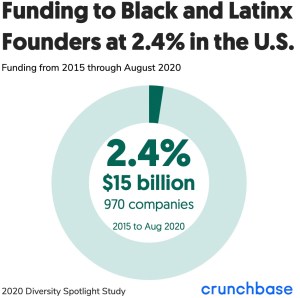
It’s widely understood that Black and Latinx founders receive not nearly as much funding as their white counterparts. Now, Crunchbase has shed some additional light on the situation. Here are some highlights from its 2020 Diversity Spotlight report.

Image Credits: Crunchbase

  • Since 2015, Black and Latinx founders have raised more than $15 billion, which represents just 2.4% of the total venture capital raised. 
  • In 2020, Black and Latinx founders have raised $2.3 billion, which represents 2.6% of all VC funding through August 31, 2020.
  • Since 2015, the top 10 leading VC firms in the U.S. have invested in around 70 startups founded by Black or Latinx people.
  • Andreessen Horowitz and Founders Fund are the two firms with the highest count of new investments in Black or Latinx-founded companies since 2015.

Gig Work


Uber engineer encourages people to vote no on Uber-backed Prop 22

Going against his employer, Uber engineer Kurt Nelson penned an op-ed on TechCrunch about why he’s voting against Prop 22. Prop 22 is a ballot measure in California that seeks to keep rideshare drivers and delivery workers classified as independent contractors. I caught up with Nelson after he published his op-ed to learn more about what brought him to the point of speaking out against Prop 22. 

“It was a combination of COVID affecting unemployment and health insurance for a bunch of people, getting close to the election and not having seen anyone who is really former Uber or Uber or former any gig companies saying anything,” Nelson told me. 

Plus, Nelson is on his way out from Uber — something that he’s been forthcoming about with his manager. He had already been feeling frustrated about the way Uber handled its rounds of layoffs this year, but the company’s push for Prop 22 was “the final nail in the coffin.”

Uber’s big arguments around why drivers should remain independent contractors is that it’s what drivers want and that it’d be costly to make them employees. Uber has said it also doesn’t see a way to offer flexibility to drivers while also employing them.

“I think it’d be really challenging,” Uber Director of Policy, Cities and Transportation Shin-pei Tsay told me at TC Sessions: Mobility this week. “We would have to start to ensure that there’s coverage to ensure that there’s the necessary number of drivers to meet demand. That would be this forecasting that needs to happen. We would only be able to offer a certain number of jobs to meet that demand because people will be working in set amounts of time. I think there would be quite fewer work opportunities, especially the ones that people really have said that they like.”

But, as Nelson notes, Silicon Valley prides itself on tackling difficult problems. 

“We’re a tech company and we solve hard problems — that’s what we do,” he said.

In response to his op-ed, Nelson said some of his co-workers have reached out to him — some thanking him for saying something. Even prior to his op-ed, Nelson said he was one of the only people who would talk about Prop 22 in any negative way in Uber’s internal Slack channels. And it’s no wonder why, given the atmosphere Uber has created around Prop 22. 

During all-hands meetings, Nelson described how the executive team wears Yes on 22 shirts or has a Yes on 22 Zoom background. Uber has also offered employees free Yes on 22 car decals and shirts, Nelson said.

As for Nelson’s next job, he knows he doesn’t “want to touch the gig economy ever again,” he said. “I know that for a fact. I’m done with the gig economy.”


Union Life


Kickstarter settles with NLRB over firing of union organizer

Kickstarter agreed to pay $36,598.63 in backpay to Taylor Moore, a former Kickstarter employee who was fired last year, Vice reported. Moore was active in organizing the company’s union, which was officially recognized earlier this year. As part of the settlement with the National Labor Relations Board, Kickstarter also agreed to post a notice to employees about the settlement on its intranet and at its physical office whenever they reopen. 

In September 2019, Kickstarter fired two people who were actively organizing a union. About a year later, the Labor Board found merit that Kickstarter unlawfully fired a union organizer.

NLRB files complaint against Google contractor HCL America

It’s been about a year since 80 Google contractors voted to form a union with U.S. Steelworkers. But those contractors, who are officially employed by HCL America, have not been able to engage in collective bargaining, according to a new complaint from the National Labor Relations Board, obtained by Vice.

The complaint states HCL has failed to bargain with the union and has even transferred the work of members of the bargaining unit to non-union members based in Poland. The NLRB alleges HCL has done that “because employees formed, joined and assisted the Union and engaged in concerted activities, and to discourage employees from engaging in these activities.”


News bites


How Roblox completely transformed its tech stack

Picture yourself in the role of CIO at Roblox in 2017.

At that point, the gaming platform and publishing system that launched in 2005 was growing fast, but its underlying technology was aging, consisting of a single data center in Chicago and a bunch of third-party partners, including AWS, all running bare metal (nonvirtualized) servers. At a time when users have precious little patience for outages, your uptime was just two nines, or less than 99% (five nines is considered optimal).

Unbelievably, Roblox was popular in spite of this, but the company’s leadership knew it couldn’t continue with performance like that, especially as it was rapidly gaining in popularity. The company needed to call in the technology cavalry, which is essentially what it did when it hired Dan Williams in 2017.

Williams has a history of solving these kinds of intractable infrastructure issues, with a background that includes a gig at Facebook between 2007 and 2011, where he worked on the technology to help the young social network scale to millions of users. Later, he worked at Dropbox, where he helped build a new internal network, leading the company’s move away from AWS, a major undertaking involving moving more than 500 petabytes of data.

When Roblox approached him in mid-2017, he jumped at the chance to take on another major infrastructure challenge. While they are still in the midst of the transition to a new modern tech stack today, we sat down with Williams to learn how he put the company on the road to a cloud-native, microservices-focused system with its own network of worldwide edge data centers.

Scoping the problem

Why Amazon and Panasonic are betting on this battery recycling startup

JB Straubel, the Tesla co-founder and former CTO, is often cast as the humble and pioneering engineer, the quiet one who toiled away in the background for 15 years on some of the company’s most important technologies. That characterization — which intensified as the hype and media attention on Tesla CEO Elon Musk grew — tells a half truth.

Straubel isn’t prone to self-promotion, or even progress reports. His personal Twitter account, nor the one dedicated to his startup, Redwood Materials, has ever even tweeted. And he does like toiling away on complex problems.

But his understated delivery obfuscates his ambitions and plans for Redwood Materials, the recycling startup that he co-founded in 2017. Straubel envisions and is actively working to make Redwood one of the world’s major battery recycling companies, with numerous facilities strategically scattered throughout the globe.

“This is something that is a major industry and a major problem, and it’s a big part of why I want to spend my time on it,” Straubel said on TechCrunch’s virtual stage Wednesday at TC Sessions: Mobility. “I want to do something that can actually make a really material impact on sustainability in the world. And you need scale to do that. So I am very excited to keep growing this and to be one of, if not the major battery recycling company in the world. And eventually, one of the large battery materials companies in the world.”

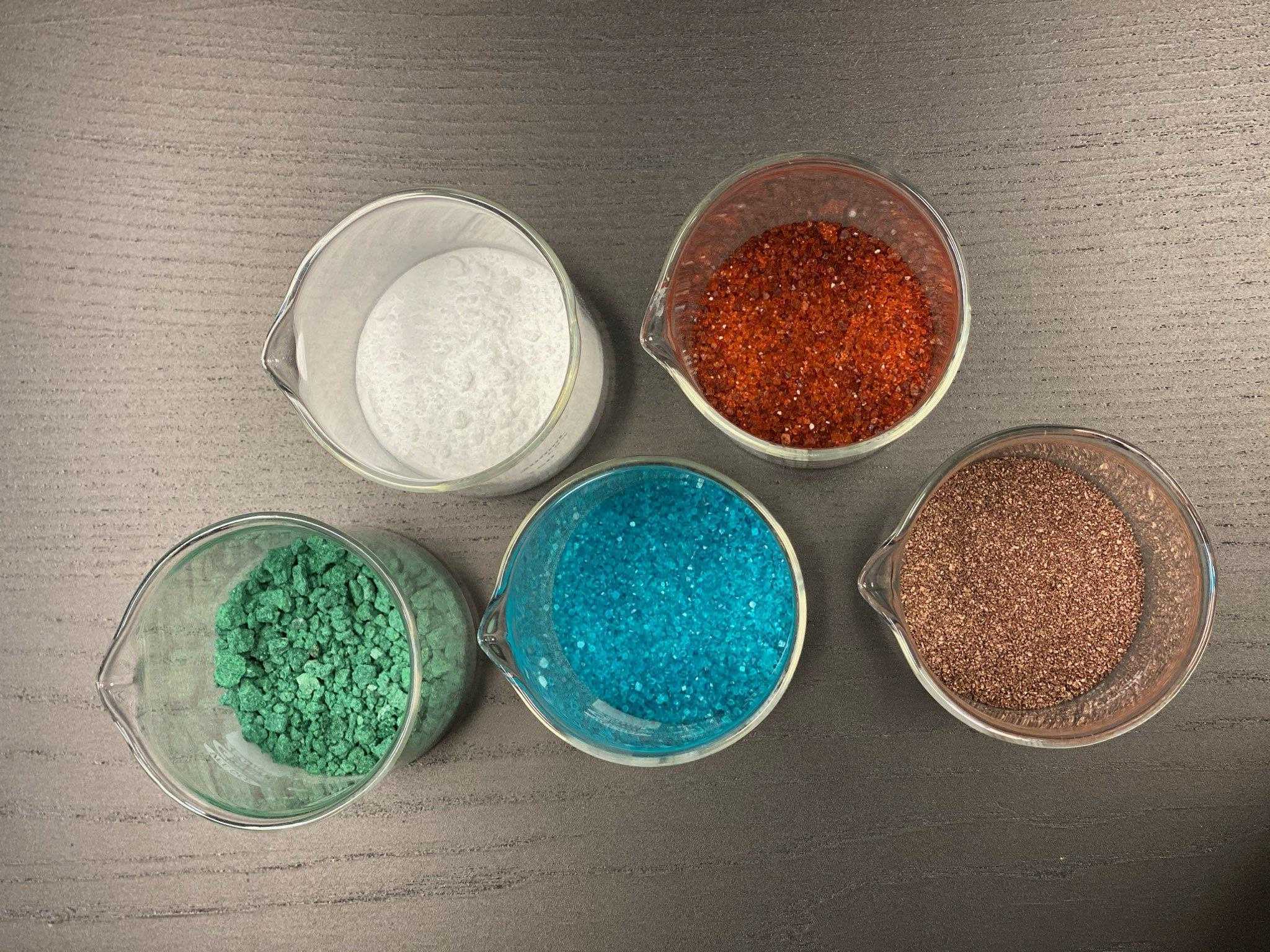
The Carson City, Nevada-based company, which Straubel runs, is aiming to create a circular supply chain. The company has a business-to-business strategy, recycling the scrap from battery cell production as well as consumer electronics like cell phone batteries, laptop computers, power tools, power banks, scooters and electric bicycles. Redwood collects the scrap from consumer electronics companies and battery cell manufacturers like Panasonic. It then processes these discarded goods, extracting materials like cobalt, nickel and lithium that are typically mined, and then supplies those back to Panasonic and other customers. Redwood Materials has a number of customers, and has only publicly disclosed that it is working with Panasonic and Amazon.
redwood materials

Image Credits: Redwood Materials

While Redwood Materials is a B2B company, its business model could someday evolve. Interest has been so high that Straubel is now contemplating whether it should also expand into a more consumer-facing business as well. Redwood may never offer collection sites where consumers can drop off old smartphones and other consumer electronics. However, the number of inquiries from local government officials, as well as consumers looking for options to recycle electronics, including the batteries in EVs, has prompted Straubel to at least consider the possibility.

What is known is that Straubel sees numerous facilities — perhaps dozens — getting set up regionally, and in some cases co-located with factories if the customer is large enough. The company hasn’t disclosed where those future facilities will be located.

The company has two recycling and processing facilities in Carson City. And while that hardly qualifies it as one of the world’s largest battery recycling companies, Redwood is already operating at the “gigawatt scale.”

“We’ve been able to grow extremely quickly and to ramp up our capacity and I expect that will follow roughly the scale of lithium-ion production, lagging by a few years,” he said.

To put Straubel’s words into context, consider the Gigafactory that Panasonic operates with Tesla in Sparks, Nevada. Today, the factory has the capacity to produce 35 gigawatt hours of lithium-ion battery cells annually. If Straubel hit the scale he’s shooting for, Redwood would be supplying Panasonic with enough materials to match that production capacity. Reaching that goal would fundamentally change Panasonic’s supply chain away from minerals that had been mined and toward those recycled by Redwood. Those recycled materials would come from Panasonic’s production scrap as well as other sources of consumer electronics.

Celina Mikolajczak, vice president of battery technology at Panasonic Energy of North America, said it would be foolish for the company to ignore the recycling supply.

“We’ve already dug these metals out of the ground, we’ve put them in cells, they’re sitting there,” Mikolajczak said during the joint interview with Straubel at TC Sessions: Mobility. “And yeah, it’s a little difficult to handle cells, they process a little differently than a typical metal ore, right, but at the same time, we have a much higher concentration of the metals we need than a typical metal ore. So it makes total sense to go after recycling and to do it aggressively because there’s a lot of it, there’s a lot of batteries already out in the world.”

Second-life batteries

Today, the majority of lithium-ion batteries used in smartphones and other consumer electronics are not recycled and instead either sit forgotten in the owner’s junk drawer or enter the waste stream and end up in a landfill. Electric vehicles have a much longer shelf life, so to speak. But eventually batteries used in electric vehicles will pose a challenge for automakers, as well as communities grappling with the waste.

Straubel wants Redwood to be a part of that end-of-life solution for electric vehicle batteries as well.

“The second-life issue and how these batteries are recovered it’s really interesting and there’s a lot of different ideas around about how batteries can go into a whole second application,” Straubel said, noting that Redwood is not working directly on second-life use cases. “It’s great if we can get more useful life on these devices by reusing them for a period of time, but it only delays the inevitable; they eventually need an appropriate disposal, and recycling solution.”

Straubel said he wants Redwood to be that backstop.

There are a number of automakers that have talked about repurposing EV batteries for energy storage. But the details of how an OEM might recapture those batteries back from consumers is scant. Straubel wants Redwood to be an independent company so it can partner with all OEMs producing electric vehicles and provide its materials across the entire industry.

Redwood has never talked publicly about which automakers it might or already is partnering with. However, looking across the EV landscape a few likely partners emerge. For instance, electric vehicle startup Rivian has never announced plans to work directly with Redwood Materials. But the companies do share Amazon as an investor and customer. Rivian CEO RJ Scaringe and Straubel not only know each other, they share a common vision.

Scaringe has talked about plans for second-life batteries — albeit without a lot of detail yet — as well as what happens at the end of a battery’s life. Rivian doesn’t have any vehicles on the road today, so it’s a seemingly distant problem. That changes in 2021 when the company will bring an electric pickup truck and SUV to the consumer market, as well electric vans to Amazon. Ultimately, Rivian has a contract to deliver 100,000 electric vans to Amazon.

“I’m really excited about what JB [Straubel] is doing because we’d love to have these vehicles be a feedstock, and the batteries from these vehicles be a feedstock to then begin another start of lifecycle for another set of batteries and electric vehicles,” Scaringe said in an interview last month at the Bloomberg Green Summit, in which he joined Straubel and Ross Rachey, director of Global Last Mile Fleet and Products at Amazon, on a panel. “The ability to control this essentially as a closed ecosystem allows us to learn and build the muscle memory for this as the whole industry starts to shift not only to electrification, but different methods of consumption as well.”

All about scale

Straubel said he isn’t interested in taking Redwood Materials public, certainly not in the short term.

“For better or worse, I had a front row seat to some of the less efficient parts of being a public company,” Straubel said, a comment directed to Tesla’s public status. “It’s nothing that I’m rushing toward. I think that being public is somehow equated with success, which doesn’t really make sense.”

He said his goal is for Redwood to make an impact, do something meaningful at an industrial scale and generate returns — aka be profitable.

“It’s not about going public quickly, or, you know, trying to give a quick return to investors or something like that,” Straubel said. “This is what I really want to spend my time on. And I see this as a very long-term growth mission that is likely to span decades.”
Smartphone discarded consumer electronics

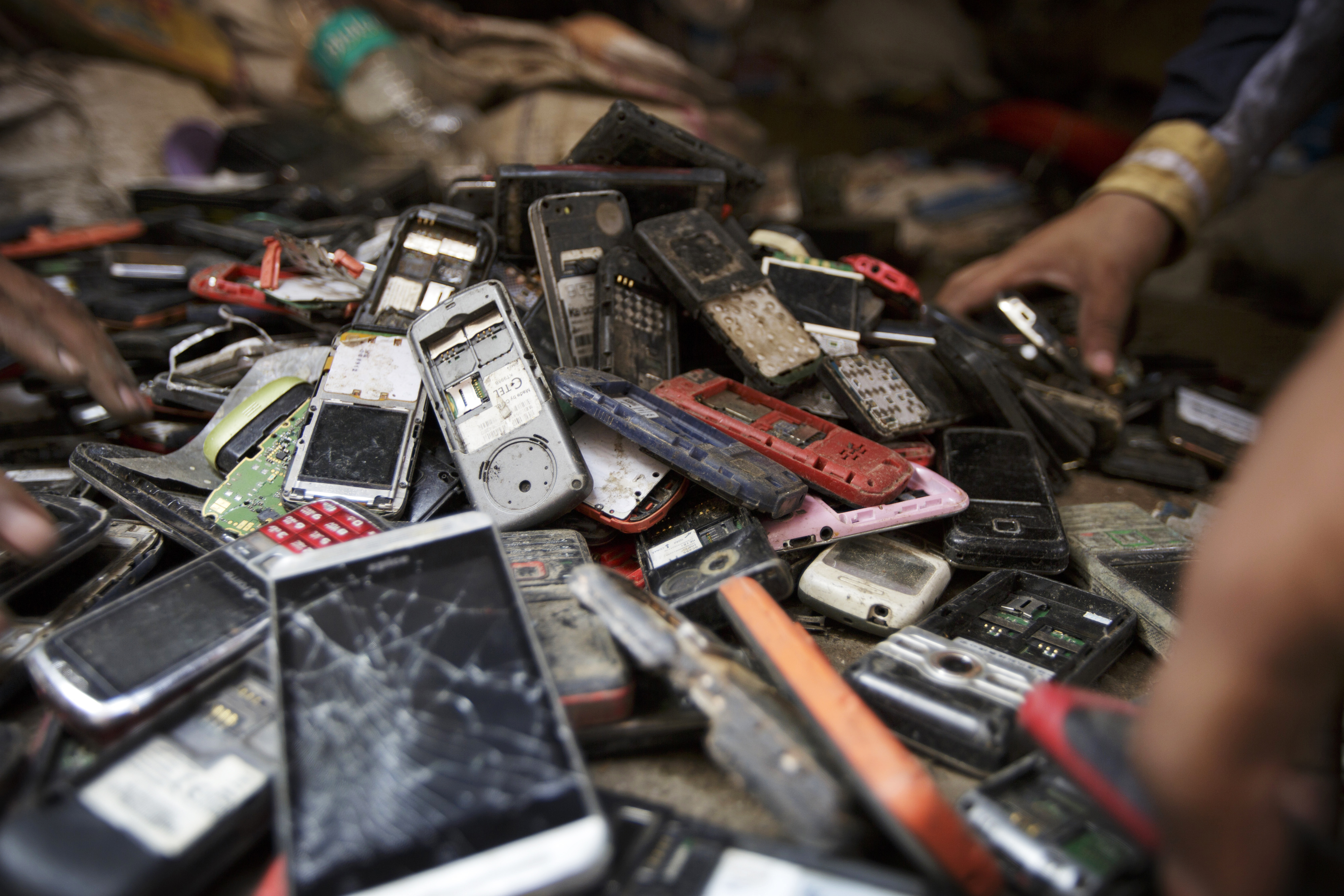
Workers sort through a pile of used mobile phones in New Delhi, India. (Image Credits: Getty Images / Kuni Takahashi/Bloomberg)

Straubel talks a lot about scale, both in terms of his vision for Redwood as well as the current state of e-waste sitting in junk drawers of U.S. consumers. It was the scale of the Gigafactory, which is used by Panasonic to make battery cells and by Tesla to make the battery packs and electric motors for its vehicles, that partially drove Straubel to start Redwood in the first place.

“As the world electrifies transportation it needs so many different materials and the supply chain upstream of the factory is, I think, often under appreciated,” he said. “The Gigafactory is a little bit like an iceberg — there’s so much of it that’s kind of below the surface, in the suppliers and in the mines and refineries and all the different things that need to feed into it that you don’t typically see.”

Parts of the supply chain became more of a bottleneck as the Gigafactory ramped, he added.

“You certainly see Tesla focusing more on this, I think rightly so,” Straubel said, a nod to Musk’s recent public comments about needs to focus on the broader supply chain of materials such as nickel. “That was a very interesting area that I thought wasn’t getting as much attention and end-of-life and recycling as a part of that material supply chain is just an incredibly powerful space, one where I think we can have a major impact on the sustainability of creating batteries.”

Facebook and Instagram will pin vote-by-mail explainers to top of feeds

Starting this weekend, everyone of voting age in the U.S. will begin seeing informational videos at the top of Instagram and Facebook, offering tips and state-specific guidance on how to vote through the mail. The videos will be offered in both English and Spanish.

The vote-by-mail videos will run on Facebook for four straight days in each state, starting between October 10 and October 18 depending on local registration deadlines. On Instagram, the videos will run in all 50 states on October 15 and October 16, followed by other notifications with vote-by-mail information over the next two days.

Facebook vote-by-mail video

Image via Facebook

Facebook vote-by-mail video

Image via Facebook

The videos let voters know when they can return a ballot in person, instruct them to sign carefully on additional envelopes that might be required and encourage returning ballots as soon as possible while being mindful of postmarking deadlines. Facebook will continue providing additional state-specific voting information in a voting information center dedicated to the 2020 election.

Even more than in past years, app makers have taken up the mantle of nudging their users to vote in the U.S. general election. From Snapchat to Credit Karma, it’s hard to open an app without being reminded to register — and that’s a good thing. Snapchat says it registered around 400,000 new voters through its own reminders and Facebook estimates that it helped 2.5 million people register to vote this year.

Voting rights advocates are concerned that 2020’s rapid scale-up of vote-by-mail might lead to many ballots being thrown out — a worry foreshadowed by the half a million ballots that were tossed out in state primaries. Some of those ballots failed to meet deadlines or were deemed invalid due to other mistakes voters made when filling them out.

In Florida, voters that were young, non-white or voting for the first time were twice as likely to have their ballots thrown out compared to white voters in the 2018 election, according to research by the ACLU.

Adding to concerns, state rules vary and they can be specific and confusing for voters new to voting through the mail. In Pennsylvania, the most likely state to decide the results of the 2020 election, new rules against “naked ballots” mean that any ballot not cast in an additional secrecy sleeve will be tossed out. In other states, secrecy sleeves have long been optional.

Facebook gets ready for November

Since 2016, Facebook has faced widespread criticism for rewarding hyper-partisan content, amplifying misinformation and incubating violent extremism. This week, the FBI revealed a plot to kidnap Michigan Governor Gretchen Whitmer that was hatched by militia groups who used the platform to organize.

Whether the public reveal of that months-long domestic terrorism investigation factored into its decisions or not, Facebook has taken a notably more aggressive posture across a handful of recent policy decisions. This week, the company expanded its ban on QAnon, the elaborate web of outlandish pro-Trump conspiracies that have increasingly spilled over into real-world violence, after that content had been allowed to thrive on the platform for years.

Facebook also just broadened its rules prohibiting voter intimidation to ban calls for poll watching that use militaristic language, like the Trump campaign’s own effort to recruit an “Army for Trump” to hold its political enemies to account on election day. The company also announced that it would suspend political advertising after election night, a policy that will likely remain in place until the results of the election are clear.

While President Trump has gone to great lengths to cast doubt on the integrity of vote-by-mail, mailed ballots are a historically very safe practice. States like Oregon and Colorado already conduct their voting through the mail in normal years, and all 50 states have absentee voting in place for people who can’t cast a ballot in person, whether they’re out of town or overseas serving in the military.

Chinese browser Tuber offers a glimpse beyond the Great Firewall — with caveats

China now has a tool that lets users access YouTube, Facebook, Twitter, Instagram, Google and other internet services that have otherwise long been banned in the country — selectively.

Called Tuber, the mobile browser debuted on China’s third-party Android stores this week, with an iOS launch in the pipeline. The landing page of the app features a scrolling feed of YouTube videos, with tabs at the bottom that allow users to visit other mainstream Western internet services.

While some celebrate the app as an unprecedented “opening up” of the Chinese internet, such as this state media journalist, others quickly noticed the browser comes with a veil of censorship. YouTube queries for politically sensitive keywords such as “Tiananmen” and “Xi Jinping” returned no results on the app, according to tests done by TechCrunch.

Using the app also comes with liabilities. Registration requires a Chinese phone number, which is tied to a person’s real identity. The platform could suspend users’ accounts and share their data “with the relevant authorities” if they “actively watch or share” content that breaches the constitution, endangers national security and sovereignty, spreads rumors, disrupts social orders or violates other local laws, according to the app’s terms of service.

Rather than blocking sites beyond the purview of Beijing and tracking the “illegal” use of VPNs to circumvent the Great Firewall, China now has an app that gives its people a glimpse into the Western internet — with the caveat that their digital footprint may be under close watch by the authorities.

Much about the service remains unclear, such as its origin, the motive behind it and the technology it uses to get past China’s elaborate censorship engine. The operator of the app’s official website (????????????) is 70% owned by a subsidiary of Qihoo 360, a Chinese cybersecurity software giant, according to business registration information.

If Tuber appears to target YouTube watchers in China with its video-first interface, its sister product Sgreennet, available on both PC and mobile, is a regular web browser connecting users to censored overseas sites. Qihoo 360 itself has been in the Chinese browser market since 2008.

Based on VPN encryption technologies, Sgreennet allows “no one to track, collect or share a user’s private data,” the app claims, a pledge that will likely draw skepticism amongst those familiar with Qihoo 360’s tainted reputation. Musical.ly’s early investor Fu Sheng alleged back in 2010 that Qihoo 360 logged user data including passwords. Software maker Sogou sued the company in 2013 over anticompetitive tactics. The most known and notorious incident is its prolonged battle with Tencent a decade ago that disrupted hundreds of millions of users’ activity.

For an annual fee of around $50, Sgreennet enables users to skip ads, stream Netflix content, download high-definition videos, perks that will likely touch a nerve with the likes of YouTube.

Within two days, Tuber has attracted over 5 million downloads just on Huawei’s Android app store. A now-banned article introducing the app went viral on WeChat on Friday. It’s safe to say tens of millions in China have already used the app to sample a heavily censored Western internet.

It’s unclear whether Beijing granted Qihoo 360 the green light to pursue the browser project. It’s unsurprising if that was the case, given two of the firm’s executives are key members of the Cybersecurity Association of China, an organization aiming to align industry and academia around the government’s cyber governance issues, including censorship.

The story was updated on October 9, 2020 with background information.

Top mobility VCs on the risks and rewards in partnering with giants like Amazon

At our recent TechCrunch Mobility event, we spoke with Amy Gu, the founder and managing partner of Hemi Ventures, Olaf Sakkers, a founding partner at Maniv Mobility and Reilly Brennan, the founding general partner at Trucks VC. We discussed a wide range of things, from frayed U.S.-China relations, to the mobility industry’s eager embrace of SPACs as a way to get capital-intensive companies into the public market.

We also talked partnerships. Specifically, we wanted to know how one determines whether a corporate leviathan that asks for information from a young startup — and maybe even invests in it — is really a friend or foe.

Our sense from the VCs is that mobility startups no longer have a choice but to partner with bigger and deeper-pocketed companies.

For example, Brennan wrote one of the first checks to autonomous shuttle company May Mobility and became its first board member. He suggested that the company, which has faced numerous engineering and operational challenges, had ambitions of going it alone when it was founded in 2017. At the time, other companies were operating in the world with apparent plans to remain independent, including self-driving software startups Cruise Automation and NuTonomy.

Today, Cruise is now a subsidiary of GM, and NuTonomy sold to automotive supplier Delphi four years after it launched. “If you were to [launch] a structured robo-taxi service today, it’s really hard to do without a big manufacturing partner,” said Brennan. Indeed, he went on to note that last December, Toyota Motor Corp. led a $50 million Series B round in May Mobility, advising attendees to “stay tuned” for the fruits of that partnership.

Gu agrees the “partner structure” is the path forward for startups and during the event cited numerous reasons why, including the fact that many of the larger companies in the automotive space have continued work nearly apace during the pandemic. She pointed to one of Hemi’s portfolio companies, Ample, a startup working on a battery-swapping technology that recently announced a partnership with Uber (which has committed to becoming a zero-emission platform by 2040).

Changing how retweets work, Twitter seeks to slow down election misinformation

Twitter announced Friday a major set of changes to the way its platform would work as the social network braces for the most contentious, uncertain and potentially high-stakes election in modern U.S. history.

In what will likely be the most noticeable change, Twitter will try a new tactic to discourage users from retweeting posts without adding their own commentary. Starting on October 20 in a “global” change, the platform will prompt anyone who goes to retweet something to share a quote tweet instead. The change will stay in place through the “end of election week,” when Twitter will decide if the change needs to stick around for longer.

Gif via Twitter

“Though this adds some extra friction for those who simply want to Retweet, we hope it will encourage everyone to not only consider why they are amplifying a Tweet, but also increase the likelihood that people add their own thoughts, reactions and perspectives to the conversation,” Twitter said of the change, which some users may see on Twitter for the web starting on Friday.

Twitter has in recent months been experimenting with changes that add friction to the platform. Last month, the company announced that it would roll out a test feature prompting users to click through a link before retweeting it to the platform at large. The change marks a major shift in thinking for social platforms, which grew aggressively by prioritizing engagement above all other measures.

how it started how it's going pic.twitter.com/hW53CYDfio

— Twitter Comms (@TwitterComms) October 9, 2020

The company also clarified its policy on election results, and now a candidate for office “may not claim an election win before it is authoritatively called.” Twitter will look to state election officials or projected results from at least two national news sources to make that determination.

Twitter stopped short of saying it will remove those posts, but said that it will add to any content claiming premature victory a misleading information label pointing users toward its hub for vetted election information. The company does plan to remove any tweets “meant to incite interference with the election process or with the implementation of election results,” including ones that incite violence.

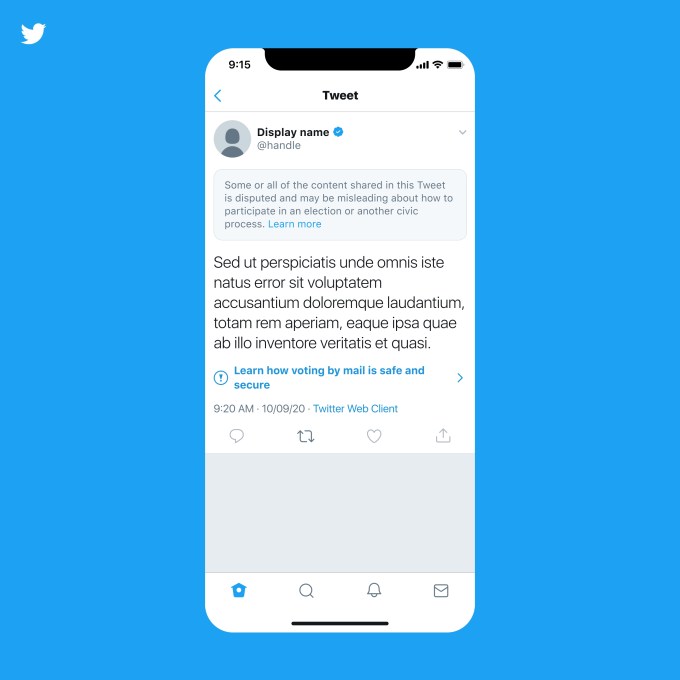
Next week, Twitter will also implement new restrictions on misleading tweets it labels, showing users a pop-up prompt linking to credible information when they go to view the tweet. Twitter applies these labels to tweets that spread misinformation about COVID-19, elections and voting, and anything that contains manipulated media, like deepfakes or otherwise misleading edited videos.

The company will also take additional measures against misleading tweets that get a label when they’re from a U.S. political figure, candidate or campaign. To see a tweet with one of its labels, a user will have to tap through a warning. Labeled tweets will have likes, normal retweets and replies disabled.

These new measures will also apply to labeled tweets from anyone with more than 100,000 followers or tweets that are getting viral traction. “We expect this will further reduce the visibility of misleading information, and will encourage people to reconsider if they want to amplify these Tweets,” Twitter said in its announcement.

Twitter warning on labeled tweet

Image via Twitter

Twitter will also turn off recommendations in the timeline in an effort to “slow down” how fast tweets can reach people from accounts they don’t follow. The company calls the decision a “worthwhile sacrifice to encourage more thoughtful and explicit amplification.” The company will also only allow trending content that comes with additional context to show up in the “for you” recommendation tab in an effort to slow the spread of misinformation.

The company acknowledges that it plays a “critical role” in protecting the U.S. election, adding that it had staffed up dedicated teams to monitoring the platform and “respond rapidly” on election night and in the potentially uncertain period of time until authoritative election results are clear.

Odell Beckham Jr. turned to Mojichat’s advertising features during his inaugural live-stream

Mojiit, the Los Angeles-based company behind the popular avatar generation service Mojichat, has landed one of its highest-profile users with the launch of Odell Beckham Jr.’s live stream over the weekend.

As Odell Beckham Jr. did his first live stream with the gaming superstar Dr. Disrespect, he turned to Mojichat to create the pop-up onscreen emote that danced above a logo from Scuf Gaming, a retailer of customized controllers.

Customized, branded emotes are one of the ways that companies are trying to make it easier for live-streamers to make money off of their shows. Companies like Mochjichat argue that it’s a more elegant solution for gamers to use, because it doesn’t take viewers away from the live stream, where they could potentially miss some of the action.

Typically, streamers rely on advertising revenue from pre-roll, mid-roll and post-roll advertising, according to Mojichat co-founder Jeremy Greene. Alongside his wife, Janelle, Greene built Mojichat into one of the premier names in avatar development. As competitors crowded in, the company has been diversifying its products to allow for influencers to begin using their digital avatars as a monetization source.

“No streamer… wants to run a pre-roll,” said Greene. “The first thing about Mojichat that made us very successful from the very beginning, you have to hunt down someone to make your custom emotes for you.”

Earlier this year, the company partnered with DoorDash on a similar activation for a concert to raise money for the Boys and Girls Club as part of a broad celebrity effort to raise money to alleviate food insecurity for families affected by the COVID-19 outbreak.

“Any time someone sends a communication, that will trigger an alert that floats as a Mojichat animation on top of the screen,” Greene said of the earlier activation. 

The way that Greene describes the service — and Janelle and his larger vision for the company — is to be the next generation of adserver for the live-streaming market.

“My plan is to become the avatar solution for all of Unity,” Greene told me earlier. “We will offer up our platform to every single gaming platform or mobile developer to plug and play… I would consider us… we’re like the Google Admob for live stream.”

Companies like Streamlabs are integrating Mojichat’s features into their streaming offerings. and the work with Dr. Disrespect and Odell Beckham Jr. show just how much demand there is for these types of offerings.

“The avatar space is going to be won in the gaming community,” Greene said.

Mojichat already has 12,000 streamers using the technology right now, and through a partnership inked earlier this year the company expects to push more ads through the service.

“Nobody wants to sit on a stream for 15 hours a day,” said Greene.

“It’s really wrong that streamers can’t make as much money as YouTubers… a streamer can spend all day on Twitch and they are forced to run these pre-rolls… [meanwhile] Jake Paul can upload a video to YouTube and make $300,000… That’s really why I built Mojichat… I wanted to make gamers’ lives easier… We are going to build custom software for gamers that makes their lives easier.”

Polestar CEO defends the Polestar 2’s recall and 233-mile EPA rating

Polestar is a young automaker spun out of Volvo and Geely. Now, just four years old, it has two cars on the market with more launching soon. Like many startups, the company is weathering early storms coming from government regulators and early recalls.

Earlier this week, the EPA released its findings on the Polestar 2’s electric range, certifying it as capable of traveling 233 miles on a charge. That’s about 90 miles less on a charge than the competing Tesla Model 3. Read our early impressions here.

Polestar CEO Thomas Ingenlath spoke at TechCrunch Sessions: Mobility shortly after the EPA released its range guidance. In short, he said Polestar knows drivers see real-world results that exceed the EPA’s range.

“We know what the car does in reality,” Ingenlath said. “We know in reality, what might look like a very big difference, is not that much of a difference in real life. We think it’s definitely sufficient for day-to-day life as an EV. It’s one of our versions, and we will be adding different variants to the Polestar 2 that will have a higher EPA [rating]. I think [the range] is absolutely in the ballpark of competing EVs that is really good for you 365 days a year.”

Ingenlath concedes his company is not beating Tesla in range, but encourages side-by-side comparisons in the real world. What looks like a large difference on paper is much less in practice. And he says a longer-range version is on the way.

“Next year, in 2021, we have in our plans to come out with a single motor version,” Ingenlath said. “This will, of course, provide a better range with the same battery. And, of course, along the way, we’ll have software improvements that will give more efficiency with the same kilowatt-hours battery.

“We are on a journey,” he said. “That is where we start, and it will get better from month to month.”

Ingenlath also addressed the Polestar 2’s recent full recall over vehicles that abruptly stopped while driving. “This happened in very, very rare cases,” he said, adding there are only 2,200 Polestar 2’s on the market, and none of the reported cases happened in the United States. None of the affected vehicles were involved in an accident.

The issue is being fixed with a software update.

“We have many things to learn, and as a company, improve,” Ingenlath said. “We are a startup that’s fresh out. And of course, you cannot expect everything to go smoothly. We have to improve, and our customers have to be with us on the way. And I think it’s a really great standard that the car industry, actually, does very early recalls to make sure no one gets into a problem.”

He says he doesn’t see a big issue with the early recall. Instead, he says, he’s now focusing on ensuring the company excels at customer service when interacting with a Polestar 2 owner around the recall.


Full Panel — Exclusive to Extra Crunch subscribers


YCharts sells to PE firm in all-cash transaction as it looks to pass $15M ARR this year

This morning, YCharts, a financial data and charting service, announced that it has been purchased by LLR Partners, a private equity firm.

The companies are dubbing the transaction a “growth recapitalization,” indicating that the smaller firm won’t be stripped of its talent in hopes of driving near-term positive EBITDA. The deal was an all-cash transaction, TechCrunch confirmed.

Digging into YCharts itself, the company told TechCrunch via email that it expects to “surpass” $15 million in annual recurring revenue (ARR) this year, and that it has been growing top line at a compound annual growth rate of 30 to 40% for “the past several years.”

Those figures imply that YCharts did not sell for cheap. At the market’s current multiples, YCharts was likely worth between 10 and 20x times its ARR, making the deal (presuming, say, $13.5 million ARR at the time of the sale) worth between $135 million and $270 million, unless LLR managed to secure a discount, or the firm’s economics were worse than we’d imagine from our current remove.

The companies declined to share details of the transaction, including price.

As a somewhat long-term YCharts user — the startup set up custom colors in my account so that I could share charts in TechCrunch green, which was fun — the deal is notable in that I’ve come to appreciate what the service is capable of; it’s a great tool to create charts that encompass a wealth of financial data to make a clear point, like the historical trends in Tesla’s price/sales ratio compared to other automotive players, for example.

Financial tooling that is accessible, and shareable, is rare in our Bloomberg world. So here’s to hoping that  the transactions promised investment into YCharts bears out.

Turning to the why, I asked YCharts why it didn’t merely raise external capital instead of selling itself. YCharts’ CEO Sean Brown wrote that he’s “found that capital is easy to get,” but that “LLR Partners provides [YCharts] with much more than just capital.” The investing group, Brown continued, shares his company’s vision, has “strong domain experience,” along with “a dedicated team focused on fintech, and a ton of relevant strategic and operational expertise.”

The CEO also stressed LLR’s prior investments into other fintech companies, and said that “as part of the buyout of our existing shareholders, LLR will be funding capital to YCharts’ balance sheet to support continued investment in product and sales [and] marketing.”

YCharts raised capital as an independent company across a number of rounds, including a 2010 Series A led by Hyde Park Angels and I2A Fund, and a Series B and C led by Morningstar. The company had around $15 million in known capital raised, according to Crunchbase data.

Porsche is researching synthetic fuels to make gas-powered cars sustainable

The road to sustainable vehicles likely ends at electric cars, yet the route to this goal isn’t clear. There are multiple ways to get there, and Porsche is looking at synthetic fuels as a potential path. These so-called eFuels are produced from CO2 and hydrogen. If produced using renewable energy, they can help vehicles powered by internal combustion engines (ICE) become more sustainable before the end of their life.

Earlier this week, Porsche AG’s Detlev von Platen spoke to this alternative fuel at TechCrunch Sessions: Mobility.

Looking at Porsche’s current lineup, it’s easy to see where the automaker is heading: Electric sports cars. Right now, in 2020, the automaker has one electric sports sedan and an electric version of its small SUV coming soon. The automaker has a handful of plug-in hybrids available, too. The automaker says half of its vehicles will be electric by 2025.

“We are seeing a lot of new regulations coming up everywhere in the world,” Detlev von Platen, member of the Executive Board, Sales and Marketing, said at TC Sessions: Mobility 2020. “California is one example. Europe and China will become even more complicated in the future, and we see the transformation coming up very quickly. And to a certain point of time, developing and producing combustion engines and cars around this technology will become even more expensive than a battery vehicle. Things are moving very fast.”

Governments worldwide are using aggressive regulations to push automakers toward an electric future, though that goal doesn’t address the millions of gasoline-powered vehicles already on the road.

Von Platen explains that it’s Porsche’s goal to reach the commitments laid out by the Paris Climate Accord ahead of schedule. To do so means reducing the environmental impact of the entire car industry, and Porsche sees eFuels as a way to reduce the environmental impact of current and future internal combustion vehicles. If produced using renewable energy, it would result in ICE-powered vehicles being powered by a renewable source fuel.

Porsche is in a unique position: 70% of the vehicles it ever produced are still on the road. Their owners are generally enthusiastic and unlikely to trade-in their classic air-cooled Porsche coupes for an electric vehicle. The company sees eFuel as a way to reduce the environmental impact of those vehicles while keeping them on the road.

This new type of synthetic fuel is produced out of hydrogen and CO2. Porsche says that this fuel shares properties with kerosene, diesel and gasoline produced from crude oil in its most basic term.

“This technology is particularly important because the combustion engine will continue to dominate the automotive world for many years to come,” said Michael Steiner, member of the Executive Board, Research and Development, in a statement released in September. “If you want to operate the existing fleet in a sustainable manner, eFuels are a fundamental component.”

Synthetic fuels were tried in the past and gained little long-term traction. Porsche wants to influence this new breed of synthetic fuel specifications to ensure the eFuel works within Porsche’s performance engines. “When E10 came onto the market, the blend had some disadvantages. It must be different this time: it must have advantages,” Steiner said.

“We started a pilot program to talk about the industrialization of this fuel technology to make it cheaper, as it is still quite expensive compared to fossil fuels,” von Platen said. “If this works in the future, we can have something that will increase the speed of creating sustainability besides battery technology.”


Full Panel — Exclusive to Extra Crunch subscribers


Funding for female founders falls to 2017 levels as pandemic shakes up the VC market

So much for progress.

New data out this week from PitchBook indicates that the number of rounds raised by female-founded and co-founded companies fell year-over-year, with dollars invested in those rounds collapsing to 2017-era levels.


The Exchange explores startups, markets and money. Read it every morning on Extra Crunch, or get The Exchange newsletter every Saturday.


It’s a disappointing quarter that comes after a few years in which female founders saw an increase in the amount of capital they were able to raise. In 2016, PitchBook data shows quarterly results for female founders totaling around 100 to 125 rounds, and between $300 and $400 million in value. By 2019, those figures rose to 150 to 200 rounds per quarter, worth between $700 million and $950 million.

To see Q3 2020 manage just 136 rounds worth just $434 million is a sharp disappointment.

The depressing results come not during a time of sharply lower aggregate venture capital results, notably. Recent data concerning Q3 2020 compiled by PwC indicates that the quarter was relatively rich. Certainly, overall deal volume in the United States is down slightly compared to year-ago periods, but female founders fared worse.

In short, a fear that well-known seed investor Charles Hudson discussed with TechCrunch during an Extra Crunch Live session back in April has come true. Let’s talk about it.

A diversity downturn?

Cards on the table, I think it’s better when venture capital is more diversely distributed. Why? Because when there’s more general access to funds, we’ll see a more varied set of products built to attack a more diverse set of issues and problems. Even more, venture capital can be a pathway to financial success for founders and employees, so investing it in all sorts of folks instead of one particular demographic set can spread the wealth around more equitably.