Free-to-play gaming giant Roblox confidentially files to go public

The gaming company Roblox announced today that it had confidentially filed paperwork with the SEC to make its public debut.

In February, the company, which operates a free-to-play gaming empire with tens of million of users, was valued at $4 billion after a Series G funding round led by Andreessen Horowitz . The company has raised more than $335 million in venture capital funding, according to Crunchbase.

The company has not detailed the number of shares it plans to offer and furthermore notes in standard legalese that their timely debut is “subject to market and other conditions.” After a slow 2019 for tech IPOs the rebound of public markets in mid-pandemic 2020 has provided an awfully wide window for tech startups reaching for their debuts.

In the games space, we recently saw the debut of Unity Technologies, which makes a popular game engine that developers use to build and monetize gaming titles.

Roblox offers an interesting sell to both consumers and developers, shipping a free-to-play vision of the future which pushes developers away from graphics-intense game design toward building content that can be played on a wide variety of devices. The games company has been more successful than most in translating a first-party experience’s success into a robust developer network. Roblox’s platform has been particularly successful with young audiences.

Bumble balances gender representation of C-suite with two new hires

Women-friendly dating and networking app Bumble announced today it’s expanding its C-suite with two new hires: Anu Subramanian as Bumble’s chief financial officer, who hails from Univision, and Selby Drummond as chief brand officer, who is joining from Snap. The additions also create something of a milestone for Bumble, as the company can now claim it has equal male-to-female representation across its C-suite, which is, unfortunately, still unusual for a company of Bumble’s size.

Before the new hires, Bumble’s C-suite included CEO Whitney Wolfe Herd, Chief Strategy Officer Sarah Jones Simmer, General Counsel Mariko O’Shea, Chief of Staff Caroline Roache, President Tariq Shaukat, CMO Dominic Gallello, Chief Product Officer Miles Norris, CTO Ronen Benchetrit, CCO Robbie McKay and Chief People Officer Tran Taylor.

Subramanian is joining Bumble from Univision Digital, where she had served as the senior vice president and chief financial officer. In this position, she helped lead Univision’s digital assets, including its direct-to-consumer business. Before Univision, Subramanian had worked at VICE Media, where she was the chief financial officer of the company’s global digital business. She also worked in the past at Scripps Networks in various roles, including CFO of digital.

Drummond, meanwhile, had been Snapchat’s first-ever global head of Fashion and Beauty Partnerships. Her work at Snap included leading strategy and launch efforts for Snapchat’s new fashion and shopping features, as well as content initiatives across the Snapchat, Bitmoji and Spectacles products. Before Snap, Drummond worked at American Vogue for eight years, where she had been a senior fashion editor. In her last role, she had risen to Accessories and Special Projects director, working on brand partnerships with Off-White, Air Jordan, Kith and Proenza Schouler, and was involved with the magazine, website and events like the Met Gala.

The two new additions to Bumble’s executive lineup arrive shortly after the company’s recent hires of its first-ever president, Tariq Shaukat and chief technology officer, Ronen Benchetrit.

Bumble says Subramanian and Drummond will partner with Bumble’s new and legacy executive leaders to support the company’s plans to expand its app to more countries and support its growth in Europe, Asia and Latin America.

The news follows what’s been a busy year for the dating and networking app. At the end of last year, Bumble took control of its business from its main backer, Badoo, valuing the now-profitable dating app at $3 billion. The deal also allowed Bumble CEO Wolfe Herd to run Bumble and other previously Badoo -backed dating apps, including Badoo, Lumen and Chappy.

According to reports, Bumble hit 100 million users this summer and is preparing to IPO in 2021, possibly at a $6 billion-plus valuation.

“The additions of Anu and Selby underscore our commitment, along with Blackstone, to strengthen our bench with world class talent that deeply epitomize our mission and values, said Wolfe Herd in a statement about the hiring news. “Not only will their contributions provide a powerful impact on our businesses, they’ve also brought equal representation of women and men on our executive leadership team — a milestone that means a great deal to me on many levels,” she added.


Seraphim Capital’s space tech accelerator releases details of its newest Space Camp cohort

The U.K.’s Seraphim Capital, the country’s only space tech accelerator, has released details of its newest cohort as part of its Space Camp programme, timed with the end of World Space Week last week.

4pi Lab
Raised so far: Undisclosed amount / Non-Equity Assistance from Creative Destruction Lab
Description: “4pi Lab is developing a Low-Earth Orbit (LEO) satellite constellation providing real-time, wildfire detection, monitoring and reporting. Their unique sensor gives them the ability to detect wildfires at a 10m resolution globally helping to eradicate major catastrophic wildfire events.”

Clutch Space Systems
Raised so far: £300,000 from FSE Group Enterprise M3 Expansion Loan
Description: “Clutch Space Systems provides software-defined radio (SDR) ground stations for satellite communications. SDR ground station technology improves downlink communications, provides significant cost savings and is far more dynamic, acting as an enabler for the exponentially growing Satcoms market.”

Helix Technologies
Raised so far: N/A
Description: “Helix Technologies – enables precision GPS antennas, providing 10cm level accuracy. Through breakthroughs in manufacturing and RF technology, Helix has developed a new GNSS antenna with a ceramic core capable of precision dynamic position accuracy whilst being space efficient for demanding tel and navigation applications. The design also enables the antenna to be highly immune to reflection off infrastructure and jamming.”

Kinnami
Raised so far: Undisclosed amount / seed from ICE71 Accelerate, 25 June 2020
Description: “Kinnami uniquely secures and optimises data sharing, ongoing data migration and management across distributed systems. Kinnami has created a unique storage and security system, ‘AmiShare’, which fragments and encrypts data. By storing these encrypted fragments across a distributed network of devices, it can secure data collected on the edge and have application within Satcoms, Defence and Enterprise.”

Starfish Space
Raised so far: Undisclosed amount / seed, 1 December 2019
Description: “Starfish Space aims to create an on-demand, in-space transportation and maintenance service for orbiting satellites. Their proximity Operations software uses a combination of breakthrough orbital mechanics, Machine Vision AI, and a low-thrust electric propulsion system to enable them to use smaller and cheaper space tugs that can operate across orbits. This addresses Counter-space and Mission opportunities.”

Sust Global
Raised so far: N/A
Description: “Sust Global provides real-time geospatial monitoring at an asset-level for analyzing Climate Risk. Their platform uses data from multiple satellites and ground sources to create full-stack ‘Asset-Level Geospatial Analytics’. Sust combines this data with the latest Climate Models and Standardised Risk Assessments to analyze risk and gain quantitative actionable insights for the Financial Services sector.”

Vector Photonics
Raised so far: 2018 secured undisclosed funding from ICURe; 2019 £70,000 of funding from Engineering and Physical Sciences Research Council and £30,000 from a Glasgow company to support that award
Description: “Vector Photonics’ disruptive and revolutionary photonic crystal lasers push the boundaries of what is possible with conventional semiconductor lasers providing comparable costs and flexibility with edge-emitting laser performance. Its unique beam steering capability is industry-changing in Datacoms and aligned markets like LIDAR.”

Google updates Android Studio with better TensorFlow Lite support and a new database inspector

Google launched version 4.1 of Android Studio, its IDE for developing Android apps, into its stable channel today. As usual for Android Studio, the minor uptick in version numbers doesn’t quite do the update justice. It includes a vast number of new and improved features that should make life a little bit easier for Android developers. The team also fixed a whopping 2,370 bugs during this release cycle and closed 275 public issues.

Image Credits: Google

The highlights of today’s release are a new database inspector and better support for on-device machine learning by allowing developers to bring TensorFlow Lite models to Android, as well as the ability to run the Android Emulator right inside of Android Studio and support for testing apps for foldable phones in the emulator as well. That’s in addition to various other changes the company has outlined.

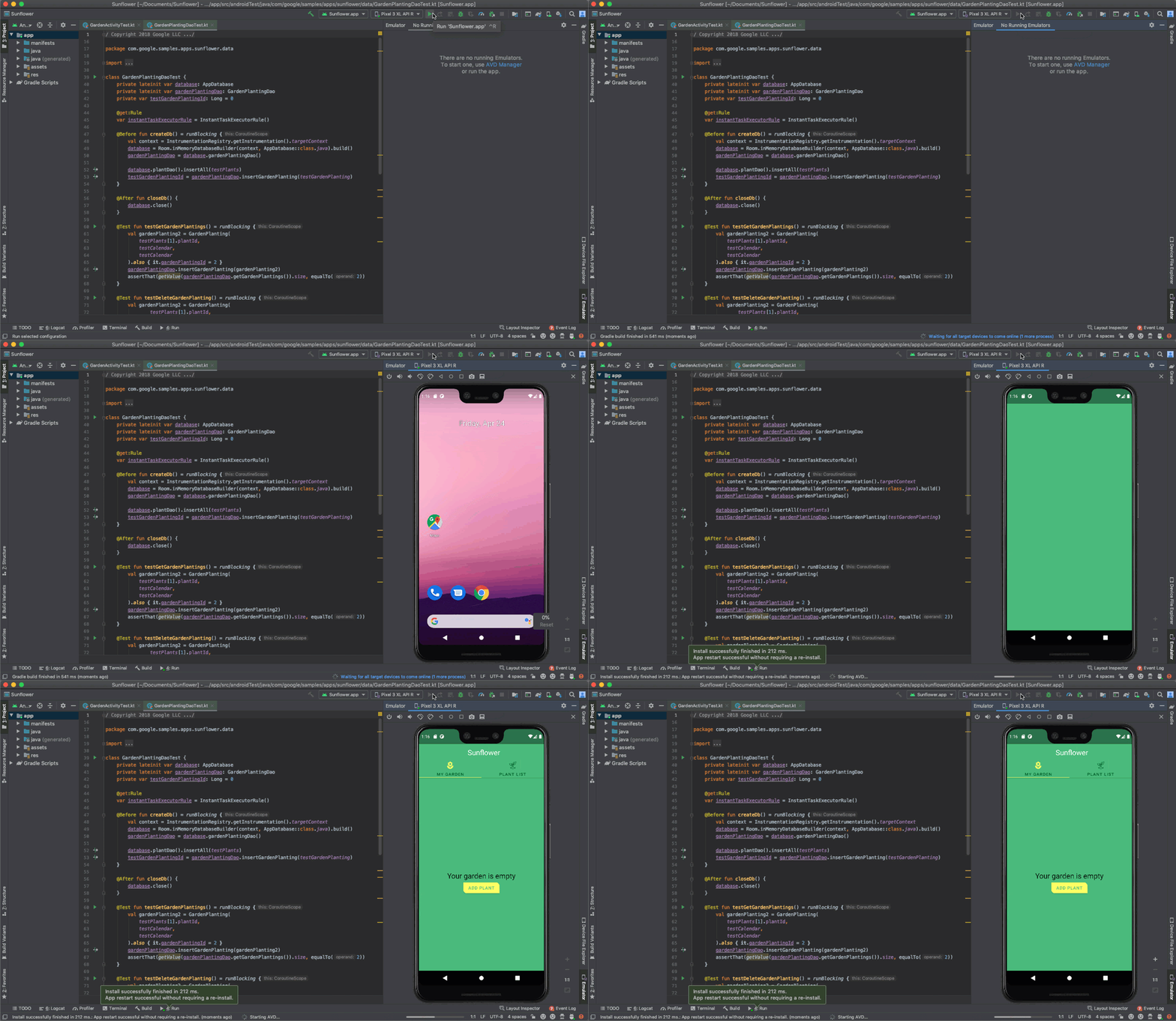
The one feature that will likely improve the quality of life for developers the most is the ability to run the Android Emulator right in Android Studio. That’s something the company announced earlier this summer, so it’s not a major surprise, but it’s a nice update for developers, as they won’t have to switch back and forth between different windows and tools to test their apps.

Talking about testing, the other update is support for foldable devices in the Android Emulator, which now allows developers to simulate the hinge angle sensor and posture changes so their apps can react accordingly. That’s still a niche market, obviously, but more and more developers are now aiming to offer apps to actually support these devices.

Image Credits: Google

Also new is improved support for TensorFlow Lite models in Android Studio, so that developers can bring those models to their apps, as well as a new database inspector that helps developers get easier insights into their queries and the data they return — and that lets them modify values while running their apps to see how their apps react to those.

Other updates include new templates in the New Project dialog that support Google’s Material Design Components, Dagger navigation support, System Trace UI improvements and new profilers to help developers optimize their apps’ performance and memory usage.