Alphabet’s latest moonshot is a field-roving, plant-inspecting robo-buggy

Alphabet (you know… Google) has taken the wraps off the latest “moonshot” from its X labs: A robotic buggy that cruises over crops, inspecting each plant individually and, perhaps, generating the kind of “big data” that agriculture needs to keep up with the demands of a hungry world.

Mineral is the name of the project, and there’s no hidden meaning there. The team just thinks minerals are really important to agriculture.

Announced with little fanfare in a blog post and site, Mineral is still very much in the experimental phase. It was born when the team saw that efforts to digitize agriculture had not found as much success as expected at a time when sustainable food production is growing in importance every year.

“These new streams of data are either overwhelming or don’t measure up to the complexity of agriculture, so they defer back to things like tradition, instinct or habit,” writes Mineral head Elliott Grant. What’s needed is something both more comprehensive and more accessible.

Much as Google originally began with the idea of indexing the entire web and organizing that information, Grant and the team imagined what might be possible if every plant in a field were to be measured and adjusted for individually.

A robotic plant inspector from Mineral.

Image Credits: Mineral

The way to do this, they decided, was the “Plant buggy,” a machine that can intelligently and indefatigably navigate fields and do those tedious and repetitive inspections without pause. With reliable data at a plant-to-plant scale, growers can initiate solutions at that scale as well — a dollop of fertilizer here, a spritz of a very specific insecticide there.

They’re not the first to think so. FarmWise raised quite a bit of money last year to expand from autonomous weed-pulling to a full-featured plant intelligence platform.

As with previous X projects at the outset, there’s a lot of talk about what could happen in the future, and how they got where they are, but rather little when it comes to “our robo-buggy lowered waste on a hundred acres of soy by 10 percent” and such like concrete information. No doubt we’ll hear more as the project digs in.

Walt Disney announces reorganization to focus on streaming

Disney is going all-in on streaming media. 

On Monday, the company announced a massive reorganization of its media and entertainment business that will focus on developing productions that will debut on its streaming and broadcast services. And Disney’s media businesses, ads and distribution, and Disney+, will now operate under the same business unit, the company said.

Its major reorganization comes just days after activist investor Dan Loeb, a major investor in the company through his Third Point Capital hedge fund, called on Disney to cancel its dividend and redirect more investments into streaming.

Wall Street has already given its seal of approval to Disney’s new move, sending shares up nearly 6% in after-hours trading.

Disney’s announcement follows a significant reorganization of its release schedule to address new realities, including a collapsing theatrical release business; production issues; and the runaway success of its streaming service — all caused or accelerated by the national failure to effectively address the COVID-19 pandemic.

Planned theatrical releases of would-be tentpole films like “Black Widow” have been rescheduled, while other films, including “Mulan” and the upcoming Pixar film “Soul,” are seeing their first runs on Disney’s streaming service, Disney+.

“This reorganization will accelerate our growth in the dynamic direct-to-consumer space, which is key to the future of our Company. The new organizational structure, with content creation distinct from distribution, will enable us to be more effective and nimble in creating what consumers want most, and delivering it in the way they prefer to consume it,” wrote Bob Chapek, Disney’s chief executive officer, in an internal memo announcing the reorganization, seen by TechCrunch. “Under this new structure, our Company’s world-class creative engines will be able to focus wholly on developing and producing great original content.”

Production of new material for Disney’s many provinces of intellectual property will fall under three groups — Studios, General Entertainment and Sports. Leadership of these groups won’t change, with Alan F. Horn and Alan Bergman, Peter Rice and James Pitaro maintaining their respective positions within the organization, the company said.

Overseeing operations for this singularly large new operational structure will be Kareem Daniel, who previously helmed the company’s consumer products, games and publishing operations.

All of the men will report to Chapek.

“Given the incredible success of Disney+ and our plans to accelerate our direct-to-consumer business, we are strategically positioning our Company to more effectively support our growth strategy and increase shareholder value,” Chapek said in a statement. “Managing content creation distinct from distribution will allow us to be more effective and nimble in making the content consumers want most, delivered in the way they prefer to consume it. Our creative teams will concentrate on what they do best—making world-class, franchise-based content—while our newly centralized global distribution team will focus on delivering and monetizing that content in the most optimal way across all platforms, including Disney+, Hulu, ESPN+ and the coming Star international streaming service.”

Studios will run all of the company’s development activities for live action and animated productions coming from Walt Disney Animation Studios, Pixar Animation Studios, Marvel Studios, Lucasfilm, 20th Century Studios and Searchlight Pictures.

General Entertainment will serve the same function for the company’s 20th Television and ABC Signature and Touchstone Television productions, along with its news divisions, Disney channels, Freeform, FX and National Geographic.

Sports will focus on ESPN and sports productions, including live events and original, and non-scripted sports-related material for cable channels, ESPN+ and ABC, the company said.

Overseeing the monetization, distribution, operations, sales, advertising and data and technology infrastructure for all of those groups will be Daniel. A longtime Disney executive, he formerly served as the head of the company’s Imagineering Operations, taking intellectual property and turning it into entertainment for the vast empire of Disney resorts and theme parks, before taking over the consumer products, games and publishing operations at the company.

“Kareem is an exceptionally talented, innovative and forward-looking leader, with a strong track record for developing and implementing successful global content distribution and commercialization strategies,” said Chapek. “As we now look to rapidly grow our direct-to-consumer business, a key focus will be delivering and monetizing our great content in the most optimal way possible, and I can think of no one better suited to lead this effort than Kareem. His wealth of experience will enable him to effectively bring together the Company’s distribution, advertising, marketing and sales functions, thereby creating a distribution powerhouse that will serve all of Disney’s media and entertainment businesses.”

The new structure is effective immediately, the company said, and expects to transition to financial reporting under this structure in the first quarter of fiscal 2021.

The company plans to hold an investor day on December 10th to unveil more of its direct to consumer strategies.


If the ad industry is serious about transparency, let’s open-source our SDKs

Erick Fang
Contributor

Erick Fang is the chief executive officer of Mintegral, where he oversees management, customer relationships and product development for this global mobile advertising platform.

Year after year, a lack of transparency in how ad traffic is sourced, sold and measured is cited by advertisers as a source of frustration and a barrier to entry in working with various providers. But despite progress on the protection and privacy of data through laws like GDPR and COPPA, the overall picture regarding ad-marketing transparency has changed very little.

In part, this is due to the staggering complexity of how programmatic and other advertising technologies work. With automated processes managing billions of impressions every day, there is no universal solution to making things more simple and clear. So the struggle for the industry is not necessarily a lack of intent around transparency, but rather how to deliver it.

Frustratingly, evidence shows that the way data is collected and used by some industry players has played a large part in reducing people’s trust in online advertising. This is not a problem that was created overnight. There is a long history and growing sense of consumer frustration with the way their data is being used, analyzed and monetized and a similar frustration by advertisers with the transparency and legitimacy of ad clicks for which they are asked to pay.

There are continuing efforts by organizations like the IAB and TAG to create policies for better transparency such as ads.txt. But without hard and fast laws, the responsibility lies with individual companies.

One relatively simple yet largely spurned practice that would engender transparency and trust for the benefit of all parties (brands, consumers and ad/marketing providers) would be for the industry to come together and have all parties open their SDKs.

Why open-sourcing benefits advertisers, publishers and the ad industry

Open-source software is code that anyone is free to use, analyze, alter and improve.

Auditing the code and adjusting the SDKs functionality based on individual needs is a common practice — and so too are audits by security companies or interested parties who are rightly on the lookout for app fraud. By showing exactly how the code within the SDK has been written, it is the best way to reassure developers and partners that there are no hidden functions or unwanted features.

Everyone using open-source SDKs can learn exactly how it works, and because it is under an open-source license, anyone can suggest modifications and improvements in the code.

Open source brings some risks, but much bigger rewards

The main risk from opening up an SDK code is that third parties will look for ways to exploit it and insert their own malicious code, or else look at potential vulnerabilities to access back-end services and data. However, providers should be on the lookout and be able to fix the potential vulnerabilities as they arise.

As for the rewards, open-sourcing engenders trust and transparency, which should certainly translate into customer loyalty and consumer confidence. After all, we are all operating in a market where advertisers and developers can choose who they want to work with — and on what terms.

Selfishly but practically speaking, opening SDKs can also help companies in our industry protect themselves from others’ baseless claims that are simply intended to promote their products. With open standards, there are no unsubstantiated, false accusations intended for publicity. The proof is out there for everyone to see.

How ad tech is embracing open source

In the ad tech space, companies such as MoPub, Appodeal and AppsFlyer are just a few that have already made some or all of their SDKs available through an open-source license.

All of these companies have decided to use an open-source approach because they recognize the importance of transparency and trust, especially when you are placing the safety and reputation of your brand in the hands of an algorithm. However, the majority of SDKs remain closed.

Relying on forward-thinking companies to set their own transparency levels will only take our industry so far. It’s time for stronger action around trust and data transparency. In the same way that GDPR and COPPA have required companies to address privacy and, ultimately, to have forced a change that was needed, open-sourcing our SDKs will take the ad-marketing space to new heights and drive new levels of trust and deployment with our clients, competitors, legislators and consumers.

The industry-wide challenge of transparency won’t be solved any time soon, but the positive news is that there is movement in the right direction, with steps that some companies are already taking and others can easily take. By implementing measures to ensure brand-safe placements and helping limit ad fraud; improving relationships between brands, agencies, and programmatic partners; and bringing clarity to consumer data use; confidence in the advertising industry will improve and opportunities will subsequently grow.

That’s why we are calling on all ad/marketing companies to take this step forward with us — for the benefit of our consumers, brands, providers and industry at large — to embrace open-source SDKs as the way to engender trust, transparency and industry transformation. In doing so, we will all be rewarded with consumers who are more trusting of brands and brand advertising, and subsequently, brands who trust us and seek opportunities to implement more sophisticated solutions and grow their business.

Family-tracking app Life360 launches ‘Bubbles,’ a location-sharing feature inspired by teens on TikTok

Helicopter parenting turned into surveillance with the debut of family-tracking apps like Life360. While the app can alleviate parental fears when setting younger kids loose in the neighborhood, Life360’s teenage users have hated the app’s location-tracking features so much that avoiding and dissing the app quickly became a TikTok meme. Life360 could have ignored the criticism — after all, teens aren’t the app’s paying subscribers; it’s the parents. But Life360 CEO Chris Hulls took a different approach. He created a TikTok account and started a dialogue with the app’s younger users. As a result of these conversations, the company has now launched a new privacy-respecting feature: “Bubbles.”

Bubbles work by allowing any Life360 Circle member to share a circle representing their generalized location instead of their exact whereabouts. To set a bubble, the user can adjust the radius on the map anywhere from 1 to 25 miles in diameter, for a given period of time of 1 to 6 hours. After this temporary bubble is created, Life360’s other existing safety and messaging features will remain enabled. But parents won’t be able to see precisely where their teen is located, other than somewhere in the bubble.

Image Credits: Life360

For example, a teen could tell their parents they were hanging out with some friends in a given part of town after school, then set a bubble accordingly. But without popping that bubble, the parents wouldn’t know if their teenager was at a friend’s house, out driving around, at a park, out shopping, and so on. The expectation is that parents and teens should communicate with one another, not rely on cyberstalking. Plus, parents need to respect that teens deserve to have more freedom to make choices, even if they will sometimes break the rules and then have to suffer the consequences.

A location bubble isn’t un-poppable, however. The bubble will burst if a car crash or other emergency is detected, the company says. A parent can also choose to override the setting and pop the bubble for any reason — like if they don’t hear from the teen for a long period of time or suspect the teen may be unsafe. This could encourage a teen to increase their direct communication with a parent in order to reassure them that they are safe, rather than risk their parent turning tracking back on.

But parents are actively discouraged from popping the bubbles out of fear. Before the bubble is burst, the app will ask the user if they’re sure they want to do so, reminding them also that the member will be notified about the bubble being burst. This gives parents a moment to pause and reconsider whether it’s really enough of an emergency to break their teen’s trust and privacy.

Image Credits: Life360

The feature isn’t necessarily going to solve the problems for teens who want to sneak out or just be un-tracked entirely, which is where many of the complaints have stemmed from in recent years. Instead, it’s meant to represent a compromise in the battle between adult surveillance of kids’ every move and teenagers’ needs to have more personal freedom.

Hulls says the idea for the new feature was inspired by conversations he had with teens on TikTok about Life360’s issues.

“Teens are a core part of the family unit — and our user base — and we value their input,” said Hulls. “After months of communicating with both parents and teens, I am proud to launch a feature that was designed with the whole family in mind, continuing our mission of redefining how safety is delivered to families,” he added.

Before joining TikTok, the Life360 mobile app had been subject to a downrating campaign where teen users rated the app with just one star in hopes of getting it kicked off the App Store. (Apps are not automatically removed for low ratings, but that hasn’t stopped teens from trying this tactic with anything they don’t like, from Google Classroom’s app to the Trump 2020 app, at times.)

In his TikTok debut, Hulls appeared as Darth Vader, then took off the mask to reveal, in his own words, “just your standard, awkward tech CEO.” In the months since, his account has posted and reacted to Life360 memes, answered questions and asked for — and even paid for — helpful user feedback. One of the ideas resulting from the collaboration was “ghost mode,” which is now being referred to at launch as “Bubbles” — a name generated by a TikTok contest to brand the feature.

In addition to sourcing ideas on TikTok, Hulls used the platform to rehabilitate the Life360 brand among teens, explaining how he created the app after Hurricane Katrina to help families reconnect after big emergencies, for example (true). His videos also suggested that he was now on teens’ side and that building “ghost mode” was going to piss off parents or even lose him his job (highly debatable).

In a related effort, the company posted a YouTube parody video to explain the app’s benefits to parents and teens. The video, suggested to teen users through a notification, hit over a million views in 24 hours.

Many teens, ultimately, came around. “i’m crying he seems so nice,” said one commenter. “ngl it’s the parents not the app,” admitted another.

In other words, the strategy worked. Hulls’ “life360ceo” TikTok account has since gained over 231,000 followers and its videos have been “liked” 6.5 million times. Teens have also turned their righteous anger back to where it may actually belong — at their cyberstalking parents, not the tech enabling the location-tracking.

Bubbles is now part of the most recent version of the Life360 app, a free download on iOS and Android. The company offers an optional upgrade to premium plans for families in need of extra features, like location history, crash detection and roadside assistance, among other things.

Family trackers are a large and growing business. As of June 2020, Life360 had 25 million monthly active users located in more than 195 countries. The company’s annualized monthly revenue was forecasted at $77.9 million, a 26% increase year-over-year.

To celebrate the launch of Bubbles, this past Saturday, Life360 launched a branded Hashtag Challenge on TikTok, #ghostmode, for a $10,000 prize. As of today, the hashtag already has 1.4 billion views.


With thousands of subscribers, The Juggernaut raises $2 million for a South Asian-focused news outlet

As paid newsletters grow in popularity, Snigdha Sur, the founder of South Asian-focused media company The Juggernaut, has no qualms about avoiding the approach entirely. In October 2017, Sur started The Juggernaut as a free newsletter, called InkMango. As she searched for news on the South Asian diaspora, she found that articles lacked original reporting, aggregation was becoming repetitive and mainstream news organizations weren’t answering big questions.

Then InkMango crossed 700 free readers, and Sur saw an opportunity for a full-bodied media company, not just a newsletter.

One year and a Y Combinator graduation later, The Juggernaut has worked with more than 100 contributors (both journalists and illustrators) to provide analysis on South Asian news. Recent headlines on The Juggernaut include: The Evolution of Padma Lakshmi; How Ancestry Test Results Became Browner; and How the Death of a Bollywood Actor Became a Political Proxy War. The network approach, instead of a single newesletter approach,aggreff is working so far: Sur says that The Juggernaut has garnered “thousands of subscribers.” During COVID-19, The Juggernaut’s net subscribers have grown 20% to 30% month over month, she said.

On the heels of this growth, The Juggernaut announced today that it has raised a $2 million seed round led by Precursor Ventures to hire editors and a full-time growth engineer, and expand new editorial projects. Other investors in the round include Unpopular Ventures, Backstage Capital, New Media Ventures and Old Town Media. Angels include former Andreessen Horowitz general partner Balaji Srinivasan; co-founder of Kabam, Holly Liu; and co-founder of sports-focused publication The Athletic, Adam Hansmann.

Currently, The Juggernaut charges $3.99 a month for an annual subscription, $9.99 a month for a monthly subscription and $249.99 for a lifetime subscription to the news outlet. It also offers a seven-day free trial (with a conversation rate to paid at over 80%) and has a free newsletter, which Sur says will remain free to bring in top-of-the-funnel customers.

The Juggernaut is part of a growing number of media companies trying to directly monetize off of subscriptions instead of advertisements, such as The Information, The Athletic, and even our very own Extra Crunch. If successful, the hope is that paid subscriptions will prove more sustainable and lucrative than advertising, which still dominates in media.

But Sur is purposely pacing herself when it comes to expenses in the early days. The team currently has only three full-time staff, including Sur, culture editor Imaan Sheikh and one full-time writer, Michaela Stone Cross.

Snigdha Sur, the founder of The Juggernaut.

“Sometimes at media companies people over-hire and over-promise, and then don’t deliver on the profitability or return,” she said. For this reason, The Juggernaut largely works with “freelancers who would probably never join any specific publication,” Sur said. While The Juggernaut hopes to have full-time staff writers eventually, the contributor approach helps temper spending.

Beyond pace, The Juggernaut is looking to build up its subscriber base by writing stories that require deep, creative thinking. The publication intentionally does not cover commoditized breaking news, which could have the potential to bring in more inbound traffic, or anything that doesn’t have a South Asian connection.

Sur is living the stories that she is working to tell. Born in Chhattisgarh, India, she grew up in the Bronx and Queens in New York City, and spent time living and working in Mumbai, India. Since founding The Juggernaut, her goal for the publication has been to be a place for not just South Asians, but for “anyone who has a form of curiosity and appreciation” for South Asian culture.

“We try not to translate words we don’t have to do, we’re not trying to dumb this down, we’re not trying to write for the white teen,” she said. “We’re trying to write for the smart, curious person. And we’re going to assume you know stuff.”

How startups should budget in uncertain times 

Isaac Roth
Contributor

Issac Roth is a seasoned entrepreneur who advises founders on open source technology and keeping communities engaged. Over this career, he’s created and sold multiple enterprise software companies and stays active as an advisor and investor.
More posts by this contributor

I was the archetypal startup CEO: I paused my degree at Stanford to start a company, and after it failed I found myself needing to preserve cash to make student loan payments.

With an old Nissan Sentra and roommates in Menlo Park, my biggest variable cost was food. So it was ramen every night. On a good week, I might have had some sushi on Friday night and if I’d managed to come in under budget somehow (someone’s parents bought dinner) I could maybe splurge again on Saturday with friends.

My guiding principle at this time is surely familiar: Control burn until income streams are more predictable. Many startups find themselves in a similar position these days: ramen or sushi?

Some businesses are thriving during COVID-19 times, but will it last? Take online learning tools: Everybody needs online learning at the moment. When in-person reopens, probably some amount of learning will stay online since we all learned how to do it, but likely not 100%. Worse than not knowing what the percentage will be is the constant variation across geography, segment and vertical. It’s not that different from the current situation for me in San Francisco: If I want to find somewhere to buy ramen or sushi, I first have to check which spots are even open before navigating their constantly changing hours and menus.

Startup budgeting looks a bit like that now. Key assumptions we used for planning — already prone to some variation in a startup — are more volatile. Conversion rate from MQL to SQL, how many decision-makers need to approve a contract, leads generated per event (and what is an event these days), net renewal rates — these factors are all changing and they’re changing differently by customer segment, by geography and by product category. The new normal is highly dynamic.

Navigate through the uncertainty (and reevaluate quarterly)

How can we budget through this? Everyone replanned in April. Plan for a similar cycle every quarter. “Are we at a new normal? How do we know? Do we feel confident about that?”

In addition to the usual factors companies use to make predictions on metrics — things like growth rate and conversion rate — now we also have to consider a variety of outside factors: How the current cycle has impacted customers and prospects, how they’re readjusting budgets and their approach to unpredictability over the coming months. It might look like a new normal is establishing, but COVID flare-ups could happen again causing lockdowns, the U.S. is in an election cycle and there are prospects of further government intervention.

Here’s a recipe for deciding what to cook or whether you can go out:

Set assumptions and analyze, then reset on a regular and irregular cadence

Visit your budget each quarter. AND any month that burn falls outside of expectations, make adjustments.

We recommend quarterly because sales cycles tend to be longer than a few weeks so it’s hard to get data back and make adjustments after only two to three weeks. Here are the key inputs you should monitor:

EBay takes a bite at StockX and GOAT with sneaker authentication for sales $100+ in the US

EBay is announcing today that it’s going to start authenticating sneaker sales over $100 in the U.S. This is a clear bite into the dominance of StockX and GOAT in the limited sneaker universe.

The authentication will be done by Sneaker Con, the company that runs, well, Sneaker Con. Founded by Yu-Ming Wu and Hayden Sharitt, Sneaker Con was infused with cash by Visionary Private Equity Group in 2018. They provide a well known and influential backer in the sneakerhead community that should provide a solid signal for buyers and sellers. It’s a good choice.

The quick story here is that eBay’s rep for authentic merch is, uh, not great — especially the sneaker universe, where fakes can be virtually indistinguishable from authentic items. Though the brands themselves have toyed with different ways to authenticate, from NFC tags to blockchain solutions, the counterfeiters have kept up with those various methods too and clone them quickly. About the only way to guarantee authenticity is to get the product in hand and have them examined by people trained to spot fakes. In some cases that spotting can be as granular as counting the number of stitches thrown in between two segments of a shoe, or observing the glue pattern of a midsole joint.

The program sounds pretty much the same as the others on the market:

  • Proof of Authentication: Upon receiving the sneakers, the independent authenticator confirms they are consistent with the listing title, description and images, and then performs a multi-point physical authentication inspection. An eBay tag, guaranteeing its authenticity, is attached to the sneakers to finalize the process, driving confidence in the collectability and resale value.
  • Third-Party Authentication: EBay has partnered with industry leader Sneaker Con to create a new state-of-the-art facility — leveraging the top authenticators in the industry, a robust checklist of product specifications and best-in-class processes to ensure accuracy and efficiency. With rigorous inspection of the box, shoe and accessories, the authentication underscores eBay’s commitment to giving shoppers exactly what they want.
  • Verified Returns: For sellers who choose to offer returns, eBay’s sneaker authentication program ensures the exact item initially sold is returned to the seller, via a verified returns process. Returns are shipped back directly to the authentication center, where the third-party experts verify each item and its condition before returning to the seller.

EBay’s reluctance to spin up a person-in-the-middle authentication program allowed a gap for StockX and GOAT to thrive, offering authentication for new and, in GOAT’s case, even pre-owned sneakers. The eBay authentication tags even look like those offered by the two players. EBay had already launched its Authenticity Guarantee for watches over $2,000 (StockX also sells watches).

The power of authenticity, of course, is what drives the booming secondary market, where shoes can be limited to thousands of pairs or even dozens of pairs per release. Sneaker culture, which was born on the basketball court and driven largely by Black athletes, musicians and icons, is now squarely mainstream and very big business. EBay has been slow to move here but has significant resources and already does brisk sneaker business, with 6 million sneakers sold in 2019.

One note here is that this may drive higher margin business for eBay because higher-end sales in the $500+ range are harder to justify on eBay where authenticity was not guaranteed. EBay was likely already capturing a decent portion of the lower-end market, but now has a chance to grab some of the fattier meat.

StockX and GOAT have advantages still, even with authentication now a commodity feature. They are purpose-driven with a collector in view, and they have significant mindshare in the community. But if eBay is able to rescue its reputation for questionable sneaker transactions (I was once shipped a pair of socks and a literal brick in an eBay transaction gone bad) and incredibly poor seller support (eBay sides with the buyer in the vast majority of disputes, even obvious con jobs) then it could pose a serious threat here.

My hope is that the faster movers here will take this as an opportunity to really revamp their product experiences. Both StockX and GOAT have been relatively stagnant on the app and website front for a while, offering some intriguing yet incremental innovation — but not dramatically overhauling their product.

Twilio’s $3.2B Segment acquisition is about helping developers build data-fueled apps

The pandemic has forced businesses to change the way they interact with customers. Whether it’s how they deliver goods and services, or how they communicate, there is one common denominator, and that’s that everything is being forced to be digitally driven much faster.

To some extent, that’s what drove Twilio to acquire Segment for $3.2 billion today. (We wrote about the deal over the weekend. Forbes broke the story last Friday night.) When you get down to it, the two companies fit together well, and expand the platform by giving Twilio customers access to valuable customer data. Chee Chew, Twilio’s chief product officer, says while it may feel like the company is pivoting in the direction of customer experience, they don’t necessarily see it that way.

“A lot of people have thought about us as a communications company, but we think of ourselves as a customer engagement company. We really think about how we help businesses communicate more effectively with their customers,” Chew told TechCrunch.

Laurie McCabe, co-founder and partner at SMB Group, sees the move related to the pandemic and the need companies have to serve customers in a more fully digital way. “More customers are realizing that delivering a great customer experience is key to survive through the pandemic, and thriving as the economy recovers — and are willing to spend to do this even in uncertain times,” McCabe said.

Certainly Chew recognized that Segment gives them something they were lacking by providing developers with direct access to customer data, and that could lead to some interesting applications.

“The data capabilities that Segment has are providing a full view of the customer. It really layers across everything we do. I think of it as a horizontal add across the channels and extending beyond. So I think it really helps us advance in a different sort of way […] towards getting the holistic view of the customer and enabling our customers to build intelligence services on top,” he said.

Brent Leary, founder and principal analyst at CRM Essentials, sees Segment helping to provide a powerful data-fueled developer experience. “This move allows Twilio to impact the data-insight-interaction-experience transformation process by removing friction from developers using their platform,” Leary explained. In other words, it gives developers that ability that Chew alluded to, to use data to build more varied applications using Twilio APIs.

Paul Greenberg, author of CRM at the Speed of Light, and founder and principal analyst at 56 Group, agrees, saying, “Segment gives Twilio the ability to use customer data in what is already a powerful unified communications platform and hub. And since it is, in effect, APIs for both, the flexibility [for developers] is enormous,” he said.

That may be so, but Holger Mueller, an analyst at Constellation Research, says the company has to be seeing that the pure communication parts of the platform like SMS are becoming increasingly commoditized, and this deal, along with the SendGrid acquisition in 2018, gives Twilio a place to expand its platform into a much more lucrative data space.

“Twilio needs more growth path and it looks like its strategy is moving up the stack, at least with the acquisition of Segment. Data movement and data residence compliance is a huge headache for enterprises when they build their next generation applications,” Mueller said.

As Chew said, early on the problems were related to building SMS messages into applications and that was the problem that Twilio was trying to solve because that’s what developers needed at the time, but as it moves forward, it wants to provide a more unified customer communications experience, and Segment should help advance that capability in a big way for them.

Hoping to be LatAm’s top digital bank for SMBs, Xepelin launches a lending and revenue management service

There’s another entrant in the startup race to provide financial services to Latin America’s small and medium-sized businesses.

Financial services have been a huge opportunity for startups coming out of Brazil, Colombia and Mexico in recent years, and now Xepelin, a new company from Chile, is looking to join the fray.

Xepelin’s founders, Sebastian Kreis and Guillermo Molina Carvallo, launched their company with the vision of creating a new kind of online bank for Latin America’s small businesses.

Sebastian Kreis, chief executive officer, Xepelin. Image Credits: Xepelin

The company’s pitch to business owners depends on a variation of the lending tool known as factoring, where small businesses can take out loans based on the income they’re expecting to receive. In Latin America, where small businesses have limited avenues to traditional loans, according to Kreis, factoring represents a novel solution.

Xepelin already has a multimillion dollar credit line on the books in addition to a small round of initial financing and the company will be using both the credit line to bring customers in and the equity infusion to continue developing revenue management and resource planning tools for its customers.

Starting in Chile and Mexico, where the two founders have a long history in the financial services world, the company expects to become a player across the continent in line with the growth of private debt services for small businesses.

Other startups, like Portal Finance and Marco Financial are also targeting the lending markets. Like Xepelin, the two companies have secured multiple lines of credit to support their businesses.

Kreis estimates that debt financing in Latin America could grow to 70 times its current size given changes to the regulatory environment and increasing demand for digital financial services over the next decade.

In the first stage we developed the new standard for SMBs’ working capital financing in LatAm, focusing on our client’s user experience, financial needs (not only transactions) and the way they manage their working capital. Xepelin gives SMBs access to capital in an easy and efficient way.

Mexico is a good indicator of the potential size of the market, according to Kreis. There only 300,000 businesses — out of more than 6 million registered companies — have sales and account executives offering revenue management and credit lines.

These money managers have a portfolio of 300 companies that they work with, while midmarket companies may work with as many as 1,000 to 5,000 small businesses.

So far, Xepelin has raised $3.5 million in early-stage funding from investors including Oskar Hjertonsson, Manutara Ventures, Ignacio Canals, Gonzalo Rojas, FJ Labs, Diego Fleischmann, and Daniel Undurraga. The most recent capital infusion, a $2.5 million round led by Impact Ideas VC closed earlier this month.


If data is labor, can collective bargaining limit big tech?

Erik Rind
Contributor

Erik Rind is the CEO of ImagineBC and an expert in understanding the
largely untapped potential that blockchain and AI technologies bring
forward in order to help secure user’s data.

Matt Prewitt
Contributor

Matt Prewitt is president of RadicalxChange Foundation. He is also an attorney and a blockchain industry advisor.

There are plenty of reasons to doubt that the House Judiciary Committee’s antitrust report will mark a turning point in the digital economy. In the end, it lacked true bipartisan support. Yet we can still marvel at the extent of left-right agreement over its central finding: The big tech companies wield troublingly great power over American society.

The bigger worry is whether the solutions on the table cut to the heart of the problem. One wonders whether empowered antitrust agencies can solve the problem before them — and whether they can keep the public behind them. For the proposition that many Facebooks would be better than one simply doesn’t resonate.

There are good reasons why not. Despite all their harms, we know that whatever benefits these platforms provide are largely a result of their titanic scale. We are as uneasy with the platforms’ exercises of their vast power over suppliers and users, as we are with their forbearance; yet it is precisely because of their enormous scale that we use their services. So if regulators broke up the networks, consumers would simply flock toward whatever platforms had the most scale, pushing the industry toward reconsolidation.

Does this mean that the platforms do not have too much power, that they are not harming society? No. It simply means they are infrastructure. In other words, we don’t need these technology platforms to be more fragmented, we need them to belong to us. We need democratic, rather than strictly market processes, to determine how they wield their power.

When you notice that an institution is infrastructure, the usual reaction is to suggest nationalization or regulation. But today, we have good reasons to suspect our political system is not up to this task. Even if an ideal government could competently tackle a problem as complex as managing the 21st century’s digital infrastructure, ours probably cannot.

This appears to leave us in a lose-lose situation and explains the current mood of resignation. But there is another option that we seem to have forgotten about. Labor organization has long afforded control to a broad array of otherwise-powerless stakeholders over the operation of powerful business enterprises. Why is this not on the table?

A growing army of academics, technologists, and commentators are warming to the proposition that “data is labor.” In short, this is the idea that the vast data streams we all produce through our contact with the digital world are a legitimate sort of work-product — over which we ought to have much more meaningful rights than the laws now afford. Collective bargaining plays a central role in this picture. Because the reason that the markets are now failing (to the benefit of the Silicon Valley giants) is that we are all trying to negotiate only for ourselves, when in fact the very nature of data is that it always touches and implicates the interests of many people.

This may seem like a complicated or intractable problem, but leading thinkers are already working on legal and technical solutions.

So in some sense, the scale of the tech giants may indeed not be such a bad thing — the problem, instead, is the power that scale gives them. But what if Facebook had to do business with large coalitions representing ordinary peoples’ data interests — presumably paying large sums, or admitting these representatives into its governance — in order to get the right to exploit its users’ data? That would put power back where it belongs, without undermining the inherent benefits of large platforms. It just might be a future we can believe in.

So what is the way forward? The answer to this question is enabling collective bargaining through data unions. Data unions would become the necessary counterpart to big tech’s information acquiring transitions. By requiring the big tech companies to deal with data unions authorized to negotiate on behalf of their memberships, both of the problems that have allowed these giant tech companies to amass the power to corrupt society are solved.

Labor unions did not gain true traction until the passage of the National Labor Relations Act of 1935. Perhaps, rather than burning our political capital on breaking up the tech giants through a slow and potentially Sisyphean process, we should focus on creating a 21st century version of this groundbreaking legislation — legislation to protect the data rights of all citizens and provide a responsible legal framework for data unions to represent public interests from the bottom up.

4-year founder vesting is dead

Jake Jolis
Contributor

Jake Jolis is a partner at Matrix Partners and invests in seed and Series A technology companies including marketplaces and software.
More posts by this contributor

We recently invested in a team of co-founders who had voluntarily made their own vesting longer than four years. Four-year vesting is the industry standard. Why would someone voluntarily make it longer for themselves?

Their answer: “These days, with companies taking seven to 10 years to reach exit, it would make sense for founders to be on a similar schedule.”

This matters because the four-year co-founder vesting schedule frequently harms startup founders’ interests. Sometimes it damages their startup irreparably.

A growing number of founders are starting to realize this. I talked to quite a few about this over the last two years. Mostly, the “longer-than-four-years-vesting” founders share a similar story as well as logic. Almost always they are repeat, experienced founders. Often scarred by a co-founder separation in their prior startup, they are determined to set things up smarter in their next company.

Importantly, this group of founders assumes they are going to be the ones actually building the company. They created the company. They are the company. Nobody is forcing them out. I suspect founders who already believe this about their own startup will find this post most helpful.

Given the massive implications of co-founder vesting schedules, all startup founders should consider co-founder vesting lengths more carefully and then choose what makes sense for them. You make this decision around the time of incorporation but feel the effects over the lifetime of your company.

4-year vesting schedules are anachronistic

As far back as the 1980s, the standard startup vesting schedule was four or five years, with five being more prevalent on the East Coast. Nobody seems to remember a time it was anything different. The closest I’ve gotten to a logical answer on why it’s four years today stretches back to a pre-401(k) era, from before Reagan’s tax reforms in the ’80s. Prior to then, tax rules incentivized big company pension plans to have vesting periods of at least five years.

Startups didn’t offer traditional pension plans. Instead, startups offered employees stock, vesting over four years instead of five as a competitive move. That is all moot today. It has no relevance for startup founders in 2020.

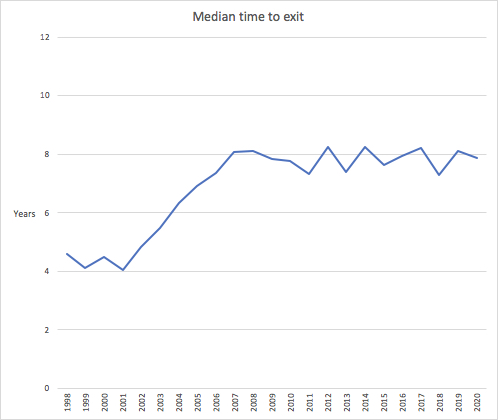
More relevantly, time from founding to exit has gone from four years in 1999 to eight years in 2020. Yet founder vesting remains stuck at four. This is dangerous.

median time to exit

Exit data from U.S. startups with minimum $1 million in venture funding. Image Credits: PitchBook

Hedging against the crash of ineptitude

France’s Health Data Hub to move to European cloud infrastructure to avoid EU-US data transfers

France’s data regulator CNIL has issued some recommendations for French services that handle health data, as Mediapart first reported. Those services should avoid using American cloud hosting companies altogether, such as Microsoft Azure, Amazon Web Services and Google Cloud.

Those recommendations follow a landmark ruling by Europe’s top court in July. The ruling, dubbed Schrems II, struck down the EU-U.S. Data Privacy Shield. Under the Privacy Shield, companies could outsource data processing from the EU to the U.S. in bulk. Due to concerns over U.S. surveillance laws, that mechanism is no longer allowed.

The CNIL is going one step further by saying that services and companies that handle health data should also avoid doing business with American companies — it’s not just about processing European data in Europe. Once again, this is all about avoiding falling under U.S. regulation and rulings.

The regulator sent those recommendations to one of France’s top courts (Conseil d’État). SantéNathon, a group of organizations and unions, originally notified the CNIL over concerns about France’s Health Data Hub.

France is currently building a platform to store health data at the national level. The idea is to build a hub that makes it easier to study rare diseases and use artificial intelligence to improve diagnoses. It is supposed to aggregate data from different sources and make it possible to share some data with public and private institutions for those specific cases.

The technical choices have been controversial as the French government originally chose to partner with Microsoft and its cloud platform Microsoft Azure.

Microsoft, like many other companies, relies on Standard Contractual Clauses for EU-U.S. data transfers. But the Court of Justice of the EU has made it clear that EU regulators have to intervene if data is being transferred to an unsafe country when it comes to privacy and surveillance.

The CNIL believes that an American company could process data in Europe but it would still fall under FISA702 and other surveillance laws. Data would still end up in the hands of American authorities. In other words, it is being extra careful with health data for now, while Schrems II is still unfolding.

“We’re working with health minister Olivier Véran on transferring the Health Data Hub to French or European platforms following the Privacy Shield bombshell,” France’s digital minister Cédric O told Public Sénat.

The French government is now looking at other solutions for the Health Data Hub. In the near future, if France’s top court confirms the CNIL’s recommendations, it could also have some effects for French companies that handle health data, such as Doctolib and Alan.

Yotascale raises a $13M Series B to help companies track and manage their cloud spends

These days when you found a startup, you don’t go out and buy a rack of servers. And you don’t build an in-house data center team. Instead, you farm out your infrastructure needs to the major cloud platforms, namely Amazon AWS, Microsoft Azure and Google Cloud.

That’s all well and good, but over time, any startup’s cloud setup will become more complex, varied and perhaps multi-provider. Throw in microservices and one can wind up with a big muddle, and an even bigger bill. That’s the problem that Yotascale wants to attack.

And there’s money backing the startup’s progress, including $13 million in new capital. The round, a Series B, was led by Aydin Senkut at Felicis, with participation from other capital pools, including Engineering Capital, Pelion Ventures and Crosslink Capital. Yotascale has now raised $25 million in total.

The funding event caught my eye, as I’ve heard startup CEOs discuss their public cloud spends in somewhat bitter terms; it’s hard for most startups to change infrastructure direction after they get off the ground, which means that as they grow, so too does their outflow of dollars to the major tech companies — the same megacaps that might turn around and compete with the very same startups that are pumping up their revenues and margins.

So spending less on AWS or Azure would be nice for startups. Yotascale wants to be the helper for lots of companies to better understand and attribute that spend to the correct part of their platform or service, perhaps lowering aggregate spend at the same time.

Let’s talk about how Yotascale got to where it is today.

The startup’s CEO, Asim Razzaq, talked TechCrunch through his company’s history, which didn’t get started until after he had wrapped up tenure at both another startup and PayPal.

When he set out to found Yotascale, Razzaq didn’t fire up a deck, raise capital and then get right to building. Instead, he first went out to do customer discovery work. That effort led him to the perspective that current solutions aimed at understanding cloud spend were insufficient and led to data being used against infrastructure teams in arguments for lower spend when it wasn’t a good idea (cutting backup expenses, for example).

During that time he also determined who Yotascale’s target customer is, namely the head of platform engineering at a company.

The startup self-funded for a while, with Razzaq telling TechCrunch that he wanted to be completely sure that he had conviction concerning the project before moving ahead.

After starting to work on Yotascale in mid 2015, the company raised some capital in 2016. It set out to solve the spend attribution problem that companies with public cloud contracts deal with — including having to contend with modern architecture and its related issues — while earning the trust of engineers, according to Razzaq.

From its period of customer discovery to working on product market fit after raising funds from Engineering Capital, Yotascale raised a Series A in mid-2018. Why? Because, Razzaq, told TechCrunch, as ones gains conviction, one must scale their team. And thus more capital was required.

During our chat with the CEO, it was notable how sequential his company-building process has proven. From talking to potential customers, to working to understand who his buyer is, to waiting on scaling the startup’s go-to-market efforts until he was confident in product-market fit, Yotascale seems to follow the inverse of the “raise lots and spend fast and try to win right away” model that became quite popular during the unicorn era.

How did Yotascale know when it found product market fit? According to its CEO, when companies started pulling the startup into their operations, and not the other way around.

Yotascale reported 4x year-over-year annual recurring revenue (ARR) growth at some point this year, though Razzaq was diffident about sharing specifics concerning the metric.

Sticking to the theme of reasonableness and caution, when asked about why his Series B is modest in size, Razzaq said that he was not interested in raising big rounds, and that $13 million is an amount of money that can move his company forward. What’s coming from the company? Yotascale wants to add support for Azure and Google Cloud in addition to its AWS work of today, to pick an example.

(You can find other hints that Yotascale is perhaps more mature than its peers at its current age. For example, in 2018 the company hired a new chief revenue officer, even putting out a release on the matter.)

That’s enough on this particular round. What will prove interesting is how far Yotascale can push its ARR up by the end of Q3 2021. And if it raises again before then.