Google introduces song matching via humming, whistling or singing

Google has added a new feature that lets you figure out which song is stuck in your head by humming, whistling or singing — a much more useful version of the kind of song-matching audio feature that it and competitors like Apple’s Shazam have offered previously. As of today, users will be able to open either the latest version of the mobile Google app, or the Google Search widget, and then tap the microphone icon, and either verbally ask to search a song or hit the “Search a song button” and start making noises.

The feature should be available to anyone using Google in English on iOS, or across more than 20 languages already on Android, and the company says it will be growing that user group to more languages on both platforms in the future. Unsurprisingly, it’s powered behind the scenes by machine learning algorithms developed by the company.

Google says that its matching tech won’t require you to be a Broadway star or even a choir member — it has built-in abilities to accommodate for various degrees of musical sensibility, and will provide a confidence score as a percentage alongside a number of possible matches. Clicking on any match will return more info about both artist and track, as well as music videos, and links that let you listen to the full song in the music app of your choice.

Image Credits: Google

Google explains in a blog post announcing the feature that it’s able to do this because it basically ignores the fluff that is the quality of your voice, any accompanying instruments, tone and other details. The algorithm is basically boiling the song down to its essence, and coming up with a numerical pattern that represents its essence, or what Google calls its “fingerprint.”

This is an evolution of how Google’s existing music recognition tech works, which is present in the passive “Now Playing” feature that’s available on its Pixel smartphones. That feature will listen passively in the background for music, and provide a match when it finds one in its offline database (all done locally). That same technology is at work in the SoundSearch feature that Google later introduced via its app.

Google isn’t the first to do this – SoundHound’s Midomi offers music matching via singing or humming. But Google is obviously much more widely used, so it’ll be interesting to see if it can achieve better hit rates, and overall usage.

Audio learning startup Knowable switches to a $9.99-per-month subscription model

Knowable, the Andreessen Horowitz-backed startup focused on audio learning, is switching business models.

When the company launched last year, it charged users on a per-class basis. Starting today, it’s shifting entirely to a subscription model, where listeners pay $50 annually or $9.99 per month for unlimited access to the Knowable library.

“This gets us closer to our mission of daily, actionable learning,” co-founder and CEO Warren Shaeffer told me. In other words, the subscription encourages people to treat learning through Knowable as an ongoing habit, rather than a one-off experience.

After all, he said Knowable is already seeing a 24% cross-purchase rate as listeners sign up for new courses. Plus, this will allow the company to experiment with other formats, such as briefer lessons. And it’s similar to the subscription model employed by MasterClass and other companies offering video classes.

But why focus on audio in the first place? Shaeffer said that he and his co-founder Alex Benzer have “both seen firsthand that a great teacher can change the trajectory of somebody’s life.” At the same time, they didn’t have time to watch hours of video.

“Every [online learning company] today is very focused on the idea that you need to stare at a screen to learn in a structured way,” Shaeffer said.

Knowable team

The Knowable team

At the same time, many people listen to podcasts when they want to learn new things. So the pair created Knowable with the idea that when you go out for a walk, you can have an easy way to spend that time on what Benzer called “nutritious” content, rather than a “low-calorie true-crime podcast.”

“Warren and I are personally excited about helping people spend less time anxiously doomscrolling, and more time acquiring optimism and confidence through self-guided learning,” he said.

Courses include Alexis Ohanian on entrepreneurship, Mark Bittman on eating well and a variety of experts on public speaking.

Shaeffer said there are now 100 hours of educational content in the Knowable library — about half of it consists of Knowable Originals created by the company’s producers (Knowable’s content team is currently led by former “This American Life” producer Amy O’Leary), with the other half coming from a new, curated marketplace, where anyone can apply to sell a course.

The content, Shaeffer added, is “audio-first, not audio-only.” Yes, you mostly listen to the classes, but there’s additional material like quizzes and workbooks.

“We think audio is a great catalyst for inspiring,” he said. As a result, Knowable has focused on “soft skills” in categories like professional development, self-improvement and health.

But he also suggested that it’s a “fallacy” to think that you can’t teach more concrete hard skills through audio: “If you want to be a programmer, we’re envisioning a course where someone gets an overview of all the different ways they can learn, and it becomes a launchpad into a deeper dive.”

Google launches a slew of Search updates

Google today announced a number of improvements to its core search engine, with a strong focus on how the company is using AI to help its users. These include the ability to better answer questions with very specific answers, very broad questions and a new algorithm to better handle the typos in your queries. The company also announced updates to Google Lens and other Search-related tools.

Most of these are meant to be useful, but some are also just fun. You will now be able to hum a song and the Google Assistant will try to find the right song for you, for example.

As Google noted, 1 in 10 search queries is misspelled. The company already does a pretty good job dealing with those through its “did you mean” feature. Now, the company is launching an improvement to this algorithm that uses a deep neural net with 680 million parameters to better understand the context of your search query.

Image Credits: Google

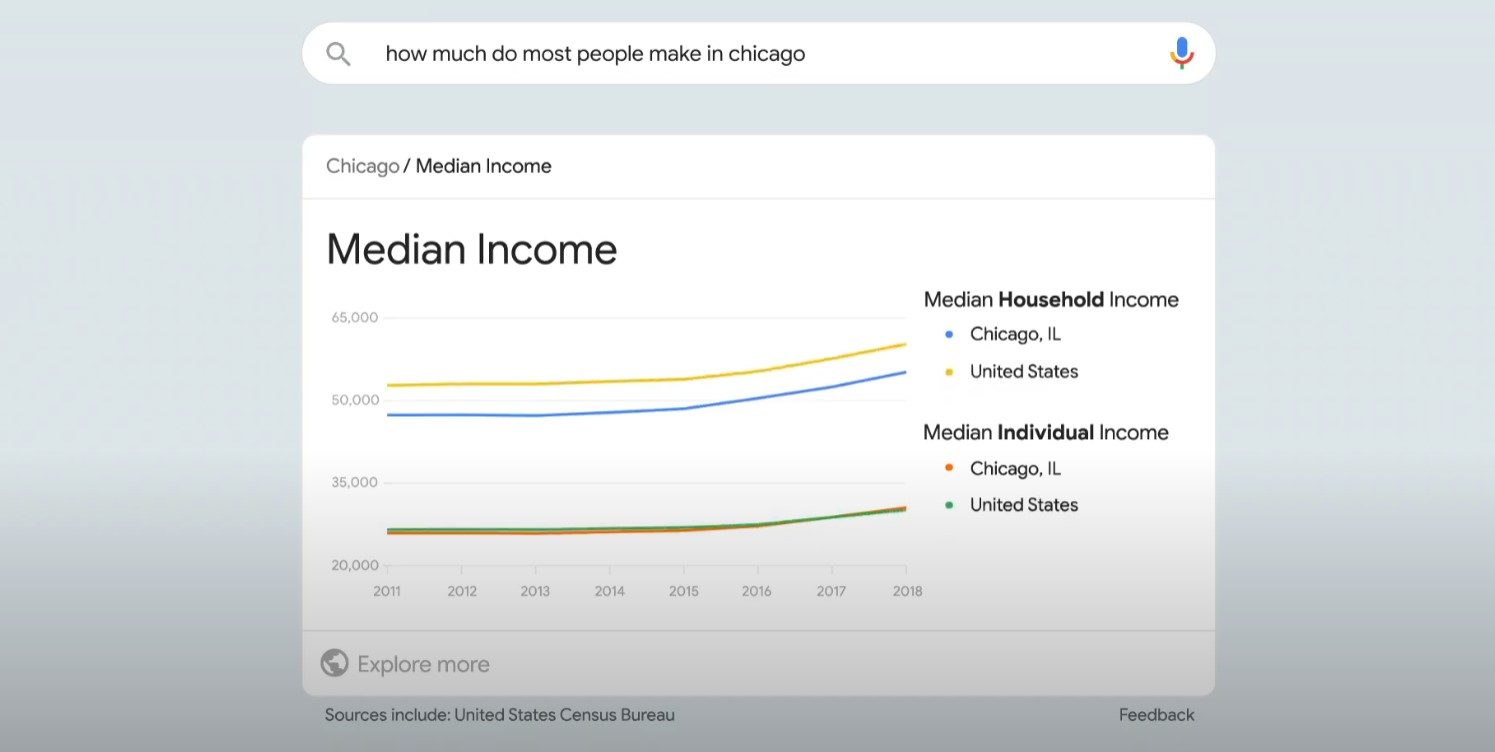
Another nifty new feature is an integration with various data sources, which were previously only available as part of Google’s Open Data Commons, into Search. Now, if you ask questions about something like “employment in Chicago,” Google’s Knowledge Graph will trigger and show you graphs with this data right on the Search results page.

Image Credits: Google

Another update the company announced today is its system’s ability to index parts of pages to better answer niche queries, like “how do I determine if my windows have UV glass?” The system can now point you right to a paragraph on a DIY forum. In total, this new system will improve about 7% of queries, Google said.

For broader questions, Google is now also using its AI system to better understand the nuances of what a page is about to better answer these queries.

Image Credits: Google

These days, a lot of content can be found in videos, too. Google is now using advanced computer recognition and speech recognition to tag key moments in videos — that’s something you can already find in Search these days, but this new algorithm should make that even easier, especially for videos where the creators haven’t already tagged the content.

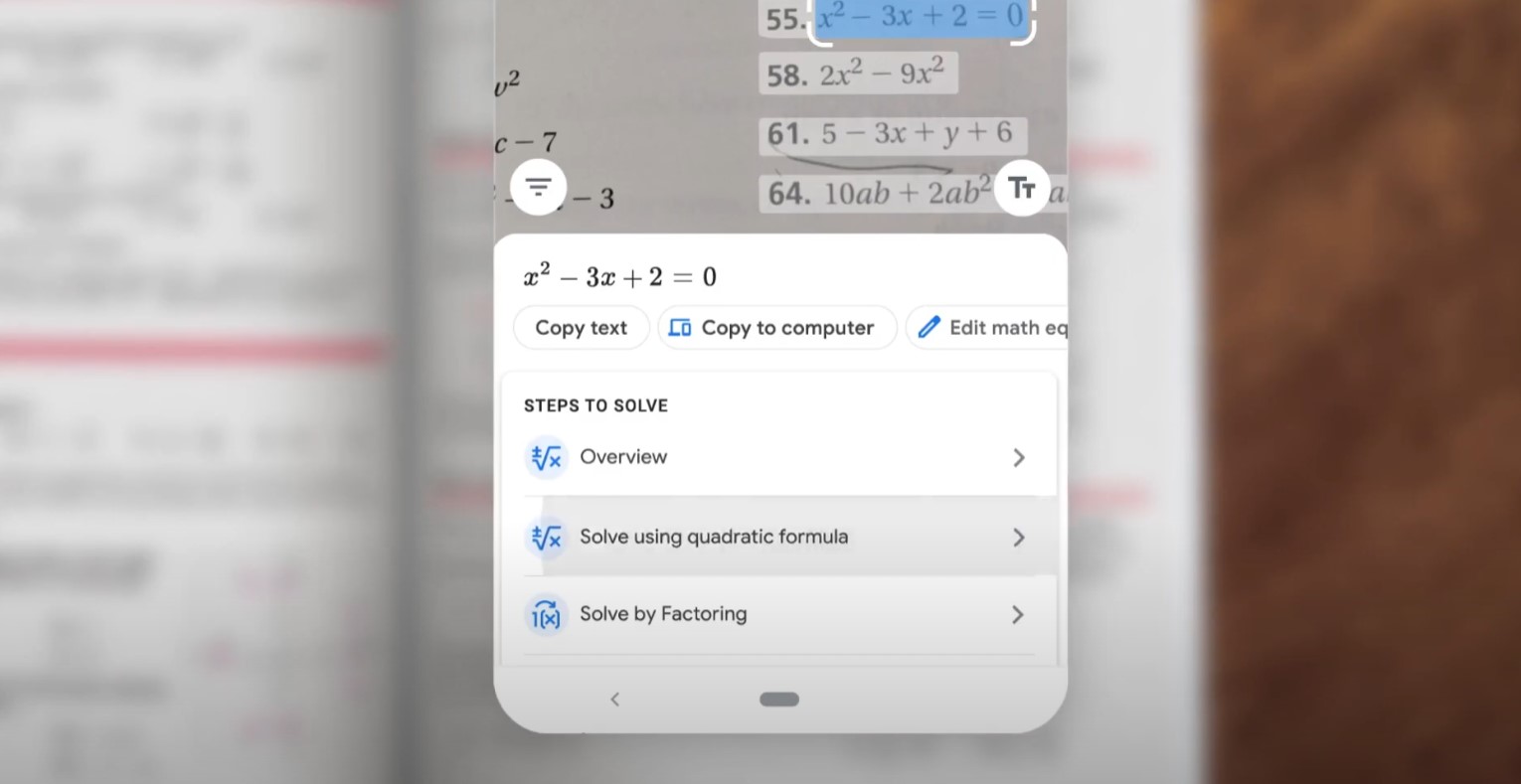
Other updates include an update to Google Lens that lets you ask the app to read out a passage from a photo of a book — no matter the language. Lens can now also understand math formulas — and then show you step-by-step guides and videos to solve it. This doesn’t just work for math, but also chemistry, biology and physics.

Image Credits: Google

Given that the holiday shopping season is coming up, it’s maybe no surprise that Google also launched a number of updates to its shopping services. Specifically, the company is launching a new feature in Chrome and the Google App where you can now long-tap on any image and then find related products. And for the fashion-challenged, the service will also show you related items that tend to show up in related images.

If you’re shopping for a car, you will now also be able to get an AR view so you can see what they look like in your driveway.

Image Credits: Google

In Google Maps, you will now also be able to point at a restaurant or other local business when you are using the AR walking directions to see their opening hours, for example.

Another new Maps feature is that Google will now also show live busyness information right on the map, so you don’t have to specifically search for a place to see how busy it currently is. That’s a useful feature in 2020.

Image Credits: Google

During the event (or really, video premiere, because this is 2020), which was set to the most calming of music, Google’s head of search, Prabhakar Raghavan, also noted that its 2019 BERT update to the natural language understanding part of its Search system is now used for almost every query and available in more languages, including Spanish, Portuguese, Hindi, Arabic, German and Amharic. That’s part of the more than 3,600 updates the company made to its search product in 2019.

All of these announcements are happening against the backdrop of various governments looking into Google’s business practices, so it’s probably no surprise that the event also put an emphasis on Google’s privacy practices and that Raghavan regularly talked about “open access” and that Google Search is free for everyone and everywhere, with ranking policies applied “fairly” to all websites. I’m sure Yelp and other Google competitors wouldn’t quite agree with this last assertion.

Small business payments and marketing startup Fivestars raises $52.5M

It’s a difficult time for small businesses — to put it mildly. And Fivestars CEO Victor Ho said that many of the big digital platforms aren’t really helping.

Ho argued that those platforms (whether they offer delivery services, user reviews or marketing tools) all have the same underlying model: “They seek to take over a small business’ customer base and then charge them a tax to start reaching those customers.”

Superficially, a company like Fivestars, which has created software to support small business payments and marketing, might not sound that different.

But Ho said that the startup actually takes the “opposite” approach, because Fivestars isn’t trying to build up a big “walled garden” of its own customers that businesses pay to access. Instead, businesses pay for the software, which they use to build a database of their own customers; they don’t have to pay to reach those customers.

“The incentives are more aligned,” he said.

Fivestars

Image Credits: Fivestars

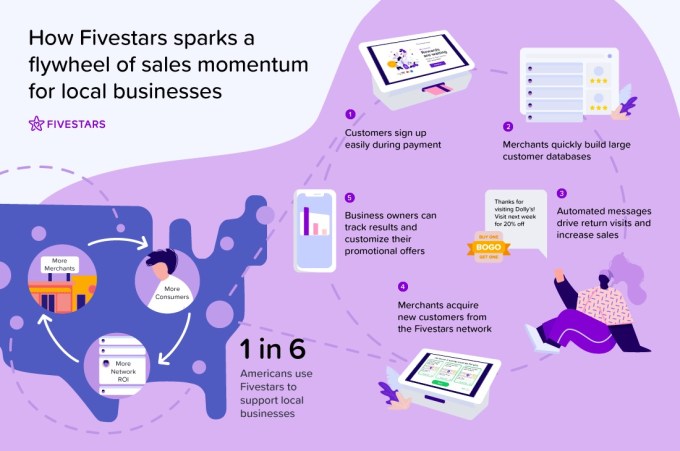
The Fivestars platform includes its own payment product, integration with other point-of-sale systems, marketing automation that delivers personalized messages to customers and a broader network of 60 million shoppers, allowing for cross-promotion across different Fivestars businesses.

The startup is announcing today that it has raised $52.5 million in new funding, combining a Series D equity round as well as debt and bringing its total funding to $145.5 million. The round was led by Salt Partners, with participation from Lightspeed Venture Partners, DCM Ventures, Menlo Ventures and HarbourVest Partners.

Ho said Fivestars actually closed the round before the COVID-19 pandemic, but the team decided to hold off on the announcement because it seemed like a bad idea to “flaunt” the company’s bank account when so many of its customers were suffering.

The company has seen “record usage” during the pandemic, with 1 million new shoppers joining the network every month. At the same time, Ho acknowledged that the pandemic has caused Fivestars to shift its strategy. Originally, the goal for the funding was “just to keep growing our portfolio of merchants across our existing products,” but he said, “What changed pretty dramatically through this period for us was emphasizing the payments piece and the network” and focusing on “what small businesses need more than ever.”

Ho also noted that during the pandemic, the company has provided customers with more than $1 million worth of credits and also made more of its products free to use.

“It’s very clear that small businesses are incredibly resilient,” he added. “Particularly when it comes to the category of experiences — you’re not going to take your wife on a date to Pizza Hut; when you go to Paris, you’re not going to go to generic chains.”

In the funding announcement, Natasha Teague of Fort Lauderdale health food store Tropibowls described the Fivestars platform as “a huge help.”

“The value of being able to communicate with our customers and share updates in real-time has been immeasurable,” Teague said in a statement. “The power of Fivestars’ expansive network and payment tech has made our reopening process seamless and a lifesaver as we navigate new needs as a result of the pandemic.”

When was the last time you worked out your soul?

Hello and welcome back to Equity, TechCrunch’s venture capital-focused podcast (now on Twitter!), where we unpack the numbers behind the headlines.

The whole crew was back today, with Natasha and Danny and I gathered to parse over what was really a blast of news. Lots of startups are raising. Lots of VCs are raising. And some unicorns are shooting to go public. It’s a lot to get through, but we’re here to catch you up.

Here’s what we got into:

And with that, we’re off until Monday morning. Chat soon, and stay safe.

Equity drops every Monday at 7:00 a.m. PDT and Thursday afternoon as fast as we can get it out, so subscribe to us on Apple PodcastsOvercastSpotify and all the casts.

Brighteye Ventures’ Alex Latsis talks European edtech funding in 2020

Brighteye Ventures, the European edtech venture capital firm, recently announced the $54 million first close of its second fund, bringing total assets under management above $112 million. Out of the new fund, the 2017-founded VC will invest in 15-20 companies over the next three years at the seed and Series A stage, writing checks up to $5 million.

Described as a thesis-driven fund investing in startups that “enhance learning” within the context of automation and other new technologies, coupled with changes in the way we live, Brighteye plans to disrupt the $7 trillion global education sector “as educators and students are adapting to distance learning en masse and millions of displaced workers are seeking to upskill,” according to a press release.

The firm’s investments to date include Ornikar, an online driving school in France and Spain serving more than 1.6 million students; Tandem, a Berlin-based peer-to-peer language learning platform with over 10 million members; and Epic!, a reading platform said to be used in more than 90% of U.S. schools.

To dig deeper into Brighteye’s thesis and the edtech sector more broadly, I caught up with managing partner Alex Latsis. We also discussed some of the findings in the firm’s recent European edtech funding report and how more venture capital than ever is set to flow into educational technology.

TechCrunch: Brighteye Ventures backs seed and Series A startups across Europe and North America that “enhance learning.” Can you elaborate a bit more on the fund’s remit, such as subsectors or specific technologies and what you look for in founders and startups at such an early stage?

Alex Latsis: We invest in startups that use technology to directly enable learning, skills acquisition or research as well as companies whose products address structural needs in the education sector. For example, Zen Educate addresses the systemic issue of teacher supply shortages in the U.K. via an on-demand platform that saves schools money whilst allowing educators to earn more. Litigate is an AI-driven coach and workflow tool improving results for legal associates, while Ironhack, the largest tech bootcamp in Europe and Latin America, gives young professionals the skills needed to enter the innovation economy and connects them to employers with a 90% job placement rate.

As education is a complex field we always seek to establish a degree of founder market fit, but more importantly that the founding teams themselves are a good fit internally. No startup succeeds on the merits of a founder alone, even if they may be driving the momentum.

In “The European EdTech Funding Report 2020,” you note that Europe is gaining momentum with a healthy increase in VC investments in local edtech startups. Specifically, you say that edtech VC investment has experienced 9.2x growth between 2014 and 2019 in terms of money invested. What is driving this and how does Europe compare to other major tech regions for edtech, such as Silicon Valley/U.S. or China?

Both Europe and the U.S. saw about 2% of venture capital invested in edtech in 2019. Growth in edtech investment in these markets to date has been driven largely by increased willingness to pay for training that is unavailable, unengaging or too expensive in legacy institutions and to a lesser extent by increased digital penetration in schools and universities that has enabled SaaS products to scale.

Given the rapid evolution of online education in the face of the pandemic, we expect funding for edtech will trend closer to 3%-5% of venture funding in the coming years on both sides of the Atlantic. This will mean billions in incremental investment, hundreds of new promising companies and incredible learning opportunities, particularly for those looking to upskill/reskill. In countries like India and China where school and university student populations are growing more rapidly, we expect 5%+ of VC funding to go into edtech as there is more growth in core demand.

Proterra, which makes big honkin’ battery systems and electric buses, raises $200 million

Proterra, the battery system technology developer for heavy-duty electric vehicles, said it has raised $200 million in a new round of funding.

The new cash comes from Cowen Sustainable Investment Advisors, which led the round, along with money from Soros Fund Management, Generation Investment Management and Broadscale Group.

Cowen took the bulk of the round, with $150 million, while Soros, Generation and Broadscale forked over the other $50 million.

This new capital infusion follows a year’s worth of speculation about a potential public offering for the big honkin’ battery systems developer. TechCrunch last reported in August 2019 that Proterra had hit a $1 billion valuation according to investors and would be seeking a potential IPO at the time.

The company said the new money would go to support the company’s ongoing research and development efforts into battery and electric drivetrain technologies and business development to increase the company’s footprint in additional commercial vehicle segments.

Proterra’s also looking at charging and energy management technology development to lower fleet management costs associated with operating electric fleets.

To date, Proterra has raised equity and debt totaling at least roughly $1 billion from investors including G2VP, Kleiner Perkins Caufield & Byers, Constellation Ventures, Mitsui & Co., as well as BMW i Ventures, Edison Energy, the Federal Transportation Administration, General Motors’s venture arm and Tao Capital Partners .

Proterra mainly makes buses for local, state and federal agencies that can travel 350 miles on a single charge. The Burlingame, California company, which has a number of former Tesla employees in leadership positions, including the company’s former chief executive Ryan Popple, has also diversified its business to provide its power trains to other heavy and medium-duty commercial electric vehicle manufacturers.

The company is now working with OEMs like Thomas Built Buses, Van Hool, FCCC, BusTech and Optimal-EV to bring to market 100% battery-electric vehicles powered by its technology, the company said in a statement.

“As demand grows for battery-electric vehicles and 100% zero-emission fleets, we are excited to collaborate with CSI as well as our other investors to accelerate the transition to clean, quiet transportation for all and deliver even more Proterra Powered vehicles around the world,” said Jack Allen, Proterra’s current chairman and chief executive.

BofA Securities acted as sole placement agent on this transaction.

Tesla’s decision to scrap its PR department could create a PR nightmare

Ayelet Noff
Contributor

Ayelet Noff is the founder and CEO of SlicedBrand, a top global PR agency headquartered in
Berlin.

A solid public relations team solves many issues within a company.

It helps spread important news announcements and topics integral to a company’s success. It communicates with the media in a timely manner to ensure accurate coverage and control the conversation. It builds a state of trust and engagement that propels a company’s vision and goals forward. Unless of course that company is Tesla, in which case it wants none of that.

According to numerous internal sources confirmed by automotive blog Electrik, Tesla has been slowly dissolving its internal PR department over the course of this year, leaving the sole voice of the company its founder, Elon Musk.

If true, this is a confounding decision by Musk and the decision-makers at Tesla.

What this creates for Tesla is a black hole of information coming from the company. Facts will be obfuscated if there is no official position on whatever happens in the news. For instance, consider the recent cases of self-driving collisions or a roof flying off a new car.

Or last month, when there was a major outage in Tesla vehicles, the press was left to speculate. There is no longer a PR department to reply to these incidents. It seems that Tesla has adopted a crisis management strategy that appears to think that the best course of action is to ignore future crises and they will just go away on their own. Unfortunately for Tesla, real life doesn’t work like that.

Cruise can now test driverless vehicles on the streets of San Francisco

Cruise, the self-driving car subsidiary of GM that also has backing from SoftBank Vision Fund, Honda and T. Rowe Price & Associates, has been issued a permit from California regulators that will allow it to test driverless vehicles on public roads in San Francisco.

The California DMV, the agency that regulates autonomous vehicle testing in the state, said the permit allows the company to test five autonomous vehicles without a driver behind the wheel on specified streets within San Francisco. Cruise has had a permit to test autonomous vehicles with safety drivers behind the wheel since 2015.

“We’re not the first company to receive this permit, but we’re going to be the first to put it to use on the streets of a major U.S. city,” Cruise CEO Dan Ammann wrote Thursday on the company’s blog. “Before the end of the year, we’ll be sending cars out onto the streets of SF — without gasoline and without anyone at the wheel. Because safely removing the driver is the true benchmark of a self-driving car, and because burning fossil fuels is no way to build the future of transportation.”

Ammann described the issuance of the driverless permit as a low-key but milestone moment for the company, which has been working on autonomous vehicle technology for six years.

“The drama of this might be hard to appreciate. All anyone will see is a car, silently driving by itself through the city. Not speeding. Not crashing. Just quietly cruising,” he wrote. “But even without a literal launch into the sky, this is our moonshot. And the chaotic, gritty streets of SF are our launchpad. This is where years of blood, sweat and tears have been poured out by everyone on the Cruise mission. And it’s where over two million miles of city testing will truly hit the road for the first time: An electric car, driving by itself, navigating one of the most difficult driving cities in the world.”

The driverless permit, which means no humans will be behind the wheel, comes with certain restrictions. The Cruise vehicles are designed to operate on roads with posted speed limits not exceeding 30 miles per hour, during all times of the day and night, but will not test during heavy fog or heavy rain, the DMV said. Any company applying for a driverless permit must provide evidence of insurance or a bond equal to $5 million, verify vehicles are capable of operating without a driver, meet federal Motor Vehicle Safety Standards or have an exemption from the National Highway Traffic Safety Administration, and be an SAE Level 4 or 5 vehicle.

Cruise is the fifth company to be issued the driverless permit in California. Waymo, AutoX, Nuro and Zoox also have driverless permits. Currently, 60 companies have an active permit to test autonomous vehicles with a safety driver, according to the DMV.

Nanoleaf adds large and small triangles to its revamped Shape product line

Nanoleaf launched the next generation of its light panels in July. Called Shape, this new product looks like the company’s original offering, but sports better connectors, a simpler mounting solution, and most importantly, these panels can work with different shapes.

Today, Nanoleaf announced triangle panels, which join the hexagon shape that launched in July.

This is the first product line from Nanoleaf that can use two different shapes at the same time. The triangles are available in large and small sizes, and feature all of the functions found on other Nanoleaf panels including mirroring a screen and syncing to music. The panels also support Google Assistant, Amazon Alexa, Apple Homekit and Samsung Smartthings.

Unlike past Nanoleaf products, the panels in the Shape line connect using a rigid connector that snaps into place. The mounting solution is also improved, allowing users to install panels without having to screw each panel to the wall.

Here’s what we concluded when reviewing the hexagon panels in the new Shape line.

The Nanoleaf Hexagons are a terrific addition to the Nanoleaf lineup, and I think they’re the model that’s mostly likely to appeal to a much broader customer base when compared to the company’s existing options. I personally didn’t expect to be that big a fan of Nanoleaf in general — I’d never been more than mildly interested in their offerings before. But as soon as I powered on the Hexagon, I was amazed at how much I felt like they improved the aesthetics of the space.

The complete kits cost $199 for the full-size triangles and $119 for the minitriangles. Expansion packs are $59 and $119, respectively.

Google will let everyone migrate from Hangouts to Chat for free in 2021

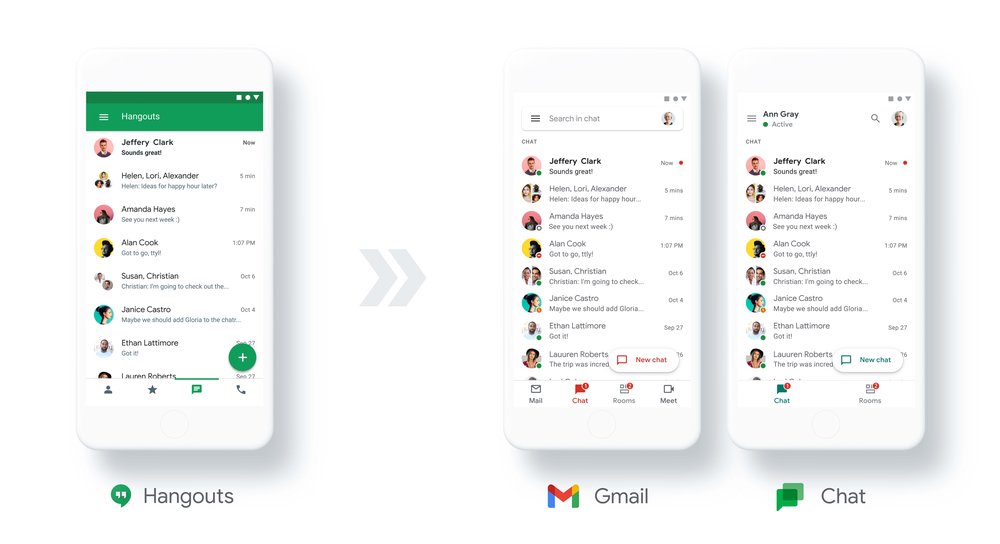
Google’s strategy around its messaging apps is nothing if not messy right now (hello Hangouts, Meet, Chat, Duo and Co.), but it looks like things will get a bit easier come next year. We already knew that Hangouts’ time was coming to an end and as Google announced today, the company will allow all current Hangouts users to migrate to Chat — which was originally meant to only be its Slack-like messaging service for business users — in the first half of 2021.

One interesting wrinkle here: Chat will now also become free to use for consumers. Currently, you have to be a paying G Suite/Workspace user to access the service (though somehow it’s enabled on my free personal account).

While Chat isn’t an exact 1-to-1 replacement of Hangouts, it actually offers a bunch of additional features for group chats and collaboration around files and tasks, as well as new security tools. Chat, together with Rooms and Meet, will also be integrated deeply into the Gmail app as part of Google’s Workspace migration.

Image Credits: Google

Google says it will automatically migrate all Hangouts conversations, contacts and history to Chat, but it’s not providing details about this yet. Final timing, Google says, may still shift. It’s not clear, though, when Google will force everyone to migrate and shut down the Hangouts servers for good.

There are a few more details here: If you use Hangouts with Google Fi, Hangouts support will go away “early next year.” Traditionally, Fi users were able to make calls and manage their text messages from Hangouts. That experience will migrate to Google’s Messages app.

If you’re a Google Voice user, there’s a similar transition happening. For voice calls and text messages, Hangouts users will now be directed to the Voice app, and early next year, your Voice support will be removed from Hangouts.

And for all users in the U.S. and Europe, the ability to call phones from Hangouts will disappear at the beginning of next year — and group video calls in Hangouts will transition to Meet in November.

Yeah — that all sounds complicated, but it’s a problem of Google’s own making. A few years ago, the idea was to move Hangouts users to its Allo and Duo apps and business users to Chat and Meet (or whatever they were called back then). Allo flopped (and few people use Duo), leaving Google with the unenviable task of keeping the aging Hangouts platform around for the foreseeable future and making the overall transition harder and more complicated, to the point where I’m not sure that consumers really understand what’s happening.


New Oxford machine learning-based COVID-19 test can provide results in under 5 minutes

Oxford scientists working out of the school’s Department of Physics have developed a new type of COVID-19 test that can detect SARS-CoV-2 with a high degree of accuracy, directly in samples taken from patients, using a machine learning-based approach that could help sidestep test supply limitations, and that also offers advantages when it comes to detecting actual virus particles, instead of antibodies or other signs of the presence of the virus which don’t necessarily correlate to an active, transmissible case.

The test created by the Oxford researchers also offer significant advantages in terms of speed, providing results in under five minutes, without any sample preparation required. That means it could be among the technologies that unlock mass testing — a crucial need not only for getting a handle on the current COVID-19 pandemic, but also on helping us deal with potential future global viral outbreaks, too. Oxford’s method is actually well-designed for that, too, since it can potentially be configured relatively easily to detect a number of viral threats.

The technology that makes this possible works by labeling any virus particles found in a sample collected by a patient using short, fluorescent DNA strands that act as markers. A microscope images the sample and the labeled viruses present, and then machine learning software takes over using algorithmic analysis developed by the team to automatically identify the virus, using differences that each one produces in terms of its fluorescent light emitted owing to their different physical surface makeup, size and individual chemical composition.

This technology, including the sample collection equipment, the microscopic imager and the flourescence insertion tools, as well as the compute capabilities, can be miniaturized to the point where it’s possible to be used just about anywhere, according to the researchers — including “businesses, music venues, airports” and more. The focus now is to create a spinout company for the purposes of commercializing the device in a format that integrates all the components together.

The researchers anticipate being able to form the company, and start product development by early next year, with the potential of having a device approved for use and ready for distribution around six months after that. It’s a tight timeline for development of a new diagnostic device, but timelines have changed already amply in the face of this pandemic, and will continue to do so as we’re unlikely to see it fade away anytime in the near future.

Why are VCs launching SPACs? Amish Jani of FirstMark shares his firm’s rationale

It’s happening slowly but surely. With every passing week, more venture firms are beginning to announce SPACs. The veritable blitz of SPACs formed by investor Chamath Palihapitiya notwithstanding, we’ve now seen a SPAC (or plans for a SPAC) revealed by Ribbit Capital, Lux Capital, the travel-focused venture firm Thayer Ventures, Tusk Ventures’s founder Bradley Tusk, the SoftBank Vision Fund, and FirstMark Capital, among others. Indeed, while many firms say they’re still in the information-gathering phase of what could become a sweeping new trend, others are diving in headfirst.

To better understand what’s happening out there, we talked on Friday with Amish Jani, the cofounder of FirstMark Capital in New York and the president of a new $360 million tech-focused blank-check company organized by Jani and his partner, Rick Heitzmann. We wanted to know why a venture firm that has historically focused on early-stage, privately held companies would be interested in public market investing, how Jani and Heitzmann will manage the regulatory requirements, and whether the firm may encounter conflicts of interest, among other things.

If you’re curious about starting a SPAC or investing in one or just want to understand how they relate to venture firms, we hope it’s useful reading. Our chat has been edited for length and clarity.

TC: Why SPACs right now? Is it fair to say it’s a shortcut to a hot public market, in a time when no one quite knows when the markets could shift?

AJ: There are a couple of different threads that are coming together. I think the first one is the the possibility that [SPACs] works and really well. [Our portfolio company] DraftKings [reverse-merged into a SPAC] and did a [private investment in public equity deal]; it was a fairly complicated transaction and they used this to go public and the stock has done incredibly well.

In parallel, [privately held companies] over the last five or six years could raise large sums of capital, and that was pushing out the the timeline [to going public] fairly substantially. [Now there are] tens of billions of dollars in value sitting in the private markets and [at the same time] an opportunity to go public and build trust with public shareholders and leverage the early tailwinds of growth.

TC: DraftKings was valued at $3 billion when it came out and it’s now valued at $17 billion, so it has performed really, really well. What makes an ideal target for a SPAC versus a traditional IPO? Does having a consumer-facing business help get public market investors excited? That seems the case.

AJ: It comes down to the nature and the growth characteristics and the sustainability of the business. The early businesses that are going out, as you point out, tend to be consumer based, but I think there’s as good an opportunity for enterprise software companies to use the SPAC to go public.

SPAC [targets] are very similar to what you would want in a traditional IPO: companies with large markets, extremely strong management teams, operating profiles that are attractive, and long term margin profiles that are sustainable, and to be able to articulate [all of that] and have the governance and infrastructure to operate in a public context. You need to be able to do that across any of these products that you use to get public.

TC: DraftKings CEO Jason Robins is an advisor on your SPAC. Why jump into sponsoring one of these yourselves?

AJ: When he was initially approached, we were, like most folks, pretty skeptical. But as the conversations evolved, and we began to understand the amount of customization and flexibility [a SPAC can offer], it felt very familiar. [Also] the whole point of backing entrepreneurs is they do things differently. They’re disruptive, they like to try different formats, and really innovate, and when we saw through the SPAC and the [actual merger] this complex transaction where you’re going through an M&A and raising capital alongside that and it’s all happening between an entrepreneur and a trusted partner, and they’ve coming to terms before even having to talk about all of these things very publicly, that felt like a really interesting avenue to create innovation.

For us, we’re lead partners and directors in the companies that we’re involved with; we start at the early stages at the seed [round] and Series A and work with these entrepreneurs for over a decade, and if we can step in with this product and innovate on behalf of our entrepreneurs and entrepreneurs in tech more broadly, we think there’s a really great opportunity to push forward the process for how companies get public.

TC: You raised $360 million for your SPAC. Who are its investors? Are the same institutional investors who invest in your venture fund? Are these hedge funds that are looking to deploy money and also potentially get their money out faster?

AJ: I think a bit of a misconception is this idea that most investors in the public markets want to be hot money or fast money. You know, there are a lot of investors that are interested in being part of a company’s journey and who’ve been frustrated because they’ve been frozen out of being able to access these companies as they’ve stayed private longe. So our investors are some are our [limited partners], but the vast majority are long-only funds, alternative investment managers, and people who are really excited about technology asa long term disrupter and want to be aligned with this next generation of iconic companies.

TC: How big a transaction are you looking to make with what you’ve raised?

AJ: The targets that we’re looking for are going to look very similar to the kind of dilution that a great company would take going public —  think of that 15%, plus or minus, around that envelope. As you do the math on that, you’re looking at a company that’s somewhere around $3 billion in value.  We’re going to have conversations with a lot of different folks who we know well, but that’s that’s generally what we’re looking for.

TC: Can you talk about your “promote,” meaning how the economics are going to work for your team?

AJ: Ours [terms] are very standard to the typical SPAC. We have 20% of the original founders shares. And that’s a very traditional structure as you think about venture funds and private equity firms and hedge funds: 20% is is very typical.

TC: It sounds like your SPAC might be one in a series.

AJ: Well, one step at a time. The job is to do this really well and focus on this task. And then we’ll see based on the reaction that we’re getting as we talk to targets and how the world evolves whether we do a second or third one.

TC: How involved would you be with the management of the merged company and if the answer is very, does that limit the number of companies that might want to reverse-merge into your SPAC?

AJ: The management teams of the companies that we will target will continue to run their businesses. When we talk about active involvement, it’s very much consistent with how we operate as a venture firm, [meaning] we’re a strong partner to the entrepreneur, we are a sounding board, we help them accelerate their businesses, we give them access to resources, and we leverage the FirstMark platform. When you go through the [merger], you look at what the existing board looks like, you look at our board and what we bring to bear there, and then you decide what makes the most sense going forward. And I think that’s going to be the approach that we take.

TC: Chamath Palihapitiya tweeted yesterday about a day when there could be so many VCs with SPACs that two board members from the same portfolio company might approach it to take it public. Does that sound like a plausible scenario and if so, what would you do?

AJ: That’s a really provocative and interesting idea and you could take that further and say, maybe they’ll form a syndicate of SPACs. The way I think about it is that competition is a good thing. It’s a great thing for entrepreneurship, it’s a good thing overall.

The market is actually really broad. I think there’s something like 700-plus private unicorns that are out there. And while there are a lot of headlines around the SPAC, if you think about technology-focused people with deep tech backgrounds, that pool gets very, very limited, very quickly. So we’re pretty excited about the ability to go have these conversations.

You can listen in on more of this conversation, including around liquidation issues and whether FirstMark will target its own portfolio companies or a broader group or targets, here.


Malaysian on-demand work platform GoGet lands $2 million Series A

GoGet, a Malaysian on-demand work platform, announced today that it has raised a $2 million Series A led by Monk’s Hill Ventures. The platform currently has 20,000 gig workers, who are called “GoGetters,” and has onboarded 5,000 businesses, including Lazada Malaysia, IKEA Malaysia, Foodpanda and flower delivery service BloomThis.

While Malaysia has other on-demand work platforms, including Supahands and Kaodim, each has its own niche. Supahands focuses on online tasks, while Kaodim offers professional services like home repairs, catering and fitness training. GoGet is more similar to TaskRabbit, with GoGetters performing errands or temp work like deliveries, moving large items, catering at events, data entry and office administration.

Chief executive officer and co-founder Francesca Chia founded GoGet in 2014. The startup decided to focus on gig workers because there is a labor gap in ASEAN (Association of Southeast Asian Nations) countries, she told TechCrunch.

“Today, the majority of ASEAN’s labor market are low- to middle-skilled, and the majority are not protected with job security, future career paths and financial services such as insurance and savings,” she said. “At the other end of the spectrum, over 70% of employment in ASEAN are from SMEs, who seek to scale without scaling full-time costs, and find it difficult to train and maintain a reliable pool of staff.”

GoGet wants to bridge the gap by connecting businesses with verified flexible workers, she added. GoGetters are able to switch between different categories of work, which Chia said gives the ability to learn new skills. Companies are provided with management features that include the ability to create a list of GoGetters they want to work with again and tools for recruiting, training and payment.

The Series A will be used to expand GoGet in Malaysia. One of the things many companies whose business models revolve around the gig economy need to grapple with as they scale include workers who are frustrated by uneven work, low pay and the lack of benefits they would receive as full-time employees. In California, for example, this has resulted in a political battle as companies like Uber, DoorDash and Lyft try to roll back legislation that would force them to classify more gig workers as full-time employees.

Chia said GoGet’s “vision is to bring flexible work to the world in a sustainable manner.” Part of this entails giving GoGet’s gig workers access to benefits like on-demand savings and insurance plans that are similar to what full-time employees receive. GoGet’s platform also has career-building features, including online trainings and networking tools, so workers can prepare for jobs that require different skill sets.

While GoGet’s short-term plan is to focus on growth in Malaysia, it eventually plans to enter other ASEAN countries, too.

In a press statement about the investment, Monk’s Hill Ventures co-founder and managing partner Kuo-Yi Lim said, “The nature of work is being redefined as companies and workers seek both flexibility and fit. This trend has been accelerated by the pandemic, as businesses are transforming in response and require more elastic workforce. GoGet provides a community of motivated and well-trained workers, but more importantly, its platform extends the corporate people management systems to ensure quality, compliance and seamless workflow.”

OnePlus co-founder Carl Pei leaves the company to start a new venture

Carl Pei, who co-founded the smartphone giant OnePlus in his 20s, has left the company, two sources familiar with the matter told TechCrunch.

Pei played an instrumental role in designing the OnePlus smartphone lineup over the years, including the recently launched OnePlus Nord, which has been the company’s biggest hit to date. Outside Shenzhen, China, where OnePlus is headquartered, Pei has also been the face of the Chinese firm, appearing at trade conferences, interacting with loyal customers and giving interviews to the media.

In the early years of OnePlus, Pei devised various marketing strategies for best positioning the company’s products and creating hype about them. In 2014 and 2015, when OnePlus struggled with scaling its inventories, the company sold its phones through invites and several other clever marketing techniques, including one in which people were required to destroy their current phones to buy a new OnePlus smartphone.

Also in the early years of the company, Pei lived almost exclusively in low-cost hotels in China and India to better understand the market and easily travel to new cities. OnePlus is now one of the most successful premium smartphone makers in India and several other markets.

“We didn’t have proper product management. What we lacked in experience, we made up in hours,” he said in an earlier interview. He talked more about the company’s early days and the state of the smartphone market at Disrupt 2019.

Once he publicly asked Samsung to hire him so that he could learn more about overseeing operations and logistics. “So, Samsung, today I have a proposal for you: let me be your intern. Seriously. I would be honored to learn from your team about how you’ve been able to scale, run, and manage your business so successfully,” he wrote on his personal blog.

Pei reached out to Pete Lau in 2012 through social media. The two started OnePlus a year later. “He said, ‘I want to change the world.’ I thought this kid has ambitious thoughts and dreams. I think it comes from the heart and it’s very important. I think he has tenacity,” Lau recalled in an interview in 2015.

Years before they started OnePlus, Pei collaborated with a friend and sold white-labeled MP3 players in China.

Pei, 31, is not joining Samsung, but has clarity on what he wishes to do next. He is starting his own venture, according to a person familiar with the matter. Pei did not respond to a request for comment early Monday.

OnePlus did not respond to a request for comment.