WIRED’s favorite dog gear, including a pet camera, fitness tracker, geofencing collar, camping bed, and leash.
Category: Tech news
hacking,system security,protection against hackers,tech-news,gadgets,gaming
America’s Poor Were Sick Before the Pandemic. Covid Made It Worse
An enormous new data set peers into the health of the world’s population before 2020—and how the coronavirus turned that into a global disaster.
Television Like ‘The Boys’ Is Destroying You
It’s not blowing your mind. It’s bludgeoning you with shock.
Do You Need a 5G iPhone? No, but You’re Getting One Anyway
This week, we discuss Apple’s new iPhone 12, from the inclusion of 5G in all four handsets, to the super-cute Mini model.
What Digital Doping Means for Esports—and Everything Else
If an elite cyclist can use performance-enhancing algorithms to cheat at a virtual race, who’s to say a doctor couldn’t cheat on a remote exam?
In the US, 50 States Could Mean 50 Vaccine Rollout Strategies
The CDC put out a central playbook for how to distribute the shots. But how states will address these guidelines is anything but uniform.
Google Pixel 5 Review: The Best Pixel Yet
By skipping all the quirky, Google-ly features of previous Pixels, the company’s latest phone is its most boring—and its best.
Sony’s $5,000 3D display (probably) isn’t for you
Sony just announced a $5,000 3D display, but odds are it’s probably not for you. Primarily known for its consumer goods, the company is targeting creative professionals with the Spatial Reality Display — more specifically, those working in fields like computer graphics and visual effects for films. Basically it’s a way for artists to view their 3D creations without having to wear a VR headset.
The company’s not the first to offer up this kind of technology for a fairly niche audience. The Looking Glass display is probably the best-known offering in the space up to this point. But unlike that massive 8K screen, Sony’s product is actually designed for a single user — specifically as a screen for their desktop PC. Also, it kind of looks like an Amazon Echo Show.

Image Credits: Sony
The big differentiator between the product and existing devices is the inclusion of a sensor that determines the user’s viewing position, including vertical and horizontal access, along with distance, and tailors the image to that specific angle, adjusting within the millisecond.
Sony says it’s a “highly-realistic, virtual environment.” It showed off an earlier version of the technology at CES this year, using a rendering of the Ecto-1 from the upcoming Ghostbusters sequel, and planned to give the press a demo of the final version of the screen, but we all had to settle for conference calls instead, because of the COVID-19 pandemic. For that reason, I can’t really speak to the efficacy of the 3D imaging as of this writing.
The company consulted with its Sony Pictures wing, which used the technology for the development of CG effects for the aforementioned Ghostbusters film. Volkswagen has also been involved since the project’s early stages, looking toward the technology’s potential use in the ideation and design processes.
For everyone else, the display goes up for sale through Sony next month.
FAA streamlines commercial launch rules to keep the rockets flying
The FAA has published its updated rules for commercial space launches and reentries, streamlining and modernizing the large and complicated set of regulations. With rockets launching in greater numbers and variety, and from more providers, it makes sense to get a bit of the red tape out of the way.
The rules provide for licensing of rocket launch operators and approval of individual launches and reentry plans, among other things. As you can imagine, such rules must be complex in the first place, more so when they’ve been assembled piecemeal for years to accommodate a quickly moving industry.
U.S. Transportation Secretary Elaine Chao called the revisions a “historic, comprehensive update.” They consolidate four sets of regulations and unify licensing and safety rules under a single umbrella, while allowing flexibility for different types of operators or operations.
According to a press release from the FAA, the new rules allow:
- A single operator’s license that can be used to support multiple launches or reentries from potentially multiple launch site locations.
- Early review when applicants submit portions of their license application incrementally.
- Applicants to negotiate mutually agreeable reduced time frames for submittals and application review periods.
- Applicants to apply for a safety element approval with a license application, instead of needing to submit a separate application.
- Additional flexibility on how to demonstrate high consequence event protection.
- Neighboring operations personnel to stay during launch or reentry in certain circumstances.
- Ground safety oversight to be scoped to better fit the safety risks and reduce duplicative requirements when operating at a federal site.
In speaking with leaders in the commercial space industry, a common theme is the burden of regulation. Any reform that simplifies and unifies will likely be welcomed by the community.
The actual regulations are hundreds of pages long, so it’s still hardly a simple task to get a license and start launching rockets. But at least it isn’t several sets of 500-page documents that you have to accommodate simultaneously.
The new rules have been submitted for entry in the Federal Register, and will take effect 90 days after that happens. In addition, the FAA will be putting out Advisory Circulars for public comment — additions and elaborations on the rules that the agency says there may be as many as two dozen of in the next year. You can keep up with those here.
Twitter is investigating widespread outage reports
If you’re reading this, you probably didn’t get here from Twitter . The service has been experiencing widespread reports of outages for at least an hour. The issue has impacted a range of different activities on the site, ranging from newsfeeds to the ability to tweet. The company has acknowledged the ongoing problem, noting on its official status page that it is investigating things:
Update – We are continuing to monitor as our teams investigate. More updates to come.
Oct 15, 22:31 UTC
Investigating – We are currently investigating this issue. More updates to come.
Oct 15, 21:56 UTC
Twitter responded to our request for comment, stating, “We know people are having trouble Tweeting and using Twitter. We’re working to fix this issue as quickly as possible. We’ll share more when we have it and Tweet from @TwitterSupport when we can – stay tuned.”
We’ll update as we hear more.
B&O’s BeoPlay H4 headphones offer great looks and comfort, but no noise canceling
It’s easy to be smitten with the H4 at first sight. They’re a great-looking pair of headphones — one of the best I’ve seen. They sport a simple, streamlined design that feels both like an homage to older models, but modern enough to avoid the nostalgia trap.
They’re comfortable, too. Like crazy comfortable. I say this as someone who is prone to dull earaches after wearing most models of over-ear headphones for an extended period. Since Bang & Olufsen sent me a pair to test a while pack, I’ve been wearing them for hours on end, prepping for a write-up during Work From Home Week.
The headphones sport an abundance of padding on the rim of their perfectly round cups. My ears sit snuggly inside, with none of the padding pressing on the ear — something that’s often a source of pressure after extended wears. They’re fairly lightweight — that helps. At 8.3 ounces they fall in between the Bose QuietComfort 35 II (8.2 ounces) and Sony WH-1000XM4 (8.96 ounces).
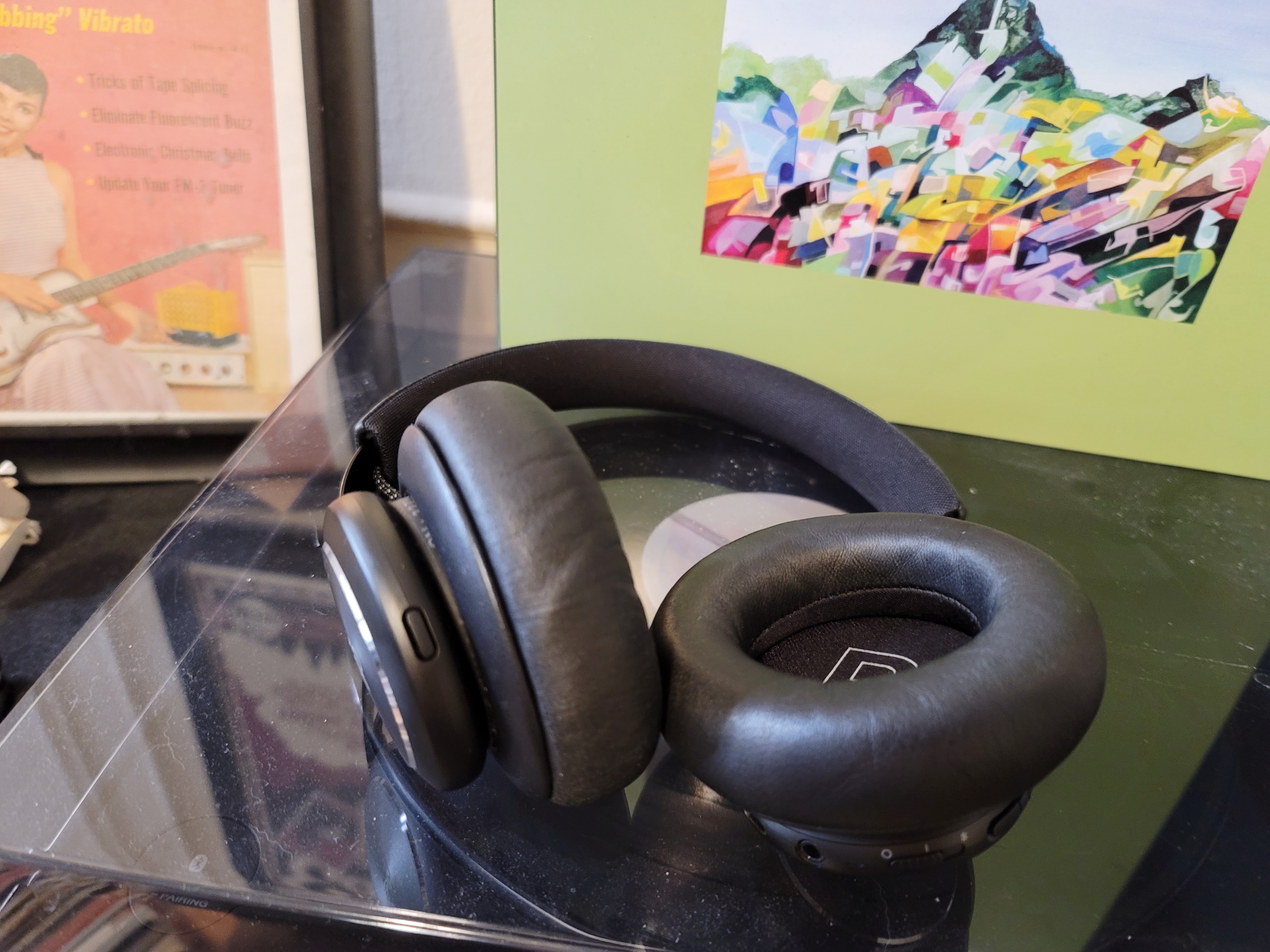
Image Credits: Brian Heater
The cups are covered in leather — either matte black or limestone (kind of a cream) — coupled with a large brushed metal plate sporting the B&O logo. It complements the concentric circles. The right cup sports a volume rocker, power/pairing switch and a port for an auxiliary cable. The ear cups sport a nice, smooth swivel that should work well with a variety of different head sizes.
The sound is good. It’s nice and full — though B&O leans a bit too heavily on the bass for some tests. They’re not quite as egregious as other units, but it’s very noticeable, particularly with traditionally bass-heavy genres like hip-hop. If you’re looking for fuller, more true-to-life music replication, you’re going to want to look elsewhere.
The absence of active noise canceling is a pretty big blind spot for a pair of $300 headphones in 2020. Even if you think you don’t need the feature, trust me, there are plenty of times you’ll be glad you have it. Take my working from home adventures over the past six months: They just started construction directly outside of my window, and it’s the worst. The Bluetooth, too, is decent, but walking around my apartment, I found them quicker to cut out than, say, the Sonys.

Image Credits: Brian Heater
There are units with longer battery life, too. Given that the H4’s are collapsible and don’t have ANC, though, I’m guessing the company isn’t really targeting frequent fliers here. With a rated battery life of up to 19 hours, though, they’ll get you through a day of home use, no problem.

Daily Crunch: Stripe acquires Nigeria’s Paystack
Stripe makes a big acquisition, Google rolls out search improvements and Snapchat adds a TikTok-y feature. This is your Daily Crunch for October 15, 2020.
The big story: Stripe acquires Nigeria’s Paystack
Stripe has made its biggest acquisition to date. It announced today that it bought Paystack, a Lagos-headquartered startup that makes it easy to integrate payment services — we’ve referred to it in the past as “the Stripe of Africa.”
Sources tell us that the acquisition price was more than $200 million.
In an interview with TechCrunch, Stripe CEO Patrick Collison said that expanding into Africa presents the company with “an enormous opportunity,” adding that Stripe is planning for “a longer time horizon” than most other companies: “We are thinking of what the world will look like in 2040-2050.”
The tech giants
Google launches a slew of Search updates — These new AI-focused improvements include the ability to better answer questions with very specific answers, as well as a new algorithm to better handle the typos in your queries.
Snapchat launches its TikTok rival, Sounds on Snapchat — Snapchat made good on its promise to release a new feature that would allow users to set their Snaps to music.
Mario Kart Live: Home Circuit review — Bryce Durbin offers an illustrated look at a new edition of Mario Kart that incorporates a real remote-controlled car.
Startups, funding and venture capital
River, the latest venture from Wander founder Jeremy Fisher, launches with $10.4M in funding — River is meant to rethink the way we consume content across the internet.
Small business payments and marketing startup Fivestars raises $52.5M — It’s a difficult time for small businesses, and Fivestars CEO Victor Ho said that many of the big digital platforms aren’t helping.
Bipedal robot developer Agility announces $20M raise — Agility’s Digit is a package delivery robot capable of navigating stairs and other terrain.
Advice and analysis from Extra Crunch
News that Calm seeks more funding at a higher valuation is not transcendental thinking — We rewind the clock and review data from 2018, 2019 and 2020 about the meditation app.
Brighteye Ventures’ Alex Latsis talks European edtech funding in 2020 — European edtech firm Brighteye Ventures recently announced the $54 million first close of its second fund.
Tesla’s decision to scrap its PR department could create a PR nightmare — The move effectively makes founder Elon Musk the company’s lone voice.
(Reminder: Extra Crunch is our subscription membership program, which aims to democratize information about startups. You can sign up here.)
Everything else
New Oxford machine learning-based COVID-19 test can provide results in under 5 minutes — The test also offers advantages when it comes to detecting actual virus particles, instead of antibodies or other signs of the presence of the virus.
When was the last time you worked out your soul? — Another discussion of wellness startup funding, this time via the latest episode of the Equity podcast.
The Daily Crunch is TechCrunch’s roundup of our biggest and most important stories. If you’d like to get this delivered to your inbox every day at around 3pm Pacific, you can subscribe here.

Startup founders set up hacker homes to recreate Silicon Valley synergy
In Y Combinator’s early days, founders would move to Palo Alto, split a two-bedroom with five others to save money and trade notes around the clock with their new, like-minded roommates.
Now, as remote work continues and the pandemic persists, scores of entrepreneurs are working from home around the world. Y Combinator isn’t requiring its recent cohorts to relocate and collaboration is a screen-to-screen affair.
Now that they can work from literally anywhere, many entrepreneurs are forming homes with other founders. Hacker homes, the newest iteration of remote work adaption, feels like a nostalgic attempt to recreate some of the synergies COVID-19 wiped out. Generally speaking, it’s a nod to the digital nomad lifestyle, but in some cases, hacker homes feel closer to Hype House, a TikTok mansion laden with sponsored indulgence and wealth.
For Greg Isenberg, a growth advisor to TikTok and former head of strategy at WeWork, entrepreneur homes are a signal of what the foreseeable future of building could look like.
“The type of vibe you used to get from Y Combinator just doesn’t exist anymore,” Isenberg said, as these houses could recreate some of the scrappiness and like-mindedness that defined the incubator’s early days.
While some see founder communes as vehicles for creating a more level playing field, critics say the model perpetuates Silicon Valley cultural constructs that favor white men.
In other words, sometimes there’s a cost to after-work happy hours making a comeback.
Product Hunt, and then TikTok
Michael Houck, a former product manager at Airbnb and Uber, rented a home in Tulum, Mexico in May 2020. He put $21,000 of non-refundable money on his credit card and invited friends and people he met on the internet before hopping on a plane. Anyone who came had to be okay with a few rules: you must pay rent, launch projects and you have to be okay with building your company in public.
In all, 18 entrepreneurs, including Houck, formed The Launch House. Residents include former startup fellowship participants from On Deck, product managers and solo entrepreneurs. On the plane ride over, house founder Brett Goldstein launched its first tool.

Habitants of the Launch House use the pool for recreation and brainstorm sessions, called “pool-storms.” Image Credits: The Launch House
“How do you actually launch a consumer product? You need wide reach, influence, community and media properties all together,” Goldstein said. “I wouldn’t say we’re the next Y Combinator, but the next YC would look something like that.”
In just a few weeks, The Launch House has produced nine products, including a discovery platform for the best OnlyFans accounts, an anonymous Twitter bot that sends positive comments and tools that enhance newsletter and email reading experiences.
Launch House members described a strong focus on inclusion when populating future homes and just opened up the application process for Launch House 2. One way the house is trying to give access to other people is by open-sourcing information and projects that residents build together.
The website has a Launch Library where builders can submit their email addresses to access resources on how to build anything from a podcast to a clothing brand to a community.
“There’s this sort of veil of mystique that surrounds a lot of entrepreneurs and founders,” Goldstein said. “The curtain has been lifted, and now you can get a social media perspective, and inside look at what it takes to start and launch a company.”
Now, more than 1,500 people are on the Launch House waitlist. Multiple investors have approached the group to sponsor internal and external events and some companies have even asked for the right to do product placements.
The concept has surely brought in an audience, and copycats: an unaffiliated group called The Rocketship House posted a trailer on Twitter in October:
Welcome to
. pic.twitter.com/tnp9MQ03V7
—

When reached via e-mail, organizers of Rocketship House declined to answer specific questions about the launch, or as they put it, “blast off.” The group confirmed that it is funded by a few unnamed large investors based in Beverly Hills, and includes a mix of marketers and influencers that invest in social media. It is currently accepting applications, drawing itself as similar to a TikTok mansion.
“Similar to Sway House [a residence for TikTok personalities], we will be making fun and dramatic dope bro content, centered around launching startups. We all live exciting lives, and there’s plenty of drama, so we’re excited to showcase that,” the e-mail from Rocketship House read.
Not all entrepreneur homes are following suit in terms of strategy, for more reasons than one.
Duplex, Google’s conversational AI, has updated 3M+ business listings since pandemic
Google today offered an update on the status of Duplex, its AI technology that uses natural conversations to get things done — like making restaurant reservations, booking appointments or updating a Google Business listing, for example. When the pandemic began, Google expanded its use of Duplex for business updates to eight countries, and has since made more than 3 million updates to business listings — including pharmacies, restaurants and grocery stores.
These updates have been seen over 20 billion times across Maps and Search, the company says.
The AI technology, first introduced at the Google I/O developer conference in 2018, is able to place calls to businesses and interact with the people who answer the phone. In the case of reservations or appointment setting, it can request dates and times, respond to questions and even make sounds to make the AI seem more like a person. For instance, it can insert subtle vocal breaks, like “mm-hm” and “um,” into its conversations.
Since launching, Duplex in Google Assistant has completed over a million bookings, Google announced today.
The company also noted it began to use Duplex to automatically update business information on Google Maps and Search in the U.S. last year, saving business owners from having to manually update details like store hours, or whether they offer takeout, among other things.
Last year, Google also brought Duplex to the web in the U.S., to help users book things like movie tickets and rental cars. Today, Google says it will begin piloting the same experience with other things, like shopping and ordering food for a faster checkout experience.
Just a few weeks ago, Google also introduced another Duplex-powered feature, “Hold for Me,” which lets you use Google Assistant to wait on hold on your phone call, then alert you when someone joins the line.
Thanks to advances in neural speech recognition and synthesis, and in Google’s own new language understanding models, the company says today that 99% of Duplex calls are entirely automated.
The Duplex update was one of several announcements Google made today at its Search On 2020 event, where it introduced a number of search improvements, including the ability to search for songs by humming, better guess at misspellings, point users to the correct part of a page to answer their question, tag key moments in videos and more.
With ‘absurd’ timing, FCC announces intention to revisit Section 230
FCC Chairman Ajit Pai has announced his intention to pursue a reform of Section 230 of the Communications Act, which among other things limits the liability of internet platforms for content they host. Commissioner Rosenworcel described the timing — immediately after Conservative outrage at Twitter and Facebook limiting the reach of an article relating to Hunter Biden — as “absurd.” But it’s not necessarily the crackdown the Trump administration clearly desires.
In a statement, Chairman Pai explained that “members of all three branches of the federal government have expressed serious concerns about the prevailing interpretation of the immunity set forth in Section 230,” and that there is broad support for changing the law — in fact there are already several bills under consideration that would do so.
At issue is the legal protections for platforms when they decide which content to allow and which to block. Some say they are clearly protected by the First Amendment (this is how it is currently interpreted), while others assert that some of those choices amount to violations of users’ right to free speech.
Though Pai does not mention specific recent circumstances in which internet platforms have been accused of having partisan bias in one direction or the other, it is difficult to imagine they — and the constant refrain from Trump demanding the “repeal” of 230, which is part of a large and important set of laws — did not factor into the decision.
A long road with an ‘unfortunate detour’
In fact the push to reform Section 230 has been progressing for years, with the limitations of the law and the FCC’s interpretation of its pertinent duties discussed candidly by the very people who wrote the original bill and thus have considerable insight into its intentions and shortcomings.
In June Commissioner Starks disparaged pressure from the White House to revisit the FCC’s interpretation of the law, saying that the First Amendment protections are clear and that Trump’s executive order “seems inconsistent with those core principles.” That said, he proposed that the FCC take the request to reconsider the law seriously.
“And if, as I suspect it ultimately will, the petition fails at a legal question of authority,” he said at the time, “I think we should say it loud and clear, and close the book on this unfortunate detour. Let us avoid an upcoming election season that can use a pending proceeding to, in my estimation, intimidate private parties.”
The latter part of his warning seems especially prescient given the choice by the Chairman to open proceedings less than three weeks before the election, and the day after Twitter and Facebook exercised their authority as private platforms to restrict the distribution of articles which, as Twitter belatedly explained, clearly broke guidelines on publishing private information. (The New York Post article had screenshots of unredacted documents with what appeared to be Hunter Biden’s personal email and phone number, among other things.)
“This is exactly what I didn’t want to happen,” Commissioner Starks told TechCrunch. “We should have both acted quickly and rejected the NTIA petition. Now voting has already started, the president is trying to work the refs, and this press release will look to many people like an attempt to help him.”
Commissioner Rosenworcel did not mince words, saying “The timing of this effort is absurd. The FCC has no business being the president’s speech police.”
Considering the timing and the utter impossibility of reaching any kind of meaningful conclusion before the election — rulemaking is at a minimum a months-long process — it is hard to see Pai’s announcement as anything but a pointed warning to internet platforms. Platforms which, it must be stressed, the FCC has essentially no regulatory powers over.
Foregone conclusion
The Chairman telegraphed his desired outcome clearly in the announcement, saying “Many advance an overly broad interpretation that in some cases shields social media companies from consumer protection laws in a way that has no basis in the text of Section 230… Social media companies have a First Amendment right to free speech. But they do not have a First Amendment right to a special immunity denied to other media outlets, such as newspapers and broadcasters.”
Whether the FCC has anything to do with regulating how these companies exercise that right remains to be seen, but it’s clear that Pai thinks the agency should, and doesn’t. With the makeup of the FCC currently 3:2 in favor of the Conservative faction, it may be said that this rulemaking is a forgone conclusion; the net neutrality debacle showed that these Commissioners are willing to ignore and twist facts in order to justify the end they choose, and there’s no reason to think this rulemaking will be any different.
The process will be just as drawn out and public as previous ones, however, which means that a cavalcade of comments may yet again indicate that the FCC ignores public opinion, experts and lawmakers alike in its decision to invent or eliminate its roles as it sees fit. Be ready to share your feedback with the FCC, but no need to fire up the outrage just yet — chances are this rulemaking won’t even exist in draft form until after the election, at which point there may be something of a change in the urgency of this effort to reinterpret the law to the White House’s liking.